




Agile Reorgs:
A Survival Guide
KATY SAULPAUGH, PRACTICE LEAD
TABLE OF CONTENTS
1 THE DILEMMAAROUND REORGS
2 HOW TO PERCEIVE LOSS AND CHANGE
3 SURVIVAL TIP 1: PREPARATION
4 SURVIVAL TIP 2: EMPOWERMENT
5 SURVIVAL TIP 3: RESILIENCE
THE DILEMMA
TO REORG OR NOT TO REORG
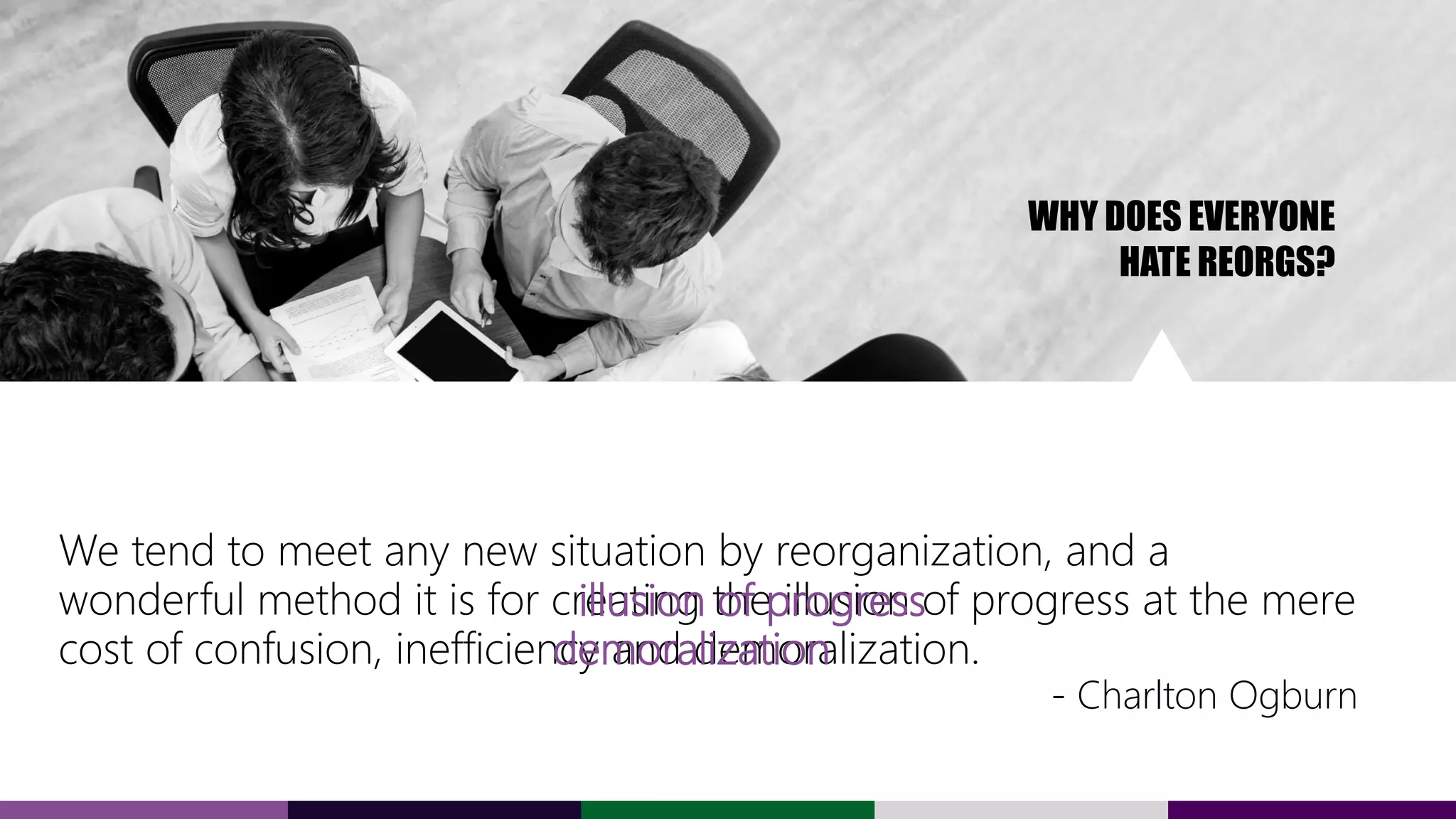
We tend to meet any new situation by reorganization, and a
wonderful method it is for creating the illusion of progress at the mere
cost of confusion, inefficiency and demoralization.
- Charlton Ogburn
WHY DOES EVERYONE
HATE REORGS?
illusion of progress
demoralization
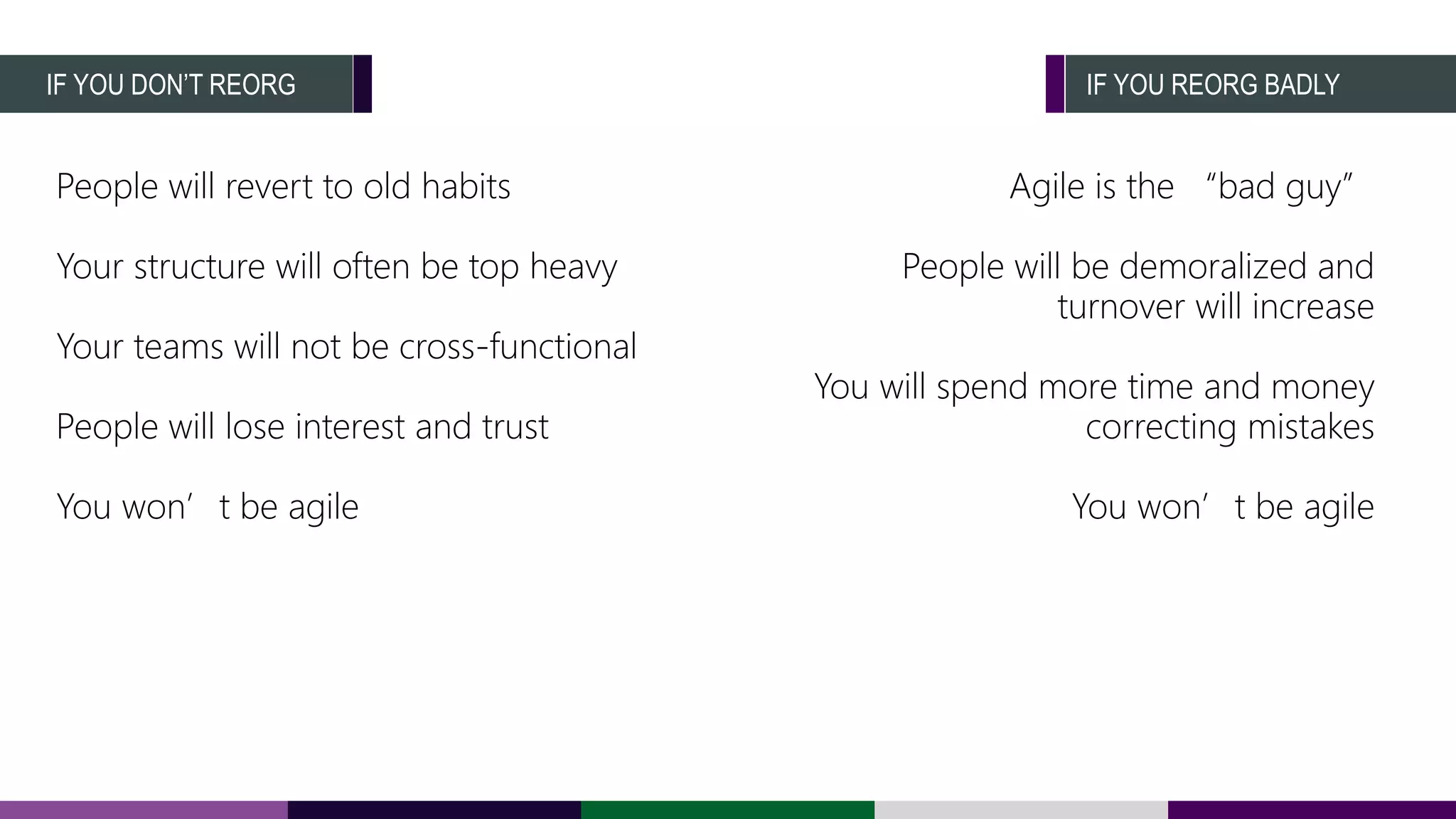
IF YOU DON’T REORG
People will revert to old habits
Your structure will often be top heavy
Your teams will not be cross-functional
People will lose interest and trust
You won’t be agile
IF YOU REORG BADLY
Agile is the “bad guy”
People will be demoralized and
turnover will increase
You will spend more time and money
correcting mistakes
You won’t be agile
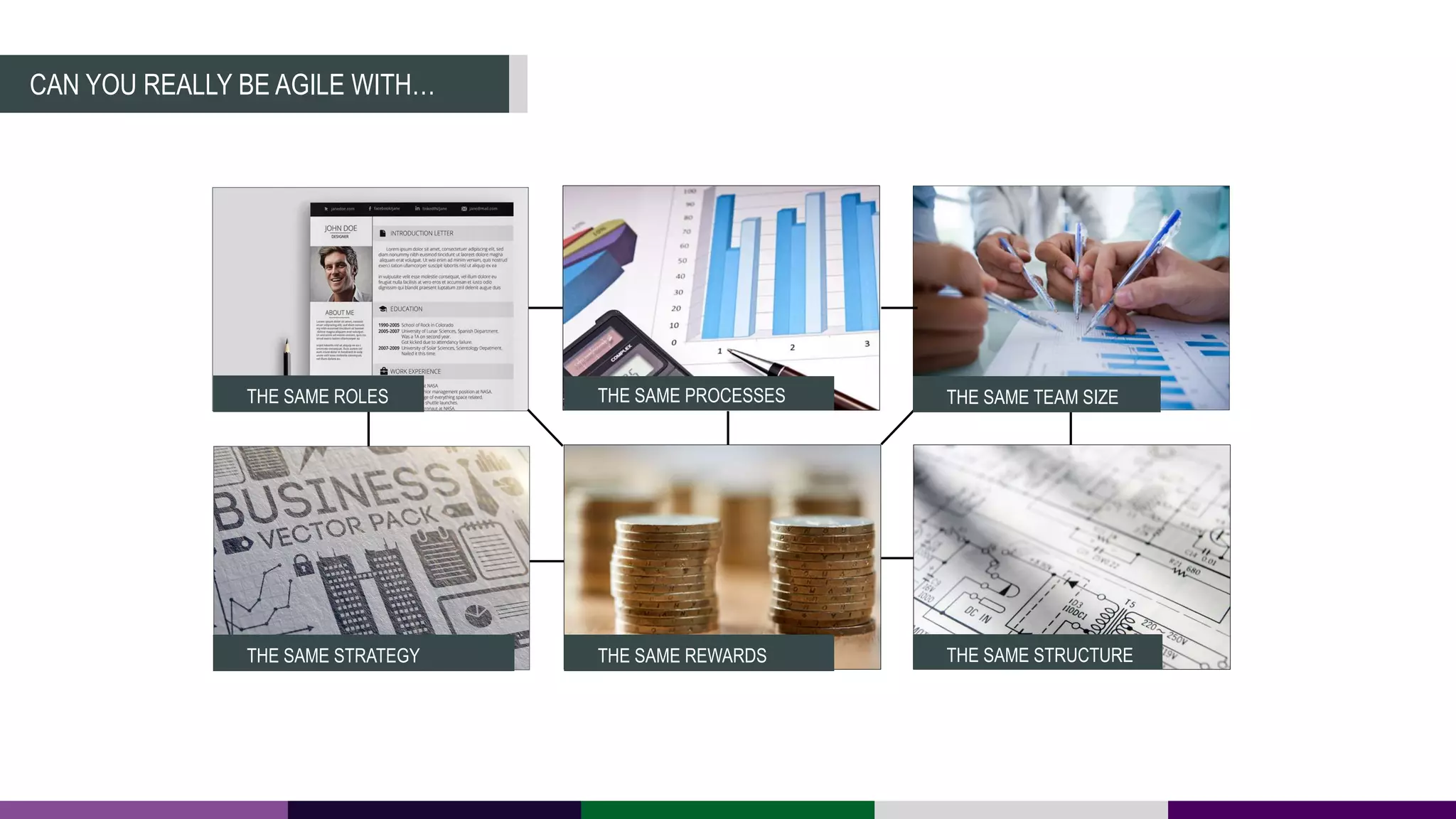
CAN YOU REALLY BE AGILE WITH…
THE SAME ROLES
THE SAME STRATEGY THE SAME REWARDS
THE SAME PROCESSES THE SAME TEAM SIZE
THE SAME STRUCTURE
REORG RULES
1. Move to a new table or row
2. You may not sit next to
someone you know
3. Introduce yourself to your new
neighbors
PERCEPTIONS OF CHANGE
HELPING OTHERS DEAL WITH LOSS
1. DENIAL 2. ANGER 3. BARGAINING 4. DEPRESSION 5. ACCEPTANCE
AMBIGUOUS LOSS AND CHANGE
“There is no such thing as closure – we have to
live with loss, clear or ambiguous, and it’s okay.”
– Pauline Boss
Translation: people don’t have to “get over” the
change, because change will never be “over.”
But they don’t have to fixate on it either.
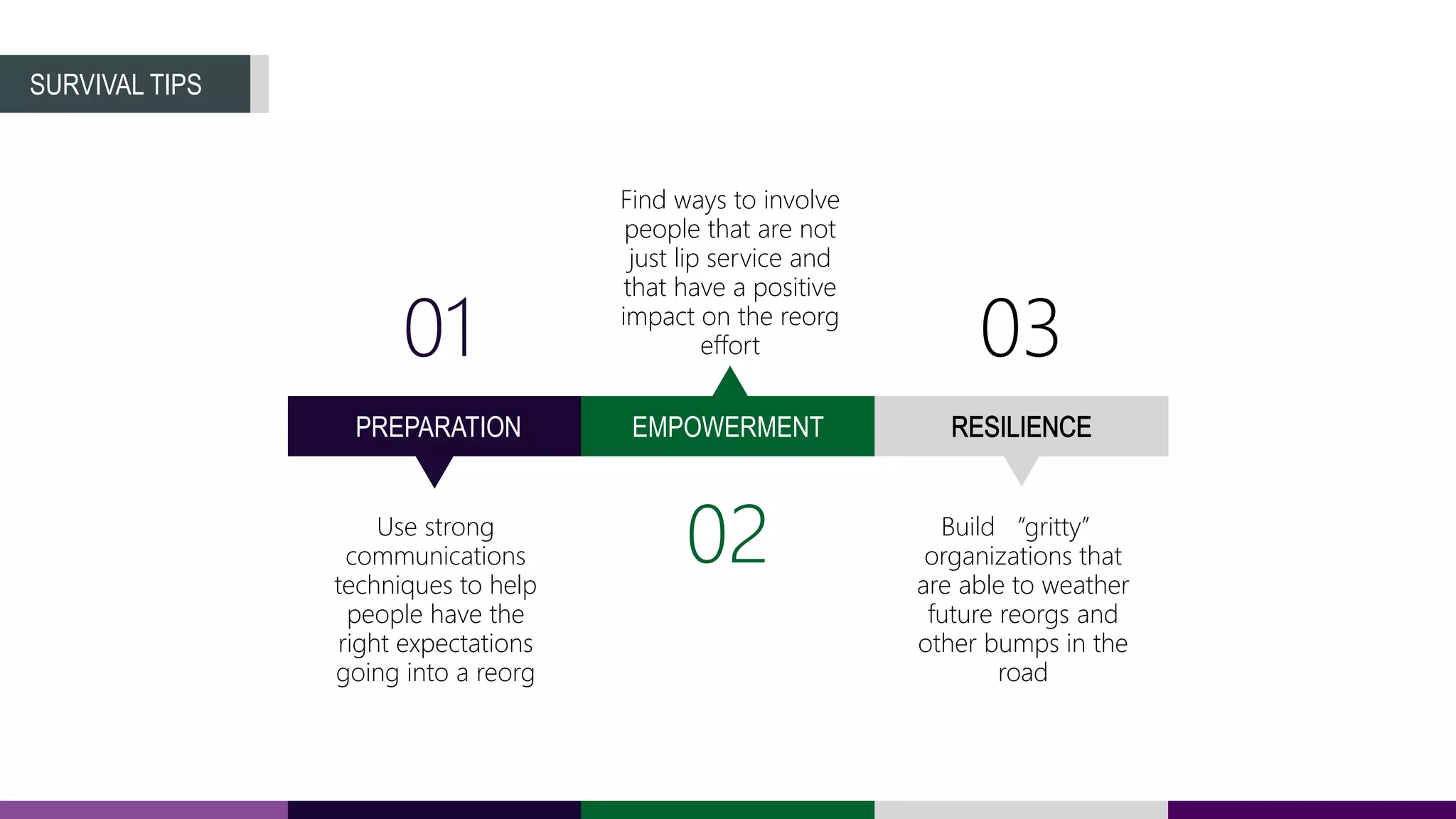
SURVIVAL TIPS
PATIENCE PREPARATION EMPOWERMENT CONCLUSION
01
02
03
Use strong
communications
techniques to help
people have the
right expectations
going into a reorg
Build “gritty”
organizations that
are able to weather
future reorgs and
other bumps in the
road
Find ways to involve
people that are not
just lip service and
that have a positive
impact on the reorg
effort
SURVIVAL TIP 1
PREPARING WITH THE RIGHT EXPECTATIONS
BUSINESS VALUE OF AGILE
WE NEED TO REORG TO…
RELEASE PRODUCTS MORE OFTEN
MAKE COLLABORATION WITH CUSTOMERS EASIER
BECOME MORE EFFICIENT IN OUR PROCESSES
EMPOWER TEAMS TO MAKE MORE DECISIONS
Find out how people
process information in
your organization
Saying you don’t know
is OK and is much
better than saying
nothing
Figure out the best way
to push and pull
information
Don’t make the agile
coach always deliver
the message
The scarier the change,
the more frequent the
communications
SURVIVAL TIP 2
FINDING A SENSE OF EMPOWERMENT
EMPOWERING TEAMS
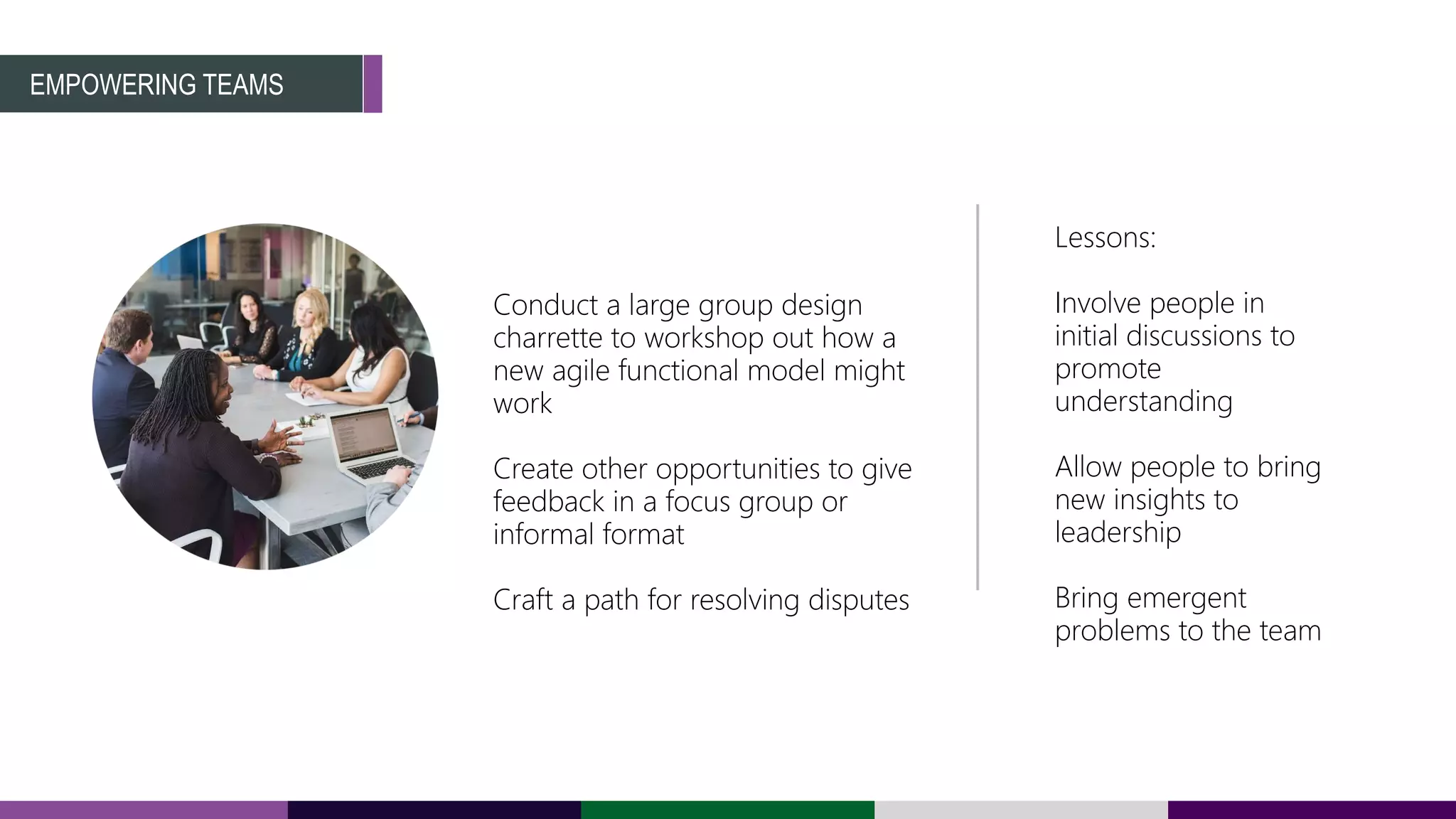
Conduct a large group design
charrette to workshop out how a
new agile functional model might
work
Create other opportunities to give
feedback in a focus group or
informal format
Craft a path for resolving disputes
Lessons:
Involve people in
initial discussions to
promote
understanding
Allow people to bring
new insights to
leadership
Bring emergent
problems to the team
SURVIVAL TIP 3
BUILDING RESILIENCE TO CHANGE
THE FUTURE NEED FOR AGILE REORGS
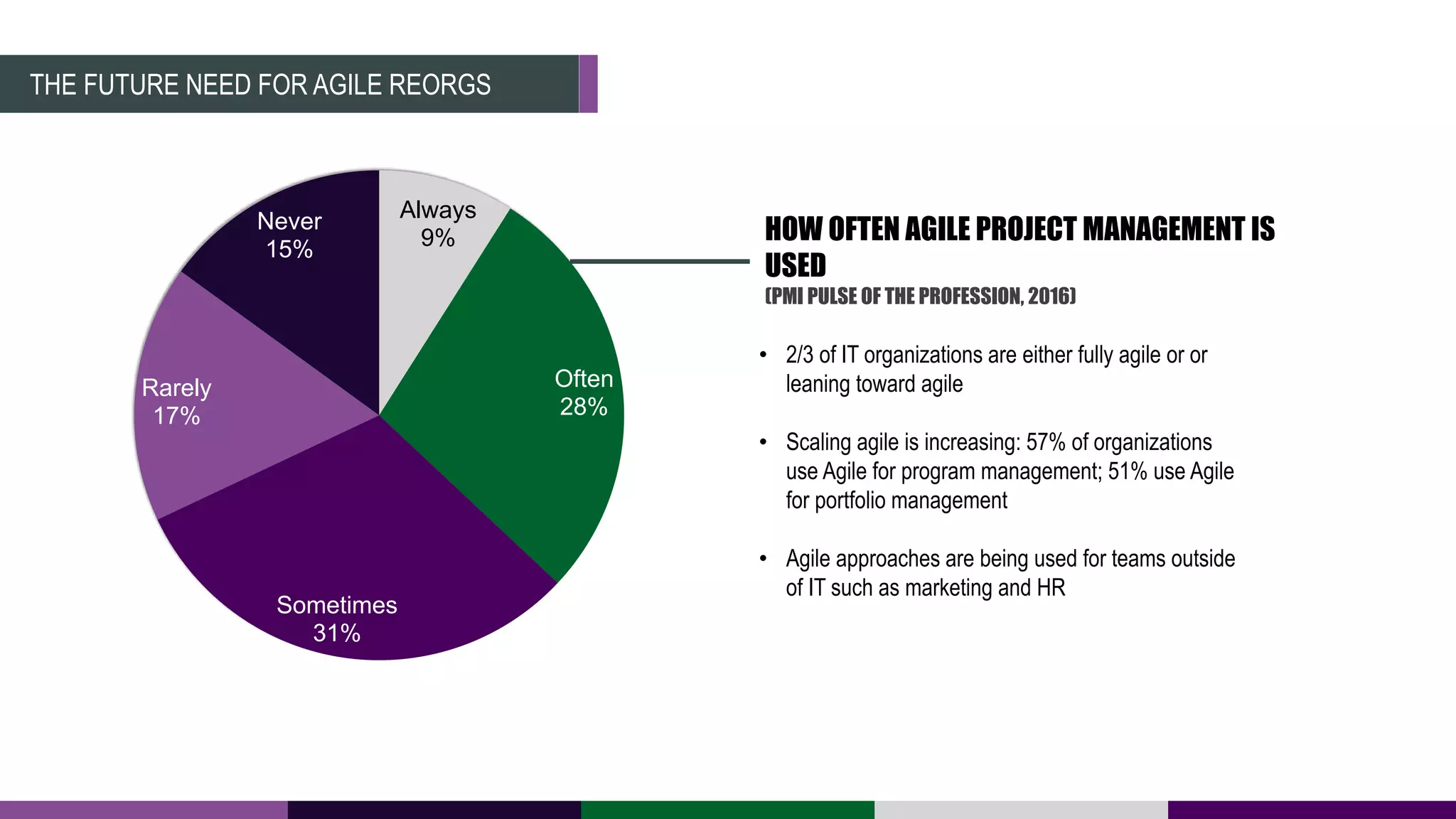
• 2/3 of IT organizations are either fully agile or or
leaning toward agile
• Scaling agile is increasing: 57% of organizations
use Agile for program management; 51% use Agile
for portfolio management
• Agile approaches are being used for teams outside
of IT such as marketing and HR
HOW OFTEN AGILE PROJECT MANAGEMENT IS
USED
(PMI PULSE OF THE PROFESSION, 2016)
Always
9%
Often
28%
Sometimes
31%
Rarely
17%
Never
15%
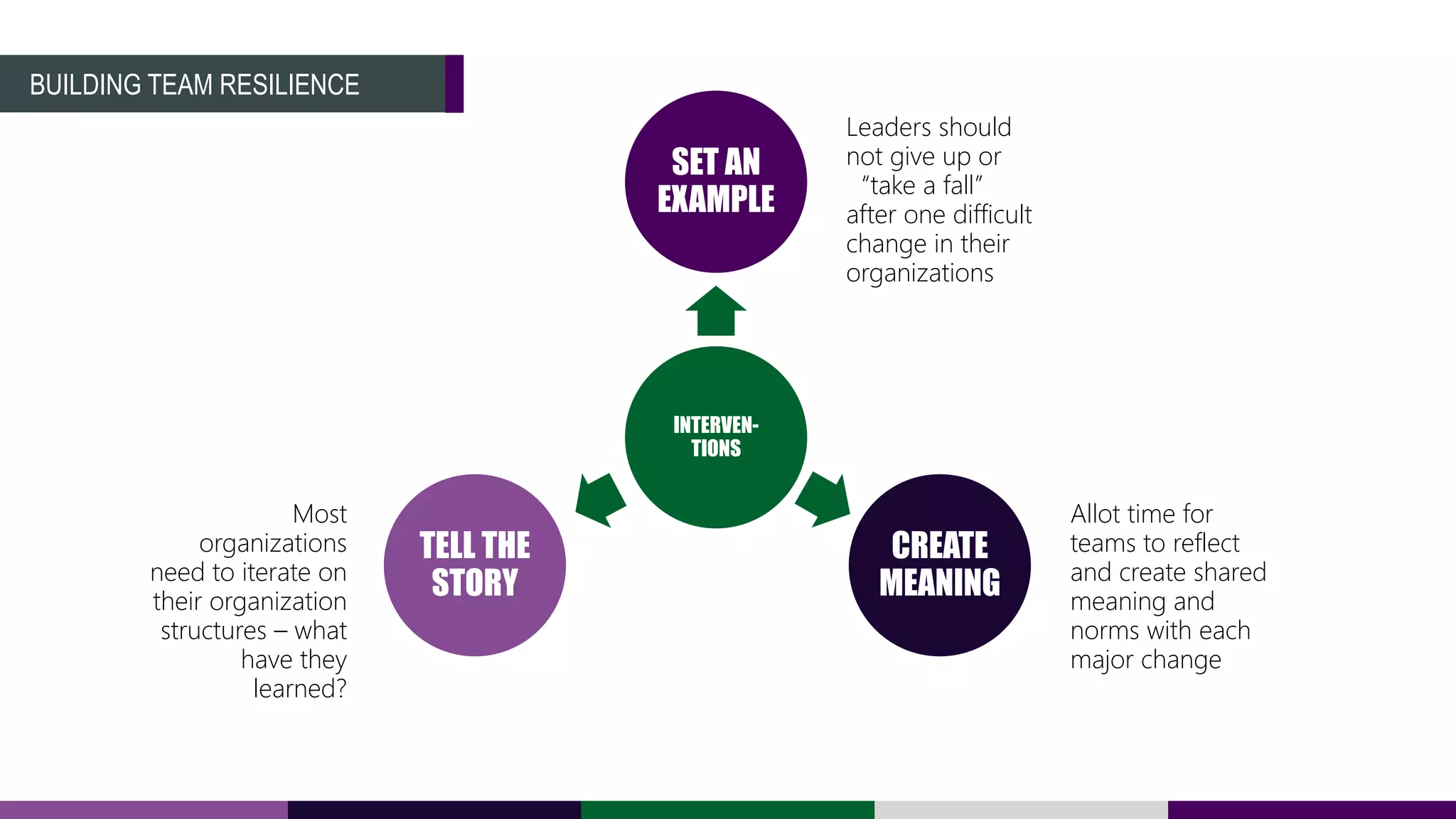
BUILDING TEAM RESILIENCE
INTERVEN-
TIONS
SET AN
EXAMPLE
CREATE
MEANING
TELL THE
STORY
Allot time for
teams to reflect
and create shared
meaning and
norms with each
major change
Most
organizations
need to iterate on
their organization
structures – what
have they
learned?
Leaders should
not give up or
“take a fall”
after one difficult
change in their
organizations
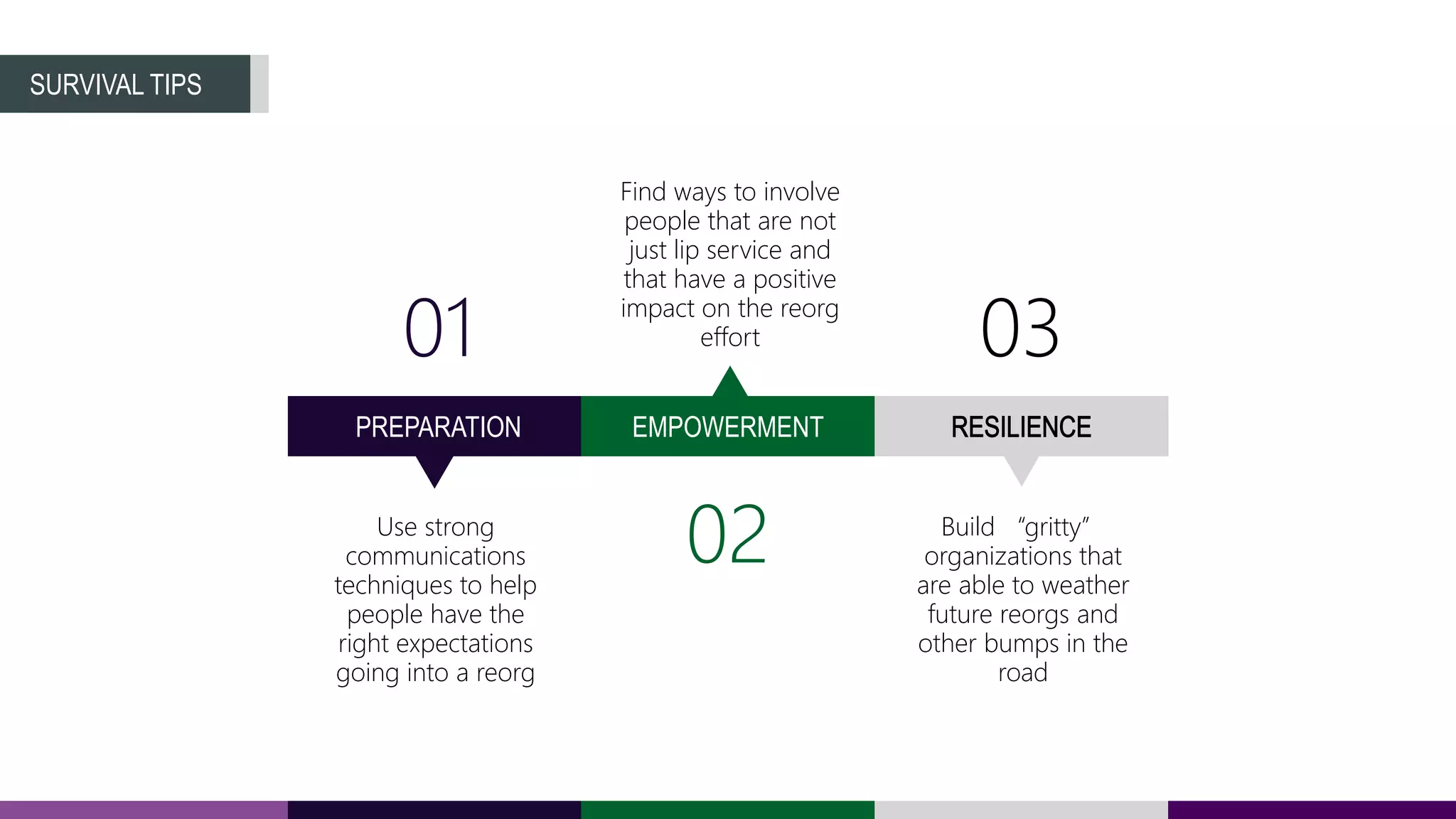
SURVIVAL TIPS
PATIENCE PREPARATION EMPOWERMENT CONCLUSION
01
02
03
Use strong
communications
techniques to help
people have the
right expectations
going into a reorg
Build “gritty”
organizations that
are able to weather
future reorgs and
other bumps in the
road
Find ways to involve
people that are not
just lip service and
that have a positive
impact on the reorg
effort
IT’S TIME FOR QUESTIONS!
Q A&
THANKS FOR LISTENING
Q & A SESSION
CONTACT
@KATYSOUTHPAW
LINKEDIN.COM/IN/KATYSAULP
AUGH
WWW.ENTERPRISE-KNOWLEDGE.COM
KSAULPAUGH@ENTERPRISE-KNOWLEDGE.COM

Agile Reorgs: A Survival Guide

  • 1.
    Agile Reorgs: A SurvivalGuide KATY SAULPAUGH, PRACTICE LEAD
  • 2.
    TABLE OF CONTENTS 1THE DILEMMAAROUND REORGS 2 HOW TO PERCEIVE LOSS AND CHANGE 3 SURVIVAL TIP 1: PREPARATION 4 SURVIVAL TIP 2: EMPOWERMENT 5 SURVIVAL TIP 3: RESILIENCE
  • 3.
    THE DILEMMA TO REORGOR NOT TO REORG
  • 4.
    We tend tomeet any new situation by reorganization, and a wonderful method it is for creating the illusion of progress at the mere cost of confusion, inefficiency and demoralization. - Charlton Ogburn WHY DOES EVERYONE HATE REORGS? illusion of progress demoralization
  • 5.
    IF YOU DON’TREORG People will revert to old habits Your structure will often be top heavy Your teams will not be cross-functional People will lose interest and trust You won’t be agile IF YOU REORG BADLY Agile is the “bad guy” People will be demoralized and turnover will increase You will spend more time and money correcting mistakes You won’t be agile
  • 6.
    CAN YOU REALLYBE AGILE WITH… THE SAME ROLES THE SAME STRATEGY THE SAME REWARDS THE SAME PROCESSES THE SAME TEAM SIZE THE SAME STRUCTURE
  • 7.
    REORG RULES 1. Moveto a new table or row 2. You may not sit next to someone you know 3. Introduce yourself to your new neighbors
  • 8.
    PERCEPTIONS OF CHANGE HELPINGOTHERS DEAL WITH LOSS
  • 9.
    1. DENIAL 2.ANGER 3. BARGAINING 4. DEPRESSION 5. ACCEPTANCE
  • 10.
    AMBIGUOUS LOSS ANDCHANGE “There is no such thing as closure – we have to live with loss, clear or ambiguous, and it’s okay.” – Pauline Boss Translation: people don’t have to “get over” the change, because change will never be “over.” But they don’t have to fixate on it either.
  • 11.
    SURVIVAL TIPS PATIENCE PREPARATIONEMPOWERMENT CONCLUSION 01 02 03 Use strong communications techniques to help people have the right expectations going into a reorg Build “gritty” organizations that are able to weather future reorgs and other bumps in the road Find ways to involve people that are not just lip service and that have a positive impact on the reorg effort
  • 12.
    SURVIVAL TIP 1 PREPARINGWITH THE RIGHT EXPECTATIONS
  • 13.
    BUSINESS VALUE OFAGILE WE NEED TO REORG TO… RELEASE PRODUCTS MORE OFTEN MAKE COLLABORATION WITH CUSTOMERS EASIER BECOME MORE EFFICIENT IN OUR PROCESSES EMPOWER TEAMS TO MAKE MORE DECISIONS
  • 14.
    Find out howpeople process information in your organization Saying you don’t know is OK and is much better than saying nothing Figure out the best way to push and pull information Don’t make the agile coach always deliver the message The scarier the change, the more frequent the communications
  • 15.
    SURVIVAL TIP 2 FINDINGA SENSE OF EMPOWERMENT
  • 16.
    EMPOWERING TEAMS Conduct alarge group design charrette to workshop out how a new agile functional model might work Create other opportunities to give feedback in a focus group or informal format Craft a path for resolving disputes Lessons: Involve people in initial discussions to promote understanding Allow people to bring new insights to leadership Bring emergent problems to the team
  • 17.
    SURVIVAL TIP 3 BUILDINGRESILIENCE TO CHANGE
  • 18.
    THE FUTURE NEEDFOR AGILE REORGS • 2/3 of IT organizations are either fully agile or or leaning toward agile • Scaling agile is increasing: 57% of organizations use Agile for program management; 51% use Agile for portfolio management • Agile approaches are being used for teams outside of IT such as marketing and HR HOW OFTEN AGILE PROJECT MANAGEMENT IS USED (PMI PULSE OF THE PROFESSION, 2016) Always 9% Often 28% Sometimes 31% Rarely 17% Never 15%
  • 19.
    BUILDING TEAM RESILIENCE INTERVEN- TIONS SETAN EXAMPLE CREATE MEANING TELL THE STORY Allot time for teams to reflect and create shared meaning and norms with each major change Most organizations need to iterate on their organization structures – what have they learned? Leaders should not give up or “take a fall” after one difficult change in their organizations
  • 20.
    SURVIVAL TIPS PATIENCE PREPARATIONEMPOWERMENT CONCLUSION 01 02 03 Use strong communications techniques to help people have the right expectations going into a reorg Build “gritty” organizations that are able to weather future reorgs and other bumps in the road Find ways to involve people that are not just lip service and that have a positive impact on the reorg effort
  • 21.
    IT’S TIME FORQUESTIONS! Q A& THANKS FOR LISTENING Q & A SESSION
  • 22.

Editor's Notes

  • #2 Introduce myself: agile coach with change management and comms background, helped teams from defense, association and commercial sector. Introduce EK: boutique consultancy with a focus on agile transformation and knowledge and information management.
  • #5 Inspiration for this talk: “we have to reorg because agile” – yes but NOOOO. Ask the audience: is anyone going through a reorg now? In the last year? This quote summed it up well for me with the “illusion of progress”
  • #6 So we have a dilemma on our hands. It is MUCH easier just to not reorg and try to shield people from the pain. Executives are afraid of what will happen if a reorg goes badly – losing their best people, losing trust, and (the big one) rework in the form of correcting a poorly executed reorg.
  • #7 Roles: no – There’s often a new role of ScrumMaster. What about people who are project managers today? Processes: there are going to be fewer handoffs as teams can make their own decisions. A process often mirrors an organization’s silos, so if the team makeup is changing, so should the process. Team size: many agile adoptions change what it means to be “on a team” – hopefully teams get smaller as fewer people are matrixed across multiple projects. Strategy: even if a company has a strategy before an agile adoption, they may uncover some unexpected things that will lead to a change, typically as part of customer collaboration increasing. Rewards: there is a relatively new movement around agile HR that addresses some of these issues – one of the important pieces is preventing “hero” syndrome and focusing rewards on teams rather than individuals. Structure: most organizations that are adopting agile don’t have cross functional teams right at the gate. Forming these teams means there will be some kind of change required. The point I want to make here is that not changing in any one of these areas is going to mean limiting your success and your organization’s ability to reach its goals. Let’s dig into the reorg dilemma a bit more.
  • #8 Discussion questions: How did it feel being asked to move with no explanation? Did you feel in control of the situation? Suggested answers – fear, anxiety, anger, survivor’s guilt
  • #10 Usually, in change management, it’s not that difficult to put a positive spin on a change. For example, you might have to learn a new payroll system but in the long term it’s going to automate processes and save you time. Reorgs are not that type of change – for most people, any attempt to make it sound positive is just going to piss them off. Change management has a way to deal with this too – the 5 stages of grief. What do people have to lose? Control, the teams they manage, a role they might enjoy, middle managers in particular. [Explain the grief model] This grief model was borrowed from psychology. Interestingly, this theory has been misinterpreted, because it originally described someone who was dying, not someone who lost a loved one. Since then, it has also been debunked, but it’s still being used in business and the media to explain change.
  • #11 If grief and change are not linear, what are they and how can we help people get through tough reorgs – agile or not? Change management is not a magic pill – it won’t make reorgs suddenly delightful, or erase the need for them entirely. Let’s define survival – it means living with ambiguity.
  • #14 Each organization has a reason for wanting to be agile. Being agile is not an end goal. These goals need to be very explicit, because they will be tied in to the reorg.
  • #15 Effective communication is the best way to make sure people are prepared and kept informed as the reorg happens. Channel Message Feedback loops Source – ask if any agile coaches if they have delivered these messages Frequency
  • #16 Reorgs often leave people feeling powerless. This section is about how to empower people in a meaningful way that isn’t just lip service.
  • #17 I wanted to give a couple of examples of tactics I’ve used that have given people real input. If you want to involve the largest group possible, try a design charrette. If you need ongoing help and feedback, a focus group is also a good choice. I’ve used these in the past as informal change networks – this is a favorite tactic of a lot of change practitioners.
  • #18 The last tip is about what happens next – when the reorg is over, will it be the last one? Probably not. Will other disruptive changes happen? Most definitely. The good news is that resilience is something that can be learned – for those who are willing. Here’s how to do it.
  • #19 Out of curiosity, who here has personally experienced a reorg in the last 2 years? Who has an organization with a reorg planned for the near future? The point is that this issue is not going away. Within IT, agile is actually far along the adoption curve. You can easily have a Scrum team here or there without effecting the overall structure. What is different now is that many more organizations are trying to scale – that is my prediction for what will create a lot of reorgs “because of agile” in the near future.