Agile Program
Management
Scaling it “right”
with the Kanban Method!
1
@sudiptal
2
Distinguished Fellow, Kanban University
@sudiptal
Your takeaways
(I hope)…
• Understanding Program Management!
• Lean Program Management…
• What Changed
• Getting it done right…
@sudiptal 3
What is a Program
• A collection of “projects”
• A collection of “applications” is generally called
a “Portfolio”
• Collection could be based on different dimensions!
• Geography, Customer, Vertical, etc.
@sudiptal 4
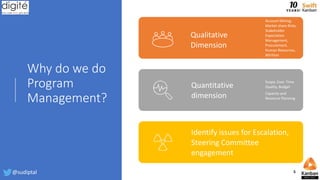
Why do we do
Program
Management?
Qualitative
Dimension
Account Mining,
Market share Risks,
Stakeholder
Expectation
Management,
Procurement,
Human Resources,
Attrition
Quantitative
dimension
Scope, Cost. Time
Quality, Budget
Capacity and
Resource Planning
Identify issues for Escalation,
Steering Committee
engagement
@sudiptal 5
Why the change?
• We cannot figure out the new-age applications/products
• We don’t fully well understand what the market wants exactly
• We don’t fully well understand what user experience works
• We don’t fully well understand what market positioning works
• We need to build fast and get feedback
• Build fast means that it must be small, independent, valuable, testable scope items
• This is specifically true for software development
• Manufacturing, Construction or other industries could PERHAPS do well with
traditional planning and execution
@sudiptal 6
Why the
change?
• Traditional planning was based on Estimates:
• We used to spend a lot of time on Estimates
• Had to do detailed Scope Analysis
• Had to do detailed Design
• Make estimates on Resource Availability
and Skills
• Then, derive an Estimate
• This model had high dependency on the
accuracy of Estimates
• Since, this would fail, we would depend on
Contingency and then, all the estimates
working
@sudiptal 7
Why the
change?
Not much with reference to the
expectation from Program/Portfolio
Management but…
… the nature of what the Programs
are tracking are widely different!
@sudiptal 8
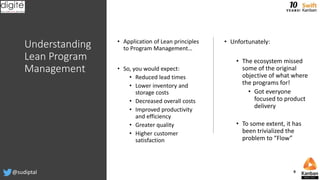
Understanding
Lean Program
Management
• Application of Lean principles
to Program Management…
• So, you would expect:
• Reduced lead times
• Lower inventory and
storage costs
• Decreased overall costs
• Improved productivity
and efficiency
• Greater quality
• Higher customer
satisfaction
• Unfortunately:
• The ecosystem missed
some of the original
objective of what where
the programs for!
• Got everyone
focused to product
delivery
• To some extent, it has
been trivialized the
problem to “Flow”
@sudiptal 9
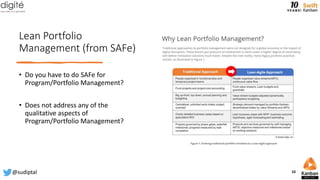
Lean Portfolio
Management (from SAFe)
• Do you have to do SAFe for
Program/Portfolio Management?
• Does not address any of the
qualitative aspects of
Program/Portfolio Management?
@sudiptal 10
What changes?
• New age planning CANNOT be based on
Estimates:
• If you don’t know what you need to
build (but just have an idea), what will
you estimate??
• So, we fall back to the next option: Velocity
• Capacity and Resource planning can be done
based on the same
• # of cards/per unit time per unit person
• Concern: How does this work without
consideration of the card size/effort?
• Sprints are of tight duration; a card should
finish in a Sprint
• # of points/per unit time per unit person
• Concern: Why is this estimate fast and
accurate?
• Its relative! Its does not delve into the
details… we poll for a relative size
• # of hours/per unit card
@sudiptal 11
How do we do it
right?
Kanban Method has multiple answers…
@sudiptal 12
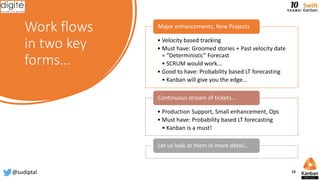
Work flows
in two key
forms…
• Velocity based tracking
• Must have: Groomed stories + Past velocity date
= “Deterministic” Forecast
• SCRUM would work...
• Good to have: Probability based LT forecasting
• Kanban will give you the edge…
Major enhancements, New Projects
• Production Support, Small enhancement, Ops
• Must have: Probability based LT forecasting
• Kanban is a must!
Continuous stream of tickets…
Let us look at them in more detail…
@sudiptal 13
Legend:
@sudiptal 14
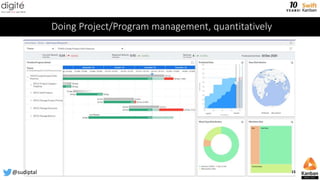
Doing Project/Program management, quantitatively
@sudiptal 15
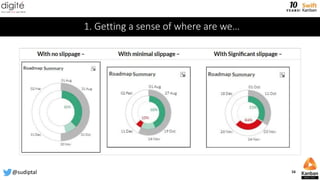
1. Getting a sense of where are we…
@sudiptal 16
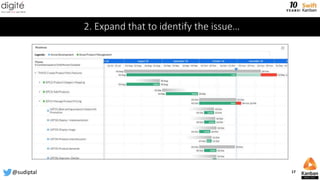
2. Expand that to identify the issue…
@sudiptal 17
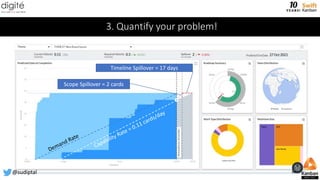
3. Quantify your problem!
Scope Spillover = 2 cards
Timeline Spillover = 17 days
@sudiptal 18
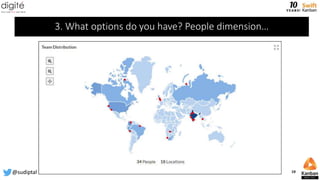
3. What options do you have? People dimension…
@sudiptal 19
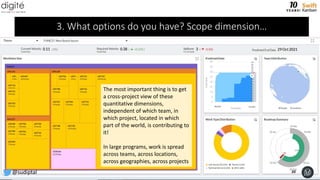
3. What options do you have? Scope dimension…
The most important thing is to get
a cross-project view of these
quantitative dimensions,
independent of which team, in
which project, located in which
part of the world, is contributing to
it!
In large programs, work is spread
across teams, across locations,
across geographies, across projects
@sudiptal 20
We can still get
better…
Velocity driven
forecasting is
deterministic
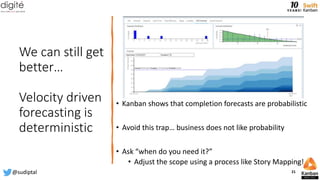
• Kanban shows that completion forecasts are probabilistic
• Avoid this trap… business does not like probability
• Ask “when do you need it?”
• Adjust the scope using a process like Story Mapping!
@sudiptal 21
WIP…
Doing Program Management,
quantitatively for continuous
flow of tickets.…
@sudiptal 22
Doing Program
Management,
qualitatively…
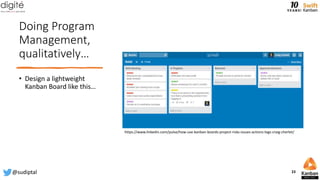
• Design a lightweight
Kanban Board like this…
https://www.linkedin.com/pulse/how-use-kanban-boards-project-risks-issues-actions-logs-craig-cherlet/
@sudiptal 23
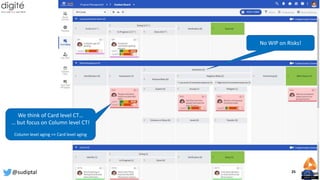
Doing Program Management, qualitatively…
A more scalable implementation for larger Programs…
@sudiptal 24
We think of Card level CT…
… but focus on Column level CT!
Column level aging => Card level aging
No WIP on Risks!
@sudiptal 25
Thank you...
26

Agile Program Management

  • 1.
    Agile Program Management Scaling it“right” with the Kanban Method! 1 @sudiptal
  • 2.
    2 Distinguished Fellow, KanbanUniversity @sudiptal
  • 3.
    Your takeaways (I hope)… •Understanding Program Management! • Lean Program Management… • What Changed • Getting it done right… @sudiptal 3
  • 4.
    What is aProgram • A collection of “projects” • A collection of “applications” is generally called a “Portfolio” • Collection could be based on different dimensions! • Geography, Customer, Vertical, etc. @sudiptal 4
  • 5.
    Why do wedo Program Management? Qualitative Dimension Account Mining, Market share Risks, Stakeholder Expectation Management, Procurement, Human Resources, Attrition Quantitative dimension Scope, Cost. Time Quality, Budget Capacity and Resource Planning Identify issues for Escalation, Steering Committee engagement @sudiptal 5
  • 6.
    Why the change? •We cannot figure out the new-age applications/products • We don’t fully well understand what the market wants exactly • We don’t fully well understand what user experience works • We don’t fully well understand what market positioning works • We need to build fast and get feedback • Build fast means that it must be small, independent, valuable, testable scope items • This is specifically true for software development • Manufacturing, Construction or other industries could PERHAPS do well with traditional planning and execution @sudiptal 6
  • 7.
    Why the change? • Traditionalplanning was based on Estimates: • We used to spend a lot of time on Estimates • Had to do detailed Scope Analysis • Had to do detailed Design • Make estimates on Resource Availability and Skills • Then, derive an Estimate • This model had high dependency on the accuracy of Estimates • Since, this would fail, we would depend on Contingency and then, all the estimates working @sudiptal 7
  • 8.
    Why the change? Not muchwith reference to the expectation from Program/Portfolio Management but… … the nature of what the Programs are tracking are widely different! @sudiptal 8
  • 9.
    Understanding Lean Program Management • Applicationof Lean principles to Program Management… • So, you would expect: • Reduced lead times • Lower inventory and storage costs • Decreased overall costs • Improved productivity and efficiency • Greater quality • Higher customer satisfaction • Unfortunately: • The ecosystem missed some of the original objective of what where the programs for! • Got everyone focused to product delivery • To some extent, it has been trivialized the problem to “Flow” @sudiptal 9
  • 10.
    Lean Portfolio Management (fromSAFe) • Do you have to do SAFe for Program/Portfolio Management? • Does not address any of the qualitative aspects of Program/Portfolio Management? @sudiptal 10
  • 11.
    What changes? • Newage planning CANNOT be based on Estimates: • If you don’t know what you need to build (but just have an idea), what will you estimate?? • So, we fall back to the next option: Velocity • Capacity and Resource planning can be done based on the same • # of cards/per unit time per unit person • Concern: How does this work without consideration of the card size/effort? • Sprints are of tight duration; a card should finish in a Sprint • # of points/per unit time per unit person • Concern: Why is this estimate fast and accurate? • Its relative! Its does not delve into the details… we poll for a relative size • # of hours/per unit card @sudiptal 11
  • 12.
    How do wedo it right? Kanban Method has multiple answers… @sudiptal 12
  • 13.
    Work flows in twokey forms… • Velocity based tracking • Must have: Groomed stories + Past velocity date = “Deterministic” Forecast • SCRUM would work... • Good to have: Probability based LT forecasting • Kanban will give you the edge… Major enhancements, New Projects • Production Support, Small enhancement, Ops • Must have: Probability based LT forecasting • Kanban is a must! Continuous stream of tickets… Let us look at them in more detail… @sudiptal 13
  • 14.
  • 15.
    Doing Project/Program management,quantitatively @sudiptal 15
  • 16.
    1. Getting asense of where are we… @sudiptal 16
  • 17.
    2. Expand thatto identify the issue… @sudiptal 17
  • 18.
    3. Quantify yourproblem! Scope Spillover = 2 cards Timeline Spillover = 17 days @sudiptal 18
  • 19.
    3. What optionsdo you have? People dimension… @sudiptal 19
  • 20.
    3. What optionsdo you have? Scope dimension… The most important thing is to get a cross-project view of these quantitative dimensions, independent of which team, in which project, located in which part of the world, is contributing to it! In large programs, work is spread across teams, across locations, across geographies, across projects @sudiptal 20
  • 21.
    We can stillget better… Velocity driven forecasting is deterministic • Kanban shows that completion forecasts are probabilistic • Avoid this trap… business does not like probability • Ask “when do you need it?” • Adjust the scope using a process like Story Mapping! @sudiptal 21
  • 22.
    WIP… Doing Program Management, quantitativelyfor continuous flow of tickets.… @sudiptal 22
  • 23.
    Doing Program Management, qualitatively… • Designa lightweight Kanban Board like this… https://www.linkedin.com/pulse/how-use-kanban-boards-project-risks-issues-actions-logs-craig-cherlet/ @sudiptal 23
  • 24.
    Doing Program Management,qualitatively… A more scalable implementation for larger Programs… @sudiptal 24
  • 25.
    We think ofCard level CT… … but focus on Column level CT! Column level aging => Card level aging No WIP on Risks! @sudiptal 25
  • 26.