AGILE
NUMBERS_
The Signposts on Your Agile Journey
By Akrem Saed
The name
that I
really
wanted_
Current
State of
Agile
Practices_
Agile didn’t
start as a
“landscape”
agilemanifesto.org
Why
Data?_
agilemanifesto.org
Good
Questions_
Which one is more popular?
Which one is endorsed by my agile coach?
Which one did Netflix use?
Which one can scale to the size of my organization?
Which one is easy to pick up?
?
Which ones
have data
behind them?
?
Better
Question_
Current
State_
of Discourse
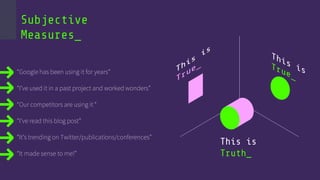
“Google has been using it for years”
“I’ve used it in a past project and worked wonders”
“Our competitors are using it “
“I’ve read this blog post”
“It’s trending on Twitter/publications/conferences”
“It made sense to me!”
Subjective
Measures_
Controlled Scientific Studies
Statistical Analysis of IT Behavior
Comparative Case Studies
Large-Scale Experiments
Small-Scale Experiments
Objective Measures_
(a.k.a Agile Numbers)
Scientific Studies
& Research_
What We Know About
Software Engineering_
“Bits of Evidence:
What We Actually Know About Software
Development, and Why We Believe It’s
True”
- Greg Wilson, January 2010
https://vimeo.com/9270320
Standard
Of Proof_
“.. the debate is hampered because not enough
people know how to develop DSLs effectively”
- Martin Fowler, 2009
“One of the smartest guys in our industry made
two substantive claims in an academic journal
without a single citation ….. I think the debate
is hampered by low standards of proof”
- Greg Wilson, 2010
Raise the Standard:
Studies_
Anchoring and Adjustment in Software Estimation
(Aranda and Easterbook 2005)
Finding:
the anchor mattered more than experience,
how formal the estimation method was,
or anything else.
(van Genuchten 1991 and many others)
The two biggest causes of project failure are poor estimation and unstable requirements.
(Woodfield, 1979)
For every 25% increase in problem complexity, there is a 100% increase in solution complexity.
(Thomas et al, 1997)
If more than 20-25% of a component has to be revised, it’s better to rewrite it from scratch.
Raise the Standard:
Studies_
(Fagan 1975)
Rigorous inspections can remove 60-90% of errors before the first test is run.
(Nagappan et al (2007) & Bird et al (2009)
Physical distance does not affect post-release fault rates. Distance in the organization chart does.
Raise the Standard:
Studies_
(Kemerer and Paulk 2009)
200 LOC/hour or less is an effective rate for code reviews, identifying more than half of the defects
Want more
studies?_
Making Software: What Really
Works, and Why We Believe it
By Andy Oram & Greg Wilson
https://goo.gl/aPUzGo
Erdogmus and Williams 2003
Pairs passed 15% more of the automated post-development test cases.
Salleh et al 2009
Pair programming creates an environment conducive to more advanced learning and social
interaction, leading to students being less frustrated, more confident and more interested in IT
More Studies:
Pair Programming_
Erdogmus and Williams 2003
Average difference in programmer-hours between pairs and solo devs was not statistically significant.
Chong and Hurlbutt 2007
Engineers seemed more engaged when in possession of keyboard or perceived control was imminent
Vanhanen and Kapori 2007, Vanhanen
and Lassenius 2007
Pair programming contributed to team morale, increased discipline in use of other prescribed
practices (e.g. TDD, coding standards, and frequent integration)
More Studies:
Pair Programming_
Arisholm et al 2007
Large experiment demonstrated a quality improvement with pairs on complex tasks but not on
simpler tasks
Folk Medicine
in IT_
Study What Already
Works in the Wild
Project
Aristotle_
Quest to Build
The Perfect Team
Aristotle:Test the
commonly-held myths_
‘‘... there was nothing showing that a mix of
specific personality types or skills or
backgrounds made any difference. The ‘who’
part of the equation didn’t seem to
matter.’’
- Abeer Dubey, leader of Project Aristotle
New York Times > https://goo.gl/z1jjac
Aristotle:
The Safety Hint_
What distinguished the “good” teams
from the dysfunctional groups was
how teammates treated one another.
Evidence for a Collective Intelligence Factor in
the Performance of Human Groups
Woolley et al. (2010)
“As long as everyone got a chance to talk, the
team did well, But if only one person or a
small group spoke all the time, the collective
intelligence declined.’’
- Anita Williams Woolley
Equal Talk Time1
Aristotle:
The Safety Hint_
Teammates were skilled at figuring out how
others felt based on their tone of voice,
expressions and other nonverbal cues.
2
Aristotle:
The Safety Hint_
High average social sensitivity
Aristotle: 1+1
Psychological Safety_
“[Psychological safety is] a sense of
confidence that the team will not embarrass,
reject or punish someone for speaking up,’’
- Amy Edmondson (1999)
TEDx Talk > https://goo.gl/eXbxXn
Aristotle:
The Finding_
“There were other behaviors that seemed
important as well — like making sure teams
had clear goals and creating a culture of
dependability. But Google’s data indicated
that psychological safety, more than
anything else, was critical to making a
team work. ”
More About
Project Aristotle_
New York Times > https://goo.gl/z1jjac Google re:Work > https://goo.gl/19k4u7
Surveys &
Statistical
Models_
27,000 Survey responses
3,200 People
6 Years
DevOps Report:
The Data_
DevOps Report:
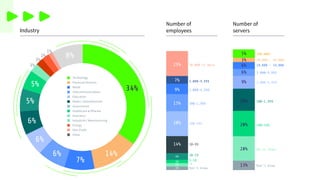
Diverse Data Set_
Demographics
DevOps teams increased
● from 16% in 2014
● to 19 % in 2015
● to 22% in 2016
● to 27% in 2017.
DevOps Report 2017 > https://goo.gl/yqTHvz
DevOps Report:
Diverse Data Set_
Respondent by Regions
DevOps Report:
IT Performance_
Stability gap
Throughput gap
High
Performing Teams
Vs
Low
Performing Teams
DevOps Report:
IT Performance Gap
DevOps Report:
IT Performance Gap
The High
Performing Teams’
Advantages
High responsiveness to
market changes
Better customer experience
Faster time to market
DevOps Report:
IT Performance Gap
DevOps Report:
Technical Practices_
33% more of configuration management
27% more of testing
30% more of deployments
27% more of change approval processes
High
Performing Teams
Vs
Low
Performing Teams
DevOps Report:
Automation
Medium- were doing more manual work
than low-performing teams in
DevOps Report:
Automation
“Continuous Delivery
significantly
contributes to both
lower deployment
pain and higher IT
performance”
DevOps Report:
Continuous Delivery
In 2015, high-performing teams were more likely to have
loosely coupled architecture.
● Loosely Coupled Teams contribute to better IT
performance.
● Loosely Coupled Architecture derives IT performance.
■ Bounded Contexts (Domain Driven Design)
■ APIs
■ Test doubles for testing
In 2017,
DevOps Report:
Architecture
Biggest contributor to Continuous Delivery (bigger
than test and deployment automation) is if a team can
do:
● Make design changes without permission or dependency
● Complete its work without involving other teams
● Deploy and release on demand
● Do most of testing on demand without integrated test
environment
● Deploy during business hours with negligible downtime
DevOps Report:
Continuous Delivery &
Teams
2017
High-performing teams spent
21% less time on unplanned work and
rework
44% more time on new features or code
2016
High-performing teams spent
22% less time on unplanned work and
rework
29% more time on new features or code
DevOps Report:
Quality
In 2017, report analyzed how long
branches live and time to integrate
branches into trunk
High-performing teams spend only hours on
both measures
Low-performing teams spend days
In 2016, higher software delivery
performance contributed by:
Merging code into trunk on daily basis
Having short-lived branches and forks (less than 1
day)
Having fewer than three active branches
DevOps Report:
Trunk-Based Dvlpmnt._
DevOps Report:
Lean Product
Management_
In 2017
the report found IT performance predicts lean product
management practices
In 2016
lean product management practices predicted:
● Higher IT performance
● Lower deployment pain
DevOps Report:
Lean Product
Management_
2016 + 2017
A virtuous cycle between LPM and software
delivery pipeline
Impact of Leadership
DevOps Report:
Impact of Leadership_
Statistically significant differences
between high-performing and
low-performing teams when it
comes to 5 leadership characteristics
DevOps Report:
Transformational Leader
Teams with least transformative
leaders are 50% less likely to exhibit
high performance
DevOps Report:
Transformational Leader
DevOps Report:
Transformational Leader
Objective Team
Transformation
How should your team evolve?
Dig Deeper1
Objective Team Transformation
Pick a Practice or
Insight from Here2
Objective Team Transformation
Favor Objective
Measures3
Objective Team Transformation
Measure Impact
on Your Team4
Objective Team Transformation
Act on
Measured Impact5
Objective Team Transformation
@AkremSaed
Who was this
Akrem dude ?
Agile numbers

Agile numbers

  • 1.
    AGILE NUMBERS_ The Signposts onYour Agile Journey By Akrem Saed
  • 2.
  • 3.
  • 4.
    Agile didn’t start asa “landscape” agilemanifesto.org
  • 5.
  • 6.
    Good Questions_ Which one ismore popular? Which one is endorsed by my agile coach? Which one did Netflix use? Which one can scale to the size of my organization? Which one is easy to pick up? ?
  • 7.
    Which ones have data behindthem? ? Better Question_
  • 8.
  • 9.
    “Google has beenusing it for years” “I’ve used it in a past project and worked wonders” “Our competitors are using it “ “I’ve read this blog post” “It’s trending on Twitter/publications/conferences” “It made sense to me!” Subjective Measures_
  • 10.
    Controlled Scientific Studies StatisticalAnalysis of IT Behavior Comparative Case Studies Large-Scale Experiments Small-Scale Experiments Objective Measures_ (a.k.a Agile Numbers)
  • 11.
  • 12.
    What We KnowAbout Software Engineering_ “Bits of Evidence: What We Actually Know About Software Development, and Why We Believe It’s True” - Greg Wilson, January 2010 https://vimeo.com/9270320
  • 13.
    Standard Of Proof_ “.. thedebate is hampered because not enough people know how to develop DSLs effectively” - Martin Fowler, 2009 “One of the smartest guys in our industry made two substantive claims in an academic journal without a single citation ….. I think the debate is hampered by low standards of proof” - Greg Wilson, 2010
  • 14.
    Raise the Standard: Studies_ Anchoringand Adjustment in Software Estimation (Aranda and Easterbook 2005) Finding: the anchor mattered more than experience, how formal the estimation method was, or anything else.
  • 15.
    (van Genuchten 1991and many others) The two biggest causes of project failure are poor estimation and unstable requirements. (Woodfield, 1979) For every 25% increase in problem complexity, there is a 100% increase in solution complexity. (Thomas et al, 1997) If more than 20-25% of a component has to be revised, it’s better to rewrite it from scratch. Raise the Standard: Studies_
  • 16.
    (Fagan 1975) Rigorous inspectionscan remove 60-90% of errors before the first test is run. (Nagappan et al (2007) & Bird et al (2009) Physical distance does not affect post-release fault rates. Distance in the organization chart does. Raise the Standard: Studies_ (Kemerer and Paulk 2009) 200 LOC/hour or less is an effective rate for code reviews, identifying more than half of the defects
  • 17.
    Want more studies?_ Making Software:What Really Works, and Why We Believe it By Andy Oram & Greg Wilson https://goo.gl/aPUzGo
  • 18.
    Erdogmus and Williams2003 Pairs passed 15% more of the automated post-development test cases. Salleh et al 2009 Pair programming creates an environment conducive to more advanced learning and social interaction, leading to students being less frustrated, more confident and more interested in IT More Studies: Pair Programming_ Erdogmus and Williams 2003 Average difference in programmer-hours between pairs and solo devs was not statistically significant.
  • 19.
    Chong and Hurlbutt2007 Engineers seemed more engaged when in possession of keyboard or perceived control was imminent Vanhanen and Kapori 2007, Vanhanen and Lassenius 2007 Pair programming contributed to team morale, increased discipline in use of other prescribed practices (e.g. TDD, coding standards, and frequent integration) More Studies: Pair Programming_ Arisholm et al 2007 Large experiment demonstrated a quality improvement with pairs on complex tasks but not on simpler tasks
  • 20.
    Folk Medicine in IT_ StudyWhat Already Works in the Wild
  • 21.
  • 22.
    Aristotle:Test the commonly-held myths_ ‘‘...there was nothing showing that a mix of specific personality types or skills or backgrounds made any difference. The ‘who’ part of the equation didn’t seem to matter.’’ - Abeer Dubey, leader of Project Aristotle New York Times > https://goo.gl/z1jjac
  • 23.
    Aristotle: The Safety Hint_ Whatdistinguished the “good” teams from the dysfunctional groups was how teammates treated one another. Evidence for a Collective Intelligence Factor in the Performance of Human Groups Woolley et al. (2010)
  • 24.
    “As long aseveryone got a chance to talk, the team did well, But if only one person or a small group spoke all the time, the collective intelligence declined.’’ - Anita Williams Woolley Equal Talk Time1 Aristotle: The Safety Hint_
  • 25.
    Teammates were skilledat figuring out how others felt based on their tone of voice, expressions and other nonverbal cues. 2 Aristotle: The Safety Hint_ High average social sensitivity
  • 26.
    Aristotle: 1+1 Psychological Safety_ “[Psychologicalsafety is] a sense of confidence that the team will not embarrass, reject or punish someone for speaking up,’’ - Amy Edmondson (1999) TEDx Talk > https://goo.gl/eXbxXn
  • 27.
    Aristotle: The Finding_ “There wereother behaviors that seemed important as well — like making sure teams had clear goals and creating a culture of dependability. But Google’s data indicated that psychological safety, more than anything else, was critical to making a team work. ”
  • 28.
    More About Project Aristotle_ NewYork Times > https://goo.gl/z1jjac Google re:Work > https://goo.gl/19k4u7
  • 29.
  • 30.
    27,000 Survey responses 3,200People 6 Years DevOps Report: The Data_
  • 31.
    DevOps Report: Diverse DataSet_ Demographics DevOps teams increased ● from 16% in 2014 ● to 19 % in 2015 ● to 22% in 2016 ● to 27% in 2017. DevOps Report 2017 > https://goo.gl/yqTHvz
  • 33.
    DevOps Report: Diverse DataSet_ Respondent by Regions
  • 34.
  • 35.
    Stability gap Throughput gap High PerformingTeams Vs Low Performing Teams DevOps Report: IT Performance Gap
  • 36.
  • 37.
    The High Performing Teams’ Advantages Highresponsiveness to market changes Better customer experience Faster time to market DevOps Report: IT Performance Gap
  • 38.
  • 39.
    33% more ofconfiguration management 27% more of testing 30% more of deployments 27% more of change approval processes High Performing Teams Vs Low Performing Teams DevOps Report: Automation
  • 40.
    Medium- were doingmore manual work than low-performing teams in DevOps Report: Automation
  • 41.
    “Continuous Delivery significantly contributes toboth lower deployment pain and higher IT performance” DevOps Report: Continuous Delivery
  • 42.
    In 2015, high-performingteams were more likely to have loosely coupled architecture. ● Loosely Coupled Teams contribute to better IT performance. ● Loosely Coupled Architecture derives IT performance. ■ Bounded Contexts (Domain Driven Design) ■ APIs ■ Test doubles for testing In 2017, DevOps Report: Architecture
  • 43.
    Biggest contributor toContinuous Delivery (bigger than test and deployment automation) is if a team can do: ● Make design changes without permission or dependency ● Complete its work without involving other teams ● Deploy and release on demand ● Do most of testing on demand without integrated test environment ● Deploy during business hours with negligible downtime DevOps Report: Continuous Delivery & Teams
  • 44.
    2017 High-performing teams spent 21%less time on unplanned work and rework 44% more time on new features or code 2016 High-performing teams spent 22% less time on unplanned work and rework 29% more time on new features or code DevOps Report: Quality
  • 45.
    In 2017, reportanalyzed how long branches live and time to integrate branches into trunk High-performing teams spend only hours on both measures Low-performing teams spend days In 2016, higher software delivery performance contributed by: Merging code into trunk on daily basis Having short-lived branches and forks (less than 1 day) Having fewer than three active branches DevOps Report: Trunk-Based Dvlpmnt._
  • 46.
  • 47.
    In 2017 the reportfound IT performance predicts lean product management practices In 2016 lean product management practices predicted: ● Higher IT performance ● Lower deployment pain DevOps Report: Lean Product Management_ 2016 + 2017 A virtuous cycle between LPM and software delivery pipeline
  • 48.
    Impact of Leadership DevOpsReport: Impact of Leadership_
  • 49.
    Statistically significant differences betweenhigh-performing and low-performing teams when it comes to 5 leadership characteristics DevOps Report: Transformational Leader
  • 50.
    Teams with leasttransformative leaders are 50% less likely to exhibit high performance DevOps Report: Transformational Leader
  • 51.
  • 52.
  • 53.
  • 54.
    Pick a Practiceor Insight from Here2 Objective Team Transformation
  • 55.
  • 56.
    Measure Impact on YourTeam4 Objective Team Transformation
  • 57.
  • 58.