






LLAMA
Agile Project
Management for
Instructional Designers
Learning DevCamp 2019 | S101
Megan Torrance | mtorrance@torrancelearning.com
LLAMA
Agile Project
Management for
Instructional Designers
llama@torrancelearning.com
Megan Torrance
mtorrance@torrancelearning.com
@MMTorrance | @xAPIGnome | @Tlearning
4
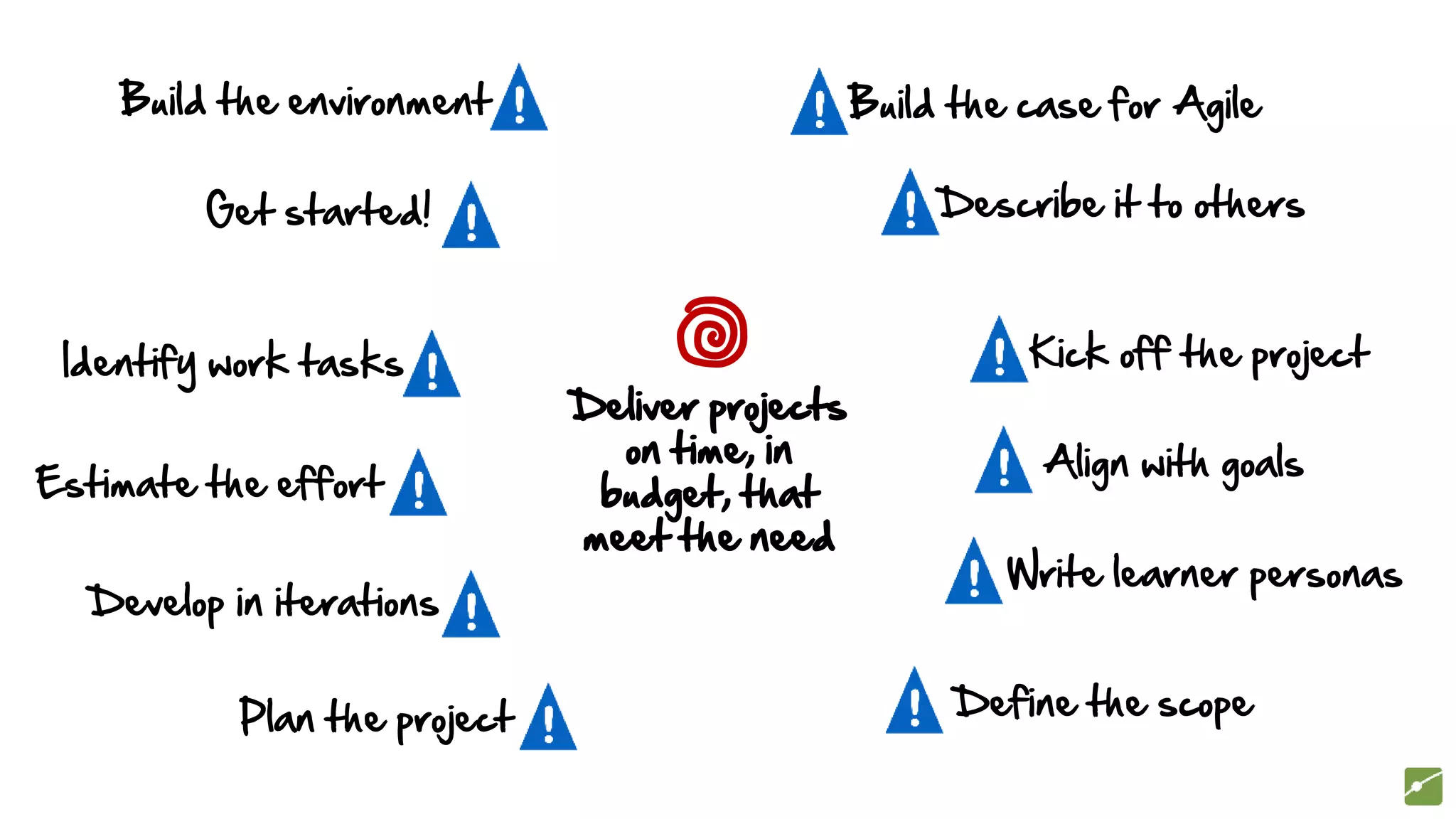
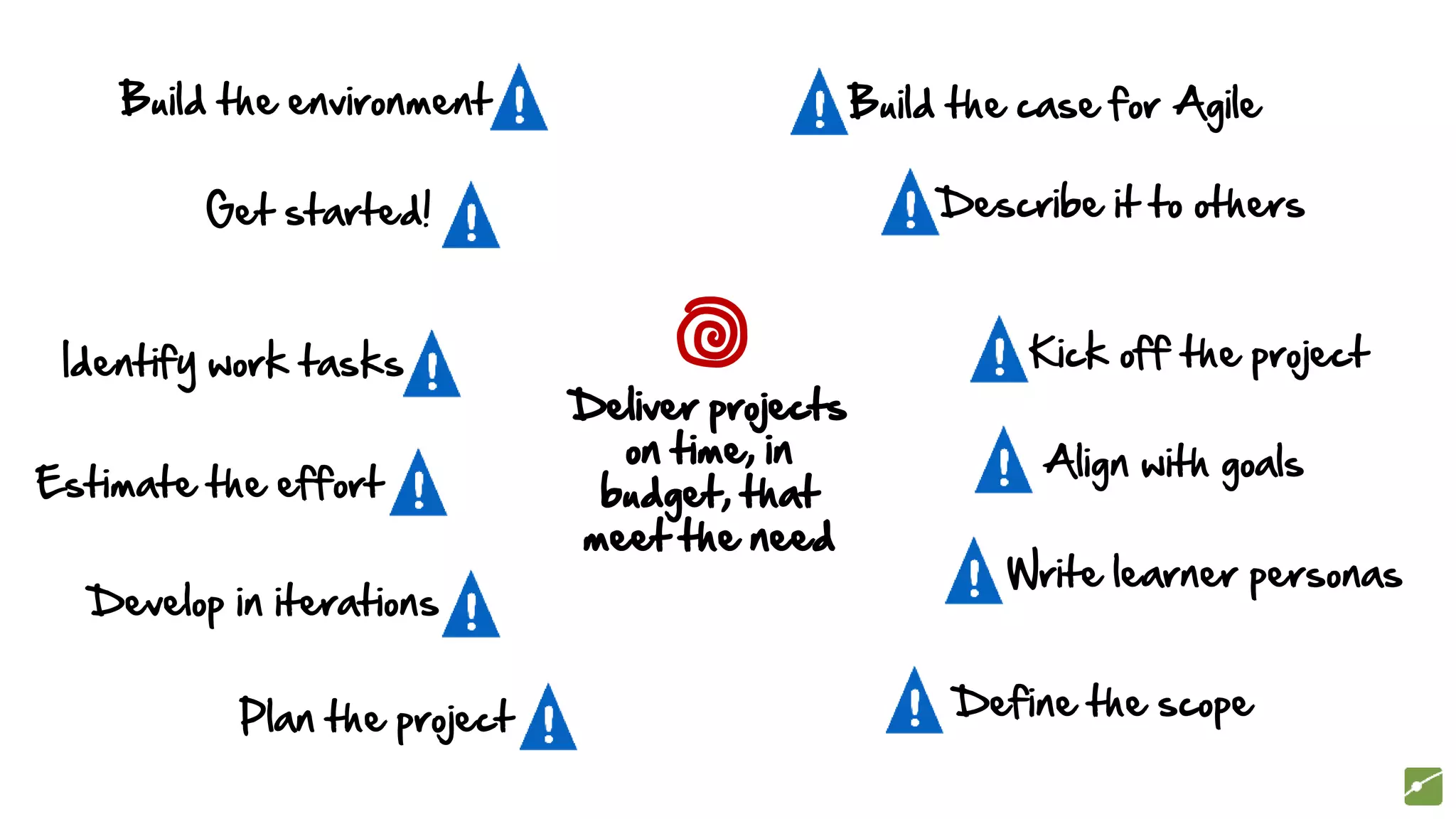
Build the case for Agile
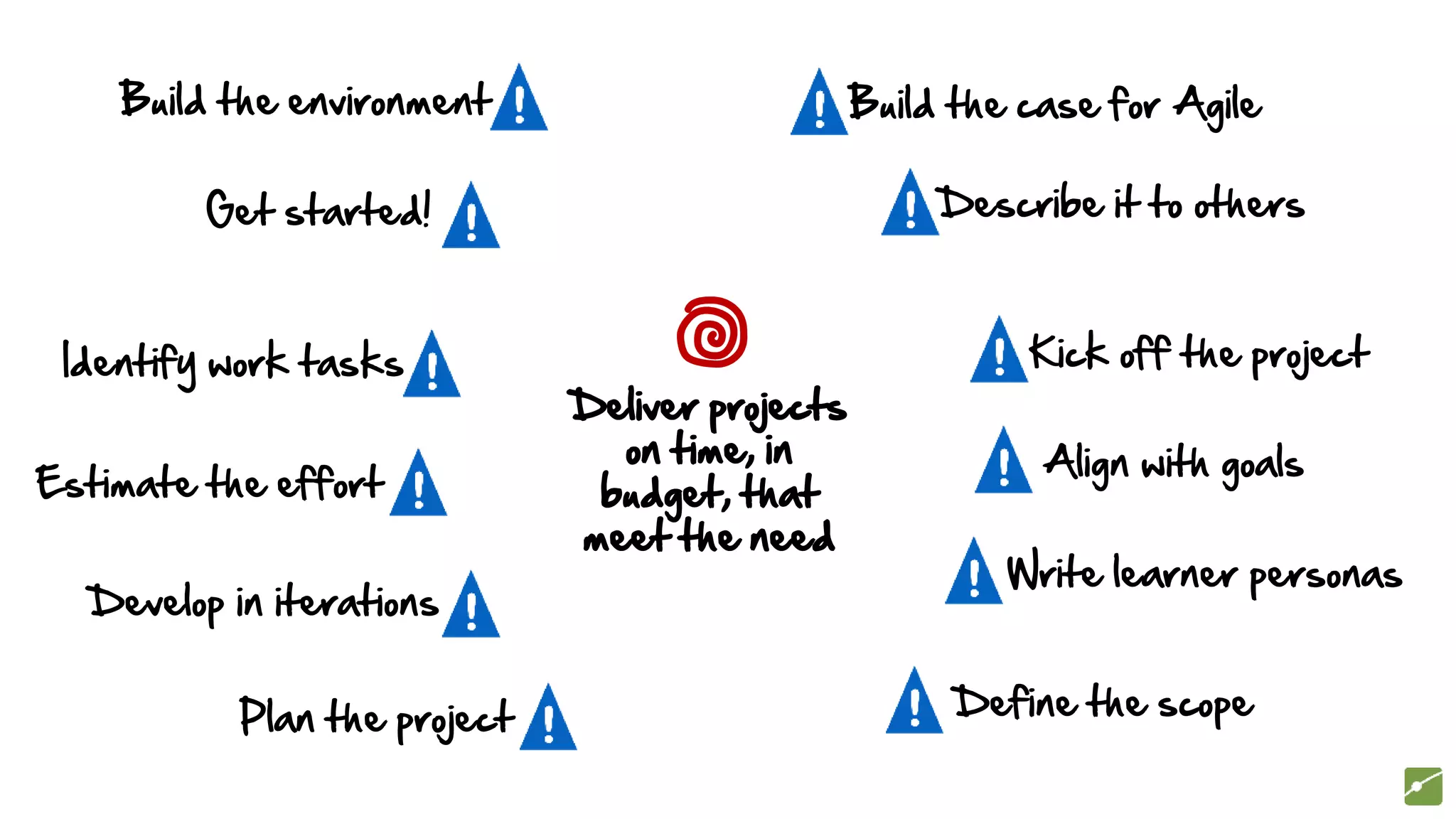
Deliver projects
on time, in
budget, that
meet the need
Describe it to others
Write learner personas
Define the scope
Build the environment
Get started!
Estimate the effort
!
Plan the project
Develop in iterations
Align with goals
Identify work tasks Kick off the project
Build the case for Agile
Articulate why traditional approaches to project
planning are lacking
6
Think about your
best project ever.
7
8
Source: Wikimedia Commons
NASA_Space_Shuttle_Atlantis_landing_(
STS-110)_(19_April_2002).jpg
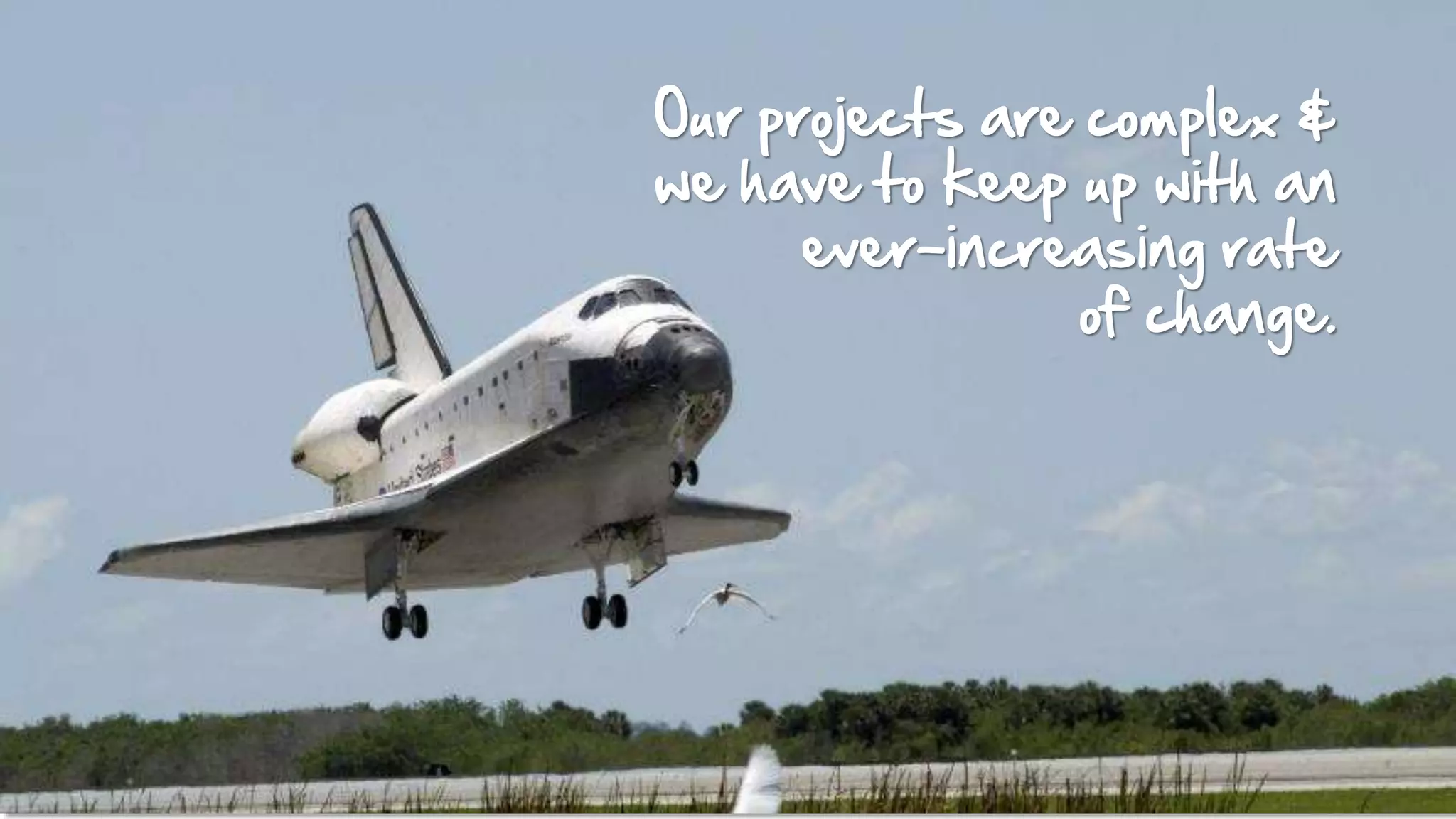
Our projects are complex &
we have to keep up with an
ever-increasing rate
of change.
9
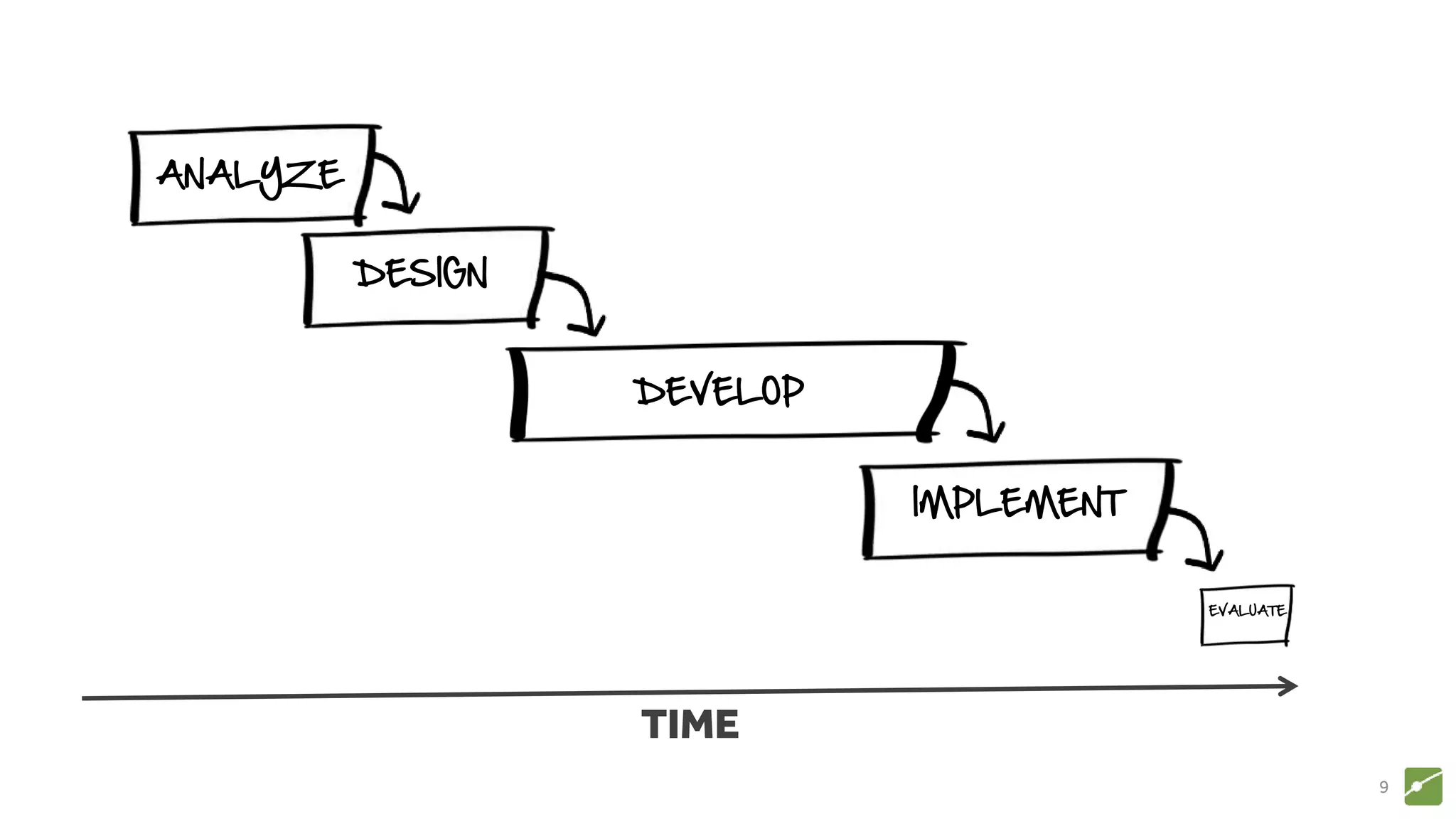
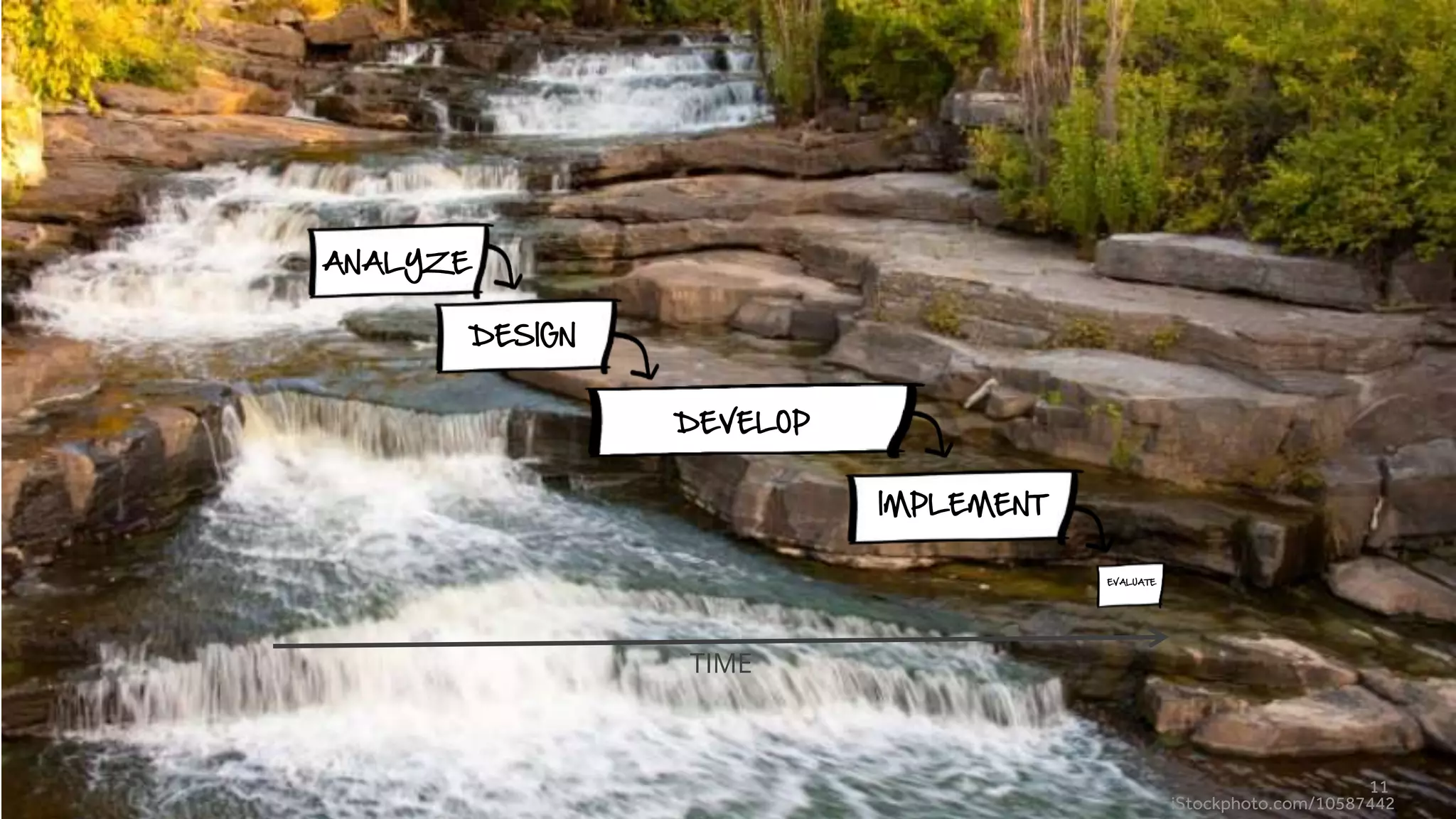
ANALYZE
DESIGN
DEVELOP
IMPLEMENT
EVALUATE
TIME
The first day of a project
is the worst day to plan what
the end product will be
(and how much it will cost).
10
11
iStockphoto.com/10587442
ANALYZE
DESIGN
DEVELOP
IMPLEMENT
EVALUATE
TIME
12
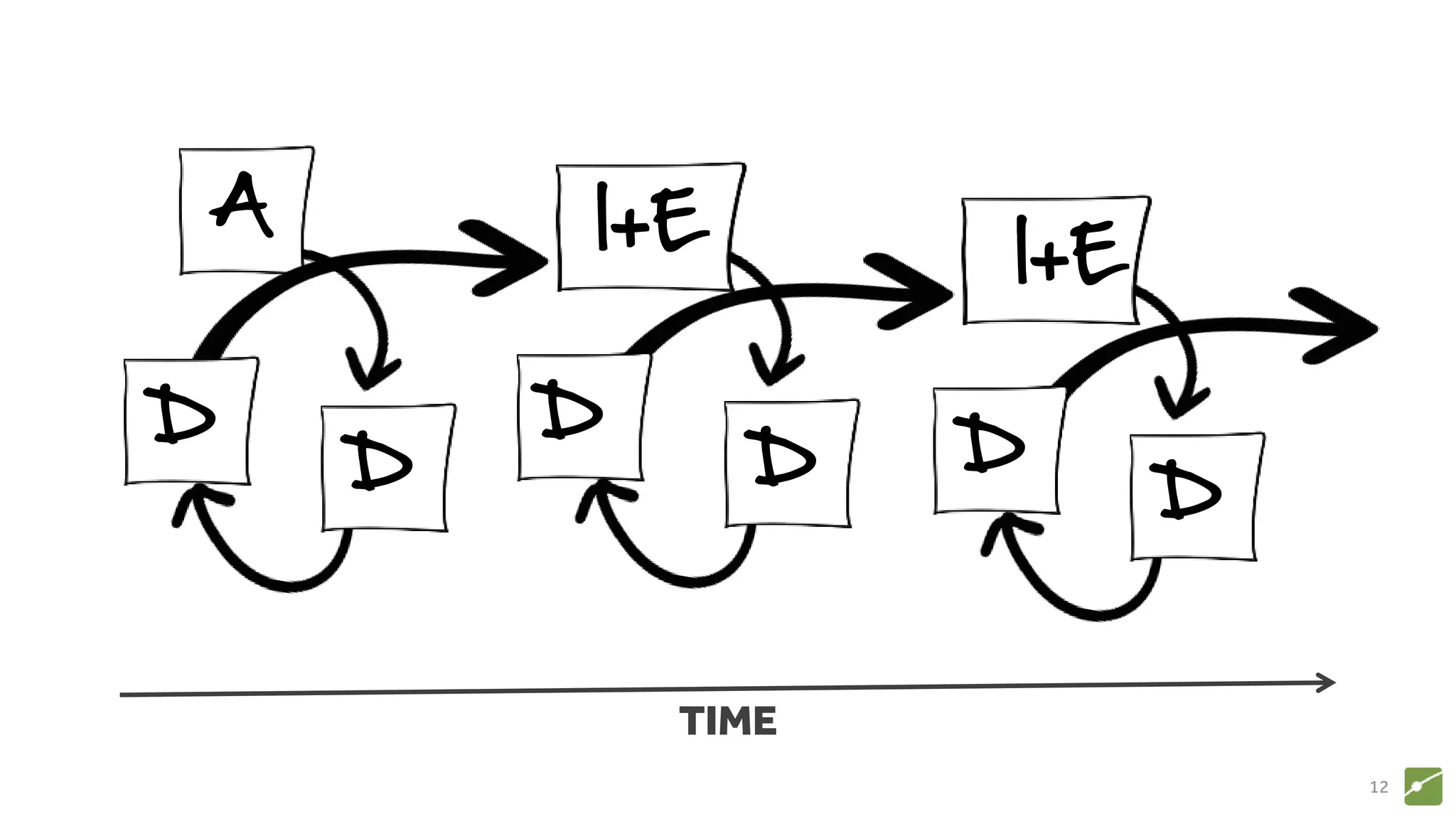
A
D
I+E
D
I+E
D
DD D
TIME
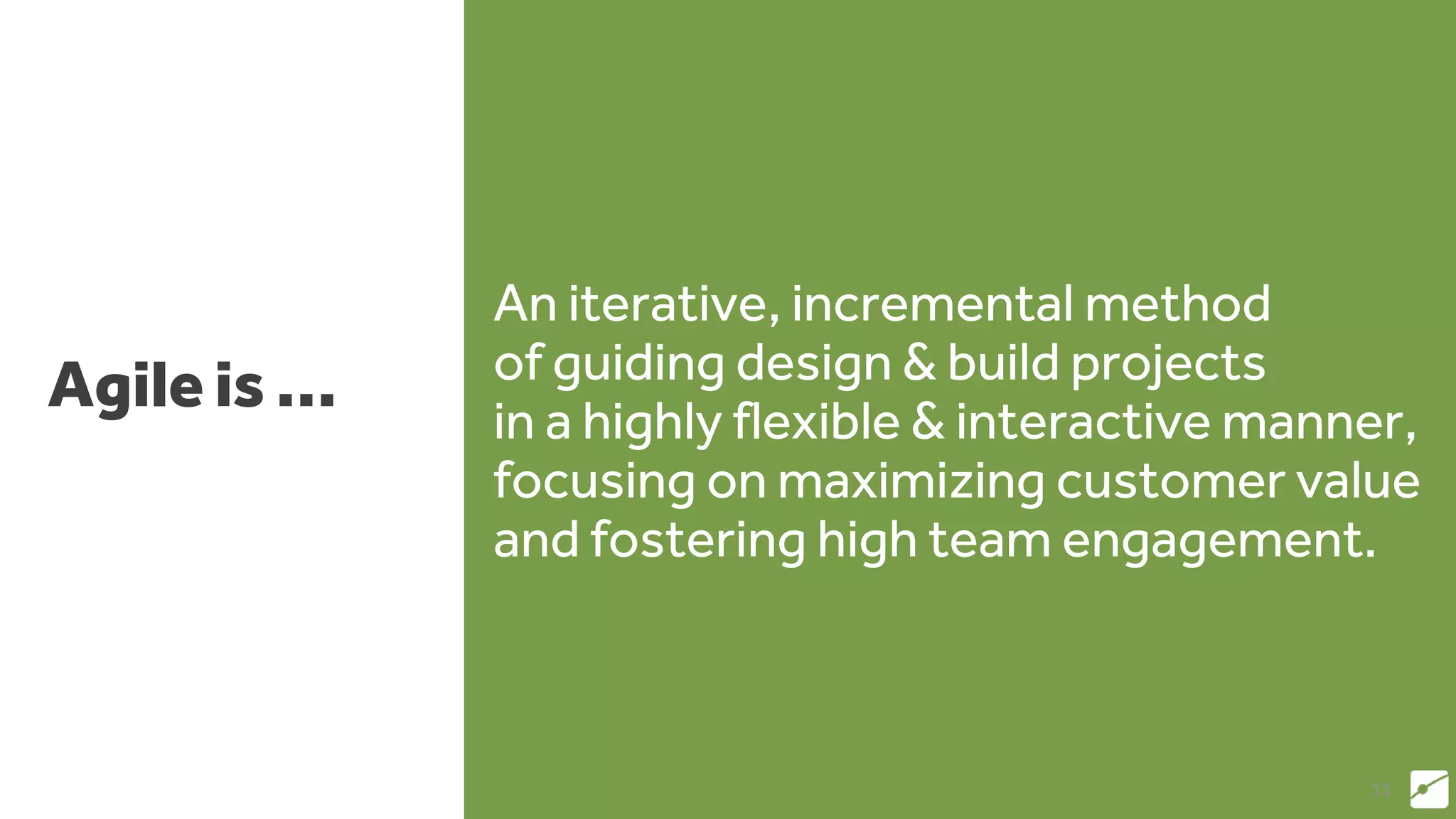
Agile is …
An iterative, incremental method
of guiding design & build projects
in a highly flexible & interactive manner,
focusing on maximizing customer value
and fostering high team engagement.
13
14
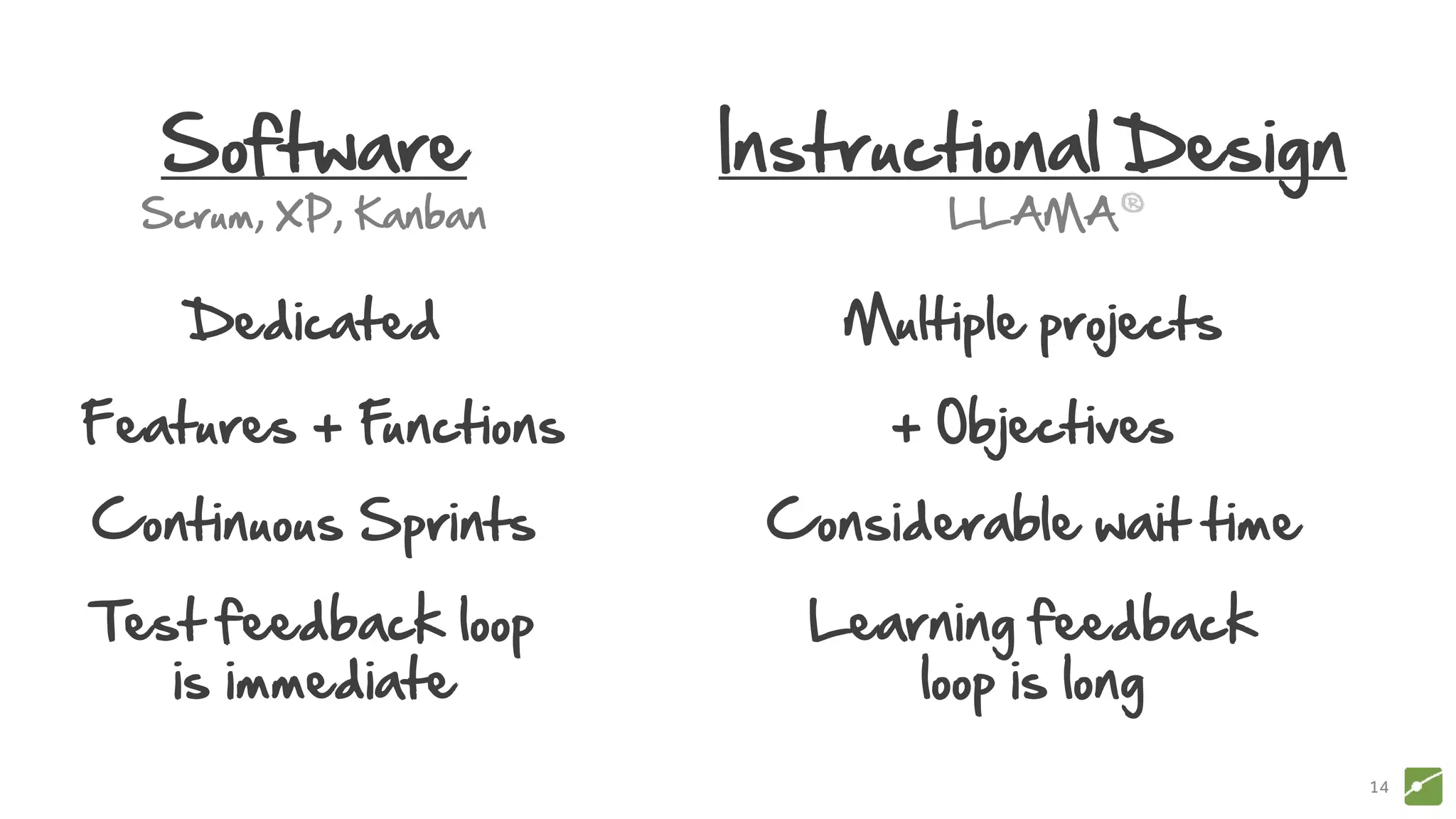
Software Instructional Design
Dedicated Multiple projects
Features + Functions + Objectives
Continuous Sprints Considerable wait time
Scrum, XP, Kanban LLAMA
Test feedback loop
is immediate
Learning feedback
loop is long
15
THE AGILE MANIFESTO:
We are uncovering better ways
of developing software
by doing it and
helping others do it...
16
source: www.agilemanifesto.org
Through this work we have
come to value:
Individuals and interactions
over
processes and tools
17
source: www.agilemanifesto.org
Through this work we have
come to value:
working software
over
comprehensive documentation
18
source: www.agilemanifesto.org
Through this work we have
come to value:
customer collaboration
over
contract negotiation
19
source: www.agilemanifesto.org
Through this work we have
come to value:
responding to change
over
following a plan
20
source: www.agilemanifesto.org
21
Dollarphotoclub_25873819
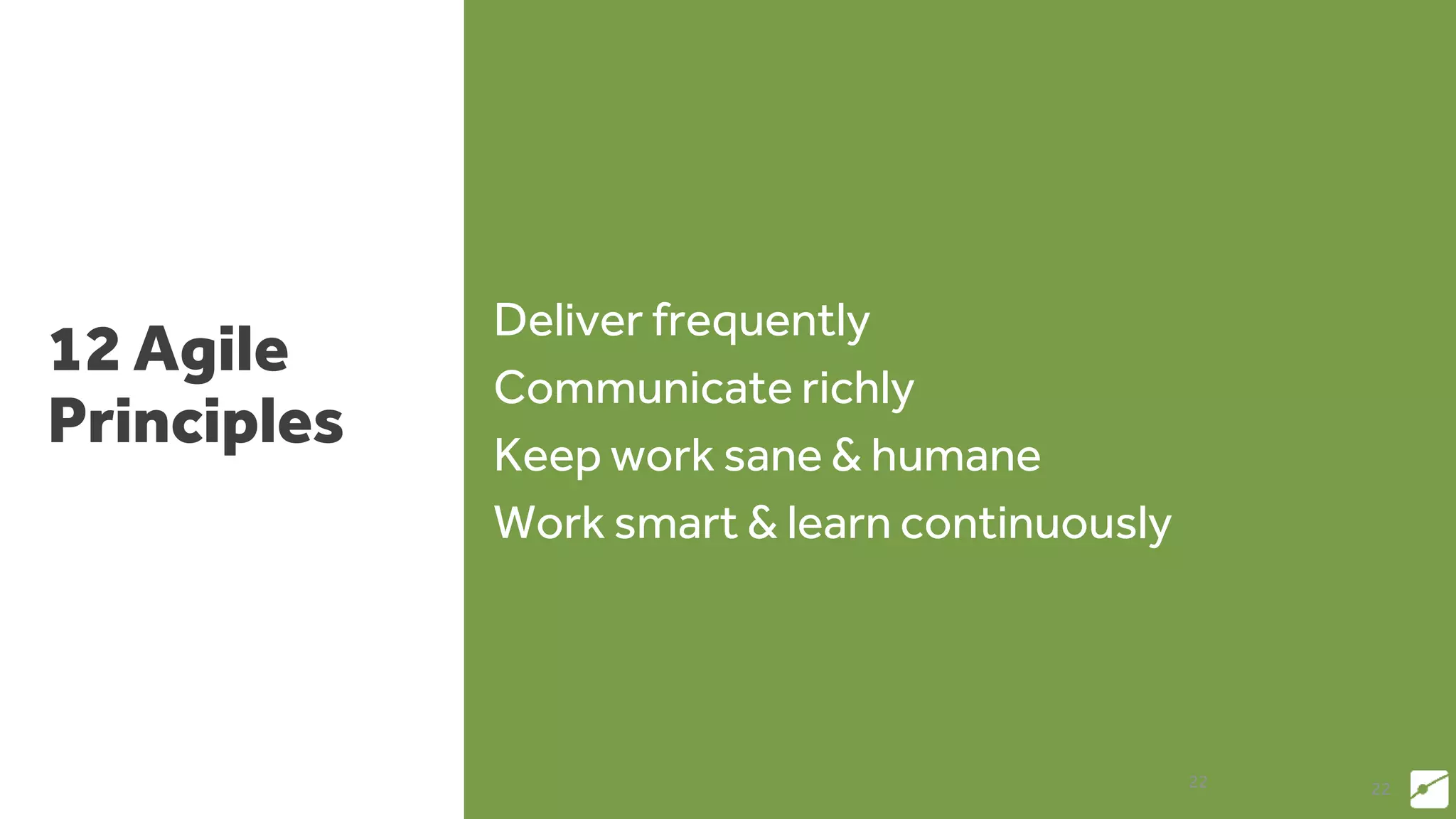
12 Agile
Principles
Deliver frequently
Communicate richly
Keep work sane & humane
Work smart & learn continuously
2222
Build the case for Agile
Deliver projects
on time, in
budget, that
meet the need
Describe it to others
Write learner personas
Define the scope
Build the environment
Get started!
Estimate the effort
!
Plan the project
Develop in iterations
Align with goals
Identify work tasks Kick off the project
Define the Goal
Begin the project with the
*agreed upon* end in mind.
24
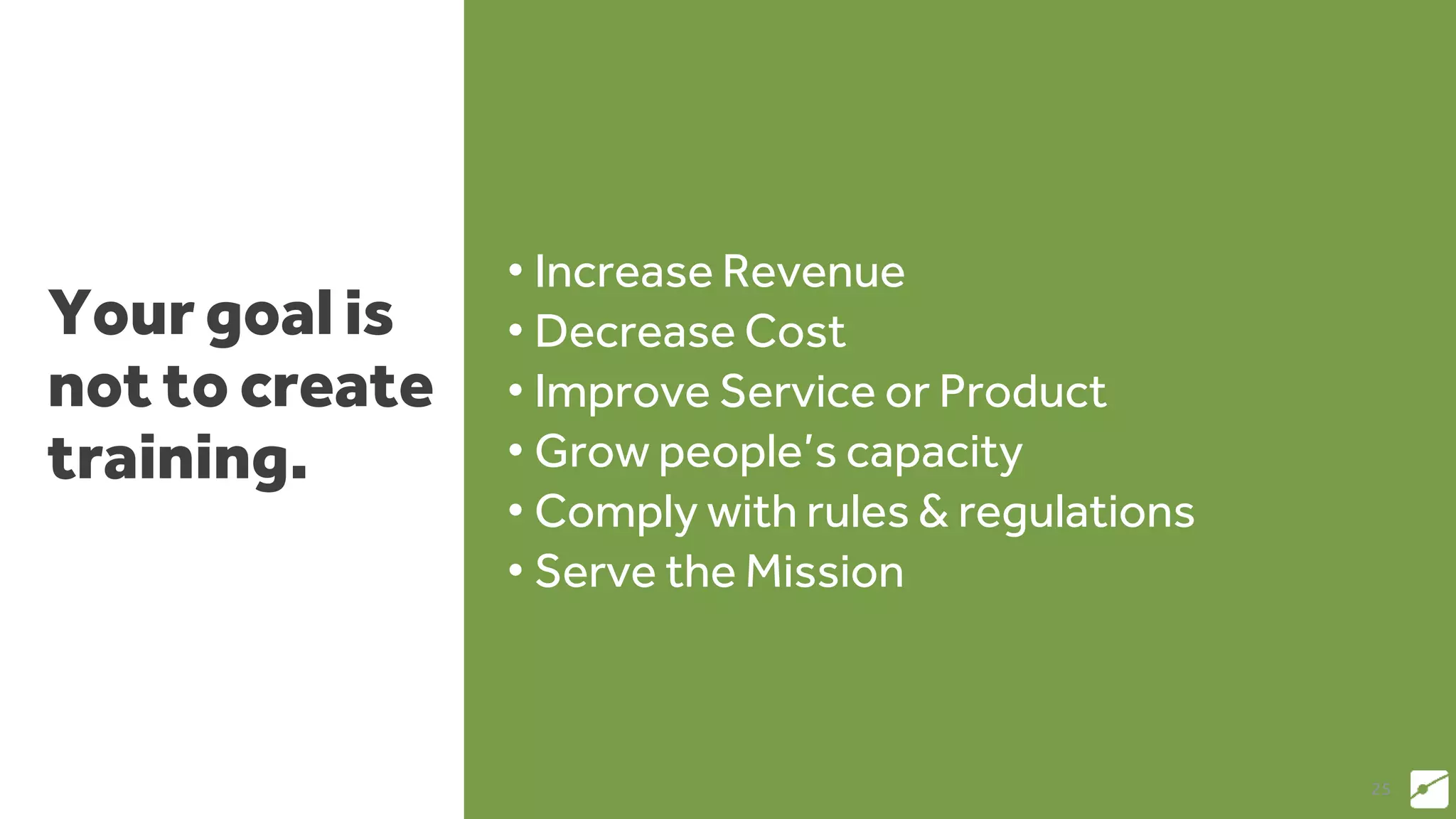
Your goal is
not to create
training.
• Increase Revenue
• Decrease Cost
• Improve Service or Product
• Grow people’s capacity
• Comply with rules & regulations
• Serve the Mission
25
Write Learner Personas
Use learner personas as a guide to keeping training
design & your project focused.
26
27
http://www.elcidweddings.com/wp-content/uploads/2012/08/Real-
AdobeStock_211557660
Define Scope with
Stories
Write learner stories and story cards to define scope
and plan the project.
30
Stories capture business needs
and performance outcomes
in a format that's useful for
planning & production.
31Story Cards 3 Things
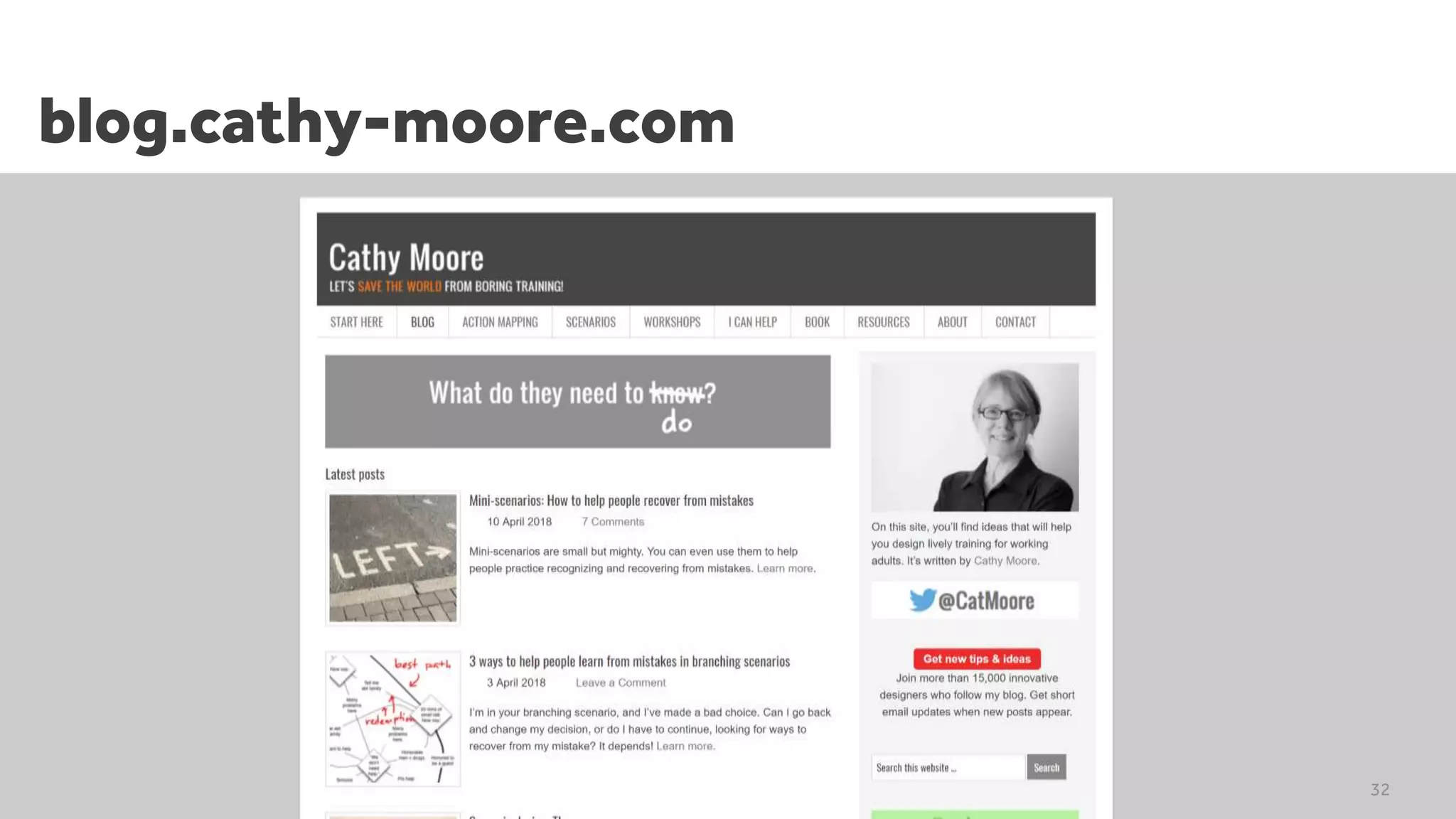
blog.cathy-moore.com
32
http://blog.cathy-moore.com/
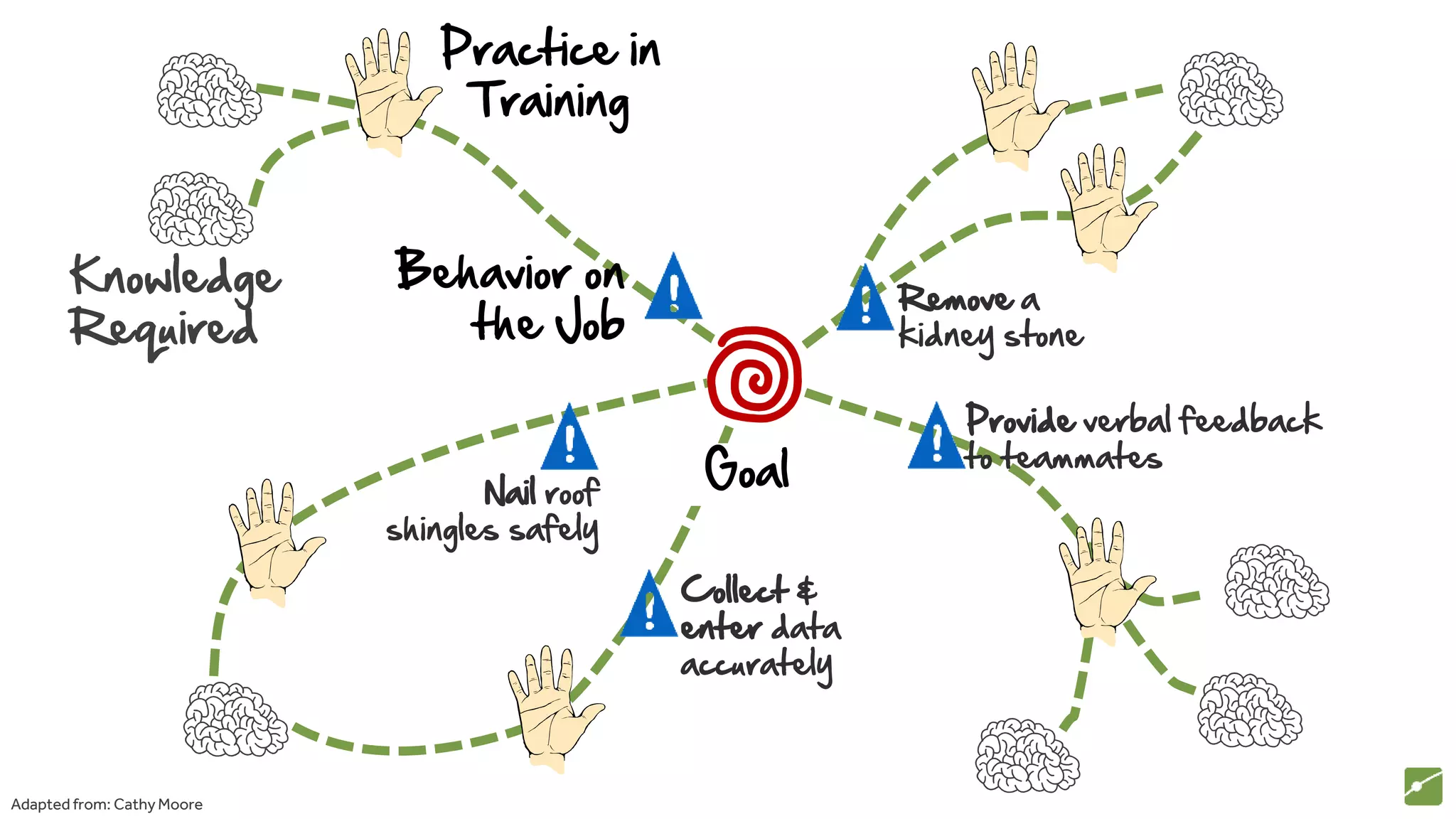
Practice in
Training
Knowledge
Required
Goal
Adapted from: CathyMoore
Behavior on
the Job
Nail roof
shingles safely
Remove a
kidney stone
Provide verbal feedback
to teammates
Collect &
enter data
accurately
34
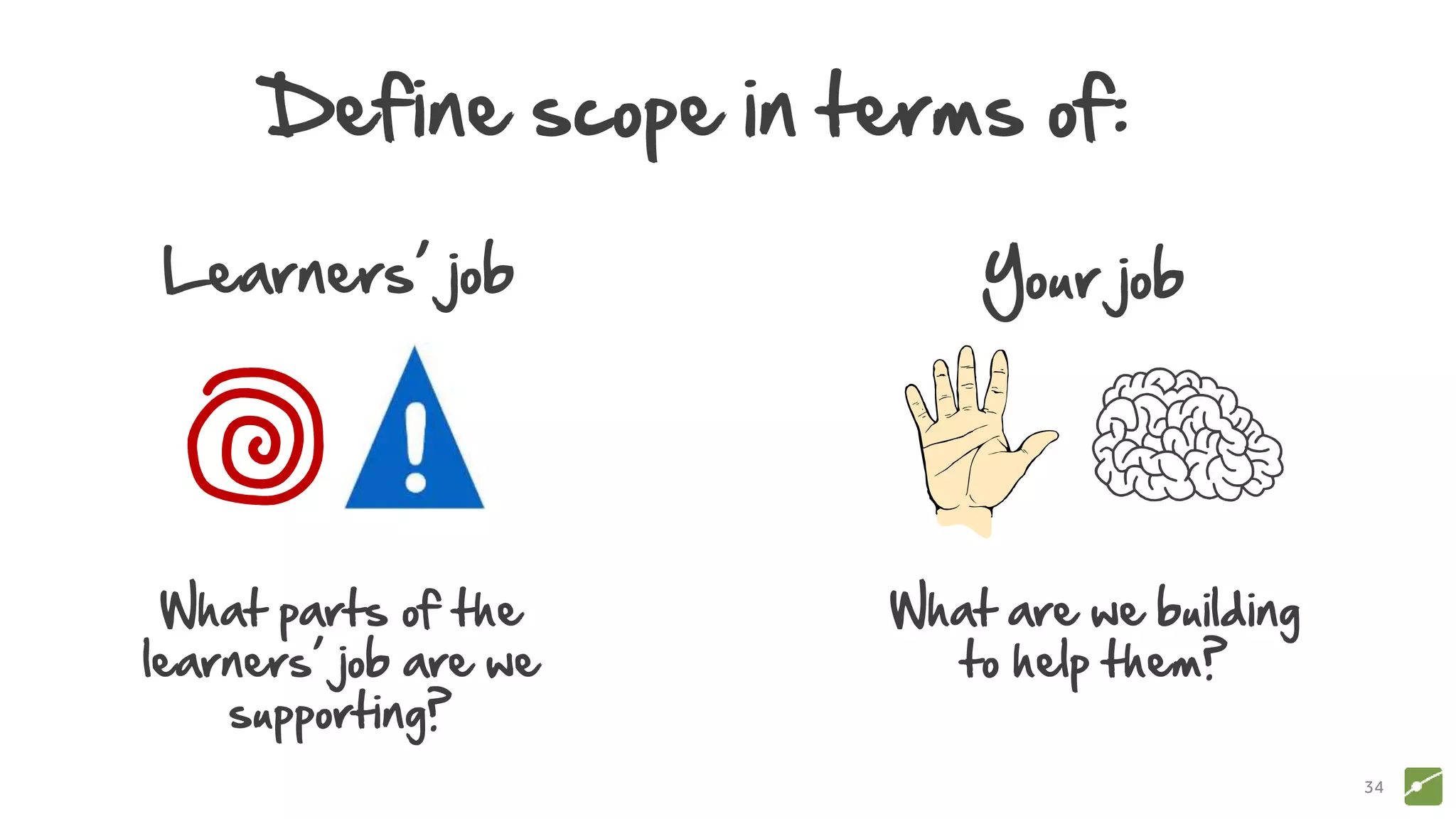
Learners’ job Your job
What parts of the
learners’ job are we
supporting?
What are we building
to help them?
Define scope in terms of:
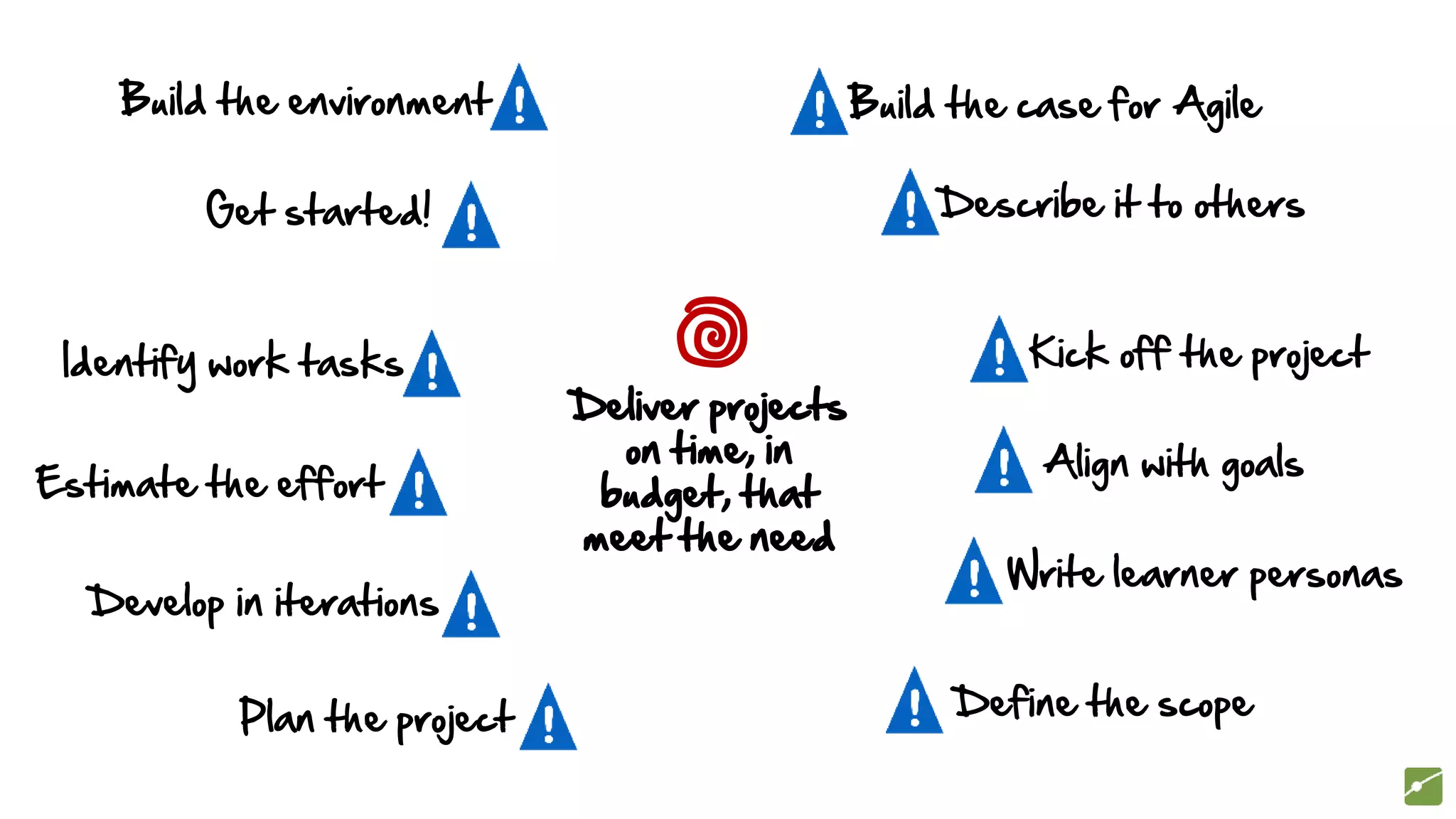
Build the case for Agile
Deliver projects
on time, in
budget, that
meet the need
Describe it to others
Write learner personas
Define the scope
Build the environment
Get started!
Estimate the effort
!
Plan the project
Develop in iterations
Align with goals
Identify work tasks Kick off the project
Identify & estimate work
tasks
Create the task list for the
first round of work to be done.
36
37
Humans are very bad at this
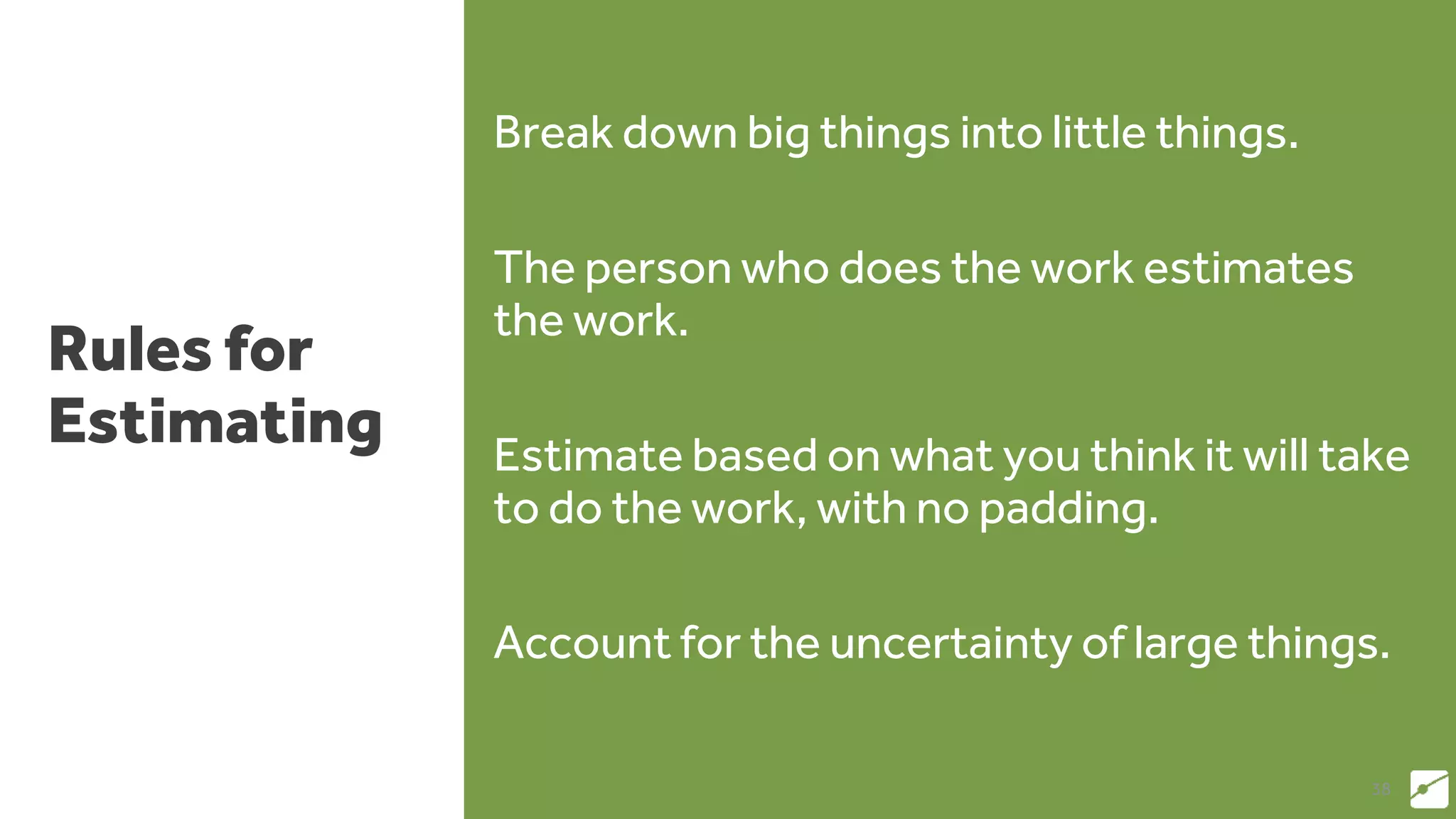
Rules for
Estimating
Break down big things into little things.
The person who does the work estimates
the work.
Estimate based on what you think it will take
to do the work, with no padding.
Account for the uncertainty of large things.
38
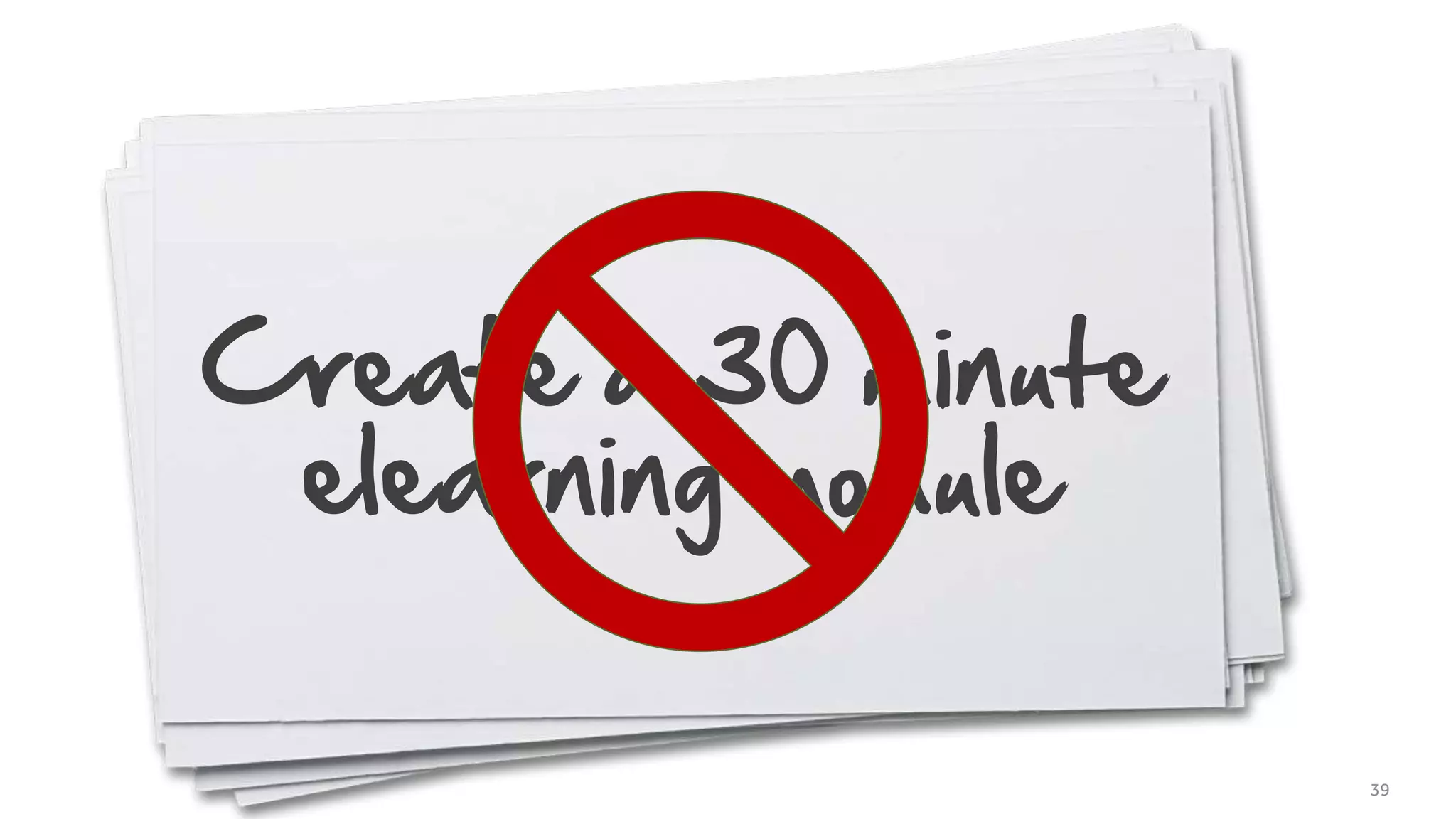
Create a 30 minute
elearning module
39
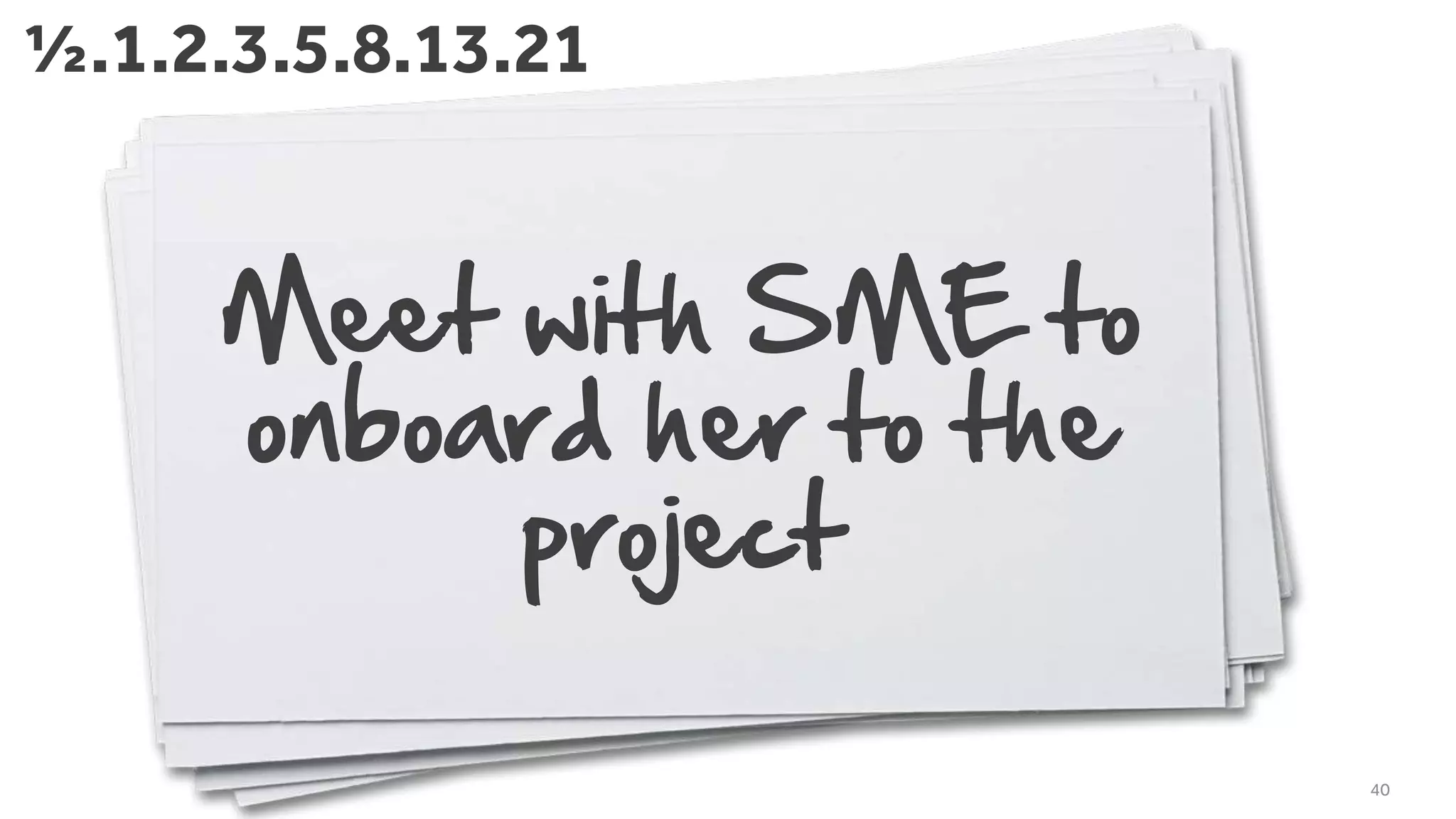
Meet with SME to
onboard her to the
project
40
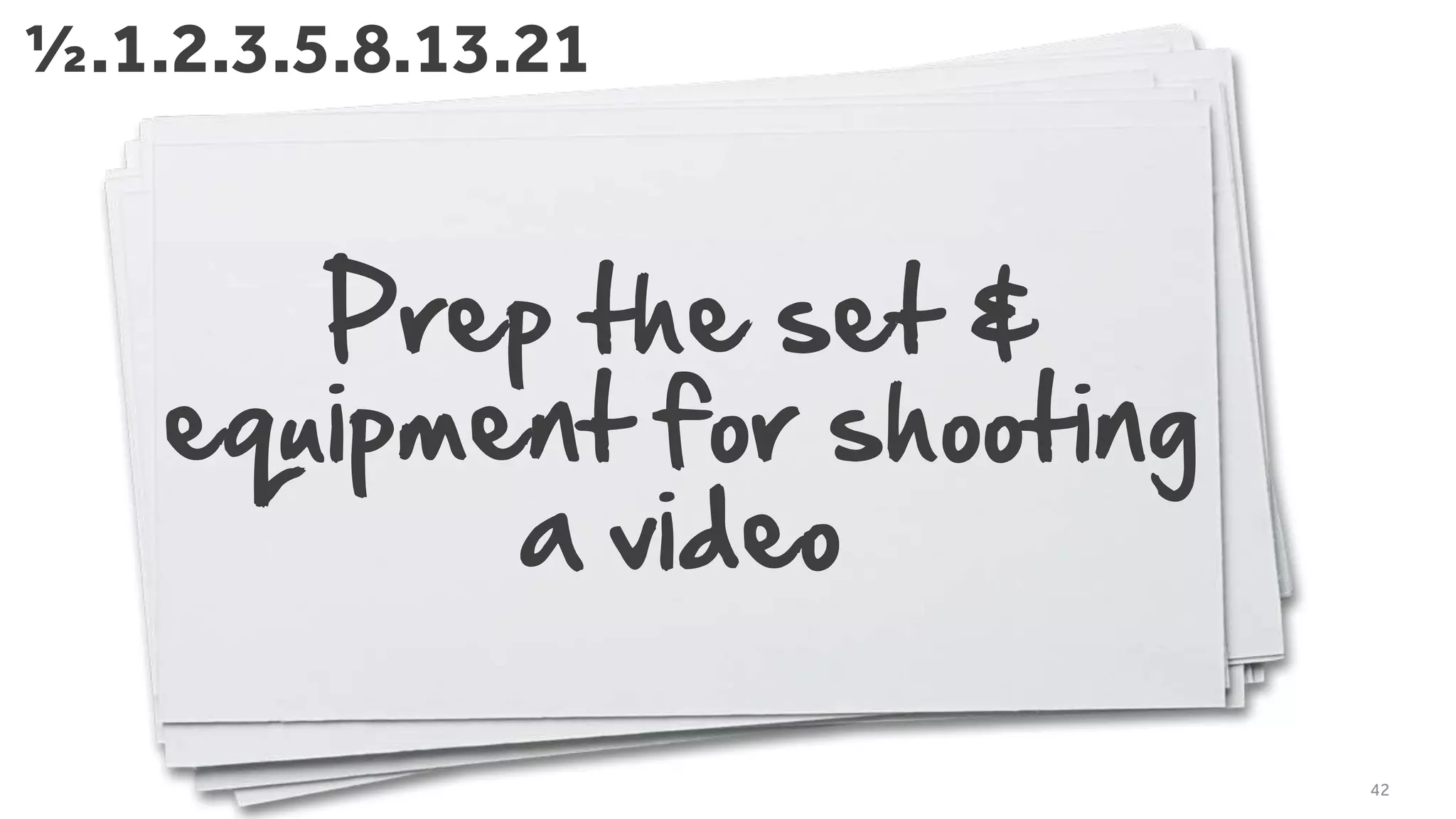
½.1.2.3.5.8.13.21
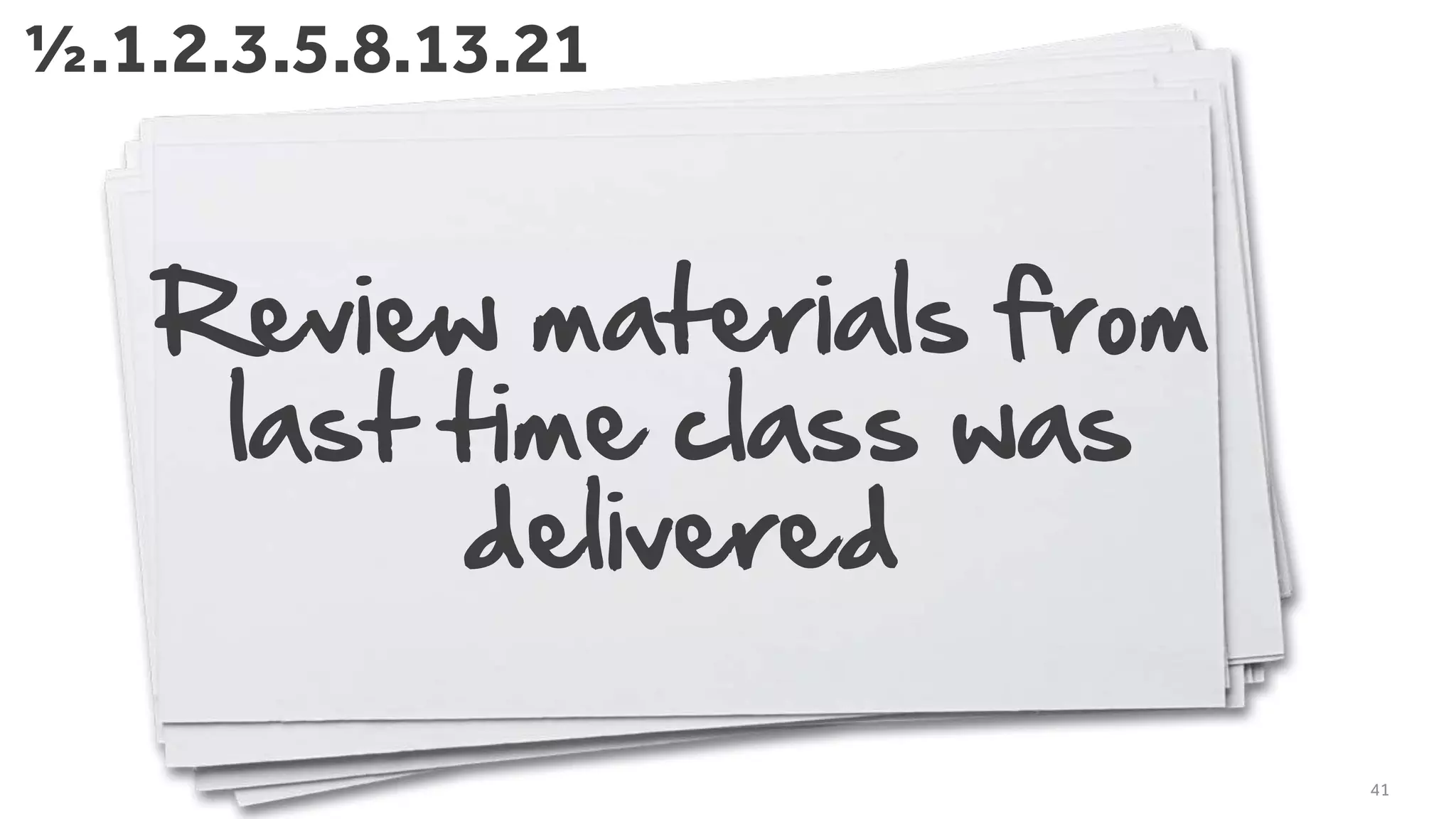
Review materials from
last time class was
delivered
41
½.1.2.3.5.8.13.21
Prep the set &
equipment for shooting
a video
42
½.1.2.3.5.8.13.21
Set up quiz questions
in course authoring
package
43
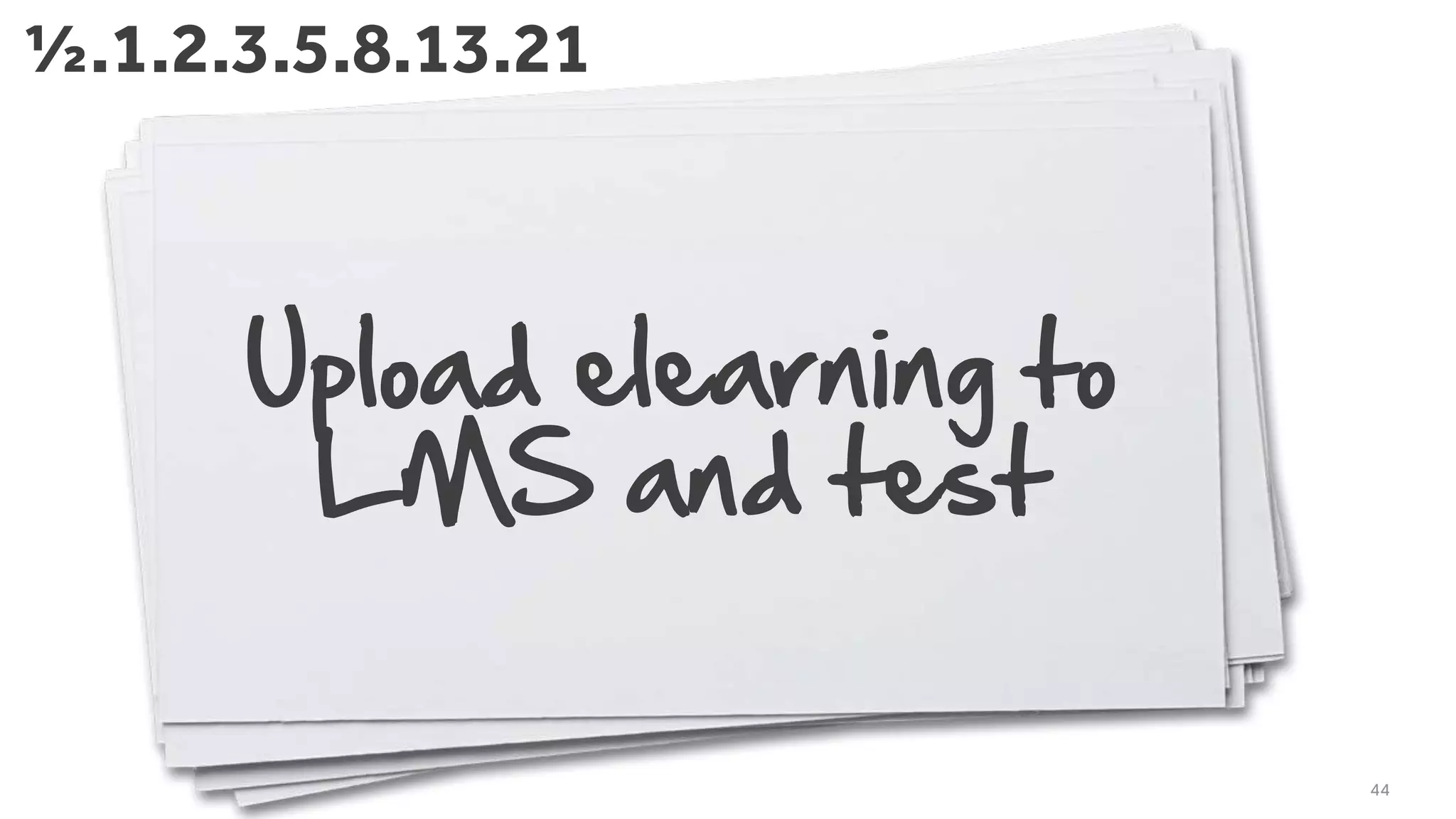
½.1.2.3.5.8.13.21
Upload elearning to
LMS and test
44
½.1.2.3.5.8.13.21
Write the level 1
evaluation for this
course
45
½.1.2.3.5.8.13.21
Why might an estimate
be wrong?
46
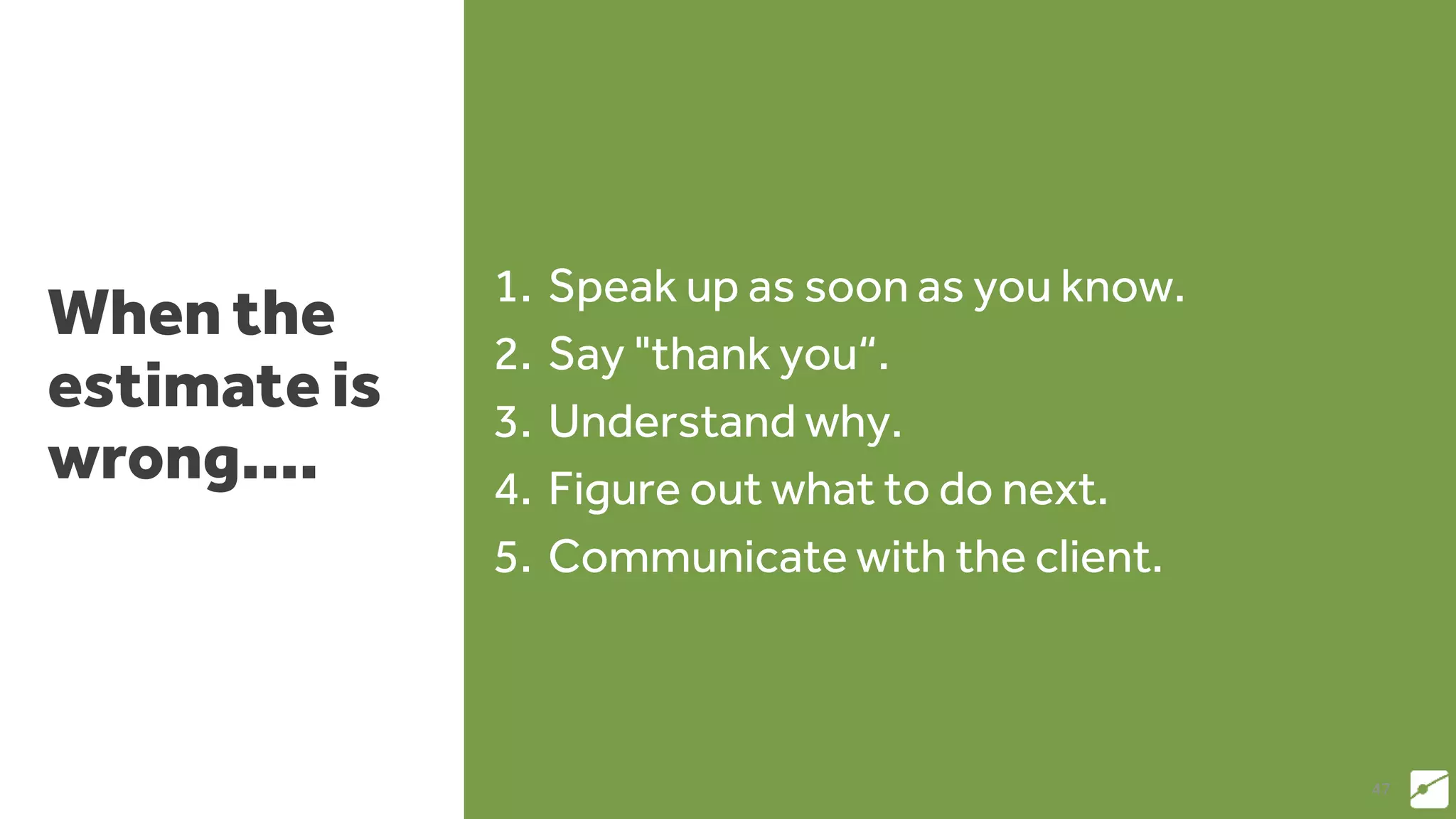
When the
estimate is
wrong....
1. Speak up as soon as you know.
2. Say "thank you“.
3. Understand why.
4. Figure out what to do next.
5. Communicate with the client.
47
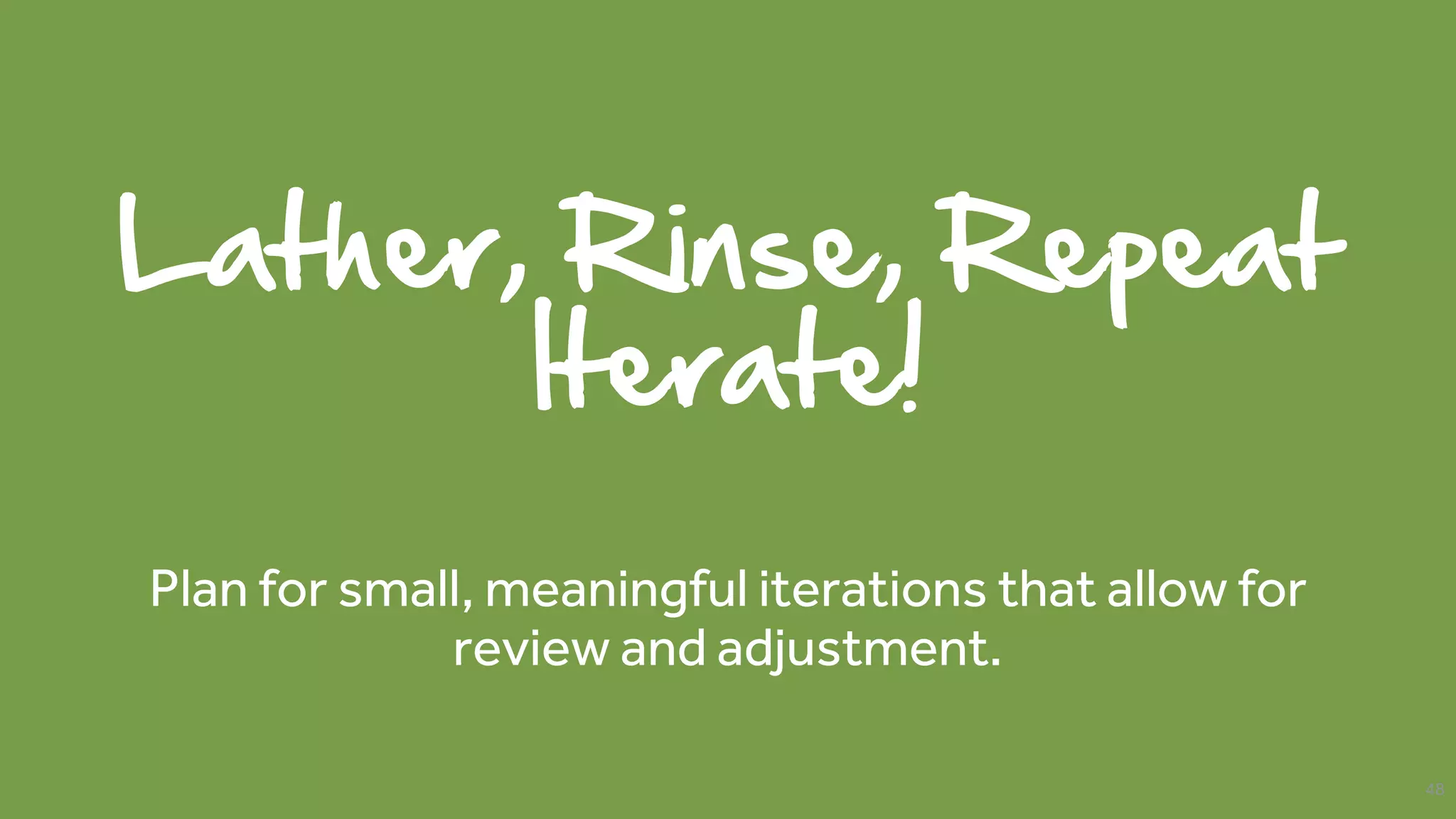
Lather, Rinse, Repeat
Iterate!
Plan for small, meaningful iterations that allow for
review and adjustment.
48
Make small mistakes faster.
Skip the big mistakes.
49Richard Sheridan, Agile Explained
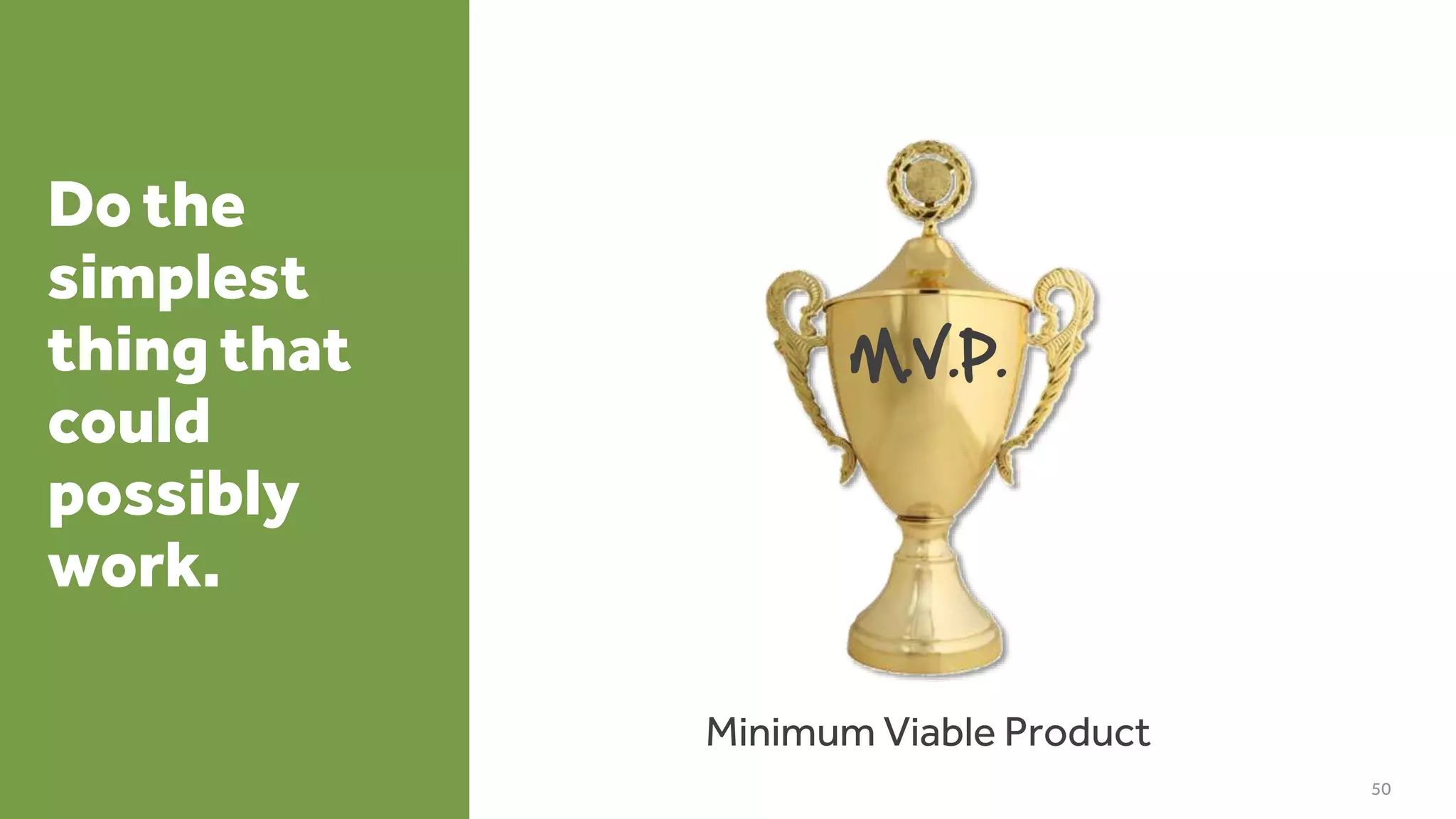
Do the
simplest
thing that
could
possibly
work.
50
M.V.P.
Minimum Viable Product
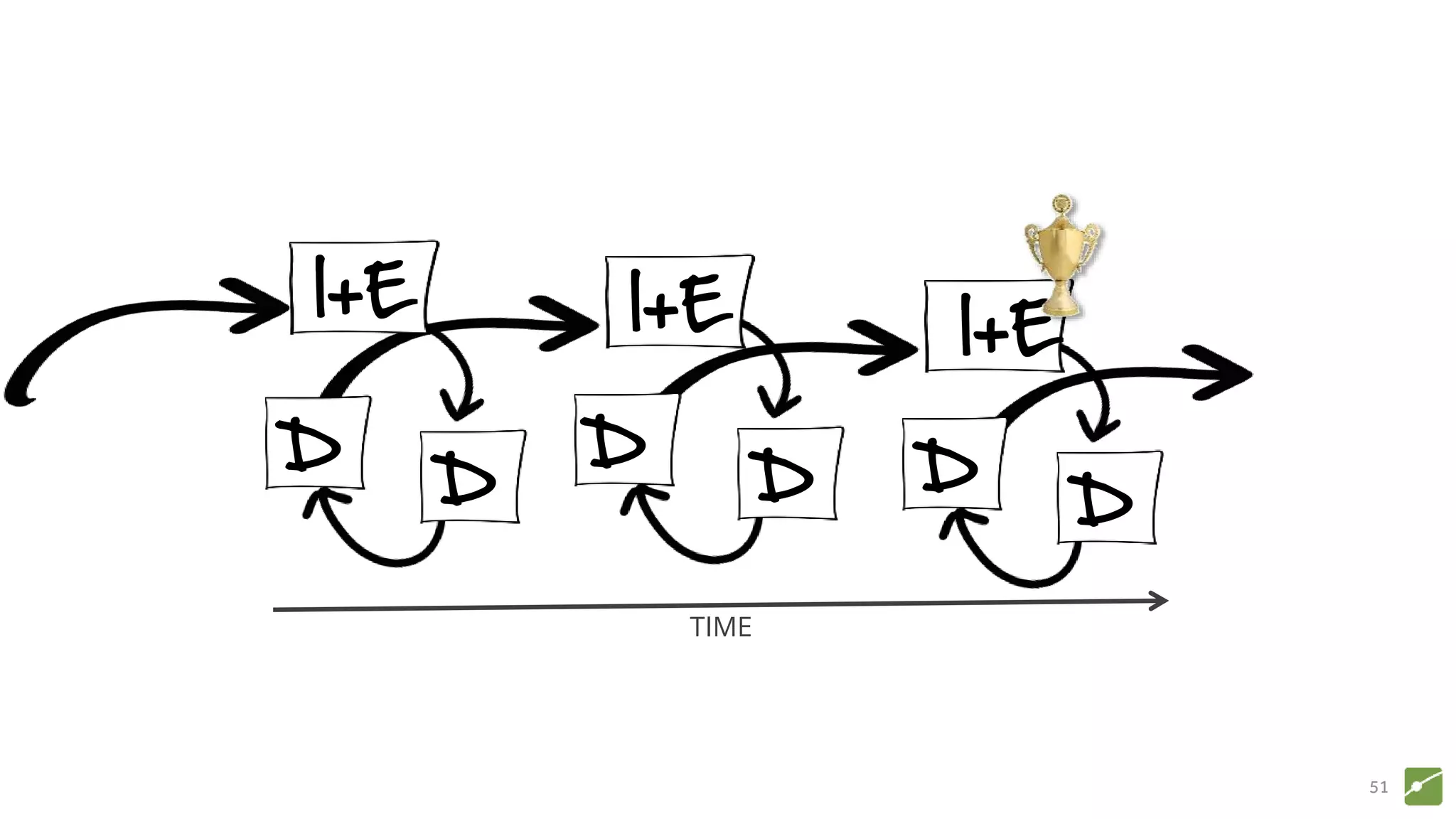
51
D
I+E
D
I+E
D
DD D
TIME
I+E
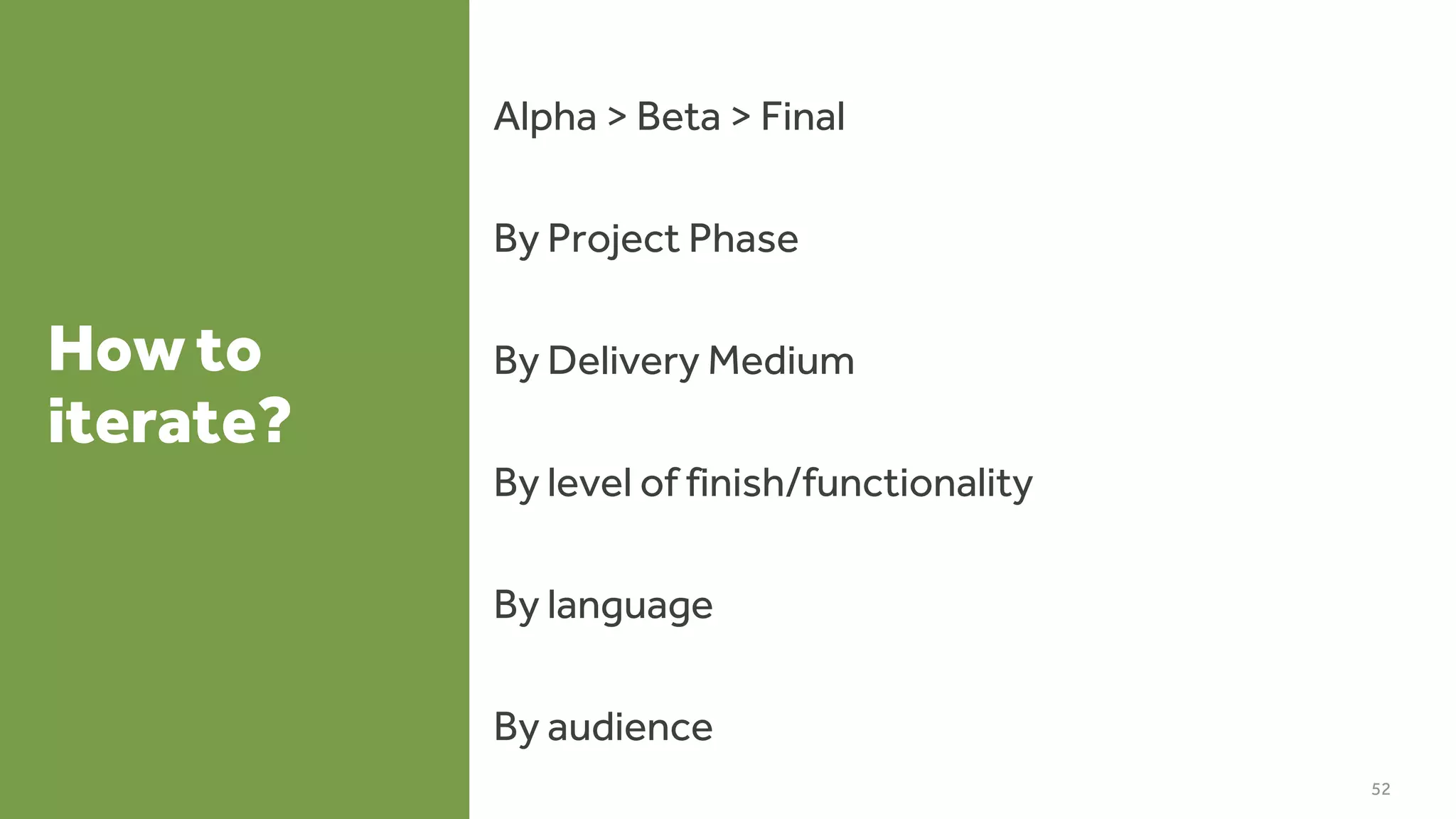
How to
iterate?
Alpha > Beta > Final
By Project Phase
By Delivery Medium
By level of finish/functionality
By language
By audience
52
Megan’s
Rules for
Iterations
It does real work.
Someone else has to use it.
You gather data.
Data informs the work to do in the next
iteration.
53
Plan the project
Prioritize and schedule work & the resources you need
54
Zero-
Surprises
Projects
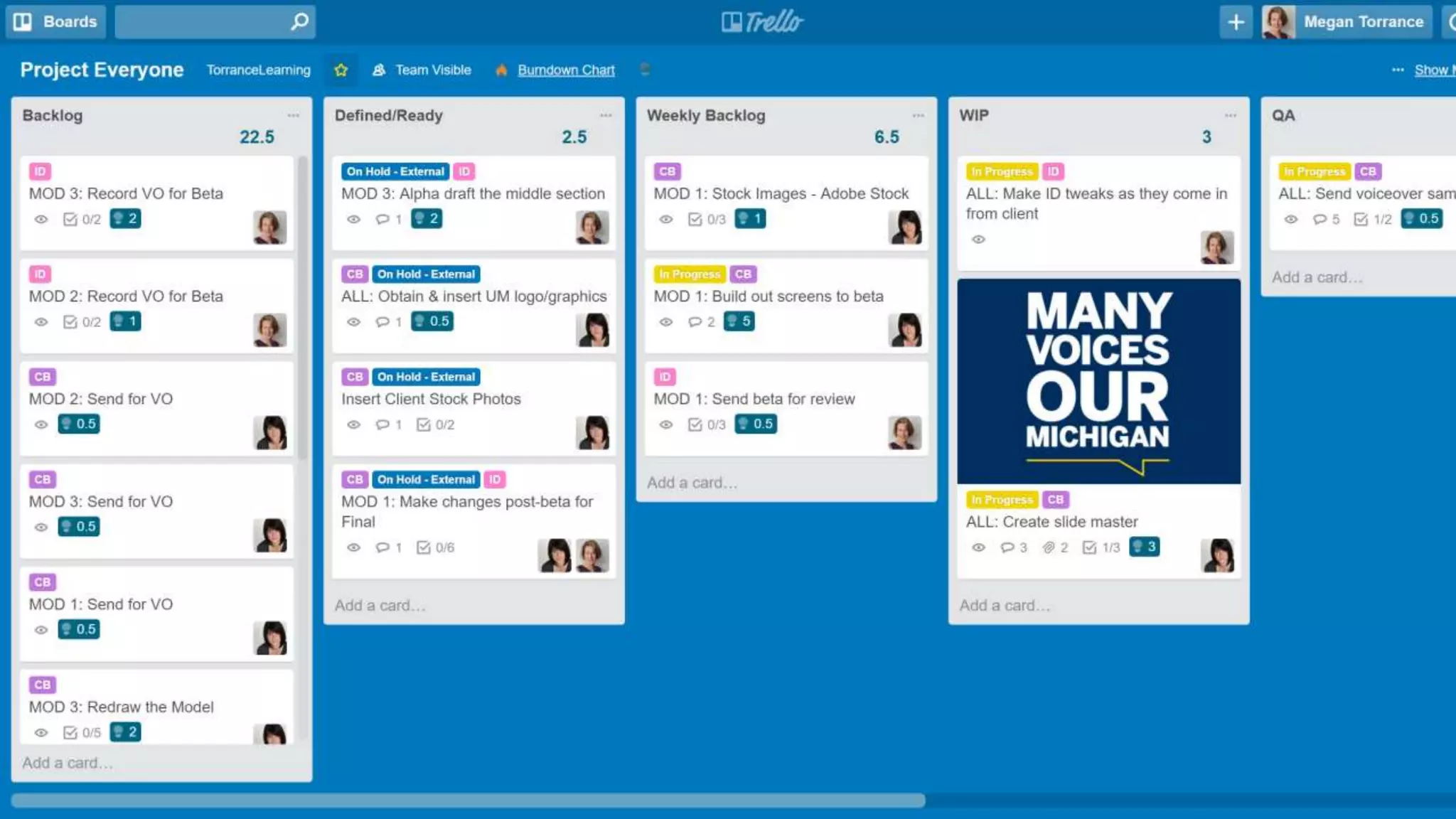
1. Break big things into little ones.
2. Plan from the big to the little.
3. Work from the little to the big.
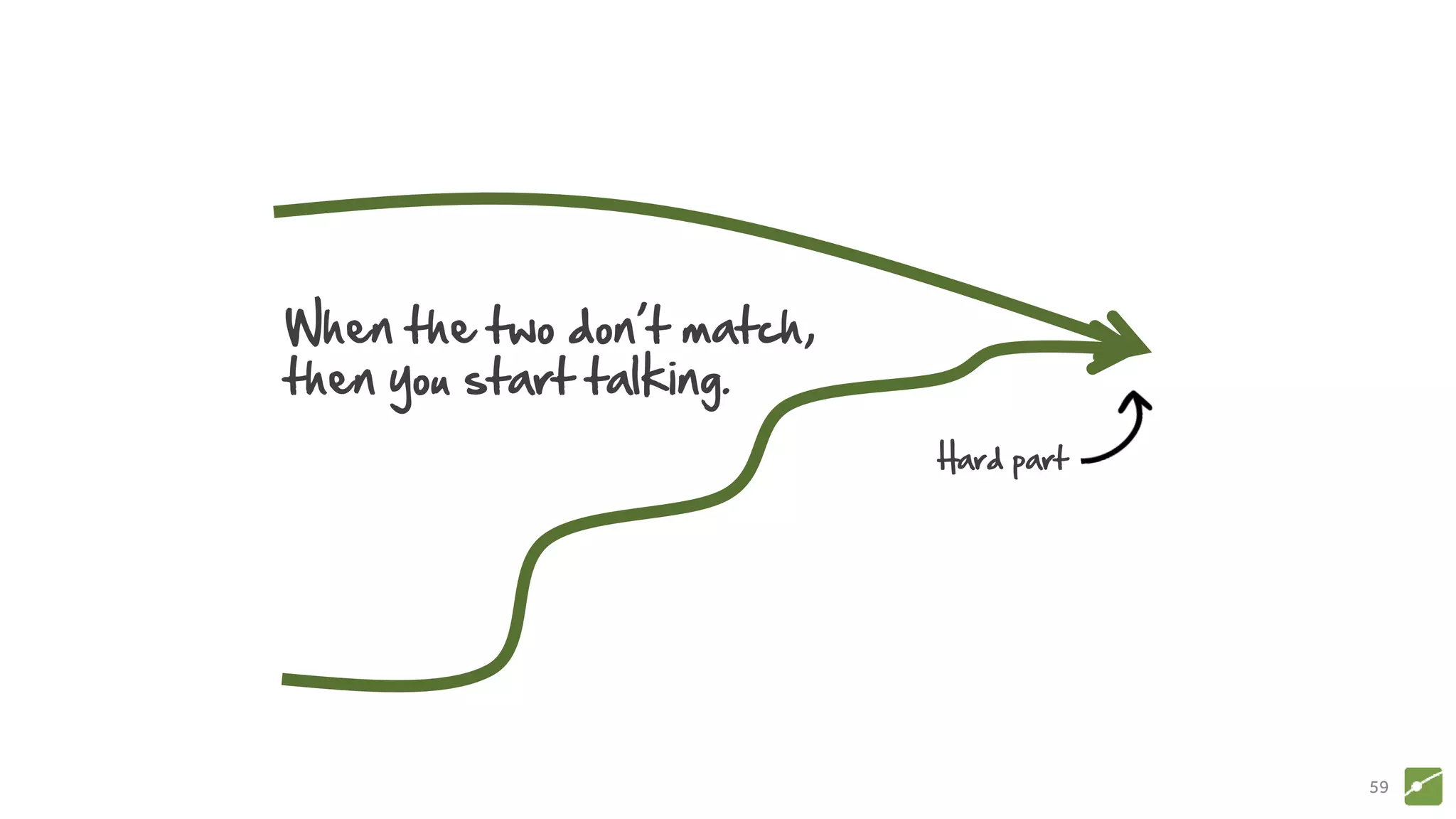
(if they don’t match, start talking)
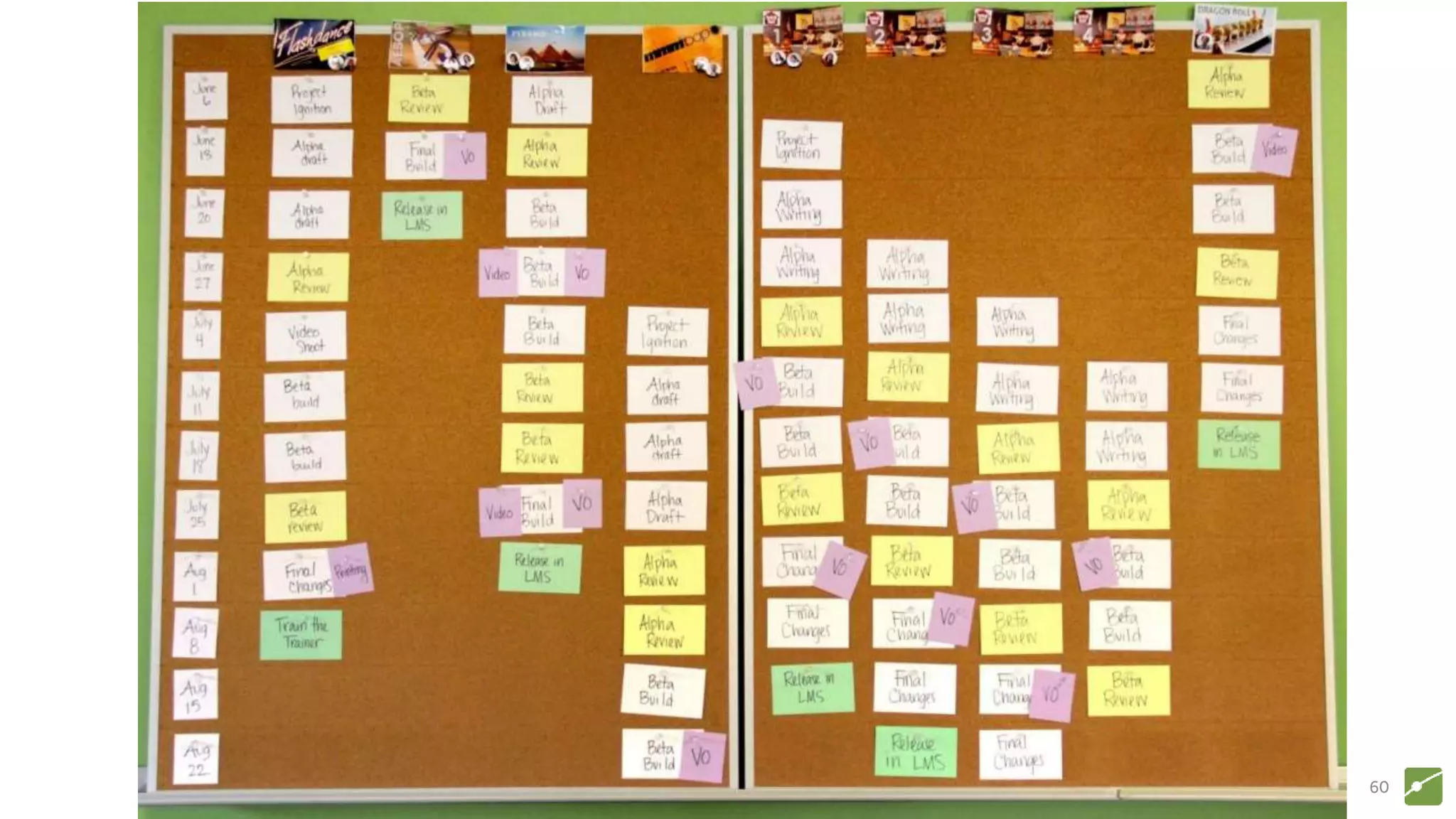
4. Make it visual.
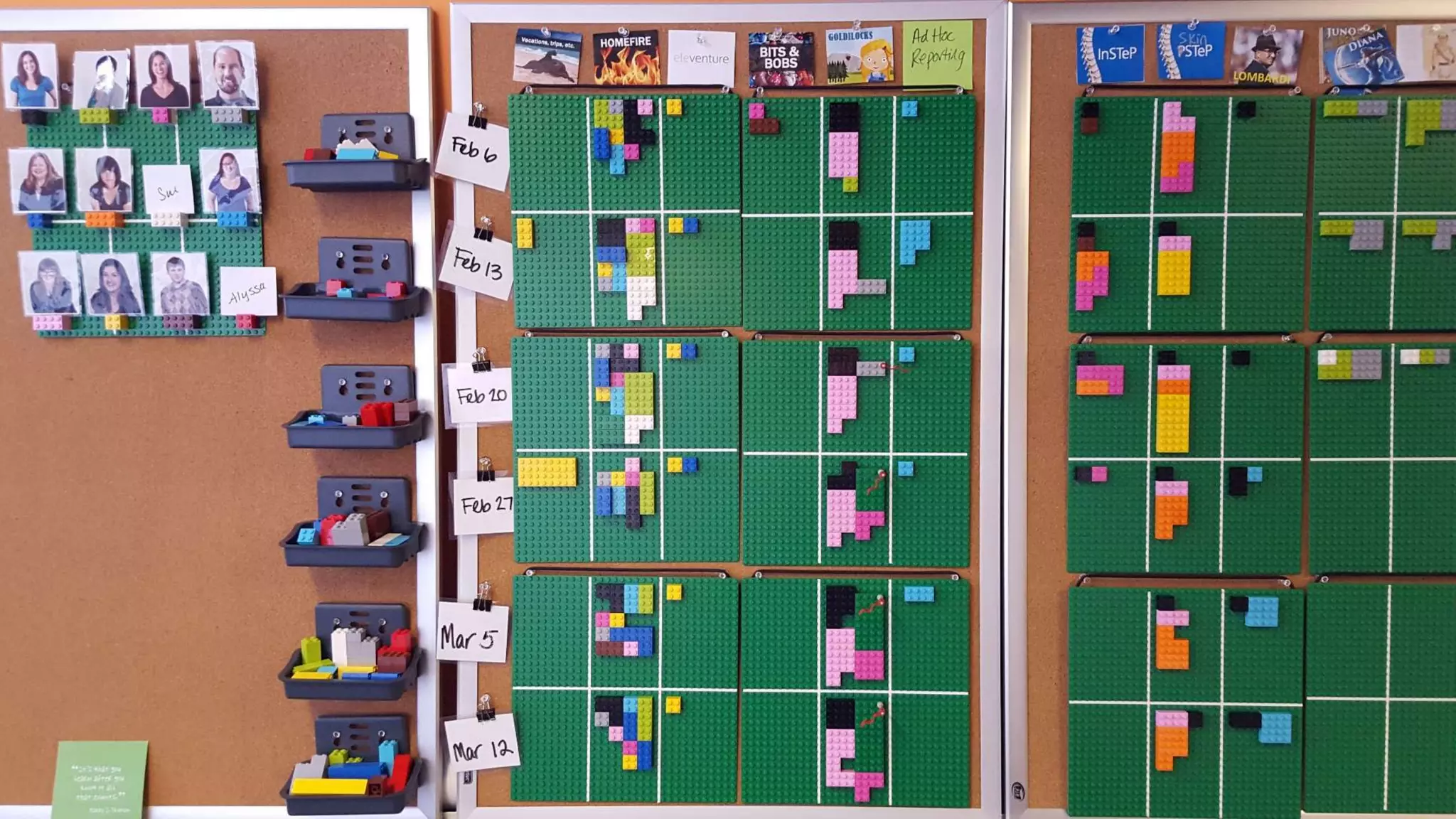
55
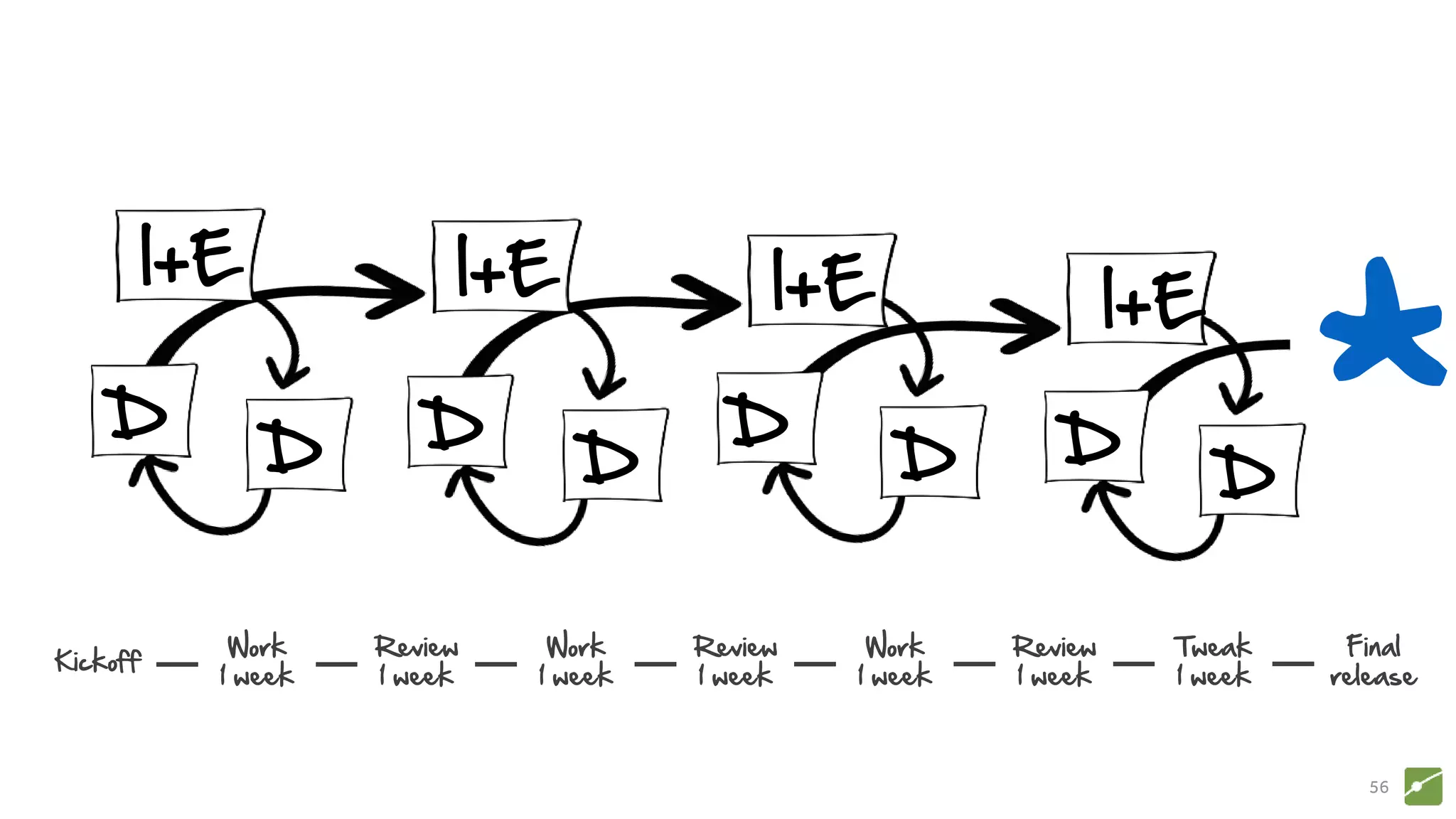
56
D
I+E
D
I+E
D
DD D
I+E
D
D
I+E
*Work
1 week
Review
1 week
Work
1 week
Review
1 week
Work
1 week
Review
1 week
Tweak
1 week
Final
release
Kickoff
57
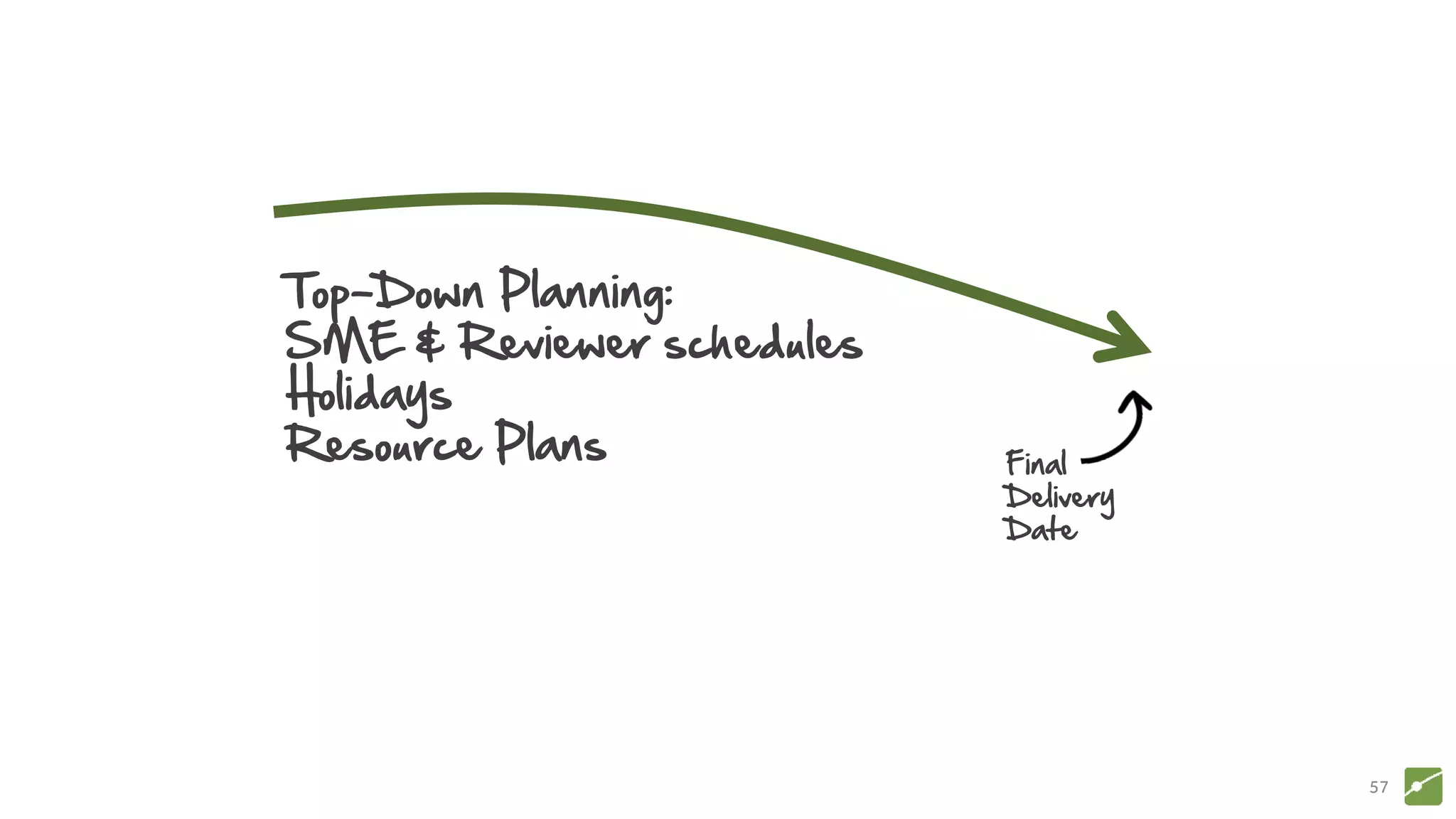
Top-Down Planning:
SME & Reviewer schedules
Holidays
Resource Plans Final
Delivery
Date
58
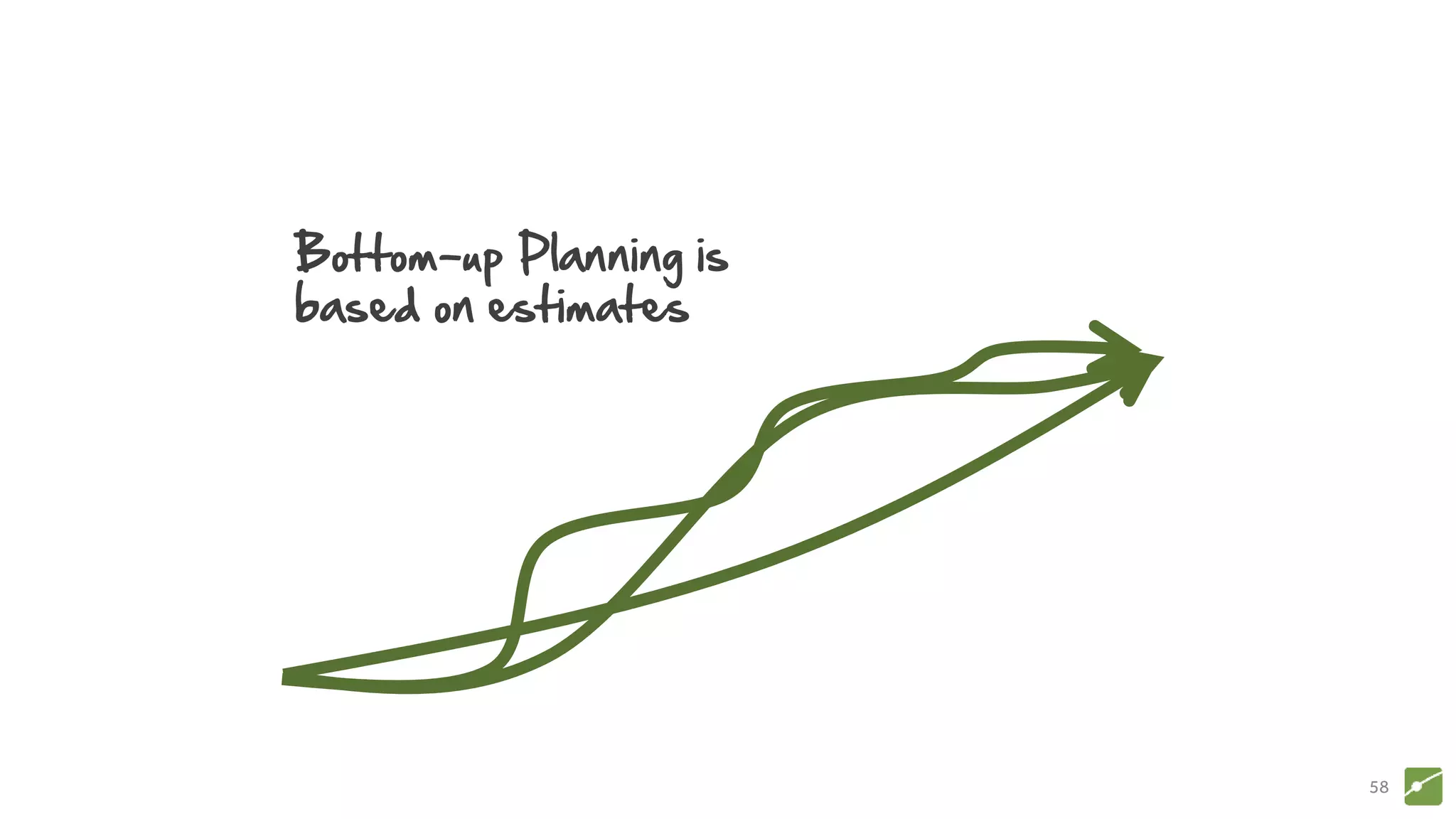
Bottom-up Planning is
based on estimates
59
When the two don’t match,
then you start talking.
Hard part
60
61
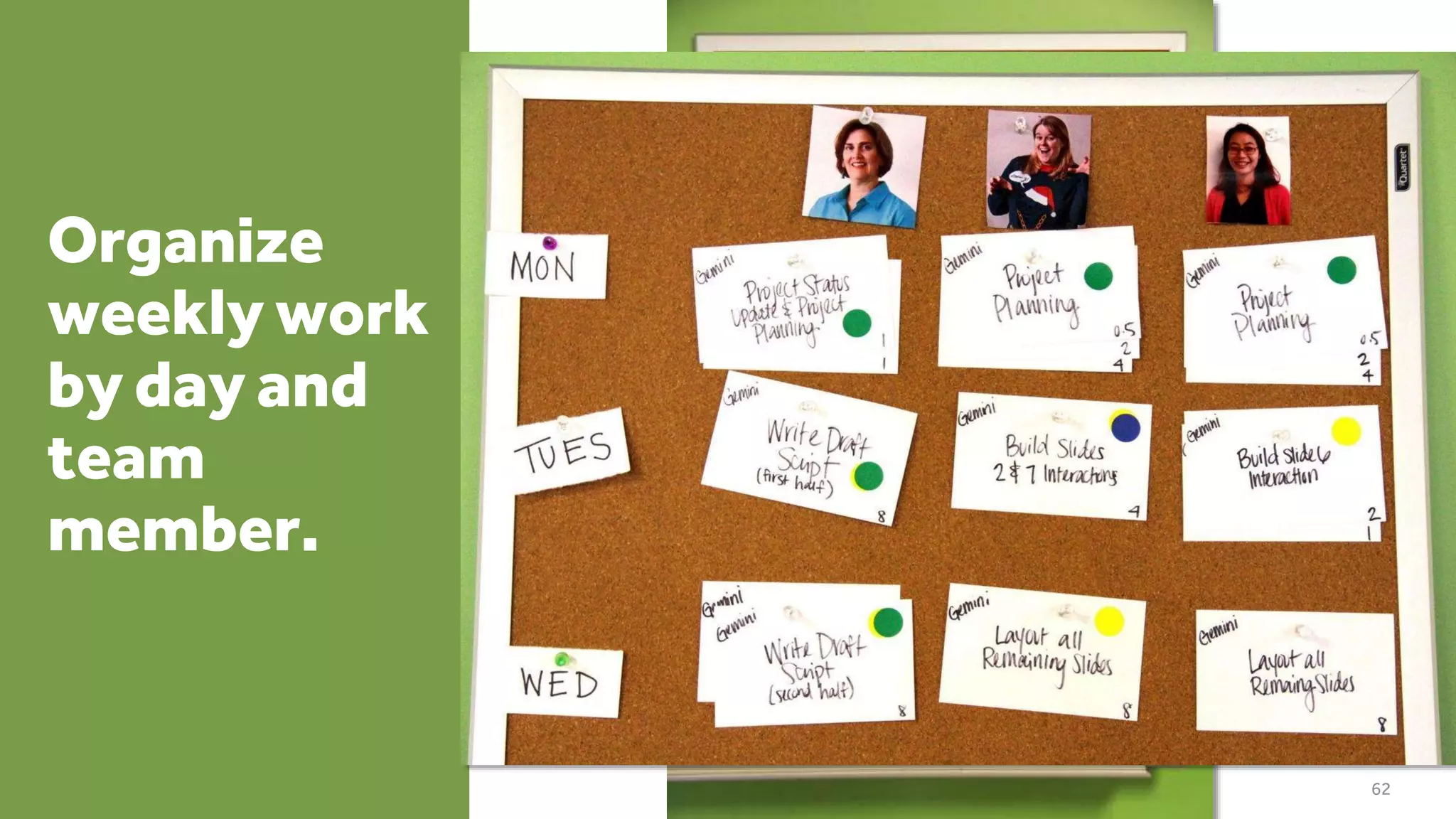
Organize
weekly work
by day and
team
member.
62
63
Build the case for Agile
Deliver projects
on time, in
budget, that
meet the need
Describe it to others
Write learner personas
Define the scope
Build the environment
Get started!
Estimate the effort
!
Plan the project
Develop in iterations
Align with goals
Identify work tasks Kick off the project
Make it your own
What will you do in:
30 days | 60 days | 90 days
65
Megan Torrance
mtorrance@torrancelearning.com
@MMTorrance | @xAPIGnome | @Tlearning
Questions &
Thoughts?
66

Agile & LLAMA For Instructional Designers DevCamp 2019 S101