AW9
Concurrent	Session	
11/11/15	2:45pm	


“Agile Adoption in Risk-Averse Environments”
	
	
Presented by:
Brian Duncan
Johns Hopkins Applied Physics Laboratory


Brought	to	you	by:	


340	Corporate	Way,	Suite	300,	Orange	Park,	FL	32073	
888-268-8770	·	904-278-0524	·	info@techwell.com	·	www.techwell.com
Brian Duncan
Johns Hopkins Applied Physics Laboratory
Passionate about software development, Brian Duncan has led highly efficient software teams in the
commercial and government sectors for more than twenty years. Having introduced agile software
methods in two very different cultural organizations, Brian understands the steps necessary for technical
training, social engineering, and project adoption at all levels of the company hierarchy. A strong leader,
coach, and technical manager, Brian knows how to help people reach their maximum potential in small
agile teams. Currently working agile adoption at the Johns Hopkins Applied Physics Laboratory, Brian
works with multidisciplinary teams developing space projects for NASA and DoD sponsors. Contact him
at brian.duncan@jhuapl.edu.
10/6/2015
1
Agile Adoption in
Risk-Averse Environments
Brian P. Duncan
11 November, 2015
Introduction
• This talk is not “Agile 101”
• Purpose of this presentation: helping agile
get incorporated into your environment
• Especially if your organization is not
necessarily open to change
10/6/2015
2
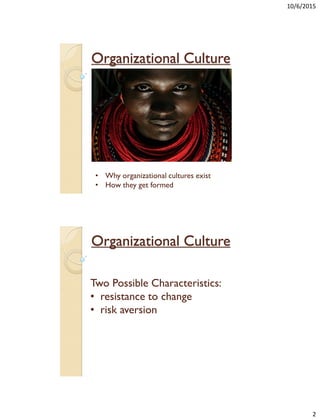
Organizational Culture
• Why organizational cultures exist
• How they get formed
Organizational Culture
Two Possible Characteristics:
• resistance to change
• risk aversion
10/6/2015
3
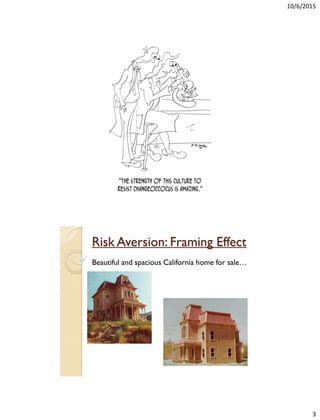
Risk Aversion: Framing Effect
Beautiful and spacious California home for sale…
10/6/2015
4
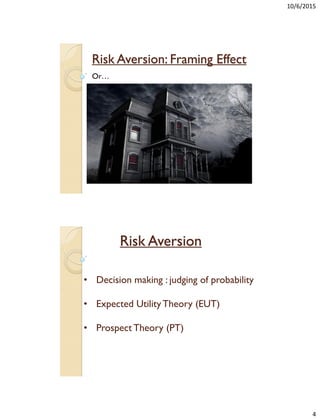
Risk Aversion: Framing Effect
Or…
Risk Aversion
• Decision making : judging of probability
• Expected UtilityTheory (EUT)
• Prospect Theory (PT)
10/6/2015
5
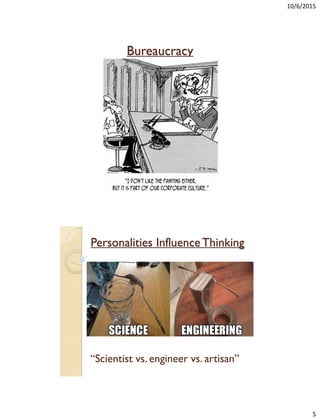
Bureaucracy
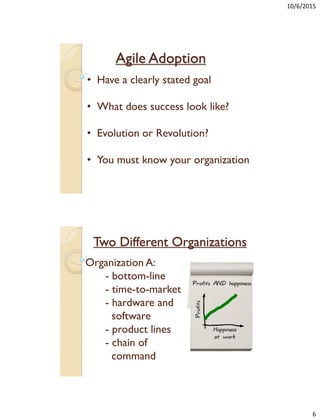
Personalities InfluenceThinking
“Scientist vs. engineer vs. artisan”
10/6/2015
6
Agile Adoption
• Have a clearly stated goal
• What does success look like?
• Evolution or Revolution?
• You must know your organization
Two Different Organizations
Organization A:
- bottom-line
- time-to-market
- hardware and
software
- product lines
- chain of
command
10/6/2015
7
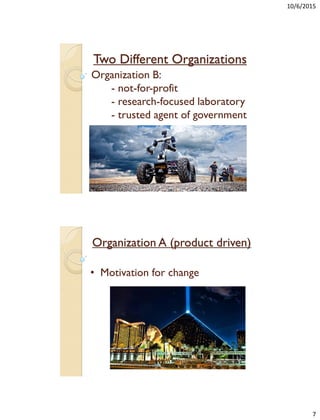
Two Different Organizations
Organization B:
- not-for-profit
- research-focused laboratory
- trusted agent of government
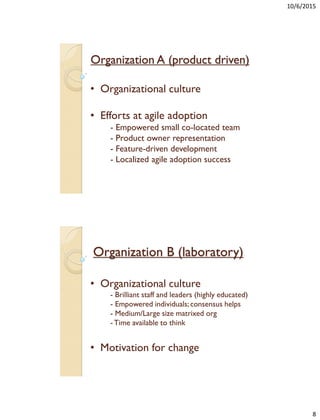
Organization A (product driven)
• Motivation for change
10/6/2015
8
Organization A (product driven)
• Organizational culture
• Efforts at agile adoption
- Empowered small co-located team
- Product owner representation
- Feature-driven development
- Localized agile adoption success
Organization B (laboratory)
• Organizational culture
- Brilliant staff and leaders (highly educated)
- Empowered individuals;consensus helps
- Medium/Large size matrixed org
-Time available to think
• Motivation for change
10/6/2015
9
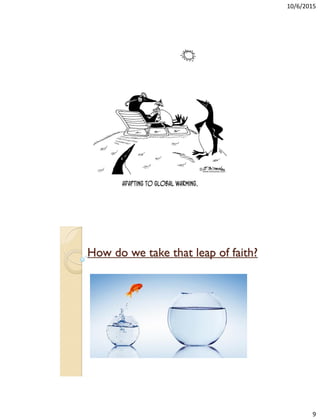
How do we take that leap of faith?
10/6/2015
10
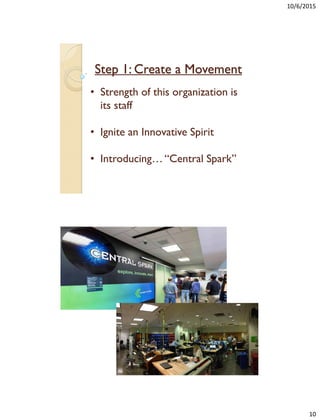
Step 1: Create a Movement
• Strength of this organization is
its staff
• Ignite an Innovative Spirit
• Introducing… “Central Spark”
10/6/2015
11
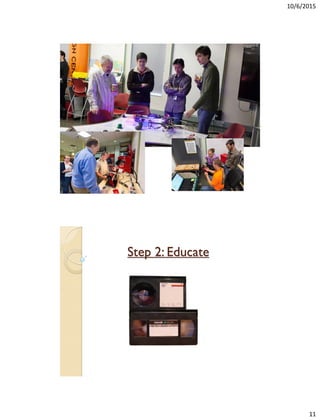
Step 2: Educate
10/6/2015
12
Educate
• Brown-bag lunches
• AgileTraining classes
• Agile Panel Discussions
• “Agile Central” – support system
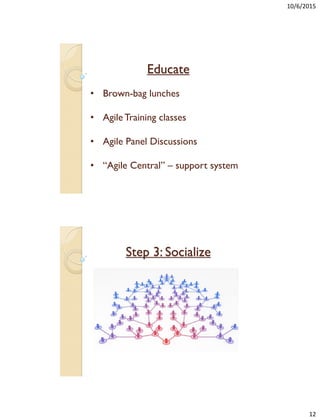
Step 3: Socialize
10/6/2015
13
Educational Thrust
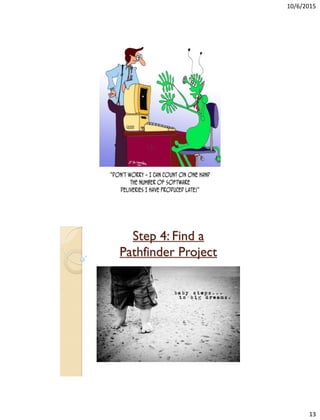
Step 4: Find a
Pathfinder Project
10/6/2015
14
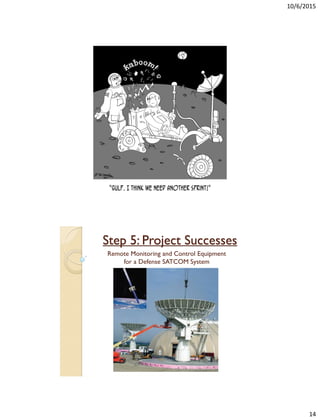
Step 5: Project Successes
Remote Monitoring and Control Equipment
for a Defense SATCOM System
10/6/2015
15
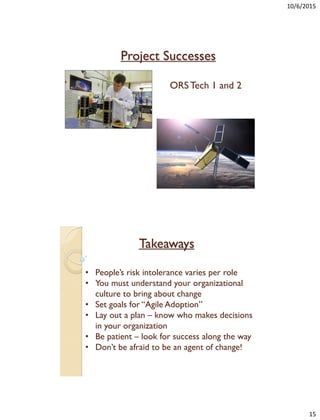
Project Successes
ORS Tech 1 and 2
Takeaways
• People’s risk intolerance varies per role
• You must understand your organizational
culture to bring about change
• Set goals for “Agile Adoption”
• Lay out a plan – know who makes decisions
in your organization
• Be patient – look for success along the way
• Don’t be afraid to be an agent of change!
10/6/2015
16
Questions?

Agile Adoption in Risk-Averse Environments

  • 1.
    AW9 Concurrent Session 11/11/15 2:45pm “Agile Adoption inRisk-Averse Environments” Presented by: Brian Duncan Johns Hopkins Applied Physics Laboratory Brought to you by: 340 Corporate Way, Suite 300, Orange Park, FL 32073 888-268-8770 · 904-278-0524 · info@techwell.com · www.techwell.com
  • 2.
    Brian Duncan Johns HopkinsApplied Physics Laboratory Passionate about software development, Brian Duncan has led highly efficient software teams in the commercial and government sectors for more than twenty years. Having introduced agile software methods in two very different cultural organizations, Brian understands the steps necessary for technical training, social engineering, and project adoption at all levels of the company hierarchy. A strong leader, coach, and technical manager, Brian knows how to help people reach their maximum potential in small agile teams. Currently working agile adoption at the Johns Hopkins Applied Physics Laboratory, Brian works with multidisciplinary teams developing space projects for NASA and DoD sponsors. Contact him at brian.duncan@jhuapl.edu.
  • 3.
    10/6/2015 1 Agile Adoption in Risk-AverseEnvironments Brian P. Duncan 11 November, 2015 Introduction • This talk is not “Agile 101” • Purpose of this presentation: helping agile get incorporated into your environment • Especially if your organization is not necessarily open to change
  • 4.
    10/6/2015 2 Organizational Culture • Whyorganizational cultures exist • How they get formed Organizational Culture Two Possible Characteristics: • resistance to change • risk aversion
  • 5.
    10/6/2015 3 Risk Aversion: FramingEffect Beautiful and spacious California home for sale…
  • 6.
    10/6/2015 4 Risk Aversion: FramingEffect Or… Risk Aversion • Decision making : judging of probability • Expected UtilityTheory (EUT) • Prospect Theory (PT)
  • 7.
  • 8.
    10/6/2015 6 Agile Adoption • Havea clearly stated goal • What does success look like? • Evolution or Revolution? • You must know your organization Two Different Organizations Organization A: - bottom-line - time-to-market - hardware and software - product lines - chain of command
  • 9.
    10/6/2015 7 Two Different Organizations OrganizationB: - not-for-profit - research-focused laboratory - trusted agent of government Organization A (product driven) • Motivation for change
  • 10.
    10/6/2015 8 Organization A (productdriven) • Organizational culture • Efforts at agile adoption - Empowered small co-located team - Product owner representation - Feature-driven development - Localized agile adoption success Organization B (laboratory) • Organizational culture - Brilliant staff and leaders (highly educated) - Empowered individuals;consensus helps - Medium/Large size matrixed org -Time available to think • Motivation for change
  • 11.
    10/6/2015 9 How do wetake that leap of faith?
  • 12.
    10/6/2015 10 Step 1: Createa Movement • Strength of this organization is its staff • Ignite an Innovative Spirit • Introducing… “Central Spark”
  • 13.
  • 14.
    10/6/2015 12 Educate • Brown-bag lunches •AgileTraining classes • Agile Panel Discussions • “Agile Central” – support system Step 3: Socialize
  • 15.
    10/6/2015 13 Educational Thrust Step 4:Find a Pathfinder Project
  • 16.
    10/6/2015 14 Step 5: ProjectSuccesses Remote Monitoring and Control Equipment for a Defense SATCOM System
  • 17.
    10/6/2015 15 Project Successes ORS Tech1 and 2 Takeaways • People’s risk intolerance varies per role • You must understand your organizational culture to bring about change • Set goals for “Agile Adoption” • Lay out a plan – know who makes decisions in your organization • Be patient – look for success along the way • Don’t be afraid to be an agent of change!
  • 18.