Growth and Poverty in Africa
Presentation at REPOA 21st Annual Conference
Dar es Salaam, Tanzania, 6-7 April 2016
By Finn Tarp
UNU-WIDER’s 2014-18 Research Programme
• 3 Challenges
– Transformation
– Inclusion
– Sustainability
• 3 Concerns
– Africa’s inclusive growth
– Gender equity
– Aid effectiveness
• 3 Audiences
– Decision-makers in developing countries
– International agencies, both bilateral and multilateral
– Global research community
WIDER Supported Research Volumes
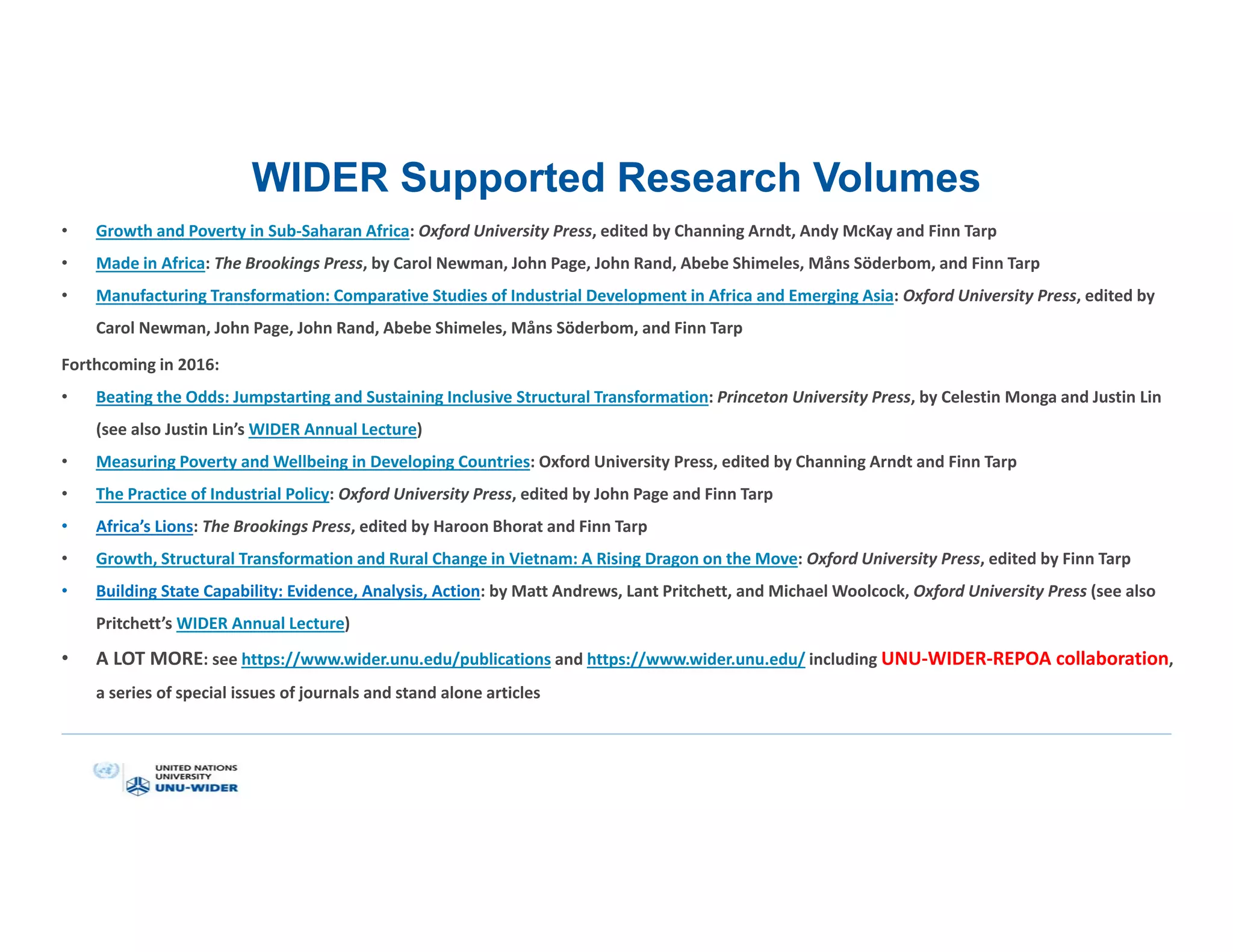
• Growth and Poverty in Sub-Saharan Africa: Oxford University Press, edited by Channing Arndt, Andy McKay and Finn Tarp
• Made in Africa: The Brookings Press, by Carol Newman, John Page, John Rand, Abebe Shimeles, Måns Söderbom, and Finn Tarp
• Manufacturing Transformation: Comparative Studies of Industrial Development in Africa and Emerging Asia: Oxford University Press, edited by
Carol Newman, John Page, John Rand, Abebe Shimeles, Måns Söderbom, and Finn Tarp
Forthcoming in 2016:
• Beating the Odds: Jumpstarting and Sustaining Inclusive Structural Transformation: Princeton University Press, by Celestin Monga and Justin Lin
(see also Justin Lin’s WIDER Annual Lecture)
• Measuring Poverty and Wellbeing in Developing Countries: Oxford University Press, edited by Channing Arndt and Finn Tarp
• The Practice of Industrial Policy: Oxford University Press, edited by John Page and Finn Tarp
• Africa’s Lions: The Brookings Press, edited by Haroon Bhorat and Finn Tarp
• Growth, Structural Transformation and Rural Change in Vietnam: A Rising Dragon on the Move: Oxford University Press, edited by Finn Tarp
• Building State Capability: Evidence, Analysis, Action: by Matt Andrews, Lant Pritchett, and Michael Woolcock, Oxford University Press (see also
Pritchett’s WIDER Annual Lecture)
• A LOT MORE: see https://www.wider.unu.edu/publications and https://www.wider.unu.edu/ including UNU-WIDER-REPOA collaboration,
a series of special issues of journals and stand alone articles
Africa
• The Economist (11 May 2000): Hopeless Africa
• The Independent (15 July 2009): Africa – the lost
continent
• The Economist (3 December 2011): The hopeful
continent – Africa rising
• A recent Afrobarometer survey suggests that ‘despite
high reported growth rates, lived poverty at the
grassroots remains little changed’ (Dulani et al. 2013);
and others even question the growth revival referring to
poor data
WIDER’s Growth and Poverty Project (GAPP)
• GAPP implemented 16 carefully designed country case studies among the 24
most populous countries in Africa [covering almost 75% of the population of the
region and 9 of the top 10 countries]
– Ethiopia, Ghana, Malawi, Rwanda, Uganda, Burkina Faso, Mozambique, Nigeria, Tanzania,
Zambia, Cameroon, Côte d’Ivoire, Kenya, Madagascar, South Africa, DRC
– Conducted by analysts with expert knowledge of the context and strengths and weaknesses
of the available data
• Focus on monetary and non-monetary indicators of well-being
• Key message: There is a lot to celebrate in African development – yet key
challenges remain
– By 2013 GDP/capita was only 7.7% higher than in 1974
– So two cheers, but not three
• Measuring Poverty and
Wellbeing in
Developing Countries
• Oxford University Press
• Edited by Channing
Arndt and Finn Tarp
Learning to Compete (L2C)
• A four year WIDER, Brookings and AfDB research programme, which offers a
comprehensive, comparative, cross-country analysis of Africa’s industrialization
experience
– Ethiopia, Ghana, Kenya, Mozambique, Nigeria, Senegal, Tanzania, Uganda, Tunesia, Cambodia,
Vietnam
– By teams of national and international researchers
• Focus: Why is there so little industry in Africa; does it matter; and what can be done
about it?
• Key message: changes in the global economy offer a window of opportunity – but
business as usual is not enough; only with a more strategic approach to industrial
development and a strong commitment of the region’s political leadership can Africa
industrialize.
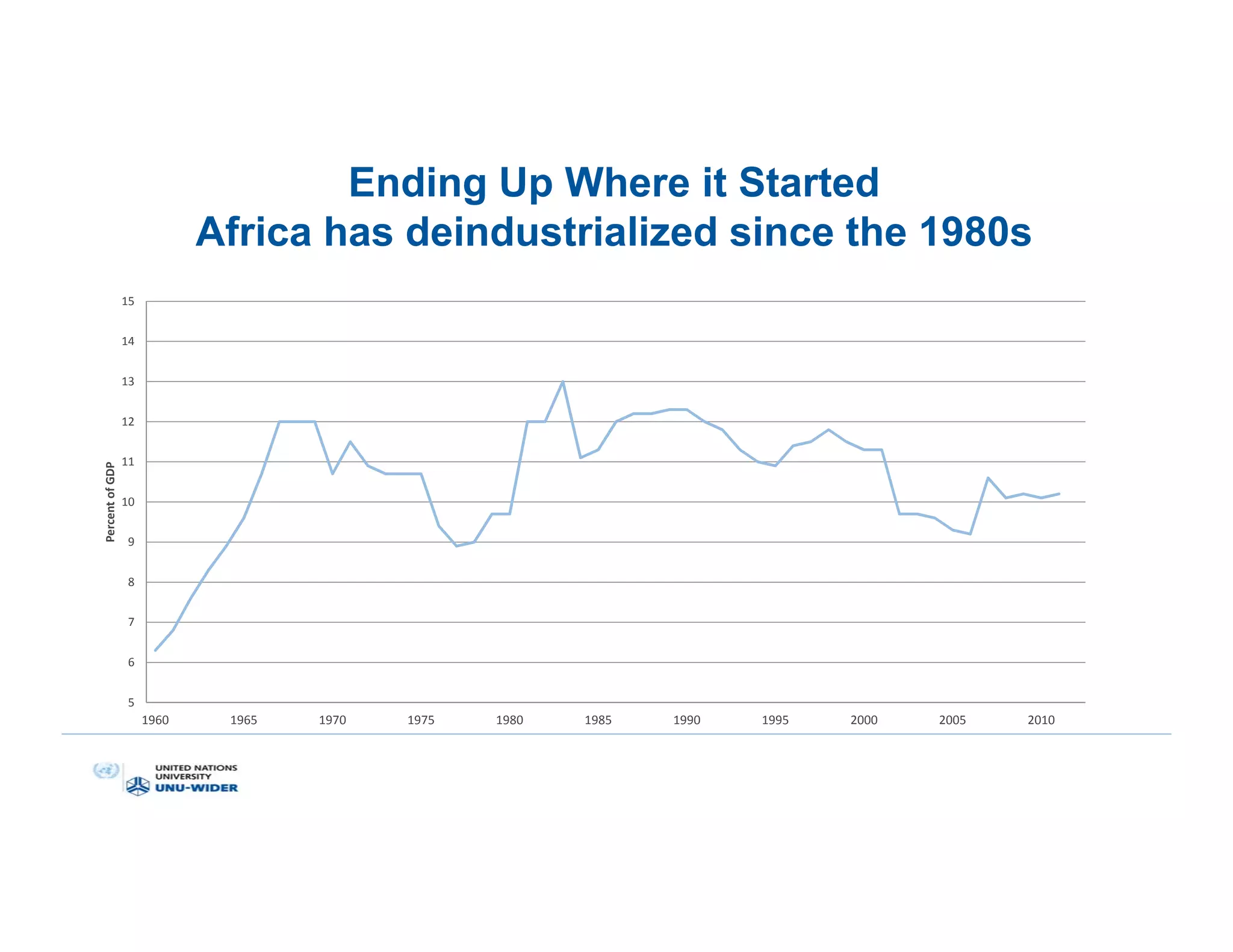
Ending Up Where it Started
Africa has deindustrialized since the 1980s
5
6
7
8
9
10
11
12
13
14
15
1960 1965 1970 1975 1980 1985 1990 1995 2000 2005 2010
PercentofGDP
• The practice of
industrial policy (OUP)
• Case studies of
government-business
relationships
• Edited by John Page and
Finn Tarp
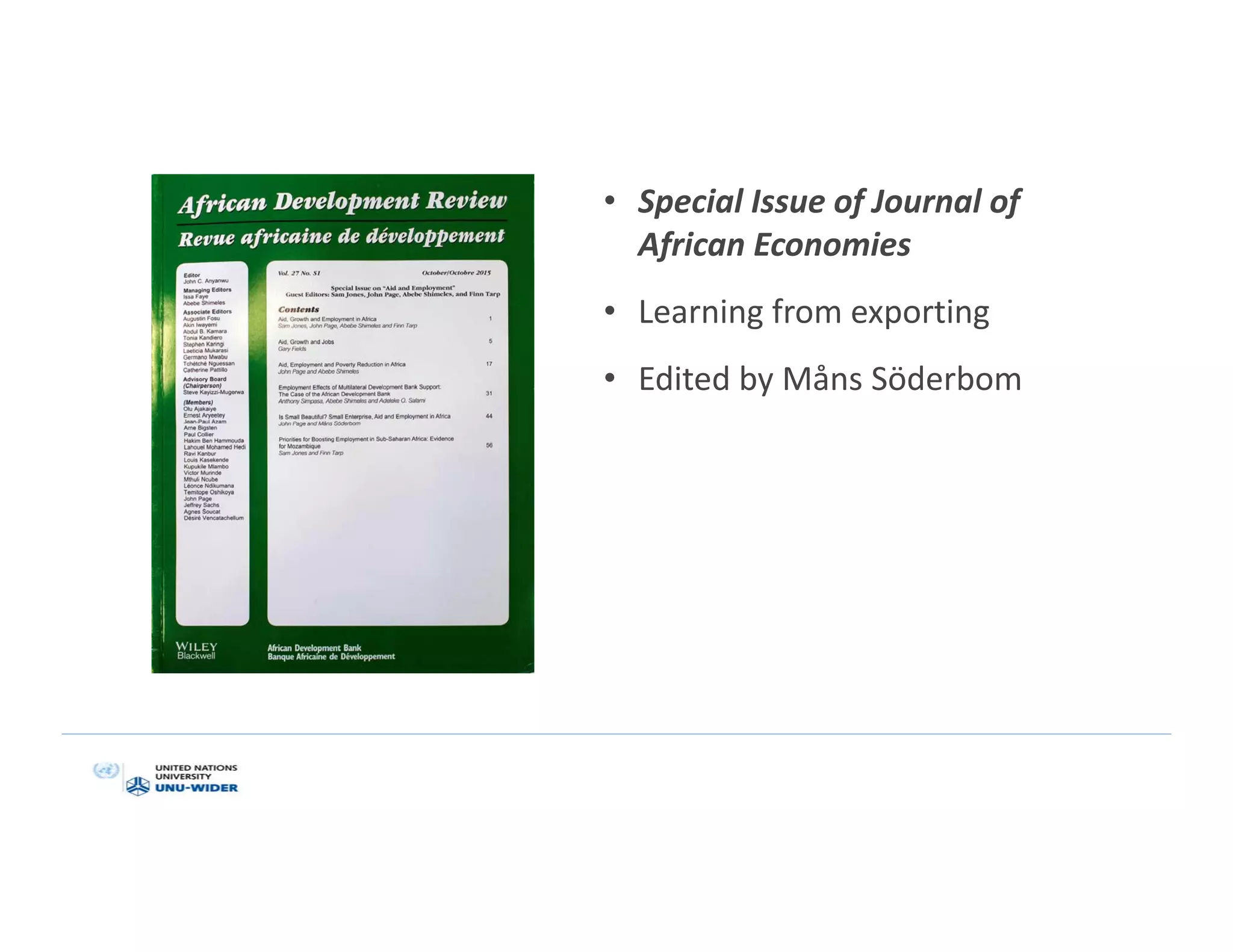
• Special Issue of Journal of
African Economies
• Learning from exporting
• Edited by Måns Söderbom
L2C Conference – Industrial development and policy in Africa
www1.wider.unu.edu/L2Cconf
The African Turn-Around
16 Country Cases (GAPP)
Summing-Up
• Progress in SSA has been markedly better than most expected 15 or 20 years ago
• Relative to previous periods, macroeconomic management has improved
significantly; a new generation of policy makers and business leaders have entered
the scene; and important gains have been registered in four key areas:
– Overall political stability (more democratic and accountable governments)
– Rates of economic growth
– A large array of non-monetary poverty indicators; and
– Monetary poverty as measured by household consumption
• Commodity prices played a role; yet there is a lot more going on: durable factors of
physical, human and institutional accumulation are at play
Summing-Up on Growth and Poverty Reduction for 16
Countries: Four Categories
• Relatively rapid economic growth and corresponding poverty reduction:
Ethiopia, Ghana, Malawi, Rwanda, and Uganda
• Relatively rapid economic growth and limited poverty reduction:
Burkina Faso, Mozambique, Nigeria, Tanzania, and Zambia
• Uninspiring or negative economic growth with corresponding stagnation
or increasing poverty: Cameroon, Côte d’Ivoire, Kenya, Madagascar, and
South Africa
• Low-information countries: DRC
Outstanding Challenges and a Thorny Dilemma
• Structural transformation slow
• Jobs and employment creation lagging
• Agriculture and industrialization constrained
• A long walk to prosperity: recall T x G = 69
• Demographic projections (2015-2050): from 7.3 to 9.7 billion, and
Africa’s population is set to double to 2.5 billion [bigger than both China
and India and Nigeria > US]
• In other words: a lot more policy action and finance in Africa is needed
UN High-Level Panel Report on the Post-2015
Development Agenda
• Calls for:
• “..A quantum leap forward in economic opportunities
and a profound economic transformation to end
extreme poverty and improve livelihoods…”
• How can aid help?
• Aid to social sectors builds human capital BUT being
educated & healthy is not enough
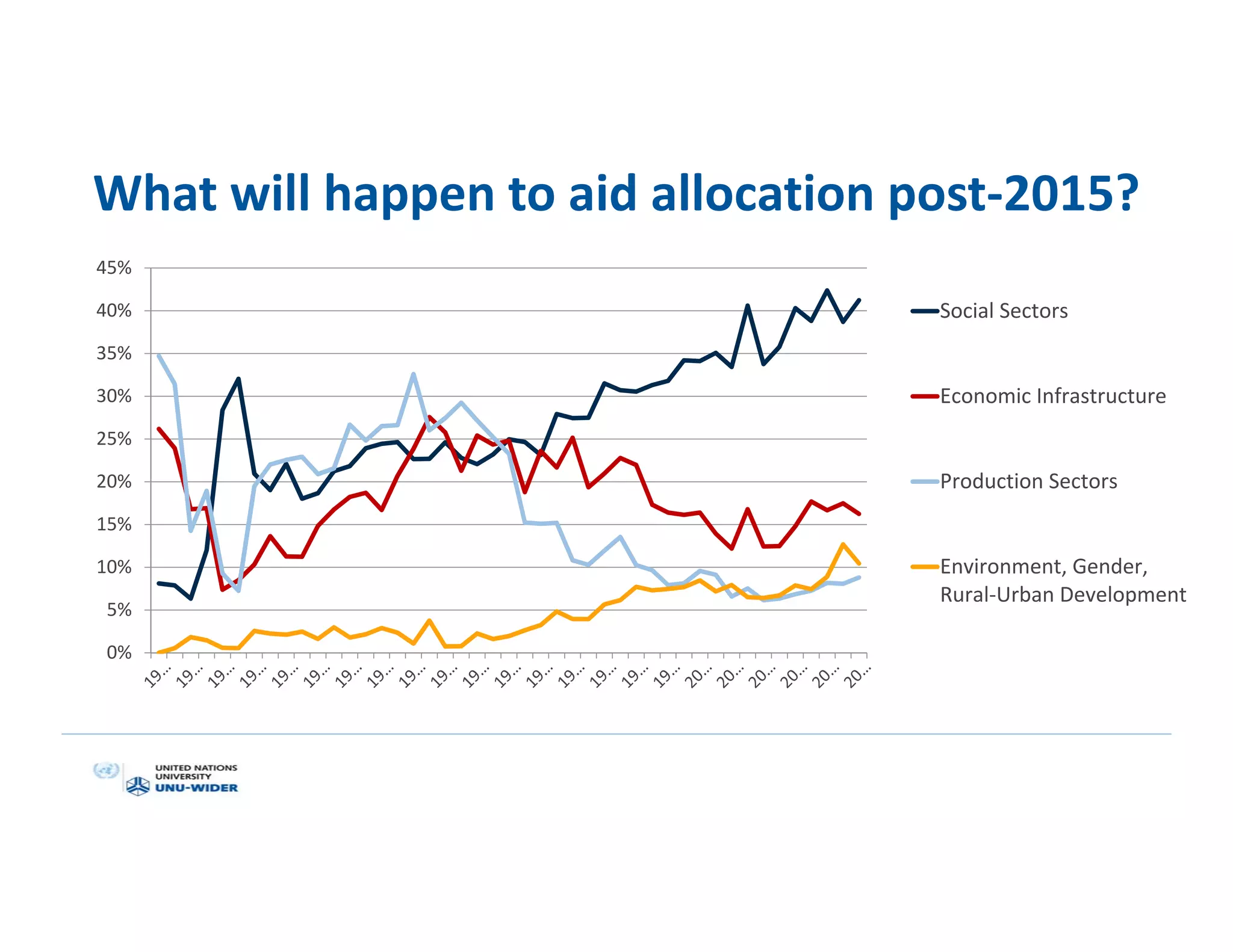
What will happen to aid allocation post-2015?
0%
5%
10%
15%
20%
25%
30%
35%
40%
45%
Social Sectors
Economic Infrastructure
Production Sectors
Environment, Gender,
Rural-Urban Development
2030 SDG Agenda
• Aid helps economic growth (overall). BUT:
• To achieve the HLP ‘quantum leap’ it must support:
• Structural transformation – industrial policy & don’t just focus on SMEs
• Creation of ‘good jobs’ – donors pay too little attention to employment – fragmented
livelihood projects
• State capability and legitimacy – support domestic capability and legitimacy to deliver like a
state, not just look like a state
• Gender equity at scale – rhetoric, but too-small-scale
• Infrastructure – use aid to leverage private capital (e.g. AfDB Africa50 fund). Recall Climate
change challenge
• Aid to agriculture – slumped & still too low (esp. crop research). IFAD & AfDB ‘going to scale’
Need: Research not Rhetoric
• Ask an engineer: do bridges work?
• Bridges work - when well-designed & built
• Ask a development expert: does aid work?
• Aid can work – when well-designed & implemented
• Instead of rhetoric – nothing works in development, nor in aid, & we
can never know what works & why (= “all bridges fail, & will continue to
fail”)…
• … find out: what works? What could work? What is scalable? What is
transferrable?
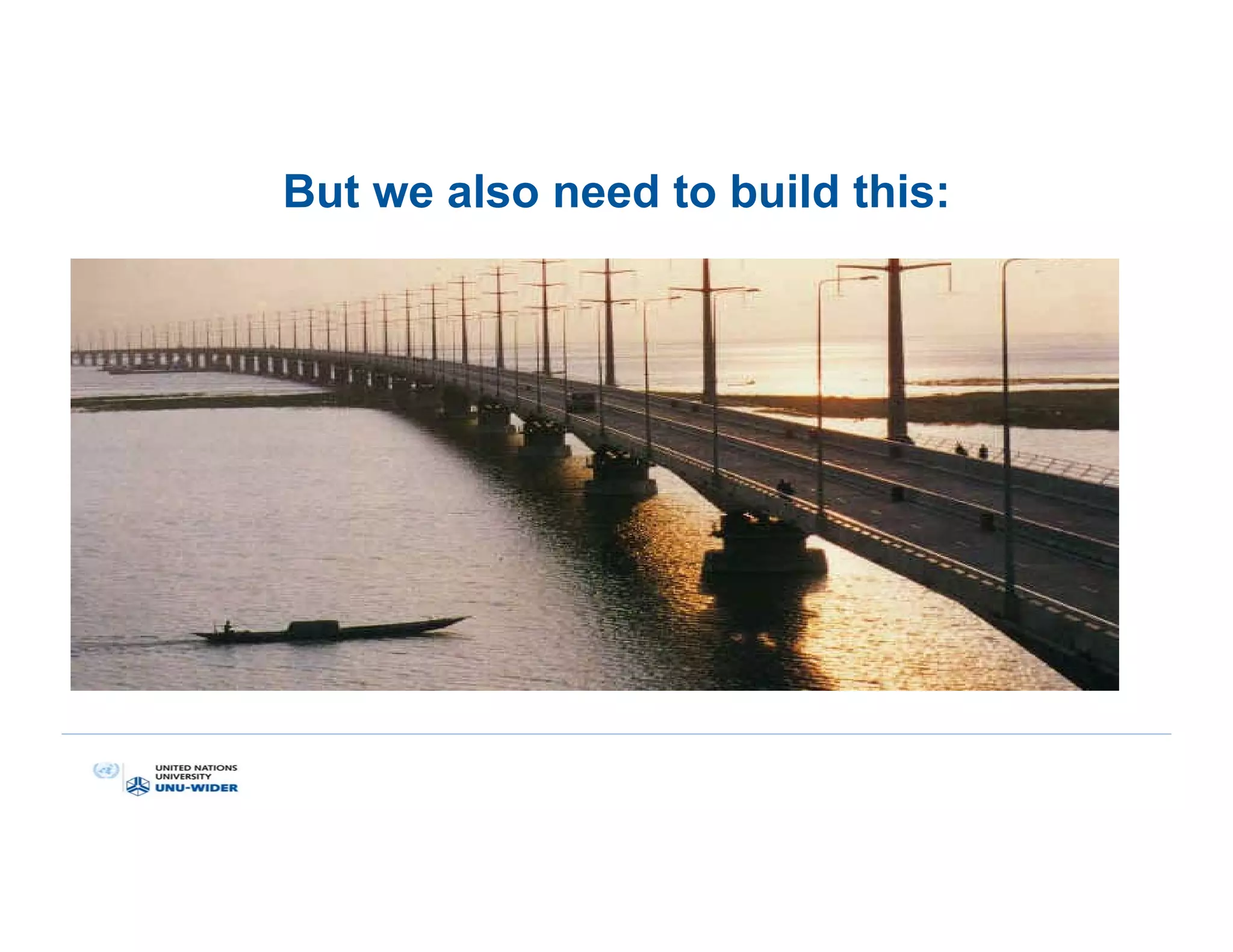
Private action can do much.
Remittances help build this:
But we also need to build this:
Key Messages
• No simple mapping between poor countries and poor people. Both
development economists and development practitioners need to unbundle
poverty on a country-by-country basis, looking for its deeper causes and
policy solutions
• Finding ways to accelerate structural change in poor economies can have a
high payoff in terms of employment growth and poverty reduction
• Investments in infrastructure and enhancement of firm capabilities are likely
to be crucial in creating more ‘ good ’ jobs
• Agriculture remains a focus for the livelihoods of the poor – and needs more
donor ambition, scale, and less project fragmentation
www.wider.unu.edu
Helsinki, Finland

Repoa april2016

  • 1.
    Growth and Povertyin Africa Presentation at REPOA 21st Annual Conference Dar es Salaam, Tanzania, 6-7 April 2016 By Finn Tarp
  • 2.
    UNU-WIDER’s 2014-18 ResearchProgramme • 3 Challenges – Transformation – Inclusion – Sustainability • 3 Concerns – Africa’s inclusive growth – Gender equity – Aid effectiveness • 3 Audiences – Decision-makers in developing countries – International agencies, both bilateral and multilateral – Global research community
  • 3.
    WIDER Supported ResearchVolumes • Growth and Poverty in Sub-Saharan Africa: Oxford University Press, edited by Channing Arndt, Andy McKay and Finn Tarp • Made in Africa: The Brookings Press, by Carol Newman, John Page, John Rand, Abebe Shimeles, Måns Söderbom, and Finn Tarp • Manufacturing Transformation: Comparative Studies of Industrial Development in Africa and Emerging Asia: Oxford University Press, edited by Carol Newman, John Page, John Rand, Abebe Shimeles, Måns Söderbom, and Finn Tarp Forthcoming in 2016: • Beating the Odds: Jumpstarting and Sustaining Inclusive Structural Transformation: Princeton University Press, by Celestin Monga and Justin Lin (see also Justin Lin’s WIDER Annual Lecture) • Measuring Poverty and Wellbeing in Developing Countries: Oxford University Press, edited by Channing Arndt and Finn Tarp • The Practice of Industrial Policy: Oxford University Press, edited by John Page and Finn Tarp • Africa’s Lions: The Brookings Press, edited by Haroon Bhorat and Finn Tarp • Growth, Structural Transformation and Rural Change in Vietnam: A Rising Dragon on the Move: Oxford University Press, edited by Finn Tarp • Building State Capability: Evidence, Analysis, Action: by Matt Andrews, Lant Pritchett, and Michael Woolcock, Oxford University Press (see also Pritchett’s WIDER Annual Lecture) • A LOT MORE: see https://www.wider.unu.edu/publications and https://www.wider.unu.edu/ including UNU-WIDER-REPOA collaboration, a series of special issues of journals and stand alone articles
  • 4.
    Africa • The Economist(11 May 2000): Hopeless Africa • The Independent (15 July 2009): Africa – the lost continent • The Economist (3 December 2011): The hopeful continent – Africa rising • A recent Afrobarometer survey suggests that ‘despite high reported growth rates, lived poverty at the grassroots remains little changed’ (Dulani et al. 2013); and others even question the growth revival referring to poor data
  • 5.
    WIDER’s Growth andPoverty Project (GAPP) • GAPP implemented 16 carefully designed country case studies among the 24 most populous countries in Africa [covering almost 75% of the population of the region and 9 of the top 10 countries] – Ethiopia, Ghana, Malawi, Rwanda, Uganda, Burkina Faso, Mozambique, Nigeria, Tanzania, Zambia, Cameroon, Côte d’Ivoire, Kenya, Madagascar, South Africa, DRC – Conducted by analysts with expert knowledge of the context and strengths and weaknesses of the available data • Focus on monetary and non-monetary indicators of well-being • Key message: There is a lot to celebrate in African development – yet key challenges remain – By 2013 GDP/capita was only 7.7% higher than in 1974 – So two cheers, but not three
  • 6.
    • Measuring Povertyand Wellbeing in Developing Countries • Oxford University Press • Edited by Channing Arndt and Finn Tarp
  • 7.
    Learning to Compete(L2C) • A four year WIDER, Brookings and AfDB research programme, which offers a comprehensive, comparative, cross-country analysis of Africa’s industrialization experience – Ethiopia, Ghana, Kenya, Mozambique, Nigeria, Senegal, Tanzania, Uganda, Tunesia, Cambodia, Vietnam – By teams of national and international researchers • Focus: Why is there so little industry in Africa; does it matter; and what can be done about it? • Key message: changes in the global economy offer a window of opportunity – but business as usual is not enough; only with a more strategic approach to industrial development and a strong commitment of the region’s political leadership can Africa industrialize.
  • 8.
    Ending Up Whereit Started Africa has deindustrialized since the 1980s 5 6 7 8 9 10 11 12 13 14 15 1960 1965 1970 1975 1980 1985 1990 1995 2000 2005 2010 PercentofGDP
  • 9.
    • The practiceof industrial policy (OUP) • Case studies of government-business relationships • Edited by John Page and Finn Tarp
  • 10.
    • Special Issueof Journal of African Economies • Learning from exporting • Edited by Måns Söderbom
  • 11.
    L2C Conference –Industrial development and policy in Africa www1.wider.unu.edu/L2Cconf
  • 12.
  • 13.
  • 14.
    Summing-Up • Progress inSSA has been markedly better than most expected 15 or 20 years ago • Relative to previous periods, macroeconomic management has improved significantly; a new generation of policy makers and business leaders have entered the scene; and important gains have been registered in four key areas: – Overall political stability (more democratic and accountable governments) – Rates of economic growth – A large array of non-monetary poverty indicators; and – Monetary poverty as measured by household consumption • Commodity prices played a role; yet there is a lot more going on: durable factors of physical, human and institutional accumulation are at play
  • 15.
    Summing-Up on Growthand Poverty Reduction for 16 Countries: Four Categories • Relatively rapid economic growth and corresponding poverty reduction: Ethiopia, Ghana, Malawi, Rwanda, and Uganda • Relatively rapid economic growth and limited poverty reduction: Burkina Faso, Mozambique, Nigeria, Tanzania, and Zambia • Uninspiring or negative economic growth with corresponding stagnation or increasing poverty: Cameroon, Côte d’Ivoire, Kenya, Madagascar, and South Africa • Low-information countries: DRC
  • 16.
    Outstanding Challenges anda Thorny Dilemma • Structural transformation slow • Jobs and employment creation lagging • Agriculture and industrialization constrained • A long walk to prosperity: recall T x G = 69 • Demographic projections (2015-2050): from 7.3 to 9.7 billion, and Africa’s population is set to double to 2.5 billion [bigger than both China and India and Nigeria > US] • In other words: a lot more policy action and finance in Africa is needed
  • 17.
    UN High-Level PanelReport on the Post-2015 Development Agenda • Calls for: • “..A quantum leap forward in economic opportunities and a profound economic transformation to end extreme poverty and improve livelihoods…” • How can aid help? • Aid to social sectors builds human capital BUT being educated & healthy is not enough
  • 18.
    What will happento aid allocation post-2015? 0% 5% 10% 15% 20% 25% 30% 35% 40% 45% Social Sectors Economic Infrastructure Production Sectors Environment, Gender, Rural-Urban Development
  • 19.
    2030 SDG Agenda •Aid helps economic growth (overall). BUT: • To achieve the HLP ‘quantum leap’ it must support: • Structural transformation – industrial policy & don’t just focus on SMEs • Creation of ‘good jobs’ – donors pay too little attention to employment – fragmented livelihood projects • State capability and legitimacy – support domestic capability and legitimacy to deliver like a state, not just look like a state • Gender equity at scale – rhetoric, but too-small-scale • Infrastructure – use aid to leverage private capital (e.g. AfDB Africa50 fund). Recall Climate change challenge • Aid to agriculture – slumped & still too low (esp. crop research). IFAD & AfDB ‘going to scale’
  • 20.
    Need: Research notRhetoric • Ask an engineer: do bridges work? • Bridges work - when well-designed & built • Ask a development expert: does aid work? • Aid can work – when well-designed & implemented • Instead of rhetoric – nothing works in development, nor in aid, & we can never know what works & why (= “all bridges fail, & will continue to fail”)… • … find out: what works? What could work? What is scalable? What is transferrable?
  • 21.
    Private action cando much. Remittances help build this:
  • 22.
    But we alsoneed to build this:
  • 23.
    Key Messages • Nosimple mapping between poor countries and poor people. Both development economists and development practitioners need to unbundle poverty on a country-by-country basis, looking for its deeper causes and policy solutions • Finding ways to accelerate structural change in poor economies can have a high payoff in terms of employment growth and poverty reduction • Investments in infrastructure and enhancement of firm capabilities are likely to be crucial in creating more ‘ good ’ jobs • Agriculture remains a focus for the livelihoods of the poor – and needs more donor ambition, scale, and less project fragmentation
  • 24.

Editor's Notes

  • #18 Donor efforts in the social sectors have been highly successful – especially in the areas of health and education. However, for the movement of labour from the agricultural sector to the non-farm economy donors need to be more closely involved in the agricultural and industrial policies.
  • #19 Measured as % of total aid flows, social sectors have increased from just above 5% of total aid flows in the late 1960s, to around 40% in 2011. In real terms, aid to social sectors has increased from an average of about 2 billion USD in the 1960s to about 50 billion in the 2000s (in 2011 it reached 64 billion USD) What does explain that trend? First, a shift in donor priorities, moving from a strong focus on building infrastructure in the 1970s and 1980s (physical capital) towards investing in human capital (education, health and water and sanitation). This has been explained by a better understanding of the role human capital in the process of social and economic development