Africa
Rene M. Lafayette, M.Ed.
Grade 6 Social Studies
1
Africa
Africa Geography Facts
● Algeria is Africa's largest country
● The Seychelles are Africa's smallest country
● Nigeria is Africa's largest country by population
● The Seychelles are Africa's smallest country by population
● Africa's highest point is Mt Kilimanjaro in Tanzania
2
Africa
Two of Africa's most interesting geographical features are the Nile River System and Sahara Desert;
both impressive in so many ways.
Nile River System: The Nile is a north-flowing river considered the longest river in the world at 6,650
km (4,130 mi) long. It is shared by and benefits eleven countries. The White Nile and Blue Nile are its
major tributaries. The White Nile is longer and rises in the Great Lakes region of central Africa, flowing
north from Tanzania to South Sudan. The Blue Nile is the source of most of the water and both rivers
join near Khartoum, Sudan The northern section of the river flows almost entirely through desert, from
Sudan into Egypt. The Nile ends in a large delta that empties into the Mediterranean Sea.
Source: www.worldatlas.com
3
Africa
Two of Africa's most interesting geographical features are the Nile River System and Sahara Desert;
both impressive in so many ways.
Nile River System: The Nile is a north-flowing river considered the longest river in the world at 6,650
km (4,130 mi) long. It is shared by and benefits eleven countries. The White Nile and Blue Nile are its
major tributaries. The White Nile is longer and rises in the Great Lakes region of central Africa, flowing
north from Tanzania to South Sudan. The Blue Nile is the source of most of the water and both rivers
join near Khartoum, Sudan The northern section of the river flows almost entirely through desert, from
Sudan into Egypt. The Nile ends in a large delta that empties into the Mediterranean Sea.
Source: www.worldatlas.com
4
Africa
Sahara Desert: It's the world's hottest desert, the third largest desert after
Antarctica and the Arctic, and almost as large as China. Covering almost one-
third of the continent, the Sahara is the largest desert in the world at
approximately 3,500,000 sq. miles (9,065,000 sq. km) in total size. Topography
includes areas of rock-strewn plains, rolling sand dunes and numerous sand
seas. It ranges in elevation from 100 ft. below sea level, to peaks in the
Ahaggar and Tibesti Mountains, that exceed 11,000 ft. (3,350m). Regional
deserts include the Libyan, Nubian and the Western desert of Egypt, just to the
west of the Nile. Almost completely without rainfall, a few underground rivers
flow from the Atlas Mountains, helping to irrigate isolated oases. In the east,
the waters of the Nile help fertilize smaller parts of the landscape.
Source: www.worldatlas.com
5
Africa
Sahara Desert: It's the world's hottest desert, the third largest desert after
Antarctica and the Arctic, and almost as large as China. Covering almost one-
third of the continent, the Sahara is the largest (hot) desert in the world at
approximately 3,500,000 sq. miles (9,065,000 sq. km) in total size. Topography
includes areas of rock-strewn plains, rolling sand dunes and numerous sand
seas. It ranges in elevation from 100 ft. below sea level, to peaks in the
Ahaggar and Tibesti Mountains, that exceed 11,000 ft. (3,350m). Regional
deserts include the Libyan, Nubian and the Western desert of Egypt, just to the
west of the Nile. Almost completely without rainfall, a few underground rivers
flow from the Atlas Mountains, helping to irrigate isolated oases. In the east,
the waters of the Nile help fertilize smaller parts of the landscape.
Source: www.worldatlas.com
6
Africa
Major Languages: By most estimates, well over a
thousand languages are spoken in Africa. Most are of
African origin, though some are of European or Asian
origin. Africa is the most multilingual continent in the world,
and it is not rare for individuals to fluently speak not only
multiple African languages, but one or more European
ones as well. (Emphasis added.)
Source: www.worldatlas.com
7
Africa
Major Languages - European:
As a result of the colonization of the African continent, the following European
languages continue to be spoken in 2015:
● English
● French
● Spanish
● Portuguese
● Italian
● Afrikaans
● German
8
Africa
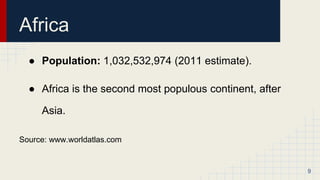
● Population: 1,032,532,974 (2011 estimate).
● Africa is the second most populous continent, after
Asia.
Source: www.worldatlas.com
9
Africa
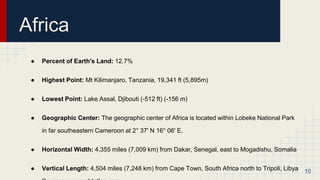
● Percent of Earth's Land: 12.7%
● Highest Point: Mt Kilimanjaro, Tanzania, 19,341 ft (5,895m)
● Lowest Point: Lake Assal, Djibouti (-512 ft) (-156 m)
● Geographic Center: The geographic center of Africa is located within Lobeke National Park
in far southeastern Cameroon at 2° 37' N 16° 06' E.
● Horizontal Width: 4,355 miles (7,009 km) from Dakar, Senegal, east to Mogadishu, Somalia
● Vertical Length: 4,504 miles (7,248 km) from Cape Town, South Africa north to Tripoli, Libya 10
Africa - Challenges Today
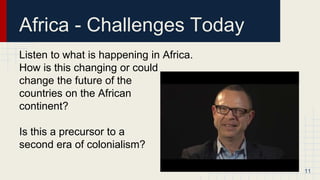
Listen to what is happening in Africa.
How is this changing or could
change the future of the
countries on the African
continent?
Is this a precursor to a
second era of colonialism?
11
Africa - Key Land Forms
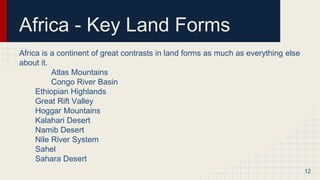
Africa is a continent of great contrasts in land forms as much as everything else
about it.
Atlas Mountains
Congo River Basin
Ethiopian Highlands
Great Rift Valley
Hoggar Mountains
Kalahari Desert
Namib Desert
Nile River System
Sahel
Sahara Desert
12
Africa
Atlas Mountains:
This mountain system runs from southwestern Morocco
along the Mediterranean coastline to the eastern edge of
Tunisia. Several smaller ranges are included, namely the
High Atlas, Middle Atlas and Maritime Atlas. The highest
peak is Mt. Toubkal in western Morocco at 13,671 ft. (4,167
m).
13
Africa
Congo River Basin:
The Congo River Basin of central Africa dominates the
landscape of the Democratic Republic of the Congo and
much of neighboring Congo. In addition, it stretches into
Angola, Cameroon, the Central African Republic and
Zambia. The fertile basin is about 1,400,000 sq. miles
(3,600,000 sq. km) in size and contains almost 20% of the
world's rain forest. The Congo River is the second longest
river in Africa, and it's network of rivers, tributaries and
streams help link the people and cities of the interior. 14
Africa
Ethiopian Highlands:
The Ethiopian Highlands are a rugged mass of mountains
in Ethiopia, Eritrea (which is sometimes referred to as the
Eritrean Highlands), and northern Somalia in the Horn of
Africa. The Ethiopian Highlands form the largest continuous
area of its altitude in the whole continent, with little of its
surface falling below 1500 m (4,921 ft), while the summits
reach heights of up to 4550 m (14,928 ft). It is sometimes
called the Roof of Africa for its height and large area.
15
Africa
Great Rift Valley:
A dramatic depression on the earth's surface, approximately 4,000
miles (6,400 km) in length, extends from the Red Sea area near Jordan
in the Middle East, south to the African country of Mozambique. In
essence, it's a series of geological faults caused by huge volcanic
eruptions centuries back, that subsequently created what we now call
the Ethiopian Highlands, and a series of perpendicular cliffs, mountain
ridges, rugged valleys and very deep lakes along it's entire length.
Many of Africa's highest mountains front the Rift Valley, including
Mount Kilimanjaro, Mount Kenya and Mount Margherita.
16
Africa
Hoggar (Ahaggar) Mountains:
The Hoggar Mountains, also known as the Ahaggar, are a
highland region in central Sahara, or southern Algeria,
along the Tropic of Cancer. They are located about 1,500
km (900 mi) south of the capital, Algiers and just west of
Tamanghasset. The region is largely rocky desert with an
average altitude of more than 900 metres (2,953 feet)
above sea level. The highest peak is at 3,003 meters
(Mount Tahat).
17
Africa
Kalahari Desert:
It's about 100,000 sq. miles (259,000 sq. km) in size and
covers much of Botswana, the southwestern region of
South Africa and all of western Namibia. The desert
plateau is criss-crossed by dry rivers beds and dense
scrub. A few small mountain ranges are situated here
including the Karas and the Huns. Large herds of wildlife
are found in the Kalahari Gemsbok National Park, located
in South Africa near its border with Namibia.
18
Africa
Namib Desert:
The Namib is a coastal desert in southern Africa that
stretches for more than 2,000 km (1,200 mi) along the
Atlantic coasts of Angola, Namibia, and South Africa,
extending southward from the Carunjamba River in Angola,
through Namibia and to the Olifants River in Western Cape,
South Africa. From the Atlantic coast eastward, the Namib
gradually ascends in elevation, reaching up to 200 km (120
mi) inland to the foot of the Great Escarpment.
19
Africa
Annual precipitation ranges from 2 mm (0.079 in) in the
most arid regions to 200 mm (7.9 in) at the escarpment,
making the Namib the only true desert in southern Africa.
The Namib is also the oldest desert in the world and its
geology consists of sand seas near the coast, while gravel
plains and scattered mountain outcrops occur further
inland.
The desert's sand dunes, some of which are 300 m (980 ft)
high and span 32 km (20 mi) long, are the second largest in
the world after the Badain Jaran Desert dunes in China 20
Africa
Nile River System:
The longest river in the world (flows north), rising from the
highlands of southeastern Africa and running about 4,160
miles (6,693 km) in length, to then drain in the
Mediterranean Sea. In simple terms it's a series of dams,
rapids, streams, swamps, tributaries and waterfalls.
Numerous (major) rivers comprise the overall system,
including the Albert Nile, Blue Nile, Victoria Nile and White
Nile.
21
Africa
Sahel:
The Sahel is a wide stretch of land running completely
across north-central Africa, just on the southern edges of
the ever-expanding Sahara Desert. This border region is
the transition zone between the dry areas of the north and
the tropical areas of the south. It receives very little rain (six
- eight inches a year) and most of the vegetation is a
savanna growth of sparse grasses and shrubs.
22
Africa
Sahara Desert:
Covering almost one-third of the continent, the Sahara is the largest desert in the world
at approximately 3,500,000 sq. miles (9,065,000 sq. km) in total size. Topography
includes areas of rock-strew plains, rolling sand dunes and numerous sand seas.
It ranges in elevation from 100 ft. below sea level, to peaks in the Ahaggar and Tibesti
mountains that exceed 11,000 ft. (3,350m). Regional deserts include the Libyan, Nubian
and the Western desert of Egypt, just to the west of the Nile.
Almost completely without rainfall, a few underground rivers flow from the Atlas
Mountains, helping to irrigate isolated oases. In the east, the water's of the Nile help
fertilize smaller parts of the landscape.
23
Africa
Africa Timeline
African Timeline:
● (5 - 2.5 million years ago) Ancient fossils, rocks and skeletal remains
uncovered in the Rift Valley
● (600,000 - 200,000 years ago) Homo Sapiens band together to form
nomadic groups; use of fire develops
● (6000 BC - 4000 BC) River People emerge along Nile, Niger and Congo
Rivers; agriculture is spread south of Sahara Desert 24
Africa
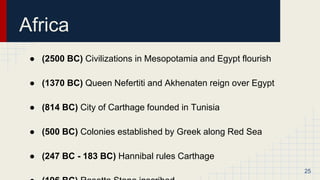
● (2500 BC) Civilizations in Mesopotamia and Egypt flourish
● (1370 BC) Queen Nefertiti and Akhenaten reign over Egypt
● (814 BC) City of Carthage founded in Tunisia
● (500 BC) Colonies established by Greek along Red Sea
● (247 BC - 183 BC) Hannibal rules Carthage
25
Africa
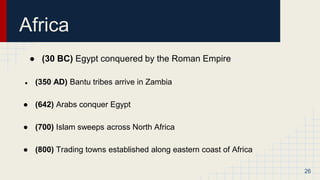
● (30 BC) Egypt conquered by the Roman Empire
● (350 AD) Bantu tribes arrive in Zambia
● (642) Arabs conquer Egypt
● (700) Islam sweeps across North Africa
● (800) Trading towns established along eastern coast of Africa
26

Africa Grade 6 Social Studies

  • 1.
    Africa Rene M. Lafayette,M.Ed. Grade 6 Social Studies 1
  • 2.
    Africa Africa Geography Facts ●Algeria is Africa's largest country ● The Seychelles are Africa's smallest country ● Nigeria is Africa's largest country by population ● The Seychelles are Africa's smallest country by population ● Africa's highest point is Mt Kilimanjaro in Tanzania 2
  • 3.
    Africa Two of Africa'smost interesting geographical features are the Nile River System and Sahara Desert; both impressive in so many ways. Nile River System: The Nile is a north-flowing river considered the longest river in the world at 6,650 km (4,130 mi) long. It is shared by and benefits eleven countries. The White Nile and Blue Nile are its major tributaries. The White Nile is longer and rises in the Great Lakes region of central Africa, flowing north from Tanzania to South Sudan. The Blue Nile is the source of most of the water and both rivers join near Khartoum, Sudan The northern section of the river flows almost entirely through desert, from Sudan into Egypt. The Nile ends in a large delta that empties into the Mediterranean Sea. Source: www.worldatlas.com 3
  • 4.
    Africa Two of Africa'smost interesting geographical features are the Nile River System and Sahara Desert; both impressive in so many ways. Nile River System: The Nile is a north-flowing river considered the longest river in the world at 6,650 km (4,130 mi) long. It is shared by and benefits eleven countries. The White Nile and Blue Nile are its major tributaries. The White Nile is longer and rises in the Great Lakes region of central Africa, flowing north from Tanzania to South Sudan. The Blue Nile is the source of most of the water and both rivers join near Khartoum, Sudan The northern section of the river flows almost entirely through desert, from Sudan into Egypt. The Nile ends in a large delta that empties into the Mediterranean Sea. Source: www.worldatlas.com 4
  • 5.
    Africa Sahara Desert: It'sthe world's hottest desert, the third largest desert after Antarctica and the Arctic, and almost as large as China. Covering almost one- third of the continent, the Sahara is the largest desert in the world at approximately 3,500,000 sq. miles (9,065,000 sq. km) in total size. Topography includes areas of rock-strewn plains, rolling sand dunes and numerous sand seas. It ranges in elevation from 100 ft. below sea level, to peaks in the Ahaggar and Tibesti Mountains, that exceed 11,000 ft. (3,350m). Regional deserts include the Libyan, Nubian and the Western desert of Egypt, just to the west of the Nile. Almost completely without rainfall, a few underground rivers flow from the Atlas Mountains, helping to irrigate isolated oases. In the east, the waters of the Nile help fertilize smaller parts of the landscape. Source: www.worldatlas.com 5
  • 6.
    Africa Sahara Desert: It'sthe world's hottest desert, the third largest desert after Antarctica and the Arctic, and almost as large as China. Covering almost one- third of the continent, the Sahara is the largest (hot) desert in the world at approximately 3,500,000 sq. miles (9,065,000 sq. km) in total size. Topography includes areas of rock-strewn plains, rolling sand dunes and numerous sand seas. It ranges in elevation from 100 ft. below sea level, to peaks in the Ahaggar and Tibesti Mountains, that exceed 11,000 ft. (3,350m). Regional deserts include the Libyan, Nubian and the Western desert of Egypt, just to the west of the Nile. Almost completely without rainfall, a few underground rivers flow from the Atlas Mountains, helping to irrigate isolated oases. In the east, the waters of the Nile help fertilize smaller parts of the landscape. Source: www.worldatlas.com 6
  • 7.
    Africa Major Languages: Bymost estimates, well over a thousand languages are spoken in Africa. Most are of African origin, though some are of European or Asian origin. Africa is the most multilingual continent in the world, and it is not rare for individuals to fluently speak not only multiple African languages, but one or more European ones as well. (Emphasis added.) Source: www.worldatlas.com 7
  • 8.
    Africa Major Languages -European: As a result of the colonization of the African continent, the following European languages continue to be spoken in 2015: ● English ● French ● Spanish ● Portuguese ● Italian ● Afrikaans ● German 8
  • 9.
    Africa ● Population: 1,032,532,974(2011 estimate). ● Africa is the second most populous continent, after Asia. Source: www.worldatlas.com 9
  • 10.
    Africa ● Percent ofEarth's Land: 12.7% ● Highest Point: Mt Kilimanjaro, Tanzania, 19,341 ft (5,895m) ● Lowest Point: Lake Assal, Djibouti (-512 ft) (-156 m) ● Geographic Center: The geographic center of Africa is located within Lobeke National Park in far southeastern Cameroon at 2° 37' N 16° 06' E. ● Horizontal Width: 4,355 miles (7,009 km) from Dakar, Senegal, east to Mogadishu, Somalia ● Vertical Length: 4,504 miles (7,248 km) from Cape Town, South Africa north to Tripoli, Libya 10
  • 11.
    Africa - ChallengesToday Listen to what is happening in Africa. How is this changing or could change the future of the countries on the African continent? Is this a precursor to a second era of colonialism? 11
  • 12.
    Africa - KeyLand Forms Africa is a continent of great contrasts in land forms as much as everything else about it. Atlas Mountains Congo River Basin Ethiopian Highlands Great Rift Valley Hoggar Mountains Kalahari Desert Namib Desert Nile River System Sahel Sahara Desert 12
  • 13.
    Africa Atlas Mountains: This mountainsystem runs from southwestern Morocco along the Mediterranean coastline to the eastern edge of Tunisia. Several smaller ranges are included, namely the High Atlas, Middle Atlas and Maritime Atlas. The highest peak is Mt. Toubkal in western Morocco at 13,671 ft. (4,167 m). 13
  • 14.
    Africa Congo River Basin: TheCongo River Basin of central Africa dominates the landscape of the Democratic Republic of the Congo and much of neighboring Congo. In addition, it stretches into Angola, Cameroon, the Central African Republic and Zambia. The fertile basin is about 1,400,000 sq. miles (3,600,000 sq. km) in size and contains almost 20% of the world's rain forest. The Congo River is the second longest river in Africa, and it's network of rivers, tributaries and streams help link the people and cities of the interior. 14
  • 15.
    Africa Ethiopian Highlands: The EthiopianHighlands are a rugged mass of mountains in Ethiopia, Eritrea (which is sometimes referred to as the Eritrean Highlands), and northern Somalia in the Horn of Africa. The Ethiopian Highlands form the largest continuous area of its altitude in the whole continent, with little of its surface falling below 1500 m (4,921 ft), while the summits reach heights of up to 4550 m (14,928 ft). It is sometimes called the Roof of Africa for its height and large area. 15
  • 16.
    Africa Great Rift Valley: Adramatic depression on the earth's surface, approximately 4,000 miles (6,400 km) in length, extends from the Red Sea area near Jordan in the Middle East, south to the African country of Mozambique. In essence, it's a series of geological faults caused by huge volcanic eruptions centuries back, that subsequently created what we now call the Ethiopian Highlands, and a series of perpendicular cliffs, mountain ridges, rugged valleys and very deep lakes along it's entire length. Many of Africa's highest mountains front the Rift Valley, including Mount Kilimanjaro, Mount Kenya and Mount Margherita. 16
  • 17.
    Africa Hoggar (Ahaggar) Mountains: TheHoggar Mountains, also known as the Ahaggar, are a highland region in central Sahara, or southern Algeria, along the Tropic of Cancer. They are located about 1,500 km (900 mi) south of the capital, Algiers and just west of Tamanghasset. The region is largely rocky desert with an average altitude of more than 900 metres (2,953 feet) above sea level. The highest peak is at 3,003 meters (Mount Tahat). 17
  • 18.
    Africa Kalahari Desert: It's about100,000 sq. miles (259,000 sq. km) in size and covers much of Botswana, the southwestern region of South Africa and all of western Namibia. The desert plateau is criss-crossed by dry rivers beds and dense scrub. A few small mountain ranges are situated here including the Karas and the Huns. Large herds of wildlife are found in the Kalahari Gemsbok National Park, located in South Africa near its border with Namibia. 18
  • 19.
    Africa Namib Desert: The Namibis a coastal desert in southern Africa that stretches for more than 2,000 km (1,200 mi) along the Atlantic coasts of Angola, Namibia, and South Africa, extending southward from the Carunjamba River in Angola, through Namibia and to the Olifants River in Western Cape, South Africa. From the Atlantic coast eastward, the Namib gradually ascends in elevation, reaching up to 200 km (120 mi) inland to the foot of the Great Escarpment. 19
  • 20.
    Africa Annual precipitation rangesfrom 2 mm (0.079 in) in the most arid regions to 200 mm (7.9 in) at the escarpment, making the Namib the only true desert in southern Africa. The Namib is also the oldest desert in the world and its geology consists of sand seas near the coast, while gravel plains and scattered mountain outcrops occur further inland. The desert's sand dunes, some of which are 300 m (980 ft) high and span 32 km (20 mi) long, are the second largest in the world after the Badain Jaran Desert dunes in China 20
  • 21.
    Africa Nile River System: Thelongest river in the world (flows north), rising from the highlands of southeastern Africa and running about 4,160 miles (6,693 km) in length, to then drain in the Mediterranean Sea. In simple terms it's a series of dams, rapids, streams, swamps, tributaries and waterfalls. Numerous (major) rivers comprise the overall system, including the Albert Nile, Blue Nile, Victoria Nile and White Nile. 21
  • 22.
    Africa Sahel: The Sahel isa wide stretch of land running completely across north-central Africa, just on the southern edges of the ever-expanding Sahara Desert. This border region is the transition zone between the dry areas of the north and the tropical areas of the south. It receives very little rain (six - eight inches a year) and most of the vegetation is a savanna growth of sparse grasses and shrubs. 22
  • 23.
    Africa Sahara Desert: Covering almostone-third of the continent, the Sahara is the largest desert in the world at approximately 3,500,000 sq. miles (9,065,000 sq. km) in total size. Topography includes areas of rock-strew plains, rolling sand dunes and numerous sand seas. It ranges in elevation from 100 ft. below sea level, to peaks in the Ahaggar and Tibesti mountains that exceed 11,000 ft. (3,350m). Regional deserts include the Libyan, Nubian and the Western desert of Egypt, just to the west of the Nile. Almost completely without rainfall, a few underground rivers flow from the Atlas Mountains, helping to irrigate isolated oases. In the east, the water's of the Nile help fertilize smaller parts of the landscape. 23
  • 24.
    Africa Africa Timeline African Timeline: ●(5 - 2.5 million years ago) Ancient fossils, rocks and skeletal remains uncovered in the Rift Valley ● (600,000 - 200,000 years ago) Homo Sapiens band together to form nomadic groups; use of fire develops ● (6000 BC - 4000 BC) River People emerge along Nile, Niger and Congo Rivers; agriculture is spread south of Sahara Desert 24
  • 25.
    Africa ● (2500 BC)Civilizations in Mesopotamia and Egypt flourish ● (1370 BC) Queen Nefertiti and Akhenaten reign over Egypt ● (814 BC) City of Carthage founded in Tunisia ● (500 BC) Colonies established by Greek along Red Sea ● (247 BC - 183 BC) Hannibal rules Carthage 25
  • 26.
    Africa ● (30 BC)Egypt conquered by the Roman Empire ● (350 AD) Bantu tribes arrive in Zambia ● (642) Arabs conquer Egypt ● (700) Islam sweeps across North Africa ● (800) Trading towns established along eastern coast of Africa 26