UNIT-3
PERSONNEL
MANAGEMENT
Calculating staff strength:
Compared to other hotel departments, the housekeeping
department employs the largest workforce in most hotels.
Manpower thus becomes a major operating expense. Good
management of the housekeeping department depends on
achieving a balance between the workload and the staff
strength. When calculating staff strength, it must be
remembered that each property will have its individual
requirements.
The factors to be considered here are:
 The type of hotel is
 The location of the hotel
 The size of the hotel (in terms of the number of rooms)
 The occupancy rate of the hotel
 Management needs
 Company Policies
 The quantity of work to be done
 The quality of work expected, that is, the standards to be met
 The time needed to do the work
 The frequency with which the work needs to be done
 The time when the work area is available
 The amount of traffic in the area
Introduction to Front Office Personnel
• The front office staff refers to the personnel who are assigned to the
reception area. They are the first personnel of the hotel to meet and
engage guests. Front office staff handles the transactions between the
hotel and its guests. The Front Office staff receives the guests, handles
their requests, and creates the first impression about the hotel in their
minds.
• Uniform Staff-Uniformed services in a hotel are provided by the staff
members who perform essential duties that add to the guest experience.
They provide more personalised services. TakeN into consideration the
degree of attention given to the guests by this department.
• The uniformed staff include door persons, bell attendants, valet parking
attendants, transportation drivers, and concierges. While personnel in
reservations, reception, and communications areas affect guest
perceptions, it is often personnel in uniformed service who make a lasting
impression. Also, uniformed service staff are usually classified as "tipped
employees" Since a portion of their income is derived from guests'
gratuities!
Planning for Staffing in Front Office Staff & Uniform Staff.
• The Front Office department is the first impression of the hotel since
the guest comes in contact with the Front Office staff on arrival (or
even before). Choosing the right staff is crucial. Human resources in
Front Office should be of the right quality and quantity for the efficient
functioning of the department.
• Planning staffing is a crucial activity for any department. The Front
Office department
• A key challenge is to have the correct number of qualified staff
members available in every
• necessary position to meet the hotel’s daily business needs.
1. Design a formal structure of hierarchy
2. Identify shifts timings
3. Scheduling each shift
1. Design a formal structure of hierarchy
• Every hotel builds a formal structure depicting the different hierarchies
of management, supervision, and employee (staff) levels. This structure
is called an organization chart
• Moreover, the organisation chart shows reporting relationships, the span
of management, and staff/line functions. The organisation chart for the
front office department differs as per the size.
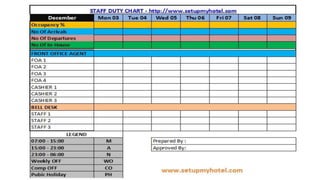
Duty Rota (Duty Roster)
A duty roster (also commonly known as rota) is a way to divide
time into various tasks. These can then be allocated to
individuals. It often takes the form calendar-like table, which is
split into days of the week and individual times on the two axis.
A work shift or duty Chart shows the allotment of jobs, hours of
duty, and days off for each member of the staff. The duty chart
also ensures that the staff has sufficient time to note their
working schedule for the following week/month. The work
shifts or timings may vary according to the hotel occupancy and
peak business days.
Advantages Of Making a Duty roaster:
• The exact number of staff required to be on duty at any given
occupancy.
• That staff working hours are as per their employment contract.
•That regular off-days are availed for enhancing productivity.
• Knowledge of which employees are present on the premises in
instances of emergencies.
• Accuracy in attendance and payroll reports.
Steps for Planning and Making a Duty Roster:
• Step 1-Ascertain occupancy levels and events expected in the hotel.
• Step 2- Ascertain the spread of duty hours to be scheduled in the duty roaster, whether 12
hours, 16 hours or 24 hours.
• Step 3 - Ascertain the type of shift-straight shift, break shift, rotating shift, or any other
alternative scheduling to be used.
• Step 4 -Ascertain the number of full-time and part-time staff on the payroll.
• Step 5 - Ascertain the number of labour hours per day and per week required for various
positions.
• Step 6 - Incorporate coffee breaks and mealtime in the roaster.
• Step 7- Ascertain that each employee gets a weekly off the day after 6 working days.
Provide for compensatory offs. Schedule one reliever per 6 employees
• Step 8 - Ascertain closed days and restricted holidays, and any contingency planning that
may be needed.
2. Identify shifts timings
• The 24-hour nature of front office operations requires constant staffing. The day in the
front
• The office is usually divided into three shifts.
• The first shift or morning shift typically is from 7 am to 4 pm. The morning shift
arrives to
• relieve the night shift and take over from them for the day’s operations.
• The second shift or afternoon shift usually is from 3 pm to 12 am. There is an overlap
of 1 hour with the morning shift. This is important since important tasks like handover,
cash counting and tallying and briefing happen during this overlap. Sometimes
departmental meetings or training sessions are scheduled during this time too.
• The third shift or the night shift is from 11 pm to 8 am. They relieve the afternoon shift.
Night audit happens during the night shift. This shift is also called as (Graveyard shift)
• In India, most of the shifts are 9-hour shifts and have 1-hour overlaps. A swing shift
may be
• Required that employees are given a break for a few hours and they report back in the
evening.
• This may be required in case of group arrivals or on busy days or when a couple of
employees are on leave/unwell. It is also known as a break shift.
1. Scheduling each shift
• The scheduling of staff ensures that the demands during business hours are met. Front
Office operation is a 7-day-a-week operation and 24 hours a day. Hence the following points
are kept in mind while scheduling.
• Room Forecasts: The scheduling of each shift and the number of employees needed per
shift
• largely depends on room forecasts. Front Office Managers do their own staff forecast using
• longer-term room forecasts (60 to 90 days forecast).
• Expected number of employees: The volume of business expected dictates the number of
• employees needed on a shift. Hotels that are very seasonal in demand rely heavily on
forecasts to plan their staffing.
• Preparing Duty Roster- Duty Chart shows the allotment of jobs, hours of duty, and days off
for each member of the staff. The duty roster or schedule must be made at least 3-4 days
prior to the date of implementation so that staff can plan their personal commitments. Not
all staff can get leave on the same day. The front office staff has to be on duty round the
clock to give service to the guests.

AFOM. Advance front office management pptx

  • 1.
  • 2.
    Calculating staff strength: Comparedto other hotel departments, the housekeeping department employs the largest workforce in most hotels. Manpower thus becomes a major operating expense. Good management of the housekeeping department depends on achieving a balance between the workload and the staff strength. When calculating staff strength, it must be remembered that each property will have its individual requirements.
  • 3.
    The factors tobe considered here are:  The type of hotel is  The location of the hotel  The size of the hotel (in terms of the number of rooms)  The occupancy rate of the hotel  Management needs  Company Policies  The quantity of work to be done  The quality of work expected, that is, the standards to be met  The time needed to do the work  The frequency with which the work needs to be done  The time when the work area is available  The amount of traffic in the area
  • 4.
    Introduction to FrontOffice Personnel • The front office staff refers to the personnel who are assigned to the reception area. They are the first personnel of the hotel to meet and engage guests. Front office staff handles the transactions between the hotel and its guests. The Front Office staff receives the guests, handles their requests, and creates the first impression about the hotel in their minds. • Uniform Staff-Uniformed services in a hotel are provided by the staff members who perform essential duties that add to the guest experience. They provide more personalised services. TakeN into consideration the degree of attention given to the guests by this department. • The uniformed staff include door persons, bell attendants, valet parking attendants, transportation drivers, and concierges. While personnel in reservations, reception, and communications areas affect guest perceptions, it is often personnel in uniformed service who make a lasting impression. Also, uniformed service staff are usually classified as "tipped employees" Since a portion of their income is derived from guests' gratuities!
  • 5.
    Planning for Staffingin Front Office Staff & Uniform Staff. • The Front Office department is the first impression of the hotel since the guest comes in contact with the Front Office staff on arrival (or even before). Choosing the right staff is crucial. Human resources in Front Office should be of the right quality and quantity for the efficient functioning of the department. • Planning staffing is a crucial activity for any department. The Front Office department • A key challenge is to have the correct number of qualified staff members available in every • necessary position to meet the hotel’s daily business needs. 1. Design a formal structure of hierarchy 2. Identify shifts timings 3. Scheduling each shift
  • 6.
    1. Design aformal structure of hierarchy • Every hotel builds a formal structure depicting the different hierarchies of management, supervision, and employee (staff) levels. This structure is called an organization chart • Moreover, the organisation chart shows reporting relationships, the span of management, and staff/line functions. The organisation chart for the front office department differs as per the size.
  • 7.
    Duty Rota (DutyRoster) A duty roster (also commonly known as rota) is a way to divide time into various tasks. These can then be allocated to individuals. It often takes the form calendar-like table, which is split into days of the week and individual times on the two axis. A work shift or duty Chart shows the allotment of jobs, hours of duty, and days off for each member of the staff. The duty chart also ensures that the staff has sufficient time to note their working schedule for the following week/month. The work shifts or timings may vary according to the hotel occupancy and peak business days.
  • 8.
    Advantages Of Makinga Duty roaster: • The exact number of staff required to be on duty at any given occupancy. • That staff working hours are as per their employment contract. •That regular off-days are availed for enhancing productivity. • Knowledge of which employees are present on the premises in instances of emergencies. • Accuracy in attendance and payroll reports.
  • 9.
    Steps for Planningand Making a Duty Roster: • Step 1-Ascertain occupancy levels and events expected in the hotel. • Step 2- Ascertain the spread of duty hours to be scheduled in the duty roaster, whether 12 hours, 16 hours or 24 hours. • Step 3 - Ascertain the type of shift-straight shift, break shift, rotating shift, or any other alternative scheduling to be used. • Step 4 -Ascertain the number of full-time and part-time staff on the payroll. • Step 5 - Ascertain the number of labour hours per day and per week required for various positions. • Step 6 - Incorporate coffee breaks and mealtime in the roaster. • Step 7- Ascertain that each employee gets a weekly off the day after 6 working days. Provide for compensatory offs. Schedule one reliever per 6 employees • Step 8 - Ascertain closed days and restricted holidays, and any contingency planning that may be needed.
  • 11.
    2. Identify shiftstimings • The 24-hour nature of front office operations requires constant staffing. The day in the front • The office is usually divided into three shifts. • The first shift or morning shift typically is from 7 am to 4 pm. The morning shift arrives to • relieve the night shift and take over from them for the day’s operations. • The second shift or afternoon shift usually is from 3 pm to 12 am. There is an overlap of 1 hour with the morning shift. This is important since important tasks like handover, cash counting and tallying and briefing happen during this overlap. Sometimes departmental meetings or training sessions are scheduled during this time too. • The third shift or the night shift is from 11 pm to 8 am. They relieve the afternoon shift. Night audit happens during the night shift. This shift is also called as (Graveyard shift) • In India, most of the shifts are 9-hour shifts and have 1-hour overlaps. A swing shift may be • Required that employees are given a break for a few hours and they report back in the evening. • This may be required in case of group arrivals or on busy days or when a couple of employees are on leave/unwell. It is also known as a break shift.
  • 12.
    1. Scheduling eachshift • The scheduling of staff ensures that the demands during business hours are met. Front Office operation is a 7-day-a-week operation and 24 hours a day. Hence the following points are kept in mind while scheduling. • Room Forecasts: The scheduling of each shift and the number of employees needed per shift • largely depends on room forecasts. Front Office Managers do their own staff forecast using • longer-term room forecasts (60 to 90 days forecast). • Expected number of employees: The volume of business expected dictates the number of • employees needed on a shift. Hotels that are very seasonal in demand rely heavily on forecasts to plan their staffing. • Preparing Duty Roster- Duty Chart shows the allotment of jobs, hours of duty, and days off for each member of the staff. The duty roster or schedule must be made at least 3-4 days prior to the date of implementation so that staff can plan their personal commitments. Not all staff can get leave on the same day. The front office staff has to be on duty round the clock to give service to the guests.