BY ORDER OF THE 
SECRETARY OF THE AIR FORCE 
COMPLIANCE WITH THIS PUBLICATION IS MANDATORY 
NOTICE: This publication is available digitally on the AFDPO WWW site at: 
http://www.e-publishing.af.mil. 
AIR FORCE INSTRUCTION 10-206 
4 OCTOBER 2004 
Operations 
OPERATIONAL REPORTING 
OPR: HQ USAF/XOO 
(MSgt Calvin French) 
Certified by: HQ USAF/XO 
(Maj General Marne Peterson) 
Supersedes AFI 10-206, 30 MAY 2003 Pages: 87 
Distribution: F 
This instruction implements AFPD 10-2, Readiness. It establishes and describes the Air Force Opera-tional 
Reporting System (AFOREPS). Part 1 introduces the general concept of the AFOREPS and covers 
reporting policies and command reporting responsibilities. PART 2 deals with Operational Status 
Reports. It explains the purpose and gives instructions for preparing and submitting these reports. PART 
3 covers Operational Support Monitoring Reports. It explains the purpose and gives instructions for pre-paring 
and submitting these reports. Send recommended changes, additions, deletions, or new reports and 
any conflict or duplication of other reports to HQ USAF/XOOOA, 1480 Air Force Pentagon, Washington, 
D.C. 20330-1480. Commands should supplement this Air Force Instruction (AFI) instead of repeating 
instructions in separate directives. Send HQ USAF/XOOOA one copy of directives (to include drafts) that 
support or implement the AFOREPS. Waiver authority for this instruction is HQ USAF/XOOOA. Ensure 
that all records created as a result of processes prescribed in this publication are maintained in accordance 
with AFPD 37-1, Information Management and AFMAN 37-123, Management of Records and disposed 
of in accordance with the Air Force Records Disposition Schedule (RDS) located at 
https://webrims.amc.af.mil. 
SUMMARY OF REVISIONS 
This revision adds USSTRATCOM as an action addressee on all nuclear related OPREP-3 Reports (Table 
3.4. Section 5); adds USSTRATCOM Command Center to all OPREP-3 nuclear related voice reports 
(paragraph 3.5.1.3.); adds a new FADED GIANT rule number for radiological accidents or incidents 
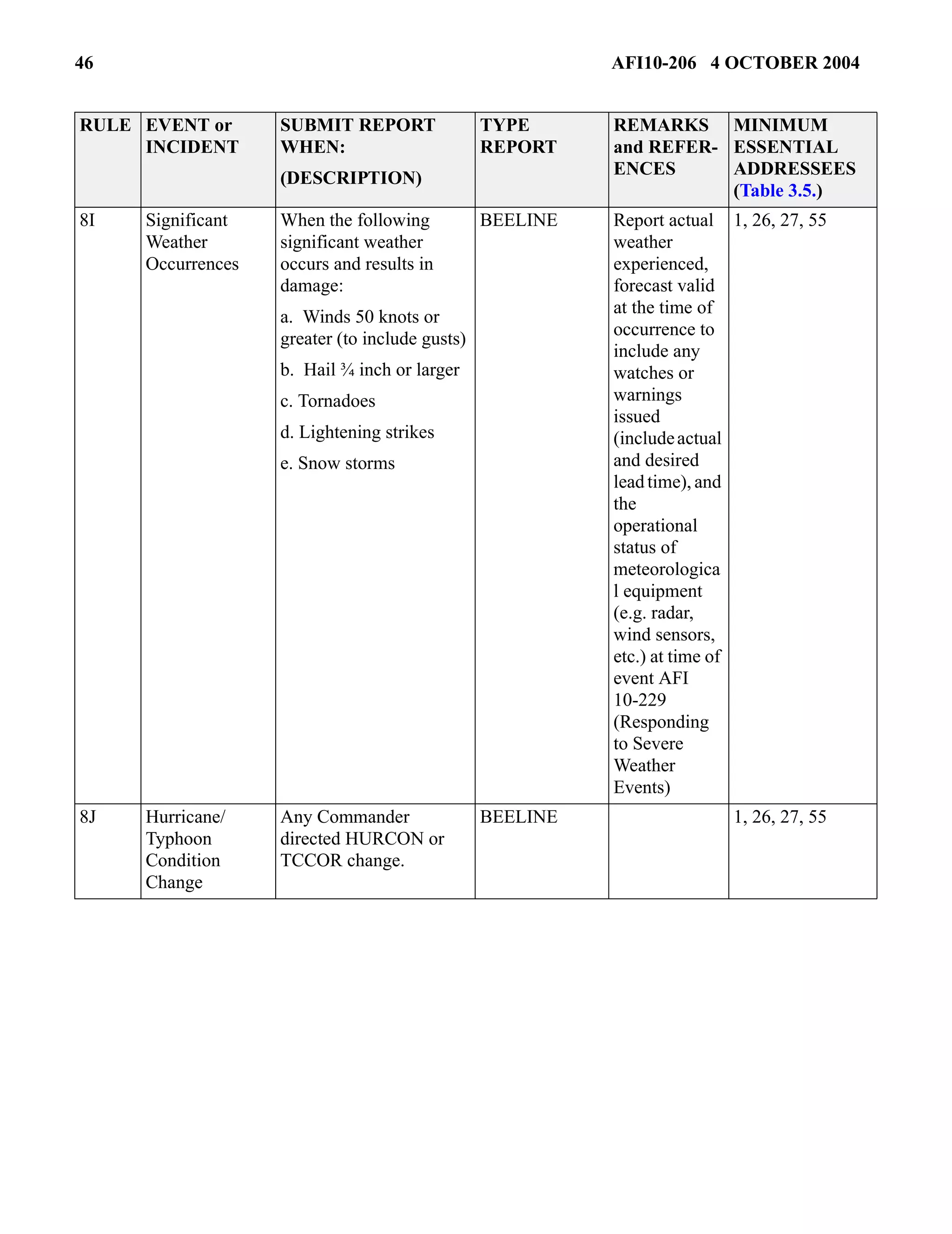
(Table 3.4. rule 5Y); revises Rule 8I to include any damage related to significant weather occurrences 
(Table 3.4. rule 8I); adds guidelines for Military Support to Civilian Authorities (MSCA) OPREP-3 
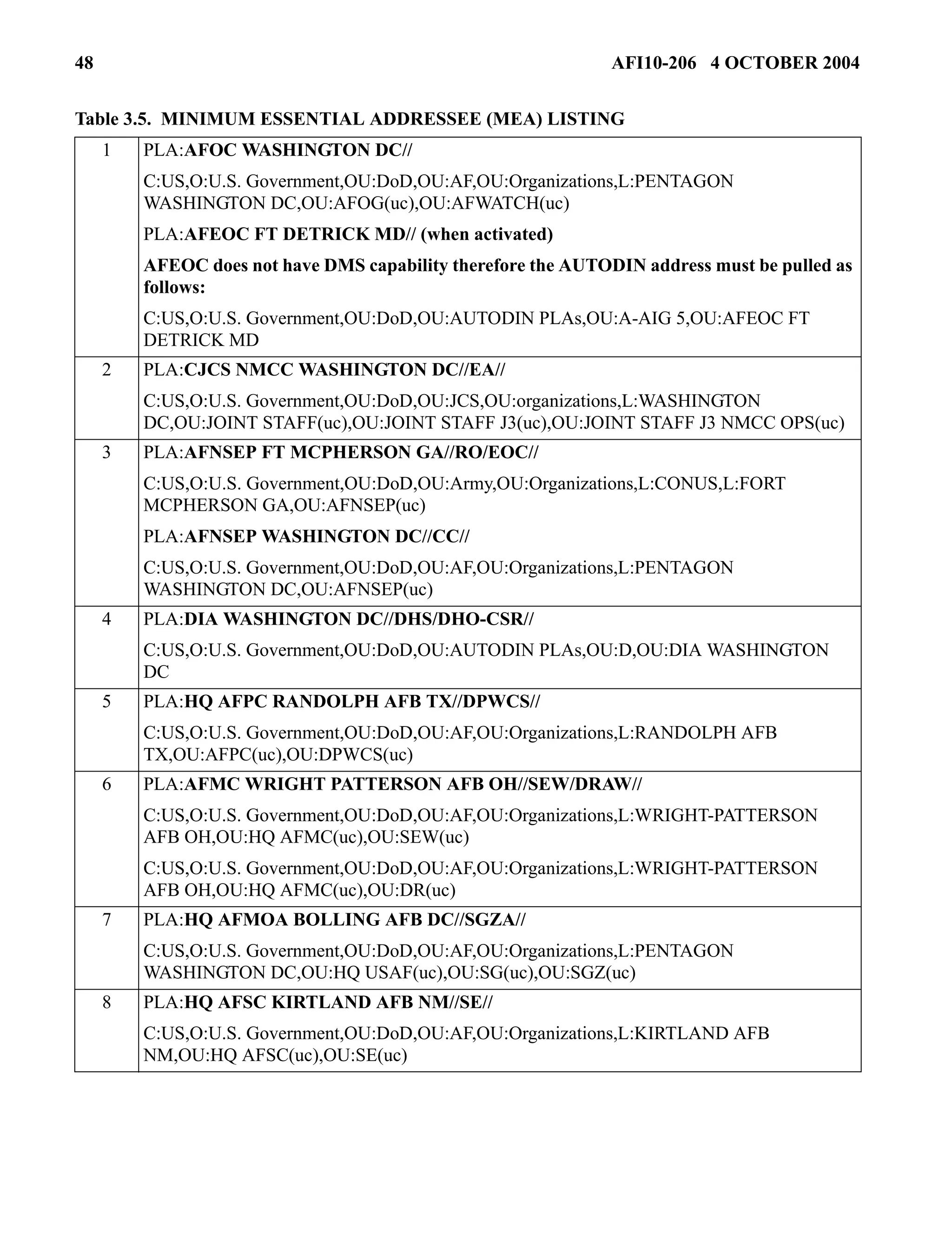
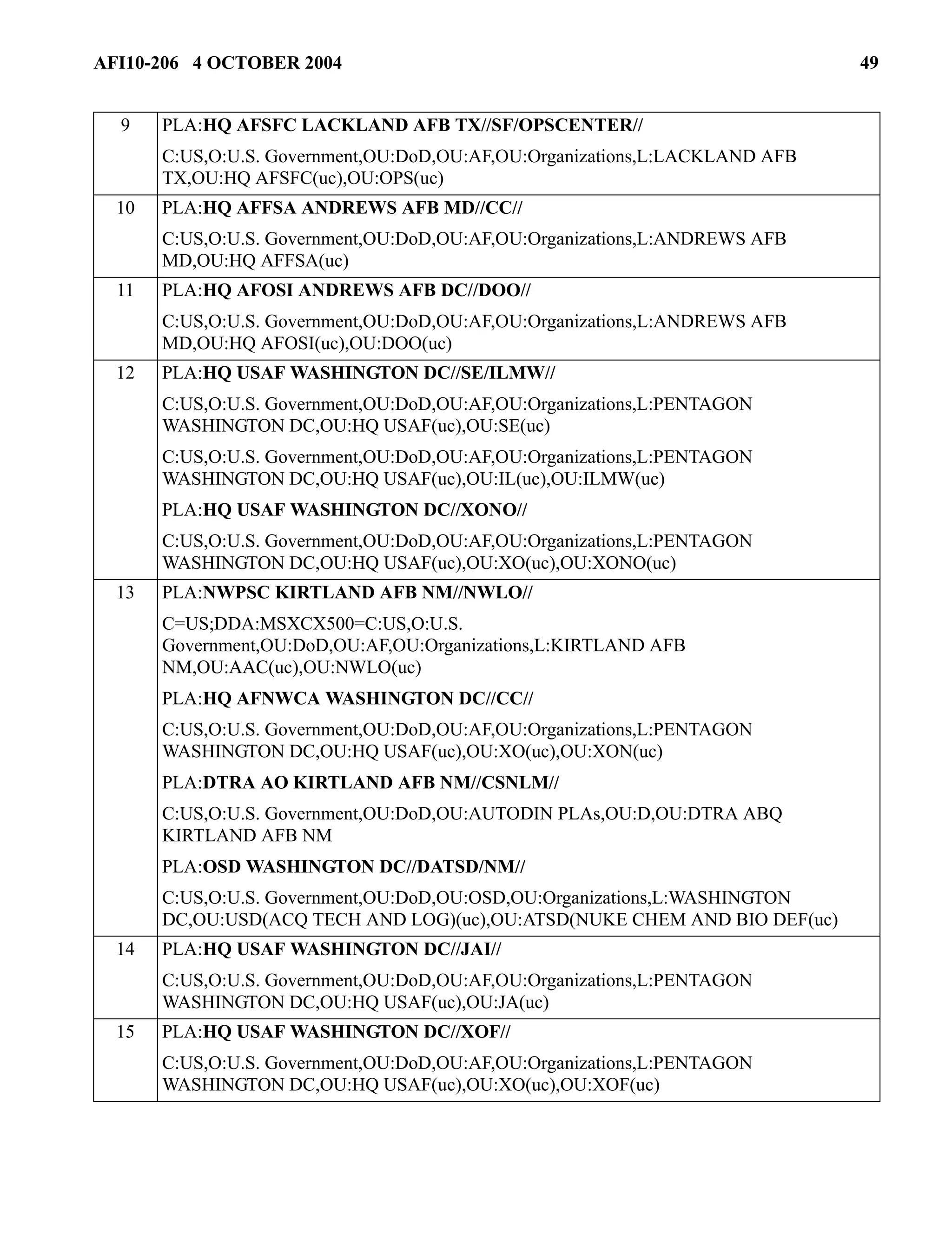
HOMELINE reports (Figure 3.4.); adds DMS addresses to the minimum essential address list (Table 
3.5.); adds remarks “All reports will be classified according to content” to all nuclear related reports 
(Table 3.4. Section 5); changes CSAF Special Interest Item to CSAF Special Reporting Item
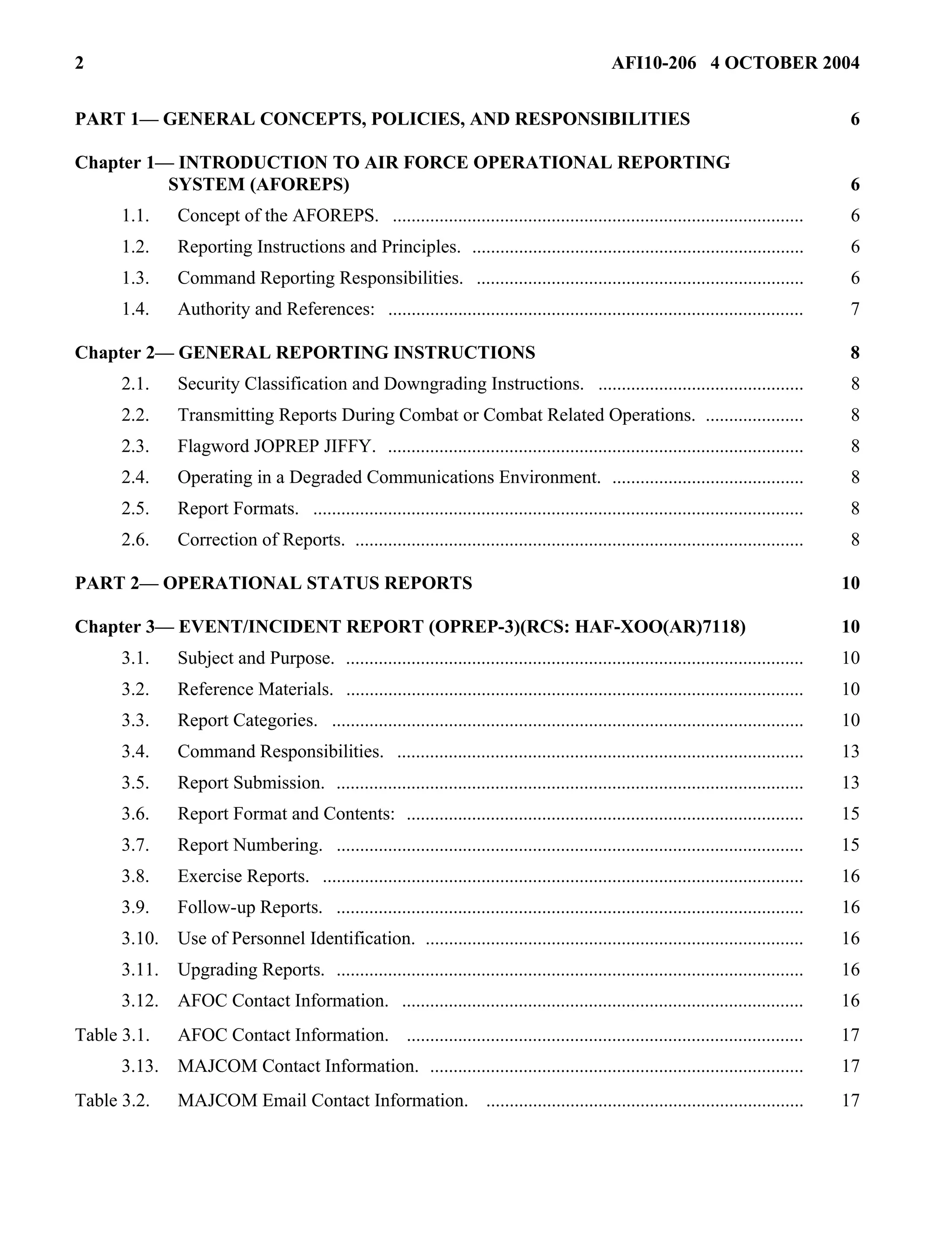
2 AFI10-206 4 OCTOBER 2004 
PART 1— GENERAL CONCEPTS, POLICIES, AND RESPONSIBILITIES 6 
Chapter 1— INTRODUCTION TO AIR FORCE OPERATIONAL REPORTING 
SYSTEM (AFOREPS) 6 
1.1. Concept of the AFOREPS. ........................................................................................ 6 
1.2. Reporting Instructions and Principles. ....................................................................... 6 
1.3. Command Reporting Responsibilities. ...................................................................... 6 
1.4. Authority and References: ......................................................................................... 7 
Chapter 2— GENERAL REPORTING INSTRUCTIONS 8 
2.1. Security Classification and Downgrading Instructions. ............................................ 8 
2.2. Transmitting Reports During Combat or Combat Related Operations. ..................... 8 
2.3. Flagword JOPREP JIFFY. ......................................................................................... 8 
2.4. Operating in a Degraded Communications Environment. ......................................... 8 
2.5. Report Formats. ......................................................................................................... 8 
2.6. Correction of Reports. ................................................................................................ 8 
PART 2— OPERATIONAL STATUS REPORTS 10 
Chapter 3— EVENT/INCIDENT REPORT (OPREP-3)(RCS: HAF-XOO(AR)7118) 10 
3.1. Subject and Purpose. .................................................................................................. 10 
3.2. Reference Materials. .................................................................................................. 10 
3.3. Report Categories. ..................................................................................................... 10 
3.4. Command Responsibilities. ....................................................................................... 13 
3.5. Report Submission. .................................................................................................... 13 
3.6. Report Format and Contents: ..................................................................................... 15 
3.7. Report Numbering. .................................................................................................... 15 
3.8. Exercise Reports. ....................................................................................................... 16 
3.9. Follow-up Reports. .................................................................................................... 16 
3.10. Use of Personnel Identification. ................................................................................. 16 
3.11. Upgrading Reports. .................................................................................................... 16 
3.12. AFOC Contact Information. ...................................................................................... 16 
Table 3.1. AFOC Contact Information. ..................................................................................... 17 
3.13. MAJCOM Contact Information. ................................................................................ 17 
Table 3.2. MAJCOM Email Contact Information. .................................................................... 17
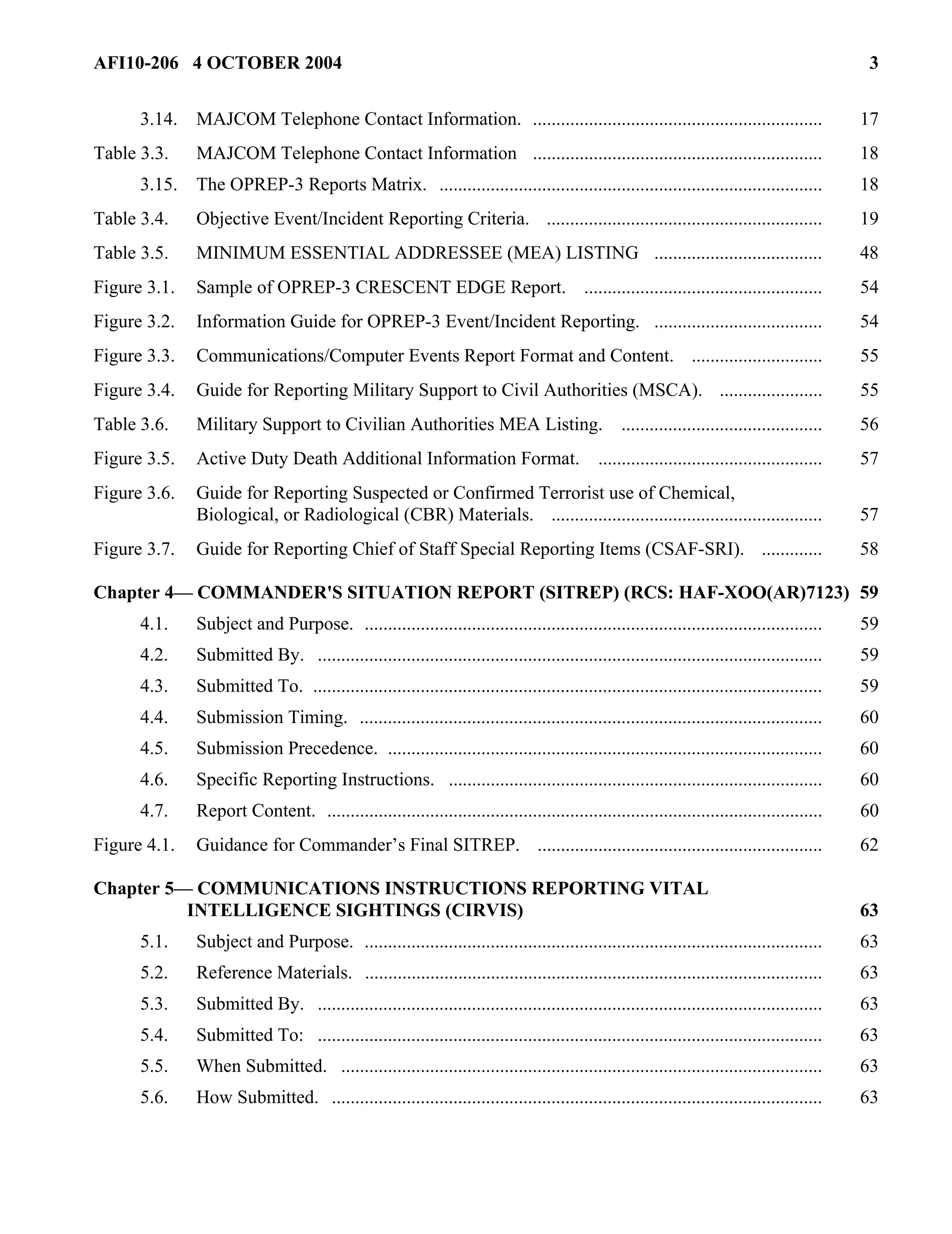
AFI10-206 4 OCTOBER 2004 3 
3.14. MAJCOM Telephone Contact Information. .............................................................. 17 
Table 3.3. MAJCOM Telephone Contact Information .............................................................. 18 
3.15. The OPREP-3 Reports Matrix. .................................................................................. 18 
Table 3.4. Objective Event/Incident Reporting Criteria. ........................................................... 19 
Table 3.5. MINIMUM ESSENTIAL ADDRESSEE (MEA) LISTING .................................... 48 
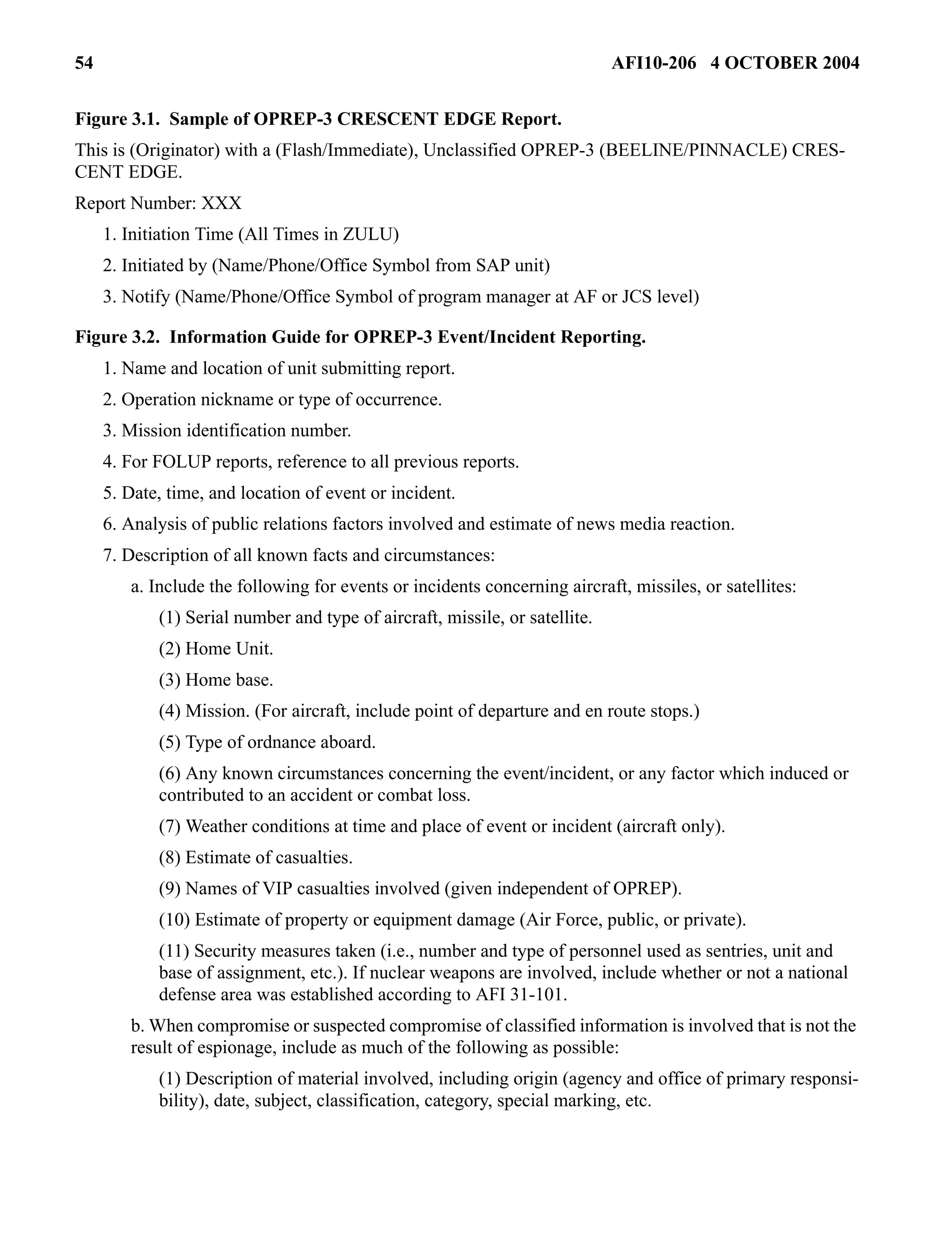
Figure 3.1. Sample of OPREP-3 CRESCENT EDGE Report. ................................................... 54 
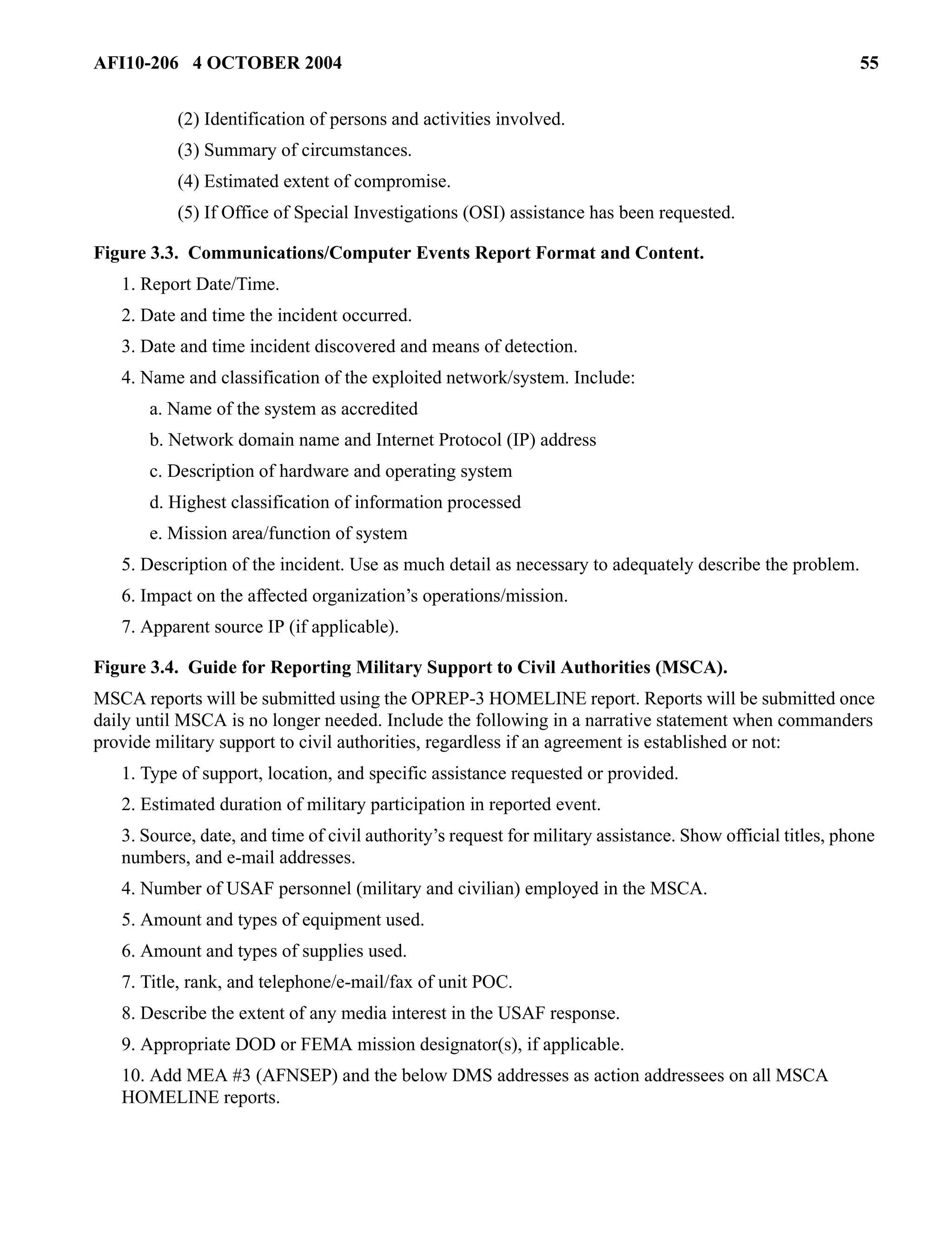
Figure 3.2. Information Guide for OPREP-3 Event/Incident Reporting. .................................... 54 
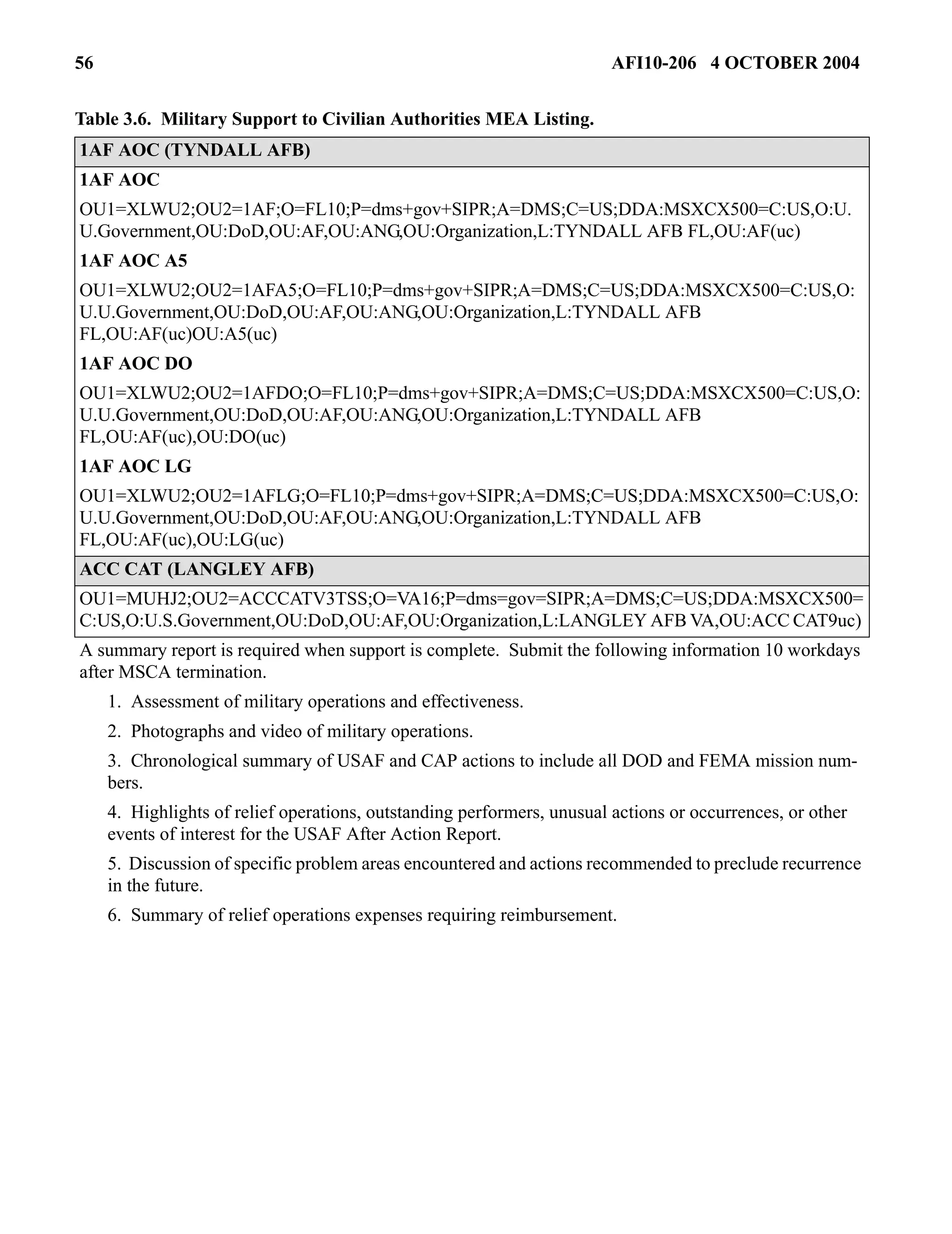
Figure 3.3. Communications/Computer Events Report Format and Content. ............................ 55 
Figure 3.4. Guide for Reporting Military Support to Civil Authorities (MSCA). ...................... 55 
Table 3.6. Military Support to Civilian Authorities MEA Listing. ........................................... 56 
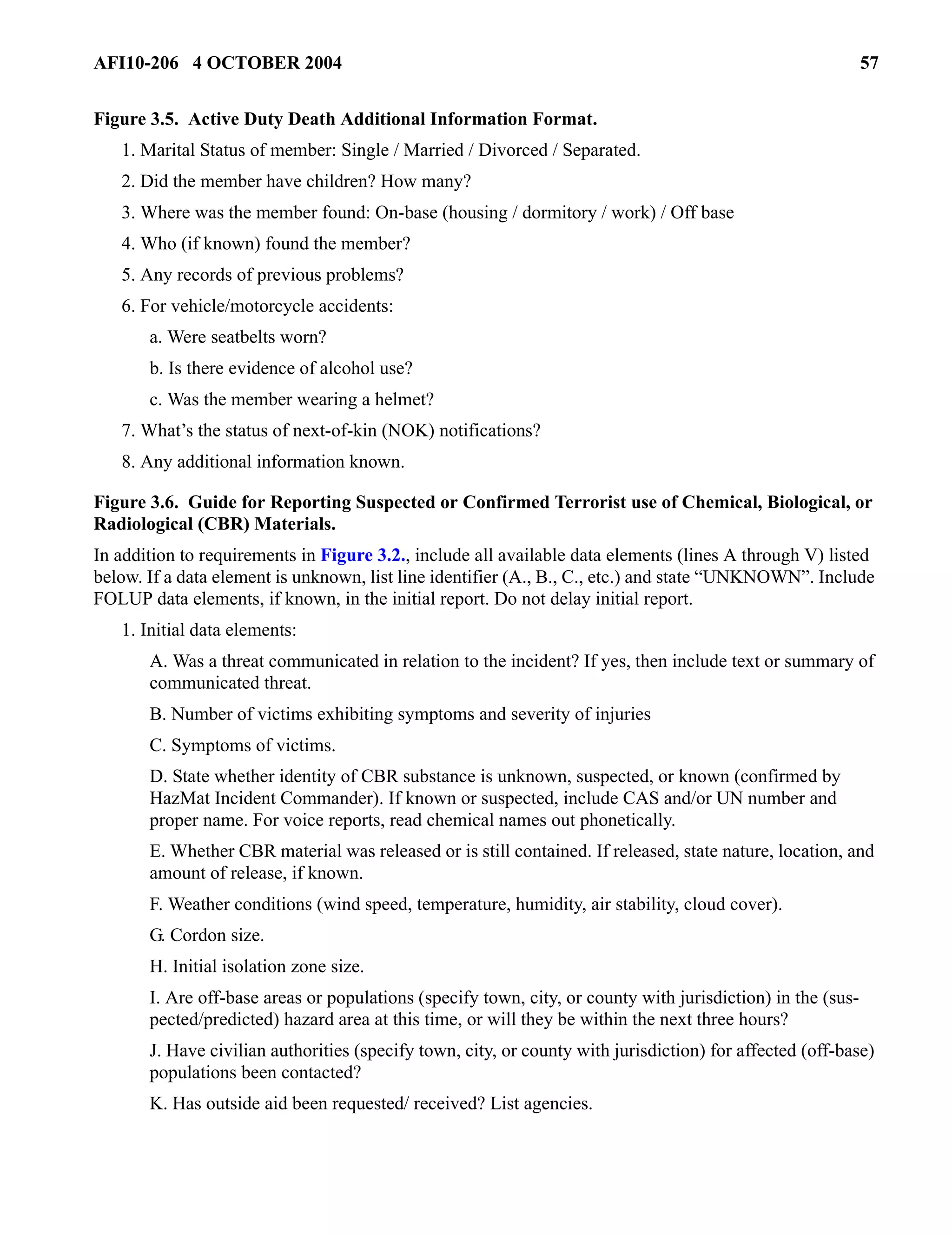
Figure 3.5. Active Duty Death Additional Information Format. ................................................ 57 
Figure 3.6. Guide for Reporting Suspected or Confirmed Terrorist use of Chemical, 
Biological, or Radiological (CBR) Materials. .......................................................... 57 
Figure 3.7. Guide for Reporting Chief of Staff Special Reporting Items (CSAF-SRI). ............. 58 
Chapter 4— COMMANDER'S SITUATION REPORT (SITREP) (RCS: HAF-XOO(AR)7123) 59 
4.1. Subject and Purpose. .................................................................................................. 59 
4.2. Submitted By. ............................................................................................................ 59 
4.3. Submitted To. ............................................................................................................. 59 
4.4. Submission Timing. ................................................................................................... 60 
4.5. Submission Precedence. ............................................................................................. 60 
4.6. Specific Reporting Instructions. ................................................................................ 60 
4.7. Report Content. .......................................................................................................... 60 
Figure 4.1. Guidance for Commander’s Final SITREP. ............................................................. 62 
Chapter 5— COMMUNICATIONS INSTRUCTIONS REPORTING VITAL 
INTELLIGENCE SIGHTINGS (CIRVIS) 63 
5.1. Subject and Purpose. .................................................................................................. 63 
5.2. Reference Materials. .................................................................................................. 63 
5.3. Submitted By. ............................................................................................................ 63 
5.4. Submitted To: ............................................................................................................ 63 
5.5. When Submitted. ....................................................................................................... 63 
5.6. How Submitted. ......................................................................................................... 63
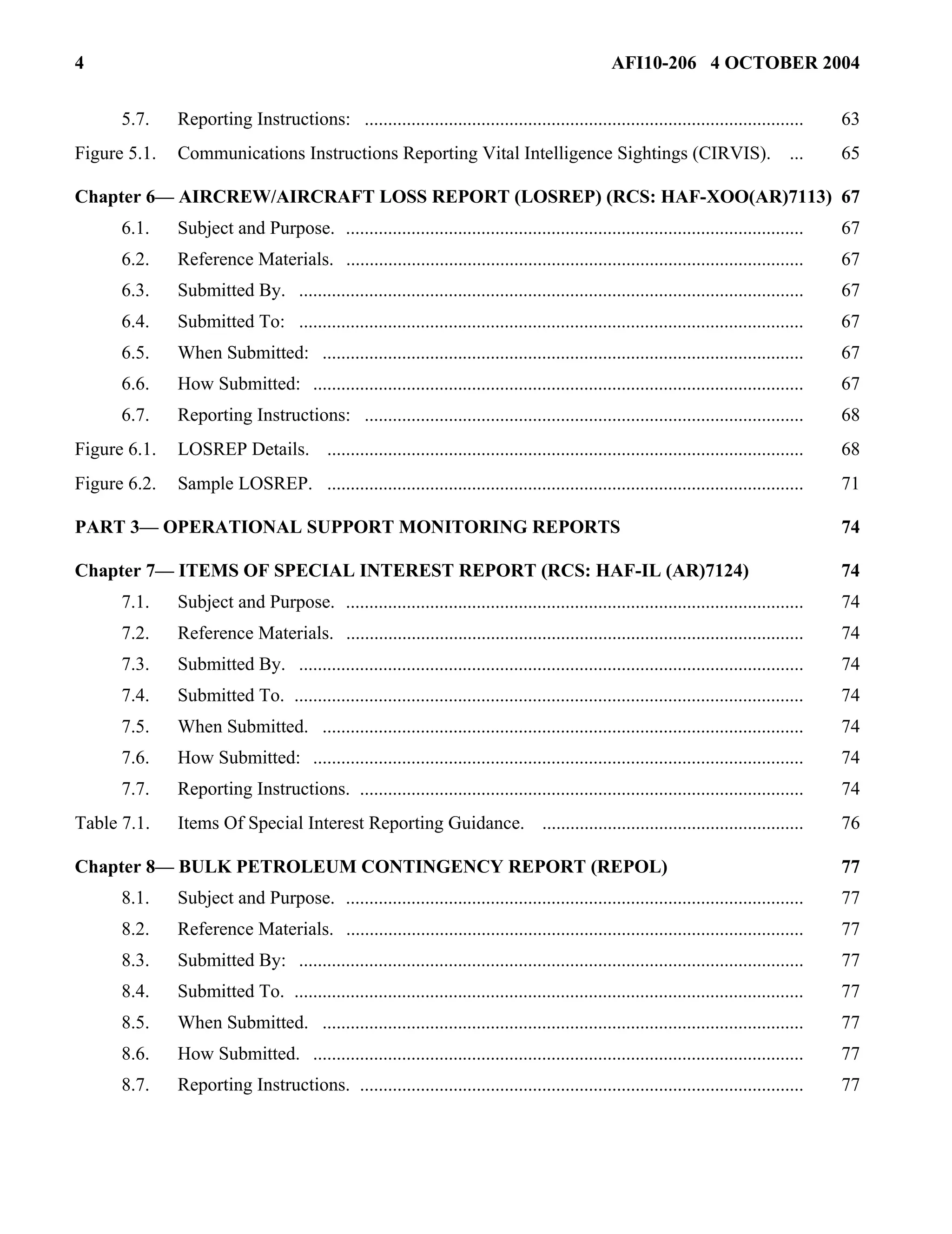
4 AFI10-206 4 OCTOBER 2004 
5.7. Reporting Instructions: .............................................................................................. 63 
Figure 5.1. Communications Instructions Reporting Vital Intelligence Sightings (CIRVIS). ... 65 
Chapter 6— AIRCREW/AIRCRAFT LOSS REPORT (LOSREP) (RCS: HAF-XOO(AR)7113) 67 
6.1. Subject and Purpose. .................................................................................................. 67 
6.2. Reference Materials. .................................................................................................. 67 
6.3. Submitted By. ............................................................................................................ 67 
6.4. Submitted To: ............................................................................................................ 67 
6.5. When Submitted: ....................................................................................................... 67 
6.6. How Submitted: ......................................................................................................... 67 
6.7. Reporting Instructions: .............................................................................................. 68 
Figure 6.1. LOSREP Details. ...................................................................................................... 68 
Figure 6.2. Sample LOSREP. ...................................................................................................... 71 
PART 3— OPERATIONAL SUPPORT MONITORING REPORTS 74 
Chapter 7— ITEMS OF SPECIAL INTEREST REPORT (RCS: HAF-IL (AR)7124) 74 
7.1. Subject and Purpose. .................................................................................................. 74 
7.2. Reference Materials. .................................................................................................. 74 
7.3. Submitted By. ............................................................................................................ 74 
7.4. Submitted To. ............................................................................................................. 74 
7.5. When Submitted. ....................................................................................................... 74 
7.6. How Submitted: ......................................................................................................... 74 
7.7. Reporting Instructions. ............................................................................................... 74 
Table 7.1. Items Of Special Interest Reporting Guidance. ........................................................ 76 
Chapter 8— BULK PETROLEUM CONTINGENCY REPORT (REPOL) 77 
8.1. Subject and Purpose. .................................................................................................. 77 
8.2. Reference Materials. .................................................................................................. 77 
8.3. Submitted By: ............................................................................................................ 77 
8.4. Submitted To. ............................................................................................................. 77 
8.5. When Submitted. ....................................................................................................... 77 
8.6. How Submitted. ......................................................................................................... 77 
8.7. Reporting Instructions. ............................................................................................... 77
AFI10-206 4 OCTOBER 2004 5 
Chapter 9— LOGISTICS FEASIBILITY ANALYSIS CAPABILITY (LOGFAC) 
(RCS: HAF-ILX(A)8001) 78 
9.1. Subject and Purpose. .................................................................................................. 78 
9.2. Reference Materials: .................................................................................................. 78 
9.3. Submitted By: ............................................................................................................ 78 
9.4. Submitted To: ............................................................................................................ 78 
9.5. When Submitted. ....................................................................................................... 78 
9.6. How Submitted: ......................................................................................................... 78 
9.7. Reporting Instructions. ............................................................................................... 78 
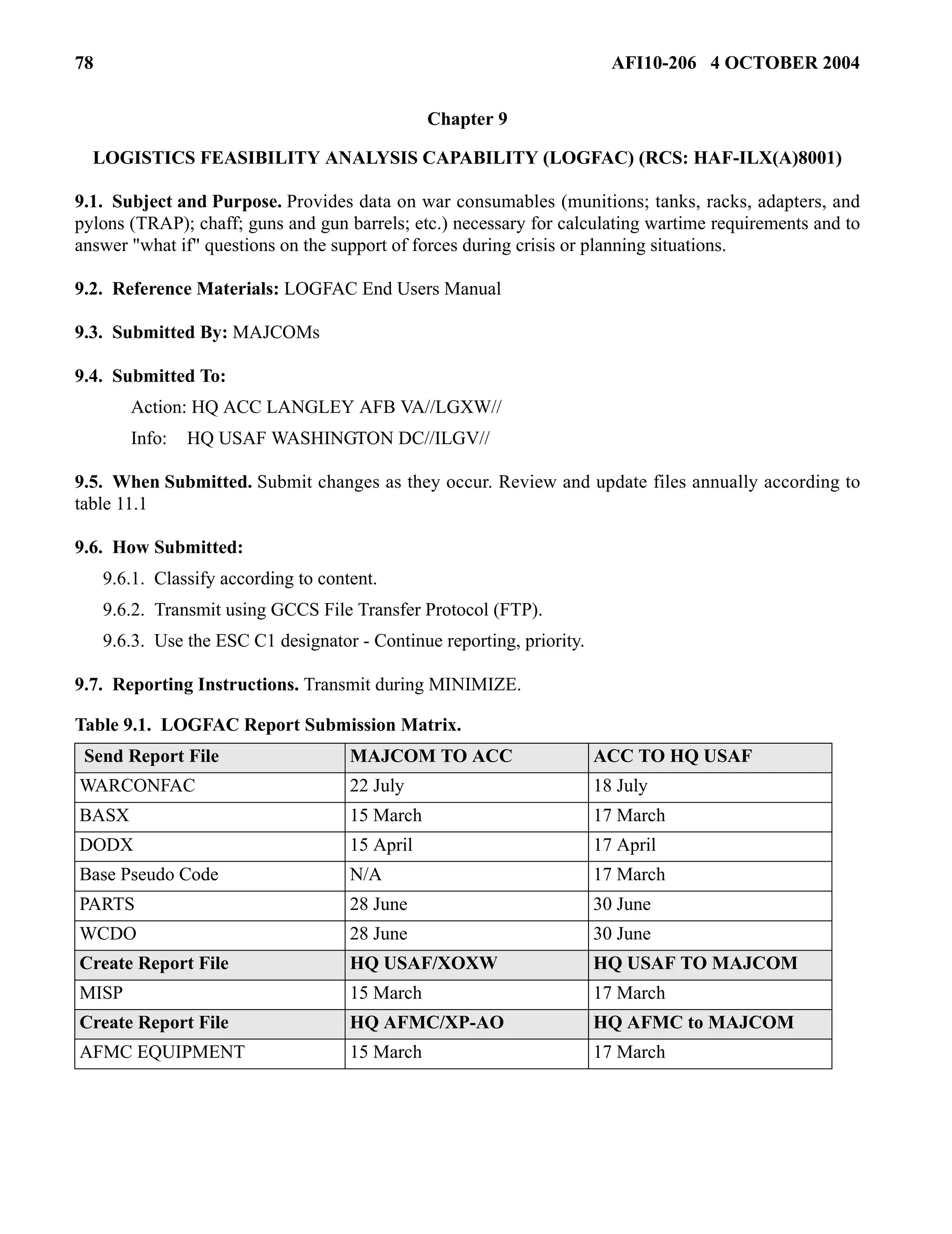
Table 9.1. LOGFAC Report Submission Matrix. ...................................................................... 78 
Chapter 10— MEDICAL REPORT FOR EMERGENCIES, DISASTERS AND 
CONTINGENCIES 79 
10.1. Subject and Purpose. .................................................................................................. 79 
10.2. References Material. .................................................................................................. 79 
10.3. Submitted By. ............................................................................................................ 79 
10.4. Submitted To: ............................................................................................................ 79 
10.5. When Submitted: ....................................................................................................... 79 
10.6. How Submitted: ......................................................................................................... 79 
Figure 10.1. Reporting Instructions. .............................................................................................. 80 
Figure 10.2. Employment Status ................................................................................................... 80 
Table 10.1. PCTEF Ratings ......................................................................................................... 82 
10.7. Waiers. ....................................................................................................................... 83 
Attachment 1— GLOSSARY OF REFERENCES AND SUPPORTING INFORMATION 84
6 AFI10-206 4 OCTOBER 2004 
PART 1 
GENERAL CONCEPTS, POLICIES, AND RESPONSIBILITIES 
Chapter 1 
INTRODUCTION TO AIR FORCE OPERATIONAL REPORTING SYSTEM (AFOREPS) 
1.1. Concept of the AFOREPS. The set of reports that make up the AFOREPS provide HQ USAF and 
intermediate commands the information necessary for timely operational decisions. Major commands 
(MAJCOM) will integrate their reporting systems into AFOREPS, thereby allowing easy lateral and ver-tical 
transfer of information. 
1.2. Reporting Instructions and Principles. The following instructions and principles apply to the 
AFOREPS: 
1.2.1. AFOREPS reports draw information from numerous sources (e.g., personnel, materiel, equip-ment 
status, operations and logistics planning, situation monitoring, and intelligence) and give deci-sion 
makers a concise picture of events. The main criterion for inclusion in the AFOREPS system is 
essential information for command and control of aerospace forces. 
1.2.2. Commands with both an Air Force and a joint or combined reporting requirement (e.g., air 
component commands) will use the AFOREPS and address both chains. 
1.2.3. Annually, MAJCOMs will review new requirements to determine operational necessity. 
1.3. Command Reporting Responsibilities. To identify and streamline host-tenant responsibilities, host 
units will establish host-tenant agreements that meet the needs of both organizations. Commanders are 
responsible for timely and accurate reporting for all events/incidents that meet CJCS reporting criteria 
(PINNACLEs), CSAF reporting criteria (BEELINEs), and MAJCOM/CC reporting criteria (HOME-LINEs) 
for all assigned or attached units, as well as units staging through their command. The agreement 
will establish procedures to ensure the installation commander is made aware of all events/incidents 
occurring on or affecting their installation. Agreements must adhere to the following stipulations at a min-imum. 
1.3.1. Ensure established procedures do not delay the submission of OPREP-3 reports. 
1.3.2. Outline specific OPREP-3 responsibilities of host and tenant command posts/units, i.e., 1C3s 
functioning as a command post entity such as AMCCs, (including who will submit the reports), with 
emphasis on timely and accurate report submission. 
1.3.3. Installations Operating Under a Single MAJCOM: If the installation has one or more ten-ant( 
s) but only one command post, the host unit will establish the agreement, and the command post 
will submit all OPREP-3 reports. The commander or authorized delegate operating the command post 
submitting the report will approve OPREP-3 reports prior to submission. 
1.3.4. Installations Operating with Multiple MAJCOMs: Tenant commanders assigned to a dif-ferent 
MAJCOM than the host unit, have the sole responsibility to report an event/incident affecting 
their assets that meet OPREP-3 reporting criteria. The unit commander or authorized delegate submit-ting 
the report will have approval/release authority for all OPREP-3 reports affecting his/her assets.
AFI10-206 4 OCTOBER 2004 7 
1.3.4.1. If the host command post submits OPREP-3 reports for the tenant, the host unit will not 
interfere with, alter, or delay the tenant unit’s report. 
1.3.5. Ensure OPREP-3 reports have all required addresses, including the affected (host or tenant) 
MAJCOM command center, and affected units and MAJCOMs. 
1.3.6. Provide copies of the agreement to the host and tenant MAJCOMs, IAW MAJCOM proce-dures. 
MAJCOMs will maintain a current copy of the agreement on file. 
1.3.7. MAJCOMs, direct reporting units (DRUs), field operating agencies (FOAs), Air Force Reserve 
(AFRC), and Air National Guard (ANG) personnel will develop instructions to ensure timely and 
accurate OPREP-3 reporting. 
1.3.7.1. Geographically Separated Units (GSUs) that do not fit under any of the above criteria will 
comply with parent MAJCOM guidance IAW this instruction. 
1.3.8. Air component commanders of unified commands and/or JTFs will ensure compliance through 
their air component command centers and de-conflict with unified/JTF command directives. 
1.4. Authority and References: 
1.4.1. Authority. This instruction includes the requirements of the various documents of the Joint 
Reporting System. Air Force units will use AFI 10-206 as the primary source for reporting instruc-tions. 
Later chapters identify reference materials for specific reports. 
1.4.2. Emergency Status Codes (ESC). These codes serve as a guide for reporting under emergency 
and crisis conditions. Each chapter reflects the ESC required for each type report. AFI 33-324, The 
Information Collections and Reports Management Program; Controlling Internal, Public, and Inter-agency 
Air Force Information Collections (formerly AFI 37-124) prescribes ESC. 
1.4.2.1. Status Code “D” indicates: Immediately discontinue reporting data requirements during 
emergency conditions. 
1.4.2.2. Status Code “C1” indicates: Continue reporting during emergency conditions, priority 
precedence. Submit data requirements assigned this category as prescribed or by any means to 
ensure arrival on the established due dates. 
1.4.2.3. Status Code “C2” indicates: Continue reporting during emergency conditions, normal pri-ority. 
Submit data requirements in this category as prescribed or by any means to ensure arrival on 
the established due dates. 
1.4.2.4. Status Code “C3” indicates: Continue reporting during emergency conditions, delayed 
precedence. Submit data requirements as prescribed, but they may be delayed to allow the submis-sion 
of higher precedence reports. Submit by non-electronic means, if possible. 
1.4.3. Chapter 5 of this instruction is exempt from report licensing as defined in AFI 33-324. The 
HQ USAF Report Control Symbol (RCS) follows the title of each type report.
8 AFI10-206 4 OCTOBER 2004 
Chapter 2 
GENERAL REPORTING INSTRUCTIONS 
2.1. Security Classification and Downgrading Instructions. AFI 31-401, Information Security Pro-gram 
Management provides security classification and downgrading instructions. 
2.1.1. Classify reports indicating unit combat readiness status according to AFI 10-201, Status of 
Resources and Training System (SORTS). 
2.1.2. Classify OPREP-3 reports containing: 
2.1.2.1. Information on a combat loss or damage or discussing combat mission results a minimum 
of SECRET. 
2.1.2.2. A complete inventory of nuclear weapons of one or more units a minimum of SECRET. 
2.1.2.3. Information on the deployment of combat aircraft, units, or personnel according to the 
appropriate deployment plans. 
2.1.2.4. Unit names and locations associated with a plan according to security instructions. 
2.1.2.5. Events/incidents involving nuclear weapons according to content. 
2.1.2.6. Events/incidents of confirmed or suspected compromise of classified information accord-ing 
to content. 
2.1.2.7. Information of a unit’s total mission impairment according to content. 
2.2. Transmitting Reports During Combat or Combat Related Operations. When combat or com-bat- 
related operational requirements make speed of delivery paramount, military commanders may mod-ify 
transmission of classified information as necessary to meet local conditions. (When so doing, 
commanders will cite in the message "CJCSM 3150.03B, Enclosure A, paragraph 4a," as the authority.) 
2.3. Flagword JOPREP JIFFY. The flagword JOPREP JIFFY identifies electrically transmitted com-mand 
post-to-command post messages and operational reports, and notifies communications centers to 
route a message directly to the command and control facility. The flagword does not indicate a precedence 
for transmission within communications channels. 
2.4. Operating in a Degraded Communications Environment. HQ USAF and MAJCOMs may sus-pend 
the submission of selected reports. MAJCOMs will advise HQ USAF immediately of any suspended 
AFOREPS reports. 
2.5. Report Formats. Prepare record copy reports using the specific formats and content information 
available in AFPAM 10-709 V1CD (formerly AFP 102-2, volume I), and as supplemented by this instruc-tion. 
When AFPAM 10-709 V1CD, does not contain a specific format for the record copy report, use the 
General Administration (GENADMIN) format with the report's name as the SUBJECT. 
2.6. Correction of Reports. The originator will submit a correction if an error is noticed after submitting 
a report. The corrected report includes only those sections of the report requiring correction. The cor-
AFI10-206 4 OCTOBER 2004 9 
rected report will be classified according to its content. Identify a corrected report by placing "CORR" in 
the third field of the TIMELOC set.
10 AFI10-206 4 OCTOBER 2004 
PART 2 
OPERATIONAL STATUS REPORTS 
Chapter 3 
EVENT/INCIDENT REPORT (OPREP-3)(RCS: HAF-XOO(AR)7118) 
3.1. Subject and Purpose. OPREP-3 reports use command post channels to immediately notify com-manders 
of any significant event or incident that rises to the level of MAJCOM, HQ USAF, or DOD inter-ests. 
Submit the applicable OPREP-3 regardless of whether or not the event is being reported through 
other channels. OPREP-3 reports do not replace the requirement for more detailed reports such as the Air-crew/ 
Aircraft Loss Report (LOSREP), the Commander's Situation Report (SITREP), and accident or inci-dent 
investigation reports. Submitting an OPREP-3 report neither changes, nor substitutes for any report 
required by other directives. 
3.2. Reference Materials. Chairman of the Joint Chiefs of Staff Manual (CJCSM) 3150.03B. 
3.3. Report Categories. OPREP-3 reports categorize events or incidents according to their nature. Flag-words 
associated with each category aid prompt transmission, processing, and distribution of the reports 
by alerting people to their importance. The following flagword reports make up the OPREP-3 system. 
3.3.1. PINNACLE (OPREP-3P). This message is used by any unit to provide the NMCC and, as 
appropriate, combatant commands and Services with immediate notification of any incident or event 
where national-level interest is indicated. The general OPREP-3P report is used for situations that do 
not require reporting via other OPREP-3P reports listed in subparagraphs 3.3.2. through 3.3.9. this 
report is not restricted to operational information. Any event or incident should be considered report-able 
if it: 
3.3.1.1. Generates a higher level of military action. 
3.3.1.2. Causes a national reaction. 
3.3.1.3. Affects international relationships. 
3.3.1.4. Causes immediate widespread coverage in news media. 
3.3.1.5. Is clearly against the national interest. 
3.3.1.6. Affects current national policy. 
3.3.2. PINNACLE NUCFLASH (OPREP-3PNF). Used to report an event, accident, or incident 
that could create the risk of a nuclear war. This message has the highest precedence in the OPREP-3 
reporting structure. Report any of the following as an OPREP-3PNF: 
3.3.2.1. Ballistic missile launch or space launch. 
3.3.2.2. Reentering space object. 
3.3.2.3. Loss, potential loss or degradation of US military space capability when the loss or deg-radation 
is because of actions by a suspected or known hostile source.
AFI10-206 4 OCTOBER 2004 11 
3.3.2.4. Reports of cruise missiles or non-friendly, non-US or non-allied aircraft not on an 
approved flight plan that could pose a threat. 
3.3.2.4.1. Accidental, unauthorized, or unexplained incident involving possible detonation of 
a nuclear weapon. 
3.3.2.4.2. Unauthorized flight or deviation from an approved flight plan, by a US 
nuclear-armed or nuclear-capable aircraft with the capability to penetrate the airspace of 
another nuclear-capable country. 
3.3.3. PINNACLE FRONT BURNER (OPREP-3PFB). Used to report pre-conflict occurrence of 
armed attack, harassment, or hostile action against US forces, territory, or interests. 
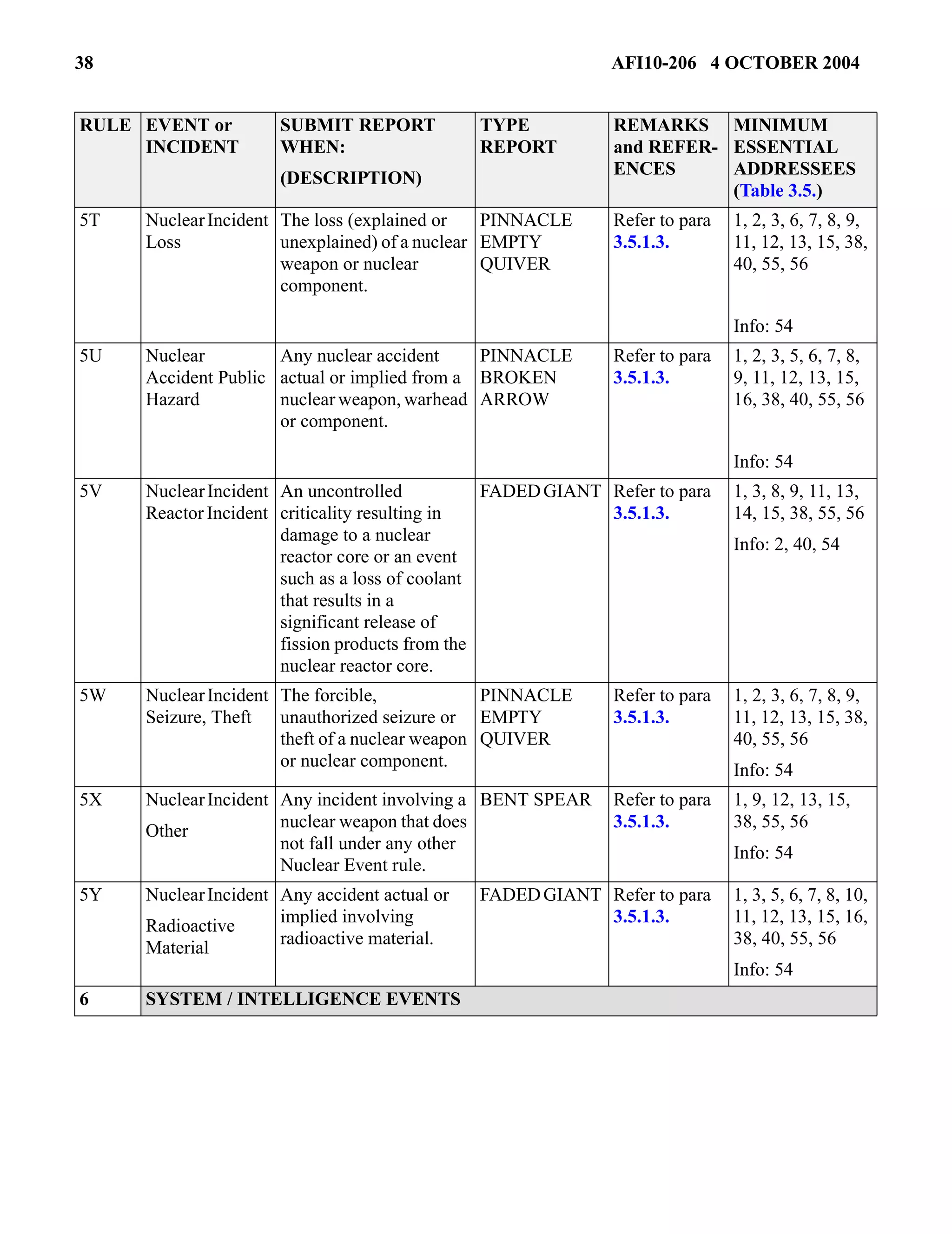
3.3.4. PINNACLE BROKEN ARROW (OPREP-3PBA). Used to report a US nuclear weapon 
accident that does not create the risk of a nuclear war. Included are the following: 
3.3.4.1. Nuclear detonation of a US nuclear weapon. 
3.3.4.2. Non-nuclear detonation or burning of a nuclear weapon. 
3.3.4.3. Radioactive contamination from a US nuclear weapon or component. 
3.3.4.4. The jettisoning of a US nuclear weapon or component. 
3.3.4.5. Public hazard, actual or implied, from a US nuclear weapon or component. 
3.3.5. PINNACLE EMPTY QUIVER (OPREP-3PEQ). Used to report the seizure, theft, or loss of 
a nuclear weapon. 
3.3.6. PINNACLE EMERGENCY DISABLEMENT (OPREP-3PED). Used for reporting opera-tions 
involving the command disablement or nonviolent disablement of nuclear weapons. 
3.3.7. PINNACLE EMERGENCY EVACUATION (OPREP-3PEV). Used to report operations 
involving the emergency evacuation of nuclear weapons. 
3.3.8. PINNACLE COMMAND ASSESSMENT (OPREP-3PCA). Used to report a combatant 
commander’s assessment of a developing or potential crisis situation. 
3.3.9. PINNACLE LERTCON STATUS OF ACTION (OPREP-3PLSOA). Used to immediately 
notify the NMCC of Combatant Commander’s actions relative to the alert condition of their forces. 
3.3.10. BENT SPEAR (OPREP-3BS). Used to report incidents involving nuclear weapons that are of 
significant interest but are not categorized as PINNACLE NUCFLASH or PINNACLE BROKEN 
ARROW to the appropriate Service headquarters. The flagword PINNACLE may be added at any 
level of command to expedite forwarding of this message to the NMCC. 
3.3.11. FADED GIANT (OPREP-3FG). Used to report nuclear reactor or radiological accidents or 
incidents to the appropriate Service headquarters. The flagword PINNACLE may be added at any 
level of command to expedite forwarding of this message to the NMCC 
3.3.12. BEELINE (OPREP-3B). Used to report any event or incident that requires Air Force-level 
interest, but not requiring OPREP-3 PINNACLE reports. Although the report normally remains 
within US Air Force channels, commanders may add other addressees, as appropriate to avoid dupli-cate 
reporting. HQ USAF may make BEELINE information available to agencies outside the Air 
Force (e.g., NMCC, State Department) based on the situation.
12 AFI10-206 4 OCTOBER 2004 
3.3.13. HOMELINE (OPREP-3H). Used to report events or incidents, which do not meet Air 
Force-level criteria, but are of interest to the MAJCOM. Although these reports are not addressed to 
HQ Air Force, they are part of the AFOREPS program and will use the same basic format. MAJCOMs 
determine specific reporting requirements and procedures for the HOMELINE report. 
ANG units report HOMELINE-level information to ANG Operations Center, unless federalized or 
mobilized. 
3.3.14. OPREP-3 CRESCENT EDGE (OPREP-3CE). Used to immediately notify program man-agers 
at the Joint Staff, Air Force, or MAJCOM level of significant activities involving Special 
Access Programs (SAPs) operating under the auspices of AFI 16-701. Affected unit command posts 
will submit voice reports through normal command post channels. The flagwords HOMELINE, BEE-LINE, 
and PINNACLE are used to reference the level of the program manager to be contacted. If the 
program manager is at the Air Force level the AFOC will notify the program manager. MAJCOMs 
will establish procedures for contacting program managers at and below the MAJCOM level. 
3.3.14.1. The CRESCENT EDGE Report allows units operating SAPs to use the operational 
reporting channel to advise their program managers of events or incidents that meet OPREP-3 
reporting criteria. The CRESCENT EDGE Report is the single reporting channel for all SAP units 
reporting incidents to higher headquarters. Crescent Edge Reports will be forwarded through com-mand 
post channels to MAJCOM Command Centers, the AFOC, or the NMCC as required 
depending on the program manager level. Refer to Figure 3.1. to view a sample voice report. 
3.3.14.2. The unit with the SAP, not the command post, initiates CRESCENT EDGE reports. The 
initiating unit will notify the command post that they have a CRESCENT EDGE report to be sub-mitted. 
No program names or incident details will be included, and command post personnel will 
not press for details. The command post will assign a report number and send the report up the 
chain to the appropriate level. After report submission, no other action is required by the command 
post. 
3.3.14.3. Only the following information will be included in the report: 
3.3.14.3.1. The time the unit initiated the report. 
3.3.14.3.2. The name, phone number, and office symbol of the person at the unit initiating the 
report. 
3.3.14.3.3. The name, phone number, and office symbol of the program manager at the appro-priate 
higher headquarters. 
3.3.14.4. A CRESCENT EDGE Report will be submitted when an event or incident involving a 
SAP has been determined, by an authorized individual from the SAP unit, that higher-level aware-ness 
is warranted. 
3.3.14.4.1. It is the reporting unit’s responsibility, not the command post’s or wing com-mander’s, 
to determine the level the report will be submitted, and to provide all the informa-tion 
to be reported IAW paragraph 3.3.14.3. above. 
3.3.14.4.2. The parent MAJCOM, the AFOC, or the NMCC (as deemed applicable) are the 
only addressees permitted on record copy CRESCENT EDGE reports. If report goes to the 
AFOC or NMCC, MAJCOM and the AFOC will be addressed.
AFI10-206 4 OCTOBER 2004 13 
3.3.14.4.3. The CRESCENT EDGE voice and record copy reports will be sent via normal 
reporting channels using FLASH or IMMEDIATE precedence. This report is unclassified; 
however, record copy reports will be transmitted Encrypt for Transmission Only (EFTO). 
3.3.15. EXERCISE WHITE PINNACLE--OPREP-3 WHITE PINNACLE (OPREP-3WP). 
OPREP-3WP is an unclassified exercise flagword used in exercise messages that contain simulated, 
time-critical information from operating forces to the NMCC. This exercise is used by the NMCC and 
combatant commanders to exercise the timeliness of the OPREP-3 PINNACLE reports. 
3.3.15.1. Regional Operations Support Division (ROSD), Operations, Training, and Exercise 
(OT&E) Branch, J-3 DDRO, will recommend to unified commands via message the number of 
exercises to be conducted within the assigned period. Unified commands will designate the units 
to receive the exercise message and will select specific exercise start times. 
3.3.15.2. Detailed guidance is governed by CJCSM 3150.03B (Joint Reporting Structure Event 
and Incident Reports). Only unified commands, units subordinate to unified commands, and the 
NMCC participate in this exercise. 
3.4. Command Responsibilities. Due to the time sensitivity of OPREP-3 information, report each event/ 
incident as promptly and accurately as possible. If there is doubt, report it. Units at all levels will develop 
procedures to quickly obtain and report the key elements of an OPREP-3 report. Since installations nor-mally 
host units assigned to different MAJCOMs, notification and coordination procedures between units 
must be agreed upon. Therefore, host, tenant, and applicable MAJCOMs will have a MOA on file (IAW 
para 1.3.). Commanders should ensure all agencies under their command receive OPREP-3 training at 
least quarterly. 
3.4.1. Command posts will thoroughly brief commanders on all reporting criteria and procedures out-lined 
in this instruction. Prior to the command post submission, the commander or designated alter-nate 
will review all OPREP-3 reports in a timely manner. The command post is responsible for 
providing commanders the necessary information to facilitate an informed decision and timely 
OPREP-3 voice and record-copy submissions IAW this instruction (para. 3.5.1. and 3.5.2.) and 
CJCSM 3150.03B (Enclosure A, para 3). 
3.5. Report Submission. The closest command post to the location where an event/incident has occurred 
having knowledge of that event/incident will submit the OPREP-3 reports. When necessary, the AFOC 
may request, through the MAJCOM, that a unit report an event/incident because that unit is located clos-est 
to where the event/incident occurred. 
3.5.1. Voice Reports: Air Force units will submit voice reports to the appropriate MAJCOM com-mand 
center via telephone conference. IAW CJCSM 3150.03B, OPREP-3 voice reports will be sub-mitted 
as soon as possible after an event or incident has occurred using FLASH or IMMEDIATE 
precedence. The goal is to initiate initial voice reports within 15 minutes of an event or incident. Due 
to the extremely time sensitive nature of the PINNACLE NUCFLASH report, these voice reports 
must be made within 5 minutes after the incident and sent at FLASH precedence. 
3.5.1.1. Normal conferencing procedures for BEELINE and Service-level reports (Bent Spear and 
Faded Giant) will be unit-to-MAJCOM-to-AFOC. Procedures for PINNACLE reports will be 
unit-to-MAJCOM-to-AFOC-to-NMCC. Because the audible quality of some conferencing sys-tems 
is degraded with each added conferee, the AFOC will conference in the NMCC for PINNA-
14 AFI10-206 4 OCTOBER 2004 
CLE reports. MAJCOMs or lower echelons may add additional conferees to conferences as 
appropriate. Ensure the AFOC is the last conferee added to the conference. 
3.5.1.2. When reporting on any asset assigned to a MAJCOM other than that of the reporting unit, 
ensure the MAJCOM command center owning the asset is included in the voice conference and 
addressed on the record copy report. 
3.5.1.3. When reporting on any nuclear event, ensure USSTRATCOM is included in the voice 
conference (Unclassified: DSN 271-1806, Comm 402-294-1806 / Classified: DSN 272-4405, 
Comm 402-232-4405) and addressed on the record copy report (MEA 38). 
3.5.1.4. MAJCOM command centers will screen HOMELINE reports for possible BEELINE cri-teria. 
The AFOC will screen BEELINE reports for possible PINNACLE criteria. When in doubt, 
consult the appropriate MAJCOM or the AFOC through the MAJCOM. 
3.5.1.5. Units submitting the OPREP-3 PINNACLE or BEELINE voice report will provide the 
MAJCOM and the AFOC the rule number and subject of the event/incident being reported. Pro-viding 
the AFOC with the rule number allows preliminary checklist steps to be accomplished 
prior to the unit beginning the voice report. After completion of voice reports, the AFOC will give 
a reference time in Zulu for record-copy BEELINE reports, and their initials. For PINNACLE 
reports, the AFOC will remind units of CJCSM 3150.03B reporting criteria (see para. 3.5.2. 
below). 
3.5.1.6. If MAJCOM or NAF command centers are unable to establish a teleconference or the unit 
is reporting a classified report and individual phone calls must be made in lieu of a teleconference, 
the unit will call the AFOC first. The AFOC will attempt to patch the appropriate MAJCOM com-mand 
center(s) and the NMCC (if applicable) into the conference. 
3.5.1.7. For PINNACLE and BEELINE Reports: Do not delay the initial voice report by prepar-ing 
the record copy report prior to voicing the report. 
3.5.1.8. Contact the NMCC directly for nuclear related PINNACLE reports. Intermediate com-mand 
centers will be conferenced if time permits and only if it does not cause a delay in immedi-ately 
voicing these reports to the NMCC. For direct contact to the NMCC, use DSN 223-8196 for 
the Senior Operations Officer (SOO (primary)) or DSN 227-6340 for the EA Cell (secondary). 
3.5.2. Record-copy Reports: IAW CJCSM 3150.03B, the goal is to submit initial record copy PIN-NACLE 
reports within 1 hour of the incident. IAW this instruction, submit all record copy BEELINE 
reports within 1 hour after the associated voice report. Intermediate levels of command will immedi-ately 
pass the report to subordinate or lateral commands that need the information. 
3.5.2.1. The AFOC may request certain questions answered prior to submission of the final 
report. Information requested by the AFOC that is unknown during the initial voice report will be 
provided (when the information becomes available) in the INITIAL record copy report or 
FOLUP/FINAL voice/hard copy reports. 
3.5.3. Do not include the following statements: “The commander has deemed the following report-able” 
and “Further reporting through xxx channels” in OPREP-3 BEELINE or PINNACLE reports. 
3.5.3.1. The first statement in the text of INITIAL record copy reports will state the time the com-mand 
post was notified of the event/incident, and the time the commander or designated alternate 
approved the voice report for command post submission. Example: “The command post was noti-
AFI10-206 4 OCTOBER 2004 15 
fied at 27/1829Z Jul 03, and the commander approved the voice report at 27/1918Z Jul 03.” Do 
not include this information in the voice report. 
3.5.4. Units will ensure all record copy OPREP-3 reports on Class “A” Mishaps are addressed to all 
MAJCOM command centers to include ANG Operations Center and AFRC Command Center using 
the MEA Listing (Table 3.5.). Additionally, address appropriate MAJCOM command centers to 
include ANG and AFRC when personnel and/or assets (active, guard or reserve, mobilized or 
non-mobilized) assigned to those organizations are affected. If units have problems transmitting over 
DMS, use regular NIPRNET/SIPRNET e-mail addresses (Table 3.2.) to forward reports. 
3.5.5. Intermediate levels of command and or the unit originating the report will immediately pass the 
report to subordinate or lateral commands whose units or assets are affected by the event/incident. 
3.5.6. Rapid reporting is imperative. Do not delay an INITIAL report to obtain additional informa-tion. 
Use FOLUP reports to provide additional information when it becomes available. 
3.5.6.1. INITIAL reports must be timely and concise, and contain as much information as imme-diately 
available within established time parameters. Record copy reports must thoroughly answer 
the following questions: who, what, when, where, why, and how. Continue reporting until these 
questions are answered. 
3.5.7. Transmit OPREP-3 reports by the fastest means available consistent with security constraints: 
usually by non-secure voice transmission, followed by a confirming record transmission. Transmit 
reports containing classified or special intelligence information with the proper security precautions. 
Include the flagword JOPREP JIFFY after the classification on all OPREP-3 reports. 
3.5.7.1. If units are unable to use DMS to meet record copy timing criteria, forward the record 
copy to the AFOC’s NIPRNET address (Table 3.1.). If electronic transmission capabilities are not 
available, faxing the record copy report to the AFOC can be used to meet timing criteria, however 
electronic transmission is preferred. If the report is sent using NIPRNET or faxed to the AFOC, 
the originating unit is still responsible for ensuring all required MEAs are in receipt of the record 
copy. For OPREP-3 PINNACLEs, the AFOC will ensure the NMCC is in receipt. 
3.5.8. The initial record copy report will contain any updated information gathered after the initial 
voice report without exceeding the time criteria established in paragraph 3.5.2. 
3.5.9. The OPREP-3 PINNACLE NUCFLASH takes precedence over all other OPREP-3 reports. 
3.5.10. Any actual OPREP-3 report takes precedence over all peacetime exercise communications. 
3.5.11. Submission of OPREP-3 reports will not be effected by the imposition of MINIMIZE. 
3.5.12. Use the ESC “C1” designator - Continue reporting, priority. 
3.6. Report Format and Contents: AFPAM 10-709 V 1CD gives specific format information for 
OPREP-3 reporting. 
3.6.1. The narrative section of each report must clearly convey the details of the incident. Use Figure 
3.2. to assist in gathering and reporting all minimum required events/incident details. 
3.7. Report Numbering. Number OPREP-3 reports consecutively for each calendar year by type, (i.e. 
PINNACLE, BEELINE) beginning with 001. Subsequent reports for the same incident will add sequen-tial 
letters to the basic report number (e.g., 002A, 002B). After the number 999, revert to 001 for the next
16 AFI10-206 4 OCTOBER 2004 
report. Report numbers are designed for the individual unit to track the total number of OPREP-3 reports 
submitted per year. 
3.8. Exercise Reports. Number exercise OPREP-3 reports independently of real-world OPREP-3 
reports. Begin exercise reports with 001 at the start of each exercise. Indicate exercise name in the EXER 
set of each report. 
3.9. Follow-up Reports. FOLUP reports are essential to keep commanders informed of developing situ-ations 
and to provide additional details as they are learned. 
3.9.1. Record copy FOLUP or FINAL reports may contain information previously provided in one or 
more voice reports. Continue reporting as long as the situation merits. When the immediacy of the 
OPREP-3 system subsides, commanders may use SITREP reporting to provide continuous informa-tion. 
Include a reference to applicable voice and record copy reports in each additional record report. 
3.9.2. FOLUP and FINAL reports will be voiced in the same manner as INITIAL voice reports, and 
a record copy report will be submitted. 
3.9.3. INITIAL, FOLUP, and FINAL reports will close with the applicable phrase, i.e., this is a com-mand 
post INITIAL, FOLUP, or FINAL report. 
3.9.4. FOLUP and FINAL reports will contain enough information from the previous report(s) to aid 
the recipient. 
3.9.5. When it is determined that situations are no longer developing, units will send the appropriate 
voice and record report (IAW para 3.9.4.) and add the phrase, "No further information available. This 
is a final report" to close INITIAL and FOLUP reports. 
3.10. Use of Personnel Identification. Do not include the name, social security number (SSN), or 
address of individuals in OPREP-3 reports. Rather, provide broad categories (e.g., active duty, reserve, 
airman, noncommissioned officer (NCO), officer, or dependent). If a report recipient requires names or 
SSN, request it as an addendum separate from OPREP-3s. Exceptions: OPREP-3CE (the name and phone 
number of both POCs are required), and for aircraft accidents, the name, title, and phone number of safety 
board president. 
3.11. Upgrading Reports. Units will upgrade OPREP-3 reports if FOLUP information to an event/inci-dent 
meets the criteria of a higher-level report (e.g., HOMELINE to BEELINE). Units will report the INI-TIAL 
information and any FOLUP information as a new report. Also include any references to earlier 
reports. In the upgraded INITIAL report, provide all known facts even if previously reported to the lower 
level organization. Upgrade reports will require both a voice and record copy. Send all FOLUP reports to 
the appropriate addressees. 
3.12. AFOC Contact Information. Table 3.1. provides secure and non-secure DSN numbers, commer-cial 
numbers, and NIPRNET addresses for the AFOC.
AFI10-206 4 OCTOBER 2004 17 
Table 3.1. AFOC Contact Information. 
VOICE Primary: Alternate: Commercial: 
Nonsecure DSN 227-6103 DSN 225-2270 (703) 697-6103 
STE/STU DSN 223-1929 DSN 225-7220 (703) 693-1929 
Red Switch DSN 228-2302 DSN 228-2303 N/A 
E-MAIL Primary: Secondary: Secondary: 
NIPRNET mailto:EA1@pentagon.af.mil mailto:afwatch@pentagon.af.mil mailto:EA2@pentagon.af.mil 
SIPRNET mailto:EA1@af.pentagon.smil.mil mailto:afwatch@af.pentagon.smil.mil mailto:EA2@af.pentagon.smil.mil 
FAX Primary: Secondary: Commercial: 
Unclassified DSN 225-9673 DSN 223-5938 (703) 695-9673 
Classified DSN 223-1929 DSN 227-2963 (703) 693-1929 
3.13. MAJCOM Contact Information. Table 3.2. provides secure and non-secure non-DMS e-mail 
addresses for the AF MAJCOMs, AFRC, and ANG. 
Table 3.2. MAJCOM Email Contact Information. 
MAJCOM NIPRNET E-mail SIPRNET E-mail 
ACC mailto:acccmdctr@langley.af.mil mailto:acc.ccs.sc@langley.af.smil.mil 
AETC mailto:12ftw.cp@randolph.af.mil mailto:12ftw.cp@randolph.af.smil.mil 
AFMC mailto:hqafmc.cmd.ctr.v3@wpafb.af.mil mailto:hqafmc.cmd.ctr@wrightpatterson.af.smil.mil 
AFRC mailto:afrc.command.center@afrc.af.mil mailto:afrc.docc@afrc.robins.af.smil.mil 
AFSOC mailto:afsoc.doc@hurlburt.af.mil mailto:afsoc.doc@hurlburt.af.smil.mil 
AFSPC mailto:v3afspc.cmdctr@peterson.af.mil mailto:afspc.commandcenter@afspc.af.smil.mil 
AMC mailto:emergency.actions@scott.af.mil mailto:xocxe.eacell@amc.af.smil.mil 
ANG mailto:angxocv3@ang.af.mil mailto:angxocv3@mdandr.ang.af.smil.mil 
PACAF mailto:502aos.aopo2@hickam.af.mil mailto:502aos.aopo@dms.hickam.af.smil.mil 
USAFE mailto:usafe.commandcenter@ramstein.af.mil mailto:usafe.commandcenter@ramstein.af.smil.mil 
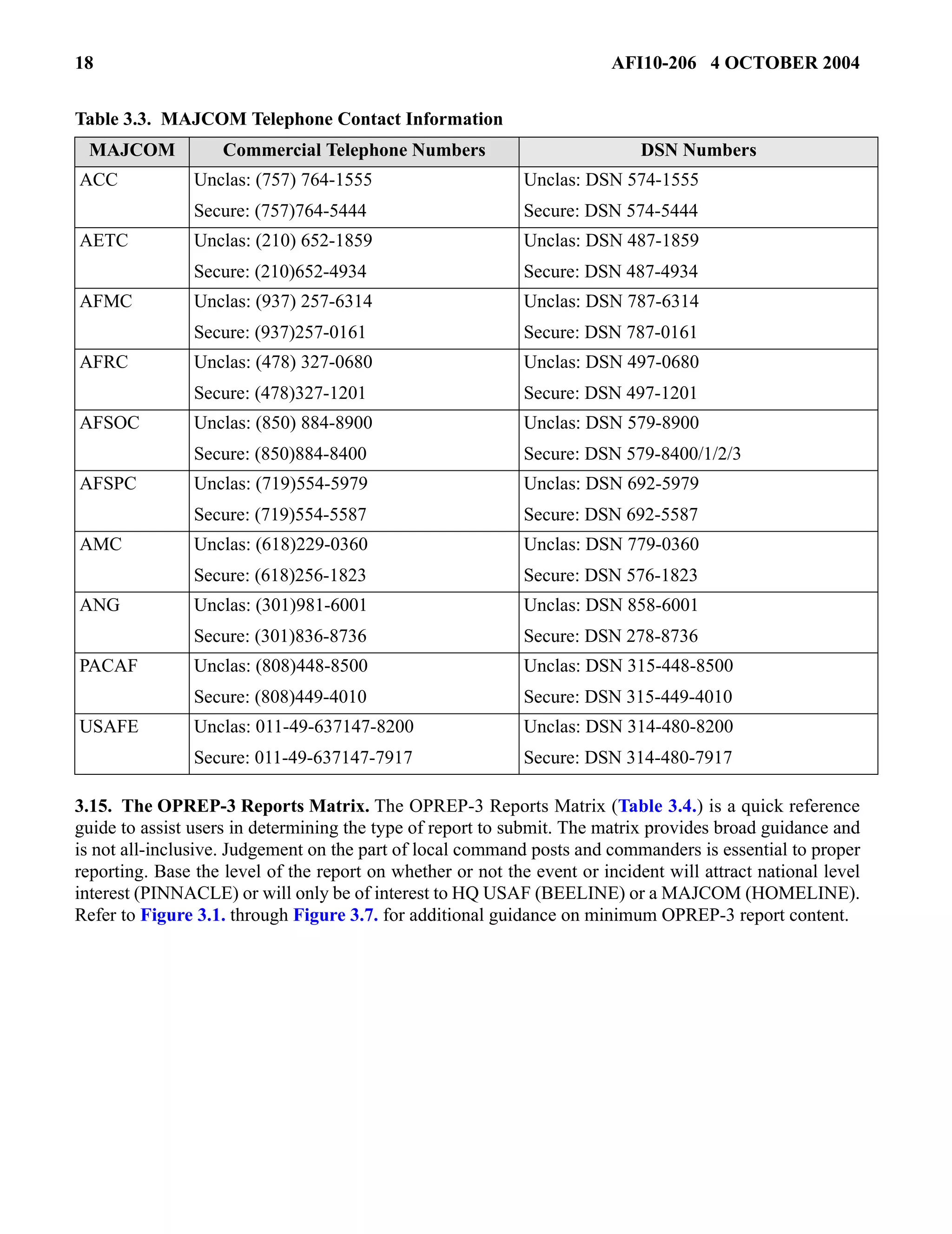
3.14. MAJCOM Telephone Contact Information. Table 3.3. provides secure and non-secure tele-phone 
numbers for the AF MAJCOMs.
18 AFI10-206 4 OCTOBER 2004 
Table 3.3. MAJCOM Telephone Contact Information 
MAJCOM Commercial Telephone Numbers DSN Numbers 
ACC Unclas: (757) 764-1555 
Secure: (757)764-5444 
Unclas: DSN 574-1555 
Secure: DSN 574-5444 
AETC Unclas: (210) 652-1859 
Secure: (210)652-4934 
Unclas: DSN 487-1859 
Secure: DSN 487-4934 
AFMC Unclas: (937) 257-6314 
Secure: (937)257-0161 
Unclas: DSN 787-6314 
Secure: DSN 787-0161 
AFRC Unclas: (478) 327-0680 
Secure: (478)327-1201 
Unclas: DSN 497-0680 
Secure: DSN 497-1201 
AFSOC Unclas: (850) 884-8900 
Secure: (850)884-8400 
Unclas: DSN 579-8900 
Secure: DSN 579-8400/1/2/3 
AFSPC Unclas: (719)554-5979 
Secure: (719)554-5587 
Unclas: DSN 692-5979 
Secure: DSN 692-5587 
AMC Unclas: (618)229-0360 
Secure: (618)256-1823 
Unclas: DSN 779-0360 
Secure: DSN 576-1823 
ANG Unclas: (301)981-6001 
Secure: (301)836-8736 
Unclas: DSN 858-6001 
Secure: DSN 278-8736 
PACAF Unclas: (808)448-8500 
Secure: (808)449-4010 
Unclas: DSN 315-448-8500 
Secure: DSN 315-449-4010 
USAFE Unclas: 011-49-637147-8200 
Secure: 011-49-637147-7917 
Unclas: DSN 314-480-8200 
Secure: DSN 314-480-7917 
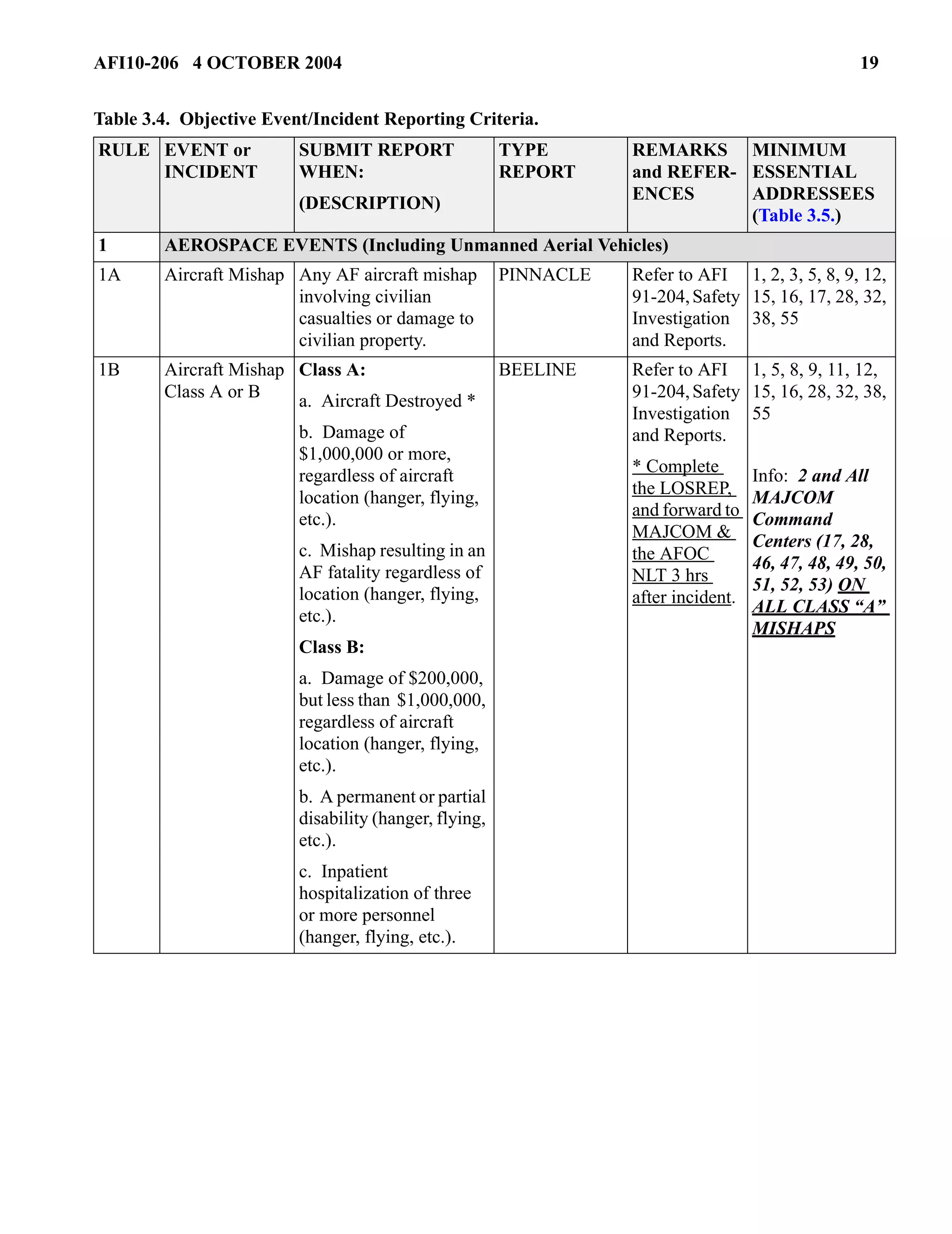
3.15. The OPREP-3 Reports Matrix. The OPREP-3 Reports Matrix (Table 3.4.) is a quick reference 
guide to assist users in determining the type of report to submit. The matrix provides broad guidance and 
is not all-inclusive. Judgement on the part of local command posts and commanders is essential to proper 
reporting. Base the level of the report on whether or not the event or incident will attract national level 
interest (PINNACLE) or will only be of interest to HQ USAF (BEELINE) or a MAJCOM (HOMELINE). 
Refer to Figure 3.1. through Figure 3.7. for additional guidance on minimum OPREP-3 report content.
AFI10-206 4 OCTOBER 2004 19 
Table 3.4. Objective Event/Incident Reporting Criteria. 
RULE EVENT or 
INCIDENT 
SUBMIT REPORT 
WHEN: 
(DESCRIPTION) 
TYPE 
REPORT 
REMARKS 
and REFER-ENCES 
MINIMUM 
ESSENTIAL 
ADDRESSEES 
(Table 3.5.) 
1 AEROSPACE EVENTS (Including Unmanned Aerial Vehicles) 
1A Aircraft Mishap Any AF aircraft mishap 
involving civilian 
casualties or damage to 
civilian property. 
PINNACLE Refer to AFI 
91-204, Safety 
Investigation 
and Reports. 
1, 2, 3, 5, 8, 9, 12, 
15, 16, 17, 28, 32, 
38, 55 
1B Aircraft Mishap 
Class A or B 
Class A: 
a. Aircraft Destroyed * 
b. Damage of 
$1,000,000 or more, 
regardless of aircraft 
location (hanger, flying, 
etc.). 
c. Mishap resulting in an 
AF fatality regardless of 
location (hanger, flying, 
etc.). 
Class B: 
a. Damage of $200,000, 
but less than $1,000,000, 
regardless of aircraft 
location (hanger, flying, 
etc.). 
b. A permanent or partial 
disability (hanger, flying, 
etc.). 
c. Inpatient 
hospitalization of three 
or more personnel 
(hanger, flying, etc.). 
BEELINE Refer to AFI 
91-204, Safety 
Investigation 
and Reports. 
* Complete 
the LOSREP, 
and forward to 
MAJCOM & 
the AFOC 
NLT 3 hrs 
after incident. 
1, 5, 8, 9, 11, 12, 
15, 16, 28, 32, 38, 
55 
Info: 2 and All 
MAJCOM 
Command 
Centers (17, 28, 
46, 47, 48, 49, 50, 
51, 52, 53) ON 
ALL CLASS “A” 
MISHAPS
20 AFI10-206 4 OCTOBER 2004 
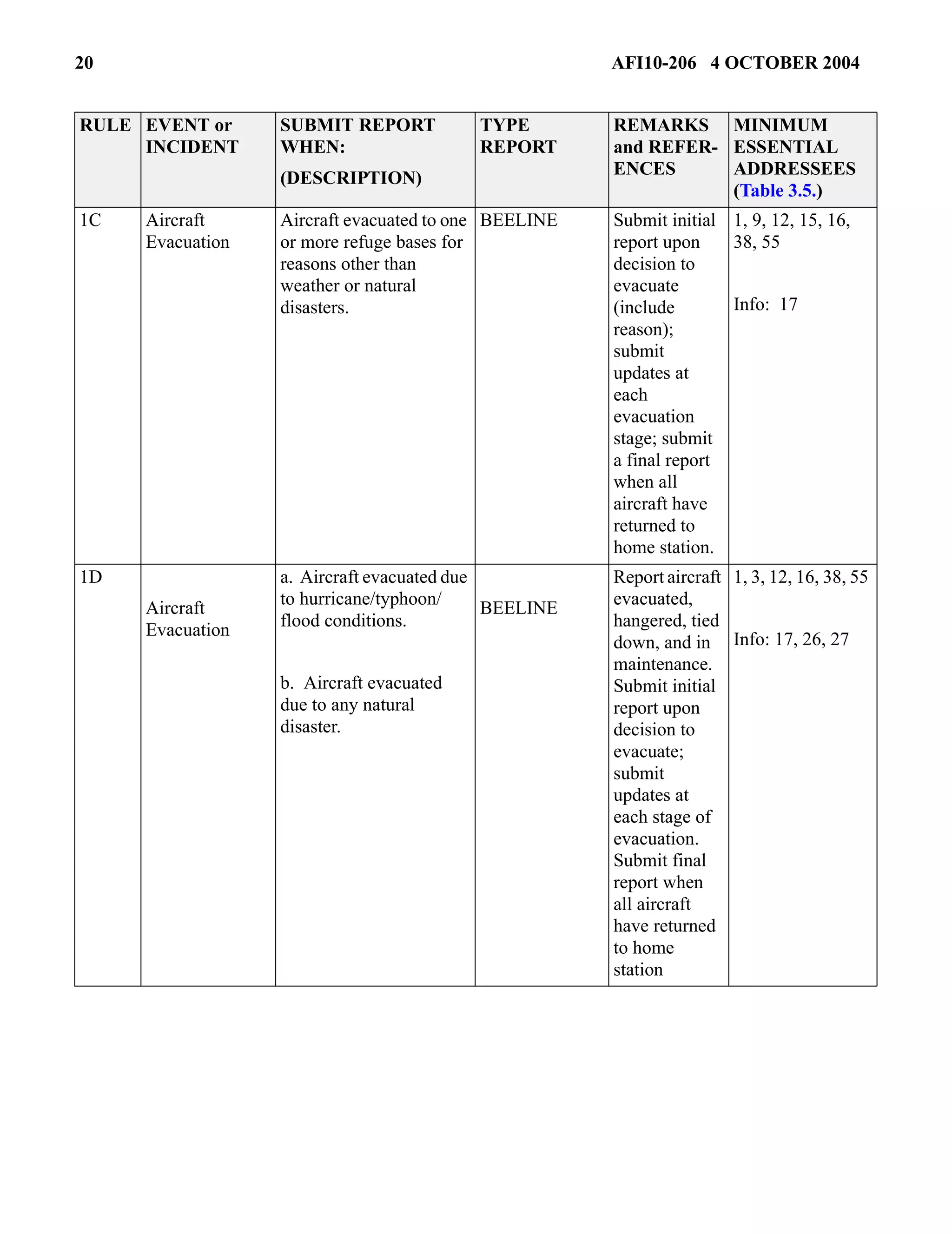
1C Aircraft 
Evacuation 
Aircraft evacuated to one 
or more refuge bases for 
reasons other than 
weather or natural 
disasters. 
BEELINE Submit initial 
report upon 
decision to 
evacuate 
(include 
reason); 
submit 
updates at 
each 
evacuation 
stage; submit 
a final report 
when all 
aircraft have 
returned to 
home station. 
1, 9, 12, 15, 16, 
38, 55 
Info: 17 
1D 
Aircraft 
Evacuation 
a. Aircraft evacuated due 
to hurricane/typhoon/ 
flood conditions. 
b. Aircraft evacuated 
due to any natural 
disaster. 
BEELINE 
Report aircraft 
evacuated, 
hangered, tied 
down, and in 
maintenance. 
Submit initial 
report upon 
decision to 
evacuate; 
submit 
updates at 
each stage of 
evacuation. 
Submit final 
report when 
all aircraft 
have returned 
to home 
station 
1, 3, 12, 16, 38, 55 
Info: 17, 26, 27 
RULE EVENT or 
INCIDENT 
SUBMIT REPORT 
WHEN: 
(DESCRIPTION) 
TYPE 
REPORT 
REMARKS 
and REFER-ENCES 
MINIMUM 
ESSENTIAL 
ADDRESSEES 
(Table 3.5.)
AFI10-206 4 OCTOBER 2004 21 
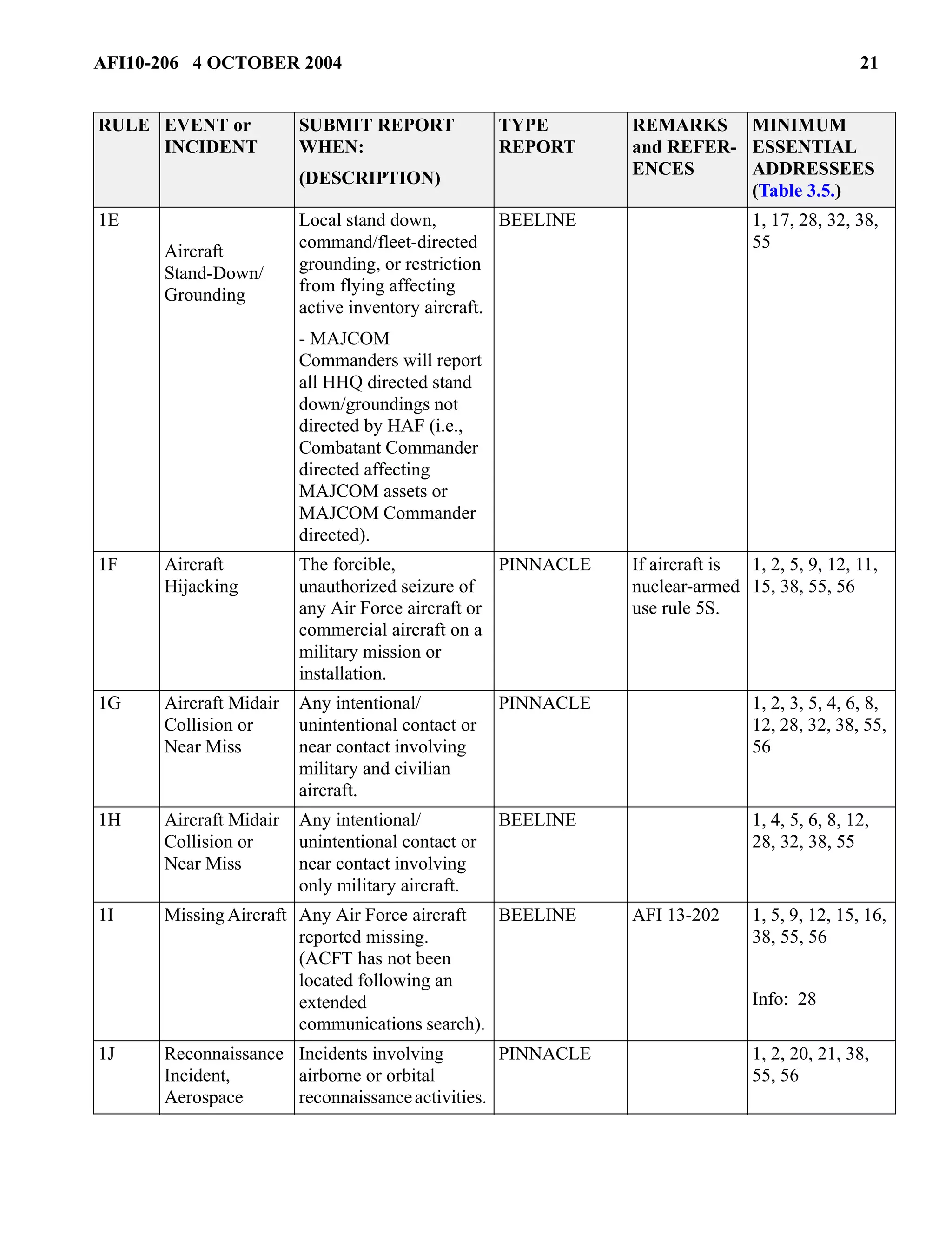
1E 
Aircraft 
Stand-Down/ 
Grounding 
Local stand down, 
command/fleet-directed 
grounding, or restriction 
from flying affecting 
active inventory aircraft. 
- MAJCOM 
Commanders will report 
all HHQ directed stand 
down/groundings not 
directed by HAF (i.e., 
Combatant Commander 
directed affecting 
MAJCOM assets or 
MAJCOM Commander 
directed). 
BEELINE 1, 17, 28, 32, 38, 
55 
1F Aircraft 
Hijacking 
The forcible, 
unauthorized seizure of 
any Air Force aircraft or 
commercial aircraft on a 
military mission or 
installation. 
PINNACLE If aircraft is 
nuclear-armed 
use rule 5S. 
1, 2, 5, 9, 12, 11, 
15, 38, 55, 56 
1G Aircraft Midair 
Collision or 
Near Miss 
Any intentional/ 
unintentional contact or 
near contact involving 
military and civilian 
aircraft. 
PINNACLE 1, 2, 3, 5, 4, 6, 8, 
12, 28, 32, 38, 55, 
56 
1H Aircraft Midair 
Collision or 
Near Miss 
Any intentional/ 
unintentional contact or 
near contact involving 
only military aircraft. 
BEELINE 1, 4, 5, 6, 8, 12, 
28, 32, 38, 55 
1I Missing Aircraft Any Air Force aircraft 
reported missing. 
(ACFT has not been 
located following an 
extended 
communications search). 
BEELINE AFI 13-202 1, 5, 9, 12, 15, 16, 
38, 55, 56 
Info: 28 
1J Reconnaissance 
Incident, 
Aerospace 
Incidents involving 
airborne or orbital 
reconnaissance activities. 
PINNACLE 1, 2, 20, 21, 38, 
55, 56 
RULE EVENT or 
INCIDENT 
SUBMIT REPORT 
WHEN: 
(DESCRIPTION) 
TYPE 
REPORT 
REMARKS 
and REFER-ENCES 
MINIMUM 
ESSENTIAL 
ADDRESSEES 
(Table 3.5.)
22 AFI10-206 4 OCTOBER 2004 
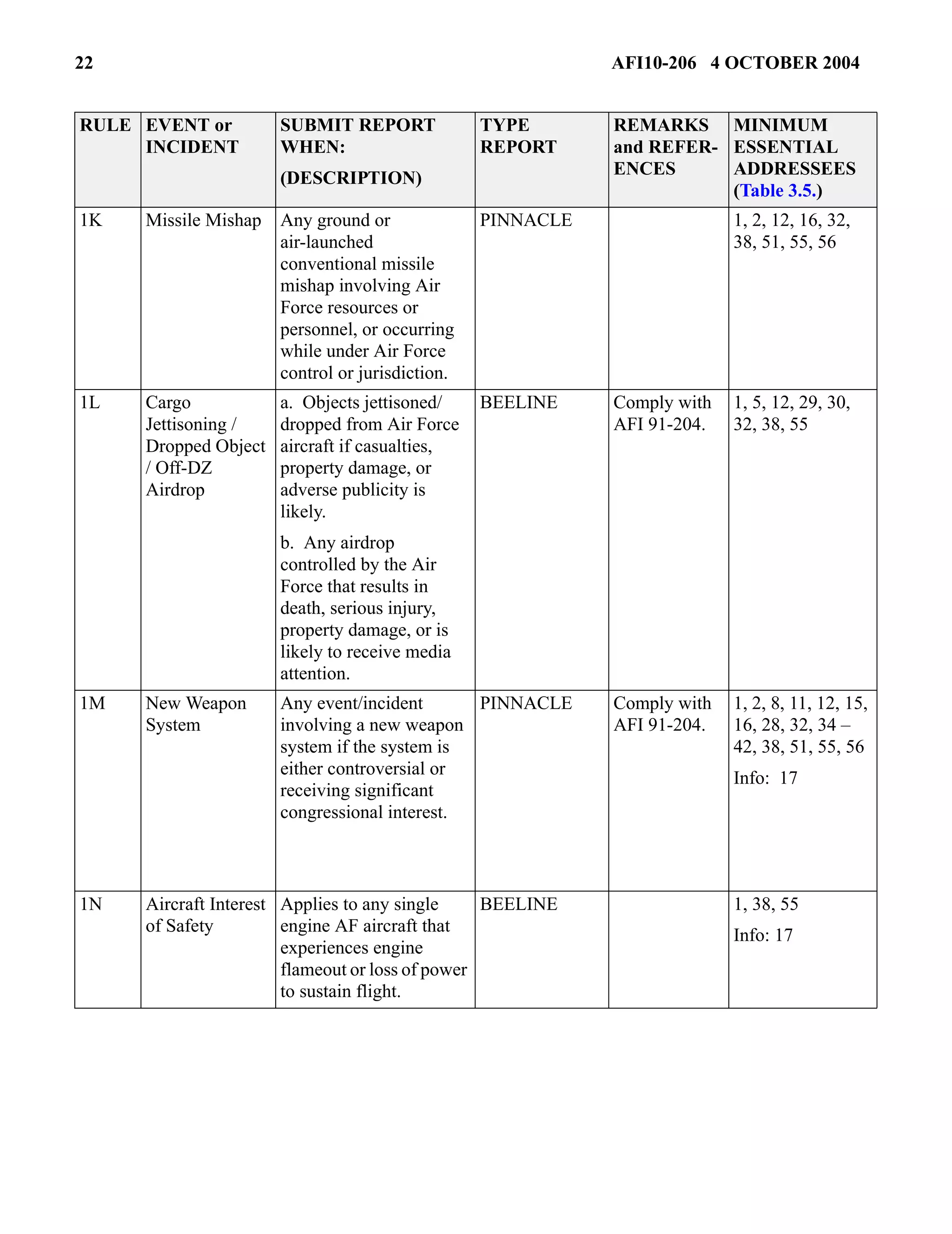
1K Missile Mishap Any ground or 
air-launched 
conventional missile 
mishap involving Air 
Force resources or 
personnel, or occurring 
while under Air Force 
control or jurisdiction. 
PINNACLE 1, 2, 12, 16, 32, 
38, 51, 55, 56 
1L Cargo 
Jettisoning / 
Dropped Object 
/ Off-DZ 
Airdrop 
a. Objects jettisoned/ 
dropped from Air Force 
aircraft if casualties, 
property damage, or 
adverse publicity is 
likely. 
b. Any airdrop 
controlled by the Air 
Force that results in 
death, serious injury, 
property damage, or is 
likely to receive media 
attention. 
BEELINE Comply with 
AFI 91-204. 
1, 5, 12, 29, 30, 
32, 38, 55 
1M New Weapon 
System 
Any event/incident 
involving a new weapon 
system if the system is 
either controversial or 
receiving significant 
congressional interest. 
PINNACLE Comply with 
AFI 91-204. 
1, 2, 8, 11, 12, 15, 
16, 28, 32, 34 – 
42, 38, 51, 55, 56 
Info: 17 
1N Aircraft Interest 
of Safety 
Applies to any single 
engine AF aircraft that 
experiences engine 
flameout or loss of power 
to sustain flight. 
BEELINE 1, 38, 55 
Info: 17 
RULE EVENT or 
INCIDENT 
SUBMIT REPORT 
WHEN: 
(DESCRIPTION) 
TYPE 
REPORT 
REMARKS 
and REFER-ENCES 
MINIMUM 
ESSENTIAL 
ADDRESSEES 
(Table 3.5.)
AFI10-206 4 OCTOBER 2004 23 
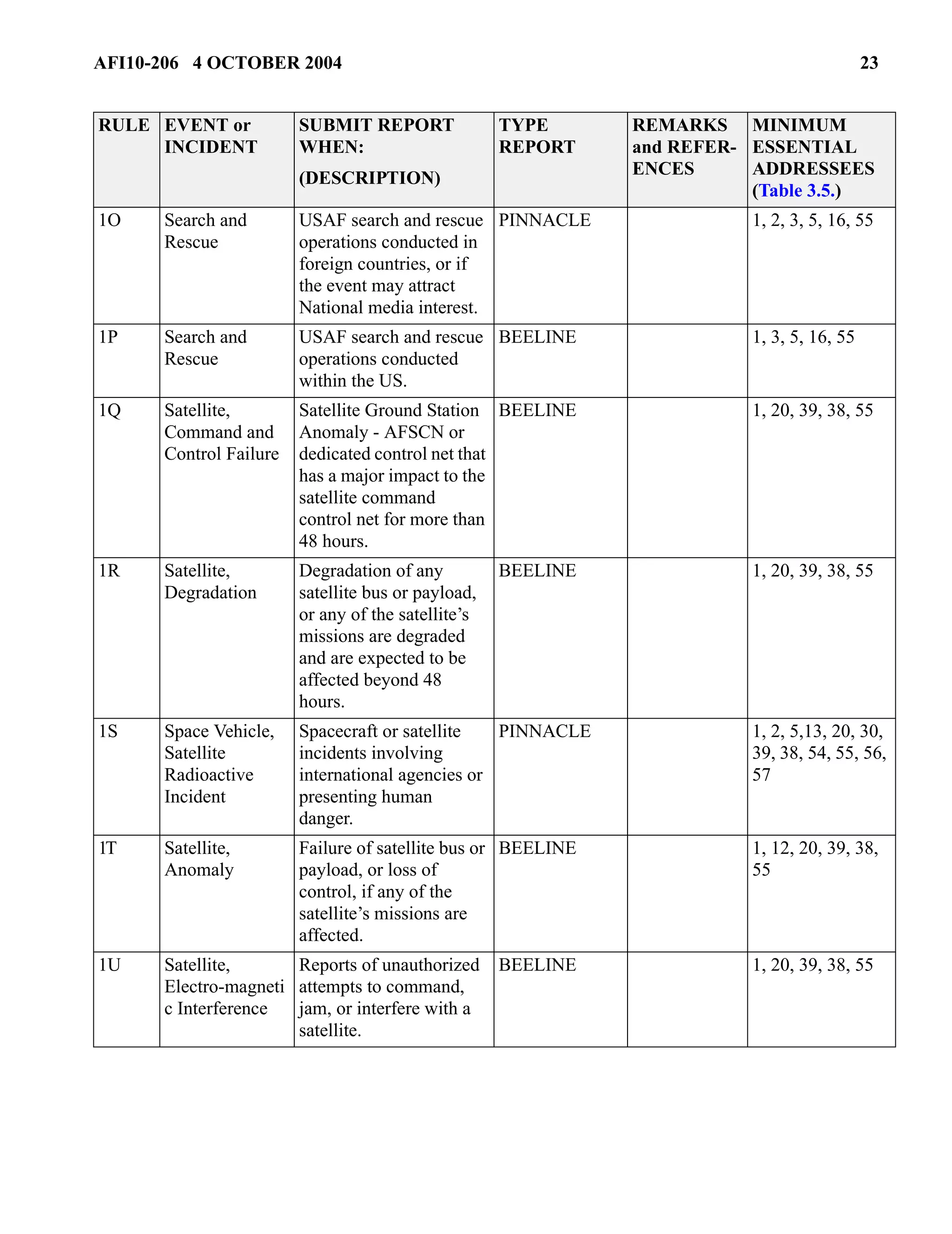
1O Search and 
Rescue 
USAF search and rescue 
operations conducted in 
foreign countries, or if 
the event may attract 
National media interest. 
PINNACLE 1, 2, 3, 5, 16, 55 
1P Search and 
Rescue 
USAF search and rescue 
operations conducted 
within the US. 
BEELINE 1, 3, 5, 16, 55 
1Q Satellite, 
Command and 
Control Failure 
Satellite Ground Station 
Anomaly - AFSCN or 
dedicated control net that 
has a major impact to the 
satellite command 
control net for more than 
48 hours. 
BEELINE 1, 20, 39, 38, 55 
1R Satellite, 
Degradation 
Degradation of any 
satellite bus or payload, 
or any of the satellite’s 
missions are degraded 
and are expected to be 
affected beyond 48 
hours. 
BEELINE 1, 20, 39, 38, 55 
1S Space Vehicle, 
Satellite 
Radioactive 
Incident 
Spacecraft or satellite 
incidents involving 
international agencies or 
presenting human 
danger. 
PINNACLE 1, 2, 5,13, 20, 30, 
39, 38, 54, 55, 56, 
57 
1T Satellite, 
Anomaly 
Failure of satellite bus or 
payload, or loss of 
control, if any of the 
satellite’s missions are 
affected. 
BEELINE 1, 12, 20, 39, 38, 
55 
1U Satellite, 
Electro-magneti 
c Interference 
Reports of unauthorized 
attempts to command, 
jam, or interfere with a 
satellite. 
BEELINE 1, 20, 39, 38, 55 
RULE EVENT or 
INCIDENT 
SUBMIT REPORT 
WHEN: 
(DESCRIPTION) 
TYPE 
REPORT 
REMARKS 
and REFER-ENCES 
MINIMUM 
ESSENTIAL 
ADDRESSEES 
(Table 3.5.)
24 AFI10-206 4 OCTOBER 2004 
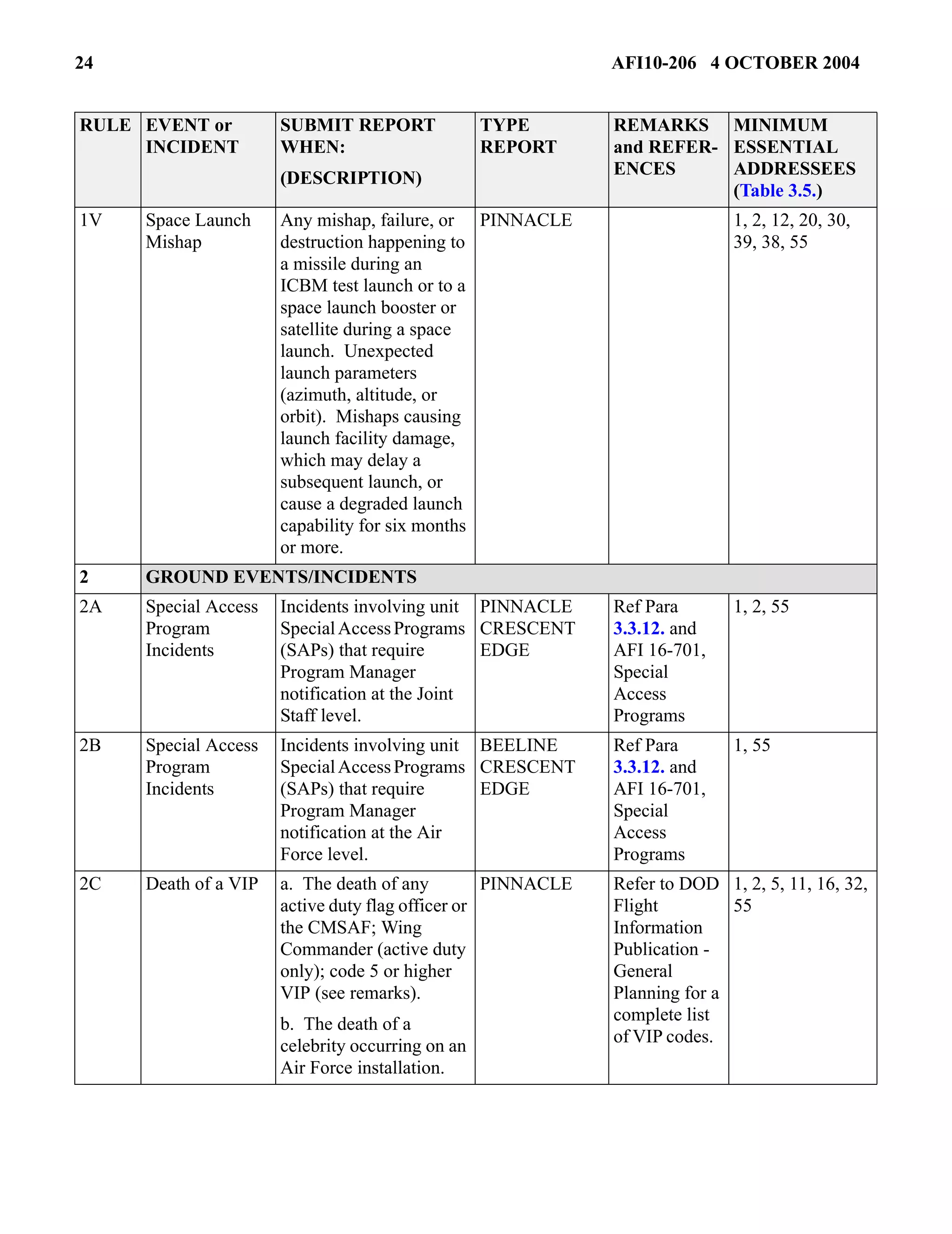
1V Space Launch 
Mishap 
Any mishap, failure, or 
destruction happening to 
a missile during an 
ICBM test launch or to a 
space launch booster or 
satellite during a space 
launch. Unexpected 
launch parameters 
(azimuth, altitude, or 
orbit). Mishaps causing 
launch facility damage, 
which may delay a 
subsequent launch, or 
cause a degraded launch 
capability for six months 
or more. 
PINNACLE 1, 2, 12, 20, 30, 
39, 38, 55 
2 GROUND EVENTS/INCIDENTS 
2A Special Access 
Program 
Incidents 
Incidents involving unit 
Special Access Programs 
(SAPs) that require 
Program Manager 
notification at the Joint 
Staff level. 
PINNACLE 
CRESCENT 
EDGE 
Ref Para 
3.3.12. and 
AFI 16-701, 
Special 
Access 
Programs 
1, 2, 55 
2B Special Access 
Program 
Incidents 
Incidents involving unit 
Special Access Programs 
(SAPs) that require 
Program Manager 
notification at the Air 
Force level. 
BEELINE 
CRESCENT 
EDGE 
Ref Para 
3.3.12. and 
AFI 16-701, 
Special 
Access 
Programs 
1, 55 
2C Death of a VIP a. The death of any 
active duty flag officer or 
the CMSAF; Wing 
Commander (active duty 
only); code 5 or higher 
VIP (see remarks). 
b. The death of a 
celebrity occurring on an 
Air Force installation. 
PINNACLE Refer to DOD 
Flight 
Information 
Publication - 
General 
Planning for a 
complete list 
of VIP codes. 
1, 2, 5, 11, 16, 32, 
55 
RULE EVENT or 
INCIDENT 
SUBMIT REPORT 
WHEN: 
(DESCRIPTION) 
TYPE 
REPORT 
REMARKS 
and REFER-ENCES 
MINIMUM 
ESSENTIAL 
ADDRESSEES 
(Table 3.5.)
AFI10-206 4 OCTOBER 2004 25 
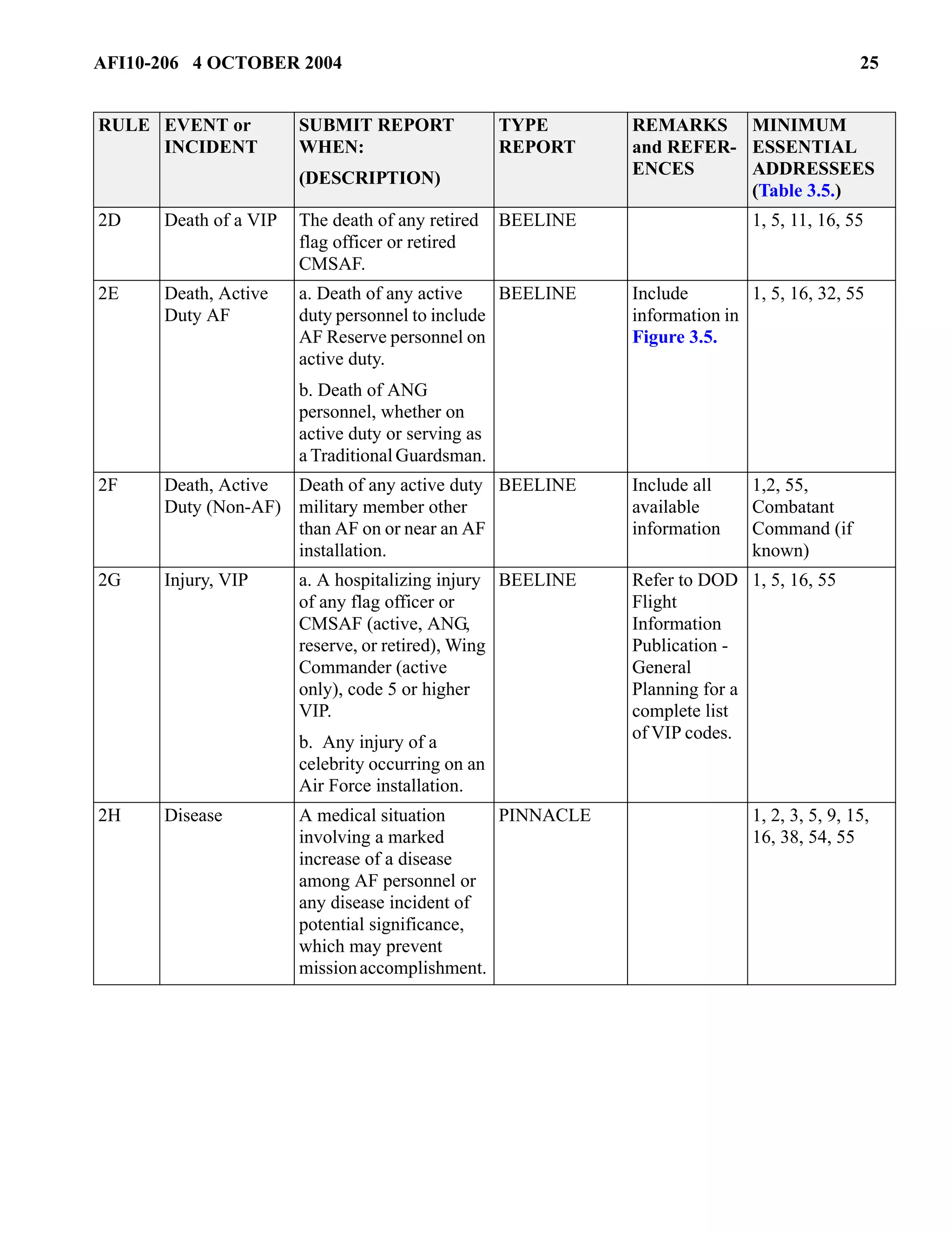
2D Death of a VIP The death of any retired 
flag officer or retired 
CMSAF. 
BEELINE 1, 5, 11, 16, 55 
2E Death, Active 
Duty AF 
a. Death of any active 
duty personnel to include 
AF Reserve personnel on 
active duty. 
b. Death of ANG 
personnel, whether on 
active duty or serving as 
a Traditional Guardsman. 
BEELINE Include 
information in 
Figure 3.5. 
1, 5, 16, 32, 55 
2F Death, Active 
Duty (Non-AF) 
Death of any active duty 
military member other 
than AF on or near an AF 
installation. 
BEELINE Include all 
available 
information 
1,2, 55, 
Combatant 
Command (if 
known) 
2G Injury, VIP a. A hospitalizing injury 
of any flag officer or 
CMSAF (active, ANG, 
reserve, or retired), Wing 
Commander (active 
only), code 5 or higher 
VIP. 
b. Any injury of a 
celebrity occurring on an 
Air Force installation. 
BEELINE Refer to DOD 
Flight 
Information 
Publication - 
General 
Planning for a 
complete list 
of VIP codes. 
1, 5, 16, 55 
2H Disease A medical situation 
involving a marked 
increase of a disease 
among AF personnel or 
any disease incident of 
potential significance, 
which may prevent 
mission accomplishment. 
PINNACLE 1, 2, 3, 5, 9, 15, 
16, 38, 54, 55 
RULE EVENT or 
INCIDENT 
SUBMIT REPORT 
WHEN: 
(DESCRIPTION) 
TYPE 
REPORT 
REMARKS 
and REFER-ENCES 
MINIMUM 
ESSENTIAL 
ADDRESSEES 
(Table 3.5.)
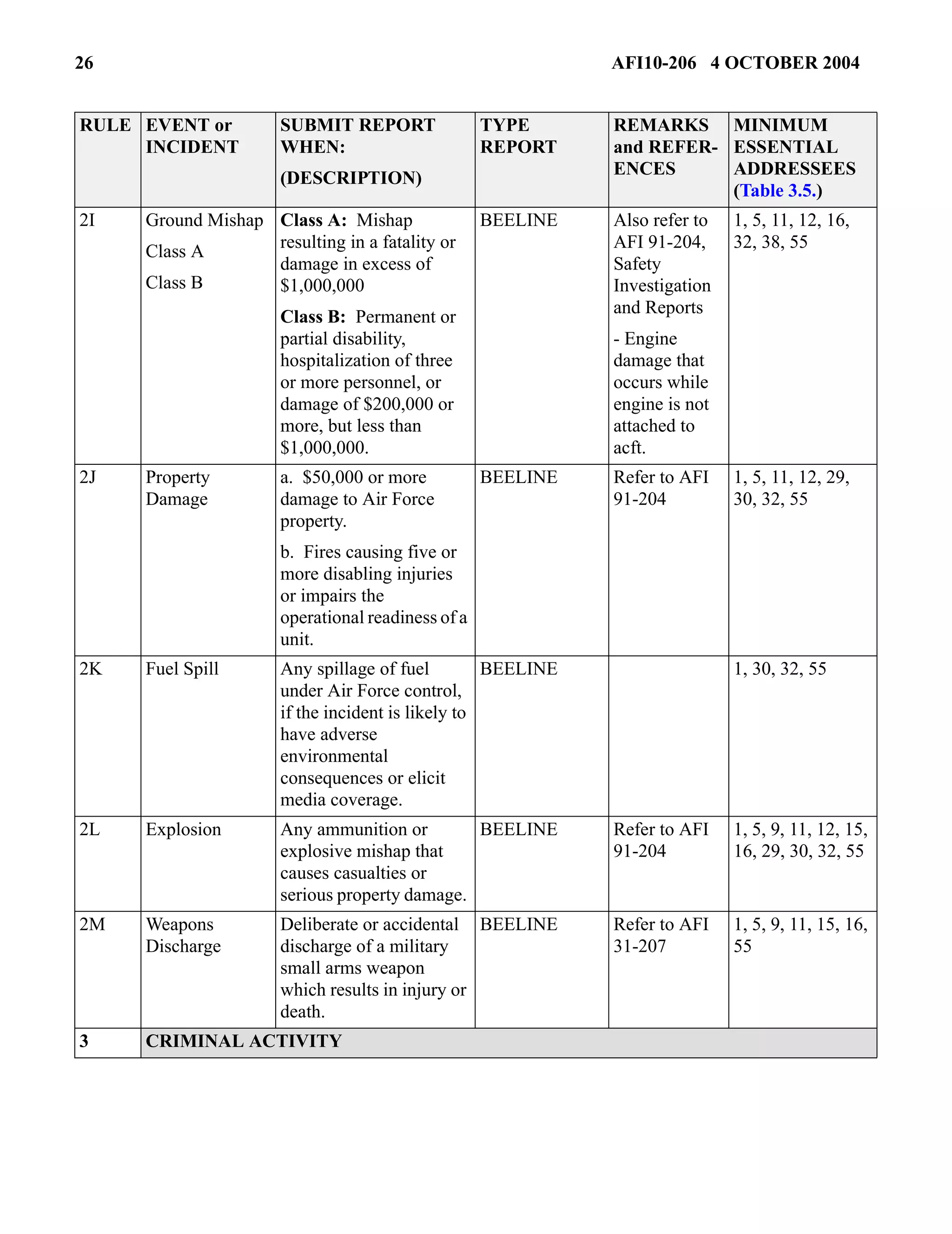
26 AFI10-206 4 OCTOBER 2004 
RULE EVENT or 
INCIDENT 
2I Ground Mishap 
Class A 
Class B 
SUBMIT REPORT 
WHEN: 
(DESCRIPTION) 
Class A: Mishap 
resulting in a fatality or 
damage in excess of 
$1,000,000 
Class B: Permanent or 
partial disability, 
hospitalization of three 
or more personnel, or 
damage of $200,000 or 
more, but less than 
$1,000,000. 
BEELINE Also refer to 
AFI 91-204, 
Safety 
Investigation 
and Reports 
- Engine 
damage that 
occurs while 
engine is not 
attached to 
acft. 
1, 5, 11, 12, 16, 
32, 38, 55 
2J Property 
Damage 
a. $50,000 or more 
damage to Air Force 
property. 
b. Fires causing five or 
more disabling injuries 
or impairs the 
operational readiness of a 
unit. 
BEELINE Refer to AFI 
91-204 
1, 5, 11, 12, 29, 
30, 32, 55 
2K Fuel Spill Any spillage of fuel 
under Air Force control, 
if the incident is likely to 
have adverse 
environmental 
consequences or elicit 
media coverage. 
BEELINE 1, 30, 32, 55 
2L Explosion Any ammunition or 
explosive mishap that 
causes casualties or 
serious property damage. 
BEELINE Refer to AFI 
91-204 
1, 5, 9, 11, 12, 15, 
16, 29, 30, 32, 55 
2M Weapons 
Discharge 
Deliberate or accidental 
discharge of a military 
small arms weapon 
which results in injury or 
death. 
BEELINE Refer to AFI 
31-207 
1, 5, 9, 11, 15, 16, 
55 
3 CRIMINAL ACTIVITY 
TYPE 
REPORT 
REMARKS 
and REFER-ENCES 
MINIMUM 
ESSENTIAL 
ADDRESSEES 
(Table 3.5.)
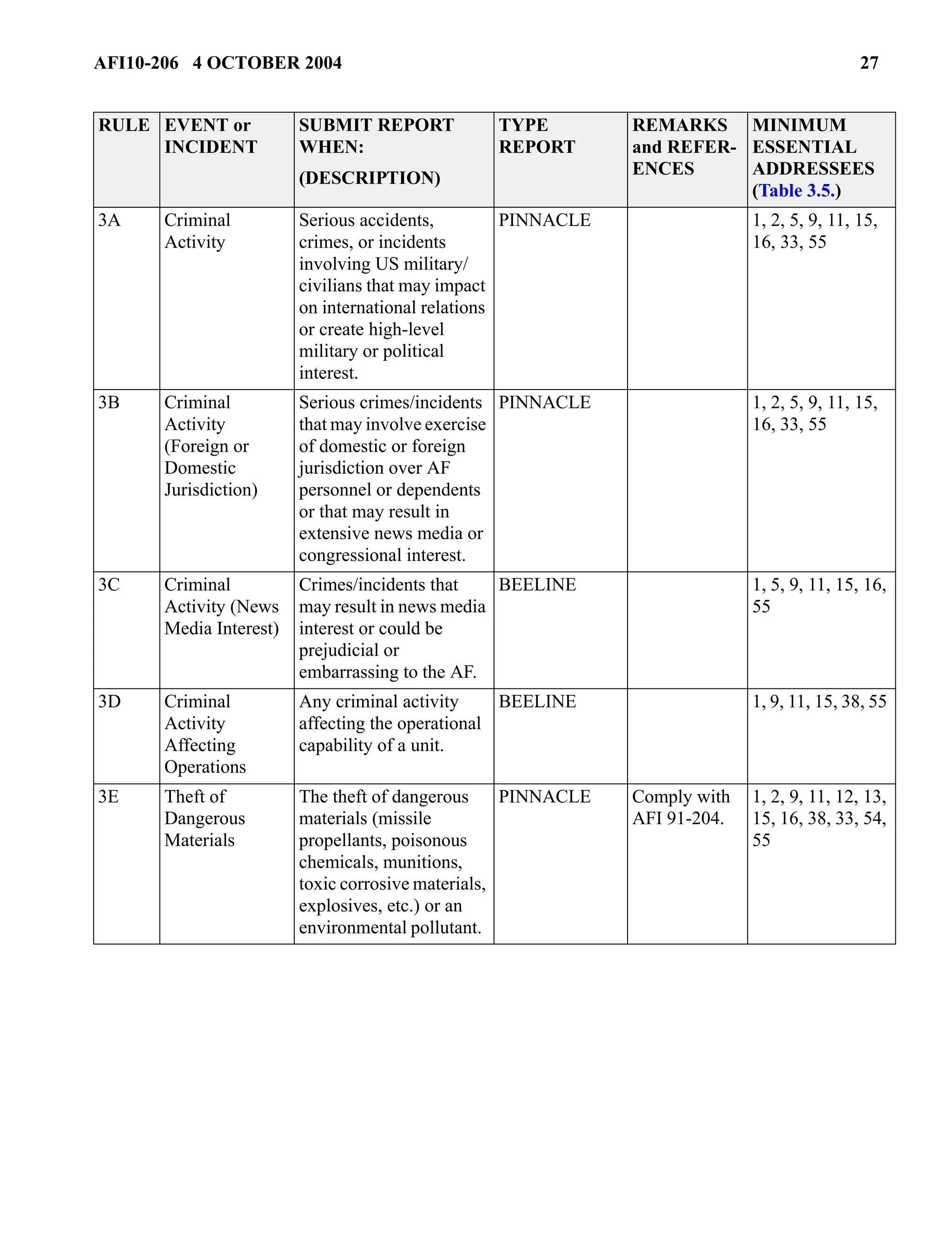
AFI10-206 4 OCTOBER 2004 27 
3A Criminal 
Activity 
Serious accidents, 
crimes, or incidents 
involving US military/ 
civilians that may impact 
on international relations 
or create high-level 
military or political 
interest. 
PINNACLE 1, 2, 5, 9, 11, 15, 
16, 33, 55 
3B Criminal 
Activity 
(Foreign or 
Domestic 
Jurisdiction) 
Serious crimes/incidents 
that may involve exercise 
of domestic or foreign 
jurisdiction over AF 
personnel or dependents 
or that may result in 
extensive news media or 
congressional interest. 
PINNACLE 1, 2, 5, 9, 11, 15, 
16, 33, 55 
3C Criminal 
Activity (News 
Media Interest) 
Crimes/incidents that 
may result in news media 
interest or could be 
prejudicial or 
embarrassing to the AF. 
BEELINE 1, 5, 9, 11, 15, 16, 
55 
3D Criminal 
Activity 
Affecting 
Operations 
Any criminal activity 
affecting the operational 
capability of a unit. 
BEELINE 1, 9, 11, 15, 38, 55 
3E Theft of 
Dangerous 
Materials 
The theft of dangerous 
materials (missile 
propellants, poisonous 
chemicals, munitions, 
toxic corrosive materials, 
explosives, etc.) or an 
environmental pollutant. 
PINNACLE Comply with 
AFI 91-204. 
1, 2, 9, 11, 12, 13, 
15, 16, 38, 33, 54, 
55 
RULE EVENT or 
INCIDENT 
SUBMIT REPORT 
WHEN: 
(DESCRIPTION) 
TYPE 
REPORT 
REMARKS 
and REFER-ENCES 
MINIMUM 
ESSENTIAL 
ADDRESSEES 
(Table 3.5.)
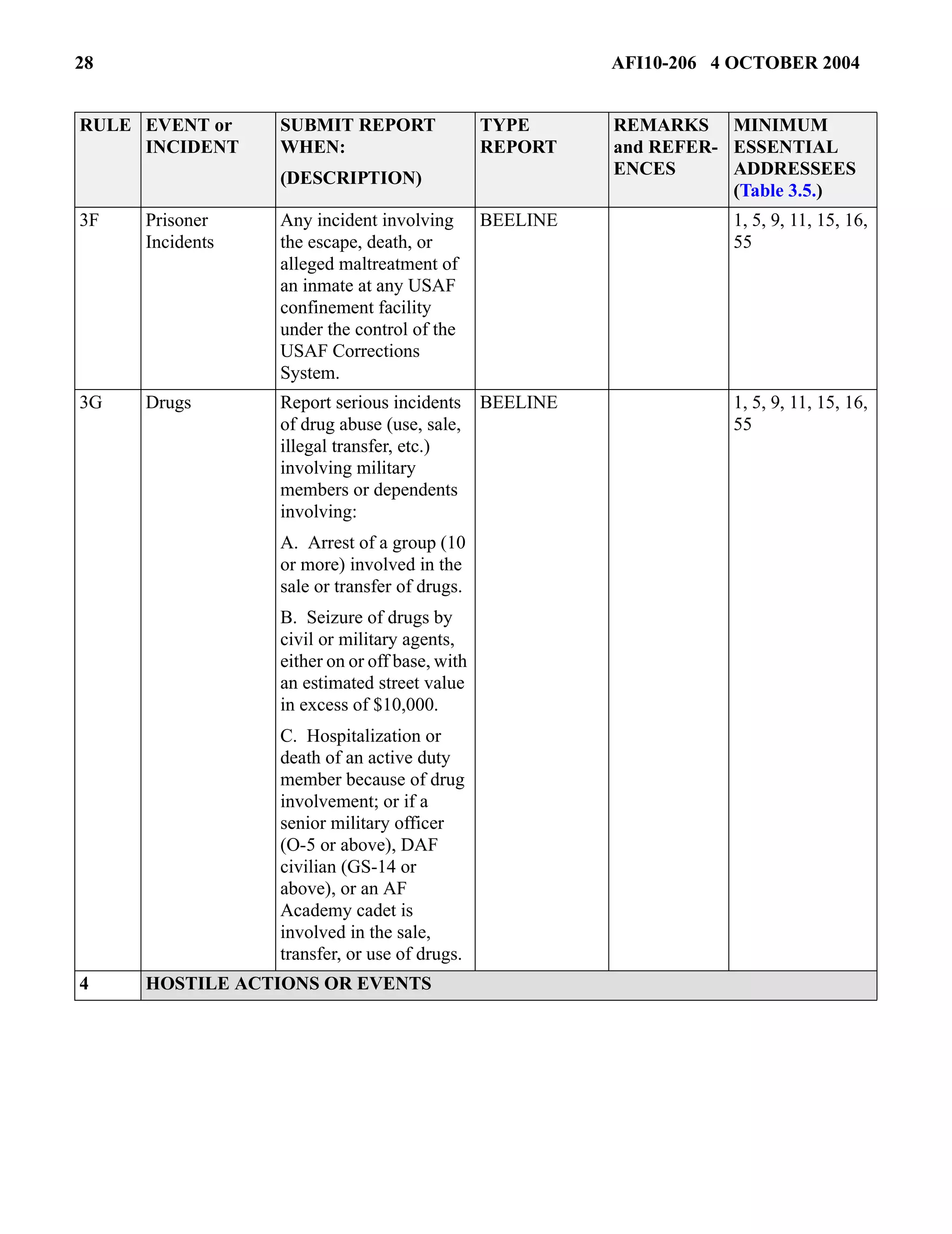
28 AFI10-206 4 OCTOBER 2004 
RULE EVENT or 
INCIDENT 
3F Prisoner 
Incidents 
SUBMIT REPORT 
WHEN: 
(DESCRIPTION) 
Any incident involving 
the escape, death, or 
alleged maltreatment of 
an inmate at any USAF 
confinement facility 
under the control of the 
USAF Corrections 
System. 
BEELINE 1, 5, 9, 11, 15, 16, 
55 
3G Drugs Report serious incidents 
of drug abuse (use, sale, 
illegal transfer, etc.) 
involving military 
members or dependents 
involving: 
A. Arrest of a group (10 
or more) involved in the 
sale or transfer of drugs. 
B. Seizure of drugs by 
civil or military agents, 
either on or off base, with 
an estimated street value 
in excess of $10,000. 
C. Hospitalization or 
death of an active duty 
member because of drug 
involvement; or if a 
senior military officer 
(O-5 or above), DAF 
civilian (GS-14 or 
above), or an AF 
Academy cadet is 
involved in the sale, 
transfer, or use of drugs. 
BEELINE 1, 5, 9, 11, 15, 16, 
55 
4 HOSTILE ACTIONS OR EVENTS 
TYPE 
REPORT 
REMARKS 
and REFER-ENCES 
MINIMUM 
ESSENTIAL 
ADDRESSEES 
(Table 3.5.)
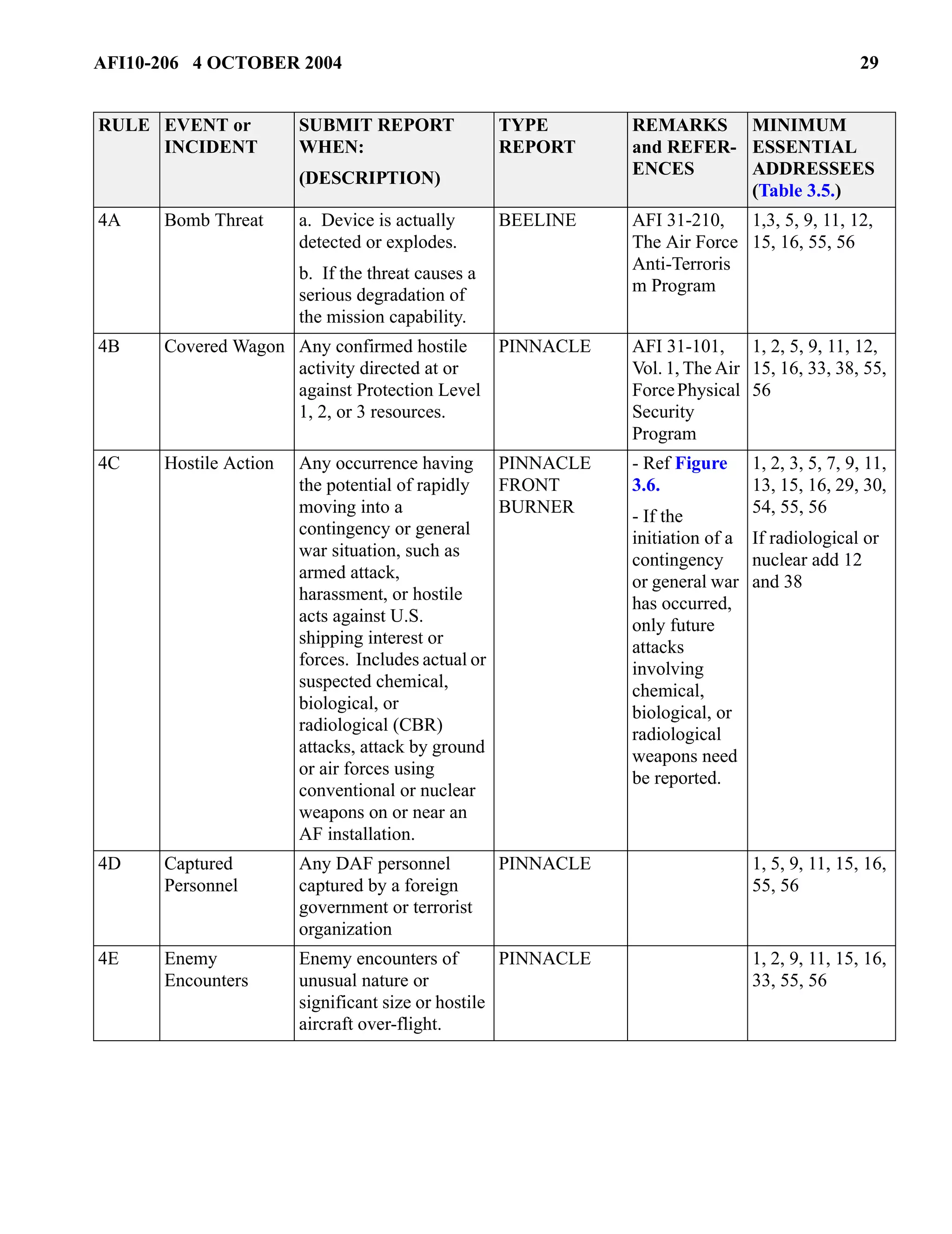
AFI10-206 4 OCTOBER 2004 29 
4A Bomb Threat a. Device is actually 
detected or explodes. 
b. If the threat causes a 
serious degradation of 
the mission capability. 
BEELINE AFI 31-210, 
The Air Force 
Anti-Terroris 
m Program 
1,3, 5, 9, 11, 12, 
15, 16, 55, 56 
4B Covered Wagon Any confirmed hostile 
activity directed at or 
against Protection Level 
1, 2, or 3 resources. 
PINNACLE AFI 31-101, 
Vol. 1, The Air 
Force Physical 
Security 
Program 
1, 2, 5, 9, 11, 12, 
15, 16, 33, 38, 55, 
56 
4C Hostile Action Any occurrence having 
the potential of rapidly 
moving into a 
contingency or general 
war situation, such as 
armed attack, 
harassment, or hostile 
acts against U.S. 
shipping interest or 
forces. Includes actual or 
suspected chemical, 
biological, or 
radiological (CBR) 
attacks, attack by ground 
or air forces using 
conventional or nuclear 
weapons on or near an 
AF installation. 
PINNACLE 
FRONT 
BURNER 
- Ref Figure 
3.6. 
- If the 
initiation of a 
contingency 
or general war 
has occurred, 
only future 
attacks 
involving 
chemical, 
biological, or 
radiological 
weapons need 
be reported. 
1, 2, 3, 5, 7, 9, 11, 
13, 15, 16, 29, 30, 
54, 55, 56 
If radiological or 
nuclear add 12 
and 38 
4D Captured 
Personnel 
Any DAF personnel 
captured by a foreign 
government or terrorist 
organization 
PINNACLE 1, 5, 9, 11, 15, 16, 
55, 56 
4E Enemy 
Encounters 
Enemy encounters of 
unusual nature or 
significant size or hostile 
aircraft over-flight. 
PINNACLE 1, 2, 9, 11, 15, 16, 
33, 55, 56 
RULE EVENT or 
INCIDENT 
SUBMIT REPORT 
WHEN: 
(DESCRIPTION) 
TYPE 
REPORT 
REMARKS 
and REFER-ENCES 
MINIMUM 
ESSENTIAL 
ADDRESSEES 
(Table 3.5.)
30 AFI10-206 4 OCTOBER 2004 
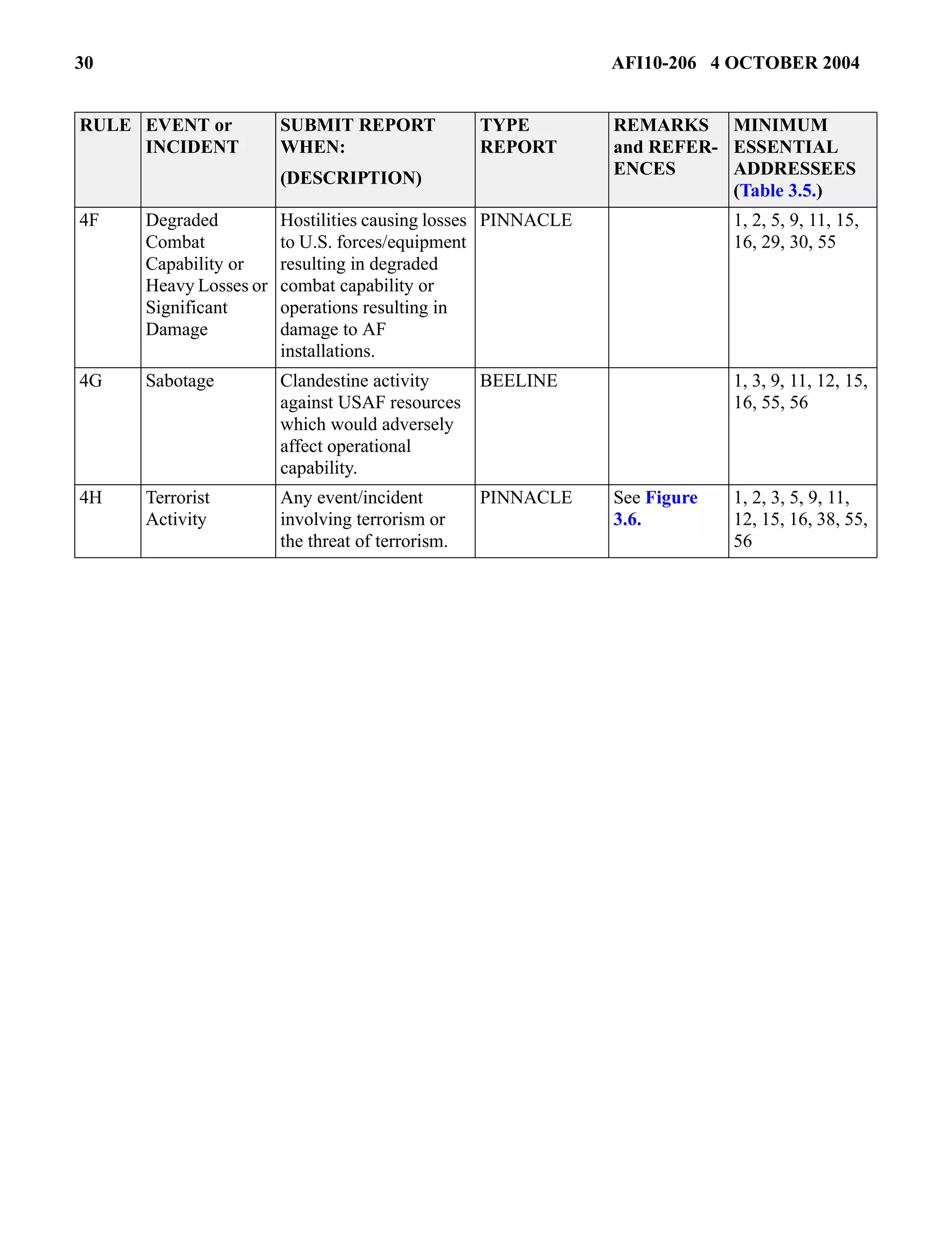
4F Degraded 
Combat 
Capability or 
Heavy Losses or 
Significant 
Damage 
Hostilities causing losses 
to U.S. forces/equipment 
resulting in degraded 
combat capability or 
operations resulting in 
damage to AF 
installations. 
PINNACLE 1, 2, 5, 9, 11, 15, 
16, 29, 30, 55 
4G Sabotage Clandestine activity 
against USAF resources 
which would adversely 
affect operational 
capability. 
BEELINE 1, 3, 9, 11, 12, 15, 
16, 55, 56 
4H Terrorist 
Activity 
Any event/incident 
involving terrorism or 
the threat of terrorism. 
PINNACLE See Figure 
3.6. 
1, 2, 3, 5, 9, 11, 
12, 15, 16, 38, 55, 
56 
RULE EVENT or 
INCIDENT 
SUBMIT REPORT 
WHEN: 
(DESCRIPTION) 
TYPE 
REPORT 
REMARKS 
and REFER-ENCES 
MINIMUM 
ESSENTIAL 
ADDRESSEES 
(Table 3.5.)
AFI10-206 4 OCTOBER 2004 31 
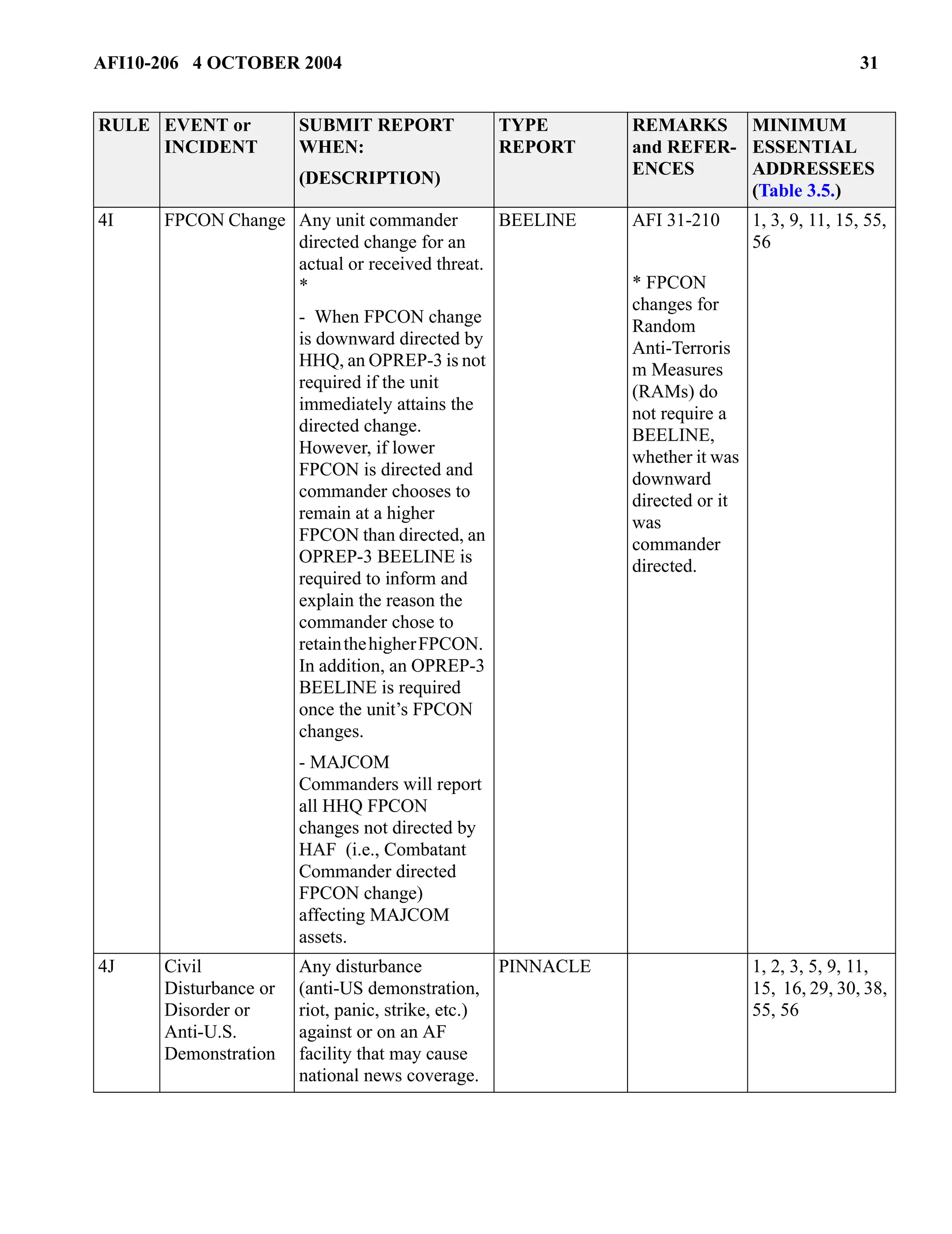
4I FPCON Change Any unit commander 
directed change for an 
actual or received threat. 
* 
- When FPCON change 
is downward directed by 
HHQ, an OPREP-3 is not 
required if the unit 
immediately attains the 
directed change. 
However, if lower 
FPCON is directed and 
commander chooses to 
remain at a higher 
FPCON than directed, an 
OPREP-3 BEELINE is 
required to inform and 
explain the reason the 
commander chose to 
retain the higher FPCON. 
In addition, an OPREP-3 
BEELINE is required 
once the unit’s FPCON 
changes. 
- MAJCOM 
Commanders will report 
all HHQ FPCON 
changes not directed by 
HAF (i.e., Combatant 
Commander directed 
FPCON change) 
affecting MAJCOM 
assets. 
BEELINE AFI 31-210 
* FPCON 
changes for 
Random 
Anti-Terroris 
m Measures 
(RAMs) do 
not require a 
BEELINE, 
whether it was 
downward 
directed or it 
was 
commander 
directed. 
1, 3, 9, 11, 15, 55, 
56 
4J Civil 
Disturbance or 
Disorder or 
Anti-U.S. 
Demonstration 
Any disturbance 
(anti-US demonstration, 
riot, panic, strike, etc.) 
against or on an AF 
facility that may cause 
national news coverage. 
PINNACLE 1, 2, 3, 5, 9, 11, 
15, 16, 29, 30, 38, 
55, 56 
RULE EVENT or 
INCIDENT 
SUBMIT REPORT 
WHEN: 
(DESCRIPTION) 
TYPE 
REPORT 
REMARKS 
and REFER-ENCES 
MINIMUM 
ESSENTIAL 
ADDRESSEES 
(Table 3.5.)
32 AFI10-206 4 OCTOBER 2004 
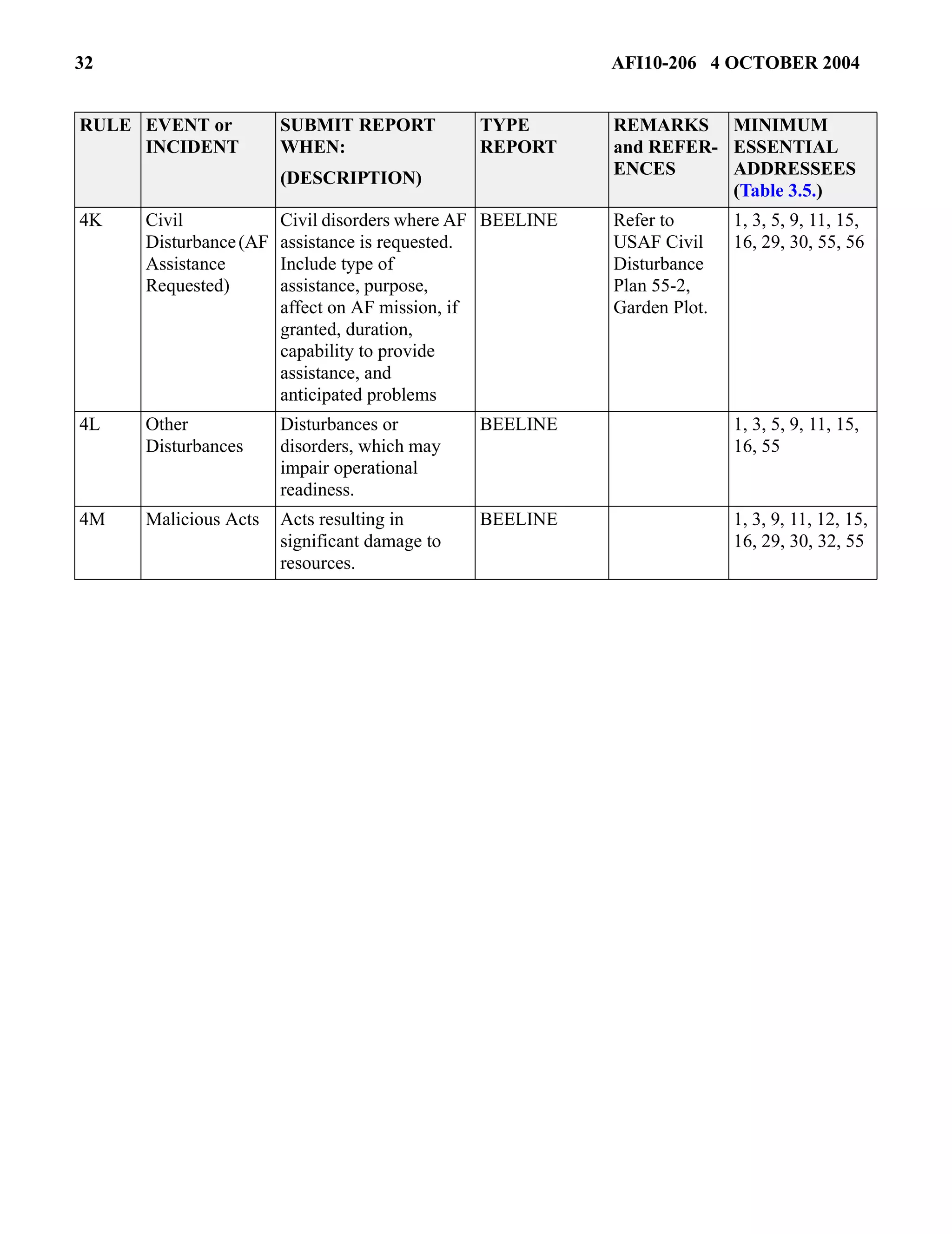
4K Civil 
Disturbance (AF 
Assistance 
Requested) 
Civil disorders where AF 
assistance is requested. 
Include type of 
assistance, purpose, 
affect on AF mission, if 
granted, duration, 
capability to provide 
assistance, and 
anticipated problems 
BEELINE Refer to 
USAF Civil 
Disturbance 
Plan 55-2, 
Garden Plot. 
1, 3, 5, 9, 11, 15, 
16, 29, 30, 55, 56 
4L Other 
Disturbances 
Disturbances or 
disorders, which may 
impair operational 
readiness. 
BEELINE 1, 3, 5, 9, 11, 15, 
16, 55 
4M Malicious Acts Acts resulting in 
significant damage to 
resources. 
BEELINE 1, 3, 9, 11, 12, 15, 
16, 29, 30, 32, 55 
RULE EVENT or 
INCIDENT 
SUBMIT REPORT 
WHEN: 
(DESCRIPTION) 
TYPE 
REPORT 
REMARKS 
and REFER-ENCES 
MINIMUM 
ESSENTIAL 
ADDRESSEES 
(Table 3.5.)
AFI10-206 4 OCTOBER 2004 33 
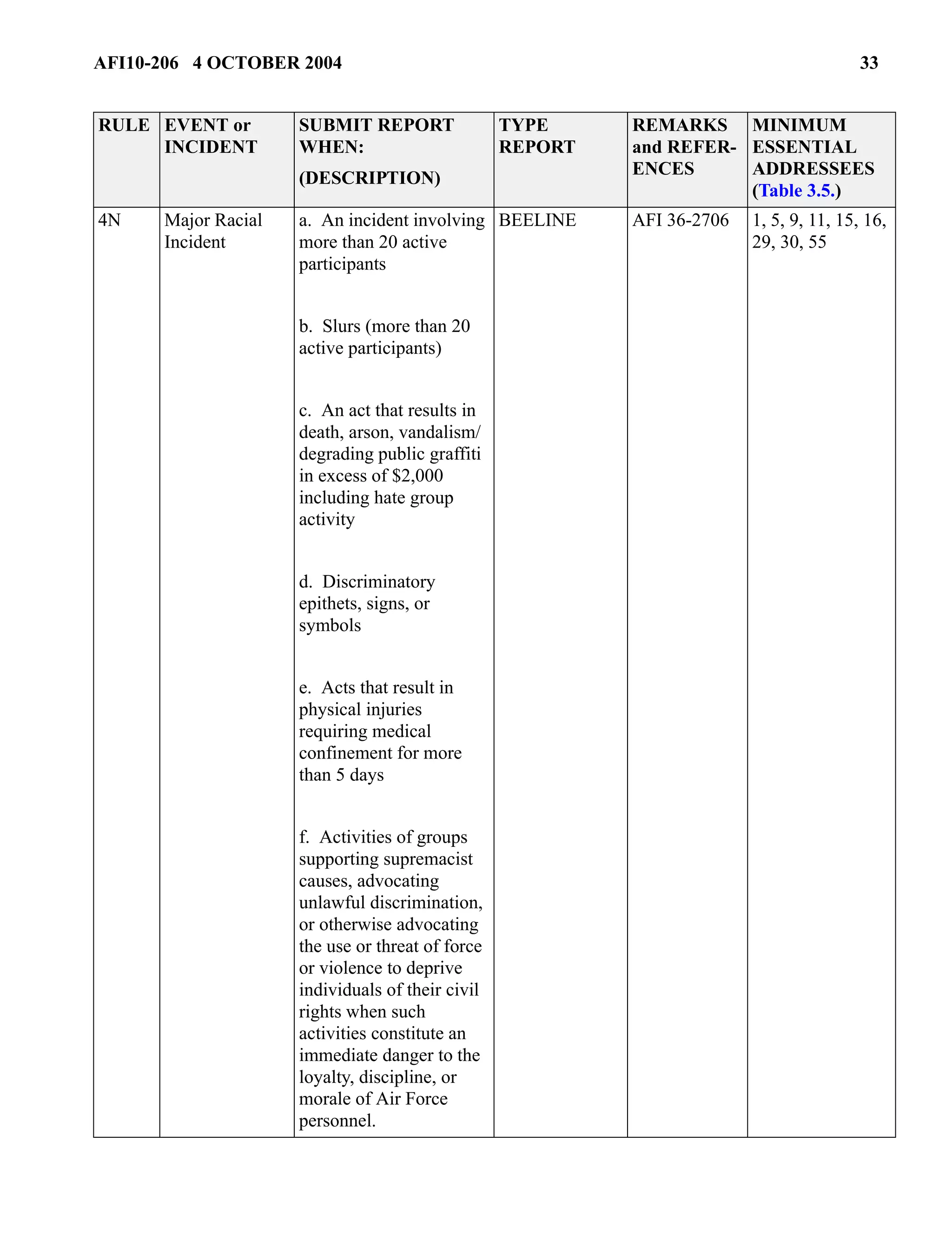
4N Major Racial 
Incident 
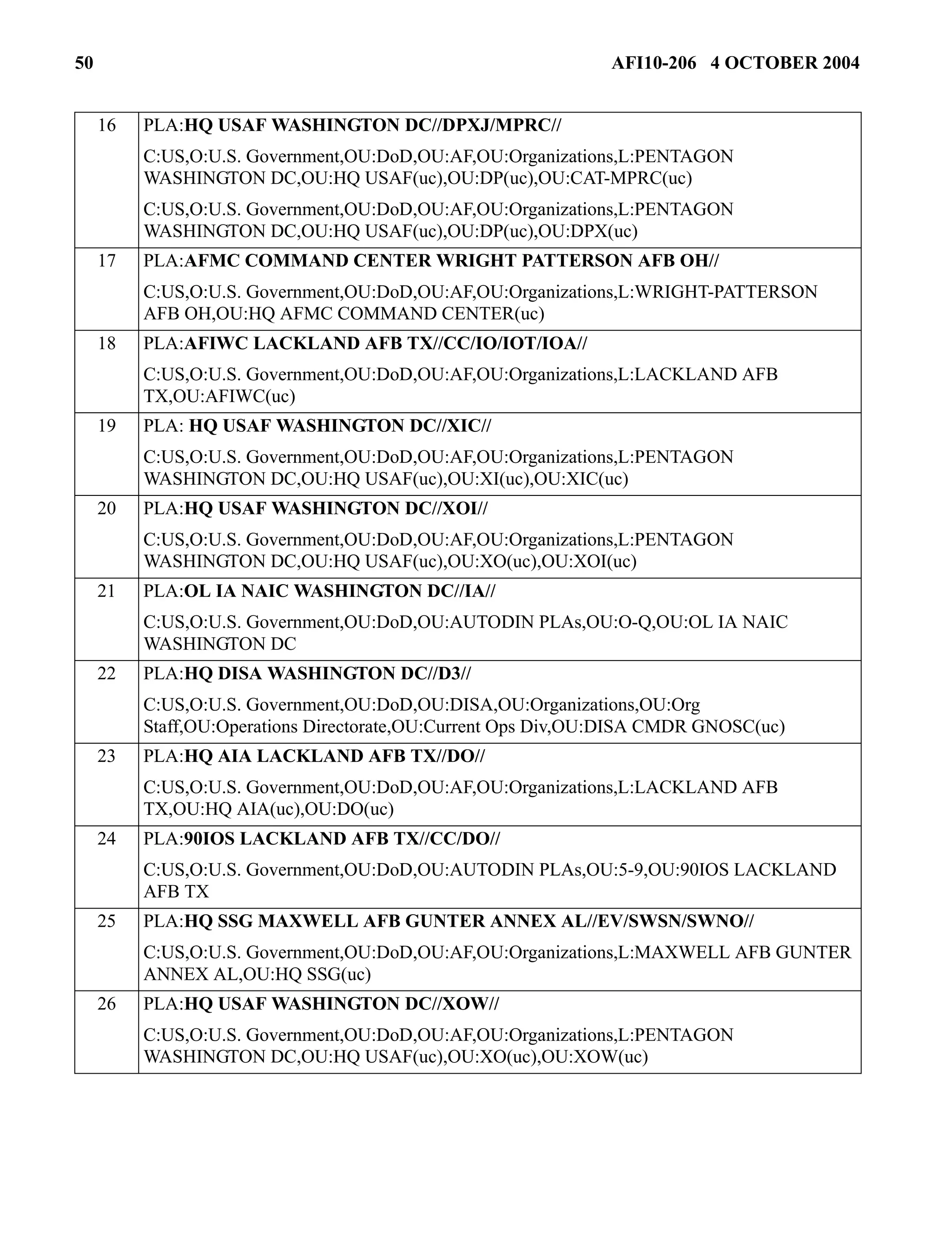
a. An incident involving 
more than 20 active 
participants 
b. Slurs (more than 20 
active participants) 
c. An act that results in 
death, arson, vandalism/ 
degrading public graffiti 
in excess of $2,000 
including hate group 
activity 
d. Discriminatory 
epithets, signs, or 
symbols 
e. Acts that result in 
physical injuries 
requiring medical 
confinement for more 
than 5 days 
f. Activities of groups 
supporting supremacist 
causes, advocating 
unlawful discrimination, 
or otherwise advocating 
the use or threat of force 
or violence to deprive 
individuals of their civil 
rights when such 
activities constitute an 
immediate danger to the 
loyalty, discipline, or 
morale of Air Force 
personnel. 
BEELINE AFI 36-2706 1, 5, 9, 11, 15, 16, 
29, 30, 55 
RULE EVENT or 
INCIDENT 
SUBMIT REPORT 
WHEN: 
(DESCRIPTION) 
TYPE 
REPORT 
REMARKS 
and REFER-ENCES 
MINIMUM 
ESSENTIAL 
ADDRESSEES 
(Table 3.5.)
34 AFI10-206 4 OCTOBER 2004 
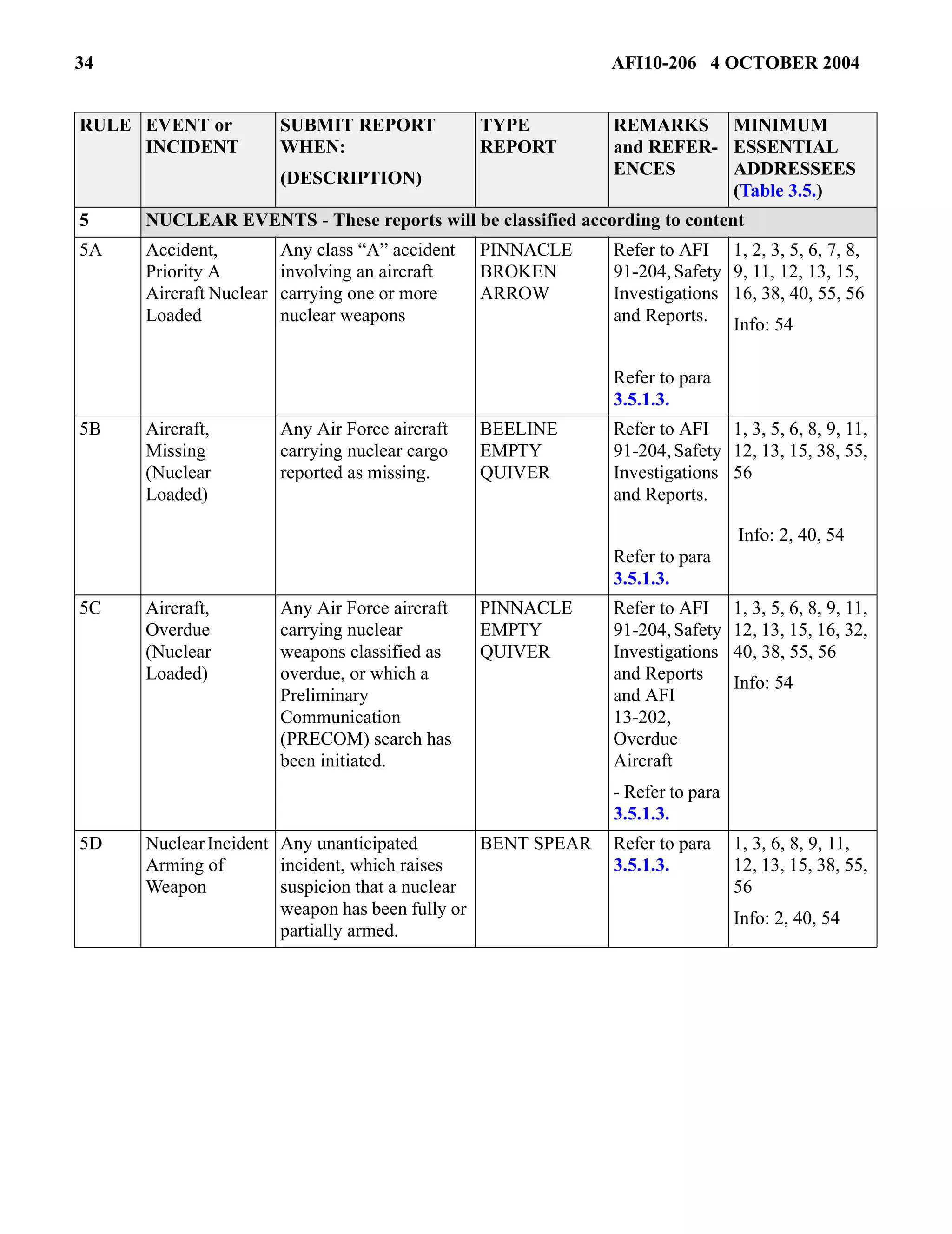
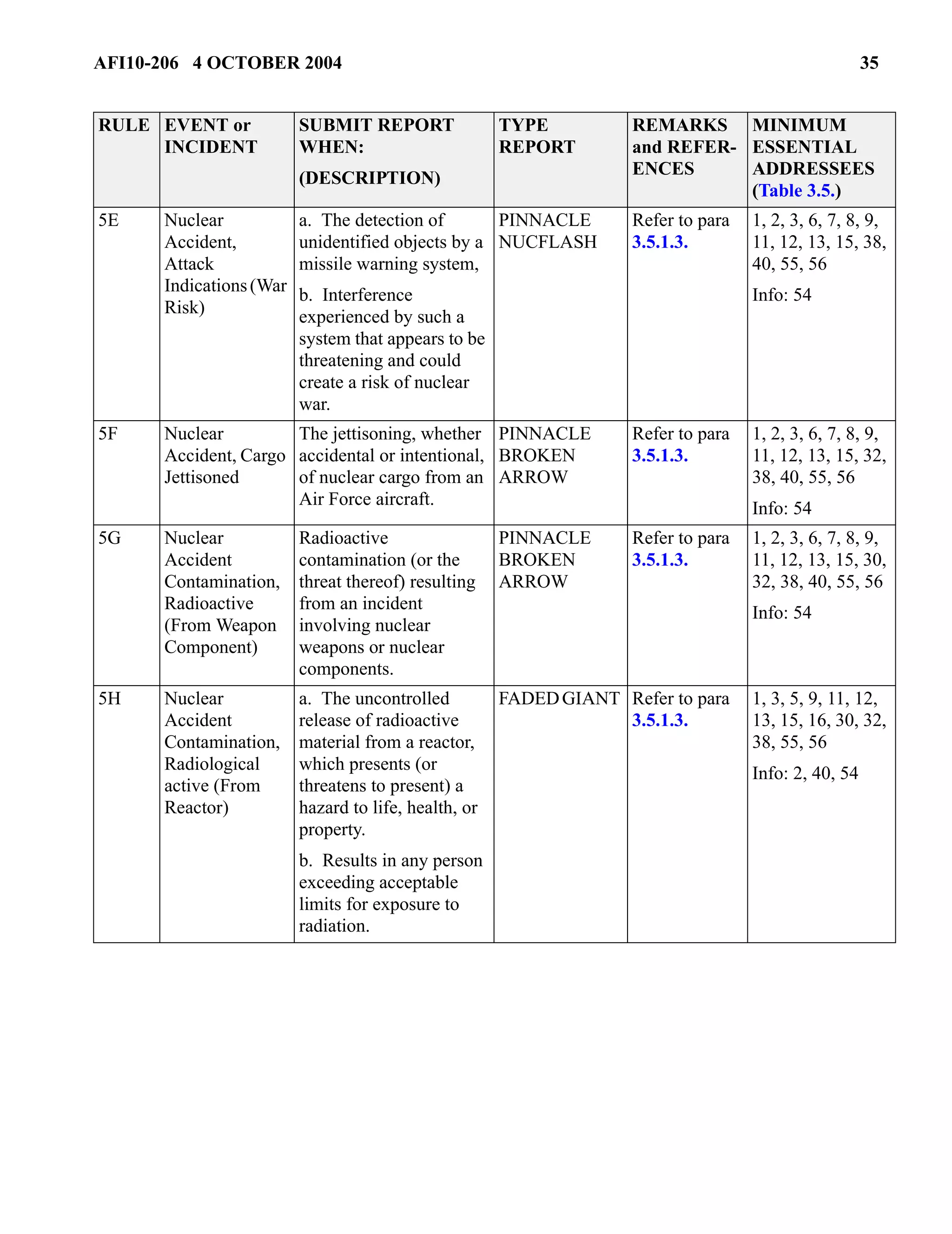
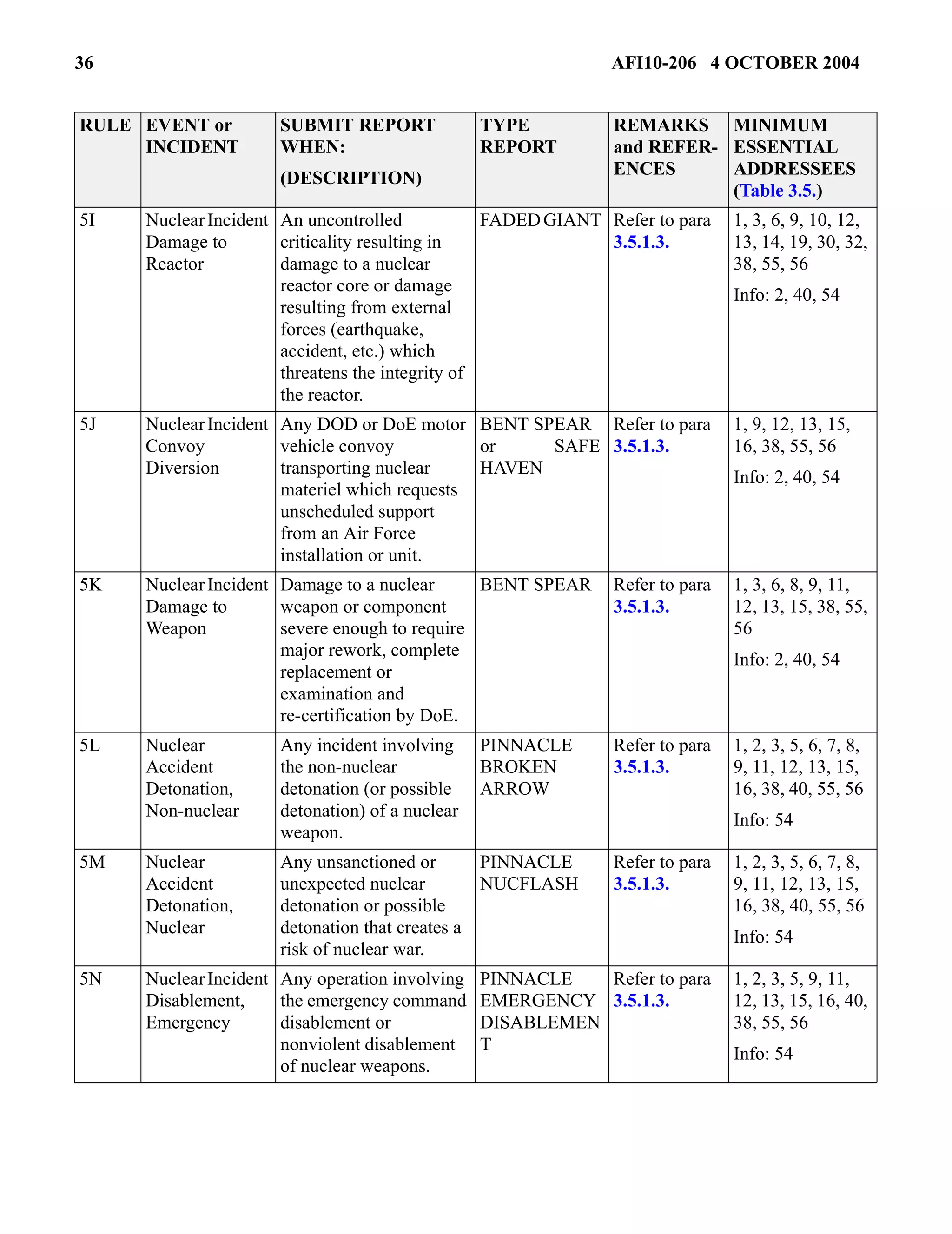
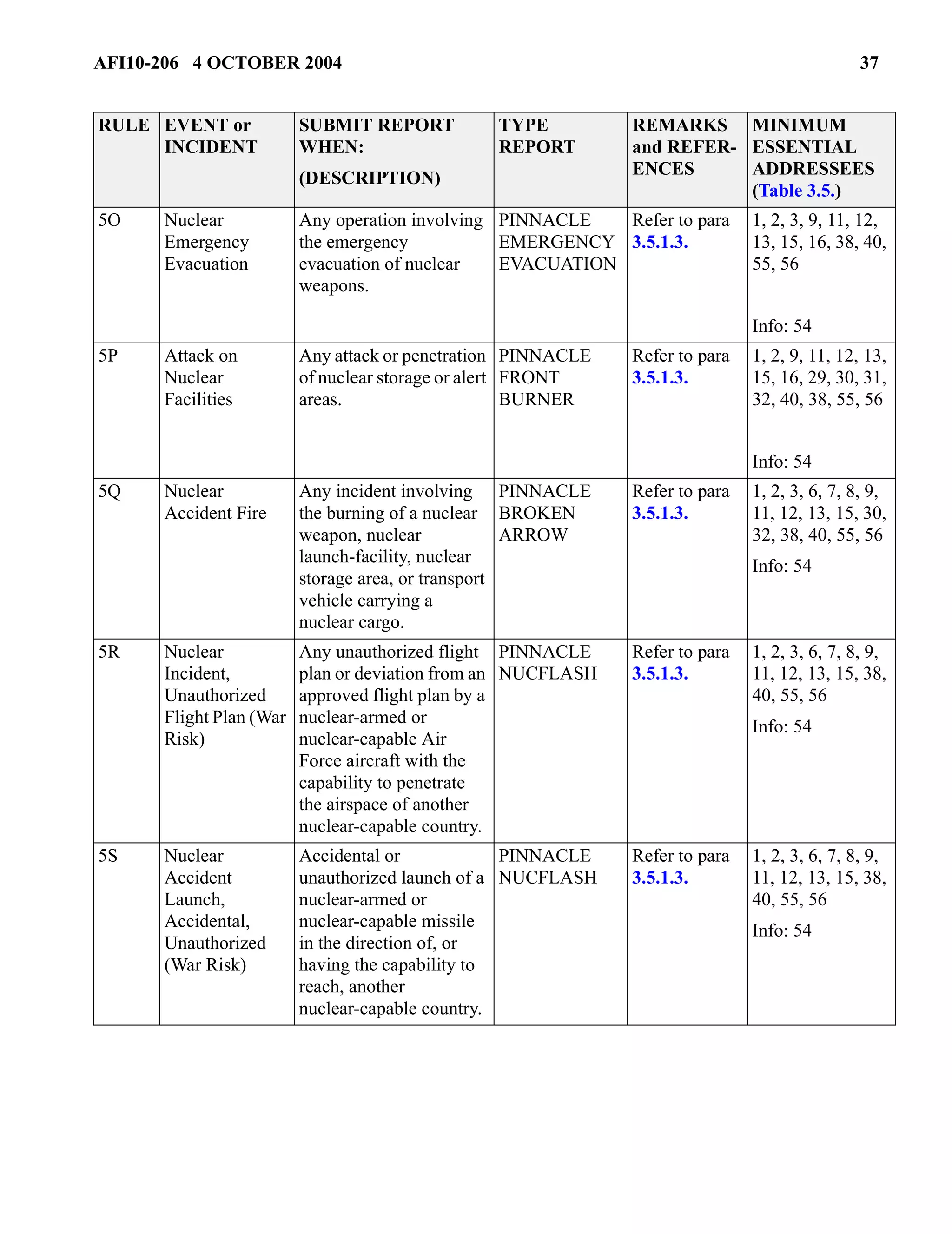
5 NUCLEAR EVENTS - These reports will be classified according to content 
5A Accident, 
Priority A 
Aircraft Nuclear 
Loaded 
Any class “A” accident 
involving an aircraft 
carrying one or more 
nuclear weapons 
PINNACLE 
BROKEN 
ARROW 
Refer to AFI 
91-204, Safety 
Investigations 
and Reports. 
Refer to para 
3.5.1.3. 
1, 2, 3, 5, 6, 7, 8, 
9, 11, 12, 13, 15, 
16, 38, 40, 55, 56 
Info: 54 
5B Aircraft, 
Missing 
(Nuclear 
Loaded) 
Any Air Force aircraft 
carrying nuclear cargo 
reported as missing. 
BEELINE 
EMPTY 
QUIVER 
Refer to AFI 
91-204, Safety 
Investigations 
and Reports. 
Refer to para 
3.5.1.3. 
1, 3, 5, 6, 8, 9, 11, 
12, 13, 15, 38, 55, 
56 
Info: 2, 40, 54 
5C Aircraft, 
Overdue 
(Nuclear 
Loaded) 
Any Air Force aircraft 
carrying nuclear 
weapons classified as 
overdue, or which a 
Preliminary 
Communication 
(PRECOM) search has 
been initiated. 
PINNACLE 
EMPTY 
QUIVER 
Refer to AFI 
91-204, Safety 
Investigations 
and Reports 
and AFI 
13-202, 
Overdue 
Aircraft 
- Refer to para 
3.5.1.3. 
1, 3, 5, 6, 8, 9, 11, 
12, 13, 15, 16, 32, 
40, 38, 55, 56 
Info: 54 
5D Nuclear Incident 
Arming of 
Weapon 
Any unanticipated 
incident, which raises 
suspicion that a nuclear 
weapon has been fully or 
partially armed. 
BENT SPEAR Refer to para 
3.5.1.3. 
1, 3, 6, 8, 9, 11, 
12, 13, 15, 38, 55, 
56 
Info: 2, 40, 54 
RULE EVENT or 
INCIDENT 
SUBMIT REPORT 
WHEN: 
(DESCRIPTION) 
TYPE 
REPORT 
REMARKS 
and REFER-ENCES 
MINIMUM 
ESSENTIAL 
ADDRESSEES 
(Table 3.5.)
AFI10-206 4 OCTOBER 2004 35 
5E Nuclear 
Accident, 
Attack 
Indications (War 
Risk) 
a. The detection of 
unidentified objects by a 
missile warning system, 
b. Interference 
experienced by such a 
system that appears to be 
threatening and could 
create a risk of nuclear 
war. 
PINNACLE 
NUCFLASH 
Refer to para 
3.5.1.3. 
1, 2, 3, 6, 7, 8, 9, 
11, 12, 13, 15, 38, 
40, 55, 56 
Info: 54 
5F Nuclear 
Accident, Cargo 
Jettisoned 
The jettisoning, whether 
accidental or intentional, 
of nuclear cargo from an 
Air Force aircraft. 
PINNACLE 
BROKEN 
ARROW 
Refer to para 
3.5.1.3. 
1, 2, 3, 6, 7, 8, 9, 
11, 12, 13, 15, 32, 
38, 40, 55, 56 
Info: 54 
5G Nuclear 
Accident 
Contamination, 
Radioactive 
(From Weapon 
Component) 
Radioactive 
contamination (or the 
threat thereof) resulting 
from an incident 
involving nuclear 
weapons or nuclear 
components. 
PINNACLE 
BROKEN 
ARROW 
Refer to para 
3.5.1.3. 
1, 2, 3, 6, 7, 8, 9, 
11, 12, 13, 15, 30, 
32, 38, 40, 55, 56 
Info: 54 
5H Nuclear 
Accident 
Contamination, 
Radiological 
active (From 
Reactor) 
a. The uncontrolled 
release of radioactive 
material from a reactor, 
which presents (or 
threatens to present) a 
hazard to life, health, or 
property. 
b. Results in any person 
exceeding acceptable 
limits for exposure to 
radiation. 
FADED GIANT Refer to para 
3.5.1.3. 
1, 3, 5, 9, 11, 12, 
13, 15, 16, 30, 32, 
38, 55, 56 
Info: 2, 40, 54 
RULE EVENT or 
INCIDENT 
SUBMIT REPORT 
WHEN: 
(DESCRIPTION) 
TYPE 
REPORT 
REMARKS 
and REFER-ENCES 
MINIMUM 
ESSENTIAL 
ADDRESSEES 
(Table 3.5.)
36 AFI10-206 4 OCTOBER 2004 
5I Nuclear Incident 
Damage to 
Reactor 
An uncontrolled 
criticality resulting in 
damage to a nuclear 
reactor core or damage 
resulting from external 
forces (earthquake, 
accident, etc.) which 
threatens the integrity of 
the reactor. 
FADED GIANT Refer to para 
3.5.1.3. 
1, 3, 6, 9, 10, 12, 
13, 14, 19, 30, 32, 
38, 55, 56 
Info: 2, 40, 54 
5J Nuclear Incident 
Convoy 
Diversion 
Any DOD or DoE motor 
vehicle convoy 
transporting nuclear 
materiel which requests 
unscheduled support 
from an Air Force 
installation or unit. 
BENT SPEAR 
or SAFE 
HAVEN 
Refer to para 
3.5.1.3. 
1, 9, 12, 13, 15, 
16, 38, 55, 56 
Info: 2, 40, 54 
5K Nuclear Incident 
Damage to 
Weapon 
Damage to a nuclear 
weapon or component 
severe enough to require 
major rework, complete 
replacement or 
examination and 
re-certification by DoE. 
BENT SPEAR Refer to para 
3.5.1.3. 
1, 3, 6, 8, 9, 11, 
12, 13, 15, 38, 55, 
56 
Info: 2, 40, 54 
5L Nuclear 
Accident 
Detonation, 
Non-nuclear 
Any incident involving 
the non-nuclear 
detonation (or possible 
detonation) of a nuclear 
weapon. 
PINNACLE 
BROKEN 
ARROW 
Refer to para 
3.5.1.3. 
1, 2, 3, 5, 6, 7, 8, 
9, 11, 12, 13, 15, 
16, 38, 40, 55, 56 
Info: 54 
5M Nuclear 
Accident 
Detonation, 
Nuclear 
Any unsanctioned or 
unexpected nuclear 
detonation or possible 
detonation that creates a 
risk of nuclear war. 
PINNACLE 
NUCFLASH 
Refer to para 
3.5.1.3. 
1, 2, 3, 5, 6, 7, 8, 
9, 11, 12, 13, 15, 
16, 38, 40, 55, 56 
Info: 54 
5N Nuclear Incident 
Disablement, 
Emergency 
Any operation involving 
the emergency command 
disablement or 
nonviolent disablement 
of nuclear weapons. 
PINNACLE 
EMERGENCY 
DISABLEMEN 
T 
Refer to para 
3.5.1.3. 
1, 2, 3, 5, 9, 11, 
12, 13, 15, 16, 40, 
38, 55, 56 
Info: 54 
RULE EVENT or 
INCIDENT 
SUBMIT REPORT 
WHEN: 
(DESCRIPTION) 
TYPE 
REPORT 
REMARKS 
and REFER-ENCES 
MINIMUM 
ESSENTIAL 
ADDRESSEES 
(Table 3.5.)
AFI10-206 4 OCTOBER 2004 37 
5O Nuclear 
Emergency 
Evacuation 
Any operation involving 
the emergency 
evacuation of nuclear 
weapons. 
PINNACLE 
EMERGENCY 
EVACUATION 
Refer to para 
3.5.1.3. 
1, 2, 3, 9, 11, 12, 
13, 15, 16, 38, 40, 
55, 56 
Info: 54 
5P Attack on 
Nuclear 
Facilities 
Any attack or penetration 
of nuclear storage or alert 
areas. 
PINNACLE 
FRONT 
BURNER 
Refer to para 
3.5.1.3. 
1, 2, 9, 11, 12, 13, 
15, 16, 29, 30, 31, 
32, 40, 38, 55, 56 
Info: 54 
5Q Nuclear 
Accident Fire 
Any incident involving 
the burning of a nuclear 
weapon, nuclear 
launch-facility, nuclear 
storage area, or transport 
vehicle carrying a 
nuclear cargo. 
PINNACLE 
BROKEN 
ARROW 
Refer to para 
3.5.1.3. 
1, 2, 3, 6, 7, 8, 9, 
11, 12, 13, 15, 30, 
32, 38, 40, 55, 56 
Info: 54 
5R Nuclear 
Incident, 
Unauthorized 
Flight Plan (War 
Risk) 
Any unauthorized flight 
plan or deviation from an 
approved flight plan by a 
nuclear-armed or 
nuclear-capable Air 
Force aircraft with the 
capability to penetrate 
the airspace of another 
nuclear-capable country. 
PINNACLE 
NUCFLASH 
Refer to para 
3.5.1.3. 
1, 2, 3, 6, 7, 8, 9, 
11, 12, 13, 15, 38, 
40, 55, 56 
Info: 54 
5S Nuclear 
Accident 
Launch, 
Accidental, 
Unauthorized 
(War Risk) 
Accidental or 
unauthorized launch of a 
nuclear-armed or 
nuclear-capable missile 
in the direction of, or 
having the capability to 
reach, another 
nuclear-capable country. 
PINNACLE 
NUCFLASH 
Refer to para 
3.5.1.3. 
1, 2, 3, 6, 7, 8, 9, 
11, 12, 13, 15, 38, 
40, 55, 56 
Info: 54 
RULE EVENT or 
INCIDENT 
SUBMIT REPORT 
WHEN: 
(DESCRIPTION) 
TYPE 
REPORT 
REMARKS 
and REFER-ENCES 
MINIMUM 
ESSENTIAL 
ADDRESSEES 
(Table 3.5.)
38 AFI10-206 4 OCTOBER 2004 
RULE EVENT or 
INCIDENT 
5T Nuclear Incident 
Loss 
SUBMIT REPORT 
WHEN: 
(DESCRIPTION) 
The loss (explained or 
unexplained) of a nuclear 
weapon or nuclear 
component. 
PINNACLE 
EMPTY 
QUIVER 
Refer to para 
3.5.1.3. 
1, 2, 3, 6, 7, 8, 9, 
11, 12, 13, 15, 38, 
40, 55, 56 
Info: 54 
5U Nuclear 
Accident Public 
Hazard 
Any nuclear accident 
actual or implied from a 
nuclear weapon, warhead 
or component. 
PINNACLE 
BROKEN 
ARROW 
Refer to para 
3.5.1.3. 
1, 2, 3, 5, 6, 7, 8, 
9, 11, 12, 13, 15, 
16, 38, 40, 55, 56 
Info: 54 
5V Nuclear Incident 
Reactor Incident 
An uncontrolled 
criticality resulting in 
damage to a nuclear 
reactor core or an event 
such as a loss of coolant 
that results in a 
significant release of 
fission products from the 
nuclear reactor core. 
FADED GIANT Refer to para 
3.5.1.3. 
1, 3, 8, 9, 11, 13, 
14, 15, 38, 55, 56 
Info: 2, 40, 54 
5W Nuclear Incident 
Seizure, Theft 
The forcible, 
unauthorized seizure or 
theft of a nuclear weapon 
or nuclear component. 
PINNACLE 
EMPTY 
QUIVER 
Refer to para 
3.5.1.3. 
1, 2, 3, 6, 7, 8, 9, 
11, 12, 13, 15, 38, 
40, 55, 56 
Info: 54 
5X Nuclear Incident 
Other 
Any incident involving a 
nuclear weapon that does 
not fall under any other 
Nuclear Event rule. 
BENT SPEAR Refer to para 
3.5.1.3. 
1, 9, 12, 13, 15, 
38, 55, 56 
Info: 54 
5Y Nuclear Incident 
Radioactive 
Material 
Any accident actual or 
implied involving 
radioactive material. 
FADED GIANT Refer to para 
3.5.1.3. 
1, 3, 5, 6, 7, 8, 10, 
11, 12, 13, 15, 16, 
38, 40, 55, 56 
Info: 54 
6 SYSTEM / INTELLIGENCE EVENTS 
TYPE 
REPORT 
REMARKS 
and REFER-ENCES 
MINIMUM 
ESSENTIAL 
ADDRESSEES 
(Table 3.5.)
AFI10-206 4 OCTOBER 2004 39 
6A Change in 
Information 
Operations 
Conditions 
(INFOCONS) 
Any unit directed change 
in INFOCON* status to 
Joint or other Service 
systems hosted on AF 
networks 
PINNACLE *Units are not 
required to 
submit this 
report if 
Higher 
Headquarters 
has directed an 
INFOCON 
change. 
1, 2, 4, 11, 15, 18, 
19, 20, 21, 22, 23, 
24, 25, 34, 35, 36, 
37, 55, 56 
RULE EVENT or 
INCIDENT 
SUBMIT REPORT 
WHEN: 
(DESCRIPTION) 
TYPE 
REPORT 
REMARKS 
and REFER-ENCES 
MINIMUM 
ESSENTIAL 
ADDRESSEES 
(Table 3.5.)
40 AFI10-206 4 OCTOBER 2004 
6B Change in 
Information 
Operations 
Conditions 
(INFOCONS) 
Any unit directed change 
in INFOCON status to 
USAF systems 
- When INFOCON 
change is downward 
directed by HAF, an 
OPREP-3 is not required 
if the unit immediately 
attains the directed 
change. However, if 
lower INFOCON is 
directed and commander 
chooses to remain at a 
higher INFOCON than 
directed, an OPREP-3 
BEELINE is required to 
inform and explain the 
reason the commander 
chose to retain the higher 
INFOCON. In addition, 
an OPREP-3 BEELINE 
is required once the unit’s 
INFOCON changes. 
- MAJCOM 
Commanders will report 
all HHQ INFOCON 
changes not directed by 
HAF (i.e., MAJCOM 
Commander directed 
change or Combatant 
Commander directed 
change affecting 
MAJCOM assets). 
BEELINE 1, 4, 11, 15, 18, 
19, 20, 21, 22, 23, 
24, 25, 34, 35, 36, 
37, 55, 56 
RULE EVENT or 
INCIDENT 
SUBMIT REPORT 
WHEN: 
(DESCRIPTION) 
TYPE 
REPORT 
REMARKS 
and REFER-ENCES 
MINIMUM 
ESSENTIAL 
ADDRESSEES 
(Table 3.5.)
AFI10-206 4 OCTOBER 2004 41 
6C Communication 
s/ 
Computer 
Systems 
Intrusion 
Confirmed unauthorized 
access or insider threat 
with malicious intent to 
sabotage Joint or other 
Service computers, 
computer networks, 
communications nodes, 
or command center 
equipment to include 
classified systems hosted 
on AF networks. 
PINNACLE Comply with 
Figure 3.2. 
and with 
AFSSI 5021. 
1, 2, 11, 12, 15, 
18, 19, 20, 21, 22, 
23, 24, 25, 34, 35, 
36, 37, 38, 55, 56 
6D Communication 
s/ Cmputer 
Systems 
Intrusion 
Confirmed unauthorized 
access or insider threat 
with malicious intent to 
sabotage USAF 
computers, computer 
networks, 
communications nodes, 
or command center 
equipment to include 
classified systems. 
BEELINE Comply with 
Figure 3.2. 
and with 
AFSSI 5021. 
1, 11, 12, 15, 18, 
19, 20, 21, 22, 23, 
24, 25, 34, 35, 36, 
37, 55, 56 
6E Compromise of 
Classified 
Information 
(Foreign 
Government 
Involved) 
Confirmed/suspected 
compromise or 
unauthorized release of 
any category of US 
classified information 
where a foreign 
government or agent is 
involved. 
PINNACLE Refer to AFI 
31-401 
Any report of 
compromise 
or suspected 
compromise 
will be 
reported via 
secure means. 
1, 2, 9, 11, 15, 38, 
55, 56 
6F Compromise of 
Top Secret 
Information 
Confirmed compromise 
or unauthorized release 
of TOP SECRET 
information. 
BEELINE Refer to AFI 
31-401 
Any report of 
compromise 
or suspected 
compromise 
will be 
reported via 
secure means. 
1, 9, 11, 15, 55, 56 
RULE EVENT or 
INCIDENT 
SUBMIT REPORT 
WHEN: 
(DESCRIPTION) 
TYPE 
REPORT 
REMARKS 
and REFER-ENCES 
MINIMUM 
ESSENTIAL 
ADDRESSEES 
(Table 3.5.)
42 AFI10-206 4 OCTOBER 2004 
RULE EVENT or 
INCIDENT 
6G Compromise of 
Classified 
Information 
(News Media 
Release) 
SUBMIT REPORT 
WHEN: 
(DESCRIPTION) 
Confirmed compromise 
or unauthorized release 
of any category of 
classified information 
that may appear in the 
news media. 
BEELINE Refer to AFI 
31-401 
Any report of 
compromise 
or suspected 
compromise 
will be 
reported via 
secure means. 
1, 9, 11, 15, 55, 56 
6H Diversion of 
Classified 
Material 
Any DOD convoy of 
classified material 
diverted from its 
destination due to natural 
disasters, civil disorders, 
or other emergencies and 
requiring temporary 
storage at an AF 
installation. 
BEELINE Refer to AFI 
10-2501 
1, 9, 15, 55, 56 
6I Vital 
Intelligence 
Sightings 
Any/all unidentifiable, 
suspicious, or hostile 
traffic (land, aerospace, 
or sea) which, because of 
its nature, course, or 
actions, may constitute a 
threat to the security of 
the US or Canada. 
Includes reports received 
from airborne platforms. 
PINNACLE 1, 2, 9, 15, 20, 21, 
38, 55, 56 
6J Intelligence Receipt of significant 
intelligence received 
through other than Intel 
channels. 
PINNACLE Submit special 
intelligence 
through SSO 
channels. 
1, 2, 15, 20, 21, 
55, 56 
7 POLITICAL EVENTS 
TYPE 
REPORT 
REMARKS 
and REFER-ENCES 
MINIMUM 
ESSENTIAL 
ADDRESSEES 
(Table 3.5.)
AFI10-206 4 OCTOBER 2004 43 
7A Asylum 
Incidents 
Any request for, or 
physical attempt by a 
foreign national to gain 
asylum on an Air Force 
installation, or incidents 
involving Air Force 
personnel or resources. 
PINNACLE Refer to AFI 
51-704, 
Handling 
Requests for 
Political 
Asylum and 
Temporary 
Refuge 
1, 2, 4, 9, 11, 14, 
15, 55 
7B Foreign 
Sovereignty 
Violation 
Violation of the foreign 
sovereignty of another 
nation through 
unauthorized entry, 
failure to comply with 
international agreements, 
or failure to comply with 
a foreign clearance. 
BEELINE AFI 91-204 
and the 
Foreign 
Clearance 
Guide. 
1, 54, 55 
7C National-Level 
Interest 
Event/incidents that may 
develop into a matter of 
White House, DOD, 
Joint, Service, or major 
media interest i.e., events 
with actual or potential 
international 
repercussions, serious 
operational changes, or 
natural/man-made 
disasters or civil 
disorders. 
PINNACLE 1, 2, 4, 38, 55, 56 
7D Political 
Ramifications 
Any event/incident 
involving Air Force 
personnel or resources 
which has political 
ramifications, such as 
defections or attempted 
defections, Status of 
Forces agreement 
violations, etc. 
BEELINE 1, 54, 55 
RULE EVENT or 
INCIDENT 
SUBMIT REPORT 
WHEN: 
(DESCRIPTION) 
TYPE 
REPORT 
REMARKS 
and REFER-ENCES 
MINIMUM 
ESSENTIAL 
ADDRESSEES 
(Table 3.5.)
44 AFI10-206 4 OCTOBER 2004 
7E Challenge to 
U.S. Authority 
Incidents where military 
authority over U.S. 
military or non-military 
personnel is challenged, 
including exercise of 
foreign jurisdiction. 
BEELINE 1, 9, 15, 55, 56 
7F Coups Report this event if DAF 
personnel are affected. 
PINNACLE 1, 2, 5, 9, 15, 16, 
33, 38, 55, 56 
7G Landing of 
Unfriendly 
Aircraft 
Report non-allied 
aircraft, which make an 
unscheduled landing at 
any U.S. military 
installation. 
PINNACLE 1, 2, 9, 11, 12, 15, 
31, 38, 55, 56 
8 MISCELLANEOUS EVENTS 
8A Convoy 
Diversion 
(Non-nuclear) 
Any DOD/DOE motor 
vehicle convoy 
(transporting other than 
nuclear materiel) that 
requests unscheduled 
support from an Air 
Force installation or unit. 
BEELINE 1, 4, 9, 12, 15, 32, 
55, 56 
8B Unsatisfactory 
Inspection 
Any final overall 
unsatisfactory rating of 
an Air Force/Air Reserve 
Component unit 
(squadron or larger) by a 
Numbered AF or higher 
inspection/assessment 
team. 
BEELINE 1, 12, 16, 55 
8C Mission-Impair 
ment 
An event/incident which 
impairs, or is likely to 
impair mission 
capability. 
BEELINE 1, 12, 55 
8D Media 
Coverage, 
International or 
National 
Adverse international or 
national media coverage 
of an event, incident, or 
action involving Air 
Force personnel, 
resources, or programs. 
PINNACLE 1, 2, 5, 11, 55 
If AF personnel 
are involved: 16 
RULE EVENT or 
INCIDENT 
SUBMIT REPORT 
WHEN: 
(DESCRIPTION) 
TYPE 
REPORT 
REMARKS 
and REFER-ENCES 
MINIMUM 
ESSENTIAL 
ADDRESSEES 
(Table 3.5.)
AFI10-206 4 OCTOBER 2004 45 
8E Media 
Coverage, Local 
Adverse local media 
coverage of any event, 
incident, or action 
involving Air Force 
personnel, resources, or 
programs. 
BEELINE 1, 5, 11, 15, 55 
If AF personnel 
are involved: 16 
8F Toxic Material The theft, escape, or 
spillage of toxic or 
dangerous materiel that 
threatens life or location. 
PINNACLE 1, 2, 3, 5, 8, 9, 11, 
13, 14, 15, 16, 30, 
32, 38, 54, 55 
8G Disasters, 
Natural 
An earthquake, flood, 
volcanic eruption, or any 
other natural 
phenomenon that may 
impair the operational 
capability of an Air Force 
activity. 
BEELINE 1, 3, 15, 26, 27, 
30, 32, 55 
8H CSAF Special 
Interests 
Any event of special 
interest to the CSAF. 
CSAF determines items 
of interest. 
BEELINE Reference 
Figure 
1, 55 
RULE EVENT or 
INCIDENT 
SUBMIT REPORT 
WHEN: 
(DESCRIPTION) 
TYPE 
REPORT 
REMARKS 
and REFER-ENCES 
MINIMUM 
ESSENTIAL 
ADDRESSEES 
(Table 3.5.)
46 AFI10-206 4 OCTOBER 2004 
8I Significant 
Weather 
Occurrences 
When the following 
significant weather 
occurs and results in 
damage: 
a. Winds 50 knots or 
greater (to include gusts) 
b. Hail ¾ inch or larger 
c. Tornadoes 
d. Lightening strikes 
e. Snow storms 
BEELINE Report actual 
weather 
experienced, 
forecast valid 
at the time of 
occurrence to 
include any 
watches or 
warnings 
issued 
(include actual 
and desired 
lead time), and 
the 
operational 
status of 
meteorologica 
l equipment 
(e.g. radar, 
wind sensors, 
etc.) at time of 
event AFI 
10-229 
(Responding 
to Severe 
Weather 
Events) 
1, 26, 27, 55 
8J Hurricane/ 
Typhoon 
Condition 
Change 
Any Commander 
directed HURCON or 
TCCOR change. 
BEELINE 1, 26, 27, 55 
RULE EVENT or 
INCIDENT 
SUBMIT REPORT 
WHEN: 
(DESCRIPTION) 
TYPE 
REPORT 
REMARKS 
and REFER-ENCES 
MINIMUM 
ESSENTIAL 
ADDRESSEES 
(Table 3.5.)
AFI10-206 4 OCTOBER 2004 47 
8K Relocation of 
wing or major 
command 
headquarters 
emergency 
essential 
functions and 
personnel under 
the DOD 
Continuity of 
Operations 
(COOP) 
program 
a. Natural or manmade 
disasters 
b. Hostile threats 
c. Execute Order 
d. Construction/ 
Renovations. 
BEELINE Refer to DOD 
3020.26 
Continuity of 
Operations 
(COOP) 
Planning and 
policy 
a. 1, 3, 5, 8, 12, 
26, 27, 30, 32, 55 
b. 1, 3, 5, 9, 11, 
15, 55 
c. 1, 55 
d. 1, 55 
RULE EVENT or 
INCIDENT 
SUBMIT REPORT 
WHEN: 
(DESCRIPTION) 
TYPE 
REPORT 
REMARKS 
and REFER-ENCES 
MINIMUM 
ESSENTIAL 
ADDRESSEES 
(Table 3.5.)
48 AFI10-206 4 OCTOBER 2004 
Table 3.5. MINIMUM ESSENTIAL ADDRESSEE (MEA) LISTING 
1 PLA:AFOC WASHINGTON DC// 
C:US,O:U.S. Government,OU:DoD,OU:AF,OU:Organizations,L:PENTAGON 
WASHINGTON DC,OU:AFOG(uc),OU:AFWATCH(uc) 
PLA:AFEOC FT DETRICK MD// (when activated) 
AFEOC does not have DMS capability therefore the AUTODIN address must be pulled as 
follows: 
C:US,O:U.S. Government,OU:DoD,OU:AUTODIN PLAs,OU:A-AIG 5,OU:AFEOC FT 
DETRICK MD 
2 PLA:CJCS NMCC WASHINGTON DC//EA// 
C:US,O:U.S. Government,OU:DoD,OU:JCS,OU:organizations,L:WASHINGTON 
DC,OU:JOINT STAFF(uc),OU:JOINT STAFF J3(uc),OU:JOINT STAFF J3 NMCC OPS(uc) 
3 PLA:AFNSEP FT MCPHERSON GA//RO/EOC// 
C:US,O:U.S. Government,OU:DoD,OU:Army,OU:Organizations,L:CONUS,L:FORT 
MCPHERSON GA,OU:AFNSEP(uc) 
PLA:AFNSEP WASHINGTON DC//CC// 
C:US,O:U.S. Government,OU:DoD,OU:AF,OU:Organizations,L:PENTAGON 
WASHINGTON DC,OU:AFNSEP(uc) 
4 PLA:DIA WASHINGTON DC//DHS/DHO-CSR// 
C:US,O:U.S. Government,OU:DoD,OU:AUTODIN PLAs,OU:D,OU:DIA WASHINGTON 
DC 
5 PLA:HQ AFPC RANDOLPH AFB TX//DPWCS// 
C:US,O:U.S. Government,OU:DoD,OU:AF,OU:Organizations,L:RANDOLPH AFB 
TX,OU:AFPC(uc),OU:DPWCS(uc) 
6 PLA:AFMC WRIGHT PATTERSON AFB OH//SEW/DRAW// 
C:US,O:U.S. Government,OU:DoD,OU:AF,OU:Organizations,L:WRIGHT-PATTERSON 
AFB OH,OU:HQ AFMC(uc),OU:SEW(uc) 
C:US,O:U.S. Government,OU:DoD,OU:AF,OU:Organizations,L:WRIGHT-PATTERSON 
AFB OH,OU:HQ AFMC(uc),OU:DR(uc) 
7 PLA:HQ AFMOA BOLLING AFB DC//SGZA// 
C:US,O:U.S. Government,OU:DoD,OU:AF,OU:Organizations,L:PENTAGON 
WASHINGTON DC,OU:HQ USAF(uc),OU:SG(uc),OU:SGZ(uc) 
8 PLA:HQ AFSC KIRTLAND AFB NM//SE// 
C:US,O:U.S. Government,OU:DoD,OU:AF,OU:Organizations,L:KIRTLAND AFB 
NM,OU:HQ AFSC(uc),OU:SE(uc)
AFI10-206 4 OCTOBER 2004 49 
9 PLA:HQ AFSFC LACKLAND AFB TX//SF/OPSCENTER// 
C:US,O:U.S. Government,OU:DoD,OU:AF,OU:Organizations,L:LACKLAND AFB 
TX,OU:HQ AFSFC(uc),OU:OPS(uc) 
10 PLA:HQ AFFSA ANDREWS AFB MD//CC// 
C:US,O:U.S. Government,OU:DoD,OU:AF,OU:Organizations,L:ANDREWS AFB 
MD,OU:HQ AFFSA(uc) 
11 PLA:HQ AFOSI ANDREWS AFB DC//DOO// 
C:US,O:U.S. Government,OU:DoD,OU:AF,OU:Organizations,L:ANDREWS AFB 
MD,OU:HQ AFOSI(uc),OU:DOO(uc) 
12 PLA:HQ USAF WASHINGTON DC//SE/ILMW// 
C:US,O:U.S. Government,OU:DoD,OU:AF,OU:Organizations,L:PENTAGON 
WASHINGTON DC,OU:HQ USAF(uc),OU:SE(uc) 
C:US,O:U.S. Government,OU:DoD,OU:AF,OU:Organizations,L:PENTAGON 
WASHINGTON DC,OU:HQ USAF(uc),OU:IL(uc),OU:ILMW(uc) 
PLA:HQ USAF WASHINGTON DC//XONO// 
C:US,O:U.S. Government,OU:DoD,OU:AF,OU:Organizations,L:PENTAGON 
WASHINGTON DC,OU:HQ USAF(uc),OU:XO(uc),OU:XONO(uc) 
13 PLA:NWPSC KIRTLAND AFB NM//NWLO// 
C=US;DDA:MSXCX500=C:US,O:U.S. 
Government,OU:DoD,OU:AF,OU:Organizations,L:KIRTLAND AFB 
NM,OU:AAC(uc),OU:NWLO(uc) 
PLA:HQ AFNWCA WASHINGTON DC//CC// 
C:US,O:U.S. Government,OU:DoD,OU:AF,OU:Organizations,L:PENTAGON 
WASHINGTON DC,OU:HQ USAF(uc),OU:XO(uc),OU:XON(uc) 
PLA:DTRA AO KIRTLAND AFB NM//CSNLM// 
C:US,O:U.S. Government,OU:DoD,OU:AUTODIN PLAs,OU:D,OU:DTRA ABQ 
KIRTLAND AFB NM 
PLA:OSD WASHINGTON DC//DATSD/NM// 
C:US,O:U.S. Government,OU:DoD,OU:OSD,OU:Organizations,L:WASHINGTON 
DC,OU:USD(ACQ TECH AND LOG)(uc),OU:ATSD(NUKE CHEM AND BIO DEF(uc) 
14 PLA:HQ USAF WASHINGTON DC//JAI// 
C:US,O:U.S. Government,OU:DoD,OU:AF,OU:Organizations,L:PENTAGON 
WASHINGTON DC,OU:HQ USAF(uc),OU:JA(uc) 
15 PLA:HQ USAF WASHINGTON DC//XOF// 
C:US,O:U.S. Government,OU:DoD,OU:AF,OU:Organizations,L:PENTAGON 
WASHINGTON DC,OU:HQ USAF(uc),OU:XO(uc),OU:XOF(uc)
50 AFI10-206 4 OCTOBER 2004 
16 PLA:HQ USAF WASHINGTON DC//DPXJ/MPRC// 
C:US,O:U.S. Government,OU:DoD,OU:AF,OU:Organizations,L:PENTAGON 
WASHINGTON DC,OU:HQ USAF(uc),OU:DP(uc),OU:CAT-MPRC(uc) 
C:US,O:U.S. Government,OU:DoD,OU:AF,OU:Organizations,L:PENTAGON 
WASHINGTON DC,OU:HQ USAF(uc),OU:DP(uc),OU:DPX(uc) 
17 PLA:AFMC COMMAND CENTER WRIGHT PATTERSON AFB OH// 
C:US,O:U.S. Government,OU:DoD,OU:AF,OU:Organizations,L:WRIGHT-PATTERSON 
AFB OH,OU:HQ AFMC COMMAND CENTER(uc) 
18 PLA:AFIWC LACKLAND AFB TX//CC/IO/IOT/IOA// 
C:US,O:U.S. Government,OU:DoD,OU:AF,OU:Organizations,L:LACKLAND AFB 
TX,OU:AFIWC(uc) 
19 PLA: HQ USAF WASHINGTON DC//XIC// 
C:US,O:U.S. Government,OU:DoD,OU:AF,OU:Organizations,L:PENTAGON 
WASHINGTON DC,OU:HQ USAF(uc),OU:XI(uc),OU:XIC(uc) 
20 PLA:HQ USAF WASHINGTON DC//XOI// 
C:US,O:U.S. Government,OU:DoD,OU:AF,OU:Organizations,L:PENTAGON 
WASHINGTON DC,OU:HQ USAF(uc),OU:XO(uc),OU:XOI(uc) 
21 PLA:OL IA NAIC WASHINGTON DC//IA// 
C:US,O:U.S. Government,OU:DoD,OU:AUTODIN PLAs,OU:O-Q,OU:OL IA NAIC 
WASHINGTON DC 
22 PLA:HQ DISA WASHINGTON DC//D3// 
C:US,O:U.S. Government,OU:DoD,OU:DISA,OU:Organizations,OU:Org 
Staff,OU:Operations Directorate,OU:Current Ops Div,OU:DISA CMDR GNOSC(uc) 
23 PLA:HQ AIA LACKLAND AFB TX//DO// 
C:US,O:U.S. Government,OU:DoD,OU:AF,OU:Organizations,L:LACKLAND AFB 
TX,OU:HQ AIA(uc),OU:DO(uc) 
24 PLA:90IOS LACKLAND AFB TX//CC/DO// 
C:US,O:U.S. Government,OU:DoD,OU:AUTODIN PLAs,OU:5-9,OU:90IOS LACKLAND 
AFB TX 
25 PLA:HQ SSG MAXWELL AFB GUNTER ANNEX AL//EV/SWSN/SWNO// 
C:US,O:U.S. Government,OU:DoD,OU:AF,OU:Organizations,L:MAXWELL AFB GUNTER 
ANNEX AL,OU:HQ SSG(uc) 
26 PLA:HQ USAF WASHINGTON DC//XOW// 
C:US,O:U.S. Government,OU:DoD,OU:AF,OU:Organizations,L:PENTAGON 
WASHINGTON DC,OU:HQ USAF(uc),OU:XO(uc),OU:XOW(uc)
AFI10-206 4 OCTOBER 2004 51 
27 PLA:HQ AFWA OFFUTT AFB NE//XO// 
C:US,O:U.S. 
Government,OU:DoD,OU:AF,OU:GSU,OU:Organizations,OU:FOAs,L:OFFUTT AFB 
NE,OU:HQ AFWA(uc),OU:XO(uc) 
28 PLA:ANG ANDREWS AFB MD//XOC// 
C:US,O:U.S. Government,OU:DoD,OU:AF,OU:ANG,OU:Organizations,L:ANGRC 
ANDREWS AFB MD,OU:ANG(uc),OU:XOC(uc) 
29 PLA:HQ AFCESA TYNDALL AFB FL//CC// 
C:US,O:U.S. Government,OU:DoD,OU:AF,OU:Organizations,L:TYNDALL AFB 
FL,OU:AFCESA(uc),OU:CC(uc) 
30 PLA:HQ USAF WASHINGTON DC//ILE// 
C:US,O:U.S. Government,OU:DoD,OU:AF,OU:Organizations,L:PENTAGON 
WASHINGTON DC,OU:HQ USAF(uc),OU:IL(uc),OU:ILE(uc) 
31 PLA:HQ USAF WASHINGTON DC//XOR// 
C:US,O:U.S. Government,OU:DoD,OU:AF,OU:Organizations,L:PENTAGON 
WASHINGTON DC,OU:HQ USAF(uc),OU:XO(uc),OU:XOR(uc) 
32 PLA:HQ USAF WASHINGTON DC//IL/ILV/ILMY/ILGD// 
C=US;DDA:MSXCX500=C:US,O:U.S. 
Government,OU:DoD,OU:AF,OU:Organizations,L:PENTAGON WASHINGTON DC,OU:HQ 
USAF(uc),OU:IL(uc) 
C:US,O:U.S. Government,OU:DoD,OU:AF,OU:Organizations,L:PENTAGON 
WASHINGTON DC,OU:HQ USAF(uc),OU:IL(uc),OU:ILV(uc) 
C=US;DDA:MSXCX500=C:US,O:U.S. 
Government,OU:DoD,OU:AF,OU:Organizations,L:PENTAGON WASHINGTON DC,OU:HQ 
USAF(uc),OU:IL(uc),OU:ILMY(uc) 
C:US,O:U.S. Government,OU:DoD,OU:AF,OU:Organizations,L:PENTAGON 
WASHINGTON DC,OU:HQ USAF(uc),OU:IL(uc),OU:ILGD(uc) 
33 PLA:HQ USAF WASHINGTON DC//XPX// 
C:US,O:U.S. Government,OU:DoD,OU:AF,OU:Organizations,L:PENTAGON 
WASHINGTON DC,OU:HQ USAF(uc),OU:XP(uc),OU:XPX(uc) 
34 PLA:8AF BARKSDALE AFB LA//COMAFFOR-CNO// 
C:US,O:U.S. Government,OU:DoD,OU:AF,OU:Organizations,L:BARKSDALE AFB 
LA,OU:8AF(uc),OU:CC(uc)
52 AFI10-206 4 OCTOBER 2004 
35 PLA:8AF BARKSDALE AFB LA//CC/DO// 
C:US,O:U.S. Government,OU:DoD,OU:AF,OU:Organizations,L:BARKSDALE AFB 
LA,OU:8AF(uc),OU:CC(uc) 
C:US,O:U.S. Government,OU:DoD,OU:AF,OU:Organizations,L:BARKSDALE AFB 
LA,OU:8AF(uc),OU:DO(uc) 
36 PLA:67IOW LACKLAND AFB TX//CC/DO// 
C:US,O:U.S. Government,OU:DoD,OU:AF,OU:Organizations,L:LACKLAND AFB 
TX,OU:67IOW(uc),OU:CC(uc) 
C:US,O:U.S. Government,OU:DoD,OU:AF,OU:Organizations,L:LACKLAND AFB 
TX,OU:67IOW(uc),OU:DO(uc) 
37 PLA:33IOS LACKLAND AFB TX//CC/DO/DOO// 
C:US,O:U.S. Government,OU:DoD,OU:AF,OU:Organizations,L:LACKLAND AFB 
TX,OU:33IOS(uc),OU:AFCERT(uc) 
38 PLA:USSTRATCOM OFFUTT AFB NE//OP111/CL12/CL124// 
C:US,O:U.S. Government,OU:DoD,OU:STRATCOM,OU:Organizations,L:OFFUTT AFB 
NE,OU:Command Center(uc) 
39 PLA:HQ NORAD COMMAND CTR CHEYENNE MOUNTAIN AFS CO// 
C:US,O:U.S. Government,OU:DoD,OU:NORAD,OU:Organizations,L:CHEYENNE 
MOUNTAIN AFS CO,OU:NORAD COMMAND CTR(uc) 
40 PLA:CDR USJFCOM NORFOLK VA//J3// 
C:US,O:U.S. Government,OU:DoD,OU:JFCOM,OU:Organizations,OU:CDR USJFCOM 
NORFOLK VA(uc),OU:JFCOM J3(uc) 
41 PLA:USCENTCOM MACDILL AFB FL//CCJ3-C// 
C:US,O:U.S. Government,OU:DoD,OU:CENTCOM,OU:Organizations,L:CONUS,L:HQ 
USCENTCOM MACDILL AFB FL,OU:USCENTCOM CCJ3(mc),OU:USCENTCOM 
CCJ3-C(mc) 
42 PLA: HQ USSOCOM MACDILL AFB FL// 
C:US,O:U.S. Government,OU:DoD,OU:SOCOM,OU:Organizations,L:HQSOCOM 
FL,OU:HQUSSOCOM Message Center(uc) 
43 PLA: HQ USSOUTHCOM MIAMI FL//J32// 
C:US,O:U.S. 
Government,OU:DoD,OU:SOUTHCOM,OU:Organizations,L:CONUS,L:MIAMI 
FL,OU:CDR USSOUTHCOM(mc),OU:SOUTHCOM J3(mc) 
44 PLA: HQ USEUCOM VAIHINGEN GE//ETCC/ECJ36// 
C:US,O:U.S. Government,OU:DoD,OU:AUTODIN PLAs,OU:E-H,OU:HQ USEUCOM 
VAIHINGEN GE
AFI10-206 4 OCTOBER 2004 53 
45 PLA: HQ USPACOM HONOLULU HI//CDO// 
C=US ; DDA:MSXCX500=C:US,O:U.S. Government,OU:DoD,OU:AUTODIN 
PLAs,OU:E-H,OU:HQ USPACOM HONOLULU HI 
46 PLA:HQ AFRC COMMAND CENTER ROBINS AFB GA //DOCC// 
C:US,O:U.S. Government,OU:DoD,OU:AF,OU:AFRC,OU:Organizations,L:ROBINS AFB 
GA,OU:HQ AFRC(uc),OU:DOCC(uc) 
47 PLA:HQ ACC LANGLEY AFB VA//DOXC// 
C:US,O:U.S. Government,OU:DoD,OU:AF,OU:Organizations,L:LANGLEY AFB 
VA,OU:ACC COMMAND CENTER(uc) 
48 PLA:RANDOLPH COMMAND CENTER RANDOLPH AFB TX 
C:US,O:U.S. Government,OU:DoD,OU:AF,OU:Organizations,L:RANDOLPH AFB 
TX,OU:12FTW(uc),OU:CP(uc) 
49 PLA:AFSOC CMD CTR HURLBURT FLD FL 
C:US,O:U.S. Government,OU:DoD,OU:AF,OU:Organizations,L:HURLBURT FLD 
FL,OU:AFSOC(uc),OU:DOOC(uc) 
50 PLA:HQ AFSPC PETERSON AFB CO//XOOO// 
C:US,O:U.S. Government,OU:DoD,OU:AF,OU:Organizations,L:PETERSON AFB 
CO,OU:HQ AFSPC(uc),OU:AFSPC Command Center(uc) 
51 PLA:USTRANSCOM AMC TACC EA CELL SCOTT AFB IL 
C:US,O:U.S. Government,OU:DoD,OU:AF,OU:Organizations,L:SCOTT AFB 
IL,OU:TACC(uc),OU:EA CELL(uc) 
52 PLA:PACAF COMMAND CENTER HICKAM AFB HI 
C:US,O:U.S. Government,OU:DoD,OU:AF,OU:Organizations,L:HICKAM AFB 
HI,OU:PACAF COMMAND CENTER(uc) 
53 PLA:USAFE COMMAND CENTER RAMSTEIN AB GE 
C:US,O:U.S. Government,OU:DoD,OU:AF,OU:Organizations,L:RAMSTEIN AB 
GE,OU:USAFE Command Center(uc) 
54 PLA:HQ USAF WASHINGTON DC//XONP// 
C:US,O:U.S. Government,OU:DoD,OU:AF,OU:Organizations,L:PENTAGON 
WASHINGTON DC,OU:HQ USAF(uc),OU:XO(uc),OU:XONP(uc) 
55 PLA: 42ABW CP MAXWELL AFB AL//CP// 
C:US,O:U.S. Government,OU:DoD,OU:AF,OU:Organizations,L:MAXWELL AFB AL,OU:42 
ABW(uc),OU:CP(uc) 
56 C:US,O:U.S. Government, OU:DoD,OU:NORTHCOM, OU:Organizations,I:CHEYENNE 
MOUNTAIN AFS CO, OU: HQ USNORTHCOM EA(uc)
54 AFI10-206 4 OCTOBER 2004 
Figure 3.1. Sample of OPREP-3 CRESCENT EDGE Report. 
This is (Originator) with a (Flash/Immediate), Unclassified OPREP-3 (BEELINE/PINNACLE) CRES-CENT 
EDGE. 
Report Number: XXX 
1. Initiation Time (All Times in ZULU) 
2. Initiated by (Name/Phone/Office Symbol from SAP unit) 
3. Notify (Name/Phone/Office Symbol of program manager at AF or JCS level) 
Figure 3.2. Information Guide for OPREP-3 Event/Incident Reporting. 
1. Name and location of unit submitting report. 
2. Operation nickname or type of occurrence. 
3. Mission identification number. 
4. For FOLUP reports, reference to all previous reports. 
5. Date, time, and location of event or incident. 
6. Analysis of public relations factors involved and estimate of news media reaction. 
7. Description of all known facts and circumstances: 
a. Include the following for events or incidents concerning aircraft, missiles, or satellites: 
(1) Serial number and type of aircraft, missile, or satellite. 
(2) Home Unit. 
(3) Home base. 
(4) Mission. (For aircraft, include point of departure and en route stops.) 
(5) Type of ordnance aboard. 
(6) Any known circumstances concerning the event/incident, or any factor which induced or 
contributed to an accident or combat loss. 
(7) Weather conditions at time and place of event or incident (aircraft only). 
(8) Estimate of casualties. 
(9) Names of VIP casualties involved (given independent of OPREP). 
(10) Estimate of property or equipment damage (Air Force, public, or private). 
(11) Security measures taken (i.e., number and type of personnel used as sentries, unit and 
base of assignment, etc.). If nuclear weapons are involved, include whether or not a national 
defense area was established according to AFI 31-101. 
b. When compromise or suspected compromise of classified information is involved that is not the 
result of espionage, include as much of the following as possible: 
(1) Description of material involved, including origin (agency and office of primary responsi-bility), 
date, subject, classification, category, special marking, etc.
AFI10-206 4 OCTOBER 2004 55 
(2) Identification of persons and activities involved. 
(3) Summary of circumstances. 
(4) Estimated extent of compromise. 
(5) If Office of Special Investigations (OSI) assistance has been requested. 
Figure 3.3. Communications/Computer Events Report Format and Content. 
1. Report Date/Time. 
2. Date and time the incident occurred. 
3. Date and time incident discovered and means of detection. 
4. Name and classification of the exploited network/system. Include: 
a. Name of the system as accredited 
b. Network domain name and Internet Protocol (IP) address 
c. Description of hardware and operating system 
d. Highest classification of information processed 
e. Mission area/function of system 
5. Description of the incident. Use as much detail as necessary to adequately describe the problem. 
6. Impact on the affected organization’s operations/mission. 
7. Apparent source IP (if applicable). 
Figure 3.4. Guide for Reporting Military Support to Civil Authorities (MSCA). 
MSCA reports will be submitted using the OPREP-3 HOMELINE report. Reports will be submitted once 
daily until MSCA is no longer needed. Include the following in a narrative statement when commanders 
provide military support to civil authorities, regardless if an agreement is established or not: 
1. Type of support, location, and specific assistance requested or provided. 
2. Estimated duration of military participation in reported event. 
3. Source, date, and time of civil authority’s request for military assistance. Show official titles, phone 
numbers, and e-mail addresses. 
4. Number of USAF personnel (military and civilian) employed in the MSCA. 
5. Amount and types of equipment used. 
6. Amount and types of supplies used. 
7. Title, rank, and telephone/e-mail/fax of unit POC. 
8. Describe the extent of any media interest in the USAF response. 
9. Appropriate DOD or FEMA mission designator(s), if applicable. 
10. Add MEA #3 (AFNSEP) and the below DMS addresses as action addressees on all MSCA 
HOMELINE reports.
56 AFI10-206 4 OCTOBER 2004 
Table 3.6. Military Support to Civilian Authorities MEA Listing. 
1AF AOC (TYNDALL AFB) 
1AF AOC 
OU1=XLWU2;OU2=1AF;O=FL10;P=dms+gov+SIPR;A=DMS;C=US;DDA:MSXCX500=C:US,O:U. 
U.Government,OU:DoD,OU:AF,OU:ANG,OU:Organization,L:TYNDALL AFB FL,OU:AF(uc) 
1AF AOC A5 
OU1=XLWU2;OU2=1AFA5;O=FL10;P=dms+gov+SIPR;A=DMS;C=US;DDA:MSXCX500=C:US,O: 
U.U.Government,OU:DoD,OU:AF,OU:ANG,OU:Organization,L:TYNDALL AFB 
FL,OU:AF(uc)OU:A5(uc) 
1AF AOC DO 
OU1=XLWU2;OU2=1AFDO;O=FL10;P=dms+gov+SIPR;A=DMS;C=US;DDA:MSXCX500=C:US,O: 
U.U.Government,OU:DoD,OU:AF,OU:ANG,OU:Organization,L:TYNDALL AFB 
FL,OU:AF(uc),OU:DO(uc) 
1AF AOC LG 
OU1=XLWU2;OU2=1AFLG;O=FL10;P=dms+gov+SIPR;A=DMS;C=US;DDA:MSXCX500=C:US,O: 
U.U.Government,OU:DoD,OU:AF,OU:ANG,OU:Organization,L:TYNDALL AFB 
FL,OU:AF(uc),OU:LG(uc) 
ACC CAT (LANGLEY AFB) 
OU1=MUHJ2;OU2=ACCCATV3TSS;O=VA16;P=dms=gov=SIPR;A=DMS;C=US;DDA:MSXCX500= 
C:US,O:U.S.Government,OU:DoD,OU:AF,OU:Organization,L:LANGLEY AFB VA,OU:ACC CAT9uc) 
A summary report is required when support is complete. Submit the following information 10 workdays 
after MSCA termination. 
1. Assessment of military operations and effectiveness. 
2. Photographs and video of military operations. 
3. Chronological summary of USAF and CAP actions to include all DOD and FEMA mission num-bers. 
4. Highlights of relief operations, outstanding performers, unusual actions or occurrences, or other 
events of interest for the USAF After Action Report. 
5. Discussion of specific problem areas encountered and actions recommended to preclude recurrence 
in the future. 
6. Summary of relief operations expenses requiring reimbursement.
AFI10-206 4 OCTOBER 2004 57 
Figure 3.5. Active Duty Death Additional Information Format. 
1. Marital Status of member: Single / Married / Divorced / Separated. 
2. Did the member have children? How many? 
3. Where was the member found: On-base (housing / dormitory / work) / Off base 
4. Who (if known) found the member? 
5. Any records of previous problems? 
6. For vehicle/motorcycle accidents: 
a. Were seatbelts worn? 
b. Is there evidence of alcohol use? 
c. Was the member wearing a helmet? 
7. What’s the status of next-of-kin (NOK) notifications? 
8. Any additional information known. 
Figure 3.6. Guide for Reporting Suspected or Confirmed Terrorist use of Chemical, Biological, or 
Radiological (CBR) Materials. 
In addition to requirements in Figure 3.2., include all available data elements (lines A through V) listed 
below. If a data element is unknown, list line identifier (A., B., C., etc.) and state “UNKNOWN”. Include 
FOLUP data elements, if known, in the initial report. Do not delay initial report. 
1. Initial data elements: 
A. Was a threat communicated in relation to the incident? If yes, then include text or summary of 
communicated threat. 
B. Number of victims exhibiting symptoms and severity of injuries 
C. Symptoms of victims. 
D. State whether identity of CBR substance is unknown, suspected, or known (confirmed by 
HazMat Incident Commander). If known or suspected, include CAS and/or UN number and 
proper name. For voice reports, read chemical names out phonetically. 
E. Whether CBR material was released or is still contained. If released, state nature, location, and 
amount of release, if known. 
F. Weather conditions (wind speed, temperature, humidity, air stability, cloud cover). 
G. Cordon size. 
H. Initial isolation zone size. 
I. Are off-base areas or populations (specify town, city, or county with jurisdiction) in the (sus-pected/ 
predicted) hazard area at this time, or will they be within the next three hours? 
J. Have civilian authorities (specify town, city, or county with jurisdiction) for affected (off-base) 
populations been contacted? 
K. Has outside aid been requested/ received? List agencies.
58 AFI10-206 4 OCTOBER 2004 
2. FOLUP data elements: Update data elements from the initial report and add the following infor-mation, 
if available: 
L. Identity of CBR substance(s) involved. If known, specify CAS and/or UN number and proper 
name. State HazMat Incident Commander’s level of confidence (High, Medium, Low) in the pre-sumptive 
identification of the CBR substance(s). 
M. Briefly describe actions taken to identity substance. List type of monitoring and tests per-formed 
and results. 
N. Describe CBR substance(s): Color, odor, and physical state (solid, powder, aerosol, vapor, gas, 
or liquid). 
O. Description of container(s) or delivery system(s). 
P. If there was a communicated threat of a specific material or agent, does the available data tend 
to support or disprove the details of the communicated threat? 
Q. If CBR substance is unknown, list protective action assumptions being employed, such as DOT 
Emergency Response Guide (ERG) guide numbers. 
R. Estimate of how many personnel were exposed. 
S. Size of cordon and evacuation zone. 
T. Sheltering in-place: size of zone and time. 
U. PPE used by responders entering Hot Zone. 
V. List all off-base agencies involved in response.” 
Figure 3.7. Guide for Reporting Chief of Staff Special Reporting Items (CSAF-SRI). 
From time to time an operation, incident, or activity receives the personal interest of the CSAF. These 
incidents will be reported using the CSAF-SRI report. CSAF-SRIs will be updated quarterly by message 
advising units of new reporting criteria. The list of CSAF-SRIs will remain in effect for a period of six 
months from the date time group of the message or until superceded or rescinded.
AFI10-206 4 OCTOBER 2004 59 
Chapter 4 
COMMANDER'S SITUATION REPORT (SITREP) (RCS: HAF-XOO(AR)7123) 
4.1. Subject and Purpose. To keep the Joint Staff, Services, and SECDEF apprised of existing political, 
military, and operational situations, and plans and to keep commanders advised of a units ability to meet 
requirements outlined in approved plans. Situation reporting will be accomplished for, but not limited to, 
the following: 
4.1.1. Involvement in critical national or international situations. 
4.1.2. Involvement in natural or manmade disasters and/or emergency relief efforts. 
4.1.3. Significant operational deficiencies that affect mission readiness. 
4.1.4. Other activities or operations to include Military Support to Civilian Authorities (MSCA). All 
MSCA events should be reported as described in Figure 3.4. 
NOTE: Critical or disastrous situations triggering national or Service level interest will be reported ini-tially 
via the OPREP-3 PINNACLE or BEELINE reports. FOLUP or amplifying messages on such 
events/incidents will continue to be submitted as OPREP-3 messages as long as the situation warrants 
OPREP-3 type reporting. 
4.2. Submitted By. MAJCOMs as required by operations plans and directives, or higher headquarters. 
Air Force Component Commands (AFCCs), Air Force Component Commands (Forward), DRUs when 
participating in joint or special operations, and unit commanders. 
4.3. Submitted To. All SITREPs will be ACTION addressed to: AFOC WASHINGTON DC// Other 
addressees are prescribed by MAJCOM and/or theater Commander’s direction. INFO address AFEOC FT 
DETRICK MD// (WHEN ACTIVATED) 
4.3.1. Reports originated by Chief of Staff, USAF (CSAF): 
4.3.1.1. At DEFCON 5 or 4: 
4.3.1.1.1. Action: AIG 933 
4.3.1.1.2. MAJCOMs 
4.3.1.1.3. Info: AFPC RANDOLPH AFB TX//PRC/-DPWRC// 
4.3.1.1.4. Additional addressees, as required/directed 
4.3.1.2. At DEFCON 3, 2, or 1: 
4.3.1.2.1. Action: AIG 934 
4.3.1.2.2. MAJCOMs 
4.3.1.2.3. Info: Additional addressees, as required. 
4.3.2. Reports originated by MAJCOMs and DRUs: 
Action: AFOC WASHINGTON DC// 
Info: AFPC RANDOLPH AFB TX//PRC/DPWRC//
60 AFI10-206 4 OCTOBER 2004 
Additional addresses, as required/directed 
4.3.3. Reports originated by commanders of task forces or special operations and unit level com-manders: 
Action: Parent Joint Command 
MAJCOMs 
Info: AFPC RANDOLPH AFB TX //PRC/-DPWRC// 
Additional addressees, as required/directed 
4.4. Submission Timing. Reports will be submitted daily, or more frequently if required, for the duration 
of the activity or operation. Unless specified otherwise by Combatant Commander directives, submit 
reports no later than 0200Z, reflecting data current as of 2359Z. 
4.5. Submission Precedence. Submit reports via IMMEDIATE precedence for Automated Digital Net-work 
(AUTODIN) or Urgent precedence with Defense Messaging System (DMS) with classification 
appropriate for the message content. Continue to report during MINIMIZE unless directed otherwise by 
the implementing authority. This message may be submitted by voice or Global Command Control Sys-tem 
(GCCS) when record AUTODIN or DMS transmission is not available. 
4.6. Specific Reporting Instructions. The SITREP is a narrative report. It keeps addressees informed 
and enables higher levels of command to prepare for potential effects of ongoing situations. 
4.6.1. Duplicate reporting is not desired; however, information available in another Joint Reporting 
Structure (JRS) report will be referenced to ensure operational impacts are noted. 
4.6.2. Any higher headquarters level in the reporting chain may direct additional reporting require-ments. 
The Air Force Operations Group, in fulfilling the CSAF's Title 10 responsibilities, is autho-rized 
to request any necessary additional/amplifying information on past events, current operations, or 
planned actions. A quick response to requests for information from the AFOC, Air Force Crisis 
Action Team, or CSAF Presentation Division is required. 
4.6.3. During peacetime MSCA operations and under hostile conditions such as terrorism, comply 
with Figure 3.4. and the daily reporting instruction timeline described in the supported Combatant 
Command’s Execute Order. 
4.7. Report Content. Air Force SITREPs will evaluate significant factors relating primarily to readiness, 
mobilization personnel, and logistics. Report content should highlight key activities and build on previous 
reports. Duplicating or including information to fill in the blank is not desirable. Brevity is paramount. 
The following is a list of subparagraphs from the USMTF formats, and will be used as applicable. 
4.7.1. Commander’s Own Situation/Disposition/Status of Forces. Includes summary of significant 
unit mission readiness degradation, current deployments, and projected deployments and require-ments. 
4.7.2. Situation Overview. A brief overall assessment of the situation, including circumstances or 
conditions that increase or materially detract from the capability and readiness of forces.
AFI10-206 4 OCTOBER 2004 61 
4.7.3. Operations. A brief description and the results of operations carried out during the report 
period. Also include deviations and variations from previously reported intentions or plans. Include as 
a minimum: unit, location, aircraft/equipment status (Available/FMC/PMC/NMC), sorties scheduled, 
sorties flown, specific reasons for sortie cancellations and sorties scheduled for next 24 hours, unit/ 
aircraft rotation plans/status, and any other items required by the AFOC. 
4.7.4. Intelligence/Reconnaissance. A brief overview of the situation in terms of operations, order of 
battle, capabilities, and threat changes. Reference any Spot Intelligence reports submitted in the past 
24 hours. 
4.7.5. Logistics. A brief description of logistics sustainability by class of supply and/or critical items. 
Highlight significant deficiencies that are above the commanders capability to overcome in a timely 
manner. 
4.7.6. Communications Connectivity. Report significant outages, equipment deficiencies and incom-patibilities. 
4.7.7. Personnel. Report factors affecting readiness of forces or units; mobilization status; battle casu-alties 
(i.e., killed in action, wounded in action, and missing in action); and the effect of casualties sus-tained. 
4.7.8. Significant Political/Military/or Diplomatic Events. Report events not reported by OPREP-3 
PINNACLE or BEELINE but which could result in local, national, or international public reaction; 
civil unrest or indications of civil defense measures contemplated or implemented; and events affect-ing 
the attitudes, emotions, or behavior of the populous that could be used in developing psychologi-cal 
operations campaigns. 
4.7.9. Commander’s Evaluation. Summary of key points from individual paragraphs. Comments will 
provide an overall assessment and any individual comments keyed to forces as outlined in approved 
Execute Order/Deployment Order and Modifications to those orders. The information contained in 
Figure 4.1. should be included in the summary SITREP:
62 AFI10-206 4 OCTOBER 2004 
Figure 4.1. Guidance for Commander’s Final SITREP. 
Commander’s assessment of military operations and effectiveness 
Photographs and video of military operations 
Location and suspected cause of the disaster/emergency 
All HQ USAF, Combatant Commanders, and FEMA mission designators assigned 
Sources of requests for military assistance to include mailing addresses 
Chronological summary of USAF and CAP actions, beginning with employment of forces and throughout 
relief operations to include type forces, equipment, and supplies used, together with aircraft operations 
including number and type aircraft, number of sorties, number of passengers and short tons moved, hours 
flown, and any other items requested by the AFOC. 
Highlights of relief operations, outstanding performers, unusual actions or occurrences, or other events of 
interest for CSAF 
Discussion of specific problem areas encountered and actions recommended precluding recurrence in the 
future 
Summary of relief operations expenses requiring reimbursement
AFI10-206 4 OCTOBER 2004 63 
Chapter 5 
COMMUNICATIONS INSTRUCTIONS REPORTING VITAL INTELLIGENCE SIGHTINGS 
(CIRVIS) 
5.1. Subject and Purpose. This report provides vital information to the security of the United States and 
Canada which, in the opinion of the observer, requires very urgent defensive action or investigation by the 
US and or Canadian Armed Forces. 
5.2. Reference Materials. NORAD Instruction 10-19. 
5.3. Submitted By. Any Air Force personnel. 
5.4. Submitted To: 
5.4.1. Airborne reports: US or Canadian military or civilian communications facility. 
5.4.2. Post-landing reports: Commander, North American Aerospace Defense Command (NORAD), 
Cheyenne Mt, Colorado, or HQ Northern NORAD Region, North Bay, Ontario, Canada, whichever is 
more convenient. If landing outside Canadian or US territories, submit reports through the nearest US 
or Canadian military or diplomatic representative. 
5.5. When Submitted. As soon as possible after the intelligence sighting. 
5.6. How Submitted. Reports are normally UNCLASSIFIED but handled as For Official Use Only. 
5.6.1. Use the most rapid means of transmission available. For airborne reports use the same proce-dures 
as for air traffic control. When pilots cannot establish contact with a ground station, make max-imum 
effort to relay the report via other aircraft. 
5.6.2. To avoid delays while airborne, repeat the word CIRVIS three times before the message to pre-empt 
all other communications (except distress and urgency). If this fails to clear the frequencies, use 
the International Urgency Signal "PAN" spoken three times. For the ground relay of airborne reports 
or post-landing reports, use FLASH precedence. 
5.6.3. Transmit during MINIMIZE. 
5.6.4. Use the ESC C1 designator- Continue reporting, priority. 
5.7. Reporting Instructions: 
5.7.1. Facilities receiving CIRVIS reports will rapidly process and forward them as prescribed by 
NORAD Instruction 10-19. 
5.7.2. Report all unidentifiable, suspicious, or hostile traffic (land, aerospace, or seaborne) which, 
because of its nature, course, or actions, considered a threat to the security of the United States or Can-ada. 
Such reporting extends the early warning defense system for the United States and Canada. There 
are five types of CIRVIS reports: 
5.7.2.1. Issue initial CIRVIS reports while airborne (or as warranted, upon landing). 
5.7.2.2. Issue post-landing CIRVIS reports if airborne reports made.
64 AFI10-206 4 OCTOBER 2004 
5.7.2.3. Issue follow-up CIRVIS reports by anyone with additional information about an earlier 
report (refer to the initial report). 
5.7.2.4. Issue cancellation CIRVIS reports once sightings are positively identified as friendly or 
determined it was erroneously reported. 
5.7.2.5. Submit evaluation CIRVIS reports to each addressee of the above CIRVIS reports. 
Promptly submit evaluation reports to keep all interested parties fully informed. 
5.7.3. Report the following specific sightings: 
5.7.3.1. Hostile or unidentified aircraft which appears directed against the United States, Canada, 
or their forces. 
5.7.3.2. Missiles. 
5.7.3.3. Unidentified flying objects. 
5.7.3.4. Hostile or unidentified military surface vessels or submarines. 
5.7.3.5. Any other individual surface vessels, submarines, or aircraft of unconventional design 
engaged in suspicious activity, observed in an unusual location, or on a course which may threaten 
the United States, Canada, or their forces. 
5.7.3.6. Any unexplained or unusual activity which may indicate a possible attack against or 
through Canada or the United States (includes the presence of any unidentified or suspicious 
ground parties in remote or sparsely populated areas, including the polar region). 
5.7.3.7. Unlisted airfields, facilities, weather stations, or air navigation aids. 
5.7.4. Make every effort to document sightings with as many photographs as possible. Send undevel-oped 
film or prints and negatives, with a brief written report and other identifying information to the 
Director of Naval Intelligence, Department of the Navy, Washington, DC 20305. The Department of 
the Navy will process the film and return one copy of each print and a roll of new film to the individ-ual. 
5.7.5. Use Figure 5.1. to gather and report specific sighting details.
AFI10-206 4 OCTOBER 2004 65 
Figure 5.1. Communications Instructions Reporting Vital Intelligence Sightings (CIRVIS). 
GUIDE FOR CIRVIS REPORTING 
The CIRVIS report is a narrative report explaining the sighting. A specific format is not required. Provide 
as much specific detail as possible to aid decision makers in responding to the sighting. Include the fol-lowing 
information if possible along with any other information, which may be significant: 
1. CIRVIS report identification. 
2. Identification of the object(s) sighted. 
a. For identifiable objects, include number and identification of the aircraft, vessel, missile, or 
individuals seen. 
b. For unidentifiable objects, give a description including shape, size (compared to a known object 
e.g., pea, silver dollar, baseball, basketball, fighter aircraft, or C-5), number and formation, any 
discernible features or details (e.g., color, trail or exhaust, sound). 
c. Include any observed identification (e.g., insignia, lettering, flags). 
3. The position of the object. Include the date and time (GMT) of the sighting. This can be indicated 
by any of the following methods: 
a. Latitude and longitude. 
b. Over a radio fix. 
c. True bearing and distance from a radio fix. 
d. Over a well-known or well-defined geographic point. 
4. Description of the course of the object: 
a. Altitude. 
b. Direction of travel. 
c. Speed. 
d. Description of flight path and maneuvers. 
e. What first called attention to the object. 
f. Angle or elevation and azimuth when first observed. 
g. How long was the object visible. 
h. Angle or elevation and azimuth upon disappearance. 
i. How did the object disappear. 
5. Manner of observation. 
a. State how observed: ground-visual, ground-electronic, air-visual, air-electronic. (If electronic, 
specify system). 
b. Were optical aids (telescope, binoculars, etc.) used? 
6. Conditions when sighting the object.
66 AFI10-206 4 OCTOBER 2004 
a. Location of observer. (Use latitude/longitude, a named geographic landmark, or other logical refer-ences.) 
If the sighting is made while airborne, include type of aircraft, identification number, altitude, 
heading, speed, and home station. 
b. Light conditions (use one of the following terms: night, day, dawn, dusk). 
c. Weather conditions (ceiling, visibility, clouds, thunderstorms, temperature, winds, etc.). 
7. Interception or identification action taken (if feasible, complying with existing directives). 
8. Location, approximate altitude, and general direction of flight of any air traffic or balloon releases 
in the area which could possibly account for the sighting. 
9. Preliminary analysis of the possible cause of the sightings. 
10. Existence of physical evidence, such as materials and photographs. 
11. Name, organization, and means of contacting the reporting individual.
AFI10-206 4 OCTOBER 2004 67 
Chapter 6 
AIRCREW/AIRCRAFT LOSS REPORT (LOSREP) (RCS: HAF-XOO(AR)7113) 
6.1. Subject and Purpose. The LOSREP provides follow-on information (after an OPREP-3) on the loss 
of aircrews or aircraft. Submit the LOSREP for both combat and peacetime losses. 
6.2. Reference Materials. Not used. 
6.3. Submitted By. The unit with the operational or mission control of the lost aircrew and aircraft. 
(EXCEPTION: When a loss occurs while on temporary duty (TDY) in, or transiting through, an overseas 
geographical area, the overseas air commander submits the report.) 
6.4. Submitted To: 
ACTION ADDRESSEES: 
CSAF WASHINGTON DC// 
AFOC WASHINGTON DC// 
MAJCOM Command Center (Area of Operation where loss occurred) 
Parent MAJCOM Command Center (Of the aircrew and aircraft) 
INFO ADDRESSEES: 
AFSA KIRTLAND AFB NM// 
AFEOC FT DETRICK MD (When Activated) 
AFPC RANDOLPH AFB TX//PRC/DPWCS// 
HQ USAF WASHINGTON DC//DPFJ//) 
ADDITIONAL ADDRESSEES AS REQUIRED 
6.5. When Submitted: 
6.5.1. Transmit the initial LOSREP when an aircraft is determined to be damaged beyond repair or 
not later than three hours after the initial OPREP-3 reporting the loss. 
6.5.2. Submit follow-on reports as additional information becomes available or if the status of a loss 
changes. 
6.5.3. Conclude reporting with a final LOSREP summarizing all available information. 
6.6. How Submitted: 
6.6.1. Classify according to content, using a minimum of SECRET for combat losses. 
6.6.2. Note the method of transmission is: Automatic Digital Network (AUTODIN), Defense Mes-sage 
System (DMS), or Defense Digital Network (DDN). 
6.6.3. Use the following Precedence for the type of report indicated:
68 AFI10-206 4 OCTOBER 2004 
6.6.3.1. Initial report: IMMEDIATE. 
6.6.3.2. Follow-on reports: PRIORITY. 
6.6.4. Transmit during MINIMIZE. 
6.6.5. Use the ESC C1 designator - Continue reporting, priority. 
6.7. Reporting Instructions: 
6.7.1. Report the initial loss with an OPREP-3 Event/Incident Report. 
6.7.2. Use GENADMIN format in AFPAM 10-709 V1CD, providing information contained in Fig-ure 
6.1. and Figure 6.2. 
6.7.3. Indicate type of loss (i.e., combat, operational, or training). 
6.7.4. Reference the applicable OPREP-3 in the initial and follow-up LOSREPs. 
6.7.5. Reference the original LOSREP in follow-on reports. 
6.7.6. The LOSREP is an operational report, separate from the safety investigation reports of AFI 
91-204, Investigating and Reporting Mishaps. 
Figure 6.1. LOSREP Details. 
Information for Aircrew/Aircraft Loss Report (LOSREP) 
A. Identify report type (initial, follow-on, or final). 
B. Type loss (operational, combat, or training). 
C. Aircraft identification: 
C1. Model, Design, and Series (MDS) (Report block numbers for F-16 aircraft). 
C2. Serial number. 
C3. Mission number. 
C4. Call sign 
C5. Operational base. 
C6. Aircraft assignment (command, numbered air force, wing, squadron). 
C7. Configuration. 
C8. Aircraft damage assessment. 
C9. Engine type. 
C10. Engine cycles and aircraft total flight time. 
C11. Recent MX. 
C12. Engine damage assessment. 
D. Time and location of loss. (GMT. Indicate location by latitude and longitude: 
D1. Time and location when battle damage occurred (if applicable).
AFI10-206 4 OCTOBER 2004 69 
D2. Time and location when aircraft was downed, lost, or crashed. 
D3. Coordinates and terrain. 
D4. Training area range (Restricted area or MOA). 
D5. Time over target (operational, combat, or training mission) if applicable. 
E. Aircrew identification and status for each crewmember: 
E1. Number of crewmembers / Number of passengers 
E2. Name and crew position. 
E3. Rank. 
E4. SSN. 
E5. Organization. 
E6. Station. (Home and deployed base, if applicable.) 
E7. Status. (Recovered, DUSTWUN, missing, ill, injured, or fatality.) 
E8. Number of months, combat missions flown, in the combat zone. 
E9. Pilot #1: Total flight time / Total flight time in mishap ACFT type / The 30/60/90-day flight 
hour totals. 
E10. Pilot #1 Qualification (SP, FP, P, IP, EP, etc.). 
E11. Pilot #2: Total flight time / Total flight time in mishap ACFT type / The 30/60/90-day flight 
hour totals. 
E12. Pilot #2 Qualification (SP, FP, P, IP, EP, etc.). 
F. Mission and target information: 
F1. Type mission (close air support, strike, armed reconnaissance, etc.). 
F2. Type target. If under Forward Air Controller (FAC) control, include FAC call sign. 
F3. Target location by latitude and longitude. 
F4. Target area weather, day or night. Include weather where aircraft was hit, if not over the target. 
If a night loss, state whether or not attack was made under flare light. 
F5. Target area defenses. (Report actual defenses encountered.) 
F6. Electronic warfare (EW) environment in target area. 
F7. Formation / Position in formation (position in flight of aircraft and number of aircraft in flight; 
e.g., number 3 in flight of 4). 
F8. Type of maneuvers at mishap occurrence. 
F9. Bail-out altitude (Above ground level). 
F10. Attempts to restart (Total numbers). 
G. Tactics: 
G1. Cause of loss (bird strike, aircraft malfunction, ground fire, missiles, etc.).
70 AFI10-206 4 OCTOBER 2004 
G2. Altitude above ground level when problem occurred. 
G3. Aircraft attitude when problem occurred. 
G4. Speed when problem occurred. 
G5. Basic maneuver or type weapons delivered to include dive angle. Report pass number when 
problem occurred and previous passes on same target by other aircraft of same light, or within previous 30 
minutes by any aircraft. 
G6. Effect of target area defense on tactics. 
G7. Effect of target area weather on tactics. 
G8. Effect of rules of engagement on tactics. 
G9. Number and type weapons carried when problem occurred. Include number and type ECM 
pods carried and their status (operative or inoperative). 
G10. Disposition of ordnance. Type ordnance being delivered when problem occurred, ordnance 
jettisoned, retained, etc. 
G11. Relevant communications from crewmembers not recovered or from others in the area. 
H. Rescue information: 
H1. Ejection and chute information. 
H2. Environment at rescue site (terrain, enemy activity, etc.). 
H3. Agency directing search and rescue (SAR). 
H4. SAR Forces/Unit 
H5. Extent of SAR effort. 
H6. Date and time (GMT) of successful SAR effort and Service accomplishing recovery. 
H7. When and why SAR efforts terminated. 
I. Weather. 
I1. WX-Precipitation 
I2. Ceiling / Cloud tops / Visibility 
I3. Winds. 
J. Crash Site. 
J1. Collateral damage (Civilian/DOD). 
J2. Site security / Unit securing the site. 
K. Safety. 
K1. Interim Safety Board President (Rank, full name, and duty title). 
K2. Chief of Inspection Board (if applicable). 
K3. Safety officer POC/DSN numbers
AFI10-206 4 OCTOBER 2004 71 
L. Remarks. Include a brief narrative or description of mishap and any other essential information not 
contained in report. 
Figure 6.2. Sample LOSREP. 
SAMPLE LOSREP 
(CLASSIFICATION) JOPREP JIFFY 
MSGID/GENADMIN/1 FW/006// 
SUBJ/LOSREP// 
REF/A/OPREP-3P/1 FW/021840Z APR 01// 
NARR/ 
A. INITIAL LOSREP. 
B. COMBAT LOSS. 
C. AIRCRAFT IDENTIFICATION. 
C1. F15C. 
C2. 85-0130. 
C3. RF449G. 
C4. WACO 41. 
C5. DHAHRAN AIR BASE, SA. 
C6. CENTAF, NA, 4404 CW, 71 FS. 
C7. RJ26 
C8. DESTROYED 
C9. GE-100 
C10. 3/600 
C11. 15 JAN 01 
C12. DESTROYED 
D. TIME/LOCATION OF LOSS 
D1. 021805Z APR 01 AT 29-00N 48-15W 
D2. 021808Z APR 01 AT 28-40N 48-00W. 
D3. 102.5N 350W/MOUNTIANS 
D4. RESTRICTED AREA 
D5. 021803Z APR 01. 
E. AIRCREW IDENTIFICATION/STATUS 
E1. 1/0
72 AFI10-206 4 OCTOBER 2004 
E2. DOE, JOHN J./AIRCRAFT COMMANDER. 
E3. MAJOR. 
E4. 123-45-6789FR. 
E5. 71 FS. 
E6. LANGLEY AIR FORCE BASE. 
E7. RECOVERED, UNINJURED. 
E8. 3 MONTHS/52 MISSIONS. 
E9. 1000 / 700 / 15/32/47 
E10. IP 
E11. N/A 
E12. N/A 
F. MISSION/TARGET INFORMATION. 
Fl. ARMED RECONNAISSANCE. 
F2. COASTAL FREIGHTER - NOT UNDER FAC CONTROL. 
F3. 29-30N 48-20W. 
F4. SCATTERED CLOUDS AT 5000FT - 12 MILES VISIBILITY. NIGHT - FLARES NOT 
USED. 
F5. AUTOMATIC WEAPONS/37MM CANNON ON BOARD FREIGHTER. 
F6. NONE. 
F7. NR 1 IN FLIGHT OF 4. 
F8. SPLIT-S 
F9. 1500 FT 
F10. 0 
G. TACTICS. 
Gl. PROBABLE AUTOMATIC WEAPONS FIRE. HITS IN ENGINE AREA CAUSED FLAME-OUT 
APPROX 3 MINUTES AFTER HITS. 
G2. APPROX 2000 FT. 
G3. LEFT CLIMBING TURN. 
G4. 450K. 
G5. RECOVERING FROM STRAFING RUN AT 20 DEGREE DIVE ANGLE, PASS NR 2, NO 
PREVIOUS PASSES ON TARGET. 
G6. NONE. 
G7. NONE.
AFI10-206 4 OCTOBER 2004 73 
G8. NONE. 
G9. 2,000 ROUNDS 20MM. NO ECM PODS. 
G10. REMAINING ROUNDS CRASHED WITH AIRCRAFT 
G11. N/A 
H. RESCUE INFORMATION. 
H1 GOOD EJECTION AND CHUTE. 
H2. OPEN SEA -NO ENEMY ACTIVITY. 
H3. CROWN AIRBORNE RESCUE COMMAND POST. 
H4. 77RQS 
H5. 1 MH-60 HELICOPTER FOR RECOVERY, 4 F-15 (CHICAGO FLT), FOR RESCAP. 
H6. RECOVERY MADE AT 021838Z APR 92 BY USAF MH-60. 
H7. N/A. 
I. WEATHER. 
I1. NONE 
I2. SCT 10 OVC 1.5 MILES 
I3. 280/10 
J. CRASH SITE. 
J1. NONE 
J2. 43AEF/SF 
K. Safety. 
K1. Col John Doe 43AEF/CV 
K2. N/A 
K3. Capt Jeff Doe/ DSN 555-1452 
L. REMARKS. WHILE RECONNING TARGET, PILOT FELT THUMP UNDER AFT SECTION. 
NOTICED DROP IN HYD PRESSURE. FIRE WARNING LIGHT CAME ON. SMOKE IN COCKPIT 
FORCED EJECTION.// 
DECLAS/X4//
74 AFI10-206 4 OCTOBER 2004 
PART 3 
OPERATIONAL SUPPORT MONITORING REPORTS 
Chapter 7 
ITEMS OF SPECIAL INTEREST REPORT (RCS: HAF-IL (AR)7124) 
7.1. Subject and Purpose. Items of Special Interest Report provides each headquarters, command, sup-porting 
agency, and base a means to manually report inventory and consumption data on special interest 
logistics items when they can not use automated systems. This report is for short-term contingencies, 
emergencies, or exercises. Use the Combat Supplies Management System for long-term reporting. 
7.2. Reference Materials. Not used. 
7.3. Submitted By. See Table 7.1. 
7.4. Submitted To. See Table 7.1. 
7.5. When Submitted. As directed by HQ USAF/ILGC or AF CAT/A-4. MAJCOMs and NAFs may 
implement this report to support a contingency or exercise. Notify HQ USAF/ILGC upon implementa-tion. 
NOTE: Be prepared to change items reported and item designations if HQ USAF/ILGC or AF CAT/A-4 
implements Items of Special Interest Report. The headquarters, which initiates the report, will terminate 
it. 
7.6. How Submitted: 
7.6.1. Transmit reports via AUTODIN or DSN. The report format, with base and item designator and 
corresponding columns, permits nonsecure telephone communications as a last resort. Do not refer to 
bases or items by name. 
7.6.2. Note that HQ USAF/ILGC or AF CAT/A-4 will provide implementing instructions based on 
contingency and/or exercise requirements. 
7.6.3. Transmit during MINIMIZE. 
7.6.4. Use GENADMIN message format according to AFPAM 10-709, Volume 1. 
7.6.5. Use the ESC C1 designator - Continue reporting, priority. 
7.7. Reporting Instructions. 
7.7.1. Implementing instructions must state the following: 
7.7.1.1. Reporting commands and agencies. 
7.7.1.2. Report recipients. 
7.7.1.3. Reporting method. 
7.7.1.4. Report classification.
AFI10-206 4 OCTOBER 2004 75 
7.7.1.5. Base designator (numerical designator assigned by ILGC or AF CAT/A-4). 
7.7.1.6. Items reported (ILGC or AF CAT/A-4 assigned item designator). 
7.7.1.7. Report timing. 
7.7.1.8. How often to submit the report. 
7.7.1.9. As of time. 
7.7.1.10. Report not later than time. 
7.7.2. Use six columns for this report. Designated columns as follows: 
7.7.2.1. A, Beginning balance. 
7.7.2.2. B, Receipts. 
7.7.2.3. C, Expenditures (consumed). 
7.7.2.4. D, Shipped. 
7.7.2.5. E, Ending balance. 
7.7.2.6. F, Remarks. 
7.7.3. Inform HQ USAF/ILGC or AF CAT/A-4 at once of any actual or suspected item designator 
compromise.
76 AFI10-206 4 OCTOBER 2004 
Table 7.1. Items Of Special Interest Reporting Guidance. 
Submitted By: Submitted To: When Submitted: Actions: 
Unit 
Intermediate Commands//ILGS// When directed 
Commanders 
Intermediate 
Commanders 
Parent MAJCOMs//ILGS// Submit 
consolidated report 
MAJCOMs HQ USAF WASHINGTON DC// ILGC/ILGP/ 
/ 
CONUS 
NORAD 
Region (CONR) 
Units 
1 AF TYNDALL AFB FL//ILX/ ILMW// 
Info: Sector 
See Oplan 3000 
Series 
CONR Battle 
Staffs 
HQ ACC LANGLEY AFB VA// ILGS// 
HQ ACC Action: HQ USAF WASHINGTON DC// 
ILGC//Info: NORAD PETERSON AFB//CO/ 
/J4//Info: 1 AF TYNDALL AFB FL// ILMW/ 
/ 
Submit 
consolidated reports 
NORAD Units 
deployed to 
Canadian region 
(CANR) 
1 AF TYNDALL AFB FL//ILX/ ILMW//Info: 
Sector and Home Station 
Before Oplan 3000 
execution 
NORAD Units 
deployed to 
Canadian region 
(CANR) 
HQ ACC LANGLEY AFB VA// ILXX//Info: 
1 AF Tyndall AFB FL//ILX/ ILMW//Info: 
CANR and HOME STATION 
After Oplan 3000 
execution 
NORAD Units 
Deployed to 
Alaskan Region 
(ANR) 
Parent Command//ILXX//Info: 1 AF Tyndall 
AFB FL//ILX/ ILMW// 
Before Oplan 3000 
execution 
11 AF Elmendorf AFB AK//ILXX// After Oplan 3000 
execution
AFI10-206 4 OCTOBER 2004 77 
Chapter 8 
BULK PETROLEUM CONTINGENCY REPORT (REPOL) 
(HQ USAF/ILGP POC: DSN: 227-2369) 
8.1. Subject and Purpose. This report provides the Joint Staff, Military Services, and Defense Energy 
Support Center (DESC) with summary information on bulk petroleum inventories, damage assessment 
for bulk petroleum distribution systems, and other strategic information pertaining to bulk petroleum sup-port 
posture. 
8.2. Reference Materials. CJCSM 3150.14A, Joint Reporting Structure (JRS) - Logistics, Department 
of Defense Manual 4140.25-M, DOD Management of Bulk Petroleum Products, Natural Gas, and Coal, 
Volume II, and AFI 23-201, Fuels Management. 
8.3. Submitted By: 
8.3.1. The Joint Petroleum Offices (JPOS) in US Joint Forces Command (JFCOM), US Northern 
Command (NORTHCOM), US European Command (USEUCOM), US Pacific (USPACOM), US 
Southern Command (USSOUTHCOM), and US Central Command (USCENTCOM). 
8.3.2. The Department of the Air Force, or its designee, will submit REPOL reports on essential 
CONUS base petroleum facilities when requested by the Joint Staff. 
8.3.3. DESC will be responsible for submitting REPOL reports for stocks reported by CONUS 
Defense Fuel Regions. 
8.4. Submitted To. The address indicator group (AIG) 935. 
8.5. When Submitted. 
8.5.1. During contingencies or when directed by the Joint Staff. 
8.5.2. When considered appropriate by reporting commanders. 
8.5.3. Once reporting begins, REPOL will be forwarded every 48 hours unless otherwise directed by 
the Joint Staff. 
8.6. How Submitted. 
8.6.1. Classify according to content. 
8.6.2. Transmit by message, classified e-mail, or FAX. 
8.6.3. Use IMMEDIATE precedence. 
8.6.4. Transmit during MINIMIZE. 
8.6.5. Use the ESC C1 designator - Continue reporting, priority. 
8.7. Reporting Instructions. CJCSM 3150.14A contains additional information.
78 AFI10-206 4 OCTOBER 2004 
Chapter 9 
LOGISTICS FEASIBILITY ANALYSIS CAPABILITY (LOGFAC) (RCS: HAF-ILX(A)8001) 
9.1. Subject and Purpose. Provides data on war consumables (munitions; tanks, racks, adapters, and 
pylons (TRAP); chaff; guns and gun barrels; etc.) necessary for calculating wartime requirements and to 
answer "what if" questions on the support of forces during crisis or planning situations. 
9.2. Reference Materials: LOGFAC End Users Manual 
9.3. Submitted By: MAJCOMs 
9.4. Submitted To: 
Action: HQ ACC LANGLEY AFB VA//LGXW// 
Info: HQ USAF WASHINGTON DC//ILGV// 
9.5. When Submitted. Submit changes as they occur. Review and update files annually according to 
table 11.1 
9.6. How Submitted: 
9.6.1. Classify according to content. 
9.6.2. Transmit using GCCS File Transfer Protocol (FTP). 
9.6.3. Use the ESC C1 designator - Continue reporting, priority. 
9.7. Reporting Instructions. Transmit during MINIMIZE. 
Table 9.1. LOGFAC Report Submission Matrix. 
Send Report File MAJCOM TO ACC ACC TO HQ USAF 
WARCONFAC 22 July 18 July 
BASX 15 March 17 March 
DODX 15 April 17 April 
Base Pseudo Code N/A 17 March 
PARTS 28 June 30 June 
WCDO 28 June 30 June 
Create Report File HQ USAF/XOXW HQ USAF TO MAJCOM 
MISP 15 March 17 March 
Create Report File HQ AFMC/XP-AO HQ AFMC to MAJCOM 
AFMC EQUIPMENT 15 March 17 March
AFI10-206 4 OCTOBER 2004 79 
Chapter 10 
MEDICAL REPORT FOR EMERGENCIES, DISASTERS AND CONTINGENCIES 
(MEDRED-C) (RCS: HAF-SGH(AR)8602) 
10.1. Subject and Purpose. Provides information on USAF Medical Service unit operational readiness 
status, availability, and patient care activities during peacetime or wartime contingency operations (actual 
or exercise). Reports also apply to medical units influenced by unusual occurrences (e.g., natural disasters 
or other emergencies). 
10.2. References Material. AFI 41-106, Medical Readiness Planning and Training. 
10.3. Submitted By. Medical units (including component medical commanders). 
10.4. Submitted To: 
ACTION ADDRESSEES: 
Unit’s Parent MAJCOM//SG/CAT// 
Gaining MAJCOM//SG/CAT// 
INFORMATION ADDRESSEES: 
HQ USAF WASHINGTON DC//SG/CAT// 
Other addressees as determined by parent and/or gaining MAJCOM contingency reporting 
10.5. When Submitted: 
10.5.1. Section A (Status Change) (See figure 12.1.). 
10.5.1.1. When a natural disaster or other emergency (e.g., tornado, fire, terrorist attack, civil dis-turbance, 
etc.) affects the medical unit's normal operations. 
10.5.1.2. Immediately, but not later than 2 hours after receiving an alert order, a declaration of 
change in DEFCON, or a subsequent change in alert status. 
10.5.1.3. As necessary, to provide a status update on completed actions under a previously 
declared stage of alert or emergency. 
10.5.1.4. As directed, by higher headquarters or as dictated by actions required by a particular 
stage of alert. 
10.5.2. Section B (Employment Status): 
10.5.2.1. Once operational at employment location. 
10.5.2.2. Daily as of 2359 local. 
10.6. How Submitted: 
10.6.1. Classify according to content. Mark unclassified reports "FOR OFFICIAL USE ONLY" and 
transmit Encrypt for Transmission Only (E F T O).
80 AFI10-206 4 OCTOBER 2004 
10.6.2. Transmit via Defense Messaging System (DMS). 
10.6.3. Transmit during MINIMIZE. 
10.6.4. Transmit using PRIORITY precedence. 
Figure 10.1. Reporting Instructions. 
Prepare MEDRED-C reports as follows, reporting each item on a separate line: 
Section A--(Status Change) 
Item A1. Nature and effective date and time of event or status change. 
Item A2. Number, name, and location of unit. . 
Item A3. Unit type codes (UTC) alerted for deployment (if applicable). 
Item A4. Identification of AEF, appropriate OPLAN, Contingency Plan (CONPLAN), and/or operation 
name being supported. 
Item A5. Narrative Remarks. Provide a complete description of the situation, actions being taken, and in 
the case of natural disaster or emergency, estimated date/time or return to normal operations. 
Example: Section A—Report 
(CLASSIFICATION)/JOPREP JIFFY/OPERATION (OR EXERCISE) NAME 
SUBJ: MEDRED-C, SECTION A REPORT 
A1. DEPLOYMENT ALERT EFFECTIVE 051500Z APR 02. 
A2. 59 MW, LACKLAND AFB TX 
A3. FFMFS, FFGL2, FFGL3, FFEP1, FFEP2, FFDAB, FFEP6 
A4. USAFE OPLAN 100-75, EAST ANGLIA EARTHQUAKE. 
A5. MISSION IS TO PROVIDE MEDICAL ASSISTANCE TO CASUALTIES IN DISASTER AREA. 
ONLY EQUIPMENT BEING DEPLOYED IS FOR FFMFS. EXPECT TO SUPPLEMENT CAPABIL-ITY 
ALREADY IN THE AREA. 
Figure 10.2. Employment Status 
Item B1. Identity and type of unit. 
Item B2. Employment location, including name of town, military site, state, country, etc.. If not known, 
indicate distance and direction from nearest town or city. 
Item B3. Report the time (GMT) and the date the unit attained operational capability. 
Item B4. Enter total number of medical personnel assigned, a semicolon (;), and breakout of personnel by 
UTC. Separate UTCs with a single slash (/). Example: 25 MEDICAL PERSONNEL ASSIGNED; 
FFMFS-5/FFEP1-3/FFEP2-5/ FFEP6-5/FFDAB-3/FFGL2-2/FFGL3-2. 
Item B5. CRITICAL PERSONNEL ISSUES. Describe personnel issues that impact mission capability. 
Item B6. PATIENT WORKLOAD DATA. Identify the type of facility on line B6. Enter patient workload 
data since the last report, based on the type of facility as indicated below. Use a single slash (/) to separate
AFI10-206 4 OCTOBER 2004 81 
data elements within each line. The primary source for this data should be Global Expeditionary Medical 
System (GEMS) or equivalent automated patient encounter tracking system. 
Item B6.A. PATIENT EVACUATION SUMMARY. For aeromedical staging units, use this section to 
report current/new activity and cumulative data as described below. Place the two data groups below on 
separate lines. 
CURRENT ACTIVITY: Patients awaiting evacuation or evacuated within theater, and awaiting evacua-tion 
or evacuated out of theater since last report. Each category is broken down into litter and ambulatory 
figures. Example: 30 PATIENTS AWAITING EVACUATION WITHIN THEATER, (10 LITTER/20 
AMBULATORY); 5 PATIENTS AWAITING EVACUATION OUT OF THEATER (3 LITTER/2 AMBU-LATORY); 
10 LITTER/5 AMBULATORY PATIENTS EVACUATED WITHIN THEATER; 9 LITTER/ 
6 AMBULATORY PATIENTS EVACUATED OUT OF THEATER. 
CUMULATIVE DATA: Cumulative numbers for each category above, broken down into litter and ambu-latory 
figures. Example: 68 TOTAL LITTER/20 TOTAL AMBULATORY PATIENTS EVACUATED 
WITHIN THEATER TO DATE; 20 TOTAL LITTER/10 TOTAL AMBULATORY PATIENTS EVACU-ATED 
OUT OF THEATER TO DATE. 
Item B6.B. INPATIENT FACILITY PATIENT DATA. For facilities with inpatient beds, such as CONUS 
Casualty Reception Hospitals (CRH), Air Force Theater Hospitals (AFTH), and CONUS Hospitals with 
bed expansion missions, report current/new activity and cumulative data as described below. Place the 
two data groups below on separate lines. 
CURRENT ACTIVITY: The number of new patient encounters, patients admitted, returned to duty 
(RTD), transferred out, and deaths since last report. Example: 60 NEW PATIENT ENCOUNTERS/11 
PATIENTS ADMITTED/48 PATIENTS DISCHARGED OR RTD/0 PATIENTS TRANSFERRED OUT/ 
1 DEATH. 
CUMULATIVE DATA: Cumulative totals to date for each category listed above. Example: 300 
PATIENTS SEEN/35 ADMISSIONS/264 RTD/20 PATIENTS TRANSFERRED OUT/1 TOTAL 
PATIENT DEATHS TO DATE. 
Item B6.C. OUTPATIENT FACILITY PATIENT DATA. For facilities with no inpatient beds, such as 
EMEDS Basic, Squadron Medical Elements with or without Air Transportable Clinics (ATC), and Clinics 
(including Residual Medical Clinics), report current/new activity and cumulative data as described below. 
Place the two data groups below on separate lines. 
CURRENT ACTIVITY: The number of new patients seen (encounters), returned to duty (RTD), awaiting 
disposition, evacuated or transferred, and deaths since last report. Example: 12 NEW PATIENTS/7 RTD/ 
3 PATIENTS AWAITING DISPOSITION/1 PATIENT EVACUATED/1 PATIENT DEATH SINCE 
LAST REPORT. 
CUMULATIVE DATA: Cumulative totals to date for each category listed above. Example: 100 
PATIENTS SEEN TO DATE/34 EVACUATED/5 DEATHS. 
Item B7: CBRNE EVENT DATA. When suspected or known CBRNE events occur, report the number of 
patients exhibiting symptoms and a description of the symptoms or injuries. 
Item B8: MEDICAL MATERIEL ISSUES. Provide a narrative report on medical materiel shortages that 
impact patient care, a description of corrective actions being taken or requested, and an estimated get-well 
date.
82 AFI10-206 4 OCTOBER 2004 
Item B9: INFRASTRUCTURE ISSUES. Describe status of facilities and significant infrastructure 
issues, focusing on limiting factors that impact patient care. Include a description of corrective actions 
taken or requested, and an estimated get-well date. 
Item B10: MEDICAL EQUIPMENT ISSUES. Describe any medical equipment issues impacting patient 
care, to include out of date calibration. Include a description of corrective actions taken or support 
requested, and an estimated get-well date. 
Item B11: ADDITIONAL REMARKS. Include a description of significant operational constraints, any 
limiting factors that adversely affect mission accomplishment, corrective actions being taken or support 
requested, and an estimated get-well date. When new equipment UTCs are expected to arrive, include a 
statement listing those UTCs, anticipated arrival date, and date of receipt. 
Item B12: EFFECTIVENESS PERCENTAGE (PCTEF) RATING. The unit commander will provide a 
subjective assessment of the unit’s ability to execute the deployed mission, using the C-ratings described 
below. Provide a detailed explanation of issues causing a rating other than C-1, list applicable UTC(s), 
and provide an estimated get-well date. 
Table 10.1. PCTEF Ratings 
C-1 Unit possesses the required resources and is trained to undertake the full 
mission(s) assigned 
C-2 Unit possesses the required resources and is trained to undertake most of the 
mission(s) assigned 
C-3 Unit possesses the required resources and is trained to undertake many, but not 
all, portions of the mission(s) assigned 
C-4 Unit requires additional resources or training to undertake the current mission(s) 
assigned 
Example: Section B—Report 
(CLASSIFICATION)/JOPREP JIFFY/OPERATION (OR EXERCISE) NAME 
SUBJ: MEDRED-C, SECTION B REPORT 
B1. 363RD EXPEDITIONARY MEDICAL GROUP 
B2. PRINCE SULTAN AIR BASE, KINGDOM OF SAUDI ARABIA 
B3. ATTAINED OPERATIONAL CAPABILITY 0800 GMT ON 8 DEC 02. 
B4. 58 MEDICAL PERSONNEL ASSIGNED; FFMFS-5/FFEP1-3/FFEP2-5/ FFEP3-27/FFEP6-5/ 
FFDAB-3/FFGL1-6/FFGL2-2/FFGL3-2. 
B5. CRITICAL PERSONNEL ISSUES: 10 PERSONNEL, INCLUDING ALL ASSIGNED SUR-GEONS 
ARE ON QUARTERS FOR AGE. 
B6. PATIENT WORKLOAD DATA: EMEDS PLUS 10 
B6.B. INPATIENT FACILITY DATA. 
NEW ACTIVITY: 12 PATIENTS TREATED/ 3 PATIENTS WAITING DISP/ 7 RTD/ 1 PATIENTS 
EVACUATED/1 PATIENT DEATH//
AFI10-206 4 OCTOBER 2004 83 
CUMULATIVE DATA: 64 PATIENTS TREATED/34 PATIENTS RTD/20 TOTAL PATIENTS EVACU-ATED/ 
10 TOTAL PATIENT DEATHS TO DATE. 
B7. NO CBRNE DATA TO REPORT AT THIS TIME. 
B8. MEDICAL MATERIEL ISSUES. UNIT IS SHORT 66 DOSES OF CIPROFLAXIN. RESUPPLY 
REQUEST SENT, EXPECTED DELIVERY DATE IS 28 MAR 03. 
B9. INFRASTRUCTURE ISSUES. ENVIRONMENTAL CONTROL UNITS (ECUs) ARE FUNC-TIONAL 
BUT FAILING TO MAINTAIN ACCEPTABLE TEMPERATURE CONTROL. CIVIL ENGI-NEERS 
CONTACTED TO EVALUATE. ANTICIPATE UPDATE WITHIN 24 HOURS. 
B10. MEDICAL EQUIPMENT ISSUES. ANESTHESIA UNIT EXPIRED CALIBRATION, UNABLE 
TO RESOLVE ON SITE. CONTINUING UTILIZATION UNTIL MEDICAL EQUIPMENT REPAIR 
CENTER CAN RESPOND. ANTICIPATED REPAIR WITHIN 72 HOURS. 
B11. ADDITIONAL REMARKS. FACILITY SECURITY IS AN ISSUE. DISCUSSION UNDERWAY 
TO ADDRESS POSSIBLE RELOCATION OF THE UNIT TO MOVE IT WITHIN PERIMETER CUR-RENTLY 
SECURED BY ARMY PERSONNEL. WILL ADVISE IF OR WHEN THIS IS EXPECTED 
TO OCCUR. 
B12. PCTEF RATING IS C-2 DUE TO 10 PERSONNEL, INCLUDING ALL ASSIGNED SURGEONS 
ARE ON QUARTERS FOR AGE AND ECU PROBLEMS. EXPECT RESULUTION OF THESE 
ISSUES WITHIN 72 HOURS. 
10.7. Waiers. Waiver authority to change format or to combine MEDRED-C data with an overall (com-bined) 
wing/group Situational Report (SITREP) is the unit’s parent MAJCOM. If waiver is granted for 
MEDRED-C data to be combined in the wing/group SITREP, all addressees listed in 12.4. must be for-warded 
copies of SITREPs. 
RONALD E. KEYS, Lt General, USAF 
DCS/Air & Space Operations
84 AFI10-206 4 OCTOBER 2004 
Attachment 1 
GLOSSARY OF REFERENCES AND SUPPORTING INFORMATION 
References 
AFI 10-201, Status of Resources and Training System (SORTS) 
AFI 10-401, Operation Plan and Concept Plan Development and Implementation 
AFI 10-802, Military Support to Civil Authority 
AFI 10-803, Military Support to Civil Authorities 
AFI 16-701, Special Access Programs 
AFI 21-102, Depot Maintenance Management 
AFI 23-201, Fuels Management 
AFI 25-101, War Reserve Material (WRM) Program, Guidance and Procedures 
AFI 31-401, Information Security Program Management 
AFI 32-4001, Disaster Preparedness Planning and Operations 
AFI 37-124, Management and Control of Information Reports Requirements 
AFI 41-106, Medical Readiness Planning and Training 
AFI 91-204, Investigating and Reporting Mishaps 
AFMAN 37-123, Management of Records 
AFPD 37-1, Information Management 
JOINT ARMY, NAVY, AIR FORCE PUBLICATION 
MIL-STD 6040/CJCSM 6120.05/JIEO/Circ 9152 
AFPAM 10-709 
Abbreviations and Acronyms 
ACC—Air Combat Command 
AFEOC—Air Force Emergency Operations Center 
AFMC—Air Force Materiel Command 
AFNSEP—Air Force National Security and Emergency Preparedness Agency 
AFOREPS—Air Force Operational Reporting System 
AFOC—Air Force Operations Center 
AFRC—Air Force Reserve Command 
AFSA—Air Force Safety Agency 
AFSCN—Air Force Satellite Control Network
AFI10-206 4 OCTOBER 2004 85 
AMC—Air Mobility Command 
AMREP—Aircraft/Missile Maintenance Compression Report 
ANG—Air National Guard 
AOR—Area of Responsibility 
ARC—Air Reserve Component 
AUTODIN—Automated Digital Network 
CAP—Civil Air Patrol 
CAT—Crisis Action Team 
CHOP—Change of Operational Control 
CJCSM—Chairman, Joint Chiefs of Staff Manual 
CMSAF—Chief Master Sergeant of the Air Force 
CONPlan—Concept Plan 
CONR—CONUS NORAD Region 
CONUS—Continental United States 
COOP—Continuity of Operations 
CPX—Command Post Exercise 
CSAF—Chief of Staff, USAF 
DAF—Department of the Air Force 
DBOF-T—Defense Budget Operating Fund Transportation 
DCAPES—Deliberate Crisis Action Planning and Execution Segment 
DEFCON—Defense Readiness Condition 
DIN—Disaster Identification Number 
DOD—Department of Defense 
DRU—Direct Reporting Unit 
DUSTWUN—Duty Status Whereabouts Unknown 
ESC—Emergency Status Codes 
FPCON—Force Protection Condition 
FOA—Field Operating Agency 
GCCS—Global Command Control System 
GENADMIN—General Administration 
GENTEXT—General Text 
GO—General Officer
86 AFI10-206 4 OCTOBER 2004 
INFOCON—Information Operations Condition 
JANAP—Joint Army, Navy, Air Force Publication 
JCS—Joint Chiefs of Staff 
JOPREP JIFFY—Flagword identifying electrically transmitted command post to command post 
Messages 
LERTCON—Alert Condition 
LOGDET—Logistics Force Packaging Subsystem 
LOGMOD—Logistics Module Major Command (M), Base Level (B) 
LOSREP—Aircrew/Aircraft Loss Report 
LRC—Logistics Readiness Center 
MAJCOM—Major Command 
MANFOR—Manpower Force Packaging Subsystem 
MANPER—Manpower and Personnel System, MANPERH/F (HQ USAF), M (MAJCOM), I 
(INTERMEDIATE), B (BASE) 
MD—Mission Designator 
MEDREDC—Medical Report for Emergencies, Disasters, and Contingencies 
MPF—Military Personnel Flight 
MPRC—Manpower and Personnel Readiness Center 
MSCA—Military Support to Civil Authorities 
NAF—Numbered Air Force 
NMCC—National Military Command Center 
NSN—National Stock Number 
OPLAN—Operation Plan 
OPREP3—Operational Event/Incident Report 
PCTEF—Effectiveness Percentage (PCTEF) Rating 
RCS—Reports Control Symbol 
REPOL—Bulk Petroleum Contingency Report 
SAP—Special Access Programs 
SITREP—Commander's Situation Report 
SORTS—Status of Resources and Training System 
SSN—Social Security Number 
SSO—Special Security Office
AFI10-206 4 OCTOBER 2004 87 
TDY—Temporary Duty 
UTC—Unit Type Code

Afi 10 206, oct. 4, 2004

  • 2.
    BY ORDER OFTHE SECRETARY OF THE AIR FORCE COMPLIANCE WITH THIS PUBLICATION IS MANDATORY NOTICE: This publication is available digitally on the AFDPO WWW site at: http://www.e-publishing.af.mil. AIR FORCE INSTRUCTION 10-206 4 OCTOBER 2004 Operations OPERATIONAL REPORTING OPR: HQ USAF/XOO (MSgt Calvin French) Certified by: HQ USAF/XO (Maj General Marne Peterson) Supersedes AFI 10-206, 30 MAY 2003 Pages: 87 Distribution: F This instruction implements AFPD 10-2, Readiness. It establishes and describes the Air Force Opera-tional Reporting System (AFOREPS). Part 1 introduces the general concept of the AFOREPS and covers reporting policies and command reporting responsibilities. PART 2 deals with Operational Status Reports. It explains the purpose and gives instructions for preparing and submitting these reports. PART 3 covers Operational Support Monitoring Reports. It explains the purpose and gives instructions for pre-paring and submitting these reports. Send recommended changes, additions, deletions, or new reports and any conflict or duplication of other reports to HQ USAF/XOOOA, 1480 Air Force Pentagon, Washington, D.C. 20330-1480. Commands should supplement this Air Force Instruction (AFI) instead of repeating instructions in separate directives. Send HQ USAF/XOOOA one copy of directives (to include drafts) that support or implement the AFOREPS. Waiver authority for this instruction is HQ USAF/XOOOA. Ensure that all records created as a result of processes prescribed in this publication are maintained in accordance with AFPD 37-1, Information Management and AFMAN 37-123, Management of Records and disposed of in accordance with the Air Force Records Disposition Schedule (RDS) located at https://webrims.amc.af.mil. SUMMARY OF REVISIONS This revision adds USSTRATCOM as an action addressee on all nuclear related OPREP-3 Reports (Table 3.4. Section 5); adds USSTRATCOM Command Center to all OPREP-3 nuclear related voice reports (paragraph 3.5.1.3.); adds a new FADED GIANT rule number for radiological accidents or incidents (Table 3.4. rule 5Y); revises Rule 8I to include any damage related to significant weather occurrences (Table 3.4. rule 8I); adds guidelines for Military Support to Civilian Authorities (MSCA) OPREP-3 HOMELINE reports (Figure 3.4.); adds DMS addresses to the minimum essential address list (Table 3.5.); adds remarks “All reports will be classified according to content” to all nuclear related reports (Table 3.4. Section 5); changes CSAF Special Interest Item to CSAF Special Reporting Item
  • 3.
    2 AFI10-206 4OCTOBER 2004 PART 1— GENERAL CONCEPTS, POLICIES, AND RESPONSIBILITIES 6 Chapter 1— INTRODUCTION TO AIR FORCE OPERATIONAL REPORTING SYSTEM (AFOREPS) 6 1.1. Concept of the AFOREPS. ........................................................................................ 6 1.2. Reporting Instructions and Principles. ....................................................................... 6 1.3. Command Reporting Responsibilities. ...................................................................... 6 1.4. Authority and References: ......................................................................................... 7 Chapter 2— GENERAL REPORTING INSTRUCTIONS 8 2.1. Security Classification and Downgrading Instructions. ............................................ 8 2.2. Transmitting Reports During Combat or Combat Related Operations. ..................... 8 2.3. Flagword JOPREP JIFFY. ......................................................................................... 8 2.4. Operating in a Degraded Communications Environment. ......................................... 8 2.5. Report Formats. ......................................................................................................... 8 2.6. Correction of Reports. ................................................................................................ 8 PART 2— OPERATIONAL STATUS REPORTS 10 Chapter 3— EVENT/INCIDENT REPORT (OPREP-3)(RCS: HAF-XOO(AR)7118) 10 3.1. Subject and Purpose. .................................................................................................. 10 3.2. Reference Materials. .................................................................................................. 10 3.3. Report Categories. ..................................................................................................... 10 3.4. Command Responsibilities. ....................................................................................... 13 3.5. Report Submission. .................................................................................................... 13 3.6. Report Format and Contents: ..................................................................................... 15 3.7. Report Numbering. .................................................................................................... 15 3.8. Exercise Reports. ....................................................................................................... 16 3.9. Follow-up Reports. .................................................................................................... 16 3.10. Use of Personnel Identification. ................................................................................. 16 3.11. Upgrading Reports. .................................................................................................... 16 3.12. AFOC Contact Information. ...................................................................................... 16 Table 3.1. AFOC Contact Information. ..................................................................................... 17 3.13. MAJCOM Contact Information. ................................................................................ 17 Table 3.2. MAJCOM Email Contact Information. .................................................................... 17
  • 4.
    AFI10-206 4 OCTOBER2004 3 3.14. MAJCOM Telephone Contact Information. .............................................................. 17 Table 3.3. MAJCOM Telephone Contact Information .............................................................. 18 3.15. The OPREP-3 Reports Matrix. .................................................................................. 18 Table 3.4. Objective Event/Incident Reporting Criteria. ........................................................... 19 Table 3.5. MINIMUM ESSENTIAL ADDRESSEE (MEA) LISTING .................................... 48 Figure 3.1. Sample of OPREP-3 CRESCENT EDGE Report. ................................................... 54 Figure 3.2. Information Guide for OPREP-3 Event/Incident Reporting. .................................... 54 Figure 3.3. Communications/Computer Events Report Format and Content. ............................ 55 Figure 3.4. Guide for Reporting Military Support to Civil Authorities (MSCA). ...................... 55 Table 3.6. Military Support to Civilian Authorities MEA Listing. ........................................... 56 Figure 3.5. Active Duty Death Additional Information Format. ................................................ 57 Figure 3.6. Guide for Reporting Suspected or Confirmed Terrorist use of Chemical, Biological, or Radiological (CBR) Materials. .......................................................... 57 Figure 3.7. Guide for Reporting Chief of Staff Special Reporting Items (CSAF-SRI). ............. 58 Chapter 4— COMMANDER'S SITUATION REPORT (SITREP) (RCS: HAF-XOO(AR)7123) 59 4.1. Subject and Purpose. .................................................................................................. 59 4.2. Submitted By. ............................................................................................................ 59 4.3. Submitted To. ............................................................................................................. 59 4.4. Submission Timing. ................................................................................................... 60 4.5. Submission Precedence. ............................................................................................. 60 4.6. Specific Reporting Instructions. ................................................................................ 60 4.7. Report Content. .......................................................................................................... 60 Figure 4.1. Guidance for Commander’s Final SITREP. ............................................................. 62 Chapter 5— COMMUNICATIONS INSTRUCTIONS REPORTING VITAL INTELLIGENCE SIGHTINGS (CIRVIS) 63 5.1. Subject and Purpose. .................................................................................................. 63 5.2. Reference Materials. .................................................................................................. 63 5.3. Submitted By. ............................................................................................................ 63 5.4. Submitted To: ............................................................................................................ 63 5.5. When Submitted. ....................................................................................................... 63 5.6. How Submitted. ......................................................................................................... 63
  • 5.
    4 AFI10-206 4OCTOBER 2004 5.7. Reporting Instructions: .............................................................................................. 63 Figure 5.1. Communications Instructions Reporting Vital Intelligence Sightings (CIRVIS). ... 65 Chapter 6— AIRCREW/AIRCRAFT LOSS REPORT (LOSREP) (RCS: HAF-XOO(AR)7113) 67 6.1. Subject and Purpose. .................................................................................................. 67 6.2. Reference Materials. .................................................................................................. 67 6.3. Submitted By. ............................................................................................................ 67 6.4. Submitted To: ............................................................................................................ 67 6.5. When Submitted: ....................................................................................................... 67 6.6. How Submitted: ......................................................................................................... 67 6.7. Reporting Instructions: .............................................................................................. 68 Figure 6.1. LOSREP Details. ...................................................................................................... 68 Figure 6.2. Sample LOSREP. ...................................................................................................... 71 PART 3— OPERATIONAL SUPPORT MONITORING REPORTS 74 Chapter 7— ITEMS OF SPECIAL INTEREST REPORT (RCS: HAF-IL (AR)7124) 74 7.1. Subject and Purpose. .................................................................................................. 74 7.2. Reference Materials. .................................................................................................. 74 7.3. Submitted By. ............................................................................................................ 74 7.4. Submitted To. ............................................................................................................. 74 7.5. When Submitted. ....................................................................................................... 74 7.6. How Submitted: ......................................................................................................... 74 7.7. Reporting Instructions. ............................................................................................... 74 Table 7.1. Items Of Special Interest Reporting Guidance. ........................................................ 76 Chapter 8— BULK PETROLEUM CONTINGENCY REPORT (REPOL) 77 8.1. Subject and Purpose. .................................................................................................. 77 8.2. Reference Materials. .................................................................................................. 77 8.3. Submitted By: ............................................................................................................ 77 8.4. Submitted To. ............................................................................................................. 77 8.5. When Submitted. ....................................................................................................... 77 8.6. How Submitted. ......................................................................................................... 77 8.7. Reporting Instructions. ............................................................................................... 77
  • 6.
    AFI10-206 4 OCTOBER2004 5 Chapter 9— LOGISTICS FEASIBILITY ANALYSIS CAPABILITY (LOGFAC) (RCS: HAF-ILX(A)8001) 78 9.1. Subject and Purpose. .................................................................................................. 78 9.2. Reference Materials: .................................................................................................. 78 9.3. Submitted By: ............................................................................................................ 78 9.4. Submitted To: ............................................................................................................ 78 9.5. When Submitted. ....................................................................................................... 78 9.6. How Submitted: ......................................................................................................... 78 9.7. Reporting Instructions. ............................................................................................... 78 Table 9.1. LOGFAC Report Submission Matrix. ...................................................................... 78 Chapter 10— MEDICAL REPORT FOR EMERGENCIES, DISASTERS AND CONTINGENCIES 79 10.1. Subject and Purpose. .................................................................................................. 79 10.2. References Material. .................................................................................................. 79 10.3. Submitted By. ............................................................................................................ 79 10.4. Submitted To: ............................................................................................................ 79 10.5. When Submitted: ....................................................................................................... 79 10.6. How Submitted: ......................................................................................................... 79 Figure 10.1. Reporting Instructions. .............................................................................................. 80 Figure 10.2. Employment Status ................................................................................................... 80 Table 10.1. PCTEF Ratings ......................................................................................................... 82 10.7. Waiers. ....................................................................................................................... 83 Attachment 1— GLOSSARY OF REFERENCES AND SUPPORTING INFORMATION 84
  • 7.
    6 AFI10-206 4OCTOBER 2004 PART 1 GENERAL CONCEPTS, POLICIES, AND RESPONSIBILITIES Chapter 1 INTRODUCTION TO AIR FORCE OPERATIONAL REPORTING SYSTEM (AFOREPS) 1.1. Concept of the AFOREPS. The set of reports that make up the AFOREPS provide HQ USAF and intermediate commands the information necessary for timely operational decisions. Major commands (MAJCOM) will integrate their reporting systems into AFOREPS, thereby allowing easy lateral and ver-tical transfer of information. 1.2. Reporting Instructions and Principles. The following instructions and principles apply to the AFOREPS: 1.2.1. AFOREPS reports draw information from numerous sources (e.g., personnel, materiel, equip-ment status, operations and logistics planning, situation monitoring, and intelligence) and give deci-sion makers a concise picture of events. The main criterion for inclusion in the AFOREPS system is essential information for command and control of aerospace forces. 1.2.2. Commands with both an Air Force and a joint or combined reporting requirement (e.g., air component commands) will use the AFOREPS and address both chains. 1.2.3. Annually, MAJCOMs will review new requirements to determine operational necessity. 1.3. Command Reporting Responsibilities. To identify and streamline host-tenant responsibilities, host units will establish host-tenant agreements that meet the needs of both organizations. Commanders are responsible for timely and accurate reporting for all events/incidents that meet CJCS reporting criteria (PINNACLEs), CSAF reporting criteria (BEELINEs), and MAJCOM/CC reporting criteria (HOME-LINEs) for all assigned or attached units, as well as units staging through their command. The agreement will establish procedures to ensure the installation commander is made aware of all events/incidents occurring on or affecting their installation. Agreements must adhere to the following stipulations at a min-imum. 1.3.1. Ensure established procedures do not delay the submission of OPREP-3 reports. 1.3.2. Outline specific OPREP-3 responsibilities of host and tenant command posts/units, i.e., 1C3s functioning as a command post entity such as AMCCs, (including who will submit the reports), with emphasis on timely and accurate report submission. 1.3.3. Installations Operating Under a Single MAJCOM: If the installation has one or more ten-ant( s) but only one command post, the host unit will establish the agreement, and the command post will submit all OPREP-3 reports. The commander or authorized delegate operating the command post submitting the report will approve OPREP-3 reports prior to submission. 1.3.4. Installations Operating with Multiple MAJCOMs: Tenant commanders assigned to a dif-ferent MAJCOM than the host unit, have the sole responsibility to report an event/incident affecting their assets that meet OPREP-3 reporting criteria. The unit commander or authorized delegate submit-ting the report will have approval/release authority for all OPREP-3 reports affecting his/her assets.
  • 8.
    AFI10-206 4 OCTOBER2004 7 1.3.4.1. If the host command post submits OPREP-3 reports for the tenant, the host unit will not interfere with, alter, or delay the tenant unit’s report. 1.3.5. Ensure OPREP-3 reports have all required addresses, including the affected (host or tenant) MAJCOM command center, and affected units and MAJCOMs. 1.3.6. Provide copies of the agreement to the host and tenant MAJCOMs, IAW MAJCOM proce-dures. MAJCOMs will maintain a current copy of the agreement on file. 1.3.7. MAJCOMs, direct reporting units (DRUs), field operating agencies (FOAs), Air Force Reserve (AFRC), and Air National Guard (ANG) personnel will develop instructions to ensure timely and accurate OPREP-3 reporting. 1.3.7.1. Geographically Separated Units (GSUs) that do not fit under any of the above criteria will comply with parent MAJCOM guidance IAW this instruction. 1.3.8. Air component commanders of unified commands and/or JTFs will ensure compliance through their air component command centers and de-conflict with unified/JTF command directives. 1.4. Authority and References: 1.4.1. Authority. This instruction includes the requirements of the various documents of the Joint Reporting System. Air Force units will use AFI 10-206 as the primary source for reporting instruc-tions. Later chapters identify reference materials for specific reports. 1.4.2. Emergency Status Codes (ESC). These codes serve as a guide for reporting under emergency and crisis conditions. Each chapter reflects the ESC required for each type report. AFI 33-324, The Information Collections and Reports Management Program; Controlling Internal, Public, and Inter-agency Air Force Information Collections (formerly AFI 37-124) prescribes ESC. 1.4.2.1. Status Code “D” indicates: Immediately discontinue reporting data requirements during emergency conditions. 1.4.2.2. Status Code “C1” indicates: Continue reporting during emergency conditions, priority precedence. Submit data requirements assigned this category as prescribed or by any means to ensure arrival on the established due dates. 1.4.2.3. Status Code “C2” indicates: Continue reporting during emergency conditions, normal pri-ority. Submit data requirements in this category as prescribed or by any means to ensure arrival on the established due dates. 1.4.2.4. Status Code “C3” indicates: Continue reporting during emergency conditions, delayed precedence. Submit data requirements as prescribed, but they may be delayed to allow the submis-sion of higher precedence reports. Submit by non-electronic means, if possible. 1.4.3. Chapter 5 of this instruction is exempt from report licensing as defined in AFI 33-324. The HQ USAF Report Control Symbol (RCS) follows the title of each type report.
  • 9.
    8 AFI10-206 4OCTOBER 2004 Chapter 2 GENERAL REPORTING INSTRUCTIONS 2.1. Security Classification and Downgrading Instructions. AFI 31-401, Information Security Pro-gram Management provides security classification and downgrading instructions. 2.1.1. Classify reports indicating unit combat readiness status according to AFI 10-201, Status of Resources and Training System (SORTS). 2.1.2. Classify OPREP-3 reports containing: 2.1.2.1. Information on a combat loss or damage or discussing combat mission results a minimum of SECRET. 2.1.2.2. A complete inventory of nuclear weapons of one or more units a minimum of SECRET. 2.1.2.3. Information on the deployment of combat aircraft, units, or personnel according to the appropriate deployment plans. 2.1.2.4. Unit names and locations associated with a plan according to security instructions. 2.1.2.5. Events/incidents involving nuclear weapons according to content. 2.1.2.6. Events/incidents of confirmed or suspected compromise of classified information accord-ing to content. 2.1.2.7. Information of a unit’s total mission impairment according to content. 2.2. Transmitting Reports During Combat or Combat Related Operations. When combat or com-bat- related operational requirements make speed of delivery paramount, military commanders may mod-ify transmission of classified information as necessary to meet local conditions. (When so doing, commanders will cite in the message "CJCSM 3150.03B, Enclosure A, paragraph 4a," as the authority.) 2.3. Flagword JOPREP JIFFY. The flagword JOPREP JIFFY identifies electrically transmitted com-mand post-to-command post messages and operational reports, and notifies communications centers to route a message directly to the command and control facility. The flagword does not indicate a precedence for transmission within communications channels. 2.4. Operating in a Degraded Communications Environment. HQ USAF and MAJCOMs may sus-pend the submission of selected reports. MAJCOMs will advise HQ USAF immediately of any suspended AFOREPS reports. 2.5. Report Formats. Prepare record copy reports using the specific formats and content information available in AFPAM 10-709 V1CD (formerly AFP 102-2, volume I), and as supplemented by this instruc-tion. When AFPAM 10-709 V1CD, does not contain a specific format for the record copy report, use the General Administration (GENADMIN) format with the report's name as the SUBJECT. 2.6. Correction of Reports. The originator will submit a correction if an error is noticed after submitting a report. The corrected report includes only those sections of the report requiring correction. The cor-
  • 10.
    AFI10-206 4 OCTOBER2004 9 rected report will be classified according to its content. Identify a corrected report by placing "CORR" in the third field of the TIMELOC set.
  • 11.
    10 AFI10-206 4OCTOBER 2004 PART 2 OPERATIONAL STATUS REPORTS Chapter 3 EVENT/INCIDENT REPORT (OPREP-3)(RCS: HAF-XOO(AR)7118) 3.1. Subject and Purpose. OPREP-3 reports use command post channels to immediately notify com-manders of any significant event or incident that rises to the level of MAJCOM, HQ USAF, or DOD inter-ests. Submit the applicable OPREP-3 regardless of whether or not the event is being reported through other channels. OPREP-3 reports do not replace the requirement for more detailed reports such as the Air-crew/ Aircraft Loss Report (LOSREP), the Commander's Situation Report (SITREP), and accident or inci-dent investigation reports. Submitting an OPREP-3 report neither changes, nor substitutes for any report required by other directives. 3.2. Reference Materials. Chairman of the Joint Chiefs of Staff Manual (CJCSM) 3150.03B. 3.3. Report Categories. OPREP-3 reports categorize events or incidents according to their nature. Flag-words associated with each category aid prompt transmission, processing, and distribution of the reports by alerting people to their importance. The following flagword reports make up the OPREP-3 system. 3.3.1. PINNACLE (OPREP-3P). This message is used by any unit to provide the NMCC and, as appropriate, combatant commands and Services with immediate notification of any incident or event where national-level interest is indicated. The general OPREP-3P report is used for situations that do not require reporting via other OPREP-3P reports listed in subparagraphs 3.3.2. through 3.3.9. this report is not restricted to operational information. Any event or incident should be considered report-able if it: 3.3.1.1. Generates a higher level of military action. 3.3.1.2. Causes a national reaction. 3.3.1.3. Affects international relationships. 3.3.1.4. Causes immediate widespread coverage in news media. 3.3.1.5. Is clearly against the national interest. 3.3.1.6. Affects current national policy. 3.3.2. PINNACLE NUCFLASH (OPREP-3PNF). Used to report an event, accident, or incident that could create the risk of a nuclear war. This message has the highest precedence in the OPREP-3 reporting structure. Report any of the following as an OPREP-3PNF: 3.3.2.1. Ballistic missile launch or space launch. 3.3.2.2. Reentering space object. 3.3.2.3. Loss, potential loss or degradation of US military space capability when the loss or deg-radation is because of actions by a suspected or known hostile source.
  • 12.
    AFI10-206 4 OCTOBER2004 11 3.3.2.4. Reports of cruise missiles or non-friendly, non-US or non-allied aircraft not on an approved flight plan that could pose a threat. 3.3.2.4.1. Accidental, unauthorized, or unexplained incident involving possible detonation of a nuclear weapon. 3.3.2.4.2. Unauthorized flight or deviation from an approved flight plan, by a US nuclear-armed or nuclear-capable aircraft with the capability to penetrate the airspace of another nuclear-capable country. 3.3.3. PINNACLE FRONT BURNER (OPREP-3PFB). Used to report pre-conflict occurrence of armed attack, harassment, or hostile action against US forces, territory, or interests. 3.3.4. PINNACLE BROKEN ARROW (OPREP-3PBA). Used to report a US nuclear weapon accident that does not create the risk of a nuclear war. Included are the following: 3.3.4.1. Nuclear detonation of a US nuclear weapon. 3.3.4.2. Non-nuclear detonation or burning of a nuclear weapon. 3.3.4.3. Radioactive contamination from a US nuclear weapon or component. 3.3.4.4. The jettisoning of a US nuclear weapon or component. 3.3.4.5. Public hazard, actual or implied, from a US nuclear weapon or component. 3.3.5. PINNACLE EMPTY QUIVER (OPREP-3PEQ). Used to report the seizure, theft, or loss of a nuclear weapon. 3.3.6. PINNACLE EMERGENCY DISABLEMENT (OPREP-3PED). Used for reporting opera-tions involving the command disablement or nonviolent disablement of nuclear weapons. 3.3.7. PINNACLE EMERGENCY EVACUATION (OPREP-3PEV). Used to report operations involving the emergency evacuation of nuclear weapons. 3.3.8. PINNACLE COMMAND ASSESSMENT (OPREP-3PCA). Used to report a combatant commander’s assessment of a developing or potential crisis situation. 3.3.9. PINNACLE LERTCON STATUS OF ACTION (OPREP-3PLSOA). Used to immediately notify the NMCC of Combatant Commander’s actions relative to the alert condition of their forces. 3.3.10. BENT SPEAR (OPREP-3BS). Used to report incidents involving nuclear weapons that are of significant interest but are not categorized as PINNACLE NUCFLASH or PINNACLE BROKEN ARROW to the appropriate Service headquarters. The flagword PINNACLE may be added at any level of command to expedite forwarding of this message to the NMCC. 3.3.11. FADED GIANT (OPREP-3FG). Used to report nuclear reactor or radiological accidents or incidents to the appropriate Service headquarters. The flagword PINNACLE may be added at any level of command to expedite forwarding of this message to the NMCC 3.3.12. BEELINE (OPREP-3B). Used to report any event or incident that requires Air Force-level interest, but not requiring OPREP-3 PINNACLE reports. Although the report normally remains within US Air Force channels, commanders may add other addressees, as appropriate to avoid dupli-cate reporting. HQ USAF may make BEELINE information available to agencies outside the Air Force (e.g., NMCC, State Department) based on the situation.
  • 13.
    12 AFI10-206 4OCTOBER 2004 3.3.13. HOMELINE (OPREP-3H). Used to report events or incidents, which do not meet Air Force-level criteria, but are of interest to the MAJCOM. Although these reports are not addressed to HQ Air Force, they are part of the AFOREPS program and will use the same basic format. MAJCOMs determine specific reporting requirements and procedures for the HOMELINE report. ANG units report HOMELINE-level information to ANG Operations Center, unless federalized or mobilized. 3.3.14. OPREP-3 CRESCENT EDGE (OPREP-3CE). Used to immediately notify program man-agers at the Joint Staff, Air Force, or MAJCOM level of significant activities involving Special Access Programs (SAPs) operating under the auspices of AFI 16-701. Affected unit command posts will submit voice reports through normal command post channels. The flagwords HOMELINE, BEE-LINE, and PINNACLE are used to reference the level of the program manager to be contacted. If the program manager is at the Air Force level the AFOC will notify the program manager. MAJCOMs will establish procedures for contacting program managers at and below the MAJCOM level. 3.3.14.1. The CRESCENT EDGE Report allows units operating SAPs to use the operational reporting channel to advise their program managers of events or incidents that meet OPREP-3 reporting criteria. The CRESCENT EDGE Report is the single reporting channel for all SAP units reporting incidents to higher headquarters. Crescent Edge Reports will be forwarded through com-mand post channels to MAJCOM Command Centers, the AFOC, or the NMCC as required depending on the program manager level. Refer to Figure 3.1. to view a sample voice report. 3.3.14.2. The unit with the SAP, not the command post, initiates CRESCENT EDGE reports. The initiating unit will notify the command post that they have a CRESCENT EDGE report to be sub-mitted. No program names or incident details will be included, and command post personnel will not press for details. The command post will assign a report number and send the report up the chain to the appropriate level. After report submission, no other action is required by the command post. 3.3.14.3. Only the following information will be included in the report: 3.3.14.3.1. The time the unit initiated the report. 3.3.14.3.2. The name, phone number, and office symbol of the person at the unit initiating the report. 3.3.14.3.3. The name, phone number, and office symbol of the program manager at the appro-priate higher headquarters. 3.3.14.4. A CRESCENT EDGE Report will be submitted when an event or incident involving a SAP has been determined, by an authorized individual from the SAP unit, that higher-level aware-ness is warranted. 3.3.14.4.1. It is the reporting unit’s responsibility, not the command post’s or wing com-mander’s, to determine the level the report will be submitted, and to provide all the informa-tion to be reported IAW paragraph 3.3.14.3. above. 3.3.14.4.2. The parent MAJCOM, the AFOC, or the NMCC (as deemed applicable) are the only addressees permitted on record copy CRESCENT EDGE reports. If report goes to the AFOC or NMCC, MAJCOM and the AFOC will be addressed.
  • 14.
    AFI10-206 4 OCTOBER2004 13 3.3.14.4.3. The CRESCENT EDGE voice and record copy reports will be sent via normal reporting channels using FLASH or IMMEDIATE precedence. This report is unclassified; however, record copy reports will be transmitted Encrypt for Transmission Only (EFTO). 3.3.15. EXERCISE WHITE PINNACLE--OPREP-3 WHITE PINNACLE (OPREP-3WP). OPREP-3WP is an unclassified exercise flagword used in exercise messages that contain simulated, time-critical information from operating forces to the NMCC. This exercise is used by the NMCC and combatant commanders to exercise the timeliness of the OPREP-3 PINNACLE reports. 3.3.15.1. Regional Operations Support Division (ROSD), Operations, Training, and Exercise (OT&E) Branch, J-3 DDRO, will recommend to unified commands via message the number of exercises to be conducted within the assigned period. Unified commands will designate the units to receive the exercise message and will select specific exercise start times. 3.3.15.2. Detailed guidance is governed by CJCSM 3150.03B (Joint Reporting Structure Event and Incident Reports). Only unified commands, units subordinate to unified commands, and the NMCC participate in this exercise. 3.4. Command Responsibilities. Due to the time sensitivity of OPREP-3 information, report each event/ incident as promptly and accurately as possible. If there is doubt, report it. Units at all levels will develop procedures to quickly obtain and report the key elements of an OPREP-3 report. Since installations nor-mally host units assigned to different MAJCOMs, notification and coordination procedures between units must be agreed upon. Therefore, host, tenant, and applicable MAJCOMs will have a MOA on file (IAW para 1.3.). Commanders should ensure all agencies under their command receive OPREP-3 training at least quarterly. 3.4.1. Command posts will thoroughly brief commanders on all reporting criteria and procedures out-lined in this instruction. Prior to the command post submission, the commander or designated alter-nate will review all OPREP-3 reports in a timely manner. The command post is responsible for providing commanders the necessary information to facilitate an informed decision and timely OPREP-3 voice and record-copy submissions IAW this instruction (para. 3.5.1. and 3.5.2.) and CJCSM 3150.03B (Enclosure A, para 3). 3.5. Report Submission. The closest command post to the location where an event/incident has occurred having knowledge of that event/incident will submit the OPREP-3 reports. When necessary, the AFOC may request, through the MAJCOM, that a unit report an event/incident because that unit is located clos-est to where the event/incident occurred. 3.5.1. Voice Reports: Air Force units will submit voice reports to the appropriate MAJCOM com-mand center via telephone conference. IAW CJCSM 3150.03B, OPREP-3 voice reports will be sub-mitted as soon as possible after an event or incident has occurred using FLASH or IMMEDIATE precedence. The goal is to initiate initial voice reports within 15 minutes of an event or incident. Due to the extremely time sensitive nature of the PINNACLE NUCFLASH report, these voice reports must be made within 5 minutes after the incident and sent at FLASH precedence. 3.5.1.1. Normal conferencing procedures for BEELINE and Service-level reports (Bent Spear and Faded Giant) will be unit-to-MAJCOM-to-AFOC. Procedures for PINNACLE reports will be unit-to-MAJCOM-to-AFOC-to-NMCC. Because the audible quality of some conferencing sys-tems is degraded with each added conferee, the AFOC will conference in the NMCC for PINNA-
  • 15.
    14 AFI10-206 4OCTOBER 2004 CLE reports. MAJCOMs or lower echelons may add additional conferees to conferences as appropriate. Ensure the AFOC is the last conferee added to the conference. 3.5.1.2. When reporting on any asset assigned to a MAJCOM other than that of the reporting unit, ensure the MAJCOM command center owning the asset is included in the voice conference and addressed on the record copy report. 3.5.1.3. When reporting on any nuclear event, ensure USSTRATCOM is included in the voice conference (Unclassified: DSN 271-1806, Comm 402-294-1806 / Classified: DSN 272-4405, Comm 402-232-4405) and addressed on the record copy report (MEA 38). 3.5.1.4. MAJCOM command centers will screen HOMELINE reports for possible BEELINE cri-teria. The AFOC will screen BEELINE reports for possible PINNACLE criteria. When in doubt, consult the appropriate MAJCOM or the AFOC through the MAJCOM. 3.5.1.5. Units submitting the OPREP-3 PINNACLE or BEELINE voice report will provide the MAJCOM and the AFOC the rule number and subject of the event/incident being reported. Pro-viding the AFOC with the rule number allows preliminary checklist steps to be accomplished prior to the unit beginning the voice report. After completion of voice reports, the AFOC will give a reference time in Zulu for record-copy BEELINE reports, and their initials. For PINNACLE reports, the AFOC will remind units of CJCSM 3150.03B reporting criteria (see para. 3.5.2. below). 3.5.1.6. If MAJCOM or NAF command centers are unable to establish a teleconference or the unit is reporting a classified report and individual phone calls must be made in lieu of a teleconference, the unit will call the AFOC first. The AFOC will attempt to patch the appropriate MAJCOM com-mand center(s) and the NMCC (if applicable) into the conference. 3.5.1.7. For PINNACLE and BEELINE Reports: Do not delay the initial voice report by prepar-ing the record copy report prior to voicing the report. 3.5.1.8. Contact the NMCC directly for nuclear related PINNACLE reports. Intermediate com-mand centers will be conferenced if time permits and only if it does not cause a delay in immedi-ately voicing these reports to the NMCC. For direct contact to the NMCC, use DSN 223-8196 for the Senior Operations Officer (SOO (primary)) or DSN 227-6340 for the EA Cell (secondary). 3.5.2. Record-copy Reports: IAW CJCSM 3150.03B, the goal is to submit initial record copy PIN-NACLE reports within 1 hour of the incident. IAW this instruction, submit all record copy BEELINE reports within 1 hour after the associated voice report. Intermediate levels of command will immedi-ately pass the report to subordinate or lateral commands that need the information. 3.5.2.1. The AFOC may request certain questions answered prior to submission of the final report. Information requested by the AFOC that is unknown during the initial voice report will be provided (when the information becomes available) in the INITIAL record copy report or FOLUP/FINAL voice/hard copy reports. 3.5.3. Do not include the following statements: “The commander has deemed the following report-able” and “Further reporting through xxx channels” in OPREP-3 BEELINE or PINNACLE reports. 3.5.3.1. The first statement in the text of INITIAL record copy reports will state the time the com-mand post was notified of the event/incident, and the time the commander or designated alternate approved the voice report for command post submission. Example: “The command post was noti-
  • 16.
    AFI10-206 4 OCTOBER2004 15 fied at 27/1829Z Jul 03, and the commander approved the voice report at 27/1918Z Jul 03.” Do not include this information in the voice report. 3.5.4. Units will ensure all record copy OPREP-3 reports on Class “A” Mishaps are addressed to all MAJCOM command centers to include ANG Operations Center and AFRC Command Center using the MEA Listing (Table 3.5.). Additionally, address appropriate MAJCOM command centers to include ANG and AFRC when personnel and/or assets (active, guard or reserve, mobilized or non-mobilized) assigned to those organizations are affected. If units have problems transmitting over DMS, use regular NIPRNET/SIPRNET e-mail addresses (Table 3.2.) to forward reports. 3.5.5. Intermediate levels of command and or the unit originating the report will immediately pass the report to subordinate or lateral commands whose units or assets are affected by the event/incident. 3.5.6. Rapid reporting is imperative. Do not delay an INITIAL report to obtain additional informa-tion. Use FOLUP reports to provide additional information when it becomes available. 3.5.6.1. INITIAL reports must be timely and concise, and contain as much information as imme-diately available within established time parameters. Record copy reports must thoroughly answer the following questions: who, what, when, where, why, and how. Continue reporting until these questions are answered. 3.5.7. Transmit OPREP-3 reports by the fastest means available consistent with security constraints: usually by non-secure voice transmission, followed by a confirming record transmission. Transmit reports containing classified or special intelligence information with the proper security precautions. Include the flagword JOPREP JIFFY after the classification on all OPREP-3 reports. 3.5.7.1. If units are unable to use DMS to meet record copy timing criteria, forward the record copy to the AFOC’s NIPRNET address (Table 3.1.). If electronic transmission capabilities are not available, faxing the record copy report to the AFOC can be used to meet timing criteria, however electronic transmission is preferred. If the report is sent using NIPRNET or faxed to the AFOC, the originating unit is still responsible for ensuring all required MEAs are in receipt of the record copy. For OPREP-3 PINNACLEs, the AFOC will ensure the NMCC is in receipt. 3.5.8. The initial record copy report will contain any updated information gathered after the initial voice report without exceeding the time criteria established in paragraph 3.5.2. 3.5.9. The OPREP-3 PINNACLE NUCFLASH takes precedence over all other OPREP-3 reports. 3.5.10. Any actual OPREP-3 report takes precedence over all peacetime exercise communications. 3.5.11. Submission of OPREP-3 reports will not be effected by the imposition of MINIMIZE. 3.5.12. Use the ESC “C1” designator - Continue reporting, priority. 3.6. Report Format and Contents: AFPAM 10-709 V 1CD gives specific format information for OPREP-3 reporting. 3.6.1. The narrative section of each report must clearly convey the details of the incident. Use Figure 3.2. to assist in gathering and reporting all minimum required events/incident details. 3.7. Report Numbering. Number OPREP-3 reports consecutively for each calendar year by type, (i.e. PINNACLE, BEELINE) beginning with 001. Subsequent reports for the same incident will add sequen-tial letters to the basic report number (e.g., 002A, 002B). After the number 999, revert to 001 for the next
  • 17.
    16 AFI10-206 4OCTOBER 2004 report. Report numbers are designed for the individual unit to track the total number of OPREP-3 reports submitted per year. 3.8. Exercise Reports. Number exercise OPREP-3 reports independently of real-world OPREP-3 reports. Begin exercise reports with 001 at the start of each exercise. Indicate exercise name in the EXER set of each report. 3.9. Follow-up Reports. FOLUP reports are essential to keep commanders informed of developing situ-ations and to provide additional details as they are learned. 3.9.1. Record copy FOLUP or FINAL reports may contain information previously provided in one or more voice reports. Continue reporting as long as the situation merits. When the immediacy of the OPREP-3 system subsides, commanders may use SITREP reporting to provide continuous informa-tion. Include a reference to applicable voice and record copy reports in each additional record report. 3.9.2. FOLUP and FINAL reports will be voiced in the same manner as INITIAL voice reports, and a record copy report will be submitted. 3.9.3. INITIAL, FOLUP, and FINAL reports will close with the applicable phrase, i.e., this is a com-mand post INITIAL, FOLUP, or FINAL report. 3.9.4. FOLUP and FINAL reports will contain enough information from the previous report(s) to aid the recipient. 3.9.5. When it is determined that situations are no longer developing, units will send the appropriate voice and record report (IAW para 3.9.4.) and add the phrase, "No further information available. This is a final report" to close INITIAL and FOLUP reports. 3.10. Use of Personnel Identification. Do not include the name, social security number (SSN), or address of individuals in OPREP-3 reports. Rather, provide broad categories (e.g., active duty, reserve, airman, noncommissioned officer (NCO), officer, or dependent). If a report recipient requires names or SSN, request it as an addendum separate from OPREP-3s. Exceptions: OPREP-3CE (the name and phone number of both POCs are required), and for aircraft accidents, the name, title, and phone number of safety board president. 3.11. Upgrading Reports. Units will upgrade OPREP-3 reports if FOLUP information to an event/inci-dent meets the criteria of a higher-level report (e.g., HOMELINE to BEELINE). Units will report the INI-TIAL information and any FOLUP information as a new report. Also include any references to earlier reports. In the upgraded INITIAL report, provide all known facts even if previously reported to the lower level organization. Upgrade reports will require both a voice and record copy. Send all FOLUP reports to the appropriate addressees. 3.12. AFOC Contact Information. Table 3.1. provides secure and non-secure DSN numbers, commer-cial numbers, and NIPRNET addresses for the AFOC.
  • 18.
    AFI10-206 4 OCTOBER2004 17 Table 3.1. AFOC Contact Information. VOICE Primary: Alternate: Commercial: Nonsecure DSN 227-6103 DSN 225-2270 (703) 697-6103 STE/STU DSN 223-1929 DSN 225-7220 (703) 693-1929 Red Switch DSN 228-2302 DSN 228-2303 N/A E-MAIL Primary: Secondary: Secondary: NIPRNET mailto:EA1@pentagon.af.mil mailto:afwatch@pentagon.af.mil mailto:EA2@pentagon.af.mil SIPRNET mailto:EA1@af.pentagon.smil.mil mailto:afwatch@af.pentagon.smil.mil mailto:EA2@af.pentagon.smil.mil FAX Primary: Secondary: Commercial: Unclassified DSN 225-9673 DSN 223-5938 (703) 695-9673 Classified DSN 223-1929 DSN 227-2963 (703) 693-1929 3.13. MAJCOM Contact Information. Table 3.2. provides secure and non-secure non-DMS e-mail addresses for the AF MAJCOMs, AFRC, and ANG. Table 3.2. MAJCOM Email Contact Information. MAJCOM NIPRNET E-mail SIPRNET E-mail ACC mailto:acccmdctr@langley.af.mil mailto:acc.ccs.sc@langley.af.smil.mil AETC mailto:12ftw.cp@randolph.af.mil mailto:12ftw.cp@randolph.af.smil.mil AFMC mailto:hqafmc.cmd.ctr.v3@wpafb.af.mil mailto:hqafmc.cmd.ctr@wrightpatterson.af.smil.mil AFRC mailto:afrc.command.center@afrc.af.mil mailto:afrc.docc@afrc.robins.af.smil.mil AFSOC mailto:afsoc.doc@hurlburt.af.mil mailto:afsoc.doc@hurlburt.af.smil.mil AFSPC mailto:v3afspc.cmdctr@peterson.af.mil mailto:afspc.commandcenter@afspc.af.smil.mil AMC mailto:emergency.actions@scott.af.mil mailto:xocxe.eacell@amc.af.smil.mil ANG mailto:angxocv3@ang.af.mil mailto:angxocv3@mdandr.ang.af.smil.mil PACAF mailto:502aos.aopo2@hickam.af.mil mailto:502aos.aopo@dms.hickam.af.smil.mil USAFE mailto:usafe.commandcenter@ramstein.af.mil mailto:usafe.commandcenter@ramstein.af.smil.mil 3.14. MAJCOM Telephone Contact Information. Table 3.3. provides secure and non-secure tele-phone numbers for the AF MAJCOMs.
  • 19.
    18 AFI10-206 4OCTOBER 2004 Table 3.3. MAJCOM Telephone Contact Information MAJCOM Commercial Telephone Numbers DSN Numbers ACC Unclas: (757) 764-1555 Secure: (757)764-5444 Unclas: DSN 574-1555 Secure: DSN 574-5444 AETC Unclas: (210) 652-1859 Secure: (210)652-4934 Unclas: DSN 487-1859 Secure: DSN 487-4934 AFMC Unclas: (937) 257-6314 Secure: (937)257-0161 Unclas: DSN 787-6314 Secure: DSN 787-0161 AFRC Unclas: (478) 327-0680 Secure: (478)327-1201 Unclas: DSN 497-0680 Secure: DSN 497-1201 AFSOC Unclas: (850) 884-8900 Secure: (850)884-8400 Unclas: DSN 579-8900 Secure: DSN 579-8400/1/2/3 AFSPC Unclas: (719)554-5979 Secure: (719)554-5587 Unclas: DSN 692-5979 Secure: DSN 692-5587 AMC Unclas: (618)229-0360 Secure: (618)256-1823 Unclas: DSN 779-0360 Secure: DSN 576-1823 ANG Unclas: (301)981-6001 Secure: (301)836-8736 Unclas: DSN 858-6001 Secure: DSN 278-8736 PACAF Unclas: (808)448-8500 Secure: (808)449-4010 Unclas: DSN 315-448-8500 Secure: DSN 315-449-4010 USAFE Unclas: 011-49-637147-8200 Secure: 011-49-637147-7917 Unclas: DSN 314-480-8200 Secure: DSN 314-480-7917 3.15. The OPREP-3 Reports Matrix. The OPREP-3 Reports Matrix (Table 3.4.) is a quick reference guide to assist users in determining the type of report to submit. The matrix provides broad guidance and is not all-inclusive. Judgement on the part of local command posts and commanders is essential to proper reporting. Base the level of the report on whether or not the event or incident will attract national level interest (PINNACLE) or will only be of interest to HQ USAF (BEELINE) or a MAJCOM (HOMELINE). Refer to Figure 3.1. through Figure 3.7. for additional guidance on minimum OPREP-3 report content.
  • 20.
    AFI10-206 4 OCTOBER2004 19 Table 3.4. Objective Event/Incident Reporting Criteria. RULE EVENT or INCIDENT SUBMIT REPORT WHEN: (DESCRIPTION) TYPE REPORT REMARKS and REFER-ENCES MINIMUM ESSENTIAL ADDRESSEES (Table 3.5.) 1 AEROSPACE EVENTS (Including Unmanned Aerial Vehicles) 1A Aircraft Mishap Any AF aircraft mishap involving civilian casualties or damage to civilian property. PINNACLE Refer to AFI 91-204, Safety Investigation and Reports. 1, 2, 3, 5, 8, 9, 12, 15, 16, 17, 28, 32, 38, 55 1B Aircraft Mishap Class A or B Class A: a. Aircraft Destroyed * b. Damage of $1,000,000 or more, regardless of aircraft location (hanger, flying, etc.). c. Mishap resulting in an AF fatality regardless of location (hanger, flying, etc.). Class B: a. Damage of $200,000, but less than $1,000,000, regardless of aircraft location (hanger, flying, etc.). b. A permanent or partial disability (hanger, flying, etc.). c. Inpatient hospitalization of three or more personnel (hanger, flying, etc.). BEELINE Refer to AFI 91-204, Safety Investigation and Reports. * Complete the LOSREP, and forward to MAJCOM & the AFOC NLT 3 hrs after incident. 1, 5, 8, 9, 11, 12, 15, 16, 28, 32, 38, 55 Info: 2 and All MAJCOM Command Centers (17, 28, 46, 47, 48, 49, 50, 51, 52, 53) ON ALL CLASS “A” MISHAPS
  • 21.
    20 AFI10-206 4OCTOBER 2004 1C Aircraft Evacuation Aircraft evacuated to one or more refuge bases for reasons other than weather or natural disasters. BEELINE Submit initial report upon decision to evacuate (include reason); submit updates at each evacuation stage; submit a final report when all aircraft have returned to home station. 1, 9, 12, 15, 16, 38, 55 Info: 17 1D Aircraft Evacuation a. Aircraft evacuated due to hurricane/typhoon/ flood conditions. b. Aircraft evacuated due to any natural disaster. BEELINE Report aircraft evacuated, hangered, tied down, and in maintenance. Submit initial report upon decision to evacuate; submit updates at each stage of evacuation. Submit final report when all aircraft have returned to home station 1, 3, 12, 16, 38, 55 Info: 17, 26, 27 RULE EVENT or INCIDENT SUBMIT REPORT WHEN: (DESCRIPTION) TYPE REPORT REMARKS and REFER-ENCES MINIMUM ESSENTIAL ADDRESSEES (Table 3.5.)
  • 22.
    AFI10-206 4 OCTOBER2004 21 1E Aircraft Stand-Down/ Grounding Local stand down, command/fleet-directed grounding, or restriction from flying affecting active inventory aircraft. - MAJCOM Commanders will report all HHQ directed stand down/groundings not directed by HAF (i.e., Combatant Commander directed affecting MAJCOM assets or MAJCOM Commander directed). BEELINE 1, 17, 28, 32, 38, 55 1F Aircraft Hijacking The forcible, unauthorized seizure of any Air Force aircraft or commercial aircraft on a military mission or installation. PINNACLE If aircraft is nuclear-armed use rule 5S. 1, 2, 5, 9, 12, 11, 15, 38, 55, 56 1G Aircraft Midair Collision or Near Miss Any intentional/ unintentional contact or near contact involving military and civilian aircraft. PINNACLE 1, 2, 3, 5, 4, 6, 8, 12, 28, 32, 38, 55, 56 1H Aircraft Midair Collision or Near Miss Any intentional/ unintentional contact or near contact involving only military aircraft. BEELINE 1, 4, 5, 6, 8, 12, 28, 32, 38, 55 1I Missing Aircraft Any Air Force aircraft reported missing. (ACFT has not been located following an extended communications search). BEELINE AFI 13-202 1, 5, 9, 12, 15, 16, 38, 55, 56 Info: 28 1J Reconnaissance Incident, Aerospace Incidents involving airborne or orbital reconnaissance activities. PINNACLE 1, 2, 20, 21, 38, 55, 56 RULE EVENT or INCIDENT SUBMIT REPORT WHEN: (DESCRIPTION) TYPE REPORT REMARKS and REFER-ENCES MINIMUM ESSENTIAL ADDRESSEES (Table 3.5.)
  • 23.
    22 AFI10-206 4OCTOBER 2004 1K Missile Mishap Any ground or air-launched conventional missile mishap involving Air Force resources or personnel, or occurring while under Air Force control or jurisdiction. PINNACLE 1, 2, 12, 16, 32, 38, 51, 55, 56 1L Cargo Jettisoning / Dropped Object / Off-DZ Airdrop a. Objects jettisoned/ dropped from Air Force aircraft if casualties, property damage, or adverse publicity is likely. b. Any airdrop controlled by the Air Force that results in death, serious injury, property damage, or is likely to receive media attention. BEELINE Comply with AFI 91-204. 1, 5, 12, 29, 30, 32, 38, 55 1M New Weapon System Any event/incident involving a new weapon system if the system is either controversial or receiving significant congressional interest. PINNACLE Comply with AFI 91-204. 1, 2, 8, 11, 12, 15, 16, 28, 32, 34 – 42, 38, 51, 55, 56 Info: 17 1N Aircraft Interest of Safety Applies to any single engine AF aircraft that experiences engine flameout or loss of power to sustain flight. BEELINE 1, 38, 55 Info: 17 RULE EVENT or INCIDENT SUBMIT REPORT WHEN: (DESCRIPTION) TYPE REPORT REMARKS and REFER-ENCES MINIMUM ESSENTIAL ADDRESSEES (Table 3.5.)
  • 24.
    AFI10-206 4 OCTOBER2004 23 1O Search and Rescue USAF search and rescue operations conducted in foreign countries, or if the event may attract National media interest. PINNACLE 1, 2, 3, 5, 16, 55 1P Search and Rescue USAF search and rescue operations conducted within the US. BEELINE 1, 3, 5, 16, 55 1Q Satellite, Command and Control Failure Satellite Ground Station Anomaly - AFSCN or dedicated control net that has a major impact to the satellite command control net for more than 48 hours. BEELINE 1, 20, 39, 38, 55 1R Satellite, Degradation Degradation of any satellite bus or payload, or any of the satellite’s missions are degraded and are expected to be affected beyond 48 hours. BEELINE 1, 20, 39, 38, 55 1S Space Vehicle, Satellite Radioactive Incident Spacecraft or satellite incidents involving international agencies or presenting human danger. PINNACLE 1, 2, 5,13, 20, 30, 39, 38, 54, 55, 56, 57 1T Satellite, Anomaly Failure of satellite bus or payload, or loss of control, if any of the satellite’s missions are affected. BEELINE 1, 12, 20, 39, 38, 55 1U Satellite, Electro-magneti c Interference Reports of unauthorized attempts to command, jam, or interfere with a satellite. BEELINE 1, 20, 39, 38, 55 RULE EVENT or INCIDENT SUBMIT REPORT WHEN: (DESCRIPTION) TYPE REPORT REMARKS and REFER-ENCES MINIMUM ESSENTIAL ADDRESSEES (Table 3.5.)
  • 25.
    24 AFI10-206 4OCTOBER 2004 1V Space Launch Mishap Any mishap, failure, or destruction happening to a missile during an ICBM test launch or to a space launch booster or satellite during a space launch. Unexpected launch parameters (azimuth, altitude, or orbit). Mishaps causing launch facility damage, which may delay a subsequent launch, or cause a degraded launch capability for six months or more. PINNACLE 1, 2, 12, 20, 30, 39, 38, 55 2 GROUND EVENTS/INCIDENTS 2A Special Access Program Incidents Incidents involving unit Special Access Programs (SAPs) that require Program Manager notification at the Joint Staff level. PINNACLE CRESCENT EDGE Ref Para 3.3.12. and AFI 16-701, Special Access Programs 1, 2, 55 2B Special Access Program Incidents Incidents involving unit Special Access Programs (SAPs) that require Program Manager notification at the Air Force level. BEELINE CRESCENT EDGE Ref Para 3.3.12. and AFI 16-701, Special Access Programs 1, 55 2C Death of a VIP a. The death of any active duty flag officer or the CMSAF; Wing Commander (active duty only); code 5 or higher VIP (see remarks). b. The death of a celebrity occurring on an Air Force installation. PINNACLE Refer to DOD Flight Information Publication - General Planning for a complete list of VIP codes. 1, 2, 5, 11, 16, 32, 55 RULE EVENT or INCIDENT SUBMIT REPORT WHEN: (DESCRIPTION) TYPE REPORT REMARKS and REFER-ENCES MINIMUM ESSENTIAL ADDRESSEES (Table 3.5.)
  • 26.
    AFI10-206 4 OCTOBER2004 25 2D Death of a VIP The death of any retired flag officer or retired CMSAF. BEELINE 1, 5, 11, 16, 55 2E Death, Active Duty AF a. Death of any active duty personnel to include AF Reserve personnel on active duty. b. Death of ANG personnel, whether on active duty or serving as a Traditional Guardsman. BEELINE Include information in Figure 3.5. 1, 5, 16, 32, 55 2F Death, Active Duty (Non-AF) Death of any active duty military member other than AF on or near an AF installation. BEELINE Include all available information 1,2, 55, Combatant Command (if known) 2G Injury, VIP a. A hospitalizing injury of any flag officer or CMSAF (active, ANG, reserve, or retired), Wing Commander (active only), code 5 or higher VIP. b. Any injury of a celebrity occurring on an Air Force installation. BEELINE Refer to DOD Flight Information Publication - General Planning for a complete list of VIP codes. 1, 5, 16, 55 2H Disease A medical situation involving a marked increase of a disease among AF personnel or any disease incident of potential significance, which may prevent mission accomplishment. PINNACLE 1, 2, 3, 5, 9, 15, 16, 38, 54, 55 RULE EVENT or INCIDENT SUBMIT REPORT WHEN: (DESCRIPTION) TYPE REPORT REMARKS and REFER-ENCES MINIMUM ESSENTIAL ADDRESSEES (Table 3.5.)
  • 27.
    26 AFI10-206 4OCTOBER 2004 RULE EVENT or INCIDENT 2I Ground Mishap Class A Class B SUBMIT REPORT WHEN: (DESCRIPTION) Class A: Mishap resulting in a fatality or damage in excess of $1,000,000 Class B: Permanent or partial disability, hospitalization of three or more personnel, or damage of $200,000 or more, but less than $1,000,000. BEELINE Also refer to AFI 91-204, Safety Investigation and Reports - Engine damage that occurs while engine is not attached to acft. 1, 5, 11, 12, 16, 32, 38, 55 2J Property Damage a. $50,000 or more damage to Air Force property. b. Fires causing five or more disabling injuries or impairs the operational readiness of a unit. BEELINE Refer to AFI 91-204 1, 5, 11, 12, 29, 30, 32, 55 2K Fuel Spill Any spillage of fuel under Air Force control, if the incident is likely to have adverse environmental consequences or elicit media coverage. BEELINE 1, 30, 32, 55 2L Explosion Any ammunition or explosive mishap that causes casualties or serious property damage. BEELINE Refer to AFI 91-204 1, 5, 9, 11, 12, 15, 16, 29, 30, 32, 55 2M Weapons Discharge Deliberate or accidental discharge of a military small arms weapon which results in injury or death. BEELINE Refer to AFI 31-207 1, 5, 9, 11, 15, 16, 55 3 CRIMINAL ACTIVITY TYPE REPORT REMARKS and REFER-ENCES MINIMUM ESSENTIAL ADDRESSEES (Table 3.5.)
  • 28.
    AFI10-206 4 OCTOBER2004 27 3A Criminal Activity Serious accidents, crimes, or incidents involving US military/ civilians that may impact on international relations or create high-level military or political interest. PINNACLE 1, 2, 5, 9, 11, 15, 16, 33, 55 3B Criminal Activity (Foreign or Domestic Jurisdiction) Serious crimes/incidents that may involve exercise of domestic or foreign jurisdiction over AF personnel or dependents or that may result in extensive news media or congressional interest. PINNACLE 1, 2, 5, 9, 11, 15, 16, 33, 55 3C Criminal Activity (News Media Interest) Crimes/incidents that may result in news media interest or could be prejudicial or embarrassing to the AF. BEELINE 1, 5, 9, 11, 15, 16, 55 3D Criminal Activity Affecting Operations Any criminal activity affecting the operational capability of a unit. BEELINE 1, 9, 11, 15, 38, 55 3E Theft of Dangerous Materials The theft of dangerous materials (missile propellants, poisonous chemicals, munitions, toxic corrosive materials, explosives, etc.) or an environmental pollutant. PINNACLE Comply with AFI 91-204. 1, 2, 9, 11, 12, 13, 15, 16, 38, 33, 54, 55 RULE EVENT or INCIDENT SUBMIT REPORT WHEN: (DESCRIPTION) TYPE REPORT REMARKS and REFER-ENCES MINIMUM ESSENTIAL ADDRESSEES (Table 3.5.)
  • 29.
    28 AFI10-206 4OCTOBER 2004 RULE EVENT or INCIDENT 3F Prisoner Incidents SUBMIT REPORT WHEN: (DESCRIPTION) Any incident involving the escape, death, or alleged maltreatment of an inmate at any USAF confinement facility under the control of the USAF Corrections System. BEELINE 1, 5, 9, 11, 15, 16, 55 3G Drugs Report serious incidents of drug abuse (use, sale, illegal transfer, etc.) involving military members or dependents involving: A. Arrest of a group (10 or more) involved in the sale or transfer of drugs. B. Seizure of drugs by civil or military agents, either on or off base, with an estimated street value in excess of $10,000. C. Hospitalization or death of an active duty member because of drug involvement; or if a senior military officer (O-5 or above), DAF civilian (GS-14 or above), or an AF Academy cadet is involved in the sale, transfer, or use of drugs. BEELINE 1, 5, 9, 11, 15, 16, 55 4 HOSTILE ACTIONS OR EVENTS TYPE REPORT REMARKS and REFER-ENCES MINIMUM ESSENTIAL ADDRESSEES (Table 3.5.)
  • 30.
    AFI10-206 4 OCTOBER2004 29 4A Bomb Threat a. Device is actually detected or explodes. b. If the threat causes a serious degradation of the mission capability. BEELINE AFI 31-210, The Air Force Anti-Terroris m Program 1,3, 5, 9, 11, 12, 15, 16, 55, 56 4B Covered Wagon Any confirmed hostile activity directed at or against Protection Level 1, 2, or 3 resources. PINNACLE AFI 31-101, Vol. 1, The Air Force Physical Security Program 1, 2, 5, 9, 11, 12, 15, 16, 33, 38, 55, 56 4C Hostile Action Any occurrence having the potential of rapidly moving into a contingency or general war situation, such as armed attack, harassment, or hostile acts against U.S. shipping interest or forces. Includes actual or suspected chemical, biological, or radiological (CBR) attacks, attack by ground or air forces using conventional or nuclear weapons on or near an AF installation. PINNACLE FRONT BURNER - Ref Figure 3.6. - If the initiation of a contingency or general war has occurred, only future attacks involving chemical, biological, or radiological weapons need be reported. 1, 2, 3, 5, 7, 9, 11, 13, 15, 16, 29, 30, 54, 55, 56 If radiological or nuclear add 12 and 38 4D Captured Personnel Any DAF personnel captured by a foreign government or terrorist organization PINNACLE 1, 5, 9, 11, 15, 16, 55, 56 4E Enemy Encounters Enemy encounters of unusual nature or significant size or hostile aircraft over-flight. PINNACLE 1, 2, 9, 11, 15, 16, 33, 55, 56 RULE EVENT or INCIDENT SUBMIT REPORT WHEN: (DESCRIPTION) TYPE REPORT REMARKS and REFER-ENCES MINIMUM ESSENTIAL ADDRESSEES (Table 3.5.)
  • 31.
    30 AFI10-206 4OCTOBER 2004 4F Degraded Combat Capability or Heavy Losses or Significant Damage Hostilities causing losses to U.S. forces/equipment resulting in degraded combat capability or operations resulting in damage to AF installations. PINNACLE 1, 2, 5, 9, 11, 15, 16, 29, 30, 55 4G Sabotage Clandestine activity against USAF resources which would adversely affect operational capability. BEELINE 1, 3, 9, 11, 12, 15, 16, 55, 56 4H Terrorist Activity Any event/incident involving terrorism or the threat of terrorism. PINNACLE See Figure 3.6. 1, 2, 3, 5, 9, 11, 12, 15, 16, 38, 55, 56 RULE EVENT or INCIDENT SUBMIT REPORT WHEN: (DESCRIPTION) TYPE REPORT REMARKS and REFER-ENCES MINIMUM ESSENTIAL ADDRESSEES (Table 3.5.)
  • 32.
    AFI10-206 4 OCTOBER2004 31 4I FPCON Change Any unit commander directed change for an actual or received threat. * - When FPCON change is downward directed by HHQ, an OPREP-3 is not required if the unit immediately attains the directed change. However, if lower FPCON is directed and commander chooses to remain at a higher FPCON than directed, an OPREP-3 BEELINE is required to inform and explain the reason the commander chose to retain the higher FPCON. In addition, an OPREP-3 BEELINE is required once the unit’s FPCON changes. - MAJCOM Commanders will report all HHQ FPCON changes not directed by HAF (i.e., Combatant Commander directed FPCON change) affecting MAJCOM assets. BEELINE AFI 31-210 * FPCON changes for Random Anti-Terroris m Measures (RAMs) do not require a BEELINE, whether it was downward directed or it was commander directed. 1, 3, 9, 11, 15, 55, 56 4J Civil Disturbance or Disorder or Anti-U.S. Demonstration Any disturbance (anti-US demonstration, riot, panic, strike, etc.) against or on an AF facility that may cause national news coverage. PINNACLE 1, 2, 3, 5, 9, 11, 15, 16, 29, 30, 38, 55, 56 RULE EVENT or INCIDENT SUBMIT REPORT WHEN: (DESCRIPTION) TYPE REPORT REMARKS and REFER-ENCES MINIMUM ESSENTIAL ADDRESSEES (Table 3.5.)
  • 33.
    32 AFI10-206 4OCTOBER 2004 4K Civil Disturbance (AF Assistance Requested) Civil disorders where AF assistance is requested. Include type of assistance, purpose, affect on AF mission, if granted, duration, capability to provide assistance, and anticipated problems BEELINE Refer to USAF Civil Disturbance Plan 55-2, Garden Plot. 1, 3, 5, 9, 11, 15, 16, 29, 30, 55, 56 4L Other Disturbances Disturbances or disorders, which may impair operational readiness. BEELINE 1, 3, 5, 9, 11, 15, 16, 55 4M Malicious Acts Acts resulting in significant damage to resources. BEELINE 1, 3, 9, 11, 12, 15, 16, 29, 30, 32, 55 RULE EVENT or INCIDENT SUBMIT REPORT WHEN: (DESCRIPTION) TYPE REPORT REMARKS and REFER-ENCES MINIMUM ESSENTIAL ADDRESSEES (Table 3.5.)
  • 34.
    AFI10-206 4 OCTOBER2004 33 4N Major Racial Incident a. An incident involving more than 20 active participants b. Slurs (more than 20 active participants) c. An act that results in death, arson, vandalism/ degrading public graffiti in excess of $2,000 including hate group activity d. Discriminatory epithets, signs, or symbols e. Acts that result in physical injuries requiring medical confinement for more than 5 days f. Activities of groups supporting supremacist causes, advocating unlawful discrimination, or otherwise advocating the use or threat of force or violence to deprive individuals of their civil rights when such activities constitute an immediate danger to the loyalty, discipline, or morale of Air Force personnel. BEELINE AFI 36-2706 1, 5, 9, 11, 15, 16, 29, 30, 55 RULE EVENT or INCIDENT SUBMIT REPORT WHEN: (DESCRIPTION) TYPE REPORT REMARKS and REFER-ENCES MINIMUM ESSENTIAL ADDRESSEES (Table 3.5.)
  • 35.
    34 AFI10-206 4OCTOBER 2004 5 NUCLEAR EVENTS - These reports will be classified according to content 5A Accident, Priority A Aircraft Nuclear Loaded Any class “A” accident involving an aircraft carrying one or more nuclear weapons PINNACLE BROKEN ARROW Refer to AFI 91-204, Safety Investigations and Reports. Refer to para 3.5.1.3. 1, 2, 3, 5, 6, 7, 8, 9, 11, 12, 13, 15, 16, 38, 40, 55, 56 Info: 54 5B Aircraft, Missing (Nuclear Loaded) Any Air Force aircraft carrying nuclear cargo reported as missing. BEELINE EMPTY QUIVER Refer to AFI 91-204, Safety Investigations and Reports. Refer to para 3.5.1.3. 1, 3, 5, 6, 8, 9, 11, 12, 13, 15, 38, 55, 56 Info: 2, 40, 54 5C Aircraft, Overdue (Nuclear Loaded) Any Air Force aircraft carrying nuclear weapons classified as overdue, or which a Preliminary Communication (PRECOM) search has been initiated. PINNACLE EMPTY QUIVER Refer to AFI 91-204, Safety Investigations and Reports and AFI 13-202, Overdue Aircraft - Refer to para 3.5.1.3. 1, 3, 5, 6, 8, 9, 11, 12, 13, 15, 16, 32, 40, 38, 55, 56 Info: 54 5D Nuclear Incident Arming of Weapon Any unanticipated incident, which raises suspicion that a nuclear weapon has been fully or partially armed. BENT SPEAR Refer to para 3.5.1.3. 1, 3, 6, 8, 9, 11, 12, 13, 15, 38, 55, 56 Info: 2, 40, 54 RULE EVENT or INCIDENT SUBMIT REPORT WHEN: (DESCRIPTION) TYPE REPORT REMARKS and REFER-ENCES MINIMUM ESSENTIAL ADDRESSEES (Table 3.5.)
  • 36.
    AFI10-206 4 OCTOBER2004 35 5E Nuclear Accident, Attack Indications (War Risk) a. The detection of unidentified objects by a missile warning system, b. Interference experienced by such a system that appears to be threatening and could create a risk of nuclear war. PINNACLE NUCFLASH Refer to para 3.5.1.3. 1, 2, 3, 6, 7, 8, 9, 11, 12, 13, 15, 38, 40, 55, 56 Info: 54 5F Nuclear Accident, Cargo Jettisoned The jettisoning, whether accidental or intentional, of nuclear cargo from an Air Force aircraft. PINNACLE BROKEN ARROW Refer to para 3.5.1.3. 1, 2, 3, 6, 7, 8, 9, 11, 12, 13, 15, 32, 38, 40, 55, 56 Info: 54 5G Nuclear Accident Contamination, Radioactive (From Weapon Component) Radioactive contamination (or the threat thereof) resulting from an incident involving nuclear weapons or nuclear components. PINNACLE BROKEN ARROW Refer to para 3.5.1.3. 1, 2, 3, 6, 7, 8, 9, 11, 12, 13, 15, 30, 32, 38, 40, 55, 56 Info: 54 5H Nuclear Accident Contamination, Radiological active (From Reactor) a. The uncontrolled release of radioactive material from a reactor, which presents (or threatens to present) a hazard to life, health, or property. b. Results in any person exceeding acceptable limits for exposure to radiation. FADED GIANT Refer to para 3.5.1.3. 1, 3, 5, 9, 11, 12, 13, 15, 16, 30, 32, 38, 55, 56 Info: 2, 40, 54 RULE EVENT or INCIDENT SUBMIT REPORT WHEN: (DESCRIPTION) TYPE REPORT REMARKS and REFER-ENCES MINIMUM ESSENTIAL ADDRESSEES (Table 3.5.)
  • 37.
    36 AFI10-206 4OCTOBER 2004 5I Nuclear Incident Damage to Reactor An uncontrolled criticality resulting in damage to a nuclear reactor core or damage resulting from external forces (earthquake, accident, etc.) which threatens the integrity of the reactor. FADED GIANT Refer to para 3.5.1.3. 1, 3, 6, 9, 10, 12, 13, 14, 19, 30, 32, 38, 55, 56 Info: 2, 40, 54 5J Nuclear Incident Convoy Diversion Any DOD or DoE motor vehicle convoy transporting nuclear materiel which requests unscheduled support from an Air Force installation or unit. BENT SPEAR or SAFE HAVEN Refer to para 3.5.1.3. 1, 9, 12, 13, 15, 16, 38, 55, 56 Info: 2, 40, 54 5K Nuclear Incident Damage to Weapon Damage to a nuclear weapon or component severe enough to require major rework, complete replacement or examination and re-certification by DoE. BENT SPEAR Refer to para 3.5.1.3. 1, 3, 6, 8, 9, 11, 12, 13, 15, 38, 55, 56 Info: 2, 40, 54 5L Nuclear Accident Detonation, Non-nuclear Any incident involving the non-nuclear detonation (or possible detonation) of a nuclear weapon. PINNACLE BROKEN ARROW Refer to para 3.5.1.3. 1, 2, 3, 5, 6, 7, 8, 9, 11, 12, 13, 15, 16, 38, 40, 55, 56 Info: 54 5M Nuclear Accident Detonation, Nuclear Any unsanctioned or unexpected nuclear detonation or possible detonation that creates a risk of nuclear war. PINNACLE NUCFLASH Refer to para 3.5.1.3. 1, 2, 3, 5, 6, 7, 8, 9, 11, 12, 13, 15, 16, 38, 40, 55, 56 Info: 54 5N Nuclear Incident Disablement, Emergency Any operation involving the emergency command disablement or nonviolent disablement of nuclear weapons. PINNACLE EMERGENCY DISABLEMEN T Refer to para 3.5.1.3. 1, 2, 3, 5, 9, 11, 12, 13, 15, 16, 40, 38, 55, 56 Info: 54 RULE EVENT or INCIDENT SUBMIT REPORT WHEN: (DESCRIPTION) TYPE REPORT REMARKS and REFER-ENCES MINIMUM ESSENTIAL ADDRESSEES (Table 3.5.)
  • 38.
    AFI10-206 4 OCTOBER2004 37 5O Nuclear Emergency Evacuation Any operation involving the emergency evacuation of nuclear weapons. PINNACLE EMERGENCY EVACUATION Refer to para 3.5.1.3. 1, 2, 3, 9, 11, 12, 13, 15, 16, 38, 40, 55, 56 Info: 54 5P Attack on Nuclear Facilities Any attack or penetration of nuclear storage or alert areas. PINNACLE FRONT BURNER Refer to para 3.5.1.3. 1, 2, 9, 11, 12, 13, 15, 16, 29, 30, 31, 32, 40, 38, 55, 56 Info: 54 5Q Nuclear Accident Fire Any incident involving the burning of a nuclear weapon, nuclear launch-facility, nuclear storage area, or transport vehicle carrying a nuclear cargo. PINNACLE BROKEN ARROW Refer to para 3.5.1.3. 1, 2, 3, 6, 7, 8, 9, 11, 12, 13, 15, 30, 32, 38, 40, 55, 56 Info: 54 5R Nuclear Incident, Unauthorized Flight Plan (War Risk) Any unauthorized flight plan or deviation from an approved flight plan by a nuclear-armed or nuclear-capable Air Force aircraft with the capability to penetrate the airspace of another nuclear-capable country. PINNACLE NUCFLASH Refer to para 3.5.1.3. 1, 2, 3, 6, 7, 8, 9, 11, 12, 13, 15, 38, 40, 55, 56 Info: 54 5S Nuclear Accident Launch, Accidental, Unauthorized (War Risk) Accidental or unauthorized launch of a nuclear-armed or nuclear-capable missile in the direction of, or having the capability to reach, another nuclear-capable country. PINNACLE NUCFLASH Refer to para 3.5.1.3. 1, 2, 3, 6, 7, 8, 9, 11, 12, 13, 15, 38, 40, 55, 56 Info: 54 RULE EVENT or INCIDENT SUBMIT REPORT WHEN: (DESCRIPTION) TYPE REPORT REMARKS and REFER-ENCES MINIMUM ESSENTIAL ADDRESSEES (Table 3.5.)
  • 39.
    38 AFI10-206 4OCTOBER 2004 RULE EVENT or INCIDENT 5T Nuclear Incident Loss SUBMIT REPORT WHEN: (DESCRIPTION) The loss (explained or unexplained) of a nuclear weapon or nuclear component. PINNACLE EMPTY QUIVER Refer to para 3.5.1.3. 1, 2, 3, 6, 7, 8, 9, 11, 12, 13, 15, 38, 40, 55, 56 Info: 54 5U Nuclear Accident Public Hazard Any nuclear accident actual or implied from a nuclear weapon, warhead or component. PINNACLE BROKEN ARROW Refer to para 3.5.1.3. 1, 2, 3, 5, 6, 7, 8, 9, 11, 12, 13, 15, 16, 38, 40, 55, 56 Info: 54 5V Nuclear Incident Reactor Incident An uncontrolled criticality resulting in damage to a nuclear reactor core or an event such as a loss of coolant that results in a significant release of fission products from the nuclear reactor core. FADED GIANT Refer to para 3.5.1.3. 1, 3, 8, 9, 11, 13, 14, 15, 38, 55, 56 Info: 2, 40, 54 5W Nuclear Incident Seizure, Theft The forcible, unauthorized seizure or theft of a nuclear weapon or nuclear component. PINNACLE EMPTY QUIVER Refer to para 3.5.1.3. 1, 2, 3, 6, 7, 8, 9, 11, 12, 13, 15, 38, 40, 55, 56 Info: 54 5X Nuclear Incident Other Any incident involving a nuclear weapon that does not fall under any other Nuclear Event rule. BENT SPEAR Refer to para 3.5.1.3. 1, 9, 12, 13, 15, 38, 55, 56 Info: 54 5Y Nuclear Incident Radioactive Material Any accident actual or implied involving radioactive material. FADED GIANT Refer to para 3.5.1.3. 1, 3, 5, 6, 7, 8, 10, 11, 12, 13, 15, 16, 38, 40, 55, 56 Info: 54 6 SYSTEM / INTELLIGENCE EVENTS TYPE REPORT REMARKS and REFER-ENCES MINIMUM ESSENTIAL ADDRESSEES (Table 3.5.)
  • 40.
    AFI10-206 4 OCTOBER2004 39 6A Change in Information Operations Conditions (INFOCONS) Any unit directed change in INFOCON* status to Joint or other Service systems hosted on AF networks PINNACLE *Units are not required to submit this report if Higher Headquarters has directed an INFOCON change. 1, 2, 4, 11, 15, 18, 19, 20, 21, 22, 23, 24, 25, 34, 35, 36, 37, 55, 56 RULE EVENT or INCIDENT SUBMIT REPORT WHEN: (DESCRIPTION) TYPE REPORT REMARKS and REFER-ENCES MINIMUM ESSENTIAL ADDRESSEES (Table 3.5.)
  • 41.
    40 AFI10-206 4OCTOBER 2004 6B Change in Information Operations Conditions (INFOCONS) Any unit directed change in INFOCON status to USAF systems - When INFOCON change is downward directed by HAF, an OPREP-3 is not required if the unit immediately attains the directed change. However, if lower INFOCON is directed and commander chooses to remain at a higher INFOCON than directed, an OPREP-3 BEELINE is required to inform and explain the reason the commander chose to retain the higher INFOCON. In addition, an OPREP-3 BEELINE is required once the unit’s INFOCON changes. - MAJCOM Commanders will report all HHQ INFOCON changes not directed by HAF (i.e., MAJCOM Commander directed change or Combatant Commander directed change affecting MAJCOM assets). BEELINE 1, 4, 11, 15, 18, 19, 20, 21, 22, 23, 24, 25, 34, 35, 36, 37, 55, 56 RULE EVENT or INCIDENT SUBMIT REPORT WHEN: (DESCRIPTION) TYPE REPORT REMARKS and REFER-ENCES MINIMUM ESSENTIAL ADDRESSEES (Table 3.5.)
  • 42.
    AFI10-206 4 OCTOBER2004 41 6C Communication s/ Computer Systems Intrusion Confirmed unauthorized access or insider threat with malicious intent to sabotage Joint or other Service computers, computer networks, communications nodes, or command center equipment to include classified systems hosted on AF networks. PINNACLE Comply with Figure 3.2. and with AFSSI 5021. 1, 2, 11, 12, 15, 18, 19, 20, 21, 22, 23, 24, 25, 34, 35, 36, 37, 38, 55, 56 6D Communication s/ Cmputer Systems Intrusion Confirmed unauthorized access or insider threat with malicious intent to sabotage USAF computers, computer networks, communications nodes, or command center equipment to include classified systems. BEELINE Comply with Figure 3.2. and with AFSSI 5021. 1, 11, 12, 15, 18, 19, 20, 21, 22, 23, 24, 25, 34, 35, 36, 37, 55, 56 6E Compromise of Classified Information (Foreign Government Involved) Confirmed/suspected compromise or unauthorized release of any category of US classified information where a foreign government or agent is involved. PINNACLE Refer to AFI 31-401 Any report of compromise or suspected compromise will be reported via secure means. 1, 2, 9, 11, 15, 38, 55, 56 6F Compromise of Top Secret Information Confirmed compromise or unauthorized release of TOP SECRET information. BEELINE Refer to AFI 31-401 Any report of compromise or suspected compromise will be reported via secure means. 1, 9, 11, 15, 55, 56 RULE EVENT or INCIDENT SUBMIT REPORT WHEN: (DESCRIPTION) TYPE REPORT REMARKS and REFER-ENCES MINIMUM ESSENTIAL ADDRESSEES (Table 3.5.)
  • 43.
    42 AFI10-206 4OCTOBER 2004 RULE EVENT or INCIDENT 6G Compromise of Classified Information (News Media Release) SUBMIT REPORT WHEN: (DESCRIPTION) Confirmed compromise or unauthorized release of any category of classified information that may appear in the news media. BEELINE Refer to AFI 31-401 Any report of compromise or suspected compromise will be reported via secure means. 1, 9, 11, 15, 55, 56 6H Diversion of Classified Material Any DOD convoy of classified material diverted from its destination due to natural disasters, civil disorders, or other emergencies and requiring temporary storage at an AF installation. BEELINE Refer to AFI 10-2501 1, 9, 15, 55, 56 6I Vital Intelligence Sightings Any/all unidentifiable, suspicious, or hostile traffic (land, aerospace, or sea) which, because of its nature, course, or actions, may constitute a threat to the security of the US or Canada. Includes reports received from airborne platforms. PINNACLE 1, 2, 9, 15, 20, 21, 38, 55, 56 6J Intelligence Receipt of significant intelligence received through other than Intel channels. PINNACLE Submit special intelligence through SSO channels. 1, 2, 15, 20, 21, 55, 56 7 POLITICAL EVENTS TYPE REPORT REMARKS and REFER-ENCES MINIMUM ESSENTIAL ADDRESSEES (Table 3.5.)
  • 44.
    AFI10-206 4 OCTOBER2004 43 7A Asylum Incidents Any request for, or physical attempt by a foreign national to gain asylum on an Air Force installation, or incidents involving Air Force personnel or resources. PINNACLE Refer to AFI 51-704, Handling Requests for Political Asylum and Temporary Refuge 1, 2, 4, 9, 11, 14, 15, 55 7B Foreign Sovereignty Violation Violation of the foreign sovereignty of another nation through unauthorized entry, failure to comply with international agreements, or failure to comply with a foreign clearance. BEELINE AFI 91-204 and the Foreign Clearance Guide. 1, 54, 55 7C National-Level Interest Event/incidents that may develop into a matter of White House, DOD, Joint, Service, or major media interest i.e., events with actual or potential international repercussions, serious operational changes, or natural/man-made disasters or civil disorders. PINNACLE 1, 2, 4, 38, 55, 56 7D Political Ramifications Any event/incident involving Air Force personnel or resources which has political ramifications, such as defections or attempted defections, Status of Forces agreement violations, etc. BEELINE 1, 54, 55 RULE EVENT or INCIDENT SUBMIT REPORT WHEN: (DESCRIPTION) TYPE REPORT REMARKS and REFER-ENCES MINIMUM ESSENTIAL ADDRESSEES (Table 3.5.)
  • 45.
    44 AFI10-206 4OCTOBER 2004 7E Challenge to U.S. Authority Incidents where military authority over U.S. military or non-military personnel is challenged, including exercise of foreign jurisdiction. BEELINE 1, 9, 15, 55, 56 7F Coups Report this event if DAF personnel are affected. PINNACLE 1, 2, 5, 9, 15, 16, 33, 38, 55, 56 7G Landing of Unfriendly Aircraft Report non-allied aircraft, which make an unscheduled landing at any U.S. military installation. PINNACLE 1, 2, 9, 11, 12, 15, 31, 38, 55, 56 8 MISCELLANEOUS EVENTS 8A Convoy Diversion (Non-nuclear) Any DOD/DOE motor vehicle convoy (transporting other than nuclear materiel) that requests unscheduled support from an Air Force installation or unit. BEELINE 1, 4, 9, 12, 15, 32, 55, 56 8B Unsatisfactory Inspection Any final overall unsatisfactory rating of an Air Force/Air Reserve Component unit (squadron or larger) by a Numbered AF or higher inspection/assessment team. BEELINE 1, 12, 16, 55 8C Mission-Impair ment An event/incident which impairs, or is likely to impair mission capability. BEELINE 1, 12, 55 8D Media Coverage, International or National Adverse international or national media coverage of an event, incident, or action involving Air Force personnel, resources, or programs. PINNACLE 1, 2, 5, 11, 55 If AF personnel are involved: 16 RULE EVENT or INCIDENT SUBMIT REPORT WHEN: (DESCRIPTION) TYPE REPORT REMARKS and REFER-ENCES MINIMUM ESSENTIAL ADDRESSEES (Table 3.5.)
  • 46.
    AFI10-206 4 OCTOBER2004 45 8E Media Coverage, Local Adverse local media coverage of any event, incident, or action involving Air Force personnel, resources, or programs. BEELINE 1, 5, 11, 15, 55 If AF personnel are involved: 16 8F Toxic Material The theft, escape, or spillage of toxic or dangerous materiel that threatens life or location. PINNACLE 1, 2, 3, 5, 8, 9, 11, 13, 14, 15, 16, 30, 32, 38, 54, 55 8G Disasters, Natural An earthquake, flood, volcanic eruption, or any other natural phenomenon that may impair the operational capability of an Air Force activity. BEELINE 1, 3, 15, 26, 27, 30, 32, 55 8H CSAF Special Interests Any event of special interest to the CSAF. CSAF determines items of interest. BEELINE Reference Figure 1, 55 RULE EVENT or INCIDENT SUBMIT REPORT WHEN: (DESCRIPTION) TYPE REPORT REMARKS and REFER-ENCES MINIMUM ESSENTIAL ADDRESSEES (Table 3.5.)
  • 47.
    46 AFI10-206 4OCTOBER 2004 8I Significant Weather Occurrences When the following significant weather occurs and results in damage: a. Winds 50 knots or greater (to include gusts) b. Hail ¾ inch or larger c. Tornadoes d. Lightening strikes e. Snow storms BEELINE Report actual weather experienced, forecast valid at the time of occurrence to include any watches or warnings issued (include actual and desired lead time), and the operational status of meteorologica l equipment (e.g. radar, wind sensors, etc.) at time of event AFI 10-229 (Responding to Severe Weather Events) 1, 26, 27, 55 8J Hurricane/ Typhoon Condition Change Any Commander directed HURCON or TCCOR change. BEELINE 1, 26, 27, 55 RULE EVENT or INCIDENT SUBMIT REPORT WHEN: (DESCRIPTION) TYPE REPORT REMARKS and REFER-ENCES MINIMUM ESSENTIAL ADDRESSEES (Table 3.5.)
  • 48.
    AFI10-206 4 OCTOBER2004 47 8K Relocation of wing or major command headquarters emergency essential functions and personnel under the DOD Continuity of Operations (COOP) program a. Natural or manmade disasters b. Hostile threats c. Execute Order d. Construction/ Renovations. BEELINE Refer to DOD 3020.26 Continuity of Operations (COOP) Planning and policy a. 1, 3, 5, 8, 12, 26, 27, 30, 32, 55 b. 1, 3, 5, 9, 11, 15, 55 c. 1, 55 d. 1, 55 RULE EVENT or INCIDENT SUBMIT REPORT WHEN: (DESCRIPTION) TYPE REPORT REMARKS and REFER-ENCES MINIMUM ESSENTIAL ADDRESSEES (Table 3.5.)
  • 49.
    48 AFI10-206 4OCTOBER 2004 Table 3.5. MINIMUM ESSENTIAL ADDRESSEE (MEA) LISTING 1 PLA:AFOC WASHINGTON DC// C:US,O:U.S. Government,OU:DoD,OU:AF,OU:Organizations,L:PENTAGON WASHINGTON DC,OU:AFOG(uc),OU:AFWATCH(uc) PLA:AFEOC FT DETRICK MD// (when activated) AFEOC does not have DMS capability therefore the AUTODIN address must be pulled as follows: C:US,O:U.S. Government,OU:DoD,OU:AUTODIN PLAs,OU:A-AIG 5,OU:AFEOC FT DETRICK MD 2 PLA:CJCS NMCC WASHINGTON DC//EA// C:US,O:U.S. Government,OU:DoD,OU:JCS,OU:organizations,L:WASHINGTON DC,OU:JOINT STAFF(uc),OU:JOINT STAFF J3(uc),OU:JOINT STAFF J3 NMCC OPS(uc) 3 PLA:AFNSEP FT MCPHERSON GA//RO/EOC// C:US,O:U.S. Government,OU:DoD,OU:Army,OU:Organizations,L:CONUS,L:FORT MCPHERSON GA,OU:AFNSEP(uc) PLA:AFNSEP WASHINGTON DC//CC// C:US,O:U.S. Government,OU:DoD,OU:AF,OU:Organizations,L:PENTAGON WASHINGTON DC,OU:AFNSEP(uc) 4 PLA:DIA WASHINGTON DC//DHS/DHO-CSR// C:US,O:U.S. Government,OU:DoD,OU:AUTODIN PLAs,OU:D,OU:DIA WASHINGTON DC 5 PLA:HQ AFPC RANDOLPH AFB TX//DPWCS// C:US,O:U.S. Government,OU:DoD,OU:AF,OU:Organizations,L:RANDOLPH AFB TX,OU:AFPC(uc),OU:DPWCS(uc) 6 PLA:AFMC WRIGHT PATTERSON AFB OH//SEW/DRAW// C:US,O:U.S. Government,OU:DoD,OU:AF,OU:Organizations,L:WRIGHT-PATTERSON AFB OH,OU:HQ AFMC(uc),OU:SEW(uc) C:US,O:U.S. Government,OU:DoD,OU:AF,OU:Organizations,L:WRIGHT-PATTERSON AFB OH,OU:HQ AFMC(uc),OU:DR(uc) 7 PLA:HQ AFMOA BOLLING AFB DC//SGZA// C:US,O:U.S. Government,OU:DoD,OU:AF,OU:Organizations,L:PENTAGON WASHINGTON DC,OU:HQ USAF(uc),OU:SG(uc),OU:SGZ(uc) 8 PLA:HQ AFSC KIRTLAND AFB NM//SE// C:US,O:U.S. Government,OU:DoD,OU:AF,OU:Organizations,L:KIRTLAND AFB NM,OU:HQ AFSC(uc),OU:SE(uc)
  • 50.
    AFI10-206 4 OCTOBER2004 49 9 PLA:HQ AFSFC LACKLAND AFB TX//SF/OPSCENTER// C:US,O:U.S. Government,OU:DoD,OU:AF,OU:Organizations,L:LACKLAND AFB TX,OU:HQ AFSFC(uc),OU:OPS(uc) 10 PLA:HQ AFFSA ANDREWS AFB MD//CC// C:US,O:U.S. Government,OU:DoD,OU:AF,OU:Organizations,L:ANDREWS AFB MD,OU:HQ AFFSA(uc) 11 PLA:HQ AFOSI ANDREWS AFB DC//DOO// C:US,O:U.S. Government,OU:DoD,OU:AF,OU:Organizations,L:ANDREWS AFB MD,OU:HQ AFOSI(uc),OU:DOO(uc) 12 PLA:HQ USAF WASHINGTON DC//SE/ILMW// C:US,O:U.S. Government,OU:DoD,OU:AF,OU:Organizations,L:PENTAGON WASHINGTON DC,OU:HQ USAF(uc),OU:SE(uc) C:US,O:U.S. Government,OU:DoD,OU:AF,OU:Organizations,L:PENTAGON WASHINGTON DC,OU:HQ USAF(uc),OU:IL(uc),OU:ILMW(uc) PLA:HQ USAF WASHINGTON DC//XONO// C:US,O:U.S. Government,OU:DoD,OU:AF,OU:Organizations,L:PENTAGON WASHINGTON DC,OU:HQ USAF(uc),OU:XO(uc),OU:XONO(uc) 13 PLA:NWPSC KIRTLAND AFB NM//NWLO// C=US;DDA:MSXCX500=C:US,O:U.S. Government,OU:DoD,OU:AF,OU:Organizations,L:KIRTLAND AFB NM,OU:AAC(uc),OU:NWLO(uc) PLA:HQ AFNWCA WASHINGTON DC//CC// C:US,O:U.S. Government,OU:DoD,OU:AF,OU:Organizations,L:PENTAGON WASHINGTON DC,OU:HQ USAF(uc),OU:XO(uc),OU:XON(uc) PLA:DTRA AO KIRTLAND AFB NM//CSNLM// C:US,O:U.S. Government,OU:DoD,OU:AUTODIN PLAs,OU:D,OU:DTRA ABQ KIRTLAND AFB NM PLA:OSD WASHINGTON DC//DATSD/NM// C:US,O:U.S. Government,OU:DoD,OU:OSD,OU:Organizations,L:WASHINGTON DC,OU:USD(ACQ TECH AND LOG)(uc),OU:ATSD(NUKE CHEM AND BIO DEF(uc) 14 PLA:HQ USAF WASHINGTON DC//JAI// C:US,O:U.S. Government,OU:DoD,OU:AF,OU:Organizations,L:PENTAGON WASHINGTON DC,OU:HQ USAF(uc),OU:JA(uc) 15 PLA:HQ USAF WASHINGTON DC//XOF// C:US,O:U.S. Government,OU:DoD,OU:AF,OU:Organizations,L:PENTAGON WASHINGTON DC,OU:HQ USAF(uc),OU:XO(uc),OU:XOF(uc)
  • 51.
    50 AFI10-206 4OCTOBER 2004 16 PLA:HQ USAF WASHINGTON DC//DPXJ/MPRC// C:US,O:U.S. Government,OU:DoD,OU:AF,OU:Organizations,L:PENTAGON WASHINGTON DC,OU:HQ USAF(uc),OU:DP(uc),OU:CAT-MPRC(uc) C:US,O:U.S. Government,OU:DoD,OU:AF,OU:Organizations,L:PENTAGON WASHINGTON DC,OU:HQ USAF(uc),OU:DP(uc),OU:DPX(uc) 17 PLA:AFMC COMMAND CENTER WRIGHT PATTERSON AFB OH// C:US,O:U.S. Government,OU:DoD,OU:AF,OU:Organizations,L:WRIGHT-PATTERSON AFB OH,OU:HQ AFMC COMMAND CENTER(uc) 18 PLA:AFIWC LACKLAND AFB TX//CC/IO/IOT/IOA// C:US,O:U.S. Government,OU:DoD,OU:AF,OU:Organizations,L:LACKLAND AFB TX,OU:AFIWC(uc) 19 PLA: HQ USAF WASHINGTON DC//XIC// C:US,O:U.S. Government,OU:DoD,OU:AF,OU:Organizations,L:PENTAGON WASHINGTON DC,OU:HQ USAF(uc),OU:XI(uc),OU:XIC(uc) 20 PLA:HQ USAF WASHINGTON DC//XOI// C:US,O:U.S. Government,OU:DoD,OU:AF,OU:Organizations,L:PENTAGON WASHINGTON DC,OU:HQ USAF(uc),OU:XO(uc),OU:XOI(uc) 21 PLA:OL IA NAIC WASHINGTON DC//IA// C:US,O:U.S. Government,OU:DoD,OU:AUTODIN PLAs,OU:O-Q,OU:OL IA NAIC WASHINGTON DC 22 PLA:HQ DISA WASHINGTON DC//D3// C:US,O:U.S. Government,OU:DoD,OU:DISA,OU:Organizations,OU:Org Staff,OU:Operations Directorate,OU:Current Ops Div,OU:DISA CMDR GNOSC(uc) 23 PLA:HQ AIA LACKLAND AFB TX//DO// C:US,O:U.S. Government,OU:DoD,OU:AF,OU:Organizations,L:LACKLAND AFB TX,OU:HQ AIA(uc),OU:DO(uc) 24 PLA:90IOS LACKLAND AFB TX//CC/DO// C:US,O:U.S. Government,OU:DoD,OU:AUTODIN PLAs,OU:5-9,OU:90IOS LACKLAND AFB TX 25 PLA:HQ SSG MAXWELL AFB GUNTER ANNEX AL//EV/SWSN/SWNO// C:US,O:U.S. Government,OU:DoD,OU:AF,OU:Organizations,L:MAXWELL AFB GUNTER ANNEX AL,OU:HQ SSG(uc) 26 PLA:HQ USAF WASHINGTON DC//XOW// C:US,O:U.S. Government,OU:DoD,OU:AF,OU:Organizations,L:PENTAGON WASHINGTON DC,OU:HQ USAF(uc),OU:XO(uc),OU:XOW(uc)
  • 52.
    AFI10-206 4 OCTOBER2004 51 27 PLA:HQ AFWA OFFUTT AFB NE//XO// C:US,O:U.S. Government,OU:DoD,OU:AF,OU:GSU,OU:Organizations,OU:FOAs,L:OFFUTT AFB NE,OU:HQ AFWA(uc),OU:XO(uc) 28 PLA:ANG ANDREWS AFB MD//XOC// C:US,O:U.S. Government,OU:DoD,OU:AF,OU:ANG,OU:Organizations,L:ANGRC ANDREWS AFB MD,OU:ANG(uc),OU:XOC(uc) 29 PLA:HQ AFCESA TYNDALL AFB FL//CC// C:US,O:U.S. Government,OU:DoD,OU:AF,OU:Organizations,L:TYNDALL AFB FL,OU:AFCESA(uc),OU:CC(uc) 30 PLA:HQ USAF WASHINGTON DC//ILE// C:US,O:U.S. Government,OU:DoD,OU:AF,OU:Organizations,L:PENTAGON WASHINGTON DC,OU:HQ USAF(uc),OU:IL(uc),OU:ILE(uc) 31 PLA:HQ USAF WASHINGTON DC//XOR// C:US,O:U.S. Government,OU:DoD,OU:AF,OU:Organizations,L:PENTAGON WASHINGTON DC,OU:HQ USAF(uc),OU:XO(uc),OU:XOR(uc) 32 PLA:HQ USAF WASHINGTON DC//IL/ILV/ILMY/ILGD// C=US;DDA:MSXCX500=C:US,O:U.S. Government,OU:DoD,OU:AF,OU:Organizations,L:PENTAGON WASHINGTON DC,OU:HQ USAF(uc),OU:IL(uc) C:US,O:U.S. Government,OU:DoD,OU:AF,OU:Organizations,L:PENTAGON WASHINGTON DC,OU:HQ USAF(uc),OU:IL(uc),OU:ILV(uc) C=US;DDA:MSXCX500=C:US,O:U.S. Government,OU:DoD,OU:AF,OU:Organizations,L:PENTAGON WASHINGTON DC,OU:HQ USAF(uc),OU:IL(uc),OU:ILMY(uc) C:US,O:U.S. Government,OU:DoD,OU:AF,OU:Organizations,L:PENTAGON WASHINGTON DC,OU:HQ USAF(uc),OU:IL(uc),OU:ILGD(uc) 33 PLA:HQ USAF WASHINGTON DC//XPX// C:US,O:U.S. Government,OU:DoD,OU:AF,OU:Organizations,L:PENTAGON WASHINGTON DC,OU:HQ USAF(uc),OU:XP(uc),OU:XPX(uc) 34 PLA:8AF BARKSDALE AFB LA//COMAFFOR-CNO// C:US,O:U.S. Government,OU:DoD,OU:AF,OU:Organizations,L:BARKSDALE AFB LA,OU:8AF(uc),OU:CC(uc)
  • 53.
    52 AFI10-206 4OCTOBER 2004 35 PLA:8AF BARKSDALE AFB LA//CC/DO// C:US,O:U.S. Government,OU:DoD,OU:AF,OU:Organizations,L:BARKSDALE AFB LA,OU:8AF(uc),OU:CC(uc) C:US,O:U.S. Government,OU:DoD,OU:AF,OU:Organizations,L:BARKSDALE AFB LA,OU:8AF(uc),OU:DO(uc) 36 PLA:67IOW LACKLAND AFB TX//CC/DO// C:US,O:U.S. Government,OU:DoD,OU:AF,OU:Organizations,L:LACKLAND AFB TX,OU:67IOW(uc),OU:CC(uc) C:US,O:U.S. Government,OU:DoD,OU:AF,OU:Organizations,L:LACKLAND AFB TX,OU:67IOW(uc),OU:DO(uc) 37 PLA:33IOS LACKLAND AFB TX//CC/DO/DOO// C:US,O:U.S. Government,OU:DoD,OU:AF,OU:Organizations,L:LACKLAND AFB TX,OU:33IOS(uc),OU:AFCERT(uc) 38 PLA:USSTRATCOM OFFUTT AFB NE//OP111/CL12/CL124// C:US,O:U.S. Government,OU:DoD,OU:STRATCOM,OU:Organizations,L:OFFUTT AFB NE,OU:Command Center(uc) 39 PLA:HQ NORAD COMMAND CTR CHEYENNE MOUNTAIN AFS CO// C:US,O:U.S. Government,OU:DoD,OU:NORAD,OU:Organizations,L:CHEYENNE MOUNTAIN AFS CO,OU:NORAD COMMAND CTR(uc) 40 PLA:CDR USJFCOM NORFOLK VA//J3// C:US,O:U.S. Government,OU:DoD,OU:JFCOM,OU:Organizations,OU:CDR USJFCOM NORFOLK VA(uc),OU:JFCOM J3(uc) 41 PLA:USCENTCOM MACDILL AFB FL//CCJ3-C// C:US,O:U.S. Government,OU:DoD,OU:CENTCOM,OU:Organizations,L:CONUS,L:HQ USCENTCOM MACDILL AFB FL,OU:USCENTCOM CCJ3(mc),OU:USCENTCOM CCJ3-C(mc) 42 PLA: HQ USSOCOM MACDILL AFB FL// C:US,O:U.S. Government,OU:DoD,OU:SOCOM,OU:Organizations,L:HQSOCOM FL,OU:HQUSSOCOM Message Center(uc) 43 PLA: HQ USSOUTHCOM MIAMI FL//J32// C:US,O:U.S. Government,OU:DoD,OU:SOUTHCOM,OU:Organizations,L:CONUS,L:MIAMI FL,OU:CDR USSOUTHCOM(mc),OU:SOUTHCOM J3(mc) 44 PLA: HQ USEUCOM VAIHINGEN GE//ETCC/ECJ36// C:US,O:U.S. Government,OU:DoD,OU:AUTODIN PLAs,OU:E-H,OU:HQ USEUCOM VAIHINGEN GE
  • 54.
    AFI10-206 4 OCTOBER2004 53 45 PLA: HQ USPACOM HONOLULU HI//CDO// C=US ; DDA:MSXCX500=C:US,O:U.S. Government,OU:DoD,OU:AUTODIN PLAs,OU:E-H,OU:HQ USPACOM HONOLULU HI 46 PLA:HQ AFRC COMMAND CENTER ROBINS AFB GA //DOCC// C:US,O:U.S. Government,OU:DoD,OU:AF,OU:AFRC,OU:Organizations,L:ROBINS AFB GA,OU:HQ AFRC(uc),OU:DOCC(uc) 47 PLA:HQ ACC LANGLEY AFB VA//DOXC// C:US,O:U.S. Government,OU:DoD,OU:AF,OU:Organizations,L:LANGLEY AFB VA,OU:ACC COMMAND CENTER(uc) 48 PLA:RANDOLPH COMMAND CENTER RANDOLPH AFB TX C:US,O:U.S. Government,OU:DoD,OU:AF,OU:Organizations,L:RANDOLPH AFB TX,OU:12FTW(uc),OU:CP(uc) 49 PLA:AFSOC CMD CTR HURLBURT FLD FL C:US,O:U.S. Government,OU:DoD,OU:AF,OU:Organizations,L:HURLBURT FLD FL,OU:AFSOC(uc),OU:DOOC(uc) 50 PLA:HQ AFSPC PETERSON AFB CO//XOOO// C:US,O:U.S. Government,OU:DoD,OU:AF,OU:Organizations,L:PETERSON AFB CO,OU:HQ AFSPC(uc),OU:AFSPC Command Center(uc) 51 PLA:USTRANSCOM AMC TACC EA CELL SCOTT AFB IL C:US,O:U.S. Government,OU:DoD,OU:AF,OU:Organizations,L:SCOTT AFB IL,OU:TACC(uc),OU:EA CELL(uc) 52 PLA:PACAF COMMAND CENTER HICKAM AFB HI C:US,O:U.S. Government,OU:DoD,OU:AF,OU:Organizations,L:HICKAM AFB HI,OU:PACAF COMMAND CENTER(uc) 53 PLA:USAFE COMMAND CENTER RAMSTEIN AB GE C:US,O:U.S. Government,OU:DoD,OU:AF,OU:Organizations,L:RAMSTEIN AB GE,OU:USAFE Command Center(uc) 54 PLA:HQ USAF WASHINGTON DC//XONP// C:US,O:U.S. Government,OU:DoD,OU:AF,OU:Organizations,L:PENTAGON WASHINGTON DC,OU:HQ USAF(uc),OU:XO(uc),OU:XONP(uc) 55 PLA: 42ABW CP MAXWELL AFB AL//CP// C:US,O:U.S. Government,OU:DoD,OU:AF,OU:Organizations,L:MAXWELL AFB AL,OU:42 ABW(uc),OU:CP(uc) 56 C:US,O:U.S. Government, OU:DoD,OU:NORTHCOM, OU:Organizations,I:CHEYENNE MOUNTAIN AFS CO, OU: HQ USNORTHCOM EA(uc)
  • 55.
    54 AFI10-206 4OCTOBER 2004 Figure 3.1. Sample of OPREP-3 CRESCENT EDGE Report. This is (Originator) with a (Flash/Immediate), Unclassified OPREP-3 (BEELINE/PINNACLE) CRES-CENT EDGE. Report Number: XXX 1. Initiation Time (All Times in ZULU) 2. Initiated by (Name/Phone/Office Symbol from SAP unit) 3. Notify (Name/Phone/Office Symbol of program manager at AF or JCS level) Figure 3.2. Information Guide for OPREP-3 Event/Incident Reporting. 1. Name and location of unit submitting report. 2. Operation nickname or type of occurrence. 3. Mission identification number. 4. For FOLUP reports, reference to all previous reports. 5. Date, time, and location of event or incident. 6. Analysis of public relations factors involved and estimate of news media reaction. 7. Description of all known facts and circumstances: a. Include the following for events or incidents concerning aircraft, missiles, or satellites: (1) Serial number and type of aircraft, missile, or satellite. (2) Home Unit. (3) Home base. (4) Mission. (For aircraft, include point of departure and en route stops.) (5) Type of ordnance aboard. (6) Any known circumstances concerning the event/incident, or any factor which induced or contributed to an accident or combat loss. (7) Weather conditions at time and place of event or incident (aircraft only). (8) Estimate of casualties. (9) Names of VIP casualties involved (given independent of OPREP). (10) Estimate of property or equipment damage (Air Force, public, or private). (11) Security measures taken (i.e., number and type of personnel used as sentries, unit and base of assignment, etc.). If nuclear weapons are involved, include whether or not a national defense area was established according to AFI 31-101. b. When compromise or suspected compromise of classified information is involved that is not the result of espionage, include as much of the following as possible: (1) Description of material involved, including origin (agency and office of primary responsi-bility), date, subject, classification, category, special marking, etc.
  • 56.
    AFI10-206 4 OCTOBER2004 55 (2) Identification of persons and activities involved. (3) Summary of circumstances. (4) Estimated extent of compromise. (5) If Office of Special Investigations (OSI) assistance has been requested. Figure 3.3. Communications/Computer Events Report Format and Content. 1. Report Date/Time. 2. Date and time the incident occurred. 3. Date and time incident discovered and means of detection. 4. Name and classification of the exploited network/system. Include: a. Name of the system as accredited b. Network domain name and Internet Protocol (IP) address c. Description of hardware and operating system d. Highest classification of information processed e. Mission area/function of system 5. Description of the incident. Use as much detail as necessary to adequately describe the problem. 6. Impact on the affected organization’s operations/mission. 7. Apparent source IP (if applicable). Figure 3.4. Guide for Reporting Military Support to Civil Authorities (MSCA). MSCA reports will be submitted using the OPREP-3 HOMELINE report. Reports will be submitted once daily until MSCA is no longer needed. Include the following in a narrative statement when commanders provide military support to civil authorities, regardless if an agreement is established or not: 1. Type of support, location, and specific assistance requested or provided. 2. Estimated duration of military participation in reported event. 3. Source, date, and time of civil authority’s request for military assistance. Show official titles, phone numbers, and e-mail addresses. 4. Number of USAF personnel (military and civilian) employed in the MSCA. 5. Amount and types of equipment used. 6. Amount and types of supplies used. 7. Title, rank, and telephone/e-mail/fax of unit POC. 8. Describe the extent of any media interest in the USAF response. 9. Appropriate DOD or FEMA mission designator(s), if applicable. 10. Add MEA #3 (AFNSEP) and the below DMS addresses as action addressees on all MSCA HOMELINE reports.
  • 57.
    56 AFI10-206 4OCTOBER 2004 Table 3.6. Military Support to Civilian Authorities MEA Listing. 1AF AOC (TYNDALL AFB) 1AF AOC OU1=XLWU2;OU2=1AF;O=FL10;P=dms+gov+SIPR;A=DMS;C=US;DDA:MSXCX500=C:US,O:U. U.Government,OU:DoD,OU:AF,OU:ANG,OU:Organization,L:TYNDALL AFB FL,OU:AF(uc) 1AF AOC A5 OU1=XLWU2;OU2=1AFA5;O=FL10;P=dms+gov+SIPR;A=DMS;C=US;DDA:MSXCX500=C:US,O: U.U.Government,OU:DoD,OU:AF,OU:ANG,OU:Organization,L:TYNDALL AFB FL,OU:AF(uc)OU:A5(uc) 1AF AOC DO OU1=XLWU2;OU2=1AFDO;O=FL10;P=dms+gov+SIPR;A=DMS;C=US;DDA:MSXCX500=C:US,O: U.U.Government,OU:DoD,OU:AF,OU:ANG,OU:Organization,L:TYNDALL AFB FL,OU:AF(uc),OU:DO(uc) 1AF AOC LG OU1=XLWU2;OU2=1AFLG;O=FL10;P=dms+gov+SIPR;A=DMS;C=US;DDA:MSXCX500=C:US,O: U.U.Government,OU:DoD,OU:AF,OU:ANG,OU:Organization,L:TYNDALL AFB FL,OU:AF(uc),OU:LG(uc) ACC CAT (LANGLEY AFB) OU1=MUHJ2;OU2=ACCCATV3TSS;O=VA16;P=dms=gov=SIPR;A=DMS;C=US;DDA:MSXCX500= C:US,O:U.S.Government,OU:DoD,OU:AF,OU:Organization,L:LANGLEY AFB VA,OU:ACC CAT9uc) A summary report is required when support is complete. Submit the following information 10 workdays after MSCA termination. 1. Assessment of military operations and effectiveness. 2. Photographs and video of military operations. 3. Chronological summary of USAF and CAP actions to include all DOD and FEMA mission num-bers. 4. Highlights of relief operations, outstanding performers, unusual actions or occurrences, or other events of interest for the USAF After Action Report. 5. Discussion of specific problem areas encountered and actions recommended to preclude recurrence in the future. 6. Summary of relief operations expenses requiring reimbursement.
  • 58.
    AFI10-206 4 OCTOBER2004 57 Figure 3.5. Active Duty Death Additional Information Format. 1. Marital Status of member: Single / Married / Divorced / Separated. 2. Did the member have children? How many? 3. Where was the member found: On-base (housing / dormitory / work) / Off base 4. Who (if known) found the member? 5. Any records of previous problems? 6. For vehicle/motorcycle accidents: a. Were seatbelts worn? b. Is there evidence of alcohol use? c. Was the member wearing a helmet? 7. What’s the status of next-of-kin (NOK) notifications? 8. Any additional information known. Figure 3.6. Guide for Reporting Suspected or Confirmed Terrorist use of Chemical, Biological, or Radiological (CBR) Materials. In addition to requirements in Figure 3.2., include all available data elements (lines A through V) listed below. If a data element is unknown, list line identifier (A., B., C., etc.) and state “UNKNOWN”. Include FOLUP data elements, if known, in the initial report. Do not delay initial report. 1. Initial data elements: A. Was a threat communicated in relation to the incident? If yes, then include text or summary of communicated threat. B. Number of victims exhibiting symptoms and severity of injuries C. Symptoms of victims. D. State whether identity of CBR substance is unknown, suspected, or known (confirmed by HazMat Incident Commander). If known or suspected, include CAS and/or UN number and proper name. For voice reports, read chemical names out phonetically. E. Whether CBR material was released or is still contained. If released, state nature, location, and amount of release, if known. F. Weather conditions (wind speed, temperature, humidity, air stability, cloud cover). G. Cordon size. H. Initial isolation zone size. I. Are off-base areas or populations (specify town, city, or county with jurisdiction) in the (sus-pected/ predicted) hazard area at this time, or will they be within the next three hours? J. Have civilian authorities (specify town, city, or county with jurisdiction) for affected (off-base) populations been contacted? K. Has outside aid been requested/ received? List agencies.
  • 59.
    58 AFI10-206 4OCTOBER 2004 2. FOLUP data elements: Update data elements from the initial report and add the following infor-mation, if available: L. Identity of CBR substance(s) involved. If known, specify CAS and/or UN number and proper name. State HazMat Incident Commander’s level of confidence (High, Medium, Low) in the pre-sumptive identification of the CBR substance(s). M. Briefly describe actions taken to identity substance. List type of monitoring and tests per-formed and results. N. Describe CBR substance(s): Color, odor, and physical state (solid, powder, aerosol, vapor, gas, or liquid). O. Description of container(s) or delivery system(s). P. If there was a communicated threat of a specific material or agent, does the available data tend to support or disprove the details of the communicated threat? Q. If CBR substance is unknown, list protective action assumptions being employed, such as DOT Emergency Response Guide (ERG) guide numbers. R. Estimate of how many personnel were exposed. S. Size of cordon and evacuation zone. T. Sheltering in-place: size of zone and time. U. PPE used by responders entering Hot Zone. V. List all off-base agencies involved in response.” Figure 3.7. Guide for Reporting Chief of Staff Special Reporting Items (CSAF-SRI). From time to time an operation, incident, or activity receives the personal interest of the CSAF. These incidents will be reported using the CSAF-SRI report. CSAF-SRIs will be updated quarterly by message advising units of new reporting criteria. The list of CSAF-SRIs will remain in effect for a period of six months from the date time group of the message or until superceded or rescinded.
  • 60.
    AFI10-206 4 OCTOBER2004 59 Chapter 4 COMMANDER'S SITUATION REPORT (SITREP) (RCS: HAF-XOO(AR)7123) 4.1. Subject and Purpose. To keep the Joint Staff, Services, and SECDEF apprised of existing political, military, and operational situations, and plans and to keep commanders advised of a units ability to meet requirements outlined in approved plans. Situation reporting will be accomplished for, but not limited to, the following: 4.1.1. Involvement in critical national or international situations. 4.1.2. Involvement in natural or manmade disasters and/or emergency relief efforts. 4.1.3. Significant operational deficiencies that affect mission readiness. 4.1.4. Other activities or operations to include Military Support to Civilian Authorities (MSCA). All MSCA events should be reported as described in Figure 3.4. NOTE: Critical or disastrous situations triggering national or Service level interest will be reported ini-tially via the OPREP-3 PINNACLE or BEELINE reports. FOLUP or amplifying messages on such events/incidents will continue to be submitted as OPREP-3 messages as long as the situation warrants OPREP-3 type reporting. 4.2. Submitted By. MAJCOMs as required by operations plans and directives, or higher headquarters. Air Force Component Commands (AFCCs), Air Force Component Commands (Forward), DRUs when participating in joint or special operations, and unit commanders. 4.3. Submitted To. All SITREPs will be ACTION addressed to: AFOC WASHINGTON DC// Other addressees are prescribed by MAJCOM and/or theater Commander’s direction. INFO address AFEOC FT DETRICK MD// (WHEN ACTIVATED) 4.3.1. Reports originated by Chief of Staff, USAF (CSAF): 4.3.1.1. At DEFCON 5 or 4: 4.3.1.1.1. Action: AIG 933 4.3.1.1.2. MAJCOMs 4.3.1.1.3. Info: AFPC RANDOLPH AFB TX//PRC/-DPWRC// 4.3.1.1.4. Additional addressees, as required/directed 4.3.1.2. At DEFCON 3, 2, or 1: 4.3.1.2.1. Action: AIG 934 4.3.1.2.2. MAJCOMs 4.3.1.2.3. Info: Additional addressees, as required. 4.3.2. Reports originated by MAJCOMs and DRUs: Action: AFOC WASHINGTON DC// Info: AFPC RANDOLPH AFB TX//PRC/DPWRC//
  • 61.
    60 AFI10-206 4OCTOBER 2004 Additional addresses, as required/directed 4.3.3. Reports originated by commanders of task forces or special operations and unit level com-manders: Action: Parent Joint Command MAJCOMs Info: AFPC RANDOLPH AFB TX //PRC/-DPWRC// Additional addressees, as required/directed 4.4. Submission Timing. Reports will be submitted daily, or more frequently if required, for the duration of the activity or operation. Unless specified otherwise by Combatant Commander directives, submit reports no later than 0200Z, reflecting data current as of 2359Z. 4.5. Submission Precedence. Submit reports via IMMEDIATE precedence for Automated Digital Net-work (AUTODIN) or Urgent precedence with Defense Messaging System (DMS) with classification appropriate for the message content. Continue to report during MINIMIZE unless directed otherwise by the implementing authority. This message may be submitted by voice or Global Command Control Sys-tem (GCCS) when record AUTODIN or DMS transmission is not available. 4.6. Specific Reporting Instructions. The SITREP is a narrative report. It keeps addressees informed and enables higher levels of command to prepare for potential effects of ongoing situations. 4.6.1. Duplicate reporting is not desired; however, information available in another Joint Reporting Structure (JRS) report will be referenced to ensure operational impacts are noted. 4.6.2. Any higher headquarters level in the reporting chain may direct additional reporting require-ments. The Air Force Operations Group, in fulfilling the CSAF's Title 10 responsibilities, is autho-rized to request any necessary additional/amplifying information on past events, current operations, or planned actions. A quick response to requests for information from the AFOC, Air Force Crisis Action Team, or CSAF Presentation Division is required. 4.6.3. During peacetime MSCA operations and under hostile conditions such as terrorism, comply with Figure 3.4. and the daily reporting instruction timeline described in the supported Combatant Command’s Execute Order. 4.7. Report Content. Air Force SITREPs will evaluate significant factors relating primarily to readiness, mobilization personnel, and logistics. Report content should highlight key activities and build on previous reports. Duplicating or including information to fill in the blank is not desirable. Brevity is paramount. The following is a list of subparagraphs from the USMTF formats, and will be used as applicable. 4.7.1. Commander’s Own Situation/Disposition/Status of Forces. Includes summary of significant unit mission readiness degradation, current deployments, and projected deployments and require-ments. 4.7.2. Situation Overview. A brief overall assessment of the situation, including circumstances or conditions that increase or materially detract from the capability and readiness of forces.
  • 62.
    AFI10-206 4 OCTOBER2004 61 4.7.3. Operations. A brief description and the results of operations carried out during the report period. Also include deviations and variations from previously reported intentions or plans. Include as a minimum: unit, location, aircraft/equipment status (Available/FMC/PMC/NMC), sorties scheduled, sorties flown, specific reasons for sortie cancellations and sorties scheduled for next 24 hours, unit/ aircraft rotation plans/status, and any other items required by the AFOC. 4.7.4. Intelligence/Reconnaissance. A brief overview of the situation in terms of operations, order of battle, capabilities, and threat changes. Reference any Spot Intelligence reports submitted in the past 24 hours. 4.7.5. Logistics. A brief description of logistics sustainability by class of supply and/or critical items. Highlight significant deficiencies that are above the commanders capability to overcome in a timely manner. 4.7.6. Communications Connectivity. Report significant outages, equipment deficiencies and incom-patibilities. 4.7.7. Personnel. Report factors affecting readiness of forces or units; mobilization status; battle casu-alties (i.e., killed in action, wounded in action, and missing in action); and the effect of casualties sus-tained. 4.7.8. Significant Political/Military/or Diplomatic Events. Report events not reported by OPREP-3 PINNACLE or BEELINE but which could result in local, national, or international public reaction; civil unrest or indications of civil defense measures contemplated or implemented; and events affect-ing the attitudes, emotions, or behavior of the populous that could be used in developing psychologi-cal operations campaigns. 4.7.9. Commander’s Evaluation. Summary of key points from individual paragraphs. Comments will provide an overall assessment and any individual comments keyed to forces as outlined in approved Execute Order/Deployment Order and Modifications to those orders. The information contained in Figure 4.1. should be included in the summary SITREP:
  • 63.
    62 AFI10-206 4OCTOBER 2004 Figure 4.1. Guidance for Commander’s Final SITREP. Commander’s assessment of military operations and effectiveness Photographs and video of military operations Location and suspected cause of the disaster/emergency All HQ USAF, Combatant Commanders, and FEMA mission designators assigned Sources of requests for military assistance to include mailing addresses Chronological summary of USAF and CAP actions, beginning with employment of forces and throughout relief operations to include type forces, equipment, and supplies used, together with aircraft operations including number and type aircraft, number of sorties, number of passengers and short tons moved, hours flown, and any other items requested by the AFOC. Highlights of relief operations, outstanding performers, unusual actions or occurrences, or other events of interest for CSAF Discussion of specific problem areas encountered and actions recommended precluding recurrence in the future Summary of relief operations expenses requiring reimbursement
  • 64.
    AFI10-206 4 OCTOBER2004 63 Chapter 5 COMMUNICATIONS INSTRUCTIONS REPORTING VITAL INTELLIGENCE SIGHTINGS (CIRVIS) 5.1. Subject and Purpose. This report provides vital information to the security of the United States and Canada which, in the opinion of the observer, requires very urgent defensive action or investigation by the US and or Canadian Armed Forces. 5.2. Reference Materials. NORAD Instruction 10-19. 5.3. Submitted By. Any Air Force personnel. 5.4. Submitted To: 5.4.1. Airborne reports: US or Canadian military or civilian communications facility. 5.4.2. Post-landing reports: Commander, North American Aerospace Defense Command (NORAD), Cheyenne Mt, Colorado, or HQ Northern NORAD Region, North Bay, Ontario, Canada, whichever is more convenient. If landing outside Canadian or US territories, submit reports through the nearest US or Canadian military or diplomatic representative. 5.5. When Submitted. As soon as possible after the intelligence sighting. 5.6. How Submitted. Reports are normally UNCLASSIFIED but handled as For Official Use Only. 5.6.1. Use the most rapid means of transmission available. For airborne reports use the same proce-dures as for air traffic control. When pilots cannot establish contact with a ground station, make max-imum effort to relay the report via other aircraft. 5.6.2. To avoid delays while airborne, repeat the word CIRVIS three times before the message to pre-empt all other communications (except distress and urgency). If this fails to clear the frequencies, use the International Urgency Signal "PAN" spoken three times. For the ground relay of airborne reports or post-landing reports, use FLASH precedence. 5.6.3. Transmit during MINIMIZE. 5.6.4. Use the ESC C1 designator- Continue reporting, priority. 5.7. Reporting Instructions: 5.7.1. Facilities receiving CIRVIS reports will rapidly process and forward them as prescribed by NORAD Instruction 10-19. 5.7.2. Report all unidentifiable, suspicious, or hostile traffic (land, aerospace, or seaborne) which, because of its nature, course, or actions, considered a threat to the security of the United States or Can-ada. Such reporting extends the early warning defense system for the United States and Canada. There are five types of CIRVIS reports: 5.7.2.1. Issue initial CIRVIS reports while airborne (or as warranted, upon landing). 5.7.2.2. Issue post-landing CIRVIS reports if airborne reports made.
  • 65.
    64 AFI10-206 4OCTOBER 2004 5.7.2.3. Issue follow-up CIRVIS reports by anyone with additional information about an earlier report (refer to the initial report). 5.7.2.4. Issue cancellation CIRVIS reports once sightings are positively identified as friendly or determined it was erroneously reported. 5.7.2.5. Submit evaluation CIRVIS reports to each addressee of the above CIRVIS reports. Promptly submit evaluation reports to keep all interested parties fully informed. 5.7.3. Report the following specific sightings: 5.7.3.1. Hostile or unidentified aircraft which appears directed against the United States, Canada, or their forces. 5.7.3.2. Missiles. 5.7.3.3. Unidentified flying objects. 5.7.3.4. Hostile or unidentified military surface vessels or submarines. 5.7.3.5. Any other individual surface vessels, submarines, or aircraft of unconventional design engaged in suspicious activity, observed in an unusual location, or on a course which may threaten the United States, Canada, or their forces. 5.7.3.6. Any unexplained or unusual activity which may indicate a possible attack against or through Canada or the United States (includes the presence of any unidentified or suspicious ground parties in remote or sparsely populated areas, including the polar region). 5.7.3.7. Unlisted airfields, facilities, weather stations, or air navigation aids. 5.7.4. Make every effort to document sightings with as many photographs as possible. Send undevel-oped film or prints and negatives, with a brief written report and other identifying information to the Director of Naval Intelligence, Department of the Navy, Washington, DC 20305. The Department of the Navy will process the film and return one copy of each print and a roll of new film to the individ-ual. 5.7.5. Use Figure 5.1. to gather and report specific sighting details.
  • 66.
    AFI10-206 4 OCTOBER2004 65 Figure 5.1. Communications Instructions Reporting Vital Intelligence Sightings (CIRVIS). GUIDE FOR CIRVIS REPORTING The CIRVIS report is a narrative report explaining the sighting. A specific format is not required. Provide as much specific detail as possible to aid decision makers in responding to the sighting. Include the fol-lowing information if possible along with any other information, which may be significant: 1. CIRVIS report identification. 2. Identification of the object(s) sighted. a. For identifiable objects, include number and identification of the aircraft, vessel, missile, or individuals seen. b. For unidentifiable objects, give a description including shape, size (compared to a known object e.g., pea, silver dollar, baseball, basketball, fighter aircraft, or C-5), number and formation, any discernible features or details (e.g., color, trail or exhaust, sound). c. Include any observed identification (e.g., insignia, lettering, flags). 3. The position of the object. Include the date and time (GMT) of the sighting. This can be indicated by any of the following methods: a. Latitude and longitude. b. Over a radio fix. c. True bearing and distance from a radio fix. d. Over a well-known or well-defined geographic point. 4. Description of the course of the object: a. Altitude. b. Direction of travel. c. Speed. d. Description of flight path and maneuvers. e. What first called attention to the object. f. Angle or elevation and azimuth when first observed. g. How long was the object visible. h. Angle or elevation and azimuth upon disappearance. i. How did the object disappear. 5. Manner of observation. a. State how observed: ground-visual, ground-electronic, air-visual, air-electronic. (If electronic, specify system). b. Were optical aids (telescope, binoculars, etc.) used? 6. Conditions when sighting the object.
  • 67.
    66 AFI10-206 4OCTOBER 2004 a. Location of observer. (Use latitude/longitude, a named geographic landmark, or other logical refer-ences.) If the sighting is made while airborne, include type of aircraft, identification number, altitude, heading, speed, and home station. b. Light conditions (use one of the following terms: night, day, dawn, dusk). c. Weather conditions (ceiling, visibility, clouds, thunderstorms, temperature, winds, etc.). 7. Interception or identification action taken (if feasible, complying with existing directives). 8. Location, approximate altitude, and general direction of flight of any air traffic or balloon releases in the area which could possibly account for the sighting. 9. Preliminary analysis of the possible cause of the sightings. 10. Existence of physical evidence, such as materials and photographs. 11. Name, organization, and means of contacting the reporting individual.
  • 68.
    AFI10-206 4 OCTOBER2004 67 Chapter 6 AIRCREW/AIRCRAFT LOSS REPORT (LOSREP) (RCS: HAF-XOO(AR)7113) 6.1. Subject and Purpose. The LOSREP provides follow-on information (after an OPREP-3) on the loss of aircrews or aircraft. Submit the LOSREP for both combat and peacetime losses. 6.2. Reference Materials. Not used. 6.3. Submitted By. The unit with the operational or mission control of the lost aircrew and aircraft. (EXCEPTION: When a loss occurs while on temporary duty (TDY) in, or transiting through, an overseas geographical area, the overseas air commander submits the report.) 6.4. Submitted To: ACTION ADDRESSEES: CSAF WASHINGTON DC// AFOC WASHINGTON DC// MAJCOM Command Center (Area of Operation where loss occurred) Parent MAJCOM Command Center (Of the aircrew and aircraft) INFO ADDRESSEES: AFSA KIRTLAND AFB NM// AFEOC FT DETRICK MD (When Activated) AFPC RANDOLPH AFB TX//PRC/DPWCS// HQ USAF WASHINGTON DC//DPFJ//) ADDITIONAL ADDRESSEES AS REQUIRED 6.5. When Submitted: 6.5.1. Transmit the initial LOSREP when an aircraft is determined to be damaged beyond repair or not later than three hours after the initial OPREP-3 reporting the loss. 6.5.2. Submit follow-on reports as additional information becomes available or if the status of a loss changes. 6.5.3. Conclude reporting with a final LOSREP summarizing all available information. 6.6. How Submitted: 6.6.1. Classify according to content, using a minimum of SECRET for combat losses. 6.6.2. Note the method of transmission is: Automatic Digital Network (AUTODIN), Defense Mes-sage System (DMS), or Defense Digital Network (DDN). 6.6.3. Use the following Precedence for the type of report indicated:
  • 69.
    68 AFI10-206 4OCTOBER 2004 6.6.3.1. Initial report: IMMEDIATE. 6.6.3.2. Follow-on reports: PRIORITY. 6.6.4. Transmit during MINIMIZE. 6.6.5. Use the ESC C1 designator - Continue reporting, priority. 6.7. Reporting Instructions: 6.7.1. Report the initial loss with an OPREP-3 Event/Incident Report. 6.7.2. Use GENADMIN format in AFPAM 10-709 V1CD, providing information contained in Fig-ure 6.1. and Figure 6.2. 6.7.3. Indicate type of loss (i.e., combat, operational, or training). 6.7.4. Reference the applicable OPREP-3 in the initial and follow-up LOSREPs. 6.7.5. Reference the original LOSREP in follow-on reports. 6.7.6. The LOSREP is an operational report, separate from the safety investigation reports of AFI 91-204, Investigating and Reporting Mishaps. Figure 6.1. LOSREP Details. Information for Aircrew/Aircraft Loss Report (LOSREP) A. Identify report type (initial, follow-on, or final). B. Type loss (operational, combat, or training). C. Aircraft identification: C1. Model, Design, and Series (MDS) (Report block numbers for F-16 aircraft). C2. Serial number. C3. Mission number. C4. Call sign C5. Operational base. C6. Aircraft assignment (command, numbered air force, wing, squadron). C7. Configuration. C8. Aircraft damage assessment. C9. Engine type. C10. Engine cycles and aircraft total flight time. C11. Recent MX. C12. Engine damage assessment. D. Time and location of loss. (GMT. Indicate location by latitude and longitude: D1. Time and location when battle damage occurred (if applicable).
  • 70.
    AFI10-206 4 OCTOBER2004 69 D2. Time and location when aircraft was downed, lost, or crashed. D3. Coordinates and terrain. D4. Training area range (Restricted area or MOA). D5. Time over target (operational, combat, or training mission) if applicable. E. Aircrew identification and status for each crewmember: E1. Number of crewmembers / Number of passengers E2. Name and crew position. E3. Rank. E4. SSN. E5. Organization. E6. Station. (Home and deployed base, if applicable.) E7. Status. (Recovered, DUSTWUN, missing, ill, injured, or fatality.) E8. Number of months, combat missions flown, in the combat zone. E9. Pilot #1: Total flight time / Total flight time in mishap ACFT type / The 30/60/90-day flight hour totals. E10. Pilot #1 Qualification (SP, FP, P, IP, EP, etc.). E11. Pilot #2: Total flight time / Total flight time in mishap ACFT type / The 30/60/90-day flight hour totals. E12. Pilot #2 Qualification (SP, FP, P, IP, EP, etc.). F. Mission and target information: F1. Type mission (close air support, strike, armed reconnaissance, etc.). F2. Type target. If under Forward Air Controller (FAC) control, include FAC call sign. F3. Target location by latitude and longitude. F4. Target area weather, day or night. Include weather where aircraft was hit, if not over the target. If a night loss, state whether or not attack was made under flare light. F5. Target area defenses. (Report actual defenses encountered.) F6. Electronic warfare (EW) environment in target area. F7. Formation / Position in formation (position in flight of aircraft and number of aircraft in flight; e.g., number 3 in flight of 4). F8. Type of maneuvers at mishap occurrence. F9. Bail-out altitude (Above ground level). F10. Attempts to restart (Total numbers). G. Tactics: G1. Cause of loss (bird strike, aircraft malfunction, ground fire, missiles, etc.).
  • 71.
    70 AFI10-206 4OCTOBER 2004 G2. Altitude above ground level when problem occurred. G3. Aircraft attitude when problem occurred. G4. Speed when problem occurred. G5. Basic maneuver or type weapons delivered to include dive angle. Report pass number when problem occurred and previous passes on same target by other aircraft of same light, or within previous 30 minutes by any aircraft. G6. Effect of target area defense on tactics. G7. Effect of target area weather on tactics. G8. Effect of rules of engagement on tactics. G9. Number and type weapons carried when problem occurred. Include number and type ECM pods carried and their status (operative or inoperative). G10. Disposition of ordnance. Type ordnance being delivered when problem occurred, ordnance jettisoned, retained, etc. G11. Relevant communications from crewmembers not recovered or from others in the area. H. Rescue information: H1. Ejection and chute information. H2. Environment at rescue site (terrain, enemy activity, etc.). H3. Agency directing search and rescue (SAR). H4. SAR Forces/Unit H5. Extent of SAR effort. H6. Date and time (GMT) of successful SAR effort and Service accomplishing recovery. H7. When and why SAR efforts terminated. I. Weather. I1. WX-Precipitation I2. Ceiling / Cloud tops / Visibility I3. Winds. J. Crash Site. J1. Collateral damage (Civilian/DOD). J2. Site security / Unit securing the site. K. Safety. K1. Interim Safety Board President (Rank, full name, and duty title). K2. Chief of Inspection Board (if applicable). K3. Safety officer POC/DSN numbers
  • 72.
    AFI10-206 4 OCTOBER2004 71 L. Remarks. Include a brief narrative or description of mishap and any other essential information not contained in report. Figure 6.2. Sample LOSREP. SAMPLE LOSREP (CLASSIFICATION) JOPREP JIFFY MSGID/GENADMIN/1 FW/006// SUBJ/LOSREP// REF/A/OPREP-3P/1 FW/021840Z APR 01// NARR/ A. INITIAL LOSREP. B. COMBAT LOSS. C. AIRCRAFT IDENTIFICATION. C1. F15C. C2. 85-0130. C3. RF449G. C4. WACO 41. C5. DHAHRAN AIR BASE, SA. C6. CENTAF, NA, 4404 CW, 71 FS. C7. RJ26 C8. DESTROYED C9. GE-100 C10. 3/600 C11. 15 JAN 01 C12. DESTROYED D. TIME/LOCATION OF LOSS D1. 021805Z APR 01 AT 29-00N 48-15W D2. 021808Z APR 01 AT 28-40N 48-00W. D3. 102.5N 350W/MOUNTIANS D4. RESTRICTED AREA D5. 021803Z APR 01. E. AIRCREW IDENTIFICATION/STATUS E1. 1/0
  • 73.
    72 AFI10-206 4OCTOBER 2004 E2. DOE, JOHN J./AIRCRAFT COMMANDER. E3. MAJOR. E4. 123-45-6789FR. E5. 71 FS. E6. LANGLEY AIR FORCE BASE. E7. RECOVERED, UNINJURED. E8. 3 MONTHS/52 MISSIONS. E9. 1000 / 700 / 15/32/47 E10. IP E11. N/A E12. N/A F. MISSION/TARGET INFORMATION. Fl. ARMED RECONNAISSANCE. F2. COASTAL FREIGHTER - NOT UNDER FAC CONTROL. F3. 29-30N 48-20W. F4. SCATTERED CLOUDS AT 5000FT - 12 MILES VISIBILITY. NIGHT - FLARES NOT USED. F5. AUTOMATIC WEAPONS/37MM CANNON ON BOARD FREIGHTER. F6. NONE. F7. NR 1 IN FLIGHT OF 4. F8. SPLIT-S F9. 1500 FT F10. 0 G. TACTICS. Gl. PROBABLE AUTOMATIC WEAPONS FIRE. HITS IN ENGINE AREA CAUSED FLAME-OUT APPROX 3 MINUTES AFTER HITS. G2. APPROX 2000 FT. G3. LEFT CLIMBING TURN. G4. 450K. G5. RECOVERING FROM STRAFING RUN AT 20 DEGREE DIVE ANGLE, PASS NR 2, NO PREVIOUS PASSES ON TARGET. G6. NONE. G7. NONE.
  • 74.
    AFI10-206 4 OCTOBER2004 73 G8. NONE. G9. 2,000 ROUNDS 20MM. NO ECM PODS. G10. REMAINING ROUNDS CRASHED WITH AIRCRAFT G11. N/A H. RESCUE INFORMATION. H1 GOOD EJECTION AND CHUTE. H2. OPEN SEA -NO ENEMY ACTIVITY. H3. CROWN AIRBORNE RESCUE COMMAND POST. H4. 77RQS H5. 1 MH-60 HELICOPTER FOR RECOVERY, 4 F-15 (CHICAGO FLT), FOR RESCAP. H6. RECOVERY MADE AT 021838Z APR 92 BY USAF MH-60. H7. N/A. I. WEATHER. I1. NONE I2. SCT 10 OVC 1.5 MILES I3. 280/10 J. CRASH SITE. J1. NONE J2. 43AEF/SF K. Safety. K1. Col John Doe 43AEF/CV K2. N/A K3. Capt Jeff Doe/ DSN 555-1452 L. REMARKS. WHILE RECONNING TARGET, PILOT FELT THUMP UNDER AFT SECTION. NOTICED DROP IN HYD PRESSURE. FIRE WARNING LIGHT CAME ON. SMOKE IN COCKPIT FORCED EJECTION.// DECLAS/X4//
  • 75.
    74 AFI10-206 4OCTOBER 2004 PART 3 OPERATIONAL SUPPORT MONITORING REPORTS Chapter 7 ITEMS OF SPECIAL INTEREST REPORT (RCS: HAF-IL (AR)7124) 7.1. Subject and Purpose. Items of Special Interest Report provides each headquarters, command, sup-porting agency, and base a means to manually report inventory and consumption data on special interest logistics items when they can not use automated systems. This report is for short-term contingencies, emergencies, or exercises. Use the Combat Supplies Management System for long-term reporting. 7.2. Reference Materials. Not used. 7.3. Submitted By. See Table 7.1. 7.4. Submitted To. See Table 7.1. 7.5. When Submitted. As directed by HQ USAF/ILGC or AF CAT/A-4. MAJCOMs and NAFs may implement this report to support a contingency or exercise. Notify HQ USAF/ILGC upon implementa-tion. NOTE: Be prepared to change items reported and item designations if HQ USAF/ILGC or AF CAT/A-4 implements Items of Special Interest Report. The headquarters, which initiates the report, will terminate it. 7.6. How Submitted: 7.6.1. Transmit reports via AUTODIN or DSN. The report format, with base and item designator and corresponding columns, permits nonsecure telephone communications as a last resort. Do not refer to bases or items by name. 7.6.2. Note that HQ USAF/ILGC or AF CAT/A-4 will provide implementing instructions based on contingency and/or exercise requirements. 7.6.3. Transmit during MINIMIZE. 7.6.4. Use GENADMIN message format according to AFPAM 10-709, Volume 1. 7.6.5. Use the ESC C1 designator - Continue reporting, priority. 7.7. Reporting Instructions. 7.7.1. Implementing instructions must state the following: 7.7.1.1. Reporting commands and agencies. 7.7.1.2. Report recipients. 7.7.1.3. Reporting method. 7.7.1.4. Report classification.
  • 76.
    AFI10-206 4 OCTOBER2004 75 7.7.1.5. Base designator (numerical designator assigned by ILGC or AF CAT/A-4). 7.7.1.6. Items reported (ILGC or AF CAT/A-4 assigned item designator). 7.7.1.7. Report timing. 7.7.1.8. How often to submit the report. 7.7.1.9. As of time. 7.7.1.10. Report not later than time. 7.7.2. Use six columns for this report. Designated columns as follows: 7.7.2.1. A, Beginning balance. 7.7.2.2. B, Receipts. 7.7.2.3. C, Expenditures (consumed). 7.7.2.4. D, Shipped. 7.7.2.5. E, Ending balance. 7.7.2.6. F, Remarks. 7.7.3. Inform HQ USAF/ILGC or AF CAT/A-4 at once of any actual or suspected item designator compromise.
  • 77.
    76 AFI10-206 4OCTOBER 2004 Table 7.1. Items Of Special Interest Reporting Guidance. Submitted By: Submitted To: When Submitted: Actions: Unit Intermediate Commands//ILGS// When directed Commanders Intermediate Commanders Parent MAJCOMs//ILGS// Submit consolidated report MAJCOMs HQ USAF WASHINGTON DC// ILGC/ILGP/ / CONUS NORAD Region (CONR) Units 1 AF TYNDALL AFB FL//ILX/ ILMW// Info: Sector See Oplan 3000 Series CONR Battle Staffs HQ ACC LANGLEY AFB VA// ILGS// HQ ACC Action: HQ USAF WASHINGTON DC// ILGC//Info: NORAD PETERSON AFB//CO/ /J4//Info: 1 AF TYNDALL AFB FL// ILMW/ / Submit consolidated reports NORAD Units deployed to Canadian region (CANR) 1 AF TYNDALL AFB FL//ILX/ ILMW//Info: Sector and Home Station Before Oplan 3000 execution NORAD Units deployed to Canadian region (CANR) HQ ACC LANGLEY AFB VA// ILXX//Info: 1 AF Tyndall AFB FL//ILX/ ILMW//Info: CANR and HOME STATION After Oplan 3000 execution NORAD Units Deployed to Alaskan Region (ANR) Parent Command//ILXX//Info: 1 AF Tyndall AFB FL//ILX/ ILMW// Before Oplan 3000 execution 11 AF Elmendorf AFB AK//ILXX// After Oplan 3000 execution
  • 78.
    AFI10-206 4 OCTOBER2004 77 Chapter 8 BULK PETROLEUM CONTINGENCY REPORT (REPOL) (HQ USAF/ILGP POC: DSN: 227-2369) 8.1. Subject and Purpose. This report provides the Joint Staff, Military Services, and Defense Energy Support Center (DESC) with summary information on bulk petroleum inventories, damage assessment for bulk petroleum distribution systems, and other strategic information pertaining to bulk petroleum sup-port posture. 8.2. Reference Materials. CJCSM 3150.14A, Joint Reporting Structure (JRS) - Logistics, Department of Defense Manual 4140.25-M, DOD Management of Bulk Petroleum Products, Natural Gas, and Coal, Volume II, and AFI 23-201, Fuels Management. 8.3. Submitted By: 8.3.1. The Joint Petroleum Offices (JPOS) in US Joint Forces Command (JFCOM), US Northern Command (NORTHCOM), US European Command (USEUCOM), US Pacific (USPACOM), US Southern Command (USSOUTHCOM), and US Central Command (USCENTCOM). 8.3.2. The Department of the Air Force, or its designee, will submit REPOL reports on essential CONUS base petroleum facilities when requested by the Joint Staff. 8.3.3. DESC will be responsible for submitting REPOL reports for stocks reported by CONUS Defense Fuel Regions. 8.4. Submitted To. The address indicator group (AIG) 935. 8.5. When Submitted. 8.5.1. During contingencies or when directed by the Joint Staff. 8.5.2. When considered appropriate by reporting commanders. 8.5.3. Once reporting begins, REPOL will be forwarded every 48 hours unless otherwise directed by the Joint Staff. 8.6. How Submitted. 8.6.1. Classify according to content. 8.6.2. Transmit by message, classified e-mail, or FAX. 8.6.3. Use IMMEDIATE precedence. 8.6.4. Transmit during MINIMIZE. 8.6.5. Use the ESC C1 designator - Continue reporting, priority. 8.7. Reporting Instructions. CJCSM 3150.14A contains additional information.
  • 79.
    78 AFI10-206 4OCTOBER 2004 Chapter 9 LOGISTICS FEASIBILITY ANALYSIS CAPABILITY (LOGFAC) (RCS: HAF-ILX(A)8001) 9.1. Subject and Purpose. Provides data on war consumables (munitions; tanks, racks, adapters, and pylons (TRAP); chaff; guns and gun barrels; etc.) necessary for calculating wartime requirements and to answer "what if" questions on the support of forces during crisis or planning situations. 9.2. Reference Materials: LOGFAC End Users Manual 9.3. Submitted By: MAJCOMs 9.4. Submitted To: Action: HQ ACC LANGLEY AFB VA//LGXW// Info: HQ USAF WASHINGTON DC//ILGV// 9.5. When Submitted. Submit changes as they occur. Review and update files annually according to table 11.1 9.6. How Submitted: 9.6.1. Classify according to content. 9.6.2. Transmit using GCCS File Transfer Protocol (FTP). 9.6.3. Use the ESC C1 designator - Continue reporting, priority. 9.7. Reporting Instructions. Transmit during MINIMIZE. Table 9.1. LOGFAC Report Submission Matrix. Send Report File MAJCOM TO ACC ACC TO HQ USAF WARCONFAC 22 July 18 July BASX 15 March 17 March DODX 15 April 17 April Base Pseudo Code N/A 17 March PARTS 28 June 30 June WCDO 28 June 30 June Create Report File HQ USAF/XOXW HQ USAF TO MAJCOM MISP 15 March 17 March Create Report File HQ AFMC/XP-AO HQ AFMC to MAJCOM AFMC EQUIPMENT 15 March 17 March
  • 80.
    AFI10-206 4 OCTOBER2004 79 Chapter 10 MEDICAL REPORT FOR EMERGENCIES, DISASTERS AND CONTINGENCIES (MEDRED-C) (RCS: HAF-SGH(AR)8602) 10.1. Subject and Purpose. Provides information on USAF Medical Service unit operational readiness status, availability, and patient care activities during peacetime or wartime contingency operations (actual or exercise). Reports also apply to medical units influenced by unusual occurrences (e.g., natural disasters or other emergencies). 10.2. References Material. AFI 41-106, Medical Readiness Planning and Training. 10.3. Submitted By. Medical units (including component medical commanders). 10.4. Submitted To: ACTION ADDRESSEES: Unit’s Parent MAJCOM//SG/CAT// Gaining MAJCOM//SG/CAT// INFORMATION ADDRESSEES: HQ USAF WASHINGTON DC//SG/CAT// Other addressees as determined by parent and/or gaining MAJCOM contingency reporting 10.5. When Submitted: 10.5.1. Section A (Status Change) (See figure 12.1.). 10.5.1.1. When a natural disaster or other emergency (e.g., tornado, fire, terrorist attack, civil dis-turbance, etc.) affects the medical unit's normal operations. 10.5.1.2. Immediately, but not later than 2 hours after receiving an alert order, a declaration of change in DEFCON, or a subsequent change in alert status. 10.5.1.3. As necessary, to provide a status update on completed actions under a previously declared stage of alert or emergency. 10.5.1.4. As directed, by higher headquarters or as dictated by actions required by a particular stage of alert. 10.5.2. Section B (Employment Status): 10.5.2.1. Once operational at employment location. 10.5.2.2. Daily as of 2359 local. 10.6. How Submitted: 10.6.1. Classify according to content. Mark unclassified reports "FOR OFFICIAL USE ONLY" and transmit Encrypt for Transmission Only (E F T O).
  • 81.
    80 AFI10-206 4OCTOBER 2004 10.6.2. Transmit via Defense Messaging System (DMS). 10.6.3. Transmit during MINIMIZE. 10.6.4. Transmit using PRIORITY precedence. Figure 10.1. Reporting Instructions. Prepare MEDRED-C reports as follows, reporting each item on a separate line: Section A--(Status Change) Item A1. Nature and effective date and time of event or status change. Item A2. Number, name, and location of unit. . Item A3. Unit type codes (UTC) alerted for deployment (if applicable). Item A4. Identification of AEF, appropriate OPLAN, Contingency Plan (CONPLAN), and/or operation name being supported. Item A5. Narrative Remarks. Provide a complete description of the situation, actions being taken, and in the case of natural disaster or emergency, estimated date/time or return to normal operations. Example: Section A—Report (CLASSIFICATION)/JOPREP JIFFY/OPERATION (OR EXERCISE) NAME SUBJ: MEDRED-C, SECTION A REPORT A1. DEPLOYMENT ALERT EFFECTIVE 051500Z APR 02. A2. 59 MW, LACKLAND AFB TX A3. FFMFS, FFGL2, FFGL3, FFEP1, FFEP2, FFDAB, FFEP6 A4. USAFE OPLAN 100-75, EAST ANGLIA EARTHQUAKE. A5. MISSION IS TO PROVIDE MEDICAL ASSISTANCE TO CASUALTIES IN DISASTER AREA. ONLY EQUIPMENT BEING DEPLOYED IS FOR FFMFS. EXPECT TO SUPPLEMENT CAPABIL-ITY ALREADY IN THE AREA. Figure 10.2. Employment Status Item B1. Identity and type of unit. Item B2. Employment location, including name of town, military site, state, country, etc.. If not known, indicate distance and direction from nearest town or city. Item B3. Report the time (GMT) and the date the unit attained operational capability. Item B4. Enter total number of medical personnel assigned, a semicolon (;), and breakout of personnel by UTC. Separate UTCs with a single slash (/). Example: 25 MEDICAL PERSONNEL ASSIGNED; FFMFS-5/FFEP1-3/FFEP2-5/ FFEP6-5/FFDAB-3/FFGL2-2/FFGL3-2. Item B5. CRITICAL PERSONNEL ISSUES. Describe personnel issues that impact mission capability. Item B6. PATIENT WORKLOAD DATA. Identify the type of facility on line B6. Enter patient workload data since the last report, based on the type of facility as indicated below. Use a single slash (/) to separate
  • 82.
    AFI10-206 4 OCTOBER2004 81 data elements within each line. The primary source for this data should be Global Expeditionary Medical System (GEMS) or equivalent automated patient encounter tracking system. Item B6.A. PATIENT EVACUATION SUMMARY. For aeromedical staging units, use this section to report current/new activity and cumulative data as described below. Place the two data groups below on separate lines. CURRENT ACTIVITY: Patients awaiting evacuation or evacuated within theater, and awaiting evacua-tion or evacuated out of theater since last report. Each category is broken down into litter and ambulatory figures. Example: 30 PATIENTS AWAITING EVACUATION WITHIN THEATER, (10 LITTER/20 AMBULATORY); 5 PATIENTS AWAITING EVACUATION OUT OF THEATER (3 LITTER/2 AMBU-LATORY); 10 LITTER/5 AMBULATORY PATIENTS EVACUATED WITHIN THEATER; 9 LITTER/ 6 AMBULATORY PATIENTS EVACUATED OUT OF THEATER. CUMULATIVE DATA: Cumulative numbers for each category above, broken down into litter and ambu-latory figures. Example: 68 TOTAL LITTER/20 TOTAL AMBULATORY PATIENTS EVACUATED WITHIN THEATER TO DATE; 20 TOTAL LITTER/10 TOTAL AMBULATORY PATIENTS EVACU-ATED OUT OF THEATER TO DATE. Item B6.B. INPATIENT FACILITY PATIENT DATA. For facilities with inpatient beds, such as CONUS Casualty Reception Hospitals (CRH), Air Force Theater Hospitals (AFTH), and CONUS Hospitals with bed expansion missions, report current/new activity and cumulative data as described below. Place the two data groups below on separate lines. CURRENT ACTIVITY: The number of new patient encounters, patients admitted, returned to duty (RTD), transferred out, and deaths since last report. Example: 60 NEW PATIENT ENCOUNTERS/11 PATIENTS ADMITTED/48 PATIENTS DISCHARGED OR RTD/0 PATIENTS TRANSFERRED OUT/ 1 DEATH. CUMULATIVE DATA: Cumulative totals to date for each category listed above. Example: 300 PATIENTS SEEN/35 ADMISSIONS/264 RTD/20 PATIENTS TRANSFERRED OUT/1 TOTAL PATIENT DEATHS TO DATE. Item B6.C. OUTPATIENT FACILITY PATIENT DATA. For facilities with no inpatient beds, such as EMEDS Basic, Squadron Medical Elements with or without Air Transportable Clinics (ATC), and Clinics (including Residual Medical Clinics), report current/new activity and cumulative data as described below. Place the two data groups below on separate lines. CURRENT ACTIVITY: The number of new patients seen (encounters), returned to duty (RTD), awaiting disposition, evacuated or transferred, and deaths since last report. Example: 12 NEW PATIENTS/7 RTD/ 3 PATIENTS AWAITING DISPOSITION/1 PATIENT EVACUATED/1 PATIENT DEATH SINCE LAST REPORT. CUMULATIVE DATA: Cumulative totals to date for each category listed above. Example: 100 PATIENTS SEEN TO DATE/34 EVACUATED/5 DEATHS. Item B7: CBRNE EVENT DATA. When suspected or known CBRNE events occur, report the number of patients exhibiting symptoms and a description of the symptoms or injuries. Item B8: MEDICAL MATERIEL ISSUES. Provide a narrative report on medical materiel shortages that impact patient care, a description of corrective actions being taken or requested, and an estimated get-well date.
  • 83.
    82 AFI10-206 4OCTOBER 2004 Item B9: INFRASTRUCTURE ISSUES. Describe status of facilities and significant infrastructure issues, focusing on limiting factors that impact patient care. Include a description of corrective actions taken or requested, and an estimated get-well date. Item B10: MEDICAL EQUIPMENT ISSUES. Describe any medical equipment issues impacting patient care, to include out of date calibration. Include a description of corrective actions taken or support requested, and an estimated get-well date. Item B11: ADDITIONAL REMARKS. Include a description of significant operational constraints, any limiting factors that adversely affect mission accomplishment, corrective actions being taken or support requested, and an estimated get-well date. When new equipment UTCs are expected to arrive, include a statement listing those UTCs, anticipated arrival date, and date of receipt. Item B12: EFFECTIVENESS PERCENTAGE (PCTEF) RATING. The unit commander will provide a subjective assessment of the unit’s ability to execute the deployed mission, using the C-ratings described below. Provide a detailed explanation of issues causing a rating other than C-1, list applicable UTC(s), and provide an estimated get-well date. Table 10.1. PCTEF Ratings C-1 Unit possesses the required resources and is trained to undertake the full mission(s) assigned C-2 Unit possesses the required resources and is trained to undertake most of the mission(s) assigned C-3 Unit possesses the required resources and is trained to undertake many, but not all, portions of the mission(s) assigned C-4 Unit requires additional resources or training to undertake the current mission(s) assigned Example: Section B—Report (CLASSIFICATION)/JOPREP JIFFY/OPERATION (OR EXERCISE) NAME SUBJ: MEDRED-C, SECTION B REPORT B1. 363RD EXPEDITIONARY MEDICAL GROUP B2. PRINCE SULTAN AIR BASE, KINGDOM OF SAUDI ARABIA B3. ATTAINED OPERATIONAL CAPABILITY 0800 GMT ON 8 DEC 02. B4. 58 MEDICAL PERSONNEL ASSIGNED; FFMFS-5/FFEP1-3/FFEP2-5/ FFEP3-27/FFEP6-5/ FFDAB-3/FFGL1-6/FFGL2-2/FFGL3-2. B5. CRITICAL PERSONNEL ISSUES: 10 PERSONNEL, INCLUDING ALL ASSIGNED SUR-GEONS ARE ON QUARTERS FOR AGE. B6. PATIENT WORKLOAD DATA: EMEDS PLUS 10 B6.B. INPATIENT FACILITY DATA. NEW ACTIVITY: 12 PATIENTS TREATED/ 3 PATIENTS WAITING DISP/ 7 RTD/ 1 PATIENTS EVACUATED/1 PATIENT DEATH//
  • 84.
    AFI10-206 4 OCTOBER2004 83 CUMULATIVE DATA: 64 PATIENTS TREATED/34 PATIENTS RTD/20 TOTAL PATIENTS EVACU-ATED/ 10 TOTAL PATIENT DEATHS TO DATE. B7. NO CBRNE DATA TO REPORT AT THIS TIME. B8. MEDICAL MATERIEL ISSUES. UNIT IS SHORT 66 DOSES OF CIPROFLAXIN. RESUPPLY REQUEST SENT, EXPECTED DELIVERY DATE IS 28 MAR 03. B9. INFRASTRUCTURE ISSUES. ENVIRONMENTAL CONTROL UNITS (ECUs) ARE FUNC-TIONAL BUT FAILING TO MAINTAIN ACCEPTABLE TEMPERATURE CONTROL. CIVIL ENGI-NEERS CONTACTED TO EVALUATE. ANTICIPATE UPDATE WITHIN 24 HOURS. B10. MEDICAL EQUIPMENT ISSUES. ANESTHESIA UNIT EXPIRED CALIBRATION, UNABLE TO RESOLVE ON SITE. CONTINUING UTILIZATION UNTIL MEDICAL EQUIPMENT REPAIR CENTER CAN RESPOND. ANTICIPATED REPAIR WITHIN 72 HOURS. B11. ADDITIONAL REMARKS. FACILITY SECURITY IS AN ISSUE. DISCUSSION UNDERWAY TO ADDRESS POSSIBLE RELOCATION OF THE UNIT TO MOVE IT WITHIN PERIMETER CUR-RENTLY SECURED BY ARMY PERSONNEL. WILL ADVISE IF OR WHEN THIS IS EXPECTED TO OCCUR. B12. PCTEF RATING IS C-2 DUE TO 10 PERSONNEL, INCLUDING ALL ASSIGNED SURGEONS ARE ON QUARTERS FOR AGE AND ECU PROBLEMS. EXPECT RESULUTION OF THESE ISSUES WITHIN 72 HOURS. 10.7. Waiers. Waiver authority to change format or to combine MEDRED-C data with an overall (com-bined) wing/group Situational Report (SITREP) is the unit’s parent MAJCOM. If waiver is granted for MEDRED-C data to be combined in the wing/group SITREP, all addressees listed in 12.4. must be for-warded copies of SITREPs. RONALD E. KEYS, Lt General, USAF DCS/Air & Space Operations
  • 85.
    84 AFI10-206 4OCTOBER 2004 Attachment 1 GLOSSARY OF REFERENCES AND SUPPORTING INFORMATION References AFI 10-201, Status of Resources and Training System (SORTS) AFI 10-401, Operation Plan and Concept Plan Development and Implementation AFI 10-802, Military Support to Civil Authority AFI 10-803, Military Support to Civil Authorities AFI 16-701, Special Access Programs AFI 21-102, Depot Maintenance Management AFI 23-201, Fuels Management AFI 25-101, War Reserve Material (WRM) Program, Guidance and Procedures AFI 31-401, Information Security Program Management AFI 32-4001, Disaster Preparedness Planning and Operations AFI 37-124, Management and Control of Information Reports Requirements AFI 41-106, Medical Readiness Planning and Training AFI 91-204, Investigating and Reporting Mishaps AFMAN 37-123, Management of Records AFPD 37-1, Information Management JOINT ARMY, NAVY, AIR FORCE PUBLICATION MIL-STD 6040/CJCSM 6120.05/JIEO/Circ 9152 AFPAM 10-709 Abbreviations and Acronyms ACC—Air Combat Command AFEOC—Air Force Emergency Operations Center AFMC—Air Force Materiel Command AFNSEP—Air Force National Security and Emergency Preparedness Agency AFOREPS—Air Force Operational Reporting System AFOC—Air Force Operations Center AFRC—Air Force Reserve Command AFSA—Air Force Safety Agency AFSCN—Air Force Satellite Control Network
  • 86.
    AFI10-206 4 OCTOBER2004 85 AMC—Air Mobility Command AMREP—Aircraft/Missile Maintenance Compression Report ANG—Air National Guard AOR—Area of Responsibility ARC—Air Reserve Component AUTODIN—Automated Digital Network CAP—Civil Air Patrol CAT—Crisis Action Team CHOP—Change of Operational Control CJCSM—Chairman, Joint Chiefs of Staff Manual CMSAF—Chief Master Sergeant of the Air Force CONPlan—Concept Plan CONR—CONUS NORAD Region CONUS—Continental United States COOP—Continuity of Operations CPX—Command Post Exercise CSAF—Chief of Staff, USAF DAF—Department of the Air Force DBOF-T—Defense Budget Operating Fund Transportation DCAPES—Deliberate Crisis Action Planning and Execution Segment DEFCON—Defense Readiness Condition DIN—Disaster Identification Number DOD—Department of Defense DRU—Direct Reporting Unit DUSTWUN—Duty Status Whereabouts Unknown ESC—Emergency Status Codes FPCON—Force Protection Condition FOA—Field Operating Agency GCCS—Global Command Control System GENADMIN—General Administration GENTEXT—General Text GO—General Officer
  • 87.
    86 AFI10-206 4OCTOBER 2004 INFOCON—Information Operations Condition JANAP—Joint Army, Navy, Air Force Publication JCS—Joint Chiefs of Staff JOPREP JIFFY—Flagword identifying electrically transmitted command post to command post Messages LERTCON—Alert Condition LOGDET—Logistics Force Packaging Subsystem LOGMOD—Logistics Module Major Command (M), Base Level (B) LOSREP—Aircrew/Aircraft Loss Report LRC—Logistics Readiness Center MAJCOM—Major Command MANFOR—Manpower Force Packaging Subsystem MANPER—Manpower and Personnel System, MANPERH/F (HQ USAF), M (MAJCOM), I (INTERMEDIATE), B (BASE) MD—Mission Designator MEDREDC—Medical Report for Emergencies, Disasters, and Contingencies MPF—Military Personnel Flight MPRC—Manpower and Personnel Readiness Center MSCA—Military Support to Civil Authorities NAF—Numbered Air Force NMCC—National Military Command Center NSN—National Stock Number OPLAN—Operation Plan OPREP3—Operational Event/Incident Report PCTEF—Effectiveness Percentage (PCTEF) Rating RCS—Reports Control Symbol REPOL—Bulk Petroleum Contingency Report SAP—Special Access Programs SITREP—Commander's Situation Report SORTS—Status of Resources and Training System SSN—Social Security Number SSO—Special Security Office
  • 88.
    AFI10-206 4 OCTOBER2004 87 TDY—Temporary Duty UTC—Unit Type Code