Aesthetic
or
Art
Appreciation
Aesthetic or Art Appreciation
–Aesthetic of art study in which the
student learns to admire the artists,
value highly different works of art,
and appreciate the role of art in
society.
Theories of Aesthetics
– The following three aesthetic theories apply to
most visual artworks.
 Imitationalism
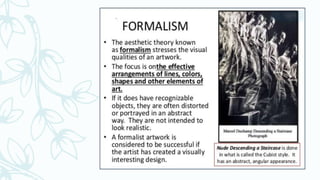
Formalism
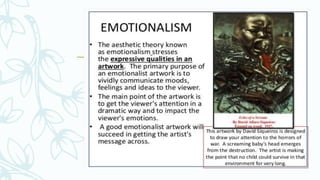
Emotionalism
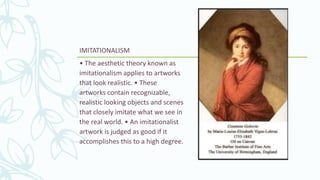
IMITATIONALISM
• The aesthetic theory known as
imitationalism applies to artworks
that look realistic. • These
artworks contain recognizable,
realistic looking objects and scenes
that closely imitate what we see in
the real world. • An imitationalist
artwork is judged as good if it
accomplishes this to a high degree.
ART MOVEMENTS
– • They are the collective titles that are given to artworks which
share the same artistic ideas, style, technical approach or time
frame.
– • They are a historical convenience for grouping together artists of
a common period, style or technique so that they may be more
easily understood.
– • Some movements are Impressionism, Dadaism, Post
Impressionism, Fauvism, Cubism etc.
POST IMPRESSIONISM
Root of Modern Art
– • Post Impressionism was not a
formal movement or style. The Post
Impressionists were a few
independent artists at the end of the
19th century who rebelled against
the limitations of Impressionism.
They developed a range of personal
styles that focused on the emotional,
structural, symbolic and spiritual
elements that they felt were missing
from Impressionism.
CUBISM - THE FIRST STYLE
OF ABSTRACT ART
– • A typical Cubist painting depicts
real people, places or objects, but
not from a fixed viewpoint. Instead it
will show you many parts of the
subject at one time, viewed from
different angles, and reconstructed
into a composition of planes, forms
and colours. The whole idea of space
is reconfigured: the front, back and
sides of the subject become
interchangeable elements in the
design of the work.
ART APPRECIATION
– Art Appreciation is the knowledge and understanding of
the universal and timeless qualities that identify all great
art. Art appreciation involves having an understanding of
all of the qualities that comprise a great work of art. Art
appreciation also involves learning about certain time
periods, movements, styles and techniques so that a
person has a better understanding of the basis for the art
as well as of the art itself.
PROCESS OF ART
APPRECIATION
1. Description
2. Analysis
3.Interpretation
4. Judgment
Step 1 – Description
• In the description step you will make observations about what you see.
For this first step your observations must be objective. Try not to express
your opinions yet. “describe only the facts.
• Also facts likes:
1. The name of the artist, his or her nationality, and date of birth and
death
2. 2. The name of the art or and the year or years it as made.
• Now really look at the artwork and describe in great detail what you see.
Use the appropriate visual Arts vocabulary (line, shape, form, space,
texture, colour and value).
Step 2 Analysis
• In this step consider the most significant art principles that were
used in the artwork. Describe how the artist used them to organize
the elements.
• BALANCE • GRADATION
• CONTRAST • MOVEMENT
• EMPHASIS • RHYTHM
• HARMONY • PROPORTION
• VARIETY • UNITY
• COMPOSITION • DEPTH
Step 3 – Interpretation
• Based on what you have learned so far about the
artwork, what do you think the artist was trying to say?
• Why did the artist create this artwork?
• What do you think it means?
• What feelings do you have when looking at this artwork?
• Do you think there are things in the artwork that
represent other things 4 symbols?
Step 4 Judgement
• Do you like this artwork?
• Do you think it is a good artwork?
• Do think it is an important artwork would display this artwork
in your home? Is this artwork good enough to put in a
museum?
• Justify your opinion.
• Explain why you feel the way you do about this artwork based
on what you have learned about it. What criteria do you base
your Judgment on?
Thank you!
MONDEJAR, KIMBERLY
LIMPAG, CHE-AN
TALAUGON, SHANNEN
CODOY, MARJORIE

Aesthetic

  • 1.
  • 2.
    Aesthetic or ArtAppreciation –Aesthetic of art study in which the student learns to admire the artists, value highly different works of art, and appreciate the role of art in society.
  • 3.
    Theories of Aesthetics –The following three aesthetic theories apply to most visual artworks.  Imitationalism Formalism Emotionalism
  • 4.
    IMITATIONALISM • The aesthetictheory known as imitationalism applies to artworks that look realistic. • These artworks contain recognizable, realistic looking objects and scenes that closely imitate what we see in the real world. • An imitationalist artwork is judged as good if it accomplishes this to a high degree.
  • 9.
    ART MOVEMENTS – •They are the collective titles that are given to artworks which share the same artistic ideas, style, technical approach or time frame. – • They are a historical convenience for grouping together artists of a common period, style or technique so that they may be more easily understood. – • Some movements are Impressionism, Dadaism, Post Impressionism, Fauvism, Cubism etc.
  • 11.
    POST IMPRESSIONISM Root ofModern Art – • Post Impressionism was not a formal movement or style. The Post Impressionists were a few independent artists at the end of the 19th century who rebelled against the limitations of Impressionism. They developed a range of personal styles that focused on the emotional, structural, symbolic and spiritual elements that they felt were missing from Impressionism.
  • 12.
    CUBISM - THEFIRST STYLE OF ABSTRACT ART – • A typical Cubist painting depicts real people, places or objects, but not from a fixed viewpoint. Instead it will show you many parts of the subject at one time, viewed from different angles, and reconstructed into a composition of planes, forms and colours. The whole idea of space is reconfigured: the front, back and sides of the subject become interchangeable elements in the design of the work.
  • 13.
    ART APPRECIATION – ArtAppreciation is the knowledge and understanding of the universal and timeless qualities that identify all great art. Art appreciation involves having an understanding of all of the qualities that comprise a great work of art. Art appreciation also involves learning about certain time periods, movements, styles and techniques so that a person has a better understanding of the basis for the art as well as of the art itself.
  • 14.
    PROCESS OF ART APPRECIATION 1.Description 2. Analysis 3.Interpretation 4. Judgment
  • 15.
    Step 1 –Description • In the description step you will make observations about what you see. For this first step your observations must be objective. Try not to express your opinions yet. “describe only the facts. • Also facts likes: 1. The name of the artist, his or her nationality, and date of birth and death 2. 2. The name of the art or and the year or years it as made. • Now really look at the artwork and describe in great detail what you see. Use the appropriate visual Arts vocabulary (line, shape, form, space, texture, colour and value).
  • 16.
    Step 2 Analysis •In this step consider the most significant art principles that were used in the artwork. Describe how the artist used them to organize the elements. • BALANCE • GRADATION • CONTRAST • MOVEMENT • EMPHASIS • RHYTHM • HARMONY • PROPORTION • VARIETY • UNITY • COMPOSITION • DEPTH
  • 17.
    Step 3 –Interpretation • Based on what you have learned so far about the artwork, what do you think the artist was trying to say? • Why did the artist create this artwork? • What do you think it means? • What feelings do you have when looking at this artwork? • Do you think there are things in the artwork that represent other things 4 symbols?
  • 18.
    Step 4 Judgement •Do you like this artwork? • Do you think it is a good artwork? • Do think it is an important artwork would display this artwork in your home? Is this artwork good enough to put in a museum? • Justify your opinion. • Explain why you feel the way you do about this artwork based on what you have learned about it. What criteria do you base your Judgment on?
  • 19.
    Thank you! MONDEJAR, KIMBERLY LIMPAG,CHE-AN TALAUGON, SHANNEN CODOY, MARJORIE