Presented by ZweigWhite Visit us at www.zweigwhite.com Project Management Part 1
Visit us at www.zweigwhite.com ZweigWhite is a Registered Provider with The American Institute of Architects Continuing Education Systems. Credit earned on completion of this program will be reported to CES Records for AIA members. Certificates of Completion for non-AIA members are available on request. This program is registered with the AIA/CES for continuing professional education. As such, it does not include content that may be deemed or construed to be an approval or endorsement by the AIA of any material of construction or any method or manner of handling, using distributing, or dealing in any material or product. Questions related to specific materials, methods, and services will be addressed at the conclusion of this presentation.
Copyright Materials Visit us at www.zweigwhite.com This presentation is protected by US and International copyright laws. Reproduction, distribution, display and use of the presentation without written permission of the speaker is prohibited. © ZweigWhite, 2010
Seminar Overview Introduction and Logistics Headaches and Learning Objectives Facts, Figures, and Things to Consider Skills and Abilities of Today’s Project Manager What we need to do, when, why and how Project Phases Key Concepts Excellence in Project Leadership Objectives in Motion Visit us at www.zweigwhite.com
Headaches and  Learning Objectives Visit us at www.zweigwhite.com
Identify one or two challenge areas you experience with project management: _____________________________________  _____________________________________   Project Management Headaches Visit us at www.zweigwhite.com
Identify one or two areas or topics you want to learn more about or become more informed on: _____________________________________  _____________________________________   Learning Objectives Visit us at www.zweigwhite.com
Elements to Consider Visit us at www.zweigwhite.com
Project Management  Visit us at www.zweigwhite.com Project Management is Applying knowledge, skills, tools, and techniques to project activities to meet all requirements.  Good Project Management is   Delivering the project so that it meets everyone’s criteria for success– ours and the client’s.
Critical Role of Projects Visit us at www.zweigwhite.com Fuel Firm Growth Build Expertise Marketing Tool Repeat Clients   New Clients   Attract New Talent   Provides Opportunities Investment & Reinvestment Experts in Industry Attract New Talent   Realize Vision Increase Value of Firm Strong Teams Training   Build Expertise   Strong Teams   Business Development   PROJECTS
Project Management Worst Practices Visit us at www.zweigwhite.com Stemming From One of Three Areas No strategic plan tie-in  Little to no investment in training Not allowing PMs to fully lead projects  Poor communication flow Infrequent feedback to PM and team Little information sharing Unrealistic budgets and schedules Leadership does not support PM best practices – no one held accountable Leadership Process Training
Project Management Worst Practices Visit us at www.zweigwhite.com Stemming From One of Three Areas Too many “ways” of managing projects Everything is rushed Utilization: challenges matching staff to needs of the project  Unrealistic budgets and schedules Little understanding of the system, components, and players No tracking of project profitability Scope creep / not paid for changes Leadership Process Training
Project Management Worst Practices Visit us at www.zweigwhite.com Stemming From One of Three Areas Little to no investment in training – learning as we go Project manager is a role – not a title Unclear roles and responsibilities Support staff does not understand the project, client or goals of the project No mentoring on special skills – scoping, scheduling, time management, leadership of team   Leadership Process Training
Causes of Claims  Visit us at www.zweigwhite.com Top Four Non-technical Risk Drivers Source:  XL Insurance
Causes of Claims  Visit us at www.zweigwhite.com Project Team Capabilities Issues Inexperienced project manager  34% Unqualified design staff assigned to project  45% Other  -  9% Unqualified on-site staff assigned to project - 4% Insufficient number of staff - 4% Project outside firm’s normal territory - 4% Source:  XL Insurance
Causes of Claims  Visit us at www.zweigwhite.com Communication Issues Source:  XL Insurance Project issues & disputes not handled correctly - 8% Lack of documentation regarding changes in scope - 10% Other  -  4% Lack of procedures to identify and/or address conflicts, omissions, or errors  64% Project staff not aware of their responsibilities - 10% Scope of services not clearly explained to client - 4%
Things to Consider  This is our client’s investment We play a big role in how that investment pays off ( or not ) Our client wants everyone to win  Whether we like it or not, we have to work with others Success is all about leadership and attitude As project managers, we’ll always be learning Visit us at www.zweigwhite.com
Project Teams Visit us at www.zweigwhite.com
Applies when we work on projects What constitutes the project team based on the type of project Lines of authority based upon the roles each individual plays on the project One individual may perform different roles on different projects Team Dynamics  Visit us at www.zweigwhite.com Projects Principals Project Managers Project Team
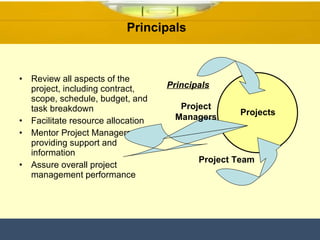
Review all aspects of the project, including contract, scope, schedule, budget, and task breakdown Facilitate resource allocation Mentor Project Managers by providing support and information Assure overall project management performance Principals  Visit us at www.zweigwhite.com Projects Principals Project Managers Project Team
Scope, plan, lead, organize and control the project Meet the scope, schedule and budget and achieve client satisfaction and quality standards of entire project Choose the project team, including subconsultants, and delegate tasks to each member Monitor overall project performance and make adjustments in scope, schedule and/or budget as necessary to meet client and company goals Project Manager  Visit us at www.zweigwhite.com Projects Principals Project Managers Project Team
Accept assignments from Project Manager Meet the scope, schedule, budget; achieve client satisfaction and quality standards of assigned tasks Provide assistance to the Project Manager Project Team  Visit us at www.zweigwhite.com Projects Principals Project Managers Project Team
Project Management  Knowledge Areas Visit us at www.zweigwhite.com
Knowledge Areas Every project manager should know: Project integration management Project scope management  Project time management Project cost management Project quality management Project human resource management Project communication management Project risk management Project procurement management Visit us at www.zweigwhite.com
Skills and Abilities Visit us at www.zweigwhite.com Leadership Management Communication Required Skills and Abilities Make sure you have yours
Building relationships Decision making Professional judgment Responsibility versus authority Leading by example Developing a professional and personal career plan Mentoring Leadership Skills Visit us at www.zweigwhite.com
Scoping Planning Organizing Delegating Controlling Supervising Time management Management Skills Visit us at www.zweigwhite.com
Listening Verbal One-on-one Conducting meetings Telephone conversations Writing Email Memos Letters Non-verbal Communication Skills Visit us at www.zweigwhite.com
Roles and Responsibilities  of a Project Manager Visit us at www.zweigwhite.com
Roles and Responsibilities Visit us at www.zweigwhite.com Roles and Responsibilities Make sure these are clear Project Technical Business Marketing
Budget:   Make the project profitable Schedule:   Complete the project on time Coordination:   Distribution and completion of tasks Communication:   Keep the entire project team up to date on all project information The Project Role  Visit us at www.zweigwhite.com
Demonstrate experience and qualifications Mentor team members Perform and/or oversee QA/QC Specialize on certain phases of projects Work on deliverables when necessary Oversee the work packages, tasks, and “to do” lists Manage consultants and subconsultants The Technical Role  Visit us at www.zweigwhite.com
Client relationships Financial management People management General administration/communications The Business Role  Visit us at www.zweigwhite.com
Good work wins more good work Additional services Ask clients for leads/new projects – cross selling Check back with client three, six months later Social/professional relationships Client referrals Business development The Marketing Role  Visit us at www.zweigwhite.com
What We Need to Do, When, Why, and How Visit us at www.zweigwhite.com
Project Lifecycle  Visit us at www.zweigwhite.com
Project Conception Visit us at www.zweigwhite.com
Project Conception  Scope Schedule Budget Visit us at www.zweigwhite.com Price Contracts Risk Management
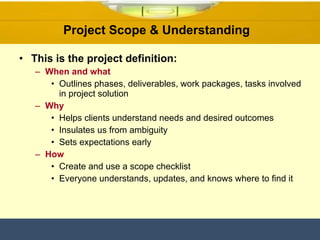
Project Scope & Understanding  This is the project definition: When and what Outlines phases, deliverables, work packages, tasks involved in project solution Why Helps clients understand needs and desired outcomes Insulates us from ambiguity Sets expectations early  How Create and use a scope checklist Everyone understands, updates, and knows where to find it Visit us at www.zweigwhite.com
Project Budget  What it will cost us internally to do this project: Why Make sure our projects are profitable What it must include Staff required and direct labor costs Breakdown of tasks and labor hours for each Sub-consultants Contingencies Reimbursable expenses Profit as a percentage of total budget Project management and technical coordination Create budget template and update  Visit us at www.zweigwhite.com
Project Budget  Different ways to do it: How Bottom-up using WBS Recent, similar projects (with validation)  Benchmarks (Hrs/sheet; $$/sqft) Input from those doing the work  Tie to accounting / reporting system Updated / reviewed at milestones Established to view budgeted vs actual  Visit us at www.zweigwhite.com
Project Schedule  Course of time to follow: When and what Often set by client – the duration in which we have to work Why It’s a necessary measurement tool  How Collect input from PM or team Associates deliverables with milestones or deadlines Allow for contingencies /  consider any delays  Distribute and share with entire team Visit us at www.zweigwhite.com
Project Schedule  Course of time to follow: Common Mistakes in Scheduling Too much detail Using more sophisticated structure than the project requires Not communicating or sharing the schedule Not updating the schedule  Not assessing impact of certain delays Too optimistic on durations or completion dates Visit us at www.zweigwhite.com
If Price > Cost, we accept the project If Cost > Price, it will be a loss and we should walk away In most cases, we cannot negotiate price… We have to negotiate (and renegotiate!) scope Key Concept:  Price versus Cost Visit us at www.zweigwhite.com Price Cost Sticker price the client pays for our services  (their budget) What it costs us to do the project / provide our services  (our budget)
Contracts  That thing we sign at the start: When and what Creates a business relationship  An agreement the law  will  enforce Why Decreases risk and magnitude of dispute Good clients respect good contracts Contracts protect our resources and efforts Outlines tools and information to prevent scope creep Lawsuits are expensive Visit us at www.zweigwhite.com
Contracts  That thing we sign at the start: How Create a defined contract process Address all basic issues  PMs are involved in contract preparation Establish contract signing authority and limits Reviewed by others Don’t let the excitement of a new project get in the way of establishing a proper contract Visit us at www.zweigwhite.com
Contracts  That thing we sign at the start: The most profitable contracts include: Scope of work (as detailed as possible) Preliminary schedule, with a refined schedule of tasks to follow Project price Provision for extra / special services Exclusions  Owner’s responsibilities Invoicing and payment procedures Visit us at www.zweigwhite.com
Key Concept:  Risk Management  Decrease impact of events adverse to our project Visit us at www.zweigwhite.com Identify Risks Prioritize Likelihood of Occurrence Options & Actions to Reduce Risks Track All Risks Identify New Risks Execute Response Plans
Key Concept:  Risk Management  Strategies for handling risk: Avoid Decrease threat by clarifying requirements, increasing communication, gaining experience Transfer Utilizing tools such as insurance, performance bonds, warranties, specific contracts Mitigate Reduce risk by conducting more tests, designing prototypes, requiring mock-ups, carefully hiring sub-consultants, more QA/QC, share lessons learned Visit us at www.zweigwhite.com
Key Concept: Risk Management Best Practices: Risks are best carried by those who can handle them and are appropriately rewarded for doing so Don’t assume the risks if you cannot handle it Establish a Risk Management Plan and use it Think severity, probability, timeframe Don’t treat risks as individual problems– rather  integrated challenges Focus on risks that lead to higher costs, failure to satisfy client requirements, time delays Despite best efforts, problems arise Visit us at www.zweigwhite.com
Key Concept:  Negotiation  Visit us at www.zweigwhite.com Why the Project Manager should be involved in negotiations:   Client’s primary contact Knows the client’s goals and objectives Knows the firm’s approach to the project Instills stronger project ownership Better able to manage project changes Shows depth of firm’s expertise
Key Concept:  Negotiation  Visit us at www.zweigwhite.com Best Practices:   Prepare for the discussion; prioritize issues Understand everyone’s goals / objectives Make a concession but receive something in return Look for non-monetary value Don’t undercut to win the contract Don’t yield to pressure Know when to walk away Negotiate now to spare trouble later
Visit us at www.zweigwhite.com
Visit us at www.zweigwhite.com Thank You! Christine Brack, PMP Principal 239-280-2300 x2902 [email_address] Click here to purchase the entire series: http://www.zweigwhite.com/p-792-ae-project-management-optimization-series.aspx

A/E Project Management Optimization-Part One

  • 1.
    Presented by ZweigWhiteVisit us at www.zweigwhite.com Project Management Part 1
  • 2.
    Visit us atwww.zweigwhite.com ZweigWhite is a Registered Provider with The American Institute of Architects Continuing Education Systems. Credit earned on completion of this program will be reported to CES Records for AIA members. Certificates of Completion for non-AIA members are available on request. This program is registered with the AIA/CES for continuing professional education. As such, it does not include content that may be deemed or construed to be an approval or endorsement by the AIA of any material of construction or any method or manner of handling, using distributing, or dealing in any material or product. Questions related to specific materials, methods, and services will be addressed at the conclusion of this presentation.
  • 3.
    Copyright Materials Visitus at www.zweigwhite.com This presentation is protected by US and International copyright laws. Reproduction, distribution, display and use of the presentation without written permission of the speaker is prohibited. © ZweigWhite, 2010
  • 4.
    Seminar Overview Introductionand Logistics Headaches and Learning Objectives Facts, Figures, and Things to Consider Skills and Abilities of Today’s Project Manager What we need to do, when, why and how Project Phases Key Concepts Excellence in Project Leadership Objectives in Motion Visit us at www.zweigwhite.com
  • 5.
    Headaches and Learning Objectives Visit us at www.zweigwhite.com
  • 6.
    Identify one ortwo challenge areas you experience with project management: _____________________________________ _____________________________________ Project Management Headaches Visit us at www.zweigwhite.com
  • 7.
    Identify one ortwo areas or topics you want to learn more about or become more informed on: _____________________________________ _____________________________________ Learning Objectives Visit us at www.zweigwhite.com
  • 8.
    Elements to ConsiderVisit us at www.zweigwhite.com
  • 9.
    Project Management Visit us at www.zweigwhite.com Project Management is Applying knowledge, skills, tools, and techniques to project activities to meet all requirements. Good Project Management is Delivering the project so that it meets everyone’s criteria for success– ours and the client’s.
  • 10.
    Critical Role ofProjects Visit us at www.zweigwhite.com Fuel Firm Growth Build Expertise Marketing Tool Repeat Clients New Clients Attract New Talent Provides Opportunities Investment & Reinvestment Experts in Industry Attract New Talent Realize Vision Increase Value of Firm Strong Teams Training Build Expertise Strong Teams Business Development PROJECTS
  • 11.
    Project Management WorstPractices Visit us at www.zweigwhite.com Stemming From One of Three Areas No strategic plan tie-in Little to no investment in training Not allowing PMs to fully lead projects Poor communication flow Infrequent feedback to PM and team Little information sharing Unrealistic budgets and schedules Leadership does not support PM best practices – no one held accountable Leadership Process Training
  • 12.
    Project Management WorstPractices Visit us at www.zweigwhite.com Stemming From One of Three Areas Too many “ways” of managing projects Everything is rushed Utilization: challenges matching staff to needs of the project Unrealistic budgets and schedules Little understanding of the system, components, and players No tracking of project profitability Scope creep / not paid for changes Leadership Process Training
  • 13.
    Project Management WorstPractices Visit us at www.zweigwhite.com Stemming From One of Three Areas Little to no investment in training – learning as we go Project manager is a role – not a title Unclear roles and responsibilities Support staff does not understand the project, client or goals of the project No mentoring on special skills – scoping, scheduling, time management, leadership of team Leadership Process Training
  • 14.
    Causes of Claims Visit us at www.zweigwhite.com Top Four Non-technical Risk Drivers Source: XL Insurance
  • 15.
    Causes of Claims Visit us at www.zweigwhite.com Project Team Capabilities Issues Inexperienced project manager 34% Unqualified design staff assigned to project 45% Other - 9% Unqualified on-site staff assigned to project - 4% Insufficient number of staff - 4% Project outside firm’s normal territory - 4% Source: XL Insurance
  • 16.
    Causes of Claims Visit us at www.zweigwhite.com Communication Issues Source: XL Insurance Project issues & disputes not handled correctly - 8% Lack of documentation regarding changes in scope - 10% Other - 4% Lack of procedures to identify and/or address conflicts, omissions, or errors 64% Project staff not aware of their responsibilities - 10% Scope of services not clearly explained to client - 4%
  • 17.
    Things to Consider This is our client’s investment We play a big role in how that investment pays off ( or not ) Our client wants everyone to win Whether we like it or not, we have to work with others Success is all about leadership and attitude As project managers, we’ll always be learning Visit us at www.zweigwhite.com
  • 18.
    Project Teams Visitus at www.zweigwhite.com
  • 19.
    Applies when wework on projects What constitutes the project team based on the type of project Lines of authority based upon the roles each individual plays on the project One individual may perform different roles on different projects Team Dynamics Visit us at www.zweigwhite.com Projects Principals Project Managers Project Team
  • 20.
    Review all aspectsof the project, including contract, scope, schedule, budget, and task breakdown Facilitate resource allocation Mentor Project Managers by providing support and information Assure overall project management performance Principals Visit us at www.zweigwhite.com Projects Principals Project Managers Project Team
  • 21.
    Scope, plan, lead,organize and control the project Meet the scope, schedule and budget and achieve client satisfaction and quality standards of entire project Choose the project team, including subconsultants, and delegate tasks to each member Monitor overall project performance and make adjustments in scope, schedule and/or budget as necessary to meet client and company goals Project Manager Visit us at www.zweigwhite.com Projects Principals Project Managers Project Team
  • 22.
    Accept assignments fromProject Manager Meet the scope, schedule, budget; achieve client satisfaction and quality standards of assigned tasks Provide assistance to the Project Manager Project Team Visit us at www.zweigwhite.com Projects Principals Project Managers Project Team
  • 23.
    Project Management Knowledge Areas Visit us at www.zweigwhite.com
  • 24.
    Knowledge Areas Everyproject manager should know: Project integration management Project scope management Project time management Project cost management Project quality management Project human resource management Project communication management Project risk management Project procurement management Visit us at www.zweigwhite.com
  • 25.
    Skills and AbilitiesVisit us at www.zweigwhite.com Leadership Management Communication Required Skills and Abilities Make sure you have yours
  • 26.
    Building relationships Decisionmaking Professional judgment Responsibility versus authority Leading by example Developing a professional and personal career plan Mentoring Leadership Skills Visit us at www.zweigwhite.com
  • 27.
    Scoping Planning OrganizingDelegating Controlling Supervising Time management Management Skills Visit us at www.zweigwhite.com
  • 28.
    Listening Verbal One-on-oneConducting meetings Telephone conversations Writing Email Memos Letters Non-verbal Communication Skills Visit us at www.zweigwhite.com
  • 29.
    Roles and Responsibilities of a Project Manager Visit us at www.zweigwhite.com
  • 30.
    Roles and ResponsibilitiesVisit us at www.zweigwhite.com Roles and Responsibilities Make sure these are clear Project Technical Business Marketing
  • 31.
    Budget: Make the project profitable Schedule: Complete the project on time Coordination: Distribution and completion of tasks Communication: Keep the entire project team up to date on all project information The Project Role Visit us at www.zweigwhite.com
  • 32.
    Demonstrate experience andqualifications Mentor team members Perform and/or oversee QA/QC Specialize on certain phases of projects Work on deliverables when necessary Oversee the work packages, tasks, and “to do” lists Manage consultants and subconsultants The Technical Role Visit us at www.zweigwhite.com
  • 33.
    Client relationships Financialmanagement People management General administration/communications The Business Role Visit us at www.zweigwhite.com
  • 34.
    Good work winsmore good work Additional services Ask clients for leads/new projects – cross selling Check back with client three, six months later Social/professional relationships Client referrals Business development The Marketing Role Visit us at www.zweigwhite.com
  • 35.
    What We Needto Do, When, Why, and How Visit us at www.zweigwhite.com
  • 36.
    Project Lifecycle Visit us at www.zweigwhite.com
  • 37.
    Project Conception Visitus at www.zweigwhite.com
  • 38.
    Project Conception Scope Schedule Budget Visit us at www.zweigwhite.com Price Contracts Risk Management
  • 39.
    Project Scope &Understanding This is the project definition: When and what Outlines phases, deliverables, work packages, tasks involved in project solution Why Helps clients understand needs and desired outcomes Insulates us from ambiguity Sets expectations early How Create and use a scope checklist Everyone understands, updates, and knows where to find it Visit us at www.zweigwhite.com
  • 40.
    Project Budget What it will cost us internally to do this project: Why Make sure our projects are profitable What it must include Staff required and direct labor costs Breakdown of tasks and labor hours for each Sub-consultants Contingencies Reimbursable expenses Profit as a percentage of total budget Project management and technical coordination Create budget template and update Visit us at www.zweigwhite.com
  • 41.
    Project Budget Different ways to do it: How Bottom-up using WBS Recent, similar projects (with validation) Benchmarks (Hrs/sheet; $$/sqft) Input from those doing the work Tie to accounting / reporting system Updated / reviewed at milestones Established to view budgeted vs actual Visit us at www.zweigwhite.com
  • 42.
    Project Schedule Course of time to follow: When and what Often set by client – the duration in which we have to work Why It’s a necessary measurement tool How Collect input from PM or team Associates deliverables with milestones or deadlines Allow for contingencies / consider any delays Distribute and share with entire team Visit us at www.zweigwhite.com
  • 43.
    Project Schedule Course of time to follow: Common Mistakes in Scheduling Too much detail Using more sophisticated structure than the project requires Not communicating or sharing the schedule Not updating the schedule Not assessing impact of certain delays Too optimistic on durations or completion dates Visit us at www.zweigwhite.com
  • 44.
    If Price >Cost, we accept the project If Cost > Price, it will be a loss and we should walk away In most cases, we cannot negotiate price… We have to negotiate (and renegotiate!) scope Key Concept: Price versus Cost Visit us at www.zweigwhite.com Price Cost Sticker price the client pays for our services (their budget) What it costs us to do the project / provide our services (our budget)
  • 45.
    Contracts Thatthing we sign at the start: When and what Creates a business relationship An agreement the law will enforce Why Decreases risk and magnitude of dispute Good clients respect good contracts Contracts protect our resources and efforts Outlines tools and information to prevent scope creep Lawsuits are expensive Visit us at www.zweigwhite.com
  • 46.
    Contracts Thatthing we sign at the start: How Create a defined contract process Address all basic issues PMs are involved in contract preparation Establish contract signing authority and limits Reviewed by others Don’t let the excitement of a new project get in the way of establishing a proper contract Visit us at www.zweigwhite.com
  • 47.
    Contracts Thatthing we sign at the start: The most profitable contracts include: Scope of work (as detailed as possible) Preliminary schedule, with a refined schedule of tasks to follow Project price Provision for extra / special services Exclusions Owner’s responsibilities Invoicing and payment procedures Visit us at www.zweigwhite.com
  • 48.
    Key Concept: Risk Management Decrease impact of events adverse to our project Visit us at www.zweigwhite.com Identify Risks Prioritize Likelihood of Occurrence Options & Actions to Reduce Risks Track All Risks Identify New Risks Execute Response Plans
  • 49.
    Key Concept: Risk Management Strategies for handling risk: Avoid Decrease threat by clarifying requirements, increasing communication, gaining experience Transfer Utilizing tools such as insurance, performance bonds, warranties, specific contracts Mitigate Reduce risk by conducting more tests, designing prototypes, requiring mock-ups, carefully hiring sub-consultants, more QA/QC, share lessons learned Visit us at www.zweigwhite.com
  • 50.
    Key Concept: RiskManagement Best Practices: Risks are best carried by those who can handle them and are appropriately rewarded for doing so Don’t assume the risks if you cannot handle it Establish a Risk Management Plan and use it Think severity, probability, timeframe Don’t treat risks as individual problems– rather integrated challenges Focus on risks that lead to higher costs, failure to satisfy client requirements, time delays Despite best efforts, problems arise Visit us at www.zweigwhite.com
  • 51.
    Key Concept: Negotiation Visit us at www.zweigwhite.com Why the Project Manager should be involved in negotiations: Client’s primary contact Knows the client’s goals and objectives Knows the firm’s approach to the project Instills stronger project ownership Better able to manage project changes Shows depth of firm’s expertise
  • 52.
    Key Concept: Negotiation Visit us at www.zweigwhite.com Best Practices: Prepare for the discussion; prioritize issues Understand everyone’s goals / objectives Make a concession but receive something in return Look for non-monetary value Don’t undercut to win the contract Don’t yield to pressure Know when to walk away Negotiate now to spare trouble later
  • 53.
    Visit us atwww.zweigwhite.com
  • 54.
    Visit us atwww.zweigwhite.com Thank You! Christine Brack, PMP Principal 239-280-2300 x2902 [email_address] Click here to purchase the entire series: http://www.zweigwhite.com/p-792-ae-project-management-optimization-series.aspx