A D V E R T I S I N G
T E C H N I Q U E S
B Y J A S O N R O D G E R S
1-5
Avante Garde
• Suggestion that using this
product puts the user ahead
of the times
• Examples being tech
companies such as apple or
Samsung
Facts and
figures
• Statistics and objective factual information is
used to prove the superiority of the product
• What kind of industries would use this
technique ?
• built engineering such as cars planes
etc.
• Technology such as how quick a CPU
is or size of RAM
Weasel words
• Weasel words – are used to
suggest a positive meaning without
really making a guarantee
• Examples include 9 out of 10
dentists approve of this toothpaste
• Another is subscribing to Chris
Hemsworth's workout plan to get
his body
• No evidence !!!!
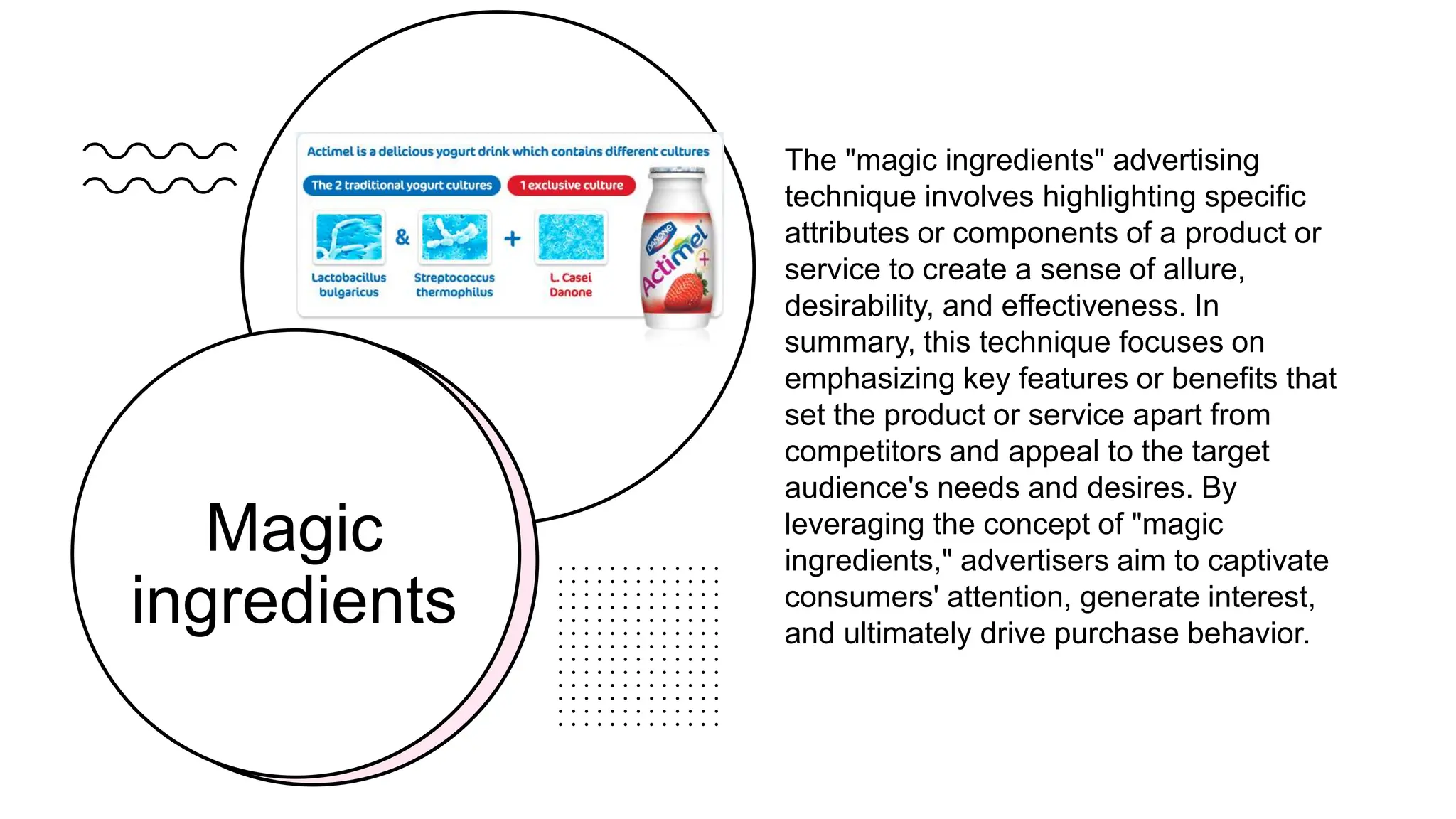
Magic
ingredients
The "magic ingredients" advertising
technique involves highlighting specific
attributes or components of a product or
service to create a sense of allure,
desirability, and effectiveness. In
summary, this technique focuses on
emphasizing key features or benefits that
set the product or service apart from
competitors and appeal to the target
audience's needs and desires. By
leveraging the concept of "magic
ingredients," advertisers aim to captivate
consumers' attention, generate interest,
and ultimately drive purchase behavior.
Patriotism
• The patriotism advertising technique
leverages national pride and loyalty
to promote products or services. In
this approach, advertisers align their
brand with symbols, values, and
narratives associated with the
country or culture, aiming to evoke
emotional connections and positive
sentiments among consumers.
Patriotic imagery, such as flags,
landmarks, and historical figures,
may be used to evoke a sense of
national identity and unity
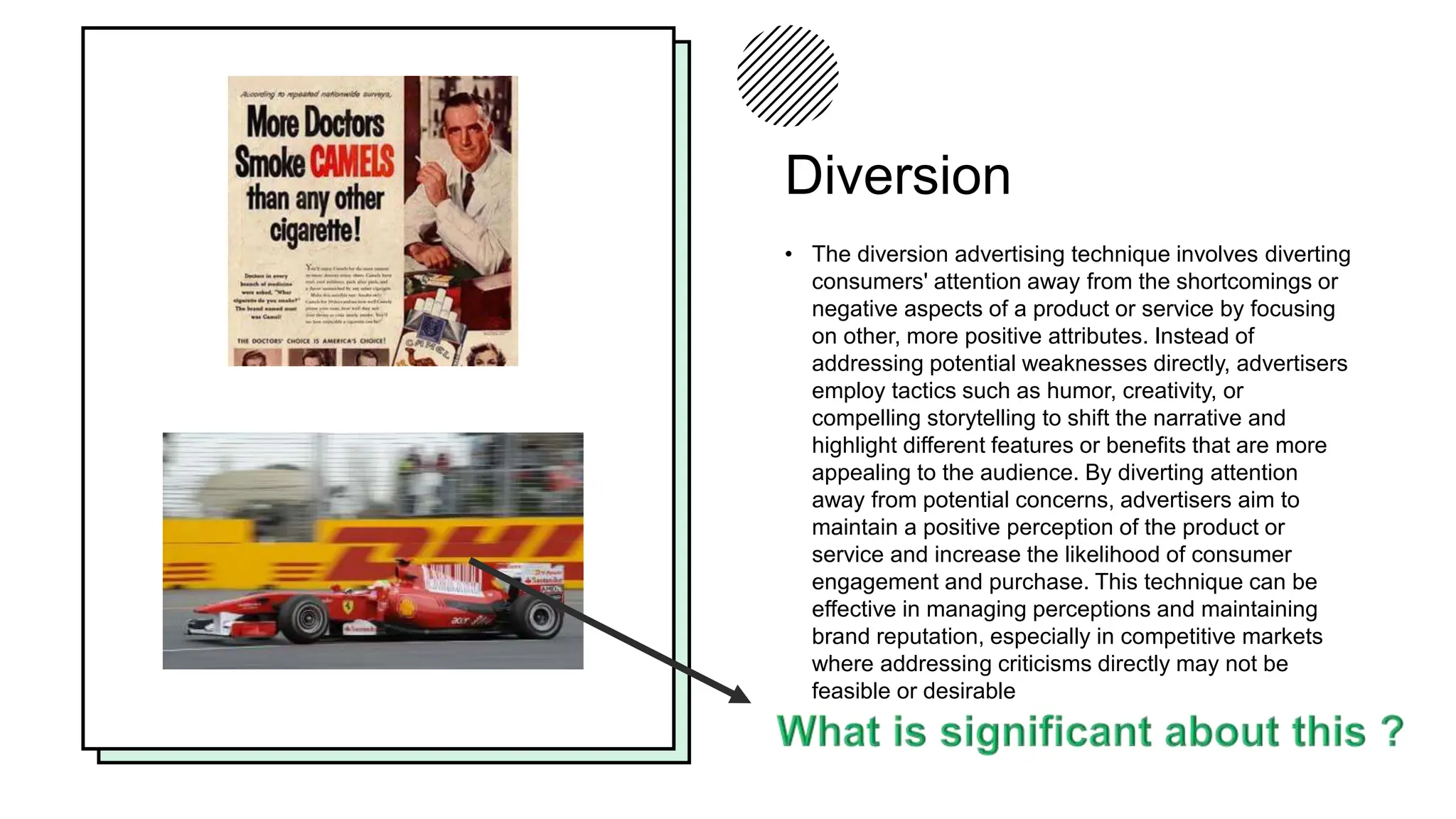
Diversion
• The diversion advertising technique involves diverting
consumers' attention away from the shortcomings or
negative aspects of a product or service by focusing
on other, more positive attributes. Instead of
addressing potential weaknesses directly, advertisers
employ tactics such as humor, creativity, or
compelling storytelling to shift the narrative and
highlight different features or benefits that are more
appealing to the audience. By diverting attention
away from potential concerns, advertisers aim to
maintain a positive perception of the product or
service and increase the likelihood of consumer
engagement and purchase. This technique can be
effective in managing perceptions and maintaining
brand reputation, especially in competitive markets
where addressing criticisms directly may not be
feasible or desirable
Transfer
• Transfer advertising, also known as associative advertising, involves
associating a product or brand with positive emotions, values, or
images unrelated to the product itself. This technique aims to
transfer the positive feelings or associations evoked by the unrelated
content to the advertised product, thereby influencing consumers'
perceptions and behavior.
• One common example of transfer advertising is celebrity
endorsements. By featuring well-known personalities in
advertisements, brands seek to transfer the positive attributes
associated with the celebrity—such as fame, attractiveness, or
success—to the product or brand
Short quiz
• What brands has Ronaldo endorsed ?
• Coca-Cola
• LiveScore
• Free Fire
• Nike
• Herbalife Nutrition
• Tag Heuer
• CR7 Fitness
Plain folks
• Plain folks advertising is a
persuasion technique that involves
portraying the advertiser, product,
or service as being ordinary,
everyday, and relatable to the
average person. This technique
aims to create a sense of familiarity
and trustworthiness by presenting
the advertiser as someone who
shares the same values,
experiences, and aspirations as the
target audience.
Snob appeal
•
Snob appeal advertising is a
persuasion technique that seeks
to associate a product or brand
with luxury, exclusivity, and
social status. This approach
targets consumers who aspire to
belong to a higher social class
or desire to be perceived as elite
and sophisticated
Bribery
• Bribery advertising, also known as bribery
persuasion, is an unethical persuasion
technique that involves offering material
incentives or rewards in exchange for
purchasing a product or taking a desired action.
In this context, "bribery" refers to the act of
providing something of value to influence
behavior or decision-making.
• Examples of bribery advertising may include:
• Offering cash rewards or discounts to
customers who make a purchase within a
certain time frame.
• Providing free gifts, samples, or incentives
to individuals who sign up for a service or
subscribe to a newsletter
Testimonial
• Testimonial advertising is a
persuasion technique that involves
featuring endorsements or
testimonials from satisfied
customers, celebrities, experts, or
influencers to promote a product or
service. Testimonials serve as
social proof, providing reassurance
and credibility to potential
customers by showcasing the
positive experiences and opinions
of others.
• What is the definition of testimonial
Wit and humor
• Wit and humor advertising is a persuasion technique that
uses cleverness, humor, and wit to capture attention,
engage audiences, and create a memorable brand
experience. This approach relies on humor to entertain and
entertain viewers while subtly conveying the key message
or selling point of the product or service being advertised.
• In wit and humor advertising:
1. Clever Wordplay: Advertisements use puns, wordplay, and
clever language to create a sense of amusement and
intrigue. These linguistic devices can make the
advertisement more memorable and enjoyable for viewers.
2. Situational Comedy: Advertisements feature humorous
scenarios, exaggerated situations, or unexpected twists to
evoke laughter and entertain audiences. By creating a
humorous narrative, advertisers can captivate viewers'
attention and keep them engaged with the advertisement.
Simple solutions
• Simple solutions advertising is a
persuasion technique that
emphasizes the ease,
convenience, and effectiveness of
a product or service in addressing
a particular problem or need. This
approach highlights the simplicity
of the solution offered, appealing to
consumers who seek
straightforward and hassle-free
solutions to their challenges.
Card stacking
• Card stacking advertising is a persuasion technique that
involves selectively presenting information in a way that
favors the advertiser's position while ignoring or
downplaying opposing viewpoints or counterarguments.
This approach is often used to manipulate perceptions
and persuade audiences by presenting a one-sided or
biased view of the issue or product being promoted.
1. Selective Presentation: Advertisements focus
exclusively on the positive aspects, benefits, or features
of the product or service, while omitting any negative
information or drawbacks. This selective presentation
gives the impression that the product or service is
flawless and superior to competing alternatives.
2. Exaggeration of Benefits: Advertisements may
exaggerate or embellish the benefits of the product or
service, making unrealistic claims or promises about its
effectiveness, performance, or value. By emphasizing
only the most positive aspects, advertisers seek to create
a favorable impression in the minds of consumers.
3. Manipulative Statistics: Advertisements may use
statistics or data selectively to support the advertiser's
claims, while ignoring or distorting contradictory evidence.
This manipulation of statistics can give the false
impression that the product or service is more effective or
Glittering generalities
• Glittering generalities advertising is a persuasion technique that involves using vague,
emotionally appealing words or phrases to evoke positive feelings and associations
without providing concrete details or evidence. This approach aims to create a favorable
impression of a product, service, or idea by associating it with lofty ideals, values, or
aspirations that appeal to the target audience's emotions.
• In glittering generalities advertising:
1.Emotionally Charged Language: Advertisements use emotionally charged words or
phrases that carry strong connotations and evoke positive emotions, such as "freedom,"
"justice," "progress," "innovation," or "happiness." These words have broad appeal and
resonate with the audience's desires and aspirations.
2.Ambiguous Claims: Advertisements make broad, sweeping statements or claims about
the product or service without providing specific details or evidence to support them.
Instead of presenting concrete facts or examples, advertisers rely on the emotional impact
of the words themselves to persuade audiences
1-5
1. What is avante garde advertising ?
2. What type of advertising is meant when doctors promote
cigarettes unintentionally ?
3. Give an example of weasel word advertising ?
4. What is my favorite golf brand ?
5. What is the definition of patriotism advertising ?
Important questions to ask ?
Who is the target audience for this advertisement?
• Understanding the intended audience can provide insight into the
messaging, tone, and imagery used.
What is the primary objective of this advertisement?
• Determine whether the advertisement aims to raise awareness, drive
sales, change perceptions, or achieve another goal.
What emotions or reactions does the advertisement evoke?
• Explore how the advertisement makes people feel and how those
emotions contribute to its effectiveness.
Important questions to ask ?
What is the central message or value proposition?
• Identify the key takeaway or benefit that the advertisement is trying to
communicate to its audience.
How does the advertisement use visuals and language to convey
its message?
• Analyze the imagery, colors, fonts, and language choices to understand how
they contribute to the overall impact of the advertisement.
What persuasive techniques are used in the advertisement?
• Look for elements such as social proof, authority figures, scarcity, storytelling,
or emotional appeal that are used to persuade the audience.
Important questions to ask ?
1.Does the advertisement use any stereotypes or cultural
references?
• Consider whether the advertisement relies on stereotypes or cultural
references and how these choices may impact its reception by different
audiences.
2.What is the call to action (CTA) and how effective is it?
• Evaluate whether the advertisement prompts viewers to take a specific action
and how compelling the CTA is in motivating that action.
What is the overall tone and voice of the advertisement?
1. Determine whether the advertisement adopts a humorous, serious,
emotional, or other tone and how that aligns with its message and audience.
Important questions to ask ?
1.How does the advertisement position the product or brand
against competitors?
• Assess how the advertisement differentiates the product or brand from
competitors and whether it effectively communicates its unique selling points.
2.What channels and platforms are used to distribute the
advertisement?
• Consider where the advertisement is being displayed or broadcasted and how
the choice of channels and platforms aligns with the target audience and
objectives.
3.What cultural, social, or political context surrounds the
advertisement?
• Examine how current events, societal trends, or cultural norms may influence
W H A T T Y P E
O F
A D V E R T I S I N G
W O U L D T H I S
B E ?

Advertising techniques Drakies grade 9.pptx

  • 1.
    A D VE R T I S I N G T E C H N I Q U E S B Y J A S O N R O D G E R S
  • 2.
  • 3.
    Avante Garde • Suggestionthat using this product puts the user ahead of the times • Examples being tech companies such as apple or Samsung
  • 4.
    Facts and figures • Statisticsand objective factual information is used to prove the superiority of the product • What kind of industries would use this technique ? • built engineering such as cars planes etc. • Technology such as how quick a CPU is or size of RAM
  • 5.
    Weasel words • Weaselwords – are used to suggest a positive meaning without really making a guarantee • Examples include 9 out of 10 dentists approve of this toothpaste • Another is subscribing to Chris Hemsworth's workout plan to get his body • No evidence !!!!
  • 6.
    Magic ingredients The "magic ingredients"advertising technique involves highlighting specific attributes or components of a product or service to create a sense of allure, desirability, and effectiveness. In summary, this technique focuses on emphasizing key features or benefits that set the product or service apart from competitors and appeal to the target audience's needs and desires. By leveraging the concept of "magic ingredients," advertisers aim to captivate consumers' attention, generate interest, and ultimately drive purchase behavior.
  • 7.
    Patriotism • The patriotismadvertising technique leverages national pride and loyalty to promote products or services. In this approach, advertisers align their brand with symbols, values, and narratives associated with the country or culture, aiming to evoke emotional connections and positive sentiments among consumers. Patriotic imagery, such as flags, landmarks, and historical figures, may be used to evoke a sense of national identity and unity
  • 8.
    Diversion • The diversionadvertising technique involves diverting consumers' attention away from the shortcomings or negative aspects of a product or service by focusing on other, more positive attributes. Instead of addressing potential weaknesses directly, advertisers employ tactics such as humor, creativity, or compelling storytelling to shift the narrative and highlight different features or benefits that are more appealing to the audience. By diverting attention away from potential concerns, advertisers aim to maintain a positive perception of the product or service and increase the likelihood of consumer engagement and purchase. This technique can be effective in managing perceptions and maintaining brand reputation, especially in competitive markets where addressing criticisms directly may not be feasible or desirable
  • 9.
    Transfer • Transfer advertising,also known as associative advertising, involves associating a product or brand with positive emotions, values, or images unrelated to the product itself. This technique aims to transfer the positive feelings or associations evoked by the unrelated content to the advertised product, thereby influencing consumers' perceptions and behavior. • One common example of transfer advertising is celebrity endorsements. By featuring well-known personalities in advertisements, brands seek to transfer the positive attributes associated with the celebrity—such as fame, attractiveness, or success—to the product or brand
  • 10.
    Short quiz • Whatbrands has Ronaldo endorsed ? • Coca-Cola • LiveScore • Free Fire • Nike • Herbalife Nutrition • Tag Heuer • CR7 Fitness
  • 11.
    Plain folks • Plainfolks advertising is a persuasion technique that involves portraying the advertiser, product, or service as being ordinary, everyday, and relatable to the average person. This technique aims to create a sense of familiarity and trustworthiness by presenting the advertiser as someone who shares the same values, experiences, and aspirations as the target audience.
  • 12.
    Snob appeal • Snob appealadvertising is a persuasion technique that seeks to associate a product or brand with luxury, exclusivity, and social status. This approach targets consumers who aspire to belong to a higher social class or desire to be perceived as elite and sophisticated
  • 13.
    Bribery • Bribery advertising,also known as bribery persuasion, is an unethical persuasion technique that involves offering material incentives or rewards in exchange for purchasing a product or taking a desired action. In this context, "bribery" refers to the act of providing something of value to influence behavior or decision-making. • Examples of bribery advertising may include: • Offering cash rewards or discounts to customers who make a purchase within a certain time frame. • Providing free gifts, samples, or incentives to individuals who sign up for a service or subscribe to a newsletter
  • 14.
    Testimonial • Testimonial advertisingis a persuasion technique that involves featuring endorsements or testimonials from satisfied customers, celebrities, experts, or influencers to promote a product or service. Testimonials serve as social proof, providing reassurance and credibility to potential customers by showcasing the positive experiences and opinions of others. • What is the definition of testimonial
  • 15.
    Wit and humor •Wit and humor advertising is a persuasion technique that uses cleverness, humor, and wit to capture attention, engage audiences, and create a memorable brand experience. This approach relies on humor to entertain and entertain viewers while subtly conveying the key message or selling point of the product or service being advertised. • In wit and humor advertising: 1. Clever Wordplay: Advertisements use puns, wordplay, and clever language to create a sense of amusement and intrigue. These linguistic devices can make the advertisement more memorable and enjoyable for viewers. 2. Situational Comedy: Advertisements feature humorous scenarios, exaggerated situations, or unexpected twists to evoke laughter and entertain audiences. By creating a humorous narrative, advertisers can captivate viewers' attention and keep them engaged with the advertisement.
  • 16.
    Simple solutions • Simplesolutions advertising is a persuasion technique that emphasizes the ease, convenience, and effectiveness of a product or service in addressing a particular problem or need. This approach highlights the simplicity of the solution offered, appealing to consumers who seek straightforward and hassle-free solutions to their challenges.
  • 17.
    Card stacking • Cardstacking advertising is a persuasion technique that involves selectively presenting information in a way that favors the advertiser's position while ignoring or downplaying opposing viewpoints or counterarguments. This approach is often used to manipulate perceptions and persuade audiences by presenting a one-sided or biased view of the issue or product being promoted. 1. Selective Presentation: Advertisements focus exclusively on the positive aspects, benefits, or features of the product or service, while omitting any negative information or drawbacks. This selective presentation gives the impression that the product or service is flawless and superior to competing alternatives. 2. Exaggeration of Benefits: Advertisements may exaggerate or embellish the benefits of the product or service, making unrealistic claims or promises about its effectiveness, performance, or value. By emphasizing only the most positive aspects, advertisers seek to create a favorable impression in the minds of consumers. 3. Manipulative Statistics: Advertisements may use statistics or data selectively to support the advertiser's claims, while ignoring or distorting contradictory evidence. This manipulation of statistics can give the false impression that the product or service is more effective or
  • 18.
    Glittering generalities • Glitteringgeneralities advertising is a persuasion technique that involves using vague, emotionally appealing words or phrases to evoke positive feelings and associations without providing concrete details or evidence. This approach aims to create a favorable impression of a product, service, or idea by associating it with lofty ideals, values, or aspirations that appeal to the target audience's emotions. • In glittering generalities advertising: 1.Emotionally Charged Language: Advertisements use emotionally charged words or phrases that carry strong connotations and evoke positive emotions, such as "freedom," "justice," "progress," "innovation," or "happiness." These words have broad appeal and resonate with the audience's desires and aspirations. 2.Ambiguous Claims: Advertisements make broad, sweeping statements or claims about the product or service without providing specific details or evidence to support them. Instead of presenting concrete facts or examples, advertisers rely on the emotional impact of the words themselves to persuade audiences
  • 19.
    1-5 1. What isavante garde advertising ? 2. What type of advertising is meant when doctors promote cigarettes unintentionally ? 3. Give an example of weasel word advertising ? 4. What is my favorite golf brand ? 5. What is the definition of patriotism advertising ?
  • 20.
    Important questions toask ? Who is the target audience for this advertisement? • Understanding the intended audience can provide insight into the messaging, tone, and imagery used. What is the primary objective of this advertisement? • Determine whether the advertisement aims to raise awareness, drive sales, change perceptions, or achieve another goal. What emotions or reactions does the advertisement evoke? • Explore how the advertisement makes people feel and how those emotions contribute to its effectiveness.
  • 21.
    Important questions toask ? What is the central message or value proposition? • Identify the key takeaway or benefit that the advertisement is trying to communicate to its audience. How does the advertisement use visuals and language to convey its message? • Analyze the imagery, colors, fonts, and language choices to understand how they contribute to the overall impact of the advertisement. What persuasive techniques are used in the advertisement? • Look for elements such as social proof, authority figures, scarcity, storytelling, or emotional appeal that are used to persuade the audience.
  • 22.
    Important questions toask ? 1.Does the advertisement use any stereotypes or cultural references? • Consider whether the advertisement relies on stereotypes or cultural references and how these choices may impact its reception by different audiences. 2.What is the call to action (CTA) and how effective is it? • Evaluate whether the advertisement prompts viewers to take a specific action and how compelling the CTA is in motivating that action. What is the overall tone and voice of the advertisement? 1. Determine whether the advertisement adopts a humorous, serious, emotional, or other tone and how that aligns with its message and audience.
  • 23.
    Important questions toask ? 1.How does the advertisement position the product or brand against competitors? • Assess how the advertisement differentiates the product or brand from competitors and whether it effectively communicates its unique selling points. 2.What channels and platforms are used to distribute the advertisement? • Consider where the advertisement is being displayed or broadcasted and how the choice of channels and platforms aligns with the target audience and objectives. 3.What cultural, social, or political context surrounds the advertisement? • Examine how current events, societal trends, or cultural norms may influence
  • 27.
    W H AT T Y P E O F A D V E R T I S I N G W O U L D T H I S B E ?