ADVERTISING MEDIA:
RADIO
KARAN SHARMA E-28 10/382
RADIO
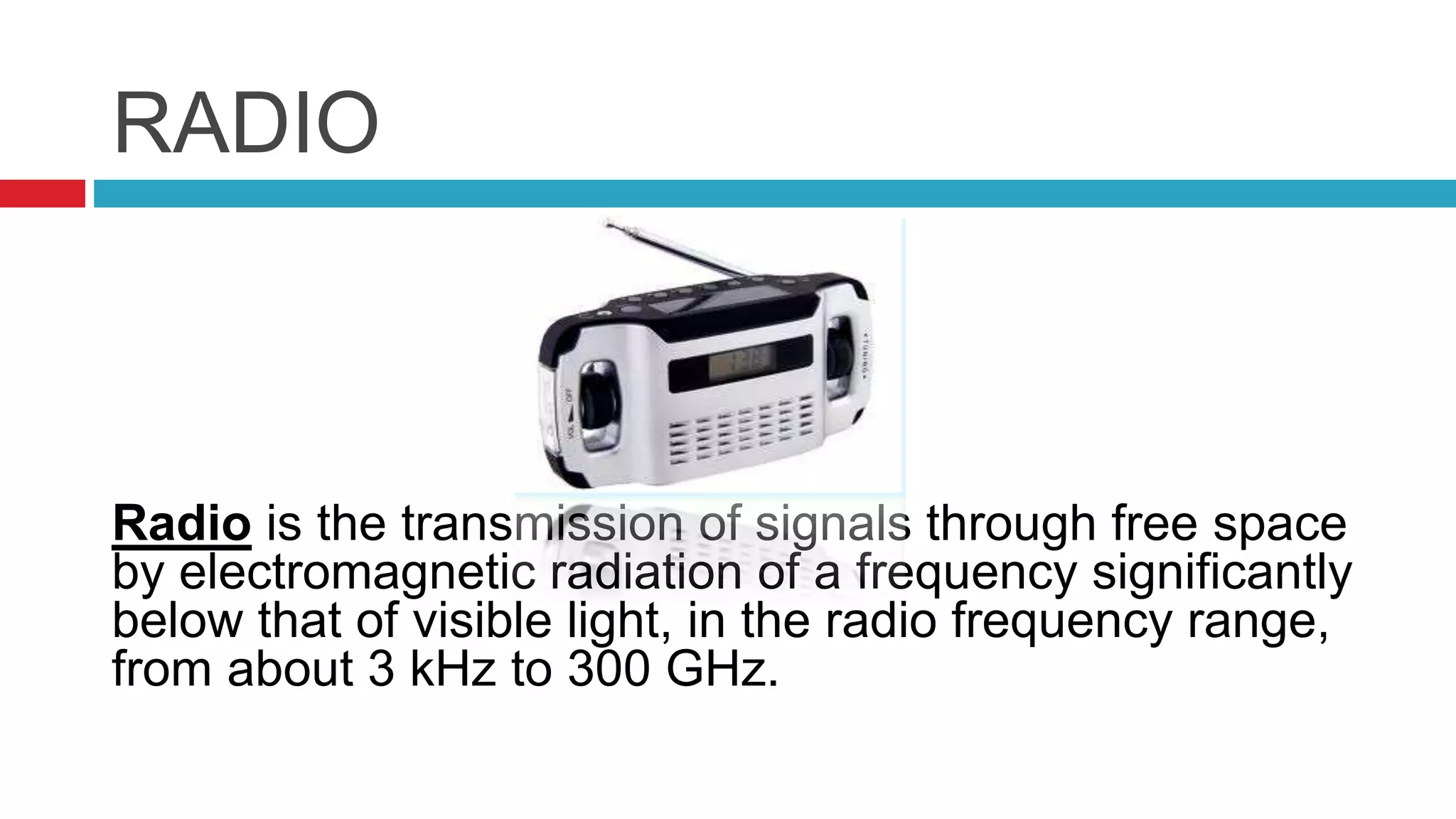
Radio is the transmission of signals through free space
by electromagnetic radiation of a frequency significantly
below that of visible light, in the radio frequency range,
from about 3 kHz to 300 GHz.
How it works!!!!
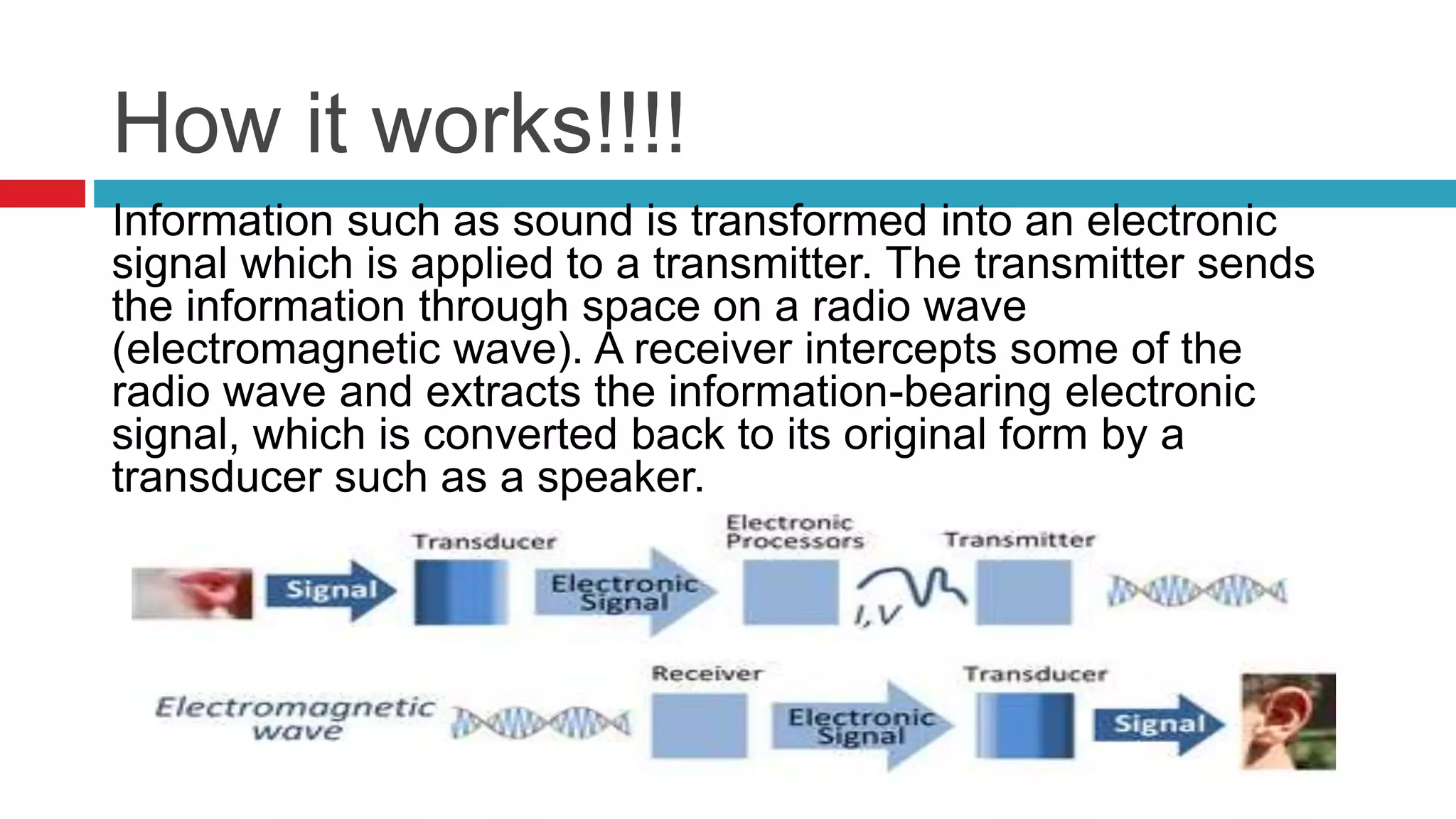
Information such as sound is transformed into an electronic
signal which is applied to a transmitter. The transmitter sends
the information through space on a radio wave
(electromagnetic wave). A receiver intercepts some of the
radio wave and extracts the information-bearing electronic
signal, which is converted back to its original form by a
transducer such as a speaker.
FM Penetration
This list includes
TAM figures from
TAM Media
Research, list of
FM channels from
the website of
Ministry of
Information and
Broadcasting, radio
industry the
television industry
figures from FICCI-
KPMG report 2012
and list of AIR
stations from the
websites of All
India Radio and
Prasar Bharati
respectively.
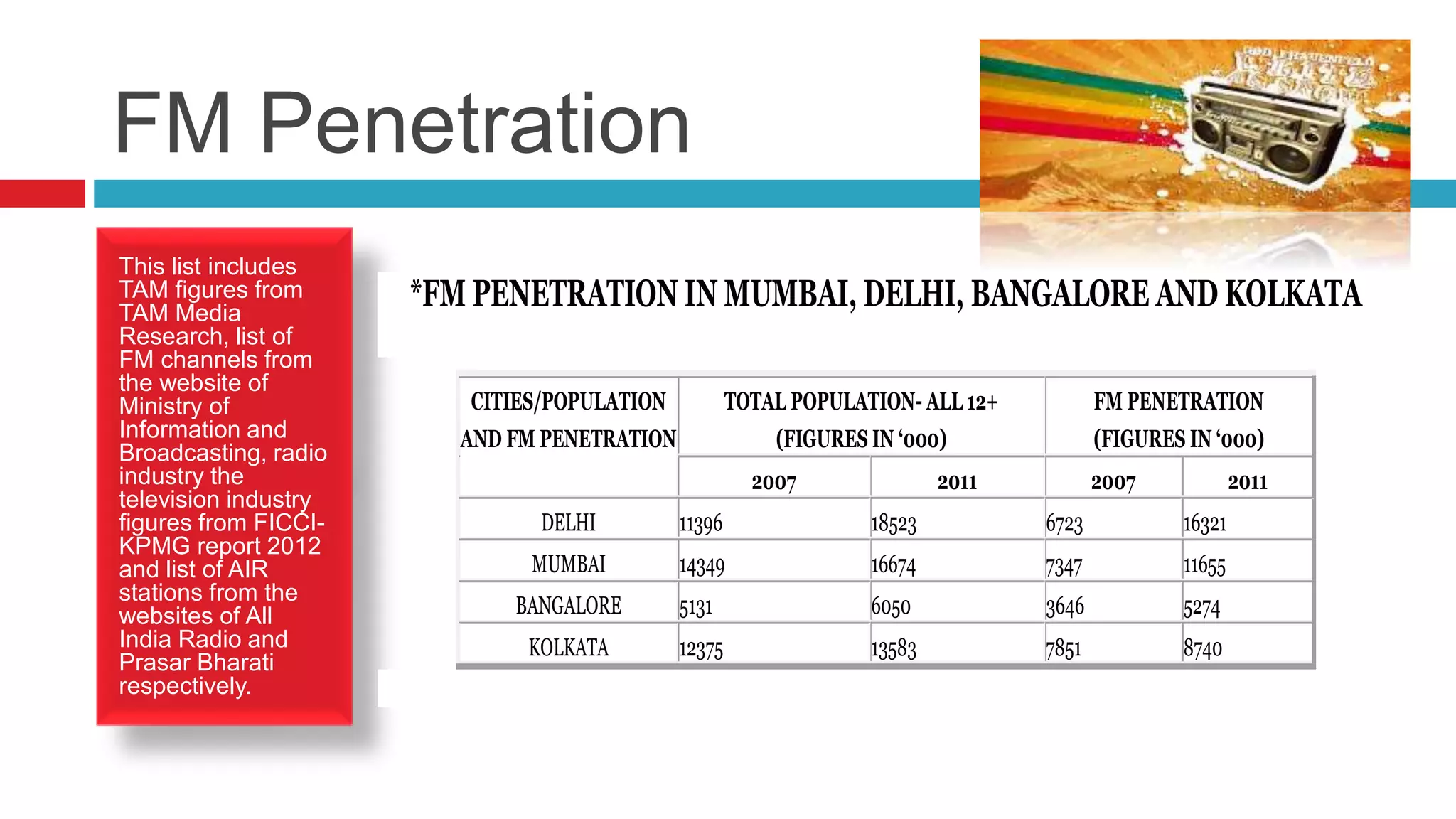
*FM PENETRATION IN MUMBAI, DELHI, BANGALORE AND KOLKATA
CITIES/POPULATION
AND FM PENETRATION
TOTAL POPULATION- ALL 12+
(FIGURES IN ‘000)
FM PENETRATION
(FIGURES IN ‘000)
2007 2011 2007 2011
DELHI 11396 18523 6723 16321
MUMBAI 14349 16674 7347 11655
BANGALORE 5131 6050 3646 5274
KOLKATA 12375 13583 7851 8740
FM Penetration
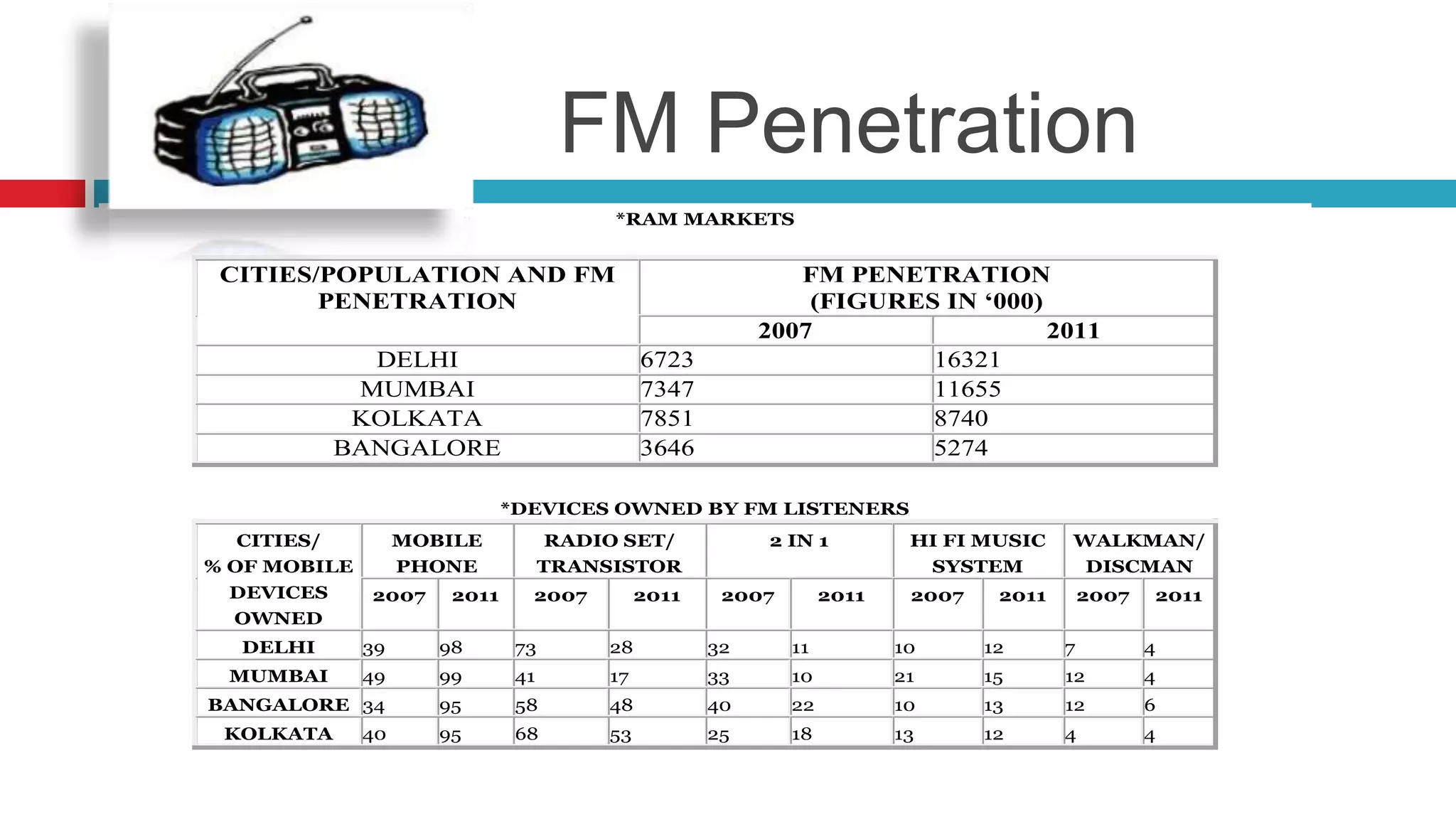
*RAM MARKETS
CITIES/POPULATION AND FM
PENETRATION
FM PENETRATION
(FIGURES IN ‘000)
2007 2011
DELHI 6723 16321
MUMBAI 7347 11655
KOLKATA 7851 8740
BANGALORE 3646 5274
*DEVICES OWNED BY FM LISTENERS
CITIES/
% OF MOBILE
DEVICES
OWNED
MOBILE
PHONE
RADIO SET/
TRANSISTOR
2 IN 1 HI FI MUSIC
SYSTEM
WALKMAN/
DISCMAN
2007 2011 2007 2011 2007 2011 2007 2011 2007 2011
DELHI 39 98 73 28 32 11 10 12 7 4
MUMBAI 49 99 41 17 33 10 21 15 12 4
BANGALORE 34 95 58 48 40 22 10 13 12 6
KOLKATA 40 95 68 53 25 18 13 12 4 4
REVENUES
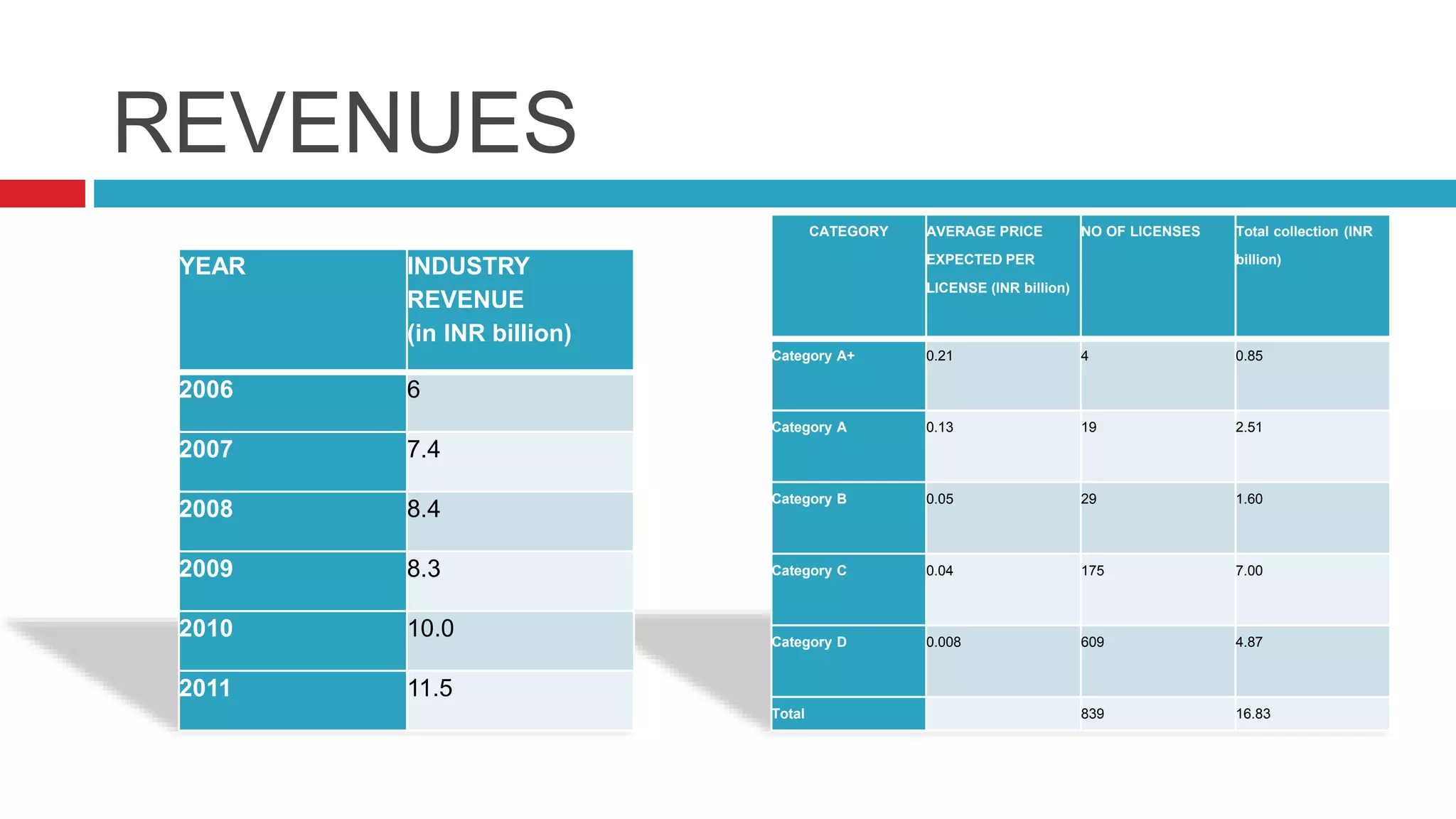
CATEGORY AVERAGE PRICE
EXPECTED PER
LICENSE (INR billion)
NO OF LICENSES Total collection (INR
billion)
Category A+ 0.21 4 0.85
Category A 0.13 19 2.51
Category B 0.05 29 1.60
Category C 0.04 175 7.00
Category D 0.008 609 4.87
Total 839 16.83
YEAR INDUSTRY
REVENUE
(in INR billion)
2006 6
2007 7.4
2008 8.4
2009 8.3
2010 10.0
2011 11.5
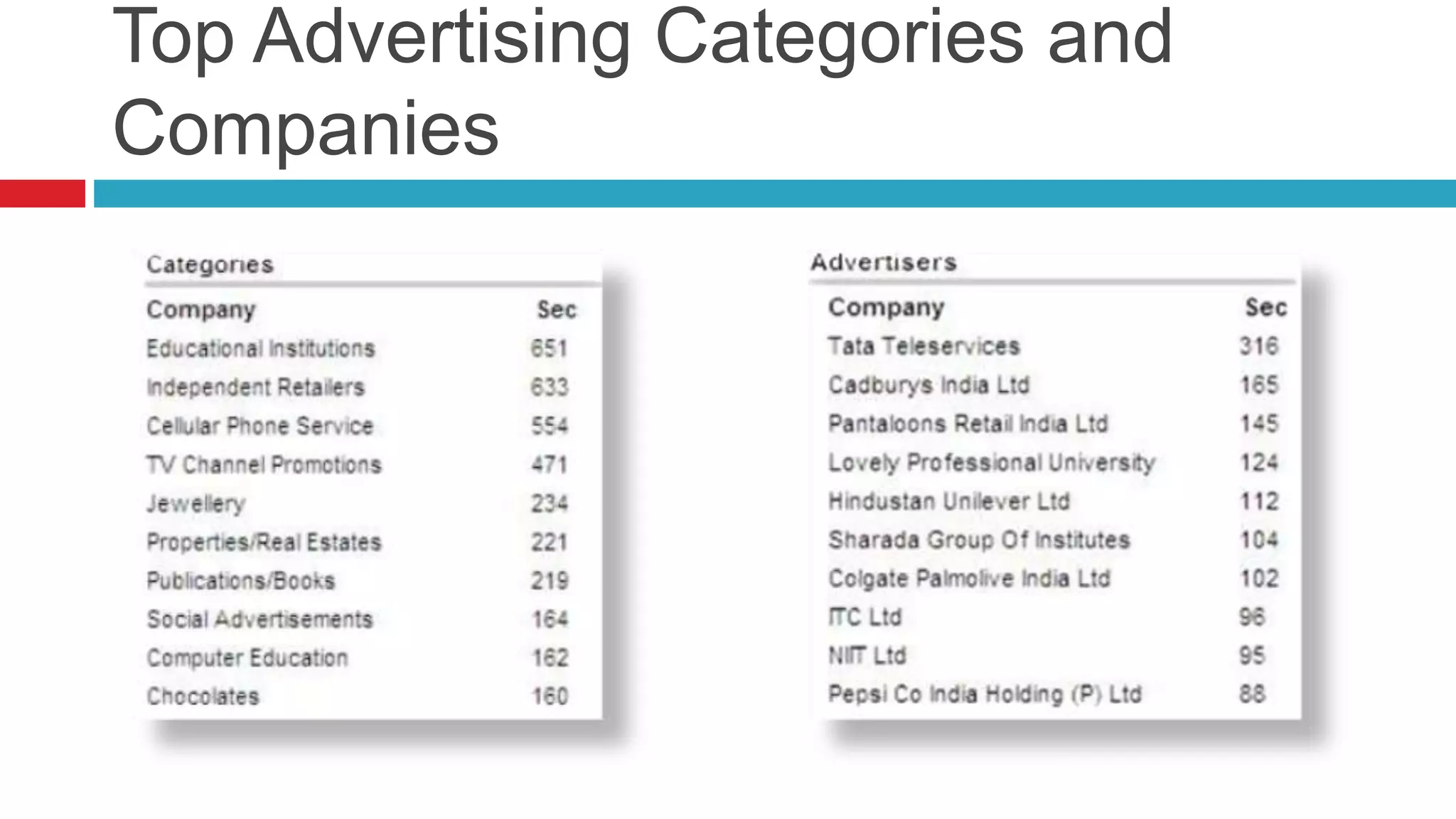
Top Advertising Categories and
Companies
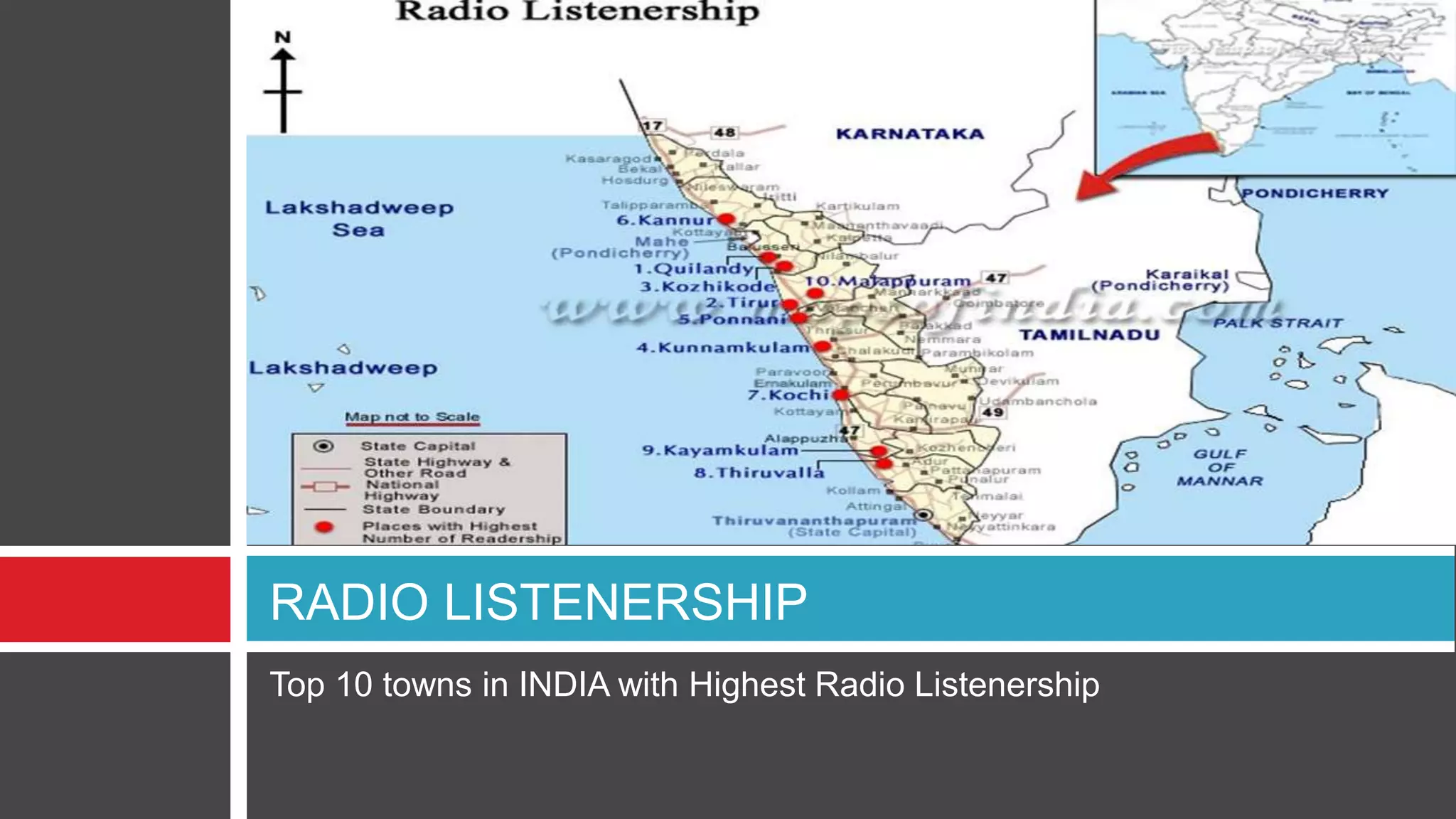
Top 10 towns in INDIA with Highest Radio Listenership
RADIO LISTENERSHIP
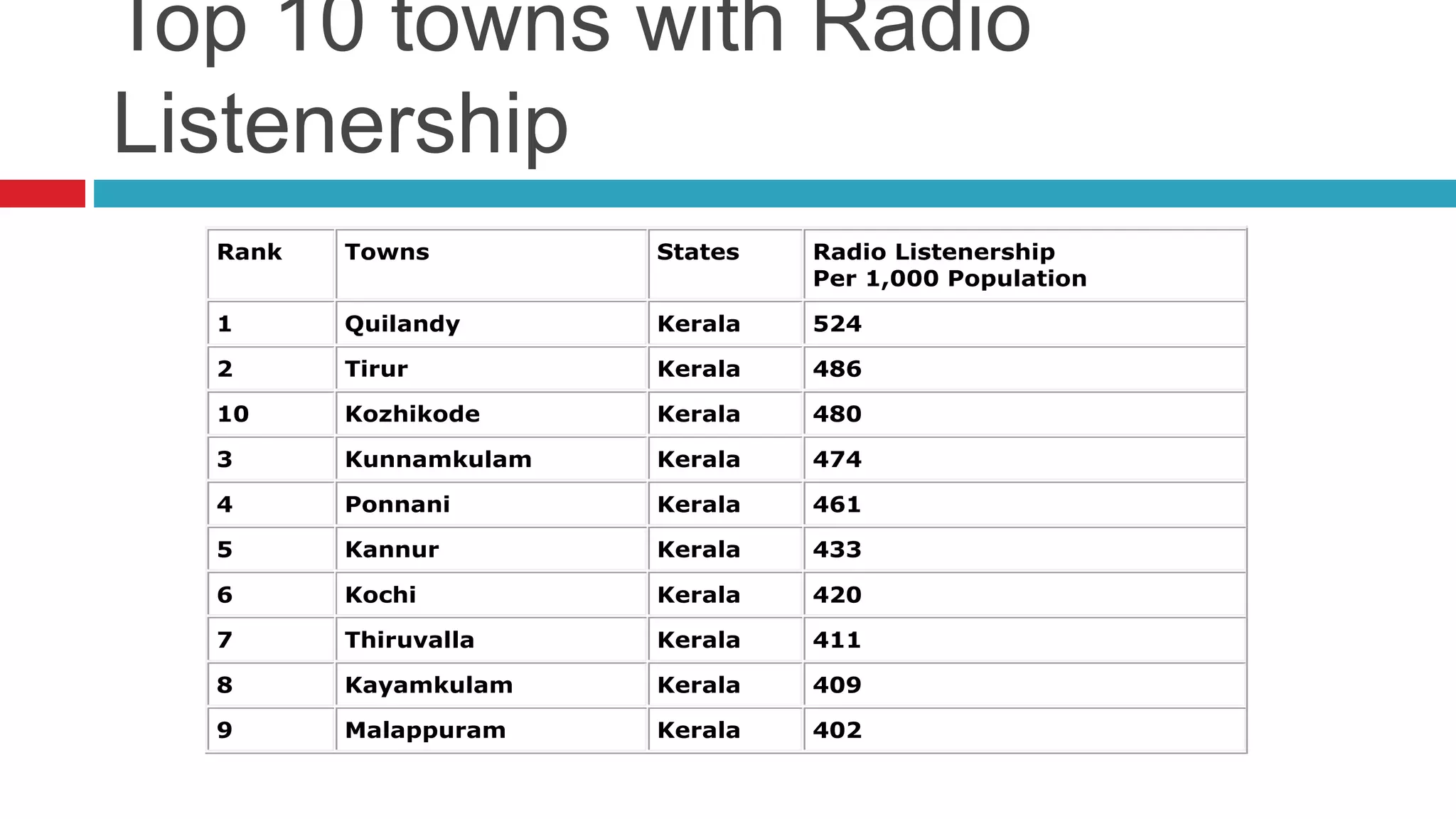
Top 10 towns with Radio
Listenership
Rank Towns States Radio Listenership
Per 1,000 Population
1 Quilandy Kerala 524
2 Tirur Kerala 486
10 Kozhikode Kerala 480
3 Kunnamkulam Kerala 474
4 Ponnani Kerala 461
5 Kannur Kerala 433
6 Kochi Kerala 420
7 Thiruvalla Kerala 411
8 Kayamkulam Kerala 409
9 Malappuram Kerala 402
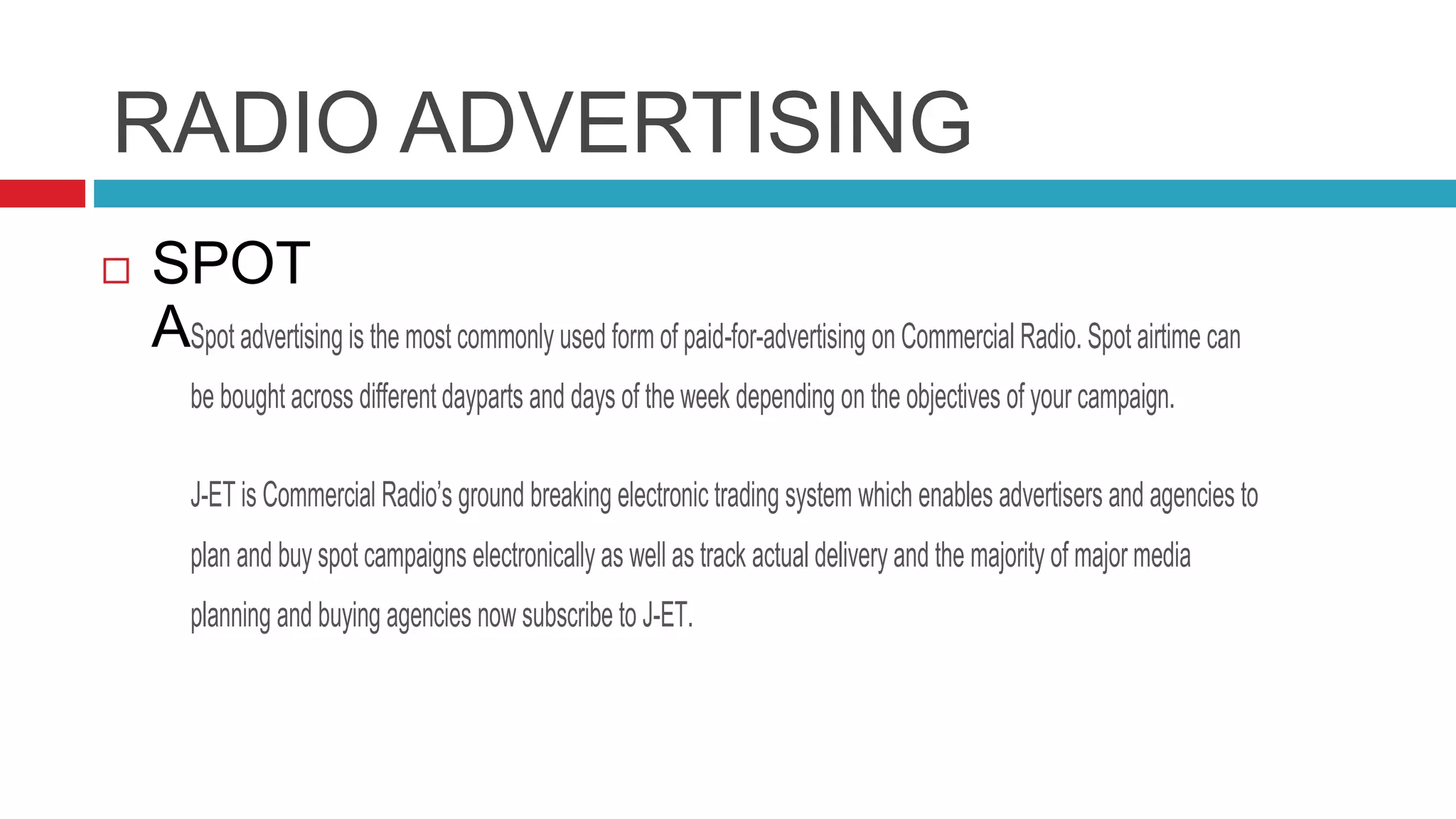
RADIO ADVERTISING
 SPOT
ADVERTISINGSpot advertising is the most commonly used form of paid-for-advertising on Commercial Radio. Spot airtime can
be bought across different dayparts and days of the week depending on the objectives of your campaign.
J-ET is Commercial Radio’s ground breaking electronic trading system which enables advertisers and agencies to
plan and buy spot campaigns electronically as well as track actual delivery and the majority of major media
planning and buying agencies now subscribe to J-ET.
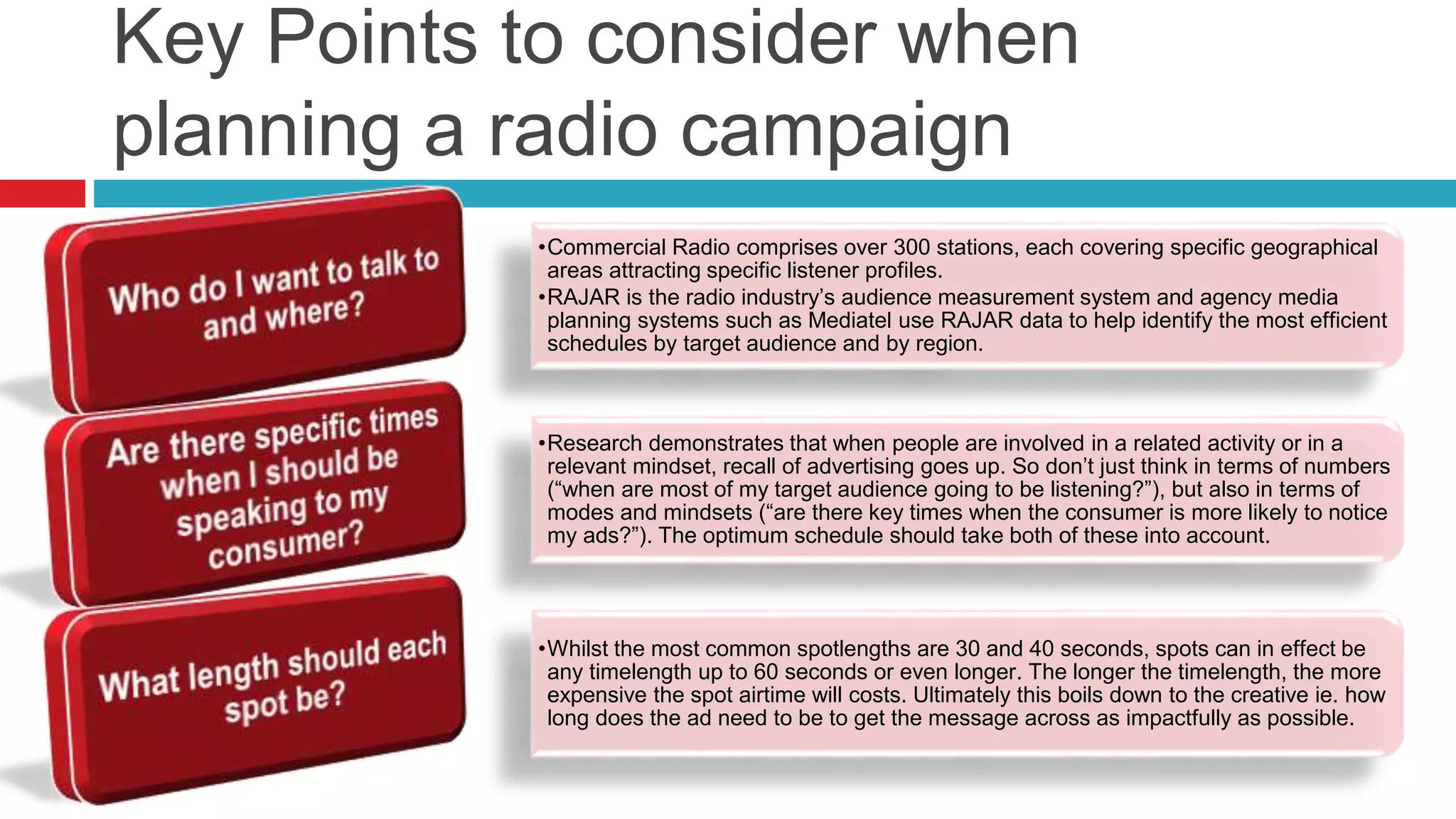
Key Points to consider when
planning a radio campaign
•Commercial Radio comprises over 300 stations, each covering specific geographical
areas attracting specific listener profiles.
•RAJAR is the radio industry’s audience measurement system and agency media
planning systems such as Mediatel use RAJAR data to help identify the most efficient
schedules by target audience and by region.
•Research demonstrates that when people are involved in a related activity or in a
relevant mindset, recall of advertising goes up. So don’t just think in terms of numbers
(“when are most of my target audience going to be listening?”), but also in terms of
modes and mindsets (“are there key times when the consumer is more likely to notice
my ads?”). The optimum schedule should take both of these into account.
•Whilst the most common spotlengths are 30 and 40 seconds, spots can in effect be
any timelength up to 60 seconds or even longer. The longer the timelength, the more
expensive the spot airtime will costs. Ultimately this boils down to the creative ie. how
long does the ad need to be to get the message across as impactfully as possible.
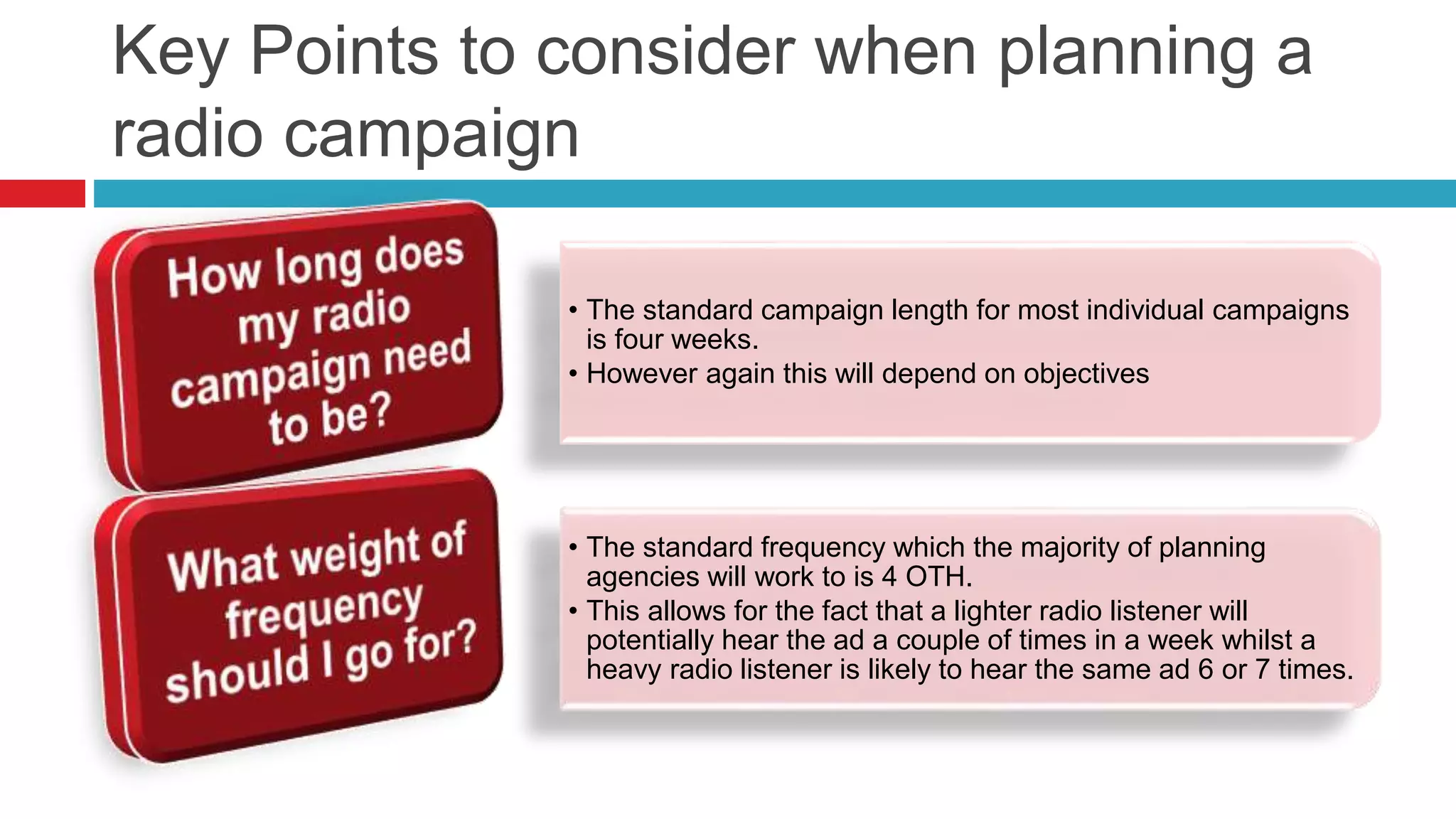
Key Points to consider when planning a
radio campaign
• The standard campaign length for most individual campaigns
is four weeks.
• However again this will depend on objectives
• The standard frequency which the majority of planning
agencies will work to is 4 OTH.
• This allows for the fact that a lighter radio listener will
potentially hear the ad a couple of times in a week whilst a
heavy radio listener is likely to hear the same ad 6 or 7 times.
COMMUNITY RADIO STATIONS
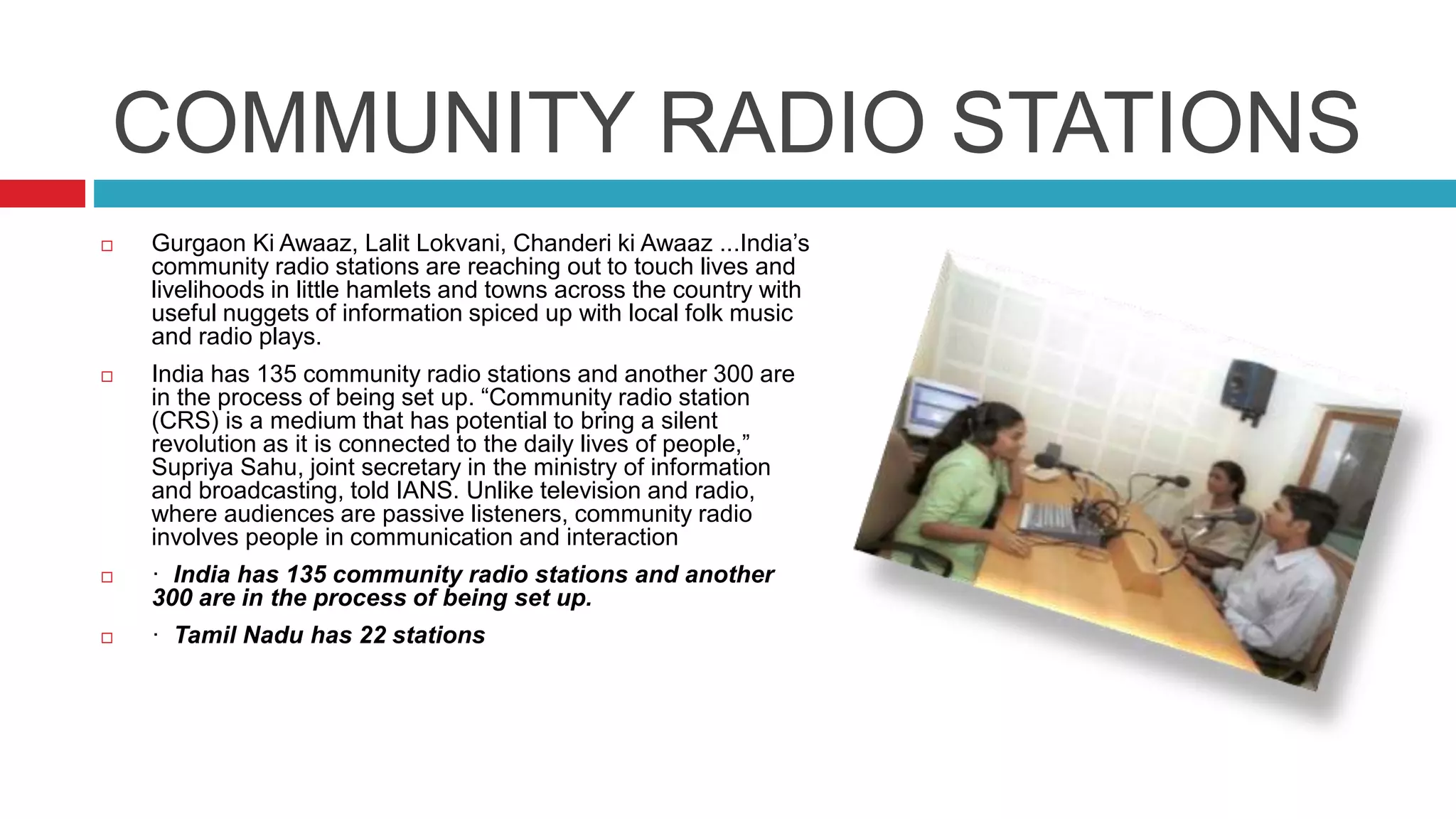
 Gurgaon Ki Awaaz, Lalit Lokvani, Chanderi ki Awaaz ...India’s
community radio stations are reaching out to touch lives and
livelihoods in little hamlets and towns across the country with
useful nuggets of information spiced up with local folk music
and radio plays.
 India has 135 community radio stations and another 300 are
in the process of being set up. “Community radio station
(CRS) is a medium that has potential to bring a silent
revolution as it is connected to the daily lives of people,”
Supriya Sahu, joint secretary in the ministry of information
and broadcasting, told IANS. Unlike television and radio,
where audiences are passive listeners, community radio
involves people in communication and interaction
 · India has 135 community radio stations and another
300 are in the process of being set up.
 · Tamil Nadu has 22 stations
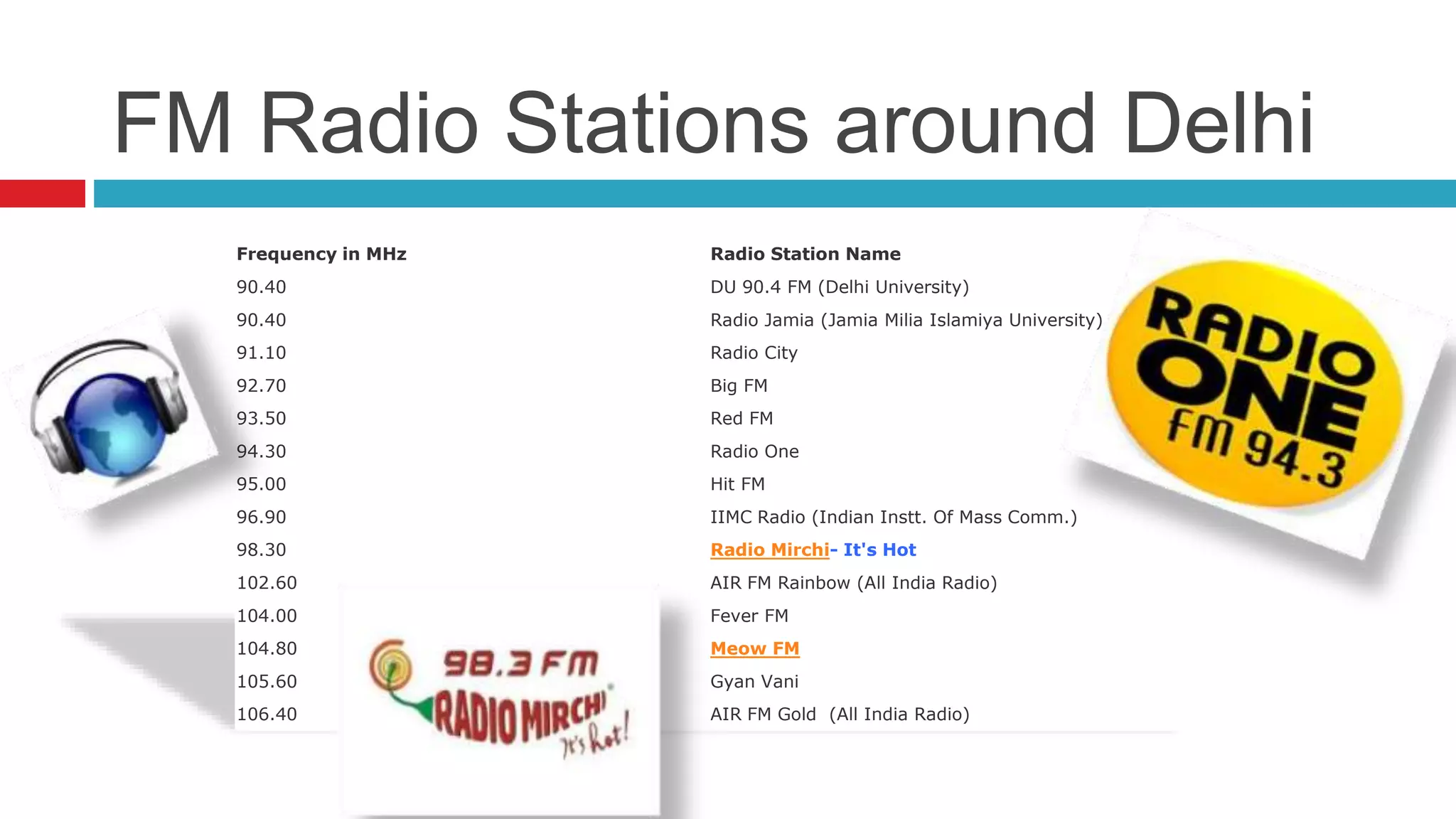
FM Radio Stations around Delhi
Frequency in MHz Radio Station Name
90.40 DU 90.4 FM (Delhi University)
90.40 Radio Jamia (Jamia Milia Islamiya University)
91.10 Radio City
92.70 Big FM
93.50 Red FM
94.30 Radio One
95.00 Hit FM
96.90 IIMC Radio (Indian Instt. Of Mass Comm.)
98.30 Radio Mirchi- It's Hot
102.60 AIR FM Rainbow (All India Radio)
104.00 Fever FM
104.80 Meow FM
105.60 Gyan Vani
106.40 AIR FM Gold (All India Radio)

Advertising media and its uses

  • 1.
  • 2.
    RADIO Radio is thetransmission of signals through free space by electromagnetic radiation of a frequency significantly below that of visible light, in the radio frequency range, from about 3 kHz to 300 GHz.
  • 3.
    How it works!!!! Informationsuch as sound is transformed into an electronic signal which is applied to a transmitter. The transmitter sends the information through space on a radio wave (electromagnetic wave). A receiver intercepts some of the radio wave and extracts the information-bearing electronic signal, which is converted back to its original form by a transducer such as a speaker.
  • 4.
    FM Penetration This listincludes TAM figures from TAM Media Research, list of FM channels from the website of Ministry of Information and Broadcasting, radio industry the television industry figures from FICCI- KPMG report 2012 and list of AIR stations from the websites of All India Radio and Prasar Bharati respectively. *FM PENETRATION IN MUMBAI, DELHI, BANGALORE AND KOLKATA CITIES/POPULATION AND FM PENETRATION TOTAL POPULATION- ALL 12+ (FIGURES IN ‘000) FM PENETRATION (FIGURES IN ‘000) 2007 2011 2007 2011 DELHI 11396 18523 6723 16321 MUMBAI 14349 16674 7347 11655 BANGALORE 5131 6050 3646 5274 KOLKATA 12375 13583 7851 8740
  • 5.
    FM Penetration *RAM MARKETS CITIES/POPULATIONAND FM PENETRATION FM PENETRATION (FIGURES IN ‘000) 2007 2011 DELHI 6723 16321 MUMBAI 7347 11655 KOLKATA 7851 8740 BANGALORE 3646 5274 *DEVICES OWNED BY FM LISTENERS CITIES/ % OF MOBILE DEVICES OWNED MOBILE PHONE RADIO SET/ TRANSISTOR 2 IN 1 HI FI MUSIC SYSTEM WALKMAN/ DISCMAN 2007 2011 2007 2011 2007 2011 2007 2011 2007 2011 DELHI 39 98 73 28 32 11 10 12 7 4 MUMBAI 49 99 41 17 33 10 21 15 12 4 BANGALORE 34 95 58 48 40 22 10 13 12 6 KOLKATA 40 95 68 53 25 18 13 12 4 4
  • 6.
    REVENUES CATEGORY AVERAGE PRICE EXPECTEDPER LICENSE (INR billion) NO OF LICENSES Total collection (INR billion) Category A+ 0.21 4 0.85 Category A 0.13 19 2.51 Category B 0.05 29 1.60 Category C 0.04 175 7.00 Category D 0.008 609 4.87 Total 839 16.83 YEAR INDUSTRY REVENUE (in INR billion) 2006 6 2007 7.4 2008 8.4 2009 8.3 2010 10.0 2011 11.5
  • 7.
  • 8.
    Top 10 townsin INDIA with Highest Radio Listenership RADIO LISTENERSHIP
  • 9.
    Top 10 townswith Radio Listenership Rank Towns States Radio Listenership Per 1,000 Population 1 Quilandy Kerala 524 2 Tirur Kerala 486 10 Kozhikode Kerala 480 3 Kunnamkulam Kerala 474 4 Ponnani Kerala 461 5 Kannur Kerala 433 6 Kochi Kerala 420 7 Thiruvalla Kerala 411 8 Kayamkulam Kerala 409 9 Malappuram Kerala 402
  • 10.
    RADIO ADVERTISING  SPOT ADVERTISINGSpotadvertising is the most commonly used form of paid-for-advertising on Commercial Radio. Spot airtime can be bought across different dayparts and days of the week depending on the objectives of your campaign. J-ET is Commercial Radio’s ground breaking electronic trading system which enables advertisers and agencies to plan and buy spot campaigns electronically as well as track actual delivery and the majority of major media planning and buying agencies now subscribe to J-ET.
  • 11.
    Key Points toconsider when planning a radio campaign •Commercial Radio comprises over 300 stations, each covering specific geographical areas attracting specific listener profiles. •RAJAR is the radio industry’s audience measurement system and agency media planning systems such as Mediatel use RAJAR data to help identify the most efficient schedules by target audience and by region. •Research demonstrates that when people are involved in a related activity or in a relevant mindset, recall of advertising goes up. So don’t just think in terms of numbers (“when are most of my target audience going to be listening?”), but also in terms of modes and mindsets (“are there key times when the consumer is more likely to notice my ads?”). The optimum schedule should take both of these into account. •Whilst the most common spotlengths are 30 and 40 seconds, spots can in effect be any timelength up to 60 seconds or even longer. The longer the timelength, the more expensive the spot airtime will costs. Ultimately this boils down to the creative ie. how long does the ad need to be to get the message across as impactfully as possible.
  • 12.
    Key Points toconsider when planning a radio campaign • The standard campaign length for most individual campaigns is four weeks. • However again this will depend on objectives • The standard frequency which the majority of planning agencies will work to is 4 OTH. • This allows for the fact that a lighter radio listener will potentially hear the ad a couple of times in a week whilst a heavy radio listener is likely to hear the same ad 6 or 7 times.
  • 13.
    COMMUNITY RADIO STATIONS Gurgaon Ki Awaaz, Lalit Lokvani, Chanderi ki Awaaz ...India’s community radio stations are reaching out to touch lives and livelihoods in little hamlets and towns across the country with useful nuggets of information spiced up with local folk music and radio plays.  India has 135 community radio stations and another 300 are in the process of being set up. “Community radio station (CRS) is a medium that has potential to bring a silent revolution as it is connected to the daily lives of people,” Supriya Sahu, joint secretary in the ministry of information and broadcasting, told IANS. Unlike television and radio, where audiences are passive listeners, community radio involves people in communication and interaction  · India has 135 community radio stations and another 300 are in the process of being set up.  · Tamil Nadu has 22 stations
  • 14.
    FM Radio Stationsaround Delhi Frequency in MHz Radio Station Name 90.40 DU 90.4 FM (Delhi University) 90.40 Radio Jamia (Jamia Milia Islamiya University) 91.10 Radio City 92.70 Big FM 93.50 Red FM 94.30 Radio One 95.00 Hit FM 96.90 IIMC Radio (Indian Instt. Of Mass Comm.) 98.30 Radio Mirchi- It's Hot 102.60 AIR FM Rainbow (All India Radio) 104.00 Fever FM 104.80 Meow FM 105.60 Gyan Vani 106.40 AIR FM Gold (All India Radio)