Service-oriented Communities
and Fractal Social Organizations
Models and concepts
for a Smarter Planet
Vincenzo De Florio
PATS / University of Antwerp & iMinds
Structure
• PATS/Adaptive-and-dependable systems
• Urgent need: Rethinking organizations
• Conjecture: Three key requirements
• A building block: Service-oriented community
• A model: Fractal social organizations
• Conclusions.
2April 2, 2014 IBM Faculty Award Ceremony
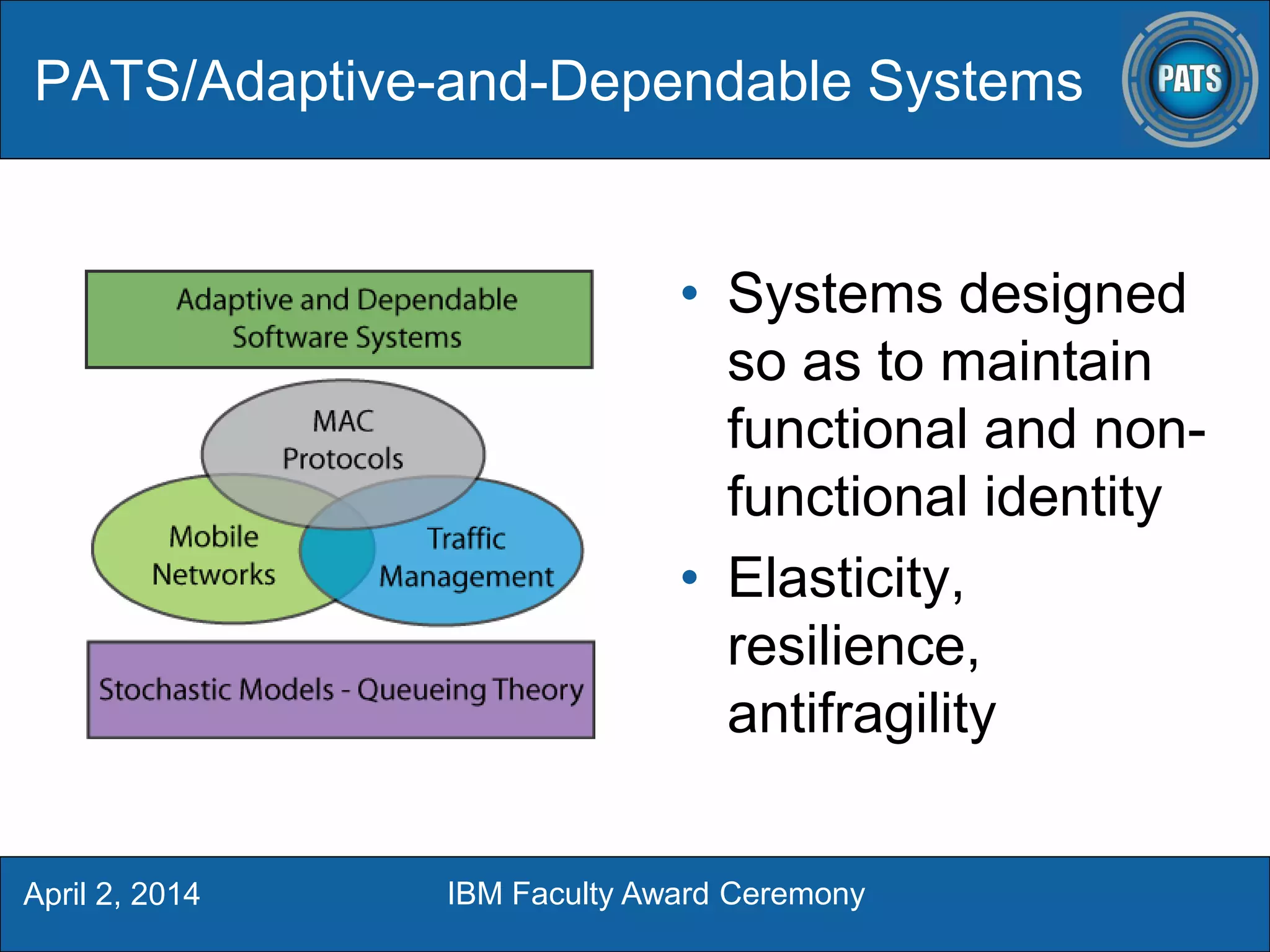
PATS/Adaptive-and-Dependable Systems
• Systems designed
so as to maintain
functional and non-
functional identity
• Elasticity,
resilience,
antifragility
April 2, 2014 IBM Faculty Award Ceremony
Structure
• PATS/Adaptive-and-dependable systems
• Urgent need: Rethinking organizations
• Conjecture: Three key requirements
• Building block: Service-oriented communities
• Model: Fractal social organizations
• Conclusions
5April 2, 2014 IBM Faculty Award Ceremony
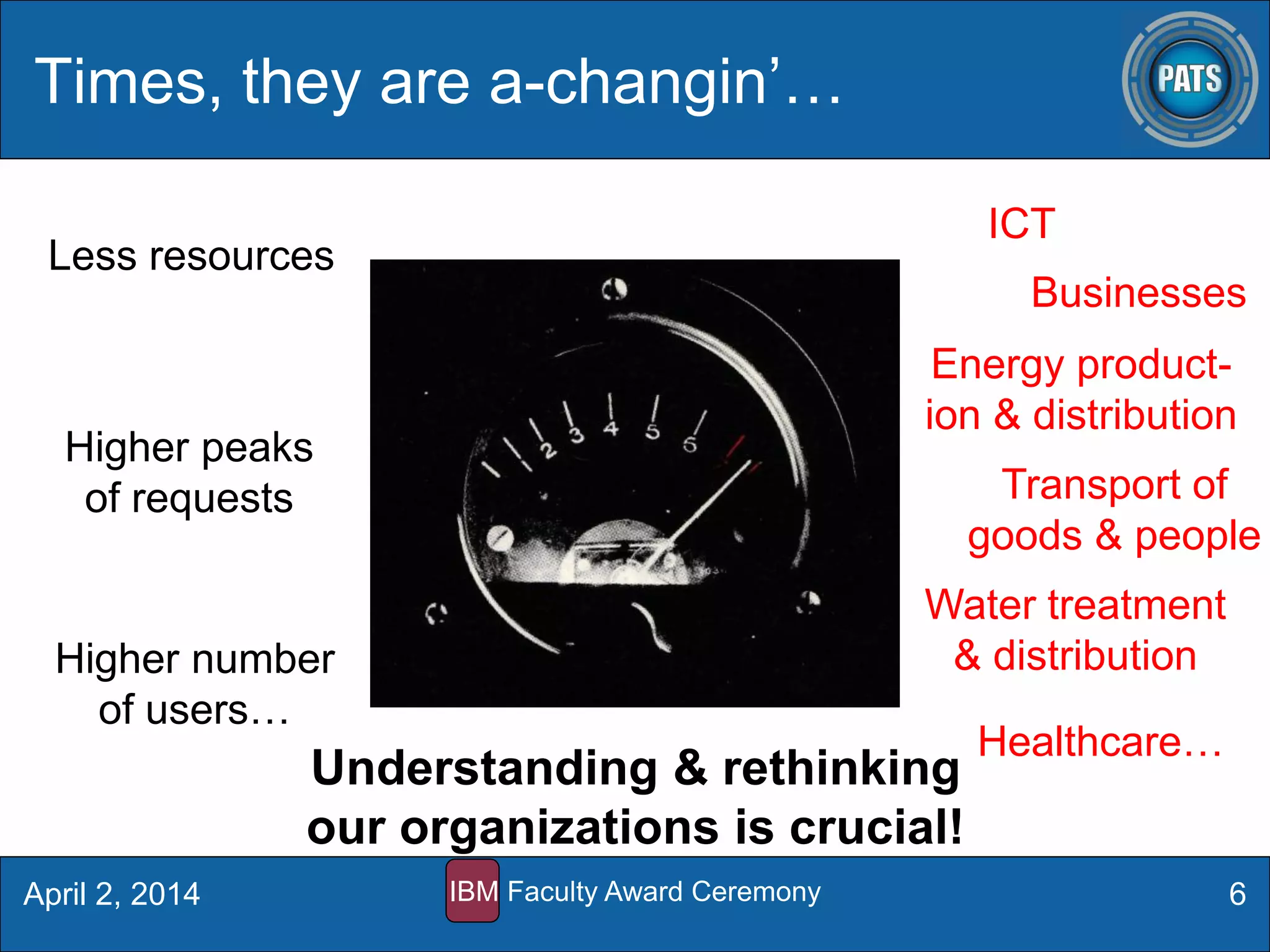
Times, they are a-changin’…
6
Less resources
Higher peaks
of requests
Higher number
of users…
ICT
Energy product-
ion & distribution
Businesses
Transport of
goods & people
Water treatment
& distribution
Healthcare…
Understanding & rethinking
our organizations is crucial!
April 2, 2014 IBM Faculty Award Ceremony
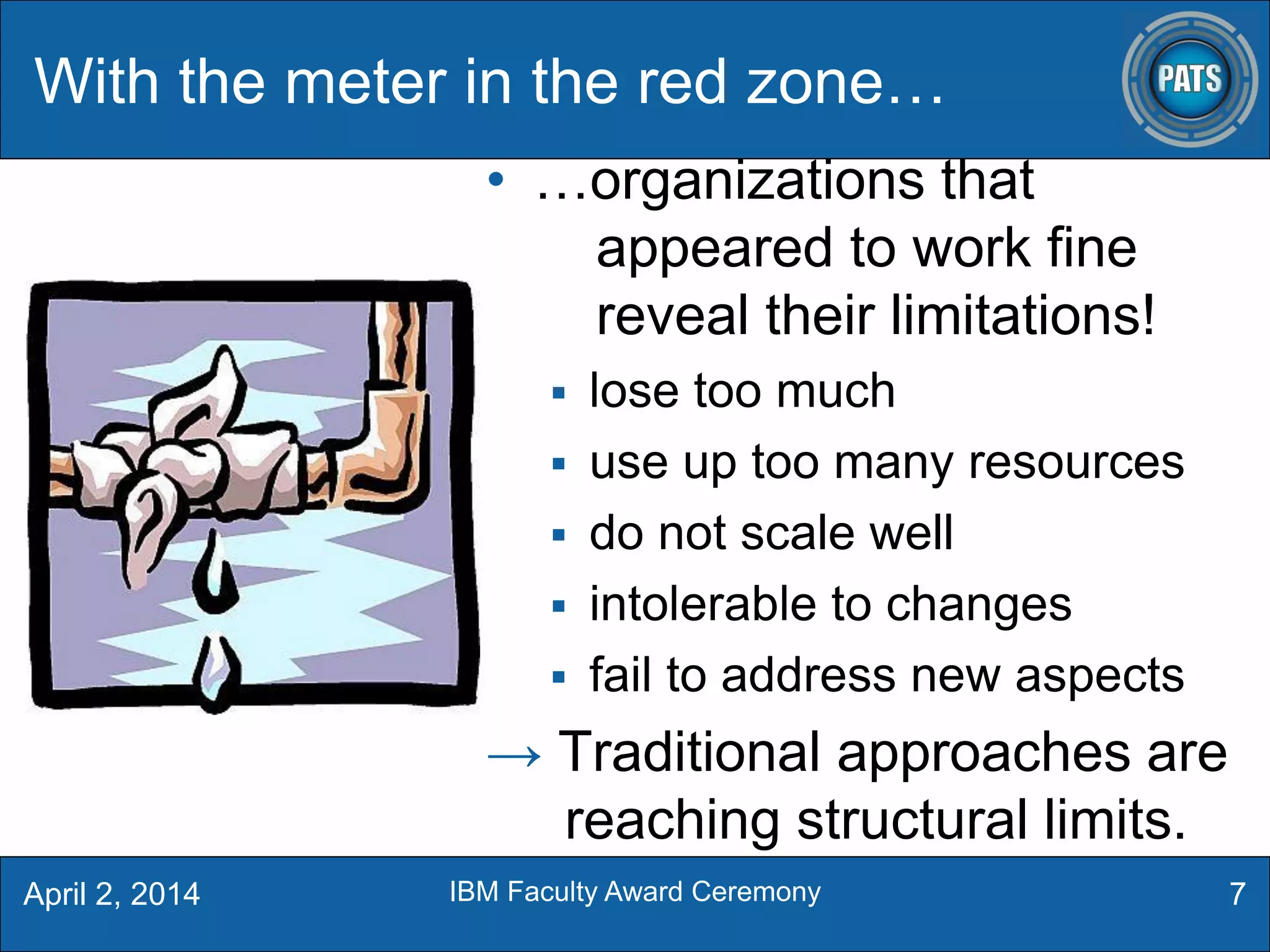
With the meter in the red zone…
• …organizations that
appeared to work fine
reveal their limitations!
 lose too much
 use up too many resources
 do not scale well
 intolerable to changes
 fail to address new aspects
→ Traditional approaches are
reaching structural limits.
7April 2, 2014 IBM Faculty Award Ceremony
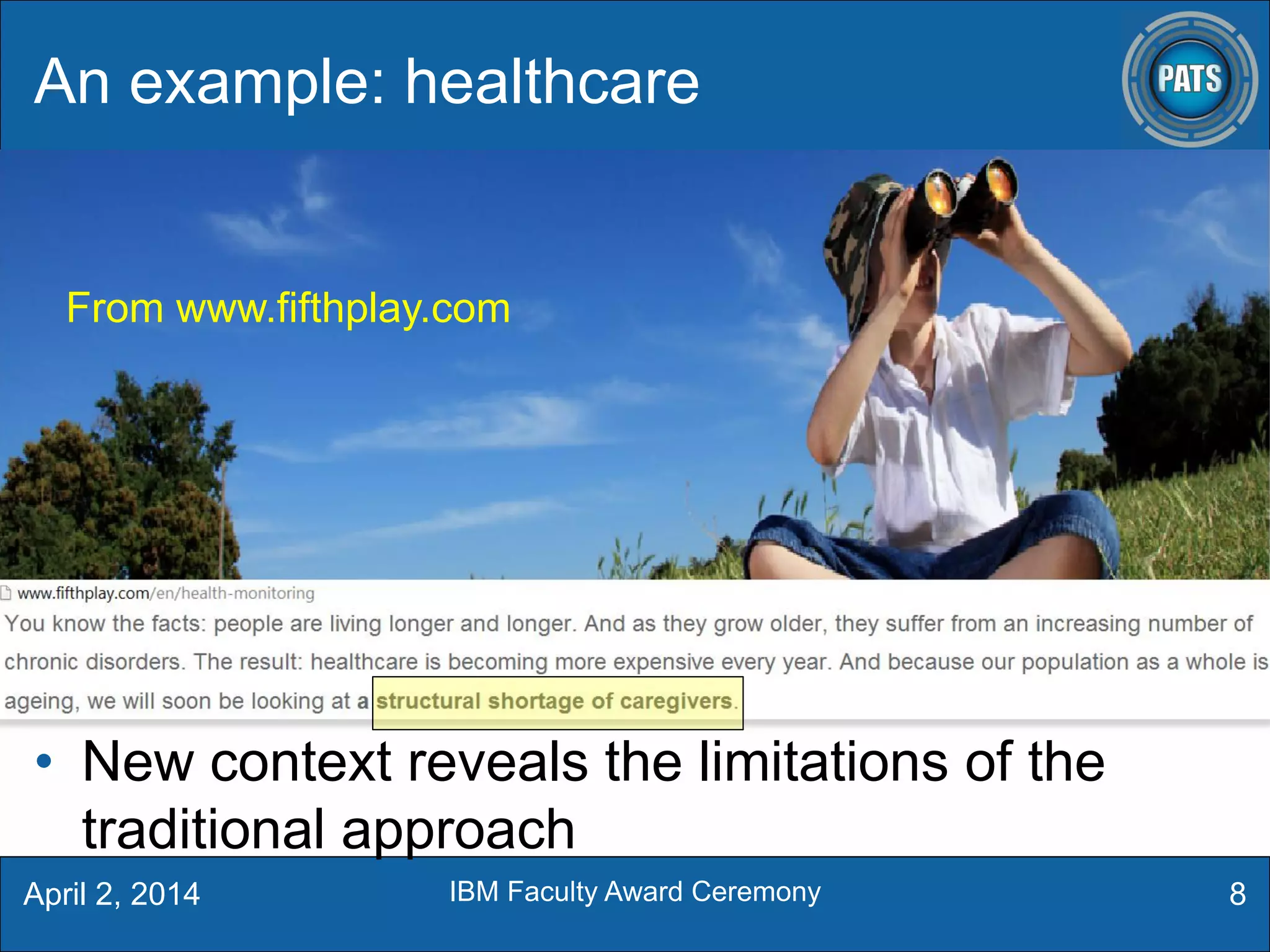
An example: healthcare
8
From www.fifthplay.com
• New context reveals the limitations of the
traditional approach
April 2, 2014 IBM Faculty Award Ceremony
The healthcare crisis
• Unmanageability is approaching
 How should we rethink healthcare?
• Starting point: Three observations:
 Society at large is not part of the solution 
Too many resources are wasted
 No complex behaviors are expected from the
vast majority of the components
 Organization (mostly hierarchical) is inflexible,
does not scale well, incurs huge costs…
9
 Three key aspects: Society, organization, behaviour
April 2, 2014 IBM Faculty Award Ceremony
Structure
• PATS/Adaptive-and-dependable systems
• Urgent need: Rethinking organizations
• Conjecture: Three key requirements
• Building block: Service-oriented communities
• Model: Fractal social organizations
• Conclusions
10April 2, 2014 IBM Faculty Award Ceremony
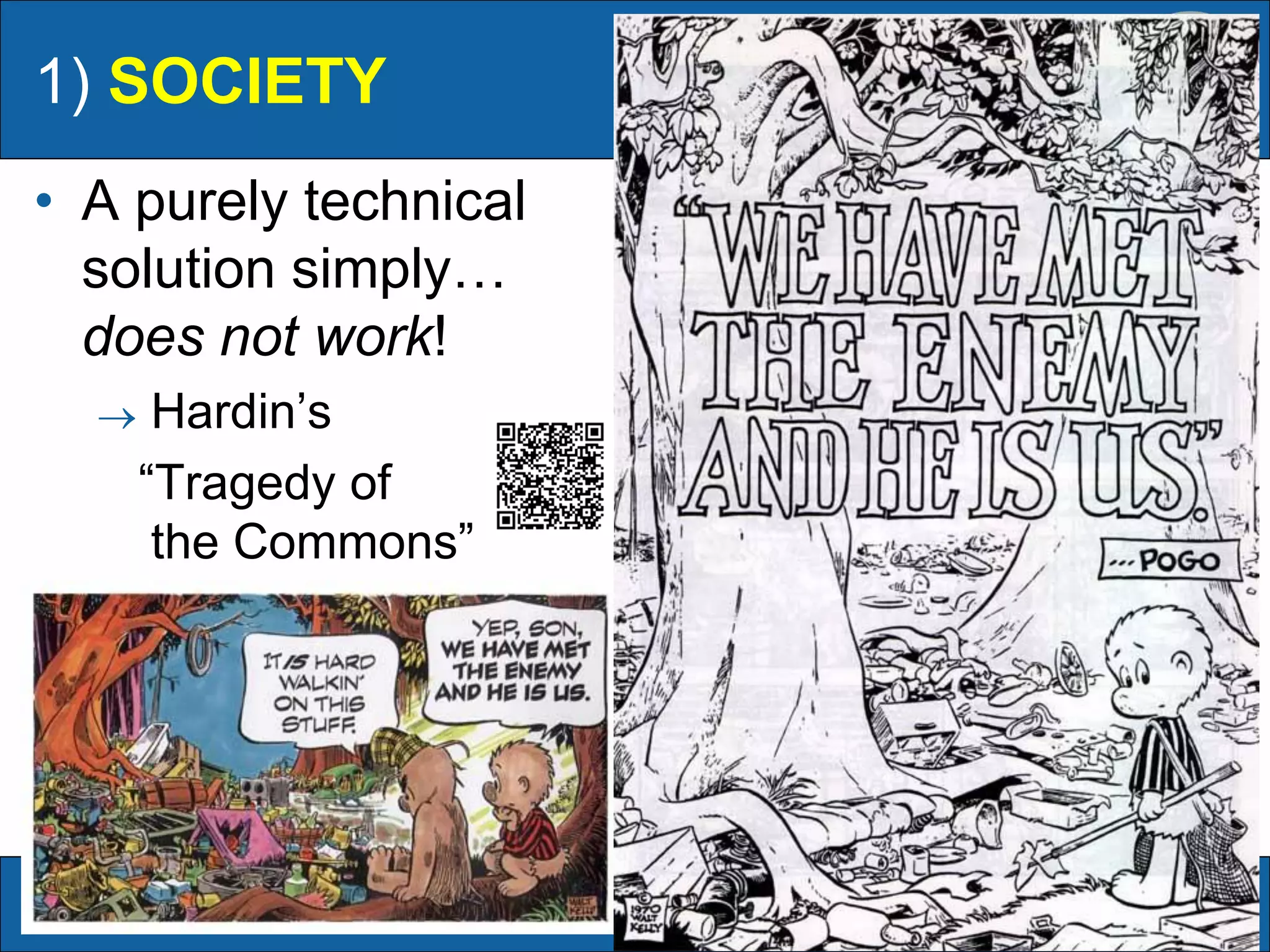
1) SOCIETY
11
• A purely technical
solution simply…
does not work!
 Hardin’s
“Tragedy of
the Commons”
• Society must be part of the solution
• Society ≡ abundant, mobile “resources” able
to exercise complex action
• Need: engineer ways to tap into the nearly
unlimited sources of “social energy” of
our societies.
12
Three key requirements... 1) SOCIETY
April 2, 2014 IBM Faculty Award Ceremony
26 November 2012 13SITIS 2012
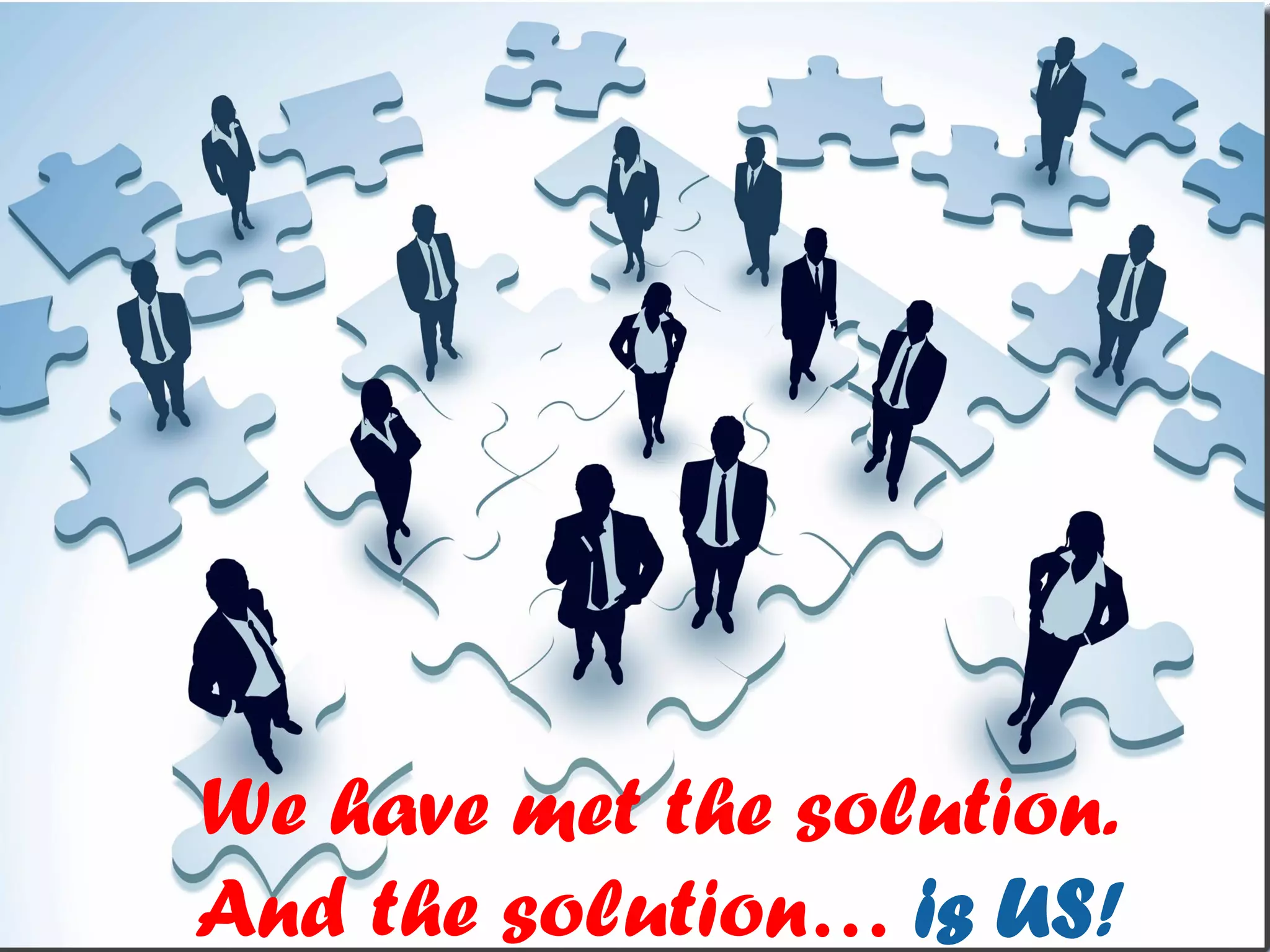
We have met the solution.
And the solution… is US!
• Organizational / architectural choices define
the features of our systems
• Classic model: quasi-closed, hierarchical
systems incapable of any complex
interoperability.
Three key requirements...2)ORGANIZATION
14April 2, 2014 IBM Faculty Award Ceremony
• Need: open smart organizations
 Self-optimizing
 Inter-organizational collective strategies
 Mutualistic relationships; collaborative
sharing of data and resources…
15April 2, 2014 IBM Faculty Award Ceremony
Three key requirements...2)ORGANIZATION
• Conjecture: Biologically inspired distributed
organizations will play a key role in the
emergence of collective intelligent responses
 Holarchies and fractal organizations
• “Simultaneously a part & a whole, a container & a
contained, a controller & a controlled” [Sou00]
 Networks of peer-levels (members).
16April 2, 2014 IBM Faculty Award Ceremony
Three key requirements...2)ORGANIZATION
• Behavior: “change w.r.t. surroundings” [RW43]
• Purposeful, reactive, proactive behaviors
• Needs:
1. Resilient behaviors: change aiming at
preserving identity
2. Antifragile behaviors: change that preserves
identity AND learns how to improve
system-environment fit
Three key requirements... 3) BEHAVIOUR
17April 2, 2014 IBM Faculty Award Ceremony
Structure
• PATS/Adaptive-and-dependable systems
• Urgent need: Rethinking organizations
• Conjecture: Three key requirements
• Building block: Service-oriented communities
• Model: Fractal social organizations
• Conclusions
19April 2, 2014 IBM Faculty Award Ceremony
• Social organization built by explicitly
addressing the mentioned aspects
 Taps into “social energy”
 Node of a distributed organization
 Supports complex resilient behaviours.
Service-oriented communities
20April 2, 2014 IBM Faculty Award Ceremony
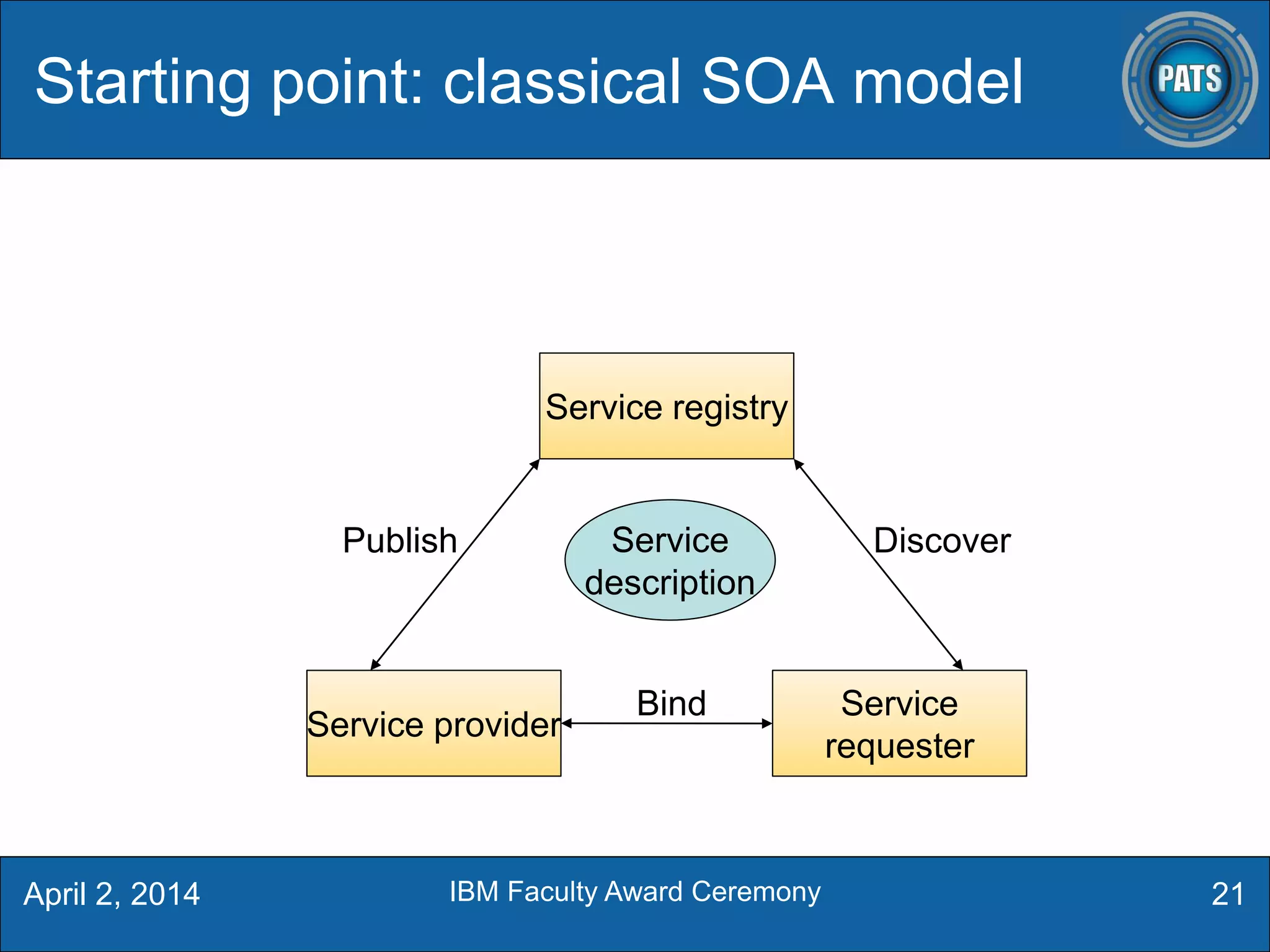
21
Service provider
Service
requester
Service registry
Starting point: classical SOA model
Publish Discover
Bind
Service
description
April 2, 2014 IBM Faculty Award Ceremony
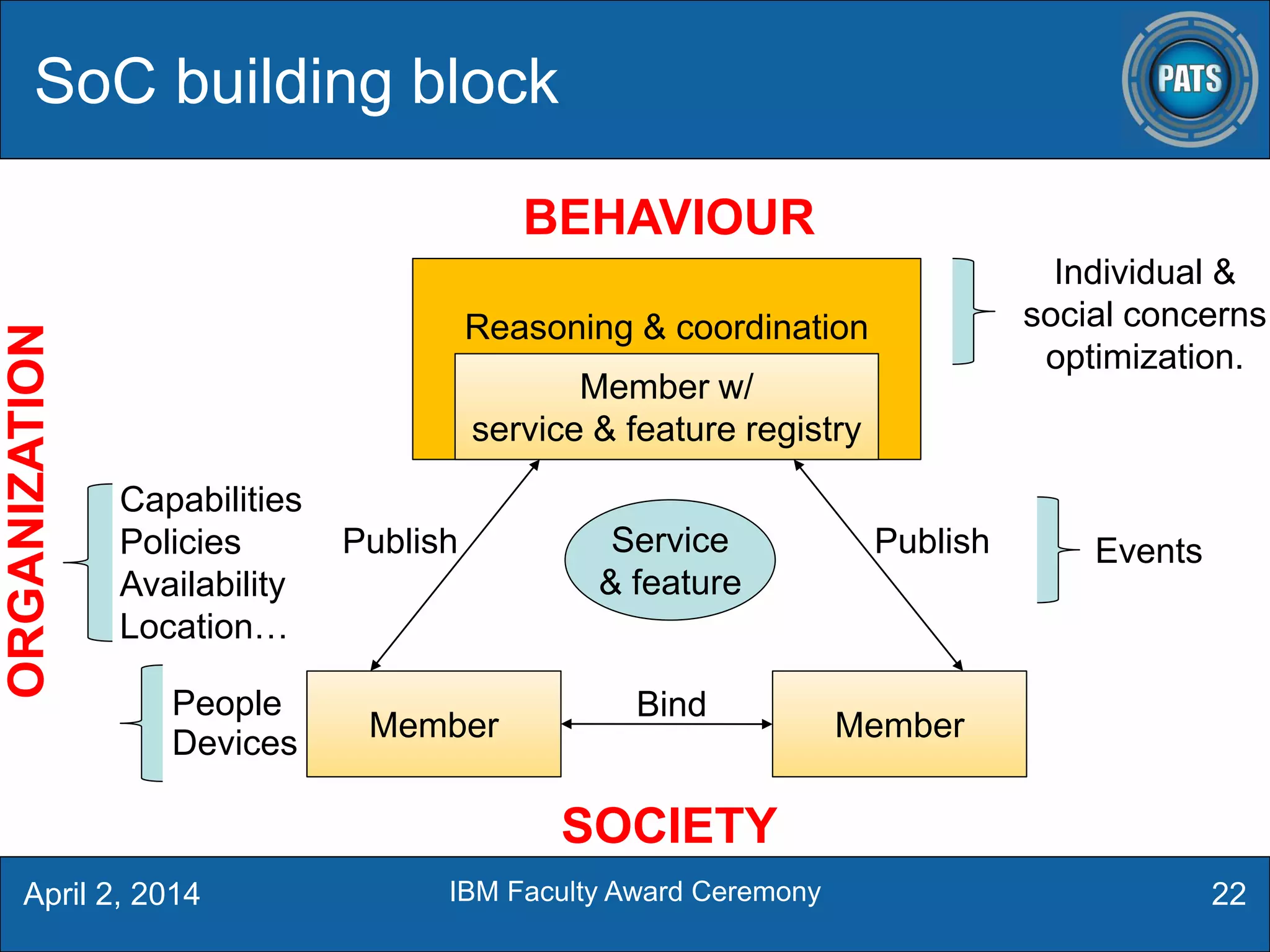
Reasoning & coordination
22
Member Member
Member w/
service & feature registry
Service
& feature
SoC building block
Publish Publish
Bind
Individual &
social concerns
optimization.
Capabilities
Policies
Availability
Location…
Events
People
Devices
SOCIETY
BEHAVIOUR
ORGANIZATION
April 2, 2014 IBM Faculty Award Ceremony
Example:
Mutual Assistance Community
23
ABC Shop
Smart
devices
Informal service
provider
Commercial vender
Doctor
Community
Access
A smart house
Coordination
center
(professional)
OSGI
Gateway
Create
OWL-S
OWL-S service
publication
Service
Request
OWL-S service
publication
OWL-S service
publication
OWL-S
Matcher
OSGI
bundle
OSGI
bundle
OSGI
bundle
More info: [DeB10]
April 2, 2014 IBM Faculty Award Ceremony
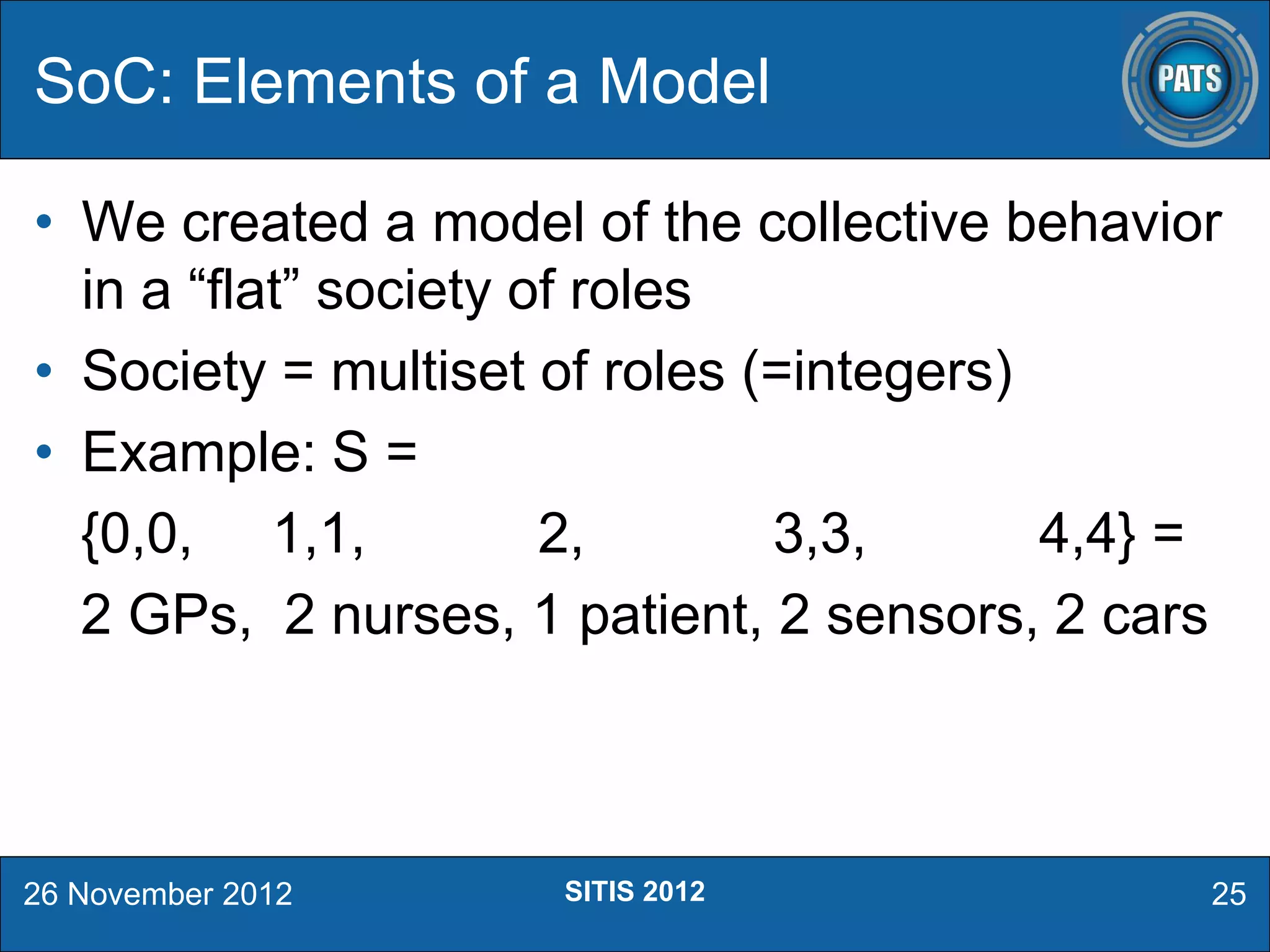
• We created a model of the collective behavior
in a “flat” society of roles
• Society = multiset of roles (=integers)
• Example: S =
{0,0, 1,1, 2, 3,3, 4,4} =
2 GPs, 2 nurses, 1 patient, 2 sensors, 2 cars
SoC: Elements of a Model
26 November 2012 25SITIS 2012
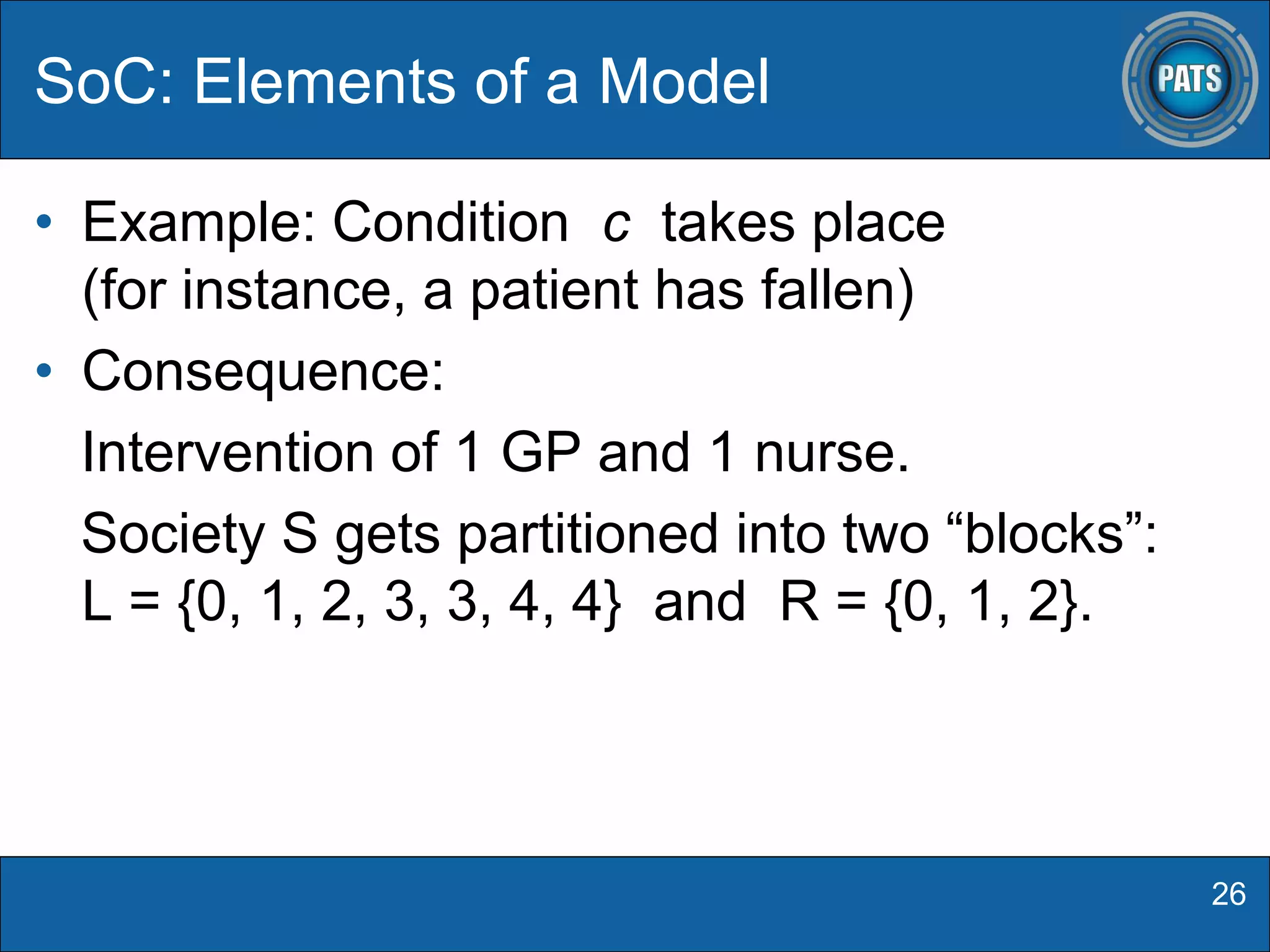
• Example: Condition c takes place
(for instance, a patient has fallen)
• Consequence:
Intervention of 1 GP and 1 nurse.
Society S gets partitioned into two “blocks”:
L = {0, 1, 2, 3, 3, 4, 4} and R = {0, 1, 2}.
SoC: Elements of a Model
26
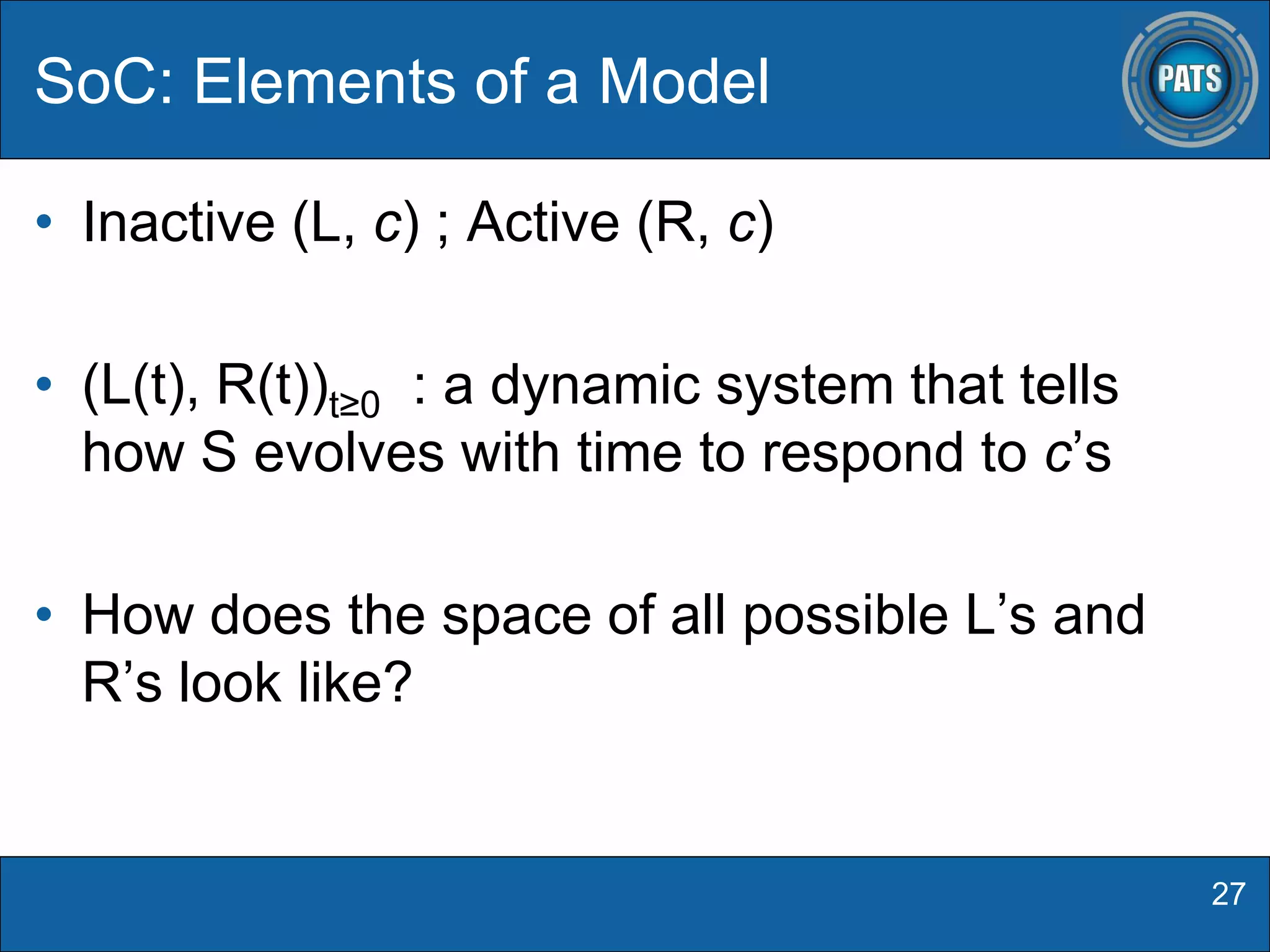
• Inactive (L, c) ; Active (R, c)
• (L(t), R(t))t≥0 : a dynamic system that tells
how S evolves with time to respond to c’s
• How does the space of all possible L’s and
R’s look like?
SoC: Elements of a Model
27
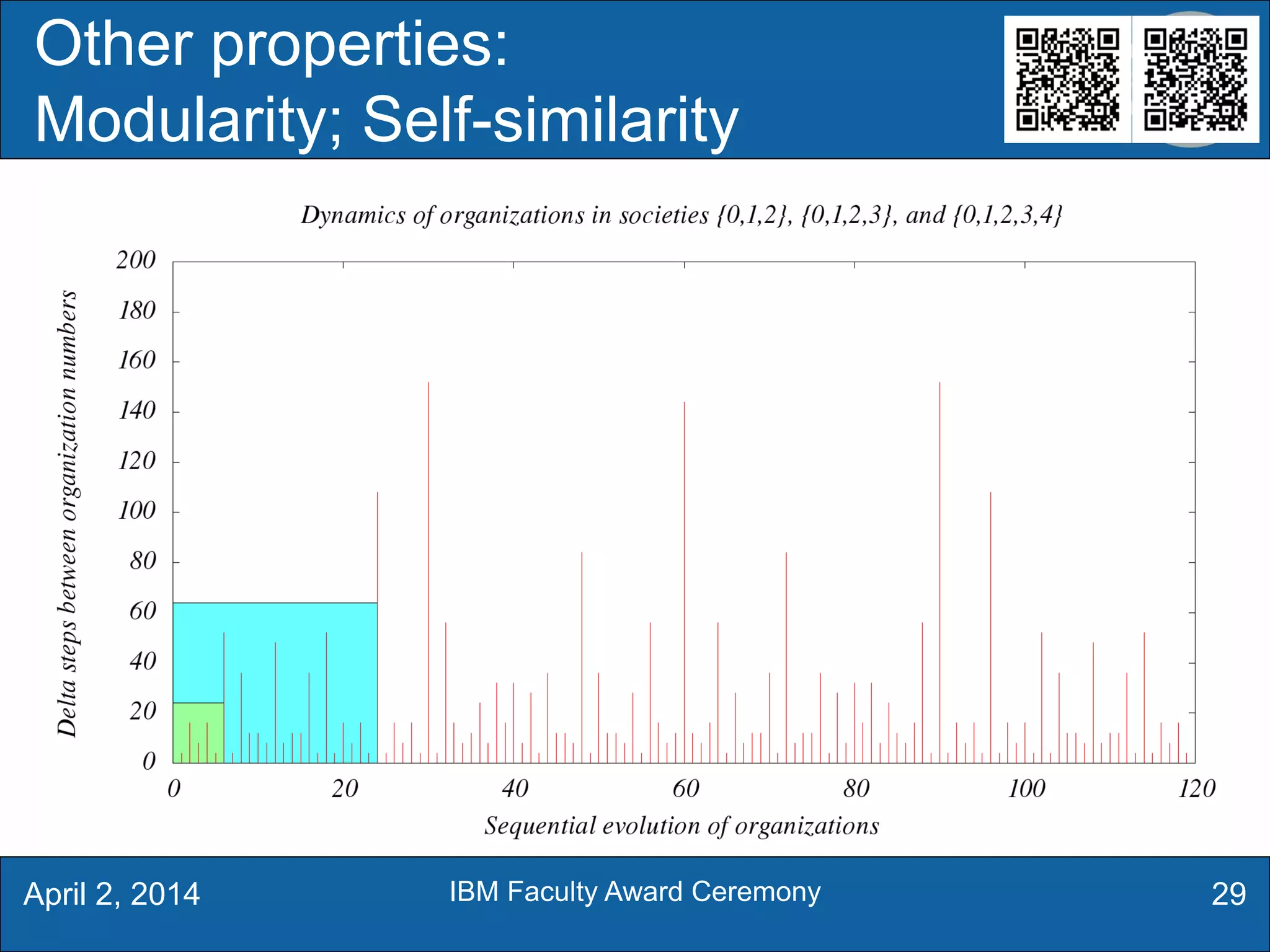
Modularity
28
Other properties:
Modularity; Self-similarity
29April 2, 2014 IBM Faculty Award Ceremony
Structure
• PATS/Adaptive-and-dependable systems
• Urgent need: Rethinking organizations
• Conjecture: Three key requirements
• Building block: Service-oriented communities
• Model: Fractal social organizations
• Conclusions
30April 2, 2014 IBM Faculty Award Ceremony
• The SoC model provides us with key ideas
 Modularity; self-similarity; fractal dimension…
• Major result: A hierarchy emerges from the
flat society!
 We injected these ideas back into the model
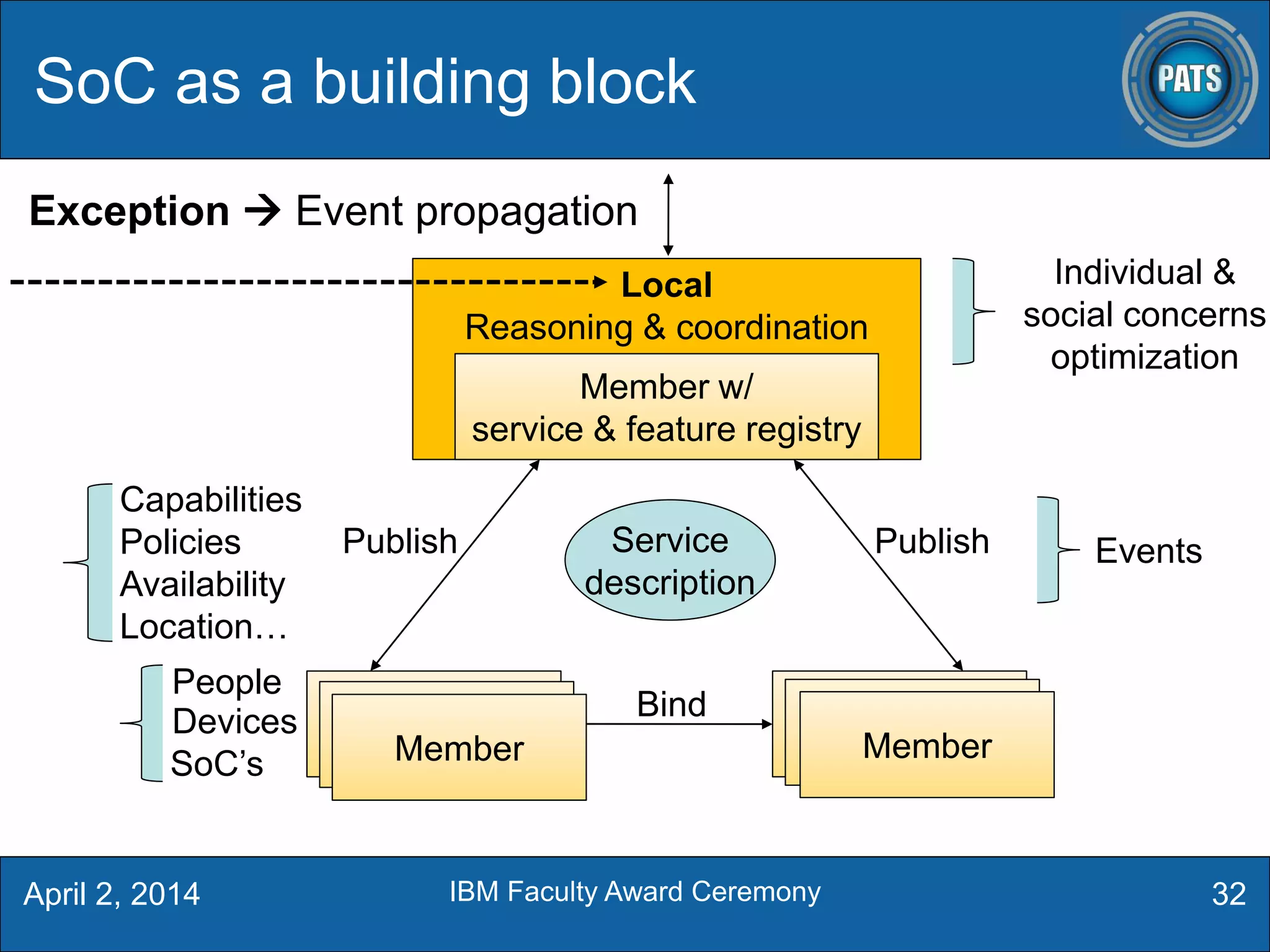
Fractal Social Organizations
26 November 2012 31SITIS 2012
32
Member Member
Service
description
SoC as a building block
Publish Publish
Bind
Local
Reasoning & coordination
Individual &
social concerns
optimization
Capabilities
Policies
Availability
Location…
Events
People
Devices MemberMember MemberMember
Exception  Event propagation
Member w/
service & feature registry
April 2, 2014 IBM Faculty Award Ceremony
SoC’s
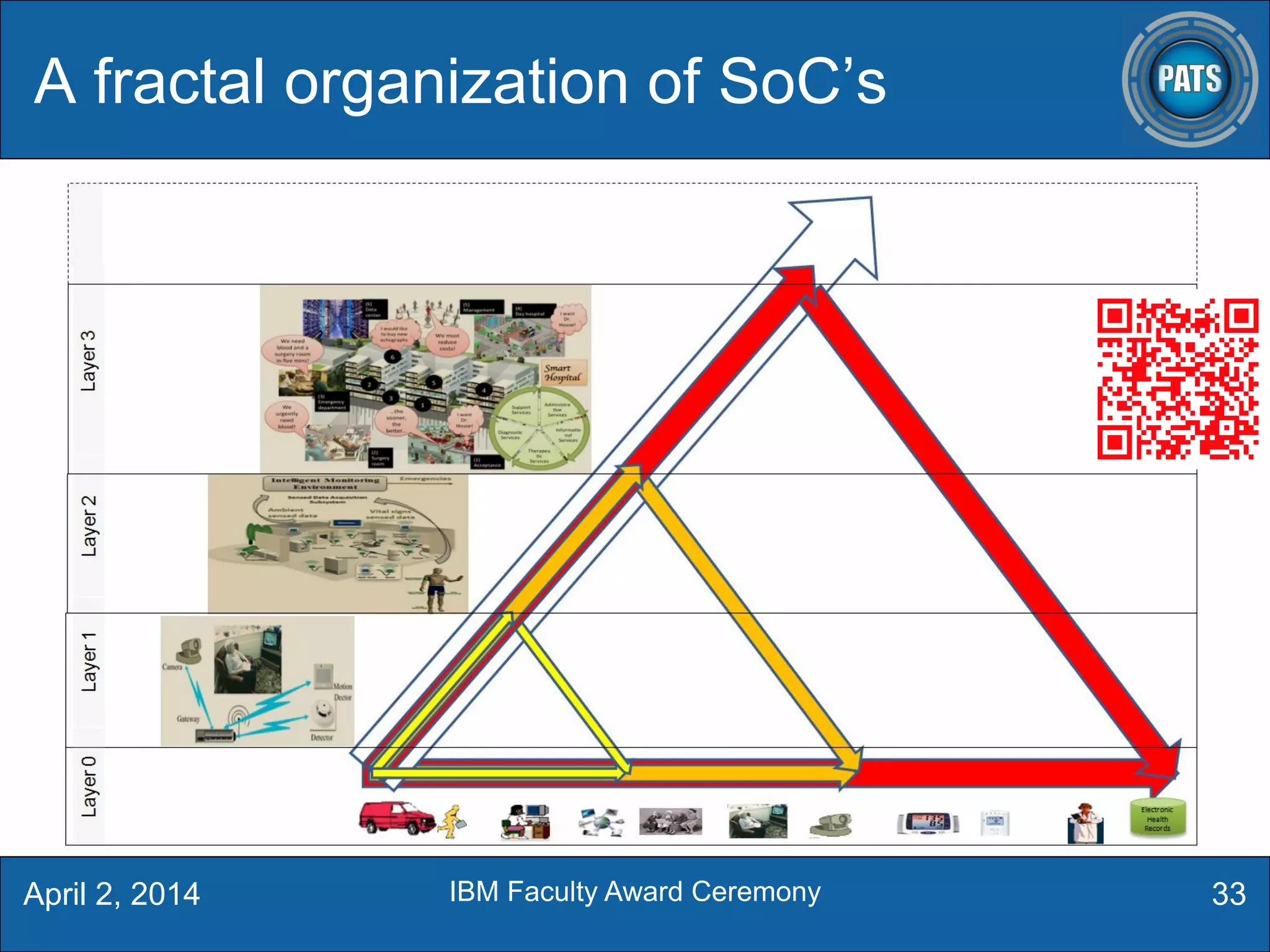
A fractal organization of SoC’s
33April 2, 2014 IBM Faculty Award Ceremony
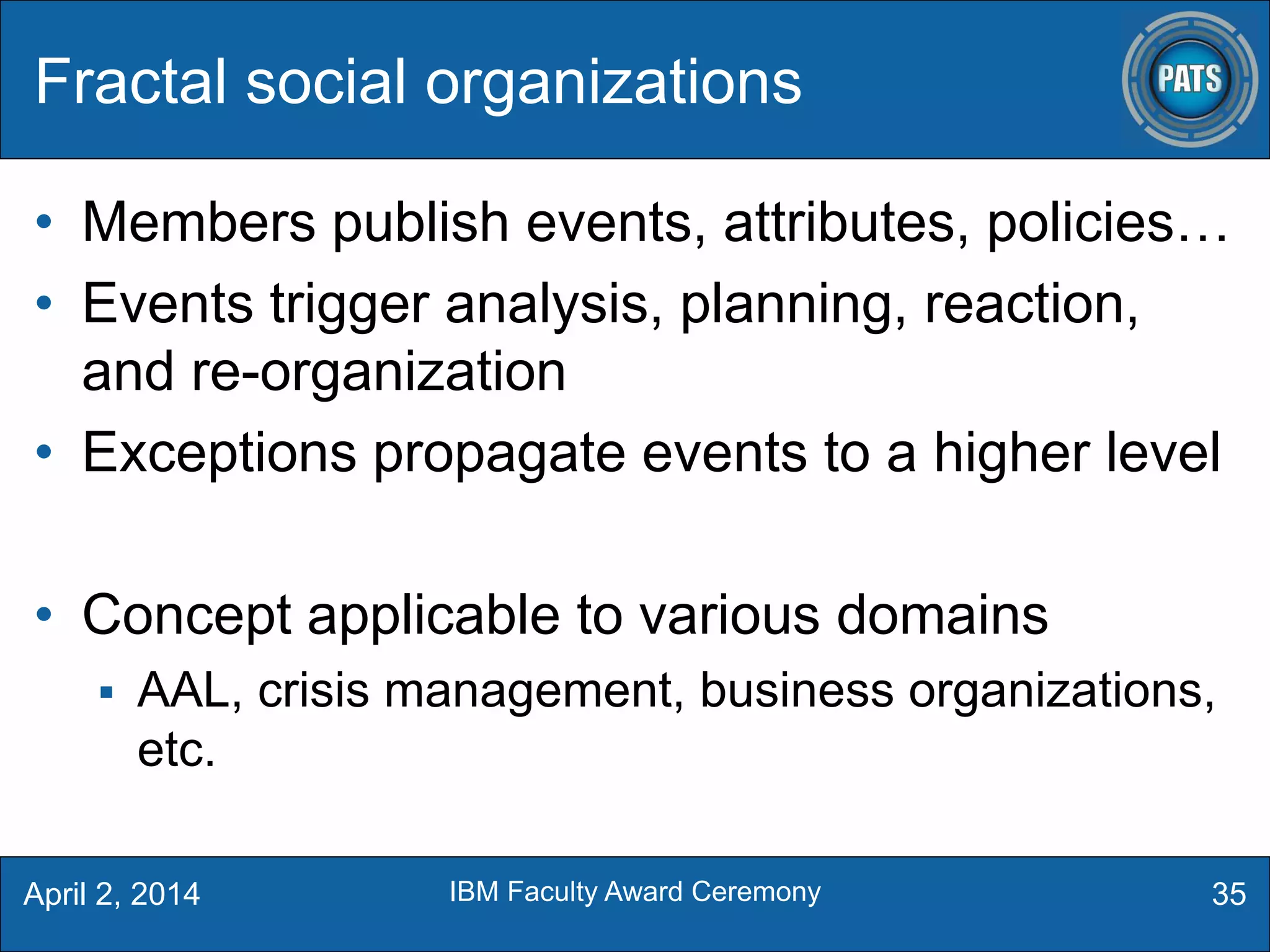
• Members publish events, attributes, policies…
• Events trigger analysis, planning, reaction,
and re-organization
• Exceptions propagate events to a higher level
• Concept applicable to various domains
 AAL, crisis management, business organizations,
etc.
Fractal social organizations
35April 2, 2014 IBM Faculty Award Ceremony
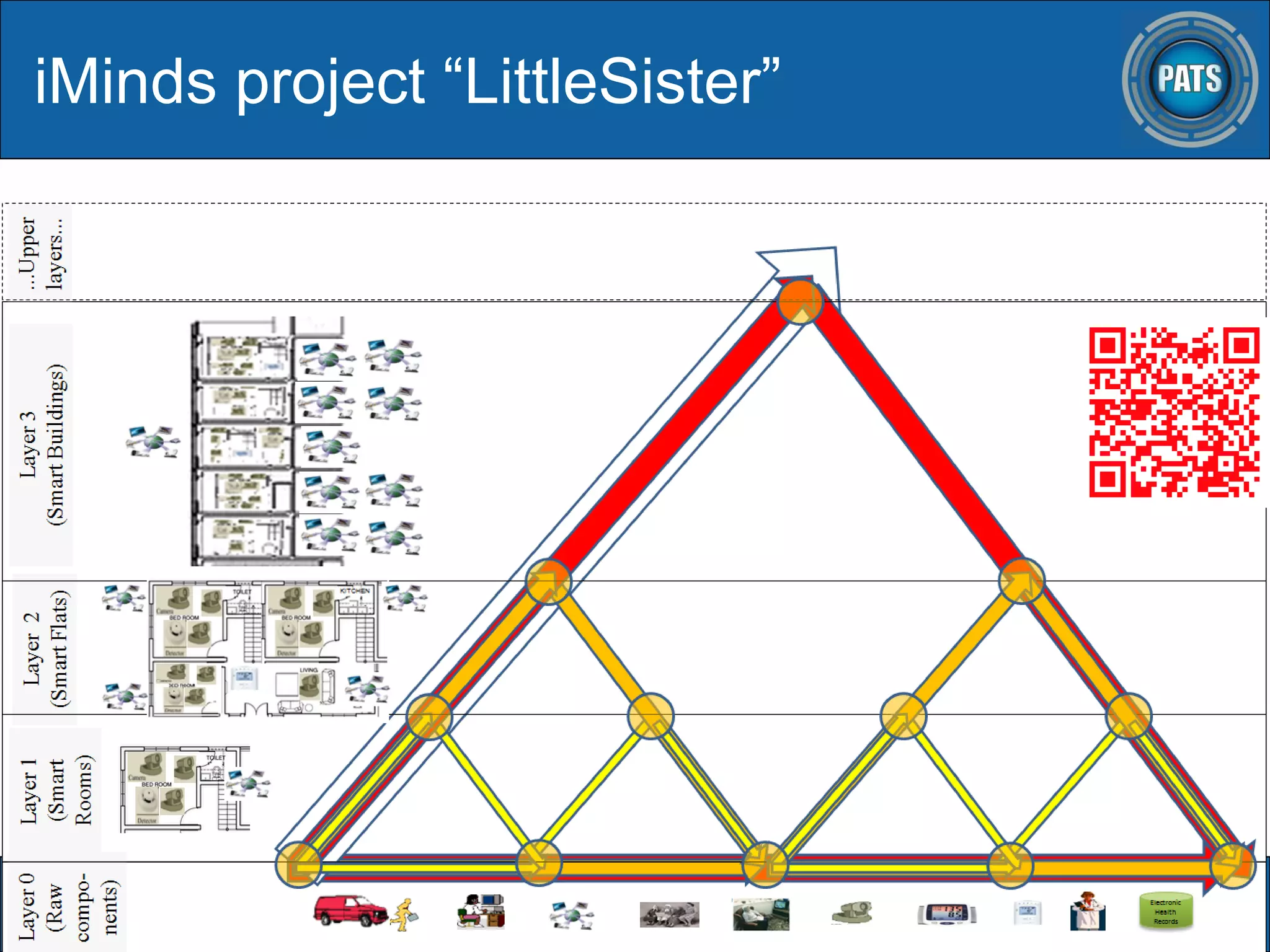
iMinds project “LittleSister”
36
• We introduced the main ideas of fractal social
organizations
 Three key “principles”: Society, behaviour,
organization
• Much is yet to be done
 From principles to simulation & actual design
 From design to deployment & testing
 Formal models to guarantee resilience...
 Etc etc!
Conclusions
37April 2, 2014 IBM Faculty Award Ceremony
• Much interest about this concept
 IBM! 
 iMinds SuperMinds
 Project proposals for H2020 (Crises
management; AAL)
• Other ideas at
http://eraclios.blogspot.be/
Conclusions
26 November 2012 38SITIS 2012
• Contact us through:
vincenzo.deflorio@uantwerpen.be
chris.blondia@uantwerpen.be
Thanks!
Conclusions
39April 2, 2014 IBM Faculty Award Ceremony

Service-oriented Communities and Fractal Social Organizations - Models and concepts for a Smarter Planet

  • 1.
    Service-oriented Communities and FractalSocial Organizations Models and concepts for a Smarter Planet Vincenzo De Florio PATS / University of Antwerp & iMinds
  • 2.
    Structure • PATS/Adaptive-and-dependable systems •Urgent need: Rethinking organizations • Conjecture: Three key requirements • A building block: Service-oriented community • A model: Fractal social organizations • Conclusions. 2April 2, 2014 IBM Faculty Award Ceremony
  • 3.
    PATS/Adaptive-and-Dependable Systems • Systemsdesigned so as to maintain functional and non- functional identity • Elasticity, resilience, antifragility April 2, 2014 IBM Faculty Award Ceremony
  • 4.
    Structure • PATS/Adaptive-and-dependable systems •Urgent need: Rethinking organizations • Conjecture: Three key requirements • Building block: Service-oriented communities • Model: Fractal social organizations • Conclusions 5April 2, 2014 IBM Faculty Award Ceremony
  • 5.
    Times, they area-changin’… 6 Less resources Higher peaks of requests Higher number of users… ICT Energy product- ion & distribution Businesses Transport of goods & people Water treatment & distribution Healthcare… Understanding & rethinking our organizations is crucial! April 2, 2014 IBM Faculty Award Ceremony
  • 6.
    With the meterin the red zone… • …organizations that appeared to work fine reveal their limitations!  lose too much  use up too many resources  do not scale well  intolerable to changes  fail to address new aspects → Traditional approaches are reaching structural limits. 7April 2, 2014 IBM Faculty Award Ceremony
  • 7.
    An example: healthcare 8 Fromwww.fifthplay.com • New context reveals the limitations of the traditional approach April 2, 2014 IBM Faculty Award Ceremony
  • 8.
    The healthcare crisis •Unmanageability is approaching  How should we rethink healthcare? • Starting point: Three observations:  Society at large is not part of the solution  Too many resources are wasted  No complex behaviors are expected from the vast majority of the components  Organization (mostly hierarchical) is inflexible, does not scale well, incurs huge costs… 9  Three key aspects: Society, organization, behaviour April 2, 2014 IBM Faculty Award Ceremony
  • 9.
    Structure • PATS/Adaptive-and-dependable systems •Urgent need: Rethinking organizations • Conjecture: Three key requirements • Building block: Service-oriented communities • Model: Fractal social organizations • Conclusions 10April 2, 2014 IBM Faculty Award Ceremony
  • 10.
    1) SOCIETY 11 • Apurely technical solution simply… does not work!  Hardin’s “Tragedy of the Commons”
  • 11.
    • Society mustbe part of the solution • Society ≡ abundant, mobile “resources” able to exercise complex action • Need: engineer ways to tap into the nearly unlimited sources of “social energy” of our societies. 12 Three key requirements... 1) SOCIETY April 2, 2014 IBM Faculty Award Ceremony
  • 12.
    26 November 201213SITIS 2012 We have met the solution. And the solution… is US!
  • 13.
    • Organizational /architectural choices define the features of our systems • Classic model: quasi-closed, hierarchical systems incapable of any complex interoperability. Three key requirements...2)ORGANIZATION 14April 2, 2014 IBM Faculty Award Ceremony
  • 14.
    • Need: opensmart organizations  Self-optimizing  Inter-organizational collective strategies  Mutualistic relationships; collaborative sharing of data and resources… 15April 2, 2014 IBM Faculty Award Ceremony Three key requirements...2)ORGANIZATION
  • 15.
    • Conjecture: Biologicallyinspired distributed organizations will play a key role in the emergence of collective intelligent responses  Holarchies and fractal organizations • “Simultaneously a part & a whole, a container & a contained, a controller & a controlled” [Sou00]  Networks of peer-levels (members). 16April 2, 2014 IBM Faculty Award Ceremony Three key requirements...2)ORGANIZATION
  • 16.
    • Behavior: “changew.r.t. surroundings” [RW43] • Purposeful, reactive, proactive behaviors • Needs: 1. Resilient behaviors: change aiming at preserving identity 2. Antifragile behaviors: change that preserves identity AND learns how to improve system-environment fit Three key requirements... 3) BEHAVIOUR 17April 2, 2014 IBM Faculty Award Ceremony
  • 17.
    Structure • PATS/Adaptive-and-dependable systems •Urgent need: Rethinking organizations • Conjecture: Three key requirements • Building block: Service-oriented communities • Model: Fractal social organizations • Conclusions 19April 2, 2014 IBM Faculty Award Ceremony
  • 18.
    • Social organizationbuilt by explicitly addressing the mentioned aspects  Taps into “social energy”  Node of a distributed organization  Supports complex resilient behaviours. Service-oriented communities 20April 2, 2014 IBM Faculty Award Ceremony
  • 19.
    21 Service provider Service requester Service registry Startingpoint: classical SOA model Publish Discover Bind Service description April 2, 2014 IBM Faculty Award Ceremony
  • 20.
    Reasoning & coordination 22 MemberMember Member w/ service & feature registry Service & feature SoC building block Publish Publish Bind Individual & social concerns optimization. Capabilities Policies Availability Location… Events People Devices SOCIETY BEHAVIOUR ORGANIZATION April 2, 2014 IBM Faculty Award Ceremony
  • 21.
    Example: Mutual Assistance Community 23 ABCShop Smart devices Informal service provider Commercial vender Doctor Community Access A smart house Coordination center (professional) OSGI Gateway Create OWL-S OWL-S service publication Service Request OWL-S service publication OWL-S service publication OWL-S Matcher OSGI bundle OSGI bundle OSGI bundle More info: [DeB10] April 2, 2014 IBM Faculty Award Ceremony
  • 22.
    • We createda model of the collective behavior in a “flat” society of roles • Society = multiset of roles (=integers) • Example: S = {0,0, 1,1, 2, 3,3, 4,4} = 2 GPs, 2 nurses, 1 patient, 2 sensors, 2 cars SoC: Elements of a Model 26 November 2012 25SITIS 2012
  • 23.
    • Example: Conditionc takes place (for instance, a patient has fallen) • Consequence: Intervention of 1 GP and 1 nurse. Society S gets partitioned into two “blocks”: L = {0, 1, 2, 3, 3, 4, 4} and R = {0, 1, 2}. SoC: Elements of a Model 26
  • 24.
    • Inactive (L,c) ; Active (R, c) • (L(t), R(t))t≥0 : a dynamic system that tells how S evolves with time to respond to c’s • How does the space of all possible L’s and R’s look like? SoC: Elements of a Model 27
  • 25.
  • 26.
  • 27.
    Structure • PATS/Adaptive-and-dependable systems •Urgent need: Rethinking organizations • Conjecture: Three key requirements • Building block: Service-oriented communities • Model: Fractal social organizations • Conclusions 30April 2, 2014 IBM Faculty Award Ceremony
  • 28.
    • The SoCmodel provides us with key ideas  Modularity; self-similarity; fractal dimension… • Major result: A hierarchy emerges from the flat society!  We injected these ideas back into the model Fractal Social Organizations 26 November 2012 31SITIS 2012
  • 29.
    32 Member Member Service description SoC asa building block Publish Publish Bind Local Reasoning & coordination Individual & social concerns optimization Capabilities Policies Availability Location… Events People Devices MemberMember MemberMember Exception  Event propagation Member w/ service & feature registry April 2, 2014 IBM Faculty Award Ceremony SoC’s
  • 30.
    A fractal organizationof SoC’s 33April 2, 2014 IBM Faculty Award Ceremony
  • 31.
    • Members publishevents, attributes, policies… • Events trigger analysis, planning, reaction, and re-organization • Exceptions propagate events to a higher level • Concept applicable to various domains  AAL, crisis management, business organizations, etc. Fractal social organizations 35April 2, 2014 IBM Faculty Award Ceremony
  • 32.
  • 33.
    • We introducedthe main ideas of fractal social organizations  Three key “principles”: Society, behaviour, organization • Much is yet to be done  From principles to simulation & actual design  From design to deployment & testing  Formal models to guarantee resilience...  Etc etc! Conclusions 37April 2, 2014 IBM Faculty Award Ceremony
  • 34.
    • Much interestabout this concept  IBM!   iMinds SuperMinds  Project proposals for H2020 (Crises management; AAL) • Other ideas at http://eraclios.blogspot.be/ Conclusions 26 November 2012 38SITIS 2012
  • 35.
    • Contact usthrough: vincenzo.deflorio@uantwerpen.be chris.blondia@uantwerpen.be Thanks! Conclusions 39April 2, 2014 IBM Faculty Award Ceremony