On the
Behavioral Interpretation of
System-Environment Fit
and Auto-Resilience
Vincenzo De Florio
MOSAIC research group
University of Antwerp & iMinds
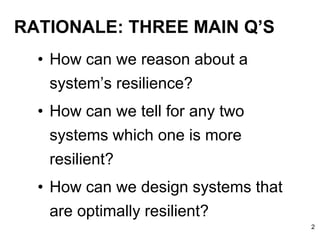
RATIONALE: THREE MAIN Q’S
• How can we reason about a
system’s resilience?
• How can we tell for any two
systems which one is more
resilient?
• How can we design systems that
are optimally resilient?
2
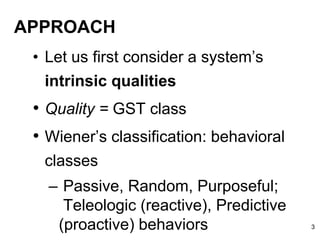
APPROACH
• Let us first consider a system’s
intrinsic qualities
• Quality = GST class
• Wiener’s classification: behavioral
classes
– Passive, Random, Purposeful;
Teleologic (reactive), Predictive
(proactive) behaviors 3
APPROACH
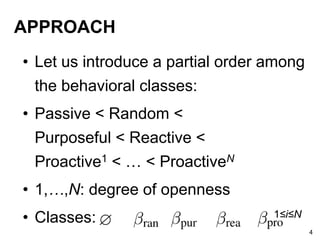
• Let us introduce a partial order among
the behavioral classes:
• Passive < Random <
Purposeful < Reactive <
Proactive1 < … < ProactiveN
• 1,…,N: degree of openness
• Classes: 1≤i≤N
4
INTRINSIC QUALITY
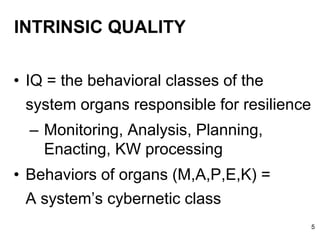
• IQ = the behavioral classes of the
system organs responsible for resilience
– Monitoring, Analysis, Planning,
Enacting, KW processing
• Behaviors of organs (M,A,P,E,K) =
A system’s cybernetic class
5
INTRINSIC QUALITY
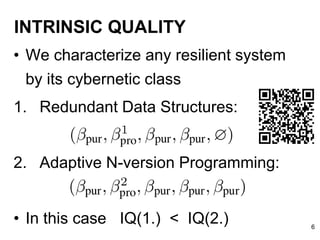
• We characterize any resilient system
by its cybernetic class
1. Redundant Data Structures:
2. Adaptive N-version Programming:
• In this case IQ(1.) < IQ(2.) 6
INTRINSIC QUALITY
• Is IQ enough to characterize resilience?
• If I have two systems, a and b, such that
IQ(a) < IQ(b), does this imply that b is
more resilient than a ?
• Not exactly
7
EXTRINSIC QUALITY
• Systemic features of Man are more
sophisticated than Dog’s; but what if
threat comes with, e.g., ultrasonic noise?
• Canary+Miner ≈ Miner < Miners; but
what if threat is, e.g., toxic gas in a mine?
• “What if” is the contingence
• “What if” is the environment
8
ENVIRONMENT
 a dynamic system we interact with
• More or less predictable!
– the result of the actions of
• a human being (a “user”)
• a software component
•A cyberphysical thing
• EMI source
•…etc… 9
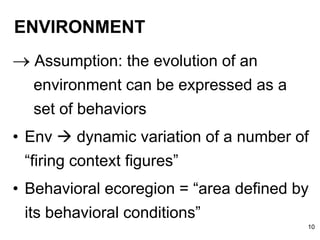
ENVIRONMENT
 Assumption: the evolution of an
environment can be expressed as a
set of behaviors
• Env  dynamic variation of a number of
“firing context figures”
• Behavioral ecoregion = “area defined by
its behavioral conditions”
10
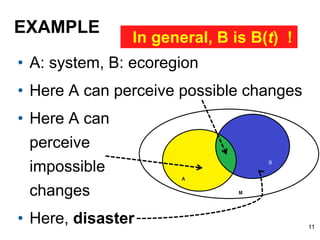
EXAMPLE
11
• A: system, B: ecoregion
• Here A can perceive possible changes
• Here A can
perceive
impossible
changes
• Here, disaster
In general, B is B(t) !
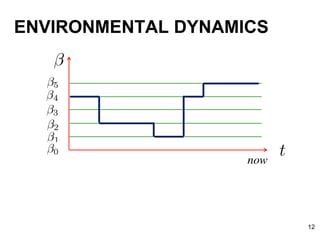
ENVIRONMENTAL DYNAMICS
12
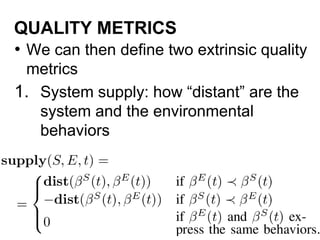
QUALITY METRICS
• We can then define two extrinsic quality
metrics
1. System supply: how “distant” are the
system and the environmental
behaviors
13
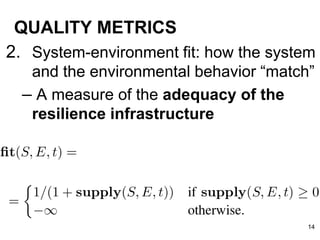
QUALITY METRICS
2. System-environment fit: how the system
and the environmental behavior “match”
– A measure of the adequacy of the
resilience infrastructure
14
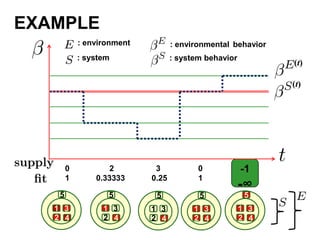
-1
-∞
0 2 3 0
1 0.33333 0.25 1
1
2
3
4
5
1
2
3
4
5
1
2
3
4
5
1
2
3
4
5
1
2
3
4
5
: environmental behavior
: system behavior
: environment
: system
(t)
(t)
EXAMPLE
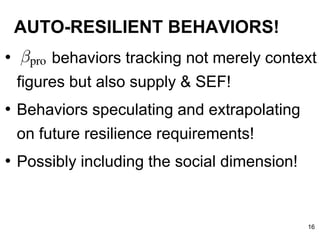
AUTO-RESILIENT BEHAVIORS!
• behaviors tracking not merely context
figures but also supply & SEF!
• Behaviors speculating and extrapolating
on future resilience requirements!
• Possibly including the social dimension!
16
APPLICATIONS
• Redundant data structures
– Optimal amount of
redundancy
• Adaptive NVP
– Optimal amount /
selection of replicas
• LittleSister framework
– Optimization of energy,
safety, performance 17
CONCLUSIONS
• How can we reason about a system’s
resilience? IQ+EQ
• How can we tell for any two systems
which one is more resilient?
IQ+EQ (to some extent!)
• How can we design systems that are
optimally resilient? Auto-resilience
Computational antifragility 18
CONCLUSIONS
• Leibniz’s lesson (cf. Session L.2)!
Intrinsic and extrinsic qualities!
–Intrinsic: systemic & (mostly)
immutable
–Extrinsic: contingent, env-
specific, dynamic
19
Thank you very much!
20
ERACLIOS
BLOG
Computational
Antifragility

On the Behavioral Interpretation of System-Environment Fit and Auto-Resilience

  • 1.
    On the Behavioral Interpretationof System-Environment Fit and Auto-Resilience Vincenzo De Florio MOSAIC research group University of Antwerp & iMinds
  • 2.
    RATIONALE: THREE MAINQ’S • How can we reason about a system’s resilience? • How can we tell for any two systems which one is more resilient? • How can we design systems that are optimally resilient? 2
  • 3.
    APPROACH • Let usfirst consider a system’s intrinsic qualities • Quality = GST class • Wiener’s classification: behavioral classes – Passive, Random, Purposeful; Teleologic (reactive), Predictive (proactive) behaviors 3
  • 4.
    APPROACH • Let usintroduce a partial order among the behavioral classes: • Passive < Random < Purposeful < Reactive < Proactive1 < … < ProactiveN • 1,…,N: degree of openness • Classes: 1≤i≤N 4
  • 5.
    INTRINSIC QUALITY • IQ= the behavioral classes of the system organs responsible for resilience – Monitoring, Analysis, Planning, Enacting, KW processing • Behaviors of organs (M,A,P,E,K) = A system’s cybernetic class 5
  • 6.
    INTRINSIC QUALITY • Wecharacterize any resilient system by its cybernetic class 1. Redundant Data Structures: 2. Adaptive N-version Programming: • In this case IQ(1.) < IQ(2.) 6
  • 7.
    INTRINSIC QUALITY • IsIQ enough to characterize resilience? • If I have two systems, a and b, such that IQ(a) < IQ(b), does this imply that b is more resilient than a ? • Not exactly 7
  • 8.
    EXTRINSIC QUALITY • Systemicfeatures of Man are more sophisticated than Dog’s; but what if threat comes with, e.g., ultrasonic noise? • Canary+Miner ≈ Miner < Miners; but what if threat is, e.g., toxic gas in a mine? • “What if” is the contingence • “What if” is the environment 8
  • 9.
    ENVIRONMENT  a dynamicsystem we interact with • More or less predictable! – the result of the actions of • a human being (a “user”) • a software component •A cyberphysical thing • EMI source •…etc… 9
  • 10.
    ENVIRONMENT  Assumption: theevolution of an environment can be expressed as a set of behaviors • Env  dynamic variation of a number of “firing context figures” • Behavioral ecoregion = “area defined by its behavioral conditions” 10
  • 11.
    EXAMPLE 11 • A: system,B: ecoregion • Here A can perceive possible changes • Here A can perceive impossible changes • Here, disaster In general, B is B(t) !
  • 12.
  • 13.
    QUALITY METRICS • Wecan then define two extrinsic quality metrics 1. System supply: how “distant” are the system and the environmental behaviors 13
  • 14.
    QUALITY METRICS 2. System-environmentfit: how the system and the environmental behavior “match” – A measure of the adequacy of the resilience infrastructure 14
  • 15.
    -1 -∞ 0 2 30 1 0.33333 0.25 1 1 2 3 4 5 1 2 3 4 5 1 2 3 4 5 1 2 3 4 5 1 2 3 4 5 : environmental behavior : system behavior : environment : system (t) (t) EXAMPLE
  • 16.
    AUTO-RESILIENT BEHAVIORS! • behaviorstracking not merely context figures but also supply & SEF! • Behaviors speculating and extrapolating on future resilience requirements! • Possibly including the social dimension! 16
  • 17.
    APPLICATIONS • Redundant datastructures – Optimal amount of redundancy • Adaptive NVP – Optimal amount / selection of replicas • LittleSister framework – Optimization of energy, safety, performance 17
  • 18.
    CONCLUSIONS • How canwe reason about a system’s resilience? IQ+EQ • How can we tell for any two systems which one is more resilient? IQ+EQ (to some extent!) • How can we design systems that are optimally resilient? Auto-resilience Computational antifragility 18
  • 19.
    CONCLUSIONS • Leibniz’s lesson(cf. Session L.2)! Intrinsic and extrinsic qualities! –Intrinsic: systemic & (mostly) immutable –Extrinsic: contingent, env- specific, dynamic 19
  • 20.
    Thank you verymuch! 20 ERACLIOS BLOG Computational Antifragility