NNFCC


         The Potential for Advanced Biofuels


                                  Dr Jeremy Tomkinson
                                      CEO NNFCC
                                     February 2012


The UK’s National Centre for Biorenewable Energy, Fuels and Materials
NNFCC

 Advanced Biofuels in the UK: Key questions?


• Why next generation biofuels are needed in the UK
• UK strengths and why thermal routes are potentially more suited to the UK
   situation
• When advanced fuels may emerge in the UK
• Potential build rate scenarios in the UK to 2020 and cost / benefit analysis


The UK’s National Centre for Biorenewable Energy, Fuels and Materials
NNFCC

Advanced Biofuels: the potential for a UK industry

NNFCC Roadmap Project:
NNFCC have examined the potential costs and benefits of developing a UK
advanced biofuels industry, compiling data that will assist the DfT and DECC in
developing a business case to support the growth of an advanced biofuels
industry in the UK.

Project aims:
• Establish if there is a need for advanced biofuels in the UK in 2020
• Investigate the potential costs and benefits of developing a UK advanced
   biofuels industry
    – The revenue required to support the industry
    – The cost of meeting the RED and FQD with advanced biofuels
    – The overall value of a UK industry


The UK’s National Centre for Biorenewable Energy, Fuels and Materials
NNFCC

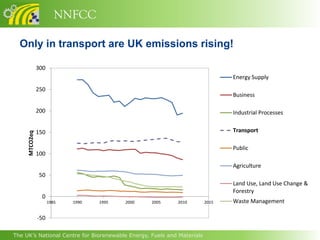
  Only in transport are UK emissions rising!

               300
                                                                               Energy Supply
               250
                                                                               Business

               200                                                             Industrial Processes


               150                                                             Transport
     MTCO2eq


                                                                               Public
               100
                                                                               Agriculture
                50
                                                                               Land Use, Land Use Change &
                                                                               Forestry
                0
                     1985   1990   1995   2000    2005     2010         2015   Waste Management

               -50

The UK’s National Centre for Biorenewable Energy, Fuels and Materials
NNFCC

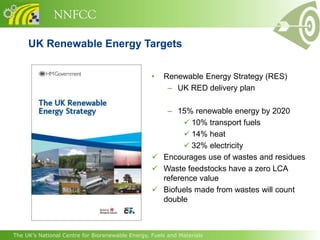
     UK Renewable Energy Targets

                                                  •   Renewable Energy Strategy (RES)
                                                       – UK RED delivery plan

                                                     – 15% renewable energy by 2020
                                                           10% transport fuels
                                                           14% heat
                                                           32% electricity
                                                   Encourages use of wastes and residues
                                                   Waste feedstocks have a zero LCA
                                                    reference value
                                                   Biofuels made from wastes will count
                                                    double


The UK’s National Centre for Biorenewable Energy, Fuels and Materials
NNFCC

     UK Renewable Energy Targets

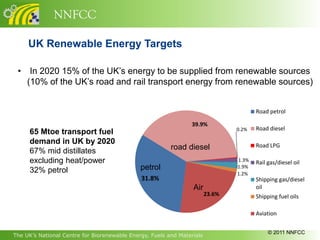
 • In 2020 15% of the UK’s energy to be supplied from renewable sources
   (10% of the UK’s road and rail transport energy from renewable sources)


                                                                                       Road petrol

                                                                 39.9%
                                                                                0.2%   Road diesel
     65 Mtoe transport fuel
     demand in UK by 2020                                                              Road LPG
     67% mid distillates                                 road diesel
     excluding heat/power                                                       1.3%   Rail gas/diesel oil
     32% petrol                               petrol                            1.9%
                                                                                1.2%
                                              31.8%                                    Shipping gas/diesel
                                                                 Air                   oil
                                                                        23.6%          Shipping fuel oils

                                                                                       Aviation


                                                                                            © 2011 NNFCC
The UK’s National Centre for Biorenewable Energy, Fuels and Materials
NNFCC

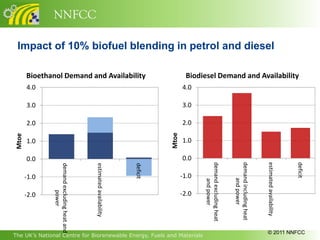
 Impact of 10% biofuel blending in petrol and diesel

       Bioethanol Demand and Availability                                            Biodiesel Demand and Availability
       4.0                                                                          4.0

       3.0                                                                          3.0

       2.0                                                                          2.0


                                                                             Mtoe
Mtoe


       1.0                                                                          1.0

       0.0                                                                          0.0


                                                                                           demand excluding heat


                                                                                                                   demand including heat


                                                                                                                                           estimated availability


                                                                                                                                                                    deficit
              demand excluding heat and


                                          estimated availability


                                                                   deficit


       -1.0                                                                         -1.0


                                                                                                                       and power
                                                                                                and power
                       power


       -2.0                                                                         -2.0


                                                                                                                                            © 2011 NNFCC
The UK’s National Centre for Biorenewable Energy, Fuels and Materials
NNFCC
 Potential first generation bioethanol and first generation
 biodiesel expansion

                    Bioethanol                                          Diesel/mid-distillate
                    production potential                                demand


                                                                            Biodiesel production
                        Petrol demand                                       potential


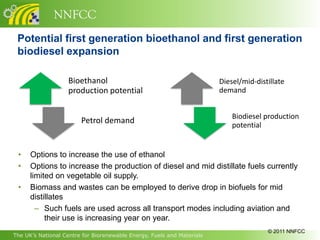
 •    Options to increase the use of ethanol
 •    Options to increase the production of diesel and mid distillate fuels currently
      limited on vegetable oil supply.
 •    Biomass and wastes can be employed to derive drop in biofuels for mid
      distillates
        – Such fuels are used across all transport modes including aviation and
           their use is increasing year on year.
                                                                                       © 2011 NNFCC
The UK’s National Centre for Biorenewable Energy, Fuels and Materials
NNFCC

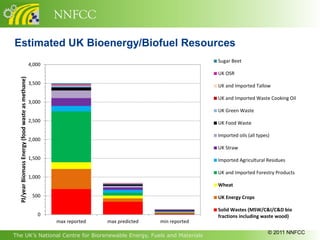
Estimated UK Bioenergy/Biofuel Resources
                                                                                                         Sugar Beet
                                                   4,000
                                                                                                         UK OSR
  PJ/year Biomass Energy (food waste as methane)


                                                   3,500                                                 UK and Imported Tallow

                                                                                                         UK and Imported Waste Cooking Oil
                                                   3,000
                                                                                                         UK Green Waste
                                                   2,500                                                 UK Food Waste

                                                                                                         Imported oils (all types)
                                                   2,000
                                                                                                         UK Straw
                                                   1,500                                                 Imported Agricultural Residues

                                                                                                         UK and Imported Forestry Products
                                                   1,000
                                                                                                         Wheat

                                                    500                                                  UK Energy Crops

                                                                                                         Solid Wastes (MSW/C&I/C&D bio
                                                      0                                                  fractions including waste wood)
                                                           max reported   max predicted   min reported

                                                                                                                                 © 2011 NNFCC
The UK’s National Centre for Biorenewable Energy, Fuels and Materials
NNFCC

    Advanced bioenergy projects

•   Bioethanol, power and heat from biowastes - Ineos Bio (Seal Sands)

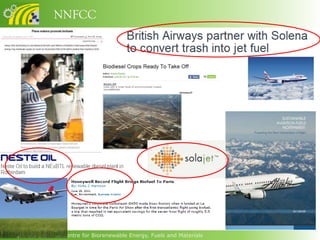
•   Aviation fuel from waste wood - British Airways / Solena (London)

•   Air Products: Building a 49 MWe IGCC plant incorporating plasma gasification
    of waste. Air Products have plans to develop hydrogen production on the back
    of this project.

•   NNFCC are working with at least two other potential UK XTL projects which are
    client confidential.

•   NNFCC have identified 750 MWe of potential gasification and pyrolysis projects
    in the UK – most propose to use wastes.


The UK’s National Centre for Biorenewable Energy, Fuels and Materials
NNFCC

   Waste to fuels and Chemicals – Ineos Bio
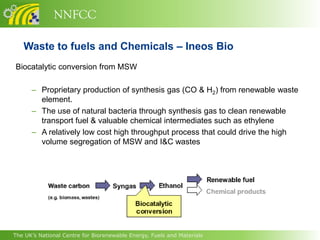
Biocatalytic conversion from MSW

      – Proprietary production of synthesis gas (CO & H2) from renewable waste
        element.
      – The use of natural bacteria through synthesis gas to clean renewable
        transport fuel & valuable chemical intermediates such as ethylene
      – A relatively low cost high throughput process that could drive the high
        volume segregation of MSW and I&C wastes


The UK’s National Centre for Biorenewable Energy, Fuels and Materials
NNFCC

    Benefits of syngas fermentation to ethanol

•   > 90% greenhouse gas savings vs. petrol / gasoline

•   Potential for bioethanol to be cheaper than petrol

•   Provides energy in addition to fuel

•   High diversion of biodegradable wastes from landfill

•   Wastes generated locally converted to clean fuel for local use

•   Simple, energy-efficient process

•   Platform to ethylene value chain


The UK’s National Centre for Biorenewable Energy, Fuels and Materials
NNFCC

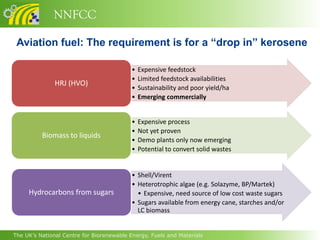
 Aviation fuel: The requirement is for a “drop in” kerosene

                                           •   Expensive feedstock
                                           •   Limited feedstock availabilities
               HRJ (HVO)
                                           •   Sustainability and poor yield/ha
                                           •   Emerging commercially


                                           •   Expensive process
                                           •   Not yet proven
          Biomass to liquids
                                           •   Demo plants only now emerging
                                           •   Potential to convert solid wastes


                                           • Shell/Virent
                                           • Heterotrophic algae (e.g. Solazyme, BP/Martek)
     Hydrocarbons from sugars                • Expensive, need source of low cost waste sugars
                                           • Sugars available from energy cane, starches and/or
                                             LC biomass


The UK’s National Centre for Biorenewable Energy, Fuels and Materials
NNFCC


The UK’s National Centre for Biorenewable Energy, Fuels and Materials
NNFCC

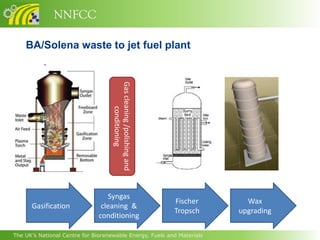
    BA/Solena waste to jet fuel plant


                                    Gas cleaning /polishing and
                                           conditioning


                                  Syngas
                                                                  Fischer     Wax
      Gasification              cleaning &
                                                                  Tropsch   upgrading
                               conditioning

The UK’s National Centre for Biorenewable Energy, Fuels and Materials
NNFCC

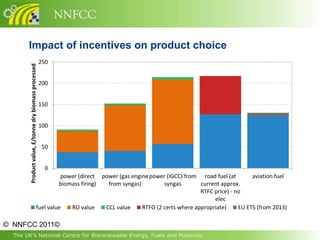
       Impact of incentives on product choice
                                                       250
        Product value, £/tonne dry biomass processed


                                                       200


                                                       150


                                                       100


                                                        50


                                                         0
                                                       power (direct power (gas engine power (IGCC) from road fuel (at        aviation fuel
                                                      biomass firing)  from syngas)         syngas        current approx.
                                                                                                          RTFC price) - no
                                                                                                               elec
                                             fuel value   RO value    CCL value     RTFO (2 certs where appropriate)     EU ETS (from 2013)

© NNFCC 2011©
  The UK’s National Centre for Biorenewable Energy, Fuels and Materials
NNFCC

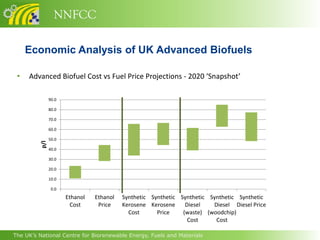
     Economic Analysis of UK Advanced Biofuels

 •   Advanced Biofuel Cost vs Fuel Price Projections - 2020 ‘Snapshot’

                90.0

                80.0

                70.0

                60.0

                50.0
          p/l


                40.0

                30.0

                20.0

                10.0

                 0.0
                       Ethanol   Ethanol   Synthetic Synthetic Synthetic Synthetic Synthetic
                         Cost     Price    Kerosene Kerosene     Diesel   Diesel Diesel Price
                                             Cost      Price    (waste) (woodchip)
                                                                  Cost     Cost

The UK’s National Centre for Biorenewable Energy, Fuels and Materials
NNFCC

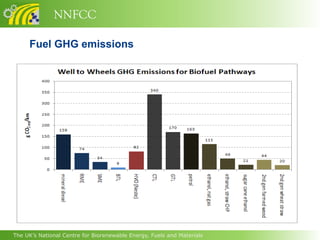
     Fuel GHG emissions


The UK’s National Centre for Biorenewable Energy, Fuels and Materials
NNFCC

    The NNFCC provides high quality, industry leading consultancy

                              for more information contact us

                                         www.nnfcc.co.uk

                               Email - enquiries@nnfcc.co.uk

                                        Twitter - @NNFCC

                                       +44 (0) 1904 435182


•   Future Market Analysis                            •   Technology evaluation & associated
•   Feedstock Logistics Planning                          due diligence
•   Sustainability Strategy                           •   Project feasibility assessment
    Development                                       •   Policy and regulatory support

The UK’s National Centre for Biorenewable Energy, Fuels and Materials

Advanced Biofuels

  • 1.
    NNFCC The Potential for Advanced Biofuels Dr Jeremy Tomkinson CEO NNFCC February 2012 The UK’s National Centre for Biorenewable Energy, Fuels and Materials
  • 2.
    NNFCC Advanced Biofuelsin the UK: Key questions? • Why next generation biofuels are needed in the UK • UK strengths and why thermal routes are potentially more suited to the UK situation • When advanced fuels may emerge in the UK • Potential build rate scenarios in the UK to 2020 and cost / benefit analysis The UK’s National Centre for Biorenewable Energy, Fuels and Materials
  • 3.
    NNFCC Advanced Biofuels: thepotential for a UK industry NNFCC Roadmap Project: NNFCC have examined the potential costs and benefits of developing a UK advanced biofuels industry, compiling data that will assist the DfT and DECC in developing a business case to support the growth of an advanced biofuels industry in the UK. Project aims: • Establish if there is a need for advanced biofuels in the UK in 2020 • Investigate the potential costs and benefits of developing a UK advanced biofuels industry – The revenue required to support the industry – The cost of meeting the RED and FQD with advanced biofuels – The overall value of a UK industry The UK’s National Centre for Biorenewable Energy, Fuels and Materials
  • 4.
    NNFCC Onlyin transport are UK emissions rising! 300 Energy Supply 250 Business 200 Industrial Processes 150 Transport MTCO2eq Public 100 Agriculture 50 Land Use, Land Use Change & Forestry 0 1985 1990 1995 2000 2005 2010 2015 Waste Management -50 The UK’s National Centre for Biorenewable Energy, Fuels and Materials
  • 5.
    NNFCC UK Renewable Energy Targets • Renewable Energy Strategy (RES) – UK RED delivery plan – 15% renewable energy by 2020  10% transport fuels  14% heat  32% electricity  Encourages use of wastes and residues  Waste feedstocks have a zero LCA reference value  Biofuels made from wastes will count double The UK’s National Centre for Biorenewable Energy, Fuels and Materials
  • 6.
    NNFCC UK Renewable Energy Targets • In 2020 15% of the UK’s energy to be supplied from renewable sources (10% of the UK’s road and rail transport energy from renewable sources) Road petrol 39.9% 0.2% Road diesel 65 Mtoe transport fuel demand in UK by 2020 Road LPG 67% mid distillates road diesel excluding heat/power 1.3% Rail gas/diesel oil 32% petrol petrol 1.9% 1.2% 31.8% Shipping gas/diesel Air oil 23.6% Shipping fuel oils Aviation © 2011 NNFCC The UK’s National Centre for Biorenewable Energy, Fuels and Materials
  • 7.
    NNFCC Impact of10% biofuel blending in petrol and diesel Bioethanol Demand and Availability Biodiesel Demand and Availability 4.0 4.0 3.0 3.0 2.0 2.0 Mtoe Mtoe 1.0 1.0 0.0 0.0 demand excluding heat demand including heat estimated availability deficit demand excluding heat and estimated availability deficit -1.0 -1.0 and power and power power -2.0 -2.0 © 2011 NNFCC The UK’s National Centre for Biorenewable Energy, Fuels and Materials
  • 8.
    NNFCC Potential firstgeneration bioethanol and first generation biodiesel expansion Bioethanol Diesel/mid-distillate production potential demand Biodiesel production Petrol demand potential • Options to increase the use of ethanol • Options to increase the production of diesel and mid distillate fuels currently limited on vegetable oil supply. • Biomass and wastes can be employed to derive drop in biofuels for mid distillates – Such fuels are used across all transport modes including aviation and their use is increasing year on year. © 2011 NNFCC The UK’s National Centre for Biorenewable Energy, Fuels and Materials
  • 9.
    NNFCC Estimated UK Bioenergy/BiofuelResources Sugar Beet 4,000 UK OSR PJ/year Biomass Energy (food waste as methane) 3,500 UK and Imported Tallow UK and Imported Waste Cooking Oil 3,000 UK Green Waste 2,500 UK Food Waste Imported oils (all types) 2,000 UK Straw 1,500 Imported Agricultural Residues UK and Imported Forestry Products 1,000 Wheat 500 UK Energy Crops Solid Wastes (MSW/C&I/C&D bio 0 fractions including waste wood) max reported max predicted min reported © 2011 NNFCC The UK’s National Centre for Biorenewable Energy, Fuels and Materials
  • 10.
    NNFCC Advanced bioenergy projects • Bioethanol, power and heat from biowastes - Ineos Bio (Seal Sands) • Aviation fuel from waste wood - British Airways / Solena (London) • Air Products: Building a 49 MWe IGCC plant incorporating plasma gasification of waste. Air Products have plans to develop hydrogen production on the back of this project. • NNFCC are working with at least two other potential UK XTL projects which are client confidential. • NNFCC have identified 750 MWe of potential gasification and pyrolysis projects in the UK – most propose to use wastes. The UK’s National Centre for Biorenewable Energy, Fuels and Materials
  • 11.
    NNFCC Waste to fuels and Chemicals – Ineos Bio Biocatalytic conversion from MSW – Proprietary production of synthesis gas (CO & H2) from renewable waste element. – The use of natural bacteria through synthesis gas to clean renewable transport fuel & valuable chemical intermediates such as ethylene – A relatively low cost high throughput process that could drive the high volume segregation of MSW and I&C wastes The UK’s National Centre for Biorenewable Energy, Fuels and Materials
  • 12.
    NNFCC Benefits of syngas fermentation to ethanol • > 90% greenhouse gas savings vs. petrol / gasoline • Potential for bioethanol to be cheaper than petrol • Provides energy in addition to fuel • High diversion of biodegradable wastes from landfill • Wastes generated locally converted to clean fuel for local use • Simple, energy-efficient process • Platform to ethylene value chain The UK’s National Centre for Biorenewable Energy, Fuels and Materials
  • 13.
    NNFCC Aviation fuel:The requirement is for a “drop in” kerosene • Expensive feedstock • Limited feedstock availabilities HRJ (HVO) • Sustainability and poor yield/ha • Emerging commercially • Expensive process • Not yet proven Biomass to liquids • Demo plants only now emerging • Potential to convert solid wastes • Shell/Virent • Heterotrophic algae (e.g. Solazyme, BP/Martek) Hydrocarbons from sugars • Expensive, need source of low cost waste sugars • Sugars available from energy cane, starches and/or LC biomass The UK’s National Centre for Biorenewable Energy, Fuels and Materials
  • 14.
    NNFCC The UK’s NationalCentre for Biorenewable Energy, Fuels and Materials
  • 15.
    NNFCC BA/Solena waste to jet fuel plant Gas cleaning /polishing and conditioning Syngas Fischer Wax Gasification cleaning & Tropsch upgrading conditioning The UK’s National Centre for Biorenewable Energy, Fuels and Materials
  • 16.
    NNFCC Impact of incentives on product choice 250 Product value, £/tonne dry biomass processed 200 150 100 50 0 power (direct power (gas engine power (IGCC) from road fuel (at aviation fuel biomass firing) from syngas) syngas current approx. RTFC price) - no elec fuel value RO value CCL value RTFO (2 certs where appropriate) EU ETS (from 2013) © NNFCC 2011© The UK’s National Centre for Biorenewable Energy, Fuels and Materials
  • 17.
    NNFCC Economic Analysis of UK Advanced Biofuels • Advanced Biofuel Cost vs Fuel Price Projections - 2020 ‘Snapshot’ 90.0 80.0 70.0 60.0 50.0 p/l 40.0 30.0 20.0 10.0 0.0 Ethanol Ethanol Synthetic Synthetic Synthetic Synthetic Synthetic Cost Price Kerosene Kerosene Diesel Diesel Diesel Price Cost Price (waste) (woodchip) Cost Cost The UK’s National Centre for Biorenewable Energy, Fuels and Materials
  • 18.
    NNFCC Fuel GHG emissions The UK’s National Centre for Biorenewable Energy, Fuels and Materials
  • 19.
    NNFCC The NNFCC provides high quality, industry leading consultancy for more information contact us www.nnfcc.co.uk Email - enquiries@nnfcc.co.uk Twitter - @NNFCC +44 (0) 1904 435182 • Future Market Analysis • Technology evaluation & associated • Feedstock Logistics Planning due diligence • Sustainability Strategy • Project feasibility assessment Development • Policy and regulatory support The UK’s National Centre for Biorenewable Energy, Fuels and Materials