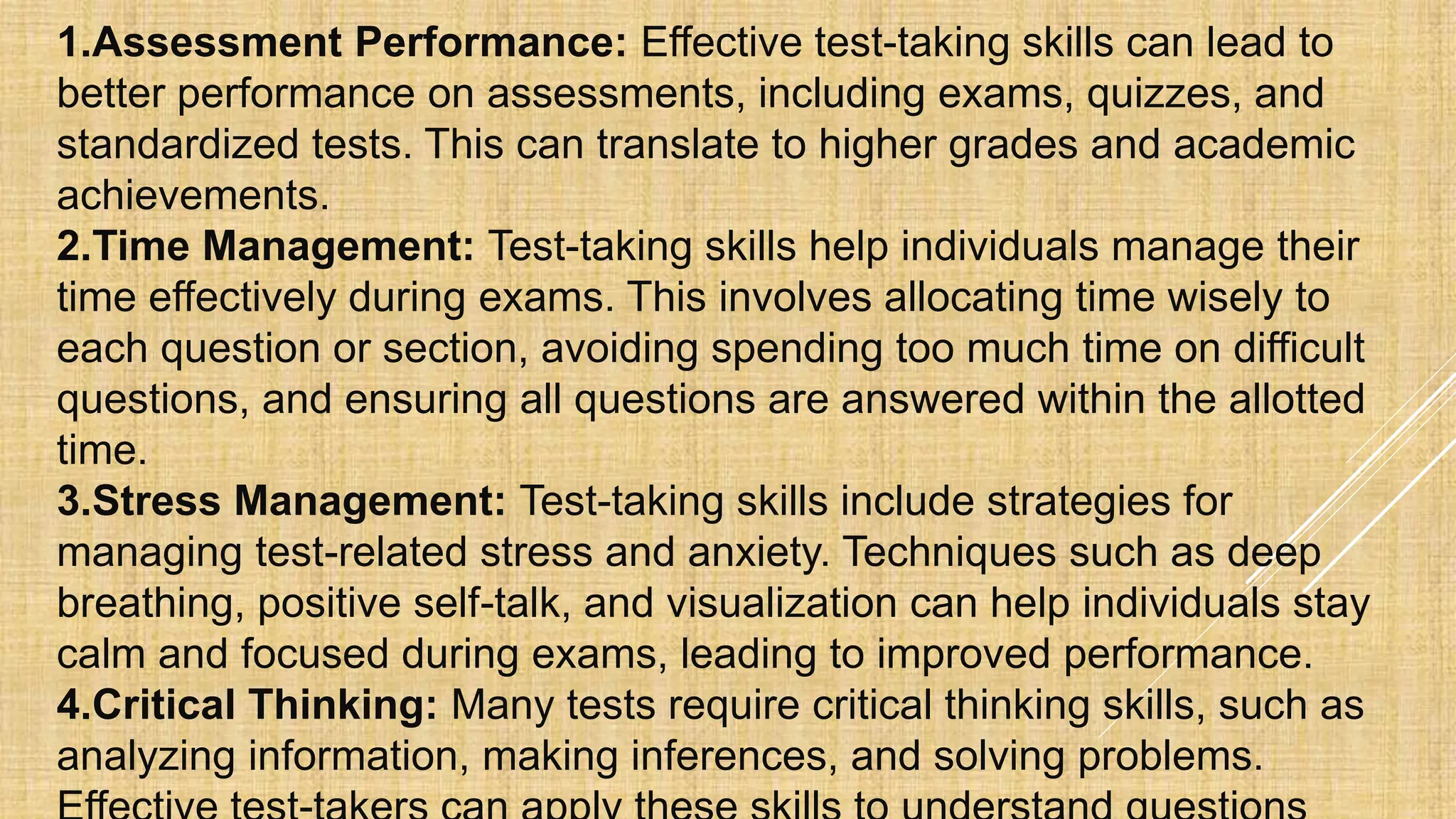
1.Assessment Performance: Effective test-taking skills can lead to
better performance on assessments, including exams, quizzes, and
standardized tests. This can translate to higher grades and academic
achievements.
2.Time Management: Test-taking skills help individuals manage their
time effectively during exams. This involves allocating time wisely to
each question or section, avoiding spending too much time on difficult
questions, and ensuring all questions are answered within the allotted
time.
3.Stress Management: Test-taking skills include strategies for
managing test-related stress and anxiety. Techniques such as deep
breathing, positive self-talk, and visualization can help individuals stay
calm and focused during exams, leading to improved performance.
4.Critical Thinking: Many tests require critical thinking skills, such as
analyzing information, making inferences, and solving problems.
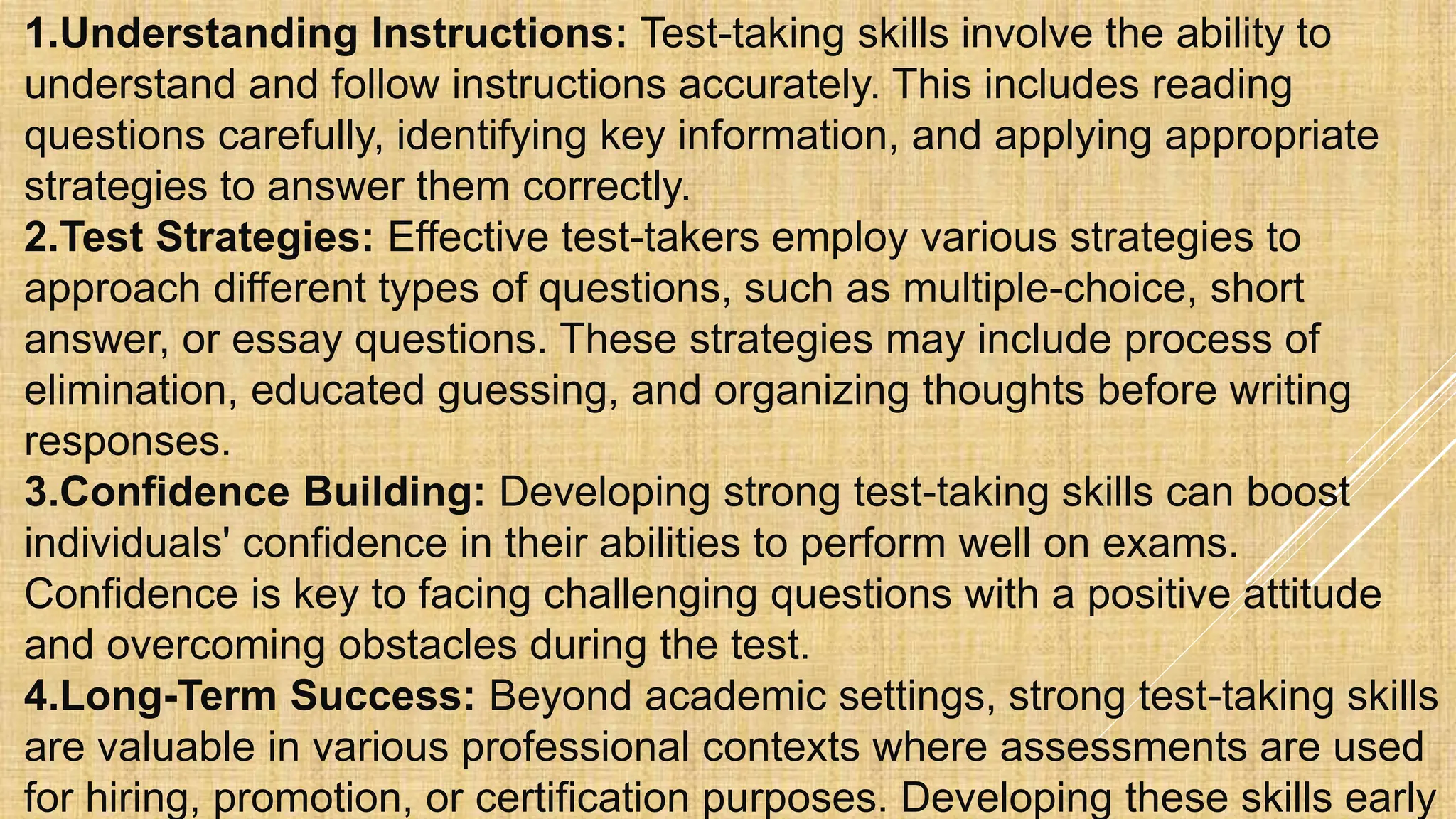
1.Understanding Instructions: Test-taking skills involve the ability to
understand and follow instructions accurately. This includes reading
questions carefully, identifying key information, and applying appropriate
strategies to answer them correctly.
2.Test Strategies: Effective test-takers employ various strategies to
approach different types of questions, such as multiple-choice, short
answer, or essay questions. These strategies may include process of
elimination, educated guessing, and organizing thoughts before writing
responses.
3.Confidence Building: Developing strong test-taking skills can boost
individuals' confidence in their abilities to perform well on exams.
Confidence is key to facing challenging questions with a positive attitude
and overcoming obstacles during the test.
4.Long-Term Success: Beyond academic settings, strong test-taking skills
are valuable in various professional contexts where assessments are used
for hiring, promotion, or certification purposes. Developing these skills early
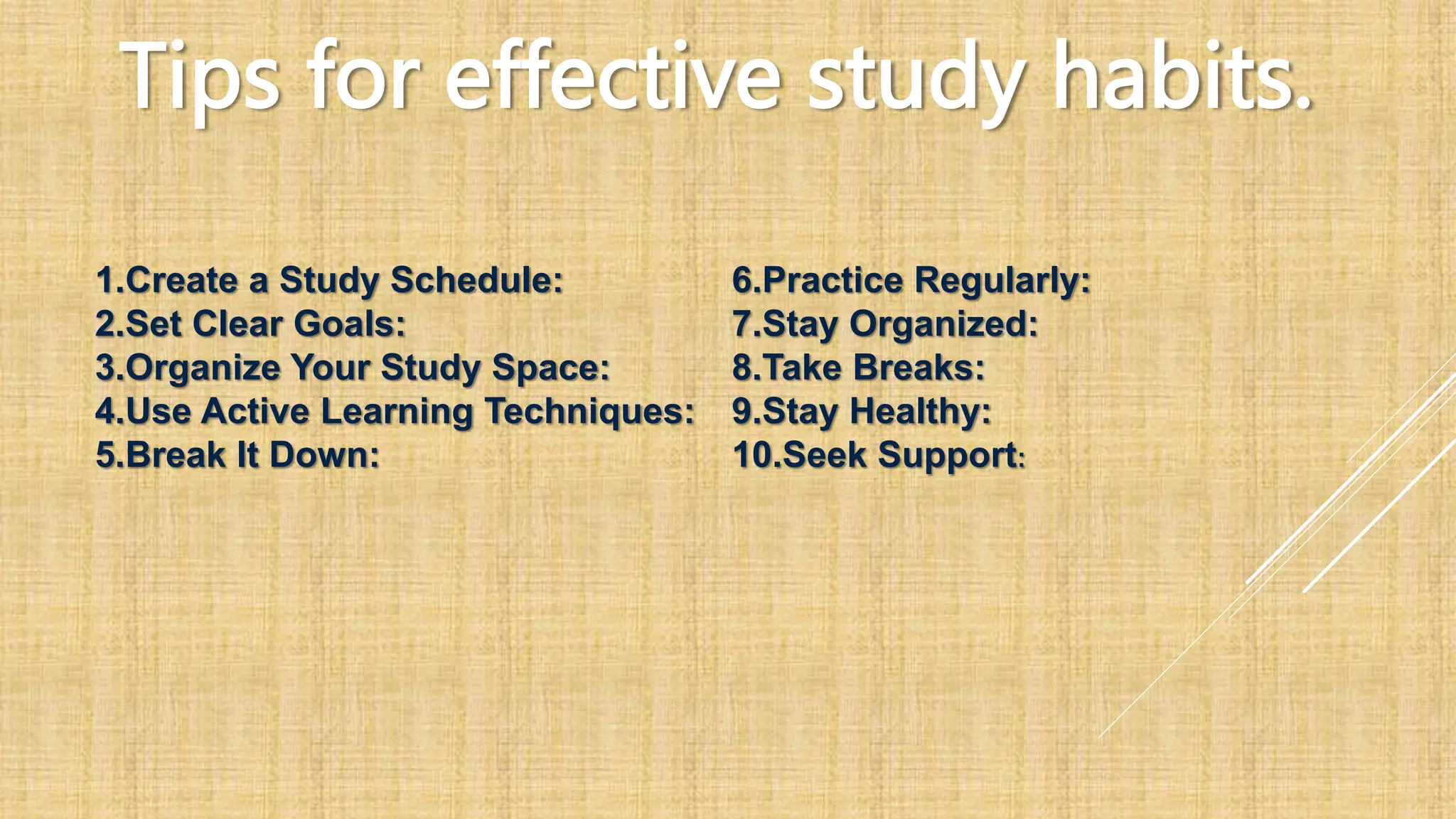
Tips for effective study habits.
1.Create a Study Schedule:
2.Set Clear Goals:
3.Organize Your Study Space:
4.Use Active Learning Techniques:
5.Break It Down:
6.Practice Regularly:
7.Stay Organized:
8.Take Breaks:
9.Stay Healthy:
10.Seek Support:
Time management techniques for studying.
1.Set Priorities: Identify your most important tasks and prioritize them based on
deadlines, importance, and level of difficulty. Focus on completing high-priority tasks first to
ensure you're making progress on what matters most.
2.Use a Planner or Calendar: Use a planner, calendar, or digital scheduling tool to
organize your study sessions and allocate time for specific subjects or topics. Break down
your study goals into smaller, manageable tasks and schedule dedicated time slots for
each one.
3.Create a Study Schedule: Develop a consistent study schedule that fits your lifestyle
and preferences. Block out dedicated study periods during times when you're most alert
and productive. Be realistic about how much time you can commit to studying each day
and stick to your schedule.
4.Use Time Blocking: Time blocking involves allocating specific blocks of time for different
activities or tasks. Designate uninterrupted study blocks for focused work on specific
subjects or assignments. Minimize distractions during these blocks to maximize
productivity.
5.Set SMART Goals: Set specific, measurable, achievable, relevant, and time-bound
Time management techniques for studying.
1.Employ the Pomodoro Technique: The Pomodoro Technique involves working in short, focused bursts
(typically 25 minutes) followed by a short break (5 minutes). Use a timer to structure your study sessions
into Pomodoro intervals, and take longer breaks (15-30 minutes) after completing several intervals.
2.Eliminate Time Wasters: Identify and eliminate or minimize distractions that can eat into your study
time, such as social media, email, or excessive multitasking. Create a conducive study environment by
removing clutter, turning off notifications, and setting boundaries with family or roommates.
3.Practice Time Management Skills: Develop and refine your time management skills through consistent
practice. Reflect on your study habits and routines regularly to identify areas for improvement.
Experiment with different techniques and strategies to find what works best for you.
4.Stay Flexible: While it's important to stick to your study schedule as much as possible, it's also essential
to remain flexible and adaptable. Life can be unpredictable, so be prepared to adjust your plans and
priorities as needed to accommodate unexpected events or changes.
5.Take Care of Yourself: Remember to prioritize self-care and well-being while managing your time for
studying. Get enough sleep, eat healthily, exercise regularly, and take breaks to recharge your mind and
body. A balanced lifestyle supports productivity and academic success in the long run.
Test-Taking Strategies:
1.Read Instructions Carefully: Before you start answering any
questions, read the instructions thoroughly to understand what is
expected of you. Pay attention to any special requirements, such as
time limits, allowed resources, or specific formats for responses.
2.Preview the Test: Take a few moments to preview the entire test
before you begin. Skim through all the questions to get an overview of
the topics covered and assess the difficulty level of each section.
3.Manage Your Time: Allocate your time wisely during the exam.
Divide the total time available by the number of questions or sections to
determine how much time you can spend on each one. Pace yourself
accordingly and don't spend too much time on any single question.
exams.
Test-Taking Strategies:
1.Answer Easy Questions First:
Start with the questions you find easiest and can answer quickly. This will help
you build confidence and make progress early in the exam. Skip difficult
questions for now and come back to them later if you have time.
2.Use Process of Elimination:
If you're unsure about an answer, use the process of elimination to rule out
obviously incorrect choices. Narrowing down your options increases your
chances of selecting the correct answer, even if you're unsure.
3.Mark and Review:
If allowed, mark questions you're unsure about and plan to revisit them later.
Use a symbol or highlighter to indicate these questions in your test booklet or
on the computer screen. After completing the rest of the exam, go back and
review the marked questions with any remaining time.
4.Budget Time for Review:
Reserve some time at the end of the exam to review your answers.
Test-Taking Strategies:
1.Stay Calm and Focused:
Maintain a positive attitude and stay calm throughout the exam. If you encounter
challenging questions or feel stressed, take a few deep breaths to relax and
refocus your mind. Trust in your preparation and do your best.
2.Manage Test Anxiety:
If you experience test anxiety, employ relaxation techniques such as deep
breathing, visualization, or positive self-talk to calm your nerves. Practice
mindfulness and stay present in the moment rather than dwelling on negative
thoughts.
3.Learn from Mistakes:
After the exam, review your performance to identify areas of improvement.
Analyze any mistakes you made and understand why you missed certain
questions. Use this feedback to adjust your study strategies and prepare more
effectively for future exams.
Multiple-choice tests are a common type of assessment where students are
presented with a question followed by a set of options, and they must select the
correct answer from among the choices provided. Here's an explanation of the
characteristics and strategies for handling multiple-choice tests:
Format: Multiple-choice questions typically consist of a stem (the question or
statement) and several options (the choices). The options may include one correct
answer (the "best" or "most accurate" response) and several distractors (incorrect
answers that resemble the correct answer but are designed to mislead).
Assessment of Knowledge: Multiple-choice tests are often used to assess a student's
understanding of factual knowledge, concepts, and sometimes higher-order thinking
skills such as analysis and evaluation, depending on how the questions are
constructed.
Strategies:
Read the Question Carefully:
- Understand what the question is asking before looking at the options.
Eliminate Obvious Distractors:
- If you can confidently eliminate one or more options as incorrect, it
improves your chances of selecting the correct answer from the remaining
choices.
Use Context Clues:
- Sometimes, information provided in one question can help you answer
another question on the same test.
Beware of Absolute Terms:
- Watch out for options with words like "always," "never," or "every."
Consider All Options:
- Even if you think you've found the correct answer, review all options before
making your final selection.
Manage Time Wisely:
- Don't spend too much time on any single question. If you're unsure, make an
educated guess and move on.
Practice:
- Familiarize yourself with the format and types of questions commonly found
in multiple-choice tests by practicing with sample questions or past exams. This
can help you become more comfortable with the format and improve your ability
to identify the correct answers efficiently.
By understanding the format of multiple-choice tests and employing effective
strategies, students can approach these assessments with confidence and
improve their chances of success.
Passage:
The Industrial Revolution, which began in Britain in
the late 18th century, had a profound impact on
society, economy, and culture. It marked a shift
from agrarian and handicraft-based economies to
industrialized ones, characterized by mechanization,
urbanization, and mass production.
One significant consequence of the Industrial
Revolution was the rise of the factory system.
Factories emerged as centers of production,
employing large numbers of workers and housing
machinery for manufacturing goods. This shift led to
the growth of urban areas as people migrated from
Passage:
Another consequence was the transformation of social
structures. The emergence of industrial capitalism
created new classes of society, including industrialists,
factory workers, and the urban middle class. Social
inequality widened, as wealth became concentrated in the
hands of a few while many workers faced harsh working
conditions and low wages.
Despite its transformative effects, the Industrial
Revolution also sparked resistance and reform
movements. Labor unions formed to advocate for
workers' rights and better working conditions.
Intellectuals and social critics raised concerns about the
Questions:
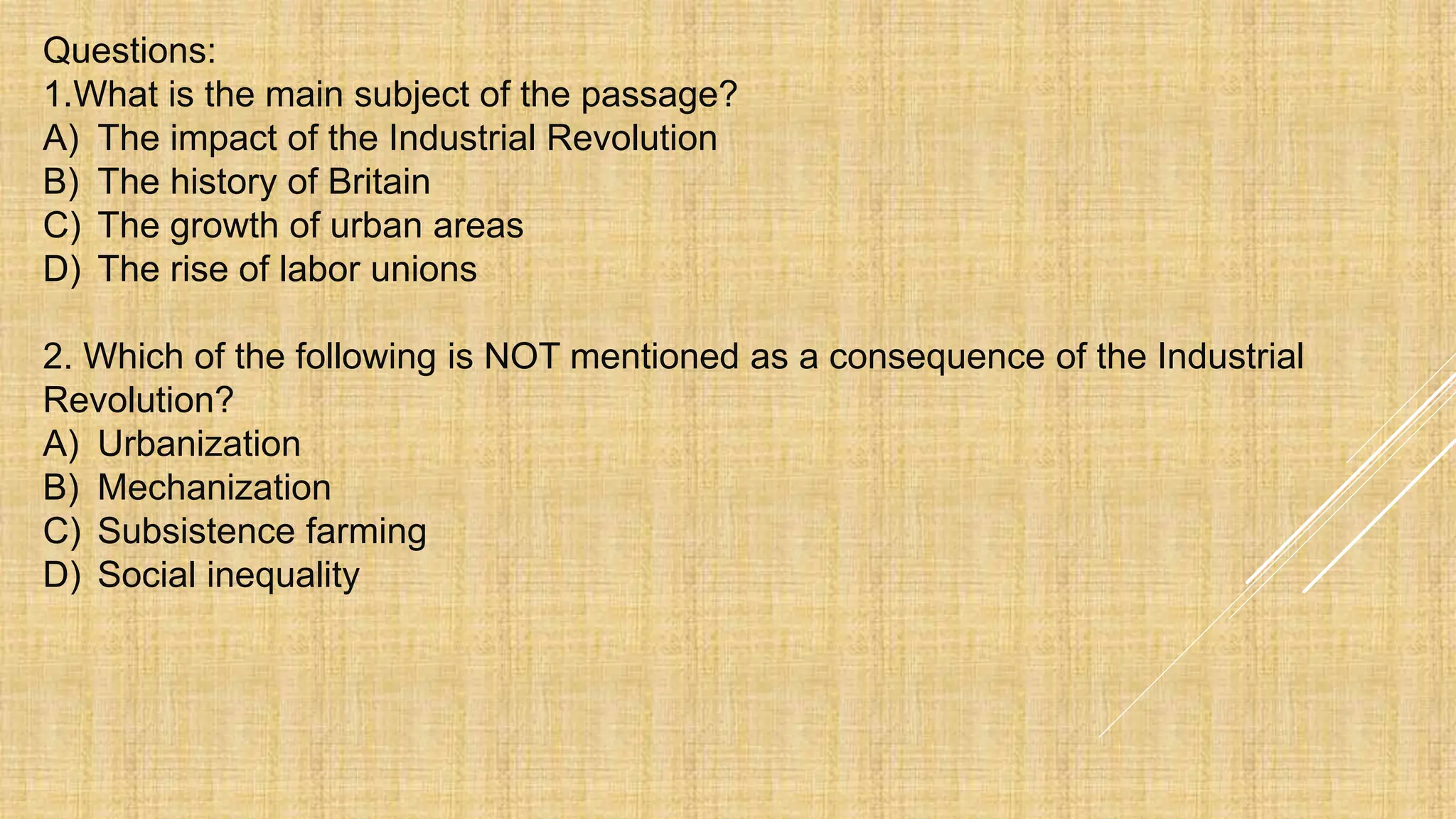
1.What is the main subject of the passage?
A) The impact of the Industrial Revolution
B) The history of Britain
C) The growth of urban areas
D) The rise of labor unions
2. Which of the following is NOT mentioned as a consequence of the Industrial
Revolution?
A) Urbanization
B) Mechanization
C) Subsistence farming
D) Social inequality
Questions:
1.According to the passage, what led to the growth of urban areas?
A) The decline of factories
B) Migration from rural areas
C) Increased agricultural productivity
D) Government policies
2. What role did labor unions play during the Industrial Revolution?
A) They advocated for workers' rights
B) They promoted industrial capitalism
C) They supported factory owners
D) They opposed urbanization
Questions:
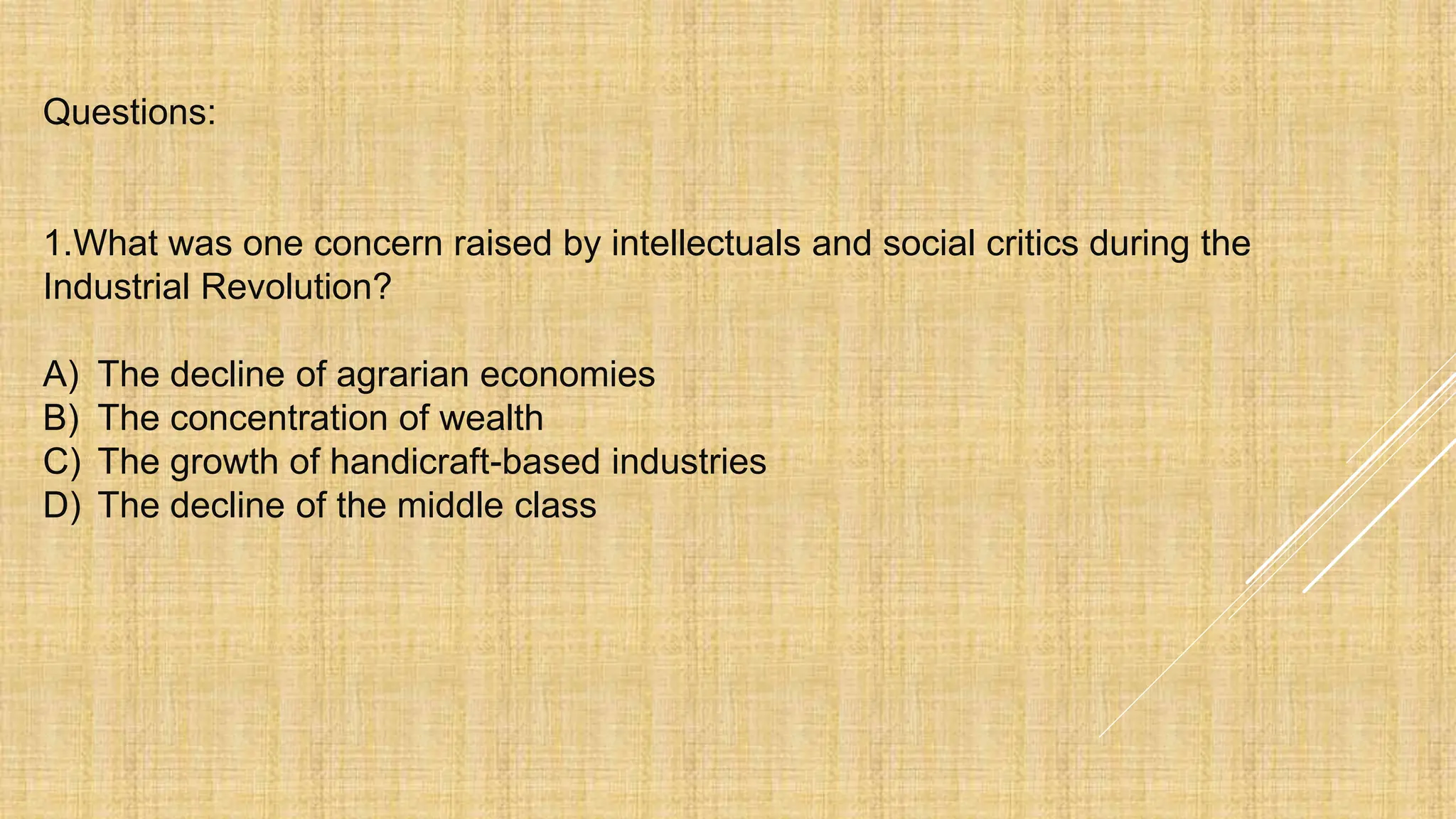
1.What was one concern raised by intellectuals and social critics during the
Industrial Revolution?
A) The decline of agrarian economies
B) The concentration of wealth
C) The growth of handicraft-based industries
D) The decline of the middle class
Answers:
1.A) The impact of the Industrial
Revolution
2.C) Subsistence farming
3.B) Migration from rural areas
4.A) They advocated for workers' rights
5.B) The concentration of wealth

Mastering Test-Taking Skills, learning how to eliminate the mistake

  • 2.
    1.Assessment Performance: Effectivetest-taking skills can lead to better performance on assessments, including exams, quizzes, and standardized tests. This can translate to higher grades and academic achievements. 2.Time Management: Test-taking skills help individuals manage their time effectively during exams. This involves allocating time wisely to each question or section, avoiding spending too much time on difficult questions, and ensuring all questions are answered within the allotted time. 3.Stress Management: Test-taking skills include strategies for managing test-related stress and anxiety. Techniques such as deep breathing, positive self-talk, and visualization can help individuals stay calm and focused during exams, leading to improved performance. 4.Critical Thinking: Many tests require critical thinking skills, such as analyzing information, making inferences, and solving problems.
  • 3.
    1.Understanding Instructions: Test-takingskills involve the ability to understand and follow instructions accurately. This includes reading questions carefully, identifying key information, and applying appropriate strategies to answer them correctly. 2.Test Strategies: Effective test-takers employ various strategies to approach different types of questions, such as multiple-choice, short answer, or essay questions. These strategies may include process of elimination, educated guessing, and organizing thoughts before writing responses. 3.Confidence Building: Developing strong test-taking skills can boost individuals' confidence in their abilities to perform well on exams. Confidence is key to facing challenging questions with a positive attitude and overcoming obstacles during the test. 4.Long-Term Success: Beyond academic settings, strong test-taking skills are valuable in various professional contexts where assessments are used for hiring, promotion, or certification purposes. Developing these skills early
  • 4.
    Tips for effectivestudy habits. 1.Create a Study Schedule: 2.Set Clear Goals: 3.Organize Your Study Space: 4.Use Active Learning Techniques: 5.Break It Down: 6.Practice Regularly: 7.Stay Organized: 8.Take Breaks: 9.Stay Healthy: 10.Seek Support:
  • 5.
    Time management techniquesfor studying. 1.Set Priorities: Identify your most important tasks and prioritize them based on deadlines, importance, and level of difficulty. Focus on completing high-priority tasks first to ensure you're making progress on what matters most. 2.Use a Planner or Calendar: Use a planner, calendar, or digital scheduling tool to organize your study sessions and allocate time for specific subjects or topics. Break down your study goals into smaller, manageable tasks and schedule dedicated time slots for each one. 3.Create a Study Schedule: Develop a consistent study schedule that fits your lifestyle and preferences. Block out dedicated study periods during times when you're most alert and productive. Be realistic about how much time you can commit to studying each day and stick to your schedule. 4.Use Time Blocking: Time blocking involves allocating specific blocks of time for different activities or tasks. Designate uninterrupted study blocks for focused work on specific subjects or assignments. Minimize distractions during these blocks to maximize productivity. 5.Set SMART Goals: Set specific, measurable, achievable, relevant, and time-bound
  • 6.
    Time management techniquesfor studying. 1.Employ the Pomodoro Technique: The Pomodoro Technique involves working in short, focused bursts (typically 25 minutes) followed by a short break (5 minutes). Use a timer to structure your study sessions into Pomodoro intervals, and take longer breaks (15-30 minutes) after completing several intervals. 2.Eliminate Time Wasters: Identify and eliminate or minimize distractions that can eat into your study time, such as social media, email, or excessive multitasking. Create a conducive study environment by removing clutter, turning off notifications, and setting boundaries with family or roommates. 3.Practice Time Management Skills: Develop and refine your time management skills through consistent practice. Reflect on your study habits and routines regularly to identify areas for improvement. Experiment with different techniques and strategies to find what works best for you. 4.Stay Flexible: While it's important to stick to your study schedule as much as possible, it's also essential to remain flexible and adaptable. Life can be unpredictable, so be prepared to adjust your plans and priorities as needed to accommodate unexpected events or changes. 5.Take Care of Yourself: Remember to prioritize self-care and well-being while managing your time for studying. Get enough sleep, eat healthily, exercise regularly, and take breaks to recharge your mind and body. A balanced lifestyle supports productivity and academic success in the long run.
  • 7.
    Test-Taking Strategies: 1.Read InstructionsCarefully: Before you start answering any questions, read the instructions thoroughly to understand what is expected of you. Pay attention to any special requirements, such as time limits, allowed resources, or specific formats for responses. 2.Preview the Test: Take a few moments to preview the entire test before you begin. Skim through all the questions to get an overview of the topics covered and assess the difficulty level of each section. 3.Manage Your Time: Allocate your time wisely during the exam. Divide the total time available by the number of questions or sections to determine how much time you can spend on each one. Pace yourself accordingly and don't spend too much time on any single question. exams.
  • 8.
    Test-Taking Strategies: 1.Answer EasyQuestions First: Start with the questions you find easiest and can answer quickly. This will help you build confidence and make progress early in the exam. Skip difficult questions for now and come back to them later if you have time. 2.Use Process of Elimination: If you're unsure about an answer, use the process of elimination to rule out obviously incorrect choices. Narrowing down your options increases your chances of selecting the correct answer, even if you're unsure. 3.Mark and Review: If allowed, mark questions you're unsure about and plan to revisit them later. Use a symbol or highlighter to indicate these questions in your test booklet or on the computer screen. After completing the rest of the exam, go back and review the marked questions with any remaining time. 4.Budget Time for Review: Reserve some time at the end of the exam to review your answers.
  • 9.
    Test-Taking Strategies: 1.Stay Calmand Focused: Maintain a positive attitude and stay calm throughout the exam. If you encounter challenging questions or feel stressed, take a few deep breaths to relax and refocus your mind. Trust in your preparation and do your best. 2.Manage Test Anxiety: If you experience test anxiety, employ relaxation techniques such as deep breathing, visualization, or positive self-talk to calm your nerves. Practice mindfulness and stay present in the moment rather than dwelling on negative thoughts. 3.Learn from Mistakes: After the exam, review your performance to identify areas of improvement. Analyze any mistakes you made and understand why you missed certain questions. Use this feedback to adjust your study strategies and prepare more effectively for future exams.
  • 10.
    Multiple-choice tests area common type of assessment where students are presented with a question followed by a set of options, and they must select the correct answer from among the choices provided. Here's an explanation of the characteristics and strategies for handling multiple-choice tests: Format: Multiple-choice questions typically consist of a stem (the question or statement) and several options (the choices). The options may include one correct answer (the "best" or "most accurate" response) and several distractors (incorrect answers that resemble the correct answer but are designed to mislead). Assessment of Knowledge: Multiple-choice tests are often used to assess a student's understanding of factual knowledge, concepts, and sometimes higher-order thinking skills such as analysis and evaluation, depending on how the questions are constructed.
  • 11.
    Strategies: Read the QuestionCarefully: - Understand what the question is asking before looking at the options. Eliminate Obvious Distractors: - If you can confidently eliminate one or more options as incorrect, it improves your chances of selecting the correct answer from the remaining choices. Use Context Clues: - Sometimes, information provided in one question can help you answer another question on the same test. Beware of Absolute Terms: - Watch out for options with words like "always," "never," or "every."
  • 12.
    Consider All Options: -Even if you think you've found the correct answer, review all options before making your final selection. Manage Time Wisely: - Don't spend too much time on any single question. If you're unsure, make an educated guess and move on. Practice: - Familiarize yourself with the format and types of questions commonly found in multiple-choice tests by practicing with sample questions or past exams. This can help you become more comfortable with the format and improve your ability to identify the correct answers efficiently. By understanding the format of multiple-choice tests and employing effective strategies, students can approach these assessments with confidence and improve their chances of success.
  • 13.
    Passage: The Industrial Revolution,which began in Britain in the late 18th century, had a profound impact on society, economy, and culture. It marked a shift from agrarian and handicraft-based economies to industrialized ones, characterized by mechanization, urbanization, and mass production. One significant consequence of the Industrial Revolution was the rise of the factory system. Factories emerged as centers of production, employing large numbers of workers and housing machinery for manufacturing goods. This shift led to the growth of urban areas as people migrated from
  • 14.
    Passage: Another consequence wasthe transformation of social structures. The emergence of industrial capitalism created new classes of society, including industrialists, factory workers, and the urban middle class. Social inequality widened, as wealth became concentrated in the hands of a few while many workers faced harsh working conditions and low wages. Despite its transformative effects, the Industrial Revolution also sparked resistance and reform movements. Labor unions formed to advocate for workers' rights and better working conditions. Intellectuals and social critics raised concerns about the
  • 15.
    Questions: 1.What is themain subject of the passage? A) The impact of the Industrial Revolution B) The history of Britain C) The growth of urban areas D) The rise of labor unions 2. Which of the following is NOT mentioned as a consequence of the Industrial Revolution? A) Urbanization B) Mechanization C) Subsistence farming D) Social inequality
  • 16.
    Questions: 1.According to thepassage, what led to the growth of urban areas? A) The decline of factories B) Migration from rural areas C) Increased agricultural productivity D) Government policies 2. What role did labor unions play during the Industrial Revolution? A) They advocated for workers' rights B) They promoted industrial capitalism C) They supported factory owners D) They opposed urbanization
  • 17.
    Questions: 1.What was oneconcern raised by intellectuals and social critics during the Industrial Revolution? A) The decline of agrarian economies B) The concentration of wealth C) The growth of handicraft-based industries D) The decline of the middle class
  • 18.
    Answers: 1.A) The impactof the Industrial Revolution 2.C) Subsistence farming 3.B) Migration from rural areas 4.A) They advocated for workers' rights 5.B) The concentration of wealth