EDM 606
ORGANIZATION AND
MANAGEMENT OF
EDUCATIONAL
INSTITUTION
ADMINISTR
ATIVE
SUPPORT
SYSTEM
JOY ANN P. RUBIALES
Objectives:
1. Discuss the components of
administrative support system;
2. Explain the roles and responsibilities of
different management areas; and
3. Realize the importance of an excellent
administrative support system.
3 REASONS WHY EFFECTIVE
SCHOOL ADMINISTRATION IS
IMPORTANT
1. Allows Teachers To Focus On
Teaching
2. Administration Promotes
Accountability
3. Administration Informs Decisions
PERSONNEL MANAGEMENT
What is Personnel Management?
Personnel management is defined as an
administrative specialization that focuses on
hiring and developing employees to become
more valuable to the company. It is sometimes
considered to be a sub-category of human
resources that only focuses on administration.
PERSONNEL MANAGEMENT
What is Personnel Management?
According to Flippo, “Personnel
management is the planning, organizing,
compensation, integration and maintenance of
people for the purpose of contributing to
organizational, individual and societal goals.”
PERSONNEL MANAGEMENT
What is Personnel Management?
According to Brech, “Personnel
Management is that part which is primarily
concerned with human resource of
organization.”
PERSONNEL MANAGEMENT
Nature of Personnel Management
 Personnel management includes the function of
employment, development and compensation.
 Personnel management is an extension to
general management.
 Personnel management exist to advice and assist
the line managers in personnel matters.
PERSONNEL MANAGEMENT
Nature of Personnel Management
 Personnel management lays emphasize on action rather
than making lengthy schedules, plans, work methods.
 It is based on human orientation.
 It also motivates the employees through it’s effective
incentive plans so that the employees provide fullest co-
operation.
 Personnel management deals with human resources of
a concern.
PERSONNEL MANAGEMENT
Role of Personnel Manager
Personnel manager is the head of personnel
department. He performs both managerial and operative
functions of management. His role can be summarized as :
 Provides assistance
 Advices the line manager
 Counsellor
 Mediator
 Spokesman
PERSONNEL MANAGEMENT
Functions of Personnel Management
Following are the four functions of
Personnel Management:
1. Manpower Planning
2. Recruitment
3. Selection
4. Training and Development
INFRASTRUCTURE
MANAGEMENT
The term infrastructure has been used
throughout history to describe the large and complex
structures of military projects, civil projects, and public
utilities.
As technology evolved from basic computing to
the Internet and beyond, business operations quickly
became dependent on technology. Over time, the IT
infrastructure became a backbone of business.
INFRASTRUCTURE
MANAGEMENT
Below is a list of areas that are commonly referred to
as infrastructure:
 Highways
 Streets/roads
 Bridges
 Airports
 Railroads
 Water utilities
 Electrical utilities
 Energy utilities
 Telecommunications
 Waste utilities
 Technology hardware, software, networks, facilities
INFRASTRUCTURE
MANAGEMENT
What Is Infrastructure
Management?
The term infrastructure describes
the structures required for the
operation of a physical facility or
business operation.
INFRASTRUCTURE
MANAGEMENT
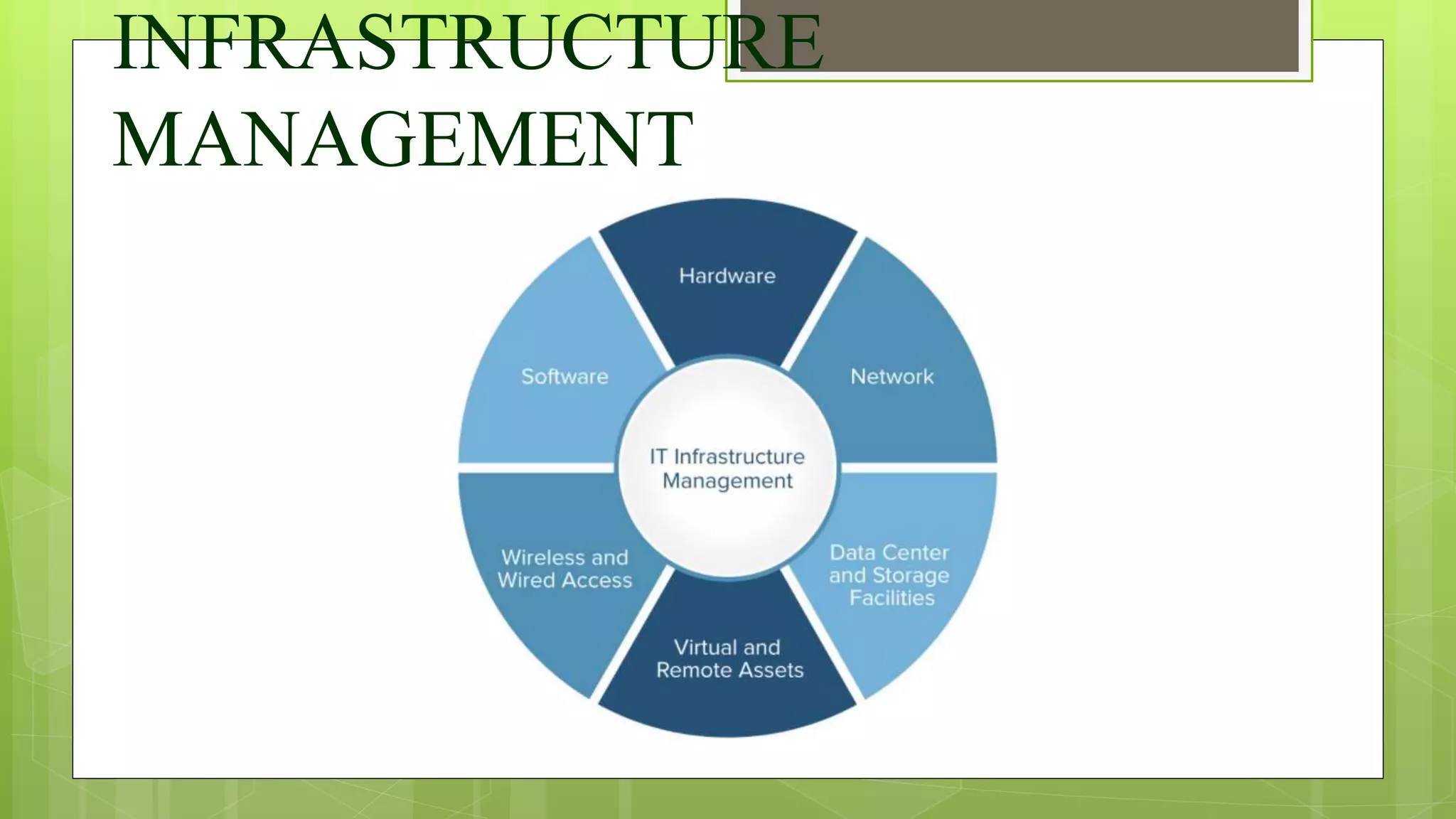
The purpose of IT infrastructure management
is to provide structure and control of the functions
responsible for diverse technical operations which
generally involve hardware, software, and
networking in both physical and virtual
environments.
The main goal is to minimize downtime and
maintain business productivity.
INFRASTRUCTURE
MANAGEMENT
Additionally, an enterprise IT infrastructure management team is typically
responsible for the following essential IT elements and services:
 Asset lifecycle
 Capacity monitoring/planning
 Storage
 Network utilization
 Availability
 Energy consumption
 Environmental issues
 Facilities (including data center infrastructure management)
 Physical and virtual assets
 Wireless and wired network operations
 Hardware
 Software
 Security (malware/virus protection)
 Mobile connectivity
 Maintenance/service updates
INFRASTRUCTURE
MANAGEMENT
INFRASTRUCTURE
MANAGEMENT
For an organization's information
technology, infrastructure management (IM) is
the management of essential operation
components, such as policies, processes,
equipment, data, human resources, and
external contacts, for overall effectiveness.
INFRASTRUCTURE
MANAGEMENT
Reducing cost and improving reporting, an IMS can:
 Provide a rapid response to any IT-related crisis
 Proactively manage devices and networks in an agile and adaptable way
 Monitor service performance, detecting when service dips below the required
standard
 Identify threats to your network, responding promptly to mitigate their impact
 Streamline your business’ day-to-day functions and operations to free-up your
in-house IT team to focus more on your business’ overall strategy
 Reduce downtime by carrying out repairs more quickly
 Contribute to increasing customer satisfaction and business performance
FINANCIAL MANAGEMENT
Meaning of Financial Management
Financial Management means planning,
organizing, directing and controlling the
financial activities such as procurement and
utilization of funds of the enterprise. It means
applying general management principles to
financial resources of the enterprise.
FINANCIAL MANAGEMENT
Scope/Elements
1.Investment decisions includes investment in fixed assets (called as capital
budgeting).
2.Financial decisions - They relate to the raising of finance from various
resources which will depend upon decision on type of source, period of
financing, cost of financing and the returns thereby.
3.Dividend decision - The finance manager has to take decision with regards
to the net profit distribution.
a. Dividend for shareholders- Dividend and the rate of it has to be decided.
b. Retained profits- Amount of retained profits has to be finalized which will
depend upon expansion and diversification plans of the enterprise.
FINANCIAL MANAGEMENT
Objectives of Financial Management
The financial management is generally concerned with procurement, allocation and
control of financial resources of a concern.
1.To ensure regular and adequate supply of funds to the concern.
2.To ensure adequate returns to the shareholders which will depend upon the
earning capacity, market price of the share, expectations of the shareholders.
3.To ensure optimum funds utilization. Once the funds are procured, they should
be utilized in maximum possible way at least cost.
4.To ensure safety on investment, i.e, funds should be invested in safe ventures so
that adequate rate of return can be achieved.
5.To plan a sound capital structure-There should be sound and fair composition of
capital so that a balance is maintained between debt and equity capital.
FINANCIAL MANAGEMENT
Functions of Financial Management
1.Estimation of capital requirements: A finance manager has to make
estimation with regards to capital requirements of the company.
2.Determination of capital composition: Once the estimation have been made,
the capital structure have to be decided.
3.Choice of sources of funds: For additional funds to be procured, a company
has many choices like-
a.Issue of shares and debentures
b.Loans to be taken from banks and financial institutions
c.Public deposits to be drawn like in form of bonds.
Choice of factor will depend on relative merits and demerits of each
source and period of financing.
FINANCIAL MANAGEMENT
Functions of Financial Management
4.Investment of funds: The finance manager has to decide to allocate
funds into profitable ventures so that there is safety on investment and
regular returns is possible.
5.Disposal of surplus: The net profits decision have to be made by the
finance manager. This can be done in two ways:
a. Dividend declaration
b. Retained profits - 6.Management of cash: Finance manager has to
make decisions with regards to cash management.
7.Financial controls: The finance manager has not only to plan, procure
and utilize the funds but he also has to exercise control over finances.
MTHODS AND PROCEDURE
Methods of identifying requirements
A systematic method for identifying which requirements or modifications are
needed includes analysis of the functional area, processes used and feedback from
stakeholders.
Choosing a suitable approach requires an understanding of organizational
structure and stakeholders, existing procedures for information management and
control, and the budgetary constraints afforded to the ongoing maintenance of the
system. Systems generally integrate several operational functions and therefore may
include many components.
Operational functions can include:
• documents and reports
• server settings/user settings
• notifications and other communications processes
• project schedules.
MTHODS AND PROCEDURE
The Anatomy of a Procedure
So what goes into creating an effective procedure?
There are a few key things to keep in mind, including:
 A procedure should be documented. Remember: A
hand-written procedure is just as effective as a
beautifully typed one.
 Your procedures need to be consistent. Using a template
can help you achieve consistency and structure –
especially for handwritten procedures.
MTHODS AND PROCEDURE
The Anatomy of a Procedure
 A procedure should be well written, concise, and easy for another
person to follow. Ask a co-worker to try to perform the task, based
only on your instructions – this will help you identify any missing
information in the procedure.
 A procedures should include bullet-points and images whenever
possible for ease of scanning the information quickly and illustrating
key points.
 Focus on command statements rather than full sentences when
writing your step-by-step instructions. Keeping your procedure direct
and simple will make it easier for others to follow.
Administrative support system

Administrative support system

  • 1.
    EDM 606 ORGANIZATION AND MANAGEMENTOF EDUCATIONAL INSTITUTION ADMINISTR ATIVE SUPPORT SYSTEM JOY ANN P. RUBIALES
  • 2.
    Objectives: 1. Discuss thecomponents of administrative support system; 2. Explain the roles and responsibilities of different management areas; and 3. Realize the importance of an excellent administrative support system.
  • 3.
    3 REASONS WHYEFFECTIVE SCHOOL ADMINISTRATION IS IMPORTANT 1. Allows Teachers To Focus On Teaching 2. Administration Promotes Accountability 3. Administration Informs Decisions
  • 4.
    PERSONNEL MANAGEMENT What isPersonnel Management? Personnel management is defined as an administrative specialization that focuses on hiring and developing employees to become more valuable to the company. It is sometimes considered to be a sub-category of human resources that only focuses on administration.
  • 5.
    PERSONNEL MANAGEMENT What isPersonnel Management? According to Flippo, “Personnel management is the planning, organizing, compensation, integration and maintenance of people for the purpose of contributing to organizational, individual and societal goals.”
  • 6.
    PERSONNEL MANAGEMENT What isPersonnel Management? According to Brech, “Personnel Management is that part which is primarily concerned with human resource of organization.”
  • 7.
    PERSONNEL MANAGEMENT Nature ofPersonnel Management  Personnel management includes the function of employment, development and compensation.  Personnel management is an extension to general management.  Personnel management exist to advice and assist the line managers in personnel matters.
  • 8.
    PERSONNEL MANAGEMENT Nature ofPersonnel Management  Personnel management lays emphasize on action rather than making lengthy schedules, plans, work methods.  It is based on human orientation.  It also motivates the employees through it’s effective incentive plans so that the employees provide fullest co- operation.  Personnel management deals with human resources of a concern.
  • 9.
    PERSONNEL MANAGEMENT Role ofPersonnel Manager Personnel manager is the head of personnel department. He performs both managerial and operative functions of management. His role can be summarized as :  Provides assistance  Advices the line manager  Counsellor  Mediator  Spokesman
  • 10.
    PERSONNEL MANAGEMENT Functions ofPersonnel Management Following are the four functions of Personnel Management: 1. Manpower Planning 2. Recruitment 3. Selection 4. Training and Development
  • 11.
    INFRASTRUCTURE MANAGEMENT The term infrastructurehas been used throughout history to describe the large and complex structures of military projects, civil projects, and public utilities. As technology evolved from basic computing to the Internet and beyond, business operations quickly became dependent on technology. Over time, the IT infrastructure became a backbone of business.
  • 12.
    INFRASTRUCTURE MANAGEMENT Below is alist of areas that are commonly referred to as infrastructure:  Highways  Streets/roads  Bridges  Airports  Railroads  Water utilities  Electrical utilities  Energy utilities  Telecommunications  Waste utilities  Technology hardware, software, networks, facilities
  • 13.
    INFRASTRUCTURE MANAGEMENT What Is Infrastructure Management? Theterm infrastructure describes the structures required for the operation of a physical facility or business operation.
  • 14.
    INFRASTRUCTURE MANAGEMENT The purpose ofIT infrastructure management is to provide structure and control of the functions responsible for diverse technical operations which generally involve hardware, software, and networking in both physical and virtual environments. The main goal is to minimize downtime and maintain business productivity.
  • 15.
    INFRASTRUCTURE MANAGEMENT Additionally, an enterpriseIT infrastructure management team is typically responsible for the following essential IT elements and services:  Asset lifecycle  Capacity monitoring/planning  Storage  Network utilization  Availability  Energy consumption  Environmental issues  Facilities (including data center infrastructure management)  Physical and virtual assets  Wireless and wired network operations  Hardware  Software  Security (malware/virus protection)  Mobile connectivity  Maintenance/service updates
  • 16.
  • 17.
    INFRASTRUCTURE MANAGEMENT For an organization'sinformation technology, infrastructure management (IM) is the management of essential operation components, such as policies, processes, equipment, data, human resources, and external contacts, for overall effectiveness.
  • 18.
    INFRASTRUCTURE MANAGEMENT Reducing cost andimproving reporting, an IMS can:  Provide a rapid response to any IT-related crisis  Proactively manage devices and networks in an agile and adaptable way  Monitor service performance, detecting when service dips below the required standard  Identify threats to your network, responding promptly to mitigate their impact  Streamline your business’ day-to-day functions and operations to free-up your in-house IT team to focus more on your business’ overall strategy  Reduce downtime by carrying out repairs more quickly  Contribute to increasing customer satisfaction and business performance
  • 19.
    FINANCIAL MANAGEMENT Meaning ofFinancial Management Financial Management means planning, organizing, directing and controlling the financial activities such as procurement and utilization of funds of the enterprise. It means applying general management principles to financial resources of the enterprise.
  • 20.
    FINANCIAL MANAGEMENT Scope/Elements 1.Investment decisionsincludes investment in fixed assets (called as capital budgeting). 2.Financial decisions - They relate to the raising of finance from various resources which will depend upon decision on type of source, period of financing, cost of financing and the returns thereby. 3.Dividend decision - The finance manager has to take decision with regards to the net profit distribution. a. Dividend for shareholders- Dividend and the rate of it has to be decided. b. Retained profits- Amount of retained profits has to be finalized which will depend upon expansion and diversification plans of the enterprise.
  • 21.
    FINANCIAL MANAGEMENT Objectives ofFinancial Management The financial management is generally concerned with procurement, allocation and control of financial resources of a concern. 1.To ensure regular and adequate supply of funds to the concern. 2.To ensure adequate returns to the shareholders which will depend upon the earning capacity, market price of the share, expectations of the shareholders. 3.To ensure optimum funds utilization. Once the funds are procured, they should be utilized in maximum possible way at least cost. 4.To ensure safety on investment, i.e, funds should be invested in safe ventures so that adequate rate of return can be achieved. 5.To plan a sound capital structure-There should be sound and fair composition of capital so that a balance is maintained between debt and equity capital.
  • 22.
    FINANCIAL MANAGEMENT Functions ofFinancial Management 1.Estimation of capital requirements: A finance manager has to make estimation with regards to capital requirements of the company. 2.Determination of capital composition: Once the estimation have been made, the capital structure have to be decided. 3.Choice of sources of funds: For additional funds to be procured, a company has many choices like- a.Issue of shares and debentures b.Loans to be taken from banks and financial institutions c.Public deposits to be drawn like in form of bonds. Choice of factor will depend on relative merits and demerits of each source and period of financing.
  • 23.
    FINANCIAL MANAGEMENT Functions ofFinancial Management 4.Investment of funds: The finance manager has to decide to allocate funds into profitable ventures so that there is safety on investment and regular returns is possible. 5.Disposal of surplus: The net profits decision have to be made by the finance manager. This can be done in two ways: a. Dividend declaration b. Retained profits - 6.Management of cash: Finance manager has to make decisions with regards to cash management. 7.Financial controls: The finance manager has not only to plan, procure and utilize the funds but he also has to exercise control over finances.
  • 24.
    MTHODS AND PROCEDURE Methodsof identifying requirements A systematic method for identifying which requirements or modifications are needed includes analysis of the functional area, processes used and feedback from stakeholders. Choosing a suitable approach requires an understanding of organizational structure and stakeholders, existing procedures for information management and control, and the budgetary constraints afforded to the ongoing maintenance of the system. Systems generally integrate several operational functions and therefore may include many components. Operational functions can include: • documents and reports • server settings/user settings • notifications and other communications processes • project schedules.
  • 25.
    MTHODS AND PROCEDURE TheAnatomy of a Procedure So what goes into creating an effective procedure? There are a few key things to keep in mind, including:  A procedure should be documented. Remember: A hand-written procedure is just as effective as a beautifully typed one.  Your procedures need to be consistent. Using a template can help you achieve consistency and structure – especially for handwritten procedures.
  • 26.
    MTHODS AND PROCEDURE TheAnatomy of a Procedure  A procedure should be well written, concise, and easy for another person to follow. Ask a co-worker to try to perform the task, based only on your instructions – this will help you identify any missing information in the procedure.  A procedures should include bullet-points and images whenever possible for ease of scanning the information quickly and illustrating key points.  Focus on command statements rather than full sentences when writing your step-by-step instructions. Keeping your procedure direct and simple will make it easier for others to follow.