Chapter  9: Administration and Scoring of the Qualitative Reading  Inventory  4 Melissa Antonelli and Jaclyn Clark February  18, 2010
Main Purposes for Administering the Passages 1. Determination of a Student’s Independent, Instructional, and/or Frustration levels Word Identification in Context Miscues counted for  Total Accuracy:  all miscues regardless of quality of mispronounced words Total Acceptability: only miscues that change or distort passage meaning Comprehension Independent, instructional, and frustration warnings determined when students read designated passages and answer passage based questions
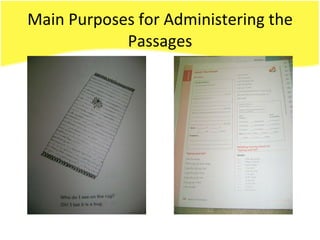
Main Purposes for Administering the Passages
Main Purposes for Administering the Passages 2. Assessment of a Student’s Ability to Read Different Types of Text *  Usually Narrative Text 3. Assessment of a Student’s Ability to Comprehend in Different Modes  *  Student reads orally or silently
Assessment Options Assessment of Prior Knowledge  (Concept Questions and Predictions) Oral Reading Miscue Analysis (whole word substitutions and omissions or insertions) Assessment of Comprehension through Unaided Recall  (retelling of story by child) Assessment of Comprehension by Look-Backs  ( Students permitted to look back in the text to find answers to missed comprehension questions) Assessment of Comprehension through Think- Alouds  (Modeled by examiner for upper and middle school readers to  practice while reading passages)
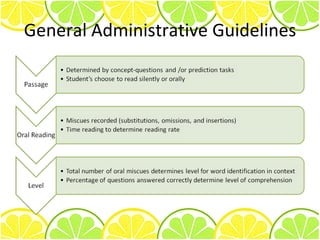
General Administrative Guidelines
Instructions to the Student “ I have some passages for you to read. Some you will read orally and some silently.  I will be making some notes as you read, and because I cannot remember everything you say, I will also be taping you. I cannot help you in any way.  If you come to a word you do not know, just do the best you can and continue on.  Afterwards I will ask you to tell me what you can remember about the passage just as if you were telling it to someone who had never heard it before. I will also ask you some questions about what you have read. Ready? The first passage is called’…”
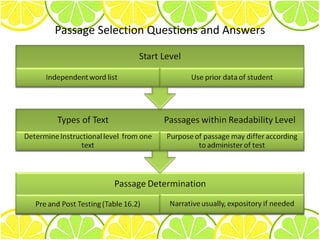
Passage Selection Questions and Answers
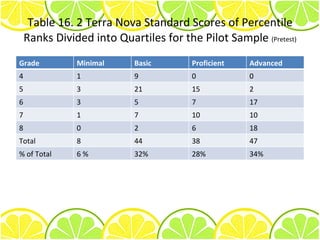
Table 16. 2 Terra Nova Standard Scores of Percentile Ranks Divided into Quartiles for the Pilot Sample  (Pretest) Grade Minimal Basic Proficient Advanced 4 1 9 0 0 5 3 21 15 2 6 3 5 7 17 7 1 7 10 10 8 0 2 6 18 Total 8 44 38 47 % of Total 6 % 32% 28% 34%
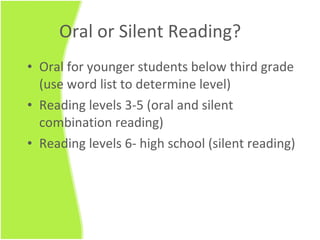
Oral or Silent Reading? Oral for younger students below third grade (use word list to determine level) Reading levels 3-5 (oral and silent combination reading) Reading levels 6- high school (silent reading)
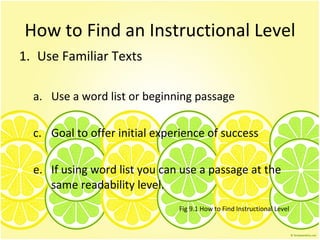
How to Find an Instructional Level Use Familiar Texts Use a word list or beginning passage Goal to offer initial experience of success  If using word list you can use a passage at the same readability level. Fig 9.1 How to Find Instructional Level
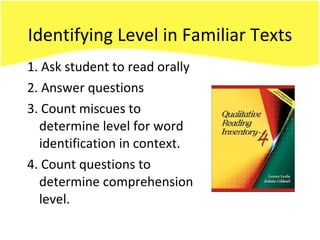
Identifying Level in Familiar Texts 1. Ask student to read orally 2. Answer questions 3. Count miscues to determine level for word identification in context. 4. Count questions to determine comprehension level.
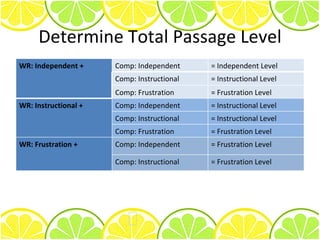
Determine Total Passage Level WR: Independent + Comp: Independent = Independent Level Comp: Instructional = Instructional Level Comp: Frustration = Frustration Level WR: Instructional + Comp: Independent = Instructional Level Comp: Instructional = Instructional Level Comp: Frustration = Frustration Level WR: Frustration + Comp: Independent = Frustration Level Comp: Instructional = Frustration Level
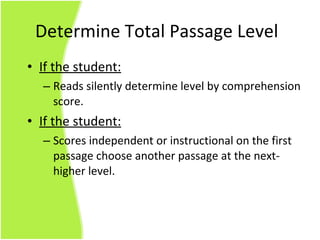
If the student: Reads silently determine level by comprehension score. If the student: Scores independent or instructional on the first passage choose another passage at the next-higher level. Determine Total Passage Level
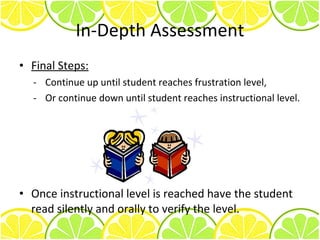
In-Depth Assessment Final Steps: Continue up until student reaches frustration level, - Or continue down until student reaches instructional level. Once instructional level is reached have the student read silently and orally to verify the level.
Finding the Instructional Level in Other Types of Material This step is after examiner determines familiar narrative instructional level. Other Types of Text: Text with or without pictures Unfamiliar selections Expository text
Types of Texts 1.  With or without pictures Only in pre-primer through grade two 2.  Expository Text Begin at Instructional level attained in familiar text 3.  Unfamiliar Text Begin one level lower than level attained in familiar text
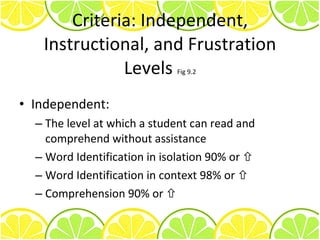
Criteria: Independent, Instructional, and Frustration Levels  Fig 9.2 Independent: The level at which a student can read and comprehend without assistance Word Identification in isolation 90% or   Word Identification in context 98% or   Comprehension 90% or  
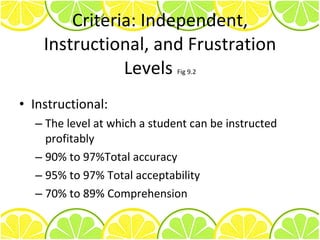
Criteria: Independent, Instructional, and Frustration Levels  Fig 9.2 Instructional: The level at which a student can be instructed profitably 90% to 97%Total accuracy 95% to 97% Total acceptability 70% to 89% Comprehension
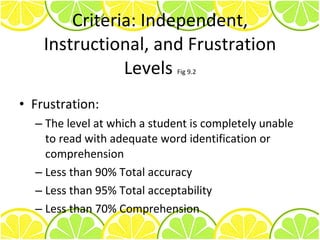
Criteria: Independent, Instructional, and Frustration Levels  Fig 9.2 Frustration: The level at which a student is completely unable to read with adequate word identification or comprehension Less than 90% Total accuracy Less than 95% Total acceptability Less than 70% Comprehension

Administering The QRI4 Reading Inventory

  • 1.
    Chapter 9:Administration and Scoring of the Qualitative Reading Inventory 4 Melissa Antonelli and Jaclyn Clark February 18, 2010
  • 2.
    Main Purposes forAdministering the Passages 1. Determination of a Student’s Independent, Instructional, and/or Frustration levels Word Identification in Context Miscues counted for Total Accuracy: all miscues regardless of quality of mispronounced words Total Acceptability: only miscues that change or distort passage meaning Comprehension Independent, instructional, and frustration warnings determined when students read designated passages and answer passage based questions
  • 3.
    Main Purposes forAdministering the Passages
  • 4.
    Main Purposes forAdministering the Passages 2. Assessment of a Student’s Ability to Read Different Types of Text * Usually Narrative Text 3. Assessment of a Student’s Ability to Comprehend in Different Modes * Student reads orally or silently
  • 5.
    Assessment Options Assessmentof Prior Knowledge (Concept Questions and Predictions) Oral Reading Miscue Analysis (whole word substitutions and omissions or insertions) Assessment of Comprehension through Unaided Recall (retelling of story by child) Assessment of Comprehension by Look-Backs ( Students permitted to look back in the text to find answers to missed comprehension questions) Assessment of Comprehension through Think- Alouds (Modeled by examiner for upper and middle school readers to practice while reading passages)
  • 6.
  • 7.
    Instructions to theStudent “ I have some passages for you to read. Some you will read orally and some silently. I will be making some notes as you read, and because I cannot remember everything you say, I will also be taping you. I cannot help you in any way. If you come to a word you do not know, just do the best you can and continue on. Afterwards I will ask you to tell me what you can remember about the passage just as if you were telling it to someone who had never heard it before. I will also ask you some questions about what you have read. Ready? The first passage is called’…”
  • 8.
  • 9.
    Table 16. 2Terra Nova Standard Scores of Percentile Ranks Divided into Quartiles for the Pilot Sample (Pretest) Grade Minimal Basic Proficient Advanced 4 1 9 0 0 5 3 21 15 2 6 3 5 7 17 7 1 7 10 10 8 0 2 6 18 Total 8 44 38 47 % of Total 6 % 32% 28% 34%
  • 10.
    Oral or SilentReading? Oral for younger students below third grade (use word list to determine level) Reading levels 3-5 (oral and silent combination reading) Reading levels 6- high school (silent reading)
  • 11.
    How to Findan Instructional Level Use Familiar Texts Use a word list or beginning passage Goal to offer initial experience of success If using word list you can use a passage at the same readability level. Fig 9.1 How to Find Instructional Level
  • 12.
    Identifying Level inFamiliar Texts 1. Ask student to read orally 2. Answer questions 3. Count miscues to determine level for word identification in context. 4. Count questions to determine comprehension level.
  • 13.
    Determine Total PassageLevel WR: Independent + Comp: Independent = Independent Level Comp: Instructional = Instructional Level Comp: Frustration = Frustration Level WR: Instructional + Comp: Independent = Instructional Level Comp: Instructional = Instructional Level Comp: Frustration = Frustration Level WR: Frustration + Comp: Independent = Frustration Level Comp: Instructional = Frustration Level
  • 14.
    If the student:Reads silently determine level by comprehension score. If the student: Scores independent or instructional on the first passage choose another passage at the next-higher level. Determine Total Passage Level
  • 15.
    In-Depth Assessment FinalSteps: Continue up until student reaches frustration level, - Or continue down until student reaches instructional level. Once instructional level is reached have the student read silently and orally to verify the level.
  • 16.
    Finding the InstructionalLevel in Other Types of Material This step is after examiner determines familiar narrative instructional level. Other Types of Text: Text with or without pictures Unfamiliar selections Expository text
  • 17.
    Types of Texts1. With or without pictures Only in pre-primer through grade two 2. Expository Text Begin at Instructional level attained in familiar text 3. Unfamiliar Text Begin one level lower than level attained in familiar text
  • 18.
    Criteria: Independent, Instructional,and Frustration Levels Fig 9.2 Independent: The level at which a student can read and comprehend without assistance Word Identification in isolation 90% or  Word Identification in context 98% or  Comprehension 90% or 
  • 19.
    Criteria: Independent, Instructional,and Frustration Levels Fig 9.2 Instructional: The level at which a student can be instructed profitably 90% to 97%Total accuracy 95% to 97% Total acceptability 70% to 89% Comprehension
  • 20.
    Criteria: Independent, Instructional,and Frustration Levels Fig 9.2 Frustration: The level at which a student is completely unable to read with adequate word identification or comprehension Less than 90% Total accuracy Less than 95% Total acceptability Less than 70% Comprehension