INTRODUCTION
◦ ADME isthe abbreviation in pharmacokinetics & pharmacodynamics for
“Absorption, Distribution, Metabolism & Excretion” and describes the
deposition of a pharmaceutical compound within a body.
◦ The 4 criteria all influence the drug levels and kinetics of drug exposure to the
tissues and hence influence the performance & pharmacological activity of the
compound as a drug.
3.
PHARMACOKINETICS & PHARMACODYNAMICS
◦Pharmacokinetics: How the drug concentration change as it moves through the
different compartments of the body.
◦ Pharmacodynamics: How does the drug exert its effect on our body.
◦ Pharmacokinetics is the study of how a body affects a drug whereas
pharmacodynamics is the study of how the drug affects the organism. Both
together influence dosing, benefit & adverse effects as seen in PL /PD models.
4.
ADME
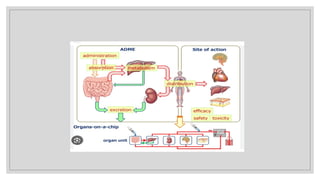
The various compartmentsthat the model is divided into are commonly referred
to as ADME scheme.
1. Absorption: The process of a substance entering the blood circulation.
2. Distribution: The dispersion / dissemination of substances throughout the
fluids and tissues of the body.
3. Metabolism(biotransformation / inaction): The irreversible transformation of
parent compounds into daughter metabolites.
4. Excretion: The removal of the substances from the body. In rare cases , some
drugs irreversibly accumulate in body tissue.
6.
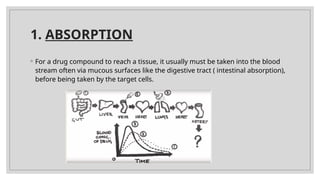
1. ABSORPTION
◦ Fora drug compound to reach a tissue, it usually must be taken into the blood
stream often via mucous surfaces like the digestive tract ( intestinal absorption),
before being taken by the target cells.
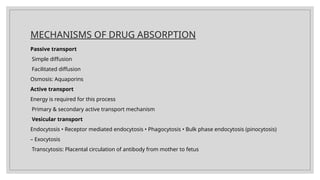
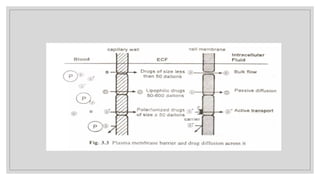
MECHANISMS OF DRUGABSORPTION
Passive transport
Simple diffusion
Facilitated diffusion
Osmosis: Aquaporins
Active transport
Energy is required for this process
Primary & secondary active transport mechanism
Vesicular transport
Endocytosis • Receptor mediated endocytosis • Phagocytosis • Bulk phase endocytosis (pinocytosis)
– Exocytosis
Transcytosis: Placental circulation of antibody from mother to fetus
9.
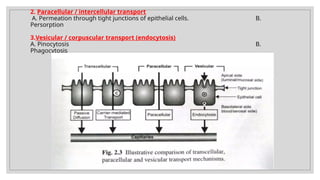
2. Paracellular /intercellular transport
A. Permeation through tight junctions of epithelial cells. B.
Persorption
3.Vesicular / corpuscular transport (endocytosis)
A. Pinocytosis B.
Phagocytosis
10.
2. DISTRIBUTION
The drugcompound needs to be carried to its effector site , most often via the
bloodstream. From there, the compound may distribute into the muscle & organs ,
usually to differing extents. After entry into the systemic circulation , either by
intravascular injection or by absorption from any of the various extracellular sites,
the drug is subjected to numerous distribution processes that tend to lower its
plasma concentration.
12.
VOLUME OF DISTRIBUTION(V)
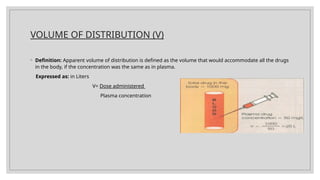
◦ Definition: Apparent volume of distribution is defined as the volume that would accommodate all the drugs
in the body, if the concentration was the same as in plasma.
Expressed as: in Liters
V= Dose administered
Plasma concentration
13.
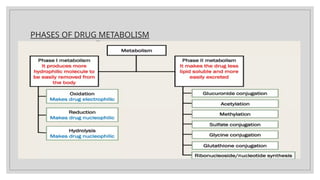
3. METABOLISM
Drugs beginto break down as soon as they enter the body. The majority of small
molecule drug metabolism is carried out in the liver by redox enzymes , termed as
P450 enzyme. When metabolism occurs , the initial (parent) compound is
converted to new compounds called metabolites. When metabolites are
pharmacologically inert, metabolism deactivates the administered dose of parent
drug and this usually reduces the effects on the body. Metabolites may also be
pharmacologically active, sometimes more so than the parent drug.
14.
FACTORS AFFECTING DRUGMETABOLISM
1. Age
2. Disease
3. Species difference
4. Heredity
5. Sex; pregnancy
6. Environmental factors
7. Drug dose
8. Enzyme inhibition
9. Enzyme induction
10. Diet
4. EXCRETION
◦ Drugsand their metabolites need to be removed from the body via excretion
usually through the kidneys (urine) or in faeces. Unless excretion is complete,
accumulation of foreign substances can adversely affect normal metabolism.
◦ There are 3 main sites where drug excretion occurs:
1. The kidney is the most important site and it is where the products are excreted
through urine.
2. Biliary excretion / faecal excretion is the process that initiates in the liver and
passes through the gut until the products are finally excreted along the waste
products or faeces.
3. The last main method of excretion is through the lungs (eg; anesthetic gases).
17.
MECHANISM OF EXCRETION
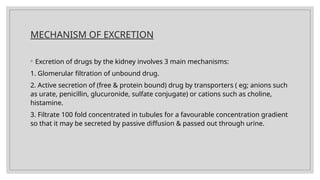
◦Excretion of drugs by the kidney involves 3 main mechanisms:
1. Glomerular filtration of unbound drug.
2. Active secretion of (free & protein bound) drug by transporters ( eg; anions such
as urate, penicillin, glucuronide, sulfate conjugate) or cations such as choline,
histamine.
3. Filtrate 100 fold concentrated in tubules for a favourable concentration gradient
so that it may be secreted by passive diffusion & passed out through urine.