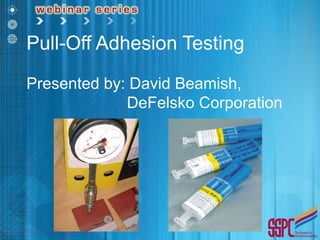
Pull-Off Adhesion Testing
Presented by: David Beamish,
DeFelsko Corporation
Learning Outcomes
• At the end of this webinar you will be able to:
• Define pull-off strength
• Explain the difference between Adhesion and Cohesion
• Describe several types of pull testers
• Understand requirements of ASTM D4541, Standard Test Method
for Pull-Off Strength of Coatings Using Portable Adhesion Testers
• Conduct a pull test
• Understand differences when testing on concrete
• Analyze and report test results
• List common pitfalls
2
Introduction
• This webinar will discuss the
method for evaluating the
pull-off strength (commonly
referred to as adhesion) of a
coating system applied to a
metal substrate.
3
Adhesion
• A complex phenomenon related to physical and chemical
forces
• The ability of a coating to adhere to the substrate or to a
previous coating
• There are many ways to evaluate degree of bonding.
But there is no single test to accurately and quantitatively
determine adhesion
• Many factors should be taken into account.
Conservative evaluations are recommended
4
What is Being Measured?
• Coating strength at different planes
• Adhesion Strength - Bond strength between the
substrate and the coating and/or the coating layer to one
another
• Cohesion Strength - Inner-strength of a coating layer
• Adhesion strength is highly variable
• No industry wide adhesion acceptance value
• Minimum adhesion values may be on a PDS or in a
specification
5
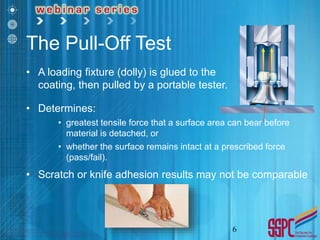
The Pull-Off Test
• A loading fixture (dolly) is glued to the
coating, then pulled by a portable tester.
• Determines:
• greatest tensile force that a surface area can bear before
material is detached, or
• whether the surface remains intact at a prescribed force
(pass/fail).
• Scratch or knife adhesion results may not be comparable
6
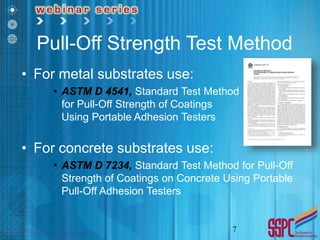
Pull-Off Strength Test Method
• For metal substrates use:
• ASTM D 4541, Standard Test Method
for Pull-Off Strength of Coatings
Using Portable Adhesion Testers
• For concrete substrates use:
• ASTM D 7234, Standard Test Method for Pull-Off
Strength of Coatings on Concrete Using Portable
Pull-Off Adhesion Testers
7
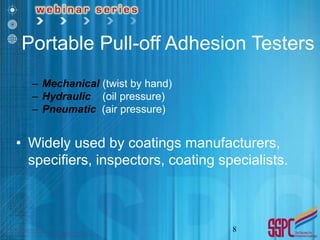
Portable Pull-off Adhesion Testers
– Mechanical (twist by hand)
– Hydraulic (oil pressure)
– Pneumatic (air pressure)
• Widely used by coatings manufacturers,
specifiers, inspectors, coating specialists.
8
Testing Equipment
• The following 5 devices are described:
– Method A: Discontinued
– Method B: Fixed Alignment Type II (Mechanical)
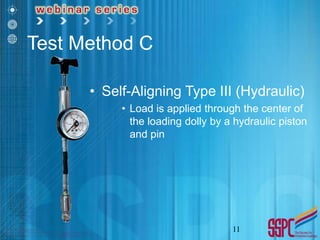
– Method C: Self-Aligning Type III (Hydraulic)
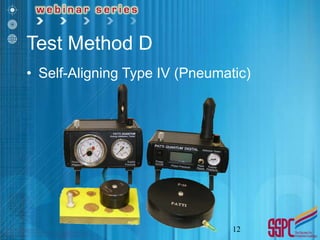
– Method D: Self-Aligning Type IV (Pneumatic)
– Method E: Self-Aligning Type V (Hydraulic)
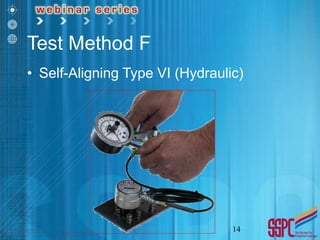
– Method F: Self-Aligning Type VI (Hydraulic)
• Results obtained by each test method
may give different results
9
Test Method B
• Fixed Alignment Type II (Mechanical)
10
Test Method C
• Self-Aligning Type III (Hydraulic)
• Load is applied through the center of
the loading dolly by a hydraulic piston
and pin
11
Test Method D
• Self-Aligning Type IV (Pneumatic)
12
Test Method E
• Self-Aligning Type V (Hydraulic)
13
Test Method F
• Self-Aligning Type VI (Hydraulic)
14
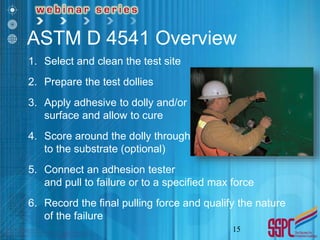
ASTM D 4541 Overview
1. Select and clean the test site
2. Prepare the test dollies
3. Apply adhesive to dolly and/or
surface and allow to cure
4. Score around the dolly through
to the substrate (optional)
5. Connect an adhesion tester
and pull to failure or to a specified max force
6. Record the final pulling force and qualify the nature
of the failure
15
Apparatus
1. Adhesion Tester, commercially available,
examples are listed in Annex A1 - A5
16
a. Loading Fixtures
b. Detaching Assembly
c. Base (if needed by the adhesion tester)
d. Means of pulling the loading fixtures vertically
e. Timer to maintain 150 psi/s in 100s
f. Force indicator
Apparatus
2. Solvent
3. Sandpaper
4. Adhesive
5. Clamps
6. Cotton Swabs
7. Circular Hole Saw (optional)
17
1 – Select and Clean Test Site
• A flat surface large enough to accommodate the
specified number of replicate test dollies
• For statistical purposes 3 test sites within a
specified area are typically required
• A rigid surface that can support the counter force
• Steel substrates less than 3.2 mm (⅛”) thickness
usually reduce pull-off strength
18
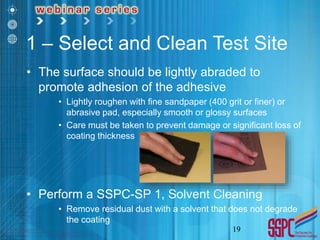
• The surface should be lightly abraded to
promote adhesion of the adhesive
• Lightly roughen with fine sandpaper (400 grit or finer) or
abrasive pad, especially smooth or glossy surfaces
• Care must be taken to prevent damage or significant loss of
coating thickness
• Perform a SSPC-SP 1, Solvent Cleaning
• Remove residual dust with a solvent that does not degrade
the coating
1 – Select and Clean Test Site
19
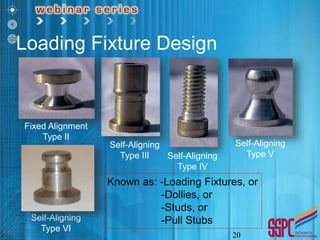
Loading Fixture Design
Self-Aligning
Type VI
Fixed Alignment
Type II
Self-Aligning
Type III
Self-Aligning
Type V
Self-Aligning
Type IV
Known as: -Loading Fixtures, or
-Dollies, or
-Studs, or
-Pull Stubs
20
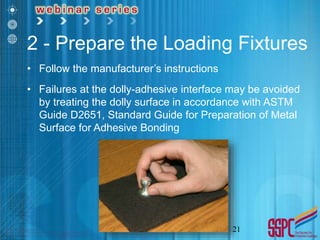
2 - Prepare the Loading Fixtures
• Follow the manufacturer’s instructions
• Failures at the dolly-adhesive interface may be avoided
by treating the dolly surface in accordance with ASTM
Guide D2651, Standard Guide for Preparation of Metal
Surface for Adhesive Bonding
21
3 - Apply Adhesive
• Identify a suitable glue:
• Cyanoacrylates (super glues) cure quickly and
are commonly used on some coatings with low
bond strengths
• 2-part epoxies when stronger bonds are required
22
3 - Apply Adhesive
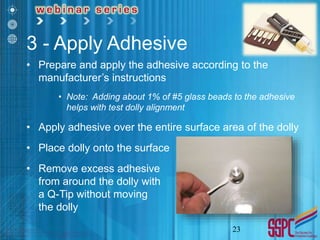
• Prepare and apply the adhesive according to the
manufacturer’s instructions
• Note: Adding about 1% of #5 glass beads to the adhesive
helps with test dolly alignment
• Apply adhesive over the entire surface area of the dolly
• Place dolly onto the surface
• Remove excess adhesive
from around the dolly with
a Q-Tip without moving
the dolly
23
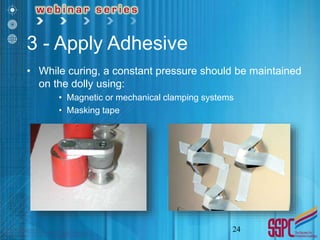
3 - Apply Adhesive
• While curing, a constant pressure should be maintained
on the dolly using:
• Magnetic or mechanical clamping systems
• Masking tape
24
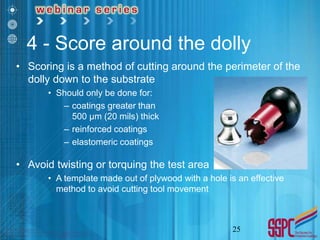
4 - Score around the dolly
• Scoring is a method of cutting around the perimeter of the
dolly down to the substrate
• Should only be done for:
– coatings greater than
500 µm (20 mils) thick
– reinforced coatings
– elastomeric coatings
• Avoid twisting or torquing the test area
• A template made out of plywood with a hole is an effective
method to avoid cutting tool movement
25
5 – Pull the Dolly
• Attach the apparatus and set the force indicator to zero
• Increase the load to the dolly in a smooth, continuous
manner
Not faster than 1 MPa/s (150 psi/s)
Not longer than 100 seconds
26
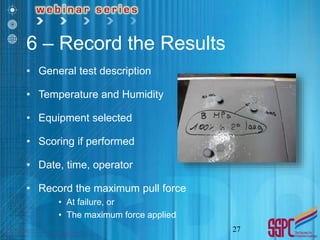
6 – Record the Results
• General test description
• Temperature and Humidity
• Equipment selected
• Scoring if performed
• Date, time, operator
• Record the maximum pull force
• At failure, or
• The maximum force applied
27
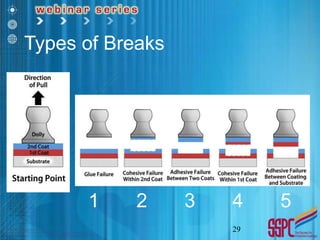
6 – Record the Results
• Adhesion Break: A break between coating layers or
between the substrate and first coating layer
• Cohesion Break: A break within a single coating layer
• Glue Break: Coating adhesion and/or cohesion strength
exceeds bonding strength of the adhesive
• If multiple locations of break occur, estimate the % of each
• e.g., 75% cohesion within primer; 25% adhesion between
primer and intermediate coats
• Report the Type and Location of the Break
28
Types of Breaks
1 2 3 4 5
29
What is Acceptable?
30
ASTM D 7234
Concrete Test Differences
• Larger 2” (50 mm) diameter
loading fixtures
• Scoring is generally performed
• Slower loading rate
• Failure is typically within the
concrete itself
• SSPC SP13/NACE No. 6, Appendix A1.6 describes
procedures for testing concrete coating adhesion
31
Cautions
1. Use D 4541 charts to select a test device
2. Verify test device has current calibration
3. The substrate must be rigid
4. Adhesive should not damage the coating
5. Prepare the contact surfaces
6. Mix and apply the adhesive carefully
7. Perform testing in triplicate
32
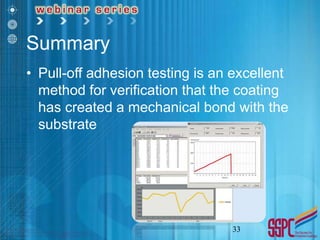
Summary
• Pull-off adhesion testing is an excellent
method for verification that the coating
has created a mechanical bond with the
substrate
33
Acknowledgements
• -SSPC www.sspc.org  Market Place
• -ASTM www.astm.org  Standards
• -Bill Corbett, KTA, Coating Adhesion Testing
Methods and Equipment Webinar
• -Elcometer, SEMicro, DeFelsko
and DFT Instruments - Equipment Suppliers
34
Pull-Off Adhesion Testing
Presented by: David Beamish,
DeFelsko Corporation
The End

Adhesion test- Pull off adhesion testings.ppt

  • 1.
    Pull-Off Adhesion Testing Presentedby: David Beamish, DeFelsko Corporation
  • 2.
    Learning Outcomes • Atthe end of this webinar you will be able to: • Define pull-off strength • Explain the difference between Adhesion and Cohesion • Describe several types of pull testers • Understand requirements of ASTM D4541, Standard Test Method for Pull-Off Strength of Coatings Using Portable Adhesion Testers • Conduct a pull test • Understand differences when testing on concrete • Analyze and report test results • List common pitfalls 2
  • 3.
    Introduction • This webinarwill discuss the method for evaluating the pull-off strength (commonly referred to as adhesion) of a coating system applied to a metal substrate. 3
  • 4.
    Adhesion • A complexphenomenon related to physical and chemical forces • The ability of a coating to adhere to the substrate or to a previous coating • There are many ways to evaluate degree of bonding. But there is no single test to accurately and quantitatively determine adhesion • Many factors should be taken into account. Conservative evaluations are recommended 4
  • 5.
    What is BeingMeasured? • Coating strength at different planes • Adhesion Strength - Bond strength between the substrate and the coating and/or the coating layer to one another • Cohesion Strength - Inner-strength of a coating layer • Adhesion strength is highly variable • No industry wide adhesion acceptance value • Minimum adhesion values may be on a PDS or in a specification 5
  • 6.
    The Pull-Off Test •A loading fixture (dolly) is glued to the coating, then pulled by a portable tester. • Determines: • greatest tensile force that a surface area can bear before material is detached, or • whether the surface remains intact at a prescribed force (pass/fail). • Scratch or knife adhesion results may not be comparable 6
  • 7.
    Pull-Off Strength TestMethod • For metal substrates use: • ASTM D 4541, Standard Test Method for Pull-Off Strength of Coatings Using Portable Adhesion Testers • For concrete substrates use: • ASTM D 7234, Standard Test Method for Pull-Off Strength of Coatings on Concrete Using Portable Pull-Off Adhesion Testers 7
  • 8.
    Portable Pull-off AdhesionTesters – Mechanical (twist by hand) – Hydraulic (oil pressure) – Pneumatic (air pressure) • Widely used by coatings manufacturers, specifiers, inspectors, coating specialists. 8
  • 9.
    Testing Equipment • Thefollowing 5 devices are described: – Method A: Discontinued – Method B: Fixed Alignment Type II (Mechanical) – Method C: Self-Aligning Type III (Hydraulic) – Method D: Self-Aligning Type IV (Pneumatic) – Method E: Self-Aligning Type V (Hydraulic) – Method F: Self-Aligning Type VI (Hydraulic) • Results obtained by each test method may give different results 9
  • 10.
    Test Method B •Fixed Alignment Type II (Mechanical) 10
  • 11.
    Test Method C •Self-Aligning Type III (Hydraulic) • Load is applied through the center of the loading dolly by a hydraulic piston and pin 11
  • 12.
    Test Method D •Self-Aligning Type IV (Pneumatic) 12
  • 13.
    Test Method E •Self-Aligning Type V (Hydraulic) 13
  • 14.
    Test Method F •Self-Aligning Type VI (Hydraulic) 14
  • 15.
    ASTM D 4541Overview 1. Select and clean the test site 2. Prepare the test dollies 3. Apply adhesive to dolly and/or surface and allow to cure 4. Score around the dolly through to the substrate (optional) 5. Connect an adhesion tester and pull to failure or to a specified max force 6. Record the final pulling force and qualify the nature of the failure 15
  • 16.
    Apparatus 1. Adhesion Tester,commercially available, examples are listed in Annex A1 - A5 16 a. Loading Fixtures b. Detaching Assembly c. Base (if needed by the adhesion tester) d. Means of pulling the loading fixtures vertically e. Timer to maintain 150 psi/s in 100s f. Force indicator
  • 17.
    Apparatus 2. Solvent 3. Sandpaper 4.Adhesive 5. Clamps 6. Cotton Swabs 7. Circular Hole Saw (optional) 17
  • 18.
    1 – Selectand Clean Test Site • A flat surface large enough to accommodate the specified number of replicate test dollies • For statistical purposes 3 test sites within a specified area are typically required • A rigid surface that can support the counter force • Steel substrates less than 3.2 mm (⅛”) thickness usually reduce pull-off strength 18
  • 19.
    • The surfaceshould be lightly abraded to promote adhesion of the adhesive • Lightly roughen with fine sandpaper (400 grit or finer) or abrasive pad, especially smooth or glossy surfaces • Care must be taken to prevent damage or significant loss of coating thickness • Perform a SSPC-SP 1, Solvent Cleaning • Remove residual dust with a solvent that does not degrade the coating 1 – Select and Clean Test Site 19
  • 20.
    Loading Fixture Design Self-Aligning TypeVI Fixed Alignment Type II Self-Aligning Type III Self-Aligning Type V Self-Aligning Type IV Known as: -Loading Fixtures, or -Dollies, or -Studs, or -Pull Stubs 20
  • 21.
    2 - Preparethe Loading Fixtures • Follow the manufacturer’s instructions • Failures at the dolly-adhesive interface may be avoided by treating the dolly surface in accordance with ASTM Guide D2651, Standard Guide for Preparation of Metal Surface for Adhesive Bonding 21
  • 22.
    3 - ApplyAdhesive • Identify a suitable glue: • Cyanoacrylates (super glues) cure quickly and are commonly used on some coatings with low bond strengths • 2-part epoxies when stronger bonds are required 22
  • 23.
    3 - ApplyAdhesive • Prepare and apply the adhesive according to the manufacturer’s instructions • Note: Adding about 1% of #5 glass beads to the adhesive helps with test dolly alignment • Apply adhesive over the entire surface area of the dolly • Place dolly onto the surface • Remove excess adhesive from around the dolly with a Q-Tip without moving the dolly 23
  • 24.
    3 - ApplyAdhesive • While curing, a constant pressure should be maintained on the dolly using: • Magnetic or mechanical clamping systems • Masking tape 24
  • 25.
    4 - Scorearound the dolly • Scoring is a method of cutting around the perimeter of the dolly down to the substrate • Should only be done for: – coatings greater than 500 µm (20 mils) thick – reinforced coatings – elastomeric coatings • Avoid twisting or torquing the test area • A template made out of plywood with a hole is an effective method to avoid cutting tool movement 25
  • 26.
    5 – Pullthe Dolly • Attach the apparatus and set the force indicator to zero • Increase the load to the dolly in a smooth, continuous manner Not faster than 1 MPa/s (150 psi/s) Not longer than 100 seconds 26
  • 27.
    6 – Recordthe Results • General test description • Temperature and Humidity • Equipment selected • Scoring if performed • Date, time, operator • Record the maximum pull force • At failure, or • The maximum force applied 27
  • 28.
    6 – Recordthe Results • Adhesion Break: A break between coating layers or between the substrate and first coating layer • Cohesion Break: A break within a single coating layer • Glue Break: Coating adhesion and/or cohesion strength exceeds bonding strength of the adhesive • If multiple locations of break occur, estimate the % of each • e.g., 75% cohesion within primer; 25% adhesion between primer and intermediate coats • Report the Type and Location of the Break 28
  • 29.
  • 30.
  • 31.
    ASTM D 7234 ConcreteTest Differences • Larger 2” (50 mm) diameter loading fixtures • Scoring is generally performed • Slower loading rate • Failure is typically within the concrete itself • SSPC SP13/NACE No. 6, Appendix A1.6 describes procedures for testing concrete coating adhesion 31
  • 32.
    Cautions 1. Use D4541 charts to select a test device 2. Verify test device has current calibration 3. The substrate must be rigid 4. Adhesive should not damage the coating 5. Prepare the contact surfaces 6. Mix and apply the adhesive carefully 7. Perform testing in triplicate 32
  • 33.
    Summary • Pull-off adhesiontesting is an excellent method for verification that the coating has created a mechanical bond with the substrate 33
  • 34.
    Acknowledgements • -SSPC www.sspc.org Market Place • -ASTM www.astm.org  Standards • -Bill Corbett, KTA, Coating Adhesion Testing Methods and Equipment Webinar • -Elcometer, SEMicro, DeFelsko and DFT Instruments - Equipment Suppliers 34
  • 35.
    Pull-Off Adhesion Testing Presentedby: David Beamish, DeFelsko Corporation The End

Editor's Notes

  • #2 This one-hour webinar describes pull-off adhesion testing, one of the most popular methods of determining the bond strength of coatings applied to rigid substrates.
  • #36 This one-hour webinar describes pull-off adhesion testing, one of the most popular methods of determining the bond strength of coatings applied to rigid substrates.