ADDICTION 101
A basic primer on addiction
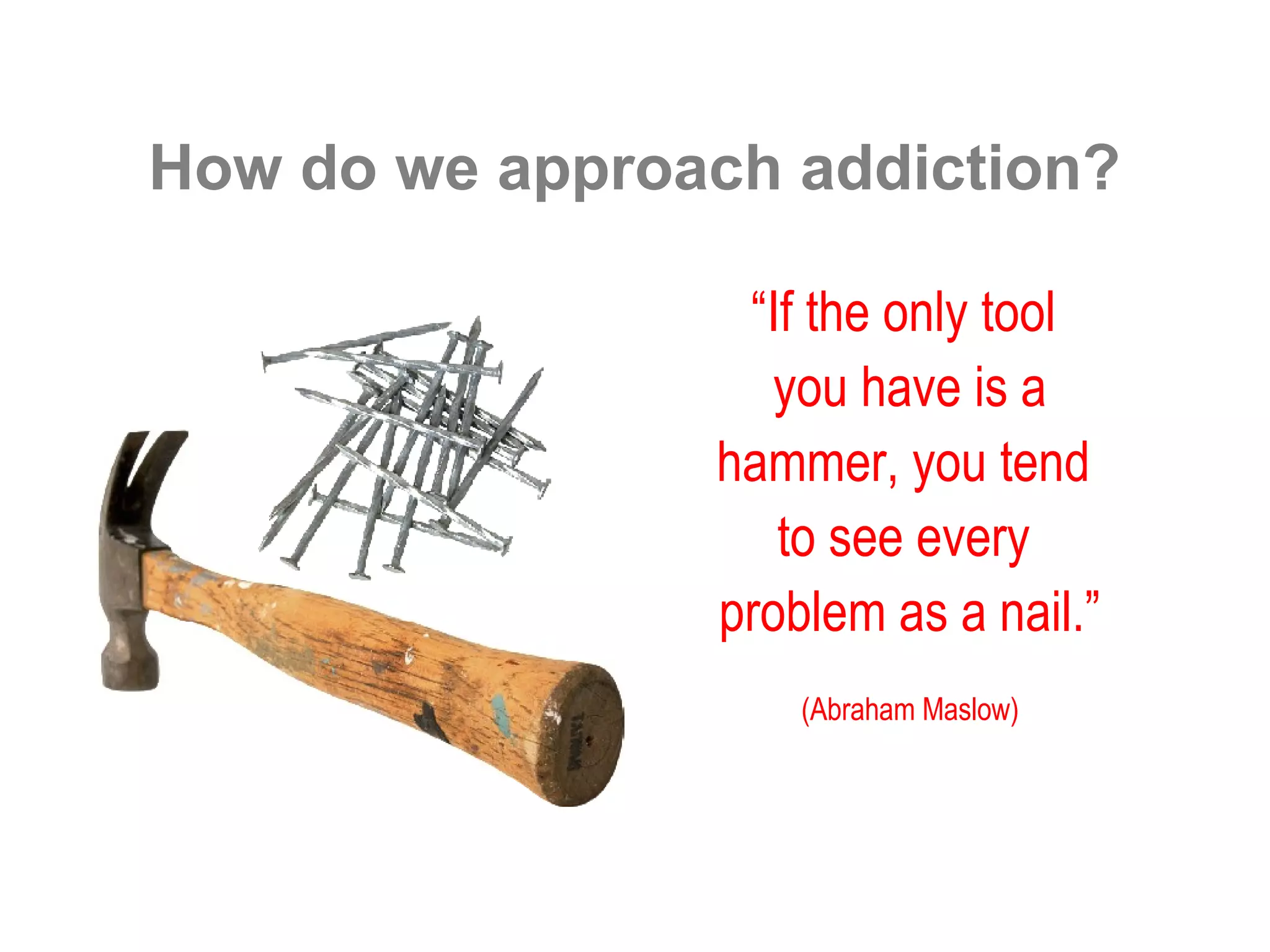
How do we approach addiction?

                 “If the only tool
                   you have is a
                hammer, you tend
                   to see every
                problem as a nail.”
                    (Abraham Maslow)
Definition of addiction
“Alcoholism is a primary, chronic disease
    with genetic, psychosocial and
    environmental factors influencing its
    development and manifestations. The
    disease is often progressive and fatal.

It is characterized by continuous or periodic
      impaired control over drinking,
      preoccupation with the drug alcohol,
      use of alcohol despite adverse
      consequences, and distortions in
      thinking, most notably denial.”
(National Council on Alcoholism and Drug Dependence, Inc. 2/3/90)
What is a disease?


         The causal model:
           1. cell, organ or system
           2. defect or injury
           3. measurable symptoms
A broken leg?


        The causal model:
            1. bone
            2. defect?
            3. symptoms?
            4. treatment?
Diabetes?


      The causal model:
          1. pancreas
          2. defect?
          3. symptoms?
          4. treatment?
Alcoholism?


       The causal model:
           1. brain? liver?
           2. defect?
           3. symptoms?
           4. treatment?
The causal model works
       for easy diagnosis


•   The model favors simple organs.
          Addiction?
          Brain disease? Liver disease?
•   In the absence of easy causality, what models work?
                   Moral
                   Personality
                   Environment
Language Problems
Treatment for Hypertension:
                                         Did Treatment Work?
m er usser P doo B
               l


                     No Tx         Tx              Tx             Tx             No Tx

                                         Treatment Status Over Time
                        Hypertension is a chronic disease. Treatment is applied consistently over
                               time (anti-hypertensive therapy with consistent follow-up).
 :
Treatment for Alcoholism:
                                        Did Treatment Work?
p m s no Cl ohoc A
               l


                     No Tx       Tx           Tx            Tx           No Tx
                                       Treatment Status Over Time
                        Should we also be using chronic/rehabilitative treatment model
   u


                           INSTEAD of an acute/single episode treatment model?
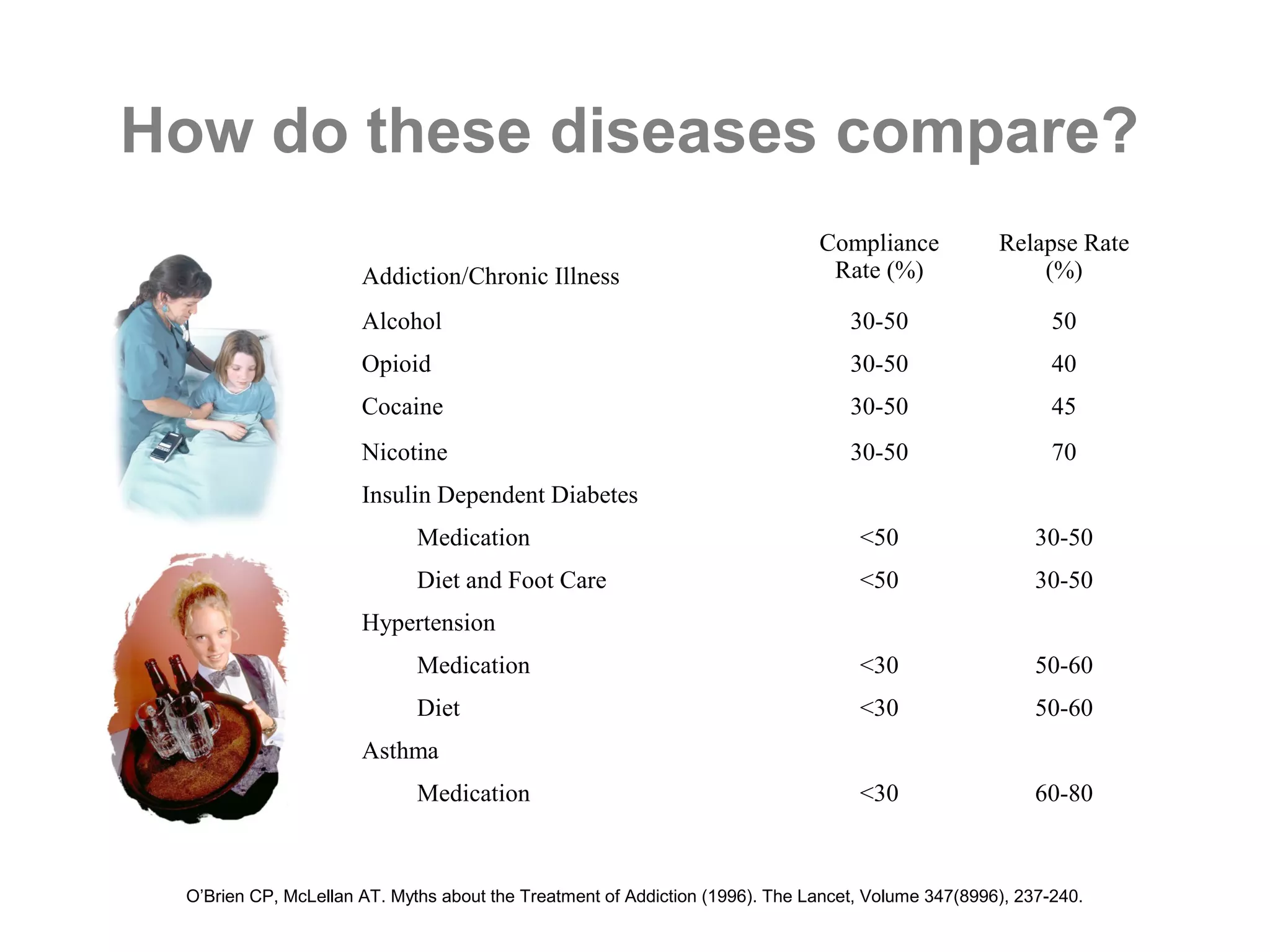
How do these diseases compare?
                                                                              Compliance            Relapse Rate
                      Addiction/Chronic Illness                                Rate (%)                 (%)

                      Alcohol                                                     30-50                    50
                      Opioid                                                      30-50                    40
                      Cocaine                                                     30-50                    45
                      Nicotine                                                    30-50                    70
                      Insulin Dependent Diabetes
                             Medication                                            <50                   30-50
                             Diet and Foot Care                                    <50                   30-50
                      Hypertension
                             Medication                                            <30                   50-60
                             Diet                                                  <30                   50-60
                      Asthma
                             Medication                                            <30                   60-80


 O’Brien CP, McLellan AT. Myths about the Treatment of Addiction (1996). The Lancet, Volume 347(8996), 237-240.
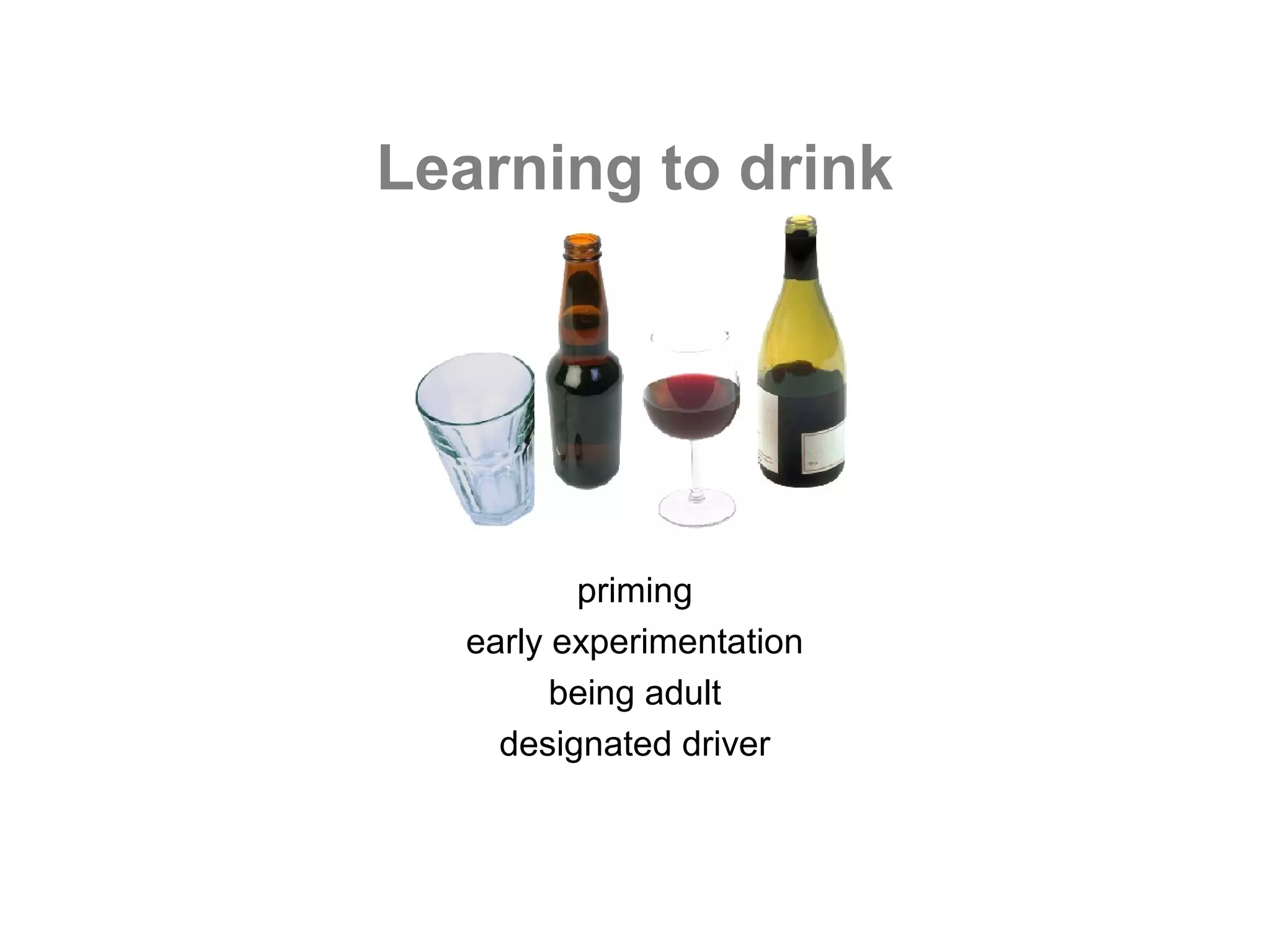
Learning to drink


         priming
  early experimentation
        being adult
    designated driver
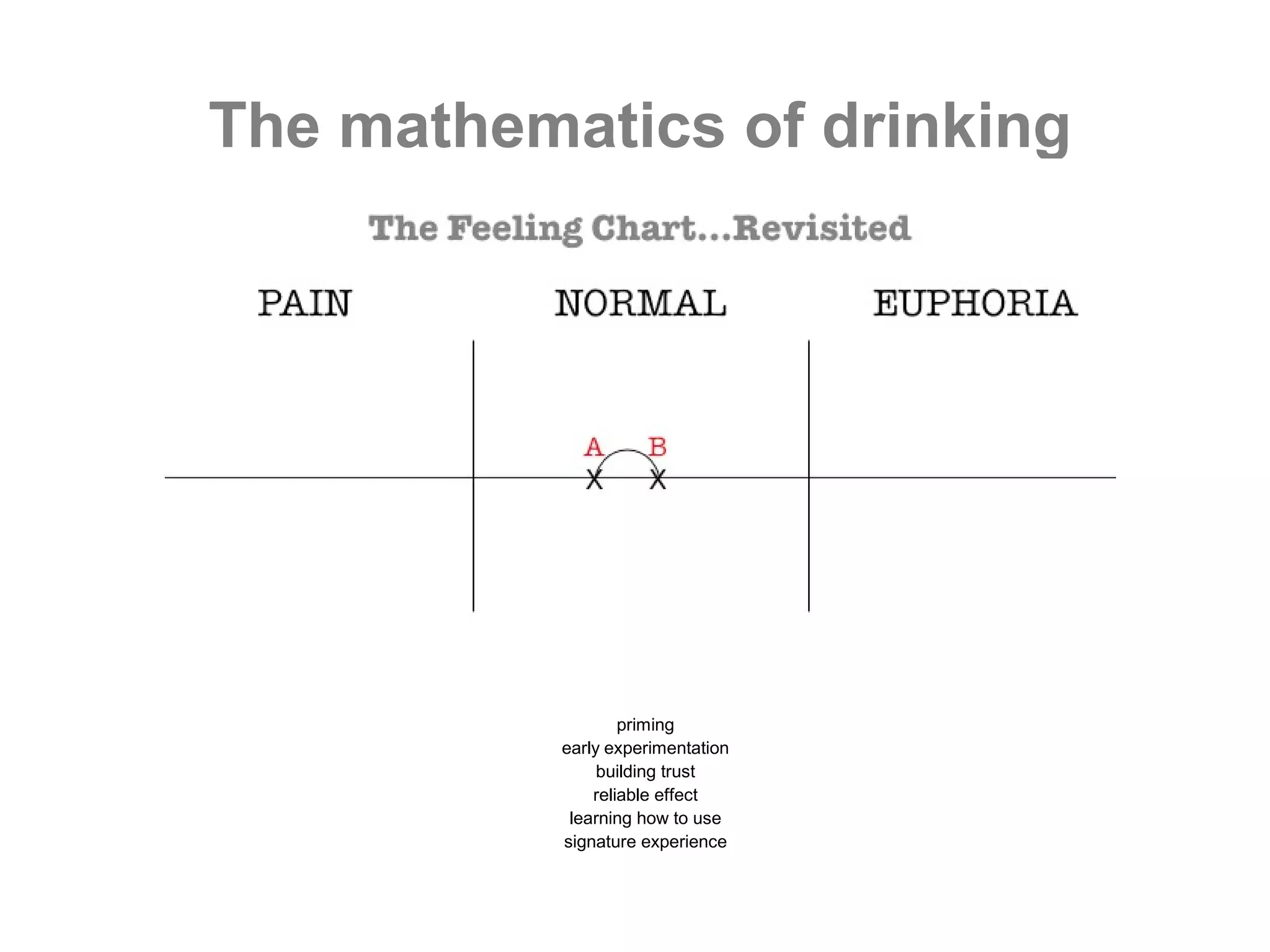
The mathematics of drinking


                   priming
           early experimentation
                building trust
               reliable effect
            learning how to use
           signature experience
More is better


            priming
    early experimentation
         building trust
        reliable effect
     learning how to use
    signature experience
The rules of drinking


                priming
        early experimentation
             building trust
            reliable effect
         learning how to use
        signature experience
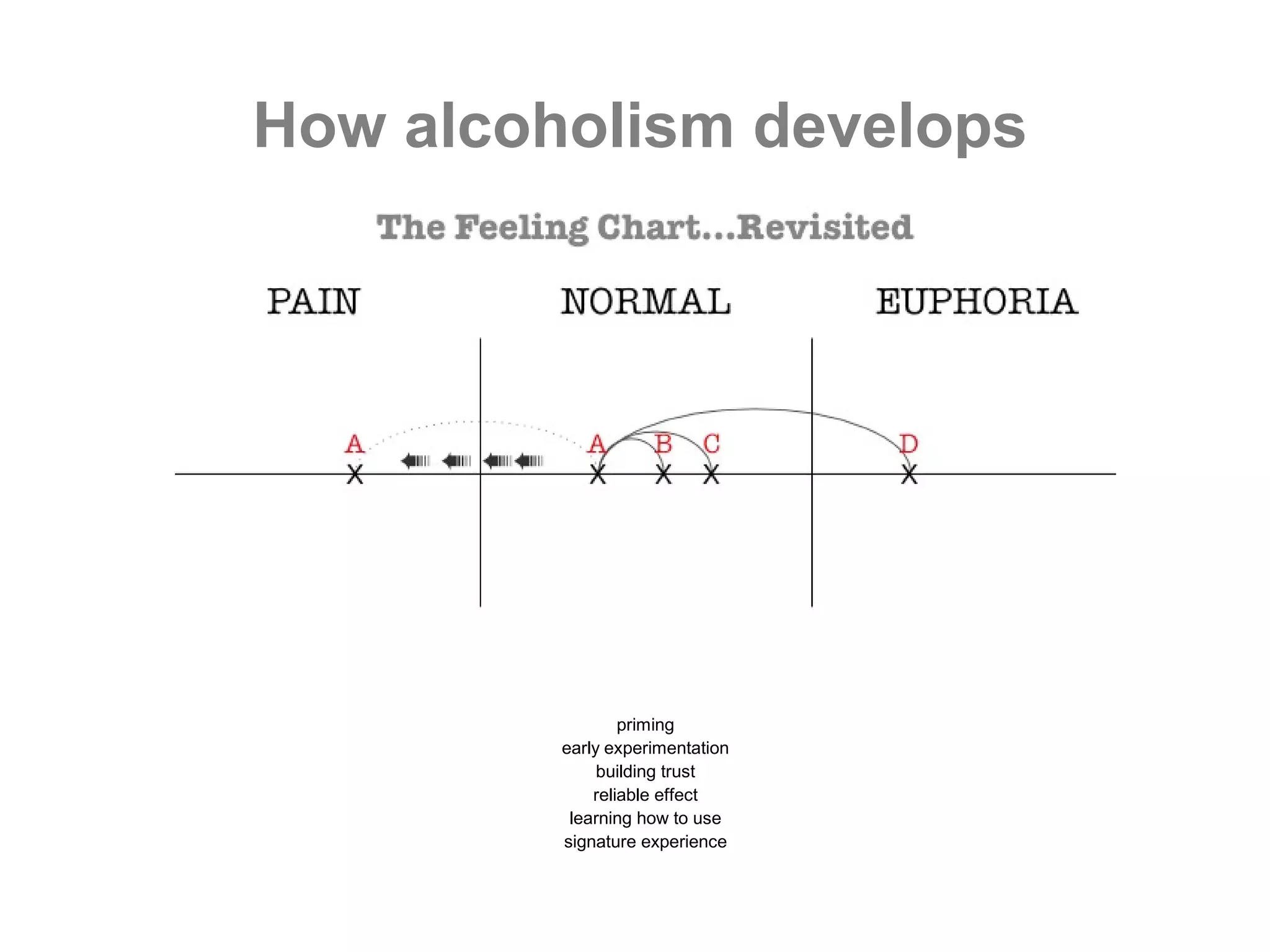
How alcoholism develops


                 priming
         early experimentation
              building trust
             reliable effect
          learning how to use
         signature experience
The lizard brain


  MENTAL OBSESSION
         CRAVING
          tolerance
       loss of control
         blackouts
   physical dependence
   withdrawal syndrome
Untreated addiction


            FEAR
       LONELINESS
       hypersensitivity
          insecurity
     adaptive defenses
          delusions
      “self will run riot”
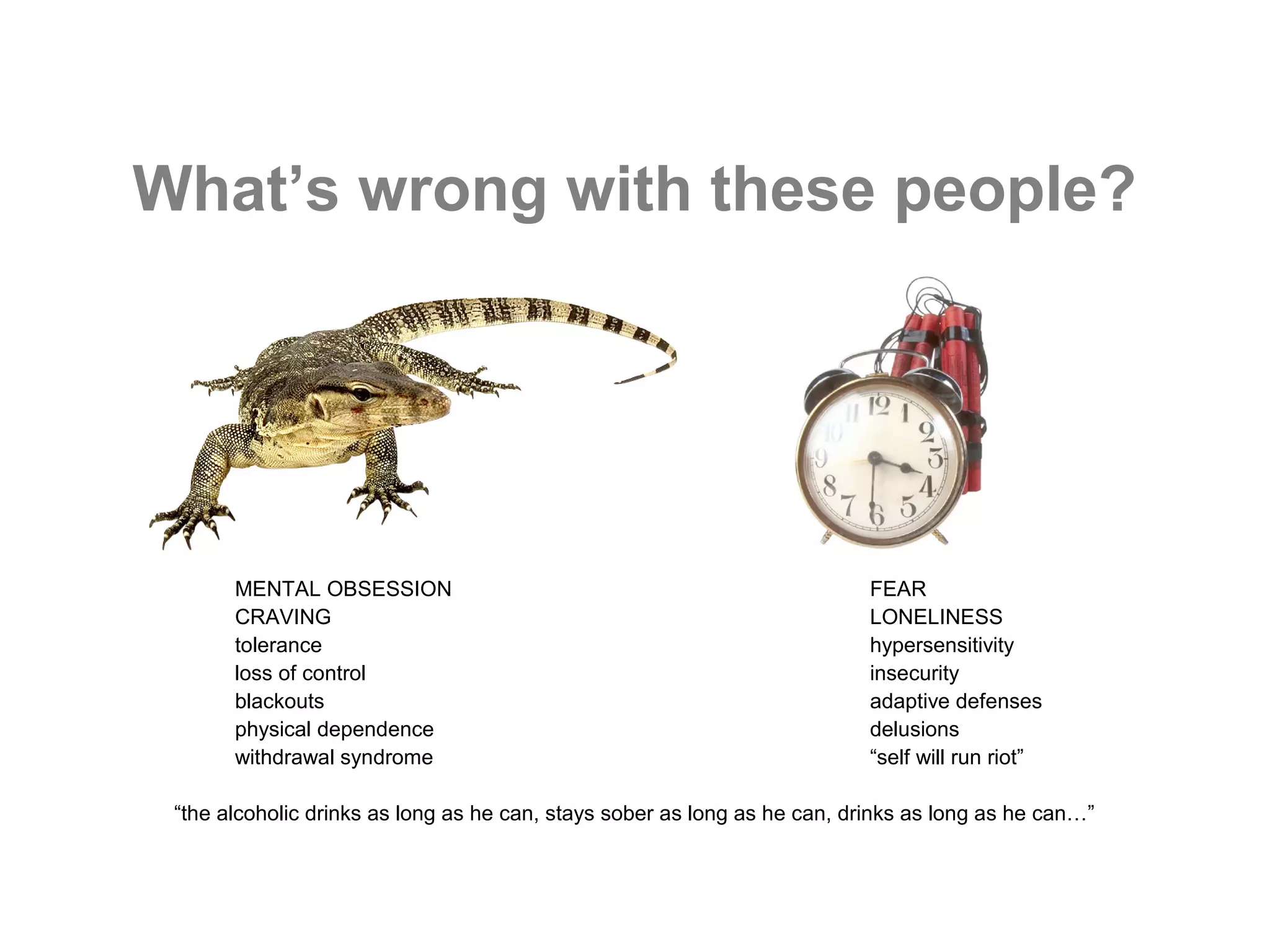
What’s wrong with these people?


       MENTAL OBSESSION                                                    FEAR
       CRAVING                                                             LONELINESS
       tolerance                                                           hypersensitivity
       loss of control                                                     insecurity
       blackouts                                                           adaptive defenses
       physical dependence                                                 delusions
       withdrawal syndrome                                                 “self will run riot”

 “the alcoholic drinks as long as he can, stays sober as long as he can, drinks as long as he can…”
Escaping a state of pain


    MENTAL OBSESSION                                                    FEAR
    CRAVING                                                             LONELINESS
    tolerance                                                           hypersensitivity
    loss of control                                                     insecurity
    blackouts                                                           adaptive defenses
    physical dependence                                                 delusions
    withdrawal syndrome                                                 “self will run riot”

“the alcoholic drinks as long as he can, stays sober as long as he can, drinks as long as he can…”
Signs and Symptoms
          •   personality change
          •   blackouts
          •   problems at work/school
          •   mood/attitude changes
          •   legal problems
          •   health problems
          •   avoiding friends/family
          •   constant obsession
          •   appetite/sleep changes
          •   high tolerance
          •   lying/dishonesty
          •   strained relationships
          •   financial problems
          •   loss of interests
          •   accidents
          •   depression/suicide attempts
          •   risk-taking behaviors
          •   changes in appearance
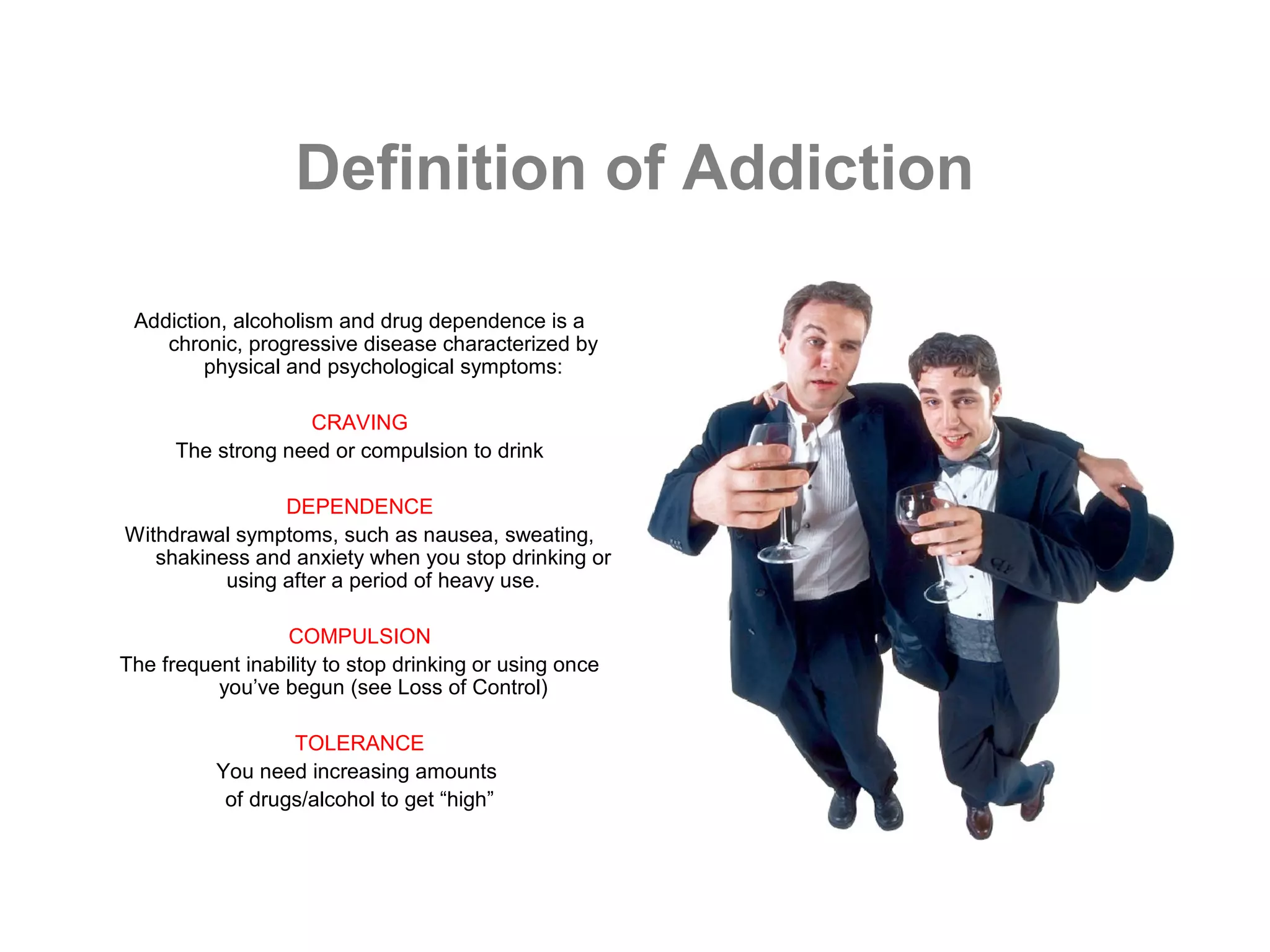
Definition of Addiction

 Addiction, alcoholism and drug dependence is a
    chronic, progressive disease characterized by
         physical and psychological symptoms:

                   CRAVING
      The strong need or compulsion to drink

                DEPENDENCE
Withdrawal symptoms, such as nausea, sweating,
   shakiness and anxiety when you stop drinking or
          using after a period of heavy use.

                 COMPULSION
The frequent inability to stop drinking or using once
          you’ve begun (see Loss of Control)

                  TOLERANCE
          You need increasing amounts
           of drugs/alcohol to get “high”
Definition of Abuse

          Drug/alcohol abuse may not involve craving, loss
          of control or physical dependence. Rather, it is a
          pattern of use that has led to at least one of the
          following situations within a 12-month period:

          •    Inability to fulfill major work, school or home
               responsibilities

          •    Drinking while driving a car, operating heavy
               machinery, or while involved in any other
               physically dangerous activity.

          •    Relationship problems that are caused or
               worsened by the effects of use.

          •    Recurring drug/alcohol-related legal problems,
               such as being arrested for driving under the
               influence, or for physically hurting someone
               while impaired.
A Disease of Perception
Traditional Therapeutic Intervention


   If “self will run riot” is the problem, what is the solution?
AA’s Counterintuitive Model


      Attend A.A. meetings regularly
             Read the Big Book
          Get and use a sponsor
      Participate in A.A. service work
        Get a home group of A.A.
               Pray regularly
           Help other alcoholics

Addiction 101 - September 2012

  • 1.
    ADDICTION 101 A basicprimer on addiction
  • 2.
    How do weapproach addiction? “If the only tool you have is a hammer, you tend to see every problem as a nail.” (Abraham Maslow)
  • 3.
    Definition of addiction “Alcoholismis a primary, chronic disease with genetic, psychosocial and environmental factors influencing its development and manifestations. The disease is often progressive and fatal. It is characterized by continuous or periodic impaired control over drinking, preoccupation with the drug alcohol, use of alcohol despite adverse consequences, and distortions in thinking, most notably denial.” (National Council on Alcoholism and Drug Dependence, Inc. 2/3/90)
  • 4.
    What is adisease? The causal model: 1. cell, organ or system 2. defect or injury 3. measurable symptoms
  • 5.
    A broken leg? The causal model: 1. bone 2. defect? 3. symptoms? 4. treatment?
  • 6.
    Diabetes? The causal model: 1. pancreas 2. defect? 3. symptoms? 4. treatment?
  • 7.
    Alcoholism? The causal model: 1. brain? liver? 2. defect? 3. symptoms? 4. treatment?
  • 8.
    The causal modelworks for easy diagnosis • The model favors simple organs. Addiction? Brain disease? Liver disease? • In the absence of easy causality, what models work? Moral Personality Environment
  • 9.
  • 11.
    Treatment for Hypertension: Did Treatment Work? m er usser P doo B l No Tx Tx Tx Tx No Tx Treatment Status Over Time Hypertension is a chronic disease. Treatment is applied consistently over time (anti-hypertensive therapy with consistent follow-up). :
  • 12.
    Treatment for Alcoholism: Did Treatment Work? p m s no Cl ohoc A l No Tx Tx Tx Tx No Tx Treatment Status Over Time Should we also be using chronic/rehabilitative treatment model u INSTEAD of an acute/single episode treatment model?
  • 13.
    How do thesediseases compare? Compliance Relapse Rate Addiction/Chronic Illness Rate (%) (%) Alcohol 30-50 50 Opioid 30-50 40 Cocaine 30-50 45 Nicotine 30-50 70 Insulin Dependent Diabetes Medication <50 30-50 Diet and Foot Care <50 30-50 Hypertension Medication <30 50-60 Diet <30 50-60 Asthma Medication <30 60-80 O’Brien CP, McLellan AT. Myths about the Treatment of Addiction (1996). The Lancet, Volume 347(8996), 237-240.
  • 14.
    Learning to drink priming early experimentation being adult designated driver
  • 15.
    The mathematics ofdrinking priming early experimentation building trust reliable effect learning how to use signature experience
  • 16.
    More is better priming early experimentation building trust reliable effect learning how to use signature experience
  • 17.
    The rules ofdrinking priming early experimentation building trust reliable effect learning how to use signature experience
  • 18.
    How alcoholism develops priming early experimentation building trust reliable effect learning how to use signature experience
  • 20.
    The lizard brain MENTAL OBSESSION CRAVING tolerance loss of control blackouts physical dependence withdrawal syndrome
  • 21.
    Untreated addiction FEAR LONELINESS hypersensitivity insecurity adaptive defenses delusions “self will run riot”
  • 23.
    What’s wrong withthese people? MENTAL OBSESSION FEAR CRAVING LONELINESS tolerance hypersensitivity loss of control insecurity blackouts adaptive defenses physical dependence delusions withdrawal syndrome “self will run riot” “the alcoholic drinks as long as he can, stays sober as long as he can, drinks as long as he can…”
  • 24.
    Escaping a stateof pain MENTAL OBSESSION FEAR CRAVING LONELINESS tolerance hypersensitivity loss of control insecurity blackouts adaptive defenses physical dependence delusions withdrawal syndrome “self will run riot” “the alcoholic drinks as long as he can, stays sober as long as he can, drinks as long as he can…”
  • 25.
    Signs and Symptoms • personality change • blackouts • problems at work/school • mood/attitude changes • legal problems • health problems • avoiding friends/family • constant obsession • appetite/sleep changes • high tolerance • lying/dishonesty • strained relationships • financial problems • loss of interests • accidents • depression/suicide attempts • risk-taking behaviors • changes in appearance
  • 26.
    Definition of Addiction Addiction, alcoholism and drug dependence is a chronic, progressive disease characterized by physical and psychological symptoms: CRAVING The strong need or compulsion to drink DEPENDENCE Withdrawal symptoms, such as nausea, sweating, shakiness and anxiety when you stop drinking or using after a period of heavy use. COMPULSION The frequent inability to stop drinking or using once you’ve begun (see Loss of Control) TOLERANCE You need increasing amounts of drugs/alcohol to get “high”
  • 27.
    Definition of Abuse Drug/alcohol abuse may not involve craving, loss of control or physical dependence. Rather, it is a pattern of use that has led to at least one of the following situations within a 12-month period: • Inability to fulfill major work, school or home responsibilities • Drinking while driving a car, operating heavy machinery, or while involved in any other physically dangerous activity. • Relationship problems that are caused or worsened by the effects of use. • Recurring drug/alcohol-related legal problems, such as being arrested for driving under the influence, or for physically hurting someone while impaired.
  • 28.
    A Disease ofPerception
  • 29.
    Traditional Therapeutic Intervention If “self will run riot” is the problem, what is the solution?
  • 30.
    AA’s Counterintuitive Model Attend A.A. meetings regularly Read the Big Book Get and use a sponsor Participate in A.A. service work Get a home group of A.A. Pray regularly Help other alcoholics