
Introduction to the
Addiction Severity IndexAddiction Severity Index
(Fifth Edition)
Trainer:
Tara Shepherd, MA, CASTara Shepherd, MA, CAS
Deputy Director, Modoc Co. Behavioral HealthDeputy Director, Modoc Co. Behavioral Health
Modoc County AOD AdministratorModoc County AOD Administrator
January 14, 2015
Alturas, California
8:30 am – 12:00 pm
1
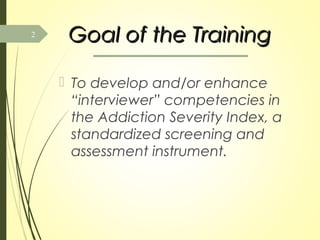
Goal of the TrainingGoal of the Training
 To develop and/or enhance
“interviewer” competencies in
the Addiction Severity Index, a
standardized screening and
assessment instrument.
2
ObjectivesObjectives
 Understand what is measured by the ASI
 Identify the specific intention of each
question asked in the ASI
 Phrase each question in the most efficient
way while remaining flexible enough to
adapt the questionnaire to specific clients
 Understand the importance of the use of
additional probes to augment information
provided by the client
 Utilize the severity rating procedure
3
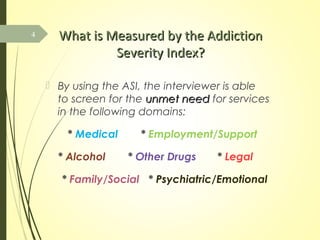
What is Measured by the AddictionWhat is Measured by the Addiction
Severity Index?Severity Index?
 By using the ASI, the interviewer is able
to screen for the unmet needunmet need for services
in the following domains:
* Medical * Employment/Support
* Alcohol * Other Drugs * Legal
* Family/Social * Psychiatric/Emotional
4
Screening & AssessmentScreening & Assessment
 Screening tools establish the presence
or absence of a problem.
 Assessment requires gathering additional
information about the problem.
 The ASI is:
• a screening tool – medical, employment/
support, legal, family/social, psychiatric;
• an assessment tool – AOD.
5
AssessmentAssessment
 Must be done with client involvement
 Single-focused assessment tools (MAST &
DAST)
 Multi-focused screening and assessment
tools (ASI, SASSI)
 Screening and assessment needs to occur
throughout the treatment process
6
Addiction Severity IndexAddiction Severity Index
 Standardized, semi-structured, multi-
focused screening & assessment tool.
 Designed for use primarily with substance
use clients.
 Used to collect information regarding
the nature and severity of problems
individuals with substance use disorders
often have.
7
Limitations of the ASILimitations of the ASI
 Does not provide quantity estimates of
alcohol and other drug use
 Does not directly assess HIV risk
 Does not directly assess issues related to
trauma
 Additional probes may be used to gather
information; record in “comments”
8
Coding & RatingCoding & Rating
 Leave no blanks
 Time periods: lifetime & last 30 days
(two distinct & different time frames)
 Rounding: > 2 weeks = month
> 6 mo = year
 Evaluate non-AOD problems
independently
9
Introducing the ASIIntroducing the ASI
 All clients receive the same standard
interview
 All information gathered is confidential
(explain your agency’s policies &
limitations on confidentiality)
 There are two time frames we will
discuss:
the past 30 days and lifetime
10
Introducing the ASIIntroducing the ASI
 State that accurate information better
equips us to help the client
 Encourage honesty rather than
misinformation
 Encourage clients to answer all questions
 Make it clear clients can choose to not
answer a question – which is preferable
to giving inaccurate information
11
Introducing the ASIIntroducing the ASI
 7 Potential Problem Areas to be addressed:
… Medical
… Employment/Support
… Alcohol
… Other Drug
… Legal
… Family/Social
… Psychiatric
12
Introducing the ASIIntroducing the ASI
 Hand the client a copy of the Client Rating Scale
 Explain → client will use the 0-4 rating scale to
respond to questions at the end of each area
 At the end of each area, I will ask:
• “How troubled or bothered have you been in
the last 30 days by these __ problems?” and
• “How important to you now is treatment,
counseling or referral for these __ problems?
13
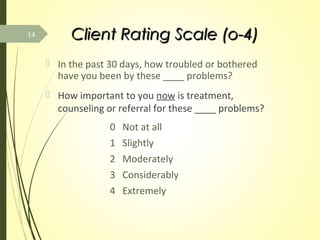
Client Rating ScaleClient Rating Scale (o-4)(o-4)
 In the past 30 days, how troubled or bothered
have you been by these ____ problems?
 How important to you now is treatment,
counseling or referral for these ____ problems?
0 Not at all
1 Slightly
2 Moderately
3 Considerably
4 Extremely
14
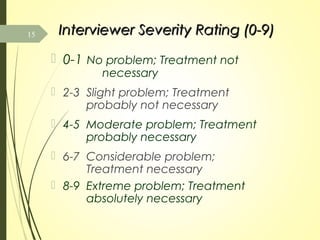
Interviewer Severity Rating (0-9)Interviewer Severity Rating (0-9)
 0-1 No problem; Treatment not
necessary
 2-3 Slight problem; Treatment
probably not necessary
 4-5 Moderate problem; Treatment
probably necessary
 6-7 Considerable problem;
Treatment necessary
 8-9 Extreme problem; Treatment
absolutely necessary
15
Interviewer Severity Ratings (0-9)Interviewer Severity Ratings (0-9)
Our EHR (Anasazi) . . .Our EHR (Anasazi) . . .
 Translates the Interviewer’s
0 – 9 ratings into:
Low (0-3)
Moderate (4-6)
High (7-9)
16
Low – Moderate – High
What to include on Tx Plan?
 General “rule of thumb” – include any area with
a moderate or high rating on the treatment plan
 If not, explain in comments why a particular area
is not being addressed at this time on the
treatment plan. Examples:
• Client unwilling at this time to address
family/ social needs
• Client wants to wait to address employment/
support needs until physical health needs
have been addressed
17
Interviewer Severity RatingsInterviewer Severity Ratings
 Not a rating of potential benefit of
treatment to the client
 Not a rating of the severity of
problems
 A rating of unmet need – the extent
to which additionaladditional treatment/
services are needed (regardless of
whether treatment is available).
18
Interviewer Rating ProcedureInterviewer Rating Procedure
 Two step method:
1. Before asking the client for client ratings – In
your mind, make a preliminary rating of a 3-
point range (i.e., 5-6-7) on the interviewer
rating scale
2. Then, ask the client for ratings (0-4 on both
questions). Using the client ratings and your
3-point range, fine tune your rating to a
single digit . . .
19
Selecting a RatingSelecting a Rating
in Your (3 point) Rangein Your (3 point) Range
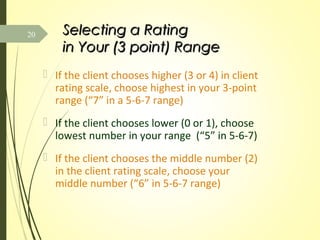
 If the client chooses higher (3 or 4) in client
rating scale, choose highest in your 3-point
range (“7” in a 5-6-7 range)
 If the client chooses lower (0 or 1), choose
lowest number in your range (“5” in 5-6-7)
 If the client chooses the middle number (2)
in the client rating scale, choose your
middle number (“6” in 5-6-7 range)
20
Selecting a RatingSelecting a Rating
in Your (3 point) Rangein Your (3 point) Range
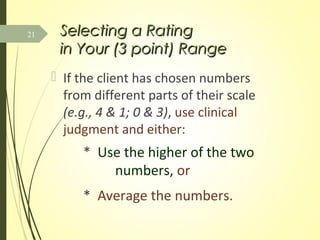
 If the client has chosen numbers
from different parts of their scale
(e.g., 4 & 1; 0 & 3), use clinical
judgment and either:
* Use the higher of the two
numbers, or
* Average the numbers.
21
Exceptions to 2-Step MethodExceptions to 2-Step Method
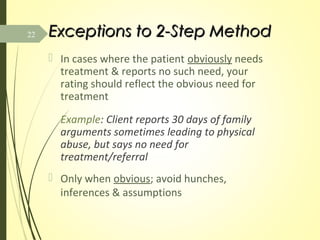
 In cases where the patient obviously needs
treatment & reports no such need, your
rating should reflect the obvious need for
treatment
Example: Client reports 30 days of family
arguments sometimes leading to physical
abuse, but says no need for
treatment/referral
 Only when obvious; avoid hunches,
inferences & assumptions
22
Confidence RatingsConfidence Ratings
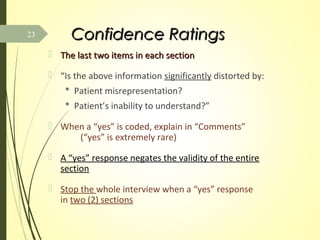
 The last two items in each sectionThe last two items in each section
 “Is the above information significantly distorted by:
* Patient misrepresentation?
* Patient’s inability to understand?”
 When a “yes” is coded, explain in “Comments”
(“yes” is extremely rare)
 A “yes” response negates the validity of the entire
section
 Stop the whole interview when a “yes” response
in two (2) sections
23
Confidence RatingsConfidence Ratings
 Clinical judgments on veracity of the client’s
statements and ability to understand the
nature & intent of the interview
 Not “gut hunches”
 Based on observations of the client’s
responses following probing and inquiry
when contradictory information has been
presented that the client cannot justify
24
Confidence RatingsConfidence Ratings
 “Patient’s misrepresentation” should not
be confused with minimization or denial
Code “Yes” only if you have clear evidence
that the client is falsifying information
throughout the entire section
25
Confidence RatingsConfidence Ratings
 “Patient’s inability to understand” =
inability to complete the section due to:
• problems of intoxication or detox
• language barriers
• serious problems with intellectual
ability such as mental retardation or
head injury
26
General Information SectionGeneral Information Section
 To provide identifying and
demographic information about
the client
 To determine if the client has been
in a living situation which restricted
freedom of movement and access
to alcohol and other drugs
(“controlled environment”)
27
G19 Controlled EnvironmentG19 Controlled Environment
 Intent: to record whether client has
had restricted access to alcohol or
other drugs in the past 30 days
 “Controlled environment: a living
situation where freedom of
movement & access to drugs is
(theoretically) controlled (jail, hospital,
residential tx program)
 Sober living/halfway houses are not
controlled environments
28
Controlled EnvironmentControlled Environment
 How many days in the last 30 days …
Reflect total time in all controlled
settings
 Additional probes: name of
institution(s); reason client was in
controlled environment (medical,
criminal charges, 5150 etc.)
29
Medical Information SectionMedical Information Section
 Client’s medical history
 Lifetime hospitalizations
 Long-term medical
problems
 Recent physical ailments
30
M1 Lifetime Medical HospitalizationsM1 Lifetime Medical Hospitalizations
 Overnight hospitalizations for medical
problems
 Exclude detox or other forms of AOD or
psychiatric treatment
 Include hospitalization for OD’s or DT’s
 Exclude normal childbirth
 Include complications from childbirth
(including C-Section)
31
M2 Length of Time SinceM2 Length of Time Since
Last HospitalizationLast Hospitalization
 How long ago (not how long) was your last
[overnight] hospitalization?
 If occurred within the last month, code 0
years, 1 month. If that hospitalization < 2
weeks, note length of stay in comments
 Additional probes: diagnosis/reasons for
hospitalization; types of medications
received
32
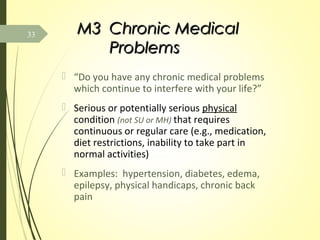
M3M3 Chronic MedicalChronic Medical
ProblemsProblems
 “Do you have any chronic medical problems
which continue to interfere with your life?”
 Serious or potentially serious physical
condition (not SU or MH) that requires
continuous or regular care (e.g., medication,
diet restrictions, inability to take part in
normal activities)
 Examples: hypertension, diabetes, edema,
epilepsy, physical handicaps, chronic back
pain
33
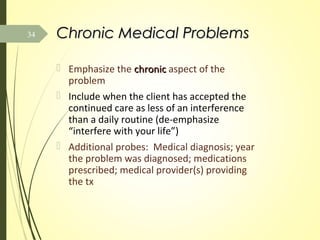
Chronic Medical ProblemsChronic Medical Problems
 Emphasize the chronicchronic aspect of the
problem
 Include when the client has accepted the
continued care as less of an interference
than a daily routine (de-emphasize
“interfere with your life”)
 Additional probes: Medical diagnosis; year
the problem was diagnosed; medications
prescribed; medical provider(s) providing
the tx
34
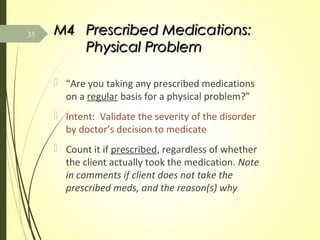
M4M4 Prescribed Medications:Prescribed Medications:
Physical ProblemPhysical Problem
 “Are you taking any prescribed medications
on a regular basis for a physical problem?”
 Intent: Validate the severity of the disorder
by doctor’s decision to medicate
 Count it if prescribed, regardless of whether
the client actually took the medication. Note
in comments if client does not take the
prescribed meds, and the reason(s) why
35
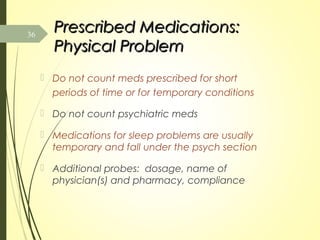
Prescribed Medications:Prescribed Medications:
Physical ProblemPhysical Problem
 Do not count meds prescribed for short
periods of time or for temporary conditions
 Do not count psychiatric meds
 Medications for sleep problems are usually
temporary and fall under the psych section
 Additional probes: dosage, name of
physician(s) and pharmacy, compliance
36
M5 Pension for
Physical Disability
 “Do you receive a pension for a physical
disability?”
 Ask as written, with examples … “from any
source such as the VA, social security, state
disability or Workman’s Compensation”
 Additional probes: details of the pension,
details of medical problem warranting
pension
37
M6M6 Number of Days in Past 30Number of Days in Past 30
w/ Medical Problemsw/ Medical Problems
 “How many days have you experienced medical
problems in the past 30 days?”
 Do not includeDo not include problems directly caused only by
alcohol or other drugs (hangovers, vomiting,
lack of sleep)
 IncludeInclude medical problems caused by AOD that
would not be eliminated simply by abstinence
(e.g., liver disease; esophageal bleeding)

38
Number of Days in Past 30Number of Days in Past 30
w/ Medical Problemsw/ Medical Problems
 IncludeInclude minor ailments such as cold or flu
 Additional probes:
• ask the client to try to pinpoint the exact number
of days – have a calendar handy to assist
• “You mentioned __ (a chronic medical problem)
earlier; how many days in the last 30 did you
experience any symptoms related to __ (the
chronic problem)?”
39
Before Asking Next QuestionsBefore Asking Next Questions
(M 7& M8)(M 7& M8)
 Before asking:
M7 – “How troubled or bothered …” and
M8 – “How important now is tx/referral
…”
 Mentally choose your 3 – point range from
0-9 Interviewer Severity Rating Scale
40
M7M7 Troubled or Bothered &Troubled or Bothered &
M8M8 Importance Now of Tx/ReferralImportance Now of Tx/Referral
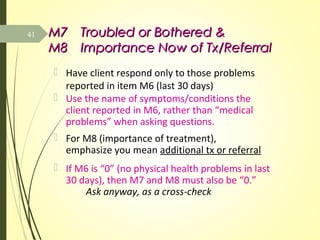
 Have client respond only to those problems
reported in item M6 (last 30 days)
 Use the name of symptoms/conditions the
client reported in M6, rather than “medical
problems” when asking questions.
 For M8 (importance of treatment),
emphasize you mean additional tx or referral
 If M6 is “0” (no physical health problems in last
30 days), then M7 and M8 must also be “0.”
Ask anyway, as a cross-check
41
M9M9 How would you rate the client’sHow would you rate the client’s
need for medical treatment?need for medical treatment?
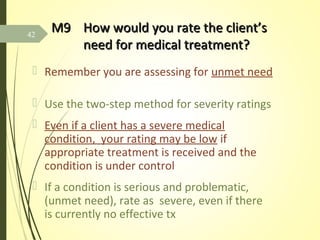
 Remember you are assessing for unmet need
 Use the two-step method for severity ratings
 Even if a client has a severe medical
condition, your rating may be low if
appropriate treatment is received and the
condition is under control
 If a condition is serious and problematic,
(unmet need), rate as severe, even if there
is currently no effective tx
42
Employment/SupportEmployment/Support
SectionSection
 Resources client can
record on a job
application
 Current sources of
income
43
E1E1 Education CompletedEducation Completed
 Intent: to record years and months of
completed formal education
 GED = 12 years, with note in “comments”
 Do not include correspondence schools
 AA = 14 years Bachelor’s = 16 years
Master’s = 18 yrs Doctorate = 20
yrs
 Additional probes: name of high school
or college, year completed, college major,
degrees earned
44
E2E2 Training or TechnicalTraining or Technical
Education CompletedEducation Completed
 Intent: to record formal, technical education or
training that could be listed on a job application
 Can include apprenticeship thru a recognized
on-the-job training program
 Include military training only if transferable to
civilian life
 Additional probes: Verify completion, name of
training institute, info about programs started
but didn’t finish, length of program
45
E3E3 Do you have a profession,Do you have a profession,
trade, or skill?trade, or skill?
 Trade = any employable, transferable
skill that was acquired through
specialized training or education.
 Additional probes: skills that were
acquired without a formal training
program.
46
E4. Valid Driver’s License
E5. Auto Available for Use
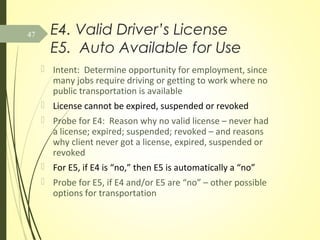
 Intent: Determine opportunity for employment, since
many jobs require driving or getting to work where no
public transportation is available
 License cannot be expired, suspended or revoked
 Probe for E4: Reason why no valid license – never had
a license; expired; suspended; revoked – and reasons
why client never got a license, expired, suspended or
revoked
 For E5, if E4 is “no,” then E5 is automatically a “no”
 Probe for E5, if E4 and/or E5 are “no” – other possible
options for transportation
47
E6E6 Longest Full-Time JobLongest Full-Time Job
 Full-time job held for the longest time (not how
long ago)
 May help to get current job status, then work
backward in time (this will assist with E10 –
usual employment pattern last 3 years)
 Only count time in military when it is beyond the
original enlistment period
 Probes: places worked, job titles, years at each job,
reasons for leaving jobs, info about part-time jobs
48
E7E7 Usual (or Last) OccupationUsual (or Last) Occupation
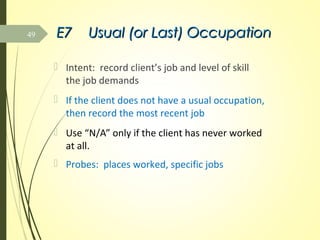
 Intent: record client’s job and level of skill
the job demands
 If the client does not have a usual occupation,
then record the most recent job
 Use “N/A” only if the client has never worked
at all.
 Probes: places worked, specific jobs
49
E8E8 Does Someone Contribute toDoes Someone Contribute to
Your Support in Any Way?Your Support in Any Way?
 Intent: discover additional sources of
financial support
 Regular support (cash, housing, food) from
friend or family member
 Include spouse’s contribution
 Exclude support from an institution
50
E9E9 Does E8 Constitute theDoes E8 Constitute the
Majority of Your Support?Majority of Your Support?
 If E8 is “No,” then E9 is “N/A”
 Avoid defensiveness in clients living with
parents and not paying rent. If that is the
situation:
• OK to automatically record “yes” to E8 & E9
• Perhaps ask, “Are you receiving money from
any source other than your parents?”
51
E10E10 Usual Employment PatternUsual Employment Pattern
Past 3 YearsPast 3 Years
 Determine choice most representative of
the past 3 years, not simply the most recent
 Full-time = Regular and 35+ hours per week
 Regular, Part-time =
Regular & sustained; < 35 hours per week.
 Irregular, Part-time = no reliable schedule
 When equal times for more than one
category, go with most current
52
E11E11 Number of Days inNumber of Days in
Past 30 Paid for WorkingPast 30 Paid for Working
 “How many days were you paid for working
in the past 30?”
 Include days worked that will be paid for
 Jobs in jail/prison/hospital are not included.
 Include paid sick and vacation days
 Include “under-the-table” jobs.
53
E12-17E12-17 Money ReceivedMoney Received
in Past 30 Daysin Past 30 Days
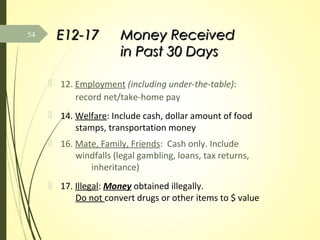
 12. Employment (including under-the-table):
record net/take-home pay
 14. Welfare: Include cash, dollar amount of food
stamps, transportation money
 16. Mate, Family, Friends: Cash only. Include
windfalls (legal gambling, loans, tax returns,
inheritance)
 17. Illegal: Money obtained illegally.
Do not convert drugs or other items to $ value
54
E18E18 Number of DependentsNumber of Dependents
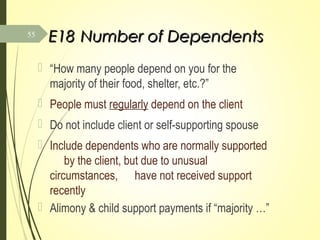
 “How many people depend on you for the
majority of their food, shelter, etc.?”
 People must regularly depend on the client
 Do not include client or self-supporting spouse
 Include dependents who are normally supported
by the client, but due to unusual
circumstances, have not received support
recently
 Alimony & child support payments if “majority …”
55
E19E19 Number of Days in Past 30Number of Days in Past 30
with Employment Problemswith Employment Problems
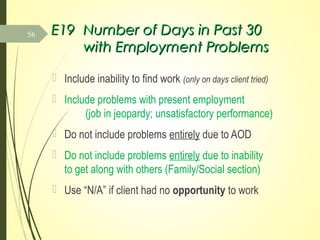
 Include inability to find work (only on days client tried)
 Include problems with present employment
(job in jeopardy; unsatisfactory performance)
 Do not include problems entirely due to AOD
 Do not include problems entirely due to inability
to get along with others (Family/Social section)
 Use “N/A” if client had no opportunity to work
56
E20E20 Troubled or BotheredTroubled or Bothered
E21E21 How Important Now is JobHow Important Now is Job
CounselingCounseling
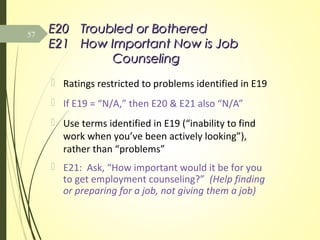
 Ratings restricted to problems identified in E19
 If E19 = “N/A,” then E20 & E21 also “N/A”
 Use terms identified in E19 (“inability to find
work when you’ve been actively looking”),
rather than “problems”
 E21: Ask, “How important would it be for you
to get employment counseling?” (Help finding
or preparing for a job, not giving them a job)
57
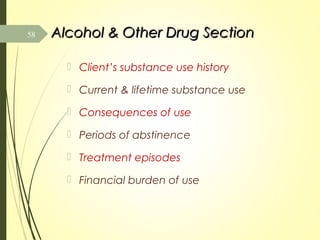
Alcohol & Other Drug SectionAlcohol & Other Drug Section
 Client’s substance use history
 Current & lifetime substance use
 Consequences of use
 Periods of abstinence
 Treatment episodes
 Financial burden of use
58
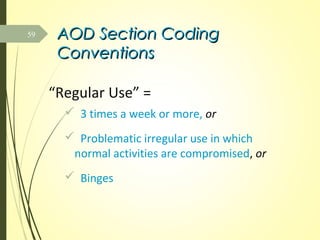
AOD Section CodingAOD Section Coding
ConventionsConventions
“Regular Use” =
 3 times a week or more, or
 Problematic irregular use in which
normal activities are compromised, or
 Binges
59
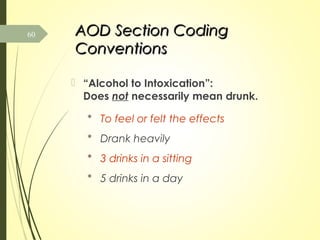
AOD Section CodingAOD Section Coding
ConventionsConventions
 “Alcohol to Intoxication”:
Does not necessarily mean drunk.
* To feel or felt the effects
* Drank heavily
* 3 drinks in a sitting
* 5 drinks in a day
60
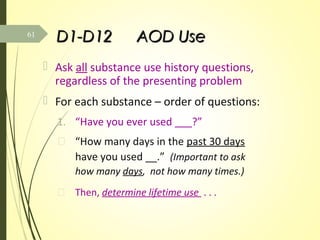
D1-D12D1-D12 AOD UseAOD Use
 Ask all substance use history questions,
regardless of the presenting problem
 For each substance – order of questions:
1. “Have you ever used ___?”
 “How many days in the past 30 days
have you used __.” (Important to ask
how many days, not how many times.)
 Then, determine lifetime use . . .
61
D1-D12D1-D12 Determine Lifetime UseDetermine Lifetime Use
 For the same substance, determine lifetime use:
1. How old were you the first time you …
2. Was there a time you began to use it regularly
(define)
3. Since you started using regularly, have you ever
abstained for over a month?
4. Add up & verify years of regular use
1. Additional probes: Quantity used per day,
estimated money spent on substance per day,
method of administration, usage patterns (e.g.,
weekends only), family history of AOD addiction
62
D1-D12. AOD UseD1-D12. AOD Use
 < 6 months use noted in comments,
not lifetime years
 Probes: Events occurring same time as
periods of abstinence; changes in route
of administration; drug combinations
63
D13D13 Multiple SubstancesMultiple Substances
 Under “30 Days,” ask, “how many days in the
past 30 did you use more than one substance,
including alcohol”
 Under “lifetime,” ask how long more than one
substance per day was regularly (define) used,
including alcohol
 Probes: drugs used together; drugs used same
day, but not together; prescribed drugs
64
D14D14 Which Substance isWhich Substance is
the Major Problem?the Major Problem?
 Interviewer’s clinical judgment determines
which drug causes greatest problems
(do not ask “drug of choice”)
 Base judgment on years of use, number of
treatments, number of DT’s/OD’s,
negative consequences, etc
 If information provides no clear indication,
ask client what s/he thinks is the major
drug problem
65
D15D15 How Long Was Last PeriodHow Long Was Last Period
of Voluntary Abstinenceof Voluntary Abstinence
 “How long (not how long ago) was your last period of
voluntary abstinence from this major substance?”
 If client indicated use of more than one substance
per day, say, “these substance.”
 If there are clear indications of problems w/ more
than one substance, even if not used on the same
day, say, “these substances”
• e.g., if client reports using excessive amounts of
alcohol on days when meth is not available, then
the period of abstinence would refer to both
substances
66
D15D15 How Long Was Last PeriodHow Long Was Last Period
of Voluntary Abstinenceof Voluntary Abstinence
 Periods of hospitalization & incarceration
are not counted (in a controlled environment)
 Periods of abstinence with Methadone,
Antabuse, Naltrexone or other medication
assisted therapy for substance use disorders
are included (As long as the medication was
used as prescribed, and not abused to get high)
 If client has never been abstinent for one
month since regular use began, enter “0”
67
D16D16 How Many Months AgoHow Many Months Ago
Did This Abstinence End?Did This Abstinence End?
 If no problem reported in D14, N/A for D16
 If D15 was “0” never abstinent for a month,
N/A for D16
 If the period of abstinence is current (no use
for a month or more), enter “0” for D16
 Probe: Circumstances surrounding the end of
the abstinence period
68
D17D17 How Many Times HaveHow Many Times Have
You Had Alcohol DT’s?You Had Alcohol DT’s?
 Delirium Tremens occur 24-48 hours after last
drink (or significant decrease in alcohol intake): shaking,
severe disorientation, often fever & hallucinations
 Usually require medical attention
 Impending DT’s as diagnosed by a medical
professional would count as DT’s
 “The shakes” occur about 6 hours after last use
of alcohol and do not include delirium (severe
disorientation). Do not code as DT’s
69
D18D18 How Many Times HaveHow Many Times Have
You Overdosed on Drugs?You Overdosed on Drugs?
 OD symptoms will differ with the type of drug
used: Coma-like effects with opiates and
barbiturates; meth overdoses frequently result
in toxic psychosis
 Simply “sleeping it off” does not constitute an OD
 Include suicide attempts by drug overdose
 Probes: Hospitalized? Did someone have to help
revive you? Did someone have to help calm you
down? Whether OD was intentional
70
D19/20/21/22D19/20/21/22
Treatment/Detox EpisodesTreatment/Detox Episodes
 Count any type of AOD treatment and/or
structured self-help, including detox,
residential and outpatient counseling
 Include DUI Treatment Programs.
 Include AA/NA (if 3 or more meetings
within a 30 day period)
 Probes: When, names of programs, length
of time, completions, reasons for leaving
71
D19/20/21/22D19/20/21/22
Treatment/Detox EpisodesTreatment/Detox Episodes
 Record “alcohol” and “drug” tx separately
 If treated for both A & D simultaneously,
count the treatment under both categories &
note in comments it was a single tx for both
 Code as a one episode treatment experiences
that occur in different facilities immediately
following one another
e.g., 3 days detox at Empire, then move to
another facility for residential treatment,
without being “out” after detox (remained in a
controlled environment).
72
D23 & D24D23 & D24
Money Spent on AOD in Last 30 DaysMoney Spent on AOD in Last 30 Days
 Intent: Measure financial burden, not amount of
use
 Enter only money spent, not street value of what
was used
 Enter “not answered” only if client cannot make a
reasonable determination after interviewer probes
 Cash only spent; not sex for drugs or “middle man”
for drug deals.
73
D25D25 Days in Past 30 inDays in Past 30 in
Outpatient Tx or AA/NAOutpatient Tx or AA/NA
 Count number of days that client actually
attended tx or AA/NA
 Do not include counseling or therapy for
issues other than substance use problems
 Treatment requires personal contact with
the program; simply being enrolled is not
enough; the client must attend to count
the day
74
D26 & 27 How Many Days in Past 30D26 & 27 How Many Days in Past 30
Experienced AOD Problems?Experienced AOD Problems?
 Number of days problems directly related
to AOD use.
 Include cravings, withdrawal symptoms,
disturbing effects of intoxication, or
wanting to stop and not being able to.
 Do not include client’s inability to find
alcohol or other drugs as a problem.
 Do not include problems in other domains
(e.g., fighting with spouse about using).
75
D28 & D29 Troubled or BotheredD28 & D29 Troubled or Bothered
D30 & 31 How Important is AOD Tx?D30 & 31 How Important is AOD Tx?
 Ask “how troubled or bothered …”
about the problems identified in
D27
 Use words (hangovers, craving,
shakes, your inability to find ___)
instead of “problems” when asking
the questions
76
Legal Status Section
 Client’s legal history
 Information about probation
or parole
 Charges, convictions,
incarcerations
 Detainment
 Illegal activities
77
L1. Admission Prompted by Criminal Justice?L1. Admission Prompted by Criminal Justice?
L2. On Probation or Parole?L2. On Probation or Parole?
 Intent: Record information about
relationship between client’s
treatment status and legal status
 Legal = Criminal
(Civil issues may be addressed in
Family/Social section)
78
L1. Admission Prompted by Criminal Justice?L1. Admission Prompted by Criminal Justice?
L2. On Probation or Parole?L2. On Probation or Parole?
 Give examples of “Criminal Justice System”
court, defense attorney, probation, parole
 Probes: Who is referral source? What
offenses led to your probation? How long
on probation? When will probation/parole
end? Name of Probation/parole officer?
Were you under the influence when
arrested?
79
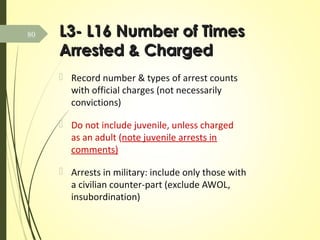
L3- L16 Number of TimesL3- L16 Number of Times
Arrested & ChargedArrested & Charged
 Record number & types of arrest counts
with official charges (not necessarily
convictions)
 Do not include juvenile, unless charged
as an adult (note juvenile arrests in
comments)
 Arrests in military: include only those with
a civilian counter-part (exclude AWOL,
insubordination)
80
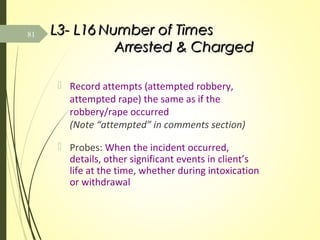
L3- L16L3- L16 Number of TimesNumber of Times
Arrested & ChargedArrested & Charged
 Record attempts (attempted robbery,
attempted rape) the same as if the
robbery/rape occurred
(Note “attempted” in comments section)
 Probes: When the incident occurred,
details, other significant events in client’s
life at the time, whether during intoxication
or withdrawal
81
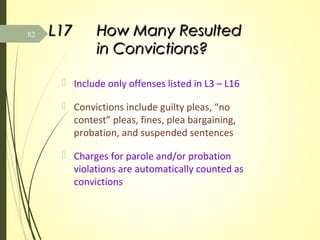
L17L17 How Many ResultedHow Many Resulted
in Convictions?in Convictions?
 Include only offenses listed in L3 – L16
 Convictions include guilty pleas, “no
contest” pleas, fines, plea bargaining,
probation, and suspended sentences
 Charges for parole and/or probation
violations are automatically counted as
convictions
82
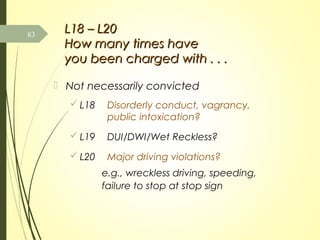
L18 – L20L18 – L20
How many times haveHow many times have
you been charged with . . .you been charged with . . .
 Not necessarily convicted
 L18 Disorderly conduct, vagrancy,
public intoxication?
 L19 DUI/DWI/Wet Reckless?
 L20 Major driving violations?
e.g., wreckless driving, speeding,
failure to stop at stop sign
83
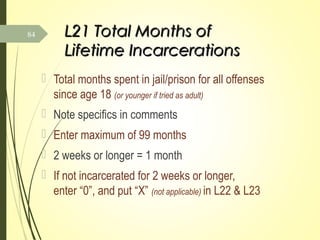
L21 Total Months ofL21 Total Months of
Lifetime IncarcerationsLifetime Incarcerations
 Total months spent in jail/prison for all offenses
since age 18 (or younger if tried as adult)
 Note specifics in comments
 Enter maximum of 99 months
 2 weeks or longer = 1 month
 If not incarcerated for 2 weeks or longer,
enter “0”, and put “X” (not applicable) in L22 & L23
84
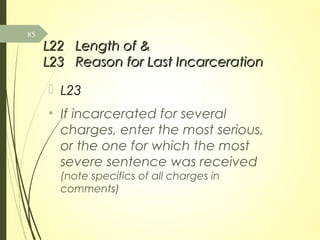
L22L22 Length of &Length of &
L23L23 Reason for Last IncarcerationReason for Last Incarceration
 L23
• If incarcerated for several
charges, enter the most serious,
or the one for which the most
severe sentence was received
(note specifics of all charges in
comments)
85
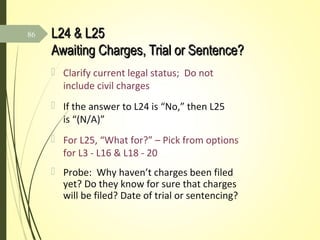
L24 & L25L24 & L25
Awaiting Charges, Trial or Sentence?Awaiting Charges, Trial or Sentence?
 Clarify current legal status; Do not
include civil charges
 If the answer to L24 is “No,” then L25
is “(N/A)”
 For L25, “What for?” – Pick from options
for L3 - L16 & L18 - 20
 Probe: Why haven’t charges been filed
yet? Do they know for sure that charges
will be filed? Date of trial or sentencing?
86
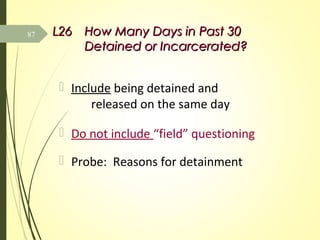
L26L26 How Many Days in Past 30How Many Days in Past 30
Detained or Incarcerated?Detained or Incarcerated?
 Include being detained and
released on the same day
 Do not include “field” questioning
 Probe: Reasons for detainment
87
L27 How Many Days in Last 30
Illegal Activities for Profit
 Regardless of whether “caught”
 Confidentiality reminder
 Do not count drug possession
or drug use
88
L27 How Many Days in Last 30
Illegal Activities for Profit
 Do count drug dealing, prostitution,
burglary, selling stolen goods, etc
 Include as “for profit” whether client
received cash, drugs, or other goods
in return for illegal activity
89
L28. How Serious …L28. How Serious …
Legal ProblemsLegal Problems
L29. How Important…L29. How Important…
Legal ReferralLegal Referral
 Current legal (criminal) problems
 Not potential legal problems
 For instance, if client didn’t get
caught selling drugs, doesn’t have
a current legal problem
90
Family & SocialFamily & Social
Relationships SectionRelationships Section
 To determine the nature of the client’s
personal relationships
 To determine if client has relationship
problems not due to alcohol or other
drug use (i.e., if the AOD problem was absent,
would there still be a relationship problem?)
 To determine potential social/family
supports for recovery
91
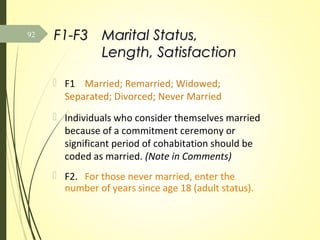
F1-F3F1-F3 Marital Status,Marital Status,
Length, SatisfactionLength, Satisfaction
 F1 Married; Remarried; Widowed;
Separated; Divorced; Never Married
 Individuals who consider themselves married
because of a commitment ceremony or
significant period of cohabitation should be
coded as married. (Note in Comments)
 F2. For those never married, enter the
number of years since age 18 (adult status).
92
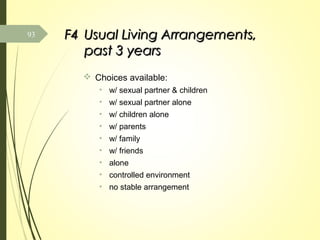
F4F4 Usual Living Arrangements,Usual Living Arrangements,
past 3 yearspast 3 years
 Choices available:
• w/ sexual partner & children
• w/ sexual partner alone
• w/ children alone
• w/ parents
• w/ family
• w/ friends
• alone
• controlled environment
• no stable arrangement
93
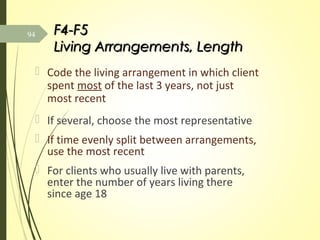
F4-F5F4-F5
Living Arrangements, LengthLiving Arrangements, Length
 Code the living arrangement in which client
spent most of the last 3 years, not just
most recent
 If several, choose the most representative
 If time evenly split between arrangements,
use the most recent
 For clients who usually live with parents,
enter the number of years living there
since age 18
94
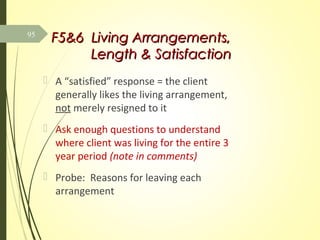
F5&6 Living Arrangements,F5&6 Living Arrangements,
Length & SatisfactionLength & Satisfaction
 A “satisfied” response = the client
generally likes the living arrangement,
not merely resigned to it
 Ask enough questions to understand
where client was living for the entire 3
year period (note in comments)
 Probe: Reasons for leaving each
arrangement
95
F7/F8F7/F8 Living with AnyoneLiving with Anyone
With AOD Problem?With AOD Problem?
 Intent: To address whether the client has
an AOD-free living situation in the home
 F7. Code yes only if there is an individual
in the home with an active alcohol
problem, regardless of whether the
client has an alcohol problem
 F8. Code yes if there is any form of illicit
drug use in the home, regardless of
whether the client or the drug-using
individual has a problem
96
F9/10F9/10 With Whom Is FreeWith Whom Is Free
Time Spent & SatisfactionTime Spent & Satisfaction
 Family, friends or alone
 Family = Immediate & extended family & in-laws
 Friends = Any associate other than family, and
should be considered “Social”
 A “Satisfied” response = they like the situation,
not just resigned to it
 Probes: Who; details of what they do
(e.g., movies, drugs, fishing)
97
F11F11 How ManyHow Many
Close Friends?Close Friends?
 Stress that you mean close, mutually
supportive relationships
 Do not include family members (or
cohabitating mates who were counted
as spouses)
 Probes: Names of close friends; amount
& type of contact with close friends; AOD
use of friends
98
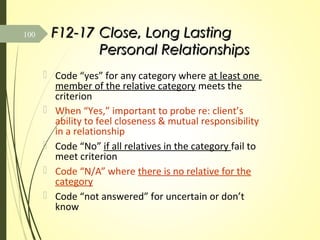
F12-17F12-17 Close, Long LastingClose, Long Lasting
Personal RelationshipsPersonal Relationships
 Intent: Extent to which client has a
history of being able to establish &
maintain close, warm, and mutually
supportive relationships with:
mother, father, brothers/sisters; sexual
partner/ spouse; children; friends
(Include step-relatives)
 “Close reciprocal relationship” = you
would help them any way you could
and vice versa”
99
F12-17F12-17 Close, Long LastingClose, Long Lasting
Personal RelationshipsPersonal Relationships
 Code “yes” for any category where at least one
member of the relative category meets the
criterion
 When “Yes,” important to probe re: client’s
ability to feel closeness & mutual responsibility
in a relationship
 Code “No” if all relatives in the category fail to
meet criterion
 Code “N/A” where there is no relative for the
category
 Code “not answered” for uncertain or don’t
know.
100
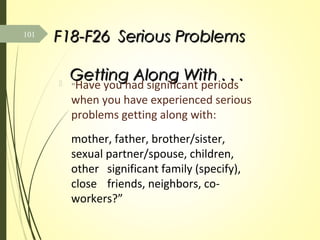
F18-F26F18-F26 Serious ProblemsSerious Problems
Getting Along With . . .Getting Along With . . . “Have you had significant periods
when you have experienced serious
problems getting along with:
mother, father, brother/sister,
sexual partner/spouse, children,
other significant family (specify),
close friends, neighbors, co-
workers?”
101
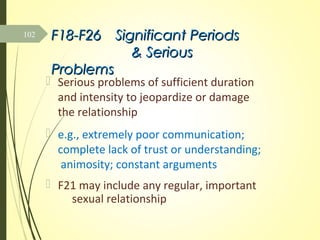
F18-F26F18-F26 Significant PeriodsSignificant Periods
& Serious& Serious
ProblemsProblems
 Serious problems of sufficient duration
and intensity to jeopardize or damage
the relationship
 e.g., extremely poor communication;
complete lack of trust or understanding;
animosity; constant arguments
 F21 may include any regular, important
sexual relationship
102
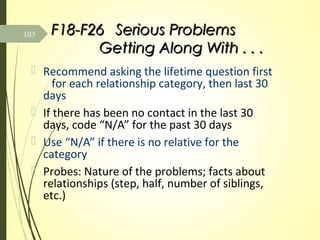
F18-F26F18-F26 Serious ProblemsSerious Problems
Getting Along With . . .Getting Along With . . .
 Recommend asking the lifetime question first
for each relationship category, then last 30
days
 If there has been no contact in the last 30
days, code “N/A” for the past 30 days
 Use “N/A” if there is no relative for the
category
 Probes: Nature of the problems; facts about
relationships (step, half, number of siblings,
etc.)
103
F27-F29F27-F29 AbuseAbuse
 Has anyone ever abused you?
(Lifetime, then last 30 days):
* Emotionally?
(Made you feel bad through
harsh words)
* Physically? (Caused you
physical harm)
* Sexually?
(Forced sexual
advances/acts and/or
childhood sexual abuse)
104
F27F27 Emotional AbuseEmotional Abuse
 Emotional Abuse will be
recorded by what the client
reports, regardless of whether
the “abuse” or lack of it,
would be considered abuse
by another person
105
2828 Physical AbusePhysical Abuse
 Physical Abuse will be recorded by what
the client reports, regardless of whether
the “abuse” or lack of it, would be
considered abuse by another person
 Except, simple spanking should only be
counted if (in the eyes of the client), the
spankings were extreme and
unnecessary
106
F29 Sexual Abuse
 Any type of unwanted
advances of a sexual nature
by a member of either sex
 Any form of childhood sexual
molestation or exploitation
107
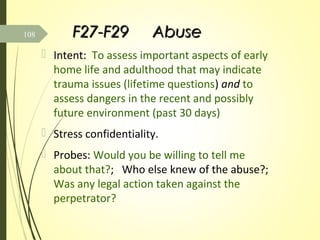
F27-F29F27-F29 AbuseAbuse
 Intent: To assess important aspects of early
home life and adulthood that may indicate
trauma issues (lifetime questions) and to
assess dangers in the recent and possibly
future environment (past 30 days)
 Stress confidentiality.
 Probes: Would you be willing to tell me
about that?; Who else knew of the abuse?;
Was any legal action taken against the
perpetrator?
108
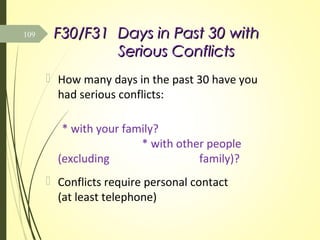
F30/F31F30/F31 Days in Past 30 withDays in Past 30 with
Serious ConflictsSerious Conflicts
 How many days in the past 30 have you
had serious conflicts:
* with your family?
* with other people
(excluding family)?
 Conflicts require personal contact
(at least telephone)
109
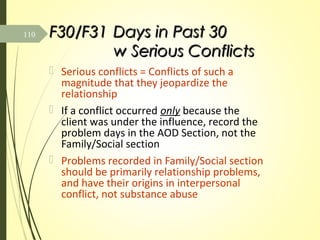
F30/F31F30/F31 Days in Past 30Days in Past 30
w Serious Conflictsw Serious Conflicts
 Serious conflicts = Conflicts of such a
magnitude that they jeopardize the
relationship
 If a conflict occurred only because the
client was under the influence, record the
problem days in the AOD Section, not the
Family/Social section
 Problems recorded in Family/Social section
should be primarily relationship problems,
and have their origins in interpersonal
conflict, not substance abuse
110
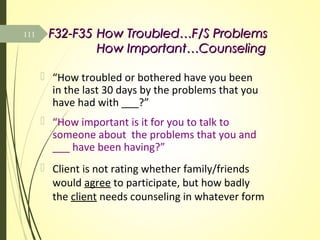
F32-F35F32-F35 How Troubled…F/S ProblemsHow Troubled…F/S Problems
How Important…CounselingHow Important…Counseling
 “How troubled or bothered have you been
in the last 30 days by the problems that you
have had with ___?”
 “How important is it for you to talk to
someone about the problems that you and
___ have been having?”
 Client is not rating whether family/friends
would agree to participate, but how badly
the client needs counseling in whatever form
111
Psychiatric Status SectionPsychiatric Status Section
 To determine the client’s long-term
and recent psychological and
emotional functioning
 To explore the potential for co-
occurring mental health and
substance use disorders
112
Psychiatric Status SectionPsychiatric Status Section
 Screening tool, not diagnostic
 Client does not need to meet any
diagnostic criteria for a symptom to
have experienced the symptom
 Will not get a definite “chicken/egg”
answer
113
Psychiatric Status SectionPsychiatric Status Section
 All symptoms except for those associated
with drug effects should be counted
Examples:
 * Depression & sluggishness related
to detox should not be counted
* Depression & guilt associated with
violating a friend’s trust or losing a
job should be counted
 Probe prior to start of psych questions:
family history of serious mental illness
(note in comments)
114
P1/P2P1/P2 Number of TimesNumber of Times
Treated – PsychTreated – Psych
 How many times have you been treated for
any psychological or emotional problems?”
Number of times = # of treatment episodes
(a series of fairly continuous visits
or treatment days)
 P1. Hospital or inpatient (does not have to be
a psychiatric unit)
e.g., If client received psychiatric
services while in an AOD inpatient
facility, count it
 If client knows diagnosis, note in comments
115
P3P3 Pension for PsychPension for Psych
DisabilityDisability
 “Do you receive a pension for a
psychiatric disability?”
 Pensions for physical problems of the
nervous system (e.g., epilepsy)
should be counted in the Medical
Section
 Probes: Diagnosis; source of pension;
amount of pension
116
P4/P5P4/P5 Significant Period …Significant Period …
Depression/AnxietyDepression/Anxiety
 For lifetime question, serious psychiatric
symptoms over a significant period of
time (at least 2 weeks)
 Refers only to times when not under
direct effects of alcohol, other drugs, or
withdrawal
 Ask lifetime first, then last 30 days
117
P4/P5P4/P5 Depression & AnxietyDepression & Anxiety
 “… Experienced serious depression
– sadness, hopelessness, loss of
interest, difficulty with daily
functioning, etc.”
 “… Experienced serious anxiety or
tension – uptight, inability to
feel relaxed, unreasonably
worried, etc.”
118
P4/P5P4/P5 Depression & AnxietyDepression & Anxiety
 If yes on depression and/or anxiety:
“During that time, were you drinking or
doing drugs that made you feel depressed/
anxious, or was it depression/anxiety that
occurred:
~ before you did drugs, or
~ when you weren’t doing drugs or
coming down from drugs?”
119
P6P6 HallucinationsHallucinations
 “Have you experienced hallucinations –
saw things or heard voices that other
people didn’t see or hear?”
 Not due to the biochemical effects of
AOD intoxication or withdrawal
 Hallucination symptoms are of sufficient
importance that even their brief
existence warrants recording
(when not due to AOD effects)
120
P7P7 Trouble Understanding,Trouble Understanding,
Concentrating or RememberingConcentrating or Remembering
 As suggested by serious trouble
understanding, concentrating, and
remembering
 Restricted to times when client was
AOD-free and not experiencing
withdrawal symptoms
121
P8P8 Trouble ControllingTrouble Controlling
Violent BehaviorViolent Behavior
 “Have you experienced trouble controlling
violent behavior, including episodes of
violence or rage?”
 Record even if under the influence of AOD
 Violence/rage symptoms are of sufficient
importance that even their brief existence
warrants recording
122
P9/P10 Serious Thoughts ofP9/P10 Serious Thoughts of
& Attempted Suicide& Attempted Suicide
 “Serious thoughts of suicide” = when client
seriously considered a suicide plan.
(Note in
comments times of less serious
thoughts, but don’t record as a “yes”)
 “Attempted suicide”: Include parasuicidal
“gestures” and attempts, even if intent to
die was low/minimal
123
P9/P10 Serious Thoughts ofP9/P10 Serious Thoughts of
& Attempted Suicide& Attempted Suicide
 Record suicidal behavior (serious thoughts
and attempts) even if under the influence of
AOD
 Serious suicidal thoughts and suicidal
attempts are of sufficient importance that
even their brief existence warrants recording
 Probes: Circumstances surrounding the
suicidal thoughts/behaviors; details of suicide
plans
124
P11P11 Psych MedicationsPsych Medications
 Have you been prescribed medication for
any psychological or emotional problem?”
 Record “Yes” if the medication was
prescribed, even if it was not taken by the
patient
 Probes: Types of medication, client’s
perception of reason for meds, whether
client is taking the meds as prescribed,
why stopped taking
125
P12P12 Days in Past 30Days in Past 30
Psych/Emotional ProblemsPsych/Emotional Problems
 “How many days in the past 30 have you
experienced ____ or ____?”
(List all symptoms identified by
the client in P4 – P10)
 Probes: Duration of symptom, trigger for
the symptom (if applicable), whether the
client was using AOD on days symptoms
occurred
126
P13/P14P13/P14 How Troubled…PsychHow Troubled…Psych
How Important…TreatmentHow Important…Treatment
 “How troubled or bothered have you been
by _____?”
(symptoms from P4-P10)
 “How important would it be for you now
to get additional treatment for _____?”
 Make sure client understands you don’t
necessarily mean transfer to a psych
hospital or psychiatric medication
127
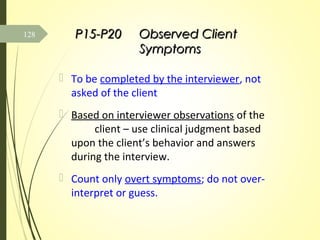
P15-P20P15-P20 Observed ClientObserved Client
SymptomsSymptoms
 To be completed by the interviewer, not
asked of the client
 Based on interviewer observations of the
client – use clinical judgment based
upon the client’s behavior and answers
during the interview.
 Count only overt symptoms; do not over-
interpret or guess.
128
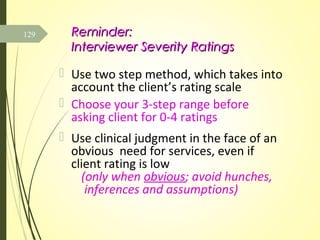
Reminder:Reminder:
Interviewer Severity RatingsInterviewer Severity Ratings
 Use two step method, which takes into
account the client’s rating scale
 Choose your 3-step range before
asking client for 0-4 ratings
 Use clinical judgment in the face of an
obvious need for services, even if
client rating is low
(only when obvious; avoid hunches,
inferences and assumptions)
129
Thank you!Thank you!

Addiction severity index intro training jan 2015

  • 1.
    Introduction to the AddictionSeverity IndexAddiction Severity Index (Fifth Edition) Trainer: Tara Shepherd, MA, CASTara Shepherd, MA, CAS Deputy Director, Modoc Co. Behavioral HealthDeputy Director, Modoc Co. Behavioral Health Modoc County AOD AdministratorModoc County AOD Administrator January 14, 2015 Alturas, California 8:30 am – 12:00 pm 1
  • 2.
    Goal of theTrainingGoal of the Training  To develop and/or enhance “interviewer” competencies in the Addiction Severity Index, a standardized screening and assessment instrument. 2
  • 3.
    ObjectivesObjectives  Understand whatis measured by the ASI  Identify the specific intention of each question asked in the ASI  Phrase each question in the most efficient way while remaining flexible enough to adapt the questionnaire to specific clients  Understand the importance of the use of additional probes to augment information provided by the client  Utilize the severity rating procedure 3
  • 4.
    What is Measuredby the AddictionWhat is Measured by the Addiction Severity Index?Severity Index?  By using the ASI, the interviewer is able to screen for the unmet needunmet need for services in the following domains: * Medical * Employment/Support * Alcohol * Other Drugs * Legal * Family/Social * Psychiatric/Emotional 4
  • 5.
    Screening & AssessmentScreening& Assessment  Screening tools establish the presence or absence of a problem.  Assessment requires gathering additional information about the problem.  The ASI is: • a screening tool – medical, employment/ support, legal, family/social, psychiatric; • an assessment tool – AOD. 5
  • 6.
    AssessmentAssessment  Must bedone with client involvement  Single-focused assessment tools (MAST & DAST)  Multi-focused screening and assessment tools (ASI, SASSI)  Screening and assessment needs to occur throughout the treatment process 6
  • 7.
    Addiction Severity IndexAddictionSeverity Index  Standardized, semi-structured, multi- focused screening & assessment tool.  Designed for use primarily with substance use clients.  Used to collect information regarding the nature and severity of problems individuals with substance use disorders often have. 7
  • 8.
    Limitations of theASILimitations of the ASI  Does not provide quantity estimates of alcohol and other drug use  Does not directly assess HIV risk  Does not directly assess issues related to trauma  Additional probes may be used to gather information; record in “comments” 8
  • 9.
    Coding & RatingCoding& Rating  Leave no blanks  Time periods: lifetime & last 30 days (two distinct & different time frames)  Rounding: > 2 weeks = month > 6 mo = year  Evaluate non-AOD problems independently 9
  • 10.
    Introducing the ASIIntroducingthe ASI  All clients receive the same standard interview  All information gathered is confidential (explain your agency’s policies & limitations on confidentiality)  There are two time frames we will discuss: the past 30 days and lifetime 10
  • 11.
    Introducing the ASIIntroducingthe ASI  State that accurate information better equips us to help the client  Encourage honesty rather than misinformation  Encourage clients to answer all questions  Make it clear clients can choose to not answer a question – which is preferable to giving inaccurate information 11
  • 12.
    Introducing the ASIIntroducingthe ASI  7 Potential Problem Areas to be addressed: … Medical … Employment/Support … Alcohol … Other Drug … Legal … Family/Social … Psychiatric 12
  • 13.
    Introducing the ASIIntroducingthe ASI  Hand the client a copy of the Client Rating Scale  Explain → client will use the 0-4 rating scale to respond to questions at the end of each area  At the end of each area, I will ask: • “How troubled or bothered have you been in the last 30 days by these __ problems?” and • “How important to you now is treatment, counseling or referral for these __ problems? 13
  • 14.
    Client Rating ScaleClientRating Scale (o-4)(o-4)  In the past 30 days, how troubled or bothered have you been by these ____ problems?  How important to you now is treatment, counseling or referral for these ____ problems? 0 Not at all 1 Slightly 2 Moderately 3 Considerably 4 Extremely 14
  • 15.
    Interviewer Severity Rating(0-9)Interviewer Severity Rating (0-9)  0-1 No problem; Treatment not necessary  2-3 Slight problem; Treatment probably not necessary  4-5 Moderate problem; Treatment probably necessary  6-7 Considerable problem; Treatment necessary  8-9 Extreme problem; Treatment absolutely necessary 15
  • 16.
    Interviewer Severity Ratings(0-9)Interviewer Severity Ratings (0-9) Our EHR (Anasazi) . . .Our EHR (Anasazi) . . .  Translates the Interviewer’s 0 – 9 ratings into: Low (0-3) Moderate (4-6) High (7-9) 16
  • 17.
    Low – Moderate– High What to include on Tx Plan?  General “rule of thumb” – include any area with a moderate or high rating on the treatment plan  If not, explain in comments why a particular area is not being addressed at this time on the treatment plan. Examples: • Client unwilling at this time to address family/ social needs • Client wants to wait to address employment/ support needs until physical health needs have been addressed 17
  • 18.
    Interviewer Severity RatingsInterviewerSeverity Ratings  Not a rating of potential benefit of treatment to the client  Not a rating of the severity of problems  A rating of unmet need – the extent to which additionaladditional treatment/ services are needed (regardless of whether treatment is available). 18
  • 19.
    Interviewer Rating ProcedureInterviewerRating Procedure  Two step method: 1. Before asking the client for client ratings – In your mind, make a preliminary rating of a 3- point range (i.e., 5-6-7) on the interviewer rating scale 2. Then, ask the client for ratings (0-4 on both questions). Using the client ratings and your 3-point range, fine tune your rating to a single digit . . . 19
  • 20.
    Selecting a RatingSelectinga Rating in Your (3 point) Rangein Your (3 point) Range  If the client chooses higher (3 or 4) in client rating scale, choose highest in your 3-point range (“7” in a 5-6-7 range)  If the client chooses lower (0 or 1), choose lowest number in your range (“5” in 5-6-7)  If the client chooses the middle number (2) in the client rating scale, choose your middle number (“6” in 5-6-7 range) 20
  • 21.
    Selecting a RatingSelectinga Rating in Your (3 point) Rangein Your (3 point) Range  If the client has chosen numbers from different parts of their scale (e.g., 4 & 1; 0 & 3), use clinical judgment and either: * Use the higher of the two numbers, or * Average the numbers. 21
  • 22.
    Exceptions to 2-StepMethodExceptions to 2-Step Method  In cases where the patient obviously needs treatment & reports no such need, your rating should reflect the obvious need for treatment Example: Client reports 30 days of family arguments sometimes leading to physical abuse, but says no need for treatment/referral  Only when obvious; avoid hunches, inferences & assumptions 22
  • 23.
    Confidence RatingsConfidence Ratings The last two items in each sectionThe last two items in each section  “Is the above information significantly distorted by: * Patient misrepresentation? * Patient’s inability to understand?”  When a “yes” is coded, explain in “Comments” (“yes” is extremely rare)  A “yes” response negates the validity of the entire section  Stop the whole interview when a “yes” response in two (2) sections 23
  • 24.
    Confidence RatingsConfidence Ratings Clinical judgments on veracity of the client’s statements and ability to understand the nature & intent of the interview  Not “gut hunches”  Based on observations of the client’s responses following probing and inquiry when contradictory information has been presented that the client cannot justify 24
  • 25.
    Confidence RatingsConfidence Ratings “Patient’s misrepresentation” should not be confused with minimization or denial Code “Yes” only if you have clear evidence that the client is falsifying information throughout the entire section 25
  • 26.
    Confidence RatingsConfidence Ratings “Patient’s inability to understand” = inability to complete the section due to: • problems of intoxication or detox • language barriers • serious problems with intellectual ability such as mental retardation or head injury 26
  • 27.
    General Information SectionGeneralInformation Section  To provide identifying and demographic information about the client  To determine if the client has been in a living situation which restricted freedom of movement and access to alcohol and other drugs (“controlled environment”) 27
  • 28.
    G19 Controlled EnvironmentG19Controlled Environment  Intent: to record whether client has had restricted access to alcohol or other drugs in the past 30 days  “Controlled environment: a living situation where freedom of movement & access to drugs is (theoretically) controlled (jail, hospital, residential tx program)  Sober living/halfway houses are not controlled environments 28
  • 29.
    Controlled EnvironmentControlled Environment How many days in the last 30 days … Reflect total time in all controlled settings  Additional probes: name of institution(s); reason client was in controlled environment (medical, criminal charges, 5150 etc.) 29
  • 30.
    Medical Information SectionMedicalInformation Section  Client’s medical history  Lifetime hospitalizations  Long-term medical problems  Recent physical ailments 30
  • 31.
    M1 Lifetime MedicalHospitalizationsM1 Lifetime Medical Hospitalizations  Overnight hospitalizations for medical problems  Exclude detox or other forms of AOD or psychiatric treatment  Include hospitalization for OD’s or DT’s  Exclude normal childbirth  Include complications from childbirth (including C-Section) 31
  • 32.
    M2 Length ofTime SinceM2 Length of Time Since Last HospitalizationLast Hospitalization  How long ago (not how long) was your last [overnight] hospitalization?  If occurred within the last month, code 0 years, 1 month. If that hospitalization < 2 weeks, note length of stay in comments  Additional probes: diagnosis/reasons for hospitalization; types of medications received 32
  • 33.
    M3M3 Chronic MedicalChronicMedical ProblemsProblems  “Do you have any chronic medical problems which continue to interfere with your life?”  Serious or potentially serious physical condition (not SU or MH) that requires continuous or regular care (e.g., medication, diet restrictions, inability to take part in normal activities)  Examples: hypertension, diabetes, edema, epilepsy, physical handicaps, chronic back pain 33
  • 34.
    Chronic Medical ProblemsChronicMedical Problems  Emphasize the chronicchronic aspect of the problem  Include when the client has accepted the continued care as less of an interference than a daily routine (de-emphasize “interfere with your life”)  Additional probes: Medical diagnosis; year the problem was diagnosed; medications prescribed; medical provider(s) providing the tx 34
  • 35.
    M4M4 Prescribed Medications:PrescribedMedications: Physical ProblemPhysical Problem  “Are you taking any prescribed medications on a regular basis for a physical problem?”  Intent: Validate the severity of the disorder by doctor’s decision to medicate  Count it if prescribed, regardless of whether the client actually took the medication. Note in comments if client does not take the prescribed meds, and the reason(s) why 35
  • 36.
    Prescribed Medications:Prescribed Medications: PhysicalProblemPhysical Problem  Do not count meds prescribed for short periods of time or for temporary conditions  Do not count psychiatric meds  Medications for sleep problems are usually temporary and fall under the psych section  Additional probes: dosage, name of physician(s) and pharmacy, compliance 36
  • 37.
    M5 Pension for PhysicalDisability  “Do you receive a pension for a physical disability?”  Ask as written, with examples … “from any source such as the VA, social security, state disability or Workman’s Compensation”  Additional probes: details of the pension, details of medical problem warranting pension 37
  • 38.
    M6M6 Number ofDays in Past 30Number of Days in Past 30 w/ Medical Problemsw/ Medical Problems  “How many days have you experienced medical problems in the past 30 days?”  Do not includeDo not include problems directly caused only by alcohol or other drugs (hangovers, vomiting, lack of sleep)  IncludeInclude medical problems caused by AOD that would not be eliminated simply by abstinence (e.g., liver disease; esophageal bleeding) 38
  • 39.
    Number of Daysin Past 30Number of Days in Past 30 w/ Medical Problemsw/ Medical Problems  IncludeInclude minor ailments such as cold or flu  Additional probes: • ask the client to try to pinpoint the exact number of days – have a calendar handy to assist • “You mentioned __ (a chronic medical problem) earlier; how many days in the last 30 did you experience any symptoms related to __ (the chronic problem)?” 39
  • 40.
    Before Asking NextQuestionsBefore Asking Next Questions (M 7& M8)(M 7& M8)  Before asking: M7 – “How troubled or bothered …” and M8 – “How important now is tx/referral …”  Mentally choose your 3 – point range from 0-9 Interviewer Severity Rating Scale 40
  • 41.
    M7M7 Troubled orBothered &Troubled or Bothered & M8M8 Importance Now of Tx/ReferralImportance Now of Tx/Referral  Have client respond only to those problems reported in item M6 (last 30 days)  Use the name of symptoms/conditions the client reported in M6, rather than “medical problems” when asking questions.  For M8 (importance of treatment), emphasize you mean additional tx or referral  If M6 is “0” (no physical health problems in last 30 days), then M7 and M8 must also be “0.” Ask anyway, as a cross-check 41
  • 42.
    M9M9 How wouldyou rate the client’sHow would you rate the client’s need for medical treatment?need for medical treatment?  Remember you are assessing for unmet need  Use the two-step method for severity ratings  Even if a client has a severe medical condition, your rating may be low if appropriate treatment is received and the condition is under control  If a condition is serious and problematic, (unmet need), rate as severe, even if there is currently no effective tx 42
  • 43.
    Employment/SupportEmployment/Support SectionSection  Resources clientcan record on a job application  Current sources of income 43
  • 44.
    E1E1 Education CompletedEducationCompleted  Intent: to record years and months of completed formal education  GED = 12 years, with note in “comments”  Do not include correspondence schools  AA = 14 years Bachelor’s = 16 years Master’s = 18 yrs Doctorate = 20 yrs  Additional probes: name of high school or college, year completed, college major, degrees earned 44
  • 45.
    E2E2 Training orTechnicalTraining or Technical Education CompletedEducation Completed  Intent: to record formal, technical education or training that could be listed on a job application  Can include apprenticeship thru a recognized on-the-job training program  Include military training only if transferable to civilian life  Additional probes: Verify completion, name of training institute, info about programs started but didn’t finish, length of program 45
  • 46.
    E3E3 Do youhave a profession,Do you have a profession, trade, or skill?trade, or skill?  Trade = any employable, transferable skill that was acquired through specialized training or education.  Additional probes: skills that were acquired without a formal training program. 46
  • 47.
    E4. Valid Driver’sLicense E5. Auto Available for Use  Intent: Determine opportunity for employment, since many jobs require driving or getting to work where no public transportation is available  License cannot be expired, suspended or revoked  Probe for E4: Reason why no valid license – never had a license; expired; suspended; revoked – and reasons why client never got a license, expired, suspended or revoked  For E5, if E4 is “no,” then E5 is automatically a “no”  Probe for E5, if E4 and/or E5 are “no” – other possible options for transportation 47
  • 48.
    E6E6 Longest Full-TimeJobLongest Full-Time Job  Full-time job held for the longest time (not how long ago)  May help to get current job status, then work backward in time (this will assist with E10 – usual employment pattern last 3 years)  Only count time in military when it is beyond the original enlistment period  Probes: places worked, job titles, years at each job, reasons for leaving jobs, info about part-time jobs 48
  • 49.
    E7E7 Usual (orLast) OccupationUsual (or Last) Occupation  Intent: record client’s job and level of skill the job demands  If the client does not have a usual occupation, then record the most recent job  Use “N/A” only if the client has never worked at all.  Probes: places worked, specific jobs 49
  • 50.
    E8E8 Does SomeoneContribute toDoes Someone Contribute to Your Support in Any Way?Your Support in Any Way?  Intent: discover additional sources of financial support  Regular support (cash, housing, food) from friend or family member  Include spouse’s contribution  Exclude support from an institution 50
  • 51.
    E9E9 Does E8Constitute theDoes E8 Constitute the Majority of Your Support?Majority of Your Support?  If E8 is “No,” then E9 is “N/A”  Avoid defensiveness in clients living with parents and not paying rent. If that is the situation: • OK to automatically record “yes” to E8 & E9 • Perhaps ask, “Are you receiving money from any source other than your parents?” 51
  • 52.
    E10E10 Usual EmploymentPatternUsual Employment Pattern Past 3 YearsPast 3 Years  Determine choice most representative of the past 3 years, not simply the most recent  Full-time = Regular and 35+ hours per week  Regular, Part-time = Regular & sustained; < 35 hours per week.  Irregular, Part-time = no reliable schedule  When equal times for more than one category, go with most current 52
  • 53.
    E11E11 Number ofDays inNumber of Days in Past 30 Paid for WorkingPast 30 Paid for Working  “How many days were you paid for working in the past 30?”  Include days worked that will be paid for  Jobs in jail/prison/hospital are not included.  Include paid sick and vacation days  Include “under-the-table” jobs. 53
  • 54.
    E12-17E12-17 Money ReceivedMoneyReceived in Past 30 Daysin Past 30 Days  12. Employment (including under-the-table): record net/take-home pay  14. Welfare: Include cash, dollar amount of food stamps, transportation money  16. Mate, Family, Friends: Cash only. Include windfalls (legal gambling, loans, tax returns, inheritance)  17. Illegal: Money obtained illegally. Do not convert drugs or other items to $ value 54
  • 55.
    E18E18 Number ofDependentsNumber of Dependents  “How many people depend on you for the majority of their food, shelter, etc.?”  People must regularly depend on the client  Do not include client or self-supporting spouse  Include dependents who are normally supported by the client, but due to unusual circumstances, have not received support recently  Alimony & child support payments if “majority …” 55
  • 56.
    E19E19 Number ofDays in Past 30Number of Days in Past 30 with Employment Problemswith Employment Problems  Include inability to find work (only on days client tried)  Include problems with present employment (job in jeopardy; unsatisfactory performance)  Do not include problems entirely due to AOD  Do not include problems entirely due to inability to get along with others (Family/Social section)  Use “N/A” if client had no opportunity to work 56
  • 57.
    E20E20 Troubled orBotheredTroubled or Bothered E21E21 How Important Now is JobHow Important Now is Job CounselingCounseling  Ratings restricted to problems identified in E19  If E19 = “N/A,” then E20 & E21 also “N/A”  Use terms identified in E19 (“inability to find work when you’ve been actively looking”), rather than “problems”  E21: Ask, “How important would it be for you to get employment counseling?” (Help finding or preparing for a job, not giving them a job) 57
  • 58.
    Alcohol & OtherDrug SectionAlcohol & Other Drug Section  Client’s substance use history  Current & lifetime substance use  Consequences of use  Periods of abstinence  Treatment episodes  Financial burden of use 58
  • 59.
    AOD Section CodingAODSection Coding ConventionsConventions “Regular Use” =  3 times a week or more, or  Problematic irregular use in which normal activities are compromised, or  Binges 59
  • 60.
    AOD Section CodingAODSection Coding ConventionsConventions  “Alcohol to Intoxication”: Does not necessarily mean drunk. * To feel or felt the effects * Drank heavily * 3 drinks in a sitting * 5 drinks in a day 60
  • 61.
    D1-D12D1-D12 AOD UseAODUse  Ask all substance use history questions, regardless of the presenting problem  For each substance – order of questions: 1. “Have you ever used ___?”  “How many days in the past 30 days have you used __.” (Important to ask how many days, not how many times.)  Then, determine lifetime use . . . 61
  • 62.
    D1-D12D1-D12 Determine LifetimeUseDetermine Lifetime Use  For the same substance, determine lifetime use: 1. How old were you the first time you … 2. Was there a time you began to use it regularly (define) 3. Since you started using regularly, have you ever abstained for over a month? 4. Add up & verify years of regular use 1. Additional probes: Quantity used per day, estimated money spent on substance per day, method of administration, usage patterns (e.g., weekends only), family history of AOD addiction 62
  • 63.
    D1-D12. AOD UseD1-D12.AOD Use  < 6 months use noted in comments, not lifetime years  Probes: Events occurring same time as periods of abstinence; changes in route of administration; drug combinations 63
  • 64.
    D13D13 Multiple SubstancesMultipleSubstances  Under “30 Days,” ask, “how many days in the past 30 did you use more than one substance, including alcohol”  Under “lifetime,” ask how long more than one substance per day was regularly (define) used, including alcohol  Probes: drugs used together; drugs used same day, but not together; prescribed drugs 64
  • 65.
    D14D14 Which SubstanceisWhich Substance is the Major Problem?the Major Problem?  Interviewer’s clinical judgment determines which drug causes greatest problems (do not ask “drug of choice”)  Base judgment on years of use, number of treatments, number of DT’s/OD’s, negative consequences, etc  If information provides no clear indication, ask client what s/he thinks is the major drug problem 65
  • 66.
    D15D15 How LongWas Last PeriodHow Long Was Last Period of Voluntary Abstinenceof Voluntary Abstinence  “How long (not how long ago) was your last period of voluntary abstinence from this major substance?”  If client indicated use of more than one substance per day, say, “these substance.”  If there are clear indications of problems w/ more than one substance, even if not used on the same day, say, “these substances” • e.g., if client reports using excessive amounts of alcohol on days when meth is not available, then the period of abstinence would refer to both substances 66
  • 67.
    D15D15 How LongWas Last PeriodHow Long Was Last Period of Voluntary Abstinenceof Voluntary Abstinence  Periods of hospitalization & incarceration are not counted (in a controlled environment)  Periods of abstinence with Methadone, Antabuse, Naltrexone or other medication assisted therapy for substance use disorders are included (As long as the medication was used as prescribed, and not abused to get high)  If client has never been abstinent for one month since regular use began, enter “0” 67
  • 68.
    D16D16 How ManyMonths AgoHow Many Months Ago Did This Abstinence End?Did This Abstinence End?  If no problem reported in D14, N/A for D16  If D15 was “0” never abstinent for a month, N/A for D16  If the period of abstinence is current (no use for a month or more), enter “0” for D16  Probe: Circumstances surrounding the end of the abstinence period 68
  • 69.
    D17D17 How ManyTimes HaveHow Many Times Have You Had Alcohol DT’s?You Had Alcohol DT’s?  Delirium Tremens occur 24-48 hours after last drink (or significant decrease in alcohol intake): shaking, severe disorientation, often fever & hallucinations  Usually require medical attention  Impending DT’s as diagnosed by a medical professional would count as DT’s  “The shakes” occur about 6 hours after last use of alcohol and do not include delirium (severe disorientation). Do not code as DT’s 69
  • 70.
    D18D18 How ManyTimes HaveHow Many Times Have You Overdosed on Drugs?You Overdosed on Drugs?  OD symptoms will differ with the type of drug used: Coma-like effects with opiates and barbiturates; meth overdoses frequently result in toxic psychosis  Simply “sleeping it off” does not constitute an OD  Include suicide attempts by drug overdose  Probes: Hospitalized? Did someone have to help revive you? Did someone have to help calm you down? Whether OD was intentional 70
  • 71.
    D19/20/21/22D19/20/21/22 Treatment/Detox EpisodesTreatment/Detox Episodes Count any type of AOD treatment and/or structured self-help, including detox, residential and outpatient counseling  Include DUI Treatment Programs.  Include AA/NA (if 3 or more meetings within a 30 day period)  Probes: When, names of programs, length of time, completions, reasons for leaving 71
  • 72.
    D19/20/21/22D19/20/21/22 Treatment/Detox EpisodesTreatment/Detox Episodes Record “alcohol” and “drug” tx separately  If treated for both A & D simultaneously, count the treatment under both categories & note in comments it was a single tx for both  Code as a one episode treatment experiences that occur in different facilities immediately following one another e.g., 3 days detox at Empire, then move to another facility for residential treatment, without being “out” after detox (remained in a controlled environment). 72
  • 73.
    D23 & D24D23& D24 Money Spent on AOD in Last 30 DaysMoney Spent on AOD in Last 30 Days  Intent: Measure financial burden, not amount of use  Enter only money spent, not street value of what was used  Enter “not answered” only if client cannot make a reasonable determination after interviewer probes  Cash only spent; not sex for drugs or “middle man” for drug deals. 73
  • 74.
    D25D25 Days inPast 30 inDays in Past 30 in Outpatient Tx or AA/NAOutpatient Tx or AA/NA  Count number of days that client actually attended tx or AA/NA  Do not include counseling or therapy for issues other than substance use problems  Treatment requires personal contact with the program; simply being enrolled is not enough; the client must attend to count the day 74
  • 75.
    D26 & 27How Many Days in Past 30D26 & 27 How Many Days in Past 30 Experienced AOD Problems?Experienced AOD Problems?  Number of days problems directly related to AOD use.  Include cravings, withdrawal symptoms, disturbing effects of intoxication, or wanting to stop and not being able to.  Do not include client’s inability to find alcohol or other drugs as a problem.  Do not include problems in other domains (e.g., fighting with spouse about using). 75
  • 76.
    D28 & D29Troubled or BotheredD28 & D29 Troubled or Bothered D30 & 31 How Important is AOD Tx?D30 & 31 How Important is AOD Tx?  Ask “how troubled or bothered …” about the problems identified in D27  Use words (hangovers, craving, shakes, your inability to find ___) instead of “problems” when asking the questions 76
  • 77.
    Legal Status Section Client’s legal history  Information about probation or parole  Charges, convictions, incarcerations  Detainment  Illegal activities 77
  • 78.
    L1. Admission Promptedby Criminal Justice?L1. Admission Prompted by Criminal Justice? L2. On Probation or Parole?L2. On Probation or Parole?  Intent: Record information about relationship between client’s treatment status and legal status  Legal = Criminal (Civil issues may be addressed in Family/Social section) 78
  • 79.
    L1. Admission Promptedby Criminal Justice?L1. Admission Prompted by Criminal Justice? L2. On Probation or Parole?L2. On Probation or Parole?  Give examples of “Criminal Justice System” court, defense attorney, probation, parole  Probes: Who is referral source? What offenses led to your probation? How long on probation? When will probation/parole end? Name of Probation/parole officer? Were you under the influence when arrested? 79
  • 80.
    L3- L16 Numberof TimesL3- L16 Number of Times Arrested & ChargedArrested & Charged  Record number & types of arrest counts with official charges (not necessarily convictions)  Do not include juvenile, unless charged as an adult (note juvenile arrests in comments)  Arrests in military: include only those with a civilian counter-part (exclude AWOL, insubordination) 80
  • 81.
    L3- L16L3- L16Number of TimesNumber of Times Arrested & ChargedArrested & Charged  Record attempts (attempted robbery, attempted rape) the same as if the robbery/rape occurred (Note “attempted” in comments section)  Probes: When the incident occurred, details, other significant events in client’s life at the time, whether during intoxication or withdrawal 81
  • 82.
    L17L17 How ManyResultedHow Many Resulted in Convictions?in Convictions?  Include only offenses listed in L3 – L16  Convictions include guilty pleas, “no contest” pleas, fines, plea bargaining, probation, and suspended sentences  Charges for parole and/or probation violations are automatically counted as convictions 82
  • 83.
    L18 – L20L18– L20 How many times haveHow many times have you been charged with . . .you been charged with . . .  Not necessarily convicted  L18 Disorderly conduct, vagrancy, public intoxication?  L19 DUI/DWI/Wet Reckless?  L20 Major driving violations? e.g., wreckless driving, speeding, failure to stop at stop sign 83
  • 84.
    L21 Total MonthsofL21 Total Months of Lifetime IncarcerationsLifetime Incarcerations  Total months spent in jail/prison for all offenses since age 18 (or younger if tried as adult)  Note specifics in comments  Enter maximum of 99 months  2 weeks or longer = 1 month  If not incarcerated for 2 weeks or longer, enter “0”, and put “X” (not applicable) in L22 & L23 84
  • 85.
    L22L22 Length of&Length of & L23L23 Reason for Last IncarcerationReason for Last Incarceration  L23 • If incarcerated for several charges, enter the most serious, or the one for which the most severe sentence was received (note specifics of all charges in comments) 85
  • 86.
    L24 & L25L24& L25 Awaiting Charges, Trial or Sentence?Awaiting Charges, Trial or Sentence?  Clarify current legal status; Do not include civil charges  If the answer to L24 is “No,” then L25 is “(N/A)”  For L25, “What for?” – Pick from options for L3 - L16 & L18 - 20  Probe: Why haven’t charges been filed yet? Do they know for sure that charges will be filed? Date of trial or sentencing? 86
  • 87.
    L26L26 How ManyDays in Past 30How Many Days in Past 30 Detained or Incarcerated?Detained or Incarcerated?  Include being detained and released on the same day  Do not include “field” questioning  Probe: Reasons for detainment 87
  • 88.
    L27 How ManyDays in Last 30 Illegal Activities for Profit  Regardless of whether “caught”  Confidentiality reminder  Do not count drug possession or drug use 88
  • 89.
    L27 How ManyDays in Last 30 Illegal Activities for Profit  Do count drug dealing, prostitution, burglary, selling stolen goods, etc  Include as “for profit” whether client received cash, drugs, or other goods in return for illegal activity 89
  • 90.
    L28. How Serious…L28. How Serious … Legal ProblemsLegal Problems L29. How Important…L29. How Important… Legal ReferralLegal Referral  Current legal (criminal) problems  Not potential legal problems  For instance, if client didn’t get caught selling drugs, doesn’t have a current legal problem 90
  • 91.
    Family & SocialFamily& Social Relationships SectionRelationships Section  To determine the nature of the client’s personal relationships  To determine if client has relationship problems not due to alcohol or other drug use (i.e., if the AOD problem was absent, would there still be a relationship problem?)  To determine potential social/family supports for recovery 91
  • 92.
    F1-F3F1-F3 Marital Status,MaritalStatus, Length, SatisfactionLength, Satisfaction  F1 Married; Remarried; Widowed; Separated; Divorced; Never Married  Individuals who consider themselves married because of a commitment ceremony or significant period of cohabitation should be coded as married. (Note in Comments)  F2. For those never married, enter the number of years since age 18 (adult status). 92
  • 93.
    F4F4 Usual LivingArrangements,Usual Living Arrangements, past 3 yearspast 3 years  Choices available: • w/ sexual partner & children • w/ sexual partner alone • w/ children alone • w/ parents • w/ family • w/ friends • alone • controlled environment • no stable arrangement 93
  • 94.
    F4-F5F4-F5 Living Arrangements, LengthLivingArrangements, Length  Code the living arrangement in which client spent most of the last 3 years, not just most recent  If several, choose the most representative  If time evenly split between arrangements, use the most recent  For clients who usually live with parents, enter the number of years living there since age 18 94
  • 95.
    F5&6 Living Arrangements,F5&6Living Arrangements, Length & SatisfactionLength & Satisfaction  A “satisfied” response = the client generally likes the living arrangement, not merely resigned to it  Ask enough questions to understand where client was living for the entire 3 year period (note in comments)  Probe: Reasons for leaving each arrangement 95
  • 96.
    F7/F8F7/F8 Living withAnyoneLiving with Anyone With AOD Problem?With AOD Problem?  Intent: To address whether the client has an AOD-free living situation in the home  F7. Code yes only if there is an individual in the home with an active alcohol problem, regardless of whether the client has an alcohol problem  F8. Code yes if there is any form of illicit drug use in the home, regardless of whether the client or the drug-using individual has a problem 96
  • 97.
    F9/10F9/10 With WhomIs FreeWith Whom Is Free Time Spent & SatisfactionTime Spent & Satisfaction  Family, friends or alone  Family = Immediate & extended family & in-laws  Friends = Any associate other than family, and should be considered “Social”  A “Satisfied” response = they like the situation, not just resigned to it  Probes: Who; details of what they do (e.g., movies, drugs, fishing) 97
  • 98.
    F11F11 How ManyHowMany Close Friends?Close Friends?  Stress that you mean close, mutually supportive relationships  Do not include family members (or cohabitating mates who were counted as spouses)  Probes: Names of close friends; amount & type of contact with close friends; AOD use of friends 98
  • 99.
    F12-17F12-17 Close, LongLastingClose, Long Lasting Personal RelationshipsPersonal Relationships  Intent: Extent to which client has a history of being able to establish & maintain close, warm, and mutually supportive relationships with: mother, father, brothers/sisters; sexual partner/ spouse; children; friends (Include step-relatives)  “Close reciprocal relationship” = you would help them any way you could and vice versa” 99
  • 100.
    F12-17F12-17 Close, LongLastingClose, Long Lasting Personal RelationshipsPersonal Relationships  Code “yes” for any category where at least one member of the relative category meets the criterion  When “Yes,” important to probe re: client’s ability to feel closeness & mutual responsibility in a relationship  Code “No” if all relatives in the category fail to meet criterion  Code “N/A” where there is no relative for the category  Code “not answered” for uncertain or don’t know. 100
  • 101.
    F18-F26F18-F26 Serious ProblemsSeriousProblems Getting Along With . . .Getting Along With . . . “Have you had significant periods when you have experienced serious problems getting along with: mother, father, brother/sister, sexual partner/spouse, children, other significant family (specify), close friends, neighbors, co- workers?” 101
  • 102.
    F18-F26F18-F26 Significant PeriodsSignificantPeriods & Serious& Serious ProblemsProblems  Serious problems of sufficient duration and intensity to jeopardize or damage the relationship  e.g., extremely poor communication; complete lack of trust or understanding; animosity; constant arguments  F21 may include any regular, important sexual relationship 102
  • 103.
    F18-F26F18-F26 Serious ProblemsSeriousProblems Getting Along With . . .Getting Along With . . .  Recommend asking the lifetime question first for each relationship category, then last 30 days  If there has been no contact in the last 30 days, code “N/A” for the past 30 days  Use “N/A” if there is no relative for the category  Probes: Nature of the problems; facts about relationships (step, half, number of siblings, etc.) 103
  • 104.
    F27-F29F27-F29 AbuseAbuse  Hasanyone ever abused you? (Lifetime, then last 30 days): * Emotionally? (Made you feel bad through harsh words) * Physically? (Caused you physical harm) * Sexually? (Forced sexual advances/acts and/or childhood sexual abuse) 104
  • 105.
    F27F27 Emotional AbuseEmotionalAbuse  Emotional Abuse will be recorded by what the client reports, regardless of whether the “abuse” or lack of it, would be considered abuse by another person 105
  • 106.
    2828 Physical AbusePhysicalAbuse  Physical Abuse will be recorded by what the client reports, regardless of whether the “abuse” or lack of it, would be considered abuse by another person  Except, simple spanking should only be counted if (in the eyes of the client), the spankings were extreme and unnecessary 106
  • 107.
    F29 Sexual Abuse Any type of unwanted advances of a sexual nature by a member of either sex  Any form of childhood sexual molestation or exploitation 107
  • 108.
    F27-F29F27-F29 AbuseAbuse  Intent:To assess important aspects of early home life and adulthood that may indicate trauma issues (lifetime questions) and to assess dangers in the recent and possibly future environment (past 30 days)  Stress confidentiality.  Probes: Would you be willing to tell me about that?; Who else knew of the abuse?; Was any legal action taken against the perpetrator? 108
  • 109.
    F30/F31F30/F31 Days inPast 30 withDays in Past 30 with Serious ConflictsSerious Conflicts  How many days in the past 30 have you had serious conflicts: * with your family? * with other people (excluding family)?  Conflicts require personal contact (at least telephone) 109
  • 110.
    F30/F31F30/F31 Days inPast 30Days in Past 30 w Serious Conflictsw Serious Conflicts  Serious conflicts = Conflicts of such a magnitude that they jeopardize the relationship  If a conflict occurred only because the client was under the influence, record the problem days in the AOD Section, not the Family/Social section  Problems recorded in Family/Social section should be primarily relationship problems, and have their origins in interpersonal conflict, not substance abuse 110
  • 111.
    F32-F35F32-F35 How Troubled…F/SProblemsHow Troubled…F/S Problems How Important…CounselingHow Important…Counseling  “How troubled or bothered have you been in the last 30 days by the problems that you have had with ___?”  “How important is it for you to talk to someone about the problems that you and ___ have been having?”  Client is not rating whether family/friends would agree to participate, but how badly the client needs counseling in whatever form 111
  • 112.
    Psychiatric Status SectionPsychiatricStatus Section  To determine the client’s long-term and recent psychological and emotional functioning  To explore the potential for co- occurring mental health and substance use disorders 112
  • 113.
    Psychiatric Status SectionPsychiatricStatus Section  Screening tool, not diagnostic  Client does not need to meet any diagnostic criteria for a symptom to have experienced the symptom  Will not get a definite “chicken/egg” answer 113
  • 114.
    Psychiatric Status SectionPsychiatricStatus Section  All symptoms except for those associated with drug effects should be counted Examples:  * Depression & sluggishness related to detox should not be counted * Depression & guilt associated with violating a friend’s trust or losing a job should be counted  Probe prior to start of psych questions: family history of serious mental illness (note in comments) 114
  • 115.
    P1/P2P1/P2 Number ofTimesNumber of Times Treated – PsychTreated – Psych  How many times have you been treated for any psychological or emotional problems?” Number of times = # of treatment episodes (a series of fairly continuous visits or treatment days)  P1. Hospital or inpatient (does not have to be a psychiatric unit) e.g., If client received psychiatric services while in an AOD inpatient facility, count it  If client knows diagnosis, note in comments 115
  • 116.
    P3P3 Pension forPsychPension for Psych DisabilityDisability  “Do you receive a pension for a psychiatric disability?”  Pensions for physical problems of the nervous system (e.g., epilepsy) should be counted in the Medical Section  Probes: Diagnosis; source of pension; amount of pension 116
  • 117.
    P4/P5P4/P5 Significant Period…Significant Period … Depression/AnxietyDepression/Anxiety  For lifetime question, serious psychiatric symptoms over a significant period of time (at least 2 weeks)  Refers only to times when not under direct effects of alcohol, other drugs, or withdrawal  Ask lifetime first, then last 30 days 117
  • 118.
    P4/P5P4/P5 Depression &AnxietyDepression & Anxiety  “… Experienced serious depression – sadness, hopelessness, loss of interest, difficulty with daily functioning, etc.”  “… Experienced serious anxiety or tension – uptight, inability to feel relaxed, unreasonably worried, etc.” 118
  • 119.
    P4/P5P4/P5 Depression &AnxietyDepression & Anxiety  If yes on depression and/or anxiety: “During that time, were you drinking or doing drugs that made you feel depressed/ anxious, or was it depression/anxiety that occurred: ~ before you did drugs, or ~ when you weren’t doing drugs or coming down from drugs?” 119
  • 120.
    P6P6 HallucinationsHallucinations  “Haveyou experienced hallucinations – saw things or heard voices that other people didn’t see or hear?”  Not due to the biochemical effects of AOD intoxication or withdrawal  Hallucination symptoms are of sufficient importance that even their brief existence warrants recording (when not due to AOD effects) 120
  • 121.
    P7P7 Trouble Understanding,TroubleUnderstanding, Concentrating or RememberingConcentrating or Remembering  As suggested by serious trouble understanding, concentrating, and remembering  Restricted to times when client was AOD-free and not experiencing withdrawal symptoms 121
  • 122.
    P8P8 Trouble ControllingTroubleControlling Violent BehaviorViolent Behavior  “Have you experienced trouble controlling violent behavior, including episodes of violence or rage?”  Record even if under the influence of AOD  Violence/rage symptoms are of sufficient importance that even their brief existence warrants recording 122
  • 123.
    P9/P10 Serious ThoughtsofP9/P10 Serious Thoughts of & Attempted Suicide& Attempted Suicide  “Serious thoughts of suicide” = when client seriously considered a suicide plan. (Note in comments times of less serious thoughts, but don’t record as a “yes”)  “Attempted suicide”: Include parasuicidal “gestures” and attempts, even if intent to die was low/minimal 123
  • 124.
    P9/P10 Serious ThoughtsofP9/P10 Serious Thoughts of & Attempted Suicide& Attempted Suicide  Record suicidal behavior (serious thoughts and attempts) even if under the influence of AOD  Serious suicidal thoughts and suicidal attempts are of sufficient importance that even their brief existence warrants recording  Probes: Circumstances surrounding the suicidal thoughts/behaviors; details of suicide plans 124
  • 125.
    P11P11 Psych MedicationsPsychMedications  Have you been prescribed medication for any psychological or emotional problem?”  Record “Yes” if the medication was prescribed, even if it was not taken by the patient  Probes: Types of medication, client’s perception of reason for meds, whether client is taking the meds as prescribed, why stopped taking 125
  • 126.
    P12P12 Days inPast 30Days in Past 30 Psych/Emotional ProblemsPsych/Emotional Problems  “How many days in the past 30 have you experienced ____ or ____?” (List all symptoms identified by the client in P4 – P10)  Probes: Duration of symptom, trigger for the symptom (if applicable), whether the client was using AOD on days symptoms occurred 126
  • 127.
    P13/P14P13/P14 How Troubled…PsychHowTroubled…Psych How Important…TreatmentHow Important…Treatment  “How troubled or bothered have you been by _____?” (symptoms from P4-P10)  “How important would it be for you now to get additional treatment for _____?”  Make sure client understands you don’t necessarily mean transfer to a psych hospital or psychiatric medication 127
  • 128.
    P15-P20P15-P20 Observed ClientObservedClient SymptomsSymptoms  To be completed by the interviewer, not asked of the client  Based on interviewer observations of the client – use clinical judgment based upon the client’s behavior and answers during the interview.  Count only overt symptoms; do not over- interpret or guess. 128
  • 129.
    Reminder:Reminder: Interviewer Severity RatingsInterviewerSeverity Ratings  Use two step method, which takes into account the client’s rating scale  Choose your 3-step range before asking client for 0-4 ratings  Use clinical judgment in the face of an obvious need for services, even if client rating is low (only when obvious; avoid hunches, inferences and assumptions) 129
  • 130.

Editor's Notes

  • #7 SASSI = Substance Abuse Subtle Screening Inventory