Acute Pulmonary Embolism
NAME: PUJA GUPTA
ROLL NO. 12
B.SC. NURSING 4TH YEAR
Introduction
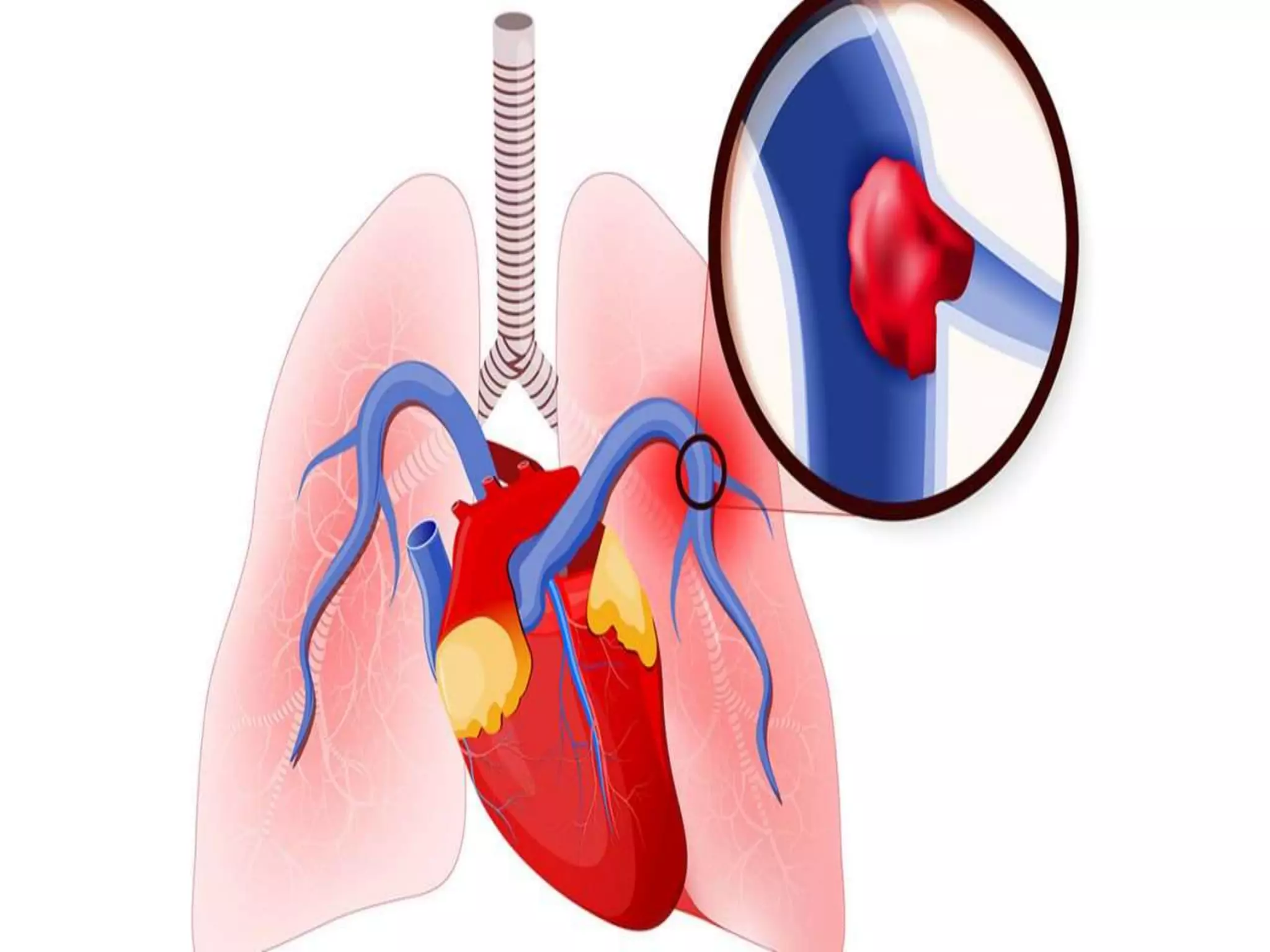
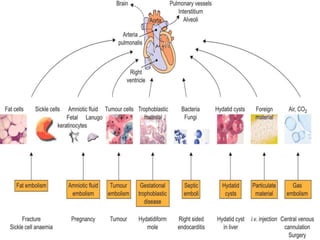
 Pulmonary embolism is an obstruction or occlusion
of the pulmonary artery or one of its branches by a
thrombus, fat or air embolus, or tumor tissue that
originates somewhere in the venous system or in the
right side of heart and has been brought to its site by
the current of pulmonary circulation.
Introduction
 The occlusion material is mostly blood clot, but may be
a fat globule, air bubble, amniotic fluid, piece of tissue
or a clump of bacteria.
 Most often, the condition results from a blood clot that
forms in the legs or another part of the body (deep vein
thrombosis, or DVT) and travels to the lungs.
Introduction
 Clinically, it is defined as an acute hemodynamic
disturbance due to occlusion of pulmonary
vasculature due to an embolus or emboli.
 It is considered as the third most common
cardiovascular disorder after Acute Coronary
Syndromes (ACS) and Stroke. (NHJ)
Embolus
 An embolus is a clot or other plug (thrombus) that is
carried by the bloodstream from its point of origin to
a smaller blood vessel, where it obstructs
circulation.
Epidemiology
 The incidence of PE is estimated to be
approximately 60 to 70 per 100,000 (Globally)
 In spite of rapid advances in the diagnosis and
management of PE, the exact epidemiology of PE in
Nepal is largely unknown. (The Egyptian Heart
Journal)
Etiology
 Thrombotic
 Non-thrombotic
Thrombotic cause
a) Deep vein thrombosis (DVT) (>90%)
b) Congestive heart failure (CHF)
c) Right-sided endocarditis
d) Atrial fibrillation (AF)
Non-thrombotic cause
a) Fat embolism, following bone trauma or a
fracture
b) Amniotic fluid embolism
 Spontaneous delivery
 Caesarean section
Non-thrombotic cause
c) Tumour embolism
 Choriocarcinoma
d) Parasitic embolism
 Schistosomiasis
e) Air embolism
Pulmonary barotrauma in divers
Clinical Risk Factors
1. Prolonged immobilization
2. Varicose veins of legs
3. Postpartum period
4. Oral contraceptives
5. Congestive heart failure
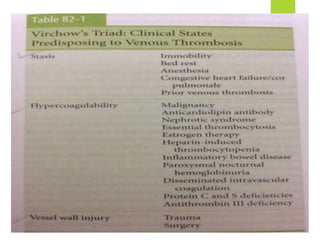
6. Hypercoagulable state
7. ‘In-plaster’ injuries or
fracture of lower limb
bones
8. Antiphospholipids
syndrome
9. Thrombophlebitis (rare)
Risk Factors
Careless intravenous drug or fluid administration.
Obesity
Age>50 years
Surgeries
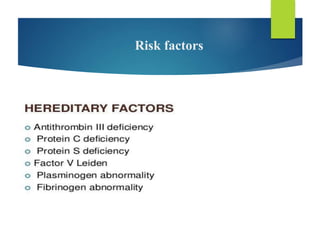
Risk factors
Risk factors
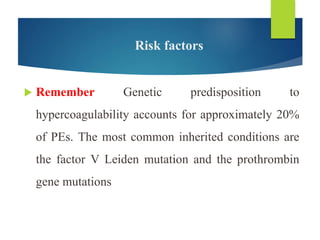
 Remember Genetic predisposition to
hypercoagulability accounts for approximately 20%
of PEs. The most common inherited conditions are
the factor V Leiden mutation and the prothrombin
gene mutations
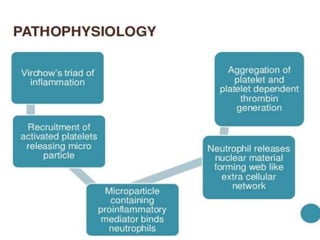
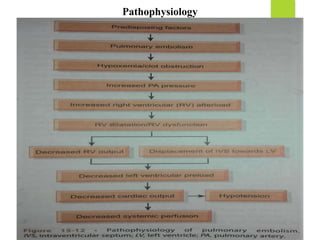
Pathophysiology
 Pathophysiological consequences of embolism
depend on:
The size of an embolus
Their number and
Size of the vessel/vessels involved
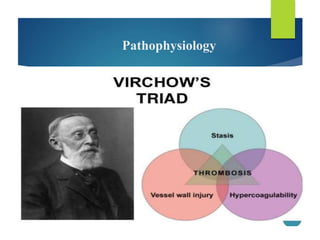
Pathophysiology
Pathophysiology
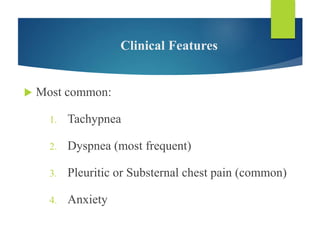
Clinical Features
 Most common:
1. Tachypnea
2. Dyspnea (most frequent)
3. Pleuritic or Substernal chest pain (common)
4. Anxiety
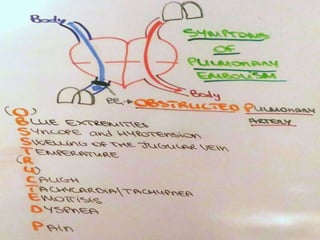
Symptoms
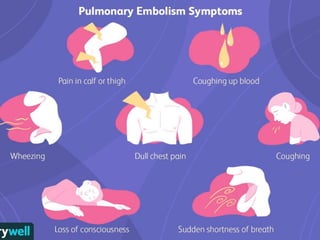
1. Acute dyspnea
2. Chest pain (Pleuritic and non-pleuritic)
3. Sweating
4. Cough
5. Hemoptysis
6. Chest tightness
7. Syncope
Signs
1. Tachypnea
2. Tachycardia
3. Hypotension
4. Fever >38.8°C
5. Cyanosis
6. Raised JVP
7. Gallop rhythm
8. Oedema
9. Crackles
10. Systolic ejection murmur
11. Sign of DVT
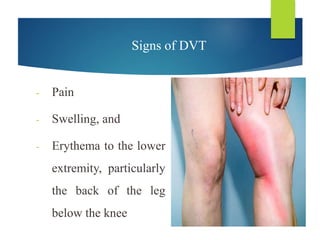
Signs of DVT
- Pain
- Swelling, and
- Erythema to the lower
extremity, particularly
the back of the leg
below the knee
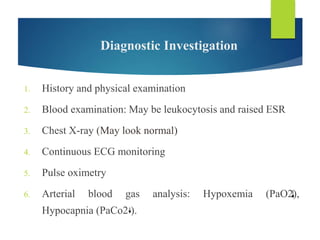
Diagnostic Investigation
1. History and physical examination
2. Blood examination: May be leukocytosis and raised ESR
3. Chest X-ray (May look normal)
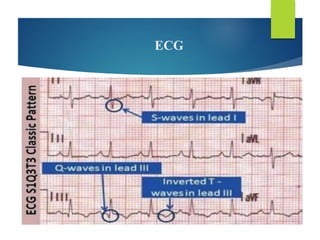
4. Continuous ECG monitoring
5. Pulse oximetry
6. Arterial blood gas analysis: Hypoxemia (PaO2),
Hypocapnia (PaCo2 ).
ECG
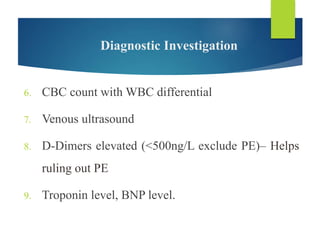
Diagnostic Investigation
6. CBC count with WBC differential
7. Venous ultrasound
8. D-Dimers elevated (<500ng/L exclude PE)– Helps
ruling out PE
9. Troponin level, BNP level.
Diagnostic Investigation
10. V/Q lung scan
11. Multidetector-row computed tomography
angiography (MDCTA) scan
12. CT Pulmonary Angiogram (Gold Standard)
Complications
• Death of part of the lung, called pulmonary infarction.
• Pulmonary hypertension
• Cardiac arrest and sudden death.
• Shock.
• Abnormal heart rhythms.
Complications
• A buildup of fluid (pleural effusion) between the
outside lining of the lungs and the inner lining of the
chest cavity.
• Paradoxical embolism.
Prevention
 For patients at risk for PE, the most effective approach is
prevention.
 Prevention of injury and accidents.
 Careful administration of IV drugs and IV fluids. No flushing
of blocked IVs.
 Active and passive exercise according to the condition (body
movement)
Prevention
 Regular checkup of BP and maintain normal level.
 Regular checkup of blood count, Hbs, PCV levels.
 Adjustment of diet as per need.
 Prevention and early detection of rheumatic fever and
rheumatic heart disease.
 Early detection and treatment pulmonary conditions.
General preventive measures
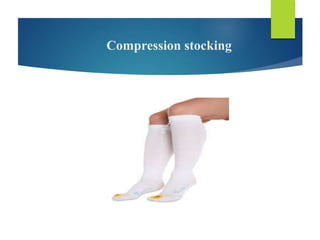
1. Application of graduated compression
stockings.
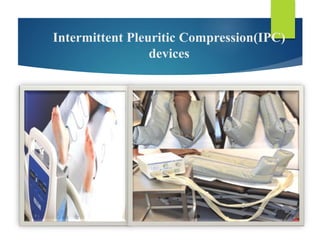
2. Use of intermittent pneumatic compression
devices.
3. Active leg exercises and early ambulation
Prevention
 An additional method to prevent venous thrombosis in
surgical patients is administration of subcutaneous
unfractionated or low-molecular-weight heparin (LMWH).
 Lifestyle modification such as;
o Weight loss
o Smoking cessation
o Regular exercise
Compression stocking
Intermittent Pleuritic Compression(IPC)
devices
Differential Diagnosis
• Acute Coronary Syndrome
• Pneumothorax
• Cardiac tamponade
• Pneumonia
• COPD
Management
1. Emergency and General Management
2. Medical Management
3. Surgical Management
4. Nursing Management
Emergency Management
 Acute PE is life-threatening emergency.
 Immediate objectives is to stabilize the cardio-
pulmonary system
Emergency mgmt. consists of the following
actions
1. Supplemental oxygen (nasal O2), intubation if
necessary.
2. Establish routes for medications or fluids.
3. For hypotension that does not resolve with IV fluids,
prompt initiation of vasopressor therapy (Dobutamine,
dopamine, or norepinephrine) is recommended.
Emergency mgmt. consists of the following
actions
4. Hemodynamic measurements and evaluation for
hypoxemia are performed. If available, MDCTA will
be performed.
5. ECG is monitored continuously for dysrhythmias and
right ventricular failure, which may occur suddenly.
6. Blood is drawn for serum electrolytes, CBC, and
coagulation studies.
Emergency mgmt. consists of the following
actions
7. Insert indwelling urinary catheter to monitor urinary
output.
8. Small doses of IV morphine or sedatives are given to
relieve patient anxiety, to alleviate chest discomfort, to
improve tolerance of the ET tube, and to ease
adaptation to the mechanical ventilator, if necessary.
9. Pulmonary embolectomy in life threatening situation.
General Management
• 100% oxygen sitting up (patients may need
intubation)
• Fluids
• Opiates
General Management
• Anticoagulants
• Unfractioned heparin IV continous infusion (check
APTT regularly 4-6 hours) OR
• Subcutaneous low-molecular-weight heparin – rapid
onset (no monitoring generally required)
• Warfarin (Oral) after patient is stable (check INR)
General Management
 Look for cause of PE
 Remember Normal INR is 1. Therapeutic range for
people on warfarin INR 2-3
Medical Management
1. Non-pharmacological therapy
 Oxygen therapy
 Anti-embolism stockings or intermittent
pneumatic leg compression devices
 Elevate leg above the level of the heart
Medical Management
2. Pharmacological therapy
 Anticoagulation therapy
 Thrombolytic/ Fibrinolytic Therapy
Anticoagulation therapy
1. Low-molecular-weight heparin (e.g. Enoxaparin
[Lovenox])
2. Unfractionated heparin, or one of the new oral
anticoagulants (NOACs), such as a direct thrombin
inhibitor (e.g., dabigatran [Pradaxal]) or a Factor Xa
inhibitor (e.g., fondaparinux [Arixtral], rivaroxaban
[Xarelto], apixaban [Eliquis], or edoxaban [Savaysa]
3. Warfarin (Coumadin)
Thrombolytic/ Fibrinolytic Therapy
 Used in patients with an acute PE who have hypotension
and do not have a contraindication or potential bleeding
risk.
 Thrombolytic therapy with recombinant tissue
plasminogen activator tPA (Activase) or other
thrombolytic agents like kabikinase (Streptase).
Surgical Management
1. Surgical embolectomy
2. Venacava interruption with the insertion of Vena
cava filter.
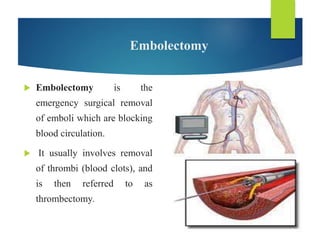
Embolectomy
 Embolectomy is the
emergency surgical removal
of emboli which are blocking
blood circulation.
 It usually involves removal
of thrombi (blood clots), and
is then referred to as
thrombectomy.
Venacava filter
Nursing Management
Nursing Goal:
1. Prevent venous stasis and complication of PE.
2. Monitor thrombolytic therapy.
3. Manage pain.
4. Manage oxygen therapy.
5. Reduce fear and apprehension.
Nursing Management
Nursing diagnosis:
1. Ineffective tissue perfusion related to perfusion and
ventilation inequality or obstructed pulmonary artery by PE as
evidenced by desaturation (Oxygen saturation below 90%),
dyspnea.
2. Impaired gas exchange related to decreased lung perfusion
caused by the obstruction of pulmonary arterial blood flow by
the embolus as evidenced by decreased PaO2 and increased
PaCO2.
Nursing Management
3. Acute chest pain or recurrent chest pain related to PE.
4. Anxiety related to the pain due to PE.
5. Deficient Knowledge related to new medical condition
possibly evidenced by inaccurate follow-through of
instruction.
Nursing Management
6. Risk for shock related to increased workload of
the right ventricle
7. Risk for Bleeding related to Anticoagulant or
thrombolytic therapy
Maintaining tissue perfusion
 Keep the patient on bed rest. Provide a quite environment and
allow bedside commode.
 Administer O2 as ordered.
 Administer and monitor thrombolytics being given through INR or
PTT
 Provide comfortable semi-fowler’s position.
 Encourage ambulation and active and passive leg exercises to
prevent venous stasis.
Maintaining adequate gas exchange
 Assess the skin color, nail beds, and mucous membranes for color
changes. Monitor for any changes in vital signs.
 Auscultate lung sounds, noting areas of decreased ventilation and the
presence of adventitious sounds.
 Maintain client on bed rest. May resume activity gradually as tolerated.
 Position the client properly to facilitate ventilation-perfusion matching.
 Administer oxygen as indicated.
 Anticipate the need to start anticoagulant therapy
Relieving pain
 Assess level and severity of pain and monitor vital signs.
 Administer prescribed pain medications i.e. morphine.
 Keep patient in comfortable i.e., semi-fowler’s position.
 Encourage client to do deep breathing exercise and provide
music therapy.
 Turn patient frequently and reposition to improve ventilation-
perfusion ratio.
Relieved anxiety
 Providing comfortable and calm atmosphere.
 Limit visitors
 Provide sound sleep at night.
 Encourage the patient to talk about any fears or concerns
related to this frightening episode.
 Anxiolytic may be given as prescribed.
Providing knowledge
 Assess the client’s knowledge of pulmonary embolus: its severity, prognosis, risk
factors, and therapy.
 Provide information on the cause of the problem, common risk factors, and effects of PE
on body functioning.
 Instruct the client about medications, their actions, dosages, and side effects.
 Discuss with and provide the client with a list of what to avoid when
taking anticoagulants
 Discuss and give the client a list of signs and symptoms of excessive anticoagulation
 Discuss with and give the client a list of measures to minimize the recurrence of emboli
Postoperative Care After Embolectomy
 Monitor the patient’s pulmonary arterial pressure and urinary output.
 Assess the insertion site of the arterial catheter for hematoma formation and
infection.
 Maintain the blood pressure at a level that supports the perfusion of vital organs.
 Prevent peripheral venous stasis and edema of the lower extremities, elevates the
foot of the bed and encourage isometric exercises, use IPC devices and early
ambulation.
 Discouraged sitting for long period as hip flexion compresses the large veins in
the legs.
Summary
Mcqs
1. The nurse assesses a patient for a possible pulmonary
embolism. The nurse looks for the most frequent sign of:
a) Cough
b) Hemoptysis
c) Syncope
d) Tachypnea.
Note: d. Tachypnea is the
most common sign to be
found among patients with
pulmonary embolism. Cough,
hemoptysis and Syncope is
not a sign of PE.
Mcqs
2. The following are nursing interventions to assist in the prevention of
pulmonary embolism in a hospitalized patient include all except:
a) A liberal fluid intake.
b) Assisting the patient to do leg elevations above the level of the heart.
c) Encouraging the patient to dangle his or her legs over the side of the
bed for 30 minutes, four times a day.
d) The use of elastic stockings, especially when decreased mobility
would promote venous stasis.
 C: Dangling could get the emboli stuck and may
impede blood flow.
 A: A liberal fluid intake may help dissolve the clot.
 B: Leg elevations are done to avoid impeding blood
flow.
 D: Elastic stockings could prevent venous stasis.
Mcqs
3. Which of the following is a type of embolism?
a) Travelling emboli.
b) Fat emboli.
c) Burn emboli.
d) Diabetic emboli.
 B: Fat emboli are one of
the types of emboli.
 A: Travelling emboli is
not a type of emboli.
 C: Burn emboli are not a
type of emboli.
 D: Diabetic emboli are
not a type of emboli.
Mcqs
4. The following are diagnostic tests for a patient with
pulmonary embolism except:
a) Chest X-ray
b) ECG
c) ABG analysis
d) Pulmonary function tests
 D: Pulmonary function tests
are not performed in a patient
pulmonary embolism.
 A: Chest x-ray is a diagnostic
test for patients with
embolism.
 B: ECG is a diagnostic test for
patients with pulmonary
 C: ABG analysis is a diagnostic
test for patients with
embolism.
Mcqs
5. What are the possible complications in a patient with
pulmonary embolism?
a) Right ventricular failure
b) Cardiogenic shock
c) Septic shock
d) Both A and B.
 D: Both right ventricular failure
and cardiogenic shock are possible
complications in a patient with
embolism.
 A: Right ventricular failure is a
possible complication in a patient
pulmonary embolism.
 B: Cardiogenic shock is a possible
complication in a patient with
embolism.
 C: Septic shock is not a
complication in pulmonary
References
 Brunner and Suddarth’s. Textbook of Medical-Surgical
Nursing. South Asian Edition. Volume I. Wolters Kluwer
(India) Pvt. Ltd., New Delhi. Page no. 413-416 and 632.
 Chugh S N. Textbook of Medical Surgical Nursing Part-
1. 3rd edition. Avichal Publishing Company. Page no.
416-419
References
 Black Joyce M, and Jane H. Hawks. Medical
Surgical Nursing: Clinical Management for Positive
outcomes. Volume-1. 8th edition. Avichal Publishing
Company 8, Industrial Area, Trilokpur Road, Delhi.
Page no.1591-1594.
References
 Lewis’s. Medical Surgical Nursing. Second South
Asia Edition. Elsevier Publication. Volume-1 .Page
no. 577-579.
 Pandey Gita. Textbook of Adult Nursing. 3rd edition.
Health Learning Materials Centre TU, IOM
Maharajgunj, Kathmandu. Page no. 47-49.
References
 https://utswmed.org/conditions-treatments/acute-
pulmonary-
embolism/#:~:text=An%20acute%20pulmonary%20emb
olism%2C%20or,and%20travels%20to%20the%20lungs
(Retrieved on June 1, 2021)
 https://www.slideshare.net/RahulGupta1687/pulmonary-
embolism-135429348 (Retrieved on June 2, 2021)
References
 https://nurseslabs.com/pulmonary-embolism-
nursing-care-plans/3/ (Retrieved on June 2, 2021)
 https://en.wikipedia.org/wiki/Embolectomy#:~:text=
Embolectomy%20is%20the%20emergency%20surg
ical,then%20referred%20to%20as%20thrombectom
y (Retrieved on June 2, 2021)
References
 https://armandoh.org/disease/pulmonary-embolism/
(Retrieved on June 7, 2021)
Assignment
Q. Write nursing considerations of
 Anticoagulation Therapy (2 marks)
 Thrombolytic/ Fibrinolytic Therapy (2marks)
Acute pulmonary embolism and its management.

Acute pulmonary embolism and its management.

  • 2.
    Acute Pulmonary Embolism NAME:PUJA GUPTA ROLL NO. 12 B.SC. NURSING 4TH YEAR
  • 3.
    Introduction  Pulmonary embolismis an obstruction or occlusion of the pulmonary artery or one of its branches by a thrombus, fat or air embolus, or tumor tissue that originates somewhere in the venous system or in the right side of heart and has been brought to its site by the current of pulmonary circulation.
  • 4.
    Introduction  The occlusionmaterial is mostly blood clot, but may be a fat globule, air bubble, amniotic fluid, piece of tissue or a clump of bacteria.  Most often, the condition results from a blood clot that forms in the legs or another part of the body (deep vein thrombosis, or DVT) and travels to the lungs.
  • 5.
    Introduction  Clinically, itis defined as an acute hemodynamic disturbance due to occlusion of pulmonary vasculature due to an embolus or emboli.  It is considered as the third most common cardiovascular disorder after Acute Coronary Syndromes (ACS) and Stroke. (NHJ)
  • 6.
    Embolus  An embolusis a clot or other plug (thrombus) that is carried by the bloodstream from its point of origin to a smaller blood vessel, where it obstructs circulation.
  • 7.
    Epidemiology  The incidenceof PE is estimated to be approximately 60 to 70 per 100,000 (Globally)  In spite of rapid advances in the diagnosis and management of PE, the exact epidemiology of PE in Nepal is largely unknown. (The Egyptian Heart Journal)
  • 8.
  • 9.
    Thrombotic cause a) Deepvein thrombosis (DVT) (>90%) b) Congestive heart failure (CHF) c) Right-sided endocarditis d) Atrial fibrillation (AF)
  • 10.
    Non-thrombotic cause a) Fatembolism, following bone trauma or a fracture b) Amniotic fluid embolism  Spontaneous delivery  Caesarean section
  • 11.
    Non-thrombotic cause c) Tumourembolism  Choriocarcinoma d) Parasitic embolism  Schistosomiasis e) Air embolism Pulmonary barotrauma in divers
  • 13.
    Clinical Risk Factors 1.Prolonged immobilization 2. Varicose veins of legs 3. Postpartum period 4. Oral contraceptives 5. Congestive heart failure 6. Hypercoagulable state 7. ‘In-plaster’ injuries or fracture of lower limb bones 8. Antiphospholipids syndrome 9. Thrombophlebitis (rare)
  • 14.
    Risk Factors Careless intravenousdrug or fluid administration. Obesity Age>50 years Surgeries
  • 15.
  • 16.
    Risk factors  RememberGenetic predisposition to hypercoagulability accounts for approximately 20% of PEs. The most common inherited conditions are the factor V Leiden mutation and the prothrombin gene mutations
  • 17.
    Pathophysiology  Pathophysiological consequencesof embolism depend on: The size of an embolus Their number and Size of the vessel/vessels involved
  • 18.
  • 21.
  • 22.
    Clinical Features  Mostcommon: 1. Tachypnea 2. Dyspnea (most frequent) 3. Pleuritic or Substernal chest pain (common) 4. Anxiety
  • 23.
    Symptoms 1. Acute dyspnea 2.Chest pain (Pleuritic and non-pleuritic) 3. Sweating 4. Cough 5. Hemoptysis 6. Chest tightness 7. Syncope
  • 24.
    Signs 1. Tachypnea 2. Tachycardia 3.Hypotension 4. Fever >38.8°C 5. Cyanosis 6. Raised JVP 7. Gallop rhythm 8. Oedema 9. Crackles 10. Systolic ejection murmur 11. Sign of DVT
  • 25.
    Signs of DVT -Pain - Swelling, and - Erythema to the lower extremity, particularly the back of the leg below the knee
  • 28.
    Diagnostic Investigation 1. Historyand physical examination 2. Blood examination: May be leukocytosis and raised ESR 3. Chest X-ray (May look normal) 4. Continuous ECG monitoring 5. Pulse oximetry 6. Arterial blood gas analysis: Hypoxemia (PaO2), Hypocapnia (PaCo2 ).
  • 29.
  • 30.
    Diagnostic Investigation 6. CBCcount with WBC differential 7. Venous ultrasound 8. D-Dimers elevated (<500ng/L exclude PE)– Helps ruling out PE 9. Troponin level, BNP level.
  • 31.
    Diagnostic Investigation 10. V/Qlung scan 11. Multidetector-row computed tomography angiography (MDCTA) scan 12. CT Pulmonary Angiogram (Gold Standard)
  • 32.
    Complications • Death ofpart of the lung, called pulmonary infarction. • Pulmonary hypertension • Cardiac arrest and sudden death. • Shock. • Abnormal heart rhythms.
  • 33.
    Complications • A buildupof fluid (pleural effusion) between the outside lining of the lungs and the inner lining of the chest cavity. • Paradoxical embolism.
  • 34.
    Prevention  For patientsat risk for PE, the most effective approach is prevention.  Prevention of injury and accidents.  Careful administration of IV drugs and IV fluids. No flushing of blocked IVs.  Active and passive exercise according to the condition (body movement)
  • 35.
    Prevention  Regular checkupof BP and maintain normal level.  Regular checkup of blood count, Hbs, PCV levels.  Adjustment of diet as per need.  Prevention and early detection of rheumatic fever and rheumatic heart disease.  Early detection and treatment pulmonary conditions.
  • 36.
    General preventive measures 1.Application of graduated compression stockings. 2. Use of intermittent pneumatic compression devices. 3. Active leg exercises and early ambulation
  • 37.
    Prevention  An additionalmethod to prevent venous thrombosis in surgical patients is administration of subcutaneous unfractionated or low-molecular-weight heparin (LMWH).  Lifestyle modification such as; o Weight loss o Smoking cessation o Regular exercise
  • 38.
  • 39.
  • 40.
    Differential Diagnosis • AcuteCoronary Syndrome • Pneumothorax • Cardiac tamponade • Pneumonia • COPD
  • 41.
    Management 1. Emergency andGeneral Management 2. Medical Management 3. Surgical Management 4. Nursing Management
  • 42.
    Emergency Management  AcutePE is life-threatening emergency.  Immediate objectives is to stabilize the cardio- pulmonary system
  • 43.
    Emergency mgmt. consistsof the following actions 1. Supplemental oxygen (nasal O2), intubation if necessary. 2. Establish routes for medications or fluids. 3. For hypotension that does not resolve with IV fluids, prompt initiation of vasopressor therapy (Dobutamine, dopamine, or norepinephrine) is recommended.
  • 44.
    Emergency mgmt. consistsof the following actions 4. Hemodynamic measurements and evaluation for hypoxemia are performed. If available, MDCTA will be performed. 5. ECG is monitored continuously for dysrhythmias and right ventricular failure, which may occur suddenly. 6. Blood is drawn for serum electrolytes, CBC, and coagulation studies.
  • 45.
    Emergency mgmt. consistsof the following actions 7. Insert indwelling urinary catheter to monitor urinary output. 8. Small doses of IV morphine or sedatives are given to relieve patient anxiety, to alleviate chest discomfort, to improve tolerance of the ET tube, and to ease adaptation to the mechanical ventilator, if necessary. 9. Pulmonary embolectomy in life threatening situation.
  • 47.
    General Management • 100%oxygen sitting up (patients may need intubation) • Fluids • Opiates
  • 48.
    General Management • Anticoagulants •Unfractioned heparin IV continous infusion (check APTT regularly 4-6 hours) OR • Subcutaneous low-molecular-weight heparin – rapid onset (no monitoring generally required) • Warfarin (Oral) after patient is stable (check INR)
  • 49.
    General Management  Lookfor cause of PE  Remember Normal INR is 1. Therapeutic range for people on warfarin INR 2-3
  • 50.
    Medical Management 1. Non-pharmacologicaltherapy  Oxygen therapy  Anti-embolism stockings or intermittent pneumatic leg compression devices  Elevate leg above the level of the heart
  • 51.
    Medical Management 2. Pharmacologicaltherapy  Anticoagulation therapy  Thrombolytic/ Fibrinolytic Therapy
  • 52.
    Anticoagulation therapy 1. Low-molecular-weightheparin (e.g. Enoxaparin [Lovenox]) 2. Unfractionated heparin, or one of the new oral anticoagulants (NOACs), such as a direct thrombin inhibitor (e.g., dabigatran [Pradaxal]) or a Factor Xa inhibitor (e.g., fondaparinux [Arixtral], rivaroxaban [Xarelto], apixaban [Eliquis], or edoxaban [Savaysa] 3. Warfarin (Coumadin)
  • 53.
    Thrombolytic/ Fibrinolytic Therapy Used in patients with an acute PE who have hypotension and do not have a contraindication or potential bleeding risk.  Thrombolytic therapy with recombinant tissue plasminogen activator tPA (Activase) or other thrombolytic agents like kabikinase (Streptase).
  • 54.
    Surgical Management 1. Surgicalembolectomy 2. Venacava interruption with the insertion of Vena cava filter.
  • 55.
    Embolectomy  Embolectomy isthe emergency surgical removal of emboli which are blocking blood circulation.  It usually involves removal of thrombi (blood clots), and is then referred to as thrombectomy.
  • 56.
  • 58.
    Nursing Management Nursing Goal: 1.Prevent venous stasis and complication of PE. 2. Monitor thrombolytic therapy. 3. Manage pain. 4. Manage oxygen therapy. 5. Reduce fear and apprehension.
  • 59.
    Nursing Management Nursing diagnosis: 1.Ineffective tissue perfusion related to perfusion and ventilation inequality or obstructed pulmonary artery by PE as evidenced by desaturation (Oxygen saturation below 90%), dyspnea. 2. Impaired gas exchange related to decreased lung perfusion caused by the obstruction of pulmonary arterial blood flow by the embolus as evidenced by decreased PaO2 and increased PaCO2.
  • 60.
    Nursing Management 3. Acutechest pain or recurrent chest pain related to PE. 4. Anxiety related to the pain due to PE. 5. Deficient Knowledge related to new medical condition possibly evidenced by inaccurate follow-through of instruction.
  • 61.
    Nursing Management 6. Riskfor shock related to increased workload of the right ventricle 7. Risk for Bleeding related to Anticoagulant or thrombolytic therapy
  • 62.
    Maintaining tissue perfusion Keep the patient on bed rest. Provide a quite environment and allow bedside commode.  Administer O2 as ordered.  Administer and monitor thrombolytics being given through INR or PTT  Provide comfortable semi-fowler’s position.  Encourage ambulation and active and passive leg exercises to prevent venous stasis.
  • 63.
    Maintaining adequate gasexchange  Assess the skin color, nail beds, and mucous membranes for color changes. Monitor for any changes in vital signs.  Auscultate lung sounds, noting areas of decreased ventilation and the presence of adventitious sounds.  Maintain client on bed rest. May resume activity gradually as tolerated.  Position the client properly to facilitate ventilation-perfusion matching.  Administer oxygen as indicated.  Anticipate the need to start anticoagulant therapy
  • 64.
    Relieving pain  Assesslevel and severity of pain and monitor vital signs.  Administer prescribed pain medications i.e. morphine.  Keep patient in comfortable i.e., semi-fowler’s position.  Encourage client to do deep breathing exercise and provide music therapy.  Turn patient frequently and reposition to improve ventilation- perfusion ratio.
  • 65.
    Relieved anxiety  Providingcomfortable and calm atmosphere.  Limit visitors  Provide sound sleep at night.  Encourage the patient to talk about any fears or concerns related to this frightening episode.  Anxiolytic may be given as prescribed.
  • 66.
    Providing knowledge  Assessthe client’s knowledge of pulmonary embolus: its severity, prognosis, risk factors, and therapy.  Provide information on the cause of the problem, common risk factors, and effects of PE on body functioning.  Instruct the client about medications, their actions, dosages, and side effects.  Discuss with and provide the client with a list of what to avoid when taking anticoagulants  Discuss and give the client a list of signs and symptoms of excessive anticoagulation  Discuss with and give the client a list of measures to minimize the recurrence of emboli
  • 67.
    Postoperative Care AfterEmbolectomy  Monitor the patient’s pulmonary arterial pressure and urinary output.  Assess the insertion site of the arterial catheter for hematoma formation and infection.  Maintain the blood pressure at a level that supports the perfusion of vital organs.  Prevent peripheral venous stasis and edema of the lower extremities, elevates the foot of the bed and encourage isometric exercises, use IPC devices and early ambulation.  Discouraged sitting for long period as hip flexion compresses the large veins in the legs.
  • 69.
  • 70.
    Mcqs 1. The nurseassesses a patient for a possible pulmonary embolism. The nurse looks for the most frequent sign of: a) Cough b) Hemoptysis c) Syncope d) Tachypnea. Note: d. Tachypnea is the most common sign to be found among patients with pulmonary embolism. Cough, hemoptysis and Syncope is not a sign of PE.
  • 71.
    Mcqs 2. The followingare nursing interventions to assist in the prevention of pulmonary embolism in a hospitalized patient include all except: a) A liberal fluid intake. b) Assisting the patient to do leg elevations above the level of the heart. c) Encouraging the patient to dangle his or her legs over the side of the bed for 30 minutes, four times a day. d) The use of elastic stockings, especially when decreased mobility would promote venous stasis.  C: Dangling could get the emboli stuck and may impede blood flow.  A: A liberal fluid intake may help dissolve the clot.  B: Leg elevations are done to avoid impeding blood flow.  D: Elastic stockings could prevent venous stasis.
  • 72.
    Mcqs 3. Which ofthe following is a type of embolism? a) Travelling emboli. b) Fat emboli. c) Burn emboli. d) Diabetic emboli.  B: Fat emboli are one of the types of emboli.  A: Travelling emboli is not a type of emboli.  C: Burn emboli are not a type of emboli.  D: Diabetic emboli are not a type of emboli.
  • 73.
    Mcqs 4. The followingare diagnostic tests for a patient with pulmonary embolism except: a) Chest X-ray b) ECG c) ABG analysis d) Pulmonary function tests  D: Pulmonary function tests are not performed in a patient pulmonary embolism.  A: Chest x-ray is a diagnostic test for patients with embolism.  B: ECG is a diagnostic test for patients with pulmonary  C: ABG analysis is a diagnostic test for patients with embolism.
  • 74.
    Mcqs 5. What arethe possible complications in a patient with pulmonary embolism? a) Right ventricular failure b) Cardiogenic shock c) Septic shock d) Both A and B.  D: Both right ventricular failure and cardiogenic shock are possible complications in a patient with embolism.  A: Right ventricular failure is a possible complication in a patient pulmonary embolism.  B: Cardiogenic shock is a possible complication in a patient with embolism.  C: Septic shock is not a complication in pulmonary
  • 75.
    References  Brunner andSuddarth’s. Textbook of Medical-Surgical Nursing. South Asian Edition. Volume I. Wolters Kluwer (India) Pvt. Ltd., New Delhi. Page no. 413-416 and 632.  Chugh S N. Textbook of Medical Surgical Nursing Part- 1. 3rd edition. Avichal Publishing Company. Page no. 416-419
  • 76.
    References  Black JoyceM, and Jane H. Hawks. Medical Surgical Nursing: Clinical Management for Positive outcomes. Volume-1. 8th edition. Avichal Publishing Company 8, Industrial Area, Trilokpur Road, Delhi. Page no.1591-1594.
  • 77.
    References  Lewis’s. MedicalSurgical Nursing. Second South Asia Edition. Elsevier Publication. Volume-1 .Page no. 577-579.  Pandey Gita. Textbook of Adult Nursing. 3rd edition. Health Learning Materials Centre TU, IOM Maharajgunj, Kathmandu. Page no. 47-49.
  • 78.
  • 79.
    References  https://nurseslabs.com/pulmonary-embolism- nursing-care-plans/3/ (Retrievedon June 2, 2021)  https://en.wikipedia.org/wiki/Embolectomy#:~:text= Embolectomy%20is%20the%20emergency%20surg ical,then%20referred%20to%20as%20thrombectom y (Retrieved on June 2, 2021)
  • 80.
  • 81.
    Assignment Q. Write nursingconsiderations of  Anticoagulation Therapy (2 marks)  Thrombolytic/ Fibrinolytic Therapy (2marks)

Editor's Notes

  • #6 Nepalese Heart Journal (NHJ)
  • #22  interventricular septum (IVS, or ventricular septum)
  • #31 Brain natriuretic peptide (BNP) test is a blood test that measures levels of a protein called BNP that is made by your heart and blood vessels. BNP levels are higher than normal when you have heart failure.
  • #55 The Greenfield filter, a basket-like cone of wires bent to look like an umbrella, is the most commonly used filter.
  • #68 An isometric exercise is a form of exercise involving the static contraction of a muscle without any visible movement in the angle of the joint.
  • #71 Tachypnea is the most common sign to be found among patients with pulmonary embolism.