Using SMS-Based Classroom Response System 
To Enhance Student’s Active Learning 
SANORD 2014 SYMPOSIUM 
10th – 12th June 2014 
Austin Mpando 
Vanwyk Chikasanda 
Gift Khangamwa 
{University of Malawi}
Overview of the Presentation 
• Background information on Active learning 
• The problem and its research objectives 
• The conceptual framework that was adopted for the study 
• The methodology used during the study 
• Study results 
• Conclusion 
• Recommendations
Background 
• Active learning has received considerable attention over the past 
years because it is considered as a radical change to the tradition 
modes of instruction 
• Deal (2004 p223) defines active learning as 
– “any instructional method that engages students in the learning process 
• Active learning requires: 
– Students to do meaningful learning activities 
– Students to think about what they are doing 
• Active learning is supported by 2 popular models of learning: 
– Constructivist 
– Collaborative (Lin & Hsieh 2001) 
• Proponents of Constructivist models believe that learning takes 
place: 
– When students exercise, verify, solidify, and improve their mental models 
through discussions and information sharing
• This results into other pedagogical assumptions of 
cooperative learning such as: 
– Knowledge is created as it is shared 
– Learners have prior knowledge they can contribute to a discussion 
– Participation is critical to learning 
– Learners learn if given optimal conditions (Lin & Hsieh 2001) 
• Collaborative learning model results in benefits such as: 
– Increase student involvement in the subject matter 
– Enhance critical thinking 
– Promote problem-solving skills among students and 
– Encourage student learning and achievement (Lin & Hsieh 2001)
Problem statement 
• Creation of large lecture classes makes students unable to benefit 
from active learning due to: 
– lack of full participation amongst students on a subject matter. 
– Lack of academic collaboration between students and the instructor 
during class sessions 
– Lack of social interaction after class sessions 
• Also in a large class the instructor has problems of classroom 
management which leads to: 
– Decline in terms of student attendance, 
– Decline in student discipline, 
– Decline in learning experiences and 
– The general alienation of students (Clarke et al 2001)
Research Objectives 
• The main objective: 
– to investigate the impact of an SMS-based Classroom 
Response System on active learning in large classes 
• Specific objectives: 
– To examine the means in which active learning can be 
achieved using the SMS-based CRS system 
– To consider which uses of the system can enable 
Students gauge their own understanding in the subject 
matter 
– To examine if the SMS-based CRS can aid Instructors to 
have better awareness of student difficulties.
Conceptual Framework 
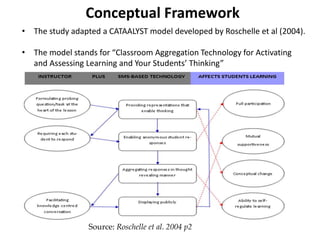
• The study adapted a CATAALYST model developed by Roschelle et al (2004). 
• The model stands for “Classroom Aggregation Technology for Activating 
and Assessing Learning and Your Students’ Thinking” 
Source: Roschelle et al. 2004 p2
Interaction loops 
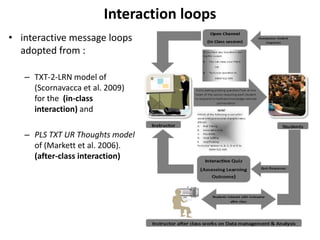
• interactive message loops 
adopted from : 
– TXT-2-LRN model of 
(Scornavacca et al. 2009) 
for the (in-class 
interaction) and 
– PLS TXT UR Thoughts model 
of (Markett et al. 2006). 
(after-class interaction)
Methodology 
• Case study design 
– Focused on large entrepreneurship , communication 
and mathematics classes at a Technical College 
• Experimental design 
– An SMS-based classroom response system 
prototype was designed and experimented for a 
period of one term (3 months). 
• Towards the end of the term, questionnaires were 
administered to students, interviews with 
instructors were conducted to assess the impact of 
the experiment on the learning outcomes
Prototype Design 
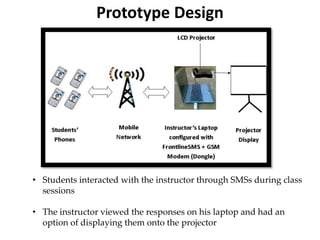
• Students interacted with the instructor through SMSs during class 
sessions 
• The instructor viewed the responses on his laptop and had an 
option of displaying them onto the projector
Data Collection and Analysis 
Study Population 
– Involved 114 students from 7 level 1 courses and 3 instructors 
Sampling 
– Used purposive sampling. 
– At a technical college, it is a must that all trades do 
entrepreneurship, communication, and mathematics 
– this justified use of purposive sampling. 
Data collection 
– Observations 
– Questionnaires 
– Structured interviews with the instructors 
Data analysis 
– Qualitative data 
• Used Content analysis (Adams et al 2007)
Results 
1. Observational results 
• Observation without system 
– In-class Interaction was instructor-centered, using lecture method 
– In-class Participation rate was 4.4% 
– After-class interaction was through homework 
– No participation in the after-class interaction 
• Observation with System in use 
– In-class interaction was student-centered –i.e. through sending 
SMSs 
– Students’ comments or questions enabled instructors to adjust 
their styles of presentation 
– In-class Participation rate rose to 33% from 4.4% 
– 10.5% participation rate in the after-class interaction 
– System used to administer examinations-i.e. multiple choice, 
short-answer items 
– System was able to aid group discussions
2. Uses of the System perceived to have greatest 
value on active learning 
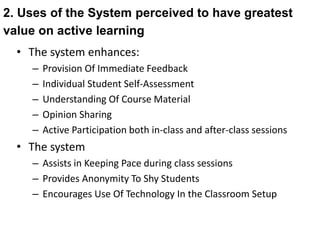
• The system enhances: 
– Provision Of Immediate Feedback 
– Individual Student Self-Assessment 
– Understanding Of Course Material 
– Opinion Sharing 
– Active Participation both in-class and after-class sessions 
• The system 
– Assists in Keeping Pace during class sessions 
– Provides Anonymity To Shy Students 
– Encourages Use Of Technology In the Classroom Setup
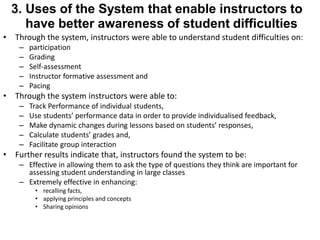
3. Uses of the System that enable instructors to 
have better awareness of student difficulties 
• Through the system, instructors were able to understand student difficulties on: 
– participation 
– Grading 
– Self-assessment 
– Instructor formative assessment and 
– Pacing 
• Through the system instructors were able to: 
– Track Performance of individual students, 
– Use students’ performance data in order to provide individualised feedback, 
– Make dynamic changes during lessons based on students’ responses, 
– Calculate students’ grades and, 
– Facilitate group interaction 
• Further results indicate that, instructors found the system to be: 
– Effective in allowing them to ask the type of questions they think are important for 
assessing student understanding in large classes 
– Extremely effective in enhancing: 
• recalling facts, 
• applying principles and concepts 
• Sharing opinions
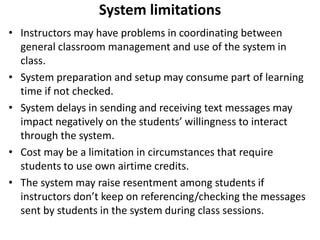
System limitations 
• Instructors may have problems in coordinating between 
general classroom management and use of the system in 
class. 
• System preparation and setup may consume part of learning 
time if not checked. 
• System delays in sending and receiving text messages may 
impact negatively on the students’ willingness to interact 
through the system. 
• Cost may be a limitation in circumstances that require 
students to use own airtime credits. 
• The system may raise resentment among students if 
instructors don’t keep on referencing/checking the messages 
sent by students in the system during class sessions.
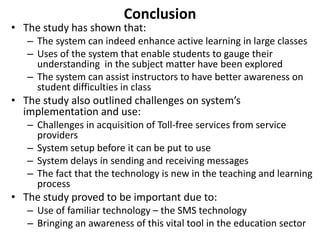
Conclusion 
• The study has shown that: 
– The system can indeed enhance active learning in large classes 
– Uses of the system that enable students to gauge their 
understanding in the subject matter have been explored 
– The system can assist instructors to have better awareness on 
student difficulties in class 
• The study also outlined challenges on system’s 
implementation and use: 
– Challenges in acquisition of Toll-free services from service 
providers 
– System setup before it can be put to use 
– System delays in sending and receiving messages 
– The fact that the technology is new in the teaching and learning 
process 
• The study proved to be important due to: 
– Use of familiar technology – the SMS technology 
– Bringing an awareness of this vital tool in the education sector
Recommendations 
• Recommendations on system implementation 
– Need for Toll-free services to complement the use of the system 
– Need for instructors to adjust their time properly for early system setup 
before lessons start 
– Need for end-user training to the instructors on the system’s use for system 
benefits realization 
• Recommendations on system improvement, adoption and 
applicability 
– Need for technological support on the part of institutions through 
acquisition of necessary gadgets in support of the system. 
– The system is applicable in all large classes and in all institutions that might 
face the problem of large class scenario. 
– Instructors need to make it a routine to keep referencing to the system, 
constantly checking on communication coming forward from students. 
– Where possible several modems from different services providers need to 
be used to alleviate the problem of system delays in sending and receiving 
messages
End of Presentation 
Thank you! 
God bless you all!

Using SMS-Based Classroom Response System To Enhance Student’s Active Learning

  • 1.
    Using SMS-Based ClassroomResponse System To Enhance Student’s Active Learning SANORD 2014 SYMPOSIUM 10th – 12th June 2014 Austin Mpando Vanwyk Chikasanda Gift Khangamwa {University of Malawi}
  • 2.
    Overview of thePresentation • Background information on Active learning • The problem and its research objectives • The conceptual framework that was adopted for the study • The methodology used during the study • Study results • Conclusion • Recommendations
  • 3.
    Background • Activelearning has received considerable attention over the past years because it is considered as a radical change to the tradition modes of instruction • Deal (2004 p223) defines active learning as – “any instructional method that engages students in the learning process • Active learning requires: – Students to do meaningful learning activities – Students to think about what they are doing • Active learning is supported by 2 popular models of learning: – Constructivist – Collaborative (Lin & Hsieh 2001) • Proponents of Constructivist models believe that learning takes place: – When students exercise, verify, solidify, and improve their mental models through discussions and information sharing
  • 4.
    • This resultsinto other pedagogical assumptions of cooperative learning such as: – Knowledge is created as it is shared – Learners have prior knowledge they can contribute to a discussion – Participation is critical to learning – Learners learn if given optimal conditions (Lin & Hsieh 2001) • Collaborative learning model results in benefits such as: – Increase student involvement in the subject matter – Enhance critical thinking – Promote problem-solving skills among students and – Encourage student learning and achievement (Lin & Hsieh 2001)
  • 5.
    Problem statement •Creation of large lecture classes makes students unable to benefit from active learning due to: – lack of full participation amongst students on a subject matter. – Lack of academic collaboration between students and the instructor during class sessions – Lack of social interaction after class sessions • Also in a large class the instructor has problems of classroom management which leads to: – Decline in terms of student attendance, – Decline in student discipline, – Decline in learning experiences and – The general alienation of students (Clarke et al 2001)
  • 6.
    Research Objectives •The main objective: – to investigate the impact of an SMS-based Classroom Response System on active learning in large classes • Specific objectives: – To examine the means in which active learning can be achieved using the SMS-based CRS system – To consider which uses of the system can enable Students gauge their own understanding in the subject matter – To examine if the SMS-based CRS can aid Instructors to have better awareness of student difficulties.
  • 7.
    Conceptual Framework •The study adapted a CATAALYST model developed by Roschelle et al (2004). • The model stands for “Classroom Aggregation Technology for Activating and Assessing Learning and Your Students’ Thinking” Source: Roschelle et al. 2004 p2
  • 8.
    Interaction loops •interactive message loops adopted from : – TXT-2-LRN model of (Scornavacca et al. 2009) for the (in-class interaction) and – PLS TXT UR Thoughts model of (Markett et al. 2006). (after-class interaction)
  • 9.
    Methodology • Casestudy design – Focused on large entrepreneurship , communication and mathematics classes at a Technical College • Experimental design – An SMS-based classroom response system prototype was designed and experimented for a period of one term (3 months). • Towards the end of the term, questionnaires were administered to students, interviews with instructors were conducted to assess the impact of the experiment on the learning outcomes
  • 10.
    Prototype Design •Students interacted with the instructor through SMSs during class sessions • The instructor viewed the responses on his laptop and had an option of displaying them onto the projector
  • 11.
    Data Collection andAnalysis Study Population – Involved 114 students from 7 level 1 courses and 3 instructors Sampling – Used purposive sampling. – At a technical college, it is a must that all trades do entrepreneurship, communication, and mathematics – this justified use of purposive sampling. Data collection – Observations – Questionnaires – Structured interviews with the instructors Data analysis – Qualitative data • Used Content analysis (Adams et al 2007)
  • 12.
    Results 1. Observationalresults • Observation without system – In-class Interaction was instructor-centered, using lecture method – In-class Participation rate was 4.4% – After-class interaction was through homework – No participation in the after-class interaction • Observation with System in use – In-class interaction was student-centered –i.e. through sending SMSs – Students’ comments or questions enabled instructors to adjust their styles of presentation – In-class Participation rate rose to 33% from 4.4% – 10.5% participation rate in the after-class interaction – System used to administer examinations-i.e. multiple choice, short-answer items – System was able to aid group discussions
  • 13.
    2. Uses ofthe System perceived to have greatest value on active learning • The system enhances: – Provision Of Immediate Feedback – Individual Student Self-Assessment – Understanding Of Course Material – Opinion Sharing – Active Participation both in-class and after-class sessions • The system – Assists in Keeping Pace during class sessions – Provides Anonymity To Shy Students – Encourages Use Of Technology In the Classroom Setup
  • 14.
    3. Uses ofthe System that enable instructors to have better awareness of student difficulties • Through the system, instructors were able to understand student difficulties on: – participation – Grading – Self-assessment – Instructor formative assessment and – Pacing • Through the system instructors were able to: – Track Performance of individual students, – Use students’ performance data in order to provide individualised feedback, – Make dynamic changes during lessons based on students’ responses, – Calculate students’ grades and, – Facilitate group interaction • Further results indicate that, instructors found the system to be: – Effective in allowing them to ask the type of questions they think are important for assessing student understanding in large classes – Extremely effective in enhancing: • recalling facts, • applying principles and concepts • Sharing opinions
  • 15.
    System limitations •Instructors may have problems in coordinating between general classroom management and use of the system in class. • System preparation and setup may consume part of learning time if not checked. • System delays in sending and receiving text messages may impact negatively on the students’ willingness to interact through the system. • Cost may be a limitation in circumstances that require students to use own airtime credits. • The system may raise resentment among students if instructors don’t keep on referencing/checking the messages sent by students in the system during class sessions.
  • 16.
    Conclusion • Thestudy has shown that: – The system can indeed enhance active learning in large classes – Uses of the system that enable students to gauge their understanding in the subject matter have been explored – The system can assist instructors to have better awareness on student difficulties in class • The study also outlined challenges on system’s implementation and use: – Challenges in acquisition of Toll-free services from service providers – System setup before it can be put to use – System delays in sending and receiving messages – The fact that the technology is new in the teaching and learning process • The study proved to be important due to: – Use of familiar technology – the SMS technology – Bringing an awareness of this vital tool in the education sector
  • 17.
    Recommendations • Recommendationson system implementation – Need for Toll-free services to complement the use of the system – Need for instructors to adjust their time properly for early system setup before lessons start – Need for end-user training to the instructors on the system’s use for system benefits realization • Recommendations on system improvement, adoption and applicability – Need for technological support on the part of institutions through acquisition of necessary gadgets in support of the system. – The system is applicable in all large classes and in all institutions that might face the problem of large class scenario. – Instructors need to make it a routine to keep referencing to the system, constantly checking on communication coming forward from students. – Where possible several modems from different services providers need to be used to alleviate the problem of system delays in sending and receiving messages
  • 18.
    End of Presentation Thank you! God bless you all!