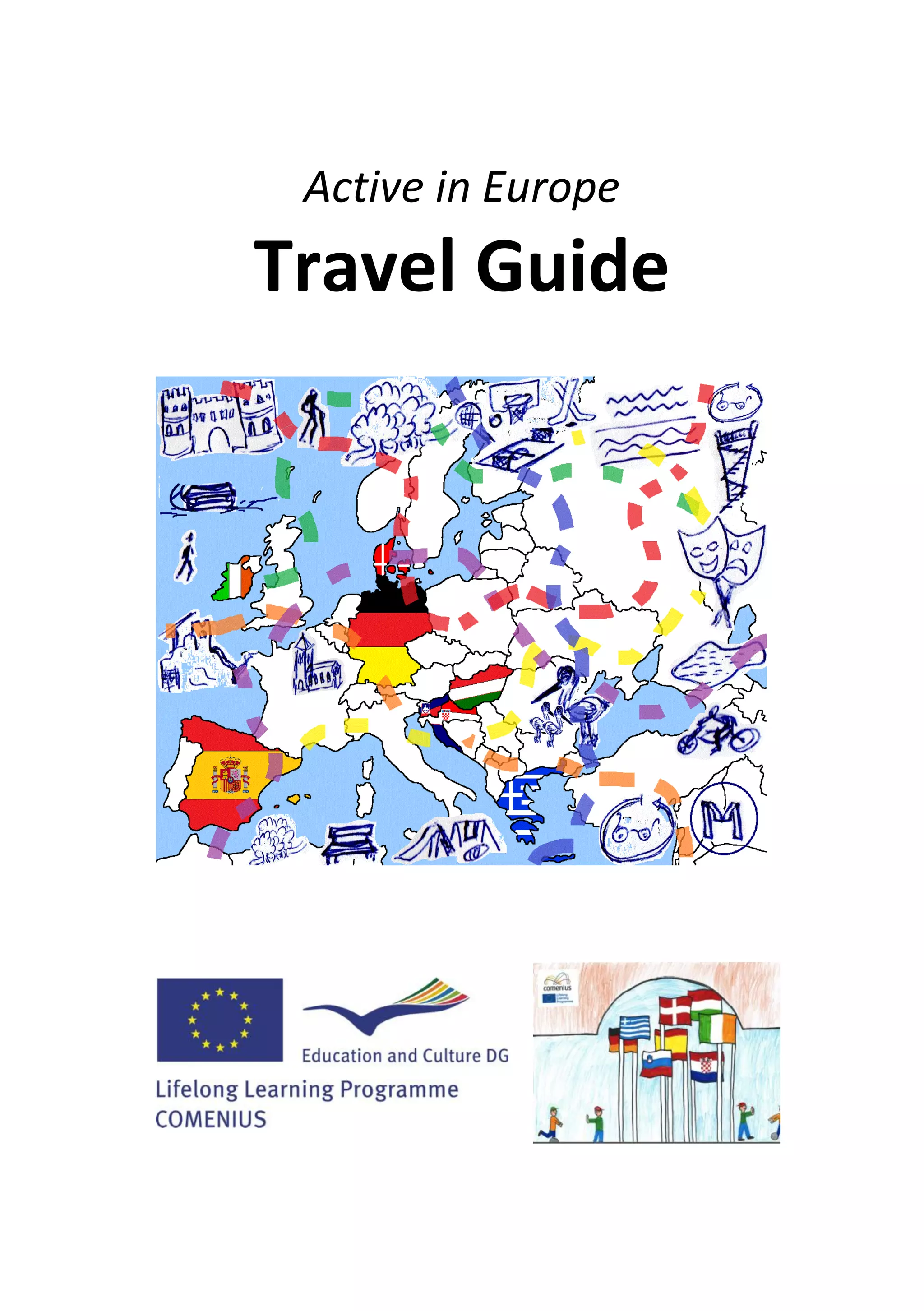
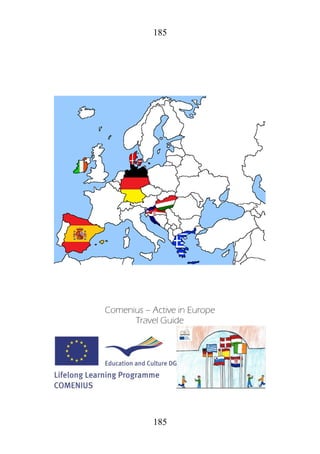
Active in Europe
Travel Guide
2
2
Introduction
Dear All,
Thank you very much and welcome to our Active Travel
Guide.
In this travel guide each of the countries and their
participating pre-primary and primary schools prepared
a small inside guide how to spend an active vacation if
you ever find yourself visiting.
Apart from some general information about the country
this travel guide will give you an inside look on the
following areas in each country: Málaga – Spain, Paks –
Hungary, Zagreb – Croatia, Düsseldorf – Germany,
Donegal – Ireland, Ljubljana – Slovenia, Hersonisos –
Greece and Kolding – Denmark.
In hope you will have as much fun actively exploring our
countries and regions as we did preparing this guide for
you,
Editor.
3
3
Content
Introduction ……………………………………………………... 2
Spain …………………………...…………………… 4
Hungary ………..…………………………………… 10
Croatia ………………………….…………………… 27
Germany ………………………………………..…. 63
Ireland ………………………………………………. 80
Slovenia ……………………….……………………. 101
Greece ………………….…….……….……………. 131
Denmark ……………….…………….……………. 175
4
4
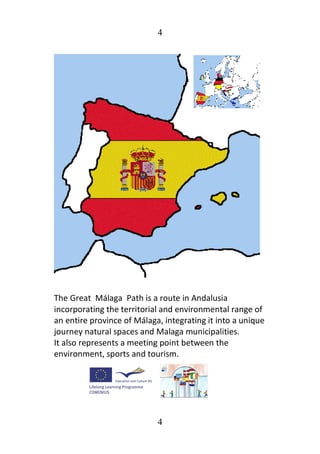
The Great Málaga Path is a route in Andalusia
incorporating the territorial and environmental range of
an entire province of Málaga, integrating it into a unique
journey natural spaces and Malaga municipalities.
It also represents a meeting point between the
environment, sports and tourism.
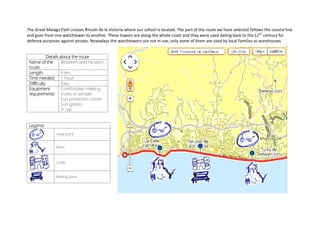
The Great Malaga Path crosses Rincón de la Victoria where our school is located. The part of the route we have selected follows the coastal line
and goes from one watchtower to another. These towers are along the whole coast and they were used dating back to the 12th
century for
defence purposes against pirates. Nowadays the watchtowers are not in use; only some of them are used by local families as warehouses
Details about the route
Name of the
route:
Between watchtowers
Length: 4 km
Time needed: 1 hour
Difficulty Easy
Equipment
requirements:
Comfortable trekking
shoes or sandals
Sun protection cream
Sun glasses
A cap
Legend
View point
Ruins
Castle
Resting place
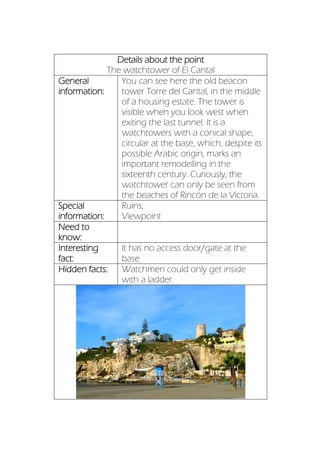
Details about the point
The watchtower of El Cantal
General
information:
You can see here the old beacon
tower Torre del Cantal, in the middle
of a housing estate. The tower is
visible when you look west when
exiting the last tunnel. It is a
watchtowers with a conical shape,
circular at the base, which, despite its
possible Arabic origin, marks an
important remodelling in the
sixteenth century. Curiously, the
watchtower can only be seen from
the beaches of Rincón de la Victoria.
Special
information:
Ruins,
Viewpoint
Need to
know:
Interesting
fact:
It has no access door/gate at the
base
Hidden facts: Watchmen could only get inside
with a ladder.
7
7
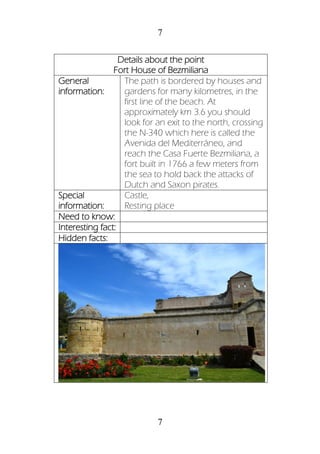
Details about the point
Fort House of Bezmiliana
General
information:
The path is bordered by houses and
gardens for many kilometres, in the
first line of the beach. At
approximately km 3.6 you should
look for an exit to the north, crossing
the N-340 which here is called the
Avenida del Mediterráneo, and
reach the Casa Fuerte Bezmiliana, a
fort built in 1766 a few meters from
the sea to hold back the attacks of
Dutch and Saxon pirates.
Special
information:
Castle,
Resting place
Need to know:
Interesting fact:
Hidden facts:
8
8
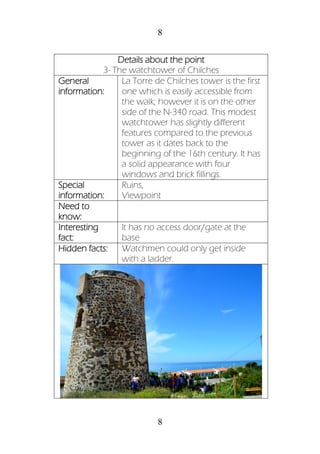
Details about the point
3- The watchtower of Chilches
General
information:
La Torre de Chilches tower is the first
one which is easily accessible from
the walk; however it is on the other
side of the N-340 road. This modest
watchtower has slightly different
features compared to the previous
tower as it dates back to the
beginning of the 16th century. It has
a solid appearance with four
windows and brick fillings.
Special
information:
Ruins,
Viewpoint
Need to
know:
Interesting
fact:
It has no access door/gate at the
base
Hidden facts: Watchmen could only get inside
with a ladder.
9
9
Phrase Book – phrases and words you might find useful
while visiting
English Native language and script
Please Por favor
Thank you Gracias
Left Izquierda
Right Derecha
Straight Recto
Back Detrás
Walk Caminar
What is the time? ¿Qué hora es?
How do you get to… ¿Cómo se va a …?
How do you get there? ¿Cómo se llega allí?
Where is the toilet? ¿Dónde están los servicios?
How long is the… ¿Cuánto se tarda en llegar
a …?
How much is it? ¿Cuánto cuesta?
Are there any special
children rates?
¿Hay tarifas especiales para
niños?
Are there any special
family rates?
¿Hay tarifas especiales para
familias?
10
10
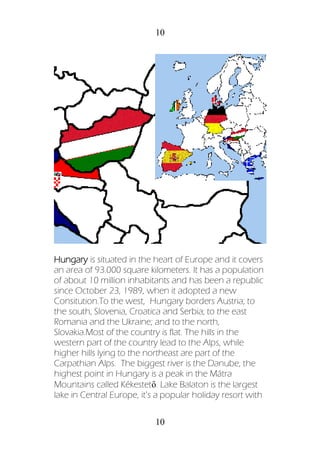
Hungary is situated in the heart of Europe and it covers
an area of 93.000 square kilometers. It has a population
of about 10 million inhabitants and has been a republic
since October 23, 1989, when it adopted a new
Consitution.To the west, Hungary borders Austria; to
the south, Slovenia, Croatica and Serbia; to the east
Romania and the Ukraine; and to the north,
Slovakia.Most of the country is flat. The hills in the
western part of the country lead to the Alps, while
higher hills lying to the northeast are part of the
Carpathian Alps. The biggest river is the Danube, the
highest point in Hungary is a peak in the Mátra
Mountains called Kékestető. Lake Balaton is the largest
lake in Central Europe, it’s a popular holiday resort with
11
11
Hungarians and other Europeans alike. The climate of
Hungary is temperate, with distinct seasons.
The capital of Hungary is Budapest with about 2 million
inhabitants: it is the political, economic, commercial and
cultural centre of the country. It is also one of the most
important railway junctions in Europe. It lies on the two
banks of the River Danube. Buda and Pest .
12
12
Paks is a town in Tolna county, central Hungary, on the
banks of the Danube River. Paks is the home of the only
Hungarian nuclear power plant, which provides about
40% the country's electricity.
In the last century several mansions were built in the
centre of the old town, such as those in Szent István tér,
the main square of the town. The Roman Catholic
three-isled, basilica style Heart of Jesus church was
consecrated in 1901. There is a tablet in the wall of the
baroque Szeniczey mansion to commemorate Ferenc
Deák, 'the Sage of the Country'. The Town Museum is
housed in the former Cseh-Vigyázó mansion. The
Calvinist and the Lutheran churches were built in 1775
and 1884 respectively.
The Catholic Holy Spirit church, built according to the
design of Imre Makovecz, is an outstanding work of
20th-century architecture. There is a hundred-year-old
chestnut alley lining the walkway on the Danube River
bank. The town hosts the Spring Festival at Whitsuntide
and the International Festival of Blues, Jazz, Rock and
Gastronomy.Paksi SE (Paks or PSE) is a Hungarian
football club based in Paks. Atomerőmű SE is a
Hungarian basketball club based in Paks.
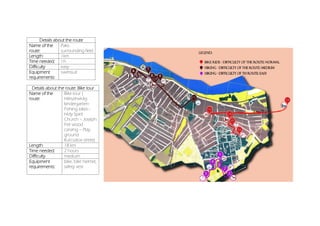
Details about the route
Name of the
route:
Paks-
surrounding field
Length: 1km
Time needed: 1h
Difficulty easy
Equipment
requirements:
swimsuit
Details about the route: Bike tour
Name of the
route:
Bike tour (
Hétszínvirág
kindergarten-
Fishing lakes–
Holy Spirit
Church – Joseph
Feil wood
carving – Play
ground
Kurcsatov street)
Length: 18 km
Time needed: 2 hours
Difficulty medium
Equipment
requirements:
bike, bike helmet,
safety vest
Details about the point
1.ASE Sports Hall
General
information:
Paks city's largest sports hall, designed
by Imre Makovec.
Special
information:
watch basketball games
Need to
know:
Other times it is closed to the public
Interesting
fact:
Paks basketball team was national
champion several times
Hidden facts:
Details about the point
2.“Ürge field” wood pub
General
information:
In the suburban pub, you can drink,
relax. In the garden you can bake
bacon with your friends.
Special
information:
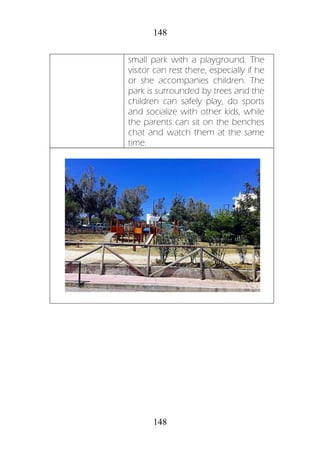
for children there is a playground
Need to
know:
Opening time.:
15h-21h
Interesting
fact:
They held a special golden pheasants
and peacocks too.
Hidden facts: tick danger
Details about the point
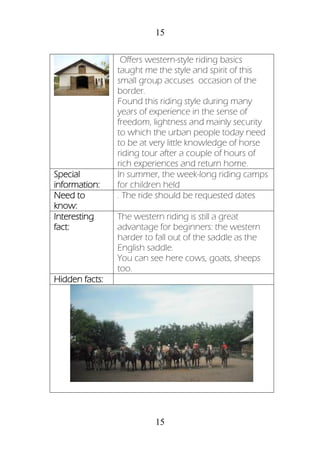
3. Palm Horse Farm
General
information:
Directly at the edge of the town of Paks
is the Palm Horse Farm, a place of rich,
scenic landscape area located in the
outskirts of.
15
15
Offers western-style riding basics
taught me the style and spirit of this
small group accuses occasion of the
border.
Found this riding style during many
years of experience in the sense of
freedom, lightness and mainly security
to which the urban people today need
to be at very little knowledge of horse
riding tour after a couple of hours of
rich experiences and return home.
Special
information:
In summer, the week-long riding camps
for children held
Need to
know:
. The ride should be requested dates
Interesting
fact:
The western riding is still a great
advantage for beginners: the western
harder to fall out of the saddle as the
English saddle.
You can see here cows, goats, sheeps
too.
Hidden facts:
16
16
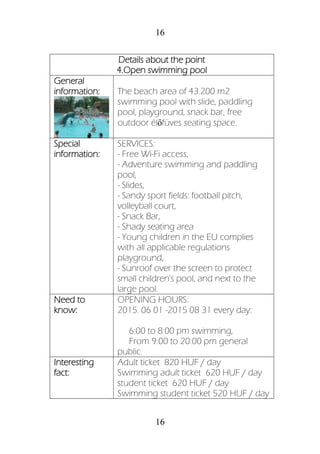
Details about the point
4.Open swimming pool
General
information: The beach area of 43.200 m2
swimming pool with slide, paddling
pool, playground, snack bar, free
outdoor élőfüves seating space.
Special
information:
SERVICES:
- Free Wi-Fi access,
- Adventure swimming and paddling
pool,
- Slides,
- Sandy sport fields: football pitch,
volleyball court,
- Snack Bar,
- Shady seating area
- Young children in the EU complies
with all applicable regulations
playground,
- Sunroof over the screen to protect
small children's pool, and next to the
large pool.
Need to
know:
OPENING HOURS:
2015. 06 01 -2015 08 31 every day:
6:00 to 8:00 pm swimming,
From 9:00 to 20:00 pm general
public.
Interesting
fact:
Adult ticket 820 HUF / day
Swimming adult ticket 620 HUF / day
student ticket 620 HUF / day
Swimming student ticket 520 HUF / day
17
17
Details about the point
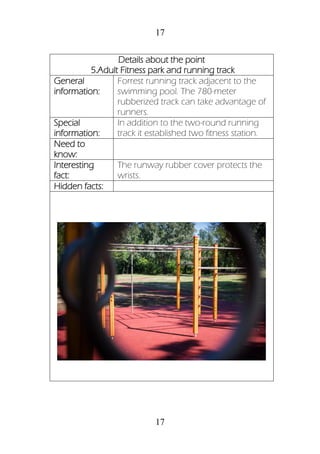
5.Adult Fitness park and running track
General
information:
Forrest running track adjacent to the
swimming pool. The 780-meter
rubberized track can take advantage of
runners.
Special
information:
In addition to the two-round running
track it established two fitness station.
Need to
know:
Interesting
fact:
The runway rubber cover protects the
wrists.
Hidden facts:
18
18
Details about the point
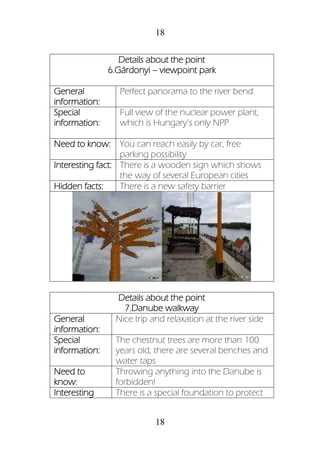
6.Gárdonyi – viewpoint park
General
information:
Perfect panorama to the river bend
Special
information:
Full view of the nuclear power plant,
which is Hungary’s only NPP
Need to know: You can reach easily by car, free
parking possibility
Interesting fact: There is a wooden sign which shows
the way of several European cities
Hidden facts: There is a new safety barrier
Details about the point
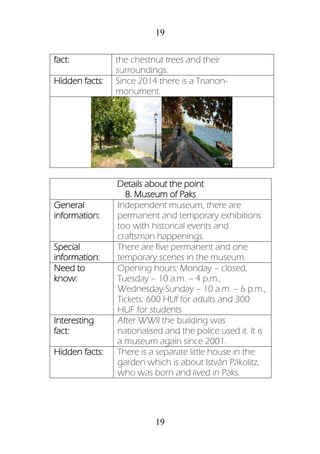
7.Danube walkway
General
information:
Nice trip and relaxation at the river side
Special
information:
The chestnut trees are more than 100
years old, there are several benches and
water taps
Need to
know:
Throwing anything into the Danube is
forbidden!
Interesting There is a special foundation to protect
19
19
fact: the chestnut trees and their
surroundings.
Hidden facts: Since 2014 there is a Trianon-
monument.
Details about the point
8. Museum of Paks
General
information:
Independent museum, there are
permanent and temporary exhibitions
too with historical events and
craftsman happenings.
Special
information:
There are five permanent and one
temporary scenes in the museum.
Need to
know:
Opening hours: Monday – closed,
Tuesday – 10 a.m. – 4 p.m.,
Wednesday-Sunday – 10 a.m. – 6 p.m.,
Tickets: 600 HUf for adults and 300
HUF for students
Interesting
fact:
After WWII the building was
nationalised and the police used it. It is
a museum again since 2001.
Hidden facts: There is a separate little house in the
garden which is about István Pákolitz,
who was born and lived in Paks.
20
20
Details about the point
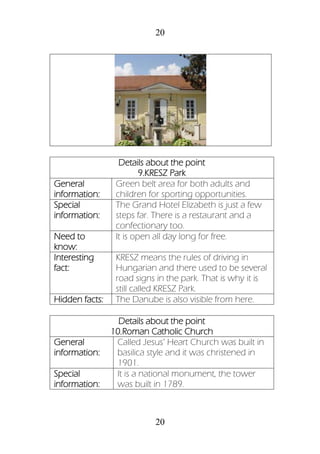
9.KRESZ Park
General
information:
Green belt area for both adults and
children for sporting opportunities.
Special
information:
The Grand Hotel Elizabeth is just a few
steps far. There is a restaurant and a
confectionary too.
Need to
know:
It is open all day long for free.
Interesting
fact:
KRESZ means the rules of driving in
Hungarian and there used to be several
road signs in the park. That is why it is
still called KRESZ Park.
Hidden facts: The Danube is also visible from here.
Details about the point
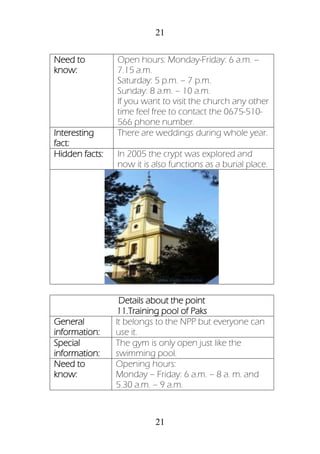
10.Roman Catholic Church
General
information:
Called Jesus’ Heart Church was built in
basilica style and it was christened in
1901.
Special
information:
It is a national monument, the tower
was built in 1789.
21
21
Need to
know:
Open hours: Monday-Friday: 6 a.m. –
7.15 a.m.
Saturday: 5 p.m. – 7 p.m.
Sunday: 8 a.m. – 10 a.m.
If you want to visit the church any other
time feel free to contact the 0675-510-
566 phone number.
Interesting
fact:
There are weddings during whole year.
Hidden facts: In 2005 the crypt was explored and
now it is also functions as a burial place.
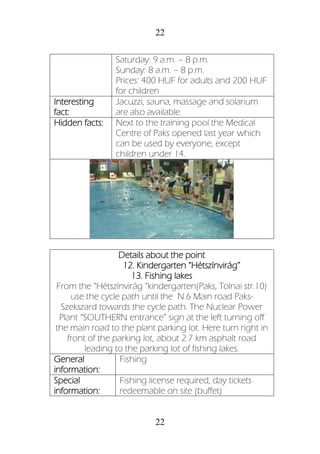
Details about the point
11.Training pool of Paks
General
information:
It belongs to the NPP but everyone can
use it.
Special
information:
The gym is only open just like the
swimming pool.
Need to
know:
Opening hours:
Monday – Friday: 6 a.m. – 8 a. m. and
5.30 a.m. – 9 a.m.
22
22
Saturday: 9 a.m. – 8 p.m.
Sunday: 8 a.m. – 8 p.m.
Prices: 400 HUF for adults and 200 HUF
for children
Interesting
fact:
Jacuzzi, sauna, massage and solarium
are also available.
Hidden facts: Next to the training pool the Medical
Centre of Paks opened last year which
can be used by everyone, except
children under 14.
Details about the point
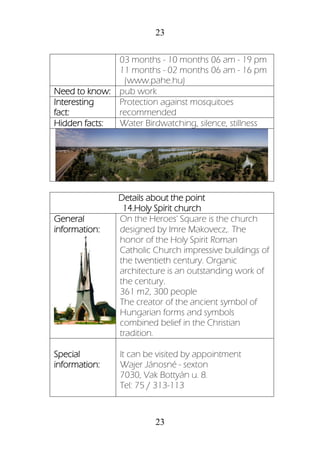
12. Kindergarten “Hétszínvirág”
13. Fishing lakes
From the “Hétszínvirág “kindergarten(Paks, Tolnai str.10)
use the cycle path until the N.6 Main road Paks-
Szekszard towards the cycle path. The Nuclear Power
Plant “SOUTHERN entrance” sign at the left turning off
the main road to the plant parking lot. Here turn right in
front of the parking lot, about 2.7 km asphalt road
leading to the parking lot of fishing lakes.
General
information:
Fishing
Special
information:
Fishing license required, day tickets
redeemable on site (buffet)
23
23
03 months - 10 months 06 am - 19 pm
11 months - 02 months 06 am - 16 pm
(www.pahe.hu)
Need to know: pub work
Interesting
fact:
Protection against mosquitoes
recommended
Hidden facts: Water Birdwatching, silence, stillness
Details about the point
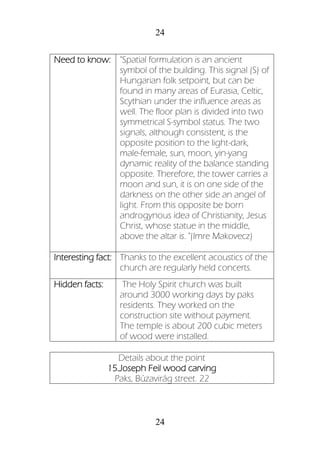
14.Holy Spirit church
General
information:
On the Heroes' Square is the church
designed by Imre Makovecz,. The
honor of the Holy Spirit Roman
Catholic Church impressive buildings of
the twentieth century. Organic
architecture is an outstanding work of
the century.
361 m2, 300 people
The creator of the ancient symbol of
Hungarian forms and symbols
combined belief in the Christian
tradition.
Special
information:
It can be visited by appointment
Wajer Jánosné - sexton
7030, Vak Bottyán u. 8.
Tel: 75 / 313-113
24
24
Need to know: "Spatial formulation is an ancient
symbol of the building. This signal (S) of
Hungarian folk setpoint, but can be
found in many areas of Eurasia, Celtic,
Scythian under the influence areas as
well. The floor plan is divided into two
symmetrical S-symbol status. The two
signals, although consistent, is the
opposite position to the light-dark,
male-female, sun, moon, yin-yang
dynamic reality of the balance standing
opposite. Therefore, the tower carries a
moon and sun, it is on one side of the
darkness on the other side an angel of
light. From this opposite be born
androgynous idea of Christianity, Jesus
Christ, whose statue in the middle,
above the altar is. "(Imre Makovecz)
Interesting fact: Thanks to the excellent acoustics of the
church are regularly held concerts.
Hidden facts: The Holy Spirit church was built
around 3000 working days by paks
residents. They worked on the
construction site without payment.
The temple is about 200 cubic meters
of wood were installed.
Details about the point
15.Joseph Feil wood carving
Paks, Búzavirág street. 22
25
25
General
information:
Hungarian peasantry everyday life,
customs and traditions, turned to
religion.
www.fafaragasok.hu
Special
information:
Until recently expanded scope of
activities of the so-called "Göbefa
furniture" production, which produce
from clean wood, pivoting technique
creates.
Need to
know:
Outstanding among the works of the
wooden cross, which was the occasion
of the Millennium beyond national
borders in memory of deceased
brothers were Hungarian Paks Calvary
cemetery; dunakömõdi Bottyán the
rampart, commemorating the
headboard, which is located on the
outskirts of spreading Dunakömlőd
Imsósi woods; and Dunakömlőd village
house standing in front of the statue of
Vak Bottyán.
Interesting
fact:
Knowledge of their own efforts, self-
taught acquired. In 2001, he received
dozens of juried sculpture possession of
folk art Woodcarving title.
Hidden facts: Exhibitions: Ministry of Environment
(Budapest, Hungary), Paks,
Dunakömlőd, Szekszárd, Györköny,
Dunaújváros, Oriszentpeter, Plauen
(Germany), Dubai
26
26
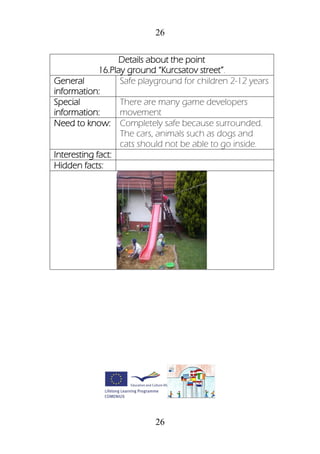
Details about the point
16.Play ground “Kurcsatov street”.
General
information:
Safe playground for children 2-12 years
Special
information:
There are many game developers
movement
Need to know: Completely safe because surrounded.
The cars, animals such as dogs and
cats should not be able to go inside.
Interesting fact:
Hidden facts:
27
27
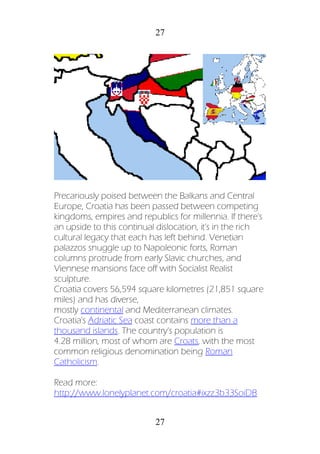
Precariously poised between the Balkans and Central
Europe, Croatia has been passed between competing
kingdoms, empires and republics for millennia. If there's
an upside to this continual dislocation, it's in the rich
cultural legacy that each has left behind. Venetian
palazzos snuggle up to Napoleonic forts, Roman
columns protrude from early Slavic churches, and
Viennese mansions face off with Socialist Realist
sculpture.
Croatia covers 56,594 square kilometres (21,851 square
miles) and has diverse,
mostly continental and Mediterranean climates.
Croatia's Adriatic Sea coast contains more than a
thousand islands. The country's population is
4.28 million, most of whom are Croats, with the most
common religious denomination being Roman
Catholicism.
Read more:
http://www.lonelyplanet.com/croatia#ixzz3b33SoiDB
28
28
http://en.wikipedia.org/wiki/Croatia
About the town/city and the area:
The city of Zagreb is the capital of Croatia. Zagreb is the
cultural, scientific, economic, political and administrative
centre of the Republic of Croatia, and is home to the
Croatian Parliament, Government and President.
Zagreb has a population of nearly one million, which is
almost a quarter of the entire population of Croatia. On
the North of Zagreb is mountain Medvednica, a
popular place for Sunday hikes. Zagreb is separated into
two areas - 'Old' and 'New', by river Sava. Over the
centuries, the city was inhabited by people coming
from all over Europe; and, in recent years, by people
coming from different parts of Croatia, ensuring a rich
cultural life. The façades of Zagreb’s buildings reflect the
ebb and flow of history, while its streets and squares
bear witness to the coming together of the many
cultures that have shaped the identity of this laid-back
capital.
Read more:
http://www.zagreb-touristinfo.hr/about-zagreb/basic-
facts
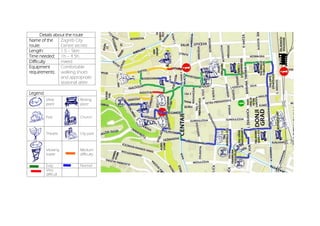
Details about the route
Name of the
route:
Zagreb City
Centre secrets
Length: 1.5 – 5km
Time needed: 1h – 4.5h
Difficulty mixed
Equipment
requirements:
Comfortable
walking shoes
and appropriate
seasonal attire
Legend
View
point
Resting
place
Park Church
Theatre City park
Viewing
tower
Medium
difficulty
Easy Normal
Very
difficult
Details about the point
Botanical Garden
[Botanički vrt]
General
information:
The Garden is open to public from 1
April to 1 November, on all holidays
except Assumption day (August 15) and
Easter!
It is closed during the winter.
Special
information:
monday-Tuesday 9.oo-14.3o
wednesday-Sunday 9.oo-19.oo (18.oo*)
* In early Spring and late Fall
The Exhibition pavillion
monday-Tuesday closed
wednesday-Sunday 12.oo-18.3o
Need to
know:
There is no entrance fee !
Interesting
fact:
In year 2014 the Botanical garden
celebrated it’s 125th
anniversary
Hidden
facts:
http://hirc.botanic.hr/vrt/english/start.ht
m
31
31
Details about the point
King Tomislav Square
[Trg kralja Tomislava]
General
information:
Situated right across the main train
station
Special
information:
The square is dominated with a large
green area and a small fountain that are
nice for relaxing
Need to
know:
King Tomislav was Croatian’s first king
Interesting
fact:
On the opposite side of the Main Train
Station is the Art Pavilion
Hidden
facts:
All around the square in the streets the
buildings have interesting façades and
stucco elements
32
32
Details about the point
J. J. Strossmayer Park
[Park J. J. Strossmayera]
General
information:
Situated half way between the
main square and Tomislav Square
Special
information:
The square has a lot of benches
casually placed so everyone can
find a place of piece of quiet to
enjoy them selves. There is also a
nice surface for children to play.
Need to know: Josip Juraj Strossmayer was a
Croatian politician, Roman
Catholic bishop and benefactor
Interesting fact: There are buildings around the
park: Croatian Academy of
Science, Modern Gallery and to
the left and right beautiful palaces
built for the richest citizens at the
end of the 19th century.
Hidden facts: Everyone who wanted to be
"someone" in 19th century just
had to have a house here in this
very part of Zagreb.
33
33
Details about the point
Park Zrinjevac
[Park Zrinjevac]
General
information: Several institution are based in buildings
around Zrinjevac:
 North side - The Supreme Court
of the Republic of Croatia,
 West side - The Zagreb
Archaeological Museum,
 South side - The Croatian
Academy of Sciences and Arts,
East side - The Ministry of Foreign Affairs
and European Integration and the
Zagreb County Court
34
34
Special
information:
Popularly called Park Zrinjevac the full
full name of the park is Nikola Šubić
Zrinski Square.
Need to
know:
In the middle of the park is a music
pavilion built in 1891
Interesting
fact:
It is a part of the so-called Green
horseshoe or Lenuci's horseshoe
Hidden
facts:
The southern part of Zrinjevac sports
busts of significant Croatian people:
Julije Klović, Andrija Medulić, Fran Krsto
Frankopan, Nikola Jurišić, Ivan Kukuljević
Sakcinski and Ivan Mažuranić
Details about the point M5
Archaeological Museum
[Arheološki muzej]
General
information:
http://www.amz.hr/home.aspx
Tuesday, Wednesday, Friday and
35
35
Saturday from 10am till 6pm
Thursday from 10am till 8pm
Sunday from 10am till 1pm
The Museum is closed on Monday and
on holidays.
Special
information:
COMPLIMENTARY MUSEUM TOURS -
SATURDAYS AT 3 pm
FREE ENTRANCE IN MUSEUM EVERY
1st SUNDAY IN THE MONTH
Need to
know:
Tickets:
• adults 20 kn
• children, pupils, students, pensioners
10 kn
• family 30 kn
• pensioners - free entrance on
Tuesdays
Professional guidance
• 50 kn in Croatian
• 100 kn in English
Interesting
fact:
OPENING HOURS OF THE
ARCHAEOLOGICAL PARK
ANDAUTONIA IN ŠČITARJEVO
MAY 1ST - OCTOBER 31st
SATURDAY-SUNDAY 12-6 PM
MONDAY TO FRIDAY: PRIOR
ARRANGEMENT REQUIRED FOR
GROUP VISITS
Tickets
- adults: 20,00 kunas
- children, students, pensioners: 15,00
36
36
kunas
- family ticket: 30,00 kn
- professional guidance: 50,00 kn
- workshops (per person): 15,00 kn
Regular bus lines to the site are
operated from Zapruđe and Velika
Gorica.
www.andautonia.com
Hidden facts: The Archaeological Museum in Zagreb
is one of the direct successors to the
former National Museum, the oldest
museum institution in the Croatian
capital, founded in 1836.
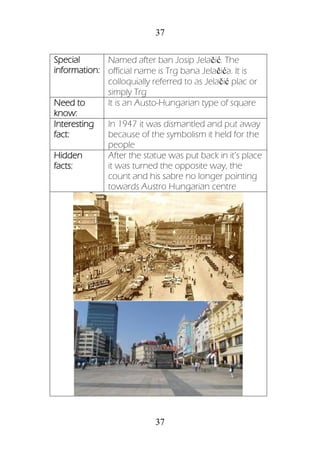
Details about the point
Ban Josip Jelacic Square
[Trg Bana Josipa Jelačića]
General
information:
Ban Jelačić Square is the central square
of the city of Zagreb, Croatia,
37
37
Special
information:
Named after ban Josip Jelačić. The
official name is Trg bana Jelačića. It is
colloquially referred to as Jelačić plac or
simply Trg
Need to
know:
It is an Austo-Hungarian type of square
Interesting
fact:
In 1947 it was dismantled and put away
because of the symbolism it held for the
people
Hidden
facts:
After the statue was put back in it’s place
it was turned the opposite way, the
count and his sabre no longer pointing
towards Austro Hungarian centre
38
38
Details about the point
Zagreb Cathedral
[Zagrebačka katedrala]
General
information:
Zagreb Cathedral is situated on Kaptol
and is the most monumental sacral
building in Gothic style southeast of the
Alps.
Special
information:
It is opened in 1906 and the height
reaches 105m
Need to
know:
It was designed by Hermann Bollé who
made the biggest influence on the
architecture of the city of Zagreb
Interesting
fact:
The restoration of the Cathedral began
in 1937 but is still not finished
Hidden
facts:
The Cathedral has a treasury that is
open for visitation with a previous
announcement to a number: 01/4920
308, 01/4894 846, 01/4814 727.
Ticket price: Adults 20 kn, Children 10 kn.
39
39
Details about the point
Comedy theatre
[Kazalište Komedija]
General
information:
http://www.komedija.hr/web/
situated on Kaptol a short walk from
Zagreb Cathedral
Special
information:
Founded on November 1st
1950.
Need to
know:
Ticket prices:
Drama productions: 40,00, 50,00 i 60,00
kn
Music Plays: 60,00, 100,00 i 120,00 kn
Children under 15 years of age
accompanied by their parents: 50% off
(under the condition that one ticket is
bought at full price).
Interesting
fact:
Its main activities are music plays and
drama productions
Hidden
facts:
The building is a part of the Franciscan
monastery
40
40
Details about the point
Dolac Market
[tržnica Dolac]
General
information:
The daily market, on a raised square a
set of stairs up from the main square
Special
information:
Opening hours: 7am-3pm Mon-Fri; 7am-
2pm Sat; 7am-1pm Sun
Need to
know:
In the covered market downstairs are
butchers, fishmongers and old ladies
selling the local speciality sir i vrhnje
(cheese and cream)
the renovated fish market, ribarnica, sells
fresh produce every day but Monday.
Interesting
fact:
the city’s major trading place since 1926
Hidden
facts:
Jackie Chan destroyed the entire Dolac
market in his famous Armour of God car
chase scene
41
41
Details about the point M1
Zagreb City Museum
[Muzej Grada Zagreba]
General
information:
http://www.mgz.hr/en/
The museum is open:
Tuesday, Wednesday, Thursday, Friday
10 a.m. - 6 p.m.
Saturday 11 a.m. - 7 p.m.
Sunday 10 a.m. - 2 p.m.
Last admission 30 minutes before
closing.
Special
information:
Entrance fee:
Adults KN 30.00
Groups (10 or more persons): KN 20.00
per person
Pupils, students, retired and disabled
persons KN 20.00
Groups of pupils, students and retired
persons (10 or more persons) KN 15.00
per person
Families (with children under 15) KN
50.00
Entrance fee for temporary exhibitions
KN 10,00
Audio guide KN 20.00
Free entrance:
Members of Croatian Museum
Association
Members of Croatian Society of Art
Historians
42
42
Members of ICOM
Children under 7
Need to
know:
The exhibition shows the past of the City
of Zagreb, from prehistory, traces of
which were recently uncovered under
the very building of the museum itself, to
the present day.
Interesting
fact:
The Zagreb City Museum was founded
by the Brethren of the Croatian Dragon
Society in 1907.
Hidden
facts:
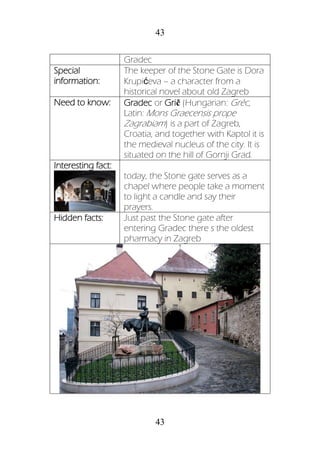
Details about the point
Stone Gate
[Kamenita vrata]
General
information:
the only remaining gate out of four
that once connected Lower town to
a part of Upper town known as
43
43
Gradec
Special
information:
The keeper of the Stone Gate is Dora
Krupićeva – a character from a
historical novel about old Zagreb
Need to know: Gradec or Grič (Hungarian: Gréc,
Latin: Mons Graecensis prope
Zagrabiam) is a part of Zagreb,
Croatia, and together with Kaptol it is
the medieval nucleus of the city. It is
situated on the hill of Gornji Grad.
Interesting fact:
today, the Stone gate serves as a
chapel where people take a moment
to light a candle and say their
prayers.
Hidden facts: Just past the Stone gate after
entering Gradec there s the oldest
pharmacy in Zagreb
44
44
Details about the point
St. Marko’s Church
[Crkva Sv. Marka]
General
information:
Its colourful tiled roof, constructed in
1880, has the medieval coat of arms of
Croatia, Dalmatia and Slavonia on the
left side, and the emblem of Zagreb on
the right
The Gothic portal, composed of 15
figures in shallow niches, was sculpted
in the 14th century
Special
information:
Opening hours: for the mass
Need to
know:
The Church of St. Mark is the parish
church of old Zagreb
Interesting
fact:
From late April to October there's a
guard-changing ceremony outside the
church every Saturday and Sunday at
noon
Hidden
facts:
The square outside, housing the Ban’s
Palace and the Croatian Parliament, has
been the hub of political activity since
the 1500s.
45
45
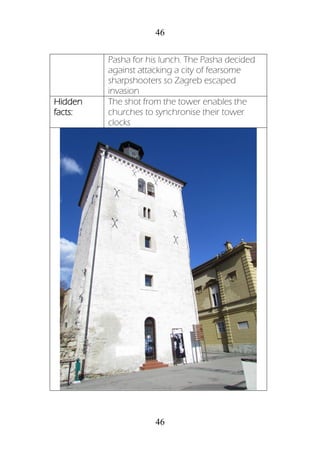
Details about the point
Lotrscak Tower
[Kula Lotrščak]
General
information:
A viewing tower that offer a 360° view
over Zagreb
Special
information:
Part of Zagreb City Museum
Need to
know:
The tower was built in the middle of the
13th century in order to protect the
southern city gate
Interesting
fact:
According to one legend, a cannon
shot from the Lotrščak tower soared
over the river Sava and landed in the
Turks’ encampment, right on a platter of
chicken that was being carried to the
46
46
Pasha for his lunch. The Pasha decided
against attacking a city of fearsome
sharpshooters so Zagreb escaped
invasion
Hidden
facts:
The shot from the tower enables the
churches to synchronise their tower
clocks
47
47
Details about the point
Strossmayer Promenade
[Strossmayerovo šetalište]
General
information:
Running along the remains of
Zagreb’s medieval defense walls
and marking the southern border
of the Upper Town (Gornji Grad)
Special
information:
the most atmospheric time to visit
the Strossmayer Promenade is
during the summer months, when
the Strossmarte street festival takes
over the area and the street is
teeming with artists, musicians and
food stalls
Need to know: It can be accessed by a great
number of paths including the
66m long funicular
Interesting fact: It offers an excellent panoramic
view of the Lower Town
The alley was named after the
Croatian bishop, politician and
writer Josip Juraj Strossmayer, one
of the most important and
influential Croatian personalities of
19th century
Hidden facts: that the building which was the
City Real Lycée in the mid 19th
century and then later the
Women’s Lycée, had previously
housed a Viennese-style café that
was patronised by many famous
48
48
citizens of Zagreb, including the
poet and writer, Antun Gustav
Matoš.
What was once a café, today is the
State Meteorological and
Hydrological Service and
Geophysics Institute
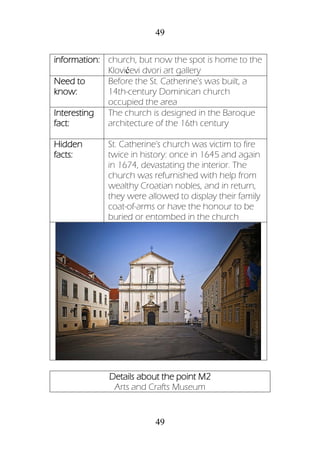
Details about the point
Katarina’s Square
[Katarining trg]
General
information:
When the Jesuits arrived in Zagreb in
the early 17th century, they thought the
original church too rundown and
inadequate, and worked to build a new
church. Construction began in 1620
and was completed in 1632.
Special A monastery was built adjacent to the
49
49
information: church, but now the spot is home to the
Klovićevi dvori art gallery
Need to
know:
Before the St. Catherine's was built, a
14th-century Dominican church
occupied the area
Interesting
fact:
The church is designed in the Baroque
architecture of the 16th century
Hidden
facts:
St. Catherine's church was victim to fire
twice in history: once in 1645 and again
in 1674, devastating the interior. The
church was refurnished with help from
wealthy Croatian nobles, and in return,
they were allowed to display their family
coat-of-arms or have the honour to be
buried or entombed in the church
Details about the point M2
Arts and Crafts Museum
50
50
[Muzej za umjetnost i obrt]
General
information:
http://www.muo.hr/en
Summer working hours (june 2nd -
August 30th)
Tuesday – Saturday: 11- 20
Sunday: 10- 14
Closed on Mondays and public
holidays
Special
information:
Price:
Adults: 30 kn
Pupils, students and retirees: 20 kn
Groups (10 – 20 people): 20 kn per
person
Family ticket (children under the age
of 15): 50 kn
Need to know: The Museum of Arts and Crafts was
founded in 1880 at the initiative of
the Arts Association and its then
president Izidor Kršnjavi, and was
one of the first such institutions in
Europe
Interesting fact: The strategy of the Museum’s activity
was directed to the preservation of
traditional values of the crafts of the
people, but also to the creation of a
new aesthetic culture in the middle
class, and in 1882 the Crafts School
was founded alongside the Museum
– today’s Applied Art and Design
School
Hidden facts: Not many know that the museum
51
51
has a library. The museum's library
was founded at the same time as the
museum itself. The idea of Izidor
Kršnjavi, founder and first director of
the Museum, was that along with
providing basic lessons from art
history it should provide suitable
patterns from its collections to
improve production in art and the
fine crafts.
Details about the point M3
Mimara Museum
[Muzej Mimara]
General
information:
http://www.mimara.hr/en/us/
Opening Hours
from 1st
October to 30th
June
Tuesday, Wednesday, Friday, Saturday
10.00 - 17.00
52
52
Thursday 10.00 - 19.00
Sunday 10.00 - 14.00
from 1st
July to 30th
September
Tuesday - Friday 10.00 - 19.00
Saturday 10.00 - 17.00
Sunday 10.00 - 14.00
Closed on Mondays and Holidays in
the Republic of Croatia
Special
information:
Permanent exhibitions:
Individual adult: 40 kn
Pupils, students, retirees: 30 kn
Groups:
Adults (20-40 people): 30 kn
Pupils, students, retirees (20-40
people): 20 kn
Temporary exhibitions are free of
charge unless stated otherwise
Need to know: Mimara Museum offers view on the
rich and varied art collection with
works of the ancient world as well as
of the European art from the early
Middle Ages to the 20th century. A
special unit consists of works of arts of
the Near, Middle and Far East
Interesting
fact:
The full name of the museum is: "The
Public Institution of the Ante and
53
53
Wiltrud Topić Mimara Art Collection" -
Mimara Museum
Hidden facts: The founder of the museum is the
Republic of CroatiaThe institution was
founded in 1980 (at first as the
establishment in the process of
founding) and the museum was
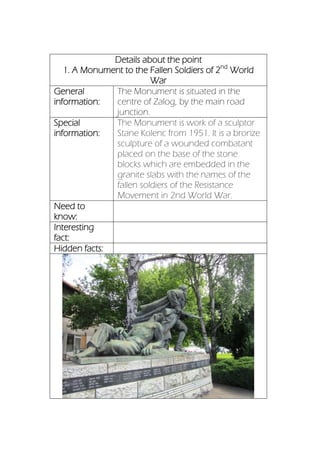
opened to the public on 17 July 1987
Details about the point M4
Ethnographic Museum
[Etnografski muzej]
General
information:
http://www.emz.hr/
Tuesday - Thursday: 10 - 18
Friday - Sunday: 10 - 13
closed on Mondays and state
holidays
Special
information:
Adults: 15 kuna
Children, pupils, students: 10 kuna
group visits (minimum 15 persons):
30% discount
Creative workshops: 15 kuna
group guided tours (minimum 15
54
54
persons) must be scheduled in
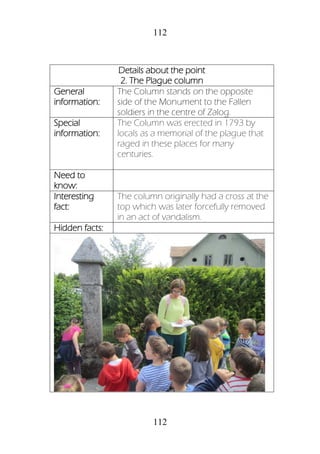
advance
Need to know: Founded in 1919.
Till then all the Ethnographic
material was collected in the
National Museum
Interesting fact: The museum is located a
remarkable Secession palace , the
former Museum of Commerce and
crafts
Hidden facts: One of the rare museums that has
a goal to stimulate creativity, desire
for exploration, preservation and
responsible attitude towards
cultural heritage
Details about the point
Croatian National Theatre
[Hrvatsko Narodno Kazalište HNK]
55
55
General
information:
http://www.hnk.hr/en/
Box Office opening hours:
MONDAY TO FRIDAY:
from 10 a.m. to 7. 30 p.m.
SATURDAY:
from 10 a.m. to 1 p.m. and 90
minutes before performance
SUNDAY:
90 minutes before performance
Special
information:
Tickets can also be bought online
Need to know: The current theatre was
ceremoniously opened on October
14, 1895
Interesting fact: The paintings on the ceiling of the
auditorium were created by the
Viennese painter and decorator
Alexander Demetrius Goltz. The
ceiling of the Foyer on the first floor
was painted by Ivan Tisov (in 1911).
The author of four busts, on the
forepart (Ivan Gundulic and Junije
Palmotic), on the eastern (Dimitrije
Demeter) and on the western side
of the building (Vatroslav Lisinski) is
unknown. The construction was
progressing according to plan and
after sixteen months, on October 8,
1895, the building received its
certificate of occupancy.
56
56
Hidden facts: The National theatre is connected
to neighbouring academy via
underground tunnels.
Details about the point
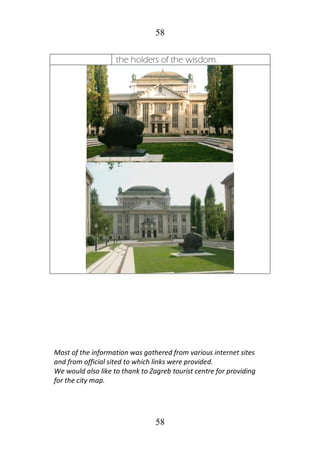
Marko Marulic Square & State Archive
[Trg Marka Marulića i Državni Arhiv]
General
information:
http://www.arhiv.hr/en/index.htm
The Croatian State Archives is located
in a distinguished art nouveau building
which is recognized by most people as
the old building of the National and
University Library.
Working hours: Monday through
Friday, 8:00 to 16:00
57
57
Special
information:
The ticket for a guided sightseeing of
the building is 4 Euro for adults and 2
Euro for pupils, students and retirees
Group guided sightseeing possible by
appointment only.
For arranging group visits after
working hours; on the weekend or
after 8 pm. During holidays the price is
50% higher
Need to
know:
The Archive building hosts:
Management, the Reading Room, the
Department for Preservation and
Arrangement of Archival Records, the
Department for Information and
Communication, the IT Department,
the Central Laboratory for
Conservation and Restoration, the
Central Laboratory for Photography,
the Department of Comprehensive and
Financial Service and Zagreb
Archdiocese’s Department of
Metropolitana Library
Interesting
fact:
The Croatian State Archives holds more
than 23.500 linear meters of archival
records, dating from the 10th
century to
the present day and arranged into
more than 1.850 archival funds and
collections
Hidden facts: Though may become mesmerize by
the sheer beauty of the building and its
interior those who look up will discover
58
58
the holders of the wisdom.
Most of the information was gathered from various internet sites
and from official sited to which links were provided.
We would also like to thank to Zagreb tourist centre for providing
for the city map.
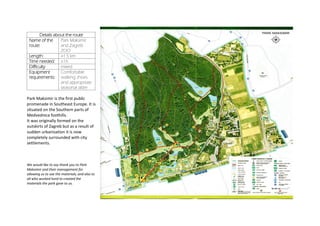
Details about the route
Name of the
route:
Park Maksimir
and Zagreb
ZOO
Length: ≥1.5 km
Time needed: ≥1h
Difficulty mixed
Equipment
requirements:
Comfortable
walking shoes
and appropriate
seasonal attire
Park Maksimir is the first public
promenade in Southeast Europe. It is
situated on the Southern parts of
Medvednica foothills.
It was originally formed on the
outskirts of Zagreb but as a result of
sudden urbanisation it is now
completely surrounded with city
settlements.
We would like to say thank you to Park
Maksimir and their management for
allowing us to use the materials; and also to
all who worked hard to created the
materials the park gave to us.
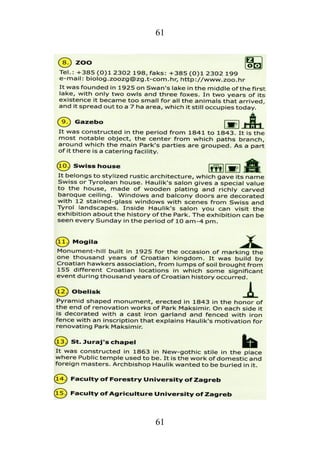
61
61
62
62
Phrase Book – phrases and words you might find useful
while visiting
English
Native language
and script
Pronunciation
Please Molim moh-leem
Thank you Hvala flah-lah
Left Lijevo lee-yevoh
Right Desno deh-snoh
Straight Ravno RAHV-noh
Back Nazad
Walk Hodajte
What is the time? Koliko je sati?
KOH-lee-kee
yeh sati
How do you get
to…
Kako doći do...
KAH-koh do
chee do
How do you get
there?
Kako se dođe do
tamo?
KAH-koh do
gje do tamo
Where is the toilet? Gdje je WC?
gdyeh jeh-
vece
How long is the…
Koliko
dugo/daleko
je....
koh-lee-koh -
duugho
How much is it? Koliko to košta?
koh-lee-koh
toh kost-teh
Are there any
special children
rates?
Ima li popusta
za djecu?
EE-mah lee
Are there any
special family rates?
Ima li popusta
za obitelji?
EE-mah lee
63
63
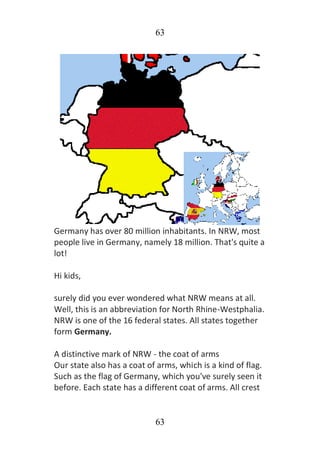
Germany has over 80 million inhabitants. In NRW, most
people live in Germany, namely 18 million. That's quite a
lot!
Hi kids,
surely did you ever wondered what NRW means at all.
Well, this is an abbreviation for North Rhine-Westphalia.
NRW is one of the 16 federal states. All states together
form Germany.
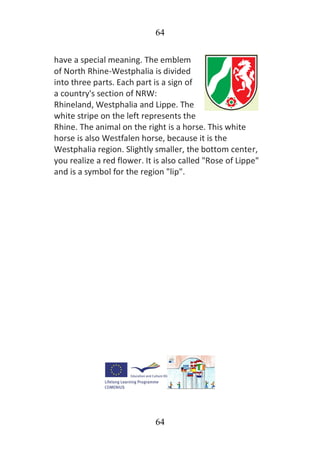
A distinctive mark of NRW - the coat of arms
Our state also has a coat of arms, which is a kind of flag.
Such as the flag of Germany, which you've surely seen it
before. Each state has a different coat of arms. All crest
64
64
have a special meaning. The emblem
of North Rhine-Westphalia is divided
into three parts. Each part is a sign of
a country's section of NRW:
Rhineland, Westphalia and Lippe. The
white stripe on the left represents the
Rhine. The animal on the right is a horse. This white
horse is also Westfalen horse, because it is the
Westphalia region. Slightly smaller, the bottom center,
you realize a red flower. It is also called "Rose of Lippe"
and is a symbol for the region "lip".
65
65
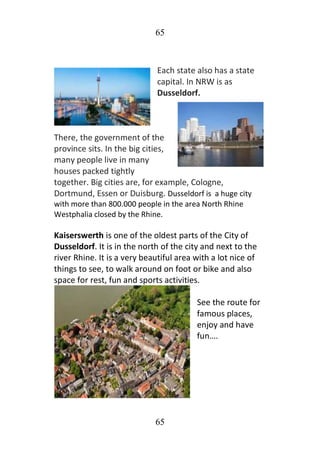
Each state also has a state
capital. In NRW is as
Dusseldorf.
There, the government of the
province sits. In the big cities,
many people live in many
houses packed tightly
together. Big cities are, for example, Cologne,
Dortmund, Essen or Duisburg. Dusseldorf is a huge city
with more than 800.000 people in the area North Rhine
Westphalia closed by the Rhine.
Kaiserswerth is one of the oldest parts of the City of
Dusseldorf. It is in the north of the city and next to the
river Rhine. It is a very beautiful area with a lot nice of
things to see, to walk around on foot or bike and also
space for rest, fun and sports activities.
See the route for
famous places,
enjoy and have
fun….
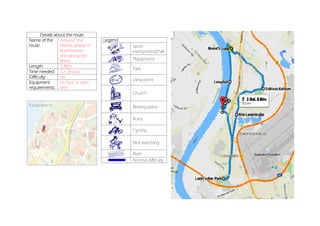
Details about the route
Name of the
route:
Around the
historic places in
Kaiserswerth
and along the
Rhine
Length: 7,4Km
Time needed: Ca. 3hours
Difficulty no
Equipment
requirements:
on foot or with
bike
Legend
Sport
event/arena/hall
Playground
Park
View point
Church
Resting place
Ruins
Cycling
Bird watching
River
Normal difficulty
Details about the point
Start Kaiserswerther Markt No. 1
General
information:
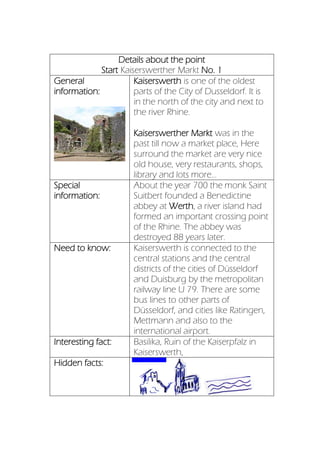
Kaiserswerth is one of the oldest
parts of the City of Dusseldorf. It is
in the north of the city and next to
the river Rhine.
Kaiserswerther Markt was in the
past till now a market place, Here
surround the market are very nice
old house, very restaurants, shops,
library and lots more…
Special
information:
About the year 700 the monk Saint
Suitbert founded a Benedictine
abbey at Werth, a river island had
formed an important crossing point
of the Rhine. The abbey was
destroyed 88 years later.
Need to know: Kaiserswerth is connected to the
central stations and the central
districts of the cities of Düsseldorf
and Duisburg by the metropolitan
railway line U 79. There are some
bus lines to other parts of
Düsseldorf, and cities like Ratingen,
Mettmann and also to the
international airport.
Interesting fact: Basilika, Ruin of the Kaiserpfalz in
Kaiserswerth,
Hidden facts:
68
68
Details about the point No, 2
Burgallee + Rhineway to Lohausen
General
information:
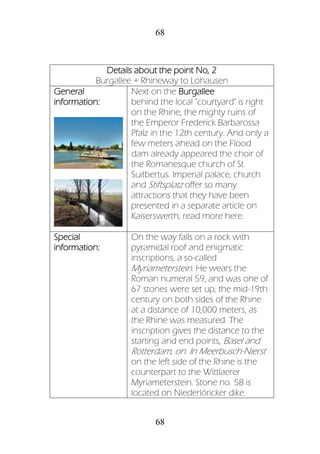
Next on the Burgallee
behind the local "courtyard" is right
on the Rhine, the mighty ruins of
the Emperor Frederick Barbarossa
Pfalz in the 12th century. And only a
few meters ahead on the Flood
dam already appeared the choir of
the Romanesque church of St.
Suitbertus. Imperial palace, church
and Stiftsplatz offer so many
attractions that they have been
presented in a separate article on
Kaiserswerth, read more here.
Special
information:
On the way falls on a rock with
pyramidal roof and enigmatic
inscriptions, a so-called
Myriameterstein. He wears the
Roman numeral 59, and was one of
67 stones were set up, the mid-19th
century on both sides of the Rhine
at a distance of 10,000 meters, as
the Rhine was measured. The
inscription gives the distance to the
starting and end points, Basel and
Rotterdam, on. In Meerbusch-Nierst
on the left side of the Rhine is the
counterpart to the Wittlaerer
Myriameterstein. Stone no. 58 is
located on Niederlöricker dike.
69
69
Need to know: Kaiserswerth was Treidelstation with
change of horses. Elector Carl
Theodor had set up the station in
1775. As is known, attracted horses
(and humans!) The vessels on long
lines upstream until the motor boat
trip to the mid-19th century made
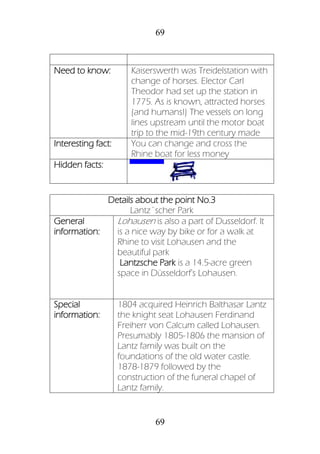
Interesting fact: You can change and cross the
Rhine boat for less money
Hidden facts:
Details about the point No.3
Lantz´scher Park
General
information:
Lohausen is also a part of Dusseldorf. It
is a nice way by bike or for a walk at
Rhine to visit Lohausen and the
beautiful park
Lantzsche Park is a 14.5-acre green
space in Düsseldorf's Lohausen.
Special
information:
1804 acquired Heinrich Balthasar Lantz
the knight seat Lohausen Ferdinand
Freiherr von Calcum called Lohausen.
Presumably 1805-1806 the mansion of
Lantz family was built on the
foundations of the old water castle.
1878-1879 followed by the
construction of the funeral chapel of
Lantz family.
70
70
Need to
know:
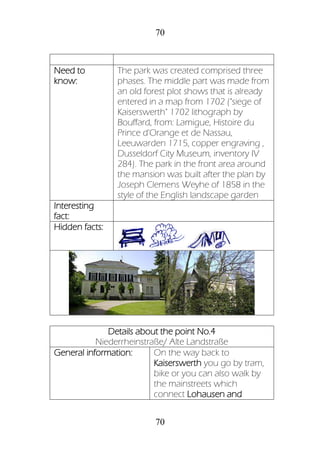
The park was created comprised three
phases. The middle part was made from
an old forest plot shows that is already
entered in a map from 1702 ("siege of
Kaiserswerth" 1702 lithograph by
Bouffard, from: Lamigue, Histoire du
Prince d'Orange et de Nassau,
Leeuwarden 1715, copper engraving ,
Dusseldorf City Museum, inventory IV
284). The park in the front area around
the mansion was built after the plan by
Joseph Clemens Weyhe of 1858 in the
style of the English landscape garden
Interesting
fact:
Hidden facts:
Details about the point No.4
Niederrheinstraße/ Alte Landstraße
General information: On the way back to
Kaiserswerth you go by tram,
bike or you can also walk by
the mainstreets which
connect Lohausen and
71
71
Kaiserswerth.
The Name of the street from
Lohausen is called
Niederrheinstraße and after
the first Cross in the direction
Kaiserswerth – there is the
next Street Alte Landstraße
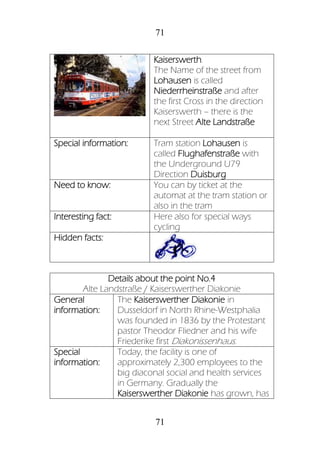
Special information: Tram station Lohausen is
called Flughafenstraße with
the Underground U79
Direction Duisburg
Need to know: You can by ticket at the
automat at the tram station or
also in the tram
Interesting fact: Here also for special ways
cycling
Hidden facts:
Details about the point No.4
Alte Landstraße / Kaiserswerther Diakonie
General
information:
The Kaiserswerther Diakonie in
Dusseldorf in North Rhine-Westphalia
was founded in 1836 by the Protestant
pastor Theodor Fliedner and his wife
Friederike first Diakonissenhaus.
Special
information:
Today, the facility is one of
approximately 2,300 employees to the
big diaconal social and health services
in Germany. Gradually the
Kaiserswerther Diakonie has grown, has
72
72
taken up the latest developments and
opens up new facilities. For example.In
2011 started operating the
FliednerFachhochschule Dusseldorf
Need to
know:
Today, the company consists of four
core areas: social services, which
include not only the youth and family
welfare services for disabled and
mentally ill, the elderly with residential,
leisure and care services for the elderly,
as well as the education of more than
2,100 education and training courses in
various vocational schools. The fourth
core area, the Florence Nightingale
Hospital; is known with ten specialist
clinics and more than 600 beds far
beyond the city limits.
Interesting
fact:
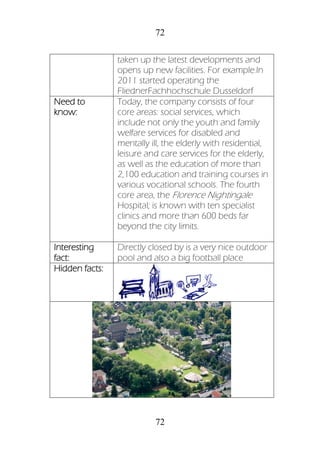
Directly closed by is a very nice outdoor
pool and also a big football place
Hidden facts:
73
73
Details about the point No.5
Schloss Kalkum
General
information: Kalkum was in the past also like
Kaiserswerth and Lohausen a small
village. Today a nice place to live
closed to the Forest. In Kalkum is
wonderful castle.
Special
information:
The Castle of Kalkum is a moated
castle in the same district in the
north of Düsseldorf, about two
kilometers northeast of Kaiserswerth
and an extraordinary example of the
neoclassical palace in the Rhineland.
Together with the associated park it
is since 18 January 1984 as overall
plant conservation.
Need to know: You have no to pay entrance and
everybody can visit the park and
can make picnics at special places,
Families enjoy that very much!
Interesting fact: Emerging from one of the oldest
knight seats in the region, [3] the
headquarters of lords of Kalkum,
the possession came to the mid-
15th century to the Lords of
Winkelhausen which should
determine the fate of the plant for
the following 300 years. In the 17th
century to a castle in the Baroque
74
74
style changed, the plant received its
current exterior appearance
substantially by a Classicist
reconstruction in 1808 and 1814
designed by the architect Georg
Krefeld Peter Leydel.
Hidden facts:
Details about the point No.6
Kalkum to Wittlaer
General
information:
To reach Wittlaer, it is necessary inside
in the direction of Kaiserswerth on the
Kalkumer drive Castle and then the
Castle Kalkum right in the narrow
country road. The village name of
Kalkum refers Yes like so much here in
the region on the rock trading with
the burnt lime, lime and the burning
of limestone. For centuries has mined
this valuable raw material to build and
the smelting of the ore in this area in
the limestone quarries, burned in lime
kilns, and transported to buyers on the
lower Rhine and in the Netherlands.
Special
information:
Here you are in these area in middle
of fields, forest and not far to the
Rhine!
75
75
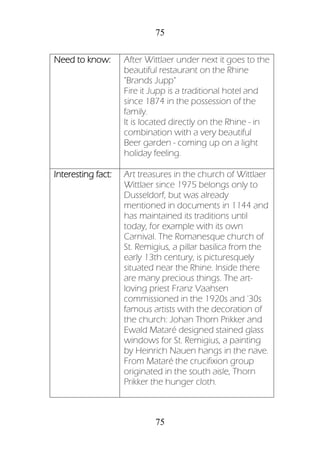
Need to know: After Wittlaer under next it goes to the
beautiful restaurant on the Rhine
"Brands Jupp"
Fire it Jupp is a traditional hotel and
since 1874 in the possession of the
family.
It is located directly on the Rhine - in
combination with a very beautiful
Beer garden - coming up on a light
holiday feeling.
Interesting fact: Art treasures in the church of Wittlaer
Wittlaer since 1975 belongs only to
Dusseldorf, but was already
mentioned in documents in 1144 and
has maintained its traditions until
today, for example with its own
Carnival. The Romanesque church of
St. Remigius, a pillar basilica from the
early 13th century, is picturesquely
situated near the Rhine. Inside there
are many precious things. The art-
loving priest Franz Vaahsen
commissioned in the 1920s and '30s
famous artists with the decoration of
the church: Johan Thorn Prikker and
Ewald Mataré designed stained glass
windows for St. Remigius, a painting
by Heinrich Nauen hangs in the nave.
From Mataré the crucifixion group
originated in the south aisle, Thorn
Prikker the hunger cloth.
76
76
Hidden facts: Here also for special ways
cycling
Details about the point No.7
Leinpfad/ Way back to Kaiserswerth by the rhine
General
information:
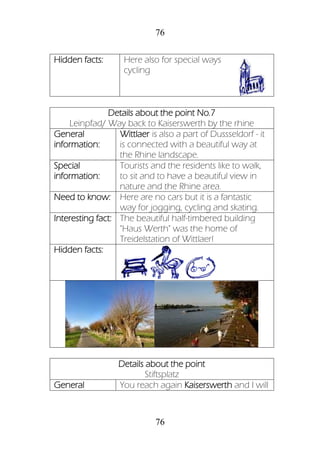
Wittlaer is also a part of Dussseldorf - it
is connected with a beautiful way at
the Rhine landscape.
Special
information:
Tourists and the residents like to walk,
to sit and to have a beautiful view in
nature and the Rhine area.
Need to know: Here are no cars but it is a fantastic
way for jogging, cycling and skating.
Interesting fact: The beautiful half-timbered building
"Haus Werth" was the home of
Treidelstation of Wittlaer!
Hidden facts:
Details about the point
Stiftsplatz
General You reach again Kaiserswerth and I will
77
77
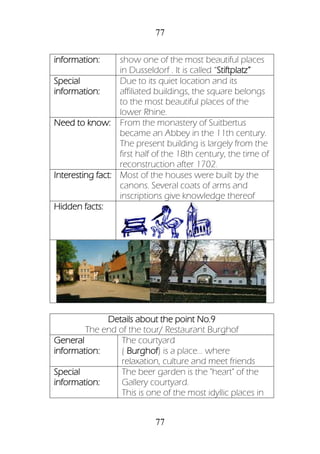
information: show one of the most beautiful places
in Dusseldorf . It is called “Stiftplatz”
Special
information:
Due to its quiet location and its
affiliated buildings, the square belongs
to the most beautiful places of the
lower Rhine.
Need to know: From the monastery of Suitbertus
became an Abbey in the 11th century.
The present building is largely from the
first half of the 18th century, the time of
reconstruction after 1702.
Interesting fact: Most of the houses were built by the
canons. Several coats of arms and
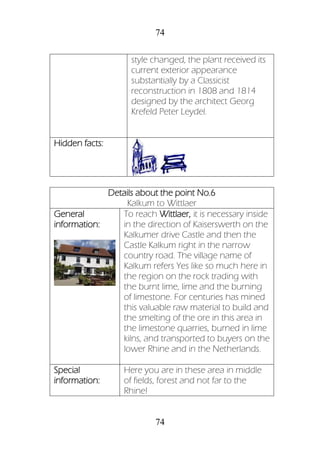
inscriptions give knowledge thereof
Hidden facts:
Details about the point No.9
The end of the tour/ Restaurant Burghof
General
information:
The courtyard
( Burghof) is a place... where
relaxation, culture and meet friends
Special
information:
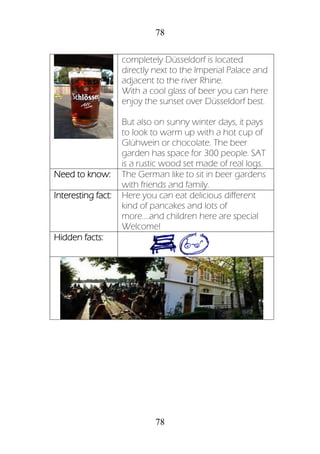
The beer garden is the "heart" of the
Gallery courtyard.
This is one of the most idyllic places in
78
78
completely Düsseldorf is located
directly next to the Imperial Palace and
adjacent to the river Rhine.
With a cool glass of beer you can here
enjoy the sunset over Düsseldorf best.
But also on sunny winter days, it pays
to look to warm up with a hot cup of
Glühwein or chocolate. The beer
garden has space for 300 people. SAT
is a rustic wood set made of real logs.
Need to know: The German like to sit in beer gardens
with friends and family.
Interesting fact: Here you can eat delicious different
kind of pancakes and lots of
more….and children here are special
Welcome!
Hidden facts:
79
79
Phrase Book – phrases and words you might find useful
while visiting
English Native language and script
Please Bitte
Thank you Danke
Left links
Right rechts
Straight geradeaus
Back rückwärts
Walk Gehen/ Spaziergang
What is the time? Wieviel Uhr haben wir?
How do you get to… Wie kommst du zu??
How do you get there? Wie kommst du dahin?
Where is the toilet? Wo ist die Toilette?
How long is the… Wie lang ist der,die…?
How much is it? Wie teuer ist das?
Are there any special
children rates?
Gibt es eine
Kinderermäßigung?
Are there any special
family rates?
Gibt es irgendeine
Familienermäßigung?
80
80
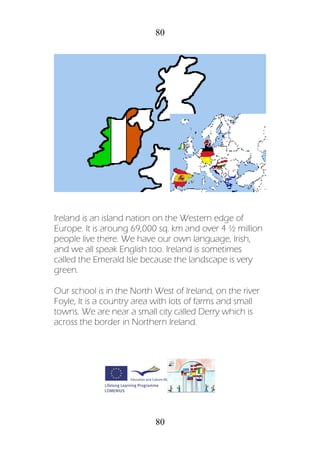
Ireland is an island nation on the Western edge of
Europe. It is aroung 69,000 sq. km and over 4 ½ million
people live there. We have our own language, Irish,
and we all speak English too. Ireland is sometimes
called the Emerald Isle because the landscape is very
green.
Our school is in the North West of Ireland, on the river
Foyle, It is a country area with lots of farms and small
towns. We are near a small city called Derry which is
across the border in Northern Ireland.
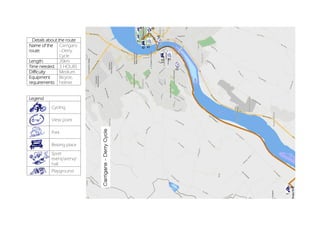
Details about the route
Name of the
route:
Carrigans
–Derry
Cycle
Length: 20km
Time needed: 3 HOURS
Difficulty Medium
Equipment
requirements:
Bicycle,
helmet
Legend
Cycling
View point
Park
Resting place
Sport
event/arena/
hall
Playground
Grading System for the spots
Phrase 1 to 10
Don’t Bother! 1
Pretty Boring 2
Worth seeing 3
OK but wouldn’t go back 4
Fun 5
Cool! 6
Heaven! 7
Pure class! 8
Don’t miss it! 9
Best thing ever! Awesome! 10
1. Carrigans
General
information:
Drive to the starting point, right turn at
sign for Donegal Meats about 500 m
from Carrigans.
Child’s
comment
and score
‘
Safe to cycle without cars’ 5/10
Need to
know:
The route follows the railway line
Interesting
fact:
This cycle route is called the Foyle Valley
Greenway
Hidden facts: Be careful, there’s a steep hill near the
start
83
83
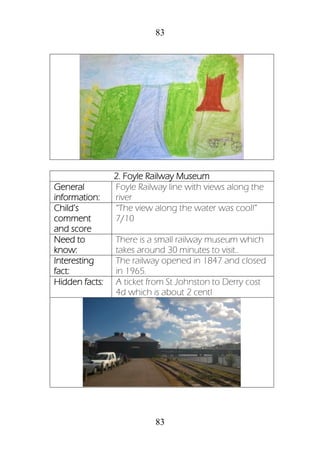
2. Foyle Railway Museum
General
information:
Foyle Railway line with views along the
river
Child’s
comment
and score
“The view along the water was cool!”
7/10
Need to
know:
There is a small railway museum which
takes around 30 minutes to visit..
Interesting
fact:
The railway opened in 1847 and closed
in 1965.
Hidden facts: A ticket from St Johnston to Derry cost
4d which is about 2 cent!
84
84
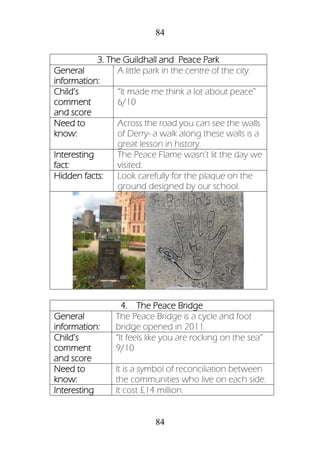
3. The Guildhall and Peace Park
General
information:
A little park in the centre of the city.
Child’s
comment
and score
“It made me think a lot about peace”
6/10
Need to
know:
Across the road you can see the walls
of Derry- a walk along these walls is a
great lesson in history.
Interesting
fact:
The Peace Flame wasn’t lit the day we
visited.
Hidden facts: Look carefully for the plaque on the
ground designed by our school.
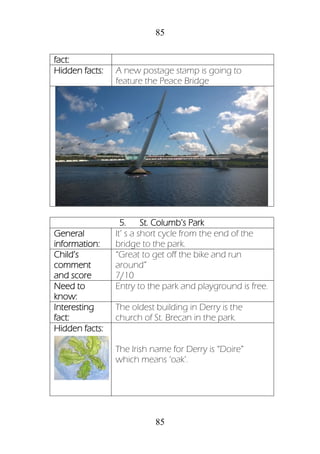
4. The Peace Bridge
General
information:
The Peace Bridge is a cycle and foot
bridge opened in 2011.
Child’s
comment
and score
“It feels like you are rocking on the sea”
9/10
Need to
know:
It is a symbol of reconciliation between
the communities who live on each side.
Interesting It cost £14 million.
85
85
fact:
Hidden facts: A new postage stamp is going to
feature the Peace Bridge
5. St. Columb’s Park
General
information:
It’ s a short cycle from the end of the
bridge to the park.
Child’s
comment
and score
“Great to get off the bike and run
around”
7/10
Need to
know:
Entry to the park and playground is free.
Interesting
fact:
The oldest building in Derry is the
church of St. Brecan in the park.
Hidden facts:
The Irish name for Derry is “Doire”
which means ‘oak’.
86
86
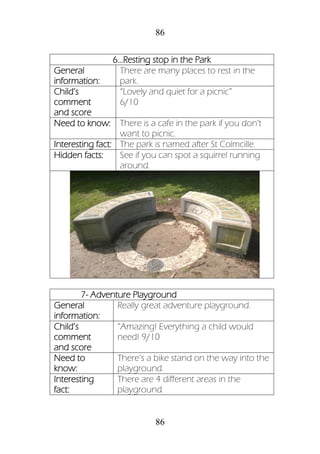
6...Resting stop in the Park
General
information:
There are many places to rest in the
park.
Child’s
comment
and score
“Lovely and quiet for a picnic”
6/10
Need to know: There is a cafe in the park if you don’t
want to picnic.
Interesting fact: The park is named after St Colmcille.
Hidden facts: See if you can spot a squirrel running
around.
7- Adventure Playground
General
information:
Really great adventure playground.
Child’s
comment
and score
“Amazing! Everything a child would
need! 9/10
Need to
know:
There’s a bike stand on the way into the
playground.
Interesting
fact:
There are 4 different areas in the
playground.
87
87
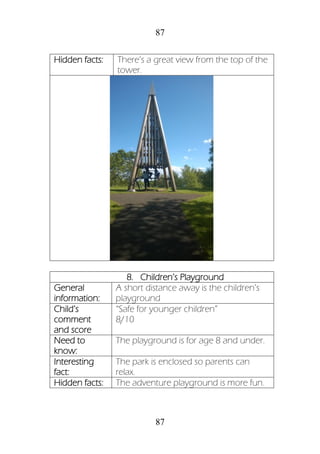
Hidden facts: There’s a great view from the top of the
tower.
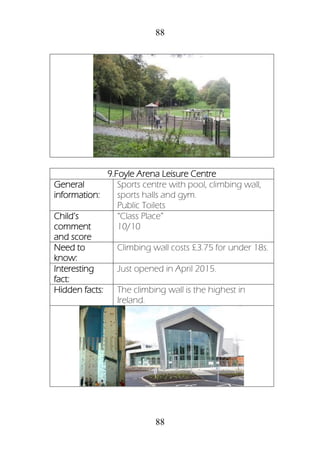
8. Children’s Playground
General
information:
A short distance away is the children’s
playground
Child’s
comment
and score
“Safe for younger children”
8/10
Need to
know:
The playground is for age 8 and under.
Interesting
fact:
The park is enclosed so parents can
relax.
Hidden facts: The adventure playground is more fun.
88
88
9.Foyle Arena Leisure Centre
General
information:
Sports centre with pool, climbing wall,
sports halls and gym.
Public Toilets
Child’s
comment
and score
“Class Place”
10/10
Need to
know:
Climbing wall costs £3.75 for under 18s.
Interesting
fact:
Just opened in April 2015.
Hidden facts: The climbing wall is the highest in
Ireland.
89
89
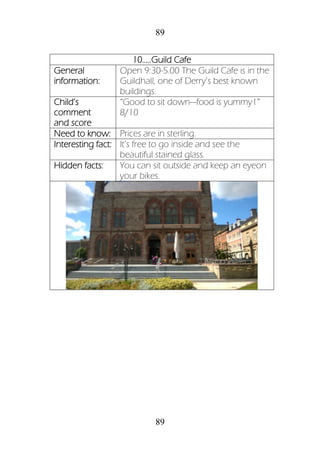
10.....Guild Cafe
General
information:
Open 9:30-5.00 The Guild Cafe is in the
Guildhall, one of Derry’s best known
buildings.
Child’s
comment
and score
“Good to sit down—food is yummy1”
8/10
Need to know: Prices are in sterling.
Interesting fact: It’s free to go inside and see the
beautiful stained glass.
Hidden facts: You can sit outside and keep an eyeon
your bikes.
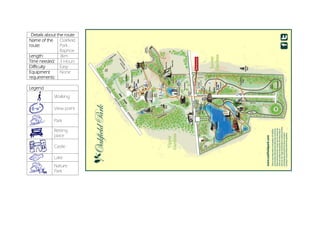
Details about the route
Name of the
route:
Oakfield
Park ,
Raphoe
Length: 3km
Time needed: 3 Hours
Difficulty Easy
Equipment
requirements:
None
Legend
Walking
View point
Park
Resting
place
Castle
Lake
Nature
Park
1. Tea Van
General
information:
This is where you buy your tickets
Child’s
comment
and score
“The staff are very kind and friendly.”
9/10
Need to
know:
Cost: €25 for a family including a train
ride
Interesting
fact:
The park is open from 12-6, Wed-
Sunday.
Hidden facts: The park is owned by the Robinson
family who live in the main house.
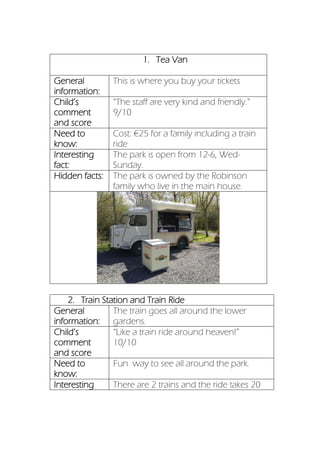
2. Train Station and Train Ride
General
information:
The train goes all around the lower
gardens.
Child’s
comment
and score
“Like a train ride around heaven!”
10/10
Need to
know:
Fun way to see all around the park.
Interesting There are 2 trains and the ride takes 20
92
92
fact: minutes.
Hidden facts: The castle is not as old as it looks!
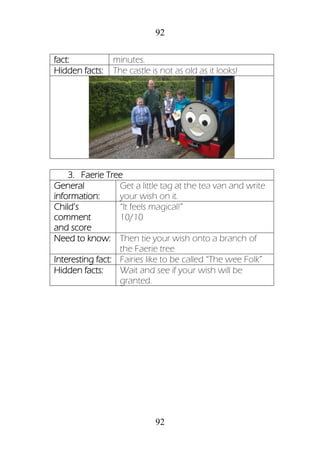
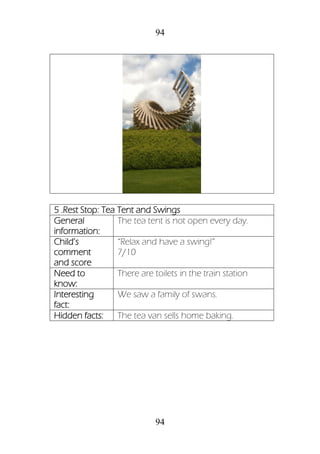
3. Faerie Tree
General
information:
Get a little tag at the tea van and write
your wish on it.
Child’s
comment
and score
“It feels magical!”
10/10
Need to know: Then tie your wish onto a branch of
the Faerie tree
Interesting fact: Fairies like to be called “The wee Folk”
Hidden facts: Wait and see if your wish will be
granted.
93
93
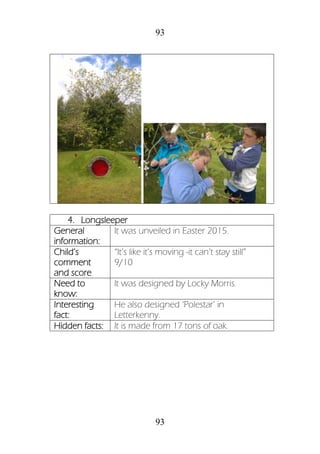
4. Longsleeper
General
information:
It was unveiled in Easter 2015.
Child’s
comment
and score
“It’s like it’s moving -it can’t stay still”
9/10
Need to
know:
It was designed by Locky Morris.
Interesting
fact:
He also designed ‘Polestar’ in
Letterkenny.
Hidden facts: It is made from 17 tons of oak.
94
94
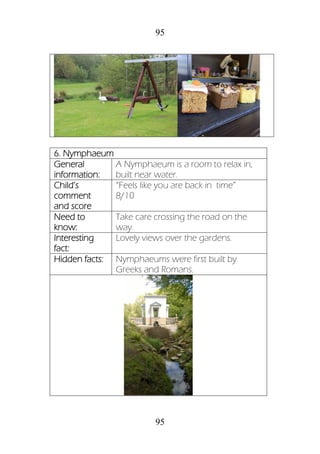
5 .Rest Stop: Tea Tent and Swings
General
information:
The tea tent is not open every day.
Child’s
comment
and score
“Relax and have a swing!”
7/10
Need to
know:
There are toilets in the train station
Interesting
fact:
We saw a family of swans.
Hidden facts: The tea van sells home baking.
95
95
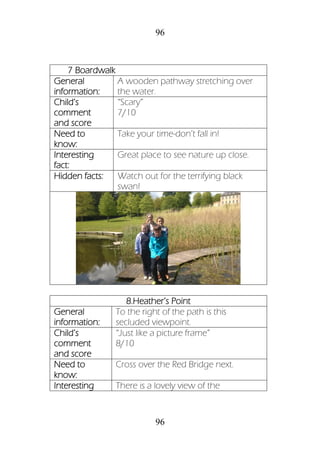
6. Nymphaeum
General
information:
A Nymphaeum is a room to relax in,
built near water.
Child’s
comment
and score
“Feels like you are back in time”
8/10
Need to
know:
Take care crossing the road on the
way.
Interesting
fact:
Lovely views over the gardens.
Hidden facts: Nymphaeums were first built by
Greeks and Romans.
96
96
7 Boardwalk
General
information:
A wooden pathway stretching over
the water.
Child’s
comment
and score
“Scary”
7/10
Need to
know:
Take your time-don’t fall in!
Interesting
fact:
Great place to see nature up close.
Hidden facts: Watch out for the terrifying black
swan!
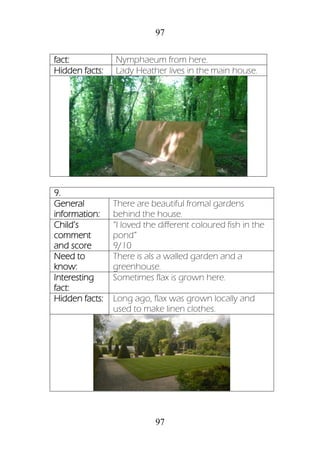
8.Heather’s Point
General
information:
To the right of the path is this
secluded viewpoint.
Child’s
comment
and score
“Just like a picture frame”
8/10
Need to
know:
Cross over the Red Bridge next.
Interesting There is a lovely view of the
97
97
fact: Nymphaeum from here.
Hidden facts: Lady Heather lives in the main house.
9.
General
information:
There are beautiful fromal gardens
behind the house.
Child’s
comment
and score
“I loved the different coloured fish in the
pond”
9/10
Need to
know:
There is als a walled garden and a
greenhouse.
Interesting
fact:
Sometimes flax is grown here.
Hidden facts: Long ago, flax was grown locally and
used to make linen clothes.
98
98
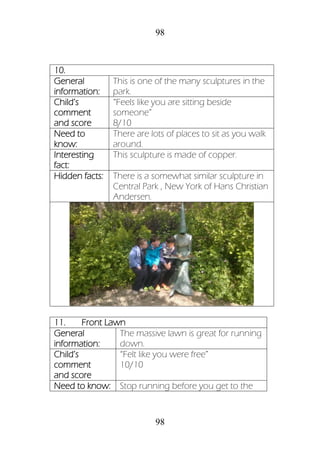
10.
General
information:
This is one of the many sculptures in the
park.
Child’s
comment
and score
“Feels like you are sitting beside
someone”
8/10
Need to
know:
There are lots of places to sit as you walk
around.
Interesting
fact:
This sculpture is made of copper.
Hidden facts: There is a somewhat similar sculpture in
Central Park , New York of Hans Christian
Andersen.
11. Front Lawn
General
information:
The massive lawn is great for running
down.
Child’s
comment
and score
“Felt like you were free”
10/10
Need to know: Stop running before you get to the
99
99
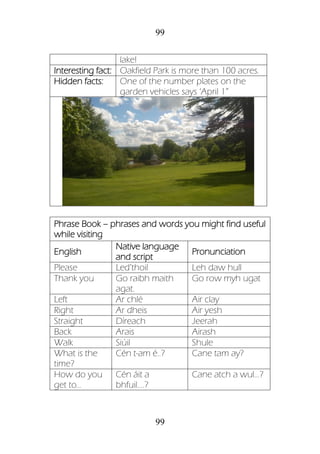
lake!
Interesting fact: Oakfield Park is more than 100 acres.
Hidden facts: One of the number plates on the
garden vehicles says ‘April 1”
Phrase Book – phrases and words you might find useful
while visiting
English
Native language
and script
Pronunciation
Please Led’thoil Leh daw hull
Thank you Go raibh maith
agat.
Go row myh ugat
Left Ar chlé Air clay
Right Ar dheis Air yesh
Straight Díreach Jeerah
Back Arais Airash
Walk Siúil Shule
What is the
time?
Cén t-am é..? Cane tam ay?
How do you
get to…
Cén áit a
bhfuil....?
Cane atch a wul…?
100
100
How do you
get there?
Cen dóigh a
fhaigheann tú go
dtí...
Cane doy a ayin to
go jee
Where is the
toilet?
Cá bhfuil an
leithreas?
Kah wul an layhris
How long is
the…
Cá fhad a bhfuil.... Kah had a wul
How much is
it?
Cé mhéad atá sé.. Kay vade atah shay
Are there any
special
children
rates?
Cé mhéad dona
páistí?
Kay vade dona
pashtí
Are there any
special family
rates?
Cé mhéad don
teaglach?
Kay vade don
chowla?
101
101
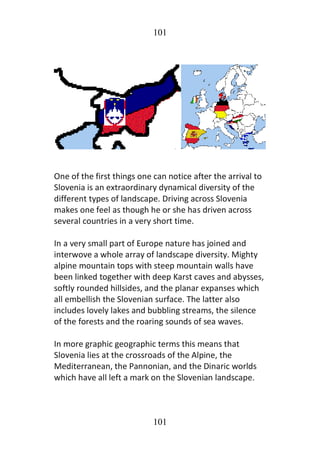
One of the first things one can notice after the arrival to
Slovenia is an extraordinary dynamical diversity of the
different types of landscape. Driving across Slovenia
makes one feel as though he or she has driven across
several countries in a very short time.
In a very small part of Europe nature has joined and
interwove a whole array of landscape diversity. Mighty
alpine mountain tops with steep mountain walls have
been linked together with deep Karst caves and abysses,
softly rounded hillsides, and the planar expanses which
all embellish the Slovenian surface. The latter also
includes lovely lakes and bubbling streams, the silence
of the forests and the roaring sounds of sea waves.
In more graphic geographic terms this means that
Slovenia lies at the crossroads of the Alpine, the
Mediterranean, the Pannonian, and the Dinaric worlds
which have all left a mark on the Slovenian landscape.
102
102
Nature, however, has awarded Slovenia with an
exceptional diversity and the variety of natural features
which is still well preserved today. More than a third of
all the territory is protected within the European
network of nature protection areas Nature 2000, whilst
the valuable areas are declared as natural parks and
Reserves. Slovenia is a European country with the third
largest share of forests.
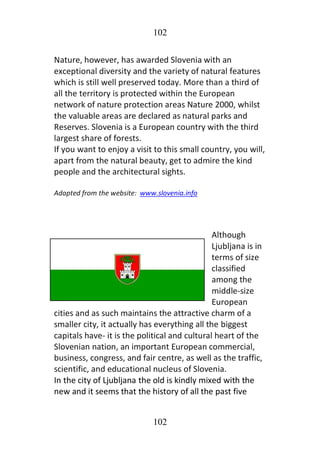
If you want to enjoy a visit to this small country, you will,
apart from the natural beauty, get to admire the kind
people and the architectural sights.
Adapted from the website: www.slovenia.info
Although
Ljubljana is in
terms of size
classified
among the
middle-size
European
cities and as such maintains the attractive charm of a
smaller city, it actually has everything all the biggest
capitals have- it is the political and cultural heart of the
Slovenian nation, an important European commercial,
business, congress, and fair centre, as well as the traffic,
scientific, and educational nucleus of Slovenia.
In the city of Ljubljana the old is kindly mixed with the
new and it seems that the history of all the past five
103
103
millenniums, which is the supposed age of the
settlement in this surrounding, has prepared the city to
become the state capital.
Ljubljana is a cultural city; it is home to several theatres,
museums, and galleries, and it prides itself on having
one of the oldest Philharmonics in the world.
During warmer months numerous coffee tables fill up
the banks of the Ljubljanica River and the squares of the
old city centre. Here the inhabitants of Ljubljana meet
for morning coffee after a nearly mandatory Saturday
visit to the Ljubljana market or the Sunday flea market,
or for an evening chat with friends.
If you are in need of a solid assurance that Ljubljana is
interesting, lovely, and nice, you will probably be
convinced by the fact that all the people living in
Ljubljana are "in love" with it and that its name, if we
follow one of the etymological explanations, actually
means "beloved".
Adapted from the website: www.ljubljana.si
Details about the route
Name of the
route:
"The path along
the wire" – The
Path of
Remembrance
and
Comradeship.
Length: 6 KM (Ring 33 KM)
Time needed: 2 hours
Difficulty
Equipment
requirements:
Sports footwear,
comfortable
clothing.
Grading System 1-10
FUŽINE BRIDGE 5
TRIM TRAIL EXERCISE
STATION
7
GOLOVEC 10
FUŽINE CASTLE 6
LABYRINTH OF ART 5
Legend
View point River
Resting
place
Park
Church Walking
Castle Theatre
Viewing
tower
FUŽINE BRIDGE
General
information:
The Fužine Bridge (Slovene: Fužinski
most) is one of the bridges crossing the
Ljubljanica River.
Special
information:
In the middle of the bridge there is a
chapel.
Need to
know:
The bridge is open to traffic.
Interesting
fact:
It was built in 1987, based on the plans
by Peter Gabrijelčič, the recipient of the
Prešeren Fund Award for this
architectural design in 1988.
Hidden facts: /
TRIM TRAIL EXERCISE STATION
General
information:
Trim station includes 6 types of
exercises for fitness in nature.
Special information: Trim station is part of the trim track
on "The path along the wire".
Need to know: The use of devices is free of
charge.
Interesting fact: All fitness equipment is made of
wood.
Hidden facts: "The path along the wire" - Path of
Remembrance and Comradeship
(presents a post-war reminder of
the times when Ljubljana was
encircled by barbed wire) serves
as the city recreational ring.
GOLOVEC
General Golovec is a hill rising above the Eastern
107
107
information: part of Ljubljana.
Special
information:
Throughout the path there are several
springs which offer drinkable water.
Need to
know:
Suitable choice of footwear is
recommended.
Interesting
fact:
In the past Golovec was mainly treeless
- therefore the name Golovec ("The
Bare One"). Afforestation did not begin
until 1890.
Hidden facts: Over the hill there runs "The path along
the wire".
FUŽINE CASTLE
General information: The Renaissance Fužine Castle
is situated at a picturesque
location along the Ljubljanica
River, on the city outskirts.
Special information: The Fužine Castle also hosts
the Museum of Architecture
and Design.
Need to know: The function halls and rooms
can host business meetings,
receptions, promotional
events, conferences, wedding
ceremonies, etc.
Interesting fact: There are excellent exhibitions
on architecture, design and
photography, taking place at
the Fužine Castle.
Hidden facts:
108
108
Almost all the distinguished
Slovene architects and
designers from the twentieth
century, as well as many
photographers, are
represented in the Museum’s
art fund, amounting to more
than 1,000 authors.
LABYRINTH OF ART
General
information:
The Labyrinth is intended for people
who want to pay an enjoyable visit to
the green areas to relax their minds, to
109
109
get rid of stress, and to refill their bodies
with revitalising energy.
Special
information:
Walking through the greenery, at the
centre of the labyrinth there is always a
book waiting for visitors to relax with
additionally.
Need to
know:
Interesting
fact:
Visitors can decide to take or bring a
book that they want to share with
others.
Hidden facts: Every person can become a custodian
of only one of the 287 Canadian
hemlock trees in the Labyrinth of Art.
When you "buy" your tree, your
"ownership" will be marked in the
following way: The custodian of this
tree is: (inserted) your name and
surname.
Details about the route
Name of the
route:
Zajčja
dobrava
Length: 5 km
Time needed: 1 h
Difficulty
Equipment
requirements:
Sports
footwear
and
sportswear.
Grading System
Phrase
1 to
10
1. A Monument to
the Fallen Soldiers
of 2nd
World War
6
2. The Plague
column
8
3. The Horse
Chestnut
5
4. Zajčja dobrava 7
5. Restaurant and
pizza house Zajčja
dobrava
5
6. Three
monuments of a
local artist
6
Legend
Sport
event/arena/hall
View
point
Walking
Playground
Nature
Park
Details about the point
1. A Monument to the Fallen Soldiers of 2nd
World
War
General
information:
The Monument is situated in the
centre of Zalog, by the main road
junction.
Special
information:
The Monument is work of a sculptor
Stane Kolenc from 1951. It is a bronze
sculpture of a wounded combatant
placed on the base of the stone
blocks which are embedded in the
granite slabs with the names of the
fallen soldiers of the Resistance
Movement in 2nd World War.
Need to
know:
Interesting
fact:
Hidden facts:
112
112
Details about the point
2. The Plague column
General
information:
The Column stands on the opposite
side of the Monument to the Fallen
soldiers in the centre of Zalog.
Special
information:
The Column was erected in 1793 by
locals as a memorial of the plague that
raged in these places for many
centuries.
Need to
know:
Interesting
fact:
The column originally had a cross at the
top which was later forcefully removed
in an act of vandalism.
Hidden facts:
113
113
Details about the point
3. The horse chestnut
General
information:
A big horse chestnut is situated next to
the railway.
Special
information:
In autumn one can collect its seeds and
use them for playing (conkers), art or for
medicinal purposes.
Need to
know:
Interesting
fact:
The seed of a horse chestnut is used in
medicine for its venotonic effect,
vascular protection, as well as for its
anti-inflammatory and free radical
scavenging properties.
Hidden facts:
114
114
Details about the point
4. The Landscape park of Zajčja dobrava
General
information:
A Landscape park
Special
information:
The park offers lots of recreational
activities, such as jogging, trekking,
and cross-country skiing in
wintertime. There are two
playgrounds and picnic areas. There
is a possibility of horse-riding
(payable option).
Need to know:
Interesting fact: The agricultural area of Zajčja
dobrava and its surroundings is
well-known for the cultivation of
cabbage. Every September an
ethnological and entertainment
event called »Zeljada« is organised
in Zajčja dobrava.
On the last Sunday in August an
Equestrian event is organized in
Zajčja dobrava. It is an opportunity
for visitors to see different breeds of
horses and various displays of old
crafts related to horses. They can
also admire the skills of the horses
and their riders. Visitors can even
take a free ride on a horse- drawn
carriage
Hidden facts:
115
115
Details about the point
5. Restaurant and pizza place Zajčja dobrava
General
information:
The restaurant is open every day from
11am to 10pm.
116
116
Special
information:
The restaurant offers classical meals and
pizzas; it also has a playground for
children.
Need to
know:
Interesting
fact:
Hidden facts:
Details about the point
6. Three monuments of a local artist
General
information:
Three monuments within a few-meter
distance are situated by the road Zajčja
dobrava.
Special
information:
The Monuments are inspired in historical
and religious tradition of the area.
Need to
know:
Interesting
fact:
The Monuments are built of different
waste material (metal, wood,
construction material, etc.)
Hidden facts:
117
117
Details about the route
Name of the
route:
Destination
Mountain
lodge
Janče
Length: 2 km
Time needed: 1 h
Difficulty
Equipment
requirements:
Appropriate
sports
footwear
and
sportswear
Grading System
Phrase
1 to
10
1.Chapel of Saint
Nicholas
6
2. Sports club 10
3. Mountain lodge
Janče
9
Legend
Sport
event/arena/hall
View
point
Church
Playground
Resting
place
Walking
Park
Sledging
course
Hiking
Details about the point
1. Chapel of Saint Nicholas
General
information:
Chapel of Saint Nicholas, which was
built in 1895. When a strong
earthquake hit Ljubljana, Ljubljana set
out to be Mother of God guardian
against such disasters.
Special
information:
If you are standing in front of the
Chapel, you have a spectacular view
over Ljubljana and its city outskirts.
Need to
know:
Interesting
fact:
Hidden facts:
Details about the point
2. Sports club
General information: Sports club Janče is situated in
the middle of a forest; it offers a
lot of welcoming shade and it is
appropriate for a variety of
sports events.
Special information: It has a football pitch, a volleyball
court and a place for outdoor
120
120
bowling.
Need to know: There is a possibility of organising
a picnic here.
Interesting fact:
Hidden facts: It is in the middle of a forest, so it is
necessary to be protected with
repellents.
Details about the point
3. Mountain lodge Janče
General
information:
It is at 794 metres of altitude.
Special
information:
Janče is a well- known excursion and
hiking destination, which is especially
attractive in spring and autumn when
there are ripe cherries and chestnuts.
From Janški hill there is a beautiful view
over all the surroundings.
Need to
know:
On all Sundays in October there is a
Chestnut festival with traditional food
and live folk music.
Interesting
fact:
There is the possibility of
accommodation and food on offer.
Also, there is a little farm for kids and a
121
121
playground.
Hidden facts:
Details about the point
4. View from Janče
General
information:
A nice view over the surrounding hills.
Special
information:
Janče is a 794 metres high peak, which
is located between the Sava river and
the Besnica stream valley.
122
122
Need to
know:
Sledding is possible In winter time.
Interesting
fact:
There is a very nice view which extends
to the surrounding hills of the Posavsko.
In case of good visibility, the view
extends all the way to the Alps in the
North and in the West as well as to the
South, all the way to the highlands of
Snežnik.
Hidden facts:
Details about the route
Name of the
route:
Debni vrh
hills
Length: 7.85 km
Time needed: 1 hour
Difficulty
Equipment
requirements:
Sportswear,
sports
footwear
Grading System
Phrase 1 to 10
THE CLIMB 3
DOWNHILL 5
ZALOG 3
STREAM 9
RESTING PLACE 7
LOOKOUT
TOWER
9
VIEW 7
Legend
Resting
place
Nature
Park
Cycling
Hiking
Viewing
tower
River
Lake
View point
START ZALOG
General information: START- Zalog
Special information: The railway line underpass
Need to know: The underpass is marked with
“HELLO” sign
Interesting fact: When you come out of the
underpass, the path begins to
become steeper quickly
Hidden facts:
The path is not marked in the
most apparent way, but it shows
signs of having been walked on
many times.
125
125
POTOČ EK
General
information:
A STREAM
Special
information:
After the last climb a stream flows
along the path.
Need to know: In the stream water collector there is
drinkable water.
Interesting fact:
Hidden facts:
THE CLIMB
General
information:
Three shorter, but steeper climbs, with
some more planar parts in between.
Special
information:
The whole path runs through the
forest.
Need to
know:
The path is suitable for all kinds of
weather.
Interesting In summer time you can pick
126
126
fact: blueberries and mushrooms along the
path.
Hidden facts:
DOWNHILL
General
information:
Downhill biking track.
Special
information:
A very steep slope of the hill.
Need to
know:
Lots of roots.
Interesting
fact:
Intended for experienced cyclists-
downhill.
Hidden facts:
127
127
A RESTING PLACE
General
information:
A resting place with a bench and a
table.
Special
information:
A rest before the crossroads of the
Ostrovrharjeva path, Stari grad and the
Debni vrh hills.
Need to
know:
There are two more steep climbs until
the Debni vrh hills destination.
Interesting
fact:
We are half way up the Debni vrh hills.
Hidden facts:
A LOOKOUT TOWER
General
information:
A lookout tower.
Special
information:
At the top there is a wooden lookout
tower.
Need to
know:
From the lookout tower you can see a
part of the Ljubljana basin.
Interesting
128
128
fact:
Hidden facts:
THE VIEW
General
information:
A great view.
Special
information:
There is open view over the valley.
Need to
know:
In summer months there are denser
trees and therefore the view is a bit
obstructed.
Interesting
fact:
You can see the whole valley; Kašelj,
Zalog and Polje- all parts of Ljubljana.
Hidden facts:
129
129
Phrase Book – phrases and words you might find useful
while visiting
English Native language and script
Please Prosim.
Thank you Hvala.
Left Levo.
Right Desno.
Straight Naravnost.
130
130
Back Nazaj.
Walk Hoja./ Hoditi.
What is the time? Koliko je ura?
How do you get to… Kako priti do…?
How do you get there? Kako priti do tja?
Where is the toilet? Kje je stranišče?
How long is the… Kako dolga/ dolg je…?
How much is it? Koliko stane?
Are there any special
children rates?
Obstajajp posebne tarife za
otroke?
Are there any special
family rates?
Obstajajo posebne tarife za
družine?
131
131
Greece with a total area of 131,957 sq km and
population of 11,3 millions is located in south-eastern
Europe, and consists of three main geographic areas:
a peninsular mainland (that extends from the region
of Central Greece on the South to the region of
Thrace on the North) being the biggest geographic
feature of the country the Peloponnese peninsula that
is separated from the mainland by the canal of the
Corinth Isthmus, and around 6.000 islands and islets,
scattered in the Aegean and Ionian Sea, most of them
grouped in clusters, that constitute the unique Greek
archipelago. Crete, Rhodes, Corfu, the Dodecanese
and the Cyclades are some of the famous and popular
islands and island clusters in Greece.
132
132
Eighty percent of the country consists of mountains or
hills, making Greece one of the most mountainous
countries of Europe; furthermore, it has 16.300
kilometers of coastline of which 7500 are found
around the thousands islands of the Greek
archipelago, a truly unparalleled phenomenon on the
European continent.
Today’s visitors to Greece have the opportunity to
trace the “fingerprints” of Greek history from the
Paleolithic Era to the Roman Period in the hundreds of
archaeological sites, as well as in the archaeological
museums and collections that are scattered
throughout the country.
Crete is the biggest island and the most southern
region of Greece. It is 260 km long and 56 km at its
widest point. The area is 8,260 sq km. and the
population is close to 600,000.
Crete is an island with an exquisite 1,000 kilometer-long
coastline dotted with numerous coves, bays and
peninsulas, which afford a multitude of soft, sandy
beaches along the beautifully blue Mediterranean Sea
that has established Crete as one of Europe's most
popular holiday destinations. The island's historic
importance in today's world as the home of the Minoan
civilization with important archeological finds at
Knossos, Phaistos and Gortys, is evidenced by the tens
of thousands of visitors to these sites each year.
133
133
HERSONISOS
Our home place Hersonissos (population 26.000) is
located centrally at the North coast of Crete and
consists of the coastal area and the inland
mountainous province.
The natural beauty of the landscape, the natural
kindness of the people and of course the unique
historical interest of the region, has resulted in
attracting thousands of visitors every year and the
rapid development of the tourism industry. Main
archaeological sites include the Minoan Palaces of
Malia and Amnissos (the summer Palace of King
Minos) the Archaeological sites of Niros, Karfi (Minoan
refuge) as well as ambiguous antiquities from the
Classical, Hellenistic, Roman and Byzantine era.
Tourism infrastructure includes high quality hotels and
134
134
accommodation businesses, blue flag awarded
beaches, water parks, golf course, extreme leisure
activities such as paragliding, water sports, mountain
bike etc Tourist attractions also include intact
landscape, picturesque villages, agricultural museums,
animal farms, cultural tours, and ancestral pathways.
Details about the route
Name of the
route:
A WALK
AROUND
THE PORT OF
HERSONISOS
Length: 2 KM
Time needed: 2 HOURS
Difficulty Easy
Equipment
requirements:
COMFORTAB
LE CLOTHES
(AS ALWAYS
DURING
SUMMER)
AND SHOES
OR FLIP
FLOPS
Evaggelistria’s holy temple
General
information:
Evaggelistria’s holy temple has been
functioning since 1969, bringing all
Orthodox Christians together in this
region, especially on the day of the
25th
of March, when the church
celebrates Virgin Mary’s
announcement by the Angel that she
will have the honor to give birth to
Christ. The temple is built according
to the Byzantine architectural rhythm,
with a dome on the top. In the
interior, it is decorated by paintings
depicting Saints and scenes from the
Bible.
Special
information:
Need to
know:
Covered shoulders and no shorts
Interesting
fact:
The temple is open to the public from
8am to 9pm. Any visitors wishing to
attend Sunday’s ritual can be at the
temple from 7am till 10am.
Hidden facts:
137
137
The Traditional Café
General
information:
While walking on the main street of
Hersonisos, the visitor can observe a
traditional café of special aesthetic
quality, which takes us back to
another period of time. Mr. Gianni’s
café is a meeting spot for most of the
elderly people of the region, where
they enjoy their coffee and the
endless discussion with the rest of
their friends about politics and current
affairs. They often play backgammon
and cards. They also drink the well-
known ‘raki’ and eat traditional
desserts.
Special
information:
Opposite the café one can see the 4
old wells of the region, but nowadays
this part is not open.
Interesting
fact:
When the café opened in 1935, it
sometimes functioned as a kind of
cinema, because there was no other
entertainment facility in the area. They
projected some films on the wall
using a filming machine.
138
138
Pedestrian Area- The Market- ‘Liberty Square’
General
information:
On the pedestrian street the visitor
can wander in the local market and
buy some souvenirs, clothes, shoes
and jewelry. Very kind and friendly
shop assistants can help you choose
among various products of different
139
139
prices.
The ‘Liberty Square’ is located at the
end of the pedestrian area, where the
visitors can admire the characteristic
statue of the Pigeon, which is the
symbol of freedom.
Coastal Street
General
information:
Wandering along the coastal street,
apart from the commercial shops, the
guests can see plenty of cafés, where
they can enjoy a wide range of
beverages and snacks while admiring
the wonderful view of the sea. Also,
there are restaurants which offer
exceptional meals accompanied by
good quality wines as well as
traditional tavernas, where one can
140
140
taste local treats and drinks like ‘ouzo’
and ‘raki’. Last but not least, there are
fast food restaurants too, which serve
the Greek ‘souvlaki’ and other snacks,
ranging from pizzas and spaghetti to
waffles and frozen yoghurt. Night life
in Hersonisos is amazing since there
are various bars and clubs, where
both local people and tourists enjoy
themselves.
141
141
Sarakino
General
information:
Near the harbor, on the coastal road,
there is a fountain in the shape of a
pyramid. This fountain used to belong
to one of the wealthiest villas of the
region. The four sides of the pyramid
were decorated with mosaic pictures,
but unfortunately nowadays only one
remains in a good condition. This
mosaic contains a marine scene. It
depicts fish, sea birds, as well as a
boat; one man rows and the other
one pulls an octopus astern. At the
bottom of the picture we can see a
man wearing a blue cap, on his back
a cuttlefish is illustrated to catch an
eel. The fountain is called Sarakino
and its chronological origin is
estimated in the period between 323-
828 AC. From this point of the
fountain’s location, the visitor can sit
on the wooden benches and have a
rest, while gazing at the endless blue
color of the sea.
142
142
Port- the Lighthouse
General
information:
Whoever has the mood to walk, can
keep on with his/her walking around
the port, until the end of the road,
where a lighthouse is located. The
unique view of the sea, in
combination with the seaboats, and
the light sea breeze can charm the
visitors. If someone has the desire to
enjoy a small trip, they can get on
board and have a cruise around the
nearby beaches, where they can dive
and have fun.
143
143
144
144
Saint Paraskevi’s Church
General
information:
Near the harbor, on the coastal road,
there is a fountain in the shape of a
pyramid. This fountain used to belong
to one of the wealthiest villas of the
region. The four sides of the pyramid
were decorated with mosaic pictures,
but unfortunately nowadays only one
remains in a good condition. This
mosaic contains a marine scene. It
depicts fish, sea birds, as well as a
boat; one man rows and the other
one pulls an octopus astern. At the
bottom of the picture we can see a
man wearing a blue cap, on his back
a cuttlefish is illustrated to catch an
eel. The fountain is called Sarakino
and its chronological origin is
estimated in the period between 323-
828 AC. From this point of the
fountain’s location, the visitor can sit
on the wooden benches and have a
rest, while gazing at the endless blue
color of the sea.
Need to
know:
Covered shoulders and no shorts
Interesting
fact:
The temple is open to the public from
8am to 9pm. Any visitors wishing to
145
145
attend Sunday’s ritual can be at the
temple from 7am till 10am.
The old Christian Basilica
General
information:
An old Christian basilica, which is built
on the rock of ‘Kastri’, dates back to
the end of the fifth century AC. It is a
three aisled basilica with an inscribed
arch with sidelong rooms. On the
floor of the church, the mosaic
pictures of the period still exist.
Underneath the church, important
priests and martyrs were buried. The
dimensions of this church make it
distinct sample of archeological
beauty in the area. Its location is a
146
146
perfect point for a panoramic view of
the whole peninsula. The
archeological site is currently closed,
but is expected to open for the public
during the summer season.
The Roman Theatre
General Moving towards the central street of
147
147
information: Hersonisos, the visitor will meet the
Roman Theatre on his left hand. The
theatre was well preserved until the
Cretan Revolution in 1897, when a
permission to the citizens was given
to dig it and take the stone seats and
use them as building materials. Today
the area is fenced and closed. The
monument has not been fully
excavated, but the surface parts of it
are visible, even from a distance.
The Park
General
information:
Very close to the central street of
Hersonisos, on the right side, there
is a vertical road which leads to a
148
148
small park with a playground. The
visitor can rest there, especially if he
or she accompanies children. The
park is surrounded by trees and the
children can safely play, do sports
and socialize with other kids, while
the parents can sit on the benches
chat and watch them at the same
time.
Name of the
route:
A WALK IN THE
TRADITIONAL
VILLAGE
AVDOU
Length: 2.5 km
Time needed: 3 hours
Difficulty EASY
Equipment
requirements:
COMFORTABLE,
NOTHING
SPECIAL.
TO VISIT THE
CHURCHES
OFCOURSE
PROPER
CLOTHES
NEEDED
Avdou is a rural village in Crete, located 33 km from Heraklion. In Greek the name of the village is written as 'Αβδού'. The village is also
named as 'Capetanochori' which means in Greek Captain's village due to the fact that many of the habitants in the village served as leaders
and rebellions in the fight against the Ottoman rule late in the nineteenth century, and for their brave in the fight against the enemy during
the Second World War.
The Village of Avdou is located in the middle of the verdant valley of Lagada. It is a very charming and authentic old village; many well-
preserved and old buildings can be found in its neighborhoods. Dispersed throughout the village can be found many fruit trees such as
apricots, oranges and tangerines, and the silver-grey colored olive groves. Even more exotic fruits such as kiwis grow here, and organic
vegetable gardens thrive. The village is full of life, especially in the summer where the population rises due to the visitors in the village. This
happens as the people that come from the village -but migrated elsewhere for various reasons- always return and feel honored for their
presence and participation in events organized by the Educational and Cultural Association of the village.
Its position -on the way to Lasithi Plateau- offers the
opportunity for daily excursions into the mountains.
From there, the more adventurous travellers, can try
mountain climbing, caving and para-gliding.
151
151
-Pantanassa Church -
The Byzantine church of Pantanassa contains no
pictures but has some interesting artefacts. It is built on
a cruciform architecture with a large central dome.
The top of the dome is decorated with bricks.
There are six Byzantine churches in this
village, two of them inside caves...
Need to
know:
Covered shoulders and no shorts in
all the following churches
Interesting
fact:
The temple is open to the public
from 8am to 9pm. Any visitors
wishing to attend Sunday’s ritual
can be at the temple from 7am till
10am.
152
152
-St. Konstantinos Church-
The church of Agios (Agios=St. in Greek) Konstantinos
is on a dirt road 5 minutes southwest of the village.
The interior is adorned with frescoes of the painters
brothers Manuel and John Fokas, significant
representatives of Constantinople Art in Crete. In the
dedicatory
inscription
indicates the year
1445 and by
reference to the
Byzantine
emperor John VIII
Palaeologus
(1425-1448),
although the
153
153
Cretans had already experienced two centuries of
Venetian occupation.
-St. Antonio’s Church
St. Antonios, at the north
end of the village proper,
dates from the fourteenth
century and has frescoes
of only two colours.
The painters were
probably Emmanuel and
Ioannis Fokas.
154
154
-St. George’s Church-
Τhe church of Agios Georgios
is near the village cemetery. It
is on a dirt road going north
towards the Kastelli. It contains
frescoes from the fourteenth
or fifteenth century, probably
by the Fokas brothers.
-St. Foteini’s cave-
The cave of Agia Fotini is located on Mount
Louloudaki, 7km south of Avdou village, at an altitude
of 760m. 35km east of Heraklion and within the
155
155
Avdou village can be
found a sign "Agia Fotini
Cave - 7 km”, which shows
the direction to the cave.
From there you enter a dirt
road, which leads to a
small square below the
mouth of the cave.
Following the steep path
on foot, the visitor arrives at the entrance of the cave.
The entrance of the cave is shaped into a spectacular
and steep rocky cliff, formed by the sharp collapse of
the limestone. The view from the entrance to the
valley of Avdou, known as Langada, is
magnificent. The accessible part of the cave has a
length of 44m, width of 1,8-7,5 m and a height of 5,3-
20m. However, the total length of the paths,
unknown to most
visitors, reaches
700m.
The Monastery of
Agia Fotini was a
hermitage in a cave.
According to the
tradition, St. Fotini
was looking for a
quiet and secluded
place from other
people, to devote
the rest of her life to
God. But while he
could not find the place She wanted, Virgin Mary and
made a miracle, opened the cave into the rock to get
156
156
a space for Agia Fotini. Today, the temple is easily
accessible, known and familiar to many people. Many
people go for religious purposes or simply as visitors.
In the cave takes place a big festival every fourth
Sunday after Easter. A big folk festival takes place in
the square opposite to the Cavern.
157
157
-Faneromeni’ s cave-
Southeast of Avdou in a place called 'Frachtis-
Koukoula' can be found the cave of Faneromeni.
Around this area there is a beautiful forest with oak
trees. The route in the cave is easy to walk. After the
entrance of the cave, a hall can be found at the end
of which there are many stalagmites and columns. A
small hallway leads to a spacious room with large and
small columns. The left panels of the room are an
excellent sight because they are covered with
lithomatiko like material which forms a large complex
that looks like a jellyfish.The cave has a length of 43m,
width 4m to 11m and a height of 2.25m to 8.5m. In
1937 the cave was excavated Marinatos and found
three stone-made offering tables, thin blades of
swords, small double axes, abundant pieces of pottery,
Geometric period objects, clay pieces of daedalic slabs
depicting a sphinx and a woman with naked breasts.
The cave was used as a place of worship until the end
of the Roman period.
158
158
-Parapente Site-
In the eastern part of
central Crete, in the
village of Avdou, there
is another parapente
site. The elevation
variance is 350m and
the orientation is to the
North. The small plain
around the village
offers breathtaking excitement and flights with good
takeoff and landing.
159
159
Position and Description of the Gorge
The gorge starts from the area of the Holy Spirit’s
church in ‘Xerokamares’ as far as its South part is
concerned and reaches up to ‘Agriana’ settlement in
the northern part. Its direction is from the South spot
to the North, its length is estimated to 4 kilometers and
its altitude is 120 meters at the Southern part and 13
meters at the Northern part. This gorge is easily
accessible from the Southern area, where the visitor
can easily start his/her route.
160
160
The first part of the gorge, which covers one third
(1/3) of its length, looks like a narrow valley and on its
eastern side there is a dirty road. Steadily the slopes
become steeper and steeper and in combination with
the dense vegetation on the banks of the river make
the visitor use the river channel in order to continue
the route. In some parts the slopes are almost vertical,
reaching the altitude of 150 to 200 meters. The setting
changes at the height of ‘Agriana’. The vertical slopes
become lower and smoother elevations and the
narrow passage is transformed into a picturesque
valley, which then leads to the mouth of the
Aposelemis river (at the height of the bridge on the
old national road).
Legend
Resting
place
View
point
Walking Hiking
Bird
watching
Church
Ruins
Details about the point
(church of the Holy Spirit)
General
information:
The church of the Holy Spirit is
located on the Southeastern edge of
Aposelemis river, a few meters away
from the dirty road which leads to the
gorge.
Special
information:
Need to
know:
Interesting
fact:
The celebration of the Holy Spirit does
not take place on a stable date. It is
always celebrated on a Monday,
seven weeks after the Easter Day.
Hidden facts:
(ruins o ( a bridge of the old aqueduct)
General
information:
At that point we observe the ruins of
the bridge over the aqueduct of
Hersonisos, which used to carry the
water from the source of
‘Koutsounara’, which is located in a
163
163
short distance southeast from ‘Kalo
Chorio’, to the Roman Hersonisos.
Details about the point
(The dirty road which leads to the gorge)
General
information:
The dirty road has a length of about
two kilometers. While walking we
observe that the road is smooth and it
had been created by local people so
that they could go to their fields. We
can see the citrus trees which villagers
grow and some plants and
vegetables in their gardens.
Special
164
164
information:
Need to
know:
We had better walk carefully on the
sides of the road because cars
sometimes pass this road.
Interesting
fact:
Just before the end of the road there
are areas covered by olive trees,
which are ideal places for picnic and
games.
Hidden facts:
At the start of the road in a field we are having a picnic.
165
165
In the field we are hugging the trunks of the trees and
we try to feel the nature through our senses.
In a large area which does not have trees or bushes we
are playing the game of ‘nests’. Every two children catch
each other and they form a nest. A child enters each
nest but the other one is left outside. Then by the
teacher’s signal the nest opens and the bird gets out.
They start all over again.
(PLANTS OF THE GORGE)
General
information:
The plants next to the banks of the
river give a different color to the
region with the big trees like the big
planes/platanes or the walnut
trees/juglans. (Juglans regia). Here
the technical systems are in
166
166
harmony with the ecosystems. The
citrus trees in the gardens totally
match the flora of the platanes and
all together distinguish amongst the
grey colors of the olive trees and
the rocky banks of the river. Other
plants are reeds (Arudo donax),
briars (Rubus sanctus), Calystegia
sepium and the Rumex
conglomeratus).
Special
information:
The vegetation of the gorge
includes approximately 300 different
plant species. The number of the
endemic plants is also important
because it reaches up to 20 species
including the following; ebenus
cretica, campanula persicifolia,
phlomis lanata, and the cistus
creticus.
Need to
know:
In order to be able to recognize all
these different plants in the gorge
someone has to communicate with
an expert from the museum of
Natural History in Heraklion and
arrange an appointment so that the
scientist can accompany him/her
during the visit to the gorge.
Interesting
fact:
The Quercus coccifera tree looks
like a bush and it is considered as
one of the best plants for
beekeeping.
Hidden facts: Cretan mothers used to fill up the
pillows of their children with the dry
167
167
flowers of ebenus in order to be
soft.
- Dracaena Salvia sp.
- Ebenus Calicotome villosa -
Cistus creticus - Genista acanthoclada -
168
168
- Campanoula Rosea - Thymus vulgaris
- Quercus coccifera - Pistacia lentiscus
Platanus sp. - - Vitex agnus - cactus
169
169
- Styrax offiinalis - Ceratonia siliqua
(FAUNA-ANIMALS OF THE GORGE )
General
information:
The main animal species that live in
Aposelemis gorge are the hare, the
hedgehog, the wild pigeon the
weasel, snakes, lizards, snails,
sparrows, blackbirds, and larks.
Special
information:
Τhe gorge is considered to be a place
where the wild birds such as the
Gyps fulvus create their nests.. Some
remarkable bird species that live in the
gorge are the Buteo buteo and the
Falco tinnunculus.
Need to
know:
Although it is hard to trace these
birds because their nests are located
high on the rocky tops of the hills ,
the visitor can use a pair of binoculars
and maybe he/she will have the
chance to see the birds flying.
Interesting
fact:
The mouth of the river covers a large
part of the sandy beach which is 750
170
170
meters long and 50 meters wide. The
region is considered a significant
habitat for migratory birds and a
place where 19 different bird species
make their nests, while 12 other
species make their nests in areas
nearby but still search for their food in
the wetland of Aposelemis river.
Hidden facts:
Photo and/or a drawing of the point:
A sign that informs the visitor that the gorge is a wildlife
shelter and therefore hunting is forbidden.
171
171
Falco tinnunculus Buteo buteo buteo
Gyps fulvus weasel
- Perotis Big ants
172
172
(Relaxation spot)
General
information:
A few meters before the slightly
difficult path of the gorge starts, the
municipality of Hersonisos has
installed benches and a stony table as
well as a kiosk where the visitor can sit
and have a rest.
173
173
Phrase Book – phrases and words you might find
useful while visiting
English
Native language
and script
Pronunciation
Please Παρακαλώ Parakalό
Thank you Ευχαριστώ πολύ Efharistό polί
Left Αριστερά Aristerά
Right Δεξιά Deksiά
Straight Ίσια Ίsia
Back Πίσω Pίso
Walk Περπάτα Perpάta
What is the
time?
Τι ώρα είναι
παρακαλώ
Tί ora ίne
parakalό
How do Πώς μπορώ να Pός mporό na
174
174
you get
to…
πάω….. pάο …..
Where is
the toilet?
Που είναι η τουαλέτα
παρακαλώ
Pu ίne I tualeta
parakalό
How long
is the…
Πόσο μακριά είναι…
Pόso makriά
ίne……
How much
is it?
Πόσο κοστίζει αυτό
Pόso kostίzi
aftό….
Are there
any special
children
rates?
Υπάρχει παιδικό
εισιτήριο?
Ipάrhi pedikό
isitίριο?
Are there
any special
family
rates?
Υπάρχει
οικογενειακό
εισιτήριο?
Ipάrhi
ikogeniakό
isitίριο?
175
175
Denmark is a small, but lovely country in Scandinavia. It’s
only 42.916 square kilometres, with a population of
5.627.235. Denmark has 40 islands and 7314 km of
coastline. Denmark has a temperate climate. Colourful
autumns, Cold snowy winters, green springs and if we
are lucky warm summer days.
Kolding is a beautiful city in Southern Denmark. There is
a big variation of activities, ether you wishes to explore
history, art or the nature side. The two primary
attractions in Kolding are the impressive Kolding Castel
(Koldinghus) and Trapholt Art Museum. The history of
Kolding is dated back from the middle of the 12th
century. The city was founded because of its location
as a border town to the Duch of Schleswig ( Northern
Germany). The areas in South Jutland have changed
hands countless times throughout history and the
176
176
region is scattered with historical sites and monuments.
If you like to shop, there are plenty of opportunities. If it
is sunny you can go down town, here you will find
shops and nice cafes. Alternatively you can visit Kolding
storcenter, a shoppingcenter with 124 different shops,
17 restaurant and cafes and a cinema. Kolding has a
great selection of education and sport activities. Kolding
is the seventh largest city in Denmark.
177
177
Details about the route
Name of the route: Castel and play
Length: 4 km
Time needed: 3 hours
Difficulty Easy/medium
Equipment requirements: Lunch box
Legend
Theatre
View
point
Playground
Resting
place
Park Lake
Castle
Bird
watching
Grading System
Phrase
1 to
10
Koldinghus 7
Slotssøen(feeding the birds) 5
Slotsisen(buy ice cream) 8
Legeparken 9
Details about the point
Koldinghus
General
information:
Kolding hus was a royal palace often
the home for Kings during their stay in
jutland. In march 1808 spanich
mercenary soldiers were
accommodated at Koldinghus during
the Napoleon wars. They were werry
cold, andheated the guardroom by
lighting a huge fire in the fireplace, and
the castle burst into flames. In 1890 the
reconstruction started. It continued
until 1989.
Special
information:
Today koldinghus works as a museum.
There are often activities for children,
such as: fencing class and costumes.
Need to
know:
Children under 18 are free of charge.
Interesting
fact:
The castle was originally founded by
Christoffer I in 1268.
Hidden facts:
180
180
Details about the point
Slotssøen
General
information:
Slotssøen means the Castle lake.
Queen Dorothea founded the lake in
1570. It is a very beautiful walk. Swans
and ducks decorate the lake.
Special
information:
If you bring a loaf of bread, you can
feed the birds.
Need to
know:
You can book a guided tour around
the lake. You will get historical facts
and architecture history. It is 1,5
hours trip, 1,5 km, and cost 1250 dk.
Interesting
fact:
The lake is monarch’s property. That
means no fishing or sailing.
Hidden facts: There is a single rowboat on the lake.
It is only for royalties.
Details about the point
Slotsisen
181
181
General
information: Ice cream Parlor
Special
information:
The best ice cream in Kolding The ice
cream cones is sometimes backed on
sight.
Need to
know:
Look out for opening hours, as they
varies according to season.
Interesting
fact:
Hidden facts: The servings are big.
Details about the point
Legeparken
General
information:
Legeparken is a playground and park.
You can climb, swing, slide.
There are miniature golf, race on
182
182
mooncars and if you dare, you can sail
on the lake.
The packed lunck can be enjoyed in
one of its three houses. Or you can use
the grill. (Du kan benytte de opstillede
grill)
Special
information:
All the activities are free.
Need to
know:
You are welcome I the park outside
opening hours, but the activities are
closed.
Interesting
fact:
Legeparken will be expanded in the fall
2015.
Hidden facts: Many families use the facilities for an
evening barbecue.
Phrase Book – phrases and words you might find useful
while visiting
English Native language and script
Please Be om
Thank you Tak
183
183
Left Venstre
Right Højre
Straight Ligeud
Back Tilbage
Walk Gå
What is the time? Hvad er klokken?
How do you get to… Hvordan kommer man til…
How do you get there? Hvordan kommer man der
hen?
Where is the toilet? Hvor er toilettet?
How long is the… Hvor lang er…
How much is it? Hvor meget koster det?
Are there any special
children rates?
Er der børnerabat?
Are there any special
family rates?
Er der familierabat
184
184
Letter of thanks
A thank you to:
Hersonisos, Crete – 1st
Primary School of the Port of
Hersonisos
Paks, Bendek Elek Óvoda – Pre-Primary School
Ljubljana, “Vrtec Pedenjped” – Pre-Primary School
Düsseldorf, Zeppenheimerweg Kindergarten – Pre-
Primary School
St. Johnston, CO. Donegal – Primary School
Málaga, Rincón de la Victoria – Pre-Primary and Primary
School
Kolding, Kolding Friskole – Primary School
Zagreb, Horizons – Pre-Primary school
for all your cooperation and hard work you put into
creating our Active in Europe Travel Guide.
Editor: In behalf of Zagreb, Horizons – Pre-Primary
School: Željka Škorić
185
185
Comenius – Active in Europe
Travel Guide

Active in europe_travel_guide

  • 1.
  • 2.
    2 2 Introduction Dear All, Thank youvery much and welcome to our Active Travel Guide. In this travel guide each of the countries and their participating pre-primary and primary schools prepared a small inside guide how to spend an active vacation if you ever find yourself visiting. Apart from some general information about the country this travel guide will give you an inside look on the following areas in each country: Málaga – Spain, Paks – Hungary, Zagreb – Croatia, Düsseldorf – Germany, Donegal – Ireland, Ljubljana – Slovenia, Hersonisos – Greece and Kolding – Denmark. In hope you will have as much fun actively exploring our countries and regions as we did preparing this guide for you, Editor.
  • 3.
    3 3 Content Introduction ……………………………………………………... 2 Spain…………………………...…………………… 4 Hungary ………..…………………………………… 10 Croatia ………………………….…………………… 27 Germany ………………………………………..…. 63 Ireland ………………………………………………. 80 Slovenia ……………………….……………………. 101 Greece ………………….…….……….……………. 131 Denmark ……………….…………….……………. 175
  • 4.
    4 4 The Great MálagaPath is a route in Andalusia incorporating the territorial and environmental range of an entire province of Málaga, integrating it into a unique journey natural spaces and Malaga municipalities. It also represents a meeting point between the environment, sports and tourism.
  • 5.
    The Great MalagaPath crosses Rincón de la Victoria where our school is located. The part of the route we have selected follows the coastal line and goes from one watchtower to another. These towers are along the whole coast and they were used dating back to the 12th century for defence purposes against pirates. Nowadays the watchtowers are not in use; only some of them are used by local families as warehouses Details about the route Name of the route: Between watchtowers Length: 4 km Time needed: 1 hour Difficulty Easy Equipment requirements: Comfortable trekking shoes or sandals Sun protection cream Sun glasses A cap Legend View point Ruins Castle Resting place
  • 6.
    Details about thepoint The watchtower of El Cantal General information: You can see here the old beacon tower Torre del Cantal, in the middle of a housing estate. The tower is visible when you look west when exiting the last tunnel. It is a watchtowers with a conical shape, circular at the base, which, despite its possible Arabic origin, marks an important remodelling in the sixteenth century. Curiously, the watchtower can only be seen from the beaches of Rincón de la Victoria. Special information: Ruins, Viewpoint Need to know: Interesting fact: It has no access door/gate at the base Hidden facts: Watchmen could only get inside with a ladder.
  • 7.
    7 7 Details about thepoint Fort House of Bezmiliana General information: The path is bordered by houses and gardens for many kilometres, in the first line of the beach. At approximately km 3.6 you should look for an exit to the north, crossing the N-340 which here is called the Avenida del Mediterráneo, and reach the Casa Fuerte Bezmiliana, a fort built in 1766 a few meters from the sea to hold back the attacks of Dutch and Saxon pirates. Special information: Castle, Resting place Need to know: Interesting fact: Hidden facts:
  • 8.
    8 8 Details about thepoint 3- The watchtower of Chilches General information: La Torre de Chilches tower is the first one which is easily accessible from the walk; however it is on the other side of the N-340 road. This modest watchtower has slightly different features compared to the previous tower as it dates back to the beginning of the 16th century. It has a solid appearance with four windows and brick fillings. Special information: Ruins, Viewpoint Need to know: Interesting fact: It has no access door/gate at the base Hidden facts: Watchmen could only get inside with a ladder.
  • 9.
    9 9 Phrase Book –phrases and words you might find useful while visiting English Native language and script Please Por favor Thank you Gracias Left Izquierda Right Derecha Straight Recto Back Detrás Walk Caminar What is the time? ¿Qué hora es? How do you get to… ¿Cómo se va a …? How do you get there? ¿Cómo se llega allí? Where is the toilet? ¿Dónde están los servicios? How long is the… ¿Cuánto se tarda en llegar a …? How much is it? ¿Cuánto cuesta? Are there any special children rates? ¿Hay tarifas especiales para niños? Are there any special family rates? ¿Hay tarifas especiales para familias?
  • 10.
    10 10 Hungary is situatedin the heart of Europe and it covers an area of 93.000 square kilometers. It has a population of about 10 million inhabitants and has been a republic since October 23, 1989, when it adopted a new Consitution.To the west, Hungary borders Austria; to the south, Slovenia, Croatica and Serbia; to the east Romania and the Ukraine; and to the north, Slovakia.Most of the country is flat. The hills in the western part of the country lead to the Alps, while higher hills lying to the northeast are part of the Carpathian Alps. The biggest river is the Danube, the highest point in Hungary is a peak in the Mátra Mountains called Kékestető. Lake Balaton is the largest lake in Central Europe, it’s a popular holiday resort with
  • 11.
    11 11 Hungarians and otherEuropeans alike. The climate of Hungary is temperate, with distinct seasons. The capital of Hungary is Budapest with about 2 million inhabitants: it is the political, economic, commercial and cultural centre of the country. It is also one of the most important railway junctions in Europe. It lies on the two banks of the River Danube. Buda and Pest .
  • 12.
    12 12 Paks is atown in Tolna county, central Hungary, on the banks of the Danube River. Paks is the home of the only Hungarian nuclear power plant, which provides about 40% the country's electricity. In the last century several mansions were built in the centre of the old town, such as those in Szent István tér, the main square of the town. The Roman Catholic three-isled, basilica style Heart of Jesus church was consecrated in 1901. There is a tablet in the wall of the baroque Szeniczey mansion to commemorate Ferenc Deák, 'the Sage of the Country'. The Town Museum is housed in the former Cseh-Vigyázó mansion. The Calvinist and the Lutheran churches were built in 1775 and 1884 respectively. The Catholic Holy Spirit church, built according to the design of Imre Makovecz, is an outstanding work of 20th-century architecture. There is a hundred-year-old chestnut alley lining the walkway on the Danube River bank. The town hosts the Spring Festival at Whitsuntide and the International Festival of Blues, Jazz, Rock and Gastronomy.Paksi SE (Paks or PSE) is a Hungarian football club based in Paks. Atomerőmű SE is a Hungarian basketball club based in Paks.
  • 13.
    Details about theroute Name of the route: Paks- surrounding field Length: 1km Time needed: 1h Difficulty easy Equipment requirements: swimsuit Details about the route: Bike tour Name of the route: Bike tour ( Hétszínvirág kindergarten- Fishing lakes– Holy Spirit Church – Joseph Feil wood carving – Play ground Kurcsatov street) Length: 18 km Time needed: 2 hours Difficulty medium Equipment requirements: bike, bike helmet, safety vest
  • 14.
    Details about thepoint 1.ASE Sports Hall General information: Paks city's largest sports hall, designed by Imre Makovec. Special information: watch basketball games Need to know: Other times it is closed to the public Interesting fact: Paks basketball team was national champion several times Hidden facts: Details about the point 2.“Ürge field” wood pub General information: In the suburban pub, you can drink, relax. In the garden you can bake bacon with your friends. Special information: for children there is a playground Need to know: Opening time.: 15h-21h Interesting fact: They held a special golden pheasants and peacocks too. Hidden facts: tick danger Details about the point 3. Palm Horse Farm General information: Directly at the edge of the town of Paks is the Palm Horse Farm, a place of rich, scenic landscape area located in the outskirts of.
  • 15.
    15 15 Offers western-style ridingbasics taught me the style and spirit of this small group accuses occasion of the border. Found this riding style during many years of experience in the sense of freedom, lightness and mainly security to which the urban people today need to be at very little knowledge of horse riding tour after a couple of hours of rich experiences and return home. Special information: In summer, the week-long riding camps for children held Need to know: . The ride should be requested dates Interesting fact: The western riding is still a great advantage for beginners: the western harder to fall out of the saddle as the English saddle. You can see here cows, goats, sheeps too. Hidden facts:
  • 16.
    16 16 Details about thepoint 4.Open swimming pool General information: The beach area of 43.200 m2 swimming pool with slide, paddling pool, playground, snack bar, free outdoor élőfüves seating space. Special information: SERVICES: - Free Wi-Fi access, - Adventure swimming and paddling pool, - Slides, - Sandy sport fields: football pitch, volleyball court, - Snack Bar, - Shady seating area - Young children in the EU complies with all applicable regulations playground, - Sunroof over the screen to protect small children's pool, and next to the large pool. Need to know: OPENING HOURS: 2015. 06 01 -2015 08 31 every day: 6:00 to 8:00 pm swimming, From 9:00 to 20:00 pm general public. Interesting fact: Adult ticket 820 HUF / day Swimming adult ticket 620 HUF / day student ticket 620 HUF / day Swimming student ticket 520 HUF / day
  • 17.
    17 17 Details about thepoint 5.Adult Fitness park and running track General information: Forrest running track adjacent to the swimming pool. The 780-meter rubberized track can take advantage of runners. Special information: In addition to the two-round running track it established two fitness station. Need to know: Interesting fact: The runway rubber cover protects the wrists. Hidden facts:
  • 18.
    18 18 Details about thepoint 6.Gárdonyi – viewpoint park General information: Perfect panorama to the river bend Special information: Full view of the nuclear power plant, which is Hungary’s only NPP Need to know: You can reach easily by car, free parking possibility Interesting fact: There is a wooden sign which shows the way of several European cities Hidden facts: There is a new safety barrier Details about the point 7.Danube walkway General information: Nice trip and relaxation at the river side Special information: The chestnut trees are more than 100 years old, there are several benches and water taps Need to know: Throwing anything into the Danube is forbidden! Interesting There is a special foundation to protect
  • 19.
    19 19 fact: the chestnuttrees and their surroundings. Hidden facts: Since 2014 there is a Trianon- monument. Details about the point 8. Museum of Paks General information: Independent museum, there are permanent and temporary exhibitions too with historical events and craftsman happenings. Special information: There are five permanent and one temporary scenes in the museum. Need to know: Opening hours: Monday – closed, Tuesday – 10 a.m. – 4 p.m., Wednesday-Sunday – 10 a.m. – 6 p.m., Tickets: 600 HUf for adults and 300 HUF for students Interesting fact: After WWII the building was nationalised and the police used it. It is a museum again since 2001. Hidden facts: There is a separate little house in the garden which is about István Pákolitz, who was born and lived in Paks.
  • 20.
    20 20 Details about thepoint 9.KRESZ Park General information: Green belt area for both adults and children for sporting opportunities. Special information: The Grand Hotel Elizabeth is just a few steps far. There is a restaurant and a confectionary too. Need to know: It is open all day long for free. Interesting fact: KRESZ means the rules of driving in Hungarian and there used to be several road signs in the park. That is why it is still called KRESZ Park. Hidden facts: The Danube is also visible from here. Details about the point 10.Roman Catholic Church General information: Called Jesus’ Heart Church was built in basilica style and it was christened in 1901. Special information: It is a national monument, the tower was built in 1789.
  • 21.
    21 21 Need to know: Open hours:Monday-Friday: 6 a.m. – 7.15 a.m. Saturday: 5 p.m. – 7 p.m. Sunday: 8 a.m. – 10 a.m. If you want to visit the church any other time feel free to contact the 0675-510- 566 phone number. Interesting fact: There are weddings during whole year. Hidden facts: In 2005 the crypt was explored and now it is also functions as a burial place. Details about the point 11.Training pool of Paks General information: It belongs to the NPP but everyone can use it. Special information: The gym is only open just like the swimming pool. Need to know: Opening hours: Monday – Friday: 6 a.m. – 8 a. m. and 5.30 a.m. – 9 a.m.
  • 22.
    22 22 Saturday: 9 a.m.– 8 p.m. Sunday: 8 a.m. – 8 p.m. Prices: 400 HUF for adults and 200 HUF for children Interesting fact: Jacuzzi, sauna, massage and solarium are also available. Hidden facts: Next to the training pool the Medical Centre of Paks opened last year which can be used by everyone, except children under 14. Details about the point 12. Kindergarten “Hétszínvirág” 13. Fishing lakes From the “Hétszínvirág “kindergarten(Paks, Tolnai str.10) use the cycle path until the N.6 Main road Paks- Szekszard towards the cycle path. The Nuclear Power Plant “SOUTHERN entrance” sign at the left turning off the main road to the plant parking lot. Here turn right in front of the parking lot, about 2.7 km asphalt road leading to the parking lot of fishing lakes. General information: Fishing Special information: Fishing license required, day tickets redeemable on site (buffet)
  • 23.
    23 23 03 months -10 months 06 am - 19 pm 11 months - 02 months 06 am - 16 pm (www.pahe.hu) Need to know: pub work Interesting fact: Protection against mosquitoes recommended Hidden facts: Water Birdwatching, silence, stillness Details about the point 14.Holy Spirit church General information: On the Heroes' Square is the church designed by Imre Makovecz,. The honor of the Holy Spirit Roman Catholic Church impressive buildings of the twentieth century. Organic architecture is an outstanding work of the century. 361 m2, 300 people The creator of the ancient symbol of Hungarian forms and symbols combined belief in the Christian tradition. Special information: It can be visited by appointment Wajer Jánosné - sexton 7030, Vak Bottyán u. 8. Tel: 75 / 313-113
  • 24.
    24 24 Need to know:"Spatial formulation is an ancient symbol of the building. This signal (S) of Hungarian folk setpoint, but can be found in many areas of Eurasia, Celtic, Scythian under the influence areas as well. The floor plan is divided into two symmetrical S-symbol status. The two signals, although consistent, is the opposite position to the light-dark, male-female, sun, moon, yin-yang dynamic reality of the balance standing opposite. Therefore, the tower carries a moon and sun, it is on one side of the darkness on the other side an angel of light. From this opposite be born androgynous idea of Christianity, Jesus Christ, whose statue in the middle, above the altar is. "(Imre Makovecz) Interesting fact: Thanks to the excellent acoustics of the church are regularly held concerts. Hidden facts: The Holy Spirit church was built around 3000 working days by paks residents. They worked on the construction site without payment. The temple is about 200 cubic meters of wood were installed. Details about the point 15.Joseph Feil wood carving Paks, Búzavirág street. 22
  • 25.
    25 25 General information: Hungarian peasantry everydaylife, customs and traditions, turned to religion. www.fafaragasok.hu Special information: Until recently expanded scope of activities of the so-called "Göbefa furniture" production, which produce from clean wood, pivoting technique creates. Need to know: Outstanding among the works of the wooden cross, which was the occasion of the Millennium beyond national borders in memory of deceased brothers were Hungarian Paks Calvary cemetery; dunakömõdi Bottyán the rampart, commemorating the headboard, which is located on the outskirts of spreading Dunakömlőd Imsósi woods; and Dunakömlőd village house standing in front of the statue of Vak Bottyán. Interesting fact: Knowledge of their own efforts, self- taught acquired. In 2001, he received dozens of juried sculpture possession of folk art Woodcarving title. Hidden facts: Exhibitions: Ministry of Environment (Budapest, Hungary), Paks, Dunakömlőd, Szekszárd, Györköny, Dunaújváros, Oriszentpeter, Plauen (Germany), Dubai
  • 26.
    26 26 Details about thepoint 16.Play ground “Kurcsatov street”. General information: Safe playground for children 2-12 years Special information: There are many game developers movement Need to know: Completely safe because surrounded. The cars, animals such as dogs and cats should not be able to go inside. Interesting fact: Hidden facts:
  • 27.
    27 27 Precariously poised betweenthe Balkans and Central Europe, Croatia has been passed between competing kingdoms, empires and republics for millennia. If there's an upside to this continual dislocation, it's in the rich cultural legacy that each has left behind. Venetian palazzos snuggle up to Napoleonic forts, Roman columns protrude from early Slavic churches, and Viennese mansions face off with Socialist Realist sculpture. Croatia covers 56,594 square kilometres (21,851 square miles) and has diverse, mostly continental and Mediterranean climates. Croatia's Adriatic Sea coast contains more than a thousand islands. The country's population is 4.28 million, most of whom are Croats, with the most common religious denomination being Roman Catholicism. Read more: http://www.lonelyplanet.com/croatia#ixzz3b33SoiDB
  • 28.
    28 28 http://en.wikipedia.org/wiki/Croatia About the town/cityand the area: The city of Zagreb is the capital of Croatia. Zagreb is the cultural, scientific, economic, political and administrative centre of the Republic of Croatia, and is home to the Croatian Parliament, Government and President. Zagreb has a population of nearly one million, which is almost a quarter of the entire population of Croatia. On the North of Zagreb is mountain Medvednica, a popular place for Sunday hikes. Zagreb is separated into two areas - 'Old' and 'New', by river Sava. Over the centuries, the city was inhabited by people coming from all over Europe; and, in recent years, by people coming from different parts of Croatia, ensuring a rich cultural life. The façades of Zagreb’s buildings reflect the ebb and flow of history, while its streets and squares bear witness to the coming together of the many cultures that have shaped the identity of this laid-back capital. Read more: http://www.zagreb-touristinfo.hr/about-zagreb/basic- facts
  • 29.
    Details about theroute Name of the route: Zagreb City Centre secrets Length: 1.5 – 5km Time needed: 1h – 4.5h Difficulty mixed Equipment requirements: Comfortable walking shoes and appropriate seasonal attire Legend View point Resting place Park Church Theatre City park Viewing tower Medium difficulty Easy Normal Very difficult
  • 30.
    Details about thepoint Botanical Garden [Botanički vrt] General information: The Garden is open to public from 1 April to 1 November, on all holidays except Assumption day (August 15) and Easter! It is closed during the winter. Special information: monday-Tuesday 9.oo-14.3o wednesday-Sunday 9.oo-19.oo (18.oo*) * In early Spring and late Fall The Exhibition pavillion monday-Tuesday closed wednesday-Sunday 12.oo-18.3o Need to know: There is no entrance fee ! Interesting fact: In year 2014 the Botanical garden celebrated it’s 125th anniversary Hidden facts: http://hirc.botanic.hr/vrt/english/start.ht m
  • 31.
    31 31 Details about thepoint King Tomislav Square [Trg kralja Tomislava] General information: Situated right across the main train station Special information: The square is dominated with a large green area and a small fountain that are nice for relaxing Need to know: King Tomislav was Croatian’s first king Interesting fact: On the opposite side of the Main Train Station is the Art Pavilion Hidden facts: All around the square in the streets the buildings have interesting façades and stucco elements
  • 32.
    32 32 Details about thepoint J. J. Strossmayer Park [Park J. J. Strossmayera] General information: Situated half way between the main square and Tomislav Square Special information: The square has a lot of benches casually placed so everyone can find a place of piece of quiet to enjoy them selves. There is also a nice surface for children to play. Need to know: Josip Juraj Strossmayer was a Croatian politician, Roman Catholic bishop and benefactor Interesting fact: There are buildings around the park: Croatian Academy of Science, Modern Gallery and to the left and right beautiful palaces built for the richest citizens at the end of the 19th century. Hidden facts: Everyone who wanted to be "someone" in 19th century just had to have a house here in this very part of Zagreb.
  • 33.
    33 33 Details about thepoint Park Zrinjevac [Park Zrinjevac] General information: Several institution are based in buildings around Zrinjevac:  North side - The Supreme Court of the Republic of Croatia,  West side - The Zagreb Archaeological Museum,  South side - The Croatian Academy of Sciences and Arts, East side - The Ministry of Foreign Affairs and European Integration and the Zagreb County Court
  • 34.
    34 34 Special information: Popularly called ParkZrinjevac the full full name of the park is Nikola Šubić Zrinski Square. Need to know: In the middle of the park is a music pavilion built in 1891 Interesting fact: It is a part of the so-called Green horseshoe or Lenuci's horseshoe Hidden facts: The southern part of Zrinjevac sports busts of significant Croatian people: Julije Klović, Andrija Medulić, Fran Krsto Frankopan, Nikola Jurišić, Ivan Kukuljević Sakcinski and Ivan Mažuranić Details about the point M5 Archaeological Museum [Arheološki muzej] General information: http://www.amz.hr/home.aspx Tuesday, Wednesday, Friday and
  • 35.
    35 35 Saturday from 10amtill 6pm Thursday from 10am till 8pm Sunday from 10am till 1pm The Museum is closed on Monday and on holidays. Special information: COMPLIMENTARY MUSEUM TOURS - SATURDAYS AT 3 pm FREE ENTRANCE IN MUSEUM EVERY 1st SUNDAY IN THE MONTH Need to know: Tickets: • adults 20 kn • children, pupils, students, pensioners 10 kn • family 30 kn • pensioners - free entrance on Tuesdays Professional guidance • 50 kn in Croatian • 100 kn in English Interesting fact: OPENING HOURS OF THE ARCHAEOLOGICAL PARK ANDAUTONIA IN ŠČITARJEVO MAY 1ST - OCTOBER 31st SATURDAY-SUNDAY 12-6 PM MONDAY TO FRIDAY: PRIOR ARRANGEMENT REQUIRED FOR GROUP VISITS Tickets - adults: 20,00 kunas - children, students, pensioners: 15,00
  • 36.
    36 36 kunas - family ticket:30,00 kn - professional guidance: 50,00 kn - workshops (per person): 15,00 kn Regular bus lines to the site are operated from Zapruđe and Velika Gorica. www.andautonia.com Hidden facts: The Archaeological Museum in Zagreb is one of the direct successors to the former National Museum, the oldest museum institution in the Croatian capital, founded in 1836. Details about the point Ban Josip Jelacic Square [Trg Bana Josipa Jelačića] General information: Ban Jelačić Square is the central square of the city of Zagreb, Croatia,
  • 37.
    37 37 Special information: Named after banJosip Jelačić. The official name is Trg bana Jelačića. It is colloquially referred to as Jelačić plac or simply Trg Need to know: It is an Austo-Hungarian type of square Interesting fact: In 1947 it was dismantled and put away because of the symbolism it held for the people Hidden facts: After the statue was put back in it’s place it was turned the opposite way, the count and his sabre no longer pointing towards Austro Hungarian centre
  • 38.
    38 38 Details about thepoint Zagreb Cathedral [Zagrebačka katedrala] General information: Zagreb Cathedral is situated on Kaptol and is the most monumental sacral building in Gothic style southeast of the Alps. Special information: It is opened in 1906 and the height reaches 105m Need to know: It was designed by Hermann Bollé who made the biggest influence on the architecture of the city of Zagreb Interesting fact: The restoration of the Cathedral began in 1937 but is still not finished Hidden facts: The Cathedral has a treasury that is open for visitation with a previous announcement to a number: 01/4920 308, 01/4894 846, 01/4814 727. Ticket price: Adults 20 kn, Children 10 kn.
  • 39.
    39 39 Details about thepoint Comedy theatre [Kazalište Komedija] General information: http://www.komedija.hr/web/ situated on Kaptol a short walk from Zagreb Cathedral Special information: Founded on November 1st 1950. Need to know: Ticket prices: Drama productions: 40,00, 50,00 i 60,00 kn Music Plays: 60,00, 100,00 i 120,00 kn Children under 15 years of age accompanied by their parents: 50% off (under the condition that one ticket is bought at full price). Interesting fact: Its main activities are music plays and drama productions Hidden facts: The building is a part of the Franciscan monastery
  • 40.
    40 40 Details about thepoint Dolac Market [tržnica Dolac] General information: The daily market, on a raised square a set of stairs up from the main square Special information: Opening hours: 7am-3pm Mon-Fri; 7am- 2pm Sat; 7am-1pm Sun Need to know: In the covered market downstairs are butchers, fishmongers and old ladies selling the local speciality sir i vrhnje (cheese and cream) the renovated fish market, ribarnica, sells fresh produce every day but Monday. Interesting fact: the city’s major trading place since 1926 Hidden facts: Jackie Chan destroyed the entire Dolac market in his famous Armour of God car chase scene
  • 41.
    41 41 Details about thepoint M1 Zagreb City Museum [Muzej Grada Zagreba] General information: http://www.mgz.hr/en/ The museum is open: Tuesday, Wednesday, Thursday, Friday 10 a.m. - 6 p.m. Saturday 11 a.m. - 7 p.m. Sunday 10 a.m. - 2 p.m. Last admission 30 minutes before closing. Special information: Entrance fee: Adults KN 30.00 Groups (10 or more persons): KN 20.00 per person Pupils, students, retired and disabled persons KN 20.00 Groups of pupils, students and retired persons (10 or more persons) KN 15.00 per person Families (with children under 15) KN 50.00 Entrance fee for temporary exhibitions KN 10,00 Audio guide KN 20.00 Free entrance: Members of Croatian Museum Association Members of Croatian Society of Art Historians
  • 42.
    42 42 Members of ICOM Childrenunder 7 Need to know: The exhibition shows the past of the City of Zagreb, from prehistory, traces of which were recently uncovered under the very building of the museum itself, to the present day. Interesting fact: The Zagreb City Museum was founded by the Brethren of the Croatian Dragon Society in 1907. Hidden facts: Details about the point Stone Gate [Kamenita vrata] General information: the only remaining gate out of four that once connected Lower town to a part of Upper town known as
  • 43.
    43 43 Gradec Special information: The keeper ofthe Stone Gate is Dora Krupićeva – a character from a historical novel about old Zagreb Need to know: Gradec or Grič (Hungarian: Gréc, Latin: Mons Graecensis prope Zagrabiam) is a part of Zagreb, Croatia, and together with Kaptol it is the medieval nucleus of the city. It is situated on the hill of Gornji Grad. Interesting fact: today, the Stone gate serves as a chapel where people take a moment to light a candle and say their prayers. Hidden facts: Just past the Stone gate after entering Gradec there s the oldest pharmacy in Zagreb
  • 44.
    44 44 Details about thepoint St. Marko’s Church [Crkva Sv. Marka] General information: Its colourful tiled roof, constructed in 1880, has the medieval coat of arms of Croatia, Dalmatia and Slavonia on the left side, and the emblem of Zagreb on the right The Gothic portal, composed of 15 figures in shallow niches, was sculpted in the 14th century Special information: Opening hours: for the mass Need to know: The Church of St. Mark is the parish church of old Zagreb Interesting fact: From late April to October there's a guard-changing ceremony outside the church every Saturday and Sunday at noon Hidden facts: The square outside, housing the Ban’s Palace and the Croatian Parliament, has been the hub of political activity since the 1500s.
  • 45.
    45 45 Details about thepoint Lotrscak Tower [Kula Lotrščak] General information: A viewing tower that offer a 360° view over Zagreb Special information: Part of Zagreb City Museum Need to know: The tower was built in the middle of the 13th century in order to protect the southern city gate Interesting fact: According to one legend, a cannon shot from the Lotrščak tower soared over the river Sava and landed in the Turks’ encampment, right on a platter of chicken that was being carried to the
  • 46.
    46 46 Pasha for hislunch. The Pasha decided against attacking a city of fearsome sharpshooters so Zagreb escaped invasion Hidden facts: The shot from the tower enables the churches to synchronise their tower clocks
  • 47.
    47 47 Details about thepoint Strossmayer Promenade [Strossmayerovo šetalište] General information: Running along the remains of Zagreb’s medieval defense walls and marking the southern border of the Upper Town (Gornji Grad) Special information: the most atmospheric time to visit the Strossmayer Promenade is during the summer months, when the Strossmarte street festival takes over the area and the street is teeming with artists, musicians and food stalls Need to know: It can be accessed by a great number of paths including the 66m long funicular Interesting fact: It offers an excellent panoramic view of the Lower Town The alley was named after the Croatian bishop, politician and writer Josip Juraj Strossmayer, one of the most important and influential Croatian personalities of 19th century Hidden facts: that the building which was the City Real Lycée in the mid 19th century and then later the Women’s Lycée, had previously housed a Viennese-style café that was patronised by many famous
  • 48.
    48 48 citizens of Zagreb,including the poet and writer, Antun Gustav Matoš. What was once a café, today is the State Meteorological and Hydrological Service and Geophysics Institute Details about the point Katarina’s Square [Katarining trg] General information: When the Jesuits arrived in Zagreb in the early 17th century, they thought the original church too rundown and inadequate, and worked to build a new church. Construction began in 1620 and was completed in 1632. Special A monastery was built adjacent to the
  • 49.
    49 49 information: church, butnow the spot is home to the Klovićevi dvori art gallery Need to know: Before the St. Catherine's was built, a 14th-century Dominican church occupied the area Interesting fact: The church is designed in the Baroque architecture of the 16th century Hidden facts: St. Catherine's church was victim to fire twice in history: once in 1645 and again in 1674, devastating the interior. The church was refurnished with help from wealthy Croatian nobles, and in return, they were allowed to display their family coat-of-arms or have the honour to be buried or entombed in the church Details about the point M2 Arts and Crafts Museum
  • 50.
    50 50 [Muzej za umjetnosti obrt] General information: http://www.muo.hr/en Summer working hours (june 2nd - August 30th) Tuesday – Saturday: 11- 20 Sunday: 10- 14 Closed on Mondays and public holidays Special information: Price: Adults: 30 kn Pupils, students and retirees: 20 kn Groups (10 – 20 people): 20 kn per person Family ticket (children under the age of 15): 50 kn Need to know: The Museum of Arts and Crafts was founded in 1880 at the initiative of the Arts Association and its then president Izidor Kršnjavi, and was one of the first such institutions in Europe Interesting fact: The strategy of the Museum’s activity was directed to the preservation of traditional values of the crafts of the people, but also to the creation of a new aesthetic culture in the middle class, and in 1882 the Crafts School was founded alongside the Museum – today’s Applied Art and Design School Hidden facts: Not many know that the museum
  • 51.
    51 51 has a library.The museum's library was founded at the same time as the museum itself. The idea of Izidor Kršnjavi, founder and first director of the Museum, was that along with providing basic lessons from art history it should provide suitable patterns from its collections to improve production in art and the fine crafts. Details about the point M3 Mimara Museum [Muzej Mimara] General information: http://www.mimara.hr/en/us/ Opening Hours from 1st October to 30th June Tuesday, Wednesday, Friday, Saturday 10.00 - 17.00
  • 52.
    52 52 Thursday 10.00 -19.00 Sunday 10.00 - 14.00 from 1st July to 30th September Tuesday - Friday 10.00 - 19.00 Saturday 10.00 - 17.00 Sunday 10.00 - 14.00 Closed on Mondays and Holidays in the Republic of Croatia Special information: Permanent exhibitions: Individual adult: 40 kn Pupils, students, retirees: 30 kn Groups: Adults (20-40 people): 30 kn Pupils, students, retirees (20-40 people): 20 kn Temporary exhibitions are free of charge unless stated otherwise Need to know: Mimara Museum offers view on the rich and varied art collection with works of the ancient world as well as of the European art from the early Middle Ages to the 20th century. A special unit consists of works of arts of the Near, Middle and Far East Interesting fact: The full name of the museum is: "The Public Institution of the Ante and
  • 53.
    53 53 Wiltrud Topić MimaraArt Collection" - Mimara Museum Hidden facts: The founder of the museum is the Republic of CroatiaThe institution was founded in 1980 (at first as the establishment in the process of founding) and the museum was opened to the public on 17 July 1987 Details about the point M4 Ethnographic Museum [Etnografski muzej] General information: http://www.emz.hr/ Tuesday - Thursday: 10 - 18 Friday - Sunday: 10 - 13 closed on Mondays and state holidays Special information: Adults: 15 kuna Children, pupils, students: 10 kuna group visits (minimum 15 persons): 30% discount Creative workshops: 15 kuna group guided tours (minimum 15
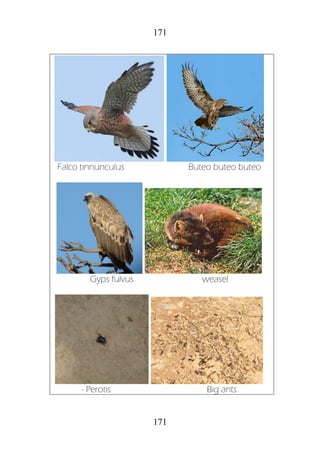
  • 54.
    54 54 persons) must bescheduled in advance Need to know: Founded in 1919. Till then all the Ethnographic material was collected in the National Museum Interesting fact: The museum is located a remarkable Secession palace , the former Museum of Commerce and crafts Hidden facts: One of the rare museums that has a goal to stimulate creativity, desire for exploration, preservation and responsible attitude towards cultural heritage Details about the point Croatian National Theatre [Hrvatsko Narodno Kazalište HNK]
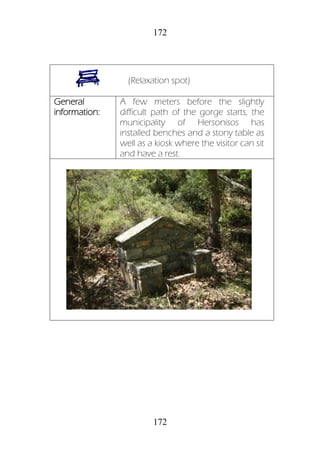
  • 55.
    55 55 General information: http://www.hnk.hr/en/ Box Office openinghours: MONDAY TO FRIDAY: from 10 a.m. to 7. 30 p.m. SATURDAY: from 10 a.m. to 1 p.m. and 90 minutes before performance SUNDAY: 90 minutes before performance Special information: Tickets can also be bought online Need to know: The current theatre was ceremoniously opened on October 14, 1895 Interesting fact: The paintings on the ceiling of the auditorium were created by the Viennese painter and decorator Alexander Demetrius Goltz. The ceiling of the Foyer on the first floor was painted by Ivan Tisov (in 1911). The author of four busts, on the forepart (Ivan Gundulic and Junije Palmotic), on the eastern (Dimitrije Demeter) and on the western side of the building (Vatroslav Lisinski) is unknown. The construction was progressing according to plan and after sixteen months, on October 8, 1895, the building received its certificate of occupancy.
  • 56.
    56 56 Hidden facts: TheNational theatre is connected to neighbouring academy via underground tunnels. Details about the point Marko Marulic Square & State Archive [Trg Marka Marulića i Državni Arhiv] General information: http://www.arhiv.hr/en/index.htm The Croatian State Archives is located in a distinguished art nouveau building which is recognized by most people as the old building of the National and University Library. Working hours: Monday through Friday, 8:00 to 16:00
  • 57.
    57 57 Special information: The ticket fora guided sightseeing of the building is 4 Euro for adults and 2 Euro for pupils, students and retirees Group guided sightseeing possible by appointment only. For arranging group visits after working hours; on the weekend or after 8 pm. During holidays the price is 50% higher Need to know: The Archive building hosts: Management, the Reading Room, the Department for Preservation and Arrangement of Archival Records, the Department for Information and Communication, the IT Department, the Central Laboratory for Conservation and Restoration, the Central Laboratory for Photography, the Department of Comprehensive and Financial Service and Zagreb Archdiocese’s Department of Metropolitana Library Interesting fact: The Croatian State Archives holds more than 23.500 linear meters of archival records, dating from the 10th century to the present day and arranged into more than 1.850 archival funds and collections Hidden facts: Though may become mesmerize by the sheer beauty of the building and its interior those who look up will discover
  • 58.
    58 58 the holders ofthe wisdom. Most of the information was gathered from various internet sites and from official sited to which links were provided. We would also like to thank to Zagreb tourist centre for providing for the city map.
  • 59.
    Details about theroute Name of the route: Park Maksimir and Zagreb ZOO Length: ≥1.5 km Time needed: ≥1h Difficulty mixed Equipment requirements: Comfortable walking shoes and appropriate seasonal attire Park Maksimir is the first public promenade in Southeast Europe. It is situated on the Southern parts of Medvednica foothills. It was originally formed on the outskirts of Zagreb but as a result of sudden urbanisation it is now completely surrounded with city settlements. We would like to say thank you to Park Maksimir and their management for allowing us to use the materials; and also to all who worked hard to created the materials the park gave to us.
  • 61.
  • 62.
    62 62 Phrase Book –phrases and words you might find useful while visiting English Native language and script Pronunciation Please Molim moh-leem Thank you Hvala flah-lah Left Lijevo lee-yevoh Right Desno deh-snoh Straight Ravno RAHV-noh Back Nazad Walk Hodajte What is the time? Koliko je sati? KOH-lee-kee yeh sati How do you get to… Kako doći do... KAH-koh do chee do How do you get there? Kako se dođe do tamo? KAH-koh do gje do tamo Where is the toilet? Gdje je WC? gdyeh jeh- vece How long is the… Koliko dugo/daleko je.... koh-lee-koh - duugho How much is it? Koliko to košta? koh-lee-koh toh kost-teh Are there any special children rates? Ima li popusta za djecu? EE-mah lee Are there any special family rates? Ima li popusta za obitelji? EE-mah lee
  • 63.
    63 63 Germany has over80 million inhabitants. In NRW, most people live in Germany, namely 18 million. That's quite a lot! Hi kids, surely did you ever wondered what NRW means at all. Well, this is an abbreviation for North Rhine-Westphalia. NRW is one of the 16 federal states. All states together form Germany. A distinctive mark of NRW - the coat of arms Our state also has a coat of arms, which is a kind of flag. Such as the flag of Germany, which you've surely seen it before. Each state has a different coat of arms. All crest
  • 64.
    64 64 have a specialmeaning. The emblem of North Rhine-Westphalia is divided into three parts. Each part is a sign of a country's section of NRW: Rhineland, Westphalia and Lippe. The white stripe on the left represents the Rhine. The animal on the right is a horse. This white horse is also Westfalen horse, because it is the Westphalia region. Slightly smaller, the bottom center, you realize a red flower. It is also called "Rose of Lippe" and is a symbol for the region "lip".
  • 65.
    65 65 Each state alsohas a state capital. In NRW is as Dusseldorf. There, the government of the province sits. In the big cities, many people live in many houses packed tightly together. Big cities are, for example, Cologne, Dortmund, Essen or Duisburg. Dusseldorf is a huge city with more than 800.000 people in the area North Rhine Westphalia closed by the Rhine. Kaiserswerth is one of the oldest parts of the City of Dusseldorf. It is in the north of the city and next to the river Rhine. It is a very beautiful area with a lot nice of things to see, to walk around on foot or bike and also space for rest, fun and sports activities. See the route for famous places, enjoy and have fun….
  • 66.
    Details about theroute Name of the route: Around the historic places in Kaiserswerth and along the Rhine Length: 7,4Km Time needed: Ca. 3hours Difficulty no Equipment requirements: on foot or with bike Legend Sport event/arena/hall Playground Park View point Church Resting place Ruins Cycling Bird watching River Normal difficulty
  • 67.
    Details about thepoint Start Kaiserswerther Markt No. 1 General information: Kaiserswerth is one of the oldest parts of the City of Dusseldorf. It is in the north of the city and next to the river Rhine. Kaiserswerther Markt was in the past till now a market place, Here surround the market are very nice old house, very restaurants, shops, library and lots more… Special information: About the year 700 the monk Saint Suitbert founded a Benedictine abbey at Werth, a river island had formed an important crossing point of the Rhine. The abbey was destroyed 88 years later. Need to know: Kaiserswerth is connected to the central stations and the central districts of the cities of Düsseldorf and Duisburg by the metropolitan railway line U 79. There are some bus lines to other parts of Düsseldorf, and cities like Ratingen, Mettmann and also to the international airport. Interesting fact: Basilika, Ruin of the Kaiserpfalz in Kaiserswerth, Hidden facts:
  • 68.
    68 68 Details about thepoint No, 2 Burgallee + Rhineway to Lohausen General information: Next on the Burgallee behind the local "courtyard" is right on the Rhine, the mighty ruins of the Emperor Frederick Barbarossa Pfalz in the 12th century. And only a few meters ahead on the Flood dam already appeared the choir of the Romanesque church of St. Suitbertus. Imperial palace, church and Stiftsplatz offer so many attractions that they have been presented in a separate article on Kaiserswerth, read more here. Special information: On the way falls on a rock with pyramidal roof and enigmatic inscriptions, a so-called Myriameterstein. He wears the Roman numeral 59, and was one of 67 stones were set up, the mid-19th century on both sides of the Rhine at a distance of 10,000 meters, as the Rhine was measured. The inscription gives the distance to the starting and end points, Basel and Rotterdam, on. In Meerbusch-Nierst on the left side of the Rhine is the counterpart to the Wittlaerer Myriameterstein. Stone no. 58 is located on Niederlöricker dike.
  • 69.
    69 69 Need to know:Kaiserswerth was Treidelstation with change of horses. Elector Carl Theodor had set up the station in 1775. As is known, attracted horses (and humans!) The vessels on long lines upstream until the motor boat trip to the mid-19th century made Interesting fact: You can change and cross the Rhine boat for less money Hidden facts: Details about the point No.3 Lantz´scher Park General information: Lohausen is also a part of Dusseldorf. It is a nice way by bike or for a walk at Rhine to visit Lohausen and the beautiful park Lantzsche Park is a 14.5-acre green space in Düsseldorf's Lohausen. Special information: 1804 acquired Heinrich Balthasar Lantz the knight seat Lohausen Ferdinand Freiherr von Calcum called Lohausen. Presumably 1805-1806 the mansion of Lantz family was built on the foundations of the old water castle. 1878-1879 followed by the construction of the funeral chapel of Lantz family.
  • 70.
    70 70 Need to know: The parkwas created comprised three phases. The middle part was made from an old forest plot shows that is already entered in a map from 1702 ("siege of Kaiserswerth" 1702 lithograph by Bouffard, from: Lamigue, Histoire du Prince d'Orange et de Nassau, Leeuwarden 1715, copper engraving , Dusseldorf City Museum, inventory IV 284). The park in the front area around the mansion was built after the plan by Joseph Clemens Weyhe of 1858 in the style of the English landscape garden Interesting fact: Hidden facts: Details about the point No.4 Niederrheinstraße/ Alte Landstraße General information: On the way back to Kaiserswerth you go by tram, bike or you can also walk by the mainstreets which connect Lohausen and
  • 71.
    71 71 Kaiserswerth. The Name ofthe street from Lohausen is called Niederrheinstraße and after the first Cross in the direction Kaiserswerth – there is the next Street Alte Landstraße Special information: Tram station Lohausen is called Flughafenstraße with the Underground U79 Direction Duisburg Need to know: You can by ticket at the automat at the tram station or also in the tram Interesting fact: Here also for special ways cycling Hidden facts: Details about the point No.4 Alte Landstraße / Kaiserswerther Diakonie General information: The Kaiserswerther Diakonie in Dusseldorf in North Rhine-Westphalia was founded in 1836 by the Protestant pastor Theodor Fliedner and his wife Friederike first Diakonissenhaus. Special information: Today, the facility is one of approximately 2,300 employees to the big diaconal social and health services in Germany. Gradually the Kaiserswerther Diakonie has grown, has
  • 72.
    72 72 taken up thelatest developments and opens up new facilities. For example.In 2011 started operating the FliednerFachhochschule Dusseldorf Need to know: Today, the company consists of four core areas: social services, which include not only the youth and family welfare services for disabled and mentally ill, the elderly with residential, leisure and care services for the elderly, as well as the education of more than 2,100 education and training courses in various vocational schools. The fourth core area, the Florence Nightingale Hospital; is known with ten specialist clinics and more than 600 beds far beyond the city limits. Interesting fact: Directly closed by is a very nice outdoor pool and also a big football place Hidden facts:
  • 73.
    73 73 Details about thepoint No.5 Schloss Kalkum General information: Kalkum was in the past also like Kaiserswerth and Lohausen a small village. Today a nice place to live closed to the Forest. In Kalkum is wonderful castle. Special information: The Castle of Kalkum is a moated castle in the same district in the north of Düsseldorf, about two kilometers northeast of Kaiserswerth and an extraordinary example of the neoclassical palace in the Rhineland. Together with the associated park it is since 18 January 1984 as overall plant conservation. Need to know: You have no to pay entrance and everybody can visit the park and can make picnics at special places, Families enjoy that very much! Interesting fact: Emerging from one of the oldest knight seats in the region, [3] the headquarters of lords of Kalkum, the possession came to the mid- 15th century to the Lords of Winkelhausen which should determine the fate of the plant for the following 300 years. In the 17th century to a castle in the Baroque
  • 74.
    74 74 style changed, theplant received its current exterior appearance substantially by a Classicist reconstruction in 1808 and 1814 designed by the architect Georg Krefeld Peter Leydel. Hidden facts: Details about the point No.6 Kalkum to Wittlaer General information: To reach Wittlaer, it is necessary inside in the direction of Kaiserswerth on the Kalkumer drive Castle and then the Castle Kalkum right in the narrow country road. The village name of Kalkum refers Yes like so much here in the region on the rock trading with the burnt lime, lime and the burning of limestone. For centuries has mined this valuable raw material to build and the smelting of the ore in this area in the limestone quarries, burned in lime kilns, and transported to buyers on the lower Rhine and in the Netherlands. Special information: Here you are in these area in middle of fields, forest and not far to the Rhine!
  • 75.
    75 75 Need to know:After Wittlaer under next it goes to the beautiful restaurant on the Rhine "Brands Jupp" Fire it Jupp is a traditional hotel and since 1874 in the possession of the family. It is located directly on the Rhine - in combination with a very beautiful Beer garden - coming up on a light holiday feeling. Interesting fact: Art treasures in the church of Wittlaer Wittlaer since 1975 belongs only to Dusseldorf, but was already mentioned in documents in 1144 and has maintained its traditions until today, for example with its own Carnival. The Romanesque church of St. Remigius, a pillar basilica from the early 13th century, is picturesquely situated near the Rhine. Inside there are many precious things. The art- loving priest Franz Vaahsen commissioned in the 1920s and '30s famous artists with the decoration of the church: Johan Thorn Prikker and Ewald Mataré designed stained glass windows for St. Remigius, a painting by Heinrich Nauen hangs in the nave. From Mataré the crucifixion group originated in the south aisle, Thorn Prikker the hunger cloth.
  • 76.
    76 76 Hidden facts: Herealso for special ways cycling Details about the point No.7 Leinpfad/ Way back to Kaiserswerth by the rhine General information: Wittlaer is also a part of Dussseldorf - it is connected with a beautiful way at the Rhine landscape. Special information: Tourists and the residents like to walk, to sit and to have a beautiful view in nature and the Rhine area. Need to know: Here are no cars but it is a fantastic way for jogging, cycling and skating. Interesting fact: The beautiful half-timbered building "Haus Werth" was the home of Treidelstation of Wittlaer! Hidden facts: Details about the point Stiftsplatz General You reach again Kaiserswerth and I will
  • 77.
    77 77 information: show oneof the most beautiful places in Dusseldorf . It is called “Stiftplatz” Special information: Due to its quiet location and its affiliated buildings, the square belongs to the most beautiful places of the lower Rhine. Need to know: From the monastery of Suitbertus became an Abbey in the 11th century. The present building is largely from the first half of the 18th century, the time of reconstruction after 1702. Interesting fact: Most of the houses were built by the canons. Several coats of arms and inscriptions give knowledge thereof Hidden facts: Details about the point No.9 The end of the tour/ Restaurant Burghof General information: The courtyard ( Burghof) is a place... where relaxation, culture and meet friends Special information: The beer garden is the "heart" of the Gallery courtyard. This is one of the most idyllic places in
  • 78.
    78 78 completely Düsseldorf islocated directly next to the Imperial Palace and adjacent to the river Rhine. With a cool glass of beer you can here enjoy the sunset over Düsseldorf best. But also on sunny winter days, it pays to look to warm up with a hot cup of Glühwein or chocolate. The beer garden has space for 300 people. SAT is a rustic wood set made of real logs. Need to know: The German like to sit in beer gardens with friends and family. Interesting fact: Here you can eat delicious different kind of pancakes and lots of more….and children here are special Welcome! Hidden facts:
  • 79.
    79 79 Phrase Book –phrases and words you might find useful while visiting English Native language and script Please Bitte Thank you Danke Left links Right rechts Straight geradeaus Back rückwärts Walk Gehen/ Spaziergang What is the time? Wieviel Uhr haben wir? How do you get to… Wie kommst du zu?? How do you get there? Wie kommst du dahin? Where is the toilet? Wo ist die Toilette? How long is the… Wie lang ist der,die…? How much is it? Wie teuer ist das? Are there any special children rates? Gibt es eine Kinderermäßigung? Are there any special family rates? Gibt es irgendeine Familienermäßigung?
  • 80.
    80 80 Ireland is anisland nation on the Western edge of Europe. It is aroung 69,000 sq. km and over 4 ½ million people live there. We have our own language, Irish, and we all speak English too. Ireland is sometimes called the Emerald Isle because the landscape is very green. Our school is in the North West of Ireland, on the river Foyle, It is a country area with lots of farms and small towns. We are near a small city called Derry which is across the border in Northern Ireland.
  • 81.
    Details about theroute Name of the route: Carrigans –Derry Cycle Length: 20km Time needed: 3 HOURS Difficulty Medium Equipment requirements: Bicycle, helmet Legend Cycling View point Park Resting place Sport event/arena/ hall Playground
  • 82.
    Grading System forthe spots Phrase 1 to 10 Don’t Bother! 1 Pretty Boring 2 Worth seeing 3 OK but wouldn’t go back 4 Fun 5 Cool! 6 Heaven! 7 Pure class! 8 Don’t miss it! 9 Best thing ever! Awesome! 10 1. Carrigans General information: Drive to the starting point, right turn at sign for Donegal Meats about 500 m from Carrigans. Child’s comment and score ‘ Safe to cycle without cars’ 5/10 Need to know: The route follows the railway line Interesting fact: This cycle route is called the Foyle Valley Greenway Hidden facts: Be careful, there’s a steep hill near the start
  • 83.
    83 83 2. Foyle RailwayMuseum General information: Foyle Railway line with views along the river Child’s comment and score “The view along the water was cool!” 7/10 Need to know: There is a small railway museum which takes around 30 minutes to visit.. Interesting fact: The railway opened in 1847 and closed in 1965. Hidden facts: A ticket from St Johnston to Derry cost 4d which is about 2 cent!
  • 84.
    84 84 3. The Guildhalland Peace Park General information: A little park in the centre of the city. Child’s comment and score “It made me think a lot about peace” 6/10 Need to know: Across the road you can see the walls of Derry- a walk along these walls is a great lesson in history. Interesting fact: The Peace Flame wasn’t lit the day we visited. Hidden facts: Look carefully for the plaque on the ground designed by our school. 4. The Peace Bridge General information: The Peace Bridge is a cycle and foot bridge opened in 2011. Child’s comment and score “It feels like you are rocking on the sea” 9/10 Need to know: It is a symbol of reconciliation between the communities who live on each side. Interesting It cost £14 million.
  • 85.
    85 85 fact: Hidden facts: Anew postage stamp is going to feature the Peace Bridge 5. St. Columb’s Park General information: It’ s a short cycle from the end of the bridge to the park. Child’s comment and score “Great to get off the bike and run around” 7/10 Need to know: Entry to the park and playground is free. Interesting fact: The oldest building in Derry is the church of St. Brecan in the park. Hidden facts: The Irish name for Derry is “Doire” which means ‘oak’.
  • 86.
    86 86 6...Resting stop inthe Park General information: There are many places to rest in the park. Child’s comment and score “Lovely and quiet for a picnic” 6/10 Need to know: There is a cafe in the park if you don’t want to picnic. Interesting fact: The park is named after St Colmcille. Hidden facts: See if you can spot a squirrel running around. 7- Adventure Playground General information: Really great adventure playground. Child’s comment and score “Amazing! Everything a child would need! 9/10 Need to know: There’s a bike stand on the way into the playground. Interesting fact: There are 4 different areas in the playground.
  • 87.
    87 87 Hidden facts: There’sa great view from the top of the tower. 8. Children’s Playground General information: A short distance away is the children’s playground Child’s comment and score “Safe for younger children” 8/10 Need to know: The playground is for age 8 and under. Interesting fact: The park is enclosed so parents can relax. Hidden facts: The adventure playground is more fun.
  • 88.
    88 88 9.Foyle Arena LeisureCentre General information: Sports centre with pool, climbing wall, sports halls and gym. Public Toilets Child’s comment and score “Class Place” 10/10 Need to know: Climbing wall costs £3.75 for under 18s. Interesting fact: Just opened in April 2015. Hidden facts: The climbing wall is the highest in Ireland.
  • 89.
    89 89 10.....Guild Cafe General information: Open 9:30-5.00The Guild Cafe is in the Guildhall, one of Derry’s best known buildings. Child’s comment and score “Good to sit down—food is yummy1” 8/10 Need to know: Prices are in sterling. Interesting fact: It’s free to go inside and see the beautiful stained glass. Hidden facts: You can sit outside and keep an eyeon your bikes.
  • 90.
    Details about theroute Name of the route: Oakfield Park , Raphoe Length: 3km Time needed: 3 Hours Difficulty Easy Equipment requirements: None Legend Walking View point Park Resting place Castle Lake Nature Park
  • 91.
    1. Tea Van General information: Thisis where you buy your tickets Child’s comment and score “The staff are very kind and friendly.” 9/10 Need to know: Cost: €25 for a family including a train ride Interesting fact: The park is open from 12-6, Wed- Sunday. Hidden facts: The park is owned by the Robinson family who live in the main house. 2. Train Station and Train Ride General information: The train goes all around the lower gardens. Child’s comment and score “Like a train ride around heaven!” 10/10 Need to know: Fun way to see all around the park. Interesting There are 2 trains and the ride takes 20
  • 92.
    92 92 fact: minutes. Hidden facts:The castle is not as old as it looks! 3. Faerie Tree General information: Get a little tag at the tea van and write your wish on it. Child’s comment and score “It feels magical!” 10/10 Need to know: Then tie your wish onto a branch of the Faerie tree Interesting fact: Fairies like to be called “The wee Folk” Hidden facts: Wait and see if your wish will be granted.
  • 93.
    93 93 4. Longsleeper General information: It wasunveiled in Easter 2015. Child’s comment and score “It’s like it’s moving -it can’t stay still” 9/10 Need to know: It was designed by Locky Morris. Interesting fact: He also designed ‘Polestar’ in Letterkenny. Hidden facts: It is made from 17 tons of oak.
  • 94.
    94 94 5 .Rest Stop:Tea Tent and Swings General information: The tea tent is not open every day. Child’s comment and score “Relax and have a swing!” 7/10 Need to know: There are toilets in the train station Interesting fact: We saw a family of swans. Hidden facts: The tea van sells home baking.
  • 95.
    95 95 6. Nymphaeum General information: A Nymphaeumis a room to relax in, built near water. Child’s comment and score “Feels like you are back in time” 8/10 Need to know: Take care crossing the road on the way. Interesting fact: Lovely views over the gardens. Hidden facts: Nymphaeums were first built by Greeks and Romans.
  • 96.
    96 96 7 Boardwalk General information: A woodenpathway stretching over the water. Child’s comment and score “Scary” 7/10 Need to know: Take your time-don’t fall in! Interesting fact: Great place to see nature up close. Hidden facts: Watch out for the terrifying black swan! 8.Heather’s Point General information: To the right of the path is this secluded viewpoint. Child’s comment and score “Just like a picture frame” 8/10 Need to know: Cross over the Red Bridge next. Interesting There is a lovely view of the
  • 97.
    97 97 fact: Nymphaeum fromhere. Hidden facts: Lady Heather lives in the main house. 9. General information: There are beautiful fromal gardens behind the house. Child’s comment and score “I loved the different coloured fish in the pond” 9/10 Need to know: There is als a walled garden and a greenhouse. Interesting fact: Sometimes flax is grown here. Hidden facts: Long ago, flax was grown locally and used to make linen clothes.
  • 98.
    98 98 10. General information: This is oneof the many sculptures in the park. Child’s comment and score “Feels like you are sitting beside someone” 8/10 Need to know: There are lots of places to sit as you walk around. Interesting fact: This sculpture is made of copper. Hidden facts: There is a somewhat similar sculpture in Central Park , New York of Hans Christian Andersen. 11. Front Lawn General information: The massive lawn is great for running down. Child’s comment and score “Felt like you were free” 10/10 Need to know: Stop running before you get to the
  • 99.
    99 99 lake! Interesting fact: OakfieldPark is more than 100 acres. Hidden facts: One of the number plates on the garden vehicles says ‘April 1” Phrase Book – phrases and words you might find useful while visiting English Native language and script Pronunciation Please Led’thoil Leh daw hull Thank you Go raibh maith agat. Go row myh ugat Left Ar chlé Air clay Right Ar dheis Air yesh Straight Díreach Jeerah Back Arais Airash Walk Siúil Shule What is the time? Cén t-am é..? Cane tam ay? How do you get to… Cén áit a bhfuil....? Cane atch a wul…?
  • 100.
    100 100 How do you getthere? Cen dóigh a fhaigheann tú go dtí... Cane doy a ayin to go jee Where is the toilet? Cá bhfuil an leithreas? Kah wul an layhris How long is the… Cá fhad a bhfuil.... Kah had a wul How much is it? Cé mhéad atá sé.. Kay vade atah shay Are there any special children rates? Cé mhéad dona páistí? Kay vade dona pashtí Are there any special family rates? Cé mhéad don teaglach? Kay vade don chowla?
  • 101.
    101 101 One of thefirst things one can notice after the arrival to Slovenia is an extraordinary dynamical diversity of the different types of landscape. Driving across Slovenia makes one feel as though he or she has driven across several countries in a very short time. In a very small part of Europe nature has joined and interwove a whole array of landscape diversity. Mighty alpine mountain tops with steep mountain walls have been linked together with deep Karst caves and abysses, softly rounded hillsides, and the planar expanses which all embellish the Slovenian surface. The latter also includes lovely lakes and bubbling streams, the silence of the forests and the roaring sounds of sea waves. In more graphic geographic terms this means that Slovenia lies at the crossroads of the Alpine, the Mediterranean, the Pannonian, and the Dinaric worlds which have all left a mark on the Slovenian landscape.
  • 102.
    102 102 Nature, however, hasawarded Slovenia with an exceptional diversity and the variety of natural features which is still well preserved today. More than a third of all the territory is protected within the European network of nature protection areas Nature 2000, whilst the valuable areas are declared as natural parks and Reserves. Slovenia is a European country with the third largest share of forests. If you want to enjoy a visit to this small country, you will, apart from the natural beauty, get to admire the kind people and the architectural sights. Adapted from the website: www.slovenia.info Although Ljubljana is in terms of size classified among the middle-size European cities and as such maintains the attractive charm of a smaller city, it actually has everything all the biggest capitals have- it is the political and cultural heart of the Slovenian nation, an important European commercial, business, congress, and fair centre, as well as the traffic, scientific, and educational nucleus of Slovenia. In the city of Ljubljana the old is kindly mixed with the new and it seems that the history of all the past five
  • 103.
    103 103 millenniums, which isthe supposed age of the settlement in this surrounding, has prepared the city to become the state capital. Ljubljana is a cultural city; it is home to several theatres, museums, and galleries, and it prides itself on having one of the oldest Philharmonics in the world. During warmer months numerous coffee tables fill up the banks of the Ljubljanica River and the squares of the old city centre. Here the inhabitants of Ljubljana meet for morning coffee after a nearly mandatory Saturday visit to the Ljubljana market or the Sunday flea market, or for an evening chat with friends. If you are in need of a solid assurance that Ljubljana is interesting, lovely, and nice, you will probably be convinced by the fact that all the people living in Ljubljana are "in love" with it and that its name, if we follow one of the etymological explanations, actually means "beloved". Adapted from the website: www.ljubljana.si
  • 104.
    Details about theroute Name of the route: "The path along the wire" – The Path of Remembrance and Comradeship. Length: 6 KM (Ring 33 KM) Time needed: 2 hours Difficulty Equipment requirements: Sports footwear, comfortable clothing. Grading System 1-10 FUŽINE BRIDGE 5 TRIM TRAIL EXERCISE STATION 7 GOLOVEC 10 FUŽINE CASTLE 6 LABYRINTH OF ART 5
  • 105.
    Legend View point River Resting place Park ChurchWalking Castle Theatre Viewing tower
  • 106.
    FUŽINE BRIDGE General information: The FužineBridge (Slovene: Fužinski most) is one of the bridges crossing the Ljubljanica River. Special information: In the middle of the bridge there is a chapel. Need to know: The bridge is open to traffic. Interesting fact: It was built in 1987, based on the plans by Peter Gabrijelčič, the recipient of the Prešeren Fund Award for this architectural design in 1988. Hidden facts: / TRIM TRAIL EXERCISE STATION General information: Trim station includes 6 types of exercises for fitness in nature. Special information: Trim station is part of the trim track on "The path along the wire". Need to know: The use of devices is free of charge. Interesting fact: All fitness equipment is made of wood. Hidden facts: "The path along the wire" - Path of Remembrance and Comradeship (presents a post-war reminder of the times when Ljubljana was encircled by barbed wire) serves as the city recreational ring. GOLOVEC General Golovec is a hill rising above the Eastern
  • 107.
    107 107 information: part ofLjubljana. Special information: Throughout the path there are several springs which offer drinkable water. Need to know: Suitable choice of footwear is recommended. Interesting fact: In the past Golovec was mainly treeless - therefore the name Golovec ("The Bare One"). Afforestation did not begin until 1890. Hidden facts: Over the hill there runs "The path along the wire". FUŽINE CASTLE General information: The Renaissance Fužine Castle is situated at a picturesque location along the Ljubljanica River, on the city outskirts. Special information: The Fužine Castle also hosts the Museum of Architecture and Design. Need to know: The function halls and rooms can host business meetings, receptions, promotional events, conferences, wedding ceremonies, etc. Interesting fact: There are excellent exhibitions on architecture, design and photography, taking place at the Fužine Castle. Hidden facts:
  • 108.
    108 108 Almost all thedistinguished Slovene architects and designers from the twentieth century, as well as many photographers, are represented in the Museum’s art fund, amounting to more than 1,000 authors. LABYRINTH OF ART General information: The Labyrinth is intended for people who want to pay an enjoyable visit to the green areas to relax their minds, to
  • 109.
    109 109 get rid ofstress, and to refill their bodies with revitalising energy. Special information: Walking through the greenery, at the centre of the labyrinth there is always a book waiting for visitors to relax with additionally. Need to know: Interesting fact: Visitors can decide to take or bring a book that they want to share with others. Hidden facts: Every person can become a custodian of only one of the 287 Canadian hemlock trees in the Labyrinth of Art. When you "buy" your tree, your "ownership" will be marked in the following way: The custodian of this tree is: (inserted) your name and surname.
  • 110.
    Details about theroute Name of the route: Zajčja dobrava Length: 5 km Time needed: 1 h Difficulty Equipment requirements: Sports footwear and sportswear. Grading System Phrase 1 to 10 1. A Monument to the Fallen Soldiers of 2nd World War 6 2. The Plague column 8 3. The Horse Chestnut 5 4. Zajčja dobrava 7 5. Restaurant and pizza house Zajčja dobrava 5 6. Three monuments of a local artist 6 Legend Sport event/arena/hall View point Walking Playground Nature Park
  • 111.
    Details about thepoint 1. A Monument to the Fallen Soldiers of 2nd World War General information: The Monument is situated in the centre of Zalog, by the main road junction. Special information: The Monument is work of a sculptor Stane Kolenc from 1951. It is a bronze sculpture of a wounded combatant placed on the base of the stone blocks which are embedded in the granite slabs with the names of the fallen soldiers of the Resistance Movement in 2nd World War. Need to know: Interesting fact: Hidden facts:
  • 112.
    112 112 Details about thepoint 2. The Plague column General information: The Column stands on the opposite side of the Monument to the Fallen soldiers in the centre of Zalog. Special information: The Column was erected in 1793 by locals as a memorial of the plague that raged in these places for many centuries. Need to know: Interesting fact: The column originally had a cross at the top which was later forcefully removed in an act of vandalism. Hidden facts:
  • 113.
    113 113 Details about thepoint 3. The horse chestnut General information: A big horse chestnut is situated next to the railway. Special information: In autumn one can collect its seeds and use them for playing (conkers), art or for medicinal purposes. Need to know: Interesting fact: The seed of a horse chestnut is used in medicine for its venotonic effect, vascular protection, as well as for its anti-inflammatory and free radical scavenging properties. Hidden facts:
  • 114.
    114 114 Details about thepoint 4. The Landscape park of Zajčja dobrava General information: A Landscape park Special information: The park offers lots of recreational activities, such as jogging, trekking, and cross-country skiing in wintertime. There are two playgrounds and picnic areas. There is a possibility of horse-riding (payable option). Need to know: Interesting fact: The agricultural area of Zajčja dobrava and its surroundings is well-known for the cultivation of cabbage. Every September an ethnological and entertainment event called »Zeljada« is organised in Zajčja dobrava. On the last Sunday in August an Equestrian event is organized in Zajčja dobrava. It is an opportunity for visitors to see different breeds of horses and various displays of old crafts related to horses. They can also admire the skills of the horses and their riders. Visitors can even take a free ride on a horse- drawn carriage Hidden facts:
  • 115.
    115 115 Details about thepoint 5. Restaurant and pizza place Zajčja dobrava General information: The restaurant is open every day from 11am to 10pm.
  • 116.
    116 116 Special information: The restaurant offersclassical meals and pizzas; it also has a playground for children. Need to know: Interesting fact: Hidden facts: Details about the point 6. Three monuments of a local artist General information: Three monuments within a few-meter distance are situated by the road Zajčja dobrava. Special information: The Monuments are inspired in historical and religious tradition of the area. Need to know: Interesting fact: The Monuments are built of different waste material (metal, wood, construction material, etc.) Hidden facts:
  • 117.
  • 118.
    Details about theroute Name of the route: Destination Mountain lodge Janče Length: 2 km Time needed: 1 h Difficulty Equipment requirements: Appropriate sports footwear and sportswear Grading System Phrase 1 to 10 1.Chapel of Saint Nicholas 6 2. Sports club 10 3. Mountain lodge Janče 9 Legend Sport event/arena/hall View point Church Playground Resting place Walking Park Sledging course Hiking
  • 119.
    Details about thepoint 1. Chapel of Saint Nicholas General information: Chapel of Saint Nicholas, which was built in 1895. When a strong earthquake hit Ljubljana, Ljubljana set out to be Mother of God guardian against such disasters. Special information: If you are standing in front of the Chapel, you have a spectacular view over Ljubljana and its city outskirts. Need to know: Interesting fact: Hidden facts: Details about the point 2. Sports club General information: Sports club Janče is situated in the middle of a forest; it offers a lot of welcoming shade and it is appropriate for a variety of sports events. Special information: It has a football pitch, a volleyball court and a place for outdoor
  • 120.
    120 120 bowling. Need to know:There is a possibility of organising a picnic here. Interesting fact: Hidden facts: It is in the middle of a forest, so it is necessary to be protected with repellents. Details about the point 3. Mountain lodge Janče General information: It is at 794 metres of altitude. Special information: Janče is a well- known excursion and hiking destination, which is especially attractive in spring and autumn when there are ripe cherries and chestnuts. From Janški hill there is a beautiful view over all the surroundings. Need to know: On all Sundays in October there is a Chestnut festival with traditional food and live folk music. Interesting fact: There is the possibility of accommodation and food on offer. Also, there is a little farm for kids and a
  • 121.
    121 121 playground. Hidden facts: Details aboutthe point 4. View from Janče General information: A nice view over the surrounding hills. Special information: Janče is a 794 metres high peak, which is located between the Sava river and the Besnica stream valley.
  • 122.
    122 122 Need to know: Sledding ispossible In winter time. Interesting fact: There is a very nice view which extends to the surrounding hills of the Posavsko. In case of good visibility, the view extends all the way to the Alps in the North and in the West as well as to the South, all the way to the highlands of Snežnik. Hidden facts:
  • 123.
    Details about theroute Name of the route: Debni vrh hills Length: 7.85 km Time needed: 1 hour Difficulty Equipment requirements: Sportswear, sports footwear Grading System Phrase 1 to 10 THE CLIMB 3 DOWNHILL 5 ZALOG 3 STREAM 9 RESTING PLACE 7 LOOKOUT TOWER 9 VIEW 7 Legend Resting place Nature Park Cycling Hiking Viewing tower River Lake View point
  • 124.
    START ZALOG General information:START- Zalog Special information: The railway line underpass Need to know: The underpass is marked with “HELLO” sign Interesting fact: When you come out of the underpass, the path begins to become steeper quickly Hidden facts: The path is not marked in the most apparent way, but it shows signs of having been walked on many times.
  • 125.
    125 125 POTOČ EK General information: A STREAM Special information: Afterthe last climb a stream flows along the path. Need to know: In the stream water collector there is drinkable water. Interesting fact: Hidden facts: THE CLIMB General information: Three shorter, but steeper climbs, with some more planar parts in between. Special information: The whole path runs through the forest. Need to know: The path is suitable for all kinds of weather. Interesting In summer time you can pick
  • 126.
    126 126 fact: blueberries andmushrooms along the path. Hidden facts: DOWNHILL General information: Downhill biking track. Special information: A very steep slope of the hill. Need to know: Lots of roots. Interesting fact: Intended for experienced cyclists- downhill. Hidden facts:
  • 127.
    127 127 A RESTING PLACE General information: Aresting place with a bench and a table. Special information: A rest before the crossroads of the Ostrovrharjeva path, Stari grad and the Debni vrh hills. Need to know: There are two more steep climbs until the Debni vrh hills destination. Interesting fact: We are half way up the Debni vrh hills. Hidden facts: A LOOKOUT TOWER General information: A lookout tower. Special information: At the top there is a wooden lookout tower. Need to know: From the lookout tower you can see a part of the Ljubljana basin. Interesting
  • 128.
    128 128 fact: Hidden facts: THE VIEW General information: Agreat view. Special information: There is open view over the valley. Need to know: In summer months there are denser trees and therefore the view is a bit obstructed. Interesting fact: You can see the whole valley; Kašelj, Zalog and Polje- all parts of Ljubljana. Hidden facts:
  • 129.
    129 129 Phrase Book –phrases and words you might find useful while visiting English Native language and script Please Prosim. Thank you Hvala. Left Levo. Right Desno. Straight Naravnost.
  • 130.
    130 130 Back Nazaj. Walk Hoja./Hoditi. What is the time? Koliko je ura? How do you get to… Kako priti do…? How do you get there? Kako priti do tja? Where is the toilet? Kje je stranišče? How long is the… Kako dolga/ dolg je…? How much is it? Koliko stane? Are there any special children rates? Obstajajp posebne tarife za otroke? Are there any special family rates? Obstajajo posebne tarife za družine?
  • 131.
    131 131 Greece with atotal area of 131,957 sq km and population of 11,3 millions is located in south-eastern Europe, and consists of three main geographic areas: a peninsular mainland (that extends from the region of Central Greece on the South to the region of Thrace on the North) being the biggest geographic feature of the country the Peloponnese peninsula that is separated from the mainland by the canal of the Corinth Isthmus, and around 6.000 islands and islets, scattered in the Aegean and Ionian Sea, most of them grouped in clusters, that constitute the unique Greek archipelago. Crete, Rhodes, Corfu, the Dodecanese and the Cyclades are some of the famous and popular islands and island clusters in Greece.
  • 132.
    132 132 Eighty percent ofthe country consists of mountains or hills, making Greece one of the most mountainous countries of Europe; furthermore, it has 16.300 kilometers of coastline of which 7500 are found around the thousands islands of the Greek archipelago, a truly unparalleled phenomenon on the European continent. Today’s visitors to Greece have the opportunity to trace the “fingerprints” of Greek history from the Paleolithic Era to the Roman Period in the hundreds of archaeological sites, as well as in the archaeological museums and collections that are scattered throughout the country. Crete is the biggest island and the most southern region of Greece. It is 260 km long and 56 km at its widest point. The area is 8,260 sq km. and the population is close to 600,000. Crete is an island with an exquisite 1,000 kilometer-long coastline dotted with numerous coves, bays and peninsulas, which afford a multitude of soft, sandy beaches along the beautifully blue Mediterranean Sea that has established Crete as one of Europe's most popular holiday destinations. The island's historic importance in today's world as the home of the Minoan civilization with important archeological finds at Knossos, Phaistos and Gortys, is evidenced by the tens of thousands of visitors to these sites each year.
  • 133.
    133 133 HERSONISOS Our home placeHersonissos (population 26.000) is located centrally at the North coast of Crete and consists of the coastal area and the inland mountainous province. The natural beauty of the landscape, the natural kindness of the people and of course the unique historical interest of the region, has resulted in attracting thousands of visitors every year and the rapid development of the tourism industry. Main archaeological sites include the Minoan Palaces of Malia and Amnissos (the summer Palace of King Minos) the Archaeological sites of Niros, Karfi (Minoan refuge) as well as ambiguous antiquities from the Classical, Hellenistic, Roman and Byzantine era. Tourism infrastructure includes high quality hotels and
  • 134.
    134 134 accommodation businesses, blueflag awarded beaches, water parks, golf course, extreme leisure activities such as paragliding, water sports, mountain bike etc Tourist attractions also include intact landscape, picturesque villages, agricultural museums, animal farms, cultural tours, and ancestral pathways.
  • 135.
    Details about theroute Name of the route: A WALK AROUND THE PORT OF HERSONISOS Length: 2 KM Time needed: 2 HOURS Difficulty Easy Equipment requirements: COMFORTAB LE CLOTHES (AS ALWAYS DURING SUMMER) AND SHOES OR FLIP FLOPS
  • 136.
    Evaggelistria’s holy temple General information: Evaggelistria’sholy temple has been functioning since 1969, bringing all Orthodox Christians together in this region, especially on the day of the 25th of March, when the church celebrates Virgin Mary’s announcement by the Angel that she will have the honor to give birth to Christ. The temple is built according to the Byzantine architectural rhythm, with a dome on the top. In the interior, it is decorated by paintings depicting Saints and scenes from the Bible. Special information: Need to know: Covered shoulders and no shorts Interesting fact: The temple is open to the public from 8am to 9pm. Any visitors wishing to attend Sunday’s ritual can be at the temple from 7am till 10am. Hidden facts:
  • 137.
    137 137 The Traditional Café General information: Whilewalking on the main street of Hersonisos, the visitor can observe a traditional café of special aesthetic quality, which takes us back to another period of time. Mr. Gianni’s café is a meeting spot for most of the elderly people of the region, where they enjoy their coffee and the endless discussion with the rest of their friends about politics and current affairs. They often play backgammon and cards. They also drink the well- known ‘raki’ and eat traditional desserts. Special information: Opposite the café one can see the 4 old wells of the region, but nowadays this part is not open. Interesting fact: When the café opened in 1935, it sometimes functioned as a kind of cinema, because there was no other entertainment facility in the area. They projected some films on the wall using a filming machine.
  • 138.
    138 138 Pedestrian Area- TheMarket- ‘Liberty Square’ General information: On the pedestrian street the visitor can wander in the local market and buy some souvenirs, clothes, shoes and jewelry. Very kind and friendly shop assistants can help you choose among various products of different
  • 139.
    139 139 prices. The ‘Liberty Square’is located at the end of the pedestrian area, where the visitors can admire the characteristic statue of the Pigeon, which is the symbol of freedom. Coastal Street General information: Wandering along the coastal street, apart from the commercial shops, the guests can see plenty of cafés, where they can enjoy a wide range of beverages and snacks while admiring the wonderful view of the sea. Also, there are restaurants which offer exceptional meals accompanied by good quality wines as well as traditional tavernas, where one can
  • 140.
    140 140 taste local treatsand drinks like ‘ouzo’ and ‘raki’. Last but not least, there are fast food restaurants too, which serve the Greek ‘souvlaki’ and other snacks, ranging from pizzas and spaghetti to waffles and frozen yoghurt. Night life in Hersonisos is amazing since there are various bars and clubs, where both local people and tourists enjoy themselves.
  • 141.
    141 141 Sarakino General information: Near the harbor,on the coastal road, there is a fountain in the shape of a pyramid. This fountain used to belong to one of the wealthiest villas of the region. The four sides of the pyramid were decorated with mosaic pictures, but unfortunately nowadays only one remains in a good condition. This mosaic contains a marine scene. It depicts fish, sea birds, as well as a boat; one man rows and the other one pulls an octopus astern. At the bottom of the picture we can see a man wearing a blue cap, on his back a cuttlefish is illustrated to catch an eel. The fountain is called Sarakino and its chronological origin is estimated in the period between 323- 828 AC. From this point of the fountain’s location, the visitor can sit on the wooden benches and have a rest, while gazing at the endless blue color of the sea.
  • 142.
    142 142 Port- the Lighthouse General information: Whoeverhas the mood to walk, can keep on with his/her walking around the port, until the end of the road, where a lighthouse is located. The unique view of the sea, in combination with the seaboats, and the light sea breeze can charm the visitors. If someone has the desire to enjoy a small trip, they can get on board and have a cruise around the nearby beaches, where they can dive and have fun.
  • 143.
  • 144.
    144 144 Saint Paraskevi’s Church General information: Nearthe harbor, on the coastal road, there is a fountain in the shape of a pyramid. This fountain used to belong to one of the wealthiest villas of the region. The four sides of the pyramid were decorated with mosaic pictures, but unfortunately nowadays only one remains in a good condition. This mosaic contains a marine scene. It depicts fish, sea birds, as well as a boat; one man rows and the other one pulls an octopus astern. At the bottom of the picture we can see a man wearing a blue cap, on his back a cuttlefish is illustrated to catch an eel. The fountain is called Sarakino and its chronological origin is estimated in the period between 323- 828 AC. From this point of the fountain’s location, the visitor can sit on the wooden benches and have a rest, while gazing at the endless blue color of the sea. Need to know: Covered shoulders and no shorts Interesting fact: The temple is open to the public from 8am to 9pm. Any visitors wishing to
  • 145.
    145 145 attend Sunday’s ritualcan be at the temple from 7am till 10am. The old Christian Basilica General information: An old Christian basilica, which is built on the rock of ‘Kastri’, dates back to the end of the fifth century AC. It is a three aisled basilica with an inscribed arch with sidelong rooms. On the floor of the church, the mosaic pictures of the period still exist. Underneath the church, important priests and martyrs were buried. The dimensions of this church make it distinct sample of archeological beauty in the area. Its location is a
  • 146.
    146 146 perfect point fora panoramic view of the whole peninsula. The archeological site is currently closed, but is expected to open for the public during the summer season. The Roman Theatre General Moving towards the central street of
  • 147.
    147 147 information: Hersonisos, thevisitor will meet the Roman Theatre on his left hand. The theatre was well preserved until the Cretan Revolution in 1897, when a permission to the citizens was given to dig it and take the stone seats and use them as building materials. Today the area is fenced and closed. The monument has not been fully excavated, but the surface parts of it are visible, even from a distance. The Park General information: Very close to the central street of Hersonisos, on the right side, there is a vertical road which leads to a
  • 148.
    148 148 small park witha playground. The visitor can rest there, especially if he or she accompanies children. The park is surrounded by trees and the children can safely play, do sports and socialize with other kids, while the parents can sit on the benches chat and watch them at the same time.
  • 149.
    Name of the route: AWALK IN THE TRADITIONAL VILLAGE AVDOU Length: 2.5 km Time needed: 3 hours Difficulty EASY Equipment requirements: COMFORTABLE, NOTHING SPECIAL. TO VISIT THE CHURCHES OFCOURSE PROPER CLOTHES NEEDED Avdou is a rural village in Crete, located 33 km from Heraklion. In Greek the name of the village is written as 'Αβδού'. The village is also named as 'Capetanochori' which means in Greek Captain's village due to the fact that many of the habitants in the village served as leaders and rebellions in the fight against the Ottoman rule late in the nineteenth century, and for their brave in the fight against the enemy during the Second World War. The Village of Avdou is located in the middle of the verdant valley of Lagada. It is a very charming and authentic old village; many well- preserved and old buildings can be found in its neighborhoods. Dispersed throughout the village can be found many fruit trees such as apricots, oranges and tangerines, and the silver-grey colored olive groves. Even more exotic fruits such as kiwis grow here, and organic vegetable gardens thrive. The village is full of life, especially in the summer where the population rises due to the visitors in the village. This happens as the people that come from the village -but migrated elsewhere for various reasons- always return and feel honored for their presence and participation in events organized by the Educational and Cultural Association of the village.
  • 150.
    Its position -onthe way to Lasithi Plateau- offers the opportunity for daily excursions into the mountains. From there, the more adventurous travellers, can try mountain climbing, caving and para-gliding.
  • 151.
    151 151 -Pantanassa Church - TheByzantine church of Pantanassa contains no pictures but has some interesting artefacts. It is built on a cruciform architecture with a large central dome. The top of the dome is decorated with bricks. There are six Byzantine churches in this village, two of them inside caves... Need to know: Covered shoulders and no shorts in all the following churches Interesting fact: The temple is open to the public from 8am to 9pm. Any visitors wishing to attend Sunday’s ritual can be at the temple from 7am till 10am.
  • 152.
    152 152 -St. Konstantinos Church- Thechurch of Agios (Agios=St. in Greek) Konstantinos is on a dirt road 5 minutes southwest of the village. The interior is adorned with frescoes of the painters brothers Manuel and John Fokas, significant representatives of Constantinople Art in Crete. In the dedicatory inscription indicates the year 1445 and by reference to the Byzantine emperor John VIII Palaeologus (1425-1448), although the
  • 153.
    153 153 Cretans had alreadyexperienced two centuries of Venetian occupation. -St. Antonio’s Church St. Antonios, at the north end of the village proper, dates from the fourteenth century and has frescoes of only two colours. The painters were probably Emmanuel and Ioannis Fokas.
  • 154.
    154 154 -St. George’s Church- Τhechurch of Agios Georgios is near the village cemetery. It is on a dirt road going north towards the Kastelli. It contains frescoes from the fourteenth or fifteenth century, probably by the Fokas brothers. -St. Foteini’s cave- The cave of Agia Fotini is located on Mount Louloudaki, 7km south of Avdou village, at an altitude of 760m. 35km east of Heraklion and within the
  • 155.
    155 155 Avdou village canbe found a sign "Agia Fotini Cave - 7 km”, which shows the direction to the cave. From there you enter a dirt road, which leads to a small square below the mouth of the cave. Following the steep path on foot, the visitor arrives at the entrance of the cave. The entrance of the cave is shaped into a spectacular and steep rocky cliff, formed by the sharp collapse of the limestone. The view from the entrance to the valley of Avdou, known as Langada, is magnificent. The accessible part of the cave has a length of 44m, width of 1,8-7,5 m and a height of 5,3- 20m. However, the total length of the paths, unknown to most visitors, reaches 700m. The Monastery of Agia Fotini was a hermitage in a cave. According to the tradition, St. Fotini was looking for a quiet and secluded place from other people, to devote the rest of her life to God. But while he could not find the place She wanted, Virgin Mary and made a miracle, opened the cave into the rock to get
  • 156.
    156 156 a space forAgia Fotini. Today, the temple is easily accessible, known and familiar to many people. Many people go for religious purposes or simply as visitors. In the cave takes place a big festival every fourth Sunday after Easter. A big folk festival takes place in the square opposite to the Cavern.
  • 157.
    157 157 -Faneromeni’ s cave- Southeastof Avdou in a place called 'Frachtis- Koukoula' can be found the cave of Faneromeni. Around this area there is a beautiful forest with oak trees. The route in the cave is easy to walk. After the entrance of the cave, a hall can be found at the end of which there are many stalagmites and columns. A small hallway leads to a spacious room with large and small columns. The left panels of the room are an excellent sight because they are covered with lithomatiko like material which forms a large complex that looks like a jellyfish.The cave has a length of 43m, width 4m to 11m and a height of 2.25m to 8.5m. In 1937 the cave was excavated Marinatos and found three stone-made offering tables, thin blades of swords, small double axes, abundant pieces of pottery, Geometric period objects, clay pieces of daedalic slabs depicting a sphinx and a woman with naked breasts. The cave was used as a place of worship until the end of the Roman period.
  • 158.
    158 158 -Parapente Site- In theeastern part of central Crete, in the village of Avdou, there is another parapente site. The elevation variance is 350m and the orientation is to the North. The small plain around the village offers breathtaking excitement and flights with good takeoff and landing.
  • 159.
    159 159 Position and Descriptionof the Gorge The gorge starts from the area of the Holy Spirit’s church in ‘Xerokamares’ as far as its South part is concerned and reaches up to ‘Agriana’ settlement in the northern part. Its direction is from the South spot to the North, its length is estimated to 4 kilometers and its altitude is 120 meters at the Southern part and 13 meters at the Northern part. This gorge is easily accessible from the Southern area, where the visitor can easily start his/her route.
  • 160.
    160 160 The first partof the gorge, which covers one third (1/3) of its length, looks like a narrow valley and on its eastern side there is a dirty road. Steadily the slopes become steeper and steeper and in combination with the dense vegetation on the banks of the river make the visitor use the river channel in order to continue the route. In some parts the slopes are almost vertical, reaching the altitude of 150 to 200 meters. The setting changes at the height of ‘Agriana’. The vertical slopes become lower and smoother elevations and the narrow passage is transformed into a picturesque valley, which then leads to the mouth of the Aposelemis river (at the height of the bridge on the old national road). Legend Resting place View point Walking Hiking Bird watching Church Ruins
  • 162.
    Details about thepoint (church of the Holy Spirit) General information: The church of the Holy Spirit is located on the Southeastern edge of Aposelemis river, a few meters away from the dirty road which leads to the gorge. Special information: Need to know: Interesting fact: The celebration of the Holy Spirit does not take place on a stable date. It is always celebrated on a Monday, seven weeks after the Easter Day. Hidden facts: (ruins o ( a bridge of the old aqueduct) General information: At that point we observe the ruins of the bridge over the aqueduct of Hersonisos, which used to carry the water from the source of ‘Koutsounara’, which is located in a
  • 163.
    163 163 short distance southeastfrom ‘Kalo Chorio’, to the Roman Hersonisos. Details about the point (The dirty road which leads to the gorge) General information: The dirty road has a length of about two kilometers. While walking we observe that the road is smooth and it had been created by local people so that they could go to their fields. We can see the citrus trees which villagers grow and some plants and vegetables in their gardens. Special
  • 164.
    164 164 information: Need to know: We hadbetter walk carefully on the sides of the road because cars sometimes pass this road. Interesting fact: Just before the end of the road there are areas covered by olive trees, which are ideal places for picnic and games. Hidden facts: At the start of the road in a field we are having a picnic.
  • 165.
    165 165 In the fieldwe are hugging the trunks of the trees and we try to feel the nature through our senses. In a large area which does not have trees or bushes we are playing the game of ‘nests’. Every two children catch each other and they form a nest. A child enters each nest but the other one is left outside. Then by the teacher’s signal the nest opens and the bird gets out. They start all over again. (PLANTS OF THE GORGE) General information: The plants next to the banks of the river give a different color to the region with the big trees like the big planes/platanes or the walnut trees/juglans. (Juglans regia). Here the technical systems are in
  • 166.
    166 166 harmony with theecosystems. The citrus trees in the gardens totally match the flora of the platanes and all together distinguish amongst the grey colors of the olive trees and the rocky banks of the river. Other plants are reeds (Arudo donax), briars (Rubus sanctus), Calystegia sepium and the Rumex conglomeratus). Special information: The vegetation of the gorge includes approximately 300 different plant species. The number of the endemic plants is also important because it reaches up to 20 species including the following; ebenus cretica, campanula persicifolia, phlomis lanata, and the cistus creticus. Need to know: In order to be able to recognize all these different plants in the gorge someone has to communicate with an expert from the museum of Natural History in Heraklion and arrange an appointment so that the scientist can accompany him/her during the visit to the gorge. Interesting fact: The Quercus coccifera tree looks like a bush and it is considered as one of the best plants for beekeeping. Hidden facts: Cretan mothers used to fill up the pillows of their children with the dry
  • 167.
    167 167 flowers of ebenusin order to be soft. - Dracaena Salvia sp. - Ebenus Calicotome villosa - Cistus creticus - Genista acanthoclada -
  • 168.
    168 168 - Campanoula Rosea- Thymus vulgaris - Quercus coccifera - Pistacia lentiscus Platanus sp. - - Vitex agnus - cactus
  • 169.
    169 169 - Styrax offiinalis- Ceratonia siliqua (FAUNA-ANIMALS OF THE GORGE ) General information: The main animal species that live in Aposelemis gorge are the hare, the hedgehog, the wild pigeon the weasel, snakes, lizards, snails, sparrows, blackbirds, and larks. Special information: Τhe gorge is considered to be a place where the wild birds such as the Gyps fulvus create their nests.. Some remarkable bird species that live in the gorge are the Buteo buteo and the Falco tinnunculus. Need to know: Although it is hard to trace these birds because their nests are located high on the rocky tops of the hills , the visitor can use a pair of binoculars and maybe he/she will have the chance to see the birds flying. Interesting fact: The mouth of the river covers a large part of the sandy beach which is 750
  • 170.
    170 170 meters long and50 meters wide. The region is considered a significant habitat for migratory birds and a place where 19 different bird species make their nests, while 12 other species make their nests in areas nearby but still search for their food in the wetland of Aposelemis river. Hidden facts: Photo and/or a drawing of the point: A sign that informs the visitor that the gorge is a wildlife shelter and therefore hunting is forbidden.
  • 171.
    171 171 Falco tinnunculus Buteobuteo buteo Gyps fulvus weasel - Perotis Big ants
  • 172.
    172 172 (Relaxation spot) General information: A fewmeters before the slightly difficult path of the gorge starts, the municipality of Hersonisos has installed benches and a stony table as well as a kiosk where the visitor can sit and have a rest.
  • 173.
    173 173 Phrase Book –phrases and words you might find useful while visiting English Native language and script Pronunciation Please Παρακαλώ Parakalό Thank you Ευχαριστώ πολύ Efharistό polί Left Αριστερά Aristerά Right Δεξιά Deksiά Straight Ίσια Ίsia Back Πίσω Pίso Walk Περπάτα Perpάta What is the time? Τι ώρα είναι παρακαλώ Tί ora ίne parakalό How do Πώς μπορώ να Pός mporό na
  • 174.
    174 174 you get to… πάω….. pάο….. Where is the toilet? Που είναι η τουαλέτα παρακαλώ Pu ίne I tualeta parakalό How long is the… Πόσο μακριά είναι… Pόso makriά ίne…… How much is it? Πόσο κοστίζει αυτό Pόso kostίzi aftό…. Are there any special children rates? Υπάρχει παιδικό εισιτήριο? Ipάrhi pedikό isitίριο? Are there any special family rates? Υπάρχει οικογενειακό εισιτήριο? Ipάrhi ikogeniakό isitίριο?
  • 175.
    175 175 Denmark is asmall, but lovely country in Scandinavia. It’s only 42.916 square kilometres, with a population of 5.627.235. Denmark has 40 islands and 7314 km of coastline. Denmark has a temperate climate. Colourful autumns, Cold snowy winters, green springs and if we are lucky warm summer days. Kolding is a beautiful city in Southern Denmark. There is a big variation of activities, ether you wishes to explore history, art or the nature side. The two primary attractions in Kolding are the impressive Kolding Castel (Koldinghus) and Trapholt Art Museum. The history of Kolding is dated back from the middle of the 12th century. The city was founded because of its location as a border town to the Duch of Schleswig ( Northern Germany). The areas in South Jutland have changed hands countless times throughout history and the
  • 176.
    176 176 region is scatteredwith historical sites and monuments. If you like to shop, there are plenty of opportunities. If it is sunny you can go down town, here you will find shops and nice cafes. Alternatively you can visit Kolding storcenter, a shoppingcenter with 124 different shops, 17 restaurant and cafes and a cinema. Kolding has a great selection of education and sport activities. Kolding is the seventh largest city in Denmark.
  • 177.
    177 177 Details about theroute Name of the route: Castel and play Length: 4 km Time needed: 3 hours Difficulty Easy/medium Equipment requirements: Lunch box Legend Theatre View point Playground Resting place Park Lake Castle Bird watching Grading System Phrase 1 to 10 Koldinghus 7 Slotssøen(feeding the birds) 5 Slotsisen(buy ice cream) 8 Legeparken 9
  • 179.
    Details about thepoint Koldinghus General information: Kolding hus was a royal palace often the home for Kings during their stay in jutland. In march 1808 spanich mercenary soldiers were accommodated at Koldinghus during the Napoleon wars. They were werry cold, andheated the guardroom by lighting a huge fire in the fireplace, and the castle burst into flames. In 1890 the reconstruction started. It continued until 1989. Special information: Today koldinghus works as a museum. There are often activities for children, such as: fencing class and costumes. Need to know: Children under 18 are free of charge. Interesting fact: The castle was originally founded by Christoffer I in 1268. Hidden facts:
  • 180.
    180 180 Details about thepoint Slotssøen General information: Slotssøen means the Castle lake. Queen Dorothea founded the lake in 1570. It is a very beautiful walk. Swans and ducks decorate the lake. Special information: If you bring a loaf of bread, you can feed the birds. Need to know: You can book a guided tour around the lake. You will get historical facts and architecture history. It is 1,5 hours trip, 1,5 km, and cost 1250 dk. Interesting fact: The lake is monarch’s property. That means no fishing or sailing. Hidden facts: There is a single rowboat on the lake. It is only for royalties. Details about the point Slotsisen
  • 181.
    181 181 General information: Ice creamParlor Special information: The best ice cream in Kolding The ice cream cones is sometimes backed on sight. Need to know: Look out for opening hours, as they varies according to season. Interesting fact: Hidden facts: The servings are big. Details about the point Legeparken General information: Legeparken is a playground and park. You can climb, swing, slide. There are miniature golf, race on
  • 182.
    182 182 mooncars and ifyou dare, you can sail on the lake. The packed lunck can be enjoyed in one of its three houses. Or you can use the grill. (Du kan benytte de opstillede grill) Special information: All the activities are free. Need to know: You are welcome I the park outside opening hours, but the activities are closed. Interesting fact: Legeparken will be expanded in the fall 2015. Hidden facts: Many families use the facilities for an evening barbecue. Phrase Book – phrases and words you might find useful while visiting English Native language and script Please Be om Thank you Tak
  • 183.
    183 183 Left Venstre Right Højre StraightLigeud Back Tilbage Walk Gå What is the time? Hvad er klokken? How do you get to… Hvordan kommer man til… How do you get there? Hvordan kommer man der hen? Where is the toilet? Hvor er toilettet? How long is the… Hvor lang er… How much is it? Hvor meget koster det? Are there any special children rates? Er der børnerabat? Are there any special family rates? Er der familierabat
  • 184.
    184 184 Letter of thanks Athank you to: Hersonisos, Crete – 1st Primary School of the Port of Hersonisos Paks, Bendek Elek Óvoda – Pre-Primary School Ljubljana, “Vrtec Pedenjped” – Pre-Primary School Düsseldorf, Zeppenheimerweg Kindergarten – Pre- Primary School St. Johnston, CO. Donegal – Primary School Málaga, Rincón de la Victoria – Pre-Primary and Primary School Kolding, Kolding Friskole – Primary School Zagreb, Horizons – Pre-Primary school for all your cooperation and hard work you put into creating our Active in Europe Travel Guide. Editor: In behalf of Zagreb, Horizons – Pre-Primary School: Željka Škorić
  • 185.
    185 185 Comenius – Activein Europe Travel Guide