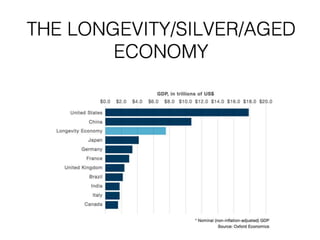





Nine way to profit from an
aging population
Presented By: Colin Milner
Founder /CEO, International Council on Active Aging
What does all of this mean to
you?
Unprecedented opportunity
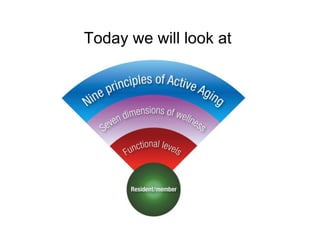
Today we will look at
Active aging
Active aging promotes the vision of
all individuals—regardless of age, socioeconomic
status or health—fully engaging in life within all
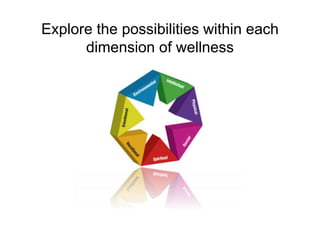
seven dimensions of wellness: emotional,
environmental, intellectual/cognitive, physical,
professional/vocational, social and spiritual.
Source: International Council on Active Aging
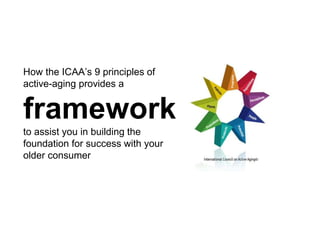
How the ICAA’s 9 principles of
active-aging provides a
framework
to assist you in building the
foundation for success with your
older consumer
Perceptions
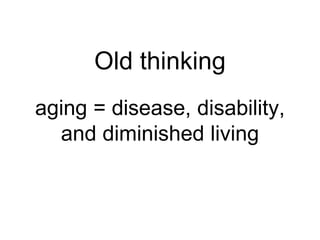
aging = disease, disability,
and diminished living
Old thinking
For success we must change the
lens we view older adults through
New thinking:
10
Potential generally refers to a
currently unrealized ability
Potential
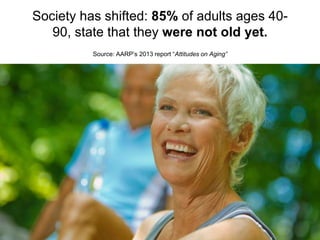
Society has shifted: 85% of adults ages 40-
90, state that they were not old yet.
Source: AARP’s 2013 report “Attitudes on Aging”
High expectations
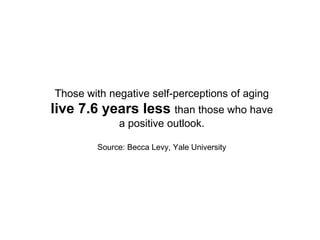
Those with negative self-perceptions of aging
live 7.6 years less than those who have
a positive outlook.
Source: Becca Levy, Yale University
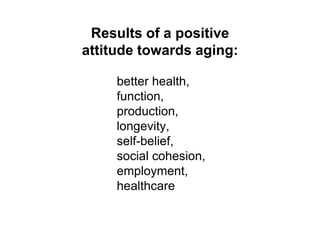
Results of a positive
attitude towards aging:
better health,
function,
production,
longevity,
self-belief,
social cohesion,
employment,
healthcare
16
A thought to ponder:
How will you respond to the
opportunity presented by this new
model and thinking?
17
Rethink, Rebrand,
Redevelop, Reeducate
and Rebuild
Change is afoot
“Our current models have fallen short in
addressing both challenges and opportunities
presented by this shift.
Governments and organizations need new
implementable models to address the
accompanying wave of change”.
Source: Global Population ageing: Peril or Promise. World Economic Forum.
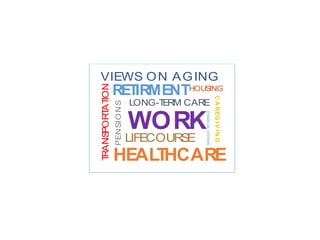
HOUSING
WORK
HEALTHCARE
RETIRMENT
TRANSPORTATION LONG-TERM CARE
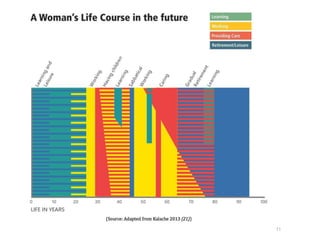
LIFECOURSE
PENSIONS
CAREGIVING
VIEWS ON AGING
FINANCIALSYSTEMS
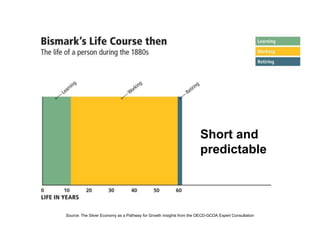
Source: The Silver Economy as a Pathway for Growth Insights from the OECD-GCOA Expert Consultation
Short and
predictable
21
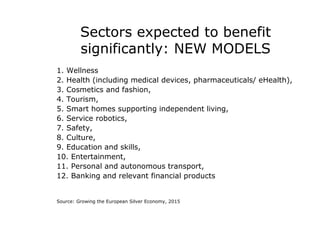
Sectors expected to benefit
significantly: NEW MODELS
1. Wellness
2. Health (including medical devices, pharmaceuticals/ eHealth),
3. Cosmetics and fashion,
4. Tourism,
5. Smart homes supporting independent living,
6. Service robotics,
7. Safety,
8. Culture,
9. Education and skills,
10. Entertainment,
11. Personal and autonomous transport,
12. Banking and relevant financial products
Source: Growing the European Silver Economy, 2015
Potential
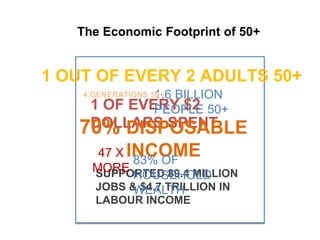
SUPPORTED 89.4 MILLION
JOBS & $4.7 TRILLION IN
LABOUR INCOME
1 OUT OF EVERY 2 ADULTS 50+
1 OF EVERY $2
DOLLARS SPENT70% DISPOSABLE
INCOME47 X
MORE
1.6 BILLION
PEOPLE 50+
4 GENERATIONS 50+
83% OF
HOUSEHOLD
WEALTH
The Economic Footprint of 50+
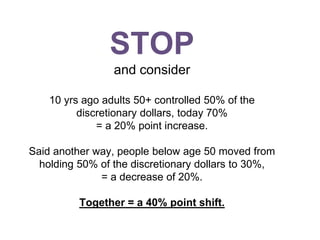
STOP
and consider
10 yrs ago adults 50+ controlled 50% of the
discretionary dollars, today 70%
= a 20% point increase.
Said another way, people below age 50 moved from
holding 50% of the discretionary dollars to 30%,
= a decrease of 20%.
Together = a 40% point shift.
Adults aged 55-64 outspend the average
consumer in nearly every category, every year,
Source: U.S. Consumer Expenditure Survey
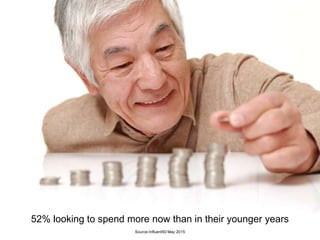
52% looking to spend more now than in their younger years
Source:Influent50 May 2015
29
Thought to ponder:
New thinking and financial power
= opportunity.
Populations
Diversity
No two individuals experience aging in
exactly the same manner; the same lifestyle
choices, medical interventions, and
environmental factors can have profoundly
different impacts on different people.
Source: USC Davis School of Gerontology
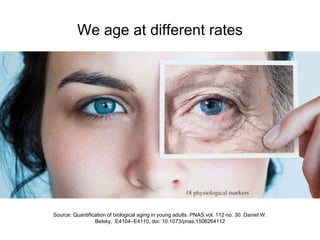
We age at different rates
Source: Quantification of biological aging in young adults. PNAS:vol. 112 no. 30. Daniel W.
Belsky, E4104–E4110, doi: 10.1073/pnas.1506264112
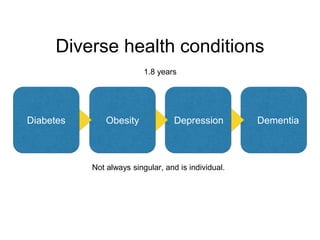
DementiaDepressionObesityDiabetes
Diverse health conditions
Not always singular, and is individual.
1.8 years
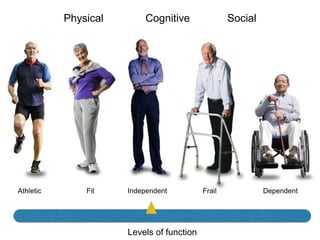
Physical Cognitive Social
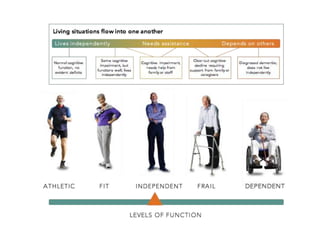
Levels of function
Athletic Fit Independent Frail Dependent
A thought to ponder
Is the lack of diversity in your
programs, marketing, product
offering and environments,
limiting your success?
People
Staffing issue
Lack of expertise
Lack of older staff
Lack of understanding
Poor attitude towards
older people
People shortage
Preparing for the future
Life coaches
Longevity coaches
Dementia coaches
Change management
Programs
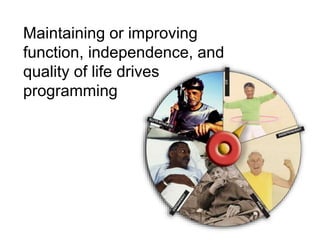
Maintaining or improving
function, independence, and
quality of life drives
programming
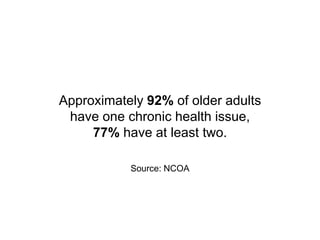
Approximately 92% of older adults
have one chronic health issue,
77% have at least two.
Source: NCOA
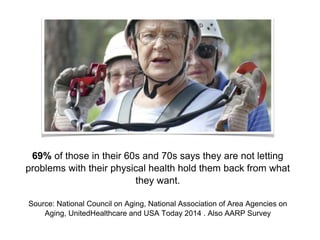
69% of those in their 60s and 70s says they are not letting
problems with their physical health hold them back from what
they want.
Source: National Council on Aging, National Association of Area Agencies on
Aging, UnitedHealthcare and USA Today 2014 . Also AARP Survey
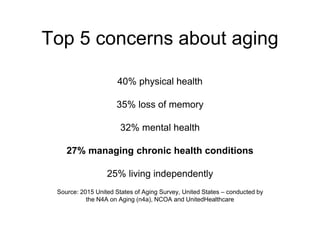
Top 5 concerns about aging
40% physical health
35% loss of memory
32% mental health
27% managing chronic health conditions
25% living independently
Source: 2015 United States of Aging Survey, United States – conducted by
the N4A on Aging (n4a), NCOA and UnitedHealthcare
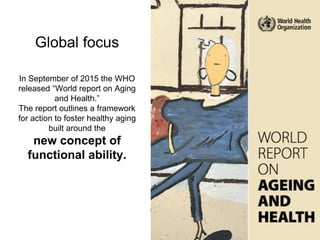
Global focus
In September of 2015 the WHO
released “World report on Aging
and Health.”
The report outlines a framework
for action to foster healthy aging
built around the
new concept of
functional ability.
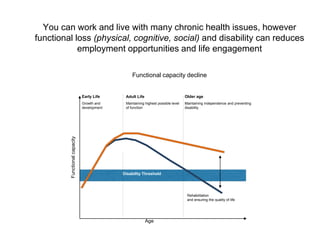
Age
Adult Life
Maintaining highest possible level
of function
Older age
Maintaining independence and preventing
disability
Rehabilitation
and ensuring the quality of life
Disability Threshold
Early Life
Growth and
development
Functional capacity declineFunctionalcapacity
You can work and live with many chronic health issues, however
functional loss (physical, cognitive, social) and disability can reduces
employment opportunities and life engagement
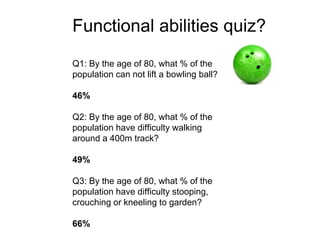
Q1: By the age of 80, what % of the
population can not lift a bowling ball?
46%
Q2: By the age of 80, what % of the
population have difficulty walking
around a 400m track?
49%
Q3: By the age of 80, what % of the
population have difficulty stooping,
crouching or kneeling to garden?
66%
Functional abilities quiz?
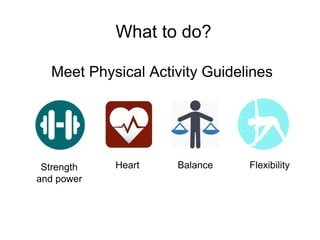
What to do?
Strength
and power
Heart Balance Flexibility
Meet Physical Activity Guidelines
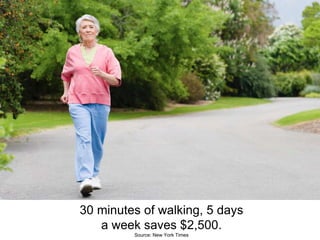
30 minutes of walking, 5 days
a week saves $2,500.
Source: New York Times
Opportunity:
Personalized aging
Marketers need to put the "me" back into their
messaging and media thinking. Authentic
communications always begin with a genuine
understanding of the consumer, but this bar is
higher for Boomers.
Source: Nielsen Wire 2012
Boomers seek more personalization
55
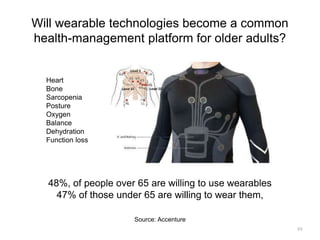
Heart
Bone
Sarcopenia
Posture
Oxygen
Balance
Dehydration
Function loss
48%, of people over 65 are willing to use wearables
47% of those under 65 are willing to wear them,
Source: Accenture
Will wearable technologies become a common
health-management platform for older adults?
Will wearable technologies become a common
health-management platform for the older
population?
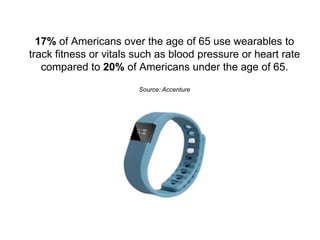
17% of Americans over the age of 65 use wearables to
track fitness or vitals such as blood pressure or heart rate
compared to 20% of Americans under the age of 65.
Source: Accenture
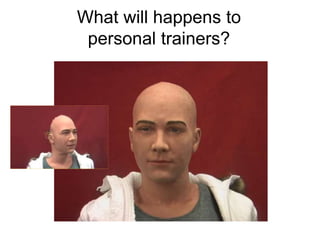
What will happens to
personal trainers?
Products
Evidence suggests there is limited availability of
goods, products and services appropriate for
people in older age groups.
Source: Future Age: The road map for ageing research , October 2011
Why?
88% of survey respondents in the hospitality and leisure
industries claimed to be highly engaged with the over-65s.
However, almost 62% did not offer any specific product or
service for these consumers.
The research indicated that 82% of survey respondents with
no offering for the older consumer had no plans to introduce
any.
The main reason: they simply had not considered it.
(Barclays Corporate)
62
Opportunity to be
“the one”
Places
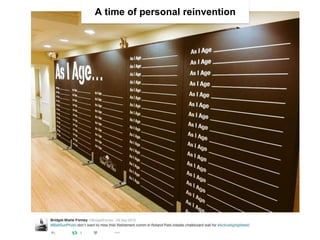
A time of personal reinvention
Develop a center for
discovery
What would that look like?
68
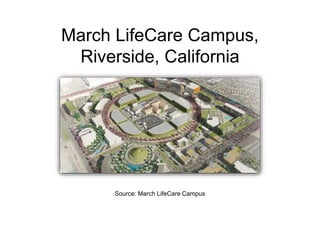
Source: March LifeCare Campus
March LifeCare Campus,
Riverside, California
70
Explore the possibilities within each
dimension of wellness
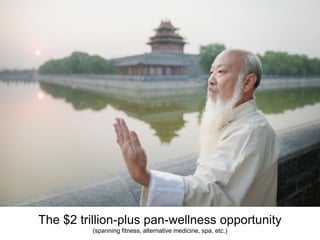
The $2 trillion-plus pan-wellness opportunity
(spanning fitness, alternative medicine, spa, etc.)
Policy
2020
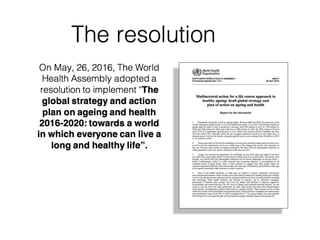
Between now and 2020 countries have
committed to focus on evidence-based action
to maximize functional ability that reaches
every person; and by 2020, establish evidence
and partnerships necessary to support a
Decade of Healthy Aging
Promotions
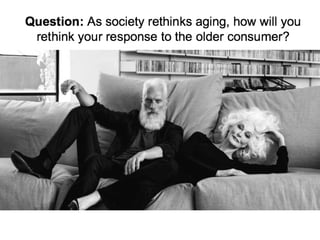
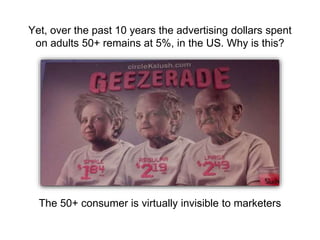
The 50+ consumer is virtually invisible to marketers
Yet, over the past 10 years the advertising dollars spent
on adults 50+ remains at 5%, in the US. Why is this?
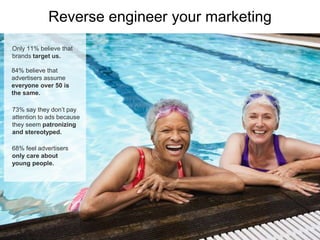
Reverse engineer your marketing
73% say they don’t pay
attention to ads because
they seem patronizing
and stereotyped.
84% believe that
advertisers assume
everyone over 50 is
the same.
68% feel advertisers
only care about
young people.
Only 11% believe that
brands target us.
Be real
Learn to speak my language
Embracing our potential
…how the 9 principles of active-aging,
offers you a framework to work from to
build a solid foundation for your active
aging initiatives.
What now?
Today we discussed...
Thank you
Presented By: Colin Milner
Founder /CEO, International Council on Active Aging

Active aging complete

  • 1.
    Nine way toprofit from an aging population Presented By: Colin Milner Founder /CEO, International Council on Active Aging
  • 2.
    What does allof this mean to you? Unprecedented opportunity
  • 3.
  • 4.
    Active aging Active agingpromotes the vision of all individuals—regardless of age, socioeconomic status or health—fully engaging in life within all seven dimensions of wellness: emotional, environmental, intellectual/cognitive, physical, professional/vocational, social and spiritual. Source: International Council on Active Aging
  • 5.
    How the ICAA’s9 principles of active-aging provides a framework to assist you in building the foundation for success with your older consumer
  • 6.
  • 7.
    aging = disease,disability, and diminished living Old thinking
  • 9.
    For success wemust change the lens we view older adults through
  • 10.
    New thinking: 10 Potential generallyrefers to a currently unrealized ability Potential
  • 12.
    Society has shifted:85% of adults ages 40- 90, state that they were not old yet. Source: AARP’s 2013 report “Attitudes on Aging”
  • 13.
  • 14.
    Those with negativeself-perceptions of aging live 7.6 years less than those who have a positive outlook. Source: Becca Levy, Yale University
  • 15.
    Results of apositive attitude towards aging: better health, function, production, longevity, self-belief, social cohesion, employment, healthcare
  • 16.
    16 A thought toponder: How will you respond to the opportunity presented by this new model and thinking?
  • 17.
  • 18.
    Change is afoot “Ourcurrent models have fallen short in addressing both challenges and opportunities presented by this shift. Governments and organizations need new implementable models to address the accompanying wave of change”. Source: Global Population ageing: Peril or Promise. World Economic Forum.
  • 19.
  • 20.
    Source: The SilverEconomy as a Pathway for Growth Insights from the OECD-GCOA Expert Consultation Short and predictable
  • 21.
  • 22.
    Sectors expected tobenefit significantly: NEW MODELS 1. Wellness 2. Health (including medical devices, pharmaceuticals/ eHealth), 3. Cosmetics and fashion, 4. Tourism, 5. Smart homes supporting independent living, 6. Service robotics, 7. Safety, 8. Culture, 9. Education and skills, 10. Entertainment, 11. Personal and autonomous transport, 12. Banking and relevant financial products Source: Growing the European Silver Economy, 2015
  • 23.
  • 24.
    SUPPORTED 89.4 MILLION JOBS& $4.7 TRILLION IN LABOUR INCOME 1 OUT OF EVERY 2 ADULTS 50+ 1 OF EVERY $2 DOLLARS SPENT70% DISPOSABLE INCOME47 X MORE 1.6 BILLION PEOPLE 50+ 4 GENERATIONS 50+ 83% OF HOUSEHOLD WEALTH The Economic Footprint of 50+
  • 25.
    STOP and consider 10 yrsago adults 50+ controlled 50% of the discretionary dollars, today 70% = a 20% point increase. Said another way, people below age 50 moved from holding 50% of the discretionary dollars to 30%, = a decrease of 20%. Together = a 40% point shift.
  • 26.
    Adults aged 55-64outspend the average consumer in nearly every category, every year, Source: U.S. Consumer Expenditure Survey
  • 27.
    52% looking tospend more now than in their younger years Source:Influent50 May 2015
  • 29.
    29 Thought to ponder: Newthinking and financial power = opportunity.
  • 30.
  • 31.
  • 32.
    No two individualsexperience aging in exactly the same manner; the same lifestyle choices, medical interventions, and environmental factors can have profoundly different impacts on different people. Source: USC Davis School of Gerontology
  • 33.
    We age atdifferent rates Source: Quantification of biological aging in young adults. PNAS:vol. 112 no. 30. Daniel W. Belsky, E4104–E4110, doi: 10.1073/pnas.1506264112
  • 34.
    DementiaDepressionObesityDiabetes Diverse health conditions Notalways singular, and is individual. 1.8 years
  • 35.
    Physical Cognitive Social Levelsof function Athletic Fit Independent Frail Dependent
  • 37.
    A thought toponder Is the lack of diversity in your programs, marketing, product offering and environments, limiting your success?
  • 38.
  • 39.
    Staffing issue Lack ofexpertise Lack of older staff Lack of understanding Poor attitude towards older people People shortage
  • 40.
    Preparing for thefuture Life coaches Longevity coaches Dementia coaches Change management
  • 42.
  • 43.
    Maintaining or improving function,independence, and quality of life drives programming
  • 44.
    Approximately 92% ofolder adults have one chronic health issue, 77% have at least two. Source: NCOA
  • 45.
    69% of thosein their 60s and 70s says they are not letting problems with their physical health hold them back from what they want. Source: National Council on Aging, National Association of Area Agencies on Aging, UnitedHealthcare and USA Today 2014 . Also AARP Survey
  • 46.
    Top 5 concernsabout aging 40% physical health 35% loss of memory 32% mental health 27% managing chronic health conditions 25% living independently Source: 2015 United States of Aging Survey, United States – conducted by the N4A on Aging (n4a), NCOA and UnitedHealthcare
  • 47.
    Global focus In Septemberof 2015 the WHO released “World report on Aging and Health.” The report outlines a framework for action to foster healthy aging built around the new concept of functional ability.
  • 48.
    Age Adult Life Maintaining highestpossible level of function Older age Maintaining independence and preventing disability Rehabilitation and ensuring the quality of life Disability Threshold Early Life Growth and development Functional capacity declineFunctionalcapacity You can work and live with many chronic health issues, however functional loss (physical, cognitive, social) and disability can reduces employment opportunities and life engagement
  • 50.
    Q1: By theage of 80, what % of the population can not lift a bowling ball? 46% Q2: By the age of 80, what % of the population have difficulty walking around a 400m track? 49% Q3: By the age of 80, what % of the population have difficulty stooping, crouching or kneeling to garden? 66% Functional abilities quiz?
  • 51.
    What to do? Strength andpower Heart Balance Flexibility Meet Physical Activity Guidelines
  • 52.
    30 minutes ofwalking, 5 days a week saves $2,500. Source: New York Times
  • 53.
  • 54.
    Marketers need toput the "me" back into their messaging and media thinking. Authentic communications always begin with a genuine understanding of the consumer, but this bar is higher for Boomers. Source: Nielsen Wire 2012 Boomers seek more personalization
  • 55.
    55 Heart Bone Sarcopenia Posture Oxygen Balance Dehydration Function loss 48%, ofpeople over 65 are willing to use wearables 47% of those under 65 are willing to wear them, Source: Accenture Will wearable technologies become a common health-management platform for older adults?
  • 56.
    Will wearable technologiesbecome a common health-management platform for the older population?
  • 57.
    17% of Americansover the age of 65 use wearables to track fitness or vitals such as blood pressure or heart rate compared to 20% of Americans under the age of 65. Source: Accenture
  • 58.
    What will happensto personal trainers?
  • 59.
  • 60.
    Evidence suggests thereis limited availability of goods, products and services appropriate for people in older age groups. Source: Future Age: The road map for ageing research , October 2011
  • 61.
  • 62.
    88% of surveyrespondents in the hospitality and leisure industries claimed to be highly engaged with the over-65s. However, almost 62% did not offer any specific product or service for these consumers. The research indicated that 82% of survey respondents with no offering for the older consumer had no plans to introduce any. The main reason: they simply had not considered it. (Barclays Corporate) 62
  • 63.
  • 65.
  • 66.
    A time ofpersonal reinvention
  • 67.
    Develop a centerfor discovery
  • 68.
    What would thatlook like? 68
  • 69.
    Source: March LifeCareCampus March LifeCare Campus, Riverside, California
  • 70.
  • 71.
    Explore the possibilitieswithin each dimension of wellness
  • 73.
    The $2 trillion-pluspan-wellness opportunity (spanning fitness, alternative medicine, spa, etc.)
  • 74.
  • 76.
    2020 Between now and2020 countries have committed to focus on evidence-based action to maximize functional ability that reaches every person; and by 2020, establish evidence and partnerships necessary to support a Decade of Healthy Aging
  • 77.
  • 79.
    The 50+ consumeris virtually invisible to marketers Yet, over the past 10 years the advertising dollars spent on adults 50+ remains at 5%, in the US. Why is this?
  • 80.
    Reverse engineer yourmarketing 73% say they don’t pay attention to ads because they seem patronizing and stereotyped. 84% believe that advertisers assume everyone over 50 is the same. 68% feel advertisers only care about young people. Only 11% believe that brands target us.
  • 81.
    Be real Learn tospeak my language
  • 82.
  • 84.
  • 85.
    …how the 9principles of active-aging, offers you a framework to work from to build a solid foundation for your active aging initiatives. What now? Today we discussed...
  • 86.
    Thank you Presented By:Colin Milner Founder /CEO, International Council on Active Aging

Editor's Notes

  • #19 These conversations will also enable us to move forward with the development of new models in areas such as prevention, retirement, environments, living arrangements, and intergenerational relationships
  • #35 9.3% of people with diabetes, just have just diabetes. The rapid rise in diabetes, and limb losses, will see a need for creative solutions.
  • #41 “While the trend of aging societies is a cause for celebration, it also presents huge challenges Source: 'Ageing in the Twenty-first Century: A Celebration and a Challenge. 2012
  • #45 9.3% of people with diabetes, just have just diabetes. The rapid rise in diabetes, and limb losses, will see a need for creative solutions.
  • #47  Keeping a positive attitude and exercising regularly (53 percent and 50 percent, respectively) are some of the best ways identified by older adults to stay mentally sharp. A majority of older adults identify inactivity (51 percent) as the top barrier to staying mentally sharp.
  • #49 HIGH FUNCTION IS THE HOLY GRAIL: Function = Independence = Quality of Life. A greater focus on function would forestall many of the issues we see in the age 50-plus population today. An example: functional declines in strength and power have. Between the ages of 35 and 70 an inactive person can lose close to 50% of their strength and 75% of their power. What is the implications of this functional decline? For physicians, physical and occupational therapists, health management organizations and employers, taking a life course approach to functional assessments allows efforts to address functional declines before their ripple effects are fully felt. Professional education, programs, environments and policies may best serve the older population through improved understanding of how function impacts society (EC European Innovation Partnership on Active and Healthy Ageing, 2013).