A Comprehensive Look at
Bioactive Glass
Applications in Dentistry
INTRODUCTION
01
HISTORY
02
COMPOSITION
03
CHEMICAL
STRUCTURE 04
APPLICATIONS
05
CONCLUSION
06
Table of Contents
REFERENCES
07
INTRODUCTION
● Biomaterials is used to make devices to replace a part or a function of the
body in a safe, reliable, economic, and physiologically acceptable manner.
● Biomaterials – Polymer, Ceramics, Composite material, Metals.
● Natural, Organic synthetic, Hand organic synthetic Materials
● Bioactive glass – Modern biomaterial-driven regenerative medicine
-(Hench and Erthridge,1982)
HISTORY
● Bioactive glasses (BG), originally developed by Hench starting in 1969.
● Tissue regeneration and repair using the gene activation properties of
Bioglass provide a third generation of biomaterials.
PROPERTIES
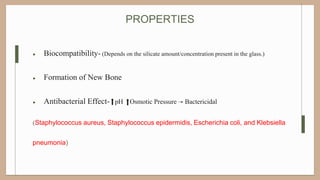
● Biocompatibility- (Depends on the silicate amount/concentration present in the glass.)
● Formation of New Bone
● Antibacterial Effect- pH Osmotic Pressure Bactericidal
(Staphylococcus aureus, Staphylococcus epidermidis, Escherichia coli, and Klebsiella
pneumonia)
COMPOSITION
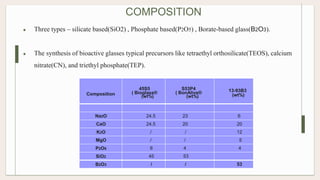
● Three types – silicate based(SiO2) , Phosphate based(P2O5) , Borate-based glass(B2O3).
● The synthesis of bioactive glasses typical precursors like tetraethyl orthosilicate(TEOS), calcium
nitrate(CN), and triethyl phosphate(TEP).
Composition
45S5
( Bioglass®
(wt%)
S53P4
( BonAlive®
(wt%)
13-93B3
(wt%)
Na2O 24.5 23 6
CaO 24.5 20 20
K2O / / 12
MgO / / 5
P2O5 6 4 4
SiO2 45 53
B2O3 / / 53
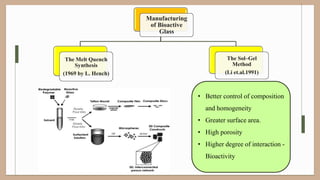
Manufacturing
of Bioactive
Glass
The Melt Quench
Synthesis
(1969 by L. Hench)
The Sol–Gel
Method
(Li et.al.1991)
• Better control of composition
and homogeneity
• Greater surface area.
• High porosity
• Higher degree of interaction -
Bioactivity
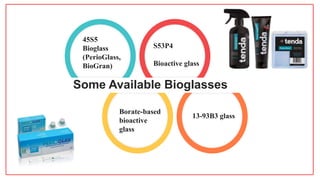
Some Available Bioglasses
Borate-based
bioactive
glass
13-93B3 glass
45S5
Bioglass
(PerioGlass,
BioGran)
S53P4
Bioactive glass
Applications
Oral and
maxillofacial
surgery
Esthetic and
Restorative
Dentistry
.
Oral care
Products
Periodontics
and Dental
Implants
Orthodontics
Endodontics
02
03
04
06
01
05
PerioGlas – 90 to 170 µm.
Wilson et.al.,1992 use of PerioGlas in periodontal defects in patus monkey.
osteoproductive and hemostatic property- allow Periodontal muscle and Alveolar
bone restoration.
BioGran – 300 to 355 µm
Intrabony defects.
Borate-based Glasses (19 93B3 Bioactive glass)
Release ions like boron, calcium, phosphrous- Promote cell proliferation,
Hydroxyapatite formation.
S52P4 Glass
Forms hydroxyapatite layer on surface.
Promote Bone integration.
Regenerative procedures.
Bioactive
glass
brand
name
Properties Composition Study type
NovaMin Release antibacterial agents, have anti-gingivitis
effect,stimulate remineralization and reduce
hypersensitiza- tion
Amorphous calcium sodium phosphosilicate
(CSPS)/45% SiO2, 24.5% Na2O, 24.5% CaO and
6% P2O5/
CaNaO6PSi [32]
In vitro
/Clinical
trial
BiominF Remineralization of artificial carious lesions,
Dentintubule occlusion
5% Fluorocalcium phosphosilicate bioactive
glass
In vitro
/Clinical
trial
PerioGlass Grafting material in bone grafts to regenerate
peri-odontal osseous defects
Calcium phospho-silicate bioactive glass
In vitro
/Clinical
trial
QMAT3 Preventing the formation of white spot lesions
&stronger antimicrobial and remineralizing
effects
Fluoride-containing bioactive glass In vitro
45S5 Removing residual orthodontic adhesive, a pulp
cap-ping material, Bio-Gutta, synthetic bone graft
45% SiO2, 6% P2O5, 24.5% CaO, and 24.5%
Na2O
In vitro
/Clinical
trial
In 2021 – Bioglass+Fluoride toothpaste received FDA approval.
Application in Periodontics and Dental Implants
• Periodontitis is a common chronic multifactorial inflam-matory disease of the periodontium.
PerioGlass-Formulation to Bioglass 45S5 used to regenerate periodontal osseous defects.
• Yadav VS et.al.,2011 stated that PerioGlas reduced probing depth significantly and gained clinical attachment
level (CAL) in periodontal intrabony defects.
• Subbaiah R et.al.,2011 - PerioGlas as a bioactive alloplast was well-tolerated by the gingival tissues.
• Silica-based bioactive glasses have been used for covering implants.
• The use of nanotechnology in the synthesis of bioactive glass has enhanced its application as a coating material
on the surfaces of dentalimplants.
Jafari, N., Habashi, M.S., Hashemi, A. et al. Application of bioactive glasses in various dental fields. Biomater Res 26, 31 (2022).
(a) A bioactive glass foam scaffold
(b) Primary human osteoblasts, cultured on a bioactive glass
foam scaffold for 2 weeks, which have produced
mineralised bone nodules.
JULIAN R. JONES, in Biomaterials, Artificial Organs and Tissue Engineering, 2005
Application in Endodontics
• Bioactive glasses have also been used in root canal treatments.
• Gutta-percha in combination with Bioglass 45S5 (Bio-Gutta) can be used as an alternative to
conventional gutta-percha-Bio-Gutta can bond to dentin walls does not require any sealers and is
also a biocompatible material
• Bioactive glass can be used as a disinfectant.
• Bioactive glasses can relieve pain during dentin hypersensitivity by binding to collagen fibers and
depositing hydroxyapatite in order to block dentin tubules .
Jafari, N., Habashi, M.S., Hashemi, A. et al. Application of bioactive glasses in various dental fields. Biomater Res 26, 31 (2022).
• Dental Adhesives
• Air-abrasion materials.
Orthodontics
• Bone scaffolds
• Bone grafts
Oral and
maxillofacial
surgery
• Managing dentin hypersensitivity
• Bonding Agents
Esthetic and
Restorative
dentistry
The Role of ions in increasing the efficiency of Bioactive Glass
● BG have good Strength, Stiffness, Hardness and they are Brittle.
● Addition of ions (strontium,zinc,phosphrous,fluoride,cobalt,silver) Affect properties.
 Cobalt - Improve Angiogenesis.
 Silver – Increased antimicrobial property
 Fluoride – Remineralization
 Strontium - Osteoblast proliferation Osteoclast activity
Conclusion
● Since bioactive glasses have a wide range of applications in different fields of dentistry,
finding an available and inexpensive resource of bioactive glass is important.
● The main focus is on their use in dentistry, reconstructive surgery (bone regeneration),
and the treatment of infections.
● To conclude, 45S5, S53P4, and borate-based glasses - replacementmaterials in the
treatment of human defects since they are available in different forms and shapes and
able to satisfy the needs of users.
● These bioactive glasses represent an exciting and evolving field of study.
● Current and potential future applications depend on the specific compositions of the
given biomaterial, so that studies of the utmost importance have been performed to
understand the interactions between glasses and the host cells.
References
● Cannio, M.; Bellucci, D.; Roether, J.A.; Boccaccini, D.N.; Cannillo, V. Bioactive Glass Applications: A
Literature Review of Human Clinical Trials. Materials 2021, 14, 5440. https://doi.org/10.3390/
ma14185440
● Furlan, R.G.; Correr, W.R.; Russi, A.F.C.; Iemma, M.R.D.C.; Trovatti, E.; Pecoraro, É. Preparation and
characterization of boron-based bioglass by sol gel process. J. Sol. Gel Sci. Technol. 2018, 88, 181–191.
● Zafar MS, Farooq I, Awais M, Najeeb S, Khurshid Z, Zohaib S. Bioactive surface coatings for enhancing
osseointegration of dental implants. In: Kaur G, editor. Biomedical, therapeutic and clinical applications
of bioactive glasses: Elsevier; 2019.
● Yadav VS, Narula SC, Sharma RK, Tewari S, Yadav R. Clinical evaluation of guided tissue regeneration
combined with autogenous bone or autog- enous bone mixed with bioactive glass in intrabony defects. J
Oral Sci. 2011;53(4):481–8.
References
1. Subbaiah R, Thomas B. Efficacy of a bioactive alloplast, in the treatment of human periodontal osseous
defects-a clinical study; 2011.
2. Kulal R, Jayanti I, Sambashivaiah S, Bilchodmath S. An in-vitro com- parison of nano hydroxyapatite,
novamin and proargin desensitizing toothpastes-A SEM study. J Clin Diagn Res. 2016;10(10):ZC51.
3. Wang Z, Sa Y, Sauro S, Chen H, Xing W, Ma X, et al. Effect of desensitis- ing toothpastes on dentinal
tubule occlusion: a dentine permeability measurement and SEM in vitro study. J Dent. 2010;38(5):400–10.
A_Comprehensive_Look_at_Bioactive_Glass_Applications_temp[1].pptx

A_Comprehensive_Look_at_Bioactive_Glass_Applications_temp[1].pptx

  • 1.
    A Comprehensive Lookat Bioactive Glass Applications in Dentistry
  • 2.
  • 3.
    INTRODUCTION ● Biomaterials isused to make devices to replace a part or a function of the body in a safe, reliable, economic, and physiologically acceptable manner. ● Biomaterials – Polymer, Ceramics, Composite material, Metals. ● Natural, Organic synthetic, Hand organic synthetic Materials ● Bioactive glass – Modern biomaterial-driven regenerative medicine -(Hench and Erthridge,1982)
  • 4.
    HISTORY ● Bioactive glasses(BG), originally developed by Hench starting in 1969. ● Tissue regeneration and repair using the gene activation properties of Bioglass provide a third generation of biomaterials.
  • 5.
    PROPERTIES ● Biocompatibility- (Dependson the silicate amount/concentration present in the glass.) ● Formation of New Bone ● Antibacterial Effect- pH Osmotic Pressure Bactericidal (Staphylococcus aureus, Staphylococcus epidermidis, Escherichia coli, and Klebsiella pneumonia)
  • 6.
    COMPOSITION ● Three types– silicate based(SiO2) , Phosphate based(P2O5) , Borate-based glass(B2O3). ● The synthesis of bioactive glasses typical precursors like tetraethyl orthosilicate(TEOS), calcium nitrate(CN), and triethyl phosphate(TEP). Composition 45S5 ( Bioglass® (wt%) S53P4 ( BonAlive® (wt%) 13-93B3 (wt%) Na2O 24.5 23 6 CaO 24.5 20 20 K2O / / 12 MgO / / 5 P2O5 6 4 4 SiO2 45 53 B2O3 / / 53
  • 7.
    Manufacturing of Bioactive Glass The MeltQuench Synthesis (1969 by L. Hench) The Sol–Gel Method (Li et.al.1991) • Better control of composition and homogeneity • Greater surface area. • High porosity • Higher degree of interaction - Bioactivity
  • 8.
    Some Available Bioglasses Borate-based bioactive glass 13-93B3glass 45S5 Bioglass (PerioGlass, BioGran) S53P4 Bioactive glass
  • 9.
    Applications Oral and maxillofacial surgery Esthetic and Restorative Dentistry . Oralcare Products Periodontics and Dental Implants Orthodontics Endodontics 02 03 04 06 01 05
  • 10.
    PerioGlas – 90to 170 µm. Wilson et.al.,1992 use of PerioGlas in periodontal defects in patus monkey. osteoproductive and hemostatic property- allow Periodontal muscle and Alveolar bone restoration. BioGran – 300 to 355 µm Intrabony defects. Borate-based Glasses (19 93B3 Bioactive glass) Release ions like boron, calcium, phosphrous- Promote cell proliferation, Hydroxyapatite formation. S52P4 Glass Forms hydroxyapatite layer on surface. Promote Bone integration. Regenerative procedures.
  • 11.
    Bioactive glass brand name Properties Composition Studytype NovaMin Release antibacterial agents, have anti-gingivitis effect,stimulate remineralization and reduce hypersensitiza- tion Amorphous calcium sodium phosphosilicate (CSPS)/45% SiO2, 24.5% Na2O, 24.5% CaO and 6% P2O5/ CaNaO6PSi [32] In vitro /Clinical trial BiominF Remineralization of artificial carious lesions, Dentintubule occlusion 5% Fluorocalcium phosphosilicate bioactive glass In vitro /Clinical trial PerioGlass Grafting material in bone grafts to regenerate peri-odontal osseous defects Calcium phospho-silicate bioactive glass In vitro /Clinical trial QMAT3 Preventing the formation of white spot lesions &stronger antimicrobial and remineralizing effects Fluoride-containing bioactive glass In vitro 45S5 Removing residual orthodontic adhesive, a pulp cap-ping material, Bio-Gutta, synthetic bone graft 45% SiO2, 6% P2O5, 24.5% CaO, and 24.5% Na2O In vitro /Clinical trial In 2021 – Bioglass+Fluoride toothpaste received FDA approval.
  • 12.
    Application in Periodonticsand Dental Implants • Periodontitis is a common chronic multifactorial inflam-matory disease of the periodontium. PerioGlass-Formulation to Bioglass 45S5 used to regenerate periodontal osseous defects. • Yadav VS et.al.,2011 stated that PerioGlas reduced probing depth significantly and gained clinical attachment level (CAL) in periodontal intrabony defects. • Subbaiah R et.al.,2011 - PerioGlas as a bioactive alloplast was well-tolerated by the gingival tissues. • Silica-based bioactive glasses have been used for covering implants. • The use of nanotechnology in the synthesis of bioactive glass has enhanced its application as a coating material on the surfaces of dentalimplants. Jafari, N., Habashi, M.S., Hashemi, A. et al. Application of bioactive glasses in various dental fields. Biomater Res 26, 31 (2022).
  • 13.
    (a) A bioactiveglass foam scaffold (b) Primary human osteoblasts, cultured on a bioactive glass foam scaffold for 2 weeks, which have produced mineralised bone nodules. JULIAN R. JONES, in Biomaterials, Artificial Organs and Tissue Engineering, 2005
  • 14.
    Application in Endodontics •Bioactive glasses have also been used in root canal treatments. • Gutta-percha in combination with Bioglass 45S5 (Bio-Gutta) can be used as an alternative to conventional gutta-percha-Bio-Gutta can bond to dentin walls does not require any sealers and is also a biocompatible material • Bioactive glass can be used as a disinfectant. • Bioactive glasses can relieve pain during dentin hypersensitivity by binding to collagen fibers and depositing hydroxyapatite in order to block dentin tubules . Jafari, N., Habashi, M.S., Hashemi, A. et al. Application of bioactive glasses in various dental fields. Biomater Res 26, 31 (2022).
  • 15.
    • Dental Adhesives •Air-abrasion materials. Orthodontics • Bone scaffolds • Bone grafts Oral and maxillofacial surgery • Managing dentin hypersensitivity • Bonding Agents Esthetic and Restorative dentistry
  • 16.
    The Role ofions in increasing the efficiency of Bioactive Glass ● BG have good Strength, Stiffness, Hardness and they are Brittle. ● Addition of ions (strontium,zinc,phosphrous,fluoride,cobalt,silver) Affect properties.  Cobalt - Improve Angiogenesis.  Silver – Increased antimicrobial property  Fluoride – Remineralization  Strontium - Osteoblast proliferation Osteoclast activity
  • 17.
    Conclusion ● Since bioactiveglasses have a wide range of applications in different fields of dentistry, finding an available and inexpensive resource of bioactive glass is important. ● The main focus is on their use in dentistry, reconstructive surgery (bone regeneration), and the treatment of infections. ● To conclude, 45S5, S53P4, and borate-based glasses - replacementmaterials in the treatment of human defects since they are available in different forms and shapes and able to satisfy the needs of users. ● These bioactive glasses represent an exciting and evolving field of study. ● Current and potential future applications depend on the specific compositions of the given biomaterial, so that studies of the utmost importance have been performed to understand the interactions between glasses and the host cells.
  • 18.
    References ● Cannio, M.;Bellucci, D.; Roether, J.A.; Boccaccini, D.N.; Cannillo, V. Bioactive Glass Applications: A Literature Review of Human Clinical Trials. Materials 2021, 14, 5440. https://doi.org/10.3390/ ma14185440 ● Furlan, R.G.; Correr, W.R.; Russi, A.F.C.; Iemma, M.R.D.C.; Trovatti, E.; Pecoraro, É. Preparation and characterization of boron-based bioglass by sol gel process. J. Sol. Gel Sci. Technol. 2018, 88, 181–191. ● Zafar MS, Farooq I, Awais M, Najeeb S, Khurshid Z, Zohaib S. Bioactive surface coatings for enhancing osseointegration of dental implants. In: Kaur G, editor. Biomedical, therapeutic and clinical applications of bioactive glasses: Elsevier; 2019. ● Yadav VS, Narula SC, Sharma RK, Tewari S, Yadav R. Clinical evaluation of guided tissue regeneration combined with autogenous bone or autog- enous bone mixed with bioactive glass in intrabony defects. J Oral Sci. 2011;53(4):481–8.
  • 19.
    References 1. Subbaiah R,Thomas B. Efficacy of a bioactive alloplast, in the treatment of human periodontal osseous defects-a clinical study; 2011. 2. Kulal R, Jayanti I, Sambashivaiah S, Bilchodmath S. An in-vitro com- parison of nano hydroxyapatite, novamin and proargin desensitizing toothpastes-A SEM study. J Clin Diagn Res. 2016;10(10):ZC51. 3. Wang Z, Sa Y, Sauro S, Chen H, Xing W, Ma X, et al. Effect of desensitis- ing toothpastes on dentinal tubule occlusion: a dentine permeability measurement and SEM in vitro study. J Dent. 2010;38(5):400–10.

Editor's Notes

  • #4 Collagen, Fibrin, Chitosan etc. Polylactic acid, Polyglycolic acid HA, ß TCP
  • #13  In vivo, animal studies demonstrate that the titanium implants coated with bioactive glasses shows significantly more significantly more osseointegration than control dental implant
  • #15 Bioactive glasses can relieve pain during dentin hypersensitivity by binding to collagen fib- ers and depositing hydroxyapatite in order to block den-tin tubules .