ACG 2071 Managerial Accounting
Process Costing Systems
Minicase
PROCESS COSTING PROBLEM
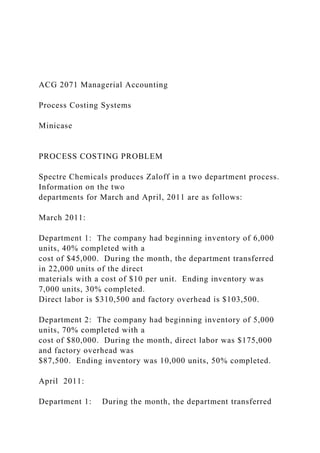
Spectre Chemicals produces Zaloff in a two department process.
Information on the two
departments for March and April, 2011 are as follows:
March 2011:
Department 1: The company had beginning inventory of 6,000
units, 40% completed with a
cost of $45,000. During the month, the department transferred
in 22,000 units of the direct
materials with a cost of $10 per unit. Ending inventory was
7,000 units, 30% completed.
Direct labor is $310,500 and factory overhead is $103,500.
Department 2: The company had beginning inventory of 5,000
units, 70% completed with a
cost of $80,000. During the month, direct labor was $175,000
and factory overhead was
$87,500. Ending inventory was 10,000 units, 50% completed.
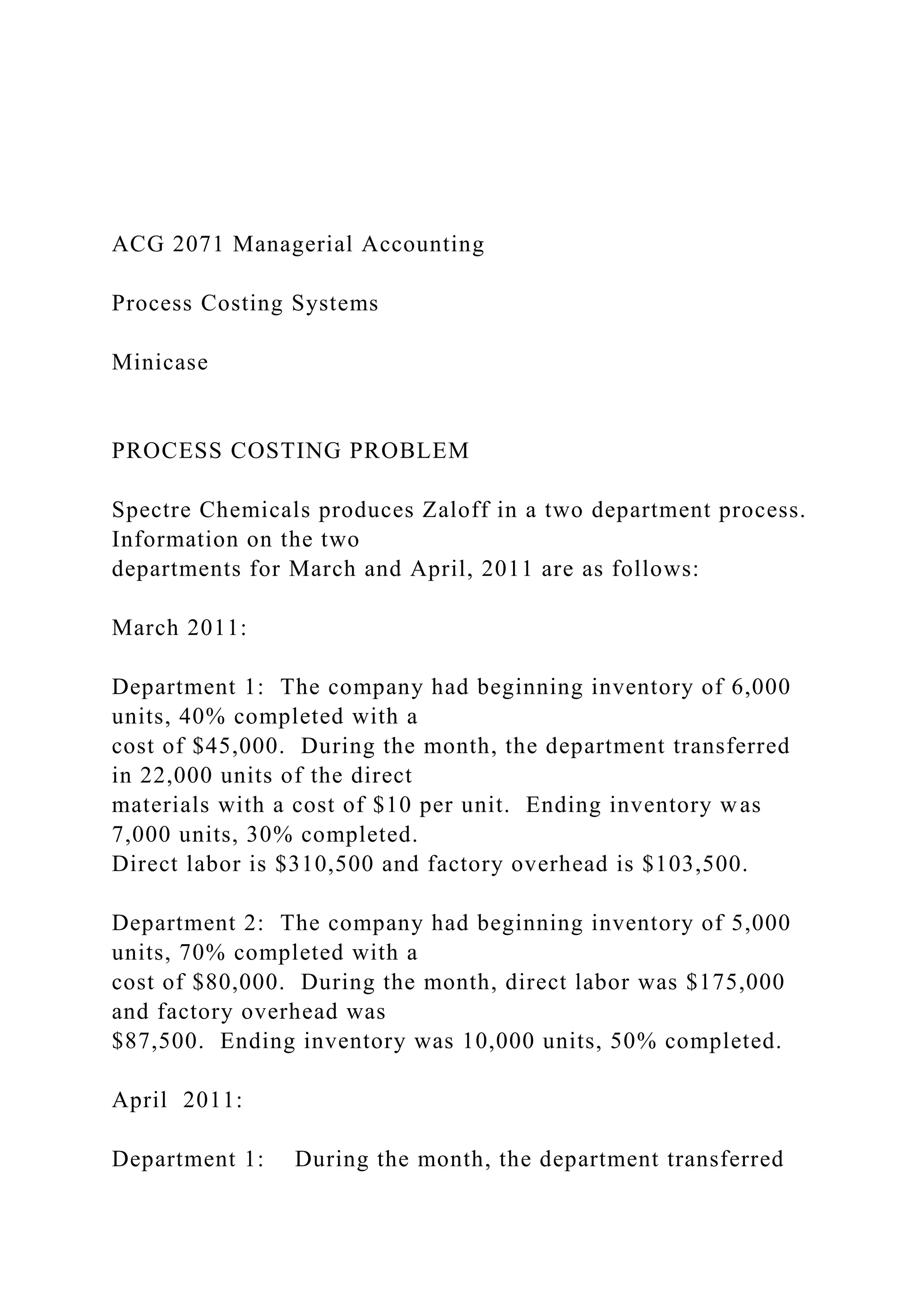
April 2011:
Department 1: During the month, the department transferred
in 20,000 units of the direct
materials with a cost of $11 per unit. Direct labor is $209,000
and factory overhead is
$104,500. Ending inventory is 10,000 units 60% completed.
Department 2: The company had beginning inventory of 5,000
units, 70% completed with a
cost of $80,000. During the month, direct labor is $175,000 and
factory overhead is
$87,500.
Required:
and Conversion costs for each
department for March and April, 2011.
– one for each department and
each month
duction report for March and April 2011.
ACG 2071
Process Cost Systems
Created by: M. Mari
Fall 2009-1
Page 1 of 13
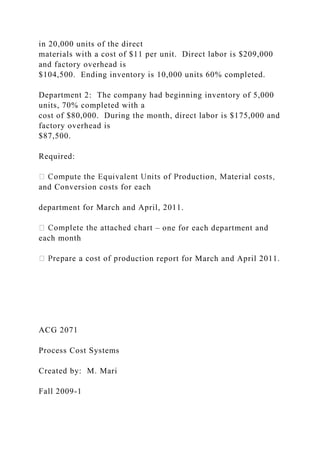
Process Manufacturing
of steps
gh a series of sequential processes
department, workstation, or work center.
each receives the output from the prior department as
a partially processed product.
applies direct labor, overhead, and additional direct
materials to move the product toward completion.
Process Cost System
verhead
to specific processes.
on units of production
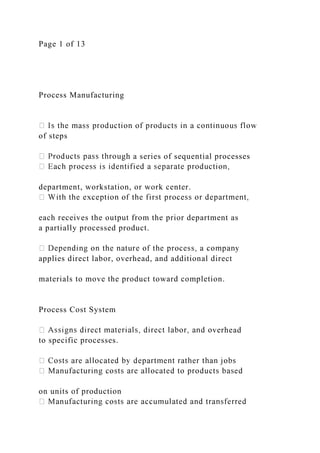
by department
associated with each process are then
divided by the number of units passing through that
process to determine the cost per equivalent units
for that process
ACG 2071
Process Cost Systems
Created by: M. Mari
Fall 2009-1
Page 2 of 13
To understand how costs are allocated, first we must decide
how the costs are accumulated. One method is First in, First
out method.
Beverage Production
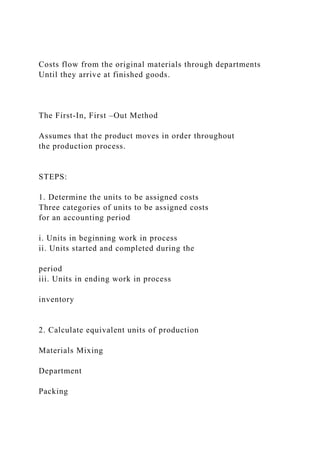
Costs flow from the original materials through departments
Until they arrive at finished goods.
The First-In, First –Out Method
Assumes that the product moves in order throughout
the production process.
STEPS:
1. Determine the units to be assigned costs
Three categories of units to be assigned costs
for an accounting period
i. Units in beginning work in process
ii. Units started and completed during the
period
iii. Units in ending work in process
inventory
2. Calculate equivalent units of production
Materials Mixing
Department
Packing
Department
ACG 2071
Process Cost Systems
Created by: M. Mari
Fall 2009-1
Page 3 of 13
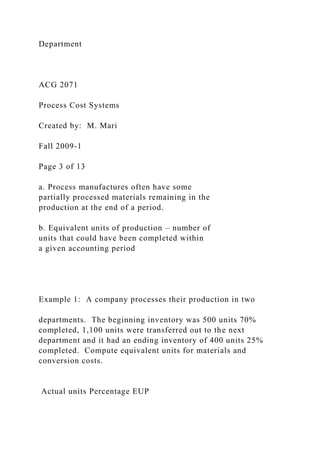
a. Process manufactures often have some
partially processed materials remaining in the
production at the end of a period.
b. Equivalent units of production – number of
units that could have been completed within
a given accounting period
Example 1: A company processes their production in two
departments. The beginning inventory was 500 units 70%
completed, 1,100 units were transferred out to the next
department and it had an ending inventory of 400 units 25%
completed. Compute equivalent units for materials and
conversion costs.
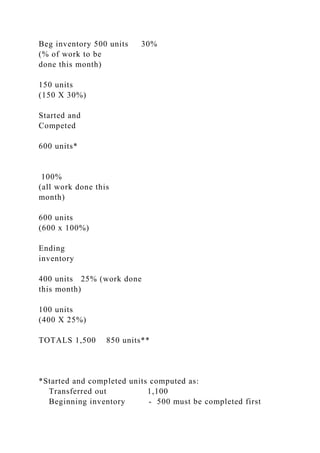
Actual units Percentage EUP
Beg inventory 500 units 30%
(% of work to be
done this month)
150 units
(150 X 30%)
Started and
Competed
600 units*
100%
(all work done this
month)
600 units
(600 x 100%)
Ending
inventory
400 units 25% (work done
this month)
100 units
(400 X 25%)
TOTALS 1,500 850 units**
*Started and completed units computed as:
Transferred out 1,100
Beginning inventory - 500 must be completed first
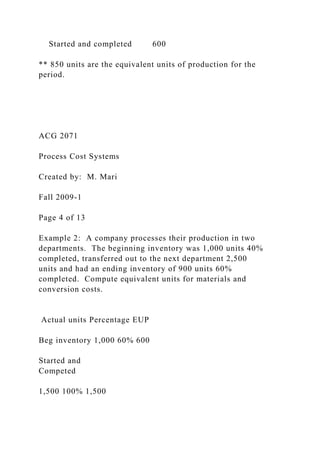
Started and completed 600
** 850 units are the equivalent units of production for the
period.
ACG 2071
Process Cost Systems
Created by: M. Mari
Fall 2009-1
Page 4 of 13
Example 2: A company processes their production in two
departments. The beginning inventory was 1,000 units 40%
completed, transferred out to the next department 2,500
units and had an ending inventory of 900 units 60%
completed. Compute equivalent units for materials and
conversion costs.
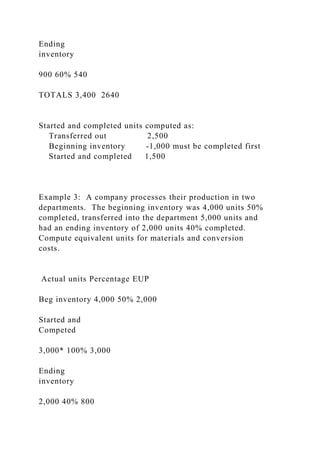
Actual units Percentage EUP
Beg inventory 1,000 60% 600
Started and
Competed
1,500 100% 1,500
Ending
inventory
900 60% 540
TOTALS 3,400 2640
Started and completed units computed as:
Transferred out 2,500
Beginning inventory -1,000 must be completed first
Started and completed 1,500
Example 3: A company processes their production in two
departments. The beginning inventory was 4,000 units 50%
completed, transferred into the department 5,000 units and
had an ending inventory of 2,000 units 40% completed.
Compute equivalent units for materials and conversion
costs.
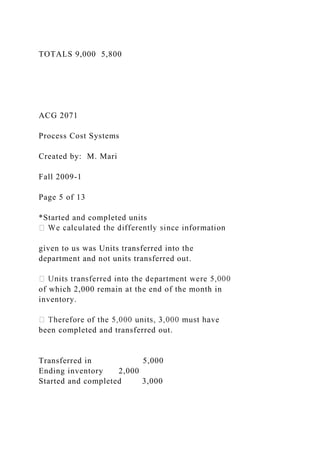
Actual units Percentage EUP
Beg inventory 4,000 50% 2,000
Started and
Competed
3,000* 100% 3,000
Ending
inventory
2,000 40% 800
TOTALS 9,000 5,800
ACG 2071
Process Cost Systems
Created by: M. Mari
Fall 2009-1
Page 5 of 13
*Started and completed units
given to us was Units transferred into the
department and not units transferred out.
of which 2,000 remain at the end of the month in
inventory.
been completed and transferred out.
Transferred in 5,000
Ending inventory 2,000
Started and completed 3,000
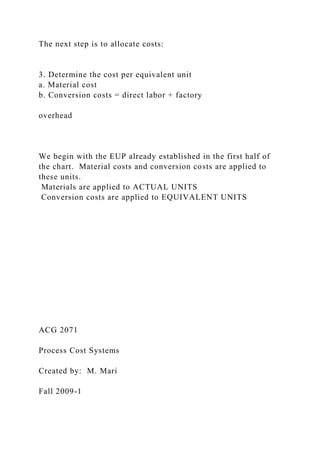
The next step is to allocate costs:
3. Determine the cost per equivalent unit
a. Material cost
b. Conversion costs = direct labor + factory
overhead
We begin with the EUP already established in the first half of
the chart. Material costs and conversion costs are applied to
these units.
Materials are applied to ACTUAL UNITS
Conversion costs are applied to EQUIVALENT UNITS
ACG 2071
Process Cost Systems
Created by: M. Mari
Fall 2009-1
Page 6 of 13
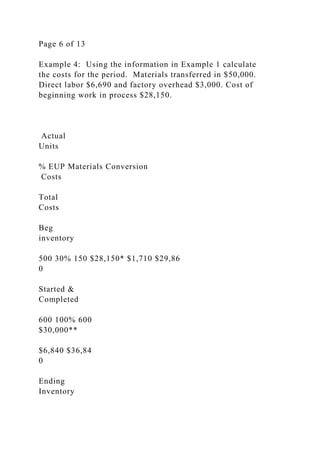
Example 4: Using the information in Example 1 calculate
the costs for the period. Materials transferred in $50,000.
Direct labor $6,690 and factory overhead $3,000. Cost of
beginning work in process $28,150.
Actual
Units
% EUP Materials Conversion
Costs
Total
Costs
Beg
inventory
500 30% 150 $28,150* $1,710 $29,86
0
Started &
Completed
600 100% 600
$30,000**
$6,840 $36,84
0
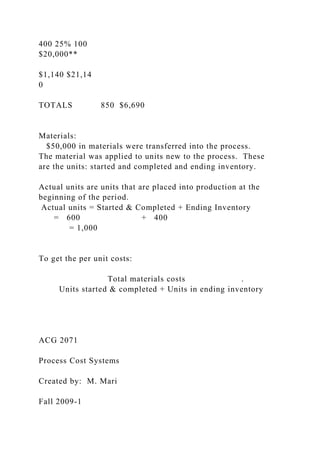
Ending
Inventory
400 25% 100
$20,000**
$1,140 $21,14
0
TOTALS 850 $6,690
Materials:
$50,000 in materials were transferred into the process.
The material was applied to units new to the process. These
are the units: started and completed and ending inventory.
Actual units are units that are placed into production at the
beginning of the period.
Actual units = Started & Completed + Ending Inventory
= 600 + 400
= 1,000
To get the per unit costs:
Total materials costs .
Units started & completed + Units in ending inventory
ACG 2071
Process Cost Systems
Created by: M. Mari
Fall 2009-1
Page 7 of 13
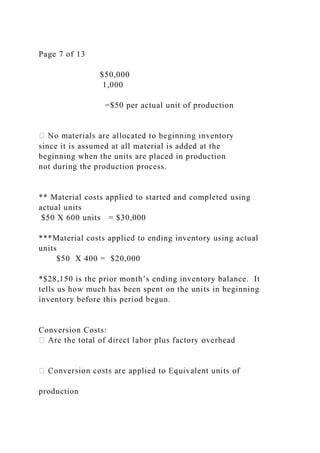
$50,000
1,000
=$50 per actual unit of production
since it is assumed at all material is added at the
beginning when the units are placed in production
not during the production process.
** Material costs applied to started and completed using
actual units
$50 X 600 units = $30,000
***Material costs applied to ending inventory using actual
units
$50 X 400 = $20,000
*$28,150 is the prior month’s ending inventory balance. It
tells us how much has been spent on the units in beginning
inventory before this period begun.
Conversion Costs:
production
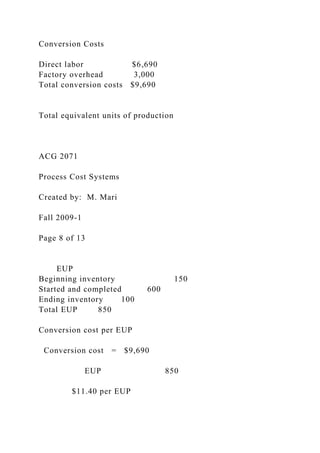
Conversion Costs
Direct labor $6,690
Factory overhead 3,000
Total conversion costs $9,690
Total equivalent units of production
ACG 2071
Process Cost Systems
Created by: M. Mari
Fall 2009-1
Page 8 of 13
EUP
Beginning inventory 150
Started and completed 600
Ending inventory 100
Total EUP 850
Conversion cost per EUP
Conversion cost = $9,690
EUP 850
$11.40 per EUP
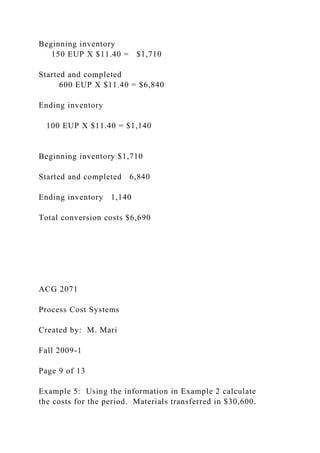
Beginning inventory
150 EUP X $11.40 = $1,710
Started and completed
600 EUP X $11.40 = $6,840
Ending inventory
100 EUP X $11.40 = $1,140
Beginning inventory $1,710
Started and completed 6,840
Ending inventory 1,140
Total conversion costs $6,690
ACG 2071
Process Cost Systems
Created by: M. Mari
Fall 2009-1
Page 9 of 13
Example 5: Using the information in Example 2 calculate
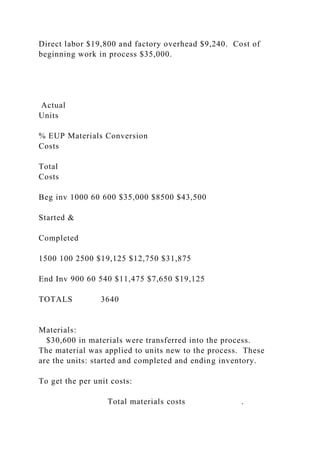
the costs for the period. Materials transferred in $30,600.
Direct labor $19,800 and factory overhead $9,240. Cost of
beginning work in process $35,000.
Actual
Units
% EUP Materials Conversion
Costs
Total
Costs
Beg inv 1000 60 600 $35,000 $8500 $43,500
Started &
Completed
1500 100 2500 $19,125 $12,750 $31,875
End Inv 900 60 540 $11,475 $7,650 $19,125
TOTALS 3640
Materials:
$30,600 in materials were transferred into the process.
The material was applied to units new to the process. These
are the units: started and completed and ending inventory.
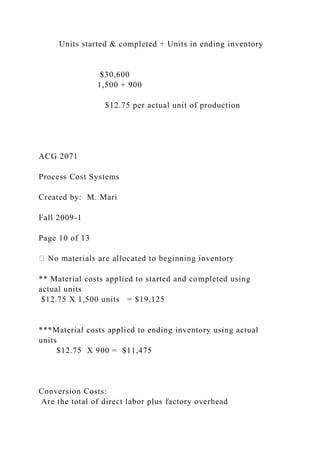
To get the per unit costs:
Total materials costs .
Units started & completed + Units in ending inventory
$30,600
1,500 + 900
$12.75 per actual unit of production
ACG 2071
Process Cost Systems
Created by: M. Mari
Fall 2009-1
Page 10 of 13
** Material costs applied to started and completed using
actual units
$12.75 X 1,500 units = $19,125
***Material costs applied to ending inventory using actual
units
$12.75 X 900 = $11,475
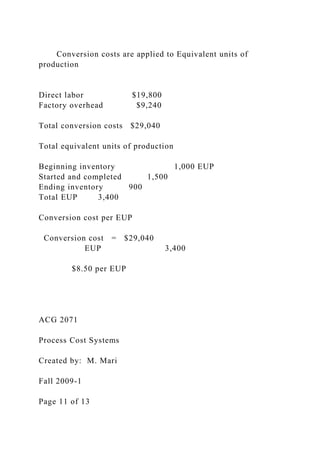
Conversion Costs:
Are the total of direct labor plus factory overhead
Conversion costs are applied to Equivalent units of
production
Direct labor $19,800
Factory overhead $9,240
Total conversion costs $29,040
Total equivalent units of production
Beginning inventory 1,000 EUP
Started and completed 1,500
Ending inventory 900
Total EUP 3,400
Conversion cost per EUP
Conversion cost = $29,040
EUP 3,400
$8.50 per EUP
ACG 2071
Process Cost Systems
Created by: M. Mari
Fall 2009-1
Page 11 of 13
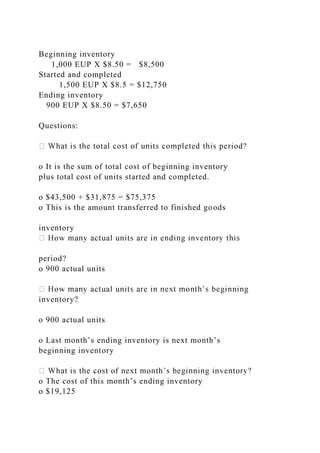
Beginning inventory
1,000 EUP X $8.50 = $8,500
Started and completed
1,500 EUP X $8.5 = $12,750
Ending inventory
900 EUP X $8.50 = $7,650
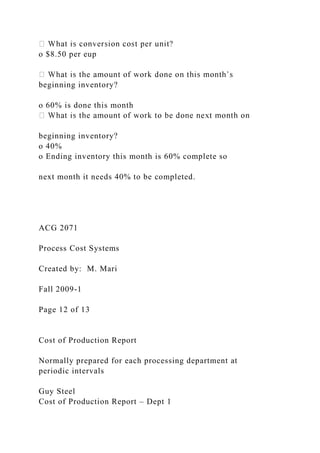
Questions:
o It is the sum of total cost of beginning inventory
plus total cost of units started and completed.
o $43,500 + $31,875 = $75,375
o This is the amount transferred to finished goods
inventory
period?
o 900 actual units
inventory?
o 900 actual units
o Last month’s ending inventory is next month’s
beginning inventory
o The cost of this month’s ending inventory
o $19,125
o $8.50 per eup
beginning inventory?
o 60% is done this month
beginning inventory?
o 40%
o Ending inventory this month is 60% complete so
next month it needs 40% to be completed.
ACG 2071
Process Cost Systems
Created by: M. Mari
Fall 2009-1
Page 12 of 13
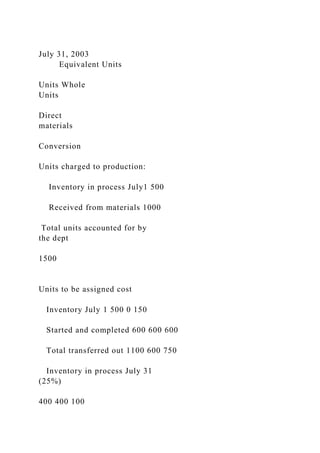
Cost of Production Report
Normally prepared for each processing department at
periodic intervals
Guy Steel
Cost of Production Report – Dept 1
July 31, 2003
Equivalent Units
Units Whole
Units
Direct
materials
Conversion
Units charged to production:
Inventory in process July1 500
Received from materials 1000
Total units accounted for by
the dept
1500
Units to be assigned cost
Inventory July 1 500 0 150
Started and completed 600 600 600
Total transferred out 1100 600 750
Inventory in process July 31
(25%)
400 400 100
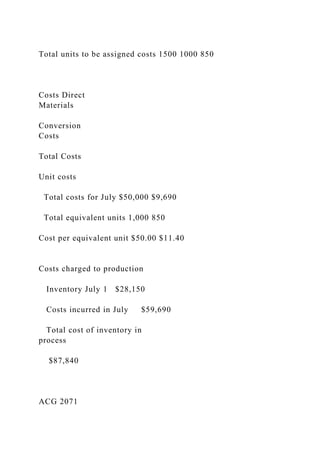
Total units to be assigned costs 1500 1000 850
Costs Direct
Materials
Conversion
Costs
Total Costs
Unit costs
Total costs for July $50,000 $9,690
Total equivalent units 1,000 850
Cost per equivalent unit $50.00 $11.40
Costs charged to production
Inventory July 1 $28,150
Costs incurred in July $59,690
Total cost of inventory in
process
$87,840
ACG 2071
Process Cost Systems
Created by: M. Mari
Fall 2009-1
Page 13 of 13
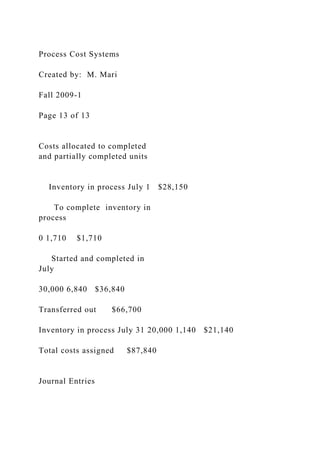
Costs allocated to completed
and partially completed units
Inventory in process July 1 $28,150
To complete inventory in
process
0 1,710 $1,710
Started and completed in
July
30,000 6,840 $36,840
Transferred out $66,700
Inventory in process July 31 20,000 1,140 $21,140
Total costs assigned $87,840
Journal Entries
Same as in job order but instead of accounting for
jobs, we account by department.
Sheet1PROCESS COSTING WORKSHEETLAYERSACTUAL
UNITS%EUPMATERIALSCONVERSION COSTSTOTAL
COSTBEGINNING INVENTORYSTARTED &
COMPLETEDENDING INVENTORYDirect materialsDirect
laborFactory overheadPROCESS COSTING
WORKSHEETLAYERSACTUAL
UNITS%EUPMATERIALSCONVERSION COSTSTOTAL
COSTBEGINNING INVENTORYSTARTED &
COMPLETEDENDING INVENTORY
Sheet2
Sheet3

ACG 2071 Managerial Accounting Process Costing Systems .docx

  • 1.
    ACG 2071 ManagerialAccounting Process Costing Systems Minicase PROCESS COSTING PROBLEM Spectre Chemicals produces Zaloff in a two department process. Information on the two departments for March and April, 2011 are as follows: March 2011: Department 1: The company had beginning inventory of 6,000 units, 40% completed with a cost of $45,000. During the month, the department transferred in 22,000 units of the direct materials with a cost of $10 per unit. Ending inventory was 7,000 units, 30% completed. Direct labor is $310,500 and factory overhead is $103,500. Department 2: The company had beginning inventory of 5,000 units, 70% completed with a cost of $80,000. During the month, direct labor was $175,000 and factory overhead was $87,500. Ending inventory was 10,000 units, 50% completed. April 2011: Department 1: During the month, the department transferred
  • 2.
    in 20,000 unitsof the direct materials with a cost of $11 per unit. Direct labor is $209,000 and factory overhead is $104,500. Ending inventory is 10,000 units 60% completed. Department 2: The company had beginning inventory of 5,000 units, 70% completed with a cost of $80,000. During the month, direct labor is $175,000 and factory overhead is $87,500. Required: and Conversion costs for each department for March and April, 2011. – one for each department and each month duction report for March and April 2011. ACG 2071 Process Cost Systems Created by: M. Mari Fall 2009-1
  • 3.
    Page 1 of13 Process Manufacturing of steps gh a series of sequential processes department, workstation, or work center. each receives the output from the prior department as a partially processed product. applies direct labor, overhead, and additional direct materials to move the product toward completion. Process Cost System verhead to specific processes. on units of production
  • 4.
    by department associated witheach process are then divided by the number of units passing through that process to determine the cost per equivalent units for that process ACG 2071 Process Cost Systems Created by: M. Mari Fall 2009-1 Page 2 of 13 To understand how costs are allocated, first we must decide how the costs are accumulated. One method is First in, First out method. Beverage Production
  • 5.
    Costs flow fromthe original materials through departments Until they arrive at finished goods. The First-In, First –Out Method Assumes that the product moves in order throughout the production process. STEPS: 1. Determine the units to be assigned costs Three categories of units to be assigned costs for an accounting period i. Units in beginning work in process ii. Units started and completed during the period iii. Units in ending work in process inventory 2. Calculate equivalent units of production Materials Mixing Department Packing
  • 6.
    Department ACG 2071 Process CostSystems Created by: M. Mari Fall 2009-1 Page 3 of 13 a. Process manufactures often have some partially processed materials remaining in the production at the end of a period. b. Equivalent units of production – number of units that could have been completed within a given accounting period Example 1: A company processes their production in two departments. The beginning inventory was 500 units 70% completed, 1,100 units were transferred out to the next department and it had an ending inventory of 400 units 25% completed. Compute equivalent units for materials and conversion costs. Actual units Percentage EUP
  • 7.
    Beg inventory 500units 30% (% of work to be done this month) 150 units (150 X 30%) Started and Competed 600 units* 100% (all work done this month) 600 units (600 x 100%) Ending inventory 400 units 25% (work done this month) 100 units (400 X 25%) TOTALS 1,500 850 units** *Started and completed units computed as: Transferred out 1,100 Beginning inventory - 500 must be completed first
  • 8.
    Started and completed600 ** 850 units are the equivalent units of production for the period. ACG 2071 Process Cost Systems Created by: M. Mari Fall 2009-1 Page 4 of 13 Example 2: A company processes their production in two departments. The beginning inventory was 1,000 units 40% completed, transferred out to the next department 2,500 units and had an ending inventory of 900 units 60% completed. Compute equivalent units for materials and conversion costs. Actual units Percentage EUP Beg inventory 1,000 60% 600 Started and Competed 1,500 100% 1,500
  • 9.
    Ending inventory 900 60% 540 TOTALS3,400 2640 Started and completed units computed as: Transferred out 2,500 Beginning inventory -1,000 must be completed first Started and completed 1,500 Example 3: A company processes their production in two departments. The beginning inventory was 4,000 units 50% completed, transferred into the department 5,000 units and had an ending inventory of 2,000 units 40% completed. Compute equivalent units for materials and conversion costs. Actual units Percentage EUP Beg inventory 4,000 50% 2,000 Started and Competed 3,000* 100% 3,000 Ending inventory 2,000 40% 800
  • 10.
    TOTALS 9,000 5,800 ACG2071 Process Cost Systems Created by: M. Mari Fall 2009-1 Page 5 of 13 *Started and completed units given to us was Units transferred into the department and not units transferred out. of which 2,000 remain at the end of the month in inventory. been completed and transferred out. Transferred in 5,000 Ending inventory 2,000 Started and completed 3,000
  • 11.
    The next stepis to allocate costs: 3. Determine the cost per equivalent unit a. Material cost b. Conversion costs = direct labor + factory overhead We begin with the EUP already established in the first half of the chart. Material costs and conversion costs are applied to these units. Materials are applied to ACTUAL UNITS Conversion costs are applied to EQUIVALENT UNITS ACG 2071 Process Cost Systems Created by: M. Mari Fall 2009-1
  • 12.
    Page 6 of13 Example 4: Using the information in Example 1 calculate the costs for the period. Materials transferred in $50,000. Direct labor $6,690 and factory overhead $3,000. Cost of beginning work in process $28,150. Actual Units % EUP Materials Conversion Costs Total Costs Beg inventory 500 30% 150 $28,150* $1,710 $29,86 0 Started & Completed 600 100% 600 $30,000** $6,840 $36,84 0 Ending Inventory
  • 13.
    400 25% 100 $20,000** $1,140$21,14 0 TOTALS 850 $6,690 Materials: $50,000 in materials were transferred into the process. The material was applied to units new to the process. These are the units: started and completed and ending inventory. Actual units are units that are placed into production at the beginning of the period. Actual units = Started & Completed + Ending Inventory = 600 + 400 = 1,000 To get the per unit costs: Total materials costs . Units started & completed + Units in ending inventory ACG 2071 Process Cost Systems Created by: M. Mari Fall 2009-1
  • 14.
    Page 7 of13 $50,000 1,000 =$50 per actual unit of production since it is assumed at all material is added at the beginning when the units are placed in production not during the production process. ** Material costs applied to started and completed using actual units $50 X 600 units = $30,000 ***Material costs applied to ending inventory using actual units $50 X 400 = $20,000 *$28,150 is the prior month’s ending inventory balance. It tells us how much has been spent on the units in beginning inventory before this period begun. Conversion Costs: production
  • 15.
    Conversion Costs Direct labor$6,690 Factory overhead 3,000 Total conversion costs $9,690 Total equivalent units of production ACG 2071 Process Cost Systems Created by: M. Mari Fall 2009-1 Page 8 of 13 EUP Beginning inventory 150 Started and completed 600 Ending inventory 100 Total EUP 850 Conversion cost per EUP Conversion cost = $9,690 EUP 850 $11.40 per EUP
  • 16.
    Beginning inventory 150 EUPX $11.40 = $1,710 Started and completed 600 EUP X $11.40 = $6,840 Ending inventory 100 EUP X $11.40 = $1,140 Beginning inventory $1,710 Started and completed 6,840 Ending inventory 1,140 Total conversion costs $6,690 ACG 2071 Process Cost Systems Created by: M. Mari Fall 2009-1 Page 9 of 13 Example 5: Using the information in Example 2 calculate the costs for the period. Materials transferred in $30,600.
  • 17.
    Direct labor $19,800and factory overhead $9,240. Cost of beginning work in process $35,000. Actual Units % EUP Materials Conversion Costs Total Costs Beg inv 1000 60 600 $35,000 $8500 $43,500 Started & Completed 1500 100 2500 $19,125 $12,750 $31,875 End Inv 900 60 540 $11,475 $7,650 $19,125 TOTALS 3640 Materials: $30,600 in materials were transferred into the process. The material was applied to units new to the process. These are the units: started and completed and ending inventory. To get the per unit costs: Total materials costs .
  • 18.
    Units started &completed + Units in ending inventory $30,600 1,500 + 900 $12.75 per actual unit of production ACG 2071 Process Cost Systems Created by: M. Mari Fall 2009-1 Page 10 of 13 ** Material costs applied to started and completed using actual units $12.75 X 1,500 units = $19,125 ***Material costs applied to ending inventory using actual units $12.75 X 900 = $11,475 Conversion Costs: Are the total of direct labor plus factory overhead
  • 19.
    Conversion costs areapplied to Equivalent units of production Direct labor $19,800 Factory overhead $9,240 Total conversion costs $29,040 Total equivalent units of production Beginning inventory 1,000 EUP Started and completed 1,500 Ending inventory 900 Total EUP 3,400 Conversion cost per EUP Conversion cost = $29,040 EUP 3,400 $8.50 per EUP ACG 2071 Process Cost Systems Created by: M. Mari Fall 2009-1 Page 11 of 13
  • 20.
    Beginning inventory 1,000 EUPX $8.50 = $8,500 Started and completed 1,500 EUP X $8.5 = $12,750 Ending inventory 900 EUP X $8.50 = $7,650 Questions: o It is the sum of total cost of beginning inventory plus total cost of units started and completed. o $43,500 + $31,875 = $75,375 o This is the amount transferred to finished goods inventory period? o 900 actual units inventory? o 900 actual units o Last month’s ending inventory is next month’s beginning inventory o The cost of this month’s ending inventory o $19,125
  • 21.
    o $8.50 pereup beginning inventory? o 60% is done this month beginning inventory? o 40% o Ending inventory this month is 60% complete so next month it needs 40% to be completed. ACG 2071 Process Cost Systems Created by: M. Mari Fall 2009-1 Page 12 of 13 Cost of Production Report Normally prepared for each processing department at periodic intervals Guy Steel Cost of Production Report – Dept 1
  • 22.
    July 31, 2003 EquivalentUnits Units Whole Units Direct materials Conversion Units charged to production: Inventory in process July1 500 Received from materials 1000 Total units accounted for by the dept 1500 Units to be assigned cost Inventory July 1 500 0 150 Started and completed 600 600 600 Total transferred out 1100 600 750 Inventory in process July 31 (25%) 400 400 100
  • 23.
    Total units tobe assigned costs 1500 1000 850 Costs Direct Materials Conversion Costs Total Costs Unit costs Total costs for July $50,000 $9,690 Total equivalent units 1,000 850 Cost per equivalent unit $50.00 $11.40 Costs charged to production Inventory July 1 $28,150 Costs incurred in July $59,690 Total cost of inventory in process $87,840 ACG 2071
  • 24.
    Process Cost Systems Createdby: M. Mari Fall 2009-1 Page 13 of 13 Costs allocated to completed and partially completed units Inventory in process July 1 $28,150 To complete inventory in process 0 1,710 $1,710 Started and completed in July 30,000 6,840 $36,840 Transferred out $66,700 Inventory in process July 31 20,000 1,140 $21,140 Total costs assigned $87,840 Journal Entries
  • 25.
    Same as injob order but instead of accounting for jobs, we account by department. Sheet1PROCESS COSTING WORKSHEETLAYERSACTUAL UNITS%EUPMATERIALSCONVERSION COSTSTOTAL COSTBEGINNING INVENTORYSTARTED & COMPLETEDENDING INVENTORYDirect materialsDirect laborFactory overheadPROCESS COSTING WORKSHEETLAYERSACTUAL UNITS%EUPMATERIALSCONVERSION COSTSTOTAL COSTBEGINNING INVENTORYSTARTED & COMPLETEDENDING INVENTORY Sheet2 Sheet3