Autocorrelation Functions and
ARIMA Modelling
Introduction
• Define what stationarity is and why it is so
important to Econometrics
• Describe the Autocorrelation coefficient
and its relationship to stationarity
• Evaluate the Q-statistic
• Describe the components of an
Autoregressive Integrated Moving Average
Model (ARIMA model)
Stationarity
• A strictly stationary process is one where
the distribution of its values remains the
same as time proceeds, implying that the
probability lies in a particular interval is the
same now as at any point in the past or
the future.
• However we tend to use the criteria
relating to a ‘weakly stationary process’ to
determine if a series is stationary or not.
Weakly Stationary Series
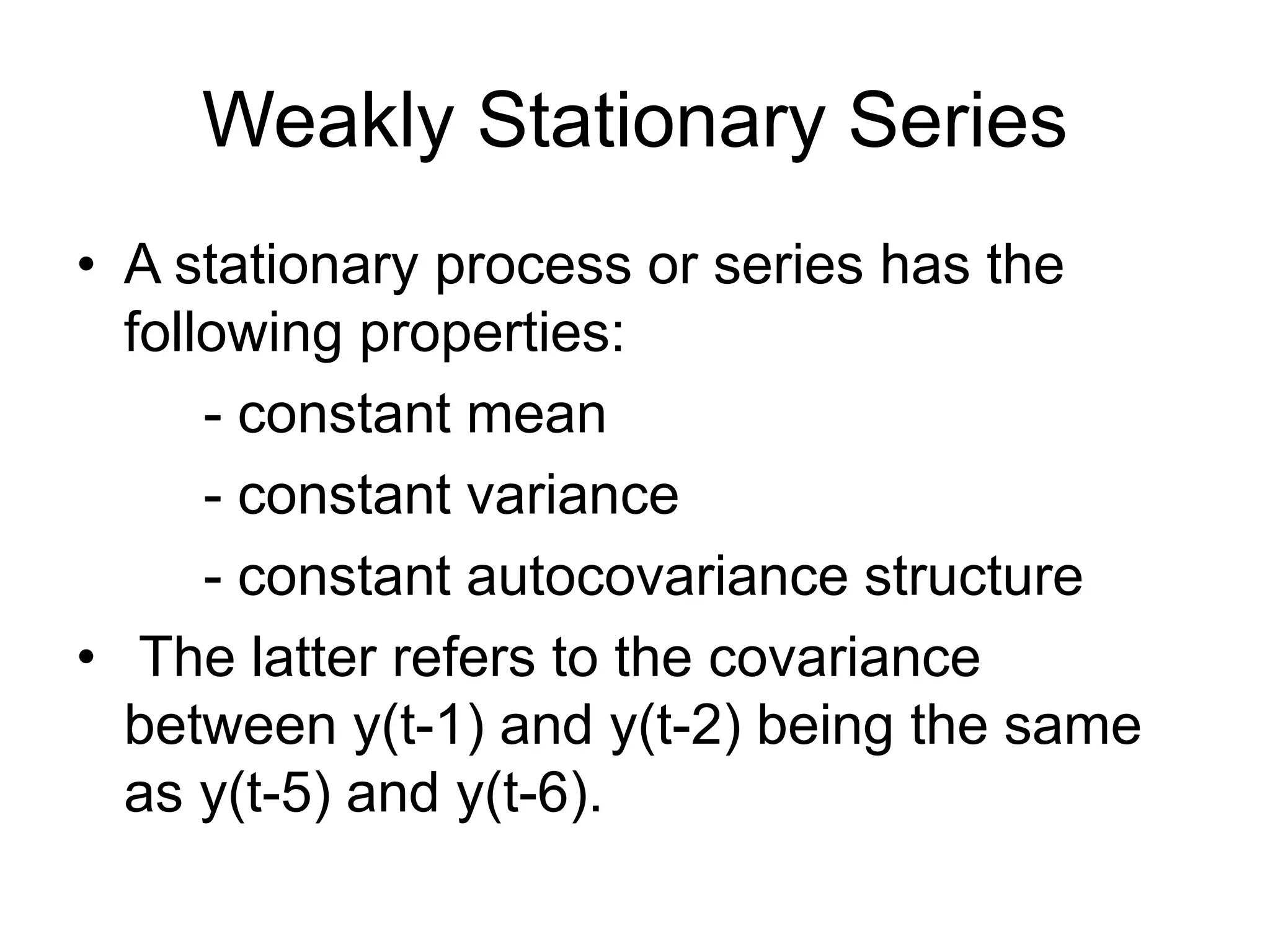
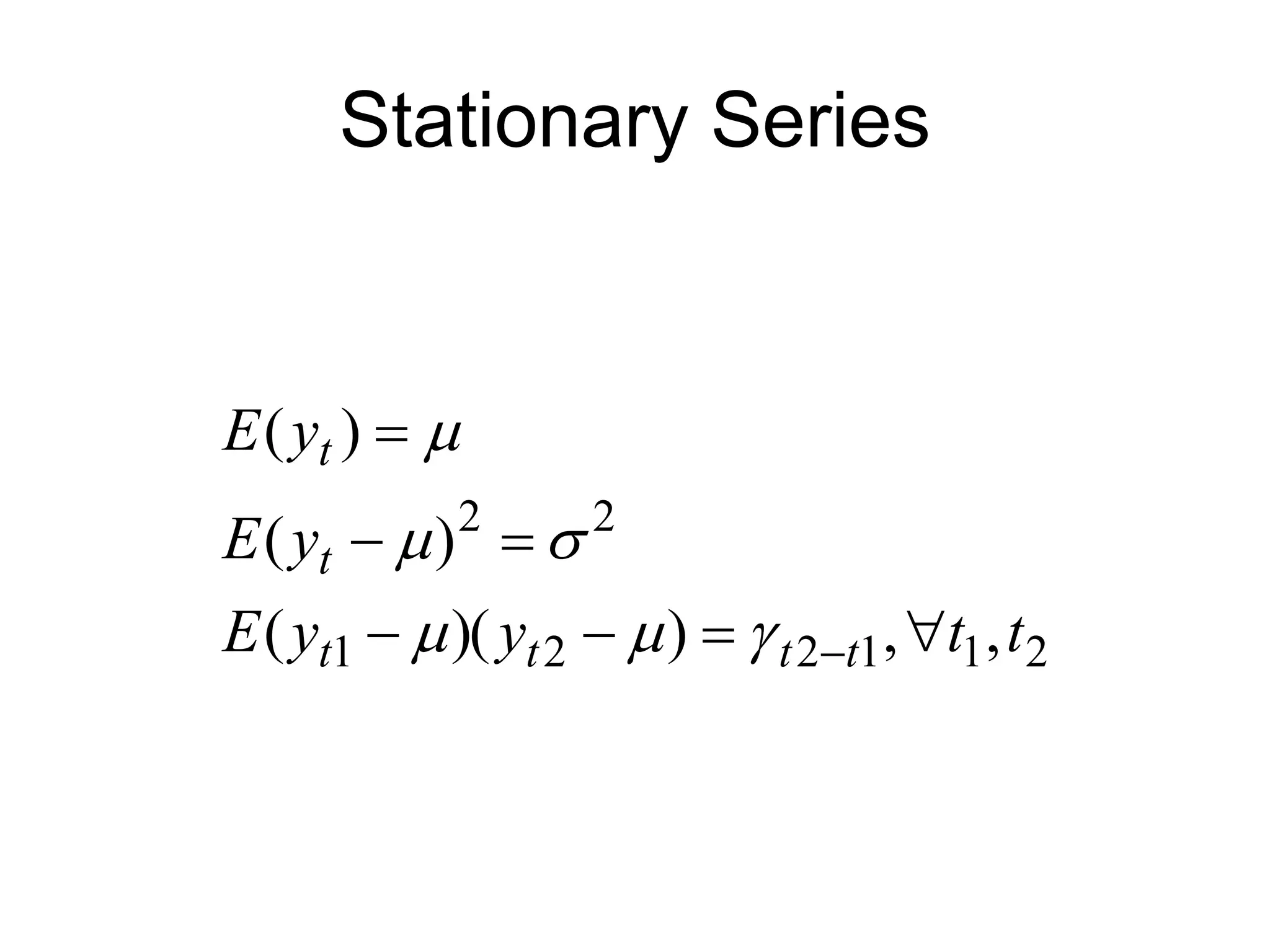
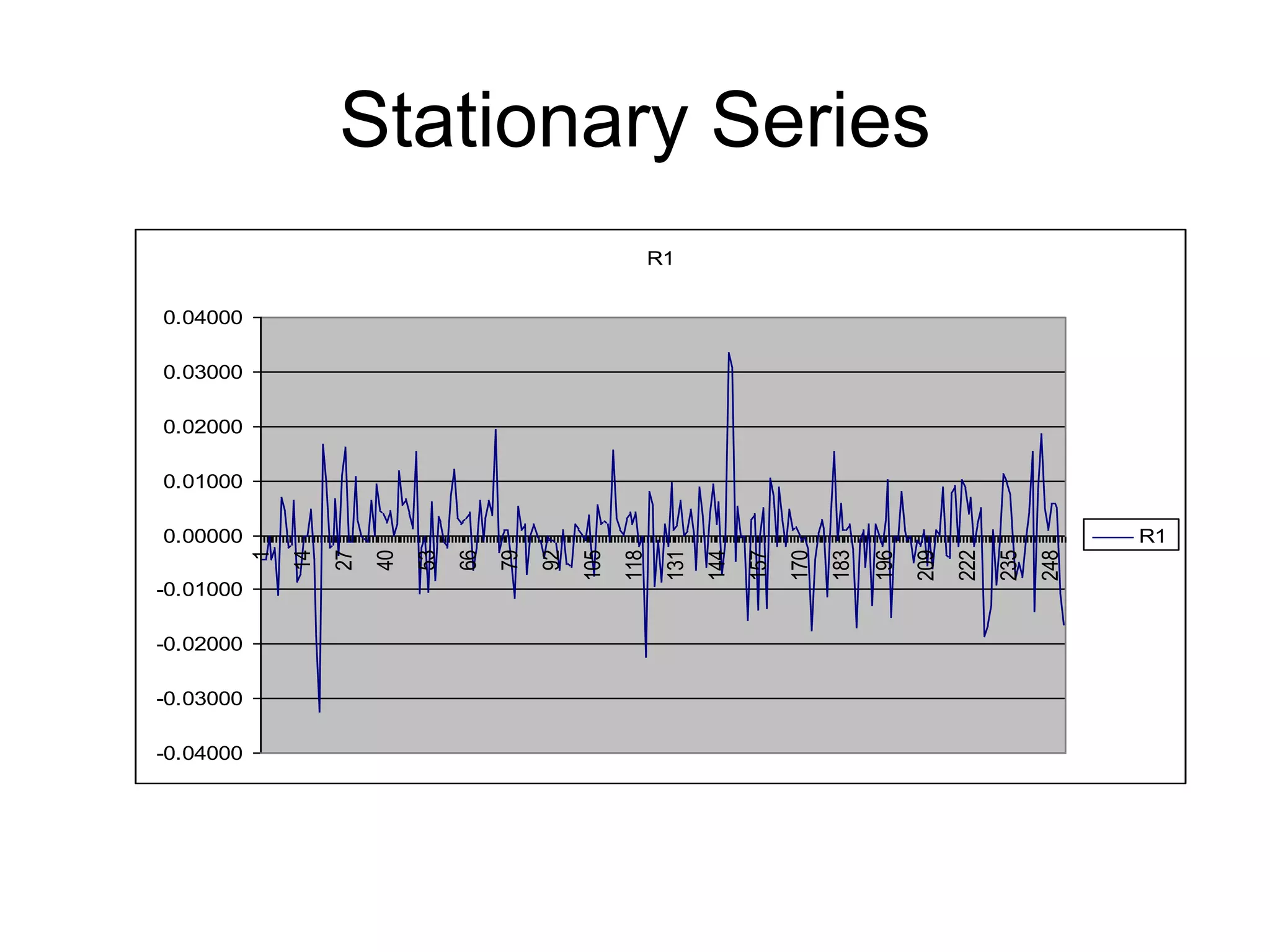
• A stationary process or series has the
following properties:
- constant mean
- constant variance
- constant autocovariance structure
• The latter refers to the covariance
between y(t-1) and y(t-2) being the same
as y(t-5) and y(t-6).
Stationary Series
2
1
1
2
2
1
2
2
,
,
)
)(
(
)
(
)
(
t
t
y
y
E
y
E
y
E
t
t
t
t
t
t














Stationary Series
R1
-0.04000
-0.03000
-0.02000
-0.01000
0.00000
0.01000
0.02000
0.03000
0.04000
1
14
27
40
53
66
79
92
105
118
131
144
157
170
183
196
209
222
235
248
R1
Non-stationary Series
UIKYE
0
200
400
600
800
1000
1200
1400
1600
1800
1
9
7
5
1
9
7
7
1
9
7
9
1
9
8
1
1
9
8
3
1
9
8
5
1
9
8
7
1
9
8
9
1
9
9
1
1
9
9
3
1
9
9
5
1
9
9
7
1
9
9
9
2
0
0
1
2
0
0
3
UIKYE
Implications of Non-stationary data
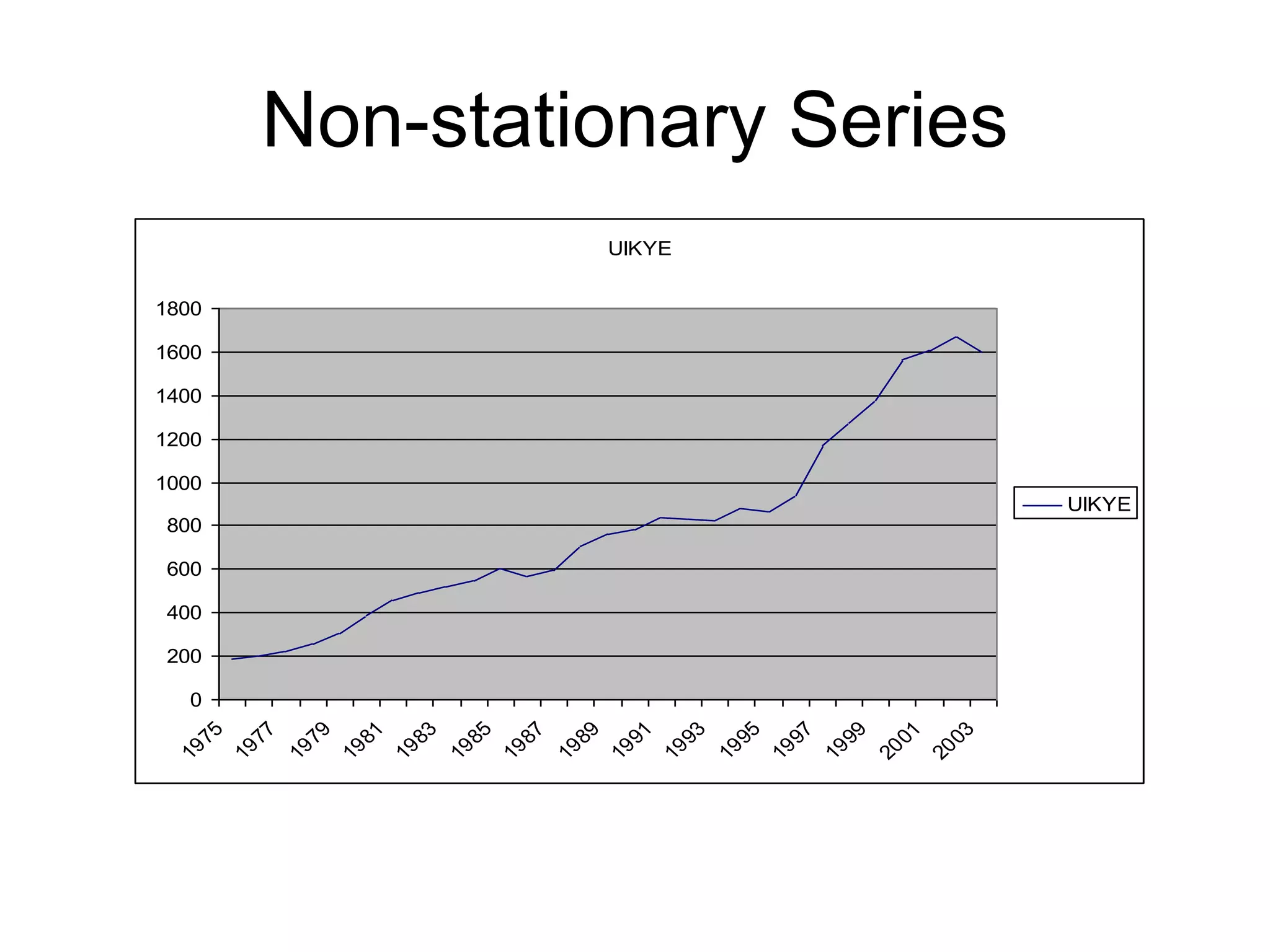
• If the variables in an OLS regression are
not stationary, they tend to produce
regressions with high R-squared statistics
and low DW statistics, indicating high
levels of autocorrelation.
• This is caused by the drift in the variables
often being related, but not directly
accounted for in the regression, hence the
omitted variable effect.
Stationary Data
• It is important to determine if our data is
stationary before the regression. This can
be done in a number of ways:
- plotting the data
- assessing the autocorrelation function
- Using a specific test on the
significance of the autocorrelation
coefficients.
- Specific tests to be covered later.
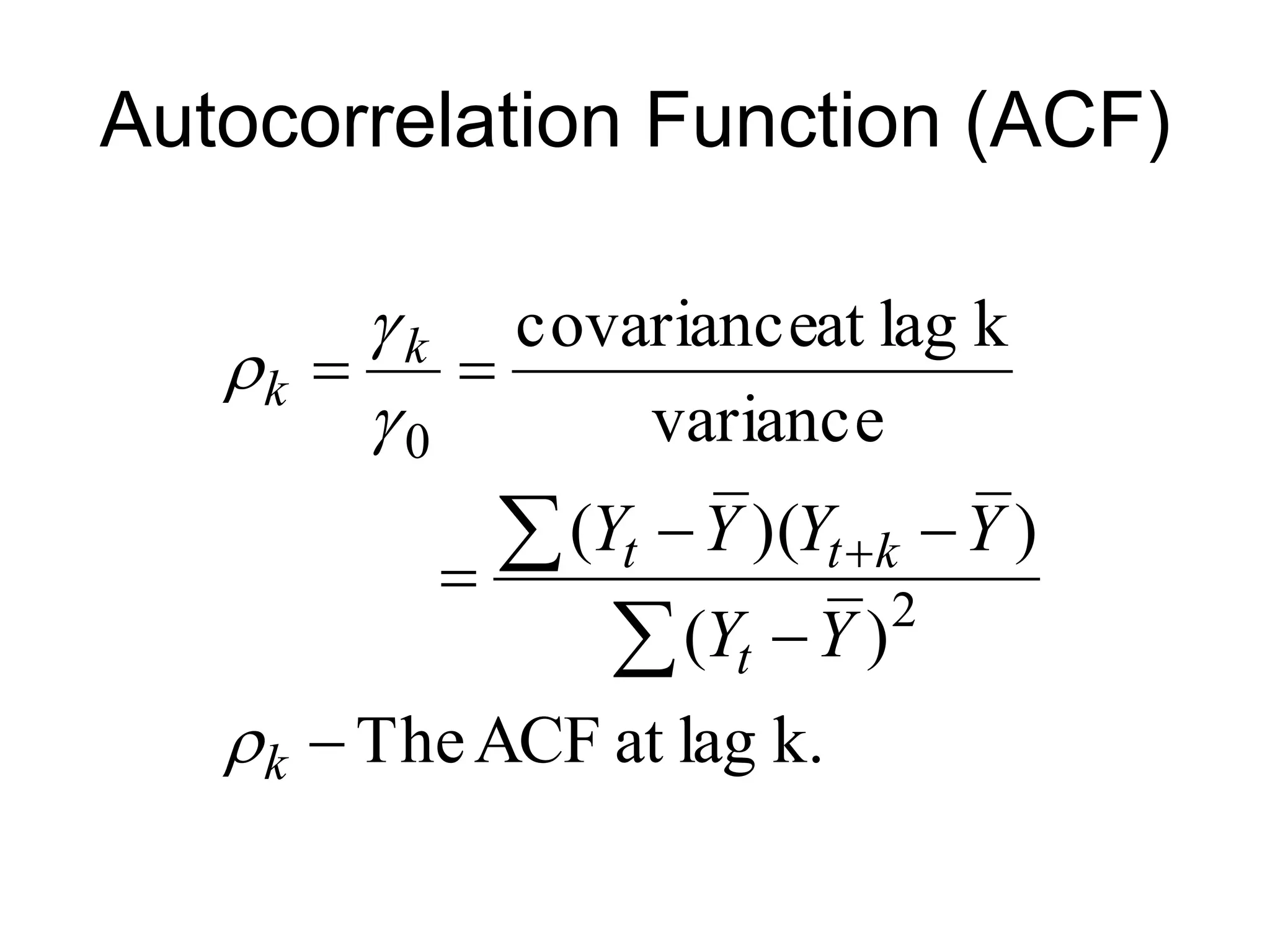
Autocorrelation Function (ACF)
k.
lag
at
ACF
The
)
(
)
)(
(
variance
k
lag
at
covariance
2
0








 
k
t
k
t
t
k
k
Y
Y
Y
Y
Y
Y




Correlogram
• The sample correlogram is the plot of the ACF
against k.
• As the ACF lies between -1 and +1, the
correlogram also lies between these values.
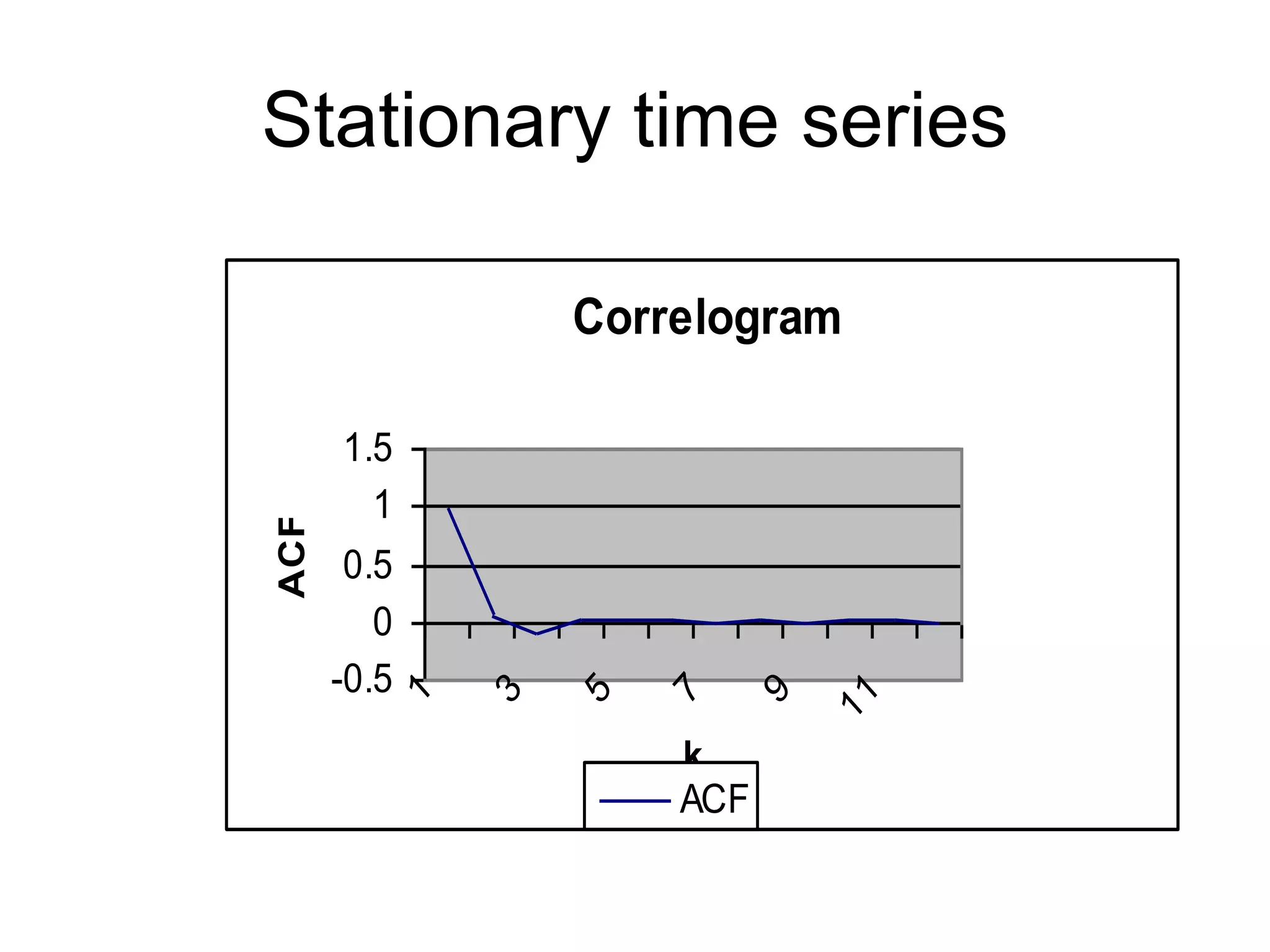
• It can be used to determine stationarity, if the
ACF falls immediately from 1 to 0, then equals
about 0 thereafter, the series is stationary.
• If the ACF declines gradually from 1 to 0 over a
prolonged period of time, then it is not stationary.
Stationary time series
Correlogram
-0.5
0
0.5
1
1.5
1
3
5
7
9
1
1
k
ACF
ACF
Statistical Significance of the ACF
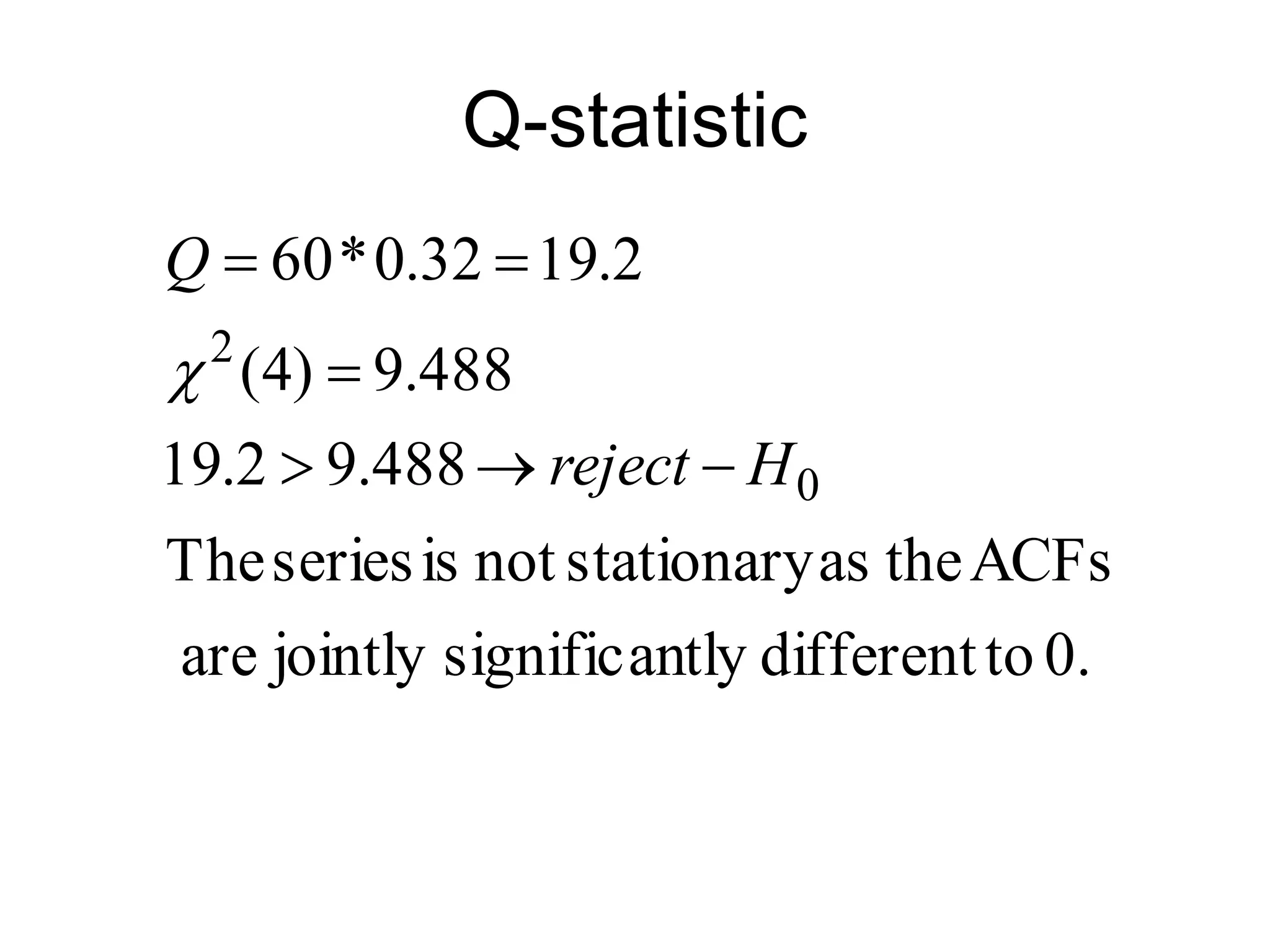
• The Q statistic can be used to determine if
the sample ACFs are jointly equal to zero.
• If jointly equal to zero we can conclude
that the series is stationary.
• It follows the chi-squared distribution,
where the null hypothesis is that the
sample ACFs jointly equal zero.
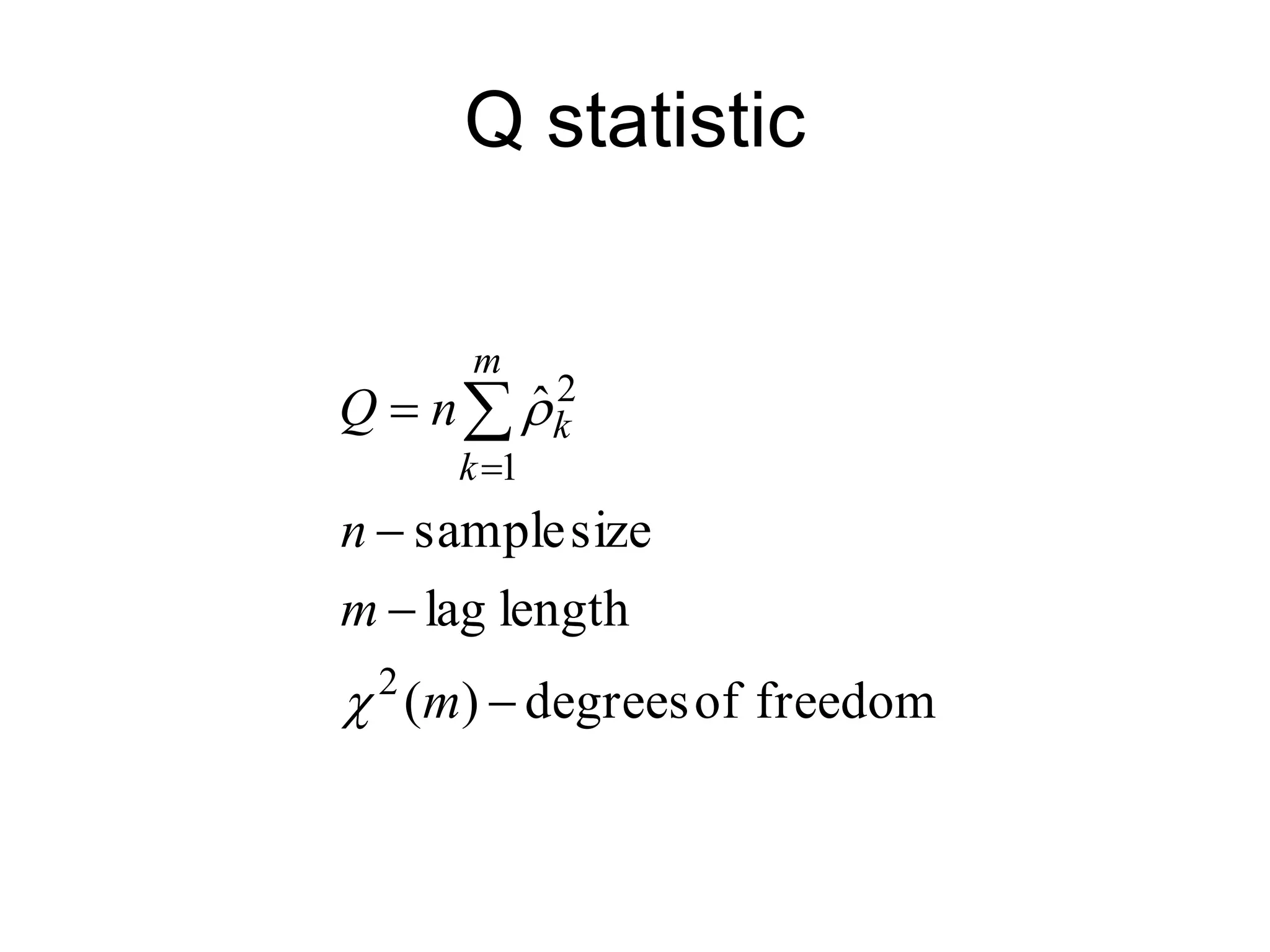
Q statistic
freedom
of
degrees
)
(
length
lag
size
sample
ˆ
2
1
2



 

m
m
n
n
Q
m
k
k


Ljung-Box Statistic
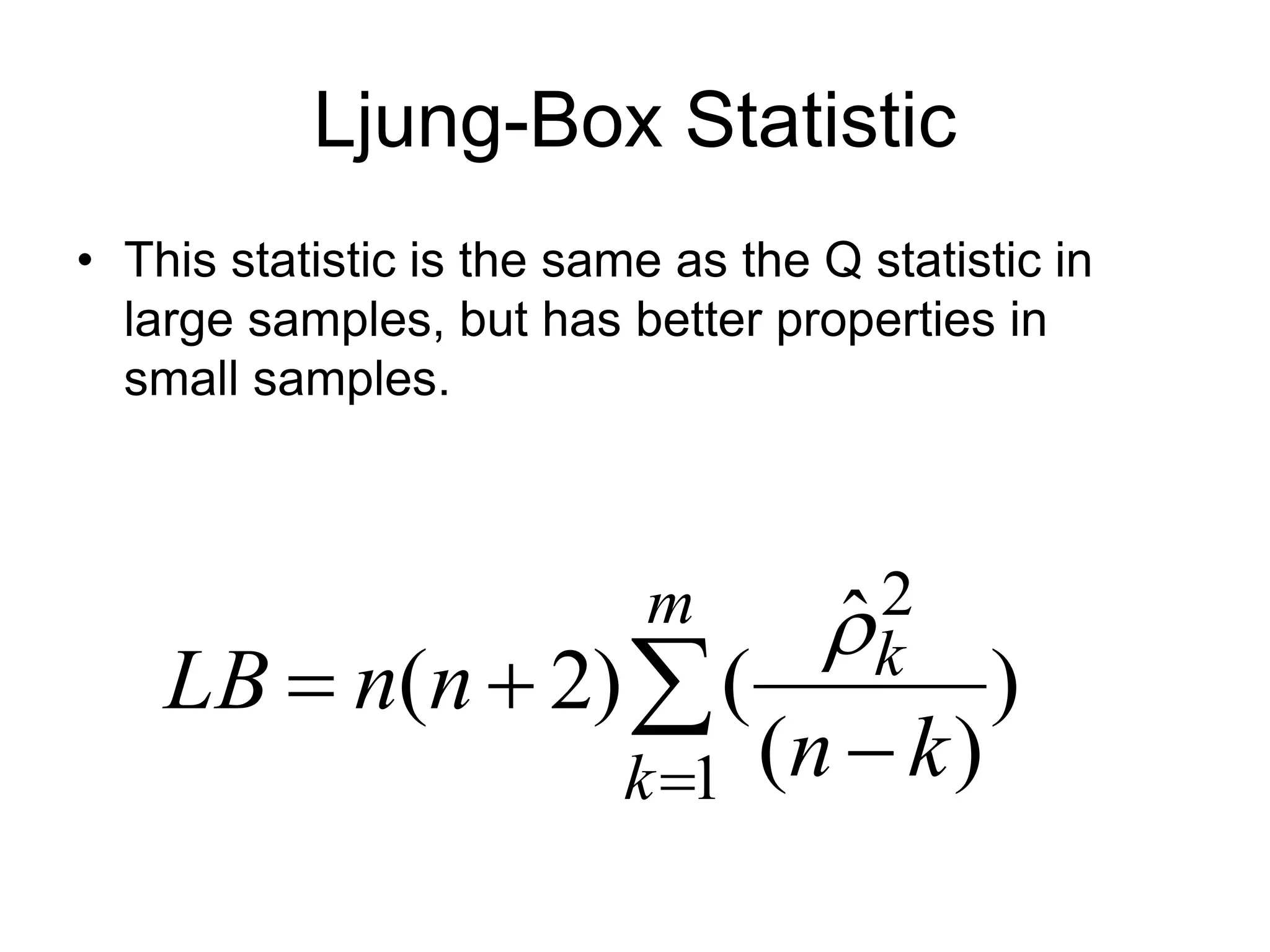
• This statistic is the same as the Q statistic in
large samples, but has better properties in
small samples.
)
)
(
ˆ
(
)
2
(
1
2

 


m
k
k
k
n
n
n
LB

Partial ACF
• The Partial Autocorrelation Function
(PACF) is similar to the ACF, however it
measures correlation between
observations that are k time periods apart,
after controlling for correlations at
intermediate lags.
• This can also be used to produce a partial
correlogram, which is used in Box-Jenkins
methodology (covered later).
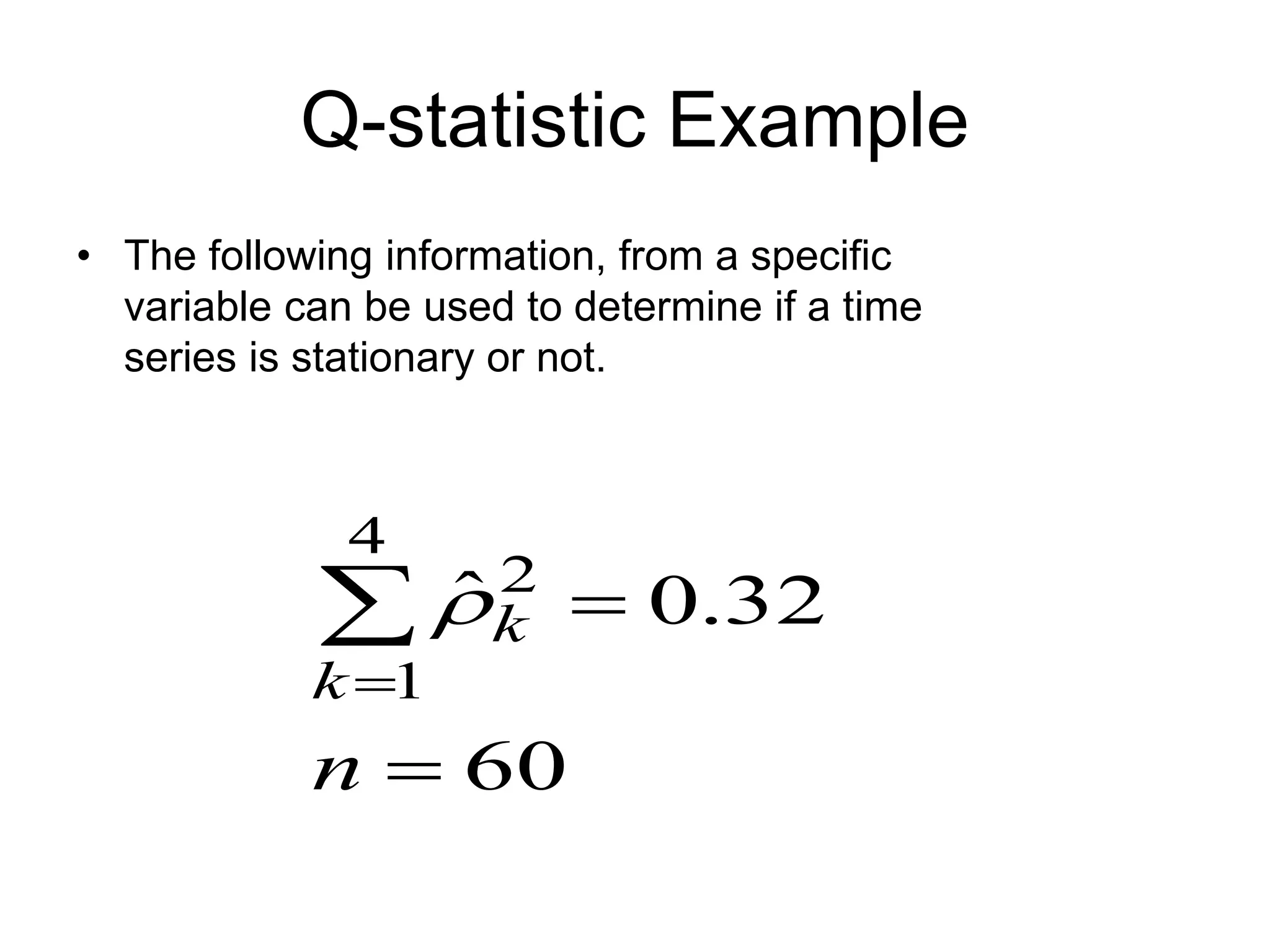
Q-statistic Example
• The following information, from a specific
variable can be used to determine if a time
series is stationary or not.
60
32
.
0
ˆ
4
1
2




n
k
k

Q-statistic
0.
to
different
tly
significan
jointly
are
ACFs
the
as
stationary
not
is
series
The
488
.
9
2
.
19
488
.
9
)
4
(
2
.
19
32
.
0
*
60
0
2
H
reject
Q







Autoregressive Process
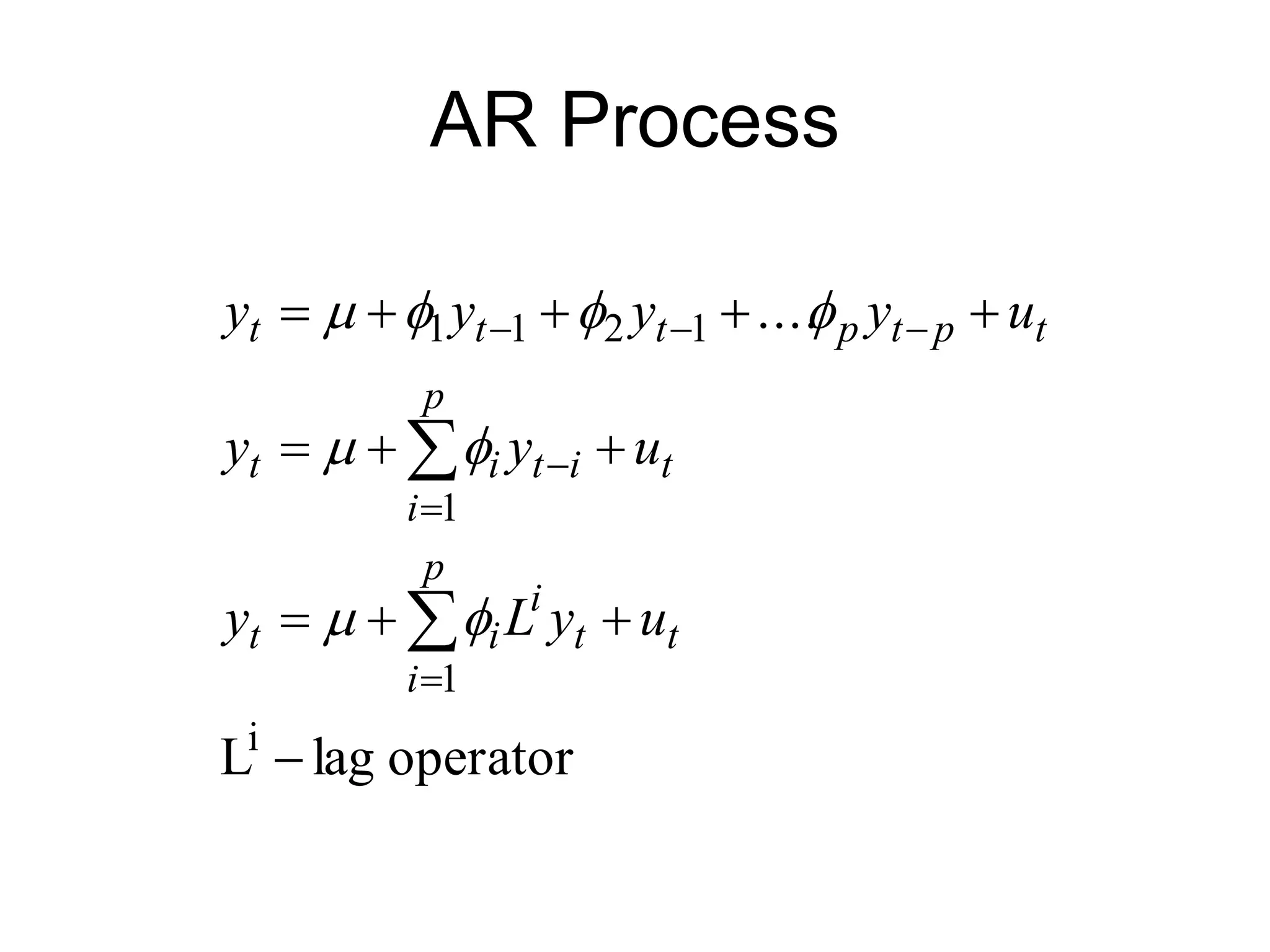
• An AR process involves the inclusion of
lagged dependent variables.
• An AR(1) process involves a single lag, an
AR(p) model involves p lags.
• AR(1) processes are often referred to as
the random walk, or driftless random walk
if we exclude the constant.
AR Process
operator
lag
L
....
i
1
1
1
2
1
1




















t
t
i
p
i
i
t
t
i
t
p
i
i
t
t
p
t
p
t
t
t
u
y
L
y
u
y
y
u
y
y
y
y








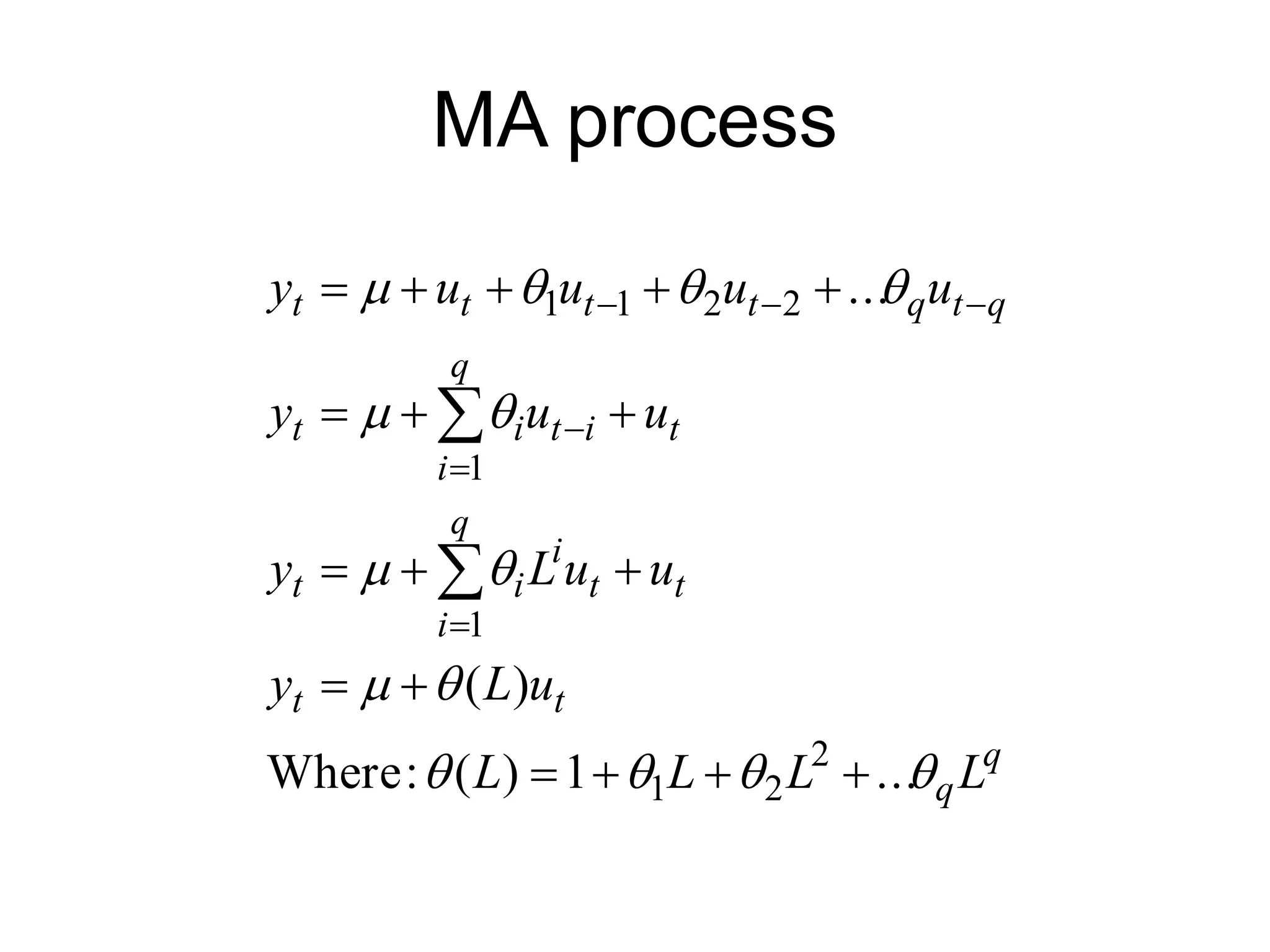
Moving Average (MA) process
• In this simple model, the dependent
variable is regressed against lagged
values of the error term.
• We assume that the assumptions on the
mean of the error term being 0 and having
a constant variance etc still apply.
MA process
q
q
t
t
t
t
q
i
i
i
t
t
i
t
q
i
i
t
q
t
q
t
t
t
t
L
L
L
L
u
L
y
u
u
L
y
u
u
y
u
u
u
u
y














...
1
)
(
:
Where
)
(
...
2
2
1
1
1
2
2
1
1

























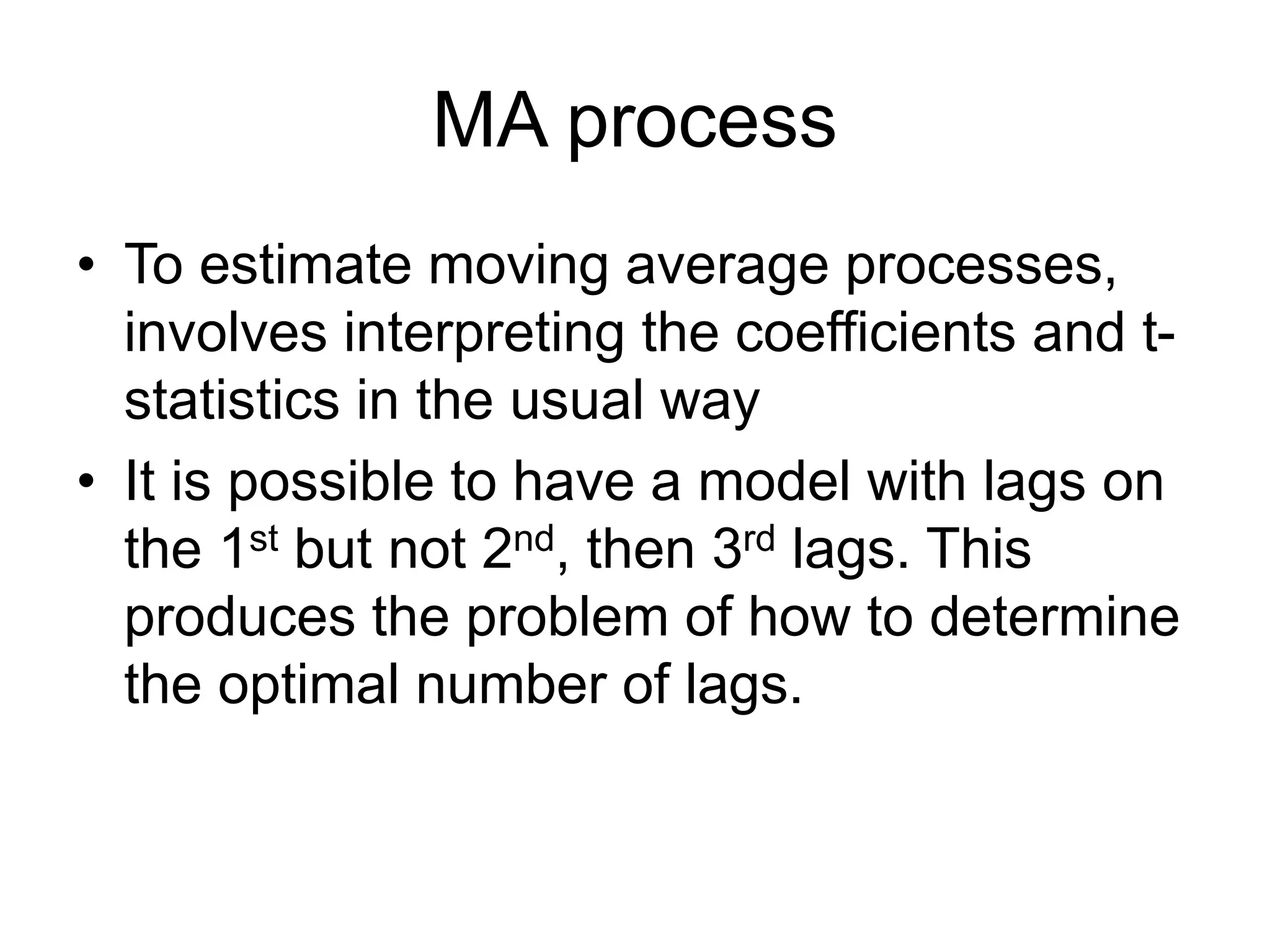
MA process
• To estimate moving average processes,
involves interpreting the coefficients and t-
statistics in the usual way
• It is possible to have a model with lags on
the 1st but not 2nd, then 3rd lags. This
produces the problem of how to determine
the optimal number of lags.
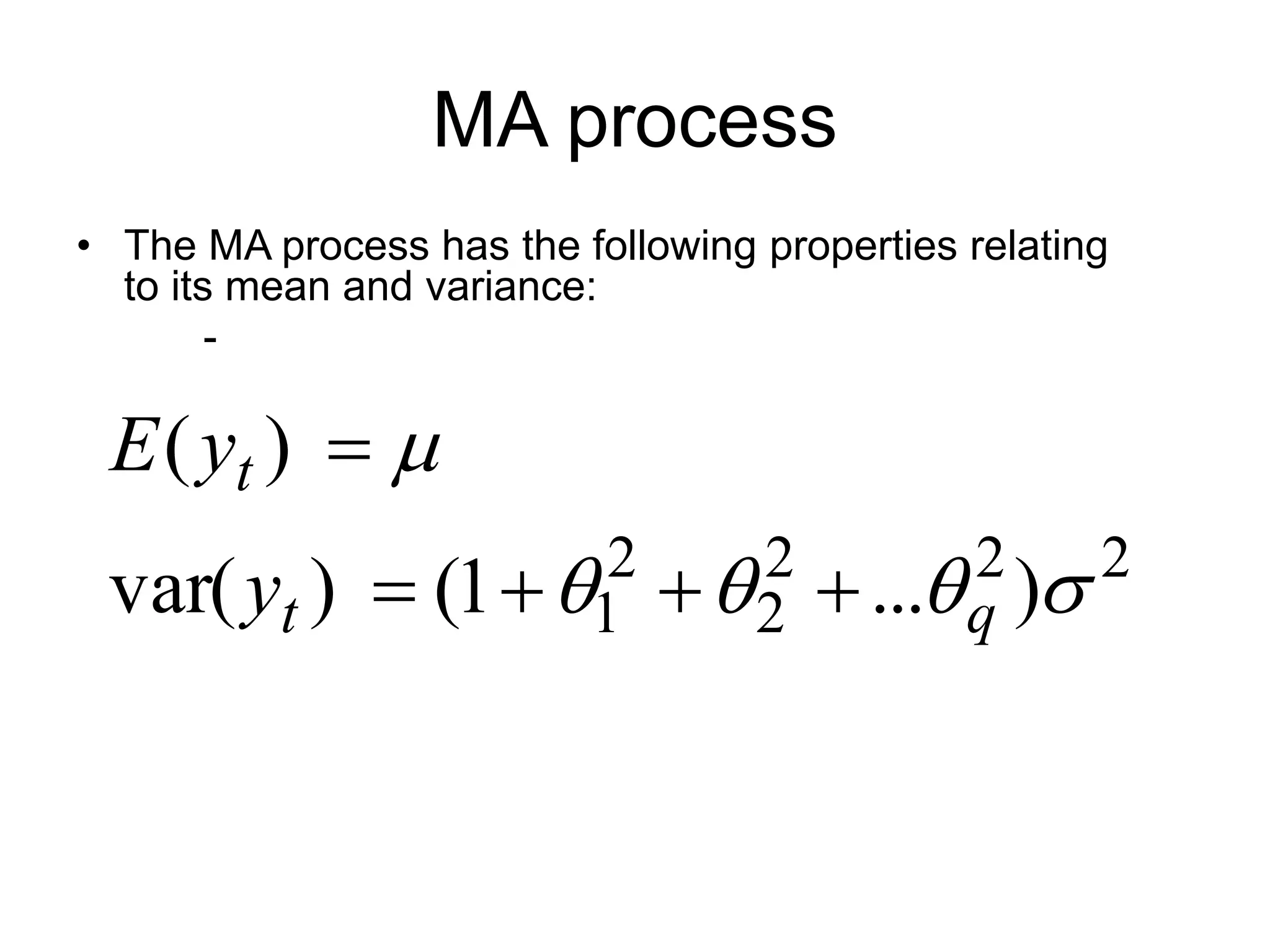
MA process
• The MA process has the following properties relating
to its mean and variance:
-
2
2
2
2
2
1 )
...
1
(
)
var(
)
(





q
t
t
y
y
E





Example of an MA Process
term
error
u
output
y
LM
u
y
y t
t
t
47
.
2
)
1
(
,
15
.
0
R
(0.1)
(0.2)
(0.1)
3
.
0
8
.
0
7
.
0
ˆ
2
1
1






 

Example
• In the previous slide we have estimated a
model using an AR(1) process and MA(1)
process or ARMA(1,1) model, with a lag
on the MA part to pick up any inertia in
adjustment in output.
• The t-statistics are interpreted in the same
way, in this case only one MA lag was
significant.
Conclusion
• Before conducting a regression, we need to
consider whether the variables are stationary or
not.
• The ACF and correlogram is one way of
determining if a series is stationary, as is the Q-
statistic
• An AR(p) process involves the use of p lags of
the dependent variable as explanatory variables
• A MA(q) process involves the use of q lags of
the error term.

ACF.ppt