Análisis de fractura
Aceros avanzados
MAYO 2017
TRIP-ASSISTED STEELS
The steels developed to exploit the properties obtained when the martensite reaction occurs during
plastic deformation are known as transformation-induced plasticity (TRIP) steels.
TRIP-assisted steels are mass produced, made using a complex heat treatment which is often completed
within a short time during the processing of steel strip.
Their microstructure consists of allotriomorphic ferrite as the major phase together with a total of 30–40%
of harder regions. The latter consist of mixtures of bainite, martensite and carbon-enriched retained
austenite.
An allotriomorph has a shape which does not reflect its internal
crystalline symmetry. This is because it tends to nucleate at the

austenite grain surfaces, forming layers which follow the grain
boundary contours.
A typical chemical composition Fe–0.12C–1.5Si–1.5Mn wt%.
The major application of TRIP-assisted steels is in the automobile industries, both for
painted surfaces and for enhancing the safety of the passenger compartment in the event
of a crash.
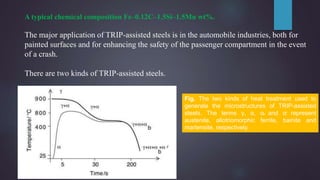
There are two kinds of TRIP-assisted steels.
Fig. The two kinds of heat treatment used to
generate the microstructures of TRIP-assisted
steels. The terms γ, α, αb and α′, represent
austenite, allotriomorphic ferrite, bainite and
martensite, respectively.
The substantial silicon addition to TRIP-assisted steels leads to the formation
of hard, adherent oxide (Fe2SiO4) which is difficult to remove prior to hot
rolling, resulting in a poor surface finish.
Galvanizing of TRIP-assisted steels
There are two basic methods of galvanizing, by dipping the steel in liquid zinc
or by electrolytically depositing the zinc. The typical concentrations of silicon
and manganese in TRIP-assisted steels lead to a stable Mn2SiO4 oxide film
on the surface during the heat treatment that leads to the desired
microstructure. This makes it difficult for the zinc to wet the steel surface,
making it necessary to electrolytically galvanize such alloys.
TWIP STEELS
A displacive transformation (e.g. martensite or bainite) results not only in a plastic
strain, but also a change of crystal structure and density; this is the phenomenon
exploited in the TRIP steels.
The third mode of deformation is mechanical twinning, in which the crystal
structure of the steel is preserved but the twinned region is reoriented in the
process. Mechanical twinning results in a much larger shear strain s=1/√2,
compared with displacive transformations where s is typically 0.25.
TWIP stands for twinning-induced plasticity. The alloys are austenitic and
remain so during mechanical deformation, but the material is able to
accommodate strain via both the glide of individual dislocations and through
mechanical twinning on the {1 1 1}γ <1 1 2>γ system.
Fig. Simplified representation of Twinning in a lattice.
Fe–25Mn–3Si– 3Al wt%
At high manganese concentrations, there is a tendency for the austenite to transform
into e-martensite (hexagonal close packed) during deformation. e-martensite can
form by the dissociation of a perfect a/2<0 1 1>γ dislocation into Shockley partials
on a close packed {1 1 1}γ plane, with a fault between the partials.
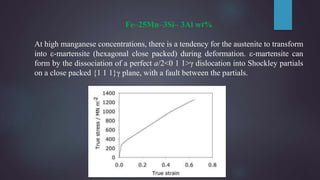
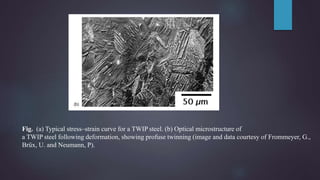
Fig. (a) Typical stress–strain curve for a TWIP steel. (b) Optical microstructure of
a TWIP steel following deformation, showing profuse twinning (image and data courtesy of Frommeyer, G.,
Brüx, U. and Neumann, P).
The alloys have a rather low yield strength at 200–300MNm−2 but the ultimate
tensile strength can be much higher, in excess of 1100MNm−2.
This is because the strain-hardening coefficient is large, resulting in a great deal of
uniform elongation, and a total elongation of some 60–95%. The effect of
mechanical twinning is two-fold. The twins add to plasticity, but they also have a
powerful effect in increasing the work-hardening rate by subdividing the untwinned
austenite into finer regions.
One major advantage of TWIP steels is that they are austenitic and they maintain
attractive properties at cryogenic temperatures (−150◦C) and high strain rates, e.g.,
103 s−1. They therefore have great potential in enhancing the safety of automobiles by
absorbing energy during crashes.
INDUSTRIAL STEELS SUBJECTEDTOTHERMOMECHANICAL
TREATMENTS
Micro-alloyed steels produced by controlled rolling are a most attractive
proposition in many engineering applications because of their relatively low
cost, moderate strength, and very good toughness and fatigue strength, together
with their ability to be readily welded. They have, to a considerable degree,
eliminated quenched and tempered steels in many applications.
These steels are most frequently available in control-rolled sheet, which is then
coiled over a range of temperatures between 750◦C and 550◦C.The coiling
temperature has an important influence as it represents the final transformation
temperature, and this influences the microstructure. The lower this temperature,
under the same conditions, the higher the strength achieved.
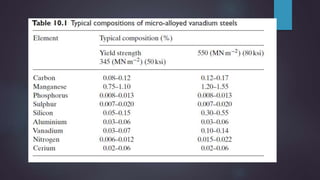
The normal range of yield strength obtained in these steels varies from
about 350 to 550MNm−2 (50–80 ksi).
The strength is controlled both by the detailed thermomechanical treatment, by
varying the manganese content from 0.5 to 1.5 wt%, and by using the micro-
alloying additions in the range 0.03 to above 0.1 wt%. Niobium is used alone, or
with vanadium, while titanium can be used in combination with the other two
carbide-forming elements.
One of the most extensive applications is in pipelines for the conveyance of
natural gas and oil, where the improved weldability due to the overall lower
alloying content (lower hardenability) and, particularly, the lower carbon levels
is a great advantage.
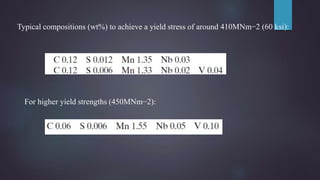
Typical compositions (wt%) to achieve a yield stress of around 410MNm−2 (60 ksi):
For higher yield strengths (450MNm−2):
At the higher strength levels, micro-alloyed steels are used for heavy duty truck
frames, tractor components, crane booms and lighting standards, etc. The control
of sulphide inclusions gives the steels a high degree of formability in cold
fabrication processes.
A steel is said to have been ausformed when martensite is produced from
plastically deformed austenite.
Austenite Ausforming has provided some of the strongest, toughest steels so far
produced, with the added advantage of very good fatigue resistance.
Typical applications have included parts for undercarriages of aircraft, special
springs and bolts.
A0.4C–6Mn–3Cr–1.5Si steel has been ausformed to a tensile strength of
3400MNm−2, with an improvement in ductility over the conventional heat
treatment. Similar high strength levels with good ductility have been reported for
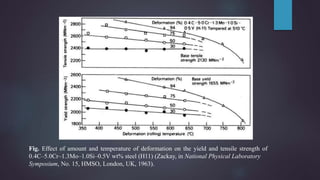
0.4C–5Cr–1.3Mo–1.0Si–0.5V wt% steel (H11)
Fig. Effect of amount and temperature of deformation on the yield and tensile strength of
0.4C–5.0Cr–1.3Mo–1.0Si–0.5V wt% steel (H11) (Zackay, in National Physical Laboratory
Symposium, No. 15, HMSO, London, UK, 1963).
THE EMBRITTLEMENTAND FRACTURE OF STEELS
Most groups of alloys can exhibit failure by cracking in circumstances where
the apparent applied stress is well below that at which failure would normally
be expected.
Fracture mechanics allows the quantitative assessment of growth of cracks in
various stress situations, to an extent that it is now frequently possible to
predict the stress level to which steel structures can be confidently subjected
without the risk of sudden failure.
CLEAVAGE FRACTURE IN IRONAND STEEL
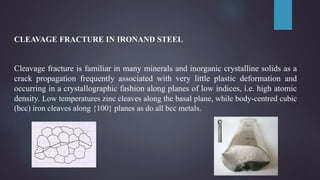
Cleavage fracture is familiar in many minerals and inorganic crystalline solids as a
crack propagation frequently associated with very little plastic deformation and
occurring in a crystallographic fashion along planes of low indices, i.e. high atomic
density. Low temperatures zinc cleaves along the basal plane, while body-centred cubic
(bcc) iron cleaves along {100} planes as do all bcc metals.
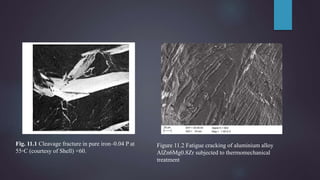
Fig. 11.1 Cleavage fracture in pure iron–0.04 P at
55◦C (courtesy of Shell) ×60.
Figure 11.2 Fatigue cracking of aluminium alloy
AlZn6Mg0.8Zr subjected to thermomechanical
treatment
As the carbon and nitrogen content of the iron is increased, the transition from
ductile to brittle cleavage behaviour takes place at increasing temperatures,
until in some steels this can occur at ambient and above-ambient temperatures.
The propagation of a cleavage crack in iron and steel requires much
less energy than that associated with the growth of a ductile crack.
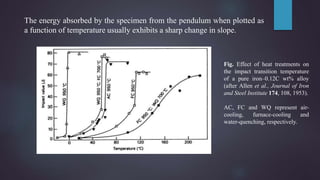
The energy absorbed by the specimen from the pendulum when plotted as
a function of temperature usually exhibits a sharp change in slope.
Fig. Effect of heat treatments on
the impact transition temperature
of a pure iron–0.12C wt% alloy
(after Allen et al., Journal of Iron
and Steel Institute 174, 108, 1953).
AC, FC and WQ represent air-
cooling, furnace-cooling and
water-quenching, respectively.
More sophisticated tests have been developed in which it is recognized that the
propagation of the fracture is the important stage.
These fracture toughness tests used notched and pre-cracked specimens, the cracks
being initiated by fatigue. The stress intensity factor, K, at the root of the crack is
defined in terms of the applied stress σ and the crack size c:
When a critical stress intensity Kc is reached, the transition to rapid fracture takes
place.
FACTORS INFLUENCINGTHE ONSET OF CLEAVAGE FRACTURE
1. The temperature dependence of the yield stress.
2. The development of a sharp yield point.
3. Nucleation of cracks at twins.
4. Nucleation of cracks at carbide particles.
5. Grain size.
All bcc metals including iron shown a marked temperature dependence of the yield
stress, even when the interstitial impurity content is very low, i.e. the stress necessary to
move dislocations, the Peierls–Nabarro stress, is strongly temperature dependent.
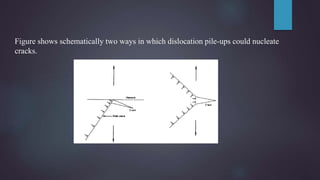
Figure shows schematically two ways in which dislocation pile-ups could nucleate
cracks.
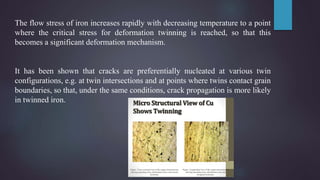
The flow stress of iron increases rapidly with decreasing temperature to a point
where the critical stress for deformation twinning is reached, so that this
becomes a significant deformation mechanism.
It has been shown that cracks are preferentially nucleated at various twin
configurations, e.g. at twin intersections and at points where twins contact grain
boundaries, so that, under the same conditions, crack propagation is more likely
in twinned iron.
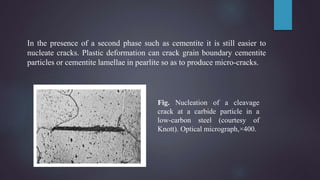
In the presence of a second phase such as cementite it is still easier to
nucleate cracks. Plastic deformation can crack grain boundary cementite
particles or cementite lamellae in pearlite so as to produce micro-cracks.
Fig. Nucleation of a cleavage
crack at a carbide particle in a
low-carbon steel (courtesy of
Knott). Optical micrograph,×400.
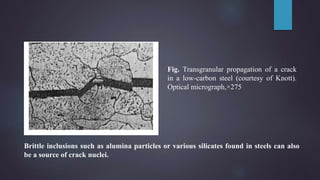
Fig. Transgranular propagation of a crack
in a low-carbon steel (courtesy of Knott).
Optical micrograph,×275
Brittle inclusions such as alumina particles or various silicates found in steels can also
be a source of crack nuclei.
Grain size is a particularly important variable for, as the ferrite grain
size is reduced, the transition temperature Tc is lowered, despite the
fact that the yield strength increases.
The smaller the grain size, the smaller the number of dislocations piling-up
where a slip band arrives at a boundary.
Bearing in mind that the shear stress at the head of such a pile-up is nτ,
where n is the number of dislocations and τ is the shear stress in the slip
direction, it follows that as the grain size is reduced, n will be smaller and
the local stress concentrations at grain boundaries will be correspondingly
less.
CRITERION FORTHE DUCTILE/BRITTLETRANSITION
The starting point of all theories on brittle fracture is the work of Griffith, who
considered the condition needed for propagation of a pre-existing crack, of length
2c, in a brittle solid.
When the applied stress σ is high enough, the crack will propagate and release
elastic energy. This energy Ue in the case of thin plates (plane stress) is:
Where E is Young’s modulus. The term is negative because this energy is

released. However, as the crack creates two new surfaces, each with
energy=2cγ, there is a positive surface energy term Us:
Griffith showed that the crack would propagate if the increase in surface
energy, Us, was less than the decrease in elastic energy Ue. The equilibrium
position is defined as that in which the change in energy with crack length is
zero.
This is the elastic energy release rate, usually referred to as G:
where σf is the fracture stress, which is defined as that just above which
energy is released and the crack propagates.
Orowan pointed out that in crystalline solids plastic deformation will occur
both during nucleation of the crack, and then at the root of the crack during
propagation.
This root deformation blunts the crack and, in practice, means that more
energy is needed to continue the crack propagation.
Griffith equation is modified to include a plastic work term γp
It has been found that γp≫γ, hence the condition for crack spreading in a
crystalline solid such as iron is:
The local stress field at the crack tip is usually characterized by a parameter
K, the stress intensity factor, which reaches a critical value Kc when
propagation takes place. This critical value is given by:
In plane stress conditions:
where Gc is the critical release rate of strain energy.
In plane strain conditions, the critical value of strain energy release rate is G1C =γp, where:
and where v is the Poisson’s ratio.
The critical value of stress intensity, K1C, is then related to G1C:
The fracture toughness of a steel is often expressed as a K1C value obtained from
tests on notched specimens which are pre-cracked by fatigue, and are stressed to
fracture in bending or tension.
The nucleation and the propagation of a cleavage crack must be distinguished
clearly. Nucleation occurs when a critical value of the effective shear stress is
reached, corresponding to a critical grouping, ideally a pile-up, of dislocations
which can create a crack nucleus, e.g. by fracturing a carbide particle.
In contrast, propagation of a crack depends on the magnitude of the local tensile
stress which must reach a critical level σf . Simple models of slip-nucleated
fracture assume either interaction of dislocations or cracks formed in grain
boundary carbides.
However, recently it has been realized that both these structural features must be
taken into account in deriving an expression for the critical fracture stress σf.
Regarding grain boundary carbide size, effective crack nuclei will occur in
particles above a certain critical size so that, if the size distribution of carbide
particles in a particular steel is known, it should be possible to predict its critical
fracture stress.
In mild steels in which the structure is essentially ferrite grains containing
carbide particles, the particle size distribution of carbides is the most important
factor. In contrast, in bainitic and martensitic steels the austenite grains
transform to lath structures where the lath width is usually between 0.2 and
2μm. The laths occur in bundles or packets with low angle boundaries between
the laths. Larger misorientations occur across packet boundaries. In such
structures, the packet width is the main microstructural feature controlling
cleavage crack propagation.
The critical local fracture stress σf has been related to the two types of
structure, as follows:
1. For ferritic steels with spheroidal carbide particles:
where c0 is carbide diameter.
2. For bainitic and martensitic steels with packets of laths:
where dp is packet width and v is Poisson’s ratio.
PRACTICAL ASPECTS OF BRITTLE FRACTURE
At the onset of fracture, elastic energy stored in the stressed steel is only partly used
for creation of the new surfaces and the associated plastic deformation and the
remainder provides kinetic energy to the crack. Using a Griffith-type model, the
crack velocity υ can be shown to be:
where c0 is the critical size, c is the half crack size at a given instant, ρ is density and
k is the constant. This relation shows that the velocity increases with increasing crack
size and reaches a limiting value υlim at large values of c.
In practice, υlim is between 0.4 and 0.5 of the speed of sound, so brittle
fracture occurs with catastrophic rapidity, as many disasters testify.
The phenomenon of brittle fracture became particularly prevalent with the
introduction of welding as the major steel fabrication technique. Previously,
brittle cracks often stopped at the joints of riveted plates but the steel
structures resulting from welding provided continuous paths for crack
propagation.
Incorrect welding procedures can give rise to high stress concentrations and
also to the formation of weld-zone cracks which may initiate brittle fracture.
Bearing in mind the temperature dependence of the failure behaviour, and the
widening use of steels at low temperatures, e.g. in Arctic pipelines, for storage of
liquid gases, etc., it is increasingly necessary to have steels with very low transition
temperatures and high fracture toughness.

Aceros avanzados .pptx

  • 1.
    Análisis de fractura Acerosavanzados MAYO 2017
  • 2.
    TRIP-ASSISTED STEELS The steelsdeveloped to exploit the properties obtained when the martensite reaction occurs during plastic deformation are known as transformation-induced plasticity (TRIP) steels. TRIP-assisted steels are mass produced, made using a complex heat treatment which is often completed within a short time during the processing of steel strip. Their microstructure consists of allotriomorphic ferrite as the major phase together with a total of 30–40% of harder regions. The latter consist of mixtures of bainite, martensite and carbon-enriched retained austenite. An allotriomorph has a shape which does not reflect its internal crystalline symmetry. This is because it tends to nucleate at the austenite grain surfaces, forming layers which follow the grain boundary contours.
  • 3.
    A typical chemicalcomposition Fe–0.12C–1.5Si–1.5Mn wt%. The major application of TRIP-assisted steels is in the automobile industries, both for painted surfaces and for enhancing the safety of the passenger compartment in the event of a crash. There are two kinds of TRIP-assisted steels. Fig. The two kinds of heat treatment used to generate the microstructures of TRIP-assisted steels. The terms γ, α, αb and α′, represent austenite, allotriomorphic ferrite, bainite and martensite, respectively.
  • 4.
    The substantial siliconaddition to TRIP-assisted steels leads to the formation of hard, adherent oxide (Fe2SiO4) which is difficult to remove prior to hot rolling, resulting in a poor surface finish. Galvanizing of TRIP-assisted steels There are two basic methods of galvanizing, by dipping the steel in liquid zinc or by electrolytically depositing the zinc. The typical concentrations of silicon and manganese in TRIP-assisted steels lead to a stable Mn2SiO4 oxide film on the surface during the heat treatment that leads to the desired microstructure. This makes it difficult for the zinc to wet the steel surface, making it necessary to electrolytically galvanize such alloys.
  • 5.
    TWIP STEELS A displacivetransformation (e.g. martensite or bainite) results not only in a plastic strain, but also a change of crystal structure and density; this is the phenomenon exploited in the TRIP steels. The third mode of deformation is mechanical twinning, in which the crystal structure of the steel is preserved but the twinned region is reoriented in the process. Mechanical twinning results in a much larger shear strain s=1/√2, compared with displacive transformations where s is typically 0.25. TWIP stands for twinning-induced plasticity. The alloys are austenitic and remain so during mechanical deformation, but the material is able to accommodate strain via both the glide of individual dislocations and through mechanical twinning on the {1 1 1}γ <1 1 2>γ system.
  • 6.
    Fig. Simplified representationof Twinning in a lattice.
  • 7.
    Fe–25Mn–3Si– 3Al wt% Athigh manganese concentrations, there is a tendency for the austenite to transform into e-martensite (hexagonal close packed) during deformation. e-martensite can form by the dissociation of a perfect a/2<0 1 1>γ dislocation into Shockley partials on a close packed {1 1 1}γ plane, with a fault between the partials.
  • 8.
    Fig. (a) Typicalstress–strain curve for a TWIP steel. (b) Optical microstructure of a TWIP steel following deformation, showing profuse twinning (image and data courtesy of Frommeyer, G., Brüx, U. and Neumann, P).
  • 9.
    The alloys havea rather low yield strength at 200–300MNm−2 but the ultimate tensile strength can be much higher, in excess of 1100MNm−2. This is because the strain-hardening coefficient is large, resulting in a great deal of uniform elongation, and a total elongation of some 60–95%. The effect of mechanical twinning is two-fold. The twins add to plasticity, but they also have a powerful effect in increasing the work-hardening rate by subdividing the untwinned austenite into finer regions. One major advantage of TWIP steels is that they are austenitic and they maintain attractive properties at cryogenic temperatures (−150◦C) and high strain rates, e.g., 103 s−1. They therefore have great potential in enhancing the safety of automobiles by absorbing energy during crashes.
  • 10.
    INDUSTRIAL STEELS SUBJECTEDTOTHERMOMECHANICAL TREATMENTS Micro-alloyedsteels produced by controlled rolling are a most attractive proposition in many engineering applications because of their relatively low cost, moderate strength, and very good toughness and fatigue strength, together with their ability to be readily welded. They have, to a considerable degree, eliminated quenched and tempered steels in many applications. These steels are most frequently available in control-rolled sheet, which is then coiled over a range of temperatures between 750◦C and 550◦C.The coiling temperature has an important influence as it represents the final transformation temperature, and this influences the microstructure. The lower this temperature, under the same conditions, the higher the strength achieved.
  • 11.
    The normal rangeof yield strength obtained in these steels varies from about 350 to 550MNm−2 (50–80 ksi). The strength is controlled both by the detailed thermomechanical treatment, by varying the manganese content from 0.5 to 1.5 wt%, and by using the micro- alloying additions in the range 0.03 to above 0.1 wt%. Niobium is used alone, or with vanadium, while titanium can be used in combination with the other two carbide-forming elements. One of the most extensive applications is in pipelines for the conveyance of natural gas and oil, where the improved weldability due to the overall lower alloying content (lower hardenability) and, particularly, the lower carbon levels is a great advantage.
  • 12.
    Typical compositions (wt%)to achieve a yield stress of around 410MNm−2 (60 ksi): For higher yield strengths (450MNm−2):
  • 14.
    At the higherstrength levels, micro-alloyed steels are used for heavy duty truck frames, tractor components, crane booms and lighting standards, etc. The control of sulphide inclusions gives the steels a high degree of formability in cold fabrication processes. A steel is said to have been ausformed when martensite is produced from plastically deformed austenite. Austenite Ausforming has provided some of the strongest, toughest steels so far produced, with the added advantage of very good fatigue resistance. Typical applications have included parts for undercarriages of aircraft, special springs and bolts.
  • 15.
    A0.4C–6Mn–3Cr–1.5Si steel hasbeen ausformed to a tensile strength of 3400MNm−2, with an improvement in ductility over the conventional heat treatment. Similar high strength levels with good ductility have been reported for 0.4C–5Cr–1.3Mo–1.0Si–0.5V wt% steel (H11)
  • 16.
    Fig. Effect ofamount and temperature of deformation on the yield and tensile strength of 0.4C–5.0Cr–1.3Mo–1.0Si–0.5V wt% steel (H11) (Zackay, in National Physical Laboratory Symposium, No. 15, HMSO, London, UK, 1963).
  • 17.
    THE EMBRITTLEMENTAND FRACTUREOF STEELS Most groups of alloys can exhibit failure by cracking in circumstances where the apparent applied stress is well below that at which failure would normally be expected. Fracture mechanics allows the quantitative assessment of growth of cracks in various stress situations, to an extent that it is now frequently possible to predict the stress level to which steel structures can be confidently subjected without the risk of sudden failure.
  • 18.
    CLEAVAGE FRACTURE INIRONAND STEEL Cleavage fracture is familiar in many minerals and inorganic crystalline solids as a crack propagation frequently associated with very little plastic deformation and occurring in a crystallographic fashion along planes of low indices, i.e. high atomic density. Low temperatures zinc cleaves along the basal plane, while body-centred cubic (bcc) iron cleaves along {100} planes as do all bcc metals.
  • 19.
    Fig. 11.1 Cleavagefracture in pure iron–0.04 P at 55◦C (courtesy of Shell) ×60. Figure 11.2 Fatigue cracking of aluminium alloy AlZn6Mg0.8Zr subjected to thermomechanical treatment
  • 20.
    As the carbonand nitrogen content of the iron is increased, the transition from ductile to brittle cleavage behaviour takes place at increasing temperatures, until in some steels this can occur at ambient and above-ambient temperatures. The propagation of a cleavage crack in iron and steel requires much less energy than that associated with the growth of a ductile crack.
  • 21.
    The energy absorbedby the specimen from the pendulum when plotted as a function of temperature usually exhibits a sharp change in slope. Fig. Effect of heat treatments on the impact transition temperature of a pure iron–0.12C wt% alloy (after Allen et al., Journal of Iron and Steel Institute 174, 108, 1953). AC, FC and WQ represent air- cooling, furnace-cooling and water-quenching, respectively.
  • 22.
    More sophisticated testshave been developed in which it is recognized that the propagation of the fracture is the important stage. These fracture toughness tests used notched and pre-cracked specimens, the cracks being initiated by fatigue. The stress intensity factor, K, at the root of the crack is defined in terms of the applied stress σ and the crack size c: When a critical stress intensity Kc is reached, the transition to rapid fracture takes place.
  • 23.
    FACTORS INFLUENCINGTHE ONSETOF CLEAVAGE FRACTURE 1. The temperature dependence of the yield stress. 2. The development of a sharp yield point. 3. Nucleation of cracks at twins. 4. Nucleation of cracks at carbide particles. 5. Grain size. All bcc metals including iron shown a marked temperature dependence of the yield stress, even when the interstitial impurity content is very low, i.e. the stress necessary to move dislocations, the Peierls–Nabarro stress, is strongly temperature dependent.
  • 24.
    Figure shows schematicallytwo ways in which dislocation pile-ups could nucleate cracks.
  • 25.
    The flow stressof iron increases rapidly with decreasing temperature to a point where the critical stress for deformation twinning is reached, so that this becomes a significant deformation mechanism. It has been shown that cracks are preferentially nucleated at various twin configurations, e.g. at twin intersections and at points where twins contact grain boundaries, so that, under the same conditions, crack propagation is more likely in twinned iron.
  • 26.
    In the presenceof a second phase such as cementite it is still easier to nucleate cracks. Plastic deformation can crack grain boundary cementite particles or cementite lamellae in pearlite so as to produce micro-cracks. Fig. Nucleation of a cleavage crack at a carbide particle in a low-carbon steel (courtesy of Knott). Optical micrograph,×400.
  • 27.
    Fig. Transgranular propagationof a crack in a low-carbon steel (courtesy of Knott). Optical micrograph,×275 Brittle inclusions such as alumina particles or various silicates found in steels can also be a source of crack nuclei.
  • 28.
    Grain size isa particularly important variable for, as the ferrite grain size is reduced, the transition temperature Tc is lowered, despite the fact that the yield strength increases. The smaller the grain size, the smaller the number of dislocations piling-up where a slip band arrives at a boundary. Bearing in mind that the shear stress at the head of such a pile-up is nτ, where n is the number of dislocations and τ is the shear stress in the slip direction, it follows that as the grain size is reduced, n will be smaller and the local stress concentrations at grain boundaries will be correspondingly less.
  • 29.
    CRITERION FORTHE DUCTILE/BRITTLETRANSITION Thestarting point of all theories on brittle fracture is the work of Griffith, who considered the condition needed for propagation of a pre-existing crack, of length 2c, in a brittle solid. When the applied stress σ is high enough, the crack will propagate and release elastic energy. This energy Ue in the case of thin plates (plane stress) is:
  • 30.
    Where E isYoung’s modulus. The term is negative because this energy is released. However, as the crack creates two new surfaces, each with energy=2cγ, there is a positive surface energy term Us: Griffith showed that the crack would propagate if the increase in surface energy, Us, was less than the decrease in elastic energy Ue. The equilibrium position is defined as that in which the change in energy with crack length is zero.
  • 31.
    This is theelastic energy release rate, usually referred to as G:
  • 32.
    where σf isthe fracture stress, which is defined as that just above which energy is released and the crack propagates. Orowan pointed out that in crystalline solids plastic deformation will occur both during nucleation of the crack, and then at the root of the crack during propagation. This root deformation blunts the crack and, in practice, means that more energy is needed to continue the crack propagation.
  • 33.
    Griffith equation ismodified to include a plastic work term γp It has been found that γp≫γ, hence the condition for crack spreading in a crystalline solid such as iron is:
  • 34.
    The local stressfield at the crack tip is usually characterized by a parameter K, the stress intensity factor, which reaches a critical value Kc when propagation takes place. This critical value is given by: In plane stress conditions: where Gc is the critical release rate of strain energy.
  • 35.
    In plane strainconditions, the critical value of strain energy release rate is G1C =γp, where: and where v is the Poisson’s ratio. The critical value of stress intensity, K1C, is then related to G1C:
  • 36.
    The fracture toughnessof a steel is often expressed as a K1C value obtained from tests on notched specimens which are pre-cracked by fatigue, and are stressed to fracture in bending or tension. The nucleation and the propagation of a cleavage crack must be distinguished clearly. Nucleation occurs when a critical value of the effective shear stress is reached, corresponding to a critical grouping, ideally a pile-up, of dislocations which can create a crack nucleus, e.g. by fracturing a carbide particle.
  • 37.
    In contrast, propagationof a crack depends on the magnitude of the local tensile stress which must reach a critical level σf . Simple models of slip-nucleated fracture assume either interaction of dislocations or cracks formed in grain boundary carbides. However, recently it has been realized that both these structural features must be taken into account in deriving an expression for the critical fracture stress σf. Regarding grain boundary carbide size, effective crack nuclei will occur in particles above a certain critical size so that, if the size distribution of carbide particles in a particular steel is known, it should be possible to predict its critical fracture stress.
  • 38.
    In mild steelsin which the structure is essentially ferrite grains containing carbide particles, the particle size distribution of carbides is the most important factor. In contrast, in bainitic and martensitic steels the austenite grains transform to lath structures where the lath width is usually between 0.2 and 2μm. The laths occur in bundles or packets with low angle boundaries between the laths. Larger misorientations occur across packet boundaries. In such structures, the packet width is the main microstructural feature controlling cleavage crack propagation.
  • 39.
    The critical localfracture stress σf has been related to the two types of structure, as follows: 1. For ferritic steels with spheroidal carbide particles: where c0 is carbide diameter. 2. For bainitic and martensitic steels with packets of laths: where dp is packet width and v is Poisson’s ratio.
  • 40.
    PRACTICAL ASPECTS OFBRITTLE FRACTURE At the onset of fracture, elastic energy stored in the stressed steel is only partly used for creation of the new surfaces and the associated plastic deformation and the remainder provides kinetic energy to the crack. Using a Griffith-type model, the crack velocity υ can be shown to be: where c0 is the critical size, c is the half crack size at a given instant, ρ is density and k is the constant. This relation shows that the velocity increases with increasing crack size and reaches a limiting value υlim at large values of c.
  • 41.
    In practice, υlimis between 0.4 and 0.5 of the speed of sound, so brittle fracture occurs with catastrophic rapidity, as many disasters testify. The phenomenon of brittle fracture became particularly prevalent with the introduction of welding as the major steel fabrication technique. Previously, brittle cracks often stopped at the joints of riveted plates but the steel structures resulting from welding provided continuous paths for crack propagation.
  • 42.
    Incorrect welding procedurescan give rise to high stress concentrations and also to the formation of weld-zone cracks which may initiate brittle fracture.
  • 43.
    Bearing in mindthe temperature dependence of the failure behaviour, and the widening use of steels at low temperatures, e.g. in Arctic pipelines, for storage of liquid gases, etc., it is increasingly necessary to have steels with very low transition temperatures and high fracture toughness.