StuDocu is not sponsored or endorsed by any college or university
Accounting for branch operations
Advanced Accounting (Thammasat University)
StuDocu is not sponsored or endorsed by any college or university
Accounting for branch operations
Advanced Accounting (Thammasat University)
Downloaded by A'nizk Pmt (vannyphommathedsoud@gmail.com)
lOMoARcPSD|4564550
ACCOUNTING FOR
BRANCH OPERATIONS
11
C H A P T E R
605
One route to corporate expansion is the external approach of acquiring other com-
panies in business combinations, as discussed in Chapter 1. Another approach to
expansion is through internal growth. While such growth can occur at a single loca-
tion, companies often expand by establishing additional locations. For example,
Wal-Mart’s phenomenal growth would have been impossible had the company not
established many new stores at various locations throughout much of the country.
When operations are conducted at more than a single location, the different
locations may be referred to as sales agencies, branches, plants, or by numerous
other terms. Unfortunately, terminology referring to multiple operating locations is
not standardized. In addition, many different approaches are taken in establishing
internal accounting and reporting systems for companies operating through outlying
locations.
Distinction between Sales Agency and Branch
The difference between a sales agency and a branch most often has to do with the
degree of autonomy. A sales agency, sometimes referred to simply as an “agency,”
usually is not an autonomous operation but acts on behalf of the home office. The
agency may display and demonstrate sample merchandise, take orders, and arrange
for delivery. The orders typically are filled by the home office because a sales
agency usually does not stock inventory. Merchandise selection, advertising, grant-
ing of credit, collection on accounts, and other aspects of operating the business
usually are conducted by the home office. As an example, Montgomery Ward and
Company for many years had numerous catalog stores across the country that took
orders but did not stock merchandise.
A branch office usually has more autonomy and provides a greater range of
services than a sales agency does, although the degree differs with the individual
company. A branch typically stocks merchandise and fills customers’ orders. For
some companies the branches perform their own credit function, while for other
companies credit is handled by the home office.
Many different types of companies operate through branches. Nearly everyone
has visited branches of major department store chains such as J.C. Penney Company
and Sears Roebuck and Company. Banks have been especially aggressive in
Multi-Corporate
Entities
Multinational
Entities
Reporting
Requirements
Partnerships
Not-for-Profit and
Governmental Entities
Corporations in
Financial Difficulty
Branch Operations
Additional
Consolidation Issues
Intercorporate
Transfers
Consolidation
Procedures
Consolidation
Concepts
Intercorporate
Investments
Business
Combinations
Downloaded by A'nizk Pmt (vannyphommathedsoud@gmail.com)
lOMoARcPSD|4564550
606 Chapter 11
expanding through extensive networks of branch banks. Some manufacturing compa-
nies also conduct business through a comparable system of operating locations, usually
referred to as “plants.” For example, General Motors operates assembly plants at many
different sites, including locations in or near Detroit, St. Louis, Los Angeles, and
Nashville.
There typically is little management decision making in a sales agency; decisions
are made at the home office, and the agency conducts routine operations. The degree
of management decision making in branches usually is greater than in sales agencies
but differs considerably from company to company.
While one branch manager may be permitted few choices, other branch managers
may operate with relative independence from the home office. The manager of an auto-
mobile assembly plant, for example, may have no discretion over the quantity and type
of units produced and little discretion in the choice of vendors. On the other hand, the
manager of a branch grocery store may have considerable discretion in the types and
quantities of products to stock and in the choice of vendors. In some banks, loans may
be approved by branch management, at least up to a certain limit, while in other banks,
all loans must be approved by a centralized loan committee. In large department store
chains, branch stores normally are required to stock certain items chosen by the home
office, but local management has a choice of other items from a large number specified
by central management. In some cases, local management may be free to make pur-
chases entirely on its own.
Accounting Systems and the Accounting Entity
A sales agency usually does not maintain a financial accounting system but only keeps
sufficient records to conduct its business. The home office maintains the accounting
system, and transactions of the agency are recorded by the home office. A branch, on
the other hand, does maintain a complete financial accounting system in most cases.
The maintenance of separate accounting systems for the home office and each branch
often provides better control over operations and allows top management to assess the
performance of individual branches.
Neither sales agencies nor branches are separate legal or accounting entities; they
do not prepare separate external accounting reports. Whether the accounting system is
centralized in the home office or separate accounting systems are maintained by indi-
vidual branches, the external reporting entity is the company as a whole. When sepa-
rate branch accounting records are maintained for internal purposes, such as
responsibility accounting and performance evaluation, the accounts of the branches
and the home office must be combined in preparing external accounting reports.
Accounting for Sales Agencies
Because a sales agency normally does not have an accounting system, all transactions
involving the agency are recorded by the home office. For some types of transactions,
the entries recorded by the home office are based on source documents generated by
the agency. For example, the home office may record agency transactions based on
sales invoices, payroll records, and documented petty cash vouchers provided by a
sales agency. Other transactions may be recorded based on source documents provided
Downloaded by A'nizk Pmt (vannyphommathedsoud@gmail.com)
lOMoARcPSD|4564550
by external parties directly to the home office. For example, the utility companies pro-
viding gas, electricity, water, and phone service to the agency might bill the home
office directly.
The home office normally accounts for the assets, revenues, and expenses of each
agency separately. This allows the home office to maintain control over the assets and
provides information for assessing the performance of each agency.
As an example of home office accounting for a sales agency, assume that Carver
Enterprises, a manufacturer of modular structures and partitions based in Atlanta,
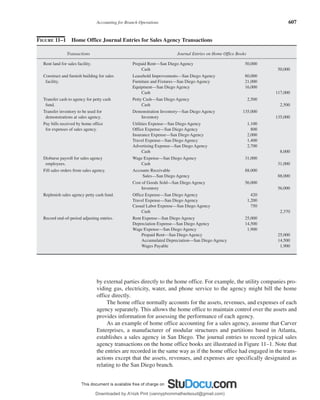
establishes a sales agency in San Diego. The journal entries to record typical sales
agency transactions on the home office books are illustrated in Figure 11–1. Note that
the entries are recorded in the same way as if the home office had engaged in the trans-
actions except that the assets, revenues, and expenses are specifically designated as
relating to the San Diego branch.
Accounting for Branch Operations 607
FIGURE 11–1 Home Office Journal Entries for Sales Agency Transactions
Transactions Journal Entries on Home Office Books
Rent land for sales facility. Prepaid Rent—San Diego Agency 50,000
Cash 50,000
Construct and furnish building for sales Leasehold Improvements—San Diego Agency 80,000
facility. Furniture and Fixtures—San Diego Agency 21,000
Equipment—San Diego Agency 16,000
Cash 117,000
Transfer cash to agency for petty cash Petty Cash—San Diego Agency 2,500
fund. Cash 2,500
Transfer inventory to be used for Demonstration Inventory—San Diego Agency 135,000
demonstrations at sales agency. Inventory 135,000
Pay bills received by home office Utilities Expense—San Diego Agency 1,100
for expenses of sales agency. Office Expense—San Diego Agency 800
Insurance Expense—San Diego Agency 2,000
Travel Expense—San Diego Agency 1,400
Advertising Expense—San Diego Agency 2,700
Cash 8,000
Disburse payroll for sales agency Wage Expense—San Diego Agency 31,000
employees. Cash 31,000
Fill sales orders from sales agency. Accounts Receivable 88,000
Sales—San Diego Agency 88,000
Cost of Goods Sold—San Diego Agency 56,000
Inventory 56,000
Replenish sales agency petty cash fund. Office Expense—San Diego Agency 420
Travel Expense—San Diego Agency 1,200
Casual Labor Expense—San Diego Agency 750
Cash 2,370
Record end-of-period adjusting entries. Rent Expense—San Diego Agency 25,000
Depreciation Expense—San Diego Agency 14,500
Wage Expense—San Diego Agency 1,900
Prepaid Rent—San Diego Agency 25,000
Accumulated Depreciation—San Diego Agency 14,500
Wages Payable 1,900
Downloaded by A'nizk Pmt (vannyphommathedsoud@gmail.com)
lOMoARcPSD|4564550
608 Chapter 11
Accounting for Branch Operations
Occasionally, accounting for branch operations is centralized at the home office, and the
procedures followed are similar to those for a sales agency. If such an approach is used,
the branch maintains only limited accounting records and submits source documents for
transactions to the home office for entry in the centralized accounting system.
Normally, however, and especially with larger branches, the home office and
branch maintain separate accounting systems. Each maintains a full set of books with
a complete self-balancing set of accounts. Each records its transactions with external
parties in its own accounting system. These transactions are recorded in the normal
manner, and no special treatment is needed. In addition, the home office and branch
both must record transactions with one another in their respective accounting systems.
Even though the home office and each branch maintain separate books, all
accounts are combined for external reporting in such a way that the external financial
statements represent the company as a single economic enterprise. As with the prepa-
ration of consolidated financial statements, simply adding together the balances of the
accounts contained in each accounting system does not result in the portrayal of a sin-
gle economic entity. Certain eliminations are needed as well. Overall, the preparation
of external accounting reports for a company with a home office and one or more
branches is quite similar to the preparation of consolidated financial statements.
Intracompany Accounts
Transactions with external parties are recorded in the normal manner. Transactions
between the home office and a branch also are treated in the normal manner except that
they are recorded in intracompany accounts. These accounts are reciprocal accounts
between the home office and the branch. When the books of both the home office and
the branch are completely up to date, the balance in an intracompany account on the
home office books will be equal but opposite that of the related intracompany account
on the branch books. For example, if an intracompany account on the home office
books has a $10,000 debit balance, the related intracompany account on the branch
books should have a credit balance of the same amount.
The intracompany account on the books of the home office often is called Invest-
ment in Branch, while the reciprocal account on the branch books may be labeled
Home Office. When a company has more than one branch, a separate investment
account for each branch is maintained on the home office books.
The balance of the Investment in Branch account indicates the extent of the home
office’s investment in a particular branch through contributions of cash and the trans-
fer of assets to the branch. The procedures employed by the home office in accounting
for its investment in a branch are similar to a parent’s application of the equity method
in accounting for its investment in a subsidiary. The reciprocal Home Office account
on the books of the branch represents the home office’s equity in the branch, and the
balance is shown in place of owners’ equity in the separate financial statements of the
branch prepared for internal reporting purposes.
The balances of the two reciprocal accounts are adjusted for the same transactions.
The account balances are increased for asset transfers from the home office to the
branch and reduced for asset transfers from the branch to the home office. Adjustments
to the accounts also are made for profits and losses of the branch, with branch profits
Downloaded by A'nizk Pmt (vannyphommathedsoud@gmail.com)
lOMoARcPSD|4564550
leading to an increase in the account balances and branch losses leading to a decrease.
Note that increases in the home office’s Investment in Branch account are accom-
plished with debit entries and decreases with credit entries. The opposite is true with
respect to the branch’s Home Office account.
The reciprocal nature of the Investment in Branch and the Home Office
accounts, and the way in which they are affected by various transactions, can be
shown as follows:
Establishment of Branch
When a company establishes a branch, the transfer of assets to the branch is recorded
by the home office in the Investment in Branch account. Similarly, the branch records
the transfer with an entry to the Home Office account. To illustrate, assume that Jensen
Corporation of St. Paul, Minnesota, establishes a branch in Mayfield, Texas. The home
office transfers to the branch $20,000 in cash, new office equipment that costs $5,000,
and new store equipment with a cost of $30,000. The home office records the transfer
with the following entry:
H(1) Investment in Mayfield Branch 55,000
Cash 20,000
Office Equipment 5,000
Store Equipment 30,000
Transfer of assets to Mayfield branch.
(Note: As in previous chapters, journal entries are numbered consecutively throughout
the chapter so that each entry is uniquely identified. Those entries made on home office
books are designated in this chapter by H, while those on branch books are identified
with B.)
Jensen’s Mayfield branch records the transfer of assets from the home office with
the following entry:
B(2) Cash 20,000
Office Equipment 5,000
Store Equipment 30,000
Home Office 55,000
Transfer of assets from home office.
Note that after both the home office and the branch have recorded the transfer, the
Investment in Mayfield Branch account on the home office books and the Home
Office account on the branch books have reciprocal balances of $55,000. A separate
balance sheet prepared for the Mayfield branch immediately after the transfer appears
as follows:
Investment in Branch
(Home Office Books)
XXXX
XXXX
XXXX
XXXX
Home Office
(Branch Books)
XXXX
XXXX
XXXX
XXXX
Asset transfers to branch
Asset transfers from branch
Branch income
Branch loss
Accounting for Branch Operations 609
Downloaded by A'nizk Pmt (vannyphommathedsoud@gmail.com)
lOMoARcPSD|4564550
610 Chapter 11
Mayfield Branch of Jensen Corporation
Balance Sheet
Assets: Liabilities:
Cash $20,000
Office Equipment 5,000
Store Equipment 30,000 Home Office: $55,000
Total $55,000 Total $55,000
While branch financial statements may be prepared for internal reporting pur-
poses, external accounting reports reflect the activities and position of the company as
a whole. The accounts of the home office and its branches are combined in preparing
external accounting reports to reflect the single enterprise consisting of the home office
and its branches. Classification of the Investment in Mayfield Branch account and the
Home Office account is not an issue because both accounts are eliminated in preparing
financial statements for external use.
Recognition of Branch Income
Income for each branch is computed periodically in the normal manner. Branches sel-
dom compute income taxes on individual branch income or record income tax expense
on their books. Because the home office and its branches are not separate legal entities,
income taxes are computed for the company as a whole. Tax expense could be allo-
cated to the branches by the home office, but this usually is not done because it would
add little to operational control.
All of a branch’s revenue and expense accounts are closed to its income summary
in the normal manner. The balance of the income summary represents the branch’s
income for the period and is closed to the Home Office account. The Home Office
account serves in place of retained earnings and other owners’ equity accounts on the
books of the branch. When the branch’s income is reported to the home office, an entry
is made on the home office books to recognize the income of the branch and to
increase the recorded amount of the home office’s investment in the branch.
For example, assume the Mayfield branch’s Income Summary account has a credit
balance of $63,000 at the end of the period. The Income Summary account is closed
with the following entry on the books of the Mayfield branch:
B(3) Income Summary 63,000
Home Office 63,000
Close income summary.
Upon receiving a report of Mayfield’s income for the period, the home office records
the following entry:
H(4) Investment in Mayfield Branch 63,000
Mayfield Branch Income 63,000
Record Mayfield branch income.
These entries maintain the reciprocal relationship of the Investment in Mayfield
Branch account and the Home Office account. When financial statements are prepared
Downloaded by A'nizk Pmt (vannyphommathedsoud@gmail.com)
lOMoARcPSD|4564550
for the company as a whole, the Investment in Mayfield Branch account, the Home
Office account, and the Mayfield Branch Income account all must be eliminated.
Merchandise Shipments to a Branch
A branch that buys and sells merchandise may be required to obtain all its merchandise
from the home office, or it may be permitted to acquire some merchandise from exter-
nal parties. Purchases of merchandise from external parties are recorded by the branch
in the normal manner. If Jensen’s Mayfield branch purchases $5,000 of merchandise
from an independent wholesaler, and the branch uses a perpetual inventory system, the
transaction is recorded by the branch as follows:
B(5) Inventory 5,000
Cash (or Accounts Payable) 5,000
Record purchase of inventory from external party.
No entry with respect to this transaction is made on the books of the home office.
When inventory is transferred from the home office to a branch, both the home
office and the branch must record the transfer. The dollar amount assigned to the
inventory that is transferred is referred to as a transfer price. Merchandise is trans-
ferred from the home office to a branch either at the original cost to the home office or
at some amount in excess of that cost.
Merchandise Billed at Cost. Merchandise transferred from the home office and
billed to the branch is recorded by the branch in the same way as inventory purchased
from external parties, except the credit is to the Home Office account. The transfer of
inventory is treated by both the home office and the branch in the same way as the trans-
fer of any other asset, assuming a perpetual inventory system is used. Thus, the journal
entries to record a transfer of inventory at cost are similar to entries H(1) and B(2).
To see this, assume that Jensen’s home office transfers inventory with a cost of
$8,000 to its Mayfield branch. The transfer is recorded on the home office books with
the following entry:
H(6) Investment in Mayfield Branch 8,000
Inventory 8,000
Transfer of inventory to Mayfield branch.
The branch records the merchandise as an asset in the same inventory account used to
record purchases from external parties and also recognizes the home office’s increased
equity in its net assets with the following entry:
B(7) Inventory 8,000
Home Office 8,000
Transfer of inventory from home office.
No profit is recognized by the home office on the transfer. The full amount of the profit
is recognized by the branch when it sells the inventory to external parties.
Freight Charges on Merchandise Shipments. Freight costs incurred in shipping
merchandise from the home office to a branch become part of the cost of the branch
inventory. For example, assume that Jensen Corporation’s home office pays $100 to
Accounting for Branch Operations 611
Downloaded by A'nizk Pmt (vannyphommathedsoud@gmail.com)
lOMoARcPSD|4564550
612 Chapter 11
transport $8,000 of merchandise to the Mayfield branch. The transfer is recorded by
the home office with the following entry:
H(8) Investment in Mayfield Branch 8,100
Inventory 8,000
Cash 100
Transfer of inventory to Mayfield branch and payment
of shipping charges.
The Mayfield branch records the transfer as follows:
B(9) Inventory 8,100
Home Office 8,100
Transfer of inventory from home office.
Merchandise Billed in Excess of Cost. Companies sometimes transfer inventory
from the home office to a branch and bill the branch for an amount greater than the
home office’s cost. This may occur, for example, when the home office and each
branch are treated as profit centers for internal reporting and evaluation purposes.
When the home office incurs costs and provides a service, such as by acquiring
inventory at lower prices through volume purchases or by manufacturing the inventory,
the company may choose to allocate the profit on the sale of the inventory between the
home office and the selling branch. This can be done by billing the branch for inventory
transfers at an amount greater than the home office’s cost. The home office is credited
with profit equal to the difference between its cost and the transfer price to the branch; this
difference is referred to as the intracompany profit. The branch’s profit is the difference
between the transfer price (the branch’s cost) and the selling price to external parties.
While companies may employ various types of internal-responsibility accounting
systems, external accounting reports must reflect inventory at its original cost to the
company (unless market value is lower) and may not include profits until the inventory
is sold to external parties. Unrealized profits must be eliminated in the preparation of
financial statements for external use. This is accomplished by using a workpaper sim-
ilar to that used in preparing consolidated financial statements.
Usually the home office records its profit on inventory shipments to its branches in
a separate account, allowing it to defer recognition of profits on intracompany sales until
the inventory is sold to external parties by the branches. Each branch normally records
inventory acquired from the home office in an account separate from inventory purchased
from external parties so that the intracompany profit can be more easily identified.
To examine the treatment of intracompany profit included in shipments to a
branch, assume that Jensen’s home office acquires merchandise for $12,000 and ships
it to the Mayfield branch, billing the branch for $15,000. The home office records the
shipment with the following entry:
H(10) Investment in Mayfield Branch 15,000
Inventory 12,000
Unrealized Intracompany Profit 3,000
Transfer of inventory to Mayfield branch, billed in excess of cost.
The $3,000 intracompany profit is unrealized because the inventory has not been sold
to an external party. Recognition of the profit is deferred until the branch sells the mer-
chandise externally.
Downloaded by A'nizk Pmt (vannyphommathedsoud@gmail.com)
lOMoARcPSD|4564550
The branch records receipt of the shipment with the following entry:
B(11) Inventory—From Home Office 15,000
Home Office 15,000
Transfer of inventory from home office.
This entry records the inventory at the cost to the branch without separately recogniz-
ing the intracompany profit included in the transfer price. A separate inventory account
is established in this case to facilitate eliminating the unrealized intracompany profit
when external accounting reports are prepared for the company as a whole. When such
reports are prepared while the inventory is still on hand, workpaper entries are needed
to eliminate the Unrealized Intracompany Profit balance against the Inventory—From
Home Office account. Thus the $3,000 unrealized intracompany profit is eliminated,
and the inventory is reported at its $12,000 original cost to the company.
When the branch sells the inventory acquired from the home office, it recognizes
a profit for the difference between the external selling price and the transfer price from
the home office. Once the inventory has been sold externally, the home office recog-
nizes the intracompany profit that it previously had deferred. For example, if the May-
field branch sold 80 percent of the inventory transferred from the home office, the
intracompany profit would be recognized by the home office with the following entry:
H(12) Unrealized Intracompany Profit 2,400
Mayfield Branch Income 2,400
Recognize intracompany profit:
$3,000  .80
This entry is appropriate if, for internal reporting purposes, the intracompany profit is
to be attributed to the Mayfield branch.
Alternatively, the company may feel that the intracompany profit should be allo-
cated to the home office for services that it has provided. In that case, the intracompany
profit is recognized with the following entry on the books of the home office in place
of entry H(12):
H(12a) Unrealized Intracompany Profit 2,400
Realized Profit on Branch Shipments 2,400
Recognize intracompany profit:
$3,000  .80
Accounting for Branch Fixed Assets
Normal procedures are followed in accounting for branch fixed assets recorded on the
books of the branch. No special procedures are required in accounting for the purchase
of fixed assets by the branch or the subsequent depreciation of those assets. On the
other hand, if the fixed assets are purchased by the home office for the branch and the
branch records the fixed assets on its books, an entry is required on the books of both
the home office and the branch.
As an illustration of this, assume that Jensen’s home office purchases $30,000 of
store equipment for the Mayfield branch. The home office records the purchase with
the following entry:
H(13) Investment in Mayfield Branch 30,000
Cash 30,000
Purchase of equipment for Mayfield branch.
Accounting for Branch Operations 613
Downloaded by A'nizk Pmt (vannyphommathedsoud@gmail.com)
lOMoARcPSD|4564550
614 Chapter 11
The purchase is recorded by the branch with the following entry:
B(14) Store Equipment 30,000
Home Office 30,000
Record purchase of equipment by home office.
Some companies account for branch fixed assets on the books of the home office
rather than on the books of the branch. This may provide the home office with better
control over branch fixed assets and may facilitate the computation of depreciation for
the company as a whole. For example, a company might establish depreciation policies
to be applied to all fixed assets within the company. Some companies use group or
composite depreciation methods, which may be applied most easily on a companywide
basis.
When branch fixed assets are recorded only on the home office books, no entry is
needed on the books of the branch if the home office makes the purchase. For example,
if Jensen’s home office purchases $30,000 of store equipment for the Mayfield branch,
and the equipment is recorded on the books of the home office rather than the branch,
the home office records the purchase as follows:
H(15) Store Equipment—Mayfield Branch 30,000
Cash 30,000
Purchase of equipment for Mayfield branch.
No entry is recorded on the books of the branch.
If the branch purchases fixed assets that are recorded on the books of the home
office, entries are needed by both the home office and the branch. As an example,
assume that Jensen’s Mayfield branch purchases $30,000 of store equipment to be used
by the branch but carried on the home office books. The branch records the purchase
with the following entry:
B(16) Home Office 30,000
Cash 30,000
Purchase of equipment.
The purchase is recorded by the home office as follows:
H(17) Store Equipment—Mayfield Branch 30,000
Investment in Mayfield Branch 30,000
Record purchase of branch equipment by Mayfield branch.
Because the branch purchases an asset that is carried on the home office books, the bal-
ances of both the Home Office account and the Investment in Mayfield Branch account
are reduced. The transaction is treated as if the branch had purchased equipment for the
home office.
Apportionment of Expenses
Branch expenses incurred and paid by the branch are recorded directly on the books of
the branch. However, the home office may elect to assign expenses to a branch. These
assigned expenses might be of several types:
1. Expenses incurred by the branch but paid by the home office; for example,
inventory purchased from external parties by the branch and billed to the
home office.
Downloaded by A'nizk Pmt (vannyphommathedsoud@gmail.com)
lOMoARcPSD|4564550
2. Expenses incurred by the home office on behalf of the branch; for example,
depreciation on branch equipment carried on the home office books, or the cost
of an advertising campaign for the branch commissioned by the home office.
3. Allocations of costs incurred by the home office; for example, a portion of the
cost of a general advertising campaign, or a portion of the general home
office overhead.
In some cases, these costs might be apportioned against branch income and
recorded only on the books of the home office. Often, however, the branch to which
the costs are apportioned is notified of the apportioned amounts and records the
expenses on its own books. In this way, the income computed by the branch on its
books includes all expenses deemed related to the branch.
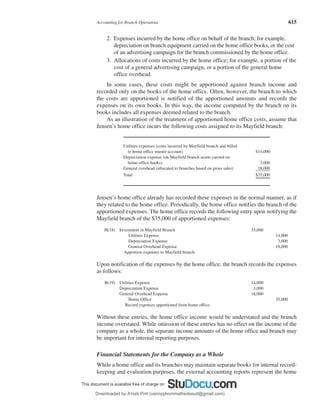
As an illustration of the treatment of apportioned home office costs, assume that
Jensen’s home office incurs the following costs assigned to its Mayfield branch:
Utilities expenses (costs incurred by Mayfield branch and billed
to home office master account) $14,000
Depreciation expense (on Mayfield branch assets carried on
home office books) 3,000
General overhead (allocated to branches based on gross sales) 18,000
Total $35,000
Jensen’s home office already has recorded these expenses in the normal manner, as if
they related to the home office. Periodically, the home office notifies the branch of the
apportioned expenses. The home office records the following entry upon notifying the
Mayfield branch of the $35,000 of apportioned expenses:
H(18) Investment in Mayfield Branch 35,000
Utilities Expense 14,000
Depreciation Expense 3,000
General Overhead Expense 18,000
Apportion expenses to Mayfield branch.
Upon notification of the expenses by the home office, the branch records the expenses
as follows:
B(19) Utilities Expense 14,000
Depreciation Expense 3,000
General Overhead Expense 18,000
Home Office 35,000
Record expenses apportioned from home office.
Without these entries, the home office income would be understated and the branch
income overstated. While omission of these entries has no effect on the income of the
company as a whole, the separate income amounts of the home office and branch may
be important for internal reporting purposes.
Financial Statements for the Company as a Whole
While a home office and its branches may maintain separate books for internal record-
keeping and evaluation purposes, the external accounting reports represent the home
Accounting for Branch Operations 615
Downloaded by A'nizk Pmt (vannyphommathedsoud@gmail.com)
lOMoARcPSD|4564550
616 Chapter 11
office and its branches as a single entity; the reporting entity is the company as a
whole. Therefore, in the preparation of the company’s financial statements, the
accounts of the home office and its branches are combined. Intracompany or recipro-
cal account balances must be eliminated because they relate to activities within the
company rather than activities between the company and external parties.
In the preparation of financial statements for the company as a whole, a workpaper
normally is used to facilitate combining the accounts of the home office and its
branches and eliminating the intracompany accounts. If a complete set of statements is
prepared, a three-part workpaper similar to that illustrated in the consolidations chap-
ters might be used to combine the accounts of the home office and branch. The work-
paper is comparable to the consolidation workpaper except that the branch’s Home
Office account replaces the subsidiary’s stockholders’ equity in the workpaper. As in
the preparation of consolidated financial statements, all eliminations are made in the
workpaper and not on the separate books of the units being combined.
As an illustration of the basic workpaper entries needed to prepare external finan-
cial statements for a company with branch operations, assume the following with
respect to Jensen Corporation’s fiscal year ending December 31, 19X1:
1. Jensen establishes a branch in Mayfield and immediately transfers cash,
office equipment, and store equipment with a total value of $55,000 to the
branch, as recorded in entry H(1). Later in the year, Jensen transfers inventory
costing $12,000 to the branch and bills it $15,000, as recorded in entry H(10).
Jensen reports a balance of $70,000 in its Investment in Mayfield Branch at
December 31, 19X1, before closing entries are recorded.
2. The Mayfield branch reports a profit of $63,000 for 19X1.
3. The balance in Jensen’s Investment in Mayfield Branch account and
Mayfield’s Home Office account are increased to $133,000 on December 31,
19X1, as follows:
Preclosing balance, December 31, 19X1 $ 70,000
Mayfield branch 19X1 income 63,000
Postclosing balance, December 31, 19X1 $133,000
4. On December 31, 19X1, the Mayfield branch has $8,000 of inventory on
hand acquired from the home office; the inventory is carried in a separate
account from inventory purchased externally.
5. A portion of the $3,000 credited to Jensen’s Unrealized Intracompany Profit
account on shipments to the Mayfield branch during 19X1 is recognized:
Intracompany profit realized by year-end $1,400
Intracompany profit unrealized at year-end 1,600
Total 19X1 intracompany profit $3,000
The intracompany profit realized by year-end is apportioned to the home office
and recorded on the home office books in an account titled Realized Profit on Branch
Downloaded by A'nizk Pmt (vannyphommathedsoud@gmail.com)
lOMoARcPSD|4564550
Shipments. The Unrealized Intracompany Profit account is reduced accordingly, leav-
ing it with a year-end balance of $1,600.
In the December 31, 19X1, workpaper used to prepare Jensen Corporation’s finan-
cial statements, the following entries are needed:
E(20) Mayfield Branch Income 63,000
Home Office, preclosing balance 70,000
Investment in Mayfield Branch 133,000
Eliminate intracompany accounts.
E(21) Realized Profit on Branch Shipments 1,400
Cost of Goods Sold 1,400
Eliminate home office profit from cost of goods sold.
E(22) Unrealized Intracompany Profit 1,600
Inventory—From Home Office 1,600
Eliminate unrealized intracompany profit from inventory.
E(23) Inventory 6,400
Inventory—From Home Office 6,400
Reclassify inventory from home office:
$8,000  $1,600
(As in the consolidations chapters, E is used to designate workpaper eliminating
entries. These entries do not appear on the books of either the home office or the
branch.)
Entry E(20) eliminates the reciprocal intracompany accounts so the financial state-
ments appear as those of the single reporting enterprise. Because a full set of financial
statements is being prepared, the individual income and expense accounts of the
branch are combined with the like items of the home office. In total, the revenue and
expense items of the branch net to an amount equal to the branch income recorded on
the home office books. To avoid counting the branch income twice, the branch income
included on the home office books is eliminated. Because the individual revenue and
expense accounts of the branch are to be carried to the company financial statements,
they are not eliminated.
In effect, entry E(20) can be viewed in two parts. The first part eliminates the
branch income recorded on the home office books as well as the portion of the invest-
ment account increase stemming from the home office’s recognition of branch income:
E(20a) Mayfield Branch Income 63,000
Investment in Mayfield Branch 63,000
The second part of entry E(20) eliminates the remaining balance of the investment
account against the reciprocal preclosing balance of the branch’s Home Office
account:
E(20b) Home Office, preclosing balance 70,000
Investment in Mayfield Branch 70,000
This part of the entry eliminates the balances that would have been in the two reciprocal
accounts if there had been no branch income. The debit to the preclosing balance of the
Accounting for Branch Operations 617
Downloaded by A'nizk Pmt (vannyphommathedsoud@gmail.com)
lOMoARcPSD|4564550
618 Chapter 11
Home Office account is analogous to the elimination of beginning retained earnings in
the investment elimination entry for the preparation of consolidated financial statements.
Entry E(21) eliminates the account used by the home office to recognize intra-
company profits on shipments to the branch that have been resold to external parties.
This entry also reduces the cost of goods sold recorded by the branch. Cost of goods
sold is reduced by the amount of the home office’s profit included in the branch’s cost
of the inventory sold. While this entry has no effect on the company’s income, it is
needed to state correctly the individual income statement items from the perspective of
the company as a whole.
Entry E(22) eliminates the unrealized intracompany profit from the branch’s end-
ing inventory, bringing the inventory back to its original cost. Entry E(23) classifies all
the inventory together rather than segregating that shipped to the branch from the home
office.
A workpaper for combining the accounts of a home office and a branch is illus-
trated in the next section.
Accounting for Branch Operations Illustrated
As a summary illustration of accounting for branch operations, assume that Ulmer Inc.
of Rockford, Illinois, a distributor of office equipment, establishes a branch sales office
in Palm Beach, Florida. The home office sells both to retailers and to its Florida
branch, with the profit on intercompany sales allocated to the home office. Also
assume the following:
a. Ulmer establishes its Florida branch in 19X1 by transferring $30,000 in cash.
In addition, the home office transfers $100,000 of new store equipment and
fixtures to the Florida branch.
b. During 19X1, the home office purchases $260,000 of merchandise and the
Florida branch purchases $50,000 of merchandise from external parties.
c. During the year, the home office transfers merchandise to the Florida branch
with a total transfer price of $110,000. The merchandise cost the home office
$70,000.
d. The home office sells merchandise costing $254,000 to external parties for
$500,000 during the year and collects $480,000 on account. The Florida
branch sells merchandise costing it $128,000 to external parties for $200,000
and collects $158,000 on account. Of the merchandise sold by the Florida
branch, $38,000 had been purchased from external parties.
e. The Florida branch remits $70,000 in cash to the home office.
f. The home office incurs various operating expenses of $133,000 during the
year. The Florida branch incurs various operating expenses of $34,000.
g. The home office pays $390,000 on account during 19X1, and the Florida
branch pays $77,000 on account.
h. Ulmer declares and pays dividends of $50,000.
i. At the end of 19X1, the home office records depreciation of $30,000, and the
Florida branch records depreciation of $6,000.
j. At the end of 19X1, the branch inventory on hand that had been purchased
from external parties had cost $12,000. The branch inventory on hand that
Downloaded by A'nizk Pmt (vannyphommathedsoud@gmail.com)
lOMoARcPSD|4564550
had been transferred from the home office had cost the home office $15,000
and been billed to the branch at $20,000.
The journal entries to record the 19X1 activities on the books of Ulmer’s home office
and the Florida branch are shown in Figure 11–2.
The workpaper to prepare financial statements for Ulmer Inc. for 19X1 appears in
Figure 11–3. The first two columns of the workpaper are the account balances from the
books of the home office and the Florida branch. The next two columns are for the
workpaper entries needed to eliminate or adjust account balances so they reflect the
position and activities of the home office and the branch as a single entity. The final
column shows the totals for each account item, where each total consists of the balance
from the home office books plus the balance from the branch books, with the sum
increased or decreased by any amounts in the elimination columns. The amounts in the
last column are those that appear in the financial statements for the company as a
whole.
The following eliminating entries are needed in the workpaper presented in Fig-
ure 11–3 for the preparation of Ulmer’s 19X1 financial statements:
E(24) Florida Branch Income 32,000
Home Office, preclosing balance 170,000
Investment in Florida Branch 202,000
Eliminate intracompany accounts.
E(25) Realized Profit on Branch Shipments 35,000
Cost of Goods Sold 35,000
Eliminate home office profit from cost of goods sold.
E(26) Unrealized Intracompany Profit 5,000
Inventory—From Home Office 5,000
Eliminate unrealized intracompany profit from inventory.
E(27) Inventory 15,000
Inventory—From Home Office 15,000
Reclassify inventory from home office.
There are several important points to note regarding the workpaper illustrated in Fig-
ure 11–3:
1. The workpaper is divided into three sections, one each for the income
statement, the retained earnings statement, and the balance sheet. The entire
last line of the income statement section of the workpaper carries down to the
retained earnings section; the entire last line of the retained earnings section
carries down to the balance sheet section.
2. Because the home office records the income of the Florida branch on its
books, the total income of the home office in the first column is equal to the
total income of the company in the last column.
3. The home office’s Florida Branch Income and its Investment in Florida
Branch are eliminated in entry E(24) along with the Florida branch’s
preclosing balance of the Home Office account. The remainder of the Home
Office account (the change resulting from the branch’s current-period
income) is eliminated by the carrydown totals from the income statement
portion of the workpaper.
Accounting for Branch Operations 619
Downloaded by A'nizk Pmt (vannyphommathedsoud@gmail.com)
lOMoARcPSD|4564550
620
FIGURE 11–2 Ulmer Inc. Home Office and Branch Entries, 19X1
Home Office Books Florida Branch Books
(a) Investment in Florida Branch 130,000 Cash 30,000
Cash 30,000 Equipment 100,000
Equipment 100,000 Home Office 130,000
Transfer of cash and equipment to Florida branch. Transfer of cash and equipment from home office.
(b) Inventory 260,000 Inventory 50,000
Accounts Payable 260,000 Accounts Payable 50,000
Purchase of inventory. Purchase of inventory.
(c) Investment in Florida Branch 110,000 Inventory—From Home Office 110,000
Inventory 70,000 Home Office 110,000
Unrealized Intracompany Profit 40,000 Transfer of inventory from home office.
Transfer of inventory to Florida branch, billed in excess of cost.
(d) Accounts Receivable 500,000 Accounts Receivable 200,000
Sales 500,000 Sales 200,000
Record sales of inventory. Record sales of inventory.
Cost of Goods Sold 254,000 Cost of Goods Sold 128,000
Inventory 254,000 Inventory 38,000
Record cost of inventory sold. Inventory—From Home Office 90,000
Record cost of inventory sold.
Cash 480,000 Cash 158,000
Accounts Receivable 480,000 Accounts Receivable 158,000
Record collections on account. Record collections on account.
(e) Cash 70,000 Home Office 70,000
Investment in Florida Branch 70,000 Cash 70,000
Cash remittance from Florida branch. Cash remittance to home office.
(f) Operating Expenses 133,000 Operating Expenses 34,000
Accounts Payable 133,000 Accounts Payable 34,000
Record 19X1 operating expenses. Record 19X1 operating expenses.
Downloaded by A'nizk Pmt (vannyphommathedsoud@gmail.com)
lOMoARcPSD|4564550
621
(g) Accounts Payable 390,000 Accounts Payable 77,000
Cash 390,000 Cash 77,000
Record payments on account. Record payments on account.
(h) Dividends Declared 50,000
Cash 50,000
Record 19X1 dividends paid.
(i) Depreciation Expense 30,000 Depreciation Expense 6,000
Accumulated Depreciation 30,000 Accumulated Depreciation 6,000
Record 19X1 depreciation. Record 19X1 depreciation.
(j) Unrealized Intracompany Profit 35,000
Realized Profit on Branch Shipments 35,000
Recognize portion of intracompany profit realized:
$40,000  $5,000
Closing entries:
Investment in Florida Branch 32,000 Sales 200,000
Florida Branch Income 32,000 Cost of Goods Sold 128,000
Record income from Florida branch. Operating Expenses 34,000
Depreciation Expense 6,000
Sales 500,000 Income Summary 32,000
Florida Branch Income 32,000 Close revenue and expense accounts.
Realized Profit on Branch Shipments 35,000
Cost of Goods Sold 254,000 Income Summary 32,000
Operating Expenses 133,000 Home Office 32,000
Depreciation Expense 30,000 Close income summary.
Income Summary 150,000
Close revenue and expense accounts.
Income Summary 150,000
Retained Earnings 150,000
Close income summary.
Retained Earnings 50,000
Dividends Declared 50,000
Close dividends declared.
Downloaded by A'nizk Pmt (vannyphommathedsoud@gmail.com)
lOMoARcPSD|4564550
622 Chapter 11
4. The branch’s Home Office account replaces retained earnings in the branch’s
trial balance for the retained earnings and balance sheet sections of the
workpaper.
5. The $5,000 of Unrealized Intracompany Profit from the home office’s trial
balance is eliminated by entry E(26), and the carrying amount of the branch’s
inventory is reduced to the original cost to the company (home office).
FIGURE 11–3 December 31, 19X1, Workpaper for Ulmer, Inc., Combined Home Office and Branch
Financial Statements
Eliminations
Home Florida
Item Office Branch Debit Credit Combined
Sales 500,000 200,000 700,000
Florida Branch Income 32,000 (24) 32,000
Realized Profit on Branch Shipments 35,000 (25) 35,000
Credits 567,000 200,000 700,000
Cost of Goods Sold 254,000 128,000 (25) 35,000 347,000
Depreciation 30,000 6,000 36,000
Other Expenses 133,000 34,000 167,000
Debits (417,000) (168,000) (550,000)
Net Income, carry forward 150,000 32,000 67,000 35,000 150,000
Retained Earnings, January 1 285,000 285,000
Home Office, preclosing balance 170,000 (24) 170,000
Net Income, from above 150,000 32,000 67,000 35,000 150,000
435,000 202,000 435,000
Dividends Declared (50,000) (50,000)
Retained Earnings, December 31,
carry forward 385,000 202,000 237,000 35,000 385,000
Cash 47,000 41,000 88,000
Accounts Receivable 75,000 42,000 117,000
Inventory 52,000 12,000 (27) 15,000 79,000
Inventory—From Home Office 20,000 (26) 5,000
(27) 15,000
Land 105,000 105,000
Buildings and Equipment 545,000 100,000 645,000
Investment in Florida Branch 202,000 (24) 202,000
Debits 1,026,000 215,000 1,034,000
Accumulated Depreciation 105,000 6,000 111,000
Accounts Payable 31,000 7,000 38,000
Common Stock 500,000 500,000
Retained Earnings (and Home Office),
from above 385,000 202,000 237,000 35,000 385,000
Unrealized Intracompany Profit 5,000 (26) 5,000
Credits 1,026,000 215,000 257,000 257,000 1,034,000
Elimination entries:
(24) Eliminate intracompany accounts.
(25) Eliminate home office profit from cost of goods sold.
(26) Eliminate unrealized intracompany profit from inventory.
(27) Reclassify inventory from home office.
Downloaded by A'nizk Pmt (vannyphommathedsoud@gmail.com)
lOMoARcPSD|4564550
6. The $35,000 of Realized Profit on Branch Shipments included in the home
office’s trial balance equals total intracompany profit for the period ($110,000
 $70,000) minus the $5,000 of intracompany profit unrealized at the end of
the year. This amount is eliminated with entry E(25), and Cost of Goods Sold
is reduced to the original cost to the company (home office) of the
merchandise sold.
7. As with the consolidation workpapers in previous chapters, the totals of the
balance sheet debits and credits must be equal, the debits and credits of each
elimination entry must be equal, and the totals of the debit and credit
elimination columns at the bottom of the workpaper must be equal.
The financial statements for Ulmer Inc. prepared from the workpaper in Fig-
ure 11–3 are shown in Figure 11–4.
Additional Considerations
Transactions between Branches
Branches sometimes transfer assets or services from one to another. While there are
several ways of accounting for such transfers, a commonly used approach is to treat the
transfers as if they went through the home office. The branches involved in an inter-
branch transfer generally account for the transfer as if they are dealing with the home
office rather than with another branch. For example, if Jensen Corporation’s Mayfield
branch transfers $5,000 of cash and inventory costing $10,000 to the Fairmont branch,
the Mayfield branch records the following entry:
B(28) Home Office 15,000
Cash 5,000
Inventory 10,000
Transfer of cash and inventory to Fairmont branch.
The Fairmont branch records the transfer with the following entry:
B(29) Cash 5,000
Inventory 10,000
Home Office 15,000
Transfer of cash and inventory from Mayfield branch.
The transfer is recorded by the home office as follows:
H(30) Investment in Fairmont Branch 15,000
Investment in Mayfield Branch 15,000
Transfer of cash and inventory from Mayfield branch
to Fairmont branch.
Unrealized Profits in Beginning Branch Inventory
Intracompany profits included in a branch’s beginning inventory are recognized on the
home office books as being realized whenever the merchandise is sold by the branch.
The treatment is the same as if the intracompany transfer had occurred in the current
period. In the period in which the branch sells the inventory to external parties, the
Accounting for Branch Operations 623
Downloaded by A'nizk Pmt (vannyphommathedsoud@gmail.com)
lOMoARcPSD|4564550
624 Chapter 11
home office reduces its Unrealized Intracompany Profit account and increases its Real-
ized Profit on Branch Shipments account (assuming the intracompany profit is to be
attributed to the home office). When financial statements are prepared for the company
as a whole, the balance of the Realized Profit on Branch Shipments account is elimi-
nated against cost of goods sold and any remaining unrealized intracompany profits are
eliminated against the carrying amount of the inventory.
Summary of Key Concepts and Terms
Companies often conduct their activities in more than one location. Locations away from
a company’s home office are referred to by various names, but two main types of outlying
FIGURE 11–4 Ulmer Inc. 19X1 Financial Statements
Ulmer Inc.
Income Statement
For the Year 19X1
Sales $700,000
Cost of Goods Sold (347,000)
Gross Margin $353,000
Expenses:
Depreciation $ 36,000
Other Expenses 167,000 (203,000)
Net Income $150,000
Ulmer, Inc.
Retained Earnings Statement
For the Year 19X1
Retained Earnings, January 1, 19X1 $285,000
Net Income, 19X1 150,000
Less: Dividends (50,000)
Retained Earnings, December 31, 19X1 $385,000
Ulmer, Inc.
Balance Sheet
December 31, 19X1
Assets: Liabilities:
Cash $ 88,000 Accounts Payable $ 38,000
Accounts Receivable 117,000
Inventory 79,000
Land 105,000
Buildings and Equipment $645,000 Stockholders’ Equity:
Less: Accumulated Common Stock $500,000
Depreciation (111,000) 534,000 Retained Earnings 385,000 885,000
Total Assets $923,000 Total Liabilities and Equity $923,000
Downloaded by A'nizk Pmt (vannyphommathedsoud@gmail.com)
lOMoARcPSD|4564550
operations are sales agencies and branches. Sales agencies usually take orders that are filled
by the home office. They usually have little autonomy, do not stock merchandise, and do
not have separate accounting systems.
Branches vary in the degree of autonomy. Most branches have greater autonomy than
sales agencies. They usually do stock merchandise and frequently have their own account-
ing systems.
A branch office’s books consist of a self-balancing set of accounts, similar to the books
of a separate company. However, a Home Office account replaces the owners’ equity
accounts found on the books of separate companies. The Home Office account indicates
the home office’s equity in the branch.
The Home Office account on the books of the branch is reciprocal to the Investment in
Branch account on the home office books. Both accounts are increased by asset transfers
from the home office to the branch and by branch profits. Both accounts are decreased by
asset transfers from the branch to the home office and by branch losses.
While companies often prepare separate accounting reports for the home office and
each branch for internal use, the external accounting reports must reflect the activities and
position of the company as a whole. The accounts of the home office and the branches are
combined to prepare financial statements for external reporting. A workpaper normally is
used to facilitate the process of combining home office and branch accounts. In addition,
certain account balances must be eliminated or changed so that the results reflect a single
company. The reciprocal Home Office and Investment in Branch accounts are eliminated,
and the amounts reported as cost of goods sold and ending inventory are adjusted for any
intracompany profit recorded by the home office on shipments of merchandise to its
branches.
Questions
Q11–1 Distinguish between a sales agency and a branch.
Q11–2 How does a sales agency’s accounting system usually differ from that
employed by a branch?
Q11–3 Distinguish between a home office and a branch.
Q11–4 Why do companies establish sales agencies and branches?
Q11–5 For a company with a home office and numerous branches, why are separate
accounting records often maintained for each of the branches when financial
statements for external reporting purposes are prepared only for the company
as a whole?
Q11–6 In what way are the accounting systems employed by agencies and branches
related to the degree of their autonomy?
Q11–7 What are intracompany accounts? Give two examples.
Q11–8 What is meant by a reciprocal relationship? Of what significance are reciprocal
relationships for branch accounting?
Branch office
Home office
Intracompany accounts
Intracompany profit
Reciprocal accounts
Sales agency
Transfer price
Accounting for Branch Operations 625
Downloaded by A'nizk Pmt (vannyphommathedsoud@gmail.com)
lOMoARcPSD|4564550
626 Chapter 11
Q11–9 What items are recorded in the home office’s Investment in Branch account?
What causes the balance in this account to change?
Q11–10 What items are recorded in a branch’s Home Office account? What causes the
balance in this account to change?
Q11–11 When is branch income recognized on the books of the home office? How is
the home office’s Investment in Branch account affected by the income
recognition?
Q11–12 What is the accounting treatment for freight charges incurred in shipping
inventory from the home office to a branch? Why?
Q11–13 What is a transfer price? Of what significance are transfer prices in accounting
for branch operations?
Q11–14 What is intracompany profit? How is unrealized intracompany profit treated
for external reporting purposes?
Q11–15 Why might a home office transfer inventory to a branch office and bill the
branch for an amount higher than cost?
Q11–16 Why are certain account balances eliminated or adjusted in combining home
office and branch accounts for external reporting purposes?
Cases
C1-1 Contrasting Sales Agency and Branch Accounting Systems
Bailey Products Inc. maintains a total of 11 sales agencies throughout California. Each
agency carries a limited number of inventory samples and relies primarily on lavishly
illustrated catalogs in presenting the merchandise available for sale. Orders are taken at
each of the agency offices and transmitted daily to one of the two main sales distribution
offices located in Van Nuys and Oakland. All inventory is shipped from one of the two
distribution offices. While individual agency offices do accept cash payments, all cash
received is deposited daily in local branches of the Western United Bank. The amounts
are credited to the company’s account at the Oakland branch of Western United Bank,
and only Bailey’s home office has access to the funds. Most merchandise is sold on
credit, and all billings emanate from and remittances are mailed to Bailey’s home office.
Chesapeake Distributors Inc. with its home office in Towson, Maryland, serves the
mid-Atlantic region through four branch offices. Each branch carries a full line of
inventory, makes deliveries, and collects accounts. Most inventory is purchased by the
home office and transferred to the branches at cost plus 25 percent. For internal reporting
purposes, each branch is treated as a profit center.
Required
Describe the main elements of the accounting system that you would expect to be used by
Bailey Products. Compare that accounting system with the one that you would expect to
be used by Chesapeake Distributors. Indicate why you would expect each of the
differences to exist.
C11-2 Comparison of Branch and Subsidiary Accounting
Nieminsky Corporation owns all the stock of four subsidiaries through which most of the
company’s activities are conducted. Although the subsidiaries are involved in similar
activities, they operate autonomously and are treated as profit centers.
Downloaded by A'nizk Pmt (vannyphommathedsoud@gmail.com)
lOMoARcPSD|4564550
Banks Manufacturing Inc. is a single corporation with no subsidiaries. The company is
organized around its home office and three manufacturing plants. The manufacturing
plants are established as profit centers and are responsible for producing and selling their
assigned products. All raw materials and equipment are purchased by the home office and
transferred to the plants at amounts in excess of cost. Periodically, the plants remit to the
home office cash collected from sales.
Required
a. What similarities would you expect to find in the accounting systems of Nieminsky
and Banks? What differences would you expect?
b. Compare the process of preparing consolidated financial statements for Nieminsky
with the process of preparing Banks’s external accounting reports.
C11-3 Expanding through Branches
A number of different types of businesses have expanded by increasing the number of
branches through which they provide goods and services to the public. The advantage of
numerous branches is that they make access to the products or services being sold more
convenient for customers, thus increasing revenues. Many types of businesses, from
brokerage firms to dry cleaners, have reached out to their current or potential customers
through branches. Perhaps the best example of this phenomenon is the explosion in the
number of branch banks over the past several decades.
Required
a. In 1997, NationsBank Corporation acquired Barnett Banks in Florida and Boatmen’s
Bancshares Inc. in Missouri. Approximately how many branches did NationsBank
add to its network with these acquisitions?
b. A.G. Edwards and Edward Jones are two St. Louis-based brokerage firms that are the
largest based outside of New York. Nationwide, how many A.G. Edwards offices are
there? How many Edward Jones offices are there? Nationwide, how many registered
representatives (brokers) are there at each of the two firms? From this information,
what can you conclude about Edward Jones’s strategy?
c. Contact a local bank in your area that has multiple branches but serves only your
region of the country. How many branches does it have currently? How many
branches did it have five years ago? If the number has changed, what do you think
has led to the change?
Exercises
E11-1 Establishing a Branch
Diversified Industries operated primarily in the western United States. Wishing to expand
its sales and operations into the eastern part of the country, Diversified established a
separate branch in New Jersey in 19X2. The New Jersey branch maintained its own
accounting records. The following transactions occurred during 19X2:
1. Cash of $80,000 and inventory costing $150,000 were transferred to the newly
established branch.
2. Equipment was purchased for $120,000 by Diversified Industries and given to the
branch. The equipment was recorded in the records of the branch.
3. The branch purchased additional inventory for $35,000 on account.
Accounting for Branch Operations 627
Downloaded by A'nizk Pmt (vannyphommathedsoud@gmail.com)
lOMoARcPSD|4564550
628 Chapter 11
4. It cost $300 to ship the inventory and $1,000 to ship the equipment to the branch.
Freight charges were paid by the home office.
5. The branch used $50,000 of its cash to purchase a small warehouse to store the
inventory acquired from the home office.
Required
Prepare the journal entries recorded by the home office of Diversified Industries and by
the New Jersey branch for each of the transactions.
E11-2 Recording Branch Activities
In 19X6, Sunshine Products elected to establish a branch in a nearby state in order to take
advantage of favorable tax laws for companies owning property there. Sunshine’s home
office and branch were involved in the following transactions during 19X8:
1. The branch purchased inventory of $80,000 from Bosco Manufacturing and
immediately made payment.
2. Sunshine’s home office shipped inventory costing $120,000 to the branch and billed
the branch for $180,000.
3. By the end of the period, the branch had sold $150,000 of its purchases from the
home office for $240,000 and all the inventory purchased from Bosco Manufacturing
for $86,000. No cash was collected at the time of sale.
4. Sunshine Products elected to apportion home office costs of $20,000 in advertising
charges, $35,000 of depreciation charges, and $12,000 of utility costs to the branch.
5. The branch collected $235,000 on its receivables and paid the home office the full
amount owed on its inventory purchase.
Required
Prepare the journal entries recorded by Sunshine Products’ home office and branch on
each of the transactions.
E11-3 Investment in Operating Division
Major Manufacturing Corporation established a new divisional operation on the west
coast in order to manufacture and sell new products in that market more cheaply. The
new division was started with $1,000,000 in cash. In addition, the following transfers
took place:
1. Inventory, which had cost Major Manufacturing Corporation $300,000 to produce,
was sold to the new division for $450,000 on account.
2. The division resold $240,000 of the items purchased from the head office for
$530,000.
3. Total income reported by the division in its first year of operations was $55,000.
4. The division paid $290,000 that it owed on account to the head office.
5. The division was granted authority to borrow $400,000 from its local bank and
purchase a future plant site. The money was borrowed and the site purchased before
the end of the year.
Required
Compute the balance in the Investment in Western Division account on the books of
Major Manufacturing’s head office at the end of the first year of the division’s operations.
Downloaded by A'nizk Pmt (vannyphommathedsoud@gmail.com)
lOMoARcPSD|4564550
E11-4 Determining Income Statement Amounts
Bean Corporation has a branch in a nearby town and regularly ships inventory to the
branch. During 19X2, Bean Corporation purchased items costing $30,000 and transferred
$20,000 of the units to the branch at a billing price of $45,000. Bean Corporation sold
60 percent of the remaining units to Separate Company for $11,000. The branch sold
70 percent of the units purchased from the home office during 19X2 for $58,000.
Required
a. Give the journal entries recorded by Bean’s home office and branch during 19X2
related to inventory transactions.
b. Determine:
(1) Cost of goods sold recorded by the branch for 19X2.
(2) Sales recorded by the branch for 19X2.
(3) Cost of goods sold for Bean Corporation as a whole for 19X2.
(4) Sales for Bean Corporation as a whole for 19X2.
E11-5 Inventory Transfers
Short Products Corporation, a manufacturer of electronics gear, established a separate
branch in another city in 19X6. During 19X6, Short produced inventory for $200,000 and
sold it to the branch for $280,000. The branch sold 25 percent of the inventory in 19X6
for $105,000 and 75 percent in 19X7 for $350,000. Both Short and its branch used
perpetual inventory systems.
Required
a. Give all journal entries related to the inventory transfers during 19X6 recorded on the
books of Short Products Corporation’s (1) home office and (2) branch.
b. Give the eliminating entries needed on December 31, 19X6, to remove the effects of
the inventory transfer in preparing financial statements for Short Products
Corporation.
E11-6 Inventory Transfers in Consecutive Years
Flash Electronics routinely transfers inventory to its branch operation located in another
state. In 19X6, Flash’s home office sold inventory costing $240,000 to its branch for
$300,000. The branch sold 45 percent of the inventory in 19X6 for $180,000 and the
remaining 55 percent in 19X7 for $295,000. In 19X7, Flash Electronics transferred
$150,000 of inventory to its branch for $225,000. The branch sold one-third of the
inventory in 19X7 for $140,000 and two-thirds in 19X8 for $280,000.
Required
a. Prepare the journal entries to be recorded during 19X7 by Flash Electronics’ (1) home
office and (2) branch with regard to the inventory transactions.
b. Give the eliminating entries needed on December 31, 19X7, to remove the effects of
the inventory transfers in preparing financial statements for Flash Electronics.
E11-7 Sale of Land Transferred to Branch
On January 1, 19X3, Amalgamated Wholesalers, Inc., created a separate branch in New
York City by transferring to the branch cash of $40,000, inventory with a book value of
$120,000, and land with a book value of $150,000. At the time, the inventory had a fair
value of $180,000, and the land was worth $190,000. The transfers were recorded at fair
value by both the home office and the branch.
Accounting for Branch Operations 629
Downloaded by A'nizk Pmt (vannyphommathedsoud@gmail.com)
lOMoARcPSD|4564550
630 Chapter 11
The branch purchases all its inventory from the home office. During 19X3,
Amalgamated Wholesalers purchased additional inventory for $200,000 and sold it to the
branch for $280,000. Both the home office and the branch use a fifo cost flow assumption
for inventory.
In 19X3, the branch decided not to build on the land transferred from the home office
and sold it for $165,000. An income statement prepared by the branch for 19X3 contained
the following items:
Sales $450,000
Cost of Goods Sold $320,000
Rent Expense 40,000
Loss on Sale of Land 25,000 (385,000)
Contribution to Profits $ 65,000
Required
a. Give the entries to be recorded on the books of the home office of Amalgamated
Wholesalers during 19X3 related to its investment in the branch.
b. Give the workpaper eliminating entries needed for December 31, 19X3, to prepare
financial statements for Amalgamated Wholesalers.
E11-8 Branch Fixed Assets
Begley Corporation has one branch, located in San Bernardino, California. At the
beginning of the current year, the branch purchased, on account, $124,000 of equipment
for its use. Freight charges related to the equipment were $2,000, billed by the carrier to
the home office. The branch subsequently paid for the equipment, and the home office
paid the freight charges. In the middle of the fiscal year, the home office purchased on
credit, and subsequently paid for, fixtures for the branch at a total cost of $35,000. The
equipment has an estimated life of 10 years, with no residual value. The fixtures are
expected to last for seven years and have no residual value. The company uses straight-
line depreciation for all of its fixed assets.
Required
a. Present all journal entries with respect to the equipment and fixtures needed on the
books of both the home office and the branch, assuming these assets are accounted for
by the home office. Assume depreciation expense on branch assets is not apportioned
to the branch.
b. Present all journal entries with respect to the equipment and fixtures needed on the
books of both the home office and the branch, assuming these assets are accounted for
by the branch.
E11-9 Adjusting and Closing Entries
Liz-Mark Company sells a multitude of products through its home office in St. Louis and
its branch in Kansas City. The Kansas City branch purchases some of its inventory from
the home office for 20 percent over the home office’s cost. During 19X9, the home office
sold $80,000 of inventory to the Kansas City branch for $96,000. The home office
records the profit on inventory sales to the branch in a separate account, Unrealized
Intracompany Profit, until the branch reports that the inventory has been sold; at that
time, the intracompany income is recognized as earned by the home office. At the end of
Downloaded by A'nizk Pmt (vannyphommathedsoud@gmail.com)
lOMoARcPSD|4564550
19X9, the Kansas City branch reports to the home office that it had total sales of
$975,000 for the year, total expenses of $522,000, and that it had sold 70 percent of the
inventory purchased from the home office; all revenue and expense accounts of the
branch have been closed to Income Summary.
Required
a. Present all remaining adjusting and closing entries relating to the branch that should
be made on the books of Liz-Mark’s home office and the Kansas City branch at the
end of 19X9.
b. At what amount should the Kansas City branch’s remaining inventory that was
purchased from the home office be reported in Liz-Mark’s balance sheet at the end
of 19X9?
E11-10* Transfers between Branches
Bright Corporation already has a branch in Brandenburg and wishes to establish a new
branch in Dullesville. On March 15, 19X5, Bright Corporation provides the branch in
Dullesville with cash of $40,000 and land of $50,000. In addition, equipment with a
book value of $120,000 and inventory of $70,000 is transferred from the branch in
Brandenburg to Dullesville. The new branch immediately uses $22,000 in cash to
purchase additional inventory.
Required
Record the journal entries for the home office and each branch for 19X5.
Problems
P11-11 Creation of a Branch Operation
Slick Auto Sales decided to create a branch in Mason City at the start of 19X3. The
branch operation had the following transactions during 19X3:
1. Automobiles costing $350,000 and cash of $200,000 were transferred from the home
office.
2. The branch purchased on account additional automobile inventory of $400,000 from
other distributors.
3. Sales of $650,000 were made by the branch during the period. The cost of these sales
was $425,000. Cash of $600,000 was collected from sales during the year.
4. Advertising costs of $40,000, sales commissions of $65,000, and other operating costs
of $45,000 were incurred and paid by the branch.
5. The branch paid $370,000 on account to other distributors and returned $120,000 to
the home office.
Required
a. Record each of the transactions on the books of the branch.
b. Prepare an income statement for the branch for 19X3.
c. Prepare a balance sheet as of December 31, 19X3, for the branch.
P11-12 Inventory Sold to Branch
Plastic Products Corporation created a branch to market its plastic window signs for
automobiles. The balance sheets of the home office and branch contained the following
amounts on December 31, 19X6:
Accounting for Branch Operations 631
Downloaded by A'nizk Pmt (vannyphommathedsoud@gmail.com)
lOMoARcPSD|4564550
632 Chapter 11
Home
Item Office Branch
Cash $ 70,000 $ 20,000
Accounts Receivable 110,000 60,000
Inventory 200,000 68,000
Inventory—From Home Office 32,000
Land 50,000 70,000
Buildings and Equipment 500,000 300,000
Less: Accumulated Depreciation (240,000) (120,000)
Investment in Branch 305,000
Total Assets $995,000 $430,000
Accounts Payable $ 53,000 $ 25,000
Bonds Payable 300,000
Notes Payable 100,000
Common Stock 200,000
Retained Earnings 430,000
Home Office 305,000
Unrealized Intracompany Profit 12,000
Total Liabilities and Equities $995,000 $430,000
During the year, Plastic Products Corporation shipped $50,000 of inventory to the branch
and billed it $80,000. The branch resold 60 percent of the inventory before the end of the
period.
Required
a. Give the eliminating entries needed to prepare a balance sheet for Plastic Products
Corporation as of December 31, 19X6.
b. Prepare a December 31, 19X6, balance sheet for Plastic Products Corporation.
P11-13 Asset Transfers to Multiple Branches
Gold Products Company has branches in Silverton and Durango. Balance sheet
amounts for the company’s home office and branches on December 31, 19X4, are
as follows:
Home Silverton Durango
Item Office Branch Branch
Cash $ 81,000 $ 20,000 $ 15,000
Accounts Receivable 100,000 40,000 25,000
Inventory 260,000 50,000 44,000
Inventory—From Home Office 70,000 56,000
Land 70,000 30,000 20,000
Buildings and Equipment 700,000 350,000 200,000
Less: Accumulated Depreciation (280,000) (120,000) (80,000)
Investment in Silverton Branch 395,000
Investment in Durango Branch 260,000
Total Assets $1,586,000 $440,000 $280,000
Downloaded by A'nizk Pmt (vannyphommathedsoud@gmail.com)
lOMoARcPSD|4564550
Accounts Payable $ 110,000 $ 45,000 $ 20,000
Bonds Payable 400,000
Common Stock 300,000
Retained Earnings 700,000
Home Office 395,000 260,000
Unrealized Intracompany Profits:
Silverton Branch 60,000
Durango Branch 16,000
Total Liabilities and Equities $1,586,000 $440,000 $280,000
The home office sells inventory to the branches at a constant markup. During 19X4, Gold
Products Company transferred $200,000 of inventory to the Silverton branch and billed
the branch for $280,000. Gold Products also transferred inventory costing $60,000 to the
Durango branch and billed the branch for $84,000. In addition, Gold Products purchased
equipment on December 31, 19X4, for $35,000 and immediately sold it to the branch in
Silverton for $75,000.
Required
a. Give the eliminating entries needed to prepare a December 31, 19X4, balance sheet
for Gold Products Company.
b. Prepare a balance sheet workpaper and a balance sheet for Gold Products Company as
a whole as of December 31, 19X4.
P11-14 Sale of Depreciable Asset to Branch
Expando Corporation established a branch in Edgarville on January 1, 19X7, by
transferring cash of $100,000 and buildings and equipment billed to the branch at
$200,000. The depreciable assets transferred had been purchased on January 1, 19X2, by
Expando for $240,000 and had an expected economic life of 15 years from the date of
original purchase and 10 years from the time of transfer to the branch. Straight-line
depreciation is used by both the home office and the branch. During 19X9, Expando
transferred inventory costing $45,000 to the branch for $70,000. The branch resold 40
percent of the inventory before December 31, 19X9.
The following balance sheets are provided by Expando for its home office and its
Edgarville branch as of December 31, 19X9:
Home Edgarville
Item Office Branch
Cash $ 50,000 $ 40,000
Accounts Receivable 90,000 80,000
Inventory 150,000 78,000
Inventory—From Home Office 42,000
Land 30,000 40,000
Buildings and Equipment 400,000 200,000
Less: Accumulated Depreciation (240,000) (60,000)
Investment in Edgarville Branch 350,000
Total Assets $830,000 $420,000
Accounting for Branch Operations 633
Downloaded by A'nizk Pmt (vannyphommathedsoud@gmail.com)
lOMoARcPSD|4564550
634 Chapter 11
Accounts Payable $ 47,000 $ 5,000
Bonds Payable 300,000
Notes Payable 65,000
Common Stock 100,000
Retained Earnings 340,000
Home Office 350,000
Unrealized Intracompany Profit 43,000
Total Liabilities and Equities $830,000 $420,000
Required
a. Give the workpaper eliminating entries needed to prepare a balance sheet for Expando
Corporation as of December 31, 19X9.
b. Prepare a December 31, 19X9, balance sheet for Expando Corporation.
P11-15 Trial Balance with Intracompany Land Transfer
Trial balances for Alpine Company’s home office and Resort branch on December 31,
19X4, are as follows:
Home Office Resort Branch
Item Debit Credit Debit Credit
Cash $ 50,000 $ 60,000
Accounts Receivable 80,000 40,000
Inventory 110,000 70,000
Land 60,000 80,000
Buildings and Equipment 370,000 240,000
Investment in Resort Branch 340,000
Cost of Goods Sold 170,000 105,000
Depreciation Expense 25,000 15,000
Other Expenses 60,000 10,000
Dividends Declared 30,000
Accumulated Depreciation $ 130,000 $ 60,000
Accounts Payable 91,000 90,000
Bonds Payable 200,000
Common Stock 150,000
Retained Earnings 380,000
Home Office 320,000
Unrealized Intracompany Profit 24,000
Sales 300,000 150,000
Resort Branch Income 20,000
Totals $1,295,000 $1,295,000 $620,000 $620,000
The Resort branch conducts all its operations separately from those of Alpine’s home
office. In 19X2, the Resort branch paid $44,000 to the home office for land that Alpine
had purchased for $20,000 several years earlier.
Required
Complete a December 31, 19X4, workpaper for the preparation of financial statements
for Alpine Company.
Downloaded by A'nizk Pmt (vannyphommathedsoud@gmail.com)
lOMoARcPSD|4564550
P11-16 Journal Entries for Branch Operations
Shoreline Corporation established a branch operation in the city of Oceanport on January
1, 19X2. The balance sheet for Shoreline Corporation on December 31, 19X1, was as
follows:
Shoreline Corporation
Balance Sheet
December 31, 19X1
Cash $160,000 Accounts Payable $ 30,000
Accounts Receivable 120,000 Bonds Payable 400,000
Inventory 210,000 Common Stock 200,000
Land 80,000 Additional Capital 70,000
Buildings and Equipment 400,000 Retained Earnings 110,000
Less: Accumulated Depreciation (160,000)
Total Assets $810,000 Total Liabilities and Equities $810,000
The following transactions occurred during 19X2:
1. Shoreline Corporation transferred $100,000 of cash and $80,000 of inventory to the
new branch. The inventory cost Shoreline Corporation $56,000 to produce.
2. The branch purchased $50,000 of inventory from other companies and recorded sales
of $200,000 for the period. Cost of goods sold for the period consisted of $40,000 of
purchases from outsiders and $60,000 of inventory transferred from the home office.
A total of $170,000 was collected on account before year-end.
3. The home office purchased $300,000 of inventory and sold $320,000 of goods
to external parties for $460,000. A total of $375,000 was collected on account
during 19X2.
4. The branch remitted $65,000 to the home office as partial payment for inventory.
Shoreline declared and paid a dividend of $15,000.
5. The home office recorded depreciation of $35,000 for 19X2 and had other operating
expenses of $55,000. The branch recorded rent expense of $36,000 for leased
facilities and had other operating expenses of $40,000.
Required
a. Present the journal entries that would appear on the books of Shoreline’s home office
for 19X2. Include closing entries.
b. Present the journal entries that would appear on the books of Shoreline’s Oceanport
branch office for 19X2. Include closing entries.
c. Compute the balance of Shoreline’s retained earnings as of December 31, 19X2.
P11-17 Trial Balance with Inventory Profits
Dependable Appliance Corporation is considering establishing a number of sales
branches to assist in selling its product line. As an experiment, it established a branch in
New York City in 19X2 and has operated it for three years. During 19X5, Dependable
shipped $60,000 of inventory to the branch and billed it for $90,000. On December 31,
19X5, the branch held $18,000 of inventory purchased by the home office for $12,000.
The following amounts were reported in the trial balances of the home office and the
branch on December 31, 19X5:
Accounting for Branch Operations 635
Downloaded by A'nizk Pmt (vannyphommathedsoud@gmail.com)
lOMoARcPSD|4564550
636 Chapter 11
Home Office New York Branch
Item Debit Credit Debit Credit
Cash $ 60,000 $ 55,000
Accounts Receivable 70,000 40,000
Inventory 110,000 80,000
Land 80,000 40,000
Buildings and Equipment 700,000 400,000
Investment in New York Branch 430,000
Dividends Declared 20,000
Cost of Goods Sold 240,000 120,000
Depreciation Expense 30,000 15,000
Other Expenses 20,000 35,000
Accumulated Depreciation $ 350,000 $165,000
Accounts Payable 90,000 20,000
Bonds Payable 300,000
Common Stock 200,000
Home Office 400,000
Retained Earnings 460,000
Unrealized Intracompany Profit 6,000
Sales 300,000 200,000
New York Branch Income 30,000
Realized Intracompany Profit 24,000
Totals $1,760,000 $1,760,000 $785,000 $785,000
Required
a. Prepare and complete a workpaper as of December 31, 19X5, to develop financial
statements for Dependable Appliance Corporation.
b. Prepare a 19X5 income statement and balance sheet for Dependable Appliance
Corporation.
P11-18 Workpaper for Home Office and Multiple Branches
Ortegren Sales Company is located in Arlington, Texas. Its balance sheet accounts at the
beginning of the year are as follows:
Cash $ 20,000
Accounts Receivable 25,000
Inventory 41,000
Land 52,000
Buildings and Equipment 90,000
Accumulated Depreciation $ 21,000
Accounts Payable 18,000
Notes Payable 30,000
Common Stock 100,000
Retained Earnings 59,000
Total $228,000 $228,000
Downloaded by A'nizk Pmt (vannyphommathedsoud@gmail.com)
lOMoARcPSD|4564550
At the beginning of the year, the company establishes branches in Denton and Houston.
The company uses a perpetual inventory system. The following transactions occur during
the year:
1. The home office purchases equipment on account for $40,000 and immediately
transfers half to each of the two branches at cost.
2. The home office transfers cash of $3,000 to the Denton branch and $5,000 to the
Houston branch.
3. The company sells inventory to unrelated parties at a 40 percent gross profit and
transfers inventory to its branches at a 20 percent gross profit. During the year, the
home office has sales of $175,000 to unrelated parties and transfers inventory to the
Denton branch at a $140,000 price and to the Houston branch at a $150,000 price.
4. The branches sell their inventory, all acquired from the home office, at a 25 percent
gross profit. During the year, the Denton branch has sales of $136,000, and the
Houston branch has sales of $152,000.
5. Operating expenses during the year, excluding cost of goods sold and depreciation,
total $85,000 for the home office, $13,000 for the Denton branch, and $11,000 for the
Houston branch.
6. Selected balance sheet accounts at the end of the year are as follows:
Home Denton Houston
Office Branch Branch
Accounts Receivable $28,000 $11,000 $14,000
Inventory 45,000 38,000 36,000
Accounts Payable 20,000 1,000 2,000
Notes Payable 30,000 35,000 40,000
Accumulated Depreciation 28,000 4,000 4,000
7. During the year, the Denton branch transfers $135,000 of cash to the home office and
the Houston branch transfers $151,000.
Required
a. Record the transactions for the year on the books of (1) the Denton branch, (2) the
Houston branch, and (3) the home office (include recognition of branch income).
b. Present a workpaper with the appropriate eliminations for the preparation of annual
financial statements for Ortegren Sales Company.
P11-19 Comprehensive Workpaper
Martin Products Company recently established a branch in Philadelphia. The branch was
established in a newly constructed building. The land on which the building was
constructed had been purchased by Martin some years ago at a cost of $60,000; it was
transferred to the branch at its current value of approximately $150,000, and an
unrealized gain was recorded by the home office. During the year, the home office
shipped $225,000 of inventory to the branch and billed it for $300,000. At the end of the
year, the branch continued to hold $50,000 of transferred inventory that had cost Martin
$35,000; the transferred inventory not on hand at the end of the period all had been sold
by the branch at normal prices and was included in sales revenue, with the cost to the
Accounting for Branch Operations 637
Downloaded by A'nizk Pmt (vannyphommathedsoud@gmail.com)
lOMoARcPSD|4564550
638 Chapter 11
branch included in cost of goods sold. The home office provided advisory services to the
branch during the year for which it charged the branch $22,000; these fees were
recognized as Other Income by the home office and Other Expenses by the branch. Near
the end of the current year, the home office made a short-term loan to the branch, with the
full amount expected to be repaid (without interest) on February 1 of the next year. A
trial balance for the home office and branch as of the end of the year is as follows:
Martin Home Office Philadelphia Branch
Item Debit Credit Debit Credit
Cash $ 80,000 $ 35,000
Accounts Receivable 95,000 52,000
Inventory 210,000 90,000
Loan to Philadelphia Branch 10,000
Land 220,000 150,000
Buildings and Equipment 2,100,000 290,000
Investment in Philadelphia Branch 500,000
Dividends Declared 25,000
Cost of Goods Sold 1,160,000 310,000
Depreciation Expense 90,000 40,000
Other Expenses 320,000 90,000
Accumulated Depreciation $ 555,000 $ 40,000
Accounts Payable 85,000 67,000
Payable to Home Office 10,000
Bonds Payable 400,000
Common Stock 1,000,000
Home Office 430,000
Retained Earnings 630,000
Unrealized Intracompany Profit 75,000
Unrealized Gain on Land Transfer 90,000
Sales Revenue 1,880,000 510,000
Other Income 25,000
Philadelphia Branch Income 70,000
Totals $4,810,000 $4,810,000 $1,057,000 $1,057,000
The trial balance was prepared after all appropriate adjusting entries were made except
for the allocation of shared expenses incurred by the home office. The company
determines that $2,000 of depreciation expense and $3,000 of other expenses should be
allocated to the Philadelphia branch. In addition, the branch did not report to the home
office the amount of transferred inventory resold during the period until after the trial
balance was prepared.
Required
a. Present a new trial balance that reflects the allocation of shared expenses to the
Philadelphia branch and the resale of inventory transferred to the branch from the
home office. The home office recognizes the profit on shipments to the branch and
does not include it in the branch’s income.
b. Prepare and complete a workpaper to develop financial statements for Martin
Products Company.
Downloaded by A'nizk Pmt (vannyphommathedsoud@gmail.com)
lOMoARcPSD|4564550
P11-20* Trial Balance with Beginning Inventory Profit
Reliable Products Corporation operated a branch in a nearby community to facilitate sales
and to enhance customer service. Trial balances for the company’s home office and
branch on December 31, 19X2, are as follows:
Home Office Branch
Item Debit Credit Debit Credit
Cash $ 70,000 $ 60,000
Accounts Receivable 80,000 90,000
Inventory 150,000 55,000
Inventory—From Home Office 45,000
Land 85,000 50,000
Buildings and Equipment 600,000 400,000
Investment in Branch 310,000
Cost of Goods Sold 410,000 170,000
Depreciation Expense 30,000 20,000
Other Expenses 50,000 30,000
Dividends Declared 25,000
Accumulated Depreciation $ 370,000 $170,000
Accounts Payable 60,000 20,000
Bonds Payable 300,000
Notes Payable 200,000
Common Stock 100,000
Retained Earnings 390,000
Home Office Balance 280,000
Unrealized Intracompany Profit 15,000
Sales 500,000 250,000
Branch Income 30,000
Realized Profit on Branch Shipments 45,000
Totals $1,810,000 $1,810,000 $920,000 $920,000
During 19X1, Reliable Products shipped inventory costing $90,000 to its branch and
billed the branch $150,000. At the end of the period, inventory that included
intracompany profit of $20,000 remained unsold. During 19X2, Reliable Products
shipped $80,000 of inventory to its branch and billed the branch for $120,000. The
branch sold all the inventory held over from 19X1 in 19X2. At the end of 19X2, the
branch still held some of the inventory transferred from the home office during the year.
Required
Develop and complete a workpaper for the preparation of 19X2 financial statements for
Reliable Products Corporation.
P11-21* Multiple Branches with Transfers
Stewart Corporation operates two branches, one in Meakinburg and the other in
Riverdale. On December 31, 19X5, the trial balances for the company’s home office and
its branches are as follows:
Accounting for Branch Operations 639
Downloaded by A'nizk Pmt (vannyphommathedsoud@gmail.com)
lOMoARcPSD|4564550
640 Chapter 11
Home Meakinburg Riverdale
Item Office Branch Branch
Cash $ 54,000 $ 60,000 $ 20,000
Accounts Receivable 100,000 90,000 40,000
Inventory 150,000 100,000 80,000
Land 60,000 50,000 20,000
Buildings and Equipment 600,000 400,000 300,000
Investment in Meakinburg Branch 310,000
Investment in Riverdale Branch 225,000
Cost of Goods Sold 310,000 170,000 130,000
Depreciation Expense 30,000 20,000 15,000
Other Expenses 50,000 30,000 20,000
Dividends Declared 16,000
Total Debits $1,905,000 $920,000 $625,000
Accumulated Depreciation $ 370,000 $170,000 $125,000
Accounts Payable 28,000 20,000 10,000
Bonds Payable 500,000
Notes Payable 200,000 100,000
Common Stock 100,000
Home Office 280,000 210,000
Retained Earnings 437,000
Unrealized Intracompany Profit 20,000
Sales 400,000 250,000 180,000
Meakinburg Branch Income 30,000
Riverdale Branch Income 15,000
Realized Intracompany Profit 5,000
Total Credits $1,905,000 $920,000 $625,000
During 19X5, the Meakinburg branch purchased inventory for $13,000 and sold it to
the Riverdale branch for $18,000. The Riverdale branch resold all this inventory before
December 31, 19X5. On December 31, 19X5, Stewart Corporation purchased
equipment for $100,000 and immediately transferred it to the Meakinburg branch for a
payment of $120,000. There were no other transactions between the home office and
the branches in 19X5.
Required
a. Develop and complete a workpaper for the preparation of Stewart Corporation’s 19X5
financial statements.
b Present Stewart Corporation’s 19X5 income statement and balance sheet.
Downloaded by A'nizk Pmt (vannyphommathedsoud@gmail.com)
lOMoARcPSD|4564550

accounting-for-branch-operations.pdf

  • 1.
    StuDocu is notsponsored or endorsed by any college or university Accounting for branch operations Advanced Accounting (Thammasat University) StuDocu is not sponsored or endorsed by any college or university Accounting for branch operations Advanced Accounting (Thammasat University) Downloaded by A'nizk Pmt (vannyphommathedsoud@gmail.com) lOMoARcPSD|4564550
  • 2.
    ACCOUNTING FOR BRANCH OPERATIONS 11 CH A P T E R 605 One route to corporate expansion is the external approach of acquiring other com- panies in business combinations, as discussed in Chapter 1. Another approach to expansion is through internal growth. While such growth can occur at a single loca- tion, companies often expand by establishing additional locations. For example, Wal-Mart’s phenomenal growth would have been impossible had the company not established many new stores at various locations throughout much of the country. When operations are conducted at more than a single location, the different locations may be referred to as sales agencies, branches, plants, or by numerous other terms. Unfortunately, terminology referring to multiple operating locations is not standardized. In addition, many different approaches are taken in establishing internal accounting and reporting systems for companies operating through outlying locations. Distinction between Sales Agency and Branch The difference between a sales agency and a branch most often has to do with the degree of autonomy. A sales agency, sometimes referred to simply as an “agency,” usually is not an autonomous operation but acts on behalf of the home office. The agency may display and demonstrate sample merchandise, take orders, and arrange for delivery. The orders typically are filled by the home office because a sales agency usually does not stock inventory. Merchandise selection, advertising, grant- ing of credit, collection on accounts, and other aspects of operating the business usually are conducted by the home office. As an example, Montgomery Ward and Company for many years had numerous catalog stores across the country that took orders but did not stock merchandise. A branch office usually has more autonomy and provides a greater range of services than a sales agency does, although the degree differs with the individual company. A branch typically stocks merchandise and fills customers’ orders. For some companies the branches perform their own credit function, while for other companies credit is handled by the home office. Many different types of companies operate through branches. Nearly everyone has visited branches of major department store chains such as J.C. Penney Company and Sears Roebuck and Company. Banks have been especially aggressive in Multi-Corporate Entities Multinational Entities Reporting Requirements Partnerships Not-for-Profit and Governmental Entities Corporations in Financial Difficulty Branch Operations Additional Consolidation Issues Intercorporate Transfers Consolidation Procedures Consolidation Concepts Intercorporate Investments Business Combinations Downloaded by A'nizk Pmt (vannyphommathedsoud@gmail.com) lOMoARcPSD|4564550
  • 3.
    606 Chapter 11 expandingthrough extensive networks of branch banks. Some manufacturing compa- nies also conduct business through a comparable system of operating locations, usually referred to as “plants.” For example, General Motors operates assembly plants at many different sites, including locations in or near Detroit, St. Louis, Los Angeles, and Nashville. There typically is little management decision making in a sales agency; decisions are made at the home office, and the agency conducts routine operations. The degree of management decision making in branches usually is greater than in sales agencies but differs considerably from company to company. While one branch manager may be permitted few choices, other branch managers may operate with relative independence from the home office. The manager of an auto- mobile assembly plant, for example, may have no discretion over the quantity and type of units produced and little discretion in the choice of vendors. On the other hand, the manager of a branch grocery store may have considerable discretion in the types and quantities of products to stock and in the choice of vendors. In some banks, loans may be approved by branch management, at least up to a certain limit, while in other banks, all loans must be approved by a centralized loan committee. In large department store chains, branch stores normally are required to stock certain items chosen by the home office, but local management has a choice of other items from a large number specified by central management. In some cases, local management may be free to make pur- chases entirely on its own. Accounting Systems and the Accounting Entity A sales agency usually does not maintain a financial accounting system but only keeps sufficient records to conduct its business. The home office maintains the accounting system, and transactions of the agency are recorded by the home office. A branch, on the other hand, does maintain a complete financial accounting system in most cases. The maintenance of separate accounting systems for the home office and each branch often provides better control over operations and allows top management to assess the performance of individual branches. Neither sales agencies nor branches are separate legal or accounting entities; they do not prepare separate external accounting reports. Whether the accounting system is centralized in the home office or separate accounting systems are maintained by indi- vidual branches, the external reporting entity is the company as a whole. When sepa- rate branch accounting records are maintained for internal purposes, such as responsibility accounting and performance evaluation, the accounts of the branches and the home office must be combined in preparing external accounting reports. Accounting for Sales Agencies Because a sales agency normally does not have an accounting system, all transactions involving the agency are recorded by the home office. For some types of transactions, the entries recorded by the home office are based on source documents generated by the agency. For example, the home office may record agency transactions based on sales invoices, payroll records, and documented petty cash vouchers provided by a sales agency. Other transactions may be recorded based on source documents provided Downloaded by A'nizk Pmt (vannyphommathedsoud@gmail.com) lOMoARcPSD|4564550
  • 4.
    by external partiesdirectly to the home office. For example, the utility companies pro- viding gas, electricity, water, and phone service to the agency might bill the home office directly. The home office normally accounts for the assets, revenues, and expenses of each agency separately. This allows the home office to maintain control over the assets and provides information for assessing the performance of each agency. As an example of home office accounting for a sales agency, assume that Carver Enterprises, a manufacturer of modular structures and partitions based in Atlanta, establishes a sales agency in San Diego. The journal entries to record typical sales agency transactions on the home office books are illustrated in Figure 11–1. Note that the entries are recorded in the same way as if the home office had engaged in the trans- actions except that the assets, revenues, and expenses are specifically designated as relating to the San Diego branch. Accounting for Branch Operations 607 FIGURE 11–1 Home Office Journal Entries for Sales Agency Transactions Transactions Journal Entries on Home Office Books Rent land for sales facility. Prepaid Rent—San Diego Agency 50,000 Cash 50,000 Construct and furnish building for sales Leasehold Improvements—San Diego Agency 80,000 facility. Furniture and Fixtures—San Diego Agency 21,000 Equipment—San Diego Agency 16,000 Cash 117,000 Transfer cash to agency for petty cash Petty Cash—San Diego Agency 2,500 fund. Cash 2,500 Transfer inventory to be used for Demonstration Inventory—San Diego Agency 135,000 demonstrations at sales agency. Inventory 135,000 Pay bills received by home office Utilities Expense—San Diego Agency 1,100 for expenses of sales agency. Office Expense—San Diego Agency 800 Insurance Expense—San Diego Agency 2,000 Travel Expense—San Diego Agency 1,400 Advertising Expense—San Diego Agency 2,700 Cash 8,000 Disburse payroll for sales agency Wage Expense—San Diego Agency 31,000 employees. Cash 31,000 Fill sales orders from sales agency. Accounts Receivable 88,000 Sales—San Diego Agency 88,000 Cost of Goods Sold—San Diego Agency 56,000 Inventory 56,000 Replenish sales agency petty cash fund. Office Expense—San Diego Agency 420 Travel Expense—San Diego Agency 1,200 Casual Labor Expense—San Diego Agency 750 Cash 2,370 Record end-of-period adjusting entries. Rent Expense—San Diego Agency 25,000 Depreciation Expense—San Diego Agency 14,500 Wage Expense—San Diego Agency 1,900 Prepaid Rent—San Diego Agency 25,000 Accumulated Depreciation—San Diego Agency 14,500 Wages Payable 1,900 Downloaded by A'nizk Pmt (vannyphommathedsoud@gmail.com) lOMoARcPSD|4564550
  • 5.
    608 Chapter 11 Accountingfor Branch Operations Occasionally, accounting for branch operations is centralized at the home office, and the procedures followed are similar to those for a sales agency. If such an approach is used, the branch maintains only limited accounting records and submits source documents for transactions to the home office for entry in the centralized accounting system. Normally, however, and especially with larger branches, the home office and branch maintain separate accounting systems. Each maintains a full set of books with a complete self-balancing set of accounts. Each records its transactions with external parties in its own accounting system. These transactions are recorded in the normal manner, and no special treatment is needed. In addition, the home office and branch both must record transactions with one another in their respective accounting systems. Even though the home office and each branch maintain separate books, all accounts are combined for external reporting in such a way that the external financial statements represent the company as a single economic enterprise. As with the prepa- ration of consolidated financial statements, simply adding together the balances of the accounts contained in each accounting system does not result in the portrayal of a sin- gle economic entity. Certain eliminations are needed as well. Overall, the preparation of external accounting reports for a company with a home office and one or more branches is quite similar to the preparation of consolidated financial statements. Intracompany Accounts Transactions with external parties are recorded in the normal manner. Transactions between the home office and a branch also are treated in the normal manner except that they are recorded in intracompany accounts. These accounts are reciprocal accounts between the home office and the branch. When the books of both the home office and the branch are completely up to date, the balance in an intracompany account on the home office books will be equal but opposite that of the related intracompany account on the branch books. For example, if an intracompany account on the home office books has a $10,000 debit balance, the related intracompany account on the branch books should have a credit balance of the same amount. The intracompany account on the books of the home office often is called Invest- ment in Branch, while the reciprocal account on the branch books may be labeled Home Office. When a company has more than one branch, a separate investment account for each branch is maintained on the home office books. The balance of the Investment in Branch account indicates the extent of the home office’s investment in a particular branch through contributions of cash and the trans- fer of assets to the branch. The procedures employed by the home office in accounting for its investment in a branch are similar to a parent’s application of the equity method in accounting for its investment in a subsidiary. The reciprocal Home Office account on the books of the branch represents the home office’s equity in the branch, and the balance is shown in place of owners’ equity in the separate financial statements of the branch prepared for internal reporting purposes. The balances of the two reciprocal accounts are adjusted for the same transactions. The account balances are increased for asset transfers from the home office to the branch and reduced for asset transfers from the branch to the home office. Adjustments to the accounts also are made for profits and losses of the branch, with branch profits Downloaded by A'nizk Pmt (vannyphommathedsoud@gmail.com) lOMoARcPSD|4564550
  • 6.
    leading to anincrease in the account balances and branch losses leading to a decrease. Note that increases in the home office’s Investment in Branch account are accom- plished with debit entries and decreases with credit entries. The opposite is true with respect to the branch’s Home Office account. The reciprocal nature of the Investment in Branch and the Home Office accounts, and the way in which they are affected by various transactions, can be shown as follows: Establishment of Branch When a company establishes a branch, the transfer of assets to the branch is recorded by the home office in the Investment in Branch account. Similarly, the branch records the transfer with an entry to the Home Office account. To illustrate, assume that Jensen Corporation of St. Paul, Minnesota, establishes a branch in Mayfield, Texas. The home office transfers to the branch $20,000 in cash, new office equipment that costs $5,000, and new store equipment with a cost of $30,000. The home office records the transfer with the following entry: H(1) Investment in Mayfield Branch 55,000 Cash 20,000 Office Equipment 5,000 Store Equipment 30,000 Transfer of assets to Mayfield branch. (Note: As in previous chapters, journal entries are numbered consecutively throughout the chapter so that each entry is uniquely identified. Those entries made on home office books are designated in this chapter by H, while those on branch books are identified with B.) Jensen’s Mayfield branch records the transfer of assets from the home office with the following entry: B(2) Cash 20,000 Office Equipment 5,000 Store Equipment 30,000 Home Office 55,000 Transfer of assets from home office. Note that after both the home office and the branch have recorded the transfer, the Investment in Mayfield Branch account on the home office books and the Home Office account on the branch books have reciprocal balances of $55,000. A separate balance sheet prepared for the Mayfield branch immediately after the transfer appears as follows: Investment in Branch (Home Office Books) XXXX XXXX XXXX XXXX Home Office (Branch Books) XXXX XXXX XXXX XXXX Asset transfers to branch Asset transfers from branch Branch income Branch loss Accounting for Branch Operations 609 Downloaded by A'nizk Pmt (vannyphommathedsoud@gmail.com) lOMoARcPSD|4564550
  • 7.
    610 Chapter 11 MayfieldBranch of Jensen Corporation Balance Sheet Assets: Liabilities: Cash $20,000 Office Equipment 5,000 Store Equipment 30,000 Home Office: $55,000 Total $55,000 Total $55,000 While branch financial statements may be prepared for internal reporting pur- poses, external accounting reports reflect the activities and position of the company as a whole. The accounts of the home office and its branches are combined in preparing external accounting reports to reflect the single enterprise consisting of the home office and its branches. Classification of the Investment in Mayfield Branch account and the Home Office account is not an issue because both accounts are eliminated in preparing financial statements for external use. Recognition of Branch Income Income for each branch is computed periodically in the normal manner. Branches sel- dom compute income taxes on individual branch income or record income tax expense on their books. Because the home office and its branches are not separate legal entities, income taxes are computed for the company as a whole. Tax expense could be allo- cated to the branches by the home office, but this usually is not done because it would add little to operational control. All of a branch’s revenue and expense accounts are closed to its income summary in the normal manner. The balance of the income summary represents the branch’s income for the period and is closed to the Home Office account. The Home Office account serves in place of retained earnings and other owners’ equity accounts on the books of the branch. When the branch’s income is reported to the home office, an entry is made on the home office books to recognize the income of the branch and to increase the recorded amount of the home office’s investment in the branch. For example, assume the Mayfield branch’s Income Summary account has a credit balance of $63,000 at the end of the period. The Income Summary account is closed with the following entry on the books of the Mayfield branch: B(3) Income Summary 63,000 Home Office 63,000 Close income summary. Upon receiving a report of Mayfield’s income for the period, the home office records the following entry: H(4) Investment in Mayfield Branch 63,000 Mayfield Branch Income 63,000 Record Mayfield branch income. These entries maintain the reciprocal relationship of the Investment in Mayfield Branch account and the Home Office account. When financial statements are prepared Downloaded by A'nizk Pmt (vannyphommathedsoud@gmail.com) lOMoARcPSD|4564550
  • 8.
    for the companyas a whole, the Investment in Mayfield Branch account, the Home Office account, and the Mayfield Branch Income account all must be eliminated. Merchandise Shipments to a Branch A branch that buys and sells merchandise may be required to obtain all its merchandise from the home office, or it may be permitted to acquire some merchandise from exter- nal parties. Purchases of merchandise from external parties are recorded by the branch in the normal manner. If Jensen’s Mayfield branch purchases $5,000 of merchandise from an independent wholesaler, and the branch uses a perpetual inventory system, the transaction is recorded by the branch as follows: B(5) Inventory 5,000 Cash (or Accounts Payable) 5,000 Record purchase of inventory from external party. No entry with respect to this transaction is made on the books of the home office. When inventory is transferred from the home office to a branch, both the home office and the branch must record the transfer. The dollar amount assigned to the inventory that is transferred is referred to as a transfer price. Merchandise is trans- ferred from the home office to a branch either at the original cost to the home office or at some amount in excess of that cost. Merchandise Billed at Cost. Merchandise transferred from the home office and billed to the branch is recorded by the branch in the same way as inventory purchased from external parties, except the credit is to the Home Office account. The transfer of inventory is treated by both the home office and the branch in the same way as the trans- fer of any other asset, assuming a perpetual inventory system is used. Thus, the journal entries to record a transfer of inventory at cost are similar to entries H(1) and B(2). To see this, assume that Jensen’s home office transfers inventory with a cost of $8,000 to its Mayfield branch. The transfer is recorded on the home office books with the following entry: H(6) Investment in Mayfield Branch 8,000 Inventory 8,000 Transfer of inventory to Mayfield branch. The branch records the merchandise as an asset in the same inventory account used to record purchases from external parties and also recognizes the home office’s increased equity in its net assets with the following entry: B(7) Inventory 8,000 Home Office 8,000 Transfer of inventory from home office. No profit is recognized by the home office on the transfer. The full amount of the profit is recognized by the branch when it sells the inventory to external parties. Freight Charges on Merchandise Shipments. Freight costs incurred in shipping merchandise from the home office to a branch become part of the cost of the branch inventory. For example, assume that Jensen Corporation’s home office pays $100 to Accounting for Branch Operations 611 Downloaded by A'nizk Pmt (vannyphommathedsoud@gmail.com) lOMoARcPSD|4564550
  • 9.
    612 Chapter 11 transport$8,000 of merchandise to the Mayfield branch. The transfer is recorded by the home office with the following entry: H(8) Investment in Mayfield Branch 8,100 Inventory 8,000 Cash 100 Transfer of inventory to Mayfield branch and payment of shipping charges. The Mayfield branch records the transfer as follows: B(9) Inventory 8,100 Home Office 8,100 Transfer of inventory from home office. Merchandise Billed in Excess of Cost. Companies sometimes transfer inventory from the home office to a branch and bill the branch for an amount greater than the home office’s cost. This may occur, for example, when the home office and each branch are treated as profit centers for internal reporting and evaluation purposes. When the home office incurs costs and provides a service, such as by acquiring inventory at lower prices through volume purchases or by manufacturing the inventory, the company may choose to allocate the profit on the sale of the inventory between the home office and the selling branch. This can be done by billing the branch for inventory transfers at an amount greater than the home office’s cost. The home office is credited with profit equal to the difference between its cost and the transfer price to the branch; this difference is referred to as the intracompany profit. The branch’s profit is the difference between the transfer price (the branch’s cost) and the selling price to external parties. While companies may employ various types of internal-responsibility accounting systems, external accounting reports must reflect inventory at its original cost to the company (unless market value is lower) and may not include profits until the inventory is sold to external parties. Unrealized profits must be eliminated in the preparation of financial statements for external use. This is accomplished by using a workpaper sim- ilar to that used in preparing consolidated financial statements. Usually the home office records its profit on inventory shipments to its branches in a separate account, allowing it to defer recognition of profits on intracompany sales until the inventory is sold to external parties by the branches. Each branch normally records inventory acquired from the home office in an account separate from inventory purchased from external parties so that the intracompany profit can be more easily identified. To examine the treatment of intracompany profit included in shipments to a branch, assume that Jensen’s home office acquires merchandise for $12,000 and ships it to the Mayfield branch, billing the branch for $15,000. The home office records the shipment with the following entry: H(10) Investment in Mayfield Branch 15,000 Inventory 12,000 Unrealized Intracompany Profit 3,000 Transfer of inventory to Mayfield branch, billed in excess of cost. The $3,000 intracompany profit is unrealized because the inventory has not been sold to an external party. Recognition of the profit is deferred until the branch sells the mer- chandise externally. Downloaded by A'nizk Pmt (vannyphommathedsoud@gmail.com) lOMoARcPSD|4564550
  • 10.
    The branch recordsreceipt of the shipment with the following entry: B(11) Inventory—From Home Office 15,000 Home Office 15,000 Transfer of inventory from home office. This entry records the inventory at the cost to the branch without separately recogniz- ing the intracompany profit included in the transfer price. A separate inventory account is established in this case to facilitate eliminating the unrealized intracompany profit when external accounting reports are prepared for the company as a whole. When such reports are prepared while the inventory is still on hand, workpaper entries are needed to eliminate the Unrealized Intracompany Profit balance against the Inventory—From Home Office account. Thus the $3,000 unrealized intracompany profit is eliminated, and the inventory is reported at its $12,000 original cost to the company. When the branch sells the inventory acquired from the home office, it recognizes a profit for the difference between the external selling price and the transfer price from the home office. Once the inventory has been sold externally, the home office recog- nizes the intracompany profit that it previously had deferred. For example, if the May- field branch sold 80 percent of the inventory transferred from the home office, the intracompany profit would be recognized by the home office with the following entry: H(12) Unrealized Intracompany Profit 2,400 Mayfield Branch Income 2,400 Recognize intracompany profit: $3,000 .80 This entry is appropriate if, for internal reporting purposes, the intracompany profit is to be attributed to the Mayfield branch. Alternatively, the company may feel that the intracompany profit should be allo- cated to the home office for services that it has provided. In that case, the intracompany profit is recognized with the following entry on the books of the home office in place of entry H(12): H(12a) Unrealized Intracompany Profit 2,400 Realized Profit on Branch Shipments 2,400 Recognize intracompany profit: $3,000 .80 Accounting for Branch Fixed Assets Normal procedures are followed in accounting for branch fixed assets recorded on the books of the branch. No special procedures are required in accounting for the purchase of fixed assets by the branch or the subsequent depreciation of those assets. On the other hand, if the fixed assets are purchased by the home office for the branch and the branch records the fixed assets on its books, an entry is required on the books of both the home office and the branch. As an illustration of this, assume that Jensen’s home office purchases $30,000 of store equipment for the Mayfield branch. The home office records the purchase with the following entry: H(13) Investment in Mayfield Branch 30,000 Cash 30,000 Purchase of equipment for Mayfield branch. Accounting for Branch Operations 613 Downloaded by A'nizk Pmt (vannyphommathedsoud@gmail.com) lOMoARcPSD|4564550
  • 11.
    614 Chapter 11 Thepurchase is recorded by the branch with the following entry: B(14) Store Equipment 30,000 Home Office 30,000 Record purchase of equipment by home office. Some companies account for branch fixed assets on the books of the home office rather than on the books of the branch. This may provide the home office with better control over branch fixed assets and may facilitate the computation of depreciation for the company as a whole. For example, a company might establish depreciation policies to be applied to all fixed assets within the company. Some companies use group or composite depreciation methods, which may be applied most easily on a companywide basis. When branch fixed assets are recorded only on the home office books, no entry is needed on the books of the branch if the home office makes the purchase. For example, if Jensen’s home office purchases $30,000 of store equipment for the Mayfield branch, and the equipment is recorded on the books of the home office rather than the branch, the home office records the purchase as follows: H(15) Store Equipment—Mayfield Branch 30,000 Cash 30,000 Purchase of equipment for Mayfield branch. No entry is recorded on the books of the branch. If the branch purchases fixed assets that are recorded on the books of the home office, entries are needed by both the home office and the branch. As an example, assume that Jensen’s Mayfield branch purchases $30,000 of store equipment to be used by the branch but carried on the home office books. The branch records the purchase with the following entry: B(16) Home Office 30,000 Cash 30,000 Purchase of equipment. The purchase is recorded by the home office as follows: H(17) Store Equipment—Mayfield Branch 30,000 Investment in Mayfield Branch 30,000 Record purchase of branch equipment by Mayfield branch. Because the branch purchases an asset that is carried on the home office books, the bal- ances of both the Home Office account and the Investment in Mayfield Branch account are reduced. The transaction is treated as if the branch had purchased equipment for the home office. Apportionment of Expenses Branch expenses incurred and paid by the branch are recorded directly on the books of the branch. However, the home office may elect to assign expenses to a branch. These assigned expenses might be of several types: 1. Expenses incurred by the branch but paid by the home office; for example, inventory purchased from external parties by the branch and billed to the home office. Downloaded by A'nizk Pmt (vannyphommathedsoud@gmail.com) lOMoARcPSD|4564550
  • 12.
    2. Expenses incurredby the home office on behalf of the branch; for example, depreciation on branch equipment carried on the home office books, or the cost of an advertising campaign for the branch commissioned by the home office. 3. Allocations of costs incurred by the home office; for example, a portion of the cost of a general advertising campaign, or a portion of the general home office overhead. In some cases, these costs might be apportioned against branch income and recorded only on the books of the home office. Often, however, the branch to which the costs are apportioned is notified of the apportioned amounts and records the expenses on its own books. In this way, the income computed by the branch on its books includes all expenses deemed related to the branch. As an illustration of the treatment of apportioned home office costs, assume that Jensen’s home office incurs the following costs assigned to its Mayfield branch: Utilities expenses (costs incurred by Mayfield branch and billed to home office master account) $14,000 Depreciation expense (on Mayfield branch assets carried on home office books) 3,000 General overhead (allocated to branches based on gross sales) 18,000 Total $35,000 Jensen’s home office already has recorded these expenses in the normal manner, as if they related to the home office. Periodically, the home office notifies the branch of the apportioned expenses. The home office records the following entry upon notifying the Mayfield branch of the $35,000 of apportioned expenses: H(18) Investment in Mayfield Branch 35,000 Utilities Expense 14,000 Depreciation Expense 3,000 General Overhead Expense 18,000 Apportion expenses to Mayfield branch. Upon notification of the expenses by the home office, the branch records the expenses as follows: B(19) Utilities Expense 14,000 Depreciation Expense 3,000 General Overhead Expense 18,000 Home Office 35,000 Record expenses apportioned from home office. Without these entries, the home office income would be understated and the branch income overstated. While omission of these entries has no effect on the income of the company as a whole, the separate income amounts of the home office and branch may be important for internal reporting purposes. Financial Statements for the Company as a Whole While a home office and its branches may maintain separate books for internal record- keeping and evaluation purposes, the external accounting reports represent the home Accounting for Branch Operations 615 Downloaded by A'nizk Pmt (vannyphommathedsoud@gmail.com) lOMoARcPSD|4564550
  • 13.
    616 Chapter 11 officeand its branches as a single entity; the reporting entity is the company as a whole. Therefore, in the preparation of the company’s financial statements, the accounts of the home office and its branches are combined. Intracompany or recipro- cal account balances must be eliminated because they relate to activities within the company rather than activities between the company and external parties. In the preparation of financial statements for the company as a whole, a workpaper normally is used to facilitate combining the accounts of the home office and its branches and eliminating the intracompany accounts. If a complete set of statements is prepared, a three-part workpaper similar to that illustrated in the consolidations chap- ters might be used to combine the accounts of the home office and branch. The work- paper is comparable to the consolidation workpaper except that the branch’s Home Office account replaces the subsidiary’s stockholders’ equity in the workpaper. As in the preparation of consolidated financial statements, all eliminations are made in the workpaper and not on the separate books of the units being combined. As an illustration of the basic workpaper entries needed to prepare external finan- cial statements for a company with branch operations, assume the following with respect to Jensen Corporation’s fiscal year ending December 31, 19X1: 1. Jensen establishes a branch in Mayfield and immediately transfers cash, office equipment, and store equipment with a total value of $55,000 to the branch, as recorded in entry H(1). Later in the year, Jensen transfers inventory costing $12,000 to the branch and bills it $15,000, as recorded in entry H(10). Jensen reports a balance of $70,000 in its Investment in Mayfield Branch at December 31, 19X1, before closing entries are recorded. 2. The Mayfield branch reports a profit of $63,000 for 19X1. 3. The balance in Jensen’s Investment in Mayfield Branch account and Mayfield’s Home Office account are increased to $133,000 on December 31, 19X1, as follows: Preclosing balance, December 31, 19X1 $ 70,000 Mayfield branch 19X1 income 63,000 Postclosing balance, December 31, 19X1 $133,000 4. On December 31, 19X1, the Mayfield branch has $8,000 of inventory on hand acquired from the home office; the inventory is carried in a separate account from inventory purchased externally. 5. A portion of the $3,000 credited to Jensen’s Unrealized Intracompany Profit account on shipments to the Mayfield branch during 19X1 is recognized: Intracompany profit realized by year-end $1,400 Intracompany profit unrealized at year-end 1,600 Total 19X1 intracompany profit $3,000 The intracompany profit realized by year-end is apportioned to the home office and recorded on the home office books in an account titled Realized Profit on Branch Downloaded by A'nizk Pmt (vannyphommathedsoud@gmail.com) lOMoARcPSD|4564550
  • 14.
    Shipments. The UnrealizedIntracompany Profit account is reduced accordingly, leav- ing it with a year-end balance of $1,600. In the December 31, 19X1, workpaper used to prepare Jensen Corporation’s finan- cial statements, the following entries are needed: E(20) Mayfield Branch Income 63,000 Home Office, preclosing balance 70,000 Investment in Mayfield Branch 133,000 Eliminate intracompany accounts. E(21) Realized Profit on Branch Shipments 1,400 Cost of Goods Sold 1,400 Eliminate home office profit from cost of goods sold. E(22) Unrealized Intracompany Profit 1,600 Inventory—From Home Office 1,600 Eliminate unrealized intracompany profit from inventory. E(23) Inventory 6,400 Inventory—From Home Office 6,400 Reclassify inventory from home office: $8,000 $1,600 (As in the consolidations chapters, E is used to designate workpaper eliminating entries. These entries do not appear on the books of either the home office or the branch.) Entry E(20) eliminates the reciprocal intracompany accounts so the financial state- ments appear as those of the single reporting enterprise. Because a full set of financial statements is being prepared, the individual income and expense accounts of the branch are combined with the like items of the home office. In total, the revenue and expense items of the branch net to an amount equal to the branch income recorded on the home office books. To avoid counting the branch income twice, the branch income included on the home office books is eliminated. Because the individual revenue and expense accounts of the branch are to be carried to the company financial statements, they are not eliminated. In effect, entry E(20) can be viewed in two parts. The first part eliminates the branch income recorded on the home office books as well as the portion of the invest- ment account increase stemming from the home office’s recognition of branch income: E(20a) Mayfield Branch Income 63,000 Investment in Mayfield Branch 63,000 The second part of entry E(20) eliminates the remaining balance of the investment account against the reciprocal preclosing balance of the branch’s Home Office account: E(20b) Home Office, preclosing balance 70,000 Investment in Mayfield Branch 70,000 This part of the entry eliminates the balances that would have been in the two reciprocal accounts if there had been no branch income. The debit to the preclosing balance of the Accounting for Branch Operations 617 Downloaded by A'nizk Pmt (vannyphommathedsoud@gmail.com) lOMoARcPSD|4564550
  • 15.
    618 Chapter 11 HomeOffice account is analogous to the elimination of beginning retained earnings in the investment elimination entry for the preparation of consolidated financial statements. Entry E(21) eliminates the account used by the home office to recognize intra- company profits on shipments to the branch that have been resold to external parties. This entry also reduces the cost of goods sold recorded by the branch. Cost of goods sold is reduced by the amount of the home office’s profit included in the branch’s cost of the inventory sold. While this entry has no effect on the company’s income, it is needed to state correctly the individual income statement items from the perspective of the company as a whole. Entry E(22) eliminates the unrealized intracompany profit from the branch’s end- ing inventory, bringing the inventory back to its original cost. Entry E(23) classifies all the inventory together rather than segregating that shipped to the branch from the home office. A workpaper for combining the accounts of a home office and a branch is illus- trated in the next section. Accounting for Branch Operations Illustrated As a summary illustration of accounting for branch operations, assume that Ulmer Inc. of Rockford, Illinois, a distributor of office equipment, establishes a branch sales office in Palm Beach, Florida. The home office sells both to retailers and to its Florida branch, with the profit on intercompany sales allocated to the home office. Also assume the following: a. Ulmer establishes its Florida branch in 19X1 by transferring $30,000 in cash. In addition, the home office transfers $100,000 of new store equipment and fixtures to the Florida branch. b. During 19X1, the home office purchases $260,000 of merchandise and the Florida branch purchases $50,000 of merchandise from external parties. c. During the year, the home office transfers merchandise to the Florida branch with a total transfer price of $110,000. The merchandise cost the home office $70,000. d. The home office sells merchandise costing $254,000 to external parties for $500,000 during the year and collects $480,000 on account. The Florida branch sells merchandise costing it $128,000 to external parties for $200,000 and collects $158,000 on account. Of the merchandise sold by the Florida branch, $38,000 had been purchased from external parties. e. The Florida branch remits $70,000 in cash to the home office. f. The home office incurs various operating expenses of $133,000 during the year. The Florida branch incurs various operating expenses of $34,000. g. The home office pays $390,000 on account during 19X1, and the Florida branch pays $77,000 on account. h. Ulmer declares and pays dividends of $50,000. i. At the end of 19X1, the home office records depreciation of $30,000, and the Florida branch records depreciation of $6,000. j. At the end of 19X1, the branch inventory on hand that had been purchased from external parties had cost $12,000. The branch inventory on hand that Downloaded by A'nizk Pmt (vannyphommathedsoud@gmail.com) lOMoARcPSD|4564550
  • 16.
    had been transferredfrom the home office had cost the home office $15,000 and been billed to the branch at $20,000. The journal entries to record the 19X1 activities on the books of Ulmer’s home office and the Florida branch are shown in Figure 11–2. The workpaper to prepare financial statements for Ulmer Inc. for 19X1 appears in Figure 11–3. The first two columns of the workpaper are the account balances from the books of the home office and the Florida branch. The next two columns are for the workpaper entries needed to eliminate or adjust account balances so they reflect the position and activities of the home office and the branch as a single entity. The final column shows the totals for each account item, where each total consists of the balance from the home office books plus the balance from the branch books, with the sum increased or decreased by any amounts in the elimination columns. The amounts in the last column are those that appear in the financial statements for the company as a whole. The following eliminating entries are needed in the workpaper presented in Fig- ure 11–3 for the preparation of Ulmer’s 19X1 financial statements: E(24) Florida Branch Income 32,000 Home Office, preclosing balance 170,000 Investment in Florida Branch 202,000 Eliminate intracompany accounts. E(25) Realized Profit on Branch Shipments 35,000 Cost of Goods Sold 35,000 Eliminate home office profit from cost of goods sold. E(26) Unrealized Intracompany Profit 5,000 Inventory—From Home Office 5,000 Eliminate unrealized intracompany profit from inventory. E(27) Inventory 15,000 Inventory—From Home Office 15,000 Reclassify inventory from home office. There are several important points to note regarding the workpaper illustrated in Fig- ure 11–3: 1. The workpaper is divided into three sections, one each for the income statement, the retained earnings statement, and the balance sheet. The entire last line of the income statement section of the workpaper carries down to the retained earnings section; the entire last line of the retained earnings section carries down to the balance sheet section. 2. Because the home office records the income of the Florida branch on its books, the total income of the home office in the first column is equal to the total income of the company in the last column. 3. The home office’s Florida Branch Income and its Investment in Florida Branch are eliminated in entry E(24) along with the Florida branch’s preclosing balance of the Home Office account. The remainder of the Home Office account (the change resulting from the branch’s current-period income) is eliminated by the carrydown totals from the income statement portion of the workpaper. Accounting for Branch Operations 619 Downloaded by A'nizk Pmt (vannyphommathedsoud@gmail.com) lOMoARcPSD|4564550
  • 17.
    620 FIGURE 11–2 UlmerInc. Home Office and Branch Entries, 19X1 Home Office Books Florida Branch Books (a) Investment in Florida Branch 130,000 Cash 30,000 Cash 30,000 Equipment 100,000 Equipment 100,000 Home Office 130,000 Transfer of cash and equipment to Florida branch. Transfer of cash and equipment from home office. (b) Inventory 260,000 Inventory 50,000 Accounts Payable 260,000 Accounts Payable 50,000 Purchase of inventory. Purchase of inventory. (c) Investment in Florida Branch 110,000 Inventory—From Home Office 110,000 Inventory 70,000 Home Office 110,000 Unrealized Intracompany Profit 40,000 Transfer of inventory from home office. Transfer of inventory to Florida branch, billed in excess of cost. (d) Accounts Receivable 500,000 Accounts Receivable 200,000 Sales 500,000 Sales 200,000 Record sales of inventory. Record sales of inventory. Cost of Goods Sold 254,000 Cost of Goods Sold 128,000 Inventory 254,000 Inventory 38,000 Record cost of inventory sold. Inventory—From Home Office 90,000 Record cost of inventory sold. Cash 480,000 Cash 158,000 Accounts Receivable 480,000 Accounts Receivable 158,000 Record collections on account. Record collections on account. (e) Cash 70,000 Home Office 70,000 Investment in Florida Branch 70,000 Cash 70,000 Cash remittance from Florida branch. Cash remittance to home office. (f) Operating Expenses 133,000 Operating Expenses 34,000 Accounts Payable 133,000 Accounts Payable 34,000 Record 19X1 operating expenses. Record 19X1 operating expenses. Downloaded by A'nizk Pmt (vannyphommathedsoud@gmail.com) lOMoARcPSD|4564550
  • 18.
    621 (g) Accounts Payable390,000 Accounts Payable 77,000 Cash 390,000 Cash 77,000 Record payments on account. Record payments on account. (h) Dividends Declared 50,000 Cash 50,000 Record 19X1 dividends paid. (i) Depreciation Expense 30,000 Depreciation Expense 6,000 Accumulated Depreciation 30,000 Accumulated Depreciation 6,000 Record 19X1 depreciation. Record 19X1 depreciation. (j) Unrealized Intracompany Profit 35,000 Realized Profit on Branch Shipments 35,000 Recognize portion of intracompany profit realized: $40,000 $5,000 Closing entries: Investment in Florida Branch 32,000 Sales 200,000 Florida Branch Income 32,000 Cost of Goods Sold 128,000 Record income from Florida branch. Operating Expenses 34,000 Depreciation Expense 6,000 Sales 500,000 Income Summary 32,000 Florida Branch Income 32,000 Close revenue and expense accounts. Realized Profit on Branch Shipments 35,000 Cost of Goods Sold 254,000 Income Summary 32,000 Operating Expenses 133,000 Home Office 32,000 Depreciation Expense 30,000 Close income summary. Income Summary 150,000 Close revenue and expense accounts. Income Summary 150,000 Retained Earnings 150,000 Close income summary. Retained Earnings 50,000 Dividends Declared 50,000 Close dividends declared. Downloaded by A'nizk Pmt (vannyphommathedsoud@gmail.com) lOMoARcPSD|4564550
  • 19.
    622 Chapter 11 4.The branch’s Home Office account replaces retained earnings in the branch’s trial balance for the retained earnings and balance sheet sections of the workpaper. 5. The $5,000 of Unrealized Intracompany Profit from the home office’s trial balance is eliminated by entry E(26), and the carrying amount of the branch’s inventory is reduced to the original cost to the company (home office). FIGURE 11–3 December 31, 19X1, Workpaper for Ulmer, Inc., Combined Home Office and Branch Financial Statements Eliminations Home Florida Item Office Branch Debit Credit Combined Sales 500,000 200,000 700,000 Florida Branch Income 32,000 (24) 32,000 Realized Profit on Branch Shipments 35,000 (25) 35,000 Credits 567,000 200,000 700,000 Cost of Goods Sold 254,000 128,000 (25) 35,000 347,000 Depreciation 30,000 6,000 36,000 Other Expenses 133,000 34,000 167,000 Debits (417,000) (168,000) (550,000) Net Income, carry forward 150,000 32,000 67,000 35,000 150,000 Retained Earnings, January 1 285,000 285,000 Home Office, preclosing balance 170,000 (24) 170,000 Net Income, from above 150,000 32,000 67,000 35,000 150,000 435,000 202,000 435,000 Dividends Declared (50,000) (50,000) Retained Earnings, December 31, carry forward 385,000 202,000 237,000 35,000 385,000 Cash 47,000 41,000 88,000 Accounts Receivable 75,000 42,000 117,000 Inventory 52,000 12,000 (27) 15,000 79,000 Inventory—From Home Office 20,000 (26) 5,000 (27) 15,000 Land 105,000 105,000 Buildings and Equipment 545,000 100,000 645,000 Investment in Florida Branch 202,000 (24) 202,000 Debits 1,026,000 215,000 1,034,000 Accumulated Depreciation 105,000 6,000 111,000 Accounts Payable 31,000 7,000 38,000 Common Stock 500,000 500,000 Retained Earnings (and Home Office), from above 385,000 202,000 237,000 35,000 385,000 Unrealized Intracompany Profit 5,000 (26) 5,000 Credits 1,026,000 215,000 257,000 257,000 1,034,000 Elimination entries: (24) Eliminate intracompany accounts. (25) Eliminate home office profit from cost of goods sold. (26) Eliminate unrealized intracompany profit from inventory. (27) Reclassify inventory from home office. Downloaded by A'nizk Pmt (vannyphommathedsoud@gmail.com) lOMoARcPSD|4564550
  • 20.
    6. The $35,000of Realized Profit on Branch Shipments included in the home office’s trial balance equals total intracompany profit for the period ($110,000 $70,000) minus the $5,000 of intracompany profit unrealized at the end of the year. This amount is eliminated with entry E(25), and Cost of Goods Sold is reduced to the original cost to the company (home office) of the merchandise sold. 7. As with the consolidation workpapers in previous chapters, the totals of the balance sheet debits and credits must be equal, the debits and credits of each elimination entry must be equal, and the totals of the debit and credit elimination columns at the bottom of the workpaper must be equal. The financial statements for Ulmer Inc. prepared from the workpaper in Fig- ure 11–3 are shown in Figure 11–4. Additional Considerations Transactions between Branches Branches sometimes transfer assets or services from one to another. While there are several ways of accounting for such transfers, a commonly used approach is to treat the transfers as if they went through the home office. The branches involved in an inter- branch transfer generally account for the transfer as if they are dealing with the home office rather than with another branch. For example, if Jensen Corporation’s Mayfield branch transfers $5,000 of cash and inventory costing $10,000 to the Fairmont branch, the Mayfield branch records the following entry: B(28) Home Office 15,000 Cash 5,000 Inventory 10,000 Transfer of cash and inventory to Fairmont branch. The Fairmont branch records the transfer with the following entry: B(29) Cash 5,000 Inventory 10,000 Home Office 15,000 Transfer of cash and inventory from Mayfield branch. The transfer is recorded by the home office as follows: H(30) Investment in Fairmont Branch 15,000 Investment in Mayfield Branch 15,000 Transfer of cash and inventory from Mayfield branch to Fairmont branch. Unrealized Profits in Beginning Branch Inventory Intracompany profits included in a branch’s beginning inventory are recognized on the home office books as being realized whenever the merchandise is sold by the branch. The treatment is the same as if the intracompany transfer had occurred in the current period. In the period in which the branch sells the inventory to external parties, the Accounting for Branch Operations 623 Downloaded by A'nizk Pmt (vannyphommathedsoud@gmail.com) lOMoARcPSD|4564550
  • 21.
    624 Chapter 11 homeoffice reduces its Unrealized Intracompany Profit account and increases its Real- ized Profit on Branch Shipments account (assuming the intracompany profit is to be attributed to the home office). When financial statements are prepared for the company as a whole, the balance of the Realized Profit on Branch Shipments account is elimi- nated against cost of goods sold and any remaining unrealized intracompany profits are eliminated against the carrying amount of the inventory. Summary of Key Concepts and Terms Companies often conduct their activities in more than one location. Locations away from a company’s home office are referred to by various names, but two main types of outlying FIGURE 11–4 Ulmer Inc. 19X1 Financial Statements Ulmer Inc. Income Statement For the Year 19X1 Sales $700,000 Cost of Goods Sold (347,000) Gross Margin $353,000 Expenses: Depreciation $ 36,000 Other Expenses 167,000 (203,000) Net Income $150,000 Ulmer, Inc. Retained Earnings Statement For the Year 19X1 Retained Earnings, January 1, 19X1 $285,000 Net Income, 19X1 150,000 Less: Dividends (50,000) Retained Earnings, December 31, 19X1 $385,000 Ulmer, Inc. Balance Sheet December 31, 19X1 Assets: Liabilities: Cash $ 88,000 Accounts Payable $ 38,000 Accounts Receivable 117,000 Inventory 79,000 Land 105,000 Buildings and Equipment $645,000 Stockholders’ Equity: Less: Accumulated Common Stock $500,000 Depreciation (111,000) 534,000 Retained Earnings 385,000 885,000 Total Assets $923,000 Total Liabilities and Equity $923,000 Downloaded by A'nizk Pmt (vannyphommathedsoud@gmail.com) lOMoARcPSD|4564550
  • 22.
    operations are salesagencies and branches. Sales agencies usually take orders that are filled by the home office. They usually have little autonomy, do not stock merchandise, and do not have separate accounting systems. Branches vary in the degree of autonomy. Most branches have greater autonomy than sales agencies. They usually do stock merchandise and frequently have their own account- ing systems. A branch office’s books consist of a self-balancing set of accounts, similar to the books of a separate company. However, a Home Office account replaces the owners’ equity accounts found on the books of separate companies. The Home Office account indicates the home office’s equity in the branch. The Home Office account on the books of the branch is reciprocal to the Investment in Branch account on the home office books. Both accounts are increased by asset transfers from the home office to the branch and by branch profits. Both accounts are decreased by asset transfers from the branch to the home office and by branch losses. While companies often prepare separate accounting reports for the home office and each branch for internal use, the external accounting reports must reflect the activities and position of the company as a whole. The accounts of the home office and the branches are combined to prepare financial statements for external reporting. A workpaper normally is used to facilitate the process of combining home office and branch accounts. In addition, certain account balances must be eliminated or changed so that the results reflect a single company. The reciprocal Home Office and Investment in Branch accounts are eliminated, and the amounts reported as cost of goods sold and ending inventory are adjusted for any intracompany profit recorded by the home office on shipments of merchandise to its branches. Questions Q11–1 Distinguish between a sales agency and a branch. Q11–2 How does a sales agency’s accounting system usually differ from that employed by a branch? Q11–3 Distinguish between a home office and a branch. Q11–4 Why do companies establish sales agencies and branches? Q11–5 For a company with a home office and numerous branches, why are separate accounting records often maintained for each of the branches when financial statements for external reporting purposes are prepared only for the company as a whole? Q11–6 In what way are the accounting systems employed by agencies and branches related to the degree of their autonomy? Q11–7 What are intracompany accounts? Give two examples. Q11–8 What is meant by a reciprocal relationship? Of what significance are reciprocal relationships for branch accounting? Branch office Home office Intracompany accounts Intracompany profit Reciprocal accounts Sales agency Transfer price Accounting for Branch Operations 625 Downloaded by A'nizk Pmt (vannyphommathedsoud@gmail.com) lOMoARcPSD|4564550
  • 23.
    626 Chapter 11 Q11–9What items are recorded in the home office’s Investment in Branch account? What causes the balance in this account to change? Q11–10 What items are recorded in a branch’s Home Office account? What causes the balance in this account to change? Q11–11 When is branch income recognized on the books of the home office? How is the home office’s Investment in Branch account affected by the income recognition? Q11–12 What is the accounting treatment for freight charges incurred in shipping inventory from the home office to a branch? Why? Q11–13 What is a transfer price? Of what significance are transfer prices in accounting for branch operations? Q11–14 What is intracompany profit? How is unrealized intracompany profit treated for external reporting purposes? Q11–15 Why might a home office transfer inventory to a branch office and bill the branch for an amount higher than cost? Q11–16 Why are certain account balances eliminated or adjusted in combining home office and branch accounts for external reporting purposes? Cases C1-1 Contrasting Sales Agency and Branch Accounting Systems Bailey Products Inc. maintains a total of 11 sales agencies throughout California. Each agency carries a limited number of inventory samples and relies primarily on lavishly illustrated catalogs in presenting the merchandise available for sale. Orders are taken at each of the agency offices and transmitted daily to one of the two main sales distribution offices located in Van Nuys and Oakland. All inventory is shipped from one of the two distribution offices. While individual agency offices do accept cash payments, all cash received is deposited daily in local branches of the Western United Bank. The amounts are credited to the company’s account at the Oakland branch of Western United Bank, and only Bailey’s home office has access to the funds. Most merchandise is sold on credit, and all billings emanate from and remittances are mailed to Bailey’s home office. Chesapeake Distributors Inc. with its home office in Towson, Maryland, serves the mid-Atlantic region through four branch offices. Each branch carries a full line of inventory, makes deliveries, and collects accounts. Most inventory is purchased by the home office and transferred to the branches at cost plus 25 percent. For internal reporting purposes, each branch is treated as a profit center. Required Describe the main elements of the accounting system that you would expect to be used by Bailey Products. Compare that accounting system with the one that you would expect to be used by Chesapeake Distributors. Indicate why you would expect each of the differences to exist. C11-2 Comparison of Branch and Subsidiary Accounting Nieminsky Corporation owns all the stock of four subsidiaries through which most of the company’s activities are conducted. Although the subsidiaries are involved in similar activities, they operate autonomously and are treated as profit centers. Downloaded by A'nizk Pmt (vannyphommathedsoud@gmail.com) lOMoARcPSD|4564550
  • 24.
    Banks Manufacturing Inc.is a single corporation with no subsidiaries. The company is organized around its home office and three manufacturing plants. The manufacturing plants are established as profit centers and are responsible for producing and selling their assigned products. All raw materials and equipment are purchased by the home office and transferred to the plants at amounts in excess of cost. Periodically, the plants remit to the home office cash collected from sales. Required a. What similarities would you expect to find in the accounting systems of Nieminsky and Banks? What differences would you expect? b. Compare the process of preparing consolidated financial statements for Nieminsky with the process of preparing Banks’s external accounting reports. C11-3 Expanding through Branches A number of different types of businesses have expanded by increasing the number of branches through which they provide goods and services to the public. The advantage of numerous branches is that they make access to the products or services being sold more convenient for customers, thus increasing revenues. Many types of businesses, from brokerage firms to dry cleaners, have reached out to their current or potential customers through branches. Perhaps the best example of this phenomenon is the explosion in the number of branch banks over the past several decades. Required a. In 1997, NationsBank Corporation acquired Barnett Banks in Florida and Boatmen’s Bancshares Inc. in Missouri. Approximately how many branches did NationsBank add to its network with these acquisitions? b. A.G. Edwards and Edward Jones are two St. Louis-based brokerage firms that are the largest based outside of New York. Nationwide, how many A.G. Edwards offices are there? How many Edward Jones offices are there? Nationwide, how many registered representatives (brokers) are there at each of the two firms? From this information, what can you conclude about Edward Jones’s strategy? c. Contact a local bank in your area that has multiple branches but serves only your region of the country. How many branches does it have currently? How many branches did it have five years ago? If the number has changed, what do you think has led to the change? Exercises E11-1 Establishing a Branch Diversified Industries operated primarily in the western United States. Wishing to expand its sales and operations into the eastern part of the country, Diversified established a separate branch in New Jersey in 19X2. The New Jersey branch maintained its own accounting records. The following transactions occurred during 19X2: 1. Cash of $80,000 and inventory costing $150,000 were transferred to the newly established branch. 2. Equipment was purchased for $120,000 by Diversified Industries and given to the branch. The equipment was recorded in the records of the branch. 3. The branch purchased additional inventory for $35,000 on account. Accounting for Branch Operations 627 Downloaded by A'nizk Pmt (vannyphommathedsoud@gmail.com) lOMoARcPSD|4564550
  • 25.
    628 Chapter 11 4.It cost $300 to ship the inventory and $1,000 to ship the equipment to the branch. Freight charges were paid by the home office. 5. The branch used $50,000 of its cash to purchase a small warehouse to store the inventory acquired from the home office. Required Prepare the journal entries recorded by the home office of Diversified Industries and by the New Jersey branch for each of the transactions. E11-2 Recording Branch Activities In 19X6, Sunshine Products elected to establish a branch in a nearby state in order to take advantage of favorable tax laws for companies owning property there. Sunshine’s home office and branch were involved in the following transactions during 19X8: 1. The branch purchased inventory of $80,000 from Bosco Manufacturing and immediately made payment. 2. Sunshine’s home office shipped inventory costing $120,000 to the branch and billed the branch for $180,000. 3. By the end of the period, the branch had sold $150,000 of its purchases from the home office for $240,000 and all the inventory purchased from Bosco Manufacturing for $86,000. No cash was collected at the time of sale. 4. Sunshine Products elected to apportion home office costs of $20,000 in advertising charges, $35,000 of depreciation charges, and $12,000 of utility costs to the branch. 5. The branch collected $235,000 on its receivables and paid the home office the full amount owed on its inventory purchase. Required Prepare the journal entries recorded by Sunshine Products’ home office and branch on each of the transactions. E11-3 Investment in Operating Division Major Manufacturing Corporation established a new divisional operation on the west coast in order to manufacture and sell new products in that market more cheaply. The new division was started with $1,000,000 in cash. In addition, the following transfers took place: 1. Inventory, which had cost Major Manufacturing Corporation $300,000 to produce, was sold to the new division for $450,000 on account. 2. The division resold $240,000 of the items purchased from the head office for $530,000. 3. Total income reported by the division in its first year of operations was $55,000. 4. The division paid $290,000 that it owed on account to the head office. 5. The division was granted authority to borrow $400,000 from its local bank and purchase a future plant site. The money was borrowed and the site purchased before the end of the year. Required Compute the balance in the Investment in Western Division account on the books of Major Manufacturing’s head office at the end of the first year of the division’s operations. Downloaded by A'nizk Pmt (vannyphommathedsoud@gmail.com) lOMoARcPSD|4564550
  • 26.
    E11-4 Determining IncomeStatement Amounts Bean Corporation has a branch in a nearby town and regularly ships inventory to the branch. During 19X2, Bean Corporation purchased items costing $30,000 and transferred $20,000 of the units to the branch at a billing price of $45,000. Bean Corporation sold 60 percent of the remaining units to Separate Company for $11,000. The branch sold 70 percent of the units purchased from the home office during 19X2 for $58,000. Required a. Give the journal entries recorded by Bean’s home office and branch during 19X2 related to inventory transactions. b. Determine: (1) Cost of goods sold recorded by the branch for 19X2. (2) Sales recorded by the branch for 19X2. (3) Cost of goods sold for Bean Corporation as a whole for 19X2. (4) Sales for Bean Corporation as a whole for 19X2. E11-5 Inventory Transfers Short Products Corporation, a manufacturer of electronics gear, established a separate branch in another city in 19X6. During 19X6, Short produced inventory for $200,000 and sold it to the branch for $280,000. The branch sold 25 percent of the inventory in 19X6 for $105,000 and 75 percent in 19X7 for $350,000. Both Short and its branch used perpetual inventory systems. Required a. Give all journal entries related to the inventory transfers during 19X6 recorded on the books of Short Products Corporation’s (1) home office and (2) branch. b. Give the eliminating entries needed on December 31, 19X6, to remove the effects of the inventory transfer in preparing financial statements for Short Products Corporation. E11-6 Inventory Transfers in Consecutive Years Flash Electronics routinely transfers inventory to its branch operation located in another state. In 19X6, Flash’s home office sold inventory costing $240,000 to its branch for $300,000. The branch sold 45 percent of the inventory in 19X6 for $180,000 and the remaining 55 percent in 19X7 for $295,000. In 19X7, Flash Electronics transferred $150,000 of inventory to its branch for $225,000. The branch sold one-third of the inventory in 19X7 for $140,000 and two-thirds in 19X8 for $280,000. Required a. Prepare the journal entries to be recorded during 19X7 by Flash Electronics’ (1) home office and (2) branch with regard to the inventory transactions. b. Give the eliminating entries needed on December 31, 19X7, to remove the effects of the inventory transfers in preparing financial statements for Flash Electronics. E11-7 Sale of Land Transferred to Branch On January 1, 19X3, Amalgamated Wholesalers, Inc., created a separate branch in New York City by transferring to the branch cash of $40,000, inventory with a book value of $120,000, and land with a book value of $150,000. At the time, the inventory had a fair value of $180,000, and the land was worth $190,000. The transfers were recorded at fair value by both the home office and the branch. Accounting for Branch Operations 629 Downloaded by A'nizk Pmt (vannyphommathedsoud@gmail.com) lOMoARcPSD|4564550
  • 27.
    630 Chapter 11 Thebranch purchases all its inventory from the home office. During 19X3, Amalgamated Wholesalers purchased additional inventory for $200,000 and sold it to the branch for $280,000. Both the home office and the branch use a fifo cost flow assumption for inventory. In 19X3, the branch decided not to build on the land transferred from the home office and sold it for $165,000. An income statement prepared by the branch for 19X3 contained the following items: Sales $450,000 Cost of Goods Sold $320,000 Rent Expense 40,000 Loss on Sale of Land 25,000 (385,000) Contribution to Profits $ 65,000 Required a. Give the entries to be recorded on the books of the home office of Amalgamated Wholesalers during 19X3 related to its investment in the branch. b. Give the workpaper eliminating entries needed for December 31, 19X3, to prepare financial statements for Amalgamated Wholesalers. E11-8 Branch Fixed Assets Begley Corporation has one branch, located in San Bernardino, California. At the beginning of the current year, the branch purchased, on account, $124,000 of equipment for its use. Freight charges related to the equipment were $2,000, billed by the carrier to the home office. The branch subsequently paid for the equipment, and the home office paid the freight charges. In the middle of the fiscal year, the home office purchased on credit, and subsequently paid for, fixtures for the branch at a total cost of $35,000. The equipment has an estimated life of 10 years, with no residual value. The fixtures are expected to last for seven years and have no residual value. The company uses straight- line depreciation for all of its fixed assets. Required a. Present all journal entries with respect to the equipment and fixtures needed on the books of both the home office and the branch, assuming these assets are accounted for by the home office. Assume depreciation expense on branch assets is not apportioned to the branch. b. Present all journal entries with respect to the equipment and fixtures needed on the books of both the home office and the branch, assuming these assets are accounted for by the branch. E11-9 Adjusting and Closing Entries Liz-Mark Company sells a multitude of products through its home office in St. Louis and its branch in Kansas City. The Kansas City branch purchases some of its inventory from the home office for 20 percent over the home office’s cost. During 19X9, the home office sold $80,000 of inventory to the Kansas City branch for $96,000. The home office records the profit on inventory sales to the branch in a separate account, Unrealized Intracompany Profit, until the branch reports that the inventory has been sold; at that time, the intracompany income is recognized as earned by the home office. At the end of Downloaded by A'nizk Pmt (vannyphommathedsoud@gmail.com) lOMoARcPSD|4564550
  • 28.
    19X9, the KansasCity branch reports to the home office that it had total sales of $975,000 for the year, total expenses of $522,000, and that it had sold 70 percent of the inventory purchased from the home office; all revenue and expense accounts of the branch have been closed to Income Summary. Required a. Present all remaining adjusting and closing entries relating to the branch that should be made on the books of Liz-Mark’s home office and the Kansas City branch at the end of 19X9. b. At what amount should the Kansas City branch’s remaining inventory that was purchased from the home office be reported in Liz-Mark’s balance sheet at the end of 19X9? E11-10* Transfers between Branches Bright Corporation already has a branch in Brandenburg and wishes to establish a new branch in Dullesville. On March 15, 19X5, Bright Corporation provides the branch in Dullesville with cash of $40,000 and land of $50,000. In addition, equipment with a book value of $120,000 and inventory of $70,000 is transferred from the branch in Brandenburg to Dullesville. The new branch immediately uses $22,000 in cash to purchase additional inventory. Required Record the journal entries for the home office and each branch for 19X5. Problems P11-11 Creation of a Branch Operation Slick Auto Sales decided to create a branch in Mason City at the start of 19X3. The branch operation had the following transactions during 19X3: 1. Automobiles costing $350,000 and cash of $200,000 were transferred from the home office. 2. The branch purchased on account additional automobile inventory of $400,000 from other distributors. 3. Sales of $650,000 were made by the branch during the period. The cost of these sales was $425,000. Cash of $600,000 was collected from sales during the year. 4. Advertising costs of $40,000, sales commissions of $65,000, and other operating costs of $45,000 were incurred and paid by the branch. 5. The branch paid $370,000 on account to other distributors and returned $120,000 to the home office. Required a. Record each of the transactions on the books of the branch. b. Prepare an income statement for the branch for 19X3. c. Prepare a balance sheet as of December 31, 19X3, for the branch. P11-12 Inventory Sold to Branch Plastic Products Corporation created a branch to market its plastic window signs for automobiles. The balance sheets of the home office and branch contained the following amounts on December 31, 19X6: Accounting for Branch Operations 631 Downloaded by A'nizk Pmt (vannyphommathedsoud@gmail.com) lOMoARcPSD|4564550
  • 29.
    632 Chapter 11 Home ItemOffice Branch Cash $ 70,000 $ 20,000 Accounts Receivable 110,000 60,000 Inventory 200,000 68,000 Inventory—From Home Office 32,000 Land 50,000 70,000 Buildings and Equipment 500,000 300,000 Less: Accumulated Depreciation (240,000) (120,000) Investment in Branch 305,000 Total Assets $995,000 $430,000 Accounts Payable $ 53,000 $ 25,000 Bonds Payable 300,000 Notes Payable 100,000 Common Stock 200,000 Retained Earnings 430,000 Home Office 305,000 Unrealized Intracompany Profit 12,000 Total Liabilities and Equities $995,000 $430,000 During the year, Plastic Products Corporation shipped $50,000 of inventory to the branch and billed it $80,000. The branch resold 60 percent of the inventory before the end of the period. Required a. Give the eliminating entries needed to prepare a balance sheet for Plastic Products Corporation as of December 31, 19X6. b. Prepare a December 31, 19X6, balance sheet for Plastic Products Corporation. P11-13 Asset Transfers to Multiple Branches Gold Products Company has branches in Silverton and Durango. Balance sheet amounts for the company’s home office and branches on December 31, 19X4, are as follows: Home Silverton Durango Item Office Branch Branch Cash $ 81,000 $ 20,000 $ 15,000 Accounts Receivable 100,000 40,000 25,000 Inventory 260,000 50,000 44,000 Inventory—From Home Office 70,000 56,000 Land 70,000 30,000 20,000 Buildings and Equipment 700,000 350,000 200,000 Less: Accumulated Depreciation (280,000) (120,000) (80,000) Investment in Silverton Branch 395,000 Investment in Durango Branch 260,000 Total Assets $1,586,000 $440,000 $280,000 Downloaded by A'nizk Pmt (vannyphommathedsoud@gmail.com) lOMoARcPSD|4564550
  • 30.
    Accounts Payable $110,000 $ 45,000 $ 20,000 Bonds Payable 400,000 Common Stock 300,000 Retained Earnings 700,000 Home Office 395,000 260,000 Unrealized Intracompany Profits: Silverton Branch 60,000 Durango Branch 16,000 Total Liabilities and Equities $1,586,000 $440,000 $280,000 The home office sells inventory to the branches at a constant markup. During 19X4, Gold Products Company transferred $200,000 of inventory to the Silverton branch and billed the branch for $280,000. Gold Products also transferred inventory costing $60,000 to the Durango branch and billed the branch for $84,000. In addition, Gold Products purchased equipment on December 31, 19X4, for $35,000 and immediately sold it to the branch in Silverton for $75,000. Required a. Give the eliminating entries needed to prepare a December 31, 19X4, balance sheet for Gold Products Company. b. Prepare a balance sheet workpaper and a balance sheet for Gold Products Company as a whole as of December 31, 19X4. P11-14 Sale of Depreciable Asset to Branch Expando Corporation established a branch in Edgarville on January 1, 19X7, by transferring cash of $100,000 and buildings and equipment billed to the branch at $200,000. The depreciable assets transferred had been purchased on January 1, 19X2, by Expando for $240,000 and had an expected economic life of 15 years from the date of original purchase and 10 years from the time of transfer to the branch. Straight-line depreciation is used by both the home office and the branch. During 19X9, Expando transferred inventory costing $45,000 to the branch for $70,000. The branch resold 40 percent of the inventory before December 31, 19X9. The following balance sheets are provided by Expando for its home office and its Edgarville branch as of December 31, 19X9: Home Edgarville Item Office Branch Cash $ 50,000 $ 40,000 Accounts Receivable 90,000 80,000 Inventory 150,000 78,000 Inventory—From Home Office 42,000 Land 30,000 40,000 Buildings and Equipment 400,000 200,000 Less: Accumulated Depreciation (240,000) (60,000) Investment in Edgarville Branch 350,000 Total Assets $830,000 $420,000 Accounting for Branch Operations 633 Downloaded by A'nizk Pmt (vannyphommathedsoud@gmail.com) lOMoARcPSD|4564550
  • 31.
    634 Chapter 11 AccountsPayable $ 47,000 $ 5,000 Bonds Payable 300,000 Notes Payable 65,000 Common Stock 100,000 Retained Earnings 340,000 Home Office 350,000 Unrealized Intracompany Profit 43,000 Total Liabilities and Equities $830,000 $420,000 Required a. Give the workpaper eliminating entries needed to prepare a balance sheet for Expando Corporation as of December 31, 19X9. b. Prepare a December 31, 19X9, balance sheet for Expando Corporation. P11-15 Trial Balance with Intracompany Land Transfer Trial balances for Alpine Company’s home office and Resort branch on December 31, 19X4, are as follows: Home Office Resort Branch Item Debit Credit Debit Credit Cash $ 50,000 $ 60,000 Accounts Receivable 80,000 40,000 Inventory 110,000 70,000 Land 60,000 80,000 Buildings and Equipment 370,000 240,000 Investment in Resort Branch 340,000 Cost of Goods Sold 170,000 105,000 Depreciation Expense 25,000 15,000 Other Expenses 60,000 10,000 Dividends Declared 30,000 Accumulated Depreciation $ 130,000 $ 60,000 Accounts Payable 91,000 90,000 Bonds Payable 200,000 Common Stock 150,000 Retained Earnings 380,000 Home Office 320,000 Unrealized Intracompany Profit 24,000 Sales 300,000 150,000 Resort Branch Income 20,000 Totals $1,295,000 $1,295,000 $620,000 $620,000 The Resort branch conducts all its operations separately from those of Alpine’s home office. In 19X2, the Resort branch paid $44,000 to the home office for land that Alpine had purchased for $20,000 several years earlier. Required Complete a December 31, 19X4, workpaper for the preparation of financial statements for Alpine Company. Downloaded by A'nizk Pmt (vannyphommathedsoud@gmail.com) lOMoARcPSD|4564550
  • 32.
    P11-16 Journal Entriesfor Branch Operations Shoreline Corporation established a branch operation in the city of Oceanport on January 1, 19X2. The balance sheet for Shoreline Corporation on December 31, 19X1, was as follows: Shoreline Corporation Balance Sheet December 31, 19X1 Cash $160,000 Accounts Payable $ 30,000 Accounts Receivable 120,000 Bonds Payable 400,000 Inventory 210,000 Common Stock 200,000 Land 80,000 Additional Capital 70,000 Buildings and Equipment 400,000 Retained Earnings 110,000 Less: Accumulated Depreciation (160,000) Total Assets $810,000 Total Liabilities and Equities $810,000 The following transactions occurred during 19X2: 1. Shoreline Corporation transferred $100,000 of cash and $80,000 of inventory to the new branch. The inventory cost Shoreline Corporation $56,000 to produce. 2. The branch purchased $50,000 of inventory from other companies and recorded sales of $200,000 for the period. Cost of goods sold for the period consisted of $40,000 of purchases from outsiders and $60,000 of inventory transferred from the home office. A total of $170,000 was collected on account before year-end. 3. The home office purchased $300,000 of inventory and sold $320,000 of goods to external parties for $460,000. A total of $375,000 was collected on account during 19X2. 4. The branch remitted $65,000 to the home office as partial payment for inventory. Shoreline declared and paid a dividend of $15,000. 5. The home office recorded depreciation of $35,000 for 19X2 and had other operating expenses of $55,000. The branch recorded rent expense of $36,000 for leased facilities and had other operating expenses of $40,000. Required a. Present the journal entries that would appear on the books of Shoreline’s home office for 19X2. Include closing entries. b. Present the journal entries that would appear on the books of Shoreline’s Oceanport branch office for 19X2. Include closing entries. c. Compute the balance of Shoreline’s retained earnings as of December 31, 19X2. P11-17 Trial Balance with Inventory Profits Dependable Appliance Corporation is considering establishing a number of sales branches to assist in selling its product line. As an experiment, it established a branch in New York City in 19X2 and has operated it for three years. During 19X5, Dependable shipped $60,000 of inventory to the branch and billed it for $90,000. On December 31, 19X5, the branch held $18,000 of inventory purchased by the home office for $12,000. The following amounts were reported in the trial balances of the home office and the branch on December 31, 19X5: Accounting for Branch Operations 635 Downloaded by A'nizk Pmt (vannyphommathedsoud@gmail.com) lOMoARcPSD|4564550
  • 33.
    636 Chapter 11 HomeOffice New York Branch Item Debit Credit Debit Credit Cash $ 60,000 $ 55,000 Accounts Receivable 70,000 40,000 Inventory 110,000 80,000 Land 80,000 40,000 Buildings and Equipment 700,000 400,000 Investment in New York Branch 430,000 Dividends Declared 20,000 Cost of Goods Sold 240,000 120,000 Depreciation Expense 30,000 15,000 Other Expenses 20,000 35,000 Accumulated Depreciation $ 350,000 $165,000 Accounts Payable 90,000 20,000 Bonds Payable 300,000 Common Stock 200,000 Home Office 400,000 Retained Earnings 460,000 Unrealized Intracompany Profit 6,000 Sales 300,000 200,000 New York Branch Income 30,000 Realized Intracompany Profit 24,000 Totals $1,760,000 $1,760,000 $785,000 $785,000 Required a. Prepare and complete a workpaper as of December 31, 19X5, to develop financial statements for Dependable Appliance Corporation. b. Prepare a 19X5 income statement and balance sheet for Dependable Appliance Corporation. P11-18 Workpaper for Home Office and Multiple Branches Ortegren Sales Company is located in Arlington, Texas. Its balance sheet accounts at the beginning of the year are as follows: Cash $ 20,000 Accounts Receivable 25,000 Inventory 41,000 Land 52,000 Buildings and Equipment 90,000 Accumulated Depreciation $ 21,000 Accounts Payable 18,000 Notes Payable 30,000 Common Stock 100,000 Retained Earnings 59,000 Total $228,000 $228,000 Downloaded by A'nizk Pmt (vannyphommathedsoud@gmail.com) lOMoARcPSD|4564550
  • 34.
    At the beginningof the year, the company establishes branches in Denton and Houston. The company uses a perpetual inventory system. The following transactions occur during the year: 1. The home office purchases equipment on account for $40,000 and immediately transfers half to each of the two branches at cost. 2. The home office transfers cash of $3,000 to the Denton branch and $5,000 to the Houston branch. 3. The company sells inventory to unrelated parties at a 40 percent gross profit and transfers inventory to its branches at a 20 percent gross profit. During the year, the home office has sales of $175,000 to unrelated parties and transfers inventory to the Denton branch at a $140,000 price and to the Houston branch at a $150,000 price. 4. The branches sell their inventory, all acquired from the home office, at a 25 percent gross profit. During the year, the Denton branch has sales of $136,000, and the Houston branch has sales of $152,000. 5. Operating expenses during the year, excluding cost of goods sold and depreciation, total $85,000 for the home office, $13,000 for the Denton branch, and $11,000 for the Houston branch. 6. Selected balance sheet accounts at the end of the year are as follows: Home Denton Houston Office Branch Branch Accounts Receivable $28,000 $11,000 $14,000 Inventory 45,000 38,000 36,000 Accounts Payable 20,000 1,000 2,000 Notes Payable 30,000 35,000 40,000 Accumulated Depreciation 28,000 4,000 4,000 7. During the year, the Denton branch transfers $135,000 of cash to the home office and the Houston branch transfers $151,000. Required a. Record the transactions for the year on the books of (1) the Denton branch, (2) the Houston branch, and (3) the home office (include recognition of branch income). b. Present a workpaper with the appropriate eliminations for the preparation of annual financial statements for Ortegren Sales Company. P11-19 Comprehensive Workpaper Martin Products Company recently established a branch in Philadelphia. The branch was established in a newly constructed building. The land on which the building was constructed had been purchased by Martin some years ago at a cost of $60,000; it was transferred to the branch at its current value of approximately $150,000, and an unrealized gain was recorded by the home office. During the year, the home office shipped $225,000 of inventory to the branch and billed it for $300,000. At the end of the year, the branch continued to hold $50,000 of transferred inventory that had cost Martin $35,000; the transferred inventory not on hand at the end of the period all had been sold by the branch at normal prices and was included in sales revenue, with the cost to the Accounting for Branch Operations 637 Downloaded by A'nizk Pmt (vannyphommathedsoud@gmail.com) lOMoARcPSD|4564550
  • 35.
    638 Chapter 11 branchincluded in cost of goods sold. The home office provided advisory services to the branch during the year for which it charged the branch $22,000; these fees were recognized as Other Income by the home office and Other Expenses by the branch. Near the end of the current year, the home office made a short-term loan to the branch, with the full amount expected to be repaid (without interest) on February 1 of the next year. A trial balance for the home office and branch as of the end of the year is as follows: Martin Home Office Philadelphia Branch Item Debit Credit Debit Credit Cash $ 80,000 $ 35,000 Accounts Receivable 95,000 52,000 Inventory 210,000 90,000 Loan to Philadelphia Branch 10,000 Land 220,000 150,000 Buildings and Equipment 2,100,000 290,000 Investment in Philadelphia Branch 500,000 Dividends Declared 25,000 Cost of Goods Sold 1,160,000 310,000 Depreciation Expense 90,000 40,000 Other Expenses 320,000 90,000 Accumulated Depreciation $ 555,000 $ 40,000 Accounts Payable 85,000 67,000 Payable to Home Office 10,000 Bonds Payable 400,000 Common Stock 1,000,000 Home Office 430,000 Retained Earnings 630,000 Unrealized Intracompany Profit 75,000 Unrealized Gain on Land Transfer 90,000 Sales Revenue 1,880,000 510,000 Other Income 25,000 Philadelphia Branch Income 70,000 Totals $4,810,000 $4,810,000 $1,057,000 $1,057,000 The trial balance was prepared after all appropriate adjusting entries were made except for the allocation of shared expenses incurred by the home office. The company determines that $2,000 of depreciation expense and $3,000 of other expenses should be allocated to the Philadelphia branch. In addition, the branch did not report to the home office the amount of transferred inventory resold during the period until after the trial balance was prepared. Required a. Present a new trial balance that reflects the allocation of shared expenses to the Philadelphia branch and the resale of inventory transferred to the branch from the home office. The home office recognizes the profit on shipments to the branch and does not include it in the branch’s income. b. Prepare and complete a workpaper to develop financial statements for Martin Products Company. Downloaded by A'nizk Pmt (vannyphommathedsoud@gmail.com) lOMoARcPSD|4564550
  • 36.
    P11-20* Trial Balancewith Beginning Inventory Profit Reliable Products Corporation operated a branch in a nearby community to facilitate sales and to enhance customer service. Trial balances for the company’s home office and branch on December 31, 19X2, are as follows: Home Office Branch Item Debit Credit Debit Credit Cash $ 70,000 $ 60,000 Accounts Receivable 80,000 90,000 Inventory 150,000 55,000 Inventory—From Home Office 45,000 Land 85,000 50,000 Buildings and Equipment 600,000 400,000 Investment in Branch 310,000 Cost of Goods Sold 410,000 170,000 Depreciation Expense 30,000 20,000 Other Expenses 50,000 30,000 Dividends Declared 25,000 Accumulated Depreciation $ 370,000 $170,000 Accounts Payable 60,000 20,000 Bonds Payable 300,000 Notes Payable 200,000 Common Stock 100,000 Retained Earnings 390,000 Home Office Balance 280,000 Unrealized Intracompany Profit 15,000 Sales 500,000 250,000 Branch Income 30,000 Realized Profit on Branch Shipments 45,000 Totals $1,810,000 $1,810,000 $920,000 $920,000 During 19X1, Reliable Products shipped inventory costing $90,000 to its branch and billed the branch $150,000. At the end of the period, inventory that included intracompany profit of $20,000 remained unsold. During 19X2, Reliable Products shipped $80,000 of inventory to its branch and billed the branch for $120,000. The branch sold all the inventory held over from 19X1 in 19X2. At the end of 19X2, the branch still held some of the inventory transferred from the home office during the year. Required Develop and complete a workpaper for the preparation of 19X2 financial statements for Reliable Products Corporation. P11-21* Multiple Branches with Transfers Stewart Corporation operates two branches, one in Meakinburg and the other in Riverdale. On December 31, 19X5, the trial balances for the company’s home office and its branches are as follows: Accounting for Branch Operations 639 Downloaded by A'nizk Pmt (vannyphommathedsoud@gmail.com) lOMoARcPSD|4564550
  • 37.
    640 Chapter 11 HomeMeakinburg Riverdale Item Office Branch Branch Cash $ 54,000 $ 60,000 $ 20,000 Accounts Receivable 100,000 90,000 40,000 Inventory 150,000 100,000 80,000 Land 60,000 50,000 20,000 Buildings and Equipment 600,000 400,000 300,000 Investment in Meakinburg Branch 310,000 Investment in Riverdale Branch 225,000 Cost of Goods Sold 310,000 170,000 130,000 Depreciation Expense 30,000 20,000 15,000 Other Expenses 50,000 30,000 20,000 Dividends Declared 16,000 Total Debits $1,905,000 $920,000 $625,000 Accumulated Depreciation $ 370,000 $170,000 $125,000 Accounts Payable 28,000 20,000 10,000 Bonds Payable 500,000 Notes Payable 200,000 100,000 Common Stock 100,000 Home Office 280,000 210,000 Retained Earnings 437,000 Unrealized Intracompany Profit 20,000 Sales 400,000 250,000 180,000 Meakinburg Branch Income 30,000 Riverdale Branch Income 15,000 Realized Intracompany Profit 5,000 Total Credits $1,905,000 $920,000 $625,000 During 19X5, the Meakinburg branch purchased inventory for $13,000 and sold it to the Riverdale branch for $18,000. The Riverdale branch resold all this inventory before December 31, 19X5. On December 31, 19X5, Stewart Corporation purchased equipment for $100,000 and immediately transferred it to the Meakinburg branch for a payment of $120,000. There were no other transactions between the home office and the branches in 19X5. Required a. Develop and complete a workpaper for the preparation of Stewart Corporation’s 19X5 financial statements. b Present Stewart Corporation’s 19X5 income statement and balance sheet. Downloaded by A'nizk Pmt (vannyphommathedsoud@gmail.com) lOMoARcPSD|4564550