2-1
Accounting for Sales
Agency, Branch, and
Division
10/2/2024 1
Chapter Two
By: Mengst D.
2-2
1. Sales Agency (የሽያጭ ኤጀንሲ/ወኪል):
• Sales agency is a term applied to a business
unit that performs only a small portion of
the functions associated with a branch.
• A sales agency usually carries samples of
products but does not have an inventory
of merchandise and usually lesser degree of
autonomy.
10/2/2024 2
2-3
2. Branch (ቅርንጫፍ):
• As a business enterprise grows, it may establish one
or more branches to market its products over a large
territory.
• The term Branch is used to describe a business unit
located at some distance from the Home Office.
• Branches are separate economic and accounting
entities from their home office.
• However, they are not separate legal entities from
their home office.
10/2/2024
3
2-4
• It is 100% owned by the HO.
• Branches may
 carry merchandise obtained from Home Office,
 make sales, approve customers’ credit, and
 make collections from its customers, and
 remits cash received.
• A branch may obtain merchandise solely from the
home office, or a portion may be purchased from
outside suppliers.
10/2/2024
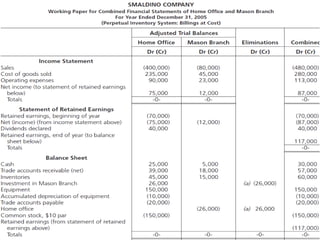
4
2-5
The cash receipts of the branch may be deposited
in a bank account belonging to the home office.
Branch expenses are paid from an imprest cash
fund or bank account provided by home office.
As the imprested cash fund is depleted, the
branch must submit a list of cash payments
supported with vouchers in order to get
replenishment from home office.
10/2/2024
5
2-6
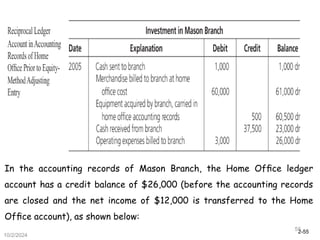
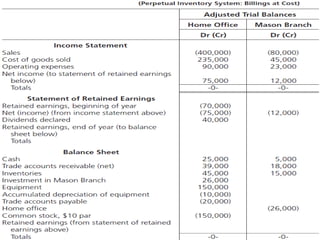
The use of an imprest cash fund gives the Home
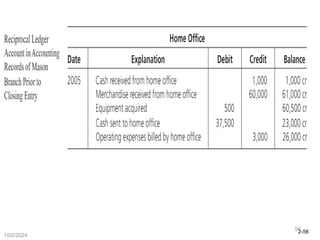
Office considerable control over the cash
transactions of the branch.
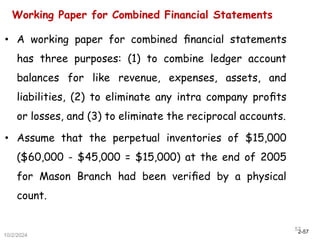
However, it is common practice for a large branch
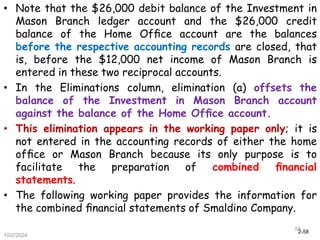
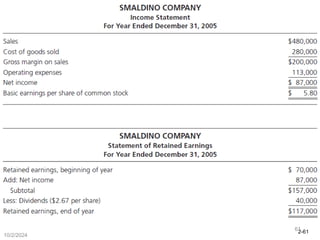
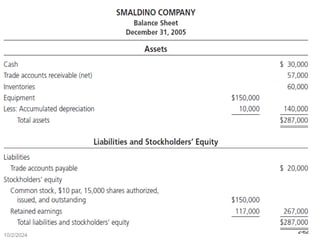
to maintain its own bank accounts.
Extent of autonomy and responsibility of a
branch varies, even among different branches of
the same business enterprise.
10/2/2024
6
2-7
3. Division (ክፍል):
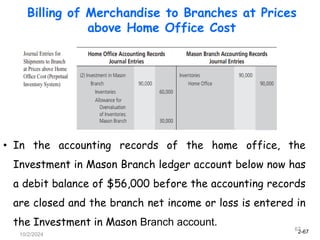
• Division is a business segment or a business
enterprise which generally has more autonomy
than a branch.
• Division may be organized as separate company
or may not be a separate company.
• If the division is not a separate company, the
accounting procedures are the same as Branch.
• If the division is a separate company (subsidiary
company), the financial accounting requires
consolidation, which will be discussed in later
topics. It will serve as Sister company.
10/2/2024 7
2-8
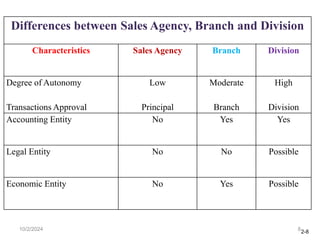
Differences between Sales Agency, Branch and Division
Characteristics Sales Agency Branch Division
Degree of Autonomy
Transactions Approval
Low
Principal
Moderate
Branch
High
Division
Accounting Entity No Yes Yes
Legal Entity No No Possible
Economic Entity No Yes Possible
10/2/2024 8
2-9
10/2/2024 9
Accounting System for Sales
Agency
2-10
Accounting System for Sales Agency
10/2/2024 10
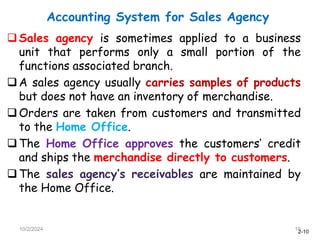
Sales agency is sometimes applied to a business
unit that performs only a small portion of the
functions associated branch.
A sales agency usually carries samples of products
but does not have an inventory of merchandise.
Orders are taken from customers and transmitted
to the Home Office.
The Home Office approves the customers’ credit
and ships the merchandise directly to customers.
The sales agency’s receivables are maintained by
the Home Office.
2-11
Accounting System for Sales Agency
10/2/2024 11
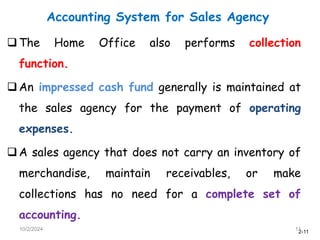
The Home Office also performs collection
function.
An impressed cash fund generally is maintained at
the sales agency for the payment of operating
expenses.
A sales agency that does not carry an inventory of
merchandise, maintain receivables, or make
collections has no need for a complete set of
accounting.
2-12
Illustration
10/2/2024 12
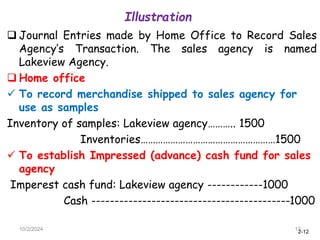
 Journal Entries made by Home Office to Record Sales
Agency’s Transaction. The sales agency is named
Lakeview Agency.
 Home office
 To record merchandise shipped to sales agency for
use as samples
Inventory of samples: Lakeview agency……….. 1500
Inventories………………………………………………1500
 To establish Impressed (advance) cash fund for sales
agency
Imperest cash fund: Lakeview agency ------------1000
Cash -------------------------------------------1000
2-13
Illustration
10/2/2024 13
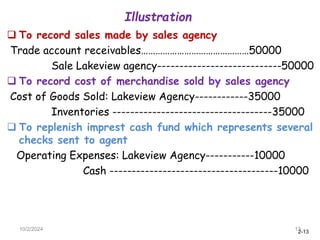
 To record sales made by sales agency
Trade account receivables………………………………………50000
Sale Lakeview agency----------------------------50000
 To record cost of merchandise sold by sales agency
Cost of Goods Sold: Lakeview Agency------------35000
Inventories ------------------------------------35000
 To replenish imprest cash fund which represents several
checks sent to agent
Operating Expenses: Lakeview Agency-----------10000
Cash --------------------------------------10000
2-14
10/2/2024 14
Accounting system for Branch
Operation
2-15
Start-Up Costs of Opening New Branches
10/2/2024
15
The establishment of a branch often requires the
incurring of considerable costs before significant
revenue may be generated.
Operating losses in the first few months are likely.
Some businesses would capitalize & amortize such
start-up costs on the grounds that such costs are
necessary to successful operation at a new
location.
However, it is not allowed in IFRS.
2-16
Start-Up Costs of Opening New Branches
10/2/2024 16
In IFRS (IAS 38) start-up cost in connection with the
opening of a branch is recognized as expenses of the
accounting period in which the costs are incurred.
The decision should be based on the principle that net
income is measured by matching expired costs with
realized revenue.
Costs that benefit future accounting periods are
deferred and allocated to those periods.
2-17
Accounting System for a Branch
10/2/2024 17
 Two alternative systems:
1. The branch does not maintain a
complete set of accounting records.
• The home office serves only as an
accounting and control center for the
branches (Dependent branches).
2-18
Accounting System for a Branch
10/2/2024 18
2. The branch maintains a complete set of
accounting records (Independent branches)
• Branch maintains its own journal entries, ledger
and chart of accounts similar to those of an
independent business enterprise.
• Financial statements are prepared by the branch
accountant and forwarded to the home office.
• The number and types of ledger accounts, the
internal control structure, the form and content of
the financial statements, and the accounting policies
generally are prescribed by the Home Office.
2-19
Accounting System for a Branch
10/2/2024 19
This chapter focuses on the second system that the
branch maintains its own accounting records.
Transactions recorded by a branch should include all
controllable expenses and revenue for which the
branch manager is responsible.
2-20
Accounting System for a Branch
10/2/2024 20
• If the branch manager has responsibility over all
branch assets, liabilities, revenue, and expenses, the
branch accounting records should reflect this
responsibility.
• Expenses such as depreciation often are not subject to
control by a branch manager; therefore both the
branch plant assets and the related depreciation
ledger accounts generally are maintained by the Home
Office.
2-21
Accounting for Branch – Reciprocal (intra company)
ledger Accounts Used by the Branch and Home
Office
10/2/2024 21
 The accounting records maintained by a branch
include a Home Office ledger account*
• H.O reflects all activity b/n the branch and
home office
– It is Cr. for all merchandise, cash or other
assets provided by the home office;
– H.O is Dr. for all cash, merchandise, or other
assets sent by the branch to the home office or
the other branches.
2-22
Accounting for Branch – Reciprocal ledger Accounts
Used by the Branch and Home Office
10/2/2024 22
• H.O ledger account is a quasi-ownership equity
account represents the net investment by the home
office in the branch.
• At the end of an accounting period when the branch
closes its accounting records, the I/Summary account
is closed to the H.O account.
• A net income increases the credit balance of the
Home Office account; a net loss decreases (debit) this
balance.
2-23
Accounting for Branch – Reciprocal ledger Accounts
Used by the Branch and Home Office
10/2/2024 23
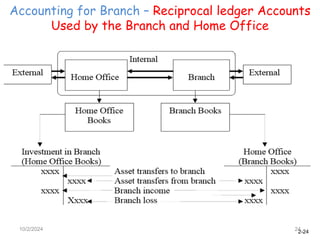
 In the home office accounting records, a reciprocal ledger
account with a title such as Investment in Branch is
maintained.
• It is non-current asset account
– Dr. for cash merchandise, and services provided to the
branch, and for the NI reported by the branch.
– Cr. for the cash or other assets received from the
branch, and for net losses reported by the branch.
 Thus the Investment in Branch account reflects the equity
method of accounting.
 A separate investment account generally is maintained by
the H.O for each branch.
2-24
Accounting for Branch – Reciprocal ledger Accounts
Used by the Branch and Home Office
10/2/2024 24
2-25
Accounting for branch
10/2/2024 25
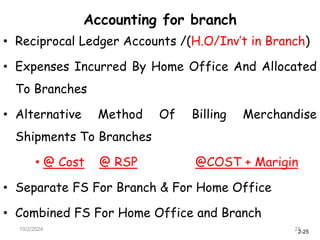
• Reciprocal Ledger Accounts /(H.O/Inv’t in Branch)
• Expenses Incurred By Home Office And Allocated
To Branches
• Alternative Method Of Billing Merchandise
Shipments To Branches
• @ Cost @ RSP @COST + Marigin
• Separate FS For Branch & For Home Office
• Combined FS For Home Office and Branch
2-26
Acquisition of Plant Assets Used in Branch
10/2/2024 26
• Some business enterprises follow a policy of
notifying each branch of expenses incurred
by the Home Office on the branch’s behalf.
• Plant assets located at a branch generally
are carried in the Home Office accounting
records.
2-27
Acquisition of Plant Assets Used in Branch
10/2/2024 27
 If a plant asset is acquired by the home
office for a branch’s usage and the record
for the plant asset is maintained by the
home office, the accounting treatments
are:
For the home office: debit a plant asset
account: branch, credit cash or a liability
account.
For the branch: no entry.
2-28
Acquisition of Plant Assets Used in Branch
10/2/2024 28
If a plant asset is acquired by a branch,
but the accounting record for this plant
asset is maintained by the home office, the
accounting treatments are:
For the branch: debit Home Office and
credit cash or a liability account.
For the home office: debit a plant asset
account: branch, and credit Investment in
Branch account.
2-29
Expense Incurred by Home Office and Allocated to
Branches
10/2/2024 29
The home office may pay some taxes, insurance or
advertising on behalf of branches or for the
benefits of all branches.
These expenses include depreciation expense for
the plant assets purchased by home office but
used by branches.
These expenses are usually allocated to branches
in determining net income of branches.
2-30
Expense Incurred by Home Office and Allocated to
Branches
10/2/2024 30
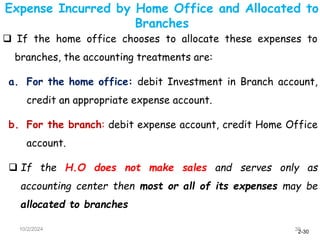
 If the home office chooses to allocate these expenses to
branches, the accounting treatments are:
a. For the home office: debit Investment in Branch account,
credit an appropriate expense account.
b. For the branch: debit expense account, credit Home Office
account.
 If the H.O does not make sales and serves only as
accounting center then most or all of its expenses may be
allocated to branches
2-31
Expense Incurred by Home Office and Allocated to
Branches
10/2/2024 31
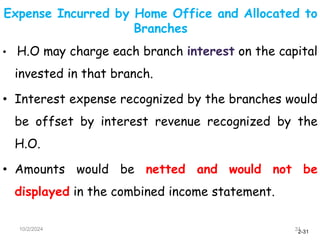
• H.O may charge each branch interest on the capital
invested in that branch.
• Interest expense recognized by the branches would
be offset by interest revenue recognized by the
H.O.
• Amounts would be netted and would not be
displayed in the combined income statement.
2-32
Alternative Methods of Billing Merchandise
Shipments to Branches
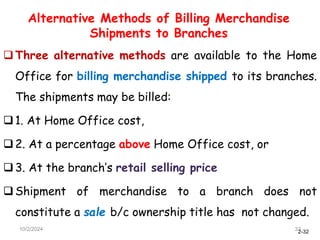
Three alternative methods are available to the Home
Office for billing merchandise shipped to its branches.
The shipments may be billed:
1. At Home Office cost,
2. At a percentage above Home Office cost, or
3. At the branch’s retail selling price
Shipment of merchandise to a branch does not
constitute a sale b/c ownership title has not changed.
10/2/2024 32
2-33
Billing shipments to a branch at Home
Office cost
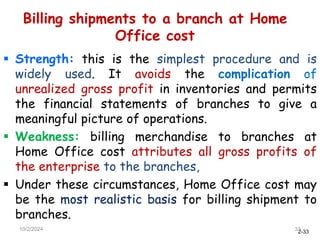
 Strength: this is the simplest procedure and is
widely used. It avoids the complication of
unrealized gross profit in inventories and permits
the financial statements of branches to give a
meaningful picture of operations.
 Weakness: billing merchandise to branches at
Home Office cost attributes all gross profits of
the enterprise to the branches,
 Under these circumstances, Home Office cost may
be the most realistic basis for billing shipment to
branches.
10/2/2024 33
2-34
Billing shipments at a percentage above Home
Office cost or at mark up (such as 110% of cost)
Strength: this may be intended to allocate a
reasonable gross profit to the Home Office.
Weakness: when merchandise is billed to a branch
at a price above Home Office cost:
 the net income reported by the branch is
understated and;
 the ending inventories are over-stated for the
enterprise as a whole.
10/2/2024 34
2-35
• Thus, adjustments must be made by the
Home Office to eliminate the excess of
billed prices over cost (intracompany profits)
in the preparation of combined financial
statements for the Home Office and the
branch.
10/2/2024 35
2-36
Billing shipments to a branch at branch
retail selling prices
• Strength: this may be based on a desire to strengthen
internal control over inventories.
• If the physical inventories taken periodically at the branch
do not agree with the amounts thus computed, an error or
theft may be indicated and should be investigated promptly.
• Weakness: no gross profit assigned to the branches and the
branch’s net loss will equal its operating expenses.
10/2/2024 36
2-37
Separate Financial Statements for Branch and for
Home Office ( for internal use only)
• A separate income statement and balance sheet
should be prepared for a branch so management
of the enterprise may review the operating
results and financial position of the branch.
• However, it is important to emphasize that
separate financial statements of the Home
Office and of the branch are prepared for
internal use only; they do not meet the needs of
investors or other external users of financial
statements.
10/2/2024 37
2-38
Separate Financial Statements for Branch and for
Home Office ( for internal use only)
• Separate financial statement doesn't serve
external users
• However, to prepare financial statements
for external users , branches financial
statement should be revised to eliminate
any intercompany profits on merchandise
shipments.
10/2/2024 38
2-39
Separate Financial Statements for Branch and for
Home Office ( for internal use only)
• The branch statements of financial position will
have H.O Ledger Account instead of Ownership
Equity Account.
• The separate F/st. prepared by branch will be
revised by H.O to include expenses incurred by
the H.O for branch & to show the results of
branch operations after elimination of any intra-
co. profits on merchandise shipments.
• Separate FS also may be prepared for the H.O,
so that the results of its operations and its
financial position can be appraised.
10/2/2024 39
2-40
Combined financial Statements for Home Office
and Branch (for external use)
• For investors, the home office and
branches are a single business entity.
• Thus, combined financial statements
should be prepared for external users.
• A four-column work sheet paper is used
to facilitate the preparation of the
combined financial statement.
10/2/2024 40
2-41
Combined financial Statements for Home Office
and Branch (for external use)
 In preparing the combined financial statements,
the following accounts should be eliminated:
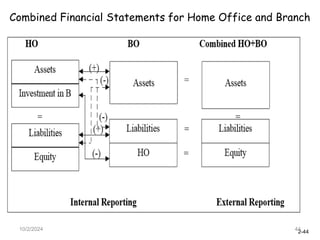
a. Reciprocal ledger accounts
b. Any intra company profits or losses.
c. Any receivables and payables between the
home office and the branch (or between two
branches).
• The rest of accounts are just summed together
for the combined financial statements.
10/2/2024 41
2-42
Combined Financial Statements for Home Office
and Branch
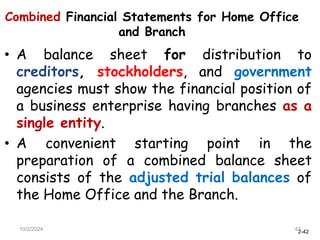
• A balance sheet for distribution to
creditors, stockholders, and government
agencies must show the financial position of
a business enterprise having branches as a
single entity.
• A convenient starting point in the
preparation of a combined balance sheet
consists of the adjusted trial balances of
the Home Office and the Branch.
10/2/2024 42
2-43
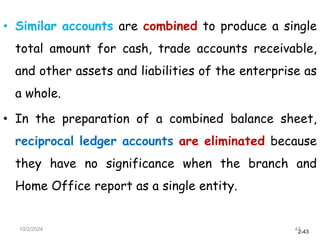
• Similar accounts are combined to produce a single
total amount for cash, trade accounts receivable,
and other assets and liabilities of the enterprise as
a whole.
• In the preparation of a combined balance sheet,
reciprocal ledger accounts are eliminated because
they have no significance when the branch and
Home Office report as a single entity.
10/2/2024 43
2-44
10/2/2024 44
Combined Financial Statements for Home Office and Branch
2-45
10/2/2024 45
Working Paper for Combined FS
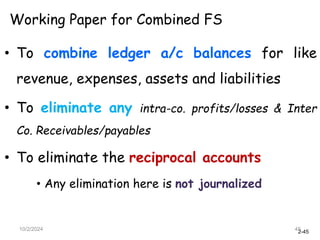
• To combine ledger a/c balances for like
revenue, expenses, assets and liabilities
• To eliminate any intra-co. profits/losses & Inter
Co. Receivables/payables
• To eliminate the reciprocal accounts
• Any elimination here is not journalized
2-46
10/2/2024 46
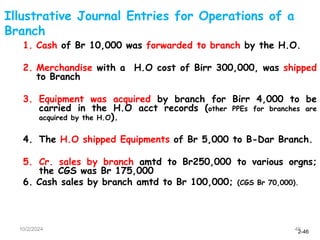
1. Cash of Br 10,000 was forwarded to branch by the H.O.
2. Merchandise with a H.O cost of Birr 300,000, was shipped
to Branch
3. Equipment was acquired by branch for Birr 4,000 to be
carried in the H.O acct records (other PPEs for branches are
acquired by the H.O).
4. The H.O shipped Equipments of Br 5,000 to B-Dar Branch.
5. Cr. sales by branch amtd to Br250,000 to various orgns;
the CGS was Br 175,000
6. Cash sales by branch amtd to Br 100,000; (CGS Br 70,000).
Illustrative Journal Entries for Operations of a
Branch
2-47
10/2/2024 47
Cont…….
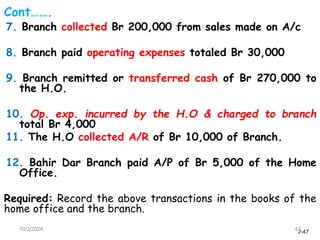
7. Branch collected Br 200,000 from sales made on A/c
8. Branch paid operating expenses totaled Br 30,000
9. Branch remitted or transferred cash of Br 270,000 to
the H.O.
10. Op. exp. incurred by the H.O & charged to branch
total Br 4,000
11. The H.O collected A/R of Br 10,000 of Branch.
12. Bahir Dar Branch paid A/P of Br 5,000 of the Home
Office.
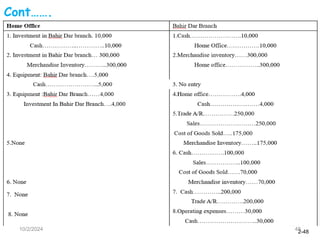
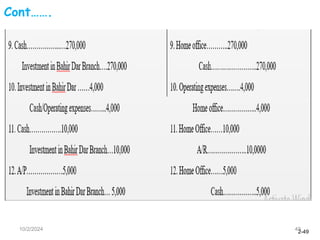
Required: Record the above transactions in the books of the
home office and the branch.
2-48
10/2/2024 48
Cont…….
2-49
10/2/2024 49
Cont…….
2-50
10/2/2024 50
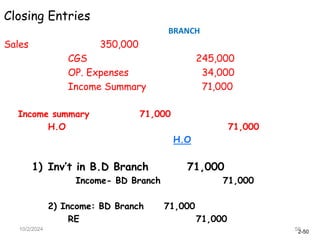
Closing Entries
BRANCH
Sales 350,000
CGS 245,000
OP. Expenses 34,000
Income Summary 71,000
Income summary 71,000
H.O 71,000
H.O
1) Inv’t in B.D Branch 71,000
Income- BD Branch 71,000
2) Income: BD Branch 71,000
RE 71,000
2-51
• Assume that Smaldino Company bills merchandise to
Mason Branch at home office cost.
• That Mason Branch maintains complete accounting
records and prepares financial statements.
• Both the home office and the branch use the perpetual
inventory system.
• Equipment used at the branch is carried in the home
office accounting records.
• Expenses, such as advertising and insurance, incurred
by the home office on behalf of the branch, are
allocated to the branch.
• Transactions and events during the first year (2005) of
operations of Mason Branch are summarized below
(start-up costs are disregarded):
10/2/2024 51
Example 2 on Branch Operation
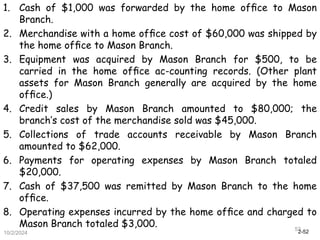
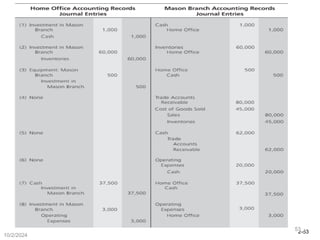
2-52
1. Cash of $1,000 was forwarded by the home office to Mason
Branch.
2. Merchandise with a home office cost of $60,000 was shipped by
the home office to Mason Branch.
3. Equipment was acquired by Mason Branch for $500, to be
carried in the home office ac-counting records. (Other plant
assets for Mason Branch generally are acquired by the home
office.)
4. Credit sales by Mason Branch amounted to $80,000; the
branch’s cost of the merchandise sold was $45,000.
5. Collections of trade accounts receivable by Mason Branch
amounted to $62,000.
6. Payments for operating expenses by Mason Branch totaled
$20,000.
7. Cash of $37,500 was remitted by Mason Branch to the home
office.
8. Operating expenses incurred by the home office and charged to
Mason Branch totaled $3,000.
10/2/2024
52
2-53
10/2/2024
53
2-54
10/2/2024
54
 If a branch obtains merchandise from outsiders as well as
from the home office, the merchandise acquired from the
home office may be recorded in a separate Inventories
from Home Office ledger account.
 In the home office accounting records, the Investment in
Mason Branch ledger account has a debit balance of
$26,000 [before the accounting records are closed and the
branch net income of $12,000 ($80,000 - $45,000 -
$20,000 - $3,000 = $12,000) is transferred to the
Investment in Mason Branch ledger account], as illustrated
on the next slide.
2-55
10/2/2024
55
In the accounting records of Mason Branch, the Home Office ledger
account has a credit balance of $26,000 (before the accounting records
are closed and the net income of $12,000 is transferred to the Home
Office account), as shown below:
2-56
10/2/2024
56
2-57
10/2/2024
57
• A working paper for combined financial statements
has three purposes: (1) to combine ledger account
balances for like revenue, expenses, assets, and
liabilities, (2) to eliminate any intra company profits
or losses, and (3) to eliminate the reciprocal accounts.
• Assume that the perpetual inventories of $15,000
($60,000 - $45,000 = $15,000) at the end of 2005
for Mason Branch had been verified by a physical
count.
Working Paper for Combined Financial Statements
2-58
10/2/2024
58
• Note that the $26,000 debit balance of the Investment in
Mason Branch ledger account and the $26,000 credit
balance of the Home Office account are the balances
before the respective accounting records are closed, that
is, before the $12,000 net income of Mason Branch is
entered in these two reciprocal accounts.
• In the Eliminations column, elimination (a) offsets the
balance of the Investment in Mason Branch account
against the balance of the Home Office account.
• This elimination appears in the working paper only; it is
not entered in the accounting records of either the home
office or Mason Branch because its only purpose is to
facilitate the preparation of combined financial
statements.
• The following working paper provides the information for
the combined financial statements of Smaldino Company.
2-59
10/2/2024
59
2-60
10/2/2024
60
2-61
10/2/2024
61
2-62
10/2/2024
62
2-63
10/2/2024 63
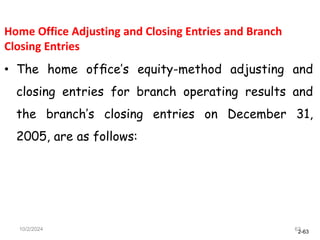
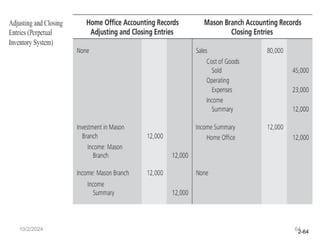
Home Office Adjusting and Closing Entries and Branch
Closing Entries
• The home office’s equity-method adjusting and
closing entries for branch operating results and
the branch’s closing entries on December 31,
2005, are as follows:
2-64
10/2/2024 64
2-65
10/2/2024 65
• As stated previously, the home offices of some
business enterprises bill merchandise shipped to
branches at home office cost plus a markup percentage
(or alternatively at branch retail selling prices).
• Because both these methods involve similar
modifications of accounting procedures, a single
example illustrates the key points involved, using the
illustration for Smaldino Company above and with one
changed assumption: the home office bills merchandise
shipped to Mason Branch at a markup of 50% above
home office cost, or 33 1/3% of billed price.
Billing of Merchandise to Branches at Prices
above Home Office Cost
2-66
10/2/2024 66
• Under this assumption, the journal entries for the
first year’s events and transactions by the home office
and Mason Branch are the same as those presented
above, except for the journal entries for shipments of
merchandise from the home office to Mason Branch.
• These shipments ($60,000 cost + 50% markup on cost
= $90,000) are recorded under the perpetual inventory
system as follows:
Billing of Merchandise to Branches at Prices
above Home Office Cost
2-67
10/2/2024
67
Billing of Merchandise to Branches at Prices
above Home Office Cost
• In the accounting records of the home office, the
Investment in Mason Branch ledger account below now has
a debit balance of $56,000 before the accounting records
are closed and the branch net income or loss is entered in
the Investment in Mason Branch account.
2-68
10/2/2024
68
Billing of Merchandise to Branches at Prices
above Home Office Cost
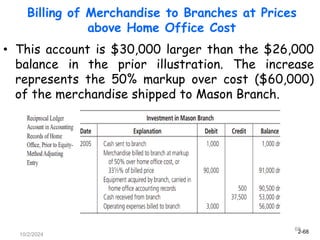
• This account is $30,000 larger than the $26,000
balance in the prior illustration. The increase
represents the 50% markup over cost ($60,000)
of the merchandise shipped to Mason Branch.
2-69
10/2/2024
69
Cont……….
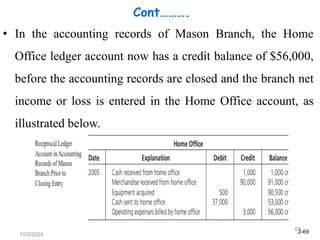
• In the accounting records of Mason Branch, the Home
Office ledger account now has a credit balance of $56,000,
before the accounting records are closed and the branch net
income or loss is entered in the Home Office account, as
illustrated below.
2-70
10/2/2024
70
Cont………..
• Mason Branch recorded the merchandise received from the home
office at billed prices of $90,000; the home office recorded the
shipment by credits of $60,000 to Inventories and $30,000 to
Allowance for Overvaluation of Inventories: Mason Branch.
• Use of the allowance account enables the home office to maintain a
record of the cost of merchandise shipped to Mason Branch as well as
the amount of the unrealized gross profit on the shipments.
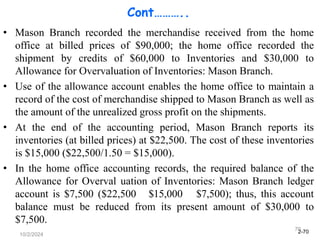
• At the end of the accounting period, Mason Branch reports its
inventories (at billed prices) at $22,500. The cost of these inventories
is $15,000 ($22,500/1.50 = $15,000).
• In the home office accounting records, the required balance of the
Allowance for Overval uation of Inventories: Mason Branch ledger
account is $7,500 ($22,500 $15,000 $7,500); thus, this account
balance must be reduced from its present amount of $30,000 to
$7,500.
2-71
10/2/2024
71
Cont………..
• The reason for this reduction is that the 50% markup of billed
prices over cost has become realized gross profit to the home
office with respect to the merchandise sold by the branch.
• Consequently, at the end of the year the home office reduces its
allowance for overvaluation of the branch inventories to the
$7,500 excess valuation contained in the ending inventories.
• The debit adjustment of $22,500 in the allowance account is
offset by a credit to the Realized Gross Profit: Mason Branch
Sales account, because it represents additional gross profit of
the home office resulting from sales by the branch.
• These matters are illustrated in the home office end-of-period
adjusting and closing entries below.
2-72
10/2/2024
72
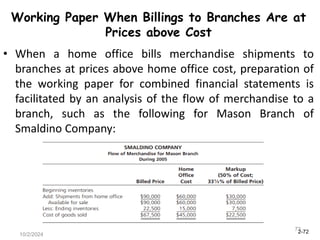
Working Paper When Billings to Branches Are at
Prices above Cost
• When a home office bills merchandise shipments to
branches at prices above home office cost, preparation of
the working paper for combined financial statements is
facilitated by an analysis of the flow of merchandise to a
branch, such as the following for Mason Branch of
Smaldino Company:
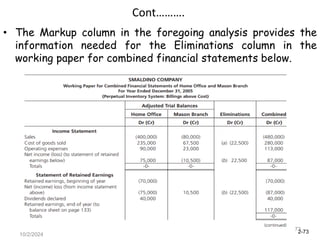
2-73
10/2/2024
73
Cont……….
• The Markup column in the foregoing analysis provides the
information needed for the Eliminations column in the
working paper for combined financial statements below.
2-74
10/2/2024
74
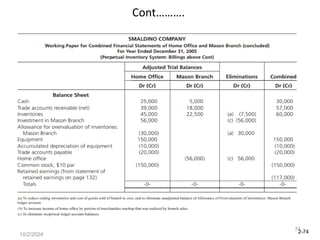
Cont……….
2-75
10/2/2024
75
Cont……….
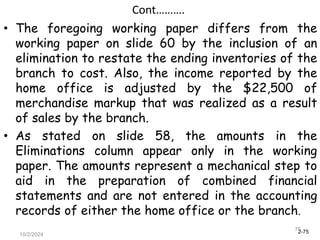
• The foregoing working paper differs from the
working paper on slide 60 by the inclusion of an
elimination to restate the ending inventories of the
branch to cost. Also, the income reported by the
home office is adjusted by the $22,500 of
merchandise markup that was realized as a result
of sales by the branch.
• As stated on slide 58, the amounts in the
Eliminations column appear only in the working
paper. The amounts represent a mechanical step to
aid in the preparation of combined financial
statements and are not entered in the accounting
records of either the home office or the branch.
2-76
10/2/2024
76
Cont……….
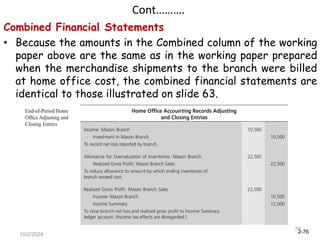
Combined Financial Statements
• Because the amounts in the Combined column of the working
paper above are the same as in the working paper prepared
when the merchandise shipments to the branch were billed
at home office cost, the combined financial statements are
identical to those illustrated on slide 63.
2-77
10/2/2024
77
Cont……….
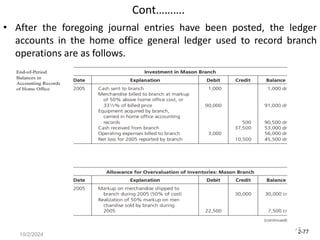
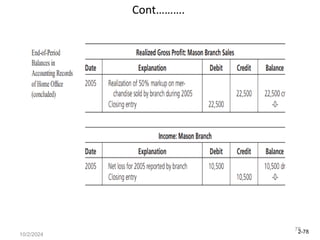
• After the foregoing journal entries have been posted, the ledger
accounts in the home office general ledger used to record branch
operations are as follows.
2-78
10/2/2024
78
Cont……….
2-79
10/2/2024
79
Cont……….
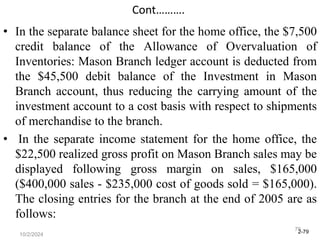
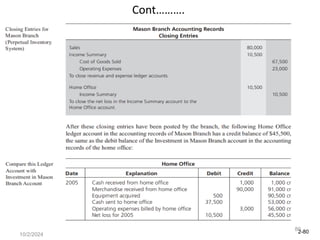
• In the separate balance sheet for the home office, the $7,500
credit balance of the Allowance of Overvaluation of
Inventories: Mason Branch ledger account is deducted from
the $45,500 debit balance of the Investment in Mason
Branch account, thus reducing the carrying amount of the
investment account to a cost basis with respect to shipments
of merchandise to the branch.
• In the separate income statement for the home office, the
$22,500 realized gross profit on Mason Branch sales may be
displayed following gross margin on sales, $165,000
($400,000 sales - $235,000 cost of goods sold = $165,000).
The closing entries for the branch at the end of 2005 are as
follows:
2-80
10/2/2024
80
Cont……….
2-81
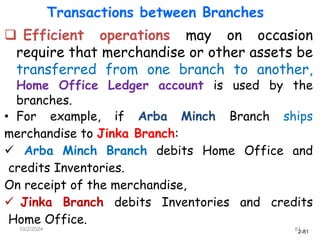
Transactions between Branches
 Efficient operations may on occasion
require that merchandise or other assets be
transferred from one branch to another,
Home Office Ledger account is used by the
branches.
• For example, if Arba Minch Branch ships
merchandise to Jinka Branch:
 Arba Minch Branch debits Home Office and
credits Inventories.
On receipt of the merchandise,
 Jinka Branch debits Inventories and credits
Home Office.
10/2/2024 81
2-82
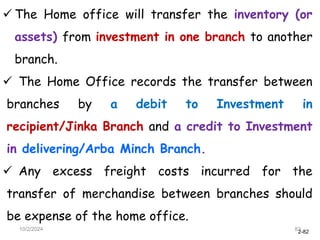
 The Home office will transfer the inventory (or
assets) from investment in one branch to another
branch.
 The Home Office records the transfer between
branches by a debit to Investment in
recipient/Jinka Branch and a credit to Investment
in delivering/Arba Minch Branch.
 Any excess freight costs incurred for the
transfer of merchandise between branches should
be expense of the home office.
10/2/2024 82
2-83
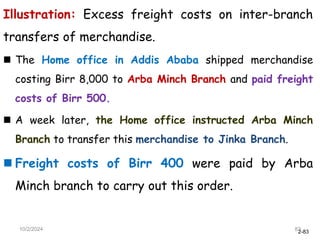
Illustration: Excess freight costs on inter-branch
transfers of merchandise.
 The Home office in Addis Ababa shipped merchandise
costing Birr 8,000 to Arba Minch Branch and paid freight
costs of Birr 500.
 A week later, the Home office instructed Arba Minch
Branch to transfer this merchandise to Jinka Branch.
 Freight costs of Birr 400 were paid by Arba
Minch branch to carry out this order.
10/2/2024 83
2-84
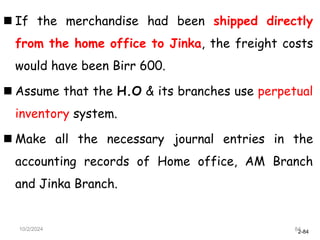
 If the merchandise had been shipped directly
from the home office to Jinka, the freight costs
would have been Birr 600.
 Assume that the H.O & its branches use perpetual
inventory system.
 Make all the necessary journal entries in the
accounting records of Home office, AM Branch
and Jinka Branch.
10/2/2024 84
2-85
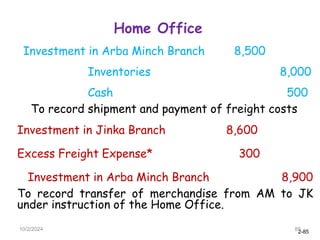
Home Office
Investment in Arba Minch Branch 8,500
Inventories 8,000
Cash 500
To record shipment and payment of freight costs
Investment in Jinka Branch 8,600
Excess Freight Expense* 300
Investment in Arba Minch Branch 8,900
To record transfer of merchandise from AM to JK
under instruction of the Home Office.
10/2/2024 85
2-86
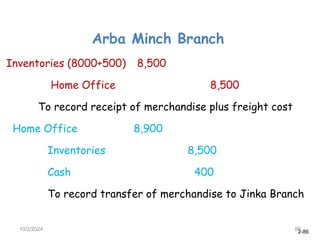
Arba Minch Branch
Inventories (8000+500) 8,500
Home Office 8,500
To record receipt of merchandise plus freight cost
Home Office 8,900
Inventories 8,500
Cash 400
To record transfer of merchandise to Jinka Branch
10/2/2024 86
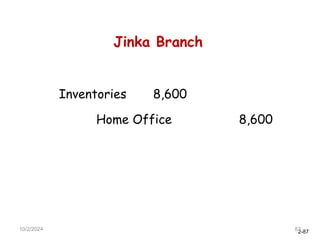
2-87
Jinka Branch
Inventories 8,600
Home Office 8,600
10/2/2024 87
2-88
End of This Chapter
10/2/2024 88

Advanced FA II, Chapter Two.pdf111111111

  • 1.
    2-1 Accounting for Sales Agency,Branch, and Division 10/2/2024 1 Chapter Two By: Mengst D.
  • 2.
    2-2 1. Sales Agency(የሽያጭ ኤጀንሲ/ወኪል): • Sales agency is a term applied to a business unit that performs only a small portion of the functions associated with a branch. • A sales agency usually carries samples of products but does not have an inventory of merchandise and usually lesser degree of autonomy. 10/2/2024 2
  • 3.
    2-3 2. Branch (ቅርንጫፍ): •As a business enterprise grows, it may establish one or more branches to market its products over a large territory. • The term Branch is used to describe a business unit located at some distance from the Home Office. • Branches are separate economic and accounting entities from their home office. • However, they are not separate legal entities from their home office. 10/2/2024 3
  • 4.
    2-4 • It is100% owned by the HO. • Branches may  carry merchandise obtained from Home Office,  make sales, approve customers’ credit, and  make collections from its customers, and  remits cash received. • A branch may obtain merchandise solely from the home office, or a portion may be purchased from outside suppliers. 10/2/2024 4
  • 5.
    2-5 The cash receiptsof the branch may be deposited in a bank account belonging to the home office. Branch expenses are paid from an imprest cash fund or bank account provided by home office. As the imprested cash fund is depleted, the branch must submit a list of cash payments supported with vouchers in order to get replenishment from home office. 10/2/2024 5
  • 6.
    2-6 The use ofan imprest cash fund gives the Home Office considerable control over the cash transactions of the branch. However, it is common practice for a large branch to maintain its own bank accounts. Extent of autonomy and responsibility of a branch varies, even among different branches of the same business enterprise. 10/2/2024 6
  • 7.
    2-7 3. Division (ክፍል): •Division is a business segment or a business enterprise which generally has more autonomy than a branch. • Division may be organized as separate company or may not be a separate company. • If the division is not a separate company, the accounting procedures are the same as Branch. • If the division is a separate company (subsidiary company), the financial accounting requires consolidation, which will be discussed in later topics. It will serve as Sister company. 10/2/2024 7
  • 8.
    2-8 Differences between SalesAgency, Branch and Division Characteristics Sales Agency Branch Division Degree of Autonomy Transactions Approval Low Principal Moderate Branch High Division Accounting Entity No Yes Yes Legal Entity No No Possible Economic Entity No Yes Possible 10/2/2024 8
  • 9.
  • 10.
    2-10 Accounting System forSales Agency 10/2/2024 10 Sales agency is sometimes applied to a business unit that performs only a small portion of the functions associated branch. A sales agency usually carries samples of products but does not have an inventory of merchandise. Orders are taken from customers and transmitted to the Home Office. The Home Office approves the customers’ credit and ships the merchandise directly to customers. The sales agency’s receivables are maintained by the Home Office.
  • 11.
    2-11 Accounting System forSales Agency 10/2/2024 11 The Home Office also performs collection function. An impressed cash fund generally is maintained at the sales agency for the payment of operating expenses. A sales agency that does not carry an inventory of merchandise, maintain receivables, or make collections has no need for a complete set of accounting.
  • 12.
    2-12 Illustration 10/2/2024 12  JournalEntries made by Home Office to Record Sales Agency’s Transaction. The sales agency is named Lakeview Agency.  Home office  To record merchandise shipped to sales agency for use as samples Inventory of samples: Lakeview agency……….. 1500 Inventories………………………………………………1500  To establish Impressed (advance) cash fund for sales agency Imperest cash fund: Lakeview agency ------------1000 Cash -------------------------------------------1000
  • 13.
    2-13 Illustration 10/2/2024 13  Torecord sales made by sales agency Trade account receivables………………………………………50000 Sale Lakeview agency----------------------------50000  To record cost of merchandise sold by sales agency Cost of Goods Sold: Lakeview Agency------------35000 Inventories ------------------------------------35000  To replenish imprest cash fund which represents several checks sent to agent Operating Expenses: Lakeview Agency-----------10000 Cash --------------------------------------10000
  • 14.
  • 15.
    2-15 Start-Up Costs ofOpening New Branches 10/2/2024 15 The establishment of a branch often requires the incurring of considerable costs before significant revenue may be generated. Operating losses in the first few months are likely. Some businesses would capitalize & amortize such start-up costs on the grounds that such costs are necessary to successful operation at a new location. However, it is not allowed in IFRS.
  • 16.
    2-16 Start-Up Costs ofOpening New Branches 10/2/2024 16 In IFRS (IAS 38) start-up cost in connection with the opening of a branch is recognized as expenses of the accounting period in which the costs are incurred. The decision should be based on the principle that net income is measured by matching expired costs with realized revenue. Costs that benefit future accounting periods are deferred and allocated to those periods.
  • 17.
    2-17 Accounting System fora Branch 10/2/2024 17  Two alternative systems: 1. The branch does not maintain a complete set of accounting records. • The home office serves only as an accounting and control center for the branches (Dependent branches).
  • 18.
    2-18 Accounting System fora Branch 10/2/2024 18 2. The branch maintains a complete set of accounting records (Independent branches) • Branch maintains its own journal entries, ledger and chart of accounts similar to those of an independent business enterprise. • Financial statements are prepared by the branch accountant and forwarded to the home office. • The number and types of ledger accounts, the internal control structure, the form and content of the financial statements, and the accounting policies generally are prescribed by the Home Office.
  • 19.
    2-19 Accounting System fora Branch 10/2/2024 19 This chapter focuses on the second system that the branch maintains its own accounting records. Transactions recorded by a branch should include all controllable expenses and revenue for which the branch manager is responsible.
  • 20.
    2-20 Accounting System fora Branch 10/2/2024 20 • If the branch manager has responsibility over all branch assets, liabilities, revenue, and expenses, the branch accounting records should reflect this responsibility. • Expenses such as depreciation often are not subject to control by a branch manager; therefore both the branch plant assets and the related depreciation ledger accounts generally are maintained by the Home Office.
  • 21.
    2-21 Accounting for Branch– Reciprocal (intra company) ledger Accounts Used by the Branch and Home Office 10/2/2024 21  The accounting records maintained by a branch include a Home Office ledger account* • H.O reflects all activity b/n the branch and home office – It is Cr. for all merchandise, cash or other assets provided by the home office; – H.O is Dr. for all cash, merchandise, or other assets sent by the branch to the home office or the other branches.
  • 22.
    2-22 Accounting for Branch– Reciprocal ledger Accounts Used by the Branch and Home Office 10/2/2024 22 • H.O ledger account is a quasi-ownership equity account represents the net investment by the home office in the branch. • At the end of an accounting period when the branch closes its accounting records, the I/Summary account is closed to the H.O account. • A net income increases the credit balance of the Home Office account; a net loss decreases (debit) this balance.
  • 23.
    2-23 Accounting for Branch– Reciprocal ledger Accounts Used by the Branch and Home Office 10/2/2024 23  In the home office accounting records, a reciprocal ledger account with a title such as Investment in Branch is maintained. • It is non-current asset account – Dr. for cash merchandise, and services provided to the branch, and for the NI reported by the branch. – Cr. for the cash or other assets received from the branch, and for net losses reported by the branch.  Thus the Investment in Branch account reflects the equity method of accounting.  A separate investment account generally is maintained by the H.O for each branch.
  • 24.
    2-24 Accounting for Branch– Reciprocal ledger Accounts Used by the Branch and Home Office 10/2/2024 24
  • 25.
    2-25 Accounting for branch 10/2/202425 • Reciprocal Ledger Accounts /(H.O/Inv’t in Branch) • Expenses Incurred By Home Office And Allocated To Branches • Alternative Method Of Billing Merchandise Shipments To Branches • @ Cost @ RSP @COST + Marigin • Separate FS For Branch & For Home Office • Combined FS For Home Office and Branch
  • 26.
    2-26 Acquisition of PlantAssets Used in Branch 10/2/2024 26 • Some business enterprises follow a policy of notifying each branch of expenses incurred by the Home Office on the branch’s behalf. • Plant assets located at a branch generally are carried in the Home Office accounting records.
  • 27.
    2-27 Acquisition of PlantAssets Used in Branch 10/2/2024 27  If a plant asset is acquired by the home office for a branch’s usage and the record for the plant asset is maintained by the home office, the accounting treatments are: For the home office: debit a plant asset account: branch, credit cash or a liability account. For the branch: no entry.
  • 28.
    2-28 Acquisition of PlantAssets Used in Branch 10/2/2024 28 If a plant asset is acquired by a branch, but the accounting record for this plant asset is maintained by the home office, the accounting treatments are: For the branch: debit Home Office and credit cash or a liability account. For the home office: debit a plant asset account: branch, and credit Investment in Branch account.
  • 29.
    2-29 Expense Incurred byHome Office and Allocated to Branches 10/2/2024 29 The home office may pay some taxes, insurance or advertising on behalf of branches or for the benefits of all branches. These expenses include depreciation expense for the plant assets purchased by home office but used by branches. These expenses are usually allocated to branches in determining net income of branches.
  • 30.
    2-30 Expense Incurred byHome Office and Allocated to Branches 10/2/2024 30  If the home office chooses to allocate these expenses to branches, the accounting treatments are: a. For the home office: debit Investment in Branch account, credit an appropriate expense account. b. For the branch: debit expense account, credit Home Office account.  If the H.O does not make sales and serves only as accounting center then most or all of its expenses may be allocated to branches
  • 31.
    2-31 Expense Incurred byHome Office and Allocated to Branches 10/2/2024 31 • H.O may charge each branch interest on the capital invested in that branch. • Interest expense recognized by the branches would be offset by interest revenue recognized by the H.O. • Amounts would be netted and would not be displayed in the combined income statement.
  • 32.
    2-32 Alternative Methods ofBilling Merchandise Shipments to Branches Three alternative methods are available to the Home Office for billing merchandise shipped to its branches. The shipments may be billed: 1. At Home Office cost, 2. At a percentage above Home Office cost, or 3. At the branch’s retail selling price Shipment of merchandise to a branch does not constitute a sale b/c ownership title has not changed. 10/2/2024 32
  • 33.
    2-33 Billing shipments toa branch at Home Office cost  Strength: this is the simplest procedure and is widely used. It avoids the complication of unrealized gross profit in inventories and permits the financial statements of branches to give a meaningful picture of operations.  Weakness: billing merchandise to branches at Home Office cost attributes all gross profits of the enterprise to the branches,  Under these circumstances, Home Office cost may be the most realistic basis for billing shipment to branches. 10/2/2024 33
  • 34.
    2-34 Billing shipments ata percentage above Home Office cost or at mark up (such as 110% of cost) Strength: this may be intended to allocate a reasonable gross profit to the Home Office. Weakness: when merchandise is billed to a branch at a price above Home Office cost:  the net income reported by the branch is understated and;  the ending inventories are over-stated for the enterprise as a whole. 10/2/2024 34
  • 35.
    2-35 • Thus, adjustmentsmust be made by the Home Office to eliminate the excess of billed prices over cost (intracompany profits) in the preparation of combined financial statements for the Home Office and the branch. 10/2/2024 35
  • 36.
    2-36 Billing shipments toa branch at branch retail selling prices • Strength: this may be based on a desire to strengthen internal control over inventories. • If the physical inventories taken periodically at the branch do not agree with the amounts thus computed, an error or theft may be indicated and should be investigated promptly. • Weakness: no gross profit assigned to the branches and the branch’s net loss will equal its operating expenses. 10/2/2024 36
  • 37.
    2-37 Separate Financial Statementsfor Branch and for Home Office ( for internal use only) • A separate income statement and balance sheet should be prepared for a branch so management of the enterprise may review the operating results and financial position of the branch. • However, it is important to emphasize that separate financial statements of the Home Office and of the branch are prepared for internal use only; they do not meet the needs of investors or other external users of financial statements. 10/2/2024 37
  • 38.
    2-38 Separate Financial Statementsfor Branch and for Home Office ( for internal use only) • Separate financial statement doesn't serve external users • However, to prepare financial statements for external users , branches financial statement should be revised to eliminate any intercompany profits on merchandise shipments. 10/2/2024 38
  • 39.
    2-39 Separate Financial Statementsfor Branch and for Home Office ( for internal use only) • The branch statements of financial position will have H.O Ledger Account instead of Ownership Equity Account. • The separate F/st. prepared by branch will be revised by H.O to include expenses incurred by the H.O for branch & to show the results of branch operations after elimination of any intra- co. profits on merchandise shipments. • Separate FS also may be prepared for the H.O, so that the results of its operations and its financial position can be appraised. 10/2/2024 39
  • 40.
    2-40 Combined financial Statementsfor Home Office and Branch (for external use) • For investors, the home office and branches are a single business entity. • Thus, combined financial statements should be prepared for external users. • A four-column work sheet paper is used to facilitate the preparation of the combined financial statement. 10/2/2024 40
  • 41.
    2-41 Combined financial Statementsfor Home Office and Branch (for external use)  In preparing the combined financial statements, the following accounts should be eliminated: a. Reciprocal ledger accounts b. Any intra company profits or losses. c. Any receivables and payables between the home office and the branch (or between two branches). • The rest of accounts are just summed together for the combined financial statements. 10/2/2024 41
  • 42.
    2-42 Combined Financial Statementsfor Home Office and Branch • A balance sheet for distribution to creditors, stockholders, and government agencies must show the financial position of a business enterprise having branches as a single entity. • A convenient starting point in the preparation of a combined balance sheet consists of the adjusted trial balances of the Home Office and the Branch. 10/2/2024 42
  • 43.
    2-43 • Similar accountsare combined to produce a single total amount for cash, trade accounts receivable, and other assets and liabilities of the enterprise as a whole. • In the preparation of a combined balance sheet, reciprocal ledger accounts are eliminated because they have no significance when the branch and Home Office report as a single entity. 10/2/2024 43
  • 44.
    2-44 10/2/2024 44 Combined FinancialStatements for Home Office and Branch
  • 45.
    2-45 10/2/2024 45 Working Paperfor Combined FS • To combine ledger a/c balances for like revenue, expenses, assets and liabilities • To eliminate any intra-co. profits/losses & Inter Co. Receivables/payables • To eliminate the reciprocal accounts • Any elimination here is not journalized
  • 46.
    2-46 10/2/2024 46 1. Cashof Br 10,000 was forwarded to branch by the H.O. 2. Merchandise with a H.O cost of Birr 300,000, was shipped to Branch 3. Equipment was acquired by branch for Birr 4,000 to be carried in the H.O acct records (other PPEs for branches are acquired by the H.O). 4. The H.O shipped Equipments of Br 5,000 to B-Dar Branch. 5. Cr. sales by branch amtd to Br250,000 to various orgns; the CGS was Br 175,000 6. Cash sales by branch amtd to Br 100,000; (CGS Br 70,000). Illustrative Journal Entries for Operations of a Branch
  • 47.
    2-47 10/2/2024 47 Cont……. 7. Branchcollected Br 200,000 from sales made on A/c 8. Branch paid operating expenses totaled Br 30,000 9. Branch remitted or transferred cash of Br 270,000 to the H.O. 10. Op. exp. incurred by the H.O & charged to branch total Br 4,000 11. The H.O collected A/R of Br 10,000 of Branch. 12. Bahir Dar Branch paid A/P of Br 5,000 of the Home Office. Required: Record the above transactions in the books of the home office and the branch.
  • 48.
  • 49.
  • 50.
    2-50 10/2/2024 50 Closing Entries BRANCH Sales350,000 CGS 245,000 OP. Expenses 34,000 Income Summary 71,000 Income summary 71,000 H.O 71,000 H.O 1) Inv’t in B.D Branch 71,000 Income- BD Branch 71,000 2) Income: BD Branch 71,000 RE 71,000
  • 51.
    2-51 • Assume thatSmaldino Company bills merchandise to Mason Branch at home office cost. • That Mason Branch maintains complete accounting records and prepares financial statements. • Both the home office and the branch use the perpetual inventory system. • Equipment used at the branch is carried in the home office accounting records. • Expenses, such as advertising and insurance, incurred by the home office on behalf of the branch, are allocated to the branch. • Transactions and events during the first year (2005) of operations of Mason Branch are summarized below (start-up costs are disregarded): 10/2/2024 51 Example 2 on Branch Operation
  • 52.
    2-52 1. Cash of$1,000 was forwarded by the home office to Mason Branch. 2. Merchandise with a home office cost of $60,000 was shipped by the home office to Mason Branch. 3. Equipment was acquired by Mason Branch for $500, to be carried in the home office ac-counting records. (Other plant assets for Mason Branch generally are acquired by the home office.) 4. Credit sales by Mason Branch amounted to $80,000; the branch’s cost of the merchandise sold was $45,000. 5. Collections of trade accounts receivable by Mason Branch amounted to $62,000. 6. Payments for operating expenses by Mason Branch totaled $20,000. 7. Cash of $37,500 was remitted by Mason Branch to the home office. 8. Operating expenses incurred by the home office and charged to Mason Branch totaled $3,000. 10/2/2024 52
  • 53.
  • 54.
    2-54 10/2/2024 54  If abranch obtains merchandise from outsiders as well as from the home office, the merchandise acquired from the home office may be recorded in a separate Inventories from Home Office ledger account.  In the home office accounting records, the Investment in Mason Branch ledger account has a debit balance of $26,000 [before the accounting records are closed and the branch net income of $12,000 ($80,000 - $45,000 - $20,000 - $3,000 = $12,000) is transferred to the Investment in Mason Branch ledger account], as illustrated on the next slide.
  • 55.
    2-55 10/2/2024 55 In the accountingrecords of Mason Branch, the Home Office ledger account has a credit balance of $26,000 (before the accounting records are closed and the net income of $12,000 is transferred to the Home Office account), as shown below:
  • 56.
  • 57.
    2-57 10/2/2024 57 • A workingpaper for combined financial statements has three purposes: (1) to combine ledger account balances for like revenue, expenses, assets, and liabilities, (2) to eliminate any intra company profits or losses, and (3) to eliminate the reciprocal accounts. • Assume that the perpetual inventories of $15,000 ($60,000 - $45,000 = $15,000) at the end of 2005 for Mason Branch had been verified by a physical count. Working Paper for Combined Financial Statements
  • 58.
    2-58 10/2/2024 58 • Note thatthe $26,000 debit balance of the Investment in Mason Branch ledger account and the $26,000 credit balance of the Home Office account are the balances before the respective accounting records are closed, that is, before the $12,000 net income of Mason Branch is entered in these two reciprocal accounts. • In the Eliminations column, elimination (a) offsets the balance of the Investment in Mason Branch account against the balance of the Home Office account. • This elimination appears in the working paper only; it is not entered in the accounting records of either the home office or Mason Branch because its only purpose is to facilitate the preparation of combined financial statements. • The following working paper provides the information for the combined financial statements of Smaldino Company.
  • 59.
  • 60.
  • 61.
  • 62.
  • 63.
    2-63 10/2/2024 63 Home OfficeAdjusting and Closing Entries and Branch Closing Entries • The home office’s equity-method adjusting and closing entries for branch operating results and the branch’s closing entries on December 31, 2005, are as follows:
  • 64.
  • 65.
    2-65 10/2/2024 65 • Asstated previously, the home offices of some business enterprises bill merchandise shipped to branches at home office cost plus a markup percentage (or alternatively at branch retail selling prices). • Because both these methods involve similar modifications of accounting procedures, a single example illustrates the key points involved, using the illustration for Smaldino Company above and with one changed assumption: the home office bills merchandise shipped to Mason Branch at a markup of 50% above home office cost, or 33 1/3% of billed price. Billing of Merchandise to Branches at Prices above Home Office Cost
  • 66.
    2-66 10/2/2024 66 • Underthis assumption, the journal entries for the first year’s events and transactions by the home office and Mason Branch are the same as those presented above, except for the journal entries for shipments of merchandise from the home office to Mason Branch. • These shipments ($60,000 cost + 50% markup on cost = $90,000) are recorded under the perpetual inventory system as follows: Billing of Merchandise to Branches at Prices above Home Office Cost
  • 67.
    2-67 10/2/2024 67 Billing of Merchandiseto Branches at Prices above Home Office Cost • In the accounting records of the home office, the Investment in Mason Branch ledger account below now has a debit balance of $56,000 before the accounting records are closed and the branch net income or loss is entered in the Investment in Mason Branch account.
  • 68.
    2-68 10/2/2024 68 Billing of Merchandiseto Branches at Prices above Home Office Cost • This account is $30,000 larger than the $26,000 balance in the prior illustration. The increase represents the 50% markup over cost ($60,000) of the merchandise shipped to Mason Branch.
  • 69.
    2-69 10/2/2024 69 Cont………. • In theaccounting records of Mason Branch, the Home Office ledger account now has a credit balance of $56,000, before the accounting records are closed and the branch net income or loss is entered in the Home Office account, as illustrated below.
  • 70.
    2-70 10/2/2024 70 Cont……….. • Mason Branchrecorded the merchandise received from the home office at billed prices of $90,000; the home office recorded the shipment by credits of $60,000 to Inventories and $30,000 to Allowance for Overvaluation of Inventories: Mason Branch. • Use of the allowance account enables the home office to maintain a record of the cost of merchandise shipped to Mason Branch as well as the amount of the unrealized gross profit on the shipments. • At the end of the accounting period, Mason Branch reports its inventories (at billed prices) at $22,500. The cost of these inventories is $15,000 ($22,500/1.50 = $15,000). • In the home office accounting records, the required balance of the Allowance for Overval uation of Inventories: Mason Branch ledger account is $7,500 ($22,500 $15,000 $7,500); thus, this account balance must be reduced from its present amount of $30,000 to $7,500.
  • 71.
    2-71 10/2/2024 71 Cont……….. • The reasonfor this reduction is that the 50% markup of billed prices over cost has become realized gross profit to the home office with respect to the merchandise sold by the branch. • Consequently, at the end of the year the home office reduces its allowance for overvaluation of the branch inventories to the $7,500 excess valuation contained in the ending inventories. • The debit adjustment of $22,500 in the allowance account is offset by a credit to the Realized Gross Profit: Mason Branch Sales account, because it represents additional gross profit of the home office resulting from sales by the branch. • These matters are illustrated in the home office end-of-period adjusting and closing entries below.
  • 72.
    2-72 10/2/2024 72 Working Paper WhenBillings to Branches Are at Prices above Cost • When a home office bills merchandise shipments to branches at prices above home office cost, preparation of the working paper for combined financial statements is facilitated by an analysis of the flow of merchandise to a branch, such as the following for Mason Branch of Smaldino Company:
  • 73.
    2-73 10/2/2024 73 Cont………. • The Markupcolumn in the foregoing analysis provides the information needed for the Eliminations column in the working paper for combined financial statements below.
  • 74.
  • 75.
    2-75 10/2/2024 75 Cont………. • The foregoingworking paper differs from the working paper on slide 60 by the inclusion of an elimination to restate the ending inventories of the branch to cost. Also, the income reported by the home office is adjusted by the $22,500 of merchandise markup that was realized as a result of sales by the branch. • As stated on slide 58, the amounts in the Eliminations column appear only in the working paper. The amounts represent a mechanical step to aid in the preparation of combined financial statements and are not entered in the accounting records of either the home office or the branch.
  • 76.
    2-76 10/2/2024 76 Cont………. Combined Financial Statements •Because the amounts in the Combined column of the working paper above are the same as in the working paper prepared when the merchandise shipments to the branch were billed at home office cost, the combined financial statements are identical to those illustrated on slide 63.
  • 77.
    2-77 10/2/2024 77 Cont………. • After theforegoing journal entries have been posted, the ledger accounts in the home office general ledger used to record branch operations are as follows.
  • 78.
  • 79.
    2-79 10/2/2024 79 Cont………. • In theseparate balance sheet for the home office, the $7,500 credit balance of the Allowance of Overvaluation of Inventories: Mason Branch ledger account is deducted from the $45,500 debit balance of the Investment in Mason Branch account, thus reducing the carrying amount of the investment account to a cost basis with respect to shipments of merchandise to the branch. • In the separate income statement for the home office, the $22,500 realized gross profit on Mason Branch sales may be displayed following gross margin on sales, $165,000 ($400,000 sales - $235,000 cost of goods sold = $165,000). The closing entries for the branch at the end of 2005 are as follows:
  • 80.
  • 81.
    2-81 Transactions between Branches Efficient operations may on occasion require that merchandise or other assets be transferred from one branch to another, Home Office Ledger account is used by the branches. • For example, if Arba Minch Branch ships merchandise to Jinka Branch:  Arba Minch Branch debits Home Office and credits Inventories. On receipt of the merchandise,  Jinka Branch debits Inventories and credits Home Office. 10/2/2024 81
  • 82.
    2-82  The Homeoffice will transfer the inventory (or assets) from investment in one branch to another branch.  The Home Office records the transfer between branches by a debit to Investment in recipient/Jinka Branch and a credit to Investment in delivering/Arba Minch Branch.  Any excess freight costs incurred for the transfer of merchandise between branches should be expense of the home office. 10/2/2024 82
  • 83.
    2-83 Illustration: Excess freightcosts on inter-branch transfers of merchandise.  The Home office in Addis Ababa shipped merchandise costing Birr 8,000 to Arba Minch Branch and paid freight costs of Birr 500.  A week later, the Home office instructed Arba Minch Branch to transfer this merchandise to Jinka Branch.  Freight costs of Birr 400 were paid by Arba Minch branch to carry out this order. 10/2/2024 83
  • 84.
    2-84  If themerchandise had been shipped directly from the home office to Jinka, the freight costs would have been Birr 600.  Assume that the H.O & its branches use perpetual inventory system.  Make all the necessary journal entries in the accounting records of Home office, AM Branch and Jinka Branch. 10/2/2024 84
  • 85.
    2-85 Home Office Investment inArba Minch Branch 8,500 Inventories 8,000 Cash 500 To record shipment and payment of freight costs Investment in Jinka Branch 8,600 Excess Freight Expense* 300 Investment in Arba Minch Branch 8,900 To record transfer of merchandise from AM to JK under instruction of the Home Office. 10/2/2024 85
  • 86.
    2-86 Arba Minch Branch Inventories(8000+500) 8,500 Home Office 8,500 To record receipt of merchandise plus freight cost Home Office 8,900 Inventories 8,500 Cash 400 To record transfer of merchandise to Jinka Branch 10/2/2024 86
  • 87.
  • 88.
    2-88 End of ThisChapter 10/2/2024 88