1
Chapter four: project financing
Project Financing
 There are two categories of sources for funding: debt
(borrowing) and equity.
Debt Financing
 There are essentially four types of debt financing: (1)
borrowing, (2) corporate bonds, (3) trade debt, and (4)
customer deposits.
1. Borrowing
 The most common type of debt financing is borrowing from
financial institutions, such as banks or leasing companies.
 Borrowing from financial institutions can be quick and
relatively inexpensive.
2. Corporate Bonds
• Issuing Procedures
 Government laws grant corporations power to issue bonds.
 Board of directors and shareholders must approve bond
issues.
 Board of directors must specify number of bonds to be
authorized, total face value, and contractual interest rate.
 Issuing company arranges for printing of bond certificates.
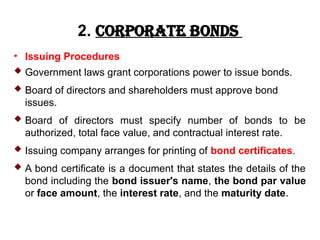
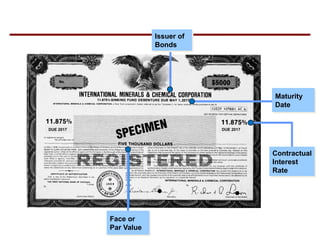
 A bond certificate is a document that states the details of the
bond including the bond issuer's name, the bond par value
or face amount, the interest rate, and the maturity date.
Cont.…
 Represents a promise to pay:
ā–ŗFace value at designated maturity date, plus
ā–ŗPeriodic interest at a contractual (stated) interest
rate on the maturity amount (face value).
 Interest payments usually made semiannually.
Maturity
Date
Contractual
Interest
Rate
Face or
Par Value
DUE 2017 DUE 2017
2017
Issuer of
Bonds
Accounting for Bond Issues
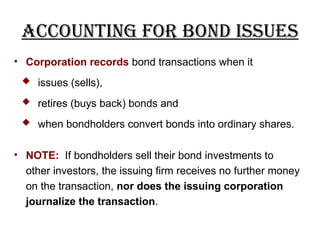
• Corporation records bond transactions when it
 issues (sells),
 retires (buys back) bonds and
 when bondholders convert bonds into ordinary shares.
• NOTE: If bondholders sell their bond investments to
other investors, the issuing firm receives no further money
on the transaction, nor does the issuing corporation
journalize the transaction.
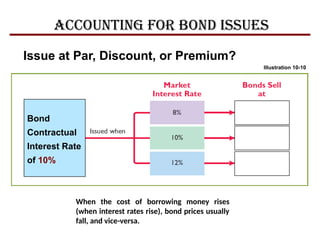
Issue at Par, Discount, or Premium?
Accounting for Bond Issues
Illustration 10-10
Bond
Contractual
Interest Rate
of 10%
When the cost of borrowing money rises
(when interest rates rise), bond prices usually
fall, and vice-versa.
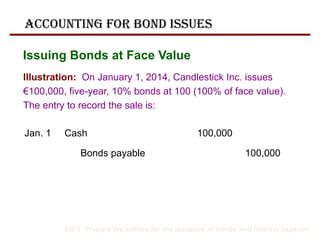
Illustration: On January 1, 2014, Candlestick Inc. issues
€100,000, five-year, 10% bonds at 100 (100% of face value).
The entry to record the sale is:
LO 5 Prepare the entries for the issuance of bonds and interest expense.
Jan. 1 Cash 100,000
Bonds payable 100,000
Issuing Bonds at Face Value
Accounting for Bond Issues
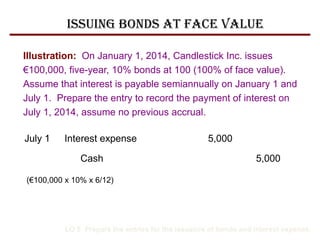
Illustration: On January 1, 2014, Candlestick Inc. issues
€100,000, five-year, 10% bonds at 100 (100% of face value).
Assume that interest is payable semiannually on January 1 and
July 1. Prepare the entry to record the payment of interest on
July 1, 2014, assume no previous accrual.
LO 5 Prepare the entries for the issuance of bonds and interest expense.
July 1 Interest expense 5,000
Cash 5,000
Issuing Bonds at Face Value
(€100,000 x 10% x 6/12)
LO 5 Prepare the entries for the issuance of bonds and interest expense.
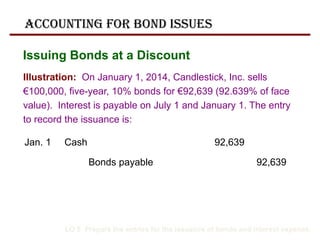
Illustration: On January 1, 2014, Candlestick, Inc. sells
€100,000, five-year, 10% bonds for €92,639 (92.639% of face
value). Interest is payable on July 1 and January 1. The entry
to record the issuance is:
Jan. 1 Cash 92,639
Bonds payable 92,639
Accounting for Bond Issues
Issuing Bonds at a Discount
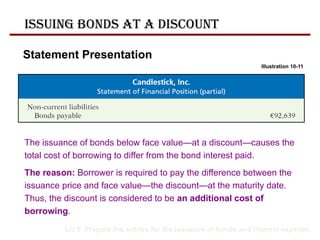
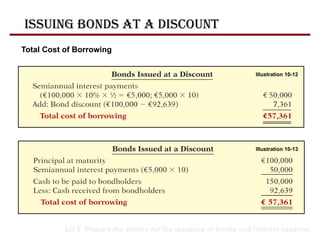
The issuance of bonds below face value—at a discount—causes the
total cost of borrowing to differ from the bond interest paid.
The reason: Borrower is required to pay the difference between the
issuance price and face value—the discount—at the maturity date.
Thus, the discount is considered to be an additional cost of
borrowing.
Statement Presentation
LO 5 Prepare the entries for the issuance of bonds and interest expense.
Illustration 10-11
Issuing Bonds at a Discount
Carrying value or
book value
LO 5 Prepare the entries for the issuance of bonds and interest expense.
Total Cost of Borrowing
Illustration 10-12
Illustration 10-13
Issuing Bonds at a Discount
LO 5 Prepare the entries for the issuance of bonds and interest expense.
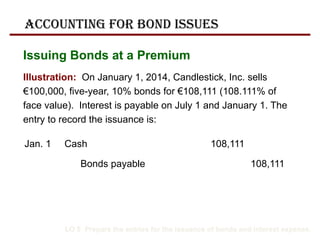
Jan. 1 Cash 108,111
Bonds payable 108,111
Illustration: On January 1, 2014, Candlestick, Inc. sells
€100,000, five-year, 10% bonds for €108,111 (108.111% of
face value). Interest is payable on July 1 and January 1. The
entry to record the issuance is:
Accounting for Bond Issues
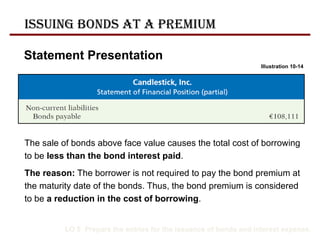
Issuing Bonds at a Premium
Statement Presentation
LO 5 Prepare the entries for the issuance of bonds and interest expense.
The sale of bonds above face value causes the total cost of borrowing
to be less than the bond interest paid.
The reason: The borrower is not required to pay the bond premium at
the maturity date of the bonds. Thus, the bond premium is considered
to be a reduction in the cost of borrowing.
Illustration 10-14
Issuing Bonds at a Premium
LO 5 Prepare the entries for the issuance of bonds and interest expense.
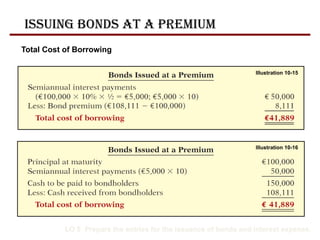
Total Cost of Borrowing
Illustration 10-15
Illustration 10-16
Issuing Bonds at a Premium
3. Trade Debt
Trade debt financing is a fancy phrase for
extending accounts payable.
The objective here is to delay payment of the
payables beyond the sales and accounts
receivable collection cycles.
This method of financing appears to be a
cheap source of money.
4. Customer Deposits (Retainers)
Customer deposits (retainers) are similar in concept
to financing the project with trade debt.
The difference is that instead of extending trade debt,
the project is financed through customer deposits (a
type of liability).
One example of this type of debt financing would be
today’s small residential building contractors.
Typically, such contractors require a payment before
beginning work and subsequent payments as
construction progresses.
2. Equity
Equity financing is the process of raising capital
through the sale of shares.
Companies raise money because they might
have a short-term need to pay bills or have a
long-term goal and require funds to invest in
their growth.
By selling shares, a company is effectively selling
ownership in their company in return for cash.
Income Tax Effect
The costs of raising and securing common or
preferred stock are not tax deductible; they
reduce the organization’s equity but not net
income.
Interest paid on loans or bonds is tax deductible.
A company’s assets are financed with either debt
or equity.
In today’s world of finance, almost all companies
have debt.
Individual assignment
• Which source of Finance is
cheap? And why
Q & A

Chapter four project financing and analysis .pptx

  • 1.
  • 2.
    Project Financing  Thereare two categories of sources for funding: debt (borrowing) and equity. Debt Financing  There are essentially four types of debt financing: (1) borrowing, (2) corporate bonds, (3) trade debt, and (4) customer deposits. 1. Borrowing  The most common type of debt financing is borrowing from financial institutions, such as banks or leasing companies.  Borrowing from financial institutions can be quick and relatively inexpensive.
  • 3.
    2. Corporate Bonds •Issuing Procedures  Government laws grant corporations power to issue bonds.  Board of directors and shareholders must approve bond issues.  Board of directors must specify number of bonds to be authorized, total face value, and contractual interest rate.  Issuing company arranges for printing of bond certificates.  A bond certificate is a document that states the details of the bond including the bond issuer's name, the bond par value or face amount, the interest rate, and the maturity date.
  • 4.
    Cont.…  Represents apromise to pay: ā–ŗFace value at designated maturity date, plus ā–ŗPeriodic interest at a contractual (stated) interest rate on the maturity amount (face value).  Interest payments usually made semiannually.
  • 5.
  • 6.
    Accounting for BondIssues • Corporation records bond transactions when it  issues (sells),  retires (buys back) bonds and  when bondholders convert bonds into ordinary shares. • NOTE: If bondholders sell their bond investments to other investors, the issuing firm receives no further money on the transaction, nor does the issuing corporation journalize the transaction.
  • 7.
    Issue at Par,Discount, or Premium? Accounting for Bond Issues Illustration 10-10 Bond Contractual Interest Rate of 10% When the cost of borrowing money rises (when interest rates rise), bond prices usually fall, and vice-versa.
  • 8.
    Illustration: On January1, 2014, Candlestick Inc. issues €100,000, five-year, 10% bonds at 100 (100% of face value). The entry to record the sale is: LO 5 Prepare the entries for the issuance of bonds and interest expense. Jan. 1 Cash 100,000 Bonds payable 100,000 Issuing Bonds at Face Value Accounting for Bond Issues
  • 9.
    Illustration: On January1, 2014, Candlestick Inc. issues €100,000, five-year, 10% bonds at 100 (100% of face value). Assume that interest is payable semiannually on January 1 and July 1. Prepare the entry to record the payment of interest on July 1, 2014, assume no previous accrual. LO 5 Prepare the entries for the issuance of bonds and interest expense. July 1 Interest expense 5,000 Cash 5,000 Issuing Bonds at Face Value (€100,000 x 10% x 6/12)
  • 10.
    LO 5 Preparethe entries for the issuance of bonds and interest expense. Illustration: On January 1, 2014, Candlestick, Inc. sells €100,000, five-year, 10% bonds for €92,639 (92.639% of face value). Interest is payable on July 1 and January 1. The entry to record the issuance is: Jan. 1 Cash 92,639 Bonds payable 92,639 Accounting for Bond Issues Issuing Bonds at a Discount
  • 11.
    The issuance ofbonds below face value—at a discount—causes the total cost of borrowing to differ from the bond interest paid. The reason: Borrower is required to pay the difference between the issuance price and face value—the discount—at the maturity date. Thus, the discount is considered to be an additional cost of borrowing. Statement Presentation LO 5 Prepare the entries for the issuance of bonds and interest expense. Illustration 10-11 Issuing Bonds at a Discount Carrying value or book value
  • 12.
    LO 5 Preparethe entries for the issuance of bonds and interest expense. Total Cost of Borrowing Illustration 10-12 Illustration 10-13 Issuing Bonds at a Discount
  • 13.
    LO 5 Preparethe entries for the issuance of bonds and interest expense. Jan. 1 Cash 108,111 Bonds payable 108,111 Illustration: On January 1, 2014, Candlestick, Inc. sells €100,000, five-year, 10% bonds for €108,111 (108.111% of face value). Interest is payable on July 1 and January 1. The entry to record the issuance is: Accounting for Bond Issues Issuing Bonds at a Premium
  • 14.
    Statement Presentation LO 5Prepare the entries for the issuance of bonds and interest expense. The sale of bonds above face value causes the total cost of borrowing to be less than the bond interest paid. The reason: The borrower is not required to pay the bond premium at the maturity date of the bonds. Thus, the bond premium is considered to be a reduction in the cost of borrowing. Illustration 10-14 Issuing Bonds at a Premium
  • 15.
    LO 5 Preparethe entries for the issuance of bonds and interest expense. Total Cost of Borrowing Illustration 10-15 Illustration 10-16 Issuing Bonds at a Premium
  • 16.
    3. Trade Debt Tradedebt financing is a fancy phrase for extending accounts payable. The objective here is to delay payment of the payables beyond the sales and accounts receivable collection cycles. This method of financing appears to be a cheap source of money.
  • 17.
    4. Customer Deposits(Retainers) Customer deposits (retainers) are similar in concept to financing the project with trade debt. The difference is that instead of extending trade debt, the project is financed through customer deposits (a type of liability). One example of this type of debt financing would be today’s small residential building contractors. Typically, such contractors require a payment before beginning work and subsequent payments as construction progresses.
  • 18.
    2. Equity Equity financingis the process of raising capital through the sale of shares. Companies raise money because they might have a short-term need to pay bills or have a long-term goal and require funds to invest in their growth. By selling shares, a company is effectively selling ownership in their company in return for cash.
  • 19.
    Income Tax Effect Thecosts of raising and securing common or preferred stock are not tax deductible; they reduce the organization’s equity but not net income. Interest paid on loans or bonds is tax deductible. A company’s assets are financed with either debt or equity. In today’s world of finance, almost all companies have debt.
  • 20.
    Individual assignment • Whichsource of Finance is cheap? And why
  • 21.