•   guys iam posting some finance basic questions, if any body wants
    can copy it...

    Some basic finance Questions:

    1. Definition of accounting: “the art of recording, classifying and
    summarizing in a significant manner and in terms of money,
    transactions and events which are, in part at least of a financial
    character and interpreting the results there of”.

    1. Book keeping:
    It is mainly concerned with recording of financial data relating to
    the business operations in a significant and orderly manner. {OR}
    Recording the transaction in order to provide financial
    information to the businessman in future.

    3. Branches of accounting
    a. financial accounting
    b. management accounting
    c. cost accounting

    4. Concepts of accounting:
    A. separate entity concept B. going concern concept
    C. money measurement concept D. cost concept
    E. dual aspect concept F. accounting period concept
    G. periodic matching of costs and revenue concept H. realization
    concept.

    5 Conventions of accounting
    A. conservatism
    B. full disclosure
    C. consistency
    D. materiality.

    6. Systems of book keeping:
    A. single entry system:-only one side of the transaction either Dr
    or Cr side. It is followed by sole trader & partnership firm. Not
    used by joint stock co. only personal a/c & cash book.{real,
    nominal, p&l & B/s not prepared}
B. double entry system:-Recording in both Dr & Cr side. One
person receive benfits & other gives benefits. So we can prepare
a/c’s.

7. Systems of accounting
A. cash system accounting
B. mercantile system of accounting.

8. Principles of accounting
a. personal a/c : It related natural{ram a/c kahn a/c},
artificial{ram & co a/c bank a/c}, & representative personal
a/c{o/s salaries a/c & rent receivable a/c}.
debit the receiver
Credit the giver
b. real a/c : related to both tangible{buildings, cash,etc} &
intangible assets{Gw,patents, copyrights etc}
debit what comes in
Credit what goes out
c. nominal a/c : related to exp.,{salary, wages, purchase},
losses{dep. Bad debts, abnormal loss}, incomes{sales ,comm}, &
gains{profit, bad debts recovered}
debit all expenses and losses
credit all gains and incomes

Accounting cycle:- source documents, journals, ledger, trial bal.,
{ trading a/c, profit/loss, B/sheet are called financial statements}.

9. Meaning of journal: journal means chronological record of
transactions. All the day to day transactions are recorded in
journal. It is called daily record or day book. { 1st recorded in
rough} next in journal.
a) journal entry:- transactions are recorded in the journal in the
form of entries are called JE.

10. Meaning of ledger: ledger is a set of accounts. It contains all
accounts of the business enterprise whether real, nominal,
personal. It is also called book of final entry.

11. Posting: it means transferring the debit and credit items from
the journal to their respective accounts in the ledger.
12. Trial balance: trial balance is a statement containing the
various ledger balances on a particular date. It is a statement of
Dr & Cr balance from various a/c in the ledger with a view to test
arithmetical accuracy of the books.

Suspense a/c:- It is the a/c prepare to transfer diff. in trial balance
if any to be rectified in future.

Trading a/c:- It is prepared to find out trading profit or loss of the
business i.e gross profit or loss during the period.

13. Credit note: the customer when returns the goods get credit
for the value of the goods returned. A credit note is sent to him
intimating that his a/c has been credited with the value of the
goods returned.

14. Debit note: when the goods are returned to the supplier, a
debit note is sent to him indicating that his a/c has been debited
with the amount mentioned in the debit note.

15. Contra entry: which accounting entry is recorded on both the
debit and credit side of the cash book is known as the contra
entry.

16. Petty cash book: petty cash is maintained by business to
record petty cash expenses of the business, such as postage,
cartage, stationery, etc.

17.promisory note: an instrument in writing containing an
unconditional undertaking signed by the maker, to pay certain
sum of money only to or to the order of a certain person or to the
barer of the instrument.

18. Cheque: a bill of exchange drawn on a specified banker and
payable on demand.

19. Stale cheque: a stale cheque means not valid of cheque that
means more than six months the cheque is not valid.
20. Bank reconciliation statement: it is a statement reconciling the
balance as shown by the bank pass book and the balance as shown
by the Cash Book. Obj: to know the difference & pass necessary
correcting, adjusting entries in the books.

21. Matching concept: matching means requires proper matching
of expense with the revenue.

22. Capital income: the term capital income means an income
which does not grow out of or pertain to the running of the
business proper.

23. Revenue income: the income which arises out of and in the
course of the regular business transactions of a concern.

24. Capital expenditure: it means an expenditure which has been
incurred for the purpose of obtaining a long term advantage for
the business.

25. Revenue expenditure: an expenditure that incurred in the
course of regular business transactions of a concern.

26. Differed revenue expenditure: an expenditure which is
incurred during an accounting period but is applicable further
periods also. Eg: heavy advertisement.

27. Bad debts: bad debts denote the amount lost from debtors to
whom the goods were sold on credit.

28. Depreciation: depreciation denotes gradually and permanent
decrease in the value of asset due to wear and tear, technology
changes, laps of time and accident.

29. Fictitious assets: These are assets not represented by tangible
possession or property. Examples of preliminary expenses,
discount on issue of shares, debit balance in the profit and loss
account when shown on the assets side in the balance sheet.

30.Intanglbe Assets : Intangible assets means the assets which is
not having the physical appearance. And its have the real value, it
shown on the assets side of the balance sheet.

31. Accrued Income : Accrued income means income which has
been earned by the business during the accounting year but which
has not yet been due and, therefore, has not been received.

32. Out standing Income : Outstanding Income means income
which has become due during the accounting year but which has
not so far been received by the firm.

33. Suspense account: the suspense account is an account to which
the difference in the trial balance has been put temporarily.

34. Depletion: it implies removal of an available but not
replaceable source, Such as extracting coal from a coal mine.

35. Amortization: the process of writing of intangible assets is
term as amortization.

36. Dilapidations: the term dilapidations to damage done to a
building or other property during tenancy.

37. Capital employed: the term capital employed means sum of
total long term funds employed in the business. i.e.

(share capital+ reserves & surplus +long term loans – (non
business assets + fictitious assets)
38. Equity shares: those shares which are not having pref. rights
are called equity shares.

39. Pref.shares: Those shares which are carrying the pref.rights is
called pref. shares
Pref.rights in respect of fixed dividend.
Pref.right to repayment of capital in the even of company winding
up.

40. Leverage: It is a force applied at a particular point to get the
desired result.

41. Operating leverage: the operating leverage takes place when a
changes in revenue greater changes in EBIT.

42. Financial leverage : it is nothing but a process of using debt
capital to increase the rate of return on equity

43. Combine leverage: it is used to measure of the total risk of the
firm = operating risk + financial risk.

44. Joint venture : A joint venture is an association of two or more
the persons who combined for the execution of a specific
transaction and divide the profit or loss their of an agreed ratio.

45. Partnership: partnership is the relation b/w the persons who
have agreed to share the profits of business carried on by all or
any of them acting for all.

46. Factoring: It is an arrangement under which a firm (called
borrower) receives advances against its receivables, from a
financial institutions (called factor)

47. Capital reserve: The reserve which transferred from the
capital gains is called capital reserve.

48. General reserve: the reserve which is transferred from normal
profits of the firm is called general reserve

49. Free Cash: The cash not for any specific purpose free from
any encumbrance like surplus cash.

50. Minority Interest: minority interest refers to the equity of the
minority shareholders in a subsidiary company.

51. Capital receipts: capital receipts may be defined as “non-
recurring receipts from the owner of the business or lender of the
money crating a liability to either of them.

52. Revenue receipts: Revenue receipts may defined as “A
recurring receipts against sale of goods in the normal course of
business and which generally the result of the trading activities”.
53. Meaning of Company: A company is an association of many
persons who contribute money or money’s worth to common
stock and employs it for a common purpose. The common stock so
contributed is denoted in money and is the capital of the company.

54. Types of a company:
1. Statutory companies
2. government company
3. foreign company
4. Registered companies:
a. Companies limited by shares
b. Companies limited by guarantee
c. Unlimited companies
D. private company
E. public company

55. Private company: A private co. is which by its AOA:
Restricts the right of the members to transfer of shares
Limits the no. of members 50.
Prohibits any Invitation to the public to subscribe for its shares or
debentures.

56. Public company: A company, the articles of association of
which does not contain the requisite restrictions to make it a
private limited company, is called a public company..

57. Characteristics of a company:
Voluntary association
Separate legal entity
Free transfer of shares
Limited liability
Common seal
Perpetual existence.

58. Formation of company:
Promotion
Incorporation
Commencement of business

59. Equity share capital: The total sum of equity shares is called
equity share capital.

60. Authorized share capital: it is the maximum amount of the
share capital which a company can raise for the time being.

61. Issued capital: It is that part of the authorized capital which
has been allotted to the public for subscriptions.

62. Subscribed capital: it is the part of the issued capital which
has been allotted to the public
63. Called up capital: It has been portion of the subscribed capital
which has been called up by the company.

64. Paid up capital: It is the portion of the called up capital
against which payment has been received.

65. Debentures: Debenture is a certificate issued by a company
under its seal acknowledging a debt due by it to its holder.

66. Cash profit: cash profit is the profit it is occurred from the
cash sales.

67. Deemed public Ltd. Company: A private company is a
subsidiary company to public company it satisfies the following
terms/conditions Sec 3(1)3:
1. having minimum share capital 5 lakhs
2. accepting investments from the public
3. no restriction of the transferable of shares
4. No restriction of no. of members.
5. accepting deposits from the investors

68. Secret reserves: secret reserves are reserves the existence of
which does not appear on the face of balance sheet. In such a
situation, net assets position of the business is stronger than that
disclosed by the balance sheet.

These reserves are crated by:
1. Excessive dep.of an asset, excessive over-valuation of a liability.
2. Complete elimination of an asset, or under valuation of an
asset.
69. Provision: provision usually means any amount written off or
retained by way of providing depreciation, renewals or
diminutions in the value of assets or retained by way of providing
for any known liability of which the amount can not be
determined with substantial accuracy.

70. Reserve: The provision in excess of the amount considered
necessary for the purpose it was originally made is also considered
as reserve
Provision is charge against profits while reserves is an
appropriation of profits
Creation of reserve increase proprietor’s fund while creation of
provisions decreases his funds in the business.

71. Reserve fund: the term reserve fund means such reserve
against which clearly investment etc.,

72. Undisclosed reserves: Sometimes a reserve is created but its
identity is merged with some other a/c or group of accounts so
that the existence of the reserve is not known such reserve is
called an undisclosed reserve.

73. finance management: financial management deals with
procurement of funds and their effective utilization in business.

74. Objectives of financial management: financial management
having two objectives that Is:
1. Profit maximization: the finance manager has to make his
decisions in a manner so that the profits of the concern are
maximized.
2. Wealth maximization: wealth maximization means the
objective of a firm should be to maximize its value or wealth, or
value of a firm is represented by the market price of its common
stock.

75. Functions of financial manager:
Investment decision
Dividend decision
Finance decision
Cash management decisions
Performance evaluation
Market impact analysis

76. Time value of money: the time value of money means that
worth of a rupee received today is different from the worth of a
rupee to be received in future.

77. Capital structure: it refers to the mix of sources from where
the long-term funds required in a business may be raised; in other
words, it refers to the proportion of debt, preference capital and
equity capital.

78. Optimum capital structure: capital structure is optimum when
the firm has a combination of equity and debt so that the wealth
of the firm is maximum.

79. Wacc: it denotes weighted average cost of capital. It is defined
as the overall cost of capital computed by reference to the
proportion of each component of capital as weights.

80. Financial break even point: it denotes the level at which a
firm’s EBIT is just sufficient to cover interest and preference
dividend.

81. Capital budgeting: capital budgeting involves the process of
decision making with regard to investment in fixed assets. Or
decision making with regard to investment of money in long term
projects.

82. Pay back period: payback period represents the time period
required for complete recovery of the initial investment in the
project.

83. ARR: accounting or average rate of return means the average
annual yield on the project.

84. NPV: the net present value of an investment proposal is
defined as the sum of the present values of all future cash in flows
less the sum of the present values of all cash out flows associated
with the proposal.

85. Profitability index: where different investment proposal each
involving different initial investments and cash inflows are to be
compared.

86. IRR: internal rate of return is the rate at which the sum total
of discounted cash inflows equals the discounted cash out flow.

87. Treasury management: it means it is defined as the efficient
management of liquidity and financial risk in business.

88. Concentration banking: it means identify locations or places
where customers are placed and open a local bank a/c in each of
these locations and open local collection centre.

89. Marketable securities: surplus cash can be invested in short
term instruments in order to earn interest.

90. Ageing schedule: in a ageing schedule the receivables are
classified according to their age.

91. Maximum permissible bank finance (MPBF): it is the
maximum amount that banks can lend a borrower towards his
working capital requirements.

92. Commercial paper: a cp is a short term promissory note
issued by a company, negotiable by endorsement and delivery,
issued at a discount on face value as may be determined by the
issuing company.

93. Bridge finance: It refers to the loans taken by the company
normally from a commercial banks for a short period pending
disbursement of loans sanctioned by the financial institutions.

94. Venture capital: It refers to the financing of high risk ventures
promoted by new qualified entrepreneurs who require funds to
give shape to their ideas.

95. Debt securitization: It is a mode of financing, where in
securities are issued on the basis of a package of assets (called
asset pool).

96. Lease financing: Leasing is a contract where one party
(owner) purchases assets and permits its views by another party
(lessee) over a specified period

97. Trade Credit: It represents credit granted by suppliers of
goods, in the normal course of business.

98. Over draft: Under this facility a fixed limit is granted within
which the borrower allowed to overdraw from his account.

99. Cash credit: It is an arrangement under which a customer is
allowed an advance up to certain limit against credit granted by
bank.

100. Clean overdraft: It refers to an advance by way of overdraft
facility, but not back by any tangible security.

101. Share capital: The sum total of the nominal value of the
shares of a company is called share capital.

102. Funds flow statement: It is the statement deals with the
financial resources for running business activities. It explains how
the funds obtained and how they used.

103. Sources of funds: There are two sources of funds Internal
sources and external sources.

Internal source: Funds from operations is the only internal
sources of funds and some important points add to it they do not
result in the outflow of funds
(a)Depreciation on fixed assets (b) Preliminary expenses or
goodwill written off, Loss on sale of fixed assets
Deduct the following items as they do not increase the funds:
Profit on sale of fixed assets, profit on revaluation of fixed assets

External sources: (a) Funds from long term loans (b) Sale of fixed
assets (c) Funds from increase in share capital
104. Application of funds: (a) Purchase of fixed assets (b)
Payment of dividend (c)Payment of tax liability (d) Payment of
fixed liability

105. ICD (Inter corporate deposits): Companies can borrow funds
for a short period. For example 6 months or less from another
company which have surplus liquidity. Such deposits made by one
company in another company are called ICD.

106. Certificate of deposits: The CD is a document of title similar
to a fixed deposit receipt issued by banks there is no prescribed
interest rate on such CDs it is based on the prevailing market
conditions.

107. Public deposits: It is very important source of short term and
medium term finance. The company can accept PD from
members of the public and shareholders. It has the maturity
period of 6 months to 3 years.

108.Euro issues: The euro issues means that the issues is listed on
a European stock Exchange. The subscription can come from any
part of the world except India.

109.GDR (Global depository receipts): A depository receipt is
basically a negotiable certificate , dominated in us dollars that
represents a non-US company publicly traded in local currency
equity shares.

110. ADR (American depository receipts): Depository receipt
issued by a company in the USA are known as ADRs. Such
receipts are to be issued in accordance with the provisions
stipulated by the securities Exchange commission (SEC) of USA
like SEBI in India.

111. Commercial banks: Commercial banks extend foreign
currency loans for international operations, just like rupee loans.
The banks also provided overdraft.

112.Development banks: It offers long-term and medium term
loans including foreign currency loans

113.International agencies: International agencies like the
IFC,IBRD,ADB,IMF etc. provide indirect assistance for obtaining
foreign currency.

114. Seed capital assistance: The seed capital assistance scheme is
desired by the IDBI for professionally or technically qualified
entrepreneurs and persons possessing relevant experience and
skills and entrepreneur traits.

115. Unsecured l0ans: It constitutes a significant part of long-term
finance available to an enterprise.

116. Cash flow statement: It is a statement depicting change in
cash position from one period to another.

117.Sources of cash: Internal sources-(a)Depreciation
(b)Amortization (c)Loss on sale of fixed assets (d)Gains from sale
of fixed assets (e) Creation of reserves External sources-(a)Issue of
new shares (b)Raising long term loans (c)Short-term borrowings
(d)Sale of fixed assets, investments

118. Application of cash: (a) Purchase of fixed assets (b) Payment
of long-term loans (c) Decrease in deferred payment liabilities (d)
Payment of tax, dividend (e) Decrease in unsecured loans and
deposits

119. Budget: It is a detailed plan of operations for some specific
future period. It is an estimate prepared in advance of the period
to which it applies.

120. Budgetary control: It is the system of management control
and accounting in which all operations are forecasted and so for
as possible planned ahead, and the actual results compared with
the forecasted and planned ones.

121. Cash budget: It is a summary statement of firm’s expected
cash inflow and outflow over a specified time period.
122. Master budget: A summary of budget schedules in capsule
form made for the purpose of presenting in one report the
highlights of the budget forecast.

123. Fixed budget: It is a budget which is designed to remain
unchanged irrespective of the level of activity actually attained.

124. Zero- base- budgeting: It is a management tool which
provides a systematic method for evaluating all operations and
programmes, current of new allows for budget reductions and
expansions in a rational manner and allows reallocation of source
from low to high priority programs.

125. Goodwill: The present value of firm’s anticipated excess
earnings.

126. BRS: It is a statement reconciling the balance as shown by
the bank pass book and balance shown by the cash book.

127. Objective of BRS: The objective of preparing such a
statement is to know the causes of difference between the two
balances and pass necessary correcting or adjusting entries in the
books of the firm.

128. Responsibilities of accounting: It is a system of control by
delegating and locating the responsibilities for costs.

129. Profit centre: A centre whose performance is measured in
terms of both the expense incurs and revenue it earns.

130. Cost centre: A location, person or item of equipment for
which cost may be ascertained and used for the purpose of cost
control.

131. Cost: The amount of expenditure incurred on to a given
thing.

132. Cost accounting: It is thus concerned with recording,
classifying, and summarizing costs for determination of costs of
products or services planning, controlling and reducing such costs
and furnishing of information management for decision making.

133. Elements of cost: (A) Material (B) Labour (C) Expenses (D)
Overheads

134. Components of total costs: (A) Prime cost (B) Factory cost
(C)Total cost of production (D) Total c0st

135. Prime cost: It consists of direct material direct labour and
direct expenses. It is also known as basic or first or flat cost.

136. Factory cost: It comprises prime cost, in addition factory
overheads which include cost of indirect material indirect labour
and indirect expenses incurred in factory. This cost is also known
as works cost or production cost or manufacturing cost.

137. Cost of production: In office and administration overheads
are added to factory cost, office cost is arrived at.

138. Total cost: Selling and distribution overheads are added to
total cost of production to get the total cost or cost of sales.

139. Cost unit: A unit of quantity of a product, service or time in
relation to which costs may be ascertained or expressed.

140.Methods of costing: (A)Job costing (B)Contract costing
(C)Process costing (D)Operation costing (E)Operating costing
(F)Unit costing (G)Batch costing.

141. Techniques of costing: (a) marginal costing (b) direct costing
(c)absorption costing (d) uniform costing.

142. Standard costing: standard costing is a system under which
the cost of the product is determined in advance on certain
predetermined standards.

143. Marginal costing: it is a technique of costing in which
allocation of expenditure to production is restricted to those
expenses which arise as a result of production, i.e., materials,
labour, direct expenses and variable overheads.
144. Derivative: derivative is product whose value is derived from
the value of one or more basic variables of underlying asset.

145. Forwards: a forward contract is customized contracts
between two entities were settlement takes place on a specific date
in the future at today’s pre agreed price.

146. Futures: a future contract is an agreement between two
parties to buy or sell an asset at a certain time in the future at a
certain price. Future contracts are standardized exchange traded
contracts.

147. Options: an option gives the holder of the option the right to
do some thing. The option holder option may exercise or not.

148. Call option: a call option gives the holder the right but not
the obligation to buy an asset by a certain date for a certain price.

149. Put option: a put option gives the holder the right but not
obligation to sell an asset by a certain date for a certain price.

150. Option price: option price is the price which the option buyer
pays to the option seller. It is also referred to as the option
premium.

151. Expiration date: the date which is specified in the option
contract is called expiration date.

152. European option: it is the option at exercised only on
expiration date it self.

153. Basis: basis means future price minus spot price.

154. Cost of carry: the relation between future prices and spot
prices can be summarized in terms of what is known as cost of
carry.

155. Initial margin: the amount that must be deposited in the
margin a/c at the time of first entered into future contract is
known as initial margin.

156 Maintenance margin: this is some what lower than initial
margin.

157. Mark to market: in future market, at the end of the each
trading day, the margin a/c is adjusted to reflect the investors’
gains or loss depending upon the futures selling price. This is
called mark to market.

158. Baskets : basket options are options on portfolio of
underlying asset.

159. Swaps: swaps are private agreements between two parties to
exchange cash flows in the future according to a pre agreed
formula.

160. Impact cost: impact cost is cost it is measure of liquidity of
the market. It reflects the costs faced when actually trading in
index.

161. Hedging: hedging means minimize the risk.

162. Capital market: capital market is the market it deals with the
long term investment funds. It consists of two markets 1.primary
market 2.secondary market.

163. Primary market: those companies which are issuing new
shares in this market. It is also called new issue market.

164. Secondary market: secondary market is the market where
shares buying and selling. In India secondary market is called
stock exchange.

165. Arbitrage: it means purchase and sale of securities in
different markets in order to profit from price discrepancies. In
other words arbitrage is a way of reducing risk of loss caused by
price fluctuations of securities held in a portfolio.

166. Meaning of ratio: Ratios are relationships expressed in
mathematical terms between figures which are connected with
each other in same manner.

167. Activity ratio: it is a measure of the level of activity attained
over a period.

168. mutual fund : a mutual fund is a pool of money, collected
from investors, and is invested according to certain investment
objectives.

169. characteristics of mutual fund :
Ownership of the MF is in the hands of the of the investors
MF managed by investment professionals
The value of portfolio is updated every day

170.advantage of MF to investors :
Portfolio diversification
Professional management
Reduction in risk
Reduction of transaction casts
Liquidity
Convenience and flexibility

171.net asset value : the value of one unit of investment is called as
the Net Asset Value

172.open-ended fund : open ended funds means investors can buy
and sell units of fund, at NAV related prices at any time, directly
from the fund this is called open ended fund.
For ex; unit 64

173.close ended funds : close ended funds means it is open for sale
to investors for a specific period, after which further sales are
closed. Any further transaction for buying the units or
repurchasing them, happen, in the secondary markets.

174. dividend option : investors who choose a dividend on their
investments, will receive dividends from the MF, as when such
dividends are declared.
175.growth option : investors who do not require periodic income
distributions can be choose the growth option.

176.equity funds : equity funds are those that invest pre-
dominantly in equity shares of company.

177.types of equity funds :
Simple equity funds
Primary market funds
Sectoral funds
Index funds

178. sectoral funds : sectoral funds choose to invest in one or more
chosen sectors of the equity markets.

179.index funds :the fund manager takes a view on companies
that are expected to perform well, and invests in these companies
.
180.debt funds : the debt funds are those that are pre-dominantly
invest in debt securities.

181. liquid funds : the debt funds invest only in instruments with
maturities less than one year.

182. gilt funds : gilt funds invests only in securities that are issued
by the GOVT. and therefore does not carry any credit risk.

183.balanced funds :funds that invest both in debt and equity
markets are called balanced funds.

184. sponsor : sponsor is the promoter of the MF and appoints
trustees, custodians and the AMC with prior approval of SEBI .

185. trustee : trustee is responsible to the investors in the MF and
appoint the AMC for managing the investment portfolio.

186. AMC : the AMC describes Asset Management Company, it is
the business face of the MF, as it manages all the affairs of the
MF.
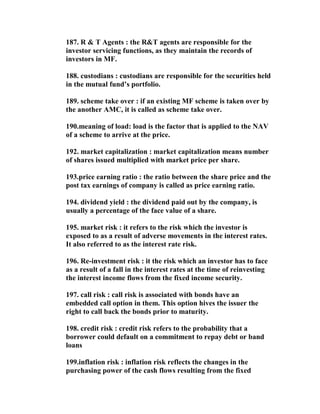
187. R & T Agents : the R&T agents are responsible for the
investor servicing functions, as they maintain the records of
investors in MF.

188. custodians : custodians are responsible for the securities held
in the mutual fund’s portfolio.

189. scheme take over : if an existing MF scheme is taken over by
the another AMC, it is called as scheme take over.

190.meaning of load: load is the factor that is applied to the NAV
of a scheme to arrive at the price.

192. market capitalization : market capitalization means number
of shares issued multiplied with market price per share.

193.price earning ratio : the ratio between the share price and the
post tax earnings of company is called as price earning ratio.

194. dividend yield : the dividend paid out by the company, is
usually a percentage of the face value of a share.

195. market risk : it refers to the risk which the investor is
exposed to as a result of adverse movements in the interest rates.
It also referred to as the interest rate risk.

196. Re-investment risk : it the risk which an investor has to face
as a result of a fall in the interest rates at the time of reinvesting
the interest income flows from the fixed income security.

197. call risk : call risk is associated with bonds have an
embedded call option in them. This option hives the issuer the
right to call back the bonds prior to maturity.

198. credit risk : credit risk refers to the probability that a
borrower could default on a commitment to repay debt or band
loans

199.inflation risk : inflation risk reflects the changes in the
purchasing power of the cash flows resulting from the fixed
income security.

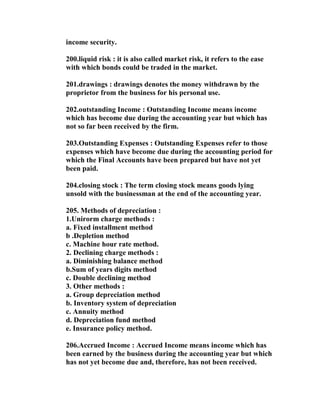
200.liquid risk : it is also called market risk, it refers to the ease
with which bonds could be traded in the market.

201.drawings : drawings denotes the money withdrawn by the
proprietor from the business for his personal use.

202.outstanding Income : Outstanding Income means income
which has become due during the accounting year but which has
not so far been received by the firm.

203.Outstanding Expenses : Outstanding Expenses refer to those
expenses which have become due during the accounting period for
which the Final Accounts have been prepared but have not yet
been paid.

204.closing stock : The term closing stock means goods lying
unsold with the businessman at the end of the accounting year.

205. Methods of depreciation :
1.Unirorm charge methods :
a. Fixed installment method
b .Depletion method
c. Machine hour rate method.
2. Declining charge methods :
a. Diminishing balance method
b.Sum of years digits method
c. Double declining method
3. Other methods :
a. Group depreciation method
b. Inventory system of depreciation
c. Annuity method
d. Depreciation fund method
e. Insurance policy method.

206.Accrued Income : Accrued Income means income which has
been earned by the business during the accounting year but which
has not yet become due and, therefore, has not been received.
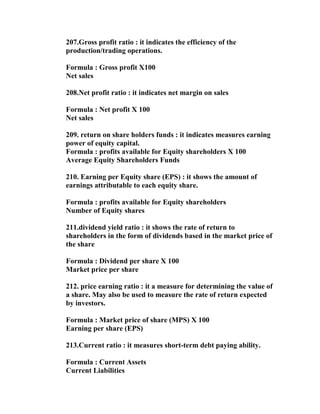
207.Gross profit ratio : it indicates the efficiency of the
production/trading operations.

Formula : Gross profit X100
Net sales

208.Net profit ratio : it indicates net margin on sales

Formula : Net profit X 100
Net sales

209. return on share holders funds : it indicates measures earning
power of equity capital.
Formula : profits available for Equity shareholders X 100
Average Equity Shareholders Funds

210. Earning per Equity share (EPS) : it shows the amount of
earnings attributable to each equity share.

Formula : profits available for Equity shareholders
Number of Equity shares

211.dividend yield ratio : it shows the rate of return to
shareholders in the form of dividends based in the market price of
the share

Formula : Dividend per share X 100
Market price per share

212. price earning ratio : it a measure for determining the value of
a share. May also be used to measure the rate of return expected
by investors.

Formula : Market price of share (MPS) X 100
Earning per share (EPS)

213.Current ratio : it measures short-term debt paying ability.

Formula : Current Assets
Current Liabilities
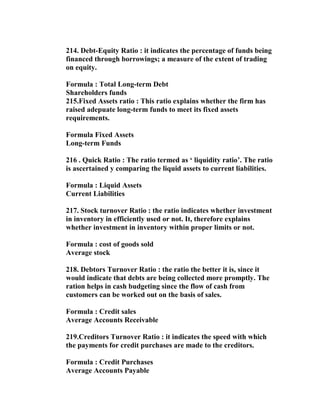
214. Debt-Equity Ratio : it indicates the percentage of funds being
financed through borrowings; a measure of the extent of trading
on equity.

Formula : Total Long-term Debt
Shareholders funds
215.Fixed Assets ratio : This ratio explains whether the firm has
raised adepuate long-term funds to meet its fixed assets
requirements.

Formula Fixed Assets
Long-term Funds

216 . Quick Ratio : The ratio termed as ‘ liquidity ratio’. The ratio
is ascertained y comparing the liquid assets to current liabilities.

Formula : Liquid Assets
Current Liabilities

217. Stock turnover Ratio : the ratio indicates whether investment
in inventory in efficiently used or not. It, therefore explains
whether investment in inventory within proper limits or not.

Formula : cost of goods sold
Average stock

218. Debtors Turnover Ratio : the ratio the better it is, since it
would indicate that debts are being collected more promptly. The
ration helps in cash budgeting since the flow of cash from
customers can be worked out on the basis of sales.

Formula : Credit sales
Average Accounts Receivable

219.Creditors Turnover Ratio : it indicates the speed with which
the payments for credit purchases are made to the creditors.

Formula : Credit Purchases
Average Accounts Payable
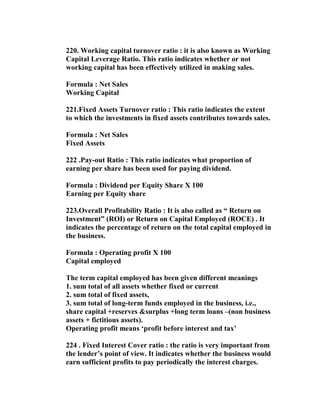
220. Working capital turnover ratio : it is also known as Working
Capital Leverage Ratio. This ratio indicates whether or not
working capital has been effectively utilized in making sales.

Formula : Net Sales
Working Capital

221.Fixed Assets Turnover ratio : This ratio indicates the extent
to which the investments in fixed assets contributes towards sales.

Formula : Net Sales
Fixed Assets

222 .Pay-out Ratio : This ratio indicates what proportion of
earning per share has been used for paying dividend.

Formula : Dividend per Equity Share X 100
Earning per Equity share

223.Overall Profitability Ratio : It is also called as “ Return on
Investment” (ROI) or Return on Capital Employed (ROCE) . It
indicates the percentage of return on the total capital employed in
the business.

Formula : Operating profit X 100
Capital employed

The term capital employed has been given different meanings
1. sum total of all assets whether fixed or current
2. sum total of fixed assets,
3. sum total of long-term funds employed in the business, i.e.,
share capital +reserves &surplus +long term loans –(non business
assets + fictitious assets).
Operating profit means ‘profit before interest and tax’

224 . Fixed Interest Cover ratio : the ratio is very important from
the lender’s point of view. It indicates whether the business would
earn sufficient profits to pay periodically the interest charges.
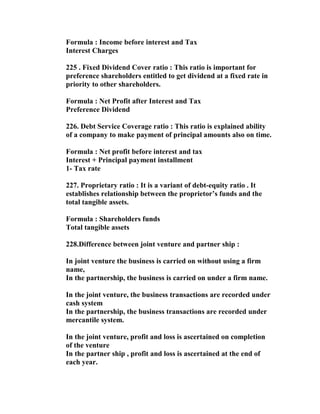
Formula : Income before interest and Tax
Interest Charges

225 . Fixed Dividend Cover ratio : This ratio is important for
preference shareholders entitled to get dividend at a fixed rate in
priority to other shareholders.

Formula : Net Profit after Interest and Tax
Preference Dividend

226. Debt Service Coverage ratio : This ratio is explained ability
of a company to make payment of principal amounts also on time.

Formula : Net profit before interest and tax
Interest + Principal payment installment
1- Tax rate

227. Proprietary ratio : It is a variant of debt-equity ratio . It
establishes relationship between the proprietor’s funds and the
total tangible assets.

Formula : Shareholders funds
Total tangible assets

228.Difference between joint venture and partner ship :

In joint venture the business is carried on without using a firm
name,
In the partnership, the business is carried on under a firm name.

In the joint venture, the business transactions are recorded under
cash system
In the partnership, the business transactions are recorded under
mercantile system.

In the joint venture, profit and loss is ascertained on completion
of the venture
In the partner ship , profit and loss is ascertained at the end of
each year.
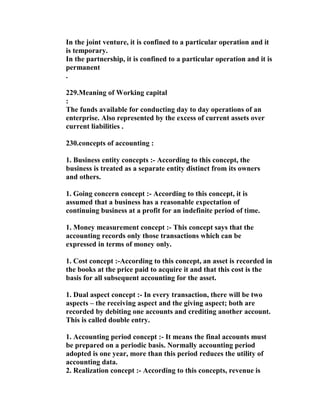
In the joint venture, it is confined to a particular operation and it
is temporary.
In the partnership, it is confined to a particular operation and it is
permanent
.

229.Meaning of Working capital
:
The funds available for conducting day to day operations of an
enterprise. Also represented by the excess of current assets over
current liabilities .

230.concepts of accounting :

1. Business entity concepts :- According to this concept, the
business is treated as a separate entity distinct from its owners
and others.

1. Going concern concept :- According to this concept, it is
assumed that a business has a reasonable expectation of
continuing business at a profit for an indefinite period of time.

1. Money measurement concept :- This concept says that the
accounting records only those transactions which can be
expressed in terms of money only.

1. Cost concept :-According to this concept, an asset is recorded in
the books at the price paid to acquire it and that this cost is the
basis for all subsequent accounting for the asset.

1. Dual aspect concept :- In every transaction, there will be two
aspects – the receiving aspect and the giving aspect; both are
recorded by debiting one accounts and crediting another account.
This is called double entry.

1. Accounting period concept :- It means the final accounts must
be prepared on a periodic basis. Normally accounting period
adopted is one year, more than this period reduces the utility of
accounting data.
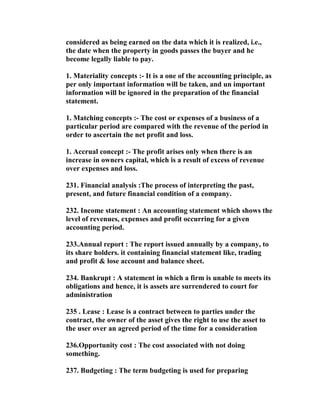
2. Realization concept :- According to this concepts, revenue is
considered as being earned on the data which it is realized, i.e.,
the date when the property in goods passes the buyer and he
become legally liable to pay.

1. Materiality concepts :- It is a one of the accounting principle, as
per only important information will be taken, and un important
information will be ignored in the preparation of the financial
statement.

1. Matching concepts :- The cost or expenses of a business of a
particular period are compared with the revenue of the period in
order to ascertain the net profit and loss.

1. Accrual concept :- The profit arises only when there is an
increase in owners capital, which is a result of excess of revenue
over expenses and loss.

231. Financial analysis :The process of interpreting the past,
present, and future financial condition of a company.

232. Income statement : An accounting statement which shows the
level of revenues, expenses and profit occurring for a given
accounting period.

233.Annual report : The report issued annually by a company, to
its share holders. it containing financial statement like, trading
and profit & lose account and balance sheet.

234. Bankrupt : A statement in which a firm is unable to meets its
obligations and hence, it is assets are surrendered to court for
administration

235 . Lease : Lease is a contract between to parties under the
contract, the owner of the asset gives the right to use the asset to
the user over an agreed period of the time for a consideration

236.Opportunity cost : The cost associated with not doing
something.

237. Budgeting : The term budgeting is used for preparing
budgets and other producer for planning,co-ordination,and
control of business enterprise
.
238.Capital : The term capital refers to the total investment of
company in money, tangible and intangible assets. It is the total
wealth of a company.

239.Capitalization : It is the sum of the par value of stocks and
bonds out standings.

240. Over capitalization : When a business is unable to earn fair
rate on its outstanding securities.

241. Under capitalization : When a business is able to earn fair
rate or over rate on it is outstanding securities.

242. Capital gearing : The term capital gearing refers to the
relationship between equity and long term debt.

243.Cost of capital : It means the minimum rate of return
expected by its investment.

244.Cash dividend : The payment of dividend in cash

245.Define the term accrual : Recognition of revenues and costs as
they are earned or incurred . it includes recognition of transaction
relating to assets and liabilities as they occur irrespective of the
actual receipts or payments.

245. accrued expenses : An expense which has been incurred in an
accounting period but for which no enforceable claim has become
due in what period against the enterprises.

246.Accrued revenue : Revenue which has been earned is an
earned is an accounting period but in respect of which no
enforceable claim has become due to in that period by the
enterprise.

247.Accrued liability : A developing but not yet enforceable claim
by an another person which accumulates with the passage of time
or the receipt of service or otherwise. it may rise from the
purchase of services which at the date of accounting have been
only partly performed and are not yet billable.

248.Convention of Full disclosure : According to this convention,
all accounting statements should be honestly prepared and to that
end full disclosure of all significant information will be made.

249.Convention of consistency : According to this convention it is
essential that accounting practices and methods remain
unchanged from one year to another.

250.Define the term preliminary expenses : Expenditure relating
to the formation of an enterprise. There include legal accounting
and share issue expenses incurred for formation of the enterprise.

251.Meaning of Charge : charge means it is a obligation to secure
an indebt ness. It may be fixed charge and floating charge.

252.Appropriation : It is application of profit towards Reserves
and Dividends.

253.Absorption costing : A method where by the cost is determine
so as to include the appropriate share of both variable and fixed
costs.

254.Marginal Cost : Marginal cost is the additional cost to
produce an additional unit of a product. It is also called variable
cost.

255. What are the ex-ordinary items in the P&L a/c : The
transaction which are not related to the business is termed as ex-
ordinary transactions or ex-ordinary items. Egg:- profit or losses
on the sale of fixed assets, interest received from other company
investments, profit or loss on foreign exchange, unexpected
dividend received.

256 . Share premium : The excess of issue of price of shares over
their face value. It will be showed with the allotment entry in the
journal, it will be adjusted in the balance sheet on the liabilities
side under the head of “reserves & surplus”.

257.Accumulated Depreciation : The total to date of the periodic
depreciation charges on depreciable assets.

258.Investment : Expenditure on assets held to earn interest,
income, profit or other benefits.

259.Capital : Generally refers to the amount invested in an
enterprise by its owner. Ex; paid up share capital in corporate
enterprise.

260. Capital Work In Progress : Expenditure on capital assets
which are in the process of construction as completion.

261. Convertible Debenture : A debenture which gives the holder
a right to conversion wholly or partly in shares in accordance
with term of issues.

262.Redeemable Preference Share : The preference share that is
repayable either after a fixed (or) determinable period (or) at any
time dividend by the management.

263. Cumulative preference shares : A class of preference shares
entitled to payment of cumulates dividends. Preference shares are
always deemed to be cumulative unless they are expressly made
non-cumulative preference shares.

264.Debenture redemption reserve : A reserve created for the
redemption of debentures at a future date.

265. Cumulative dividend : A dividend payable as cumulative
preference shares which it unpaid cumulates as a claim against
the earnings of a corporate before any distribution is made to the
other shareholders.

266. Dividend Equalization reserve : A reserve created to
maintain the rate of dividend in future years.

267. Opening Stock : The term ‘opening stock’ means goods lying
unsold with the businessman in the beginning of the accounting
year. This is shown on the debit side of the trading account.

268.Closing Stock : The term ‘Closing Stock’ includes goods lying
unsold with the businessman at the end of the accounting year.
The amount of closing stock is shown on the credit side of the
trading account and as an asset in the balance sheet.

269.Valuation of closing stock : The closing stock is valued on the
basis of “Cost or Market price whichever is less” principle.

272. Contingency : A condition (or) situation the ultimate out
come of which gain or loss will be known as determined only as
the occurrence or non occurrence of one or more uncertain future
events.

273.Contingent Asset : An asset the existence ownership or value
of which may be known or determined only on the occurrence or
non occurrence of one more uncertain future events.

274. Contingent liability : An obligation to an existing condition
or situation which may arise in future depending on the
occurrence of one or more uncertain future events.

275. Deficiency : the excess of liabilities over assets of an
enterprise at a given date is called deficiency.

276.Deficit : The debit balance in the profit and loss a/c is called
deficit.

277.Surplus : Credit balance in the profit & loss statement after
providing for proposed appropriation & dividend , reserves.

278.Appropriation Assets : An account sometimes included as a
separate section of the profit and loss statement showing
application of profits towards dividends, reserves.

279. Capital redemption reserve : A reserve created on
redemption of the average cost:- the cost of an item at a point of
time as determined by applying an average of the cost of all items
of the same nature over a period. When weights are also applied
in the computation it is termed as weight average cost.

280.Floating Change : Assume change on some or all assets of an
enterprise which are not attached to specific assets and are given
as security against debt.

1. Difference between Funds flow and Cash flow statement :

A Cash flow statement is concerned only with the change in cash
position while a funds flow analysis is concerned with change in
working capital position between two balance sheet dates.

A cash flow statement is merely a record of cash receipts and
disbursements. While studying the short-term solvency of a
business one is interested not only in cash balance but also in the
assets which are easily convertible into cash.

282. Difference Between the Funds flow and Income statement:

A funds flow statement deals with the financial resource required
for running the business activities. It explains how were the funds
obtained and how were they used,
Whereas an income statement discloses the results of the business
activities, i.e., how much has been earned and how it has been
spent.

A funds flow statement matches the “funds raised” and “funds
applied” during a particular period. The source and application
of funds may be of capital as well as of revenue nature.
An income statement matches the incomes of a period with the
expenditure of that period, which are both of a revenue nature.

Finance

  • 1.
    guys iam posting some finance basic questions, if any body wants can copy it... Some basic finance Questions: 1. Definition of accounting: “the art of recording, classifying and summarizing in a significant manner and in terms of money, transactions and events which are, in part at least of a financial character and interpreting the results there of”. 1. Book keeping: It is mainly concerned with recording of financial data relating to the business operations in a significant and orderly manner. {OR} Recording the transaction in order to provide financial information to the businessman in future. 3. Branches of accounting a. financial accounting b. management accounting c. cost accounting 4. Concepts of accounting: A. separate entity concept B. going concern concept C. money measurement concept D. cost concept E. dual aspect concept F. accounting period concept G. periodic matching of costs and revenue concept H. realization concept. 5 Conventions of accounting A. conservatism B. full disclosure C. consistency D. materiality. 6. Systems of book keeping: A. single entry system:-only one side of the transaction either Dr or Cr side. It is followed by sole trader & partnership firm. Not used by joint stock co. only personal a/c & cash book.{real, nominal, p&l & B/s not prepared}
  • 2.
    B. double entrysystem:-Recording in both Dr & Cr side. One person receive benfits & other gives benefits. So we can prepare a/c’s. 7. Systems of accounting A. cash system accounting B. mercantile system of accounting. 8. Principles of accounting a. personal a/c : It related natural{ram a/c kahn a/c}, artificial{ram & co a/c bank a/c}, & representative personal a/c{o/s salaries a/c & rent receivable a/c}. debit the receiver Credit the giver b. real a/c : related to both tangible{buildings, cash,etc} & intangible assets{Gw,patents, copyrights etc} debit what comes in Credit what goes out c. nominal a/c : related to exp.,{salary, wages, purchase}, losses{dep. Bad debts, abnormal loss}, incomes{sales ,comm}, & gains{profit, bad debts recovered} debit all expenses and losses credit all gains and incomes Accounting cycle:- source documents, journals, ledger, trial bal., { trading a/c, profit/loss, B/sheet are called financial statements}. 9. Meaning of journal: journal means chronological record of transactions. All the day to day transactions are recorded in journal. It is called daily record or day book. { 1st recorded in rough} next in journal. a) journal entry:- transactions are recorded in the journal in the form of entries are called JE. 10. Meaning of ledger: ledger is a set of accounts. It contains all accounts of the business enterprise whether real, nominal, personal. It is also called book of final entry. 11. Posting: it means transferring the debit and credit items from the journal to their respective accounts in the ledger.
  • 3.
    12. Trial balance:trial balance is a statement containing the various ledger balances on a particular date. It is a statement of Dr & Cr balance from various a/c in the ledger with a view to test arithmetical accuracy of the books. Suspense a/c:- It is the a/c prepare to transfer diff. in trial balance if any to be rectified in future. Trading a/c:- It is prepared to find out trading profit or loss of the business i.e gross profit or loss during the period. 13. Credit note: the customer when returns the goods get credit for the value of the goods returned. A credit note is sent to him intimating that his a/c has been credited with the value of the goods returned. 14. Debit note: when the goods are returned to the supplier, a debit note is sent to him indicating that his a/c has been debited with the amount mentioned in the debit note. 15. Contra entry: which accounting entry is recorded on both the debit and credit side of the cash book is known as the contra entry. 16. Petty cash book: petty cash is maintained by business to record petty cash expenses of the business, such as postage, cartage, stationery, etc. 17.promisory note: an instrument in writing containing an unconditional undertaking signed by the maker, to pay certain sum of money only to or to the order of a certain person or to the barer of the instrument. 18. Cheque: a bill of exchange drawn on a specified banker and payable on demand. 19. Stale cheque: a stale cheque means not valid of cheque that means more than six months the cheque is not valid.
  • 4.
    20. Bank reconciliationstatement: it is a statement reconciling the balance as shown by the bank pass book and the balance as shown by the Cash Book. Obj: to know the difference & pass necessary correcting, adjusting entries in the books. 21. Matching concept: matching means requires proper matching of expense with the revenue. 22. Capital income: the term capital income means an income which does not grow out of or pertain to the running of the business proper. 23. Revenue income: the income which arises out of and in the course of the regular business transactions of a concern. 24. Capital expenditure: it means an expenditure which has been incurred for the purpose of obtaining a long term advantage for the business. 25. Revenue expenditure: an expenditure that incurred in the course of regular business transactions of a concern. 26. Differed revenue expenditure: an expenditure which is incurred during an accounting period but is applicable further periods also. Eg: heavy advertisement. 27. Bad debts: bad debts denote the amount lost from debtors to whom the goods were sold on credit. 28. Depreciation: depreciation denotes gradually and permanent decrease in the value of asset due to wear and tear, technology changes, laps of time and accident. 29. Fictitious assets: These are assets not represented by tangible possession or property. Examples of preliminary expenses, discount on issue of shares, debit balance in the profit and loss account when shown on the assets side in the balance sheet. 30.Intanglbe Assets : Intangible assets means the assets which is not having the physical appearance. And its have the real value, it
  • 5.
    shown on theassets side of the balance sheet. 31. Accrued Income : Accrued income means income which has been earned by the business during the accounting year but which has not yet been due and, therefore, has not been received. 32. Out standing Income : Outstanding Income means income which has become due during the accounting year but which has not so far been received by the firm. 33. Suspense account: the suspense account is an account to which the difference in the trial balance has been put temporarily. 34. Depletion: it implies removal of an available but not replaceable source, Such as extracting coal from a coal mine. 35. Amortization: the process of writing of intangible assets is term as amortization. 36. Dilapidations: the term dilapidations to damage done to a building or other property during tenancy. 37. Capital employed: the term capital employed means sum of total long term funds employed in the business. i.e. (share capital+ reserves & surplus +long term loans – (non business assets + fictitious assets) 38. Equity shares: those shares which are not having pref. rights are called equity shares. 39. Pref.shares: Those shares which are carrying the pref.rights is called pref. shares Pref.rights in respect of fixed dividend. Pref.right to repayment of capital in the even of company winding up. 40. Leverage: It is a force applied at a particular point to get the desired result. 41. Operating leverage: the operating leverage takes place when a
  • 6.
    changes in revenuegreater changes in EBIT. 42. Financial leverage : it is nothing but a process of using debt capital to increase the rate of return on equity 43. Combine leverage: it is used to measure of the total risk of the firm = operating risk + financial risk. 44. Joint venture : A joint venture is an association of two or more the persons who combined for the execution of a specific transaction and divide the profit or loss their of an agreed ratio. 45. Partnership: partnership is the relation b/w the persons who have agreed to share the profits of business carried on by all or any of them acting for all. 46. Factoring: It is an arrangement under which a firm (called borrower) receives advances against its receivables, from a financial institutions (called factor) 47. Capital reserve: The reserve which transferred from the capital gains is called capital reserve. 48. General reserve: the reserve which is transferred from normal profits of the firm is called general reserve 49. Free Cash: The cash not for any specific purpose free from any encumbrance like surplus cash. 50. Minority Interest: minority interest refers to the equity of the minority shareholders in a subsidiary company. 51. Capital receipts: capital receipts may be defined as “non- recurring receipts from the owner of the business or lender of the money crating a liability to either of them. 52. Revenue receipts: Revenue receipts may defined as “A recurring receipts against sale of goods in the normal course of business and which generally the result of the trading activities”.
  • 7.
    53. Meaning ofCompany: A company is an association of many persons who contribute money or money’s worth to common stock and employs it for a common purpose. The common stock so contributed is denoted in money and is the capital of the company. 54. Types of a company: 1. Statutory companies 2. government company 3. foreign company 4. Registered companies: a. Companies limited by shares b. Companies limited by guarantee c. Unlimited companies D. private company E. public company 55. Private company: A private co. is which by its AOA: Restricts the right of the members to transfer of shares Limits the no. of members 50. Prohibits any Invitation to the public to subscribe for its shares or debentures. 56. Public company: A company, the articles of association of which does not contain the requisite restrictions to make it a private limited company, is called a public company.. 57. Characteristics of a company: Voluntary association Separate legal entity Free transfer of shares Limited liability Common seal Perpetual existence. 58. Formation of company: Promotion Incorporation Commencement of business 59. Equity share capital: The total sum of equity shares is called
  • 8.
    equity share capital. 60.Authorized share capital: it is the maximum amount of the share capital which a company can raise for the time being. 61. Issued capital: It is that part of the authorized capital which has been allotted to the public for subscriptions. 62. Subscribed capital: it is the part of the issued capital which has been allotted to the public 63. Called up capital: It has been portion of the subscribed capital which has been called up by the company. 64. Paid up capital: It is the portion of the called up capital against which payment has been received. 65. Debentures: Debenture is a certificate issued by a company under its seal acknowledging a debt due by it to its holder. 66. Cash profit: cash profit is the profit it is occurred from the cash sales. 67. Deemed public Ltd. Company: A private company is a subsidiary company to public company it satisfies the following terms/conditions Sec 3(1)3: 1. having minimum share capital 5 lakhs 2. accepting investments from the public 3. no restriction of the transferable of shares 4. No restriction of no. of members. 5. accepting deposits from the investors 68. Secret reserves: secret reserves are reserves the existence of which does not appear on the face of balance sheet. In such a situation, net assets position of the business is stronger than that disclosed by the balance sheet. These reserves are crated by: 1. Excessive dep.of an asset, excessive over-valuation of a liability. 2. Complete elimination of an asset, or under valuation of an asset.
  • 9.
    69. Provision: provisionusually means any amount written off or retained by way of providing depreciation, renewals or diminutions in the value of assets or retained by way of providing for any known liability of which the amount can not be determined with substantial accuracy. 70. Reserve: The provision in excess of the amount considered necessary for the purpose it was originally made is also considered as reserve Provision is charge against profits while reserves is an appropriation of profits Creation of reserve increase proprietor’s fund while creation of provisions decreases his funds in the business. 71. Reserve fund: the term reserve fund means such reserve against which clearly investment etc., 72. Undisclosed reserves: Sometimes a reserve is created but its identity is merged with some other a/c or group of accounts so that the existence of the reserve is not known such reserve is called an undisclosed reserve. 73. finance management: financial management deals with procurement of funds and their effective utilization in business. 74. Objectives of financial management: financial management having two objectives that Is: 1. Profit maximization: the finance manager has to make his decisions in a manner so that the profits of the concern are maximized. 2. Wealth maximization: wealth maximization means the objective of a firm should be to maximize its value or wealth, or value of a firm is represented by the market price of its common stock. 75. Functions of financial manager: Investment decision Dividend decision Finance decision
  • 10.
    Cash management decisions Performanceevaluation Market impact analysis 76. Time value of money: the time value of money means that worth of a rupee received today is different from the worth of a rupee to be received in future. 77. Capital structure: it refers to the mix of sources from where the long-term funds required in a business may be raised; in other words, it refers to the proportion of debt, preference capital and equity capital. 78. Optimum capital structure: capital structure is optimum when the firm has a combination of equity and debt so that the wealth of the firm is maximum. 79. Wacc: it denotes weighted average cost of capital. It is defined as the overall cost of capital computed by reference to the proportion of each component of capital as weights. 80. Financial break even point: it denotes the level at which a firm’s EBIT is just sufficient to cover interest and preference dividend. 81. Capital budgeting: capital budgeting involves the process of decision making with regard to investment in fixed assets. Or decision making with regard to investment of money in long term projects. 82. Pay back period: payback period represents the time period required for complete recovery of the initial investment in the project. 83. ARR: accounting or average rate of return means the average annual yield on the project. 84. NPV: the net present value of an investment proposal is defined as the sum of the present values of all future cash in flows less the sum of the present values of all cash out flows associated
  • 11.
    with the proposal. 85.Profitability index: where different investment proposal each involving different initial investments and cash inflows are to be compared. 86. IRR: internal rate of return is the rate at which the sum total of discounted cash inflows equals the discounted cash out flow. 87. Treasury management: it means it is defined as the efficient management of liquidity and financial risk in business. 88. Concentration banking: it means identify locations or places where customers are placed and open a local bank a/c in each of these locations and open local collection centre. 89. Marketable securities: surplus cash can be invested in short term instruments in order to earn interest. 90. Ageing schedule: in a ageing schedule the receivables are classified according to their age. 91. Maximum permissible bank finance (MPBF): it is the maximum amount that banks can lend a borrower towards his working capital requirements. 92. Commercial paper: a cp is a short term promissory note issued by a company, negotiable by endorsement and delivery, issued at a discount on face value as may be determined by the issuing company. 93. Bridge finance: It refers to the loans taken by the company normally from a commercial banks for a short period pending disbursement of loans sanctioned by the financial institutions. 94. Venture capital: It refers to the financing of high risk ventures promoted by new qualified entrepreneurs who require funds to give shape to their ideas. 95. Debt securitization: It is a mode of financing, where in
  • 12.
    securities are issuedon the basis of a package of assets (called asset pool). 96. Lease financing: Leasing is a contract where one party (owner) purchases assets and permits its views by another party (lessee) over a specified period 97. Trade Credit: It represents credit granted by suppliers of goods, in the normal course of business. 98. Over draft: Under this facility a fixed limit is granted within which the borrower allowed to overdraw from his account. 99. Cash credit: It is an arrangement under which a customer is allowed an advance up to certain limit against credit granted by bank. 100. Clean overdraft: It refers to an advance by way of overdraft facility, but not back by any tangible security. 101. Share capital: The sum total of the nominal value of the shares of a company is called share capital. 102. Funds flow statement: It is the statement deals with the financial resources for running business activities. It explains how the funds obtained and how they used. 103. Sources of funds: There are two sources of funds Internal sources and external sources. Internal source: Funds from operations is the only internal sources of funds and some important points add to it they do not result in the outflow of funds (a)Depreciation on fixed assets (b) Preliminary expenses or goodwill written off, Loss on sale of fixed assets Deduct the following items as they do not increase the funds: Profit on sale of fixed assets, profit on revaluation of fixed assets External sources: (a) Funds from long term loans (b) Sale of fixed assets (c) Funds from increase in share capital
  • 13.
    104. Application offunds: (a) Purchase of fixed assets (b) Payment of dividend (c)Payment of tax liability (d) Payment of fixed liability 105. ICD (Inter corporate deposits): Companies can borrow funds for a short period. For example 6 months or less from another company which have surplus liquidity. Such deposits made by one company in another company are called ICD. 106. Certificate of deposits: The CD is a document of title similar to a fixed deposit receipt issued by banks there is no prescribed interest rate on such CDs it is based on the prevailing market conditions. 107. Public deposits: It is very important source of short term and medium term finance. The company can accept PD from members of the public and shareholders. It has the maturity period of 6 months to 3 years. 108.Euro issues: The euro issues means that the issues is listed on a European stock Exchange. The subscription can come from any part of the world except India. 109.GDR (Global depository receipts): A depository receipt is basically a negotiable certificate , dominated in us dollars that represents a non-US company publicly traded in local currency equity shares. 110. ADR (American depository receipts): Depository receipt issued by a company in the USA are known as ADRs. Such receipts are to be issued in accordance with the provisions stipulated by the securities Exchange commission (SEC) of USA like SEBI in India. 111. Commercial banks: Commercial banks extend foreign currency loans for international operations, just like rupee loans. The banks also provided overdraft. 112.Development banks: It offers long-term and medium term
  • 14.
    loans including foreigncurrency loans 113.International agencies: International agencies like the IFC,IBRD,ADB,IMF etc. provide indirect assistance for obtaining foreign currency. 114. Seed capital assistance: The seed capital assistance scheme is desired by the IDBI for professionally or technically qualified entrepreneurs and persons possessing relevant experience and skills and entrepreneur traits. 115. Unsecured l0ans: It constitutes a significant part of long-term finance available to an enterprise. 116. Cash flow statement: It is a statement depicting change in cash position from one period to another. 117.Sources of cash: Internal sources-(a)Depreciation (b)Amortization (c)Loss on sale of fixed assets (d)Gains from sale of fixed assets (e) Creation of reserves External sources-(a)Issue of new shares (b)Raising long term loans (c)Short-term borrowings (d)Sale of fixed assets, investments 118. Application of cash: (a) Purchase of fixed assets (b) Payment of long-term loans (c) Decrease in deferred payment liabilities (d) Payment of tax, dividend (e) Decrease in unsecured loans and deposits 119. Budget: It is a detailed plan of operations for some specific future period. It is an estimate prepared in advance of the period to which it applies. 120. Budgetary control: It is the system of management control and accounting in which all operations are forecasted and so for as possible planned ahead, and the actual results compared with the forecasted and planned ones. 121. Cash budget: It is a summary statement of firm’s expected cash inflow and outflow over a specified time period.
  • 15.
    122. Master budget:A summary of budget schedules in capsule form made for the purpose of presenting in one report the highlights of the budget forecast. 123. Fixed budget: It is a budget which is designed to remain unchanged irrespective of the level of activity actually attained. 124. Zero- base- budgeting: It is a management tool which provides a systematic method for evaluating all operations and programmes, current of new allows for budget reductions and expansions in a rational manner and allows reallocation of source from low to high priority programs. 125. Goodwill: The present value of firm’s anticipated excess earnings. 126. BRS: It is a statement reconciling the balance as shown by the bank pass book and balance shown by the cash book. 127. Objective of BRS: The objective of preparing such a statement is to know the causes of difference between the two balances and pass necessary correcting or adjusting entries in the books of the firm. 128. Responsibilities of accounting: It is a system of control by delegating and locating the responsibilities for costs. 129. Profit centre: A centre whose performance is measured in terms of both the expense incurs and revenue it earns. 130. Cost centre: A location, person or item of equipment for which cost may be ascertained and used for the purpose of cost control. 131. Cost: The amount of expenditure incurred on to a given thing. 132. Cost accounting: It is thus concerned with recording, classifying, and summarizing costs for determination of costs of products or services planning, controlling and reducing such costs
  • 16.
    and furnishing ofinformation management for decision making. 133. Elements of cost: (A) Material (B) Labour (C) Expenses (D) Overheads 134. Components of total costs: (A) Prime cost (B) Factory cost (C)Total cost of production (D) Total c0st 135. Prime cost: It consists of direct material direct labour and direct expenses. It is also known as basic or first or flat cost. 136. Factory cost: It comprises prime cost, in addition factory overheads which include cost of indirect material indirect labour and indirect expenses incurred in factory. This cost is also known as works cost or production cost or manufacturing cost. 137. Cost of production: In office and administration overheads are added to factory cost, office cost is arrived at. 138. Total cost: Selling and distribution overheads are added to total cost of production to get the total cost or cost of sales. 139. Cost unit: A unit of quantity of a product, service or time in relation to which costs may be ascertained or expressed. 140.Methods of costing: (A)Job costing (B)Contract costing (C)Process costing (D)Operation costing (E)Operating costing (F)Unit costing (G)Batch costing. 141. Techniques of costing: (a) marginal costing (b) direct costing (c)absorption costing (d) uniform costing. 142. Standard costing: standard costing is a system under which the cost of the product is determined in advance on certain predetermined standards. 143. Marginal costing: it is a technique of costing in which allocation of expenditure to production is restricted to those expenses which arise as a result of production, i.e., materials, labour, direct expenses and variable overheads.
  • 17.
    144. Derivative: derivativeis product whose value is derived from the value of one or more basic variables of underlying asset. 145. Forwards: a forward contract is customized contracts between two entities were settlement takes place on a specific date in the future at today’s pre agreed price. 146. Futures: a future contract is an agreement between two parties to buy or sell an asset at a certain time in the future at a certain price. Future contracts are standardized exchange traded contracts. 147. Options: an option gives the holder of the option the right to do some thing. The option holder option may exercise or not. 148. Call option: a call option gives the holder the right but not the obligation to buy an asset by a certain date for a certain price. 149. Put option: a put option gives the holder the right but not obligation to sell an asset by a certain date for a certain price. 150. Option price: option price is the price which the option buyer pays to the option seller. It is also referred to as the option premium. 151. Expiration date: the date which is specified in the option contract is called expiration date. 152. European option: it is the option at exercised only on expiration date it self. 153. Basis: basis means future price minus spot price. 154. Cost of carry: the relation between future prices and spot prices can be summarized in terms of what is known as cost of carry. 155. Initial margin: the amount that must be deposited in the margin a/c at the time of first entered into future contract is
  • 18.
    known as initialmargin. 156 Maintenance margin: this is some what lower than initial margin. 157. Mark to market: in future market, at the end of the each trading day, the margin a/c is adjusted to reflect the investors’ gains or loss depending upon the futures selling price. This is called mark to market. 158. Baskets : basket options are options on portfolio of underlying asset. 159. Swaps: swaps are private agreements between two parties to exchange cash flows in the future according to a pre agreed formula. 160. Impact cost: impact cost is cost it is measure of liquidity of the market. It reflects the costs faced when actually trading in index. 161. Hedging: hedging means minimize the risk. 162. Capital market: capital market is the market it deals with the long term investment funds. It consists of two markets 1.primary market 2.secondary market. 163. Primary market: those companies which are issuing new shares in this market. It is also called new issue market. 164. Secondary market: secondary market is the market where shares buying and selling. In India secondary market is called stock exchange. 165. Arbitrage: it means purchase and sale of securities in different markets in order to profit from price discrepancies. In other words arbitrage is a way of reducing risk of loss caused by price fluctuations of securities held in a portfolio. 166. Meaning of ratio: Ratios are relationships expressed in
  • 19.
    mathematical terms betweenfigures which are connected with each other in same manner. 167. Activity ratio: it is a measure of the level of activity attained over a period. 168. mutual fund : a mutual fund is a pool of money, collected from investors, and is invested according to certain investment objectives. 169. characteristics of mutual fund : Ownership of the MF is in the hands of the of the investors MF managed by investment professionals The value of portfolio is updated every day 170.advantage of MF to investors : Portfolio diversification Professional management Reduction in risk Reduction of transaction casts Liquidity Convenience and flexibility 171.net asset value : the value of one unit of investment is called as the Net Asset Value 172.open-ended fund : open ended funds means investors can buy and sell units of fund, at NAV related prices at any time, directly from the fund this is called open ended fund. For ex; unit 64 173.close ended funds : close ended funds means it is open for sale to investors for a specific period, after which further sales are closed. Any further transaction for buying the units or repurchasing them, happen, in the secondary markets. 174. dividend option : investors who choose a dividend on their investments, will receive dividends from the MF, as when such dividends are declared.
  • 20.
    175.growth option :investors who do not require periodic income distributions can be choose the growth option. 176.equity funds : equity funds are those that invest pre- dominantly in equity shares of company. 177.types of equity funds : Simple equity funds Primary market funds Sectoral funds Index funds 178. sectoral funds : sectoral funds choose to invest in one or more chosen sectors of the equity markets. 179.index funds :the fund manager takes a view on companies that are expected to perform well, and invests in these companies . 180.debt funds : the debt funds are those that are pre-dominantly invest in debt securities. 181. liquid funds : the debt funds invest only in instruments with maturities less than one year. 182. gilt funds : gilt funds invests only in securities that are issued by the GOVT. and therefore does not carry any credit risk. 183.balanced funds :funds that invest both in debt and equity markets are called balanced funds. 184. sponsor : sponsor is the promoter of the MF and appoints trustees, custodians and the AMC with prior approval of SEBI . 185. trustee : trustee is responsible to the investors in the MF and appoint the AMC for managing the investment portfolio. 186. AMC : the AMC describes Asset Management Company, it is the business face of the MF, as it manages all the affairs of the MF.
  • 21.
    187. R &T Agents : the R&T agents are responsible for the investor servicing functions, as they maintain the records of investors in MF. 188. custodians : custodians are responsible for the securities held in the mutual fund’s portfolio. 189. scheme take over : if an existing MF scheme is taken over by the another AMC, it is called as scheme take over. 190.meaning of load: load is the factor that is applied to the NAV of a scheme to arrive at the price. 192. market capitalization : market capitalization means number of shares issued multiplied with market price per share. 193.price earning ratio : the ratio between the share price and the post tax earnings of company is called as price earning ratio. 194. dividend yield : the dividend paid out by the company, is usually a percentage of the face value of a share. 195. market risk : it refers to the risk which the investor is exposed to as a result of adverse movements in the interest rates. It also referred to as the interest rate risk. 196. Re-investment risk : it the risk which an investor has to face as a result of a fall in the interest rates at the time of reinvesting the interest income flows from the fixed income security. 197. call risk : call risk is associated with bonds have an embedded call option in them. This option hives the issuer the right to call back the bonds prior to maturity. 198. credit risk : credit risk refers to the probability that a borrower could default on a commitment to repay debt or band loans 199.inflation risk : inflation risk reflects the changes in the purchasing power of the cash flows resulting from the fixed
  • 22.
    income security. 200.liquid risk: it is also called market risk, it refers to the ease with which bonds could be traded in the market. 201.drawings : drawings denotes the money withdrawn by the proprietor from the business for his personal use. 202.outstanding Income : Outstanding Income means income which has become due during the accounting year but which has not so far been received by the firm. 203.Outstanding Expenses : Outstanding Expenses refer to those expenses which have become due during the accounting period for which the Final Accounts have been prepared but have not yet been paid. 204.closing stock : The term closing stock means goods lying unsold with the businessman at the end of the accounting year. 205. Methods of depreciation : 1.Unirorm charge methods : a. Fixed installment method b .Depletion method c. Machine hour rate method. 2. Declining charge methods : a. Diminishing balance method b.Sum of years digits method c. Double declining method 3. Other methods : a. Group depreciation method b. Inventory system of depreciation c. Annuity method d. Depreciation fund method e. Insurance policy method. 206.Accrued Income : Accrued Income means income which has been earned by the business during the accounting year but which has not yet become due and, therefore, has not been received.
  • 23.
    207.Gross profit ratio: it indicates the efficiency of the production/trading operations. Formula : Gross profit X100 Net sales 208.Net profit ratio : it indicates net margin on sales Formula : Net profit X 100 Net sales 209. return on share holders funds : it indicates measures earning power of equity capital. Formula : profits available for Equity shareholders X 100 Average Equity Shareholders Funds 210. Earning per Equity share (EPS) : it shows the amount of earnings attributable to each equity share. Formula : profits available for Equity shareholders Number of Equity shares 211.dividend yield ratio : it shows the rate of return to shareholders in the form of dividends based in the market price of the share Formula : Dividend per share X 100 Market price per share 212. price earning ratio : it a measure for determining the value of a share. May also be used to measure the rate of return expected by investors. Formula : Market price of share (MPS) X 100 Earning per share (EPS) 213.Current ratio : it measures short-term debt paying ability. Formula : Current Assets Current Liabilities
  • 24.
    214. Debt-Equity Ratio: it indicates the percentage of funds being financed through borrowings; a measure of the extent of trading on equity. Formula : Total Long-term Debt Shareholders funds 215.Fixed Assets ratio : This ratio explains whether the firm has raised adepuate long-term funds to meet its fixed assets requirements. Formula Fixed Assets Long-term Funds 216 . Quick Ratio : The ratio termed as ‘ liquidity ratio’. The ratio is ascertained y comparing the liquid assets to current liabilities. Formula : Liquid Assets Current Liabilities 217. Stock turnover Ratio : the ratio indicates whether investment in inventory in efficiently used or not. It, therefore explains whether investment in inventory within proper limits or not. Formula : cost of goods sold Average stock 218. Debtors Turnover Ratio : the ratio the better it is, since it would indicate that debts are being collected more promptly. The ration helps in cash budgeting since the flow of cash from customers can be worked out on the basis of sales. Formula : Credit sales Average Accounts Receivable 219.Creditors Turnover Ratio : it indicates the speed with which the payments for credit purchases are made to the creditors. Formula : Credit Purchases Average Accounts Payable
  • 25.
    220. Working capitalturnover ratio : it is also known as Working Capital Leverage Ratio. This ratio indicates whether or not working capital has been effectively utilized in making sales. Formula : Net Sales Working Capital 221.Fixed Assets Turnover ratio : This ratio indicates the extent to which the investments in fixed assets contributes towards sales. Formula : Net Sales Fixed Assets 222 .Pay-out Ratio : This ratio indicates what proportion of earning per share has been used for paying dividend. Formula : Dividend per Equity Share X 100 Earning per Equity share 223.Overall Profitability Ratio : It is also called as “ Return on Investment” (ROI) or Return on Capital Employed (ROCE) . It indicates the percentage of return on the total capital employed in the business. Formula : Operating profit X 100 Capital employed The term capital employed has been given different meanings 1. sum total of all assets whether fixed or current 2. sum total of fixed assets, 3. sum total of long-term funds employed in the business, i.e., share capital +reserves &surplus +long term loans –(non business assets + fictitious assets). Operating profit means ‘profit before interest and tax’ 224 . Fixed Interest Cover ratio : the ratio is very important from the lender’s point of view. It indicates whether the business would earn sufficient profits to pay periodically the interest charges.
  • 26.
    Formula : Incomebefore interest and Tax Interest Charges 225 . Fixed Dividend Cover ratio : This ratio is important for preference shareholders entitled to get dividend at a fixed rate in priority to other shareholders. Formula : Net Profit after Interest and Tax Preference Dividend 226. Debt Service Coverage ratio : This ratio is explained ability of a company to make payment of principal amounts also on time. Formula : Net profit before interest and tax Interest + Principal payment installment 1- Tax rate 227. Proprietary ratio : It is a variant of debt-equity ratio . It establishes relationship between the proprietor’s funds and the total tangible assets. Formula : Shareholders funds Total tangible assets 228.Difference between joint venture and partner ship : In joint venture the business is carried on without using a firm name, In the partnership, the business is carried on under a firm name. In the joint venture, the business transactions are recorded under cash system In the partnership, the business transactions are recorded under mercantile system. In the joint venture, profit and loss is ascertained on completion of the venture In the partner ship , profit and loss is ascertained at the end of each year.
  • 27.
    In the jointventure, it is confined to a particular operation and it is temporary. In the partnership, it is confined to a particular operation and it is permanent . 229.Meaning of Working capital : The funds available for conducting day to day operations of an enterprise. Also represented by the excess of current assets over current liabilities . 230.concepts of accounting : 1. Business entity concepts :- According to this concept, the business is treated as a separate entity distinct from its owners and others. 1. Going concern concept :- According to this concept, it is assumed that a business has a reasonable expectation of continuing business at a profit for an indefinite period of time. 1. Money measurement concept :- This concept says that the accounting records only those transactions which can be expressed in terms of money only. 1. Cost concept :-According to this concept, an asset is recorded in the books at the price paid to acquire it and that this cost is the basis for all subsequent accounting for the asset. 1. Dual aspect concept :- In every transaction, there will be two aspects – the receiving aspect and the giving aspect; both are recorded by debiting one accounts and crediting another account. This is called double entry. 1. Accounting period concept :- It means the final accounts must be prepared on a periodic basis. Normally accounting period adopted is one year, more than this period reduces the utility of accounting data. 2. Realization concept :- According to this concepts, revenue is
  • 28.
    considered as beingearned on the data which it is realized, i.e., the date when the property in goods passes the buyer and he become legally liable to pay. 1. Materiality concepts :- It is a one of the accounting principle, as per only important information will be taken, and un important information will be ignored in the preparation of the financial statement. 1. Matching concepts :- The cost or expenses of a business of a particular period are compared with the revenue of the period in order to ascertain the net profit and loss. 1. Accrual concept :- The profit arises only when there is an increase in owners capital, which is a result of excess of revenue over expenses and loss. 231. Financial analysis :The process of interpreting the past, present, and future financial condition of a company. 232. Income statement : An accounting statement which shows the level of revenues, expenses and profit occurring for a given accounting period. 233.Annual report : The report issued annually by a company, to its share holders. it containing financial statement like, trading and profit & lose account and balance sheet. 234. Bankrupt : A statement in which a firm is unable to meets its obligations and hence, it is assets are surrendered to court for administration 235 . Lease : Lease is a contract between to parties under the contract, the owner of the asset gives the right to use the asset to the user over an agreed period of the time for a consideration 236.Opportunity cost : The cost associated with not doing something. 237. Budgeting : The term budgeting is used for preparing
  • 29.
    budgets and otherproducer for planning,co-ordination,and control of business enterprise . 238.Capital : The term capital refers to the total investment of company in money, tangible and intangible assets. It is the total wealth of a company. 239.Capitalization : It is the sum of the par value of stocks and bonds out standings. 240. Over capitalization : When a business is unable to earn fair rate on its outstanding securities. 241. Under capitalization : When a business is able to earn fair rate or over rate on it is outstanding securities. 242. Capital gearing : The term capital gearing refers to the relationship between equity and long term debt. 243.Cost of capital : It means the minimum rate of return expected by its investment. 244.Cash dividend : The payment of dividend in cash 245.Define the term accrual : Recognition of revenues and costs as they are earned or incurred . it includes recognition of transaction relating to assets and liabilities as they occur irrespective of the actual receipts or payments. 245. accrued expenses : An expense which has been incurred in an accounting period but for which no enforceable claim has become due in what period against the enterprises. 246.Accrued revenue : Revenue which has been earned is an earned is an accounting period but in respect of which no enforceable claim has become due to in that period by the enterprise. 247.Accrued liability : A developing but not yet enforceable claim by an another person which accumulates with the passage of time
  • 30.
    or the receiptof service or otherwise. it may rise from the purchase of services which at the date of accounting have been only partly performed and are not yet billable. 248.Convention of Full disclosure : According to this convention, all accounting statements should be honestly prepared and to that end full disclosure of all significant information will be made. 249.Convention of consistency : According to this convention it is essential that accounting practices and methods remain unchanged from one year to another. 250.Define the term preliminary expenses : Expenditure relating to the formation of an enterprise. There include legal accounting and share issue expenses incurred for formation of the enterprise. 251.Meaning of Charge : charge means it is a obligation to secure an indebt ness. It may be fixed charge and floating charge. 252.Appropriation : It is application of profit towards Reserves and Dividends. 253.Absorption costing : A method where by the cost is determine so as to include the appropriate share of both variable and fixed costs. 254.Marginal Cost : Marginal cost is the additional cost to produce an additional unit of a product. It is also called variable cost. 255. What are the ex-ordinary items in the P&L a/c : The transaction which are not related to the business is termed as ex- ordinary transactions or ex-ordinary items. Egg:- profit or losses on the sale of fixed assets, interest received from other company investments, profit or loss on foreign exchange, unexpected dividend received. 256 . Share premium : The excess of issue of price of shares over their face value. It will be showed with the allotment entry in the journal, it will be adjusted in the balance sheet on the liabilities
  • 31.
    side under thehead of “reserves & surplus”. 257.Accumulated Depreciation : The total to date of the periodic depreciation charges on depreciable assets. 258.Investment : Expenditure on assets held to earn interest, income, profit or other benefits. 259.Capital : Generally refers to the amount invested in an enterprise by its owner. Ex; paid up share capital in corporate enterprise. 260. Capital Work In Progress : Expenditure on capital assets which are in the process of construction as completion. 261. Convertible Debenture : A debenture which gives the holder a right to conversion wholly or partly in shares in accordance with term of issues. 262.Redeemable Preference Share : The preference share that is repayable either after a fixed (or) determinable period (or) at any time dividend by the management. 263. Cumulative preference shares : A class of preference shares entitled to payment of cumulates dividends. Preference shares are always deemed to be cumulative unless they are expressly made non-cumulative preference shares. 264.Debenture redemption reserve : A reserve created for the redemption of debentures at a future date. 265. Cumulative dividend : A dividend payable as cumulative preference shares which it unpaid cumulates as a claim against the earnings of a corporate before any distribution is made to the other shareholders. 266. Dividend Equalization reserve : A reserve created to maintain the rate of dividend in future years. 267. Opening Stock : The term ‘opening stock’ means goods lying
  • 32.
    unsold with thebusinessman in the beginning of the accounting year. This is shown on the debit side of the trading account. 268.Closing Stock : The term ‘Closing Stock’ includes goods lying unsold with the businessman at the end of the accounting year. The amount of closing stock is shown on the credit side of the trading account and as an asset in the balance sheet. 269.Valuation of closing stock : The closing stock is valued on the basis of “Cost or Market price whichever is less” principle. 272. Contingency : A condition (or) situation the ultimate out come of which gain or loss will be known as determined only as the occurrence or non occurrence of one or more uncertain future events. 273.Contingent Asset : An asset the existence ownership or value of which may be known or determined only on the occurrence or non occurrence of one more uncertain future events. 274. Contingent liability : An obligation to an existing condition or situation which may arise in future depending on the occurrence of one or more uncertain future events. 275. Deficiency : the excess of liabilities over assets of an enterprise at a given date is called deficiency. 276.Deficit : The debit balance in the profit and loss a/c is called deficit. 277.Surplus : Credit balance in the profit & loss statement after providing for proposed appropriation & dividend , reserves. 278.Appropriation Assets : An account sometimes included as a separate section of the profit and loss statement showing application of profits towards dividends, reserves. 279. Capital redemption reserve : A reserve created on redemption of the average cost:- the cost of an item at a point of time as determined by applying an average of the cost of all items
  • 33.
    of the samenature over a period. When weights are also applied in the computation it is termed as weight average cost. 280.Floating Change : Assume change on some or all assets of an enterprise which are not attached to specific assets and are given as security against debt. 1. Difference between Funds flow and Cash flow statement : A Cash flow statement is concerned only with the change in cash position while a funds flow analysis is concerned with change in working capital position between two balance sheet dates. A cash flow statement is merely a record of cash receipts and disbursements. While studying the short-term solvency of a business one is interested not only in cash balance but also in the assets which are easily convertible into cash. 282. Difference Between the Funds flow and Income statement: A funds flow statement deals with the financial resource required for running the business activities. It explains how were the funds obtained and how were they used, Whereas an income statement discloses the results of the business activities, i.e., how much has been earned and how it has been spent. A funds flow statement matches the “funds raised” and “funds applied” during a particular period. The source and application of funds may be of capital as well as of revenue nature. An income statement matches the incomes of a period with the expenditure of that period, which are both of a revenue nature.