Bondary secondary 
school 
Project 
Accidental inventions 
that changed the world 
Authors: 
Kazmina Nastya, 
Terekhova Oksana, 
Yeltsova Yulia, 
11th grade students 
2013
Accident is the name of 
the greatest of all 
inventors. 
Mark Twain
Aim 
Identify the significance of accidental 
discoveries to society’s progress.
Tasks 
1. Review the list of accidental discoveries. 
2. Give a precise definition of the accidental 
discovery. 
3. Determine their value to society’s 
progress. 
4. Give a detailed description of the opening 
of some inventions. 
5. Make a conclusion about the significance 
of these inventions for Mankind.
Hypothesis 
If these inventions were not be done we 
would not have such useful things like a 
microwave.
Steps of research 
OGive the definition to the world 
«accidental inventions». 
OFind out why such inventions 
were appeared. 
ODescribe these inventions. 
OAnalyze the frequency of their 
mention in the Internet.
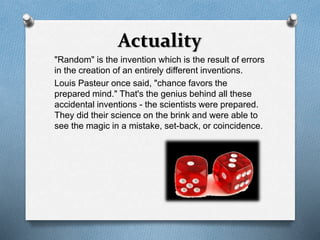
Actuality 
"Random" is the invention which is the result of errors 
in the creation of an entirely different inventions. 
Louis Pasteur once said, "chance favors the 
prepared mind." That's the genius behind all these 
accidental inventions - the scientists were prepared. 
They did their science on the brink and were able to 
see the magic in a mistake, set-back, or coincidence.
Microwave 
In 1945, the American scientist Percy Spencer 
Libaron was busy studying and developing 
Magnetronov. Standing near the operating 
magnetron, Spencer noticed that the 
chocolate bar in his pocket began to slowly 
melt. Through engineering mind he quickly 
realized that the reason for this may be the 
micro-waves emanating from the instrument is 
turned on. Later, he began to experiment with 
popcorn, and finally experienced the impact of 
micro-waves on the egg, which is a result of 
this experiment exploded. Incidentally, the first 
microwave oven was the size of a huge 
refrigerator.
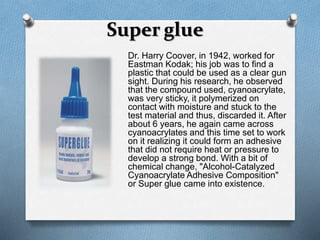
Super glue 
Dr. Harry Coover, in 1942, worked for 
Eastman Kodak; his job was to find a 
plastic that could be used as a clear gun 
sight. During his research, he observed 
that the compound used, cyanoacrylate, 
was very sticky, it polymerized on 
contact with moisture and stuck to the 
test material and thus, discarded it. After 
about 6 years, he again came across 
cyanoacrylates and this time set to work 
on it realizing it could form an adhesive 
that did not require heat or pressure to 
develop a strong bond. With a bit of 
chemical change, "Alcohol-Catalyzed 
Cyanoacrylate Adhesive Composition" 
or Super glue came into existence.
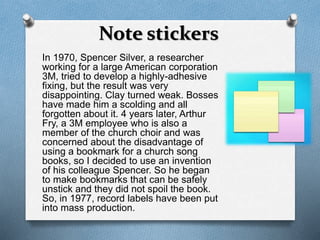
Note stickers 
In 1970, Spencer Silver, a researcher 
working for a large American corporation 
3M, tried to develop a highly-adhesive 
fixing, but the result was very 
disappointing. Clay turned weak. Bosses 
have made him a scolding and all 
forgotten about it. 4 years later, Arthur 
Fry, a 3M employee who is also a 
member of the church choir and was 
concerned about the disadvantage of 
using a bookmark for a church song 
books, so I decided to use an invention 
of his colleague Spencer. So he began 
to make bookmarks that can be safely 
unstick and they did not spoil the book. 
So, in 1977, record labels have been put 
into mass production.
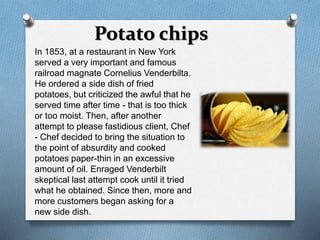
Potato chips 
In 1853, at a restaurant in New York 
served a very important and famous 
railroad magnate Cornelius Venderbilta. 
He ordered a side dish of fried 
potatoes, but criticized the awful that he 
served time after time - that is too thick 
or too moist. Then, after another 
attempt to please fastidious client, Chef 
- Chef decided to bring the situation to 
the point of absurdity and cooked 
potatoes paper-thin in an excessive 
amount of oil. Enraged Venderbilt 
skeptical last attempt cook until it tried 
what he obtained. Since then, more and 
more customers began asking for a 
new side dish.
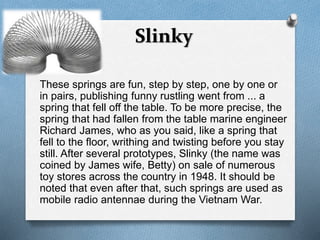
Slinky 
These springs are fun, step by step, one by one or 
in pairs, publishing funny rustling went from ... a 
spring that fell off the table. To be more precise, the 
spring that had fallen from the table marine engineer 
Richard James, who as you said, like a spring that 
fell to the floor, writhing and twisting before you stay 
still. After several prototypes, Slinky (the name was 
coined by James wife, Betty) on sale of numerous 
toy stores across the country in 1948. It should be 
noted that even after that, such springs are used as 
mobile radio antennae during the Vietnam War.
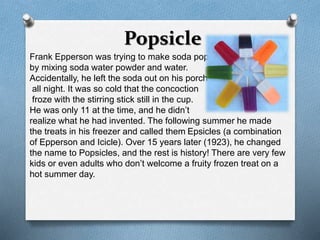
Popsicle 
Frank Epperson was trying to make soda pop 
by mixing soda water powder and water. 
Accidentally, he left the soda out on his porch 
all night. It was so cold that the concoction 
froze with the stirring stick still in the cup. 
He was only 11 at the time, and he didn’t 
realize what he had invented. The following summer he made 
the treats in his freezer and called them Epsicles (a combination 
of Epperson and Icicle). Over 15 years later (1923), he changed 
the name to Popsicles, and the rest is history! There are very few 
kids or even adults who don’t welcome a fruity frozen treat on a 
hot summer day.
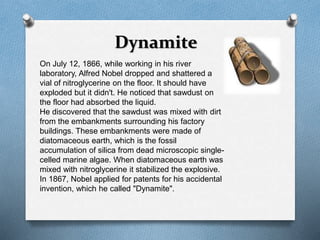
Dynamite 
On July 12, 1866, while working in his river 
laboratory, Alfred Nobel dropped and shattered a 
vial of nitroglycerine on the floor. It should have 
exploded but it didn't. He noticed that sawdust on 
the floor had absorbed the liquid. 
He discovered that the sawdust was mixed with dirt 
from the embankments surrounding his factory 
buildings. These embankments were made of 
diatomaceous earth, which is the fossil 
accumulation of silica from dead microscopic single-celled 
marine algae. When diatomaceous earth was 
mixed with nitroglycerine it stabilized the explosive. 
In 1867, Nobel applied for patents for his accidental 
invention, which he called "Dynamite".
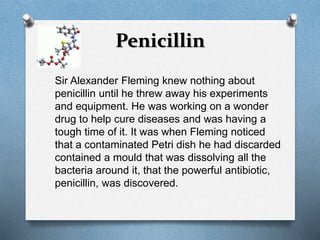
Penicillin 
Sir Alexander Fleming knew nothing about 
penicillin until he threw away his experiments 
and equipment. He was working on a wonder 
drug to help cure diseases and was having a 
tough time of it. It was when Fleming noticed 
that a contaminated Petri dish he had discarded 
contained a mould that was dissolving all the 
bacteria around it, that the powerful antibiotic, 
penicillin, was discovered.
Results 
We have analyzed 30 Internet sites and have 
found out that the most frequent invention is a 
microwave (it was used 26 times), the second 
place has the super glue (it was used 25 times). 
The third place is for potato chips (it was used 20 
times), then comes dynamite (it was used 19 
times). The fifth place is for note stickers and 
slinky (they were used 16 times), then comes 
popsicle (it was used 14 times) and the seventh 
place is penicillin (it was used 9 times).
Conclusion 
As for inventions, totally random inventions can not 
be, because for any invention there is some discovery 
on which it is based. All of the "accidental" invention is 
the result of errors in creating a very different 
inventions. 
These accidental discoveries have become an integral 
part of every modern man. It can be in any field such 
as medicine, the arts, science, or in the home. So it 
can be seen that they were not as random.
As for inventions, totally random inventions 
can not be, because for any invention there 
is some discovery on which it is based. All of 
the "accidental" invention is the result of 
errors in creating a very different inventions. 
Our hypothesis is wright. Sometimes it's 
better to be lucky than good.
Information resources 
O http://sckolnik.ru/shkolnaya-forma 
O http://www.mirabell.ru 
O http://108.su/search_history_33.html 
O http://www.parenting.ru 
O http://www.newagent.spb.ru/kak/1075-2010-08-30- 
18-58-55 
O http://www.molomo.ru/inquiry/casual_inventions.htm 
l 
O http://www.alfy.ru/articles/487-10-sluchajjnykh-izobretenijj- 
chelovechestva..html 
O http://www.buzzle.com/articles/accidental-inventions- 
that-changed-the-world.html

Accidental inventions

  • 1.
    Bondary secondary school Project Accidental inventions that changed the world Authors: Kazmina Nastya, Terekhova Oksana, Yeltsova Yulia, 11th grade students 2013
  • 2.
    Accident is thename of the greatest of all inventors. Mark Twain
  • 3.
    Aim Identify thesignificance of accidental discoveries to society’s progress.
  • 4.
    Tasks 1. Reviewthe list of accidental discoveries. 2. Give a precise definition of the accidental discovery. 3. Determine their value to society’s progress. 4. Give a detailed description of the opening of some inventions. 5. Make a conclusion about the significance of these inventions for Mankind.
  • 5.
    Hypothesis If theseinventions were not be done we would not have such useful things like a microwave.
  • 6.
    Steps of research OGive the definition to the world «accidental inventions». OFind out why such inventions were appeared. ODescribe these inventions. OAnalyze the frequency of their mention in the Internet.
  • 7.
    Actuality "Random" isthe invention which is the result of errors in the creation of an entirely different inventions. Louis Pasteur once said, "chance favors the prepared mind." That's the genius behind all these accidental inventions - the scientists were prepared. They did their science on the brink and were able to see the magic in a mistake, set-back, or coincidence.
  • 8.
    Microwave In 1945,the American scientist Percy Spencer Libaron was busy studying and developing Magnetronov. Standing near the operating magnetron, Spencer noticed that the chocolate bar in his pocket began to slowly melt. Through engineering mind he quickly realized that the reason for this may be the micro-waves emanating from the instrument is turned on. Later, he began to experiment with popcorn, and finally experienced the impact of micro-waves on the egg, which is a result of this experiment exploded. Incidentally, the first microwave oven was the size of a huge refrigerator.
  • 9.
    Super glue Dr.Harry Coover, in 1942, worked for Eastman Kodak; his job was to find a plastic that could be used as a clear gun sight. During his research, he observed that the compound used, cyanoacrylate, was very sticky, it polymerized on contact with moisture and stuck to the test material and thus, discarded it. After about 6 years, he again came across cyanoacrylates and this time set to work on it realizing it could form an adhesive that did not require heat or pressure to develop a strong bond. With a bit of chemical change, "Alcohol-Catalyzed Cyanoacrylate Adhesive Composition" or Super glue came into existence.
  • 10.
    Note stickers In1970, Spencer Silver, a researcher working for a large American corporation 3M, tried to develop a highly-adhesive fixing, but the result was very disappointing. Clay turned weak. Bosses have made him a scolding and all forgotten about it. 4 years later, Arthur Fry, a 3M employee who is also a member of the church choir and was concerned about the disadvantage of using a bookmark for a church song books, so I decided to use an invention of his colleague Spencer. So he began to make bookmarks that can be safely unstick and they did not spoil the book. So, in 1977, record labels have been put into mass production.
  • 11.
    Potato chips In1853, at a restaurant in New York served a very important and famous railroad magnate Cornelius Venderbilta. He ordered a side dish of fried potatoes, but criticized the awful that he served time after time - that is too thick or too moist. Then, after another attempt to please fastidious client, Chef - Chef decided to bring the situation to the point of absurdity and cooked potatoes paper-thin in an excessive amount of oil. Enraged Venderbilt skeptical last attempt cook until it tried what he obtained. Since then, more and more customers began asking for a new side dish.
  • 12.
    Slinky These springsare fun, step by step, one by one or in pairs, publishing funny rustling went from ... a spring that fell off the table. To be more precise, the spring that had fallen from the table marine engineer Richard James, who as you said, like a spring that fell to the floor, writhing and twisting before you stay still. After several prototypes, Slinky (the name was coined by James wife, Betty) on sale of numerous toy stores across the country in 1948. It should be noted that even after that, such springs are used as mobile radio antennae during the Vietnam War.
  • 13.
    Popsicle Frank Eppersonwas trying to make soda pop by mixing soda water powder and water. Accidentally, he left the soda out on his porch all night. It was so cold that the concoction froze with the stirring stick still in the cup. He was only 11 at the time, and he didn’t realize what he had invented. The following summer he made the treats in his freezer and called them Epsicles (a combination of Epperson and Icicle). Over 15 years later (1923), he changed the name to Popsicles, and the rest is history! There are very few kids or even adults who don’t welcome a fruity frozen treat on a hot summer day.
  • 14.
    Dynamite On July12, 1866, while working in his river laboratory, Alfred Nobel dropped and shattered a vial of nitroglycerine on the floor. It should have exploded but it didn't. He noticed that sawdust on the floor had absorbed the liquid. He discovered that the sawdust was mixed with dirt from the embankments surrounding his factory buildings. These embankments were made of diatomaceous earth, which is the fossil accumulation of silica from dead microscopic single-celled marine algae. When diatomaceous earth was mixed with nitroglycerine it stabilized the explosive. In 1867, Nobel applied for patents for his accidental invention, which he called "Dynamite".
  • 15.
    Penicillin Sir AlexanderFleming knew nothing about penicillin until he threw away his experiments and equipment. He was working on a wonder drug to help cure diseases and was having a tough time of it. It was when Fleming noticed that a contaminated Petri dish he had discarded contained a mould that was dissolving all the bacteria around it, that the powerful antibiotic, penicillin, was discovered.
  • 16.
    Results We haveanalyzed 30 Internet sites and have found out that the most frequent invention is a microwave (it was used 26 times), the second place has the super glue (it was used 25 times). The third place is for potato chips (it was used 20 times), then comes dynamite (it was used 19 times). The fifth place is for note stickers and slinky (they were used 16 times), then comes popsicle (it was used 14 times) and the seventh place is penicillin (it was used 9 times).
  • 17.
    Conclusion As forinventions, totally random inventions can not be, because for any invention there is some discovery on which it is based. All of the "accidental" invention is the result of errors in creating a very different inventions. These accidental discoveries have become an integral part of every modern man. It can be in any field such as medicine, the arts, science, or in the home. So it can be seen that they were not as random.
  • 18.
    As for inventions,totally random inventions can not be, because for any invention there is some discovery on which it is based. All of the "accidental" invention is the result of errors in creating a very different inventions. Our hypothesis is wright. Sometimes it's better to be lucky than good.
  • 19.
    Information resources Ohttp://sckolnik.ru/shkolnaya-forma O http://www.mirabell.ru O http://108.su/search_history_33.html O http://www.parenting.ru O http://www.newagent.spb.ru/kak/1075-2010-08-30- 18-58-55 O http://www.molomo.ru/inquiry/casual_inventions.htm l O http://www.alfy.ru/articles/487-10-sluchajjnykh-izobretenijj- chelovechestva..html O http://www.buzzle.com/articles/accidental-inventions- that-changed-the-world.html