International Research Journal of Engineering and Technology (IRJET) e-ISSN: 2395 -0056
Volume: 04 Issue: 03 | Mar -2017 www.irjet.net p-ISSN: 2395-0072
© 2017, IRJET | Impact Factor value: 5.181 | ISO 9001:2008 Certified Journal | Page 308
Accident Prevention System by Automatic Pneumatic Bumper
Asst. Prof. Aamir Sayed1, Vipin Raut2, Shubham Mashankar3, Shubham Lashkare4, Nikesh
Khobragade5, Shantanu Ghodeshwar6
1Asst. Prof., Mechanical Department, J.D. College of Engineering, Nagpur, Maharashtra, India
2Student, Mechanical Engineering, J.D. College of Engineering, Nagpur, Maharashtra, India
3456Student, Mechanical Engineering, J.D. College of Engineering, Nagpur, Maharashtra, India
---------------------------------------------------------------------***---------------------------------------------------------------------
Abstract - In today’s world vehicle accident is a
major problem. To avoid this we have developed an
automatic impact reducing system in our project. The
system is based on intelligent electronically control
system known as “Automatic pneumatic-bumper
system”. Automatic pneumatic bumper system uses
infrared sensor (IR), which is used to sense the vehicle
coming is front of our vehicle which is responsible for
an accident. As soon as any object or vehicle is sensed
by the sensor the sensor sends feedback signal to
engine through the relay control to activate the
Solenoid Valve which allows the flow of compressed
air to the cylinder. During the working of Automatic
Pneumatic Bumper system simultaneously the driver
also try to stop the vehicle by applying brake pedal
which somewhat slows down the engine. The
compressed gas flowing through the solenoid valve
will activate the cylinder which in turn activates the
Bumper. This system provides pre-crash safety to the
vehicle. As well as it improves the response time of
vehicle braking to keep safe distance between the
vehicles. By using this system we can obtain control
over the speed of vehicle in short distance
Key Words: Automatic Pneumatic Bumper System, IR
Receiver, IR Transmitter, Electromechanical System,
Solenoid Valve
1. INTRODUCTION
India is the developing country. India is a densely
populated country with the vehicle usage being really
diverse. While the available resources which are used to
run the vehicles like road quality & new technologies in
vehicles are being developed to avoid accidents. The
number of people expired during vehicle accidents is very
large as compared to the other causes of death. Though
there are different causes for accidents but proper
technology of braking system and technology to reduce
the damage during accident should be developed. Hence
there is need of Impact Reduction system to prevent the
accidents and to reduce the damage to vehicle and also the
driver. To achieve this goal, we design this Automatic
Pneumatic Bumper system. Our main aim is to design &
develop automatic control system based on intelligent
electronic control automotive bumper activation system
called “AUTOMATIC PNEUMATIC BUMPER SYSTEM ’’.
2. OBJECTIVES
The future of any industry is more than just developing
new technology. It is integrating the approach towards
achieving safety. Impact Reducing System approach
represents considerable shift from the traditional
approach to safety, by considering safety in terms of,
Firstly avoiding the possibility of accidents, and secondly,
protecting occupants when a crash is unavoidable, we can
prevent more accidents, save more lives, decrease
material damage to vehicles and reduce medical costs.
Following are the main objectives of Impact
Reduction System with Pneumatic Bumpers:
- To ensure the braking of vehicle in time.
- To increase the crashing distance during accident.
- To increase the safety during pre-crash.
- To increase external safety to vehicle body.
- To decrease the level of passenger injury by use of
external vehicle safety device.
- To reduce the requirement of internal safety devices like
air bags.
3. CURRENT TRENDS
In conventional vehicles there are different mechanism
operated for braking system like hydraulic, pneumatic, or
mechanical system. But in all these braking mechanisms
the input signal is to be given directly from the driver by
applying the brake pedal. Thus, braking of vehicles is
totally manual operated. So, if the driver fails to see the
obstacle in front of his driving vehicle or fails to apply
proper braking force on the brake pedal, he may lose the
control of his vehicle, leading to accident. Also the driver
may not able to pay complete attention when driving at
night. So there are many chances of accidents. Urgent
application of brakes may also result in imbalance by
skidding of the tyres of the vehicle.
So, There are no arrangements to prevent or minimize
the damage on the vehicle or the passengers.
International Research Journal of Engineering and Technology (IRJET) e-ISSN: 2395 -0056
Volume: 04 Issue: 03 | Mar -2017 www.irjet.net p-ISSN: 2395-0072
© 2017, IRJET | Impact Factor value: 5.181 | ISO 9001:2008 Certified Journal | Page 309
4. CONSTRUCTION AND WORKING
As this system is used at the time of emergency during
work. In normal travelling of vehicle this system can be
switched of with the help of a switch and it will not affect
the normal working of the vehicle
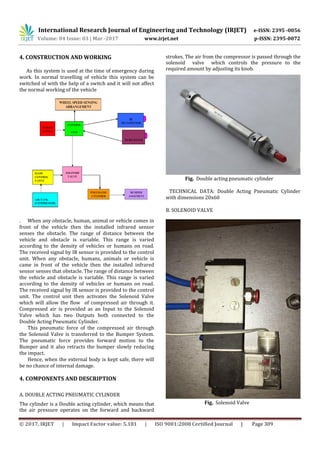
. When any obstacle, human, animal or vehicle comes in
front of the vehicle then the installed infrared sensor
senses the obstacle. The range of distance between the
vehicle and obstacle is variable. This range is varied
according to the density of vehicles or humans on road.
The received signal by IR sensor is provided to the control
unit. When any obstacle, humans, animals or vehicle is
came in front of the vehicle then the installed infrared
sensor senses that obstacle. The range of distance between
the vehicle and obstacle is variable. This range is varied
according to the density of vehicles or humans on road.
The received signal by IR sensor is provided to the control
unit. The control unit then activates the Solenoid Valve
which will allow the flow of compressed air through it.
Compressed air is provided as an Input to the Solenoid
Valve which has two Outputs both connected to the
Double Acting Pneumatic Cylinder.
This pneumatic force of the compressed air through
the Solenoid Valve is transferred to the Bumper System.
The pneumatic force provides forward motion to the
Bumper and it also retracts the bumper slowly reducing
the impact.
Hence, when the external body is kept safe, there will
be no chance of internal damage.
4. COMPONENTS AND DESCRIPTION
A. DOUBLE ACTING PNEUMATIC CYLINDER
The cylinder is a Double acting cylinder, which means that
the air pressure operates on the forward and backward
strokes. The air from the compressor is passed through the
solenoid valve which controls the pressure to the
required amount by adjusting its knob.
Fig. Double acting pneumatic cylinder
TECHNICAL DATA: Double Acting Pneumatic Cylinder
with dimensions 20x60
B. SOLENOID VALVE
Fig. Solenoid Valve
International Research Journal of Engineering and Technology (IRJET) e-ISSN: 2395 -0056
Volume: 04 Issue: 03 | Mar -2017 www.irjet.net p-ISSN: 2395-0072
© 2017, IRJET | Impact Factor value: 5.181 | ISO 9001:2008 Certified Journal | Page 310
It is a flow control device used in pneumatic system to
change the direction of air flow. Solenoid valve is used in
automatic bumper system to control the compressed air
towards the pneumatic cylinder during the extraction of
the bumper. Different types of solenoid valves are
available in market. But most common is ½ solenoid valve
and 2/5 solenoid valve. ½ means one way operation and
two ports and 2/5 means two way operation and five
ports.
C. AC MOTOR
Fig. Electric Motor
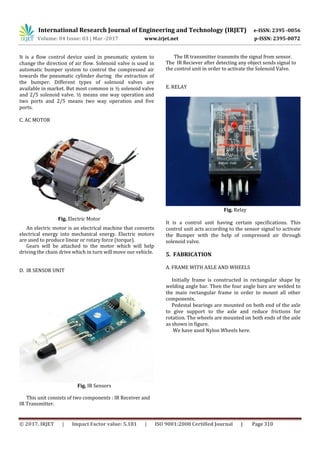
An electric motor is an electrical machine that converts
electrical energy into mechanical energy. Electric motors
are used to produce linear or rotary force (torque).
Gears will be attached to the motor which will help
driving the chain drive which in turn will move our vehicle.
D. IR SENSOR UNIT
Fig. IR Sensors
This unit consists of two components : IR Receiver and
IR Transmitter.
The IR transmitter transmits the signal from sensor.
The IR Reciever after detecting any object sends signal to
the control unit in order to activate the Solenoid Valve.
E. RELAY
Fig. Relay
It is a control unit having certain specifications. This
control unit acts according to the sensor signal to activate
the Bumper with the help of compressed air through
solenoid valve.
5. FABRICATION
A. FRAME WITH AXLE AND WHEELS
Initially frame is constructed in rectangular shape by
welding angle bar. Then the four angle bars are welded to
the main rectangular frame in order to mount all other
components.
Pedestal bearings are mounted on both end of the axle
to give support to the axle and reduce frictions for
rotation. The wheels are mounted on both ends of the axle
as shown in figure.
We have used Nylon Wheels here.
International Research Journal of Engineering and Technology (IRJET) e-ISSN: 2395 -0056
Volume: 04 Issue: 03 | Mar -2017 www.irjet.net p-ISSN: 2395-0072
© 2017, IRJET | Impact Factor value: 5.181 | ISO 9001:2008 Certified Journal | Page 311
B. ASSEMBLING ALL THE COMPONENTS
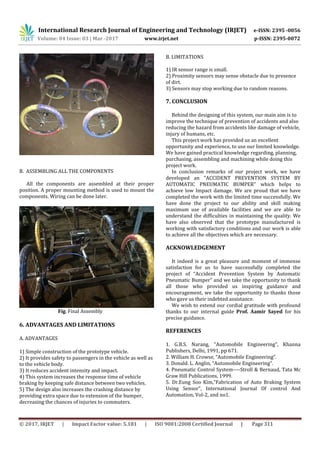
All the components are assembled at their proper
position. A proper mounting method is used to mount the
components. Wiring can be done later.
Fig. Final Assembly
6. ADVANTAGES AND LIMITATIONS
A. ADVANTAGES
1) Simple construction of the prototype vehicle.
2) It provides safety to passengers in the vehicle as well as
to the vehicle body.
3) It reduces accident intensity and impact.
4) This system increases the response time of vehicle
braking by keeping safe distance between two vehicles.
5) The design also increases the crashing distance by
providing extra space due to extension of the bumper,
decreasing the chances of injuries to commuters.
B. LIMITATIONS
1) IR sensor range is small.
2) Proximity sensors may sense obstacle due to presence
of dirt.
3) Sensors may stop working due to random reasons.
7. CONCLUSION
Behind the designing of this system, our main aim is to
improve the technique of prevention of accidents and also
reducing the hazard from accidents like damage of vehicle,
injury of humans, etc.
This project work has provided us an excellent
opportunity and experience, to use our limited knowledge.
We have gained practical knowledge regarding, planning,
purchasing, assembling and machining while doing this
project work.
In conclusion remarks of our project work, we have
developed an “ACCIDENT PREVENTION SYSTEM BY
AUTOMATIC PNEUMATIC BUMPER” which helps to
achieve low Impact damage. We are proud that we have
completed the work with the limited time successfully. We
have done the project to our ability and skill making
maximum use of available facilities and we are able to
understand the difficulties in maintaining the quality. We
have also observed that the prototype manufactured is
working with satisfactory conditions and our work is able
to achieve all the objectives which are necessary.
ACKNOWLEDGEMENT
It indeed is a great pleasure and moment of immense
satisfaction for us to have successfully completed the
project of “Accident Prevention System by Automatic
Pneumatic Bumper” and we take the opportunity to thank
all those who provided us inspiring guidance and
encouragement, we take the opportunity to thanks those
who gave us their indebted assistance.
We wish to extend our cordial gratitude with profound
thanks to our internal guide Prof. Aamir Sayed for his
precise guidance.
REFERENCES
1. G.B.S. Narang, “Automobile Engineering”, Khanna
Publishers, Delhi, 1991, pp 671.
2. William H. Crowse, “Automobile Engineering”.
3. Donald. L. Anglin, “Automobile Engineering”.
4. Pneumatic Control System----Stroll & Bernaud, Tata Mc
Graw Hill Publications, 1999.
5. Dr.Eung Soo Kim,”Fabrication of Auto Braking System
Using Sensor”, International Journal Of control And
Automation, Vol-2, and no1.
International Research Journal of Engineering and Technology (IRJET) e-ISSN: 2395 -0056
Volume: 04 Issue: 03 | Mar -2017 www.irjet.net p-ISSN: 2395-0072
© 2017, IRJET | Impact Factor value: 5.181 | ISO 9001:2008 Certified Journal | Page 312
BIOGRAPHIES
Mr. Aamir Sayed professor in
mechanical having 4 year
teaching experience and 1year
experience total experience
5year.
Vipin Raut persuing Bachelors in
mechanical engineering, doing
project in automobile sector and
also training in G.G.Dandekar.
Shubham Mashankar persuing
Bachelors in mechanical
engineering, doing project in
automobile sector and also
training in G.G.Dandekar.
Shubham Lashkare persuing
Bachelors in mechanical
engineering, doing project in
automobile sector and also
training in G.G.Dandekar.
Nikesh Khobragade presently
student of final year in
mechanical engineering doing
project in automobile sector and
also training in G.G.Dandekar.
Shantanu Ghodeshwar presently
student of final year in
mechanical engineering doing
project in automobile sector and
also training in G.G.Dandekar
4th
5th

Accident Prevention System by Automatic Pneumatic Bumper

  • 1.
    International Research Journalof Engineering and Technology (IRJET) e-ISSN: 2395 -0056 Volume: 04 Issue: 03 | Mar -2017 www.irjet.net p-ISSN: 2395-0072 © 2017, IRJET | Impact Factor value: 5.181 | ISO 9001:2008 Certified Journal | Page 308 Accident Prevention System by Automatic Pneumatic Bumper Asst. Prof. Aamir Sayed1, Vipin Raut2, Shubham Mashankar3, Shubham Lashkare4, Nikesh Khobragade5, Shantanu Ghodeshwar6 1Asst. Prof., Mechanical Department, J.D. College of Engineering, Nagpur, Maharashtra, India 2Student, Mechanical Engineering, J.D. College of Engineering, Nagpur, Maharashtra, India 3456Student, Mechanical Engineering, J.D. College of Engineering, Nagpur, Maharashtra, India ---------------------------------------------------------------------***--------------------------------------------------------------------- Abstract - In today’s world vehicle accident is a major problem. To avoid this we have developed an automatic impact reducing system in our project. The system is based on intelligent electronically control system known as “Automatic pneumatic-bumper system”. Automatic pneumatic bumper system uses infrared sensor (IR), which is used to sense the vehicle coming is front of our vehicle which is responsible for an accident. As soon as any object or vehicle is sensed by the sensor the sensor sends feedback signal to engine through the relay control to activate the Solenoid Valve which allows the flow of compressed air to the cylinder. During the working of Automatic Pneumatic Bumper system simultaneously the driver also try to stop the vehicle by applying brake pedal which somewhat slows down the engine. The compressed gas flowing through the solenoid valve will activate the cylinder which in turn activates the Bumper. This system provides pre-crash safety to the vehicle. As well as it improves the response time of vehicle braking to keep safe distance between the vehicles. By using this system we can obtain control over the speed of vehicle in short distance Key Words: Automatic Pneumatic Bumper System, IR Receiver, IR Transmitter, Electromechanical System, Solenoid Valve 1. INTRODUCTION India is the developing country. India is a densely populated country with the vehicle usage being really diverse. While the available resources which are used to run the vehicles like road quality & new technologies in vehicles are being developed to avoid accidents. The number of people expired during vehicle accidents is very large as compared to the other causes of death. Though there are different causes for accidents but proper technology of braking system and technology to reduce the damage during accident should be developed. Hence there is need of Impact Reduction system to prevent the accidents and to reduce the damage to vehicle and also the driver. To achieve this goal, we design this Automatic Pneumatic Bumper system. Our main aim is to design & develop automatic control system based on intelligent electronic control automotive bumper activation system called “AUTOMATIC PNEUMATIC BUMPER SYSTEM ’’. 2. OBJECTIVES The future of any industry is more than just developing new technology. It is integrating the approach towards achieving safety. Impact Reducing System approach represents considerable shift from the traditional approach to safety, by considering safety in terms of, Firstly avoiding the possibility of accidents, and secondly, protecting occupants when a crash is unavoidable, we can prevent more accidents, save more lives, decrease material damage to vehicles and reduce medical costs. Following are the main objectives of Impact Reduction System with Pneumatic Bumpers: - To ensure the braking of vehicle in time. - To increase the crashing distance during accident. - To increase the safety during pre-crash. - To increase external safety to vehicle body. - To decrease the level of passenger injury by use of external vehicle safety device. - To reduce the requirement of internal safety devices like air bags. 3. CURRENT TRENDS In conventional vehicles there are different mechanism operated for braking system like hydraulic, pneumatic, or mechanical system. But in all these braking mechanisms the input signal is to be given directly from the driver by applying the brake pedal. Thus, braking of vehicles is totally manual operated. So, if the driver fails to see the obstacle in front of his driving vehicle or fails to apply proper braking force on the brake pedal, he may lose the control of his vehicle, leading to accident. Also the driver may not able to pay complete attention when driving at night. So there are many chances of accidents. Urgent application of brakes may also result in imbalance by skidding of the tyres of the vehicle. So, There are no arrangements to prevent or minimize the damage on the vehicle or the passengers.
  • 2.
    International Research Journalof Engineering and Technology (IRJET) e-ISSN: 2395 -0056 Volume: 04 Issue: 03 | Mar -2017 www.irjet.net p-ISSN: 2395-0072 © 2017, IRJET | Impact Factor value: 5.181 | ISO 9001:2008 Certified Journal | Page 309 4. CONSTRUCTION AND WORKING As this system is used at the time of emergency during work. In normal travelling of vehicle this system can be switched of with the help of a switch and it will not affect the normal working of the vehicle . When any obstacle, human, animal or vehicle comes in front of the vehicle then the installed infrared sensor senses the obstacle. The range of distance between the vehicle and obstacle is variable. This range is varied according to the density of vehicles or humans on road. The received signal by IR sensor is provided to the control unit. When any obstacle, humans, animals or vehicle is came in front of the vehicle then the installed infrared sensor senses that obstacle. The range of distance between the vehicle and obstacle is variable. This range is varied according to the density of vehicles or humans on road. The received signal by IR sensor is provided to the control unit. The control unit then activates the Solenoid Valve which will allow the flow of compressed air through it. Compressed air is provided as an Input to the Solenoid Valve which has two Outputs both connected to the Double Acting Pneumatic Cylinder. This pneumatic force of the compressed air through the Solenoid Valve is transferred to the Bumper System. The pneumatic force provides forward motion to the Bumper and it also retracts the bumper slowly reducing the impact. Hence, when the external body is kept safe, there will be no chance of internal damage. 4. COMPONENTS AND DESCRIPTION A. DOUBLE ACTING PNEUMATIC CYLINDER The cylinder is a Double acting cylinder, which means that the air pressure operates on the forward and backward strokes. The air from the compressor is passed through the solenoid valve which controls the pressure to the required amount by adjusting its knob. Fig. Double acting pneumatic cylinder TECHNICAL DATA: Double Acting Pneumatic Cylinder with dimensions 20x60 B. SOLENOID VALVE Fig. Solenoid Valve
  • 3.
    International Research Journalof Engineering and Technology (IRJET) e-ISSN: 2395 -0056 Volume: 04 Issue: 03 | Mar -2017 www.irjet.net p-ISSN: 2395-0072 © 2017, IRJET | Impact Factor value: 5.181 | ISO 9001:2008 Certified Journal | Page 310 It is a flow control device used in pneumatic system to change the direction of air flow. Solenoid valve is used in automatic bumper system to control the compressed air towards the pneumatic cylinder during the extraction of the bumper. Different types of solenoid valves are available in market. But most common is ½ solenoid valve and 2/5 solenoid valve. ½ means one way operation and two ports and 2/5 means two way operation and five ports. C. AC MOTOR Fig. Electric Motor An electric motor is an electrical machine that converts electrical energy into mechanical energy. Electric motors are used to produce linear or rotary force (torque). Gears will be attached to the motor which will help driving the chain drive which in turn will move our vehicle. D. IR SENSOR UNIT Fig. IR Sensors This unit consists of two components : IR Receiver and IR Transmitter. The IR transmitter transmits the signal from sensor. The IR Reciever after detecting any object sends signal to the control unit in order to activate the Solenoid Valve. E. RELAY Fig. Relay It is a control unit having certain specifications. This control unit acts according to the sensor signal to activate the Bumper with the help of compressed air through solenoid valve. 5. FABRICATION A. FRAME WITH AXLE AND WHEELS Initially frame is constructed in rectangular shape by welding angle bar. Then the four angle bars are welded to the main rectangular frame in order to mount all other components. Pedestal bearings are mounted on both end of the axle to give support to the axle and reduce frictions for rotation. The wheels are mounted on both ends of the axle as shown in figure. We have used Nylon Wheels here.
  • 4.
    International Research Journalof Engineering and Technology (IRJET) e-ISSN: 2395 -0056 Volume: 04 Issue: 03 | Mar -2017 www.irjet.net p-ISSN: 2395-0072 © 2017, IRJET | Impact Factor value: 5.181 | ISO 9001:2008 Certified Journal | Page 311 B. ASSEMBLING ALL THE COMPONENTS All the components are assembled at their proper position. A proper mounting method is used to mount the components. Wiring can be done later. Fig. Final Assembly 6. ADVANTAGES AND LIMITATIONS A. ADVANTAGES 1) Simple construction of the prototype vehicle. 2) It provides safety to passengers in the vehicle as well as to the vehicle body. 3) It reduces accident intensity and impact. 4) This system increases the response time of vehicle braking by keeping safe distance between two vehicles. 5) The design also increases the crashing distance by providing extra space due to extension of the bumper, decreasing the chances of injuries to commuters. B. LIMITATIONS 1) IR sensor range is small. 2) Proximity sensors may sense obstacle due to presence of dirt. 3) Sensors may stop working due to random reasons. 7. CONCLUSION Behind the designing of this system, our main aim is to improve the technique of prevention of accidents and also reducing the hazard from accidents like damage of vehicle, injury of humans, etc. This project work has provided us an excellent opportunity and experience, to use our limited knowledge. We have gained practical knowledge regarding, planning, purchasing, assembling and machining while doing this project work. In conclusion remarks of our project work, we have developed an “ACCIDENT PREVENTION SYSTEM BY AUTOMATIC PNEUMATIC BUMPER” which helps to achieve low Impact damage. We are proud that we have completed the work with the limited time successfully. We have done the project to our ability and skill making maximum use of available facilities and we are able to understand the difficulties in maintaining the quality. We have also observed that the prototype manufactured is working with satisfactory conditions and our work is able to achieve all the objectives which are necessary. ACKNOWLEDGEMENT It indeed is a great pleasure and moment of immense satisfaction for us to have successfully completed the project of “Accident Prevention System by Automatic Pneumatic Bumper” and we take the opportunity to thank all those who provided us inspiring guidance and encouragement, we take the opportunity to thanks those who gave us their indebted assistance. We wish to extend our cordial gratitude with profound thanks to our internal guide Prof. Aamir Sayed for his precise guidance. REFERENCES 1. G.B.S. Narang, “Automobile Engineering”, Khanna Publishers, Delhi, 1991, pp 671. 2. William H. Crowse, “Automobile Engineering”. 3. Donald. L. Anglin, “Automobile Engineering”. 4. Pneumatic Control System----Stroll & Bernaud, Tata Mc Graw Hill Publications, 1999. 5. Dr.Eung Soo Kim,”Fabrication of Auto Braking System Using Sensor”, International Journal Of control And Automation, Vol-2, and no1.
  • 5.
    International Research Journalof Engineering and Technology (IRJET) e-ISSN: 2395 -0056 Volume: 04 Issue: 03 | Mar -2017 www.irjet.net p-ISSN: 2395-0072 © 2017, IRJET | Impact Factor value: 5.181 | ISO 9001:2008 Certified Journal | Page 312 BIOGRAPHIES Mr. Aamir Sayed professor in mechanical having 4 year teaching experience and 1year experience total experience 5year. Vipin Raut persuing Bachelors in mechanical engineering, doing project in automobile sector and also training in G.G.Dandekar. Shubham Mashankar persuing Bachelors in mechanical engineering, doing project in automobile sector and also training in G.G.Dandekar. Shubham Lashkare persuing Bachelors in mechanical engineering, doing project in automobile sector and also training in G.G.Dandekar. Nikesh Khobragade presently student of final year in mechanical engineering doing project in automobile sector and also training in G.G.Dandekar. Shantanu Ghodeshwar presently student of final year in mechanical engineering doing project in automobile sector and also training in G.G.Dandekar 4th 5th