MINI PROJECT :
AUTOMOTIVE ENGINEERING
DEPARTMENT
BUMPER
A bumper is a structure attached or integrated to the front and rear of an
automobile to absorb impact in a minor collision, ideally minimizing repair
costs. Bumpers also have two safety functions: minimizing height mismatches
between vehicles, and protecting pedestrians from injury. British inventor
Frederick Simms invented bumpers in 1901.
Physics
Bumpers offer protection to other vehicle components by dissipating the kinetic
energy generated by an impact. This energy is a function of vehicle mass and
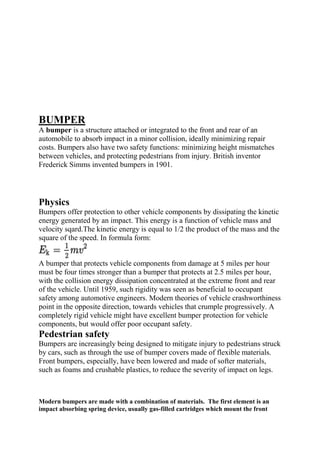
velocity sqard.The kinetic energy is equal to 1/2 the product of the mass and the
square of the speed. In formula form:
A bumper that protects vehicle components from damage at 5 miles per hour
must be four times stronger than a bumper that protects at 2.5 miles per hour,
with the collision energy dissipation concentrated at the extreme front and rear
of the vehicle. Until 1959, such rigidity was seen as beneficial to occupant
safety among automotive engineers. Modern theories of vehicle crashworthiness
point in the opposite direction, towards vehicles that crumple progressively. A
completely rigid vehicle might have excellent bumper protection for vehicle
components, but would offer poor occupant safety.
Pedestrian safety
Bumpers are increasingly being designed to mitigate injury to pedestrians struck
by cars, such as through the use of bumper covers made of flexible materials.
Front bumpers, especially, have been lowered and made of softer materials,
such as foams and crushable plastics, to reduce the severity of impact on legs.
Modern bumpers are made with a combination of materials. The first element is an
impact absorbing spring device, usually gas-filled cartridges which mount the front
bumper to the chassis. This allows the bumper system to absorb minor impacts without
any damage.
INTRODUCTION
We have pleasure in introducing our project “AUTOMATIC PNEUMATIC
BUMPER BEFORE COLLISION”. Which is fully equipped by IR sensors circuit and
Pneumatic bumper. It is the project which has been fully equipped and
designed for auto vehicles. The technology of pneumatics plays a major role in
the field of automation and modern machine shops and space robots. The aim
is to design and develop a control system based on intelligent electronically
controlled automotive bumper activation system is called “automatic
pneumatic bumper before collision”. The project consists of IR transmitter and
Receiver circuit, Control Unit, Pneumatic bumper system. The IR sensor senses
the obstacle. There is any obstacle closer to the vehicle (within 1feet), the
control signal is given to the bumper and break activation system. This bumper
activation system is activated when the vehicle speed above 40-50 km per
hour. The speed is sensed by the proximity sensor and this signal is transfer to
the control unit and pneumatic bumper activation system.
Abstract:
The aim is to design and develop a control system based an intelligent
electronically controlled automotive bumper activation system is called "
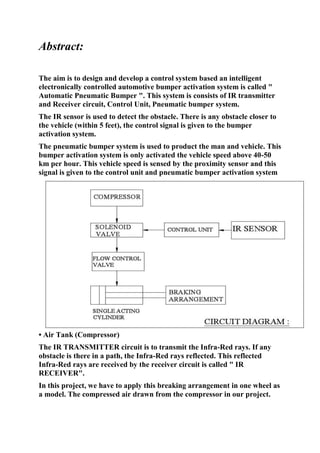
Automatic Pneumatic Bumper ". This system is consists of IR transmitter
and Receiver circuit, Control Unit, Pneumatic bumper system.
The IR sensor is used to detect the obstacle. There is any obstacle closer to
the vehicle (within 5 feet), the control signal is given to the bumper
activation system.
The pneumatic bumper system is used to product the man and vehicle. This
bumper activation system is only activated the vehicle speed above 40-50
km per hour. This vehicle speed is sensed by the proximity sensor and this
signal is given to the control unit and pneumatic bumper activation system
• Air Tank (Compressor)
The IR TRANSMITTER circuit is to transmit the Infra-Red rays. If any
obstacle is there in a path, the Infra-Red rays reflected. This reflected
Infra-Red rays are received by the receiver circuit is called " IR
RECEIVER".
In this project, we have to apply this breaking arrangement in one wheel as
a model. The compressed air drawn from the compressor in our project.
The compressed air flow through the Polyurethane tube to the flow control
valve.
The flow control valve is connected to the solenoid valve as mentioned in
the block diagram. The application of pneumatics produces smooth
operation. By using more techniques, they can be modified and developed
according to the applications.
The important components of the project are,
• IR transmitter
• IR receiver
• Control Unit with Power supply
• Solenoid Valve
• Flow control Valve
ADVANTAGES OF USING “INTELLIGENT
AUTOMATIC PNEUMATIC BUMPER SYSTEM”
1. It able to Increase the sureness in braking system.
2. Braking system able to give fast response.
3. System able to increase the pre-crash safety.
4. System able to provide more safety to the passengers.
5. System plays an important role to save human 6. Life in road accidents.
LIMITATIONS
1. System has few limitations in densely traffic road.
2. Hard and thick materials cannot be riveted.
3. Stroke length is fixed.
APPLICATIONS
1. This system may be applicable in all types of light vehicles like cars,
Rickshaws, Tempos.
2. This system also successfully installed in the heavy vehicles like buses,
trucks, trailers, etc.
CONCLUSION
I hope this abstract will be satisfactory to our automotive.
MINI PROJECT

MINI PROJECT

  • 1.
    MINI PROJECT : AUTOMOTIVEENGINEERING DEPARTMENT
  • 2.
    BUMPER A bumper isa structure attached or integrated to the front and rear of an automobile to absorb impact in a minor collision, ideally minimizing repair costs. Bumpers also have two safety functions: minimizing height mismatches between vehicles, and protecting pedestrians from injury. British inventor Frederick Simms invented bumpers in 1901. Physics Bumpers offer protection to other vehicle components by dissipating the kinetic energy generated by an impact. This energy is a function of vehicle mass and velocity sqard.The kinetic energy is equal to 1/2 the product of the mass and the square of the speed. In formula form: A bumper that protects vehicle components from damage at 5 miles per hour must be four times stronger than a bumper that protects at 2.5 miles per hour, with the collision energy dissipation concentrated at the extreme front and rear of the vehicle. Until 1959, such rigidity was seen as beneficial to occupant safety among automotive engineers. Modern theories of vehicle crashworthiness point in the opposite direction, towards vehicles that crumple progressively. A completely rigid vehicle might have excellent bumper protection for vehicle components, but would offer poor occupant safety. Pedestrian safety Bumpers are increasingly being designed to mitigate injury to pedestrians struck by cars, such as through the use of bumper covers made of flexible materials. Front bumpers, especially, have been lowered and made of softer materials, such as foams and crushable plastics, to reduce the severity of impact on legs. Modern bumpers are made with a combination of materials. The first element is an impact absorbing spring device, usually gas-filled cartridges which mount the front
  • 3.
    bumper to thechassis. This allows the bumper system to absorb minor impacts without any damage. INTRODUCTION We have pleasure in introducing our project “AUTOMATIC PNEUMATIC BUMPER BEFORE COLLISION”. Which is fully equipped by IR sensors circuit and Pneumatic bumper. It is the project which has been fully equipped and designed for auto vehicles. The technology of pneumatics plays a major role in the field of automation and modern machine shops and space robots. The aim is to design and develop a control system based on intelligent electronically controlled automotive bumper activation system is called “automatic pneumatic bumper before collision”. The project consists of IR transmitter and Receiver circuit, Control Unit, Pneumatic bumper system. The IR sensor senses the obstacle. There is any obstacle closer to the vehicle (within 1feet), the control signal is given to the bumper and break activation system. This bumper activation system is activated when the vehicle speed above 40-50 km per hour. The speed is sensed by the proximity sensor and this signal is transfer to the control unit and pneumatic bumper activation system.
  • 4.
    Abstract: The aim isto design and develop a control system based an intelligent electronically controlled automotive bumper activation system is called " Automatic Pneumatic Bumper ". This system is consists of IR transmitter and Receiver circuit, Control Unit, Pneumatic bumper system. The IR sensor is used to detect the obstacle. There is any obstacle closer to the vehicle (within 5 feet), the control signal is given to the bumper activation system. The pneumatic bumper system is used to product the man and vehicle. This bumper activation system is only activated the vehicle speed above 40-50 km per hour. This vehicle speed is sensed by the proximity sensor and this signal is given to the control unit and pneumatic bumper activation system • Air Tank (Compressor) The IR TRANSMITTER circuit is to transmit the Infra-Red rays. If any obstacle is there in a path, the Infra-Red rays reflected. This reflected Infra-Red rays are received by the receiver circuit is called " IR RECEIVER". In this project, we have to apply this breaking arrangement in one wheel as a model. The compressed air drawn from the compressor in our project.
  • 5.
    The compressed airflow through the Polyurethane tube to the flow control valve. The flow control valve is connected to the solenoid valve as mentioned in the block diagram. The application of pneumatics produces smooth operation. By using more techniques, they can be modified and developed according to the applications. The important components of the project are, • IR transmitter • IR receiver • Control Unit with Power supply • Solenoid Valve • Flow control Valve ADVANTAGES OF USING “INTELLIGENT AUTOMATIC PNEUMATIC BUMPER SYSTEM” 1. It able to Increase the sureness in braking system. 2. Braking system able to give fast response. 3. System able to increase the pre-crash safety. 4. System able to provide more safety to the passengers. 5. System plays an important role to save human 6. Life in road accidents. LIMITATIONS 1. System has few limitations in densely traffic road. 2. Hard and thick materials cannot be riveted. 3. Stroke length is fixed. APPLICATIONS 1. This system may be applicable in all types of light vehicles like cars, Rickshaws, Tempos. 2. This system also successfully installed in the heavy vehicles like buses, trucks, trailers, etc. CONCLUSION I hope this abstract will be satisfactory to our automotive.