Lessons from other Industries for
   Transforming Health Care

            Will Falk
          April 22, 2009
Lessons from Other Industries: Purpose

• Provide some examples that raise
  fundamental questions

• “De-anchor”. Hopefully without giving offence

• Be leading edge while remaining relevant to
  the challenges of today

• Have some fun with it!


                                                  2
Reorganizing and Restructuring:
           What do We Have to Learn from Telecoms?


                                                     3
Source: The Colbert Report
Not Much! Healthcare Leads the Way.


       Pre-1994
       Pre-1994                            2003
                                            2003
11Provincial Health Ministry
   Provincial Health Ministry          99Health Regions
                                          Health Regions
   128 acute care boards
    128 acute care boards               ++Mental Health
                                           Mental Health
   25 public health boards
    25 public health boards               ++Addictions
                                             Addictions
    40 long-term boards
     40 long-term boards                    ++Cancer
                                               Cancer


                        1994
                         1994                              2008
                                                            2008
                  17 Health Regions
                   17 Health Regions            11Health Services Board
                                                   Health Services Board


                                                                           4
Healthcare Has A Core Belief in:
                          The Straight Line of Death!
     Major Demographically Driven Program as Share of GDP: National Total

         • Boomer Bulge Graphic


                                                                          lation
                                                              , before inf
                                          R 2%
                                       CAG ce intensity growth
                                         Servi


                                                                                   5
Source: “Boomer Bulge”, Robson, January 13, 2009
We believe this because of our history
                    Costs: Health Spending vs. GDP


                                                                                    %
                                                                              R 3.16
                                                                        CAG                    %
                                                                                           3
                                                                                     R 4.8
                                                                              C AG

                                                  Note: CAGR calculated based on Total
                                                  Health Expenditures (constant 1997 $)


Sources: Canadian Institute for Health Information; Statistics Canada
                                                                                                   6
10000
                                                          15000
                                                                  20000
                                                                          25000
                                                                                  30000


                                0
                                    5000
                         1975
                         1976


Source: Yahoo! Finance
                         1977
                         1978
                         1979
                         1980
                         1981
                         1982
                         1983
                         1984
                         1985


                                      CA G
                         1986


                                           R
                         1987
                         1988
                         1989
                         1990
                                             = 12
                                                  %
                         1991
                         1992
                         1993
                         1994
                         1995
                         1996
                         1997
                         1998
                         1999
                         2000
                         2001
                         2002
                         2003
                                                                                              Lessons from Other Industries…


                         2004
                         2005
                         2006
                         2007
                                                                                          Another Straight Line: Dow Jones 30,000!


                         2008
                         2009
            7
Costs: Lesson from the Computer Industry
     Moore’s Law: Transistor count doubles every two years


     What is its application to health care?


                                                                             8
Source: Four students from MGT 2017 (J. Clayman, S. Yang, A. Lo, T . Looi)
Case Study #1:
                       Centre of Excellence in Cataracts
     Direct to                  Cost in Inpatient Nights                              Price per Eye
     Patients
        KEI


      Patients


              Cost                         Quality                           Access             Value
     40% reduction in          >40% reduction of                   KEI responsible for 58%
     cost (from 2005           resident’s falls at KEI             Decrease in wait times in
     to 2008)                  (other measures of                  <2 years, volume of
                               comfort, outcomes, and              7200/yr, capacity of 12,
                               safety also improved)               000/yr

                                                                                                        9
Source: Four students from MGT 2017 (J. Clayman, S. Yang, A. Lo, T . Looi)
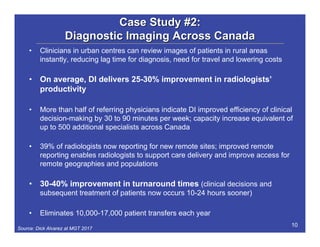
Case Study #2:
                    Diagnostic Imaging Across Canada
    •    Clinicians in urban centres can review images of patients in rural areas
         instantly, reducing lag time for diagnosis, need for travel and lowering costs

    •    On average, DI delivers 25-30% improvement in radiologists’
         productivity

    •    More than half of referring physicians indicate DI improved efficiency of clinical
         decision-making by 30 to 90 minutes per week; capacity increase equivalent of
         up to 500 additional specialists across Canada

    •    39% of radiologists now reporting for new remote sites; improved remote
         reporting enables radiologists to support care delivery and improve access for
         remote geographies and populations

    •    30-40% improvement in turnaround times (clinical decisions and
         subsequent treatment of patients now occurs 10-24 hours sooner)

    •    Eliminates 10,000-17,000 patient transfers each year
                                                                                          10
Source: Dick Alvarez at MGT 2017
Case Study #3:
                            Moore’s Law and the Genome


                                                            • Sequencing equipment
                                                            has been improving
                                                            even faster than Moore’s
                                                            law!
                                                            • In the last decade the
                                                            pace has been
                                                            increasing.


                                                                                   11
Source: “Getting Personal”, The Economist, April 16, 2009
Costs: What’s really happening?

Things become clearer when you consider
trends over longer periods of time…
 • Surgery and
                                            # units
   Diagnostic Imaging                       (++ve)
 • Cardiac Devices?
 • Lab Tests?                                          TOTAL $
                                                        (+ve)
 • Individual drugs?                        $ / unit
                                             (-ve)

                                                      time
Lessons:
• We have mistaken rising total costs for rising
  unit costs. Many unit costs are actually declining!
• We need to manage at the cost per unit & basket level
• Some VERY good news in our future around the end of
  the next decade – “The Healthcare Dividend?”             12
Lessons in Costs:
                       It Costs More Because We Want More!
          Comparison of Cost Drivers, 1975-2005               Three Economical Growth Scenarios: Health as % of GDP


  • Aging and population only account for 0.8% and 1.0% per year cost
    growth; inflation accounts for 2.5%
  • The real challenge is in financing the enrichment of health care: new
    drugs, surgical techniques, DI technologies, and end-of-life care (30-50%
    of health care expenditures happen in the final year of life)
  • Canadians now receive 1.5X the health care of Canadians 30 years ago
  • Even with medium growth in GDP, health care costs are controllable
    within the current basket; the tough decisions will be in managing the
    “enrichment” of services offered. We need to create room to buy more!

Source: “How Sustainable is Medicare”, CCPA, September 2007
New Customer Service Technologies:
              Lessons from My Lawyer


“Hi Daniel, it’s Will. How are you?”
“Good. What’s up? I am in the middle of a
  closing.”
“My neighbour’s runway crosses on to my farm
  for fifty feet. Am I OK if he names me as an
  insured? Anything else I need to do?”
“Probably should get him to acknowledge that
   he doesn’t have any ownership by right of
   continued use.”
“Could you draft me something?”
“Sure. When do you need it? Send me the
   details by email.”


                                                 14
New Customer Service Technologies:
             Lessons from My Accountant

                               From: Allan Jubenville [ajubenville@kbllp.ca]
He emails me with advice       Sent: Monday, January 12, 2009 9:58 AM
                               To: Falk, William F.
and I pay his bills!           Subject: RRSP Limits

Imagine how it would           WF – 9,999
                               KF – 9,999
affect OUR productivity
(both his and mine) if I had   If you have any questions, please let me know.
to go see him for this
question…                      Regards,
                               Allan Jubenville, C.A.
                               Manager
                               Kraft Berger LLP
                               ajubenville@kbllp.ca
                               www.kbllp.ca


                                                                               15
Technology Adoption in Context
     • We are spending billions to implement
       modern eHealth systems and we will not
       let providers use 19th and 20th century
       technology in their daily practice
     • This is purely a false economy that results
       in HHR shortages and deadweight loss to
       consumers who have to physically see
       their provider for a visit to happen
     • Kaiser Permanente published evidence
       that its digital efforts have cut visits per
       patient by an average of 26% thanks to Lesson:
       more e-mail & telephone consultations…
       patients seem to like it too1                • We have the
                                                      technology; we just
     • If we don’t act, we will now see extra-        don’t use it (or
       billing and a two tier system                  can’t)
     • WE COULD FIX THIS!
Source: 1 Health Affairs as quoted in The Economist                     16
Healthcare Provider Technology Hype Cycle - Gartner


            Huge # of new innovations
            in the next 2-5 years

            This material can be purchased from Gartner
Solving HR Problems:
                      Lessons from Nannies and Strippers
           •      In 2004, Canada imported1:
                   – 5,000 live-in caregivers
                   – 1,560 university professors
                   – 661 exotic dancers

           •      According to CNA, we will be short by 113,000
                  nurses by 2010
           •      Philippines over-graduates nurses for export
           •      Capital Health figured this out first and hired
                  600+ in 2006 and then went back again
           •      In Nov. 2008, Philippine government signed a
                  bilateral agreement with Canada to supply as
                  many as 57,000 to 113,000 nurses until 20112

                  Surprisingly, there has been little press
                  coverage of this initiative in Canada!

           1
Sources:       Washington Post, December 5, 2004
           2                                                        18
               Manila Times, December 7, 2008
Solving HR Problems:
                         Stimulus and Medical Tourism
            •
            62-year-old retired Bank of America executive needed surgery
                                                          for a double hernia
          • Private health insurance policy had a steep $10,000 deductible
                           • Operation would have cost $14,000 stateside
         • Paid only $3,900 in hospital and doctor’s bills in Costa Rica, and
                          was home four weeks later with no complications


             •    Cost of surgery performed overseas can be as little as 20% of
                           the price of the same procedure in the United States

                   Should Canada be a medical tourism destination for the US?
                                            What about remote diagnostics?
Source: New York Times, March 20, 2009
                                                                    19
Quality: Lessons from Aviation (Checklists)
The WHO developed a 19-step surgical safety checklist that is shocking in its
simplicity. Mortality dropped from 1.5% to 0.8% across the 8 WHO hospitals


            Source: www.hsph.harvard.edu


                                                                          20
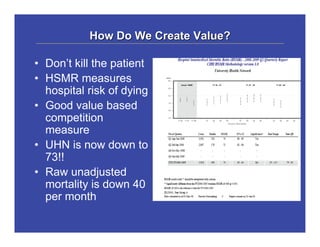
How Do We Create Value?

• Don’t kill the patient
• HSMR measures
  hospital risk of dying
• Good value based
  competition
  measure
• UHN is now down to
  73!!
• Raw unadjusted
  mortality is down 40
  per month


                                     21
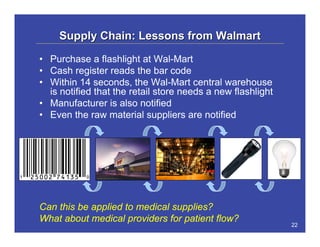
Supply Chain: Lessons from Walmart

• Purchase a flashlight at Wal-Mart
• Cash register reads the bar code
• Within 14 seconds, the Wal-Mart central warehouse
  is notified that the retail store needs a new flashlight
• Manufacturer is also notified
• Even the raw material suppliers are notified


Can this be applied to medical supplies?
What about medical providers for patient flow?
                                                             22
Service: Lessons from FedEx


• Parcel is picked up and tagged, and scanned
• Scanned at each connection point
• I can go online at any time and see the
  progress towards the end destination

  We should be able to see where a patient
  has received care starting from the initial
  diagnosis

                                                23
Efficiency: Lessons from NASCAR


• Team fixes problem and is out of the
  way within 20 seconds
• Area is then free for next problem

 Can this concept of flexible work areas
 be applied in hospitals?

                                           24
How do we overcome the Barriers
• Why don’t we learn from these examples
  from other industries and adopt the
  techniques?
• We Do!
• But we could do more:
  –   Expect cost declines; insist on them
  –   Reward those who build a better mousetrap
  –   End fuzzy thinking on public/private
  –   Continue investing in capital
  –   Restrain the guilds in the public interest
  –   Act for patients and regain the high ground   25
Financial Incentives:
                               Lessons from Telecom in the 80’s

          Rate of Return Regulation
          Rate of Return Regulation                                             Price Cap Regulation
                                                                                Price Cap Regulation

       Incentives:
        Incentives:                                                     Incentives:
                                                                         Incentives:
       ••Buy overly expensive
          Buy overly expensive                                          ••Keep equipment costs low
                                                                           Keep equipment costs low
         equipment
          equipment                1980s                                ••Improve human capital
                                                                           Improve human capital
       ••Employ excessive
          Employ excessive      Deregulation                              efficiency
                                                                           efficiency
         human capital
          human capital                                                 ••Lower prices to boost demand
                                                                           Lower prices to boost demand
       ••Make volume forecasts
          Make volume forecasts
         unrealistically low
          unrealistically low                                           ••Capital efficiency leaped
                                                                           Capital efficiency leaped
                                                                        ••Human capital costs dropped
                                                                           Human capital costs dropped
                                                                          by 45%11
                                                                           by 45%
                                                                        ••Prices dropped dramatically
                                                                           Prices dropped dramatically

                               • Cost-plus keeps prices high
           Lessons:            • Global budgets are raising total costs
                               • We can change this and make a difference
1
    http://www.cranbrook.kent.sch.uk/site/economics/A2/Docs/Unit%204/General/70281.pdf
Financial Incentives: Lessons from Loblaw


         What would you do for 5¢ ?
       • In January ‘09, Loblaw started
         charging 5¢ for each plastic bag

       • 55% reduction in plastic bags used

           Lesson: Small incentives really
           matter to people


Source: CBC News, January 12, 2009                     27
How do we overcome the Barriers?
• Why don’t we learn from these examples
  from other industries and adopt the
  techniques?
• We Do!
• But we could do more:
  –   Expect cost declines; insist on them
  –   Reward those who build a better mousetrap
  –   End fuzzy thinking on public/private
  –   Continue investing in capital
  –   Restrain the guilds in the public interest
  –   Act for patients and regain the high ground   28

Accenture Lessons Other Industries

  • 1.
    Lessons from otherIndustries for Transforming Health Care Will Falk April 22, 2009
  • 2.
    Lessons from OtherIndustries: Purpose • Provide some examples that raise fundamental questions • “De-anchor”. Hopefully without giving offence • Be leading edge while remaining relevant to the challenges of today • Have some fun with it! 2
  • 3.
    Reorganizing and Restructuring: What do We Have to Learn from Telecoms? 3 Source: The Colbert Report
  • 4.
    Not Much! HealthcareLeads the Way. Pre-1994 Pre-1994 2003 2003 11Provincial Health Ministry Provincial Health Ministry 99Health Regions Health Regions 128 acute care boards 128 acute care boards ++Mental Health Mental Health 25 public health boards 25 public health boards ++Addictions Addictions 40 long-term boards 40 long-term boards ++Cancer Cancer 1994 1994 2008 2008 17 Health Regions 17 Health Regions 11Health Services Board Health Services Board 4
  • 5.
    Healthcare Has ACore Belief in: The Straight Line of Death! Major Demographically Driven Program as Share of GDP: National Total • Boomer Bulge Graphic lation , before inf R 2% CAG ce intensity growth Servi 5 Source: “Boomer Bulge”, Robson, January 13, 2009
  • 6.
    We believe thisbecause of our history Costs: Health Spending vs. GDP % R 3.16 CAG % 3 R 4.8 C AG Note: CAGR calculated based on Total Health Expenditures (constant 1997 $) Sources: Canadian Institute for Health Information; Statistics Canada 6
  • 7.
    10000 15000 20000 25000 30000 0 5000 1975 1976 Source: Yahoo! Finance 1977 1978 1979 1980 1981 1982 1983 1984 1985 CA G 1986 R 1987 1988 1989 1990 = 12 % 1991 1992 1993 1994 1995 1996 1997 1998 1999 2000 2001 2002 2003 Lessons from Other Industries… 2004 2005 2006 2007 Another Straight Line: Dow Jones 30,000! 2008 2009 7
  • 8.
    Costs: Lesson fromthe Computer Industry Moore’s Law: Transistor count doubles every two years What is its application to health care? 8 Source: Four students from MGT 2017 (J. Clayman, S. Yang, A. Lo, T . Looi)
  • 9.
    Case Study #1: Centre of Excellence in Cataracts Direct to  Cost in Inpatient Nights Price per Eye Patients KEI Patients Cost Quality Access Value 40% reduction in >40% reduction of KEI responsible for 58% cost (from 2005 resident’s falls at KEI Decrease in wait times in to 2008) (other measures of <2 years, volume of comfort, outcomes, and 7200/yr, capacity of 12, safety also improved) 000/yr 9 Source: Four students from MGT 2017 (J. Clayman, S. Yang, A. Lo, T . Looi)
  • 10.
    Case Study #2: Diagnostic Imaging Across Canada • Clinicians in urban centres can review images of patients in rural areas instantly, reducing lag time for diagnosis, need for travel and lowering costs • On average, DI delivers 25-30% improvement in radiologists’ productivity • More than half of referring physicians indicate DI improved efficiency of clinical decision-making by 30 to 90 minutes per week; capacity increase equivalent of up to 500 additional specialists across Canada • 39% of radiologists now reporting for new remote sites; improved remote reporting enables radiologists to support care delivery and improve access for remote geographies and populations • 30-40% improvement in turnaround times (clinical decisions and subsequent treatment of patients now occurs 10-24 hours sooner) • Eliminates 10,000-17,000 patient transfers each year 10 Source: Dick Alvarez at MGT 2017
  • 11.
    Case Study #3: Moore’s Law and the Genome • Sequencing equipment has been improving even faster than Moore’s law! • In the last decade the pace has been increasing. 11 Source: “Getting Personal”, The Economist, April 16, 2009
  • 12.
    Costs: What’s reallyhappening? Things become clearer when you consider trends over longer periods of time… • Surgery and # units Diagnostic Imaging (++ve) • Cardiac Devices? • Lab Tests? TOTAL $ (+ve) • Individual drugs? $ / unit (-ve) time Lessons: • We have mistaken rising total costs for rising unit costs. Many unit costs are actually declining! • We need to manage at the cost per unit & basket level • Some VERY good news in our future around the end of the next decade – “The Healthcare Dividend?” 12
  • 13.
    Lessons in Costs: It Costs More Because We Want More! Comparison of Cost Drivers, 1975-2005 Three Economical Growth Scenarios: Health as % of GDP • Aging and population only account for 0.8% and 1.0% per year cost growth; inflation accounts for 2.5% • The real challenge is in financing the enrichment of health care: new drugs, surgical techniques, DI technologies, and end-of-life care (30-50% of health care expenditures happen in the final year of life) • Canadians now receive 1.5X the health care of Canadians 30 years ago • Even with medium growth in GDP, health care costs are controllable within the current basket; the tough decisions will be in managing the “enrichment” of services offered. We need to create room to buy more! Source: “How Sustainable is Medicare”, CCPA, September 2007
  • 14.
    New Customer ServiceTechnologies: Lessons from My Lawyer “Hi Daniel, it’s Will. How are you?” “Good. What’s up? I am in the middle of a closing.” “My neighbour’s runway crosses on to my farm for fifty feet. Am I OK if he names me as an insured? Anything else I need to do?” “Probably should get him to acknowledge that he doesn’t have any ownership by right of continued use.” “Could you draft me something?” “Sure. When do you need it? Send me the details by email.” 14
  • 15.
    New Customer ServiceTechnologies: Lessons from My Accountant From: Allan Jubenville [ajubenville@kbllp.ca] He emails me with advice Sent: Monday, January 12, 2009 9:58 AM To: Falk, William F. and I pay his bills! Subject: RRSP Limits Imagine how it would WF – 9,999 KF – 9,999 affect OUR productivity (both his and mine) if I had If you have any questions, please let me know. to go see him for this question… Regards, Allan Jubenville, C.A. Manager Kraft Berger LLP ajubenville@kbllp.ca www.kbllp.ca 15
  • 16.
    Technology Adoption inContext • We are spending billions to implement modern eHealth systems and we will not let providers use 19th and 20th century technology in their daily practice • This is purely a false economy that results in HHR shortages and deadweight loss to consumers who have to physically see their provider for a visit to happen • Kaiser Permanente published evidence that its digital efforts have cut visits per patient by an average of 26% thanks to Lesson: more e-mail & telephone consultations… patients seem to like it too1 • We have the technology; we just • If we don’t act, we will now see extra- don’t use it (or billing and a two tier system can’t) • WE COULD FIX THIS! Source: 1 Health Affairs as quoted in The Economist 16
  • 17.
    Healthcare Provider TechnologyHype Cycle - Gartner Huge # of new innovations in the next 2-5 years This material can be purchased from Gartner
  • 18.
    Solving HR Problems: Lessons from Nannies and Strippers • In 2004, Canada imported1: – 5,000 live-in caregivers – 1,560 university professors – 661 exotic dancers • According to CNA, we will be short by 113,000 nurses by 2010 • Philippines over-graduates nurses for export • Capital Health figured this out first and hired 600+ in 2006 and then went back again • In Nov. 2008, Philippine government signed a bilateral agreement with Canada to supply as many as 57,000 to 113,000 nurses until 20112 Surprisingly, there has been little press coverage of this initiative in Canada! 1 Sources: Washington Post, December 5, 2004 2 18 Manila Times, December 7, 2008
  • 19.
    Solving HR Problems: Stimulus and Medical Tourism • 62-year-old retired Bank of America executive needed surgery for a double hernia • Private health insurance policy had a steep $10,000 deductible • Operation would have cost $14,000 stateside • Paid only $3,900 in hospital and doctor’s bills in Costa Rica, and was home four weeks later with no complications • Cost of surgery performed overseas can be as little as 20% of the price of the same procedure in the United States Should Canada be a medical tourism destination for the US? What about remote diagnostics? Source: New York Times, March 20, 2009 19
  • 20.
    Quality: Lessons fromAviation (Checklists) The WHO developed a 19-step surgical safety checklist that is shocking in its simplicity. Mortality dropped from 1.5% to 0.8% across the 8 WHO hospitals Source: www.hsph.harvard.edu 20
  • 21.
    How Do WeCreate Value? • Don’t kill the patient • HSMR measures hospital risk of dying • Good value based competition measure • UHN is now down to 73!! • Raw unadjusted mortality is down 40 per month 21
  • 22.
    Supply Chain: Lessonsfrom Walmart • Purchase a flashlight at Wal-Mart • Cash register reads the bar code • Within 14 seconds, the Wal-Mart central warehouse is notified that the retail store needs a new flashlight • Manufacturer is also notified • Even the raw material suppliers are notified Can this be applied to medical supplies? What about medical providers for patient flow? 22
  • 23.
    Service: Lessons fromFedEx • Parcel is picked up and tagged, and scanned • Scanned at each connection point • I can go online at any time and see the progress towards the end destination We should be able to see where a patient has received care starting from the initial diagnosis 23
  • 24.
    Efficiency: Lessons fromNASCAR • Team fixes problem and is out of the way within 20 seconds • Area is then free for next problem Can this concept of flexible work areas be applied in hospitals? 24
  • 25.
    How do weovercome the Barriers • Why don’t we learn from these examples from other industries and adopt the techniques? • We Do! • But we could do more: – Expect cost declines; insist on them – Reward those who build a better mousetrap – End fuzzy thinking on public/private – Continue investing in capital – Restrain the guilds in the public interest – Act for patients and regain the high ground 25
  • 26.
    Financial Incentives: Lessons from Telecom in the 80’s Rate of Return Regulation Rate of Return Regulation Price Cap Regulation Price Cap Regulation Incentives: Incentives: Incentives: Incentives: ••Buy overly expensive Buy overly expensive ••Keep equipment costs low Keep equipment costs low equipment equipment 1980s ••Improve human capital Improve human capital ••Employ excessive Employ excessive Deregulation efficiency efficiency human capital human capital ••Lower prices to boost demand Lower prices to boost demand ••Make volume forecasts Make volume forecasts unrealistically low unrealistically low ••Capital efficiency leaped Capital efficiency leaped ••Human capital costs dropped Human capital costs dropped by 45%11 by 45% ••Prices dropped dramatically Prices dropped dramatically • Cost-plus keeps prices high Lessons: • Global budgets are raising total costs • We can change this and make a difference 1 http://www.cranbrook.kent.sch.uk/site/economics/A2/Docs/Unit%204/General/70281.pdf
  • 27.
    Financial Incentives: Lessonsfrom Loblaw What would you do for 5¢ ? • In January ‘09, Loblaw started charging 5¢ for each plastic bag • 55% reduction in plastic bags used Lesson: Small incentives really matter to people Source: CBC News, January 12, 2009 27
  • 28.
    How do weovercome the Barriers? • Why don’t we learn from these examples from other industries and adopt the techniques? • We Do! • But we could do more: – Expect cost declines; insist on them – Reward those who build a better mousetrap – End fuzzy thinking on public/private – Continue investing in capital – Restrain the guilds in the public interest – Act for patients and regain the high ground 28