©2020 Intel
Acceleration of Deep Learning
using Intel® Distribution of
OpenVINO™ toolkit: 3D Seismic
Case Study
Manas Pathak
Global AI Lead for Oil & Gas
September 2020
©2020 Intel
Notices and Disclaimers
Intel does not control or audit third-party benchmark data or the web sites referenced in this document. You should visit the referenced web site and confirm whether referenced data are accurate.
For more complete information about performance and benchmark results, visit www.intel.com/benchmarks.
Intel technologies’ features and benefits depend on system configuration and may require enabled hardware, software or service activation. Learn more at intel.com, or from the OEM or retailer.
The cost reduction scenarios described are intended to enable you to get a better understanding of how the purchase of a given Intel based product, combined with a number of situation-specific
variables, might affect future costs and savings. Circumstances will vary and there may be unaccounted-for costs related to the use and deployment of a given product. Nothing in this document should
be interpreted as either a promise of or contract for a given level of costs or cost reduction.
Optimization Notice: Intel's compilers may or may not optimize to the same degree for non-Intel microprocessors for optimizations that are not unique to Intel microprocessors. These optimizations
include SSE2, SSE3, and SSSE3 instruction sets and other optimizations. Intel does not guarantee the availability, functionality, or effectiveness of any optimization on microprocessors not manufactured
by Intel. Microprocessor-dependent optimizations in this product are intended for use with Intel microprocessors. Certain optimizations not specific to Intel microarchitecture are reserved for Intel
microprocessors. Please refer to the applicable product User and Reference Guides for more information regarding the specific instruction sets covered by this notice.
No computer system can be absolutely secure.
Intel® Advanced Vector Extensions (Intel® AVX)* provides higher throughput to certain processor operations. Due to varying processor power characteristics, utilizing AVX instructions may cause a) some
parts to operate at less than the rated frequency and b) some parts with Intel® Turbo Boost Technology 2.0 to not achieve any or maximum turbo frequencies. Performance varies depending on
hardware, software, and system configuration and you can learn more at http://www.intel.com/go/turbo.
Intel processors of the same SKU may vary in frequency or power as a result of natural variability in the production process.
© 2020 Intel Corporation. Intel, Xeon, Optane, 3D Xpoint, DL Boost, AVX, the Intel logo, and Xeon logos are trademarks of Intel Corporation in the U.S. and/or other countries.
Intel Corporation. *Other names and brands may be claimed as the property of others. OpenVINO is a trademark of Intel Corporation or its subsidiaries.
Results have been estimated or simulated using internal Intel analysis or architecture simulation or modeling, and provided to you for informational purposes. Any differences in your system hardware,
software or configuration may affect your actual performance.
INFORMATION IN THIS DOCUMENT IS PROVIDED “AS IS”. NO LICENSE, EXPRESS OR IMPLIED, BY ESTOPPEL OR OTHERWISE, TO ANY INTELLECTUAL PROPERTY RIGHTS IS GRANTED BY THIS DOCUMENT.
INTEL ASSUMES NO LIABILITY WHATSOEVER AND INTEL DISCLAIMS ANY EXPRESS OR IMPLIED WARRANTY, RELATING TO THIS INFORMATION INCLUDING LIABILITY OR WARRANTIES RELATING TO FITNESS
FOR A PARTICULAR PURPOSE, MERCHANTABILITY, OR INFRINGEMENT OF ANY PATENT, COPYRIGHT OR OTHER INTELLECTUAL PROPERTY RIGHT.
©2020 Intel
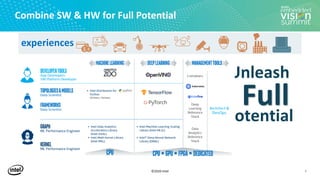
Combine SW & HW for Full Potential
3
libraries
Intel® Math Kernel Library
tools
Frameworks
Intel® Data
Analytics
Acceleration
Library
hardware
Memory & Storage NetworkingCompute
Intel® Distribution for
Python*
Mlib
BigDL
Intel® nGraph™
Compiler
experiences
Movidius Stack
Visual Intelligence
Intel® Parallel Studio XE Intel® Distribution of OpenVINO™ toolkit
Intel® System Studio Intel® SDK for OpenCL™ Applications Intel®
Media SDK
3
©2020 Intel
Interpretation
Imaging
Acquisition
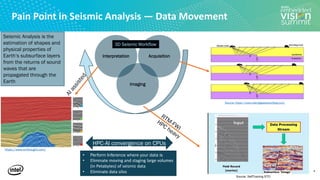
Pain Point in Seismic Analysis — Data Movement
4
Source: https://www.oilandgaslawyerblog.com/
Source: SelfTraining STO
https://www.enthought.com/
HPC-AI convergence on CPUs
• Perform Inference where your data is
• Eliminate moving and staging large volumes
(in Petabytes) of seismic data
• Eliminate data silos
3D Seismic Workflow
Seismic Analysis is the
estimation of shapes and
physical properties of
Earth’s subsurface layers
from the returns of sound
waves that are
propagated through the
Earth
©2020 Intel
Accelerate Performance for Deep Learning Inference
for 3D Seismic
Objective: General purpose Intel® Xeon® can be used for both HPC and AI
workloads in oil and gas – show optimization in AI pipeline
• Full stack solution: Increase performance of DL models for oil & gas datasets on
Intel® Xeon® processor using Intel® Distribution of OpenVINO™ toolkit
• A well-cited 3D seismic use-case was used to show this performance boost
5
©2020 Intel
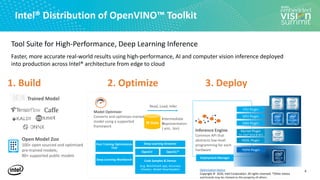
Intel® Distribution of OpenVINO™ Toolkit
66
Tool Suite for High-Performance, Deep Learning Inference
Faster, more accurate real-world results using high-performance, AI and computer vision inference deployed
into production across Intel® architecture from edge to cloud
Optimization Notice
Copyright © 2020, Intel Corporation. All rights reserved. *Other names
and brands may be claimed as the property of others.
1. Build 2. Optimize 3. Deploy
Trained Model
Open Model Zoo
100+ open sourced and optimized
pre-trained models;
80+ supported public models
Model Optimizer
Converts and optimizes trained
model using a supported
framework
IR Data
Read, Load, Infer
Inference Engine
Common API that
abstracts low-level
programming for each
hardware
Intermediate
Representation
(.xml, .bin)
Myriad Plugin
For Intel® NCS2 & NCS
HDDL Plugin
FGPA Plugin
GPU Plugin
GNA Plugin
CPU Plugin
Post-Training Optimization
Tool
Deep Learning Workbench
Deployment Manager
OpenCV OpenCL™
Deep Learning Streamer
Code Samples & Demos
(e.g. Benchmark app, Accuracy
Checker, Model Downloader)
©2020 Intel
The Compounding Effect of Both Hardware and Software
7
*2
*3
7
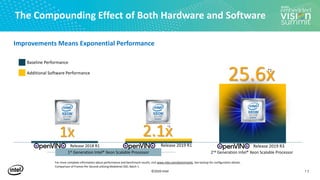
Improvements Means Exponential Performance
Baseline Performance
Additional Software Performance
1x 2.1x
25.6x
For more complete information about performance and benchmark results, visit www.intel.com/benchmarks. See backup for configuration details.
Comparison of Frames Per Second utilizing Mobilenet SSD, Batch 1.
*1
Release 2018 R1 Release 2019 R1 Release 2019 R3
1st Generation Intel® Xeon Scalable Processor 2nd Generation Intel® Xeon Scalable Processor
©2020 Intel
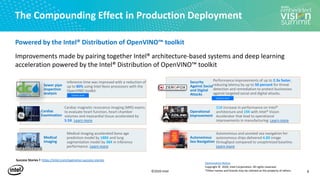
The Compounding Effect in Production Deployment
8
Powered by the Intel® Distribution of OpenVINO™ toolkit
Improvements made by pairing together Intel® architecture-based systems and deep learning
acceleration powered by the Intel® Distribution of OpenVINO™ toolkit
Inference time was improved with a reduction of
up to 80% using Intel Xeon processors with the
OpenVINO toolkit
Sewer pipe
inspection
analysis
Cardiac magnetic resonance imaging (MRI) exams
to evaluate heart function, heart chamber
volumes and myocardial tissue accelerated by
5.5X. Learn more
Cardiac
Examination
Success Stories  https://intel.com/openvino-success-stories
Medical imaging accelerated bone age
prediction model by 188X and lung
segmentation model by 38X in inference
performance. Learn more
Medical
Imaging
Performance improvements of up to 2.3x faster,
reducing latency by up to 50 percent for threat
detection and remediation to protect businesses
against targeted social and digital attacks.
Security
Against Social
and Digital
Attacks
11X increase in performance on Intel®
architecture and 19X with Intel® Vision
Accelerator that lead to operational
improvements in manufacturing. Learn more
Operational
Improvement
Autonomous and assisted sea navigation for
autonomous ships delivered 4.8X image
throughput compared to unoptimized baseline.
Learn more
Autonomous
Sea Navigation
Optimization Notice
Copyright © 2020, Intel Corporation. All rights reserved.
*Other names and brands may be claimed as the property of others.
Philips
healthcare
Solution Brief
Solution Brief
©2020 Intel
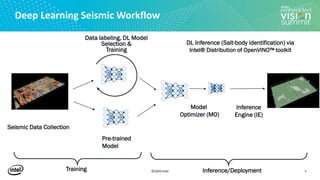
Deep Learning Seismic Workflow
9
Seismic Data Collection
Data labeling, DL Model
Selection &
Training
DL Inference (Salt-body identification) via
Intel® Distribution of OpenVINO™ toolkit
Model
Optimizer (MO)
Inference
Engine (IE)
Training Inference/Deployment
Pre-trained
Model
©2020 Intel
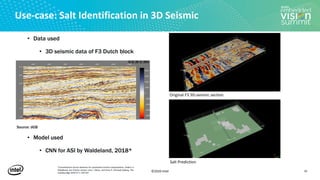
Use-case: Salt Identification in 3D Seismic
10
• Data used
• 3D seismic data of F3 Dutch block
Source: dGB
• Model used
• CNN for ASI by Waldeland, 2018*
Original F3 3D-seismic section
Salt Prediction
*Convolutional neural networks for automated seismic interpretation, Anders U.
Waldeland, Are Charles Jensen, Leiv-J. Gelius, and Anne H. Schistad Solberg, The
Leading Edge 2018 37:7, 529-537
©2020 Intel
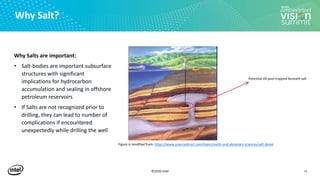
Why Salt?
11
Figure is modified from: https://www.sciencedirect.com/topics/earth-and-planetary-sciences/salt-dome
Why Salts are important:
• Salt-bodies are important subsurface
structures with significant
implications for hydrocarbon
accumulation and sealing in offshore
petroleum reservoirs
• If Salts are not recognized prior to
drilling, they can lead to number of
complications if encountered
unexpectedly while drilling the well
©2020 Intel
Salt Identification CNN Model*
12
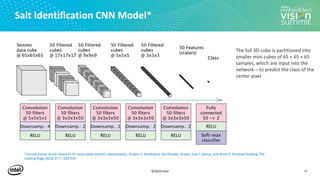
The full 3D cube is partitioned into
smaller mini cubes of 65 × 65 × 65
samples, which are input into the
network – to predict the class of the
center pixel
*Convolutional neural networks for automated seismic interpretation, Anders U. Waldeland, Are Charles Jensen, Leiv-J. Gelius, and Anne H. Schistad Solberg, The
Leading Edge 2018 37:7, 529-537
©2020 Intel
Performance Result
13
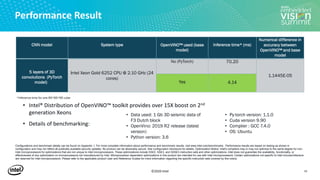
CNN model System type OpenVINO™ used (base
model)
Inference time* (ms)
Numerical difference in
accuracy between
OpenVINO™ and base
model
5 layers of 3D
convolutions (PyTorch
model)
Intel Xeon Gold 6252 CPU @ 2.10 GHz (24
cores)
No (PyTorch) 70.20
1.1445E-05
Yes 4.14
*Inference time for one 65*65*65 cube
• Intel® Distribution of OpenVINO™ toolkit provides over 15X boost on 2nd
generation Xeons
• Details of benchmarking:
• Data used: 1 Gb 3D seismic data of
F3 Dutch block
• OpenVino: 2019 R2 release (latest
version)
• Python version: 3.6
• Py-torch version: 1.1.0
• Cuda version 9.90
• Complier : GCC 7.4.0
• OS: Ubuntu
Configurations and benchmark details can be found on Appendix 1. For more complete information about performance and benchmark results, visit www.intel.com/benchmarks. Performance results are based on testing as shown in
configuration and may not reflect all publically available security updates. No product can be absolutely secure. See configuration disclosure for details. Optimization Notice: Intel's compilers may or may not optimize to the same degree for non-
Intel microprocessors for optimizations that are not unique to Intel microprocessors. These optimizations include SSE2, SSE3, and SSSE3 instruction sets and other optimizations. Intel does not guarantee the availability, functionality, or
effectiveness of any optimization on microprocessors not manufactured by Intel. Microprocessor-dependent optimizations in this product are intended for use with Intel microprocessors. Certain optimizations not specific to Intel microarchitecture
are reserved for Intel microprocessors. Please refer to the applicable product User and Reference Guides for more information regarding the specific instruction sets covered by this notice.
©2020 Intel
Performance Result
14
0
0.01
0.02
0.03
0.04
0.05
0.06
0.07
0.08
0.09
0.1
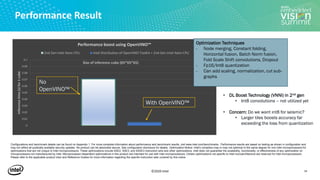
Inferencetime(s)for1cube
Size of inference cube (65*65*65)
Performance boost using OpenVINO™
2nd Gen Intel Xeon CPU Intel Distribution of OpenVINO Toolkit + 2nd Gen Intel Xeon CPU
Configurations and benchmark details can be found on Appendix 1. For more complete information about performance and benchmark results, visit www.intel.com/benchmarks. Performance results are based on testing as shown in configuration and
may not reflect all publically available security updates. No product can be absolutely secure. See configuration disclosure for details. Optimization Notice: Intel's compilers may or may not optimize to the same degree for non-Intel microprocessors for
optimizations that are not unique to Intel microprocessors. These optimizations include SSE2, SSE3, and SSSE3 instruction sets and other optimizations. Intel does not guarantee the availability, functionality, or effectiveness of any optimization on
microprocessors not manufactured by Intel. Microprocessor-dependent optimizations in this product are intended for use with Intel microprocessors. Certain optimizations not specific to Intel microarchitecture are reserved for Intel microprocessors.
Please refer to the applicable product User and Reference Guides for more information regarding the specific instruction sets covered by this notice.
• DL Boost Technology (VNNI) in 2nd gen
• Int8 convolutions – not utilized yet
• Concern: Do we want int8 for seismic?
• Larger tiles boosts accuracy far
exceeding the loss from quantization
With OpenVINO™
No
OpenVINO™
Optimization Techniques
- Node merging, Constant folding,
Horizontal fusion, Batch Norm fusion,
Fold Scale Shift convolutions, Dropout
- Fp16/Int8 quantization
- Can add scaling, normalization, cut sub-
graphs
©2020 Intel
Intel R&D: Small V/S Large Tiles — Accuracy is Better With
Larger!
15
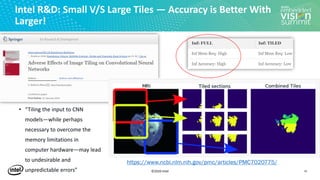
• “Tiling the input to CNN
models—while perhaps
necessary to overcome the
memory limitations in
computer hardware—may lead
to undesirable and
unpredictable errors”
https://www.ncbi.nlm.nih.gov/pmc/articles/PMC7020775/
©2020 Intel
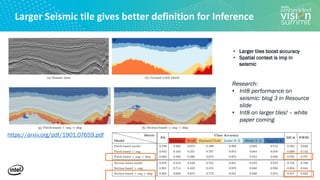
Larger Seismic tile gives better definition for Inference
16
Research:
• Int8 performance on
seismic: blog 3 in Resource
slide
• Int8 on larger tiles! – white
paper coming
• Larger tiles boost accuracy
• Spatial context is imp in
seismic
https://arxiv.org/pdf/1901.07659.pdf
©2020 Intel
Key Takeaway
17
The general-purpose 2nd generation Intel® Xeon® Scalable Processor together with
Intel® Distribution of OpenVINO™ toolkit provides DL performance that is well suited
for Oil and Gas datasets
✓ Use OpenVINO™ toolkit to boost inference performance for oil and gas
datasets on Intel® Xeon® processor
✓ Int 8 quantization with larger tiles on 2nd generation Intel® Xeon®
processor gives even better performance boost for seismic data – see
blog 3 in Resources slide
✓ Scale DL on existing CPUs that are used for HPC
✓ Use CPUs for other workloads when not doing DL
©2020 Intel
Resource Slide
18
Resources for OpenVINO™ toolkit
OpenVINO™ toolkit guide
Download OpenVINO™ toolkit
Resource for Seismic
Seismic model used in this work
Blogs published on OpenVINO™ toolkit + seismic
Blog 1: Accelerating fault detection in 3D Seismic
Blog 2: Accelerating seismic Interpretation using
OpenVINO™
Blog 3: Lower Precision Pipeline for Seismic
Interpretation
2020 Embedded Vision Summit
Intel Booth
© 2020 Intel Corporation
Workshops and demos to visit
19
In-depth technical workshops
• Friday, September 18, 9:00 a.m. to 1:30 p.m. PDT: Using the Intel® Distribution of the OpenVINO™ Toolkit for Deploying Accelerated Deep
Learning Applications
• Monday, September 21, 9:00 a.m. to 1:30 p.m. PDT: Intel’s Edge AI for Retail
• Wednesday, September 23, 9:00 a.m. to 1:30 p.m. PDT: Intel’s Edge AI for Industrial
Technical presentations
Dedicated demos and networking space
• Alexander Kozlov, Deep Learning R&D engineer, Intel: Recent Advances in Post-Training Quantization
• Dr. Manas Pathak, Global AI lead for oil and gas, Intel: Acceleration of Deep Learning for 3D Seismic
• Tara K. Thimmanaik, solutions architect, Intel: Smarter Manufacturing Achieved with Intel’s Deep Learning-Based Machine Vision
• Gary Brown, Director of AI Marketing, Intel: Getting Efficient DL Inference Performance: Is It Really All About The TOPS?
• Rama Karamsetty, Edge AI Marketing Manager, Intel: Edge Inferencing-- Scaling w/ Vision Accelerator Cards
• Vaidyanathan Krishnamoorthy, edge inference solutions architect, Intel: Federated Edge Inferencing
General Session Speaker:
• Bill Pearson, VP IOTG, GM Developer Enabling, Intel, Tuesday, September 15, 10:00 a.m. to 10:30 a.m. PDT: Streamline, Simplify and Solve for
the Edge of the Future

“Acceleration of Deep Learning Using OpenVINO: 3D Seismic Case Study,” a Presentation from Intel

  • 1.
    ©2020 Intel Acceleration ofDeep Learning using Intel® Distribution of OpenVINO™ toolkit: 3D Seismic Case Study Manas Pathak Global AI Lead for Oil & Gas September 2020
  • 2.
    ©2020 Intel Notices andDisclaimers Intel does not control or audit third-party benchmark data or the web sites referenced in this document. You should visit the referenced web site and confirm whether referenced data are accurate. For more complete information about performance and benchmark results, visit www.intel.com/benchmarks. Intel technologies’ features and benefits depend on system configuration and may require enabled hardware, software or service activation. Learn more at intel.com, or from the OEM or retailer. The cost reduction scenarios described are intended to enable you to get a better understanding of how the purchase of a given Intel based product, combined with a number of situation-specific variables, might affect future costs and savings. Circumstances will vary and there may be unaccounted-for costs related to the use and deployment of a given product. Nothing in this document should be interpreted as either a promise of or contract for a given level of costs or cost reduction. Optimization Notice: Intel's compilers may or may not optimize to the same degree for non-Intel microprocessors for optimizations that are not unique to Intel microprocessors. These optimizations include SSE2, SSE3, and SSSE3 instruction sets and other optimizations. Intel does not guarantee the availability, functionality, or effectiveness of any optimization on microprocessors not manufactured by Intel. Microprocessor-dependent optimizations in this product are intended for use with Intel microprocessors. Certain optimizations not specific to Intel microarchitecture are reserved for Intel microprocessors. Please refer to the applicable product User and Reference Guides for more information regarding the specific instruction sets covered by this notice. No computer system can be absolutely secure. Intel® Advanced Vector Extensions (Intel® AVX)* provides higher throughput to certain processor operations. Due to varying processor power characteristics, utilizing AVX instructions may cause a) some parts to operate at less than the rated frequency and b) some parts with Intel® Turbo Boost Technology 2.0 to not achieve any or maximum turbo frequencies. Performance varies depending on hardware, software, and system configuration and you can learn more at http://www.intel.com/go/turbo. Intel processors of the same SKU may vary in frequency or power as a result of natural variability in the production process. © 2020 Intel Corporation. Intel, Xeon, Optane, 3D Xpoint, DL Boost, AVX, the Intel logo, and Xeon logos are trademarks of Intel Corporation in the U.S. and/or other countries. Intel Corporation. *Other names and brands may be claimed as the property of others. OpenVINO is a trademark of Intel Corporation or its subsidiaries. Results have been estimated or simulated using internal Intel analysis or architecture simulation or modeling, and provided to you for informational purposes. Any differences in your system hardware, software or configuration may affect your actual performance. INFORMATION IN THIS DOCUMENT IS PROVIDED “AS IS”. NO LICENSE, EXPRESS OR IMPLIED, BY ESTOPPEL OR OTHERWISE, TO ANY INTELLECTUAL PROPERTY RIGHTS IS GRANTED BY THIS DOCUMENT. INTEL ASSUMES NO LIABILITY WHATSOEVER AND INTEL DISCLAIMS ANY EXPRESS OR IMPLIED WARRANTY, RELATING TO THIS INFORMATION INCLUDING LIABILITY OR WARRANTIES RELATING TO FITNESS FOR A PARTICULAR PURPOSE, MERCHANTABILITY, OR INFRINGEMENT OF ANY PATENT, COPYRIGHT OR OTHER INTELLECTUAL PROPERTY RIGHT.
  • 3.
    ©2020 Intel Combine SW& HW for Full Potential 3 libraries Intel® Math Kernel Library tools Frameworks Intel® Data Analytics Acceleration Library hardware Memory & Storage NetworkingCompute Intel® Distribution for Python* Mlib BigDL Intel® nGraph™ Compiler experiences Movidius Stack Visual Intelligence Intel® Parallel Studio XE Intel® Distribution of OpenVINO™ toolkit Intel® System Studio Intel® SDK for OpenCL™ Applications Intel® Media SDK 3
  • 4.
    ©2020 Intel Interpretation Imaging Acquisition Pain Pointin Seismic Analysis — Data Movement 4 Source: https://www.oilandgaslawyerblog.com/ Source: SelfTraining STO https://www.enthought.com/ HPC-AI convergence on CPUs • Perform Inference where your data is • Eliminate moving and staging large volumes (in Petabytes) of seismic data • Eliminate data silos 3D Seismic Workflow Seismic Analysis is the estimation of shapes and physical properties of Earth’s subsurface layers from the returns of sound waves that are propagated through the Earth
  • 5.
    ©2020 Intel Accelerate Performancefor Deep Learning Inference for 3D Seismic Objective: General purpose Intel® Xeon® can be used for both HPC and AI workloads in oil and gas – show optimization in AI pipeline • Full stack solution: Increase performance of DL models for oil & gas datasets on Intel® Xeon® processor using Intel® Distribution of OpenVINO™ toolkit • A well-cited 3D seismic use-case was used to show this performance boost 5
  • 6.
    ©2020 Intel Intel® Distributionof OpenVINO™ Toolkit 66 Tool Suite for High-Performance, Deep Learning Inference Faster, more accurate real-world results using high-performance, AI and computer vision inference deployed into production across Intel® architecture from edge to cloud Optimization Notice Copyright © 2020, Intel Corporation. All rights reserved. *Other names and brands may be claimed as the property of others. 1. Build 2. Optimize 3. Deploy Trained Model Open Model Zoo 100+ open sourced and optimized pre-trained models; 80+ supported public models Model Optimizer Converts and optimizes trained model using a supported framework IR Data Read, Load, Infer Inference Engine Common API that abstracts low-level programming for each hardware Intermediate Representation (.xml, .bin) Myriad Plugin For Intel® NCS2 & NCS HDDL Plugin FGPA Plugin GPU Plugin GNA Plugin CPU Plugin Post-Training Optimization Tool Deep Learning Workbench Deployment Manager OpenCV OpenCL™ Deep Learning Streamer Code Samples & Demos (e.g. Benchmark app, Accuracy Checker, Model Downloader)
  • 7.
    ©2020 Intel The CompoundingEffect of Both Hardware and Software 7 *2 *3 7 Improvements Means Exponential Performance Baseline Performance Additional Software Performance 1x 2.1x 25.6x For more complete information about performance and benchmark results, visit www.intel.com/benchmarks. See backup for configuration details. Comparison of Frames Per Second utilizing Mobilenet SSD, Batch 1. *1 Release 2018 R1 Release 2019 R1 Release 2019 R3 1st Generation Intel® Xeon Scalable Processor 2nd Generation Intel® Xeon Scalable Processor
  • 8.
    ©2020 Intel The CompoundingEffect in Production Deployment 8 Powered by the Intel® Distribution of OpenVINO™ toolkit Improvements made by pairing together Intel® architecture-based systems and deep learning acceleration powered by the Intel® Distribution of OpenVINO™ toolkit Inference time was improved with a reduction of up to 80% using Intel Xeon processors with the OpenVINO toolkit Sewer pipe inspection analysis Cardiac magnetic resonance imaging (MRI) exams to evaluate heart function, heart chamber volumes and myocardial tissue accelerated by 5.5X. Learn more Cardiac Examination Success Stories  https://intel.com/openvino-success-stories Medical imaging accelerated bone age prediction model by 188X and lung segmentation model by 38X in inference performance. Learn more Medical Imaging Performance improvements of up to 2.3x faster, reducing latency by up to 50 percent for threat detection and remediation to protect businesses against targeted social and digital attacks. Security Against Social and Digital Attacks 11X increase in performance on Intel® architecture and 19X with Intel® Vision Accelerator that lead to operational improvements in manufacturing. Learn more Operational Improvement Autonomous and assisted sea navigation for autonomous ships delivered 4.8X image throughput compared to unoptimized baseline. Learn more Autonomous Sea Navigation Optimization Notice Copyright © 2020, Intel Corporation. All rights reserved. *Other names and brands may be claimed as the property of others. Philips healthcare Solution Brief Solution Brief
  • 9.
    ©2020 Intel Deep LearningSeismic Workflow 9 Seismic Data Collection Data labeling, DL Model Selection & Training DL Inference (Salt-body identification) via Intel® Distribution of OpenVINO™ toolkit Model Optimizer (MO) Inference Engine (IE) Training Inference/Deployment Pre-trained Model
  • 10.
    ©2020 Intel Use-case: SaltIdentification in 3D Seismic 10 • Data used • 3D seismic data of F3 Dutch block Source: dGB • Model used • CNN for ASI by Waldeland, 2018* Original F3 3D-seismic section Salt Prediction *Convolutional neural networks for automated seismic interpretation, Anders U. Waldeland, Are Charles Jensen, Leiv-J. Gelius, and Anne H. Schistad Solberg, The Leading Edge 2018 37:7, 529-537
  • 11.
    ©2020 Intel Why Salt? 11 Figureis modified from: https://www.sciencedirect.com/topics/earth-and-planetary-sciences/salt-dome Why Salts are important: • Salt-bodies are important subsurface structures with significant implications for hydrocarbon accumulation and sealing in offshore petroleum reservoirs • If Salts are not recognized prior to drilling, they can lead to number of complications if encountered unexpectedly while drilling the well
  • 12.
    ©2020 Intel Salt IdentificationCNN Model* 12 The full 3D cube is partitioned into smaller mini cubes of 65 × 65 × 65 samples, which are input into the network – to predict the class of the center pixel *Convolutional neural networks for automated seismic interpretation, Anders U. Waldeland, Are Charles Jensen, Leiv-J. Gelius, and Anne H. Schistad Solberg, The Leading Edge 2018 37:7, 529-537
  • 13.
    ©2020 Intel Performance Result 13 CNNmodel System type OpenVINO™ used (base model) Inference time* (ms) Numerical difference in accuracy between OpenVINO™ and base model 5 layers of 3D convolutions (PyTorch model) Intel Xeon Gold 6252 CPU @ 2.10 GHz (24 cores) No (PyTorch) 70.20 1.1445E-05 Yes 4.14 *Inference time for one 65*65*65 cube • Intel® Distribution of OpenVINO™ toolkit provides over 15X boost on 2nd generation Xeons • Details of benchmarking: • Data used: 1 Gb 3D seismic data of F3 Dutch block • OpenVino: 2019 R2 release (latest version) • Python version: 3.6 • Py-torch version: 1.1.0 • Cuda version 9.90 • Complier : GCC 7.4.0 • OS: Ubuntu Configurations and benchmark details can be found on Appendix 1. For more complete information about performance and benchmark results, visit www.intel.com/benchmarks. Performance results are based on testing as shown in configuration and may not reflect all publically available security updates. No product can be absolutely secure. See configuration disclosure for details. Optimization Notice: Intel's compilers may or may not optimize to the same degree for non- Intel microprocessors for optimizations that are not unique to Intel microprocessors. These optimizations include SSE2, SSE3, and SSSE3 instruction sets and other optimizations. Intel does not guarantee the availability, functionality, or effectiveness of any optimization on microprocessors not manufactured by Intel. Microprocessor-dependent optimizations in this product are intended for use with Intel microprocessors. Certain optimizations not specific to Intel microarchitecture are reserved for Intel microprocessors. Please refer to the applicable product User and Reference Guides for more information regarding the specific instruction sets covered by this notice.
  • 14.
    ©2020 Intel Performance Result 14 0 0.01 0.02 0.03 0.04 0.05 0.06 0.07 0.08 0.09 0.1 Inferencetime(s)for1cube Sizeof inference cube (65*65*65) Performance boost using OpenVINO™ 2nd Gen Intel Xeon CPU Intel Distribution of OpenVINO Toolkit + 2nd Gen Intel Xeon CPU Configurations and benchmark details can be found on Appendix 1. For more complete information about performance and benchmark results, visit www.intel.com/benchmarks. Performance results are based on testing as shown in configuration and may not reflect all publically available security updates. No product can be absolutely secure. See configuration disclosure for details. Optimization Notice: Intel's compilers may or may not optimize to the same degree for non-Intel microprocessors for optimizations that are not unique to Intel microprocessors. These optimizations include SSE2, SSE3, and SSSE3 instruction sets and other optimizations. Intel does not guarantee the availability, functionality, or effectiveness of any optimization on microprocessors not manufactured by Intel. Microprocessor-dependent optimizations in this product are intended for use with Intel microprocessors. Certain optimizations not specific to Intel microarchitecture are reserved for Intel microprocessors. Please refer to the applicable product User and Reference Guides for more information regarding the specific instruction sets covered by this notice. • DL Boost Technology (VNNI) in 2nd gen • Int8 convolutions – not utilized yet • Concern: Do we want int8 for seismic? • Larger tiles boosts accuracy far exceeding the loss from quantization With OpenVINO™ No OpenVINO™ Optimization Techniques - Node merging, Constant folding, Horizontal fusion, Batch Norm fusion, Fold Scale Shift convolutions, Dropout - Fp16/Int8 quantization - Can add scaling, normalization, cut sub- graphs
  • 15.
    ©2020 Intel Intel R&D:Small V/S Large Tiles — Accuracy is Better With Larger! 15 • “Tiling the input to CNN models—while perhaps necessary to overcome the memory limitations in computer hardware—may lead to undesirable and unpredictable errors” https://www.ncbi.nlm.nih.gov/pmc/articles/PMC7020775/
  • 16.
    ©2020 Intel Larger Seismictile gives better definition for Inference 16 Research: • Int8 performance on seismic: blog 3 in Resource slide • Int8 on larger tiles! – white paper coming • Larger tiles boost accuracy • Spatial context is imp in seismic https://arxiv.org/pdf/1901.07659.pdf
  • 17.
    ©2020 Intel Key Takeaway 17 Thegeneral-purpose 2nd generation Intel® Xeon® Scalable Processor together with Intel® Distribution of OpenVINO™ toolkit provides DL performance that is well suited for Oil and Gas datasets ✓ Use OpenVINO™ toolkit to boost inference performance for oil and gas datasets on Intel® Xeon® processor ✓ Int 8 quantization with larger tiles on 2nd generation Intel® Xeon® processor gives even better performance boost for seismic data – see blog 3 in Resources slide ✓ Scale DL on existing CPUs that are used for HPC ✓ Use CPUs for other workloads when not doing DL
  • 18.
    ©2020 Intel Resource Slide 18 Resourcesfor OpenVINO™ toolkit OpenVINO™ toolkit guide Download OpenVINO™ toolkit Resource for Seismic Seismic model used in this work Blogs published on OpenVINO™ toolkit + seismic Blog 1: Accelerating fault detection in 3D Seismic Blog 2: Accelerating seismic Interpretation using OpenVINO™ Blog 3: Lower Precision Pipeline for Seismic Interpretation 2020 Embedded Vision Summit Intel Booth
  • 19.
    © 2020 IntelCorporation Workshops and demos to visit 19 In-depth technical workshops • Friday, September 18, 9:00 a.m. to 1:30 p.m. PDT: Using the Intel® Distribution of the OpenVINO™ Toolkit for Deploying Accelerated Deep Learning Applications • Monday, September 21, 9:00 a.m. to 1:30 p.m. PDT: Intel’s Edge AI for Retail • Wednesday, September 23, 9:00 a.m. to 1:30 p.m. PDT: Intel’s Edge AI for Industrial Technical presentations Dedicated demos and networking space • Alexander Kozlov, Deep Learning R&D engineer, Intel: Recent Advances in Post-Training Quantization • Dr. Manas Pathak, Global AI lead for oil and gas, Intel: Acceleration of Deep Learning for 3D Seismic • Tara K. Thimmanaik, solutions architect, Intel: Smarter Manufacturing Achieved with Intel’s Deep Learning-Based Machine Vision • Gary Brown, Director of AI Marketing, Intel: Getting Efficient DL Inference Performance: Is It Really All About The TOPS? • Rama Karamsetty, Edge AI Marketing Manager, Intel: Edge Inferencing-- Scaling w/ Vision Accelerator Cards • Vaidyanathan Krishnamoorthy, edge inference solutions architect, Intel: Federated Edge Inferencing General Session Speaker: • Bill Pearson, VP IOTG, GM Developer Enabling, Intel, Tuesday, September 15, 10:00 a.m. to 10:30 a.m. PDT: Streamline, Simplify and Solve for the Edge of the Future