Accelerating NoSQL
   Running Voldemort on HailDB


         Sunny Gleason
         March 11, 2011
whoami
• Sunny Gleason, human
• passion: distributed systems engineering
• previous...
   Ning : custom social networks
   Amazon.com : infra & web services
• now...
   building cloud infrastructure
whereami

• twitter : twitter.com/sunnygleason
• github : github.com/sunnygleason
• linkedin : linkedin.com/in/sunnygleason
what’s in this presentation?

  • NoSQL Roundup
  • Voldemort who?
  • HailDB wha?
  • Results & Next Steps
  • Special Bonus Material
NoSQL

• “Not Only” SQL
• What’s the point?
• Proponent: “reaching next level of scale”
• Cynic: “cloud is hype, ops nightmare”
what does it gain?

• Higher performance, scalability, availability
• More robust fault-tolerance
• Simplified systems design
• Easier operations
what does it lose?
• Reduced / simplified programming model
• No ad-hoc queries, no joins, no txns
• Not ACID: Atomicity / Consistency /
  Isolation / Durability
• Operations / management is still evolving
• Challenging to quantify health of system
• Fewer domain experts
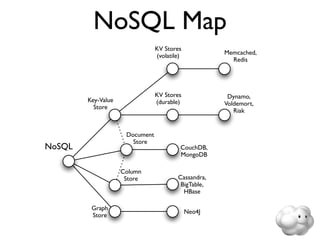
NoSQL Map
                                KV Stores
                                (volatile)           Memcached,
                                                       Redis


                                KV Stores             Dynamo,
        Key-Value               (durable)            Voldemort,
          Store
                                                        Riak


                     Document
                       Store
NoSQL                                    CouchDB,
                                         MongoDB

                    Column
                     Store              Cassandra,
                                         BigTable,
                                          HBase

         Graph
                                             Neo4J
         Store
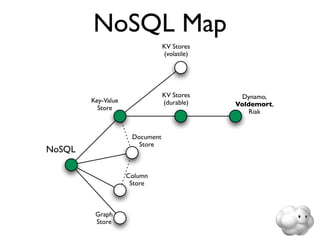
NoSQL Map
                                KV Stores
                                (volatile)


                                KV Stores      Dynamo,
        Key-Value               (durable)    Voldemort,
          Store
                                                 Riak


                     Document
                       Store
NoSQL

                    Column
                     Store


         Graph
         Store
motivation

• database on 1 box : ok
• database with master/slave replication : ok
• database on cluster : tricky
• database on SAN : time bomb
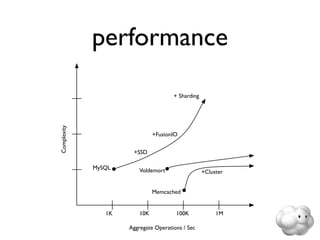
performance
                                      + Sharding
Complexity


                               +FusionIO

                      +SSD

             MySQL       Voldemort                 +Cluster


                               Memcached


                1K       10K           100K             1M

                     Aggregate Operations / Sec
dynamo case study
• Amazon : high read throughput, always-
  accessible writes
• Shopping cart application
• ‘Glitches’ ok, duplicate or missing item
• Data loss or unavailability is unacceptable
• Solution: K-V schema plus smart routing &
  data placement
key-value storage
• Essentially, a gigantic hash table
• Typically assign byte[] values to byte[] keys
• Plus versioning mixed in to handle failures
  and conflicts
• Yes, you *can* do range partitioning; in
  practice, avoid it because of hot spots
k-v: durable vs. volatile

• RAM is ridiculous speed (ns), not durable
• Disk is persistent and slow (3-7ms)
• RAID eases the pain a bit (4-8x throughput)
• SSD is providing good promise (100-300us)
• FusionIO is redefining the space (30-100us)
dynamo clones

• Voldemort : from LinkedIn, dynamo
  implementation in Java (default: BDB-JE)
• Riak : from Basho, dynamo implementation
  in Erlang (default: embedded InnoDB)
Voldemort

• Developed at LinkedIn
• Scalable Key-Value Storage
• Based on Amazon Dynamo model
• High Read Throughput
• Always Writable
Voldemort features

• Consistent Hashing
• Quorum settings : R, W, N
• Auto-sharding & rebalancing
• Pluggable storage engines
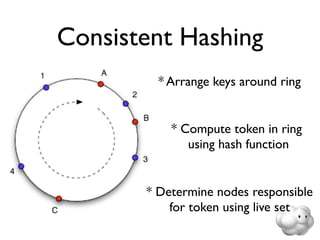
Consistent Hashing
         * Arrange keys around ring


           * Compute token in ring
              using hash function


       * Determine nodes responsible
           for token using live set
R/W/N
• N : maximum number of nodes to query
  for an operation
• R : read quorum
• W : write quorum
• Can adjust ‘quorum’ to balance throughput
  and fault-tolerance
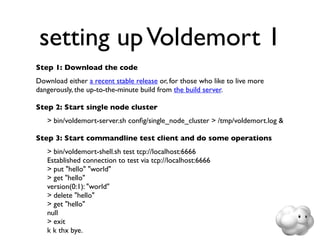
setting up Voldemort 1
Step 1: Download the code
Download either a recent stable release or, for those who like to live more
dangerously, the up-to-the-minute build from the build server.

Step 2: Start single node cluster
	

   > bin/voldemort-server.sh config/single_node_cluster > /tmp/voldemort.log &

Step 3: Start commandline test client and do some operations
	

   > bin/voldemort-shell.sh test tcp://localhost:6666
	

   Established connection to test via tcp://localhost:6666
	

   > put "hello" "world"
	

   > get "hello"
	

   version(0:1): "world"
	

   > delete "hello"
	

   > get "hello"
	

   null
	

   > exit
	

   k k thx bye.
setting up Voldemort 2

• For a cluster, use cloud startup scripts
• Works with Amazon EC2
• See https://github.com/voldemort/
  voldemort/wiki/EC2-Testing-Infrastructure
Voldemort client libraries


• Java, Scala, Clojure
• Ruby
• Python
• C++
storage engines

• BDB-JE (Oracle Sleepycat, the original)
• Krati (LinkedIn, pretty new)
• HailDB (new!)
• MySQL (old / dated)
BDB-JE

• Log-Structured B-Tree
• Fast Storage When Mostly Cached
• Configured without fsync() by default -
  writes are batched and flushed periodically
Krati

• Fast Hash-Oriented Storage
• Uses memory-mapped files for speed
• Configured without fsync() by default -
  writes are batched and flushed periodically
HailDB
• Fork of MySQL InnoDB plugin
  (contributors : Oracle, Google, Facebook,
  Percona)
• Higher stability for large data sets
• Fast crash recovery
• External from Java heap (ease GC pain)
• apt-get install haildb (from launchpad PPA)
• Use “flush-once-per-second” mode
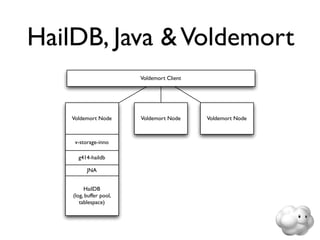
HailDB, Java & Voldemort
                         Voldemort Client


    Voldemort Node       Voldemort Node     Voldemort Node


     v-storage-inno

      g414-haildb

          JNA


         HailDB
    (log, buffer pool,
       tablespace)
HailDB & Java

• g414-haildb : where the magic happens
• uses JNA: Java Native Access
• dynamic binding to libhaildb shared library
• auto-generated from .h file (w/ JNAerator)
• Pointer classes & other shenanigans
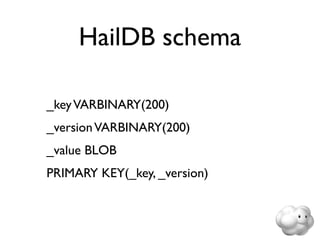
HailDB schema

_key VARBINARY(200)
_version VARBINARY(200)
_value BLOB
PRIMARY KEY(_key, _version)
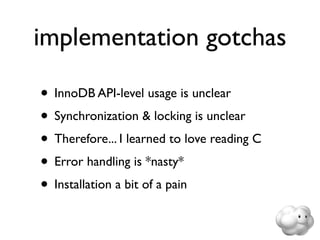
implementation gotchas

• InnoDB API-level usage is unclear
• Synchronization & locking is unclear
• Therefore... I learned to love reading C
• Error handling is *nasty*
• Installation a bit of a pain
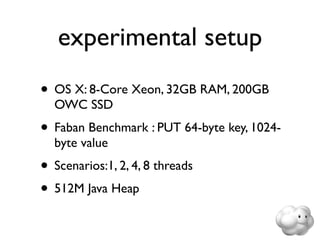
experimental setup
• OS X: 8-Core Xeon, 32GB RAM, 200GB
  OWC SSD
• Faban Benchmark : PUT 64-byte key, 1024-
  byte value
• Scenarios:1, 2, 4, 8 threads
• 512M Java Heap
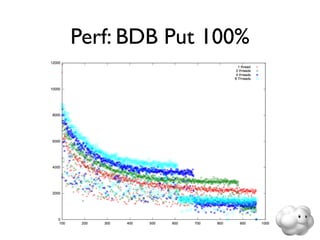
Perf: BDB Put 100%
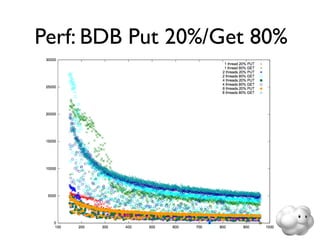
Perf: BDB Put 20%/Get 80%
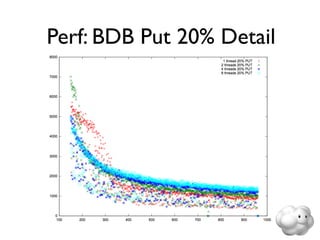
Perf: BDB Put 20% Detail
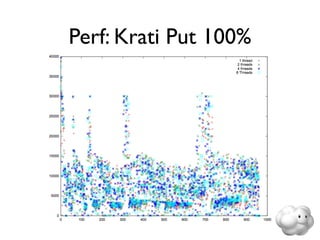
Perf: Krati Put 100%
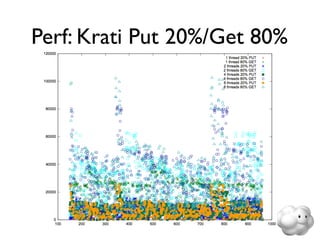
Perf: Krati Put 20%/Get 80%
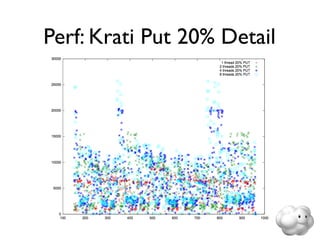
Perf: Krati Put 20% Detail
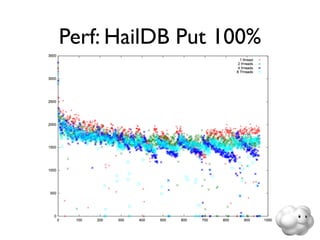
Perf: HailDB Put 100%
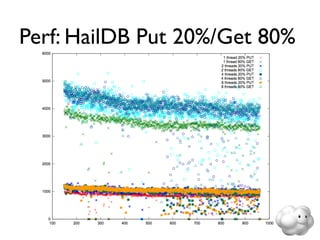
Perf: HailDB Put 20%/Get 80%
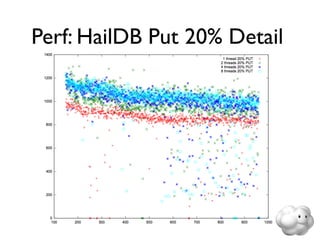
Perf: HailDB Put 20% Detail
future work

• Improve Packaging / Installation
• Schema refinements & perf enhancements
• Online backup/export with XtraBackup
• JNI Bindings
schema refinements
• Build upon Nokia work on fast k-v schema
• 8-byte ‘long’ key hash vs. full key bytes
• Smart use of secondary indexes
• Native representation of vector clocks
• Delayed / soft deletion
• Expect 40-50% performance boost
InnoDB tuning
• Skinny columns, skinny rows! (esp. Primary Key)
 • Varchar enum ‘bad’, int or smallint ‘good’
 • fixed-width rows allows in-place updates
• Use covering indexes strategically
• More data per page means faster index scans,
  more efficient buffer pool utilization
• You only get so many trx’s on given CPU/RAM
  configuration - benchmark this!
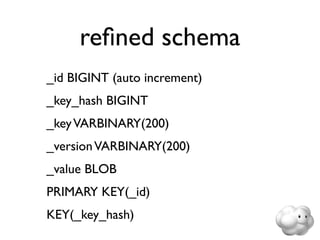
refined schema
_id BIGINT (auto increment)
_key_hash BIGINT
_key VARBINARY(200)
_version VARBINARY(200)
_value BLOB
PRIMARY KEY(_id)
KEY(_key_hash)
online backup

• hot backup of data to other machine /
  destination
• test Percona Xtrabackup with HailDB
• next step: backup/export to Hadoop/HDFS
  (similar to Cloudera Sqoop tool)
JNI bindings

• JNI can get 2-5x perf boost vs. JNA
• ... at the expense of nasty code
• Will go for schema optimizations and
  InnoDB tuning tips *first*
resources

• github.com/voldemort/voldemort
  freenode #voldemort
• github.com/sunnygleason/v-storage-haildb
  github.com/sunnygleason/v-storage-bench
  github.com/sunnygleason/g414-haildb
• jna.dev.java.net
more resources

• Amazon Dynamo
• Faban / XFaban
• HailDB
• Drizzle
• PBXT
Thank You!

Accelerating NoSQL

  • 1.
    Accelerating NoSQL Running Voldemort on HailDB Sunny Gleason March 11, 2011
  • 2.
    whoami • Sunny Gleason,human • passion: distributed systems engineering • previous... Ning : custom social networks Amazon.com : infra & web services • now... building cloud infrastructure
  • 3.
    whereami • twitter :twitter.com/sunnygleason • github : github.com/sunnygleason • linkedin : linkedin.com/in/sunnygleason
  • 4.
    what’s in thispresentation? • NoSQL Roundup • Voldemort who? • HailDB wha? • Results & Next Steps • Special Bonus Material
  • 5.
    NoSQL • “Not Only”SQL • What’s the point? • Proponent: “reaching next level of scale” • Cynic: “cloud is hype, ops nightmare”
  • 6.
    what does itgain? • Higher performance, scalability, availability • More robust fault-tolerance • Simplified systems design • Easier operations
  • 7.
    what does itlose? • Reduced / simplified programming model • No ad-hoc queries, no joins, no txns • Not ACID: Atomicity / Consistency / Isolation / Durability • Operations / management is still evolving • Challenging to quantify health of system • Fewer domain experts
  • 8.
    NoSQL Map KV Stores (volatile) Memcached, Redis KV Stores Dynamo, Key-Value (durable) Voldemort, Store Riak Document Store NoSQL CouchDB, MongoDB Column Store Cassandra, BigTable, HBase Graph Neo4J Store
  • 9.
    NoSQL Map KV Stores (volatile) KV Stores Dynamo, Key-Value (durable) Voldemort, Store Riak Document Store NoSQL Column Store Graph Store
  • 10.
    motivation • database on1 box : ok • database with master/slave replication : ok • database on cluster : tricky • database on SAN : time bomb
  • 11.
    performance + Sharding Complexity +FusionIO +SSD MySQL Voldemort +Cluster Memcached 1K 10K 100K 1M Aggregate Operations / Sec
  • 12.
    dynamo case study •Amazon : high read throughput, always- accessible writes • Shopping cart application • ‘Glitches’ ok, duplicate or missing item • Data loss or unavailability is unacceptable • Solution: K-V schema plus smart routing & data placement
  • 13.
    key-value storage • Essentially,a gigantic hash table • Typically assign byte[] values to byte[] keys • Plus versioning mixed in to handle failures and conflicts • Yes, you *can* do range partitioning; in practice, avoid it because of hot spots
  • 14.
    k-v: durable vs.volatile • RAM is ridiculous speed (ns), not durable • Disk is persistent and slow (3-7ms) • RAID eases the pain a bit (4-8x throughput) • SSD is providing good promise (100-300us) • FusionIO is redefining the space (30-100us)
  • 15.
    dynamo clones • Voldemort: from LinkedIn, dynamo implementation in Java (default: BDB-JE) • Riak : from Basho, dynamo implementation in Erlang (default: embedded InnoDB)
  • 16.
    Voldemort • Developed atLinkedIn • Scalable Key-Value Storage • Based on Amazon Dynamo model • High Read Throughput • Always Writable
  • 17.
    Voldemort features • ConsistentHashing • Quorum settings : R, W, N • Auto-sharding & rebalancing • Pluggable storage engines
  • 18.
    Consistent Hashing * Arrange keys around ring * Compute token in ring using hash function * Determine nodes responsible for token using live set
  • 19.
    R/W/N • N :maximum number of nodes to query for an operation • R : read quorum • W : write quorum • Can adjust ‘quorum’ to balance throughput and fault-tolerance
  • 20.
    setting up Voldemort1 Step 1: Download the code Download either a recent stable release or, for those who like to live more dangerously, the up-to-the-minute build from the build server. Step 2: Start single node cluster > bin/voldemort-server.sh config/single_node_cluster > /tmp/voldemort.log & Step 3: Start commandline test client and do some operations > bin/voldemort-shell.sh test tcp://localhost:6666 Established connection to test via tcp://localhost:6666 > put "hello" "world" > get "hello" version(0:1): "world" > delete "hello" > get "hello" null > exit k k thx bye.
  • 21.
    setting up Voldemort2 • For a cluster, use cloud startup scripts • Works with Amazon EC2 • See https://github.com/voldemort/ voldemort/wiki/EC2-Testing-Infrastructure
  • 22.
    Voldemort client libraries •Java, Scala, Clojure • Ruby • Python • C++
  • 23.
    storage engines • BDB-JE(Oracle Sleepycat, the original) • Krati (LinkedIn, pretty new) • HailDB (new!) • MySQL (old / dated)
  • 24.
    BDB-JE • Log-Structured B-Tree •Fast Storage When Mostly Cached • Configured without fsync() by default - writes are batched and flushed periodically
  • 25.
    Krati • Fast Hash-OrientedStorage • Uses memory-mapped files for speed • Configured without fsync() by default - writes are batched and flushed periodically
  • 26.
    HailDB • Fork ofMySQL InnoDB plugin (contributors : Oracle, Google, Facebook, Percona) • Higher stability for large data sets • Fast crash recovery • External from Java heap (ease GC pain) • apt-get install haildb (from launchpad PPA) • Use “flush-once-per-second” mode
  • 27.
    HailDB, Java &Voldemort Voldemort Client Voldemort Node Voldemort Node Voldemort Node v-storage-inno g414-haildb JNA HailDB (log, buffer pool, tablespace)
  • 28.
    HailDB & Java •g414-haildb : where the magic happens • uses JNA: Java Native Access • dynamic binding to libhaildb shared library • auto-generated from .h file (w/ JNAerator) • Pointer classes & other shenanigans
  • 29.
    HailDB schema _key VARBINARY(200) _versionVARBINARY(200) _value BLOB PRIMARY KEY(_key, _version)
  • 30.
    implementation gotchas • InnoDBAPI-level usage is unclear • Synchronization & locking is unclear • Therefore... I learned to love reading C • Error handling is *nasty* • Installation a bit of a pain
  • 31.
    experimental setup • OSX: 8-Core Xeon, 32GB RAM, 200GB OWC SSD • Faban Benchmark : PUT 64-byte key, 1024- byte value • Scenarios:1, 2, 4, 8 threads • 512M Java Heap
  • 32.
  • 33.
    Perf: BDB Put20%/Get 80%
  • 34.
    Perf: BDB Put20% Detail
  • 35.
  • 36.
    Perf: Krati Put20%/Get 80%
  • 37.
    Perf: Krati Put20% Detail
  • 38.
  • 39.
    Perf: HailDB Put20%/Get 80%
  • 40.
    Perf: HailDB Put20% Detail
  • 41.
    future work • ImprovePackaging / Installation • Schema refinements & perf enhancements • Online backup/export with XtraBackup • JNI Bindings
  • 42.
    schema refinements • Buildupon Nokia work on fast k-v schema • 8-byte ‘long’ key hash vs. full key bytes • Smart use of secondary indexes • Native representation of vector clocks • Delayed / soft deletion • Expect 40-50% performance boost
  • 43.
    InnoDB tuning • Skinnycolumns, skinny rows! (esp. Primary Key) • Varchar enum ‘bad’, int or smallint ‘good’ • fixed-width rows allows in-place updates • Use covering indexes strategically • More data per page means faster index scans, more efficient buffer pool utilization • You only get so many trx’s on given CPU/RAM configuration - benchmark this!
  • 44.
    refined schema _id BIGINT(auto increment) _key_hash BIGINT _key VARBINARY(200) _version VARBINARY(200) _value BLOB PRIMARY KEY(_id) KEY(_key_hash)
  • 45.
    online backup • hotbackup of data to other machine / destination • test Percona Xtrabackup with HailDB • next step: backup/export to Hadoop/HDFS (similar to Cloudera Sqoop tool)
  • 46.
    JNI bindings • JNIcan get 2-5x perf boost vs. JNA • ... at the expense of nasty code • Will go for schema optimizations and InnoDB tuning tips *first*
  • 47.
    resources • github.com/voldemort/voldemort freenode #voldemort • github.com/sunnygleason/v-storage-haildb github.com/sunnygleason/v-storage-bench github.com/sunnygleason/g414-haildb • jna.dev.java.net
  • 48.
    more resources • AmazonDynamo • Faban / XFaban • HailDB • Drizzle • PBXT
  • 49.