BOYS LITERACY
How to engage our boys in
reading
OUR RESEARCH TELLS US…
 Boys are not achieving as well as girls in reading and writing.
 Unmotivated readers lack self esteem in reading
 Unmotivated readers blame other factors
    “the classroom is too noise” or “it was unfair”

 Reluctant readers become skilled evaders.
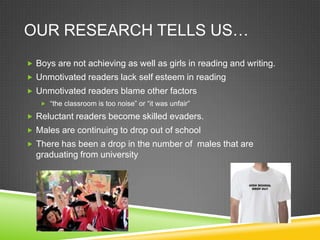
 Males are continuing to drop out of school
 There has been a drop in the number of males that are
  graduating from university
DIFFICULTIES FOR BOYS

 Boys are less successful in girls in conventional literacy
  classrooms and activities.
 Boys show a general lack of interest in print based activities.
 Boys perceived that school work was irrelevant
 Boys were more disruptive, distracted and unmotivated.
POSITIVES FOR BOYS
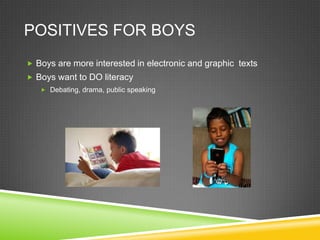
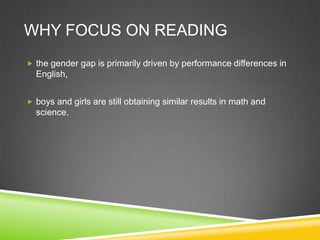
 Boys are more interested in electronic and graphic texts
 Boys want to DO literacy
    Debating, drama, public speaking
WHY FOCUS ON READING
 the gender gap is primarily driven by performance differences in
  English,


 boys and girls are still obtaining similar results in math and
  science.
SO WHAT ARE WE DOING ABOUT
IT?
 Build better classroom Libraries that include books that interest
  boys
    Graphic Novels
    Electronic News and Stories
    Magazines
    Instruction Manuals
    Action Adventure Stories
    Stories with strong male leads
    Non Fiction text stories
    Series books
SO WHAT ARE WE DOING ABOUT
IT?
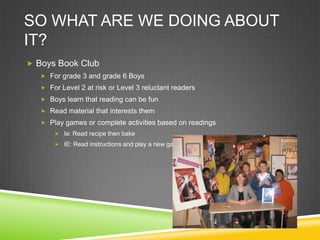
 Boys Book Club
    For grade 3 and grade 6 Boys
    For Level 2 at risk or Level 3 reluctant readers
    Boys learn that reading can be fun
    Read material that interests them
    Play games or complete activities based on readings
        Ie: Read recipe then bake

        IE: Read instructions and play a new game
SO WHAT ARE WE DOING ABOUT
IT?
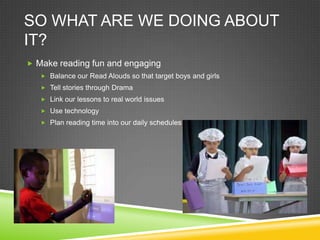
 Make reading fun and engaging
    Balance our Read Alouds so that target boys and girls
    Tell stories through Drama
    Link our lessons to real world issues
    Use technology
    Plan reading time into our daily schedules
SO WHAT ARE WE DOING ABOUT
IT?
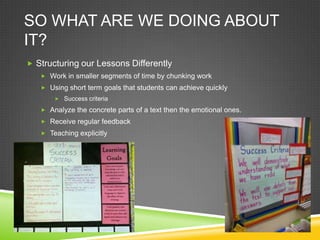
 Structuring our Lessons Differently
    Work in smaller segments of time by chunking work
    Using short term goals that students can achieve quickly
        Success criteria

    Analyze the concrete parts of a text then the emotional ones.
    Receive regular feedback
    Teaching explicitly
SO WHAT ARE WE DOING ABOUT
IT?
 Explicitly teaching Comprehension strategies. We let them in on
  the secret
    Using think alouds
    Label and teach comprehension strategies.
    Drawing inferences
    Make predictions
    Summarizing a text
    Using graphic organizers and writing frames
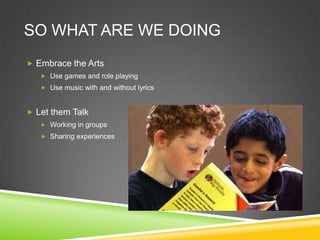
SO WHAT ARE WE DOING
 Embrace the Arts
    Use games and role playing
    Use music with and without lyrics


 Let them Talk
    Working in groups
    Sharing experiences
WHAT CAN PARENTS DO?
 Take it easy…
    Let your son choose his own reading material.

 Boys need strong male role models
 Model reading to your children by reading for your personal
  enjoyment
 Read with your child
 Go to the library
 Ask questions about what you are reading
 Compare what you read to your lives and the world.

Boys Literacy

  • 1.
    BOYS LITERACY How toengage our boys in reading
  • 2.
    OUR RESEARCH TELLSUS…  Boys are not achieving as well as girls in reading and writing.  Unmotivated readers lack self esteem in reading  Unmotivated readers blame other factors  “the classroom is too noise” or “it was unfair”  Reluctant readers become skilled evaders.  Males are continuing to drop out of school  There has been a drop in the number of males that are graduating from university
  • 3.
    DIFFICULTIES FOR BOYS Boys are less successful in girls in conventional literacy classrooms and activities.  Boys show a general lack of interest in print based activities.  Boys perceived that school work was irrelevant  Boys were more disruptive, distracted and unmotivated.
  • 4.
    POSITIVES FOR BOYS Boys are more interested in electronic and graphic texts  Boys want to DO literacy  Debating, drama, public speaking
  • 5.
    WHY FOCUS ONREADING  the gender gap is primarily driven by performance differences in English,  boys and girls are still obtaining similar results in math and science.
  • 6.
    SO WHAT AREWE DOING ABOUT IT?  Build better classroom Libraries that include books that interest boys  Graphic Novels  Electronic News and Stories  Magazines  Instruction Manuals  Action Adventure Stories  Stories with strong male leads  Non Fiction text stories  Series books
  • 7.
    SO WHAT AREWE DOING ABOUT IT?  Boys Book Club  For grade 3 and grade 6 Boys  For Level 2 at risk or Level 3 reluctant readers  Boys learn that reading can be fun  Read material that interests them  Play games or complete activities based on readings  Ie: Read recipe then bake  IE: Read instructions and play a new game
  • 8.
    SO WHAT AREWE DOING ABOUT IT?  Make reading fun and engaging  Balance our Read Alouds so that target boys and girls  Tell stories through Drama  Link our lessons to real world issues  Use technology  Plan reading time into our daily schedules
  • 9.
    SO WHAT AREWE DOING ABOUT IT?  Structuring our Lessons Differently  Work in smaller segments of time by chunking work  Using short term goals that students can achieve quickly  Success criteria  Analyze the concrete parts of a text then the emotional ones.  Receive regular feedback  Teaching explicitly
  • 10.
    SO WHAT AREWE DOING ABOUT IT?  Explicitly teaching Comprehension strategies. We let them in on the secret  Using think alouds  Label and teach comprehension strategies.  Drawing inferences  Make predictions  Summarizing a text  Using graphic organizers and writing frames
  • 11.
    SO WHAT AREWE DOING  Embrace the Arts  Use games and role playing  Use music with and without lyrics  Let them Talk  Working in groups  Sharing experiences
  • 12.
    WHAT CAN PARENTSDO?  Take it easy…  Let your son choose his own reading material.  Boys need strong male role models  Model reading to your children by reading for your personal enjoyment  Read with your child  Go to the library  Ask questions about what you are reading  Compare what you read to your lives and the world.

Editor's Notes

  • #3 Test results provincially and at the board level indicate that overall, boys are not achieving as well as girls in reading and writing. In order to engage, motivate and improve boys’ literacy skills, the HWDSB began supporting boys through “Boys Read to Succeed” reading clubs for Grade 3 and Grade 6 boys across the boardhttp://www.hwdsb.on.ca/lawfield/departments/literacy.htmlReaders who tend to be unmotivated often lack self-esteem regarding their ability to read. • They often attribute their difficulties to the difficulty of the task, interference, too much noise, vision problems, or unfairness. • Seldom do they acknowledge that their own lack of skill is at the heart of the problem. • Often they have a sense of hopelessness. When the reluctance of these students to participate in activities is interpreted as defiance or laziness, their underlying reading problem may not be identified or addressed. • Reluctant readers who have had many years of frustration often become skilled evaders who try either to “hide out or act out” so they can avoid reading. The number of young males who are dropping out of school, relinquishinggraduation, and dispensing with college or university education, thereby constraining theireconomic futures, is a source of continuing concern. The report goes on to state that “In2005, 62% of all university undergraduate completers were female and 38% were male – achange from 1992, when 58% were female and 42% were male” (p. 23).
  • #4  boys were less successful than girls in their ways of negotiating and participating inconventional literacy classrooms and conventional literacy activities; boys showed a general lack of interest in print-based reading and writing activities; boys demonstrated a perceived lack of purpose and relevance in school work; boys made “minimalistic” efforts to complete and present school literacy tasks; boys were disruptive, easily distracted and difficult to motivate within the classroom; and boys lacked self-esteem and confidence as learners.the gender gap is primarily driven by performance differences in English, whereasboys and girls are still obtaining similar results in math and science.
  • #5  boys had a strong interest in electronic and graphic forms of literate practice; boys were willing to “do” literacy in active, public ways (such as debating, drama,public speaking); and boys were eager to engage with “real-life” literacy contexts and “real-life” literacypractices.
  • #7 Reference: Me Read, No Way
  • #8 Reference: Me Read, No Way
  • #10 Reference: Me Read, No Way
  • #11 Reference: Me Read, No Way
  • #12 Reference: Me Read, No Way
  • #13 Reference: Me Read, No Way