NatureandCharacteristicsof
AcademicTexts
Lesson:1
What I Know?
Categorize the information based on
their characteristics below by filling in the
table to differentiate academic text from non-
academic text.
ACADEMIC
WRITING
An academic text is a written language that provides
information, which contain ideas and concepts that are
related to the particular discipline. Essay, Research Paper,
Report, Project, Article, Thesis, and Dissertation are
considered as academic texts.
ACADEMIC
WRITING
The basic structure that is used by an academic text is consist
of three (3) parts introduction, body, and conclusion which is
formal and logical. This kind of structure enables the reader to
follow the argument and navigate the text. In academic writing
a clear structure and a logical flow are imperative to a cohesive
text.
STRUCTURE
This refers to the attitude conveyed in a piece of writing. The
arguments of others are fairly presented and with an
appropriate narrative tone. When presenting a position or
argument that disagrees with one’s perspectives, describe the
argument accurately without loaded or biased language.
TONE
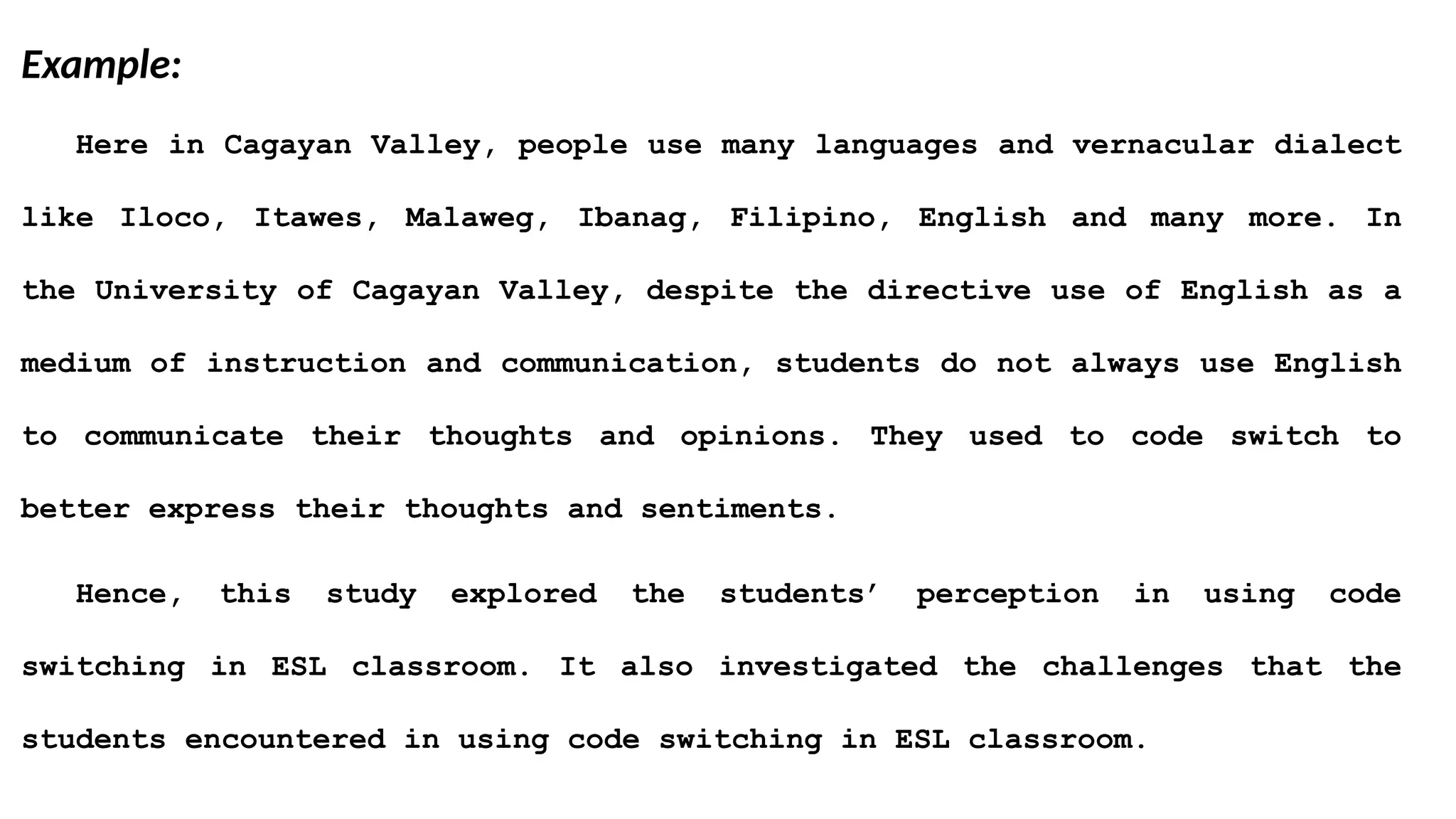
Example:
Here in Cagayan Valley, people use many languages and vernacular dialect
like Iloco, Itawes, Malaweg, Ibanag, Filipino, English and many more. In
the University of Cagayan Valley, despite the directive use of English as a
medium of instruction and communication, students do not always use English
to communicate their thoughts and opinions. They used to code switch to
better express their thoughts and sentiments.
Hence, this study explored the students’ perception in using code
switching in ESL classroom. It also investigated the challenges that the
students encountered in using code switching in ESL classroom.
It is important to use unambiguous language. Clear topic
sentences enable a reader to follow your line of thinking
without difficulty. Formal language and the third person
point-of-view should be used.
Technical language appropriate to area of study may also be
used, however, it does not mean using “big words” just for
the sake of doing so.
LANGUAGE
Example:
Based on the finding of the study, the researchers
conclude that students positively perceived the use of
code-switching because they better understood the
lesson during the instruction.
Citing sources in the body of the paper and providing a list of
references as either footnotes or endnotes is a very important
aspect of an academic text.
It is essential to always acknowledge the source of any ideas,
research findings, data, or quoted text that have been used in a
paper as a defense against allegations of plagiarism.
CITATION
Example 1:
Al-Qaysi (2019), defined code-switching as the
combining of terms or phrases from two languages
during the course of speaking or writing.
IN-TEXT
CITATION:
REFERENCING
SOURCES
WITHIN THE
TEXT
Example 2:
The research conclusively proved a
correlation between the results
(Mullane, 2006). A recent study
(Wilson, 2015) shows the same
correlation.
An academic text addresses complex issues that require
higher-order thinking skills to comprehend.
COMPLEXITY
Example:
Based on the results of the study, the following
recommendations were drawn:
1.Teachers should apply code-switching in the teaching-
learning process for their students to better understand
their lesson.
What is valued in an academic text is that opinions are based
on a sound understanding of the pertinent body of knowledge
and academic debates that exist within, and often external to a
specific discipline.
EVIDENCE-BASED
ARGUMENTS
The starting point of an academic text is a particular
perspective, idea or position applied to the chosen research
problem, such as establishing, proving, or disproving solutions
to the questions posed for the topic.
THESIS-DRIVEN
Example:
Language plays an important role in our lives. Most of the
Filipinos are language conscious especially when it comes to
English Language. Filipinos consider it as their second
language as it is commonly used by people of all ages, whether
in formal or informal discussions. However, nowadays, mixing
the English language with the Filipino or vernacular language
became a habitual practice among Filipinos particularly in
students inside or outside the classroom.
FeaturesofAcademicTexts
Lesson:2
Complex
- Written language has no longer words, it is lexically
more varied vocabulary.
- Written texts are shorter and the language has
more grammatical complexity, including more
subordinate clauses and more passives.
Formal
- Should avoid colloquial words and
expressions.
Precise
- Facts are given accurately and precisely.
Objective
- has fewer words that emphasize on the information
you want to give and the arguments you want to
make
-mostly use nouns (adjectives), rather than verbs
(adverbs)
Explicit
- It is the responsibility of the writer in English
to make it clear to the reader how the various
parts of the text are related.
Accurate
- Uses vocabulary accurately
- Most subjects have words with narrow
specific meanings.
Hedging
- It is necessary to make decisions about your
stance on a particular subject, or the strength of
the claims you are making.
Responsible
- You must be responsible for and must be able to
provide evidence and justification for any claims you
make.
Organize
- Well-organized.
- It flows easily from one section to the next in a logical
fashion.
FeaturesofAcademicTexts
Lesson:3
Purposes in Reading an
Academic Text
1. To locate a main idea;
2. To scan for information;
3. To identify gaps in existing studies;
4. To connect new ideas to existing ones;
5. To gain more pieces of information;
6. To support a particular writing
assignment; and,
7. To deeply understand an existing idea.
Factors to Consider in Writing Academic Text
1.State critical questions and issues;
2. Provide facts and evidence from credible sources;
3. Use precise and accurate words while avoiding
jargon;
4. Take an objective point of view;
5. List references; and,
6. Use cautious language.
Academic Language
Academic language is the language needed by students to
do the work in schools. It includes, for example, discipline-
specific vocabulary, grammar and punctuation, and
applications of rhetorical conventions and devices that are
typical for a content area (e.g. Essays, lab reports,
discussions of a controversial issue.) Students who master
academic language are more likely to be successful in
academic and professional settings.
Social Language
Social language is the set of vocabulary that
allows us to communicate with others in
the context of regular daily conversations.
Characteristics of Academic
Language
Formal
- It should not sound
conversational or casual.
Colloquial, idiomatic, slang
or journalistic expressions
should particularly be
avoided.
Objective
- This means it is unbiased. It
shouldbebasedonfactsand
evidence and are not influenced
by personal feelings.
Impersonal
- This involves avoiding the personal pronouns
‘I’ and ‘we’. For example, instead of writing ‘I
will show’, you might write ‘this report will
show’. The second person, ‘you’, is also to be
avoided.

Academic Writing - Senior High School.pptx

  • 4.
  • 5.
    What I Know? Categorizethe information based on their characteristics below by filling in the table to differentiate academic text from non- academic text.
  • 6.
    ACADEMIC WRITING An academic textis a written language that provides information, which contain ideas and concepts that are related to the particular discipline. Essay, Research Paper, Report, Project, Article, Thesis, and Dissertation are considered as academic texts. ACADEMIC WRITING
  • 7.
    The basic structurethat is used by an academic text is consist of three (3) parts introduction, body, and conclusion which is formal and logical. This kind of structure enables the reader to follow the argument and navigate the text. In academic writing a clear structure and a logical flow are imperative to a cohesive text. STRUCTURE
  • 8.
    This refers tothe attitude conveyed in a piece of writing. The arguments of others are fairly presented and with an appropriate narrative tone. When presenting a position or argument that disagrees with one’s perspectives, describe the argument accurately without loaded or biased language. TONE
  • 9.
    Example: Here in CagayanValley, people use many languages and vernacular dialect like Iloco, Itawes, Malaweg, Ibanag, Filipino, English and many more. In the University of Cagayan Valley, despite the directive use of English as a medium of instruction and communication, students do not always use English to communicate their thoughts and opinions. They used to code switch to better express their thoughts and sentiments. Hence, this study explored the students’ perception in using code switching in ESL classroom. It also investigated the challenges that the students encountered in using code switching in ESL classroom.
  • 10.
    It is importantto use unambiguous language. Clear topic sentences enable a reader to follow your line of thinking without difficulty. Formal language and the third person point-of-view should be used. Technical language appropriate to area of study may also be used, however, it does not mean using “big words” just for the sake of doing so. LANGUAGE
  • 11.
    Example: Based on thefinding of the study, the researchers conclude that students positively perceived the use of code-switching because they better understood the lesson during the instruction.
  • 12.
    Citing sources inthe body of the paper and providing a list of references as either footnotes or endnotes is a very important aspect of an academic text. It is essential to always acknowledge the source of any ideas, research findings, data, or quoted text that have been used in a paper as a defense against allegations of plagiarism. CITATION
  • 13.
    Example 1: Al-Qaysi (2019),defined code-switching as the combining of terms or phrases from two languages during the course of speaking or writing.
  • 14.
    IN-TEXT CITATION: REFERENCING SOURCES WITHIN THE TEXT Example 2: Theresearch conclusively proved a correlation between the results (Mullane, 2006). A recent study (Wilson, 2015) shows the same correlation.
  • 16.
    An academic textaddresses complex issues that require higher-order thinking skills to comprehend. COMPLEXITY
  • 17.
    Example: Based on theresults of the study, the following recommendations were drawn: 1.Teachers should apply code-switching in the teaching- learning process for their students to better understand their lesson.
  • 18.
    What is valuedin an academic text is that opinions are based on a sound understanding of the pertinent body of knowledge and academic debates that exist within, and often external to a specific discipline. EVIDENCE-BASED ARGUMENTS
  • 20.
    The starting pointof an academic text is a particular perspective, idea or position applied to the chosen research problem, such as establishing, proving, or disproving solutions to the questions posed for the topic. THESIS-DRIVEN
  • 21.
    Example: Language plays animportant role in our lives. Most of the Filipinos are language conscious especially when it comes to English Language. Filipinos consider it as their second language as it is commonly used by people of all ages, whether in formal or informal discussions. However, nowadays, mixing the English language with the Filipino or vernacular language became a habitual practice among Filipinos particularly in students inside or outside the classroom.
  • 22.
  • 23.
    Complex - Written languagehas no longer words, it is lexically more varied vocabulary. - Written texts are shorter and the language has more grammatical complexity, including more subordinate clauses and more passives.
  • 24.
    Formal - Should avoidcolloquial words and expressions.
  • 25.
    Precise - Facts aregiven accurately and precisely.
  • 26.
    Objective - has fewerwords that emphasize on the information you want to give and the arguments you want to make -mostly use nouns (adjectives), rather than verbs (adverbs)
  • 27.
    Explicit - It isthe responsibility of the writer in English to make it clear to the reader how the various parts of the text are related.
  • 28.
    Accurate - Uses vocabularyaccurately - Most subjects have words with narrow specific meanings.
  • 29.
    Hedging - It isnecessary to make decisions about your stance on a particular subject, or the strength of the claims you are making.
  • 30.
    Responsible - You mustbe responsible for and must be able to provide evidence and justification for any claims you make.
  • 31.
    Organize - Well-organized. - Itflows easily from one section to the next in a logical fashion.
  • 32.
  • 33.
    Purposes in Readingan Academic Text 1. To locate a main idea; 2. To scan for information; 3. To identify gaps in existing studies; 4. To connect new ideas to existing ones; 5. To gain more pieces of information; 6. To support a particular writing assignment; and, 7. To deeply understand an existing idea.
  • 34.
    Factors to Considerin Writing Academic Text 1.State critical questions and issues; 2. Provide facts and evidence from credible sources; 3. Use precise and accurate words while avoiding jargon; 4. Take an objective point of view; 5. List references; and, 6. Use cautious language.
  • 35.
    Academic Language Academic languageis the language needed by students to do the work in schools. It includes, for example, discipline- specific vocabulary, grammar and punctuation, and applications of rhetorical conventions and devices that are typical for a content area (e.g. Essays, lab reports, discussions of a controversial issue.) Students who master academic language are more likely to be successful in academic and professional settings.
  • 36.
    Social Language Social languageis the set of vocabulary that allows us to communicate with others in the context of regular daily conversations.
  • 38.
    Characteristics of Academic Language Formal -It should not sound conversational or casual. Colloquial, idiomatic, slang or journalistic expressions should particularly be avoided. Objective - This means it is unbiased. It shouldbebasedonfactsand evidence and are not influenced by personal feelings. Impersonal - This involves avoiding the personal pronouns ‘I’ and ‘we’. For example, instead of writing ‘I will show’, you might write ‘this report will show’. The second person, ‘you’, is also to be avoided.