An assignment on
Aspect of contracts and Negligence’s for the business

Submitted:

An Assignment On

Name:
ID:

ASPECT OF CONTRACTS AND
NEGLIGENCE’S FOR THE BUSINESS
Submitted To:

Date of Submission

Submitted By:
Name:
ID:
Submitted To:
Date of Submission:

~0~
TABLE OF CONTENTS
Executive Summary ...................................................................................................................... 2
Task 1 ............................................................................................................................................. 3
1.1 Essential Elements of a Valid Contract ............................................................................ 3
1.2 The Impact of Different types of Contract ....................................................................... 4
1.3 Analysis of Terms in Contracts ......................................................................................... 5
Task 2 ............................................................................................................................................. 5
2.1 Application of the Elements of Contract .......................................................................... 5
2.2 Application of the Law ....................................................................................................... 6
2.3 Evaluation of the Effect of Different Terms ..................................................................... 8
Task 3 ............................................................................................................................................. 9
3.1 Contrasting Liability in Tort with Contractual Liability ............................................... 9
3.2 The Nature of Liability in Negligence ............................................................................... 9
3.3 Vicarious Liability in business ........................................................................................... 9
Task 4 ........................................................................................................................................... 10
4.1 Application of the Tort of Negligence and Defences ...................................................... 10
4.2 Application of Vicarious Liability ................................................................................... 12
Conclusion ................................................................................................................................... 13
References .................................................................................................................................... 14

1
Executive Summary
From the case scenario it is very clear that the TAM’s college focus on becoming the leading and
one of the best educational institutions of United Kingdom with highest order of facilities. To
fulfill this mission they have consulted and made an agreement with a consulting firm named
NAMS regarding the issues like promoting their title, attracting more and more students and
helping them with marketing sector on a monthly basis.But due to financial matters, NAMS
could not stick to the agreement which is a straight violation against the contract and TAM’s
have taken legal activities against NAMS. On the last scenario, legitimate action was taken
TAM’s as a result of an unfortunate accident that occurred to one of its non-teaching staffs.
Although TAM’s denied to provide any kind of compensation as the accident was the result of
the staff’s careless attitude of not following the safety protocol of the institute, they faced the
prosecution according to “Vicarious Liability” doctrine.

2
Task 1
1.1

ESSENTIAL ELEMENTS OF A VALID CONTRACT

The eight elements those are essential for making a valid contract is stated as below:
1. Lawful Consideration: A mutual agreement leads to an affirmation where the person
accepting the offer takes conclusion based on some lawful consideration (Mountella, H.
C. 1979).
2. Offer and Acceptance:An offer has to be made in order to pattern legitimate agreement
and it is the introduction of an affirmation (Mountella, H. C. 1979). The involved party
has to accept upon the offer and therefore pattern an agreement.
3. Writing and Registration:To make the agreement legitimate, an official contract has to
be in written form and registered by the government administration (Mountella, H. C.
1979).
4. Free Consent:The two parties have togive their free approvalin order to form a
legitimate agreement, or else the contract will be advised as a null and void agreement
(Mountella, H. C. 1979).
5. Formal Relation:Official relation has to be considered in order to make a valid
agreement (Mountella, H. C. 1979). Any act of oral agreement cannot be considered as a
formal contract. For example an individual promised another person that he would give
him a car but he did not mention when. So, it will not be count as an agreement because
there was no formal relation present.
6. Certainty:Each and every element of an agreement has to be certain so that each party is
able to identify the matters considering the contract (Mountella, H. C. 1979).
7. Enforceable by Law: An agreement is valid only when it is enforceable by regulation;
else it will be advised as the event of termination of contract (Mountella, H. C. 1979).
8. Possibility of Performance:A valid agreement should have the prospect of presentation
because if the agreement cannot perform the matters then it will not be considered as a
contract (Mountella, H. C. 1979).

3
1.2

THE IMPACT OF DIFFERENT TYPES OF CONTRACT

Different types of contracts and their impacts are described below
 Executed Contact:In this type of agreement both parties accomplish the terms and
conditions of the contracts before they go in to an agreement and there is not anything to
be worked out by each party(Mountella, H. C. 1979).
 Contract under Seal:The customary method of making an agreement legitimate is the
closing of the lawful article that is enforceable(Mountella, H. C. 1979). It is important to
seal the documents and it is the liability of both the parties to accept the outcomes of the
agreementonce it is sealed.
 Implied Contact:Agreement of both parties is significantto pattern a legitimate. But in
case of implied agreement it will be advised as a legitimate agreement if one party does
not give permission(Mountella, H. C. 1979). Implied contract is applicable when a
personacts like he/she owns any assets. An example of this type of contract can be as if a
servant deals his or her owner’s stuffs as if s/he is the owner of the assets without the
permission of the owner then it will be considered as an implied contract.
 Unconscionable Contact:This type of contract is an agreement in which both parties are
alarmed about the agreement but one party gets the higher advantages than the other
(Mountella, H. C. 1979). As there is lack of free permission from one of the party, this
type of agreement is unenforceable.
 Express Contract:Express contract is one of the numerous kinds of contracts where it is
either in the formation of a written document or it can even be in the oral pattern which is
accepted to the authority that focuses on the permission to terms (Mountella, H. C. 1979).

4
1.3

ANALYSIS OF TERMS IN CONTRACTS

It is significant for the parties to understand the distinct types of agreements, terms, and
componentswhich not only helps the parties to comply with the agreement but furthermore
assists to diminish agreement administration charges (Herrald, C.A. 1983).
Agreements may comprise of various objectives. Major alterations are essential to align the
emplacement affirmation.
It is the mission of TAM’s College to become one of the best educational institutes in the United
Kingdom and they are putting together their best effort to accomplish it. Keeping this mission in
focus, they are hiring agencies and lawful advisors. For their marketing reasons and solving the
legal matters, they are going into agreements with some bureaus. TAM’s college is undertaking
to bring the differences and to pattern a legitimate agreement there should be some
distinctionwithin the exchanging of terms, concerns and bargaining of the parties.

Task 2
2.1

APPLICATION OF THE ELEMENTS OF CONTRACT

The parties must respect the terms and conditions of the agreement and if one of the parties
disagrees from the promise of affirmation then the party respecting the affirmation can go to
court and take lawful actions (Cite man, 2011).To sum up a valid agreement must be enforceable
by law.
The basic elements of the contract with NAMS are:
 Offer
 Acceptance
 Free Consent
 Formal Relation
 Valid Contract is enforceable

5
TAM’s was assisted by NAMS to become one of the best educational institutes in UK and aided
to promote its reputation to as higher as possible. When there is an initiation of agreement
between two parties about business relationship, it forms an official valid agreement.
Both the parties have to accept the terms and conditions of a contract in order to make the
contract legitimate. Otherwise it will be consider as an invalid agreement. Both the parties in the
accepted the terms and conditions of the agreement andthe agreement was in a written form to
make the contract a formal contract. TAM’s college paid the initial fee of £2500 accepting the
NAMS marketing offer.
Another key point is an agreement must be enforceable by regulation in order to become
legitimate. In the case of agreement between TAM’s college and NAMS it was pretty much the
same. So, when NAMS could not supply marketing assistance, TAM’s college took lawful
activities against them.

2.2

APPLICATION OF THE LAW

There are some vital components that need to be advised as soon astwo or more parties make
anagreementin order to make a legitimate contract (Cite man, 2011).Attitude of the parties may
differ from the affirmation which was presumed to be in use as just a pre-declaration of the valid
contract and consequently not part of the agreement (Doughlas, L. A. 1998). Both the parties
always have to follow the terms and conditions of an agreement to make it a successful one.

6
Contract Includes Conditions and
Warranties

Collateral Contracts

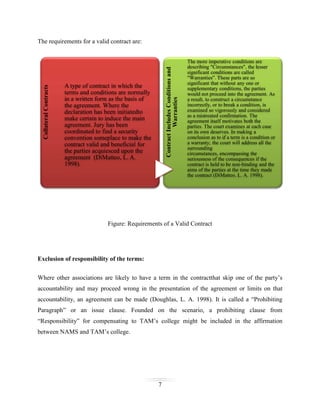
The requirements for a valid contract are:

A type of contract in which the
terms and conditions are normally
in a written form as the basis of
the agreement. Where the
declaration has been initiatedto
make certain to induce the main
agreement. Jury has been
coordinated to find a security
convention someplace to make the
contract valid and beneficial for
the parties acquiesced upon the
agreement (DiMatteo, L. A.
1998).

The more imperative conditions are
describing "Circumstances", the lesser
significant conditions are called
"Warranties”. These parts are so
significant that without any one or
supplementary conditions, the parties
would not proceed into the agreement. As
a result, to construct a circumstance
incorrectly, or to break a condition, is
examined so vigorously and considered
as a mistreated confirmation. The
agreement itself motivates both the
parties. The court examines at each case
on its own deserves. In making a
conclusion as to if a term is a condition or
a warranty; the court will address all the
surrounding
circumstances, encompassing the
seriousness of the consequences if the
contract is held to be non-binding and the
aims of the parties at the time they made
the contract (DiMatteo, L. A. 1998).

Figure: Requirements of a Valid Contract

Exclusion of responsibility of the terms:
Where other associations are likely to have a term in the contractthat skip one of the party’s
accountability and may proceed wrong in the presentation of the agreement or limits on that
accountability, an agreement can be made (Doughlas, L. A. 1998). It is called a “Prohibiting
Paragraph” or an issue clause. Founded on the scenario, a prohibiting clause from
“Responsibility” for compensating to TAM’s college might be included in the affirmation
between NAMS and TAM’s college.

7
2.3

EVALUATION OF THE EFFECT OF DIFFERENT TERMS

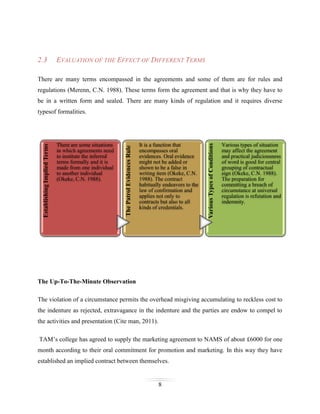
There are many terms encompassed in the agreements and some of them are for rules and
regulations (Merenn, C.N. 1988). These terms form the agreement and that is why they have to
be in a written form and sealed. There are many kinds of regulation and it requires diverse

It is a function that
encompasses oral
evidences. Oral evidence
might not be added or
shown to be a false in
writing item (Okeke, C.N.
1988). The contract
habitually endeavors to the
law of confirmation and
applies not only to
contracts but also to all
kinds of credentials.

Various Types of Conditions

There are some situations
in which agreements need
to institute the inferred
terms formally and it is
made from one individual
to another individual
(Okeke, C.N. 1988).

The Patrol Evidences Rule

Establishing Implied Terms

typesof formalities.

Various types of situation
may affect the agreement
and practical judiciousness
of word is good for central
grouping of contractual
sign (Okeke, C.N. 1988).
The preparation for
committing a breach of
circumstance at universal
regulation is refutation and
indemnity.

The Up-To-The-Minute Observation
The violation of a circumstance permits the overhead misgiving accumulating to reckless cost to
the indenture as rejected, extravagance in the indenture and the parties are endow to compel to
the activities and presentation (Cite man, 2011).
TAM’s college has agreed to supply the marketing agreement to NAMS of about £6000 for one
month according to their oral commitment for promotion and marketing. In this way they have
established an implied contract between themselves.

8
Task 3
3.1

CONTRASTING LIABILITY IN TORT WITH CONTRACTUAL LIABILITY

Tort and contract liability:
The regulation of tort and of agreement is categorized as part of the "Law of Obligations", but
the law of tort concerns to every person that it is relevant to, while in the regulation of contract or
in trusts obligation is "Voluntarily Assumed" (Doughlas, L. A. 1998). Tort damages are for
compensation while contract damages are calculated for expected losses over a period of time.

3.2

THE NATURE OF LIABILITY IN NEGLIGENCE

 Breach of Contract:Breach of agreement is the most significant thing in the contract tort
of negligence. It is the demeanour of the people to proceed as a reckless individual or
party and not performing the agreement terms and conditions(Doughlas, L. A. 1998).
This element implies the pre-existence of a standard of correct behaviour to avoid
imposing undue risks of damage to people. NAMS has broken the agreement when they
could not continue the promotion and marketing of TAM’s college for one week.
 DUTY:The duty is an obligation of one individual to another individual, it is conceived
form the communal desires and beliefs(Doughlas, L. A. 1998). The glue of communal
obligation is the threaded that binds humans to one another in assemblies where
preferences are advised inappropriately if they contravene a pre-existing impulse and
restore hastily.
 Cause in Fact:A small number of trouble are more fascinating, with tenacity more vague
then causation. Based on the surrounds and performances an individual might select to
take steps and avoid doing silly dramatics in assured(Doughlas, L. A. 1998).

3.3

VICARIOUS LIABILITY IN BUSINESS

It is a policy of English tort regulation that imposes firm liability on employers for the
wrongdoings of their employees (Leibee, B. C. 1976). While a worker is conducting his/her
obligations, thecompany will be held liable for any tort promised. Vicarious liabilities mean that

9
anybody can be imprisonedlegitimately or to blame for the lacking concentration actions of a
discrete one-by-one even regardless of the fact that someone overwhelms no mistake in
furtherance of the inattentive or tortuous acts(Doughlas, L. A. 1998).
As the guard’s family has taken lawful actions against TAM’s college,the administration of the
institute fell in the policy of vicarious liability. Though the administration and the supervisors
were alerted about the accident and were clearlywarned to wear safety clothingto avoid any kind
of accident or hazard at workplace.
The staffwhowasinjured did not listen to the instructions and thus did not follow organization’s
policies. So, the administration refused to give any compensation to the casualty but The TAM’s
college are compelled to pay the compensation because of the policy of vicarious liability.

Task 4
4.1

APPLICATION OF THE TORT OF NEGLIGENCE AND DEFENCES

The elements of the tort negligence and defences in various business situations are given as
below:

Duty of care:The person might owe an obligation of care to ensure that they do not suffer from
any awkward harm or decrease. If such obligation is broken, a legal liability is imposed (Leibee,
B. C. 1976). All the staffs and workers of TAM’s college was previously alerted and briefed to
strictly follow the safety measures to avoid accident.
Tort negligence law:It is a pattern of regulation in which it is founded and operated in the realm
of intentional tort regulation and the basic purpose of negligence regulation, is to command and
protect the workers from wounds related to their line (Leibee, B. C. 1976). Non-teaching
employees of TAM’s college were suggested to use protectiveclothingto ensure security.

10
It is the duty of an individual to ensure that they do not face any kind of accident. If such duty is
broken, a legal liability is imposed. TAM’s college employees were warned about the harm and
losses that the employees might face.

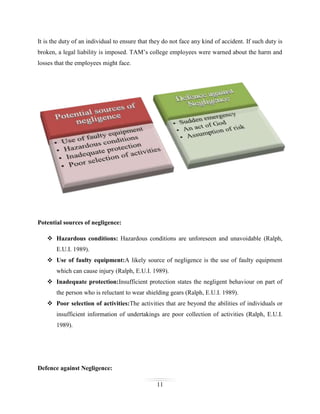
Potential sources of negligence:
 Hazardous conditions: Hazardous conditions are unforeseen and unavoidable (Ralph,
E.U.I. 1989).
 Use of faulty equipment:A likely source of negligence is the use of faulty equipment
which can cause injury (Ralph, E.U.I. 1989).
 Inadequate protection:Insufficient protection states the negligent behaviour on part of
the person who is reluctant to wear shielding gears (Ralph, E.U.I. 1989).
 Poor selection of activities:The activities that are beyond the abilities of individuals or
insufficient information of undertakings are poor collection of activities (Ralph, E.U.I.
1989).

Defence against Negligence:
11
 Sudden emergency:

Any act of instantaneous action to help the person in

endangerment. Such as, attempt to rescue a drowning person is an act of sudden
emergency (Ralph, E.U.I. 1989).
 An act of God: The situations or circumstances that human beings cannot control. This
hypothesis is only applicable when adequate safety measures are taken to avoid injuries
(Ralph, E.U.I. 1989).
 Assumption of risk:A common assumption is that a person takes measure of the risks
when engaging in activity (Ralph, E.U.I. 1989).

4.2

APPLICATION OF VICARIOUS LIABILITY

To ensure the safety of the teaching staff’s from any future accident, TAM’s college has
imposed safety clothing. It was a fault of the senior supervisor that he did not notice the alert and
posted a night guard on duty without proper safety protocol which is a violation ofinstitute’s
principle.
Supervisors possess the intrinsicpowerof controlling the workers and the supervisors were
requested to ensure the right clothing and proper defensive gears of the non-teaching staffs. But
in this case the supervisors did not follow the instructions and lead one of their staffs to duty
without correct apparel (Hofstra, 2012.).
However, vicarious blame implies that any person can be punished legally to blame for the
careless actions of a different person. In this case the supervisors were careless to the directions
and that lead one of the staffs to get injured. But according to vicarious liability doctrine the
administration of the TAM’s college will be found to blame.
The administration denied providing any compensation to the employee because it was his fault
that he was not following the directions of the TAM’s college. But under the vicarious liability
doctrine an employee may be faulty but TAM’s administration will be legitimate to blame for the
staff’s careless attitude.

12
Conclusion
From the case study it is clear that TAM’s college which aims to be one of the best institutions in
UK, hired bureaus to promote their institution and to attract students providing them with
enriched facilities. They also consulted with legal advisors to deal with the potential threats.
TAM’s college received a lucrative offer of £6000 on monthly basis from NAMS marketing
consultant firm for the promotion of their title and marketing purpose.Due to financial matters,
NAMS could not stick to the agreement which is a straight violation against the contract and
TAM’s have taken legal activities against NAMS. Finally we can see that TAM”s college had to
compensate for the accident that occurred with one of their staff in spite of the accident occurred
due to the staff’s negligence to the institute’s safety protocol.Although TAM’s denied that they
are responsible for the accident, they had to face legal actions according to a doctrine named
“Vicarious Liability”.

13
References
Cite

man,

2011.

“The

Evolution

of

Contractual

impact”

(Online)

available

at

:<http://www.citeman.com/4121-essential-elements-of-a-valid-contract.html(Accessed on
December 13, 2013)
Doughlas, L. A. 1998. Contract Theory: The Evolution of Contractual Intent. East Lansing:
Michigan State Univ. Press.
Herrald, C.A. (1983). Administration of Legal Responsibilities. The C.V. Mosby Company, St.
Louis., vol. 32, no. 8, pp. 849-875.
Hofstra, 2012. “Business law and commercial law and practical use of these” (Online)
availableat
:<http://law.hofstra.edu/pdf/Academics/Journals/LawReview/lrv_issues_v35n04_i01.pdf
>(Accessed on November 29, 2013)
Leibee, B. C. (1976). Tort Liability for Injuries to employees.Organisation and Administration.
Philadelphia W.B. Saunders Company Journal Of Tort Law ,vol. 18, no. 1, p. 1.
Merenn, C.N. (1988). Some Legal aspects of Organizations. A paper presented at a two day
conference organized by the National Sports Commission, Enugu, vol. 13, no. 5, pp. 707719.
Mountella, H. C. (1979). Mountella Law Dictionary, St. Paul West Publishing Company vol. 57,
no. 2, pp. 217-268.
Ralph, E.U.I. (1989). Safety Measures associated with Physical and Health Education Journals.
Vol. 3, No. 1, vol. 48, no. 1, pp. 54-82.

14

Ac 15

  • 1.
    An assignment on Aspectof contracts and Negligence’s for the business Submitted: An Assignment On Name: ID: ASPECT OF CONTRACTS AND NEGLIGENCE’S FOR THE BUSINESS Submitted To: Date of Submission Submitted By: Name: ID: Submitted To: Date of Submission: ~0~
  • 2.
    TABLE OF CONTENTS ExecutiveSummary ...................................................................................................................... 2 Task 1 ............................................................................................................................................. 3 1.1 Essential Elements of a Valid Contract ............................................................................ 3 1.2 The Impact of Different types of Contract ....................................................................... 4 1.3 Analysis of Terms in Contracts ......................................................................................... 5 Task 2 ............................................................................................................................................. 5 2.1 Application of the Elements of Contract .......................................................................... 5 2.2 Application of the Law ....................................................................................................... 6 2.3 Evaluation of the Effect of Different Terms ..................................................................... 8 Task 3 ............................................................................................................................................. 9 3.1 Contrasting Liability in Tort with Contractual Liability ............................................... 9 3.2 The Nature of Liability in Negligence ............................................................................... 9 3.3 Vicarious Liability in business ........................................................................................... 9 Task 4 ........................................................................................................................................... 10 4.1 Application of the Tort of Negligence and Defences ...................................................... 10 4.2 Application of Vicarious Liability ................................................................................... 12 Conclusion ................................................................................................................................... 13 References .................................................................................................................................... 14 1
  • 3.
    Executive Summary From thecase scenario it is very clear that the TAM’s college focus on becoming the leading and one of the best educational institutions of United Kingdom with highest order of facilities. To fulfill this mission they have consulted and made an agreement with a consulting firm named NAMS regarding the issues like promoting their title, attracting more and more students and helping them with marketing sector on a monthly basis.But due to financial matters, NAMS could not stick to the agreement which is a straight violation against the contract and TAM’s have taken legal activities against NAMS. On the last scenario, legitimate action was taken TAM’s as a result of an unfortunate accident that occurred to one of its non-teaching staffs. Although TAM’s denied to provide any kind of compensation as the accident was the result of the staff’s careless attitude of not following the safety protocol of the institute, they faced the prosecution according to “Vicarious Liability” doctrine. 2
  • 4.
    Task 1 1.1 ESSENTIAL ELEMENTSOF A VALID CONTRACT The eight elements those are essential for making a valid contract is stated as below: 1. Lawful Consideration: A mutual agreement leads to an affirmation where the person accepting the offer takes conclusion based on some lawful consideration (Mountella, H. C. 1979). 2. Offer and Acceptance:An offer has to be made in order to pattern legitimate agreement and it is the introduction of an affirmation (Mountella, H. C. 1979). The involved party has to accept upon the offer and therefore pattern an agreement. 3. Writing and Registration:To make the agreement legitimate, an official contract has to be in written form and registered by the government administration (Mountella, H. C. 1979). 4. Free Consent:The two parties have togive their free approvalin order to form a legitimate agreement, or else the contract will be advised as a null and void agreement (Mountella, H. C. 1979). 5. Formal Relation:Official relation has to be considered in order to make a valid agreement (Mountella, H. C. 1979). Any act of oral agreement cannot be considered as a formal contract. For example an individual promised another person that he would give him a car but he did not mention when. So, it will not be count as an agreement because there was no formal relation present. 6. Certainty:Each and every element of an agreement has to be certain so that each party is able to identify the matters considering the contract (Mountella, H. C. 1979). 7. Enforceable by Law: An agreement is valid only when it is enforceable by regulation; else it will be advised as the event of termination of contract (Mountella, H. C. 1979). 8. Possibility of Performance:A valid agreement should have the prospect of presentation because if the agreement cannot perform the matters then it will not be considered as a contract (Mountella, H. C. 1979). 3
  • 5.
    1.2 THE IMPACT OFDIFFERENT TYPES OF CONTRACT Different types of contracts and their impacts are described below  Executed Contact:In this type of agreement both parties accomplish the terms and conditions of the contracts before they go in to an agreement and there is not anything to be worked out by each party(Mountella, H. C. 1979).  Contract under Seal:The customary method of making an agreement legitimate is the closing of the lawful article that is enforceable(Mountella, H. C. 1979). It is important to seal the documents and it is the liability of both the parties to accept the outcomes of the agreementonce it is sealed.  Implied Contact:Agreement of both parties is significantto pattern a legitimate. But in case of implied agreement it will be advised as a legitimate agreement if one party does not give permission(Mountella, H. C. 1979). Implied contract is applicable when a personacts like he/she owns any assets. An example of this type of contract can be as if a servant deals his or her owner’s stuffs as if s/he is the owner of the assets without the permission of the owner then it will be considered as an implied contract.  Unconscionable Contact:This type of contract is an agreement in which both parties are alarmed about the agreement but one party gets the higher advantages than the other (Mountella, H. C. 1979). As there is lack of free permission from one of the party, this type of agreement is unenforceable.  Express Contract:Express contract is one of the numerous kinds of contracts where it is either in the formation of a written document or it can even be in the oral pattern which is accepted to the authority that focuses on the permission to terms (Mountella, H. C. 1979). 4
  • 6.
    1.3 ANALYSIS OF TERMSIN CONTRACTS It is significant for the parties to understand the distinct types of agreements, terms, and componentswhich not only helps the parties to comply with the agreement but furthermore assists to diminish agreement administration charges (Herrald, C.A. 1983). Agreements may comprise of various objectives. Major alterations are essential to align the emplacement affirmation. It is the mission of TAM’s College to become one of the best educational institutes in the United Kingdom and they are putting together their best effort to accomplish it. Keeping this mission in focus, they are hiring agencies and lawful advisors. For their marketing reasons and solving the legal matters, they are going into agreements with some bureaus. TAM’s college is undertaking to bring the differences and to pattern a legitimate agreement there should be some distinctionwithin the exchanging of terms, concerns and bargaining of the parties. Task 2 2.1 APPLICATION OF THE ELEMENTS OF CONTRACT The parties must respect the terms and conditions of the agreement and if one of the parties disagrees from the promise of affirmation then the party respecting the affirmation can go to court and take lawful actions (Cite man, 2011).To sum up a valid agreement must be enforceable by law. The basic elements of the contract with NAMS are:  Offer  Acceptance  Free Consent  Formal Relation  Valid Contract is enforceable 5
  • 7.
    TAM’s was assistedby NAMS to become one of the best educational institutes in UK and aided to promote its reputation to as higher as possible. When there is an initiation of agreement between two parties about business relationship, it forms an official valid agreement. Both the parties have to accept the terms and conditions of a contract in order to make the contract legitimate. Otherwise it will be consider as an invalid agreement. Both the parties in the accepted the terms and conditions of the agreement andthe agreement was in a written form to make the contract a formal contract. TAM’s college paid the initial fee of £2500 accepting the NAMS marketing offer. Another key point is an agreement must be enforceable by regulation in order to become legitimate. In the case of agreement between TAM’s college and NAMS it was pretty much the same. So, when NAMS could not supply marketing assistance, TAM’s college took lawful activities against them. 2.2 APPLICATION OF THE LAW There are some vital components that need to be advised as soon astwo or more parties make anagreementin order to make a legitimate contract (Cite man, 2011).Attitude of the parties may differ from the affirmation which was presumed to be in use as just a pre-declaration of the valid contract and consequently not part of the agreement (Doughlas, L. A. 1998). Both the parties always have to follow the terms and conditions of an agreement to make it a successful one. 6
  • 8.
    Contract Includes Conditionsand Warranties Collateral Contracts The requirements for a valid contract are: A type of contract in which the terms and conditions are normally in a written form as the basis of the agreement. Where the declaration has been initiatedto make certain to induce the main agreement. Jury has been coordinated to find a security convention someplace to make the contract valid and beneficial for the parties acquiesced upon the agreement (DiMatteo, L. A. 1998). The more imperative conditions are describing "Circumstances", the lesser significant conditions are called "Warranties”. These parts are so significant that without any one or supplementary conditions, the parties would not proceed into the agreement. As a result, to construct a circumstance incorrectly, or to break a condition, is examined so vigorously and considered as a mistreated confirmation. The agreement itself motivates both the parties. The court examines at each case on its own deserves. In making a conclusion as to if a term is a condition or a warranty; the court will address all the surrounding circumstances, encompassing the seriousness of the consequences if the contract is held to be non-binding and the aims of the parties at the time they made the contract (DiMatteo, L. A. 1998). Figure: Requirements of a Valid Contract Exclusion of responsibility of the terms: Where other associations are likely to have a term in the contractthat skip one of the party’s accountability and may proceed wrong in the presentation of the agreement or limits on that accountability, an agreement can be made (Doughlas, L. A. 1998). It is called a “Prohibiting Paragraph” or an issue clause. Founded on the scenario, a prohibiting clause from “Responsibility” for compensating to TAM’s college might be included in the affirmation between NAMS and TAM’s college. 7
  • 9.
    2.3 EVALUATION OF THEEFFECT OF DIFFERENT TERMS There are many terms encompassed in the agreements and some of them are for rules and regulations (Merenn, C.N. 1988). These terms form the agreement and that is why they have to be in a written form and sealed. There are many kinds of regulation and it requires diverse It is a function that encompasses oral evidences. Oral evidence might not be added or shown to be a false in writing item (Okeke, C.N. 1988). The contract habitually endeavors to the law of confirmation and applies not only to contracts but also to all kinds of credentials. Various Types of Conditions There are some situations in which agreements need to institute the inferred terms formally and it is made from one individual to another individual (Okeke, C.N. 1988). The Patrol Evidences Rule Establishing Implied Terms typesof formalities. Various types of situation may affect the agreement and practical judiciousness of word is good for central grouping of contractual sign (Okeke, C.N. 1988). The preparation for committing a breach of circumstance at universal regulation is refutation and indemnity. The Up-To-The-Minute Observation The violation of a circumstance permits the overhead misgiving accumulating to reckless cost to the indenture as rejected, extravagance in the indenture and the parties are endow to compel to the activities and presentation (Cite man, 2011). TAM’s college has agreed to supply the marketing agreement to NAMS of about £6000 for one month according to their oral commitment for promotion and marketing. In this way they have established an implied contract between themselves. 8
  • 10.
    Task 3 3.1 CONTRASTING LIABILITYIN TORT WITH CONTRACTUAL LIABILITY Tort and contract liability: The regulation of tort and of agreement is categorized as part of the "Law of Obligations", but the law of tort concerns to every person that it is relevant to, while in the regulation of contract or in trusts obligation is "Voluntarily Assumed" (Doughlas, L. A. 1998). Tort damages are for compensation while contract damages are calculated for expected losses over a period of time. 3.2 THE NATURE OF LIABILITY IN NEGLIGENCE  Breach of Contract:Breach of agreement is the most significant thing in the contract tort of negligence. It is the demeanour of the people to proceed as a reckless individual or party and not performing the agreement terms and conditions(Doughlas, L. A. 1998). This element implies the pre-existence of a standard of correct behaviour to avoid imposing undue risks of damage to people. NAMS has broken the agreement when they could not continue the promotion and marketing of TAM’s college for one week.  DUTY:The duty is an obligation of one individual to another individual, it is conceived form the communal desires and beliefs(Doughlas, L. A. 1998). The glue of communal obligation is the threaded that binds humans to one another in assemblies where preferences are advised inappropriately if they contravene a pre-existing impulse and restore hastily.  Cause in Fact:A small number of trouble are more fascinating, with tenacity more vague then causation. Based on the surrounds and performances an individual might select to take steps and avoid doing silly dramatics in assured(Doughlas, L. A. 1998). 3.3 VICARIOUS LIABILITY IN BUSINESS It is a policy of English tort regulation that imposes firm liability on employers for the wrongdoings of their employees (Leibee, B. C. 1976). While a worker is conducting his/her obligations, thecompany will be held liable for any tort promised. Vicarious liabilities mean that 9
  • 11.
    anybody can beimprisonedlegitimately or to blame for the lacking concentration actions of a discrete one-by-one even regardless of the fact that someone overwhelms no mistake in furtherance of the inattentive or tortuous acts(Doughlas, L. A. 1998). As the guard’s family has taken lawful actions against TAM’s college,the administration of the institute fell in the policy of vicarious liability. Though the administration and the supervisors were alerted about the accident and were clearlywarned to wear safety clothingto avoid any kind of accident or hazard at workplace. The staffwhowasinjured did not listen to the instructions and thus did not follow organization’s policies. So, the administration refused to give any compensation to the casualty but The TAM’s college are compelled to pay the compensation because of the policy of vicarious liability. Task 4 4.1 APPLICATION OF THE TORT OF NEGLIGENCE AND DEFENCES The elements of the tort negligence and defences in various business situations are given as below: Duty of care:The person might owe an obligation of care to ensure that they do not suffer from any awkward harm or decrease. If such obligation is broken, a legal liability is imposed (Leibee, B. C. 1976). All the staffs and workers of TAM’s college was previously alerted and briefed to strictly follow the safety measures to avoid accident. Tort negligence law:It is a pattern of regulation in which it is founded and operated in the realm of intentional tort regulation and the basic purpose of negligence regulation, is to command and protect the workers from wounds related to their line (Leibee, B. C. 1976). Non-teaching employees of TAM’s college were suggested to use protectiveclothingto ensure security. 10
  • 12.
    It is theduty of an individual to ensure that they do not face any kind of accident. If such duty is broken, a legal liability is imposed. TAM’s college employees were warned about the harm and losses that the employees might face. Potential sources of negligence:  Hazardous conditions: Hazardous conditions are unforeseen and unavoidable (Ralph, E.U.I. 1989).  Use of faulty equipment:A likely source of negligence is the use of faulty equipment which can cause injury (Ralph, E.U.I. 1989).  Inadequate protection:Insufficient protection states the negligent behaviour on part of the person who is reluctant to wear shielding gears (Ralph, E.U.I. 1989).  Poor selection of activities:The activities that are beyond the abilities of individuals or insufficient information of undertakings are poor collection of activities (Ralph, E.U.I. 1989). Defence against Negligence: 11
  • 13.
     Sudden emergency: Anyact of instantaneous action to help the person in endangerment. Such as, attempt to rescue a drowning person is an act of sudden emergency (Ralph, E.U.I. 1989).  An act of God: The situations or circumstances that human beings cannot control. This hypothesis is only applicable when adequate safety measures are taken to avoid injuries (Ralph, E.U.I. 1989).  Assumption of risk:A common assumption is that a person takes measure of the risks when engaging in activity (Ralph, E.U.I. 1989). 4.2 APPLICATION OF VICARIOUS LIABILITY To ensure the safety of the teaching staff’s from any future accident, TAM’s college has imposed safety clothing. It was a fault of the senior supervisor that he did not notice the alert and posted a night guard on duty without proper safety protocol which is a violation ofinstitute’s principle. Supervisors possess the intrinsicpowerof controlling the workers and the supervisors were requested to ensure the right clothing and proper defensive gears of the non-teaching staffs. But in this case the supervisors did not follow the instructions and lead one of their staffs to duty without correct apparel (Hofstra, 2012.). However, vicarious blame implies that any person can be punished legally to blame for the careless actions of a different person. In this case the supervisors were careless to the directions and that lead one of the staffs to get injured. But according to vicarious liability doctrine the administration of the TAM’s college will be found to blame. The administration denied providing any compensation to the employee because it was his fault that he was not following the directions of the TAM’s college. But under the vicarious liability doctrine an employee may be faulty but TAM’s administration will be legitimate to blame for the staff’s careless attitude. 12
  • 14.
    Conclusion From the casestudy it is clear that TAM’s college which aims to be one of the best institutions in UK, hired bureaus to promote their institution and to attract students providing them with enriched facilities. They also consulted with legal advisors to deal with the potential threats. TAM’s college received a lucrative offer of £6000 on monthly basis from NAMS marketing consultant firm for the promotion of their title and marketing purpose.Due to financial matters, NAMS could not stick to the agreement which is a straight violation against the contract and TAM’s have taken legal activities against NAMS. Finally we can see that TAM”s college had to compensate for the accident that occurred with one of their staff in spite of the accident occurred due to the staff’s negligence to the institute’s safety protocol.Although TAM’s denied that they are responsible for the accident, they had to face legal actions according to a doctrine named “Vicarious Liability”. 13
  • 15.
    References Cite man, 2011. “The Evolution of Contractual impact” (Online) available at :<http://www.citeman.com/4121-essential-elements-of-a-valid-contract.html(Accessed on December 13,2013) Doughlas, L. A. 1998. Contract Theory: The Evolution of Contractual Intent. East Lansing: Michigan State Univ. Press. Herrald, C.A. (1983). Administration of Legal Responsibilities. The C.V. Mosby Company, St. Louis., vol. 32, no. 8, pp. 849-875. Hofstra, 2012. “Business law and commercial law and practical use of these” (Online) availableat :<http://law.hofstra.edu/pdf/Academics/Journals/LawReview/lrv_issues_v35n04_i01.pdf >(Accessed on November 29, 2013) Leibee, B. C. (1976). Tort Liability for Injuries to employees.Organisation and Administration. Philadelphia W.B. Saunders Company Journal Of Tort Law ,vol. 18, no. 1, p. 1. Merenn, C.N. (1988). Some Legal aspects of Organizations. A paper presented at a two day conference organized by the National Sports Commission, Enugu, vol. 13, no. 5, pp. 707719. Mountella, H. C. (1979). Mountella Law Dictionary, St. Paul West Publishing Company vol. 57, no. 2, pp. 217-268. Ralph, E.U.I. (1989). Safety Measures associated with Physical and Health Education Journals. Vol. 3, No. 1, vol. 48, no. 1, pp. 54-82. 14