
Abracadabra – Poof
the Developer is Gone and
You’re Left Holding the Bag
Life with Lawyers, Banks,
Insurance Companies, and
Angry Homeowners
The Legal Stuff
• MGL Chapter 41, section 81U
“Any such bond may be enforced and any such deposit may be
applied by the planning board for the benefit of such city or
town, as provided in section eighty-one Y, upon failure of the
performance for which any such bond or deposit was given to
the extent of the reasonable cost to such city or town of
completing such construction and installation.”
Acceptable Forms of
Performance Guarantees
• Covenant
• Cash
• Tri-partite Agreement
• Surety Bond
• Or Any Combination Thereof
*Municipal counsel and treasurer should review deposit
agreements, escrow agreements & surety bonds prior to
Planning Board acceptance*
Types …..
• Cash (or passbook)
▫ Legal agreement indicating purpose
recommended
▫ If passbook/bank account, must be in the name
of subdivider AND the Town/City of _____
▫ Use subdivider’s SSN/tax ID number (for interest
purposes)
▫ Municipality should control all associated
documents (fin dir)
▫ Most easily accessible in default situation
Types…
• Tri-Partite (TriParty) Agreement
▫ Agreement between 3 parties – subdivider,
mortgaging bank and municipality
▫ “shall provide for the retention by the lender of
funds”
▫ Trigger mechanism for disbursement of funds
specified
▫ Doesn’t require substantial documentation to
access…Planning Board vote only
Types…
• Bond
▫ Must be posted pursuant to MGL Ch 41 S 81 U
▫ Tied to subdivision approvals
▫ Local insurance agent!
▫ Most difficult to exercise of the four types
Types…
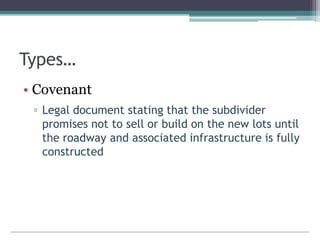
• Covenant
▫ Legal document stating that the subdivider
promises not to sell or build on the new lots until
the roadway and associated infrastructure is fully
constructed
Performance
Guarantees
The Good, The Bad,
and The Ugly
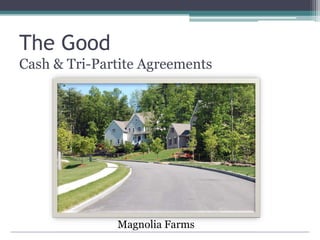
The Good
Cash & Tri-Partite Agreements
Magnolia Farms
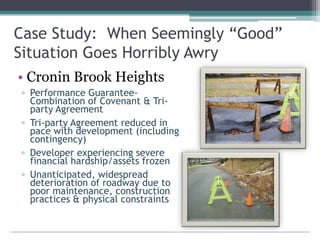
Case Study: When Seemingly “Good”
Situation Goes Horribly Awry
• Cronin Brook Heights
▫ Performance Guarantee-
Combination of Covenant & Tri-
party Agreement
▫ Tri-party Agreement reduced in
pace with development (including
contingency)
▫ Developer experiencing severe
financial hardship/assets frozen
▫ Unanticipated, widespread
deterioration of roadway due to
poor maintenance, construction
practices & physical constraints
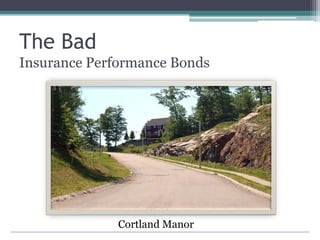
The Bad
Insurance Performance Bonds
Cortland Manor
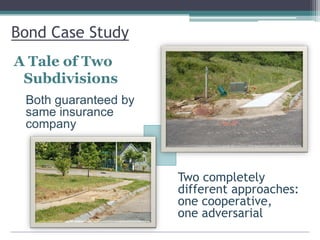
Bond Case Study
A Tale of Two
Subdivisions
Two completely
different approaches:
one cooperative,
one adversarial
Both guaranteed by
same insurance
company
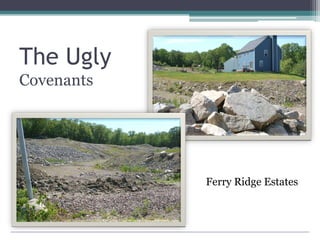
The Ugly
Covenants
Ferry Ridge Estates
Default Challenges
Challenge: How do we protect municipalities from weaknesses
inherent in surety bonds?
Response:
▫ Surety bonds should always be in name of subdivider, not site
contractor
▫ Never accept surety bonds with expiration dates
▫ Consider requiring cash deposit to accompany surety bond to cover
maintenance and costs associated with calling the bond
▫ Be picky! Only accept surety bonds from companies with good
reputations (i.e. companies that actually honor their obligations in
default scenario)
Default Challenges
Challenge: What if the subdivision completion costs outweigh
performance guarantee amount due to deterioration of existing
components or runaway inflation?
Response:
▫ Performance guarantee amounts should be determined by
Planning Board’s consulting engineer (44/53G) based on
prevailing wage and conservative pricing. It’s ALWAYS better
to have too much money than not enough
▫ Performance guarantees should have at least 20% contingency
factor to take into account what-if’s & inflation
▫ Contingency factor shouldn’t be reduced until project
completion – The 20% Solution
Default Challenges
Challenge: Who will maintain the roads & infrastructure until
subdivision completion?
Response:
- Insert operation & maintenance provision in Subdivision Rules &
Regulations
- Require operation & maintenance provision as part of any
performance guarantee and tie it to approved plan
- Require maintenance performance guarantee (ideally cash) that
the municipality can tap into to cover routine maintenance costs
associated with snow plowing, sanding, sweeping, and cleaning
of catch basins (81Q) in default scenario
Default Challenges
Challenge: How does a municipality accept roads when the subdivider
is not available or won’t execute transfer of ownership?
Response:
▫ Assessor’s Office may consider taxing roadways so that roadways
can be taken through tax title in default scenario
▫ Eminent domain
 Confirm title to land within the road right-of-way
 Town Meeting accepts the road layout
 Within 120 days of affirmative vote, record order of taking (automatically vests
good title)
 Downside - G.L. c. 79 requires appraisal and payment of damages to owners
before taking. Resulting award can be challenged in Court for up to 3 yrs
following recording of order. Avoid this scenario by obtaining owner waivers of
damages & appraisal rights.
Default Challenges
Challenge: What is the value of development rights under a
covenant and how does it translate into value?
Response: ?
Challenge: What if nobody wants the remaining
developable land in a partially constructed subdivision
(i.e., mortgaging bank and municipality)?
Response: ?
The central issue remains:
Whether existing legislation
adequately protects
municipalities when
confronted with
subdivisions in default.
Thank you.
Questions?
Comments?

Abracadabra: the Developer is Gone and You're Left Holding the Bag

  • 1.
    Abracadabra – Poof theDeveloper is Gone and You’re Left Holding the Bag Life with Lawyers, Banks, Insurance Companies, and Angry Homeowners
  • 2.
    The Legal Stuff •MGL Chapter 41, section 81U “Any such bond may be enforced and any such deposit may be applied by the planning board for the benefit of such city or town, as provided in section eighty-one Y, upon failure of the performance for which any such bond or deposit was given to the extent of the reasonable cost to such city or town of completing such construction and installation.”
  • 3.
    Acceptable Forms of PerformanceGuarantees • Covenant • Cash • Tri-partite Agreement • Surety Bond • Or Any Combination Thereof *Municipal counsel and treasurer should review deposit agreements, escrow agreements & surety bonds prior to Planning Board acceptance*
  • 4.
    Types ….. • Cash(or passbook) ▫ Legal agreement indicating purpose recommended ▫ If passbook/bank account, must be in the name of subdivider AND the Town/City of _____ ▫ Use subdivider’s SSN/tax ID number (for interest purposes) ▫ Municipality should control all associated documents (fin dir) ▫ Most easily accessible in default situation
  • 5.
    Types… • Tri-Partite (TriParty)Agreement ▫ Agreement between 3 parties – subdivider, mortgaging bank and municipality ▫ “shall provide for the retention by the lender of funds” ▫ Trigger mechanism for disbursement of funds specified ▫ Doesn’t require substantial documentation to access…Planning Board vote only
  • 6.
    Types… • Bond ▫ Mustbe posted pursuant to MGL Ch 41 S 81 U ▫ Tied to subdivision approvals ▫ Local insurance agent! ▫ Most difficult to exercise of the four types
  • 7.
    Types… • Covenant ▫ Legaldocument stating that the subdivider promises not to sell or build on the new lots until the roadway and associated infrastructure is fully constructed
  • 8.
  • 9.
    The Good Cash &Tri-Partite Agreements Magnolia Farms
  • 10.
    Case Study: WhenSeemingly “Good” Situation Goes Horribly Awry • Cronin Brook Heights ▫ Performance Guarantee- Combination of Covenant & Tri- party Agreement ▫ Tri-party Agreement reduced in pace with development (including contingency) ▫ Developer experiencing severe financial hardship/assets frozen ▫ Unanticipated, widespread deterioration of roadway due to poor maintenance, construction practices & physical constraints
  • 11.
    The Bad Insurance PerformanceBonds Cortland Manor
  • 12.
    Bond Case Study ATale of Two Subdivisions Two completely different approaches: one cooperative, one adversarial Both guaranteed by same insurance company
  • 13.
  • 14.
    Default Challenges Challenge: Howdo we protect municipalities from weaknesses inherent in surety bonds? Response: ▫ Surety bonds should always be in name of subdivider, not site contractor ▫ Never accept surety bonds with expiration dates ▫ Consider requiring cash deposit to accompany surety bond to cover maintenance and costs associated with calling the bond ▫ Be picky! Only accept surety bonds from companies with good reputations (i.e. companies that actually honor their obligations in default scenario)
  • 15.
    Default Challenges Challenge: Whatif the subdivision completion costs outweigh performance guarantee amount due to deterioration of existing components or runaway inflation? Response: ▫ Performance guarantee amounts should be determined by Planning Board’s consulting engineer (44/53G) based on prevailing wage and conservative pricing. It’s ALWAYS better to have too much money than not enough ▫ Performance guarantees should have at least 20% contingency factor to take into account what-if’s & inflation ▫ Contingency factor shouldn’t be reduced until project completion – The 20% Solution
  • 16.
    Default Challenges Challenge: Whowill maintain the roads & infrastructure until subdivision completion? Response: - Insert operation & maintenance provision in Subdivision Rules & Regulations - Require operation & maintenance provision as part of any performance guarantee and tie it to approved plan - Require maintenance performance guarantee (ideally cash) that the municipality can tap into to cover routine maintenance costs associated with snow plowing, sanding, sweeping, and cleaning of catch basins (81Q) in default scenario
  • 17.
    Default Challenges Challenge: Howdoes a municipality accept roads when the subdivider is not available or won’t execute transfer of ownership? Response: ▫ Assessor’s Office may consider taxing roadways so that roadways can be taken through tax title in default scenario ▫ Eminent domain  Confirm title to land within the road right-of-way  Town Meeting accepts the road layout  Within 120 days of affirmative vote, record order of taking (automatically vests good title)  Downside - G.L. c. 79 requires appraisal and payment of damages to owners before taking. Resulting award can be challenged in Court for up to 3 yrs following recording of order. Avoid this scenario by obtaining owner waivers of damages & appraisal rights.
  • 18.
    Default Challenges Challenge: Whatis the value of development rights under a covenant and how does it translate into value? Response: ? Challenge: What if nobody wants the remaining developable land in a partially constructed subdivision (i.e., mortgaging bank and municipality)? Response: ?
  • 19.
    The central issueremains: Whether existing legislation adequately protects municipalities when confronted with subdivisions in default.
  • 20.