ABDOMINAL PAIN in the
PEDIATRIC PATIENT
Tim Weiner, M.D.
Dept. of Surgery
University of North Carolina
at Chapel Hill
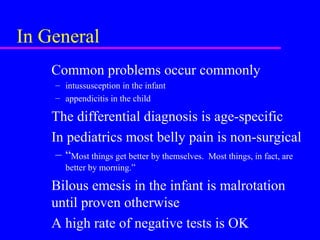
In General
Common problems occur commonly
– intussusception in the infant
– appendicitis in the child
The differential diagnosis is age-specific
In pediatrics most belly pain is non-surgical
– “Most things get better by themselves. Most things, in fact, are
better by morning.”
Bilous emesis in the infant is malrotation
until proven otherwise
A high rate of negative tests is OK
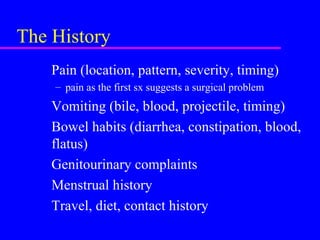
The History
Pain (location, pattern, severity, timing)
– pain as the first sx suggests a surgical problem
Vomiting (bile, blood, projectile, timing)
Bowel habits (diarrhea, constipation, blood,
flatus)
Genitourinary complaints
Menstrual history
Travel, diet, contact history
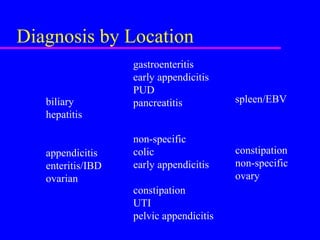
Diagnosis by Location
gastroenteritis
early appendicitis
PUD
pancreatitis
non-specific
colic
early appendicitis
constipation
UTI
pelvic appendicitis
biliary
hepatitis
appendicitis
enteritis/IBD
ovarian
spleen/EBV
constipation
non-specific
ovary
The Physical Examination
Warm hands and exam room
Try to distract the child (talk about pets)
A quiet, unhurried, thorough exam
Plan to do serial exams
Do a rectal exam
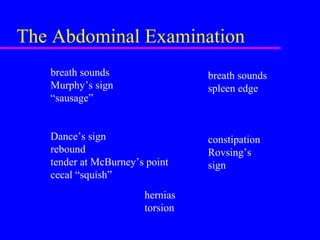
The Abdominal Examination
breath sounds
Murphy’s sign
“sausage”
Dance’s sign
rebound
tender at McBurney’s point
cecal “squish”
hernias
torsion
breath sounds
spleen edge
constipation
Rovsing’s
sign
Relevant Physical Findings
Tachycardia
Alert and active/still and silent
Abdominal rigidity/softness
Bowel sounds
Peritoneal signs (tap, jump)
Signs of other infection (otitis, pharyngitis,
pneumonia)
Check for hernias
Blood in the Stool
Newborn
– ingested maternal blood, formula intolerance, NEC, volvulus,
Hirschsprung’s
Toddler
– anal fissures, infectious colitis, Meckel’s, milk allergy, juvenile
polyps, HUS, IBD
2 to 6 years
– infectious colitis, juvenile polyps, anal fissures, intussusception,
Meckel’s, IBD, HSP
6 years and older
– IBD, colitis, polyps, hemorrhoids
Blood in the Vomitus
Newborn
– ingested maternal blood, drug induced, gastritis
Toddler
– ulcers, gastritis, esophagitis, HPS
2 to 6 years
– ulcers, gastritis, esophagitis, varices, FB
6 years and older
– ulcers, gastritis, esophagitis, varices
Further Work-up
CBC and differential
Urinalysis
X-rays (KUB, CXR)
US
Abdominal CT
Stool cultures
Liver, pancreatic function tests
(Rehydrate, ?antibiotics, ?analgesiscs)
Relevant X-ray Findings
Signs of obstruction
– air/fluid levels
– dilated loops
– air in the rectum?
Fecalith
Paucity of air in the right side
Constipation
Operate NOW
Vascular compromise
– malrotation and volvulus
– incarcerated hernia
– nonreduced intussusception
– ischemic bowel obstruction
– torsed gonads
Perforated viscus
Uncontrolled intra-abdominal bleeding
Operate SOON
Intestinal obstruction
Non-perforated appendicitis
Refractory IBD
Tumors
Appendicitis
Common in children; rare in infants
Symptoms tend to get worse
Perforation rarely occurs in the first 24
hours
The physical exam is the mainstay of
diagnosis
Classify as simple (acute, supparative) or
complex (gangrenous, perforated)
Incidental Appendectomy
Can be done by inversion technique
Absolute indication
– Ladd’s procedure
Relative indications
– Hirschsprung’s pullthrough
– Ovarian cystectomy
– Intussusception
– Atresia repair
– Wilms’ tumor excision
– CDH
Intussusception
Typically in the 8-24 month age group
Diagnosis is historical
– intermittent severe colic episodes
– unexplained lethargy in a previously healthy infant
Contrast enema is diagnostic and often
therapeutic
Post-op small bowel intussusception
The “Medical Bellyache”
Pneumonia
Mesenteric adenitis
Henoch-Schonlein Purpura
Gastroenteritis/colitis
Hepatitis
Swallowed FB
Porphyria
Functional ileus
UTI
Constipation
IBD “flare”
rectus hematoma
Laparoscopy
Diagnosis
– non-specific abdominal pain
– chronic abdominal pain
– female patients
– undescended testes
– trauma
Treatment
– appendicitis
– Meckel’s diverticulum
– cholecystitis
– ovarian detorsion/excision
– lysis of adhesions
The Neurologically Impaired Patient
The physical exam is important for non-
verbal patients
The history is important for the spinal cord
dysfunction patient
Close observation and complementary
imaging studies are necessary
The Immunologically Impaired
Patient
A high index of suspicion for surgical
conditions and signs of peritonitis may
necessitate operation
– perforation
– uncontrolled bleeding
– clinical deterioration
Blood product replacement is essential
Typhlitis should be considered; diagnosis is
best established by CT
The Teenage Female
Menstrual history
– regularity, last period, character, dysmenorrhea
Pelvic/bimanual exam with cultures
Pregnancy test/urinalysis
US
Laparoscopy
Differential diagnosis
– mittelschmerz, PID, ovarian cyst/torsion, endometriosis, ectopic
pregnancy, UTI, pyelonephritis
In Summary
“My dear surgeon, beware- haste not,
Pleads the child silently,
Listen to my mother, and then-
Examine and again examine me:
This will improve my lot
And assure you accuracy.”

Abpain (1)

  • 1.
    ABDOMINAL PAIN inthe PEDIATRIC PATIENT Tim Weiner, M.D. Dept. of Surgery University of North Carolina at Chapel Hill
  • 2.
    In General Common problemsoccur commonly – intussusception in the infant – appendicitis in the child The differential diagnosis is age-specific In pediatrics most belly pain is non-surgical – “Most things get better by themselves. Most things, in fact, are better by morning.” Bilous emesis in the infant is malrotation until proven otherwise A high rate of negative tests is OK
  • 3.
    The History Pain (location,pattern, severity, timing) – pain as the first sx suggests a surgical problem Vomiting (bile, blood, projectile, timing) Bowel habits (diarrhea, constipation, blood, flatus) Genitourinary complaints Menstrual history Travel, diet, contact history
  • 4.
    Diagnosis by Location gastroenteritis earlyappendicitis PUD pancreatitis non-specific colic early appendicitis constipation UTI pelvic appendicitis biliary hepatitis appendicitis enteritis/IBD ovarian spleen/EBV constipation non-specific ovary
  • 5.
    The Physical Examination Warmhands and exam room Try to distract the child (talk about pets) A quiet, unhurried, thorough exam Plan to do serial exams Do a rectal exam
  • 6.
    The Abdominal Examination breathsounds Murphy’s sign “sausage” Dance’s sign rebound tender at McBurney’s point cecal “squish” hernias torsion breath sounds spleen edge constipation Rovsing’s sign
  • 7.
    Relevant Physical Findings Tachycardia Alertand active/still and silent Abdominal rigidity/softness Bowel sounds Peritoneal signs (tap, jump) Signs of other infection (otitis, pharyngitis, pneumonia) Check for hernias
  • 8.
    Blood in theStool Newborn – ingested maternal blood, formula intolerance, NEC, volvulus, Hirschsprung’s Toddler – anal fissures, infectious colitis, Meckel’s, milk allergy, juvenile polyps, HUS, IBD 2 to 6 years – infectious colitis, juvenile polyps, anal fissures, intussusception, Meckel’s, IBD, HSP 6 years and older – IBD, colitis, polyps, hemorrhoids
  • 9.
    Blood in theVomitus Newborn – ingested maternal blood, drug induced, gastritis Toddler – ulcers, gastritis, esophagitis, HPS 2 to 6 years – ulcers, gastritis, esophagitis, varices, FB 6 years and older – ulcers, gastritis, esophagitis, varices
  • 10.
    Further Work-up CBC anddifferential Urinalysis X-rays (KUB, CXR) US Abdominal CT Stool cultures Liver, pancreatic function tests (Rehydrate, ?antibiotics, ?analgesiscs)
  • 11.
    Relevant X-ray Findings Signsof obstruction – air/fluid levels – dilated loops – air in the rectum? Fecalith Paucity of air in the right side Constipation
  • 12.
    Operate NOW Vascular compromise –malrotation and volvulus – incarcerated hernia – nonreduced intussusception – ischemic bowel obstruction – torsed gonads Perforated viscus Uncontrolled intra-abdominal bleeding
  • 13.
    Operate SOON Intestinal obstruction Non-perforatedappendicitis Refractory IBD Tumors
  • 14.
    Appendicitis Common in children;rare in infants Symptoms tend to get worse Perforation rarely occurs in the first 24 hours The physical exam is the mainstay of diagnosis Classify as simple (acute, supparative) or complex (gangrenous, perforated)
  • 15.
    Incidental Appendectomy Can bedone by inversion technique Absolute indication – Ladd’s procedure Relative indications – Hirschsprung’s pullthrough – Ovarian cystectomy – Intussusception – Atresia repair – Wilms’ tumor excision – CDH
  • 16.
    Intussusception Typically in the8-24 month age group Diagnosis is historical – intermittent severe colic episodes – unexplained lethargy in a previously healthy infant Contrast enema is diagnostic and often therapeutic Post-op small bowel intussusception
  • 17.
    The “Medical Bellyache” Pneumonia Mesentericadenitis Henoch-Schonlein Purpura Gastroenteritis/colitis Hepatitis Swallowed FB Porphyria Functional ileus UTI Constipation IBD “flare” rectus hematoma
  • 18.
    Laparoscopy Diagnosis – non-specific abdominalpain – chronic abdominal pain – female patients – undescended testes – trauma Treatment – appendicitis – Meckel’s diverticulum – cholecystitis – ovarian detorsion/excision – lysis of adhesions
  • 19.
    The Neurologically ImpairedPatient The physical exam is important for non- verbal patients The history is important for the spinal cord dysfunction patient Close observation and complementary imaging studies are necessary
  • 20.
    The Immunologically Impaired Patient Ahigh index of suspicion for surgical conditions and signs of peritonitis may necessitate operation – perforation – uncontrolled bleeding – clinical deterioration Blood product replacement is essential Typhlitis should be considered; diagnosis is best established by CT
  • 21.
    The Teenage Female Menstrualhistory – regularity, last period, character, dysmenorrhea Pelvic/bimanual exam with cultures Pregnancy test/urinalysis US Laparoscopy Differential diagnosis – mittelschmerz, PID, ovarian cyst/torsion, endometriosis, ectopic pregnancy, UTI, pyelonephritis
  • 22.
    In Summary “My dearsurgeon, beware- haste not, Pleads the child silently, Listen to my mother, and then- Examine and again examine me: This will improve my lot And assure you accuracy.”