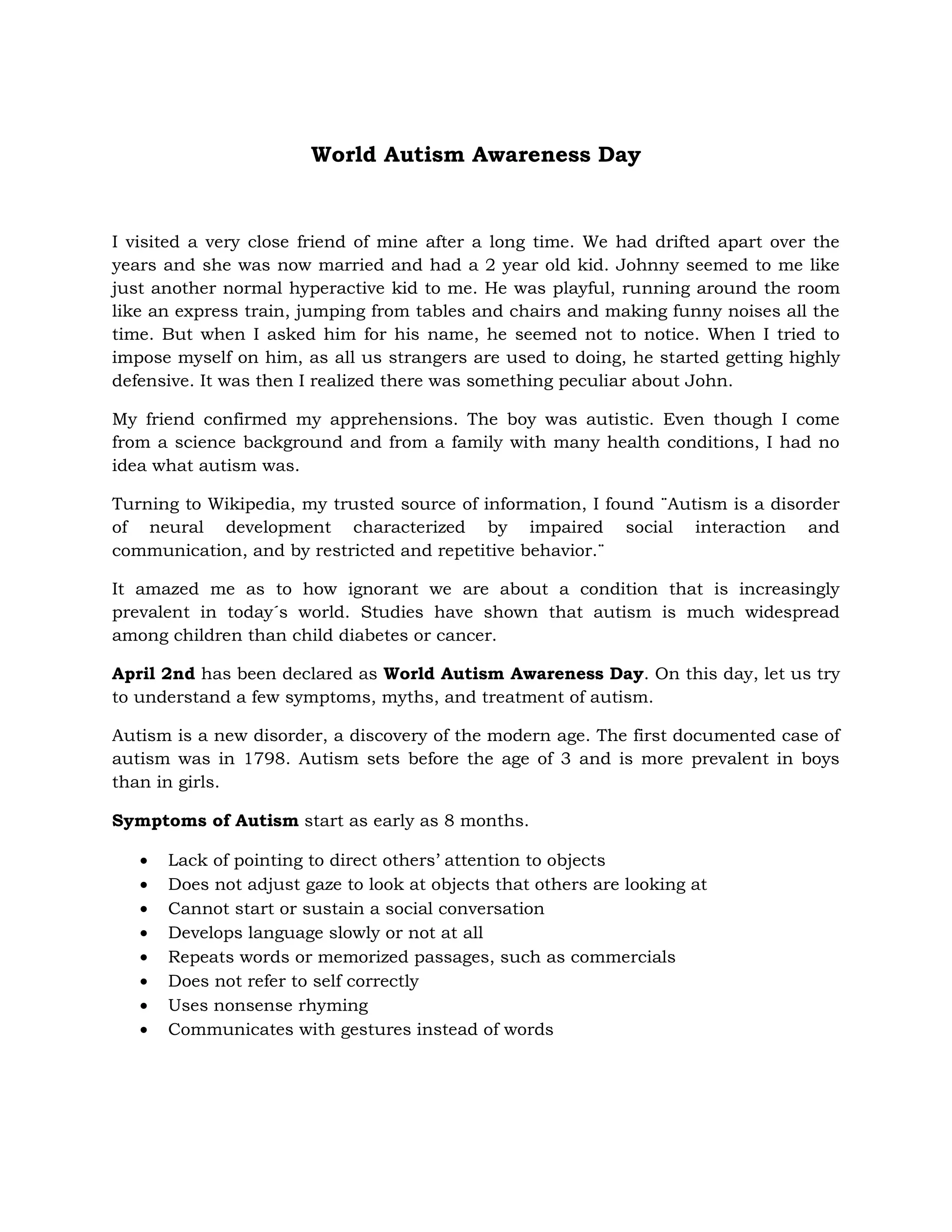
World Autism Awareness Day


I visited a very close friend of mine after a long time. We had drifted apart over the
years and she was now married and had a 2 year old kid. Johnny seemed to me like
just another normal hyperactive kid to me. He was playful, running around the room
like an express train, jumping from tables and chairs and making funny noises all the
time. But when I asked him for his name, he seemed not to notice. When I tried to
impose myself on him, as all us strangers are used to doing, he started getting highly
defensive. It was then I realized there was something peculiar about John.

My friend confirmed my apprehensions. The boy was autistic. Even though I come
from a science background and from a family with many health conditions, I had no
idea what autism was.

Turning to Wikipedia, my trusted source of information, I found ¨Autism is a disorder
of neural development characterized by impaired social interaction and
communication, and by restricted and repetitive behavior.¨

It amazed me as to how ignorant we are about a condition that is increasingly
prevalent in today´s world. Studies have shown that autism is much widespread
among children than child diabetes or cancer.

April 2nd has been declared as World Autism Awareness Day. On this day, let us try
to understand a few symptoms, myths, and treatment of autism.

Autism is a new disorder, a discovery of the modern age. The first documented case of
autism was in 1798. Autism sets before the age of 3 and is more prevalent in boys
than in girls.

Symptoms of Autism start as early as 8 months.

      Lack of pointing to direct others’ attention to objects
      Does not adjust gaze to look at objects that others are looking at
      Cannot start or sustain a social conversation
      Develops language slowly or not at all
      Repeats words or memorized passages, such as commercials
      Does not refer to self correctly
      Uses nonsense rhyming
      Communicates with gestures instead of words
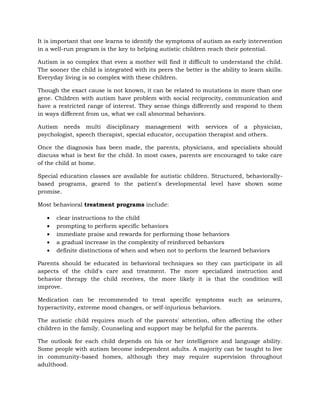
It is important that one learns to identify the symptoms of autism as early intervention
in a well-run program is the key to helping autistic children reach their potential.

Autism is so complex that even a mother will find it difficult to understand the child.
The sooner the child is integrated with its peers the better is the ability to learn skills.
Everyday living is so complex with these children.

Though the exact cause is not known, it can be related to mutations in more than one
gene. Children with autism have problem with social reciprocity, communication and
have a restricted range of interest. They sense things differently and respond to them
in ways different from us, what we call abnormal behaviors.

Autism needs multi disciplinary management with services of a physician,
psychologist, speech therapist, special educator, occupation therapist and others.

Once the diagnosis has been made, the parents, physicians, and specialists should
discuss what is best for the child. In most cases, parents are encouraged to take care
of the child at home.

Special education classes are available for autistic children. Structured, behaviorally-
based programs, geared to the patient's developmental level have shown some
promise.

Most behavioral treatment programs include:

       clear instructions to the child
       prompting to perform specific behaviors
       immediate praise and rewards for performing those behaviors
       a gradual increase in the complexity of reinforced behaviors
       definite distinctions of when and when not to perform the learned behaviors

Parents should be educated in behavioral techniques so they can participate in all
aspects of the child's care and treatment. The more specialized instruction and
behavior therapy the child receives, the more likely it is that the condition will
improve.

Medication can be recommended to treat specific symptoms such as seizures,
hyperactivity, extreme mood changes, or self-injurious behaviors.

The autistic child requires much of the parents' attention, often affecting the other
children in the family. Counseling and support may be helpful for the parents.

The outlook for each child depends on his or her intelligence and language ability.
Some people with autism become independent adults. A majority can be taught to live
in community-based homes, although they may require supervision throughout
adulthood.
Sankalp, the open school and learning
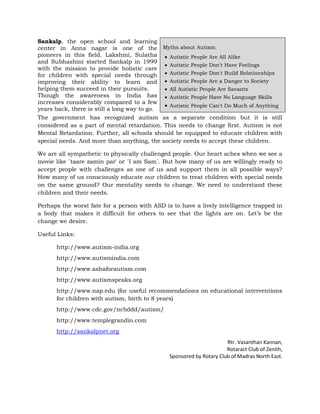
center in Anna nagar is one of the Myths about Autism:
pioneers in this field. Lakshmi, Sulatha      Autistic People Are All Alike
and Subhashini started Sankalp in 1999
                                              Autistic People Don't Have Feelings
with the mission to provide holistic care
for children with special needs through       Autistic People Don't Build Relationships
improving their ability to learn and          Autistic People Are a Danger to Society
helping them succeed in their pursuits.       All Autistic People Are Savants
Though the awareness in India has             Autistic People Have No Language Skills
increases considerably compared to a few
                                              Autistic People Can't Do Much of Anything
years back, there is still a long way to go.
The government has recognized autism as a separate condition but it is still
considered as a part of mental retardation. This needs to change first. Autism is not
Mental Retardation. Further, all schools should be equipped to educate children with
special needs. And more than anything, the society needs to accept these children.

We are all sympathetic to physically challenged people. Our heart aches when we see a
movie like ´taare zamin par' or ´I am Sam´. But how many of us are willingly ready to
accept people with challenges as one of us and support them in all possible ways?
How many of us consciously educate our children to treat children with special needs
on the same ground? Our mentality needs to change. We need to understand these
children and their needs.

Perhaps the worst fate for a person with ASD is to have a lively intelligence trapped in
a body that makes it difficult for others to see that the lights are on. Let’s be the
change we desire.

Useful Links:

      http://www.autism-india.org
      http://www.autismindia.com
      http://www.ashaforautism.com
      http://www.autismspeaks.org
      http://www.nap.edu (for useful recommendations on educational interventions
      for children with autism, birth to 8 years)
      http://www.cdc.gov/ncbddd/autism/
      http://www.templegrandin.com
      http://sankalpnet.org
                                                                      Rtr. Vasanthan Kannan,
                                                                      Rotaract Club of Zenith,
                                               Sponsored by Rotary Club of Madras North East.

About AUTISM

  • 1.
    World Autism AwarenessDay I visited a very close friend of mine after a long time. We had drifted apart over the years and she was now married and had a 2 year old kid. Johnny seemed to me like just another normal hyperactive kid to me. He was playful, running around the room like an express train, jumping from tables and chairs and making funny noises all the time. But when I asked him for his name, he seemed not to notice. When I tried to impose myself on him, as all us strangers are used to doing, he started getting highly defensive. It was then I realized there was something peculiar about John. My friend confirmed my apprehensions. The boy was autistic. Even though I come from a science background and from a family with many health conditions, I had no idea what autism was. Turning to Wikipedia, my trusted source of information, I found ¨Autism is a disorder of neural development characterized by impaired social interaction and communication, and by restricted and repetitive behavior.¨ It amazed me as to how ignorant we are about a condition that is increasingly prevalent in today´s world. Studies have shown that autism is much widespread among children than child diabetes or cancer. April 2nd has been declared as World Autism Awareness Day. On this day, let us try to understand a few symptoms, myths, and treatment of autism. Autism is a new disorder, a discovery of the modern age. The first documented case of autism was in 1798. Autism sets before the age of 3 and is more prevalent in boys than in girls. Symptoms of Autism start as early as 8 months. Lack of pointing to direct others’ attention to objects Does not adjust gaze to look at objects that others are looking at Cannot start or sustain a social conversation Develops language slowly or not at all Repeats words or memorized passages, such as commercials Does not refer to self correctly Uses nonsense rhyming Communicates with gestures instead of words
  • 2.
    It is importantthat one learns to identify the symptoms of autism as early intervention in a well-run program is the key to helping autistic children reach their potential. Autism is so complex that even a mother will find it difficult to understand the child. The sooner the child is integrated with its peers the better is the ability to learn skills. Everyday living is so complex with these children. Though the exact cause is not known, it can be related to mutations in more than one gene. Children with autism have problem with social reciprocity, communication and have a restricted range of interest. They sense things differently and respond to them in ways different from us, what we call abnormal behaviors. Autism needs multi disciplinary management with services of a physician, psychologist, speech therapist, special educator, occupation therapist and others. Once the diagnosis has been made, the parents, physicians, and specialists should discuss what is best for the child. In most cases, parents are encouraged to take care of the child at home. Special education classes are available for autistic children. Structured, behaviorally- based programs, geared to the patient's developmental level have shown some promise. Most behavioral treatment programs include: clear instructions to the child prompting to perform specific behaviors immediate praise and rewards for performing those behaviors a gradual increase in the complexity of reinforced behaviors definite distinctions of when and when not to perform the learned behaviors Parents should be educated in behavioral techniques so they can participate in all aspects of the child's care and treatment. The more specialized instruction and behavior therapy the child receives, the more likely it is that the condition will improve. Medication can be recommended to treat specific symptoms such as seizures, hyperactivity, extreme mood changes, or self-injurious behaviors. The autistic child requires much of the parents' attention, often affecting the other children in the family. Counseling and support may be helpful for the parents. The outlook for each child depends on his or her intelligence and language ability. Some people with autism become independent adults. A majority can be taught to live in community-based homes, although they may require supervision throughout adulthood.
  • 3.
    Sankalp, the openschool and learning center in Anna nagar is one of the Myths about Autism: pioneers in this field. Lakshmi, Sulatha Autistic People Are All Alike and Subhashini started Sankalp in 1999 Autistic People Don't Have Feelings with the mission to provide holistic care for children with special needs through Autistic People Don't Build Relationships improving their ability to learn and Autistic People Are a Danger to Society helping them succeed in their pursuits. All Autistic People Are Savants Though the awareness in India has Autistic People Have No Language Skills increases considerably compared to a few Autistic People Can't Do Much of Anything years back, there is still a long way to go. The government has recognized autism as a separate condition but it is still considered as a part of mental retardation. This needs to change first. Autism is not Mental Retardation. Further, all schools should be equipped to educate children with special needs. And more than anything, the society needs to accept these children. We are all sympathetic to physically challenged people. Our heart aches when we see a movie like ´taare zamin par' or ´I am Sam´. But how many of us are willingly ready to accept people with challenges as one of us and support them in all possible ways? How many of us consciously educate our children to treat children with special needs on the same ground? Our mentality needs to change. We need to understand these children and their needs. Perhaps the worst fate for a person with ASD is to have a lively intelligence trapped in a body that makes it difficult for others to see that the lights are on. Let’s be the change we desire. Useful Links: http://www.autism-india.org http://www.autismindia.com http://www.ashaforautism.com http://www.autismspeaks.org http://www.nap.edu (for useful recommendations on educational interventions for children with autism, birth to 8 years) http://www.cdc.gov/ncbddd/autism/ http://www.templegrandin.com http://sankalpnet.org Rtr. Vasanthan Kannan, Rotaract Club of Zenith, Sponsored by Rotary Club of Madras North East.