ALL ABOUT
NIPT TEST
ALL ABOUT
NIPT TEST
Non-invasive Prenatal Testing (NIPT) is a
screening test for detecting genetic
anomalies in the fetus. The test is non-
invasive and involves taking a blood sample
from the mother. NIPT has revolutionized
prenatal care and has become a popular
choice for expectant mothers. In this
presentation, we will discuss the benefits
and limitations of NIPT.
Non-invasive Prenatal Testing (NIPT) is a
screening test for detecting genetic
anomalies in the fetus. The test is non-
invasive and involves taking a blood sample
from the mother. NIPT has revolutionized
prenatal care and has become a popular
choice for expectant mothers. In this
presentation, we will discuss the benefits
and limitations of NIPT.
INTRODUCTION
INTRODUCTION
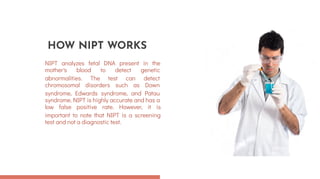
NIPT analyzes fetal DNA present in the
mother's blood to detect genetic
abnormalities. The test can detect
chromosomal disorders such as Down
syndrome, Edwards syndrome, and Patau
syndrome. NIPT is highly accurate and has a
low false positive rate. However, it is
important to note that NIPT is a screening
test and not a diagnostic test.
NIPT analyzes fetal DNA present in the
mother's blood to detect genetic
abnormalities. The test can detect
chromosomal disorders such as Down
syndrome, Edwards syndrome, and Patau
syndrome. NIPT is highly accurate and has a
low false positive rate. However, it is
important to note that NIPT is a screening
test and not a diagnostic test.
HOW NIPT WORKS
HOW NIPT WORKS
WHO SHOULD CONSIDER NIPT?
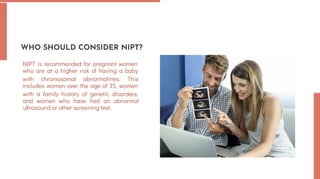
NIPT is recommended for pregnant women
who are at a higher risk of having a baby
with chromosomal abnormalities. This
includes women over the age of 35, women
with a family history of genetic disorders,
and women who have had an abnormal
ultrasound or other screening test.
NIPT is recommended for pregnant women
who are at a higher risk of having a baby
with chromosomal abnormalities. This
includes women over the age of 35, women
with a family history of genetic disorders,
and women who have had an abnormal
ultrasound or other screening test.
ACCURACY OF NIPT
ACCURACY OF NIPT
Studies have shown that NIPT has a
sensitivity of over 99% and a specificity of
over 99% for detecting Down syndrome,
which means that it is highly accurate in
identifying pregnancies affected by Down
syndrome. The accuracy for other
chromosomal abnormalities, such as
Edwards syndrome and Patau syndrome, is
also high.
Studies have shown that NIPT has a
sensitivity of over 99% and a specificity of
over 99% for detecting Down syndrome,
which means that it is highly accurate in
identifying pregnancies affected by Down
syndrome. The accuracy for other
chromosomal abnormalities, such as
Edwards syndrome and Patau syndrome, is
also high.
BENEFITS OF NIPT
BENEFITS OF NIPT
NIPT is a non-invasive test that poses minimal
risk to the mother and fetus. The test is highly
accurate and can detect chromosomal
abnormalities earlier than other screening tests.
This allows expectant parents to prepare
emotionally and financially for the arrival of a
child with special needs.
NIPT is a non-invasive test that poses minimal
risk to the mother and fetus. The test is highly
accurate and can detect chromosomal
abnormalities earlier than other screening tests.
This allows expectant parents to prepare
emotionally and financially for the arrival of a
child with special needs.
NIPT is a screening test and not a diagnostic
test. A positive result does not necessarily
mean that the fetus has a chromosomal
abnormality. In some cases, a diagnostic
test such as amniocentesis or chorionic
villus sampling may be required to confirm
the results. Additionally, NIPT is not a test for
all genetic disorders.
NIPT is a screening test and not a diagnostic
test. A positive result does not necessarily
mean that the fetus has a chromosomal
abnormality. In some cases, a diagnostic
test such as amniocentesis or chorionic
villus sampling may be required to confirm
the results. Additionally, NIPT is not a test for
all genetic disorders.
LIMITATIONS OF NIPT
LIMITATIONS OF NIPT
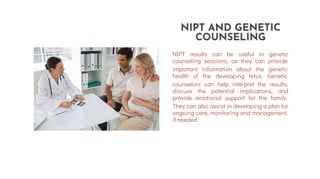
NIPT results can be useful in genetic
counseling sessions, as they can provide
important information about the genetic
health of the developing fetus. Genetic
counselors can help interpret the results,
discuss the potential implications, and
provide emotional support for the family.
They can also assist in developing a plan for
ongoing care, monitoring and management,
if needed.
NIPT results can be useful in genetic
counseling sessions, as they can provide
important information about the genetic
health of the developing fetus. Genetic
counselors can help interpret the results,
discuss the potential implications, and
provide emotional support for the family.
They can also assist in developing a plan for
ongoing care, monitoring and management,
if needed.
NIPT AND GENETIC
COUNSELING
NIPT AND GENETIC
COUNSELING
CONCLUSION
CONCLUSION
NIPT is a valuable tool for detecting chromosomal abnormalities in the
fetus. The test is non-invasive, highly accurate, and poses minimal risk to
the mother and fetus. However, it is important to note that NIPT is a
screening test and not a diagnostic test. A positive result requires further
testing to confirm the results. NIPT has revolutionized prenatal care and
has become a popular choice for expectant mothers.
NIPT is a valuable tool for detecting chromosomal abnormalities in the
fetus. The test is non-invasive, highly accurate, and poses minimal risk to
the mother and fetus. However, it is important to note that NIPT is a
screening test and not a diagnostic test. A positive result requires further
testing to confirm the results. NIPT has revolutionized prenatal care and
has become a popular choice for expectant mothers.
THANK YOU
THANK YOU
https://www.conceptodiagnostics.co.uk/
Concepto Diagnostics

All about NIPT Test

  • 1.
    ALL ABOUT NIPT TEST ALLABOUT NIPT TEST
  • 2.
    Non-invasive Prenatal Testing(NIPT) is a screening test for detecting genetic anomalies in the fetus. The test is non- invasive and involves taking a blood sample from the mother. NIPT has revolutionized prenatal care and has become a popular choice for expectant mothers. In this presentation, we will discuss the benefits and limitations of NIPT. Non-invasive Prenatal Testing (NIPT) is a screening test for detecting genetic anomalies in the fetus. The test is non- invasive and involves taking a blood sample from the mother. NIPT has revolutionized prenatal care and has become a popular choice for expectant mothers. In this presentation, we will discuss the benefits and limitations of NIPT. INTRODUCTION INTRODUCTION
  • 3.
    NIPT analyzes fetalDNA present in the mother's blood to detect genetic abnormalities. The test can detect chromosomal disorders such as Down syndrome, Edwards syndrome, and Patau syndrome. NIPT is highly accurate and has a low false positive rate. However, it is important to note that NIPT is a screening test and not a diagnostic test. NIPT analyzes fetal DNA present in the mother's blood to detect genetic abnormalities. The test can detect chromosomal disorders such as Down syndrome, Edwards syndrome, and Patau syndrome. NIPT is highly accurate and has a low false positive rate. However, it is important to note that NIPT is a screening test and not a diagnostic test. HOW NIPT WORKS HOW NIPT WORKS
  • 4.
    WHO SHOULD CONSIDERNIPT? WHO SHOULD CONSIDER NIPT? NIPT is recommended for pregnant women who are at a higher risk of having a baby with chromosomal abnormalities. This includes women over the age of 35, women with a family history of genetic disorders, and women who have had an abnormal ultrasound or other screening test. NIPT is recommended for pregnant women who are at a higher risk of having a baby with chromosomal abnormalities. This includes women over the age of 35, women with a family history of genetic disorders, and women who have had an abnormal ultrasound or other screening test.
  • 5.
    ACCURACY OF NIPT ACCURACYOF NIPT Studies have shown that NIPT has a sensitivity of over 99% and a specificity of over 99% for detecting Down syndrome, which means that it is highly accurate in identifying pregnancies affected by Down syndrome. The accuracy for other chromosomal abnormalities, such as Edwards syndrome and Patau syndrome, is also high. Studies have shown that NIPT has a sensitivity of over 99% and a specificity of over 99% for detecting Down syndrome, which means that it is highly accurate in identifying pregnancies affected by Down syndrome. The accuracy for other chromosomal abnormalities, such as Edwards syndrome and Patau syndrome, is also high.
  • 6.
    BENEFITS OF NIPT BENEFITSOF NIPT NIPT is a non-invasive test that poses minimal risk to the mother and fetus. The test is highly accurate and can detect chromosomal abnormalities earlier than other screening tests. This allows expectant parents to prepare emotionally and financially for the arrival of a child with special needs. NIPT is a non-invasive test that poses minimal risk to the mother and fetus. The test is highly accurate and can detect chromosomal abnormalities earlier than other screening tests. This allows expectant parents to prepare emotionally and financially for the arrival of a child with special needs.
  • 7.
    NIPT is ascreening test and not a diagnostic test. A positive result does not necessarily mean that the fetus has a chromosomal abnormality. In some cases, a diagnostic test such as amniocentesis or chorionic villus sampling may be required to confirm the results. Additionally, NIPT is not a test for all genetic disorders. NIPT is a screening test and not a diagnostic test. A positive result does not necessarily mean that the fetus has a chromosomal abnormality. In some cases, a diagnostic test such as amniocentesis or chorionic villus sampling may be required to confirm the results. Additionally, NIPT is not a test for all genetic disorders. LIMITATIONS OF NIPT LIMITATIONS OF NIPT
  • 8.
    NIPT results canbe useful in genetic counseling sessions, as they can provide important information about the genetic health of the developing fetus. Genetic counselors can help interpret the results, discuss the potential implications, and provide emotional support for the family. They can also assist in developing a plan for ongoing care, monitoring and management, if needed. NIPT results can be useful in genetic counseling sessions, as they can provide important information about the genetic health of the developing fetus. Genetic counselors can help interpret the results, discuss the potential implications, and provide emotional support for the family. They can also assist in developing a plan for ongoing care, monitoring and management, if needed. NIPT AND GENETIC COUNSELING NIPT AND GENETIC COUNSELING
  • 9.
    CONCLUSION CONCLUSION NIPT is avaluable tool for detecting chromosomal abnormalities in the fetus. The test is non-invasive, highly accurate, and poses minimal risk to the mother and fetus. However, it is important to note that NIPT is a screening test and not a diagnostic test. A positive result requires further testing to confirm the results. NIPT has revolutionized prenatal care and has become a popular choice for expectant mothers. NIPT is a valuable tool for detecting chromosomal abnormalities in the fetus. The test is non-invasive, highly accurate, and poses minimal risk to the mother and fetus. However, it is important to note that NIPT is a screening test and not a diagnostic test. A positive result requires further testing to confirm the results. NIPT has revolutionized prenatal care and has become a popular choice for expectant mothers.
  • 10.