CSF
CEREBRO SPINAL FLUID
FUNCTIONS
FUNCTIONS
• Mechanical : a water-jacket for
brain
and spinal cord.
• If there is an increase in arterial
pressure, blood content, or brain
volume, there is a decrease in the
amount of CSF, and vice versa…..
• Homeostasis : equilibrium with the
extracellular fluid of the brain.
a medium for the transfer of
substances
from within the brain and spinal cord
to the blood stream
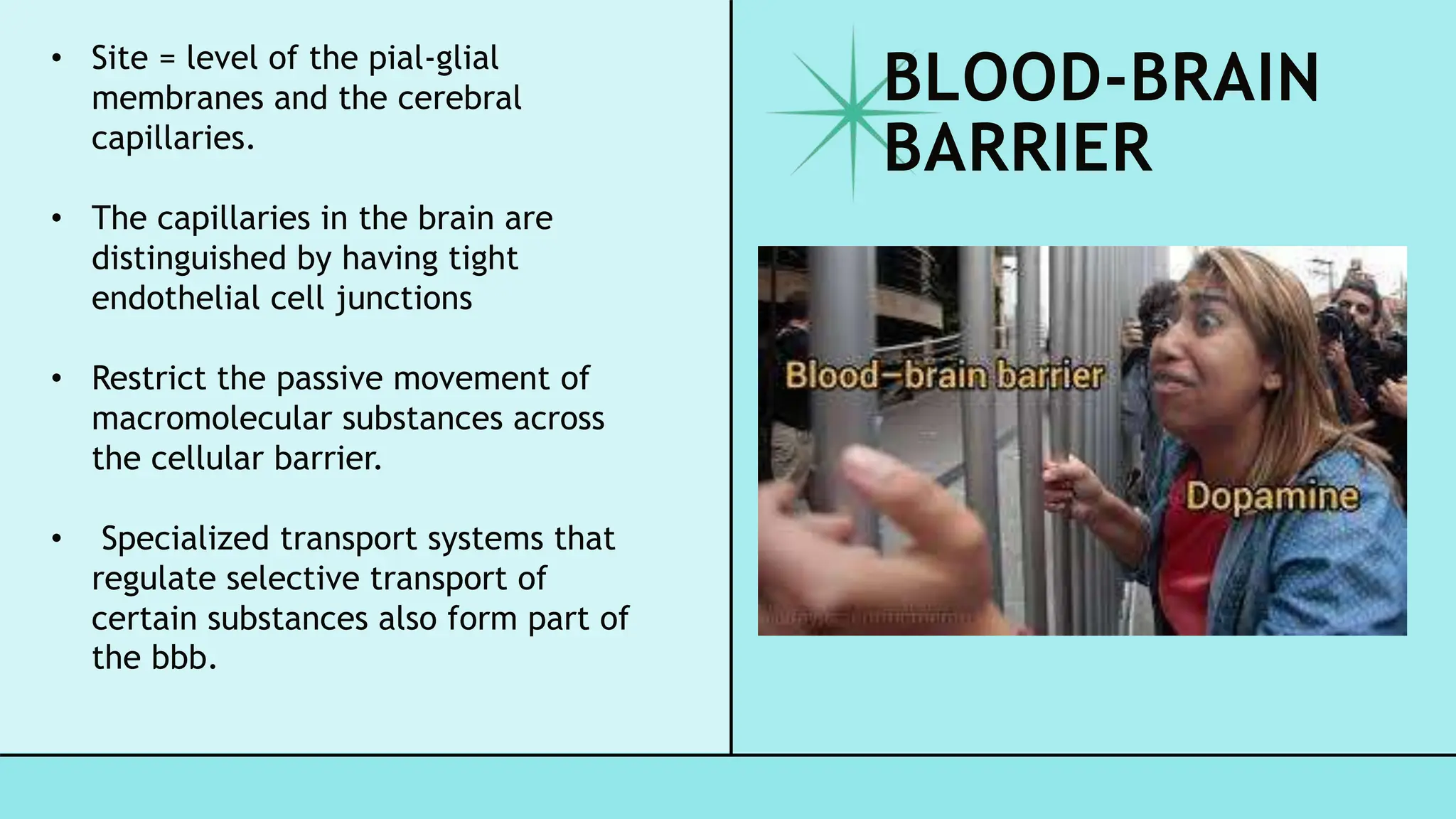
BLOOD-BRAIN
BARRIER
• Site = level of the pial-glial
membranes and the cerebral
capillaries.
• The capillaries in the brain are
distinguished by having tight
endothelial cell junctions
• Restrict the passive movement of
macromolecular substances across
the cellular barrier.
• Specialized transport systems that
regulate selective transport of
certain substances also form part of
the bbb.
BLOOD-BRAIN
BARRIER
• Substances that are highly lipid soluble enter
more easily than those with low lipid solubility.
• Substances highly bound to serum proteins are
unable to penetrate the BBB.
• Some areas of the CNS lack a BBB, : the
chemoreceptor trigger zone , in the floor of
the fourth ventricle, anterior wall of
• the third ventricle, the median eminence of
the hypothalamus, choroid plexus and the
pineal and posterior pituitary glands.
• Many drugs produce
• nausea and vomiting as a prominent side
effect because the lack of a BBB allows
unfettered access directly from the blood
stream to the area chemoreceptor trigger
zone.
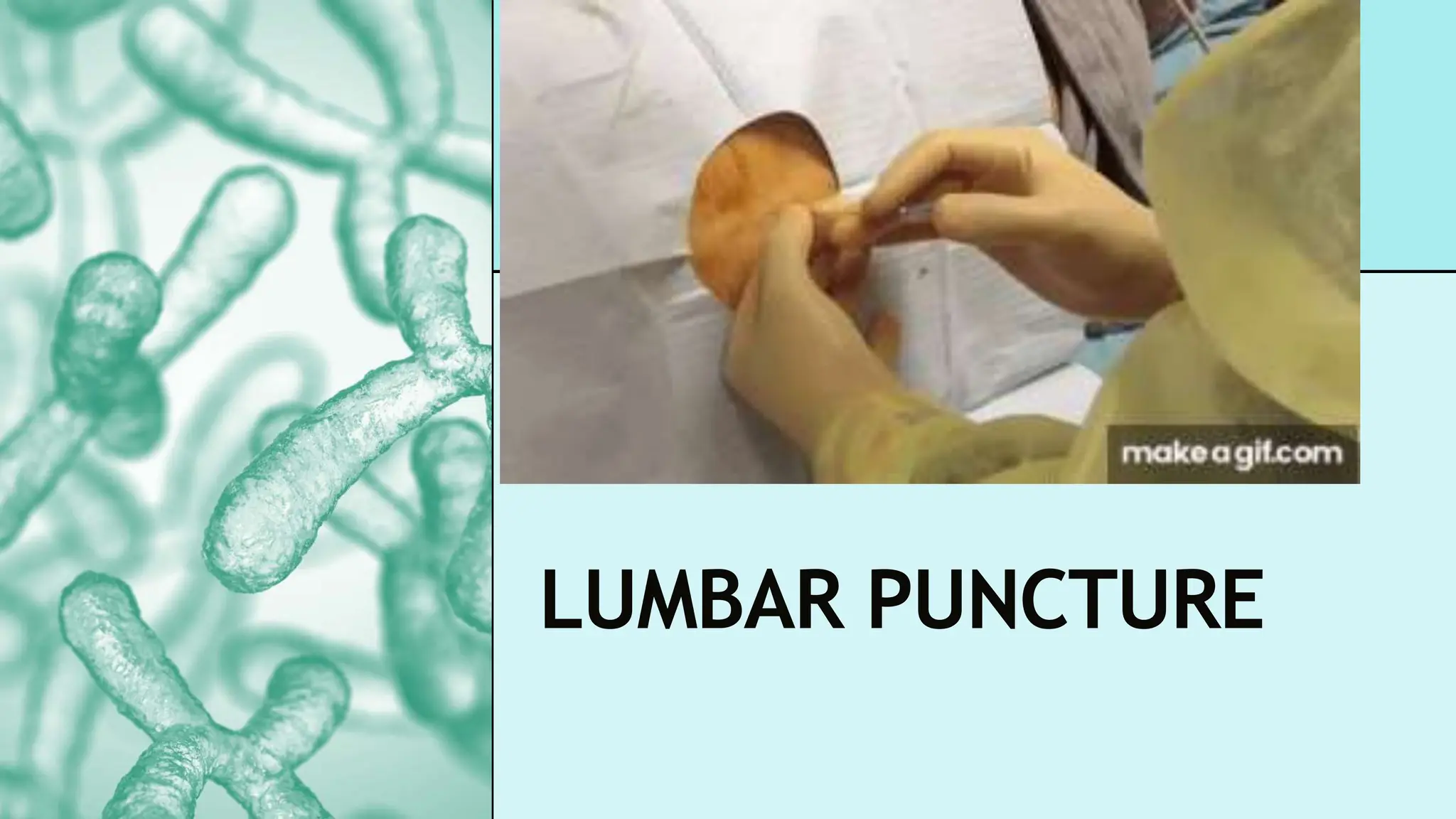
LUMBAR PUNCTURE
LUMBAR
PUNCTURE
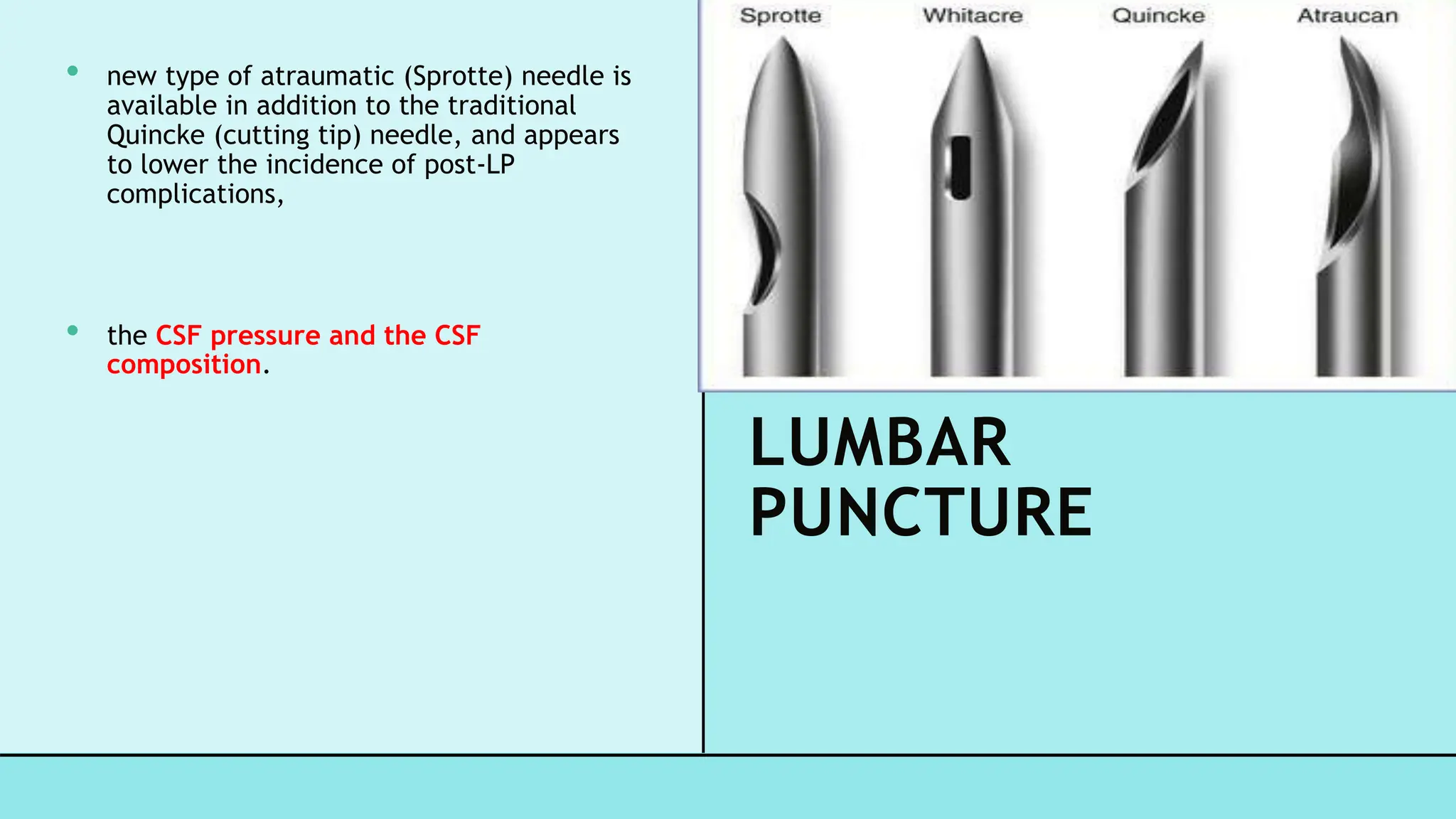
• new type of atraumatic (Sprotte) needle is
available in addition to the traditional
Quincke (cutting tip) needle, and appears
to lower the incidence of post-LP
complications,
• the CSF pressure and the CSF
composition.
OPENING PRESSURE
(OP)
• Normal is up to 180 mm of CSF,
values of 180 to 200 are
borderline
• most reliable indicator of the
intracranial pressure.
• In some circumstances the only
LP abnormality is an elevated OP,
as in pseudotumor cerebri
includes cell
• count, differential, protein, and
glucose.
CSF COMPOSITION
• Includes cell Count, differential,
protein, and glucose.
• It requires about 2 hours for the
blood sugar to equilibrate with
the csf sugar.
• For accurate csf Glucose
determinations, the blood sample
should be drawn 2 hours prior to
LP, or the LP done in a fasting
State.
CONTD…..
Condition Cells Protein Sugar
Acute bacterial
infection
Markedly increased cell
count, with the cells
consisting primarily of
polymorphonuclear
Lymphocytes
An elevated
protein
Decreased sugar. Less
than 10
Mg/dl
Aseptic pattern
(viral infections,
tuberculosis, fungal
infection, partially
Treated bacterial
meningitis etc )
Elevated cell count with
predominantly
Mononuclear cells
Elevated Normal
Guillain-barré
syndrome
(albuminocytologic )
In the absence of an
increased cell count
Extremely
elevated
Protein
-
MS
elevation of IgG in the
spinal fluid
must be compared with
- -
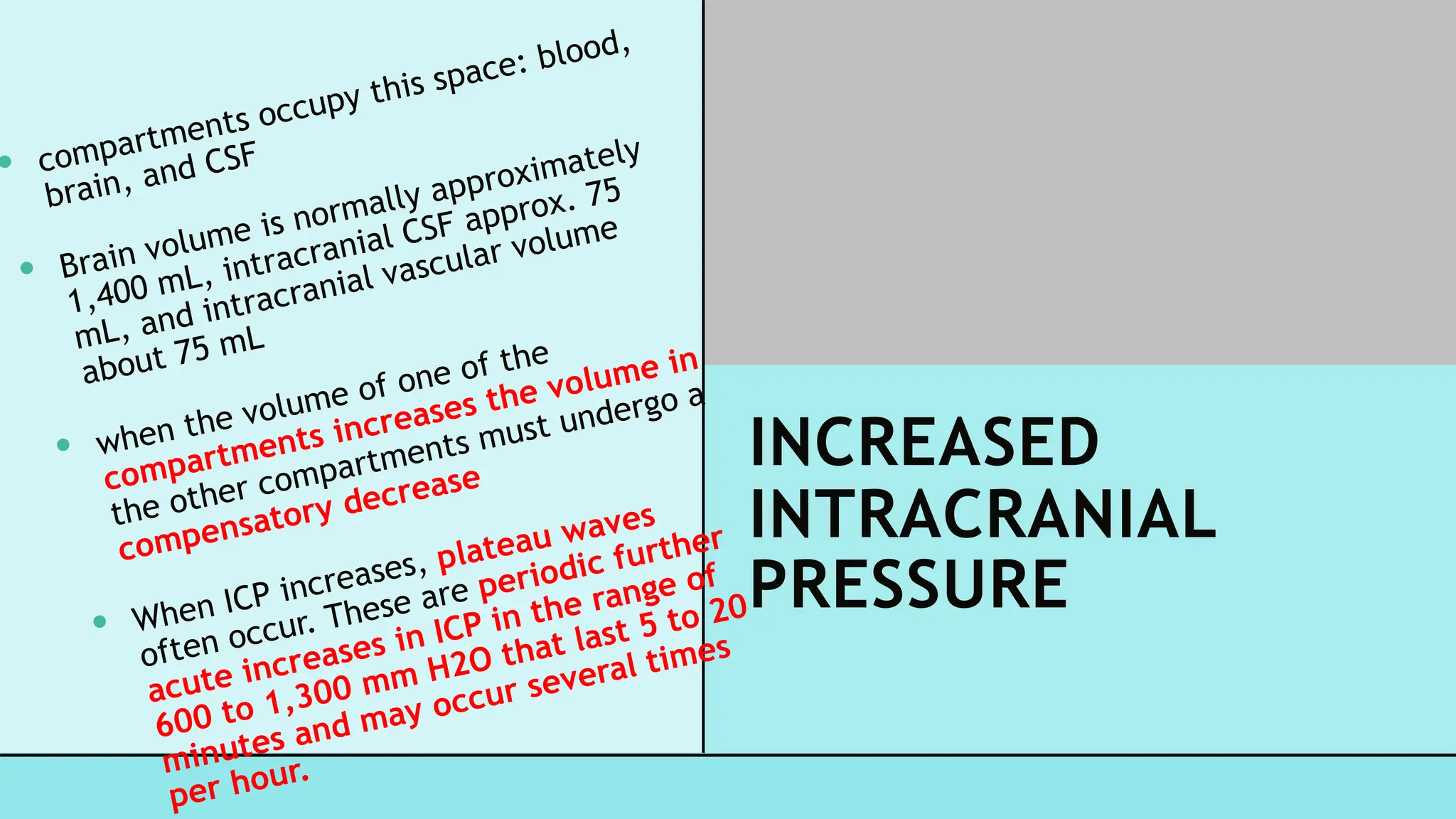
INCREASED
INTRACRANIAL
PRESSURE
INCREASED
INTRACRANIAL
PRESSURE
• ICP increases there are two major
deleterious consequences.
• herniation of brain structures out of their
normal location
• The second is a decrease in cerebral perfusion
pressure (CPP).
• cerebral blood flow can usually be
maintained until the CPP decreases
below 40 to 60 mm Hg; below this
level cerebral perfusion suffers and
leads to secondary ischemic damage
• hydrocephalus , cerebral oedema ,
intracranial space occupying mass
lesions
CLINICAL
MANIFESTATIONS
• Headache : exacerbated by
coughing, straining, or changes in
position , often worse at night
• Pressure on the autonomic centers
in the brainstem nausea, vomiting,
increased blood pressure, changes
in respiration, and bradycardia.
• If the increase in ICP occurs before
the cranial sutures have fused
there may be separation of suture
lines, bulging of the anterior
fontanelle, or head enlargement
• Cushing triad consists of
hypertension, bradycardia, and
slowing of respiration due to
brainstem compromise.
THANK YOU
Dr. Preet Mehta| | pnmehta99@gmail.com

Abnormal CSF Diagnosis and Lumbar puncture

  • 1.
  • 2.
  • 3.
  • 4.
    FUNCTIONS • Mechanical :a water-jacket for brain and spinal cord. • If there is an increase in arterial pressure, blood content, or brain volume, there is a decrease in the amount of CSF, and vice versa….. • Homeostasis : equilibrium with the extracellular fluid of the brain. a medium for the transfer of substances from within the brain and spinal cord to the blood stream
  • 5.
    BLOOD-BRAIN BARRIER • Site =level of the pial-glial membranes and the cerebral capillaries. • The capillaries in the brain are distinguished by having tight endothelial cell junctions • Restrict the passive movement of macromolecular substances across the cellular barrier. • Specialized transport systems that regulate selective transport of certain substances also form part of the bbb.
  • 6.
    BLOOD-BRAIN BARRIER • Substances thatare highly lipid soluble enter more easily than those with low lipid solubility. • Substances highly bound to serum proteins are unable to penetrate the BBB. • Some areas of the CNS lack a BBB, : the chemoreceptor trigger zone , in the floor of the fourth ventricle, anterior wall of • the third ventricle, the median eminence of the hypothalamus, choroid plexus and the pineal and posterior pituitary glands. • Many drugs produce • nausea and vomiting as a prominent side effect because the lack of a BBB allows unfettered access directly from the blood stream to the area chemoreceptor trigger zone.
  • 7.
  • 8.
    LUMBAR PUNCTURE • new typeof atraumatic (Sprotte) needle is available in addition to the traditional Quincke (cutting tip) needle, and appears to lower the incidence of post-LP complications, • the CSF pressure and the CSF composition.
  • 9.
    OPENING PRESSURE (OP) • Normalis up to 180 mm of CSF, values of 180 to 200 are borderline • most reliable indicator of the intracranial pressure. • In some circumstances the only LP abnormality is an elevated OP, as in pseudotumor cerebri includes cell • count, differential, protein, and glucose.
  • 10.
    CSF COMPOSITION • Includescell Count, differential, protein, and glucose. • It requires about 2 hours for the blood sugar to equilibrate with the csf sugar. • For accurate csf Glucose determinations, the blood sample should be drawn 2 hours prior to LP, or the LP done in a fasting State.
  • 11.
  • 12.
    Condition Cells ProteinSugar Acute bacterial infection Markedly increased cell count, with the cells consisting primarily of polymorphonuclear Lymphocytes An elevated protein Decreased sugar. Less than 10 Mg/dl Aseptic pattern (viral infections, tuberculosis, fungal infection, partially Treated bacterial meningitis etc ) Elevated cell count with predominantly Mononuclear cells Elevated Normal Guillain-barré syndrome (albuminocytologic ) In the absence of an increased cell count Extremely elevated Protein - MS elevation of IgG in the spinal fluid must be compared with - -
  • 13.
  • 14.
    INCREASED INTRACRANIAL PRESSURE • ICP increasesthere are two major deleterious consequences. • herniation of brain structures out of their normal location • The second is a decrease in cerebral perfusion pressure (CPP). • cerebral blood flow can usually be maintained until the CPP decreases below 40 to 60 mm Hg; below this level cerebral perfusion suffers and leads to secondary ischemic damage • hydrocephalus , cerebral oedema , intracranial space occupying mass lesions
  • 15.
    CLINICAL MANIFESTATIONS • Headache :exacerbated by coughing, straining, or changes in position , often worse at night • Pressure on the autonomic centers in the brainstem nausea, vomiting, increased blood pressure, changes in respiration, and bradycardia. • If the increase in ICP occurs before the cranial sutures have fused there may be separation of suture lines, bulging of the anterior fontanelle, or head enlargement • Cushing triad consists of hypertension, bradycardia, and slowing of respiration due to brainstem compromise.
  • 16.
    THANK YOU Dr. PreetMehta| | pnmehta99@gmail.com