Dr. Sanjay Pandian
Abnormal Breathing and O2
Therapy
22-08-2022
1
Normal vs Abnormal Breathing
 A normal breath sound is similar to the sound of air
 Abnormal breath sounds may include:
 rhonchi (a low-pitched breath sound)
 crackles (a high-pitched breath sound)
22-08-2022
2
Parameters of Assessing
 Rate
 Depth
 Rhythm
 Character
22-08-2022
3
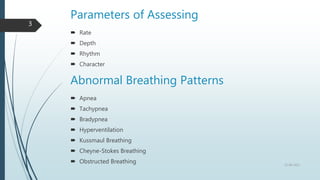
Abnormal Breathing Patterns
 Apnea
 Tachypnea
 Bradypnea
 Hyperventilation
 Kussmaul Breathing
 Cheyne-Stokes Breathing
 Obstructed Breathing
22-08-2022
4
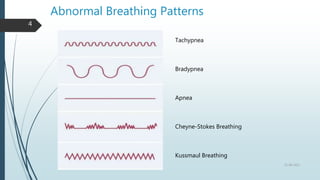
Tachypnea
Bradypnea
Apnea
Cheyne-Stokes Breathing
Kussmaul Breathing
Abnormal Breathing Patterns
Treatment Options
 Behaviour Modification
 Surgery
 Medications
 Oral Devices
 Oxygen Therapy
22-08-2022
5
Oxygen Therapy
 Definition - Administration of oxygen at a concentration of pressure greater than
that found in the atmosphere
 Purpose - To increase oxygen saturation in tissues
 Used in the treatment of hypoxemia, severe respiratory distress, severe trauma,
chronic obstructive pulmonary disease, pulmonary hypertension, acute myocardial
infarction
22-08-2022
6
Classification of Oxygen delivery Systems
 Low-flow systems
 provide oxygen at flow rates that are lower than patients' inspiratory demands
 E.g., nasal cannula, simple mask, non-rebreather mask, partial rebreather mask
 High-flow systems
 Deliver specific and constant percent of oxygen independent of patient’s
breathing
 E.g., venturi mask, trach collar, T-piece
22-08-2022
7
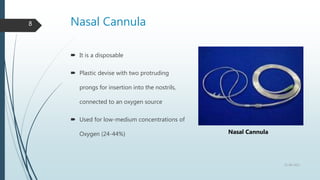
Nasal Cannula
8
 It is a disposable
 Plastic devise with two protruding
prongs for insertion into the nostrils,
connected to an oxygen source
 Used for low-medium concentrations of
Oxygen (24-44%)
22-08-2022
Nasal Cannula
Simple Oxygen Mask
9
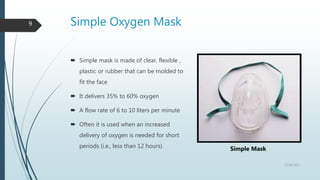
 Simple mask is made of clear, flexible ,
plastic or rubber that can be molded to
fit the face
 It delivers 35% to 60% oxygen
 A flow rate of 6 to 10 liters per minute
 Often it is used when an increased
delivery of oxygen is needed for short
periods (i.e., less than 12 hours)
22-08-2022
Simple Mask
Non-rebreather Mask
10
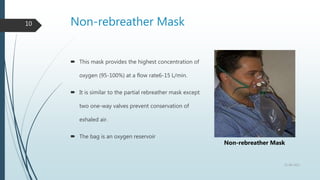
 This mask provides the highest concentration of
oxygen (95-100%) at a flow rate6-15 L/min.
 It is similar to the partial rebreather mask except
two one-way valves prevent conservation of
exhaled air.
 The bag is an oxygen reservoir
22-08-2022
Non-rebreather Mask
Partial Rebreather Mask
11
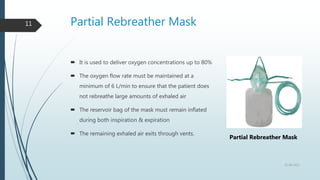
 It is used to deliver oxygen concentrations up to 80%
 The oxygen flow rate must be maintained at a
minimum of 6 L/min to ensure that the patient does
not rebreathe large amounts of exhaled air
 The reservoir bag of the mask must remain inflated
during both inspiration & expiration
 The remaining exhaled air exits through vents.
22-08-2022
Partial Rebreather Mask
Venturi Mask
12
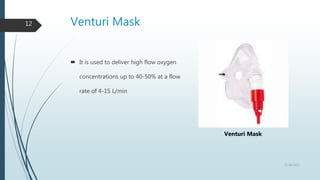
 It is used to deliver high flow oxygen
concentrations up to 40-50% at a flow
rate of 4-15 L/min
22-08-2022
Venturi Mask
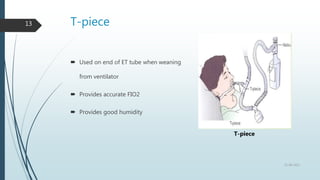
T-piece
13
 Used on end of ET tube when weaning
from ventilator
 Provides accurate FIO2
 Provides good humidity
22-08-2022
T-piece
22-08-2022
14 Equipment Flow FIO2 Special Notes
Nasal Cannula 1/2 - 6 L/M .24 – 44 6 L/M Maximum
Simple O2 Mask
(Without Bag)
6 - 10 L/M .35 – 55 Use 5 L/M Minimum
Reservoir Mask
(With Bag)
10 -15 L/M .60 -80 Bag to not
Collapse
Venturi Mask 3 L/M
6 L/M
.24, 26, 31,
.35, .40, .50
Read enclosed
instructions
Nebulizer 8 L/M OR > .28, .30, .35
.40, .50, 70
Mist must be visible
Shows that FIO2 varies with different F, VT, inspiratory flow rates.
14
Side Effects and Complications of Oxygen
Therapy
 Oxygen toxicity
 It is a condition in which ventilator failure occurs due to inspiration of a high
concentration of oxygen for a prolonged period of time.
 Oxygen concentration greater than 50% for over 24 to 48 hours can cause
pathological changes in the lungs.
 Retrolental fibroplasia
 Absorption atelectasis
22-08-2022
15
Thank You
22-08-2022
16

Abnormal Breathing

  • 1.
    Dr. Sanjay Pandian AbnormalBreathing and O2 Therapy 22-08-2022 1
  • 2.
    Normal vs AbnormalBreathing  A normal breath sound is similar to the sound of air  Abnormal breath sounds may include:  rhonchi (a low-pitched breath sound)  crackles (a high-pitched breath sound) 22-08-2022 2
  • 3.
    Parameters of Assessing Rate  Depth  Rhythm  Character 22-08-2022 3 Abnormal Breathing Patterns  Apnea  Tachypnea  Bradypnea  Hyperventilation  Kussmaul Breathing  Cheyne-Stokes Breathing  Obstructed Breathing
  • 4.
  • 5.
    Treatment Options  BehaviourModification  Surgery  Medications  Oral Devices  Oxygen Therapy 22-08-2022 5
  • 6.
    Oxygen Therapy  Definition- Administration of oxygen at a concentration of pressure greater than that found in the atmosphere  Purpose - To increase oxygen saturation in tissues  Used in the treatment of hypoxemia, severe respiratory distress, severe trauma, chronic obstructive pulmonary disease, pulmonary hypertension, acute myocardial infarction 22-08-2022 6
  • 7.
    Classification of Oxygendelivery Systems  Low-flow systems  provide oxygen at flow rates that are lower than patients' inspiratory demands  E.g., nasal cannula, simple mask, non-rebreather mask, partial rebreather mask  High-flow systems  Deliver specific and constant percent of oxygen independent of patient’s breathing  E.g., venturi mask, trach collar, T-piece 22-08-2022 7
  • 8.
    Nasal Cannula 8  Itis a disposable  Plastic devise with two protruding prongs for insertion into the nostrils, connected to an oxygen source  Used for low-medium concentrations of Oxygen (24-44%) 22-08-2022 Nasal Cannula
  • 9.
    Simple Oxygen Mask 9 Simple mask is made of clear, flexible , plastic or rubber that can be molded to fit the face  It delivers 35% to 60% oxygen  A flow rate of 6 to 10 liters per minute  Often it is used when an increased delivery of oxygen is needed for short periods (i.e., less than 12 hours) 22-08-2022 Simple Mask
  • 10.
    Non-rebreather Mask 10  Thismask provides the highest concentration of oxygen (95-100%) at a flow rate6-15 L/min.  It is similar to the partial rebreather mask except two one-way valves prevent conservation of exhaled air.  The bag is an oxygen reservoir 22-08-2022 Non-rebreather Mask
  • 11.
    Partial Rebreather Mask 11 It is used to deliver oxygen concentrations up to 80%  The oxygen flow rate must be maintained at a minimum of 6 L/min to ensure that the patient does not rebreathe large amounts of exhaled air  The reservoir bag of the mask must remain inflated during both inspiration & expiration  The remaining exhaled air exits through vents. 22-08-2022 Partial Rebreather Mask
  • 12.
    Venturi Mask 12  Itis used to deliver high flow oxygen concentrations up to 40-50% at a flow rate of 4-15 L/min 22-08-2022 Venturi Mask
  • 13.
    T-piece 13  Used onend of ET tube when weaning from ventilator  Provides accurate FIO2  Provides good humidity 22-08-2022 T-piece
  • 14.
    22-08-2022 14 Equipment FlowFIO2 Special Notes Nasal Cannula 1/2 - 6 L/M .24 – 44 6 L/M Maximum Simple O2 Mask (Without Bag) 6 - 10 L/M .35 – 55 Use 5 L/M Minimum Reservoir Mask (With Bag) 10 -15 L/M .60 -80 Bag to not Collapse Venturi Mask 3 L/M 6 L/M .24, 26, 31, .35, .40, .50 Read enclosed instructions Nebulizer 8 L/M OR > .28, .30, .35 .40, .50, 70 Mist must be visible Shows that FIO2 varies with different F, VT, inspiratory flow rates. 14
  • 15.
    Side Effects andComplications of Oxygen Therapy  Oxygen toxicity  It is a condition in which ventilator failure occurs due to inspiration of a high concentration of oxygen for a prolonged period of time.  Oxygen concentration greater than 50% for over 24 to 48 hours can cause pathological changes in the lungs.  Retrolental fibroplasia  Absorption atelectasis 22-08-2022 15
  • 16.